
Introduction
Whether you manage a large commercial facility, work in industrial cleaning, or are simply trying to make sense of what is available before committing to a purchase, the landscape of cleaning machines is broader and more varied than most people expect.
This guide covers the full range — from everyday floor-cleaning equipment through to specialist systems used in precision industrial applications — so you can understand what each category is, what it is suited to, and where it sits relative to the alternatives.
TL;DR
Choosing the right category of cleaning machine matters more than most buyers initially realise — the wrong type for a task does not just underperform, it can be entirely unsuited to the job. Each machine type works through a distinct mechanism, and understanding those differences is what makes a confident, well-matched decision possible.
This article covers:

Major cleaning machine categories explained
Floor sweepers, scrubbers, vacuums, pressure washers
Steam cleaners and carpet cleaning machines
Laser cleaning and specialist industrial systems
How to choose the right machine type
What are types of cleaning machines?
Cleaning machines are powered equipment designed to remove contamination, debris, or soiling from surfaces — distinct from manual tools such as mops, brushes, and cloths, and from chemical agents used alone. The distinction matters because powered machines introduce mechanical force, heat, pressure, suction, or energy that fundamentally changes what is achievable and at what scale.
Choosing the wrong machine type for a task is a more common and more costly mistake than most buyers initially appreciate. A floor sweeper will not remove grease from a production floor. A pressure washer will not clean embedded carpet soil. A general-purpose vacuum will not safely handle hazardous industrial dust. These are not edge cases — they are routine mismatches, and understanding why they happen is the starting point for choosing well.
As Nilfisk's contamination control guidance makes clear, the goal is to match the cleaning machine to the zone, the process, and the type of contamination being removed — rather than relying on a single machine to solve every problem across a facility.
Cleaning machines also exist across a broad domestic–commercial–industrial spectrum of scale, power, capacity, and durability. The same category can span all three levels with meaningfully different specifications and duty cycles. A domestic vacuum cleaner and an industrial vacuum are not interchangeable: the latter may incorporate HEPA filtration, sealed construction, and continuous-duty motors that a home appliance cannot approach. Selecting the right machine is therefore not just a question of category, but also of grade and scale.
Four primary axes run through every selection decision, and the guide uses them throughout to differentiate categories and guide practical choices.
- Surface type: What the machine cleans on — floors, fabric, metal, stone, masonry, precision components. Different surfaces tolerate different forces, moisture levels, heat, and chemical exposure.
- Contamination type: What is being removed — dry debris, grease, rust, biological soiling, paint, coatings. The nature of the contamination is often the single most decisive factor in machine selection.
- Scale of operation: How much area needs cleaning, how frequently, and whether the operation is batch or continuous. Scale drives the choice between walk-behind and ride-on, compact and industrial.
- Environment: Where cleaning takes place — indoor or outdoor, food contact or healthcare, constrained chemical use, noise limits, emissions, and applicable safety requirements.
Tennant's selection guidance reinforces this logic directly: understanding the type of floor surface, the soils to be removed, the size of the space, and the cleaning frequency are the foundational inputs before any machine category is even considered.
Together, what is being removed and what it is being removed from narrow the field of viable machine categories faster than any other combination of factors. Scale and environment then determine which grade and configuration within that category is the right fit.
The guide works through eight major categories in turn: floor sweepers for large-area dry debris removal; floor scrubbers for hard-surface wet cleaning and grease removal; vacuum cleaners across domestic, commercial, and industrial grades; pressure washers for high-force outdoor and industrial surface cleaning; steam cleaners for chemical-free heat-based sanitisation; carpet cleaning machines for embedded soil extraction from soft flooring; laser cleaning machines for precision removal of coatings, rust, and contamination from solid substrates; and specialist systems including ultrasonic cleaners and dry ice blasting.
With that framework in place, the guide begins with floor sweepers — the workhorse of large-area dry debris removal and one of the most widely deployed machine types across commercial and industrial facilities.
Floor sweepers
Before a floor can be scrubbed, mopped, or polished, the loose debris sitting on top of it needs to go somewhere. That is the job the floor sweeper was built for: fast, efficient dry debris removal across large surface areas, using rotating brushes rather than water or suction.
At its core, a floor sweeper works by driving a rotating cylindrical brush across the floor surface, lifting debris and directing it into a built-in hopper or collection bin. Nilfisk describes this as using rotating brushes to sweep debris into a built-in hopper or collection bin, with many models also including a vacuum or filter system to control fine dust.
That filter system marks the key distinction between a basic mechanical sweeper and a vacuum-assisted sweeper. In a vacuum-assisted model, a suction turbine works alongside the brush to capture fine particles that the brush alone would otherwise scatter back into the air, improving air quality in the working environment.
Walk-behind vs ride-on sweepers
The primary sub-type division in the sweeper category is between walk-behind and ride-on models, and the deciding factor is almost always the size of the area to be cleaned.
According to Tennant, walk-behind sweepers are better suited for smaller environments and tight spaces where manoeuvrability is key, with any space under 4,000 square feet considered ideal, whereas ride-on models are more practical for large spaces.
Ride-on sweepers carry the operator and are designed to cover ground quickly. Tennant notes that they tend to have more powerful motors and brush systems, allowing them to cover more area in less time.
Within the walk-behind sub-type, there is a further practical distinction worth understanding: push sweepers versus powered walk-behinds. Push sweepers are manually propelled by the operator — lighter, simpler, and suited to shorter sessions or smaller tasks. Powered walk-behinds use battery or engine drive, reducing physical effort and making them the better choice for longer periods of operation, as Kärcher notes, due to their larger waste containers and traction drive.
Kärcher identifies approximately 600 square metres as the threshold above which a powered walk-behind becomes a faster and more efficient option than a manual push sweeper.
How sweepers collect debris: two principles
There is a less commonly explained technical distinction within sweeper design that affects both cleaning performance and hopper efficiency: whether the machine uses a direct-throw or an overthrow collection principle.
In the direct-throw method, the roller brush turns in the opposite direction to travel, moving debris forward into a front-mounted hopper. Kärcher describes this approach as producing lower dust generation due to lower brush speeds and a shorter sweep path, with less brush wear, and notes it is ideal for fine dust as well as expansive and heavy dirt.
The overthrow method works differently: the brush rotates at higher speeds, flinging debris rearward into a trailing container. Kärcher notes that this allows the container to reach up to 100% of its fill capacity and that the method is particularly well suited to coarse and light dirt.
In practical terms, the direct-throw principle is the one used in push sweepers and industrial vacuum sweepers, while the overthrow principle is more common in powered walk-behind and ride-on models.
Brush types and power sources
Selecting the right roller brush matters as much as selecting the right machine. Kärcher identifies several brush variants suited to different surfaces and debris types.
- Hard brushes: Harder bristles for rough surfaces and heavier waste; also suitable for damp conditions, per Kärcher.
- Soft brushes: Soft bristles for smooth indoor floors and fine dust; stir up less dust during operation.
- Antistatic brushes: Antistatic rollers suited to carpet sweeping, for example at indoor tennis courts, per Kärcher.
The power source shapes where and how a sweeper can be used, and the emissions consideration is particularly important for indoor environments.
- Electric (mains-corded): Consistent power output, but mobility is limited by cable reach and proximity to power outlets.
- Battery-powered: Quiet, no emissions, and fully mobile — well suited to indoor use across a wide range of facilities.
- Gas-powered: Powerful performance with long operating times, but because of emissions and noise, not best for indoor applications, per Tennant.
Tennant makes this point directly: gas-powered sweepers, because of their emissions and noise, are usually not best for indoor applications. For indoor facilities, battery power is generally the appropriate choice.
What sweepers do well — and what they do not
Sweepers excel at fast, high-volume dry debris removal across large floor areas. Nilfisk describes them as focused on fast, high-volume debris pickup across large areas where loose materials accumulate — making them ideal for warehouses, industrial facilities, retail stores, and outdoor walkways.
Typical applications include warehouses, logistics and distribution centres, factories, loading docks, parking areas, outdoor paths, food and drink production facilities, and sports and leisure venues. Kärcher and Tennant both identify these as core sweeper environments.
What a sweeper does not do is equally important to understand. As Nilfisk states clearly: a sweeper is designed to collect dry dust, dirt, and debris — but it does not wash or scrub the floor. A swept floor is dry and debris-free; it is not clean in the wet-scrubbing sense.
Sweepers also differ meaningfully from vacuum cleaners in their niche. Nilfisk positions sweepers as suited to fast, large-area debris pickup, while commercial vacuums deliver the suction and filtration required for fine dust control, allergen capture, and detailed cleaning — particularly in environments such as healthcare facilities, offices, and schools.
A sweeper removes dry debris efficiently, but it does not clean in the wet-scrubbing sense. Facilities with hard floors typically need both machines used in sequence: the sweeper clears loose material first, then the scrubber handles the surface itself. As Kärcher, Nilfisk, and Tennant all confirm, sweeping first protects the scrubber and improves the final cleaning result.
Once the sweeper has done its work — floor clear of loose debris, surface dry — the next step is wet cleaning, which is where floor scrubbers take over.
Floor Scrubbers
A floor scrubber does something no mop can: it cleans and dries the floor in a single pass, leaving the surface ready to walk on immediately.
The cleaning cycle works in three stages. Cleaning solution flows from the solution tank onto the floor; rotating brushes or pads then agitate the surface to loosen embedded soil; and a trailing squeegee wipes the dirty water into a recovery tank via vacuum suction — all as the machine moves forward in one continuous pass.
That single-pass outcome matters in practice: where a mopped floor stays wet for several minutes and poses a slip hazard, a scrubbed floor is dry the moment the machine has passed. There is no wet-floor downtime, no need to cordon off sections, and no second drying step.
Scrubbers also address two other limitations of mopping at commercial scale: dosing consistency and cross-contamination. The machine dispenses a measured volume of solution automatically, removing reliance on operator judgement; and because dirty water is collected into the recovery tank rather than re-spread across the floor, the risk of distributing contamination from one area to another is substantially reduced.
Where a sweeper handles dry debris removal as the first stage of a two-stage process, the floor scrubber takes over for the wet-cleaning stage — and the most consequential technical decision within the category is which brush head to fit.
Disc vs cylindrical brush heads
Disc brush heads sit flat against the floor and rotate at speeds of 250–300 RPM, according to Tennant's disc vs cylindrical brushes guide. They are well suited to smooth, finished hard floors — Vinyl Composition Tile (VCT), sheet vinyl, and polished concrete — where consistent down pressure and the ability to accommodate pad drivers for wax maintenance are valued.
Their key limitation is that disc heads have no mechanism for picking up loose debris: the floor must be swept before scrubbing, otherwise debris can scratch the surface or clog the squeegee.
Cylindrical brush heads use a pair of counter-rotating rollers running at 600–800 RPM. The motion throws loose particles into a debris tray, which means the machine can sweep and scrub simultaneously — no pre-sweeping required. Kärcher's mechanical cleaning guidance notes that roller brush technology reaches into floor joints and grout lines to loosen embedded dirt, which is then vacuumed away.
Cylindrical heads are the preferred choice for textured, structured, or heavily soiled floors — natural stone, rubber studded safety floors, floors with grout lines, and environments such as food production facilities, warehouses, and parking areas where debris is present and pre-sweeping is impractical.
| Disc brush head | Cylindrical brush head | |
|---|---|---|
| Brush speed | 250–300 RPM | 600–800 RPM |
| Pre-sweep required | Yes | No — sweeps and scrubs simultaneously |
| Best floor types | VCT, sheet vinyl, polished concrete | Natural stone, rubber studded, safety floors, grout lines |
| Ideal environments | Schools, retail, healthcare — finished floors | Warehouses, food production, parking areas |
| Pad driver compatible | Yes — for wax maintenance and polishing | – |
Disc vs cylindrical brush heads compared by speed, pre-sweep requirement, floor type suitability, and pad compatibility. RPM figures sourced from Tennant's disc vs cylindrical brushes guide. – not applicable to this head type.
The practical consequence of choosing the wrong head is either inadequate cleaning or floor damage. A disc head used without pre-sweeping on a debris-laden floor risks scratching the surface; a cylindrical head on a highly polished floor may be more aggressive than the surface requires. Matching head type to floor type and soil type is the first decision a buyer should make — and for facilities with both smooth finished floors and textured or debris-prone areas, a machine range that covers both head types gives the most flexibility.
Walk-behind, ride-on, and robotic scrubbers
Walk-behind scrubbers are guided by an operator on foot and are the right tool for small to medium spaces where manoeuvrability matters — hospitals, schools, hotels, retail aisles, and corridors. Compact models with narrow cleaning paths are built specifically to navigate tight spaces and frequent directional changes.
Ride-on scrubbers seat the operator and are designed for large open facilities: warehouses, airports, distribution centres, and manufacturing plants. The practical advantage over walk-behind operation in these environments is reduced operator fatigue across long shifts, which supports consistent cleaning performance where a walk-behind operator would tire and slow.
Robotic scrubbers navigate autonomously using sensors, LiDAR, and AI-driven mapping to clean pre-programmed routes without an operator present. Tennant's robotic scrubbers page describes the category as delivering consistent, repeatable cleaning performance in commercial and industrial environments — the same standard on every run, regardless of shift or staffing levels.
The value of that autonomy extends beyond the cleaning itself: staff freed from repetitive floor scrubbing can be redirected to higher-value tasks such as detail cleaning, high-touch area sanitation, and customer-facing work. According to a Facility Executive article by John Ickes, the cleaning robotics market grew 23.9% year-over-year between 2024 and 2025 — rising from $14.11 billion to $17.47 billion — reflecting a clear shift from niche pilots to mainstream facility operations.
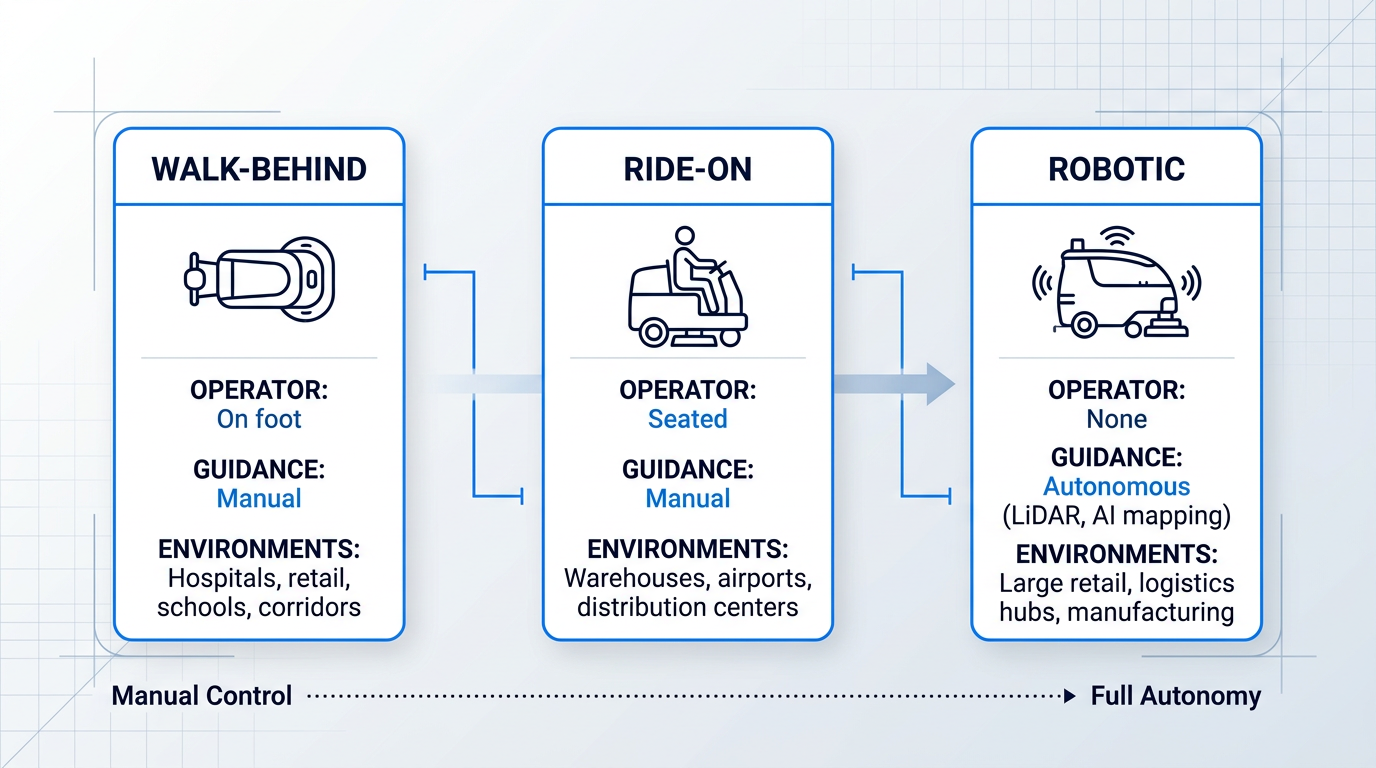
Robotic scrubbers are best suited to large, open, repeating floor environments where routes are predictable — retail stores, logistics hubs, airports, manufacturing facilities. In environments with high obstacle density or frequent layout changes, the autonomous navigation advantage is reduced.
Power source options
- Corded electric: Lower cost, consistent power output. Suited to smaller indoor areas with reliable access to power points; range is limited by cable reach.
- Battery (lead-acid or lithium-ion): Mobile, quiet, zero emissions. Well suited to occupied facilities, noise-sensitive environments, and areas without convenient power access.
- Combustion engine (diesel or LPG): High power output for large outdoor or well-ventilated indoor areas. Not appropriate for enclosed indoor spaces due to exhaust emissions.
Kärcher's floor scrubber guidance frames the power source decision as an application and environment question, not simply a cost question: corded machines are affordable and practical for smaller indoor areas cleaned outside business hours; battery models offer maximum flexibility for daytime use in occupied facilities; and combustion engine versions are recommended only for large outdoor or well-ventilated indoor areas.
The cleaning robotics market grew 23.9% year-over-year between 2024 and 2025, rising from $14.11 billion to $17.47 billion — a figure that reflects how quickly autonomous floor scrubbing has moved from pilot programmes into standard facility operations.
Scrubbers are not the right tool for every situation. They require loose debris to be removed first (especially with disc heads), cannot clean carpet or soft floor surfaces, and are not suited to very small or heavily cluttered spaces where the machine cannot manoeuvre. For heavily contaminated industrial floors where deep removal of ingrained soiling is the priority, a pressure washer or specialist method may be more appropriate than a scrubber.
Hard-floor wet cleaning is where scrubbers are unmatched — grease, stains, and embedded soil on concrete, tile, vinyl, and stone are exactly the contamination types this category was built for. For fine dust, above-floor surfaces, and carpet, a different category of machine takes over — which is where vacuum cleaners come in.
Vacuum Cleaners
Sweepers clear what is visible; scrubbers clean and dry what remains on hard floors. But both categories work at floor level, and neither addresses what falls between the cracks — literally and figuratively. Vacuum cleaners fill that gap: they capture fine dust that sweeper brushes disturb without fully containing, lift embedded soil from carpet fibres that a scrubber's pads cannot reach, and extend cleaning to above-floor surfaces entirely outside the scope of both.
The operating principle is straightforward: a motor generates suction that draws air and particles through a filtration system into a collection bag or container. What makes vacuum selection genuinely complex is what happens to the air on its way out.
Filter quality determines what is captured and what is returned to the room — a low-grade filter may remove visible debris while releasing fine particulates back into the air the occupants breathe. This single axis — filter efficiency — is the most consequential decision in vacuum selection, and it separates domestic convenience products from commercial-grade and industrial-grade machines.
Types of vacuum cleaner
- Upright vacuums: All-in-one design pushed by the handle, with a powered rotating brush ideal for carpeted floors and open areas. Primarily a domestic and light-commercial form factor.
- Canister vacuums: Separate motor unit on wheels, connected by a hose and telescoping wand. Quieter than uprights, highly manoeuvrable around furniture — well suited to offices, hotels, and hospitals.
- Backpack vacuums: Worn on the operator's back, freeing both hands and eliminating the need to reposition a unit. Ideal for stairs, aircraft cabins, seating, shelves, and facilities with complex layouts.
- Wet-and-dry vacuums: Handle both dry dust and liquid spills without a filter change between modes. Essential in workshops, construction sites, and food-processing environments where both contamination types coexist.
- Industrial vacuum systems: Heavy-duty machines engineered for continuous operation, hazardous dusts, large debris volumes, and production waste. Carry HEPA or ULPA filtration and, where required, ATEX certification.
The choice between these sub-types is driven by three factors: the surface being cleaned, the mobility the environment demands, and the nature of the dust or debris involved.
Canister models outperform uprights wherever furniture density, noise sensitivity, or stairwells are a factor — Nilfisk describes them as compact, quiet, and versatile for offices, hotels, and hospitals. Backpack vacuums extend that mobility further still, making them the preferred choice for transportation environments such as aircraft and train carriages, hospitality corridors, and any facility where the operator needs to cover ground quickly without trailing a machine behind them.
Wet-and-dry vacuums are indispensable wherever spills and fine dust coexist — construction sites, automotive workshops, and food-processing lines — and are frequently specified by dust class rating for exactly those environments. Industrial vacuum systems step beyond commercial capability entirely, handling materials such as silica, metal shavings, coolants, and combustible dusts in continuous-duty operation across factories, pharmaceutical plants, and production lines.
Dust classification: L, M, and H
The L, M, and H dust classification system is defined in BS EN 60335-2-69, the standard governing wet and dry vacuum cleaners for commercial and industrial use. The HSE's published guidance (HSG201) confirms that a British Standard defines these three classes — L (low), M (medium), and H (high) — with higher classes carrying additional features that make them suitable for more toxic substances.
| Dust Class | Filter Penetration | Filter Efficiency | Typical Applications |
|---|---|---|---|
| L (Low hazard) | < 1% | > 99% | Lime dust, plaster dust, soft wood — moderate-risk dusts with no special disposal requirements |
| M (Medium hazard) | < 0.1% | > 99.9% | Hardwood dust, concrete, paint dust, ceramics — the minimum class required on construction sites |
| H (High hazard) | < 0.005% | > 99.995% | Carcinogenic and pathogen-containing dusts including lead, mould, and asbestos |
Dust class filter penetration and efficiency figures as defined in BS EN 60335-2-69, with typical applications drawn from Kärcher's published dust class guidance. M class is the minimum legally required class for construction site use.
The practical implication is clear: specifying a vacuum by dust class is not a technical formality — it determines whether fine hazardous particles are contained inside the machine or returned to the air around the operator.
Kärcher's published guidance notes that M class is the lowest legally required class for use on construction sites, while H class covers carcinogenic and pathogen-containing dusts including asbestos, lead, mould, and related substances. The HSE's equipment and method sheet (em4) is explicit that domestic vacuum cleaners — even those fitted with HEPA filters — must never be used for asbestos, and that only a Class H vacuum meeting the relevant British Standards is appropriate for that application.
For environments where combustible dust creates an explosion risk, a further specification layer applies: ATEX certification. Under the Dangerous Substances and Explosive Atmospheres Regulations (DSEAR) and the ATEX Equipment Directive (2014/34/EU), areas where explosive dust atmospheres may occur are classified into zones — Zone 20 (continuous presence), Zone 21 (occasional in normal operation), and Zone 22 (unlikely in normal operation, short duration if it occurs). Industrial vacuum systems specified for these environments carry ATEX certification confirming they will not act as an ignition source within the relevant zone.
A vacuum's dust class rating determines whether hazardous particles are captured or returned to the air. For construction sites, M class is the minimum required; for carcinogenic dusts including asbestos, only H class is appropriate. Motor power and tank size are secondary to getting this specification right.
Residential, commercial, and industrial grades
The three-grade distinction maps directly onto the duty cycle and material demands of each environment. Residential vacuums are built for occasional home use — lighter motors, smaller capacity, and no expectation of extended daily operation. Commercial vacuums are engineered for professional cleaning schedules: stronger motors, larger dust bags that reduce downtime, and construction durable enough to withstand daily use across offices, retail spaces, hotels, and schools.
Industrial vacuum systems occupy a different category altogether. As Nilfisk describes them, they are designed for continuous, heavy-duty operation in demanding environments — often involving hazardous dust, large debris volumes, or production waste — with certified HEPA or ULPA filtration, stainless steel construction options, and ATEX-certified variants for explosive dust zones. The choice between commercial and industrial is not simply a matter of scale; it is a matter of what the machine is certified to handle and how long it can run without interruption.
Where sweepers excel at fast, large-area dry debris removal and scrubbers deliver wet cleaning on hard floors, vacuums are the right category wherever the task involves fine particulate control, embedded carpet soil, above-floor surfaces, or environments where the quality of the air returned to the room is as important as the cleanliness of the floor itself.
The next category shifts the frame entirely: from precision filtration in indoor environments to the high-pressure removal of heavy contamination from robust outdoor surfaces — the territory of pressure washers.
Pressure Washers
Where scrubbers clean at floor level with controlled moisture, pressure washers operate at a different scale entirely: raw hydraulic force applied at distance, capable of stripping mud, grease, and encrusted grime from surfaces that no mop or scrub head could touch.
The mechanism is straightforward: a motor drives a pump that pressurises water drawn from a supply, which then travels through a hose, lance, and nozzle, exiting at high velocity to blast contamination from the surface.
Cold Water vs Hot Water: The Key Decision
The most consequential choice when selecting a pressure washer is not pressure rating or power source — it is whether the machine heats the water before delivery.
- Cold water models: The standard configuration. Effective on dirt, mud, dust, and loose debris. Ideal for vehicles, outdoor surfaces, and equipment where grease or oil is not a major concern.
- Hot water models: Add a burner to heat incoming water, making them substantially more effective on oil, grease, and sticky residues. Kärcher notes that heat accelerates the emulsification of oils and fats in a way cold water cannot replicate.
Kärcher's IE professional know-how page puts the cleaning time saving at up to 35 per cent compared with cold water machines, and notes that hot water often reduces or eliminates the need for chemical detergents on greasy soils.
Nilfisk's professional range guidance confirms the split: cold water for general cleaning of vehicles, floors, and outdoor areas; hot water for automotive, agriculture, manufacturing, and food processing environments where oily or protein-based contamination is the target.
Pressure and Flow Rate: Two Metrics That Both Matter
Overall cleaning performance depends on two variables working in combination, and understanding what each one does is essential for matching a machine to a task.
Pressure (measured in bar or PSI) is the stripping power of the jet — how forcefully it dislodges contamination from the surface.
Flow rate (measured in litres per hour, or GPM in some markets) is the rinsing power — how effectively the dislodged material is flushed away once the jet has lifted it.
As Simpson Cleaning's published guidance puts it: PSI exerts the pressure to strip or scrub off the dirt, while GPM is the rinsing power that washes the dirt away — a machine with high pressure but low flow rate will strip but not rinse effectively, and vice versa.
Pressure Ratings by Application Tier
Nilfisk's professional range guidance sets out a clear framework for matching bar rating to task demand.
| Application tier | Pressure range (bar) | Pressure range (PSI) | Typical tasks |
|---|---|---|---|
| Light-duty | 100–150 bar | 1,450–2,175 PSI | Vehicle washing, patio cleaning, basic maintenance |
| Medium to heavy-duty | 150–250 bar | 2,175–3,625 PSI | Machinery, equipment, and surface cleaning |
| Heavy-duty / industrial | 250+ bar | 3,625+ PSI | Stubborn residues, large surfaces, intensive use |
Pressure washer application tiers by bar and PSI rating, based on Nilfisk's published professional range guidance.
The tiers are a starting point, not a ceiling: Nilfisk also notes that too much pressure on the wrong surface can cause damage, so matching the rating to both the task and the surface is equally important.
Kärcher's GB consumer range illustrates the lower end of the spectrum, with models spanning 110 bar (K 2, suited to garden furniture and balcony cleaning) through to 180 bar (K 7, covering facades, pools, and boats) — demonstrating that even domestic machines cover a meaningful performance range.
Electric vs Petrol/Diesel: A Deployment Decision
Power source is a deployment axis, not a hierarchy — the right choice depends entirely on where and how the machine will be used.
- Electric models: Produce zero exhaust emissions, run quietly, and suit indoor facilities, food production lines, and enclosed spaces. Runtime is limited only by the electrical connection.
- Petrol/diesel models: Operate independently of the power grid, making them suited to large outdoor sites, remote locations, and anywhere mains power is unavailable. Not appropriate for enclosed spaces.
Nilfisk's guidance explicitly recommends electric-powered units for indoor cleaning to avoid exhaust fumes, and petrol/diesel-powered models for outdoor or mobile use where maximum flexibility is needed.
Nozzle Selection and Surface Risk
The machine's raw output is only part of the equation: nozzle selection determines how that pressure is applied, and choosing incorrectly can damage surfaces.
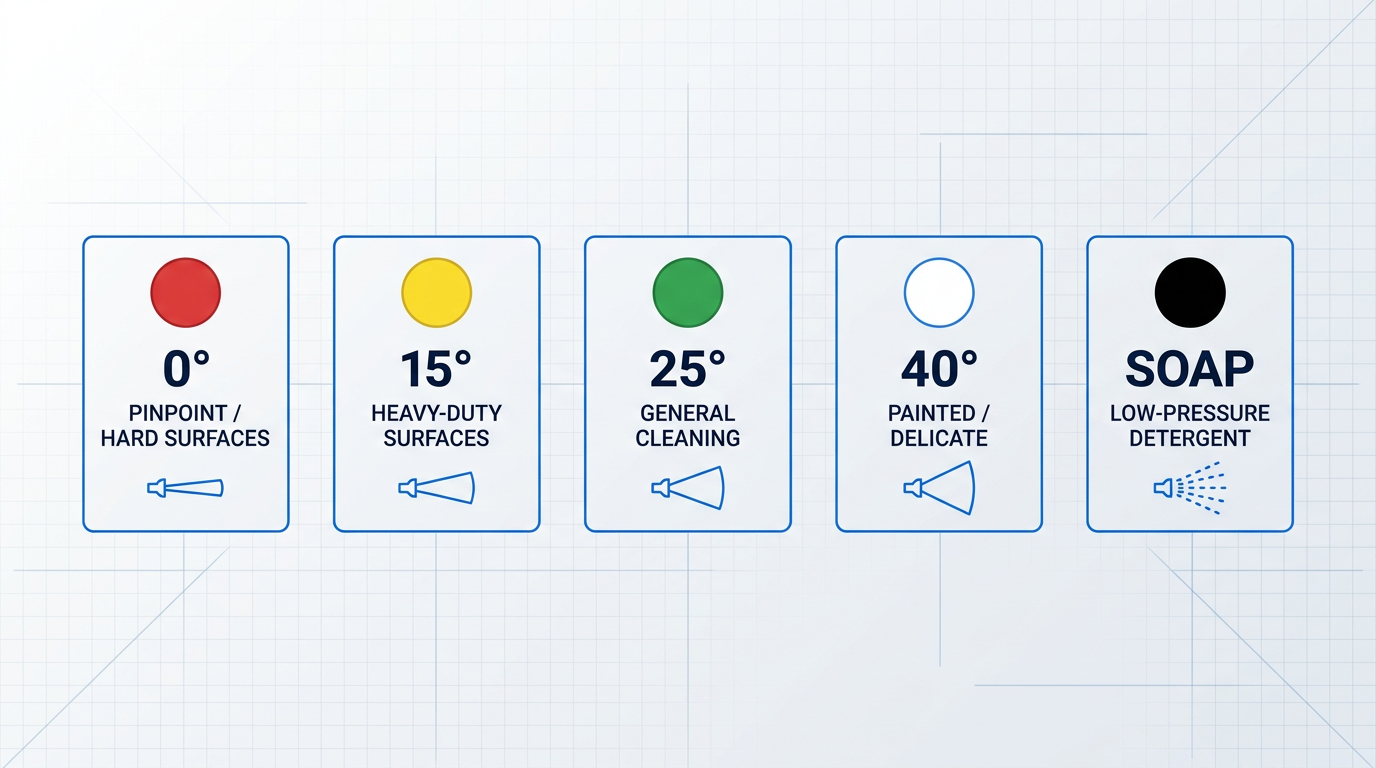
Nozzles are typically colour-coded by spray angle — from 0° (red, a concentrated pinpoint for hard unpainted surfaces) through 15°, 25°, and 40° (white, suited to painted or delicate surfaces such as vehicles and wood), plus a low-pressure soap nozzle — with narrower angles delivering deeper, more aggressive cleaning and wider angles distributing pressure across a broader area.
Simpson Cleaning's product documentation states plainly that using the incorrect nozzle can damage surfaces, and that high-pressure spray is capable of damaging wood, glass, and painted finishes — making nozzle choice as important as the machine's pressure rating.
Where Pressure Washers Belong
Pressure washers are the right tool across a wide range of demanding outdoor and well-ventilated environments.
- Vehicles and equipment: Cars, trucks, agricultural machinery, and plant equipment — cold water for general cleaning, hot water for engine bays and oily components.
- Outdoor hard surfaces: Patios, driveways, car parks, loading docks, and building facades, including removal of moss, lichen, and organic growth.
- Food processing environments: Hot water models are effective on protein and grease contamination in food production, where appropriate drainage infrastructure exists.
- Construction and industrial sites: Heavy-duty models handle stubborn residues and large surface areas in construction, manufacturing, and automotive workshop settings.
For oily, greasy, or protein-based contamination, a cold water pressure washer working harder is not the answer — heat fundamentally changes the chemistry, emulsifying fats and oils in a way pressure alone cannot, often removing the need for chemical detergents entirely.
Limitations of Pressure Washers
Pressure washers produce significant wastewater and runoff. Kärcher's wash bay guidance makes clear that proper drainage infrastructure — sludge traps, oil separators, and discharge permits — is a practical requirement wherever pressure washing takes place regularly.
Without dedicated drainage, pressure washers are generally unsuitable for indoor use, and impractical in any environment where runoff cannot be contained or managed.
There are also contamination types where water-jetting alone reaches its limits: where soiling is embedded or bonded to a surface in ways that volume and pressure cannot resolve, specialist methods covered later in this guide come into play.
Where pressure washers use water in volume and at force, the next category takes a fundamentally different approach: steam cleaners apply heat with minimal moisture, making them suited to hygiene-critical surfaces and enclosed environments where a pressure washer would never be appropriate.
Steam Cleaners
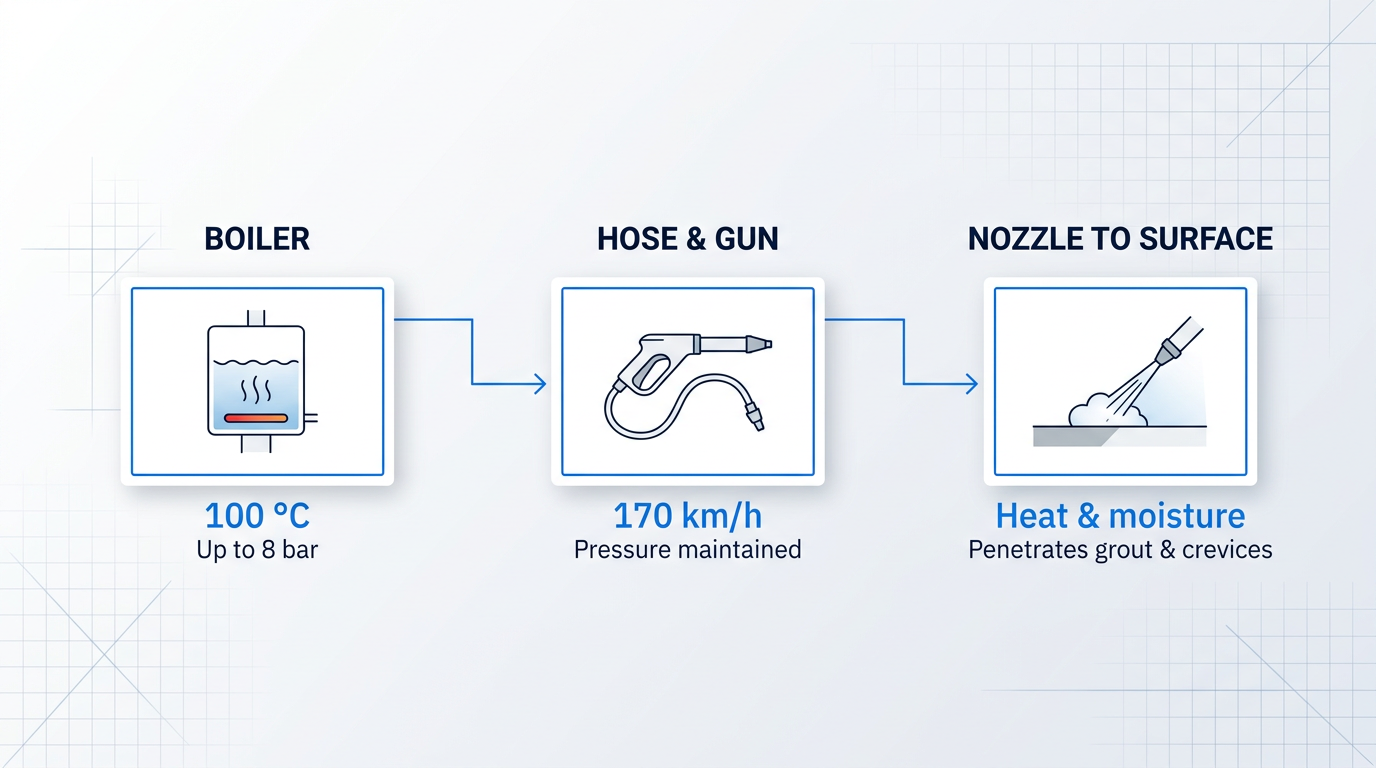
Where pressure washers rely on sheer hydraulic force and volume, steam cleaners take the opposite approach: a small quantity of water, heated in a sealed boiler until it vaporises, then released through a nozzle at around 100 °C and pressures of up to 8 bar.
The result is a cleaning mechanism built on heat and moisture rather than mechanical force — steam particles accelerate out of the nozzle at approximately 170 km/h, penetrating grout lines, crevices, and textured surfaces that brushes and cloths cannot reach effectively.
Dry steam vs wet steam
Not all steam is the same, and the distinction matters for surface compatibility.
Domestic and entry-level machines produce saturated steam — steam that carries a higher residual moisture content, which can leave surfaces noticeably damp after cleaning.
Commercial and industrial systems produce dry steam vapour, which carries only around 5 to 6 per cent water content according to trade press reporting in Cleanlink and Cleanfax, at higher temperatures and pressures — meaning surfaces dry far faster and the risk of moisture damage to sensitive materials is significantly reduced.
The practical consequence is that dry steam systems are better suited to environments where downtime matters and surfaces need to be ready for use quickly — a 500-bed hospital, for instance, cannot afford floors that stay wet for an hour after cleaning.
The hygiene advantage
Steam cleaning's most significant differentiator from mechanical categories like sweeping or scrubbing is its capacity to sanitise as it cleans, not just remove visible soiling.
Kärcher states that its steam cleaners and steam vacuum cleaners, tested by an independent laboratory, achieve bactericidal and limited virucidal PLUS efficacy — a classification defined by the Robert Koch Institute covering enveloped viruses as well as non-enveloped adeno-, rota-, and noroviruses — certified to European standard EN 16615.
The mechanism is straightforward: pathogens are extremely sensitive to high temperatures, and even brief contact with steam at 100 °C or above is sufficient to inactivate them on hard surfaces, according to Kärcher's thermal disinfection guidance.
Because steam uses only water, facilities that switch to steam cleaning eliminate chemical procurement costs, reduce operator exposure to cleaning agents, and remove the need to flush surfaces after disinfection — a requirement in food preparation areas using chemical sanitisers.
Where steam cleaning performs well
Steam excels on hard, sealed surfaces and in environments where chemical residues are unacceptable — food contact zones, allergy-sensitive settings, and healthcare environments where pathogen control is a priority.
- Tiles, stone and sealed floors: Steam penetrates grout lines and surface pores that mops and pads cannot reach, lifting embedded soiling without chemical agents.
- Kitchen and food preparation surfaces: Kärcher identifies food processing and industrial kitchens as primary steam applications, where chemical-free sanitisation meets food safety requirements.
- Healthcare and care environments: Hospitals, care homes and restrooms benefit from steam's pathogen-control capability, particularly on creviced or textured surfaces where bacteria accumulate.
- Hospitality settings: Hotels, restaurants and public restrooms are well-suited to steam — Cleanfax notes steam has become popular for sanitising these environments.
- Vehicle interiors: Steam cleans upholstery, trim and hard-to-reach interior surfaces without leaving chemical residues or saturating materials.
- Fittings, sinks and bathroom surfaces: High-temperature steam dissolves limescale and soap residue from chrome, ceramic and glass surfaces quickly and without abrasive action.
Nilfisk notes that steam can also be deployed outdoors and on porous surfaces, reaching into biofilms and contamination that chemical sanitisers cannot always access — making it a versatile choice across a wider range of environments than the indoor-only assumption suggests.
Where steam cleaning has limitations
Steam is not a universal solution, and matching it to the right surface is important.
- Unsealed or oiled wood: Kärcher advises against steam on oiled or waxed parquet flooring, as moisture can penetrate and damage the surface or finish.
- Heat-sensitive plastics: Nilfisk recommends caution on certain plastics, as high temperatures can cause warping or surface damage — manufacturer guidelines should be checked.
- Heavy mechanical contamination: Steam cuts through grease and biofilm effectively, but Nilfisk notes that large build-ups of caked-on soil are better addressed first by pressure washing.
The category is also defined by what it does not use: one litre of tap water produces approximately 1,700 litres of steam, according to Kärcher — meaning water consumption is minimal, there is no chemical runoff, and surfaces dry quickly compared to methods that apply water directly.
Domestic, commercial and industrial scale
Steam cleaners span a wide range of form factors, from compact handheld units to continuous-operation industrial machines.
| Scale | Typical form | Boiler / run time | Primary applications |
|---|---|---|---|
| Domestic | Handheld or upright steam mop | Small tank (e.g. 200–500 ml); refillable between sessions | Hard floors, tiles, kitchen surfaces, bathroom fittings, spot cleaning |
| Commercial | Canister or cylinder unit with accessory range | Up to 1.8–2.4 L boiler; continuous-fill models run up to 6 hours | Food service, hospitality, retail, restrooms, multi-surface cleaning |
| Industrial | Heavy-duty steam and vacuum combined unit | Up to 3.3 L boiler; continuous-fill models run up to 8–12 hours | Food production, healthcare, large-scale hospitality, sustained throughput |
Steam cleaner scale compared by form, boiler capacity, run time, and typical application — based on published specifications from Kärcher and Nilfisk professional ranges.
The jump from domestic to commercial is primarily about continuous-fill boiler design: professional models separate the fresh water reservoir from the boiler, so water can be added without stopping work — a critical feature for facilities that cannot afford cleaning downtime.
At the industrial end, combined steam and vacuum units recover the moisture immediately after application, leaving surfaces dry and ready for use in under ten minutes, according to Nilfisk — a significant advantage over cleaning methods that require extended drying time.
Steam cleaning covers hard surfaces comprehensively, but the cleaning challenge shifts considerably when the surface is textile rather than solid — which is where carpet cleaning machines, the next category, take over.
Carpet Cleaning Machines: Methods and Maintenance
Every hard-floor method covered so far — sweeping, scrubbing, vacuuming, pressure washing, steam cleaning — shares one limitation: none of them works on carpet. Textile floor surfaces trap soil in a fundamentally different way, with grit, grease, and allergens becoming embedded deep within the pile where surface-level tools cannot reach.
Routine vacuuming removes loose debris from the upper layers of the pile, but it cannot dislodge soil that has worked its way down to the backing. Restoring a carpet requires mechanical agitation combined with moisture and extraction — a combination that defines the specialist machine category covered here.
Commercial carpet cleaning machines are deployed across offices, hotels, healthcare facilities, retail spaces, schools, and hospitality venues — anywhere textile flooring faces sustained foot traffic. Three primary methods cover the full range of cleaning needs: hot water extraction, encapsulation, and bonnet cleaning.
Hot Water Extraction
Hot water extraction (also known as spray extraction) is the restorative deep-clean method. The machine injects a water-and-detergent solution under pressure deep into the carpet pile, agitates the fibres to loosen embedded soil, and immediately vacuums the dirty solution back into a recovery tank — all in a single pass.
Two machine form factors serve different scales of work. Walk-behind carpet extractors are built for large carpeted areas, with wide cleaning paths and high-capacity tanks suited to continuous operation across open floors. Box-and-wand extractors are portable units used with a hand-held wand for spot cleaning, upholstery, and confined spaces.
The key limitation of hot water extraction is drying time. Tennant's ReadySpace brochure shows deep extraction drying at 8 to 24 hours, depending on airflow, humidity, and carpet construction — which means areas typically need to be closed to foot traffic during and after cleaning.
Because of this disruption, Tennant's D.I.R.T. framework positions restorative extraction at a frequency of every 6 to 12 months — enough to flush deeply embedded contamination and restore carpet appearance, but infrequent enough that the downtime is manageable.
Encapsulation
Encapsulation works on a different principle entirely. A crystallising polymer solution is applied to the carpet and worked into the pile using a cylindrical brush machine. As the solution dries, it encapsulates soil particles into brittle crystals, which are then removed during routine vacuuming — no rinsing required.
The low-moisture approach produces a significant practical advantage: drying times of around 20 minutes, according to trade sources, compared to many hours for hot water extraction. Areas can be reopened to foot traffic quickly, making encapsulation particularly well-suited to hotel lobbies, corridors, and other spaces where prolonged closure is not feasible.
Encapsulation is an interim maintenance method, not a restorative one. It maintains carpet appearance and extends the interval between deep extractions, but it does not flush the deeply embedded soil that only hot water extraction can reach. Cleanlink trade sources note that encapsulation can be performed three to four times between extractions, using substantially less water and chemical than a full extraction cycle.
Bonnet Cleaning
Bonnet cleaning uses a rotating absorbent pad — the bonnet — attached to a low-speed rotary floor machine, typically running no faster than 300 rpm. The pad is lightly moistened, then worked across the carpet surface, absorbing surface soils as it travels.
Its strengths are speed and low cost. Most facilities already own a low-speed floor machine, so no specialist equipment investment is needed. For quick appearance improvement in traffic lanes — lobbies before an event, corridors between scheduled cleans — bonnet cleaning delivers results rapidly, with short dry times.
The significant limitation is depth. As the Cleanfax trade publication notes, bonnet cleaning addresses only the upper portion of the carpet pile and is not a restorative process. It is an interim maintenance tool, and should not be used on heavily soiled carpet where deeper methods are needed.
There is also a documented industry caveat. Cleanfax's coverage of commercial carpet warranties reports that major carpet manufacturers — including Beaulieu, Shaw, Tandus, Interface, and Mohawk — advise against bonnet or rotary cleaning, with several stating explicitly that use of a bonnet machine may void the carpet warranty. Shaw's published position is that the spinning bonnet may distort the pile of cut carpet, and that more customer soiling complaints result from this method than from all other causes combined. Before using bonnet cleaning on any commercial installation, checking the carpet manufacturer's maintenance guidelines is advisable.
Carpet Fibre Type and Method Selection
The choice of cleaning method cannot be made without knowing the carpet's fibre type. As Kärcher's carpet care guidance states, fibres react very differently to cleaning agents, mechanical action, and temperature — and professional cleaning is only possible when the fibre type is known.
Synthetic fibres such as polyester are resistant to acidic cleaning agents, though Kärcher notes that polyamide (nylon) is an exception among synthetics and does not share this acid resistance. Natural and protein fibres — wool and sisal — require more careful handling: Kärcher's guidance notes sensitivity to acidic cleaners (below pH 3), while the Carpet and Rug Institute advises cleaning wool with neutral detergents (pH 5.0–8.0) and avoiding excessive agitation and heat.
Sisal presents a particular constraint: Kärcher notes it must not get wet, which significantly limits which cleaning methods are appropriate. For heated extraction on any natural or protein fibre, Kärcher notes that temperatures above 40 °C can cause damage — a consideration that affects equipment settings as much as method selection.
Synthetic fibres tolerate most commercial cleaning methods, with some exceptions. Natural and protein fibres — wool, sisal — are sensitive to heat, acidic chemistry, and excessive mechanical agitation. Knowing the fibre type before selecting a method is not optional; it is the starting point for any professional carpet cleaning programme.
The three methods work most effectively as a layered maintenance programme rather than as competing alternatives. Tennant's D.I.R.T. framework structures the programme around four tiers: daily vacuuming of high-traffic areas; interim cleaning every one to six months; restorative extraction every six to twelve months; and immediate spot treatment as needed.
- Daily vacuuming: Removes loose surface soil from high-traffic areas before it becomes embedded in the pile. High-traffic areas every day; lower-traffic areas weekly.
- Interim cleaning (1–6 months): Encapsulation or bonnet cleaning refreshes appearance, removes traffic lane soiling, and extends the interval before restorative extraction is needed.
- Restorative extraction (6–12 months): Hot water extraction flushes deeply embedded soil, detergent residues, and contaminants that interim methods cannot reach.
- Spot treatment (as needed): Immediate treatment of spills and stains prevents them from setting permanently into the pile between scheduled cleaning cycles.
The practical value of this structure is that each tier reduces the burden on the next. Consistent daily vacuuming means interim cleaning is more effective; regular interim cleaning means restorative extraction is needed less frequently. Nilfisk's commercial carpet care guidance frames the combined approach as a programme that extends carpet life and keeps colours consistent across large areas — reducing the frequency and cost of replacement.
From carpet cleaning, the guide moves into a very different part of the cleaning machine landscape: the industrial specialist end, where laser cleaning, ultrasonic systems, and dry ice blasting address contamination challenges that no textile or hard-floor machine can touch.
Laser, Ultrasonic, and Dry Ice Cleaning Machines
At the specialist end of the cleaning machine spectrum, the physics changes entirely. Laser cleaning machines, ultrasonic cleaners, and dry ice blasting systems each remove contamination through mechanisms that have no counterpart in the sweepers, scrubbers, and pressure washers covered earlier — and each unlocks applications that conventional methods simply cannot reach.
How Laser Cleaning Works
A laser cleaning machine scans a focused beam across a surface at high speed, delivering concentrated energy to a tiny area at a time.
The key to the process is differential ablation thresholds: every material has an ablation threshold — the energy level at which its molecular bonds break and it vaporises.
Contaminants such as rust, paint, oxides, oil, and mill scale have lower ablation thresholds than the metals and stone beneath them, as IPG Photonics and Laserax both describe in their published technical content.
By tuning the laser parameters so that the beam's intensity sits above the contaminant's threshold but below the substrate's, the contamination is vaporised while the base material is left intact — a degree of selectivity that no abrasive method can match.
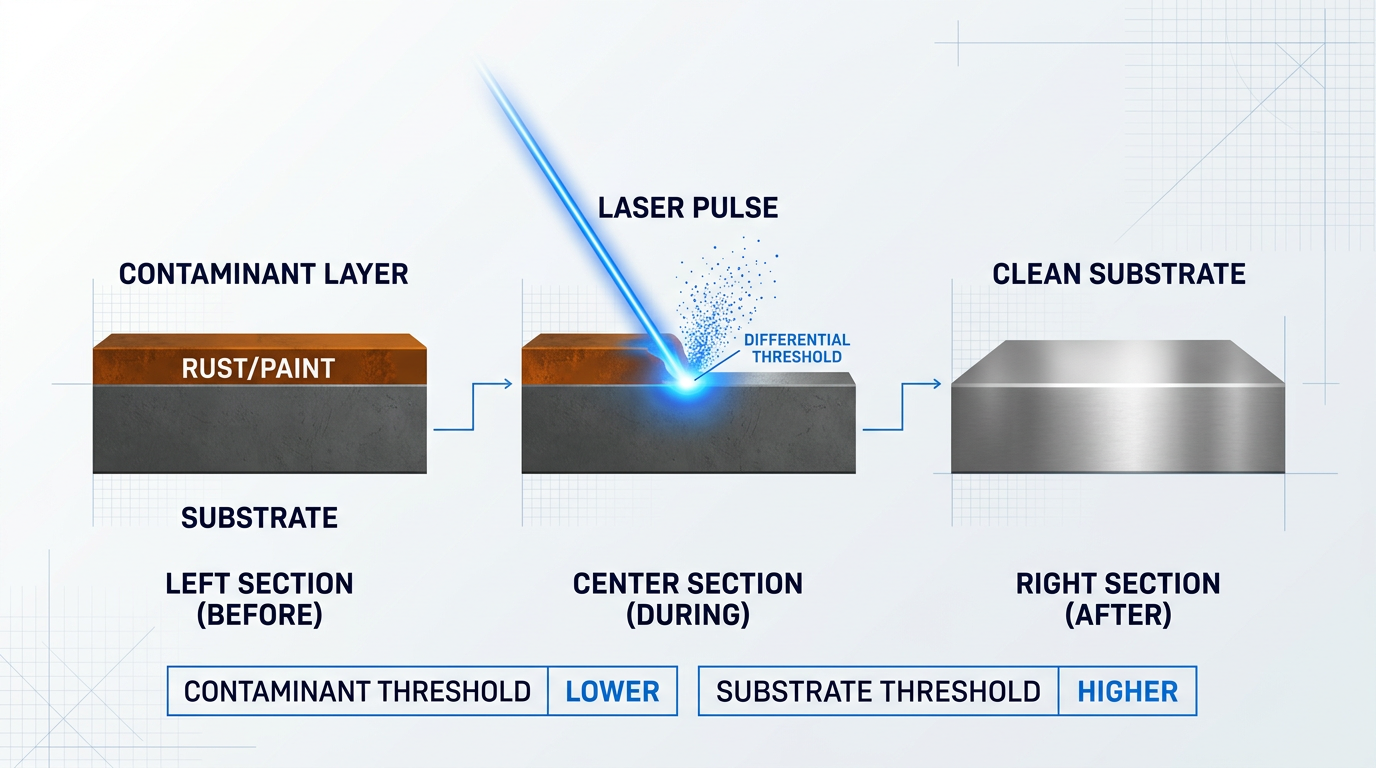
The process is also entirely contact-free: no abrasive media touches the surface, no mechanical stress is introduced, and no grit or residue is left behind.
What Laser Cleaning Removes and From What Surfaces
The breadth of what laser cleaning handles is one of its most significant characteristics — a single machine can address a wide range of contamination types across a wide range of surfaces.
- Corrosion and scale: Rust, oxides, mill scale, and tarnish — including weld discolouration and heat-affected zones.
- Coatings and films: Paint, powder coating, lacquer, primer, e-coat, phosphate coating, and adhesive residues.
- Process contamination: Oil and grease, carbon and soot, release agents, mould residue, and graffiti.
- Compatible surfaces: Steel, aluminium, copper, titanium, cast iron, brass, bronze, galvanised metal, stone, brick, concrete, and masonry.
This combination of contamination and surface compatibility explains why laser cleaning is used across industries as varied as aerospace, automotive, heritage restoration, injection moulding, and food processing.
Portable Laser Cleaning: The ELASER and ELASER-RHZ
The most common form factor for on-site industrial work is the portable laser cleaner: a wheeled unit housing the laser source, with a lightweight handheld scanner connected by a delivery cable, operated by a single person.
Woodrow Scientific's ELASER is the company's own portable system — designed, built, and supported in-house at their Southampton facility, making Woodrow Scientific the only UK-based laser cleaning manufacturer.
The laser market includes both manufacturers who engineer their own systems and resellers who rebadge third-party machines; the distinction matters for support, improvement capability, and long-term reliability.
The ELASER delivers up to 300 W of fibre laser power, tunable from 0–100%, allowing one machine to span everything from light oxide removal to thick coating stripping across the full range of compatible surfaces.
Its handheld scanner weighs under 3 kg, and the delivery cable reaches up to 50 m — giving a single operator genuine reach across a large structure or facility without repositioning the main unit.
The system is air-cooled and consumable-free: no water circuit, no chiller, no blasting media to manage or dispose of. It carries CE and UKCA certification and is Made in Britain.
Safety and operation training is available directly from Woodrow Scientific — get in touch for details. Bespoke engineering and customisation is also available; contact the team to discuss specific requirements.
The ELASER-RHZ: Cleaning Without Area Evacuation
Conventional laser cleaning has one significant practical barrier: the laser hazard zone typically requires the surrounding area to be sealed off and cleared before work can begin, making it impractical in open workshops, mixed-use facilities, or publicly accessible environments.
The ELASER-RHZ addresses this directly, using Woodrow Scientific's patented reduced-hazard-zone technology to confine the laser hazard to a small area immediately around the work.
The ELASER-RHZ is the world's first laser cleaner of its kind: WSL's patented engineering confines the hazard zone to the immediate work area, enabling laser cleaning in open workshops, mixed-use facilities, and public-facing settings — without sealing off or evacuating the surrounding space.
This unlocks laser cleaning in environments where it was previously impractical — heritage restoration on public monuments, graffiti removal in occupied spaces, and industrial maintenance in live production facilities.
Automated Laser Cleaning: The AutoLASE
Where portable laser cleaning suits varied on-site work, automated laser cleaning suits repetitive production-line applications where the same parts need cleaning to the same standard, cycle after cycle.
In this form factor, the laser cleaning head is mounted on an articulated robotic arm, which carries it through precise paths across complex three-dimensional part geometries.
Woodrow Scientific's AutoLASE is the company's automated system, and its defining characteristic is how easy it is to run: load the part, and the system takes it from there.
Machine vision scans the loaded part, builds a 3D map automatically, and generates the cleaning path without any manual programming, path-setting, or knowledge of the part's geometry — no technical skills required to operate it.
The AutoLASE integrates with a customer's existing collaborative or industrial robots, or can be supplied as a complete custom cell — with bespoke engineering available for specific integration requirements.
Configured with the RHZ upgrade, the AutoLASE requires no enclosure at all — the only automated laser cleaning system with this capability, made possible by Woodrow Scientific's eye-safe technology.
Both the ELASER/ELASER-RHZ and the AutoLASE are competitively priced within the European market — contact Woodrow Scientific for a quote.
Laser Cleaning vs Alternative Industrial Methods
When evaluating laser cleaning against the industrial methods it most commonly replaces, the differences extend beyond mechanism to running costs and environmental impact.
- vs Sandblasting: Laser cleaning is non-abrasive: no substrate damage, no grit residue to clear, no consumable media to purchase and dispose of.
- vs Chemical stripping: No solvents or acid solutions are used, eliminating chemical handling, hazardous waste disposal, and the health risks associated with both.
- vs Water-jetting: Unlike pressure washing, laser cleaning leaves no moisture residue — important for applications where surface dryness matters immediately after cleaning.
- Running costs: With no consumables — no media, no chemicals, no water — the ongoing cost of laser cleaning is substantially lower than methods that require them.
As Laserax notes in their published comparison, laser cleaning removes rust, oxides, oil, grease, and paint with little to no impact on the underlying material — a property that reduces rework and improves downstream process quality for welding, bonding, and coating applications.
Ultrasonic Cleaners
Ultrasonic cleaning works on a fundamentally different principle: parts are submerged in a tank of cleaning solution, and high-frequency sound waves — typically in the range of 20 to 130 kHz — are transmitted through the liquid by transducers.
These sound waves create cavitation: millions of microscopic bubbles that form and implode in rapid succession, generating localised energy that dislodges contamination from every surface the liquid touches — including crevices, blind holes, and complex internal geometries that no external cleaning method can reach, as Crest Ultrasonics describes.
The process is non-abrasive, making it suitable for delicate or precision components where surface integrity matters.
Frequency selection is the primary tuning variable: lower frequencies (around 20–40 kHz) produce larger, more powerful cavitation bubbles suited to heavy contamination on robust parts, while higher frequencies (68–130 kHz and above) produce smaller, gentler bubbles suited to fine particles on delicate or precision surfaces.
Applications span automotive parts cleaning, aerospace component maintenance, medical and dental instrument sterilisation, electronics, jewellery, and pharmaceutical manufacturing equipment.
Dry Ice Blasting
Dry ice blasting accelerates solid CO₂ pellets through compressed air at supersonic speeds, directing them at the surface to be cleaned.
The cleaning action combines three simultaneous mechanisms, as Cold Jet's published technical content describes: kinetic impact from the pellets breaking through the contaminant's surface layer; thermal shock, as the dry ice at −78.9°C causes the contaminant to embrittle and micro-crack, breaking its bond with the substrate; and rapid sublimation, where the CO₂ expands up to 800 times its solid volume on impact, lifting the fractured contamination away.
Two properties make dry ice blasting distinctively useful in certain environments: it produces no secondary waste (the dry ice sublimates to gas, leaving only the dislodged contamination), and it can clean equipment while still hot and running, without disassembly — dramatically reducing downtime in production settings.
The process is non-abrasive, non-conductive, non-toxic, and uses food-grade CO₂, making it well suited to food and beverage processing, injection mould cleaning, automotive and aerospace production lines, and electrical components.
With all the major categories of cleaning machines now covered — from floor sweepers to laser systems — the next step is matching the right machine type to a specific task, surface, and environment.
See Laser Cleaning Machines in Action
Laser cleaning removes contaminants with precision that conventional machines cannot match. Explore the ELASER range or watch a live demonstration to see what the technology does on real surfaces.
How to choose the right type of cleaning machine
The right cleaning machine is rarely obvious from the surface of a task. Two facilities might both describe their need as "floor cleaning" and require entirely different categories of equipment. Working through a handful of focused questions — what is the contamination, what is the surface, how large is the area, what environment is it in — narrows the field quickly and reliably.
Contamination type and surface are the primary filter. Before scale, power source, or budget enters the conversation, these two factors determine which machine category is even capable of doing the job.
- Dry loose debris, hard floors: Points to a floor sweeper. Rotating brushes collect debris efficiently without water, leaving the floor ready for the next stage.
- Grease, stains, embedded soil: Points to a floor scrubber. Scrubbing action with cleaning solution lifts bonded soiling that sweeping cannot reach.
- Fine dust, filtration requirements: Points to a vacuum cleaner. High-filtration systems capture fine particles and prevent re-release into the air.
- Heavy outdoor contamination: Points to a pressure washer. Hydraulic force strips mud, grease, and encrusted grime from robust external surfaces.
- Hygiene-critical, chemical-free surfaces: Points to a steam cleaner. High-temperature vapour sanitises without leaving chemical residue on food-contact or sensitive surfaces.
- Embedded soil in carpet: Points to a carpet extractor. Hot-water extraction or encapsulation reaches contamination locked within textile fibres.
- Industrial contamination, metals or masonry: Points to laser cleaning. The beam removes rust, coatings, and deposits selectively, leaving the base material unaffected.
- Precision parts, complex geometry: Points to an ultrasonic cleaner. Cavitation reaches joints, crevices, and lumens that no surface tool can access.
- In-place equipment, no secondary waste: Points to dry ice blasting. CO₂ pellets sublimate on contact, leaving no residue or secondary cleaning requirement.
This mapping is a starting point, not a rigid rule. Many real-world tasks call for a two-stage approach: a sweeper to clear loose debris before a scrubber tackles the bonded soiling beneath it, for instance, or a vacuum pass before laser cleaning to remove loose particulate. Nilfisk's contamination control guidance makes the same point — matching the machine to the zone and the contamination type prevents both over-cleaning in low-risk areas and under-cleaning where it matters most.
Once the right category is confirmed, scale and throughput determine the appropriate form factor within it. Walk-behind machines suit smaller areas and tight spaces where maneuverability is the priority; ride-on machines cover larger open areas faster and reduce operator fatigue over long cleaning runs. For tasks that repeat at volume or demand consistent results every cycle, automated systems deliver what manual methods cannot — robotic scrubbers, for example, can run defined routes multiple times a day with minimal supervision, freeing operators for work that requires human judgement.
The indoor versus outdoor environment shapes which power sources are practically viable. Indoor use generally favours electric or battery-powered machines: no exhaust emissions, lower noise, and safer operation in enclosed spaces. Outdoor or large industrial settings may require petrol, diesel, or LPG to deliver the mobility and sustained power those conditions demand. Some combustion-powered machine types are unsuitable for enclosed spaces — this is a practical selection input, not a drawback of those machines in the contexts where they belong.
Where eliminating chemical agents is a priority — food processing areas, healthcare environments, or allergy-sensitive settings — steam cleaning and laser cleaning are the two categories that operate without chemical agents entirely. In other contexts, encapsulation carpet cleaning and modern scrubber dosing systems reduce rather than eliminate chemical consumption, which still delivers meaningful benefits: lower disposal costs, reduced operator exposure, and simpler compliance in regulated environments.
A further axis that is easy to underweight is precision and substrate care. Where the underlying material must not be damaged — heritage stonework, precision-engineered components, aerospace parts, delicate finishes — the cleaning method's selectivity matters as much as its cleaning power. Laser cleaning stops at the base material; peer-reviewed conservation studies confirm it removes contaminants from stone, metal, and other heritage surfaces while preserving substrate integrity. Steam cleaning is gentle on appropriate surfaces. Ultrasonic cleaning reaches complex geometry non-abrasively. When rework from substrate damage is a real cost, these methods repay the consideration.
Matching machine category to task reduces consumables, downtime, rework, and operator effort. The wrong category creates all of them — and often leaves the contamination behind as well.
That cost logic is the closing principle of any selection decision. The categories covered in this guide each have a domain where they excel; used outside it, they generate avoidable costs at every stage of the cleaning cycle. Choosing at the category level — before considering specific models or brands — is where the largest efficiency gains are made.
With the full decision framework in place, the final section brings the guide to a close and points towards next steps for readers ready to act on what they've learned.
Conclusion
Finding the right cleaning machine for your task
The category a machine belongs to shapes everything: what it can clean, what it cannot touch, and whether it will leave a surface better or worse than it found it — so the most useful question is never which machine is best, but which machine fits this contamination, on this surface, in this environment.
For those whose requirements point towards laser cleaning, Woodrow Scientific offers portable and automated laser cleaning systems — get in touch to discuss what your application needs.
Frequently asked questions about cleaning machines
Common questions about the types of cleaning machines available and how to choose between them.
Floor sweepers collect dry debris using rotating brushes into a hopper — ideal for large indoor and outdoor areas before wet cleaning. Floor scrubbers apply water and detergent, agitate with brushes, and recover dirty water in one pass, leaving hard floors clean and dry. Vacuum cleaners use suction to capture fine dust, dirt, and debris from floors, carpets, and above-floor surfaces. Pressure washers deliver high-pressure water jets to strip mud, grease, and encrusted grime from outdoor surfaces and heavy plant. Steam cleaners use superheated steam to loosen and sanitise without chemicals, suited to hygiene-critical environments. Carpet cleaning machines — including hot-water extractors and encapsulation machines — deep-clean textile floor surfaces that hard-floor methods cannot address. Laser cleaning machines use focused light pulses to vaporise surface contamination from metals and other substrates without abrasive media or chemicals, used in industrial and precision applications. Specialist systems such as ultrasonic cleaners and dry ice blasting machines round out the landscape for component-level and sensitive-substrate cleaning tasks.
Mechanical cleaning machines are those that remove contamination primarily through physical action — rotating brushes, suction, high-pressure water jets, or abrasive forces — rather than through purely chemical or purely thermal means. The clearest examples in commercial and industrial settings are floor sweepers, floor scrubbers, and vacuum cleaners; pressure washers also fall into this category. It is worth noting that many mechanical machines combine physical action with chemical agents: a floor scrubber, for instance, uses detergent alongside its rotating brushes. The "mechanical" label describes the primary removal mechanism, not the only one at work.
A floor sweeper collects dry debris — dust, sand, packaging scraps, loose litter — using rotating brushes that deposit material into an onboard hopper. It does not apply water or cleaning solution, and it does not wash or scrub the floor surface. A floor scrubber does the opposite: it applies water and detergent, agitates the surface with rotating brushes or pads, then recovers the dirty water through a squeegee and vacuum system, leaving the floor clean and dry in a single pass. The core distinction is dry debris collection versus wet soil removal. Many facilities use both in sequence: a sweeper clears loose debris first, then a scrubber deep-cleans the surface. As Nilfisk notes, this approach protects the scrubber and improves cleaning results, since scrubbers work best on pre-swept floors.
No. Different contamination types, surface types, scales of operation, and environments require fundamentally different cleaning mechanisms, and no single machine type handles all of them effectively. A floor scrubber excels on hard floors but cannot clean carpets; a vacuum handles carpets and above-floor surfaces but will not remove grease from a concrete floor; a pressure washer is suited to outdoor or heavy contamination tasks but is not appropriate for indoor hard floors in most settings. In practice, facilities typically combine machine types: a sweeper followed by a scrubber for large hard-floor areas, a vacuum for carpeted zones, a steam cleaner for hygiene-critical surfaces, and a pressure washer for external or heavily soiled areas. Matching the machine to the task — rather than seeking one universal solution — is what delivers consistent, efficient results.
Laser cleaning is chosen over sandblasting or chemical stripping when the substrate must be left completely undamaged. The laser beam is tuned so that contaminants absorb the energy and vaporise, while the underlying material is unaffected — a level of precision that abrasive blasting, which can erode or roughen the substrate, cannot reliably match. It is also the preferred method when no consumables or secondary waste are acceptable: laser cleaning uses no abrasive media, no chemicals, and no water, whereas sandblasting generates dust and spent media that must be collected and disposed of, and chemical stripping involves hazardous solvents requiring costly handling. Because laser cleaning produces no consumable costs in operation, running costs over time are significantly lower than for either alternative, despite a higher initial capital outlay. The method is particularly well suited to precision-engineered components, art and heritage conservation work, food processing equipment cleaned in place, and aerospace and industrial maintenance applications where disassembly is impractical or impossible.