

Introduction
Small satellites have quietly shifted from the margins of space research to the backbone of a rapidly expanding orbital economy — a change that is hard to ignore once you start looking for it.
This guide is for those who want more than a passing definition: researchers, learners, and early-stage evaluators building the kind of foundational knowledge that makes the broader landscape legible.
It traces the full arc from classification and history through engineering constraints, applications, constellation design, standardisation, and the regulatory and sustainability questions that now shape the field.
Each section builds on the last, so reading from the beginning will take you somewhere — not just inform you.
TL;DR
Small satellites have crossed from experimental curiosity to operational infrastructure — and that transition carries real consequences for how space is accessed, governed, and sustained.
Understanding those consequences means working through the classification frameworks, engineering trade-offs, and regulatory pressures that have shaped the field into what it is today.
This article covers:

Small satellite classifications and mass categories
Historical development from early spacecraft to constellations
Technical constraints of compact spacecraft design
Applications across Earth observation, comms, and science
Constellation architecture and rideshare launch strategy
Regulation, spectrum coordination, orbital sustainability
What is a Small Satellite?
The term small satellite is deceptively straightforward: the concept is clear, but the precise boundary is not — and that ambiguity is itself informative about how the field actually works.
At its core, a small satellite is a spacecraft characterised primarily by its mass, with an upper threshold that varies meaningfully depending on which organisation is drawing the line and for what purpose. NASA's State of the Art (SOA) of Small Spacecraft Technology reports use 180 kg as their operational upper bound — a figure derived from the mass allocation provided by the EELV Secondary Payload Adapter (ESPA), which offered up to 180 kg per payload slot when the reporting framework was first established. Broader industry and academic contexts extend the threshold to 500 kg or even 1,200 kg, reflecting different launch vehicle constraints and programmatic definitions.
This variation is not imprecision — it reflects the fact that different organisations draw the line where it is useful for their specific context, whether that is secondary payload integration, regulatory reporting, or research programme scope.
Within the smallsat family, the literature organises spacecraft into five recognised subcategories by mass, providing a shared vocabulary that cuts across those varying upper thresholds.
| Subcategory | Approximate Mass Range | Notes |
|---|---|---|
| Femtosatellite | 0.001 – 0.01 kg (1 – 10 g) | Theoretical lower bound; ChipSat development underway, not commercially established |
| Picosatellite | 0.01 – 1 kg | Includes early CubeSat-class spacecraft; mass range per NASA public explainer |
| Nanosatellite | 1 – 10 kg | Home of the standard 1U–3U CubeSat form factors |
| Microsatellite | 10 – 100 kg | Larger CubeSat configurations (6U, 12U) may fall here |
| Minisatellite | 100 – 180 kg | Upper bound tied to ESPA secondary payload mass allocation |
Mass-based classification of small satellite subcategories per NASA SOA framework
The five-category framework above reflects the NASA SOA classification used consistently across multiple report editions. It is the most widely cited taxonomy in the literature, but it is not universal: ESA, IEEE, and other bodies apply different upper thresholds, shaped by their own launch vehicle constraints and programmatic contexts. Encountering a different boundary elsewhere is not an error — it is a sign that the source is working from a different but equally valid frame of reference.
At the lower end of the scale, femtosatellites — spacecraft with a total mass between 0.001 and 0.01 kg — represent the theoretical floor of the classification framework. Practical development in this class is active: ChipSats such as the Sprite, developed at Cornell University, measure approximately 3.5 cm × 3.5 cm and weigh around 5 grams, and have been deployed in orbit. This class is not yet commercially established, but it is no longer purely conceptual.
The mass taxonomy describes what small satellites are by weight. The most consequential development in the field, however, was the creation of a standardised form factor that gave the taxonomy a practical, deployable shape.
The CubeSat Standard
The CubeSat is a standardised spacecraft form factor that sits within the nanosatellite class. The standard was created in 1999 by Jordi Puig-Suari at California Polytechnic State University (Cal Poly) and Bob Twiggs at Stanford University, originally as a means of giving university students a practical, cost-effective route to orbit. The base unit — the 1U — is a 10 cm × 10 cm × 10 cm cube with a maximum mass of 1.33 kg per the CubeSat Design Specification Rev 13, updated to 2 kg in CDS Rev 14. The first CubeSats launched on 20 June 2003 aboard a Eurockot vehicle.
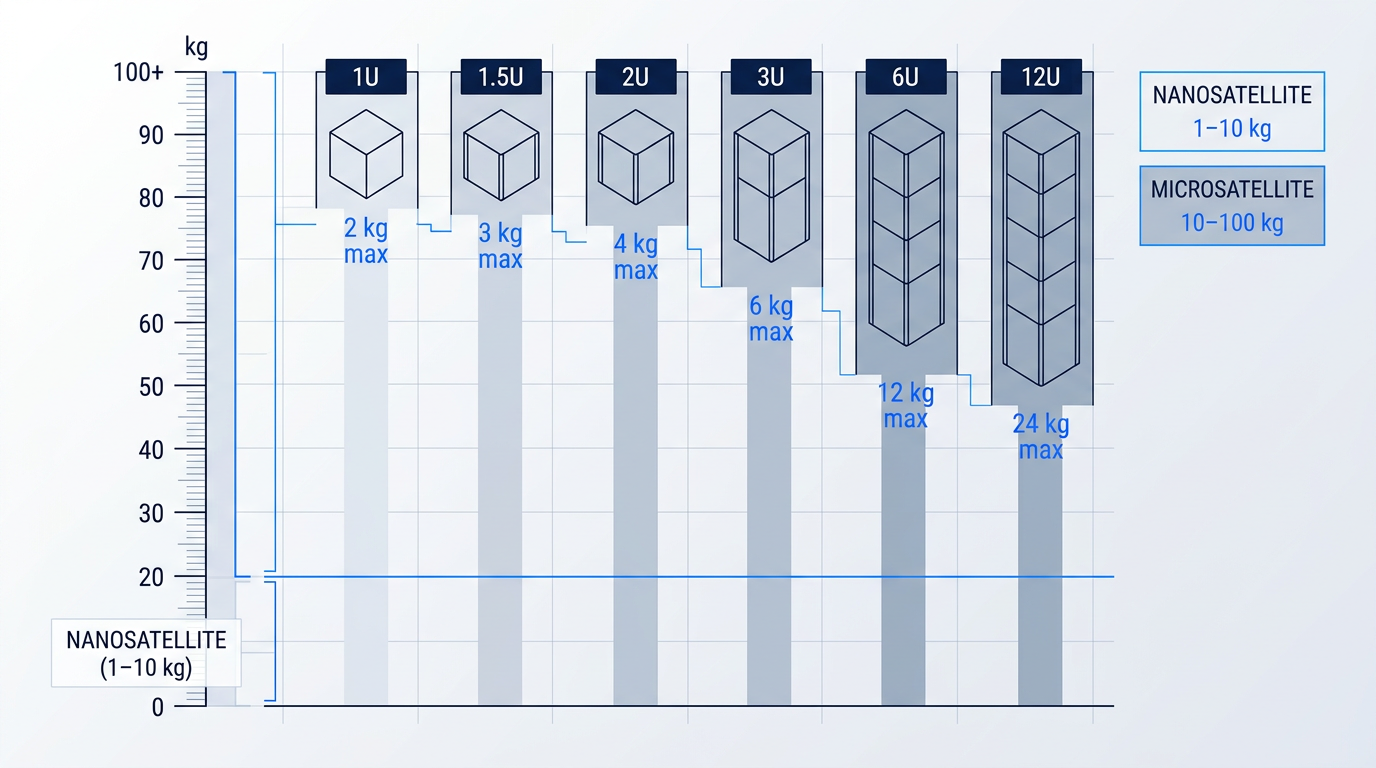
The standard is explicitly scalable. The CubeSat Design Specification covers configurations from 1U through 1.5U, 2U, 3U, 6U, and 12U, with maximum masses of 2 kg, 3 kg, 4 kg, 6 kg, 12 kg, and 24 kg respectively per CDS Rev 14. A 12U CubeSat at up to 24 kg sits squarely within the microsatellite band — the standard has, in practice, grown beyond the nanosatellite class it originally occupied.
The structural reason the CubeSat standard proved so consequential lies in a component that is easy to overlook: the Poly Picosatellite Orbital Deployer (P-POD).
The P-POD is a standardised deployment mechanism developed at Cal Poly. Any spacecraft built to the CubeSat form factor specification can be integrated into a P-POD and share a standardised launch interface with any compatible launch vehicle. Before this existed, an institution wanting to put a small spacecraft into orbit had to negotiate a bespoke mechanical and electrical interface with a launch provider — a significant coordination cost that effectively excluded universities and small research groups. The P-POD removed that negotiation from the equation entirely.
By standardising the deployer interface, the P-POD meant that any CubeSat-compliant spacecraft could share a launch mechanism without bespoke negotiation — the engineering decision that made orbit structurally accessible to institutions without dedicated aerospace infrastructure.
As CubeSat configurations have grown to 6U and 12U, they now span both the nanosatellite and microsatellite mass categories, and the form factor has been adopted well beyond its original university context — by government agencies, commercial operators, and research institutions worldwide.
With the classification framework and the CubeSat standard established, the natural question is how the field arrived at this point — which the next section addresses through the history of small satellite development from the earliest spacecraft through to the commercial constellation era.
The History of Small Satellites: From Sputnik to Constellations
The story of the small satellite is not a straight line from small to large and back again — it is a story of constraint giving way to philosophy, and philosophy giving way to industry.
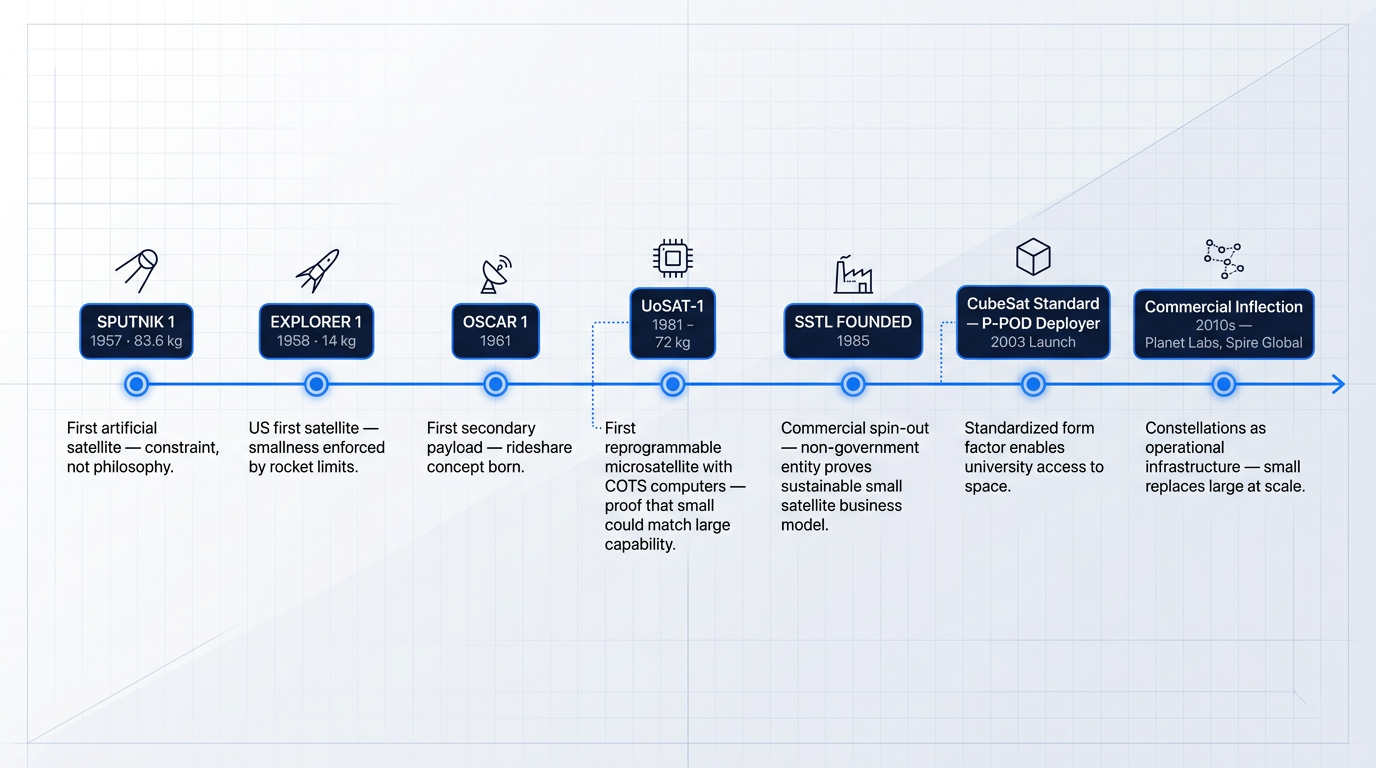
The very first artificial satellites were small not because their designers had a vision for compact spacecraft, but because the rockets of the era could carry very little. Sputnik 1 (1957) weighed just 83.6 kg; Explorer 1 (1958), America's first satellite, weighed only 14 kg. Smallness was a hard engineering constraint imposed by launch vehicle capability — not a design philosophy, not a cost strategy.
As launch vehicles grew more powerful through the 1960s and 1970s, spacecraft masses grew with them, and the prevailing orthodoxy of the era took hold: serious space missions required large, bespoke, long-lifecycle spacecraft built by government agencies and prime contractors.
One quiet exception planted a seed that would matter enormously later. In December 1961, OSCAR 1 — Orbiting Satellite Carrying Amateur Radio — became the first non-governmental satellite to reach orbit and the first spacecraft ever launched as a secondary payload, riding as a piggyback passenger alongside the primary mission on a Thor-Agena rocket. The concept of sharing a launch vehicle with a primary payload, rather than requiring a dedicated rocket, was born here — a structural idea that underpins the entire modern rideshare model.
The Microelectronics Revolution and the Surrey Lineage
The first genuine structural shift in the field came not from a policy decision or a launch programme, but from the electronics industry. The microelectronics revolution of the late 1970s and early 1980s made it possible, for the first time, to equip a small satellite with a reprogrammable onboard computer built from commercial off-the-shelf (COTS) components.
A young researcher named Martin Sweeting at the University of Surrey recognised the opportunity. Working in a makeshift cleanroom constructed in a university laboratory — circuit boards designed by hand on a kitchen table — his team designed and built UoSAT-1, launched in October 1981 with NASA's assistance on a Delta rocket.
UoSAT-1 weighed 72 kg and was the first modern microsatellite with in-orbit re-programmable computers, as well as the first to fly a CCD area array Earth imager. What made it significant was not its instruments alone, but its method: it demonstrated that a capable satellite mission could be built rapidly and cheaply from commercially available parts, outliving its planned three-year operational life by more than five years.
This was a direct challenge to the 'bigger is better' orthodoxy. The prevailing assumption — that serious space missions demanded large, custom-engineered, bespoke spacecraft — had just been contradicted by a small team working in a university building.
Sweeting recognised that research funding alone could not sustain the pace of development this approach required. In June 1985, he founded Surrey Satellite Technology Ltd (SSTL) as a commercial spin-out from the University of Surrey, initially with four employees and a capital of just £100. Its purpose was to transfer the results of Surrey's small satellite research into a commercial enterprise.
SSTL's significance was not merely that a new company had been formed. It was proof of concept: a non-government, non-prime-contractor entity could design, build, and operate capable satellites at a fraction of the cost and development time of traditional programmes — and do so commercially. That proof would take decades to propagate through the industry, but the template had been set.
The CubeSat Standard and the Deployer Insight
The next structural turning point arrived in 1999, when Jordi Puig-Suari at California Polytechnic State University (Cal Poly) and Bob Twiggs at Stanford University created the CubeSat standard — not to build a commercial platform, but to give university students direct, hands-on access to space.
The goal was to produce satellites that could be developed within one to two years at very low cost, in contrast to the microsatellites of the era that cost upwards of $50,000 to develop at Stanford alone. Cal Poly's role was specifically to develop the standardised launcher-interface mechanism: the Poly Picosatellite Orbital Deployer (P-POD), which could hold CubeSats and attach to a wide range of launch vehicles as a secondary payload.
The CubeSat standard's most consequential innovation was not the small size of the spacecraft — it was the standardisation of the deployer interface. By requiring all CubeSats to conform to common physical requirements and share a standard deployer, any institution that built to the spec could share a launch. That is what unlocked mass access to orbit.
The first CubeSats launched in June 2003, and the standard spread rapidly — adopted by hundreds of organisations worldwide, from universities to national space agencies to commercial ventures that would not have been imaginable when Puig-Suari and Twiggs first drew up the specification.
The Commercial Inflection Point: Constellations as Infrastructure
The 2010s brought the commercial inflection point that transformed small satellites from research novelties into operational infrastructure. Planet Labs and Spire Global demonstrated something the field had not yet proven at scale: that constellations of small, low-cost, rapidly iterable satellites could deliver commercially valuable data — Earth observation and weather, maritime, and aviation tracking respectively — at a fraction of the cost of legacy large-spacecraft approaches.
The significance of this was structural, not merely commercial. Planet and Spire were not just new companies; they were a proof of concept for a fundamentally different architecture — many small, cheap, replaceable satellites outperforming fewer large, expensive, long-lifecycle ones for specific applications.
By the end of the 2010s, NASA, NOAA, the US Department of Defense, and the National Reconnaissance Office were all either flying their own CubeSats or purchasing data gathered by commercial smallsat constellations — with the NRO explicitly adopting a 'buy what we can, build what we must' strategy that placed commercial smallsat data at the centre of its intelligence architecture.
When agencies with large budgets and high reliability requirements adopt a technology for operational use, it is the clearest signal the field can produce that the technology has matured. The small satellite had crossed from research novelty to operational infrastructure.
That historical arc — from constraint to philosophy to industry — also bequeathed a set of engineering challenges that define how these spacecraft are designed today, and those constraints are what the next section examines.
Technical Challenges of Small Satellite Design
Shrinking a spacecraft is not simply a scaling exercise — it is a fundamental change in design logic. When mass and volume are constrained, every engineering decision downstream is affected: how much power is available, which propulsion technologies are viable, how much radiation protection can be carried, how heat is managed, and how much data can realistically be sent back to Earth. These constraints do not operate independently; they form an interconnected system where the tightest limit shapes all the others.
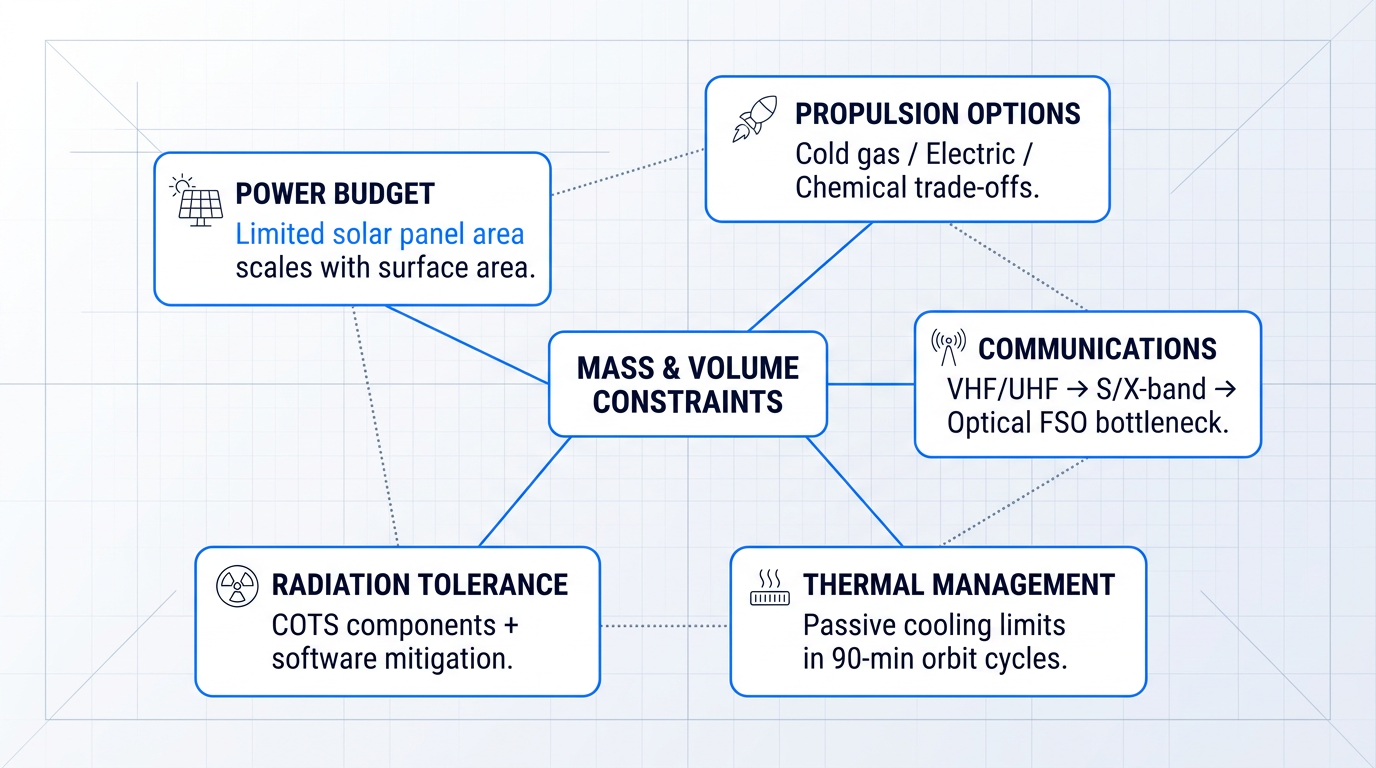
The master constraint is the power budget. Available solar panel area scales directly with spacecraft surface area, which itself scales with mass and volume — a nanosatellite has a fraction of the deployable panel area of a large spacecraft, and its power generation reflects that reality.
This power ceiling is not merely an inconvenience; it is the constraint that makes every other constraint harder to solve. Payloads must be sized to fit within it, propulsion systems must be chosen with it in mind, and the rate at which data can be transmitted is bounded by how much power the radio or optical terminal can draw.
Propulsion Options and Trade-offs
Propulsion choice for a small satellite is never made in isolation — it is tightly coupled to the available power budget, the mission's delta-V requirement, and the constraints imposed by the launch vehicle.
Three propulsion families are available to smallsat designers, each with a different set of trade-offs across performance, power demand, and rideshare compatibility.
- Cold gas thrusters: Simple and flight-proven on CubeSats, but low specific impulse limits the total delta-V achievable — suitable for attitude control and small orbit adjustments.
- Electric propulsion: Electrospray, RF ion, and electrothermal systems offer far higher specific impulse, but require sustained electrical power and long burn times, looping directly back to the power budget constraint.
- Chemical propulsion: Higher thrust than electric options, but high-pressure systems and hazardous propellants are typically prohibited on rideshare missions for safety reasons, limiting access.
The practical consequence is that no propulsion option is simply 'better' — each involves a trade-off between performance and the constraints the mission must live within. Electric propulsion's efficiency advantage is only realisable if the spacecraft's power budget can sustain it; cold gas systems sidestep that problem but sacrifice range; chemical systems offer thrust but are frequently ruled out at the launch vehicle level.
Radiation Tolerance and Thermal Management
Mass constraints prevent smallsats from carrying the heavy radiation shielding that large spacecraft rely on, so designers deliberately choose COTS (commercial off-the-shelf) components rather than radiation-hardened hardware — accepting a higher susceptibility to single-event upsets and total ionising dose effects in exchange for dramatically lower cost and faster development cycles.
This is compensated at the software level through techniques such as watchdog timers and memory scrubbing, which detect and correct the transient faults that COTS components experience more frequently in the radiation environment of low Earth orbit.
Using COTS components instead of radiation-hardened hardware is a conscious engineering decision: accepting a higher probability of component-level failures in exchange for lower cost and faster development. For constellations with redundancy built into the system architecture, this trade-off is often the rational choice.
Thermal management presents a related challenge: the small volume of a compact spacecraft limits passive thermal control options that large spacecraft take for granted, such as oversized radiator panels and substantial thermal mass to buffer temperature swings.
In low Earth orbit, where an orbital period is roughly 90 minutes, the spacecraft cycles between full solar illumination and eclipse on a continuous basis — a demanding thermal environment that intensifies as payloads become more power-hungry and generate more waste heat.
Communications: From RF Bands to Optical Links
Early CubeSat communications were dominated by VHF and UHF bands, using simple whip antennas that required minimal pointing precision and drew little power — adequate for housekeeping telemetry, but far too narrow for high-volume data return.
As mission ambitions grew, the industry shifted toward S-band and X-band frequencies, gaining meaningful bandwidth at the cost of stricter pointing requirements and greater sensitivity to atmospheric attenuation.
As smallsat constellations scale and aggregate data volumes increase, even higher RF bands are approaching a genuine bottleneck: spectrum is both technically limited and heavily licensed, creating congestion that cannot be resolved simply by moving to a higher frequency.
Free-space optical (FSO) communications at 1550 nm represent the logical path beyond that bottleneck, offering throughput that RF links cannot match and sidestepping congested, licensed spectrum entirely — but they introduce their own ground segment engineering challenges around pointing, atmospheric turbulence, and evolving link standards.
The standards environment for optical ground links is still maturing: CCSDS and SDA protocols are both in active use, and ground infrastructure committed to a fixed configuration at manufacture faces re-procurement costs as standards shift.
Software-definable ground station hardware addresses this directly — components that can be reconfigured across modulation standards, wavelength, and beacon or data modes protect long-term programme investment against standards evolution.
Woodrow Scientific's EDFA for satellite ground links is a concrete example of this design philosophy in practice: it nests the tracking beacon and uplink data in a single amplified beam, with the beacon riding low and the data above it — a capability that simplifies ground station architecture considerably.
Both the hardware build and the control layer are configured to the client's ground station: band (C-band, L-band, or dual-band), output power, emitter diversity, and cooling are set at the physical level, while Woodrow Scientific's Modulation-on-Demand system provides software-selectable waveforms, frequency, and modulation index — switchable between CCSDS and SDA standards at full power.
Woodrow Scientific designs, builds, qualifies, and supports the amplifier entirely in-house on patented technology, with engineering expertise rooted in Southampton's Optoelectronics Research Centre — the birthplace of the EDFA.
This matters in a market where many suppliers are resellers or importers rather than manufacturers: without in-house engineering, support is slower, spares take longer, and there is no capacity to adapt the product as programme requirements change. CE and UKCA certified, the amplifier is supplied to ground station integrators worldwide.
The broader principle here extends beyond any single component: across the constraint landscape of compact spacecraft design, reconfigurability is a practical response to uncertainty, not a luxury. Hardware locked to a single configuration at manufacture — whether on the spacecraft bus or in the ground segment — becomes a liability as mission requirements evolve and standards shift.
With the engineering constraints of compact spacecraft now mapped, the next section turns to where those constraints lead in practice: the applications that smallsat capabilities are well-suited to serve, and why.
What Small Satellites Are Used For
The constraints covered in the previous section — limited power, constrained propulsion, narrow bandwidth — might suggest that small satellites are simply cut-down versions of larger spacecraft, doing the same jobs less well. The reality is more interesting: those constraints, combined with low unit cost and rapid deployment, make smallsats genuinely superior for a specific class of problem where the answer is more nodes, not a bigger one.
Earth Observation: Revisit Frequency Over Resolution
Earth observation is where the smallsat architecture makes its most compelling case, and the logic is worth understanding precisely.
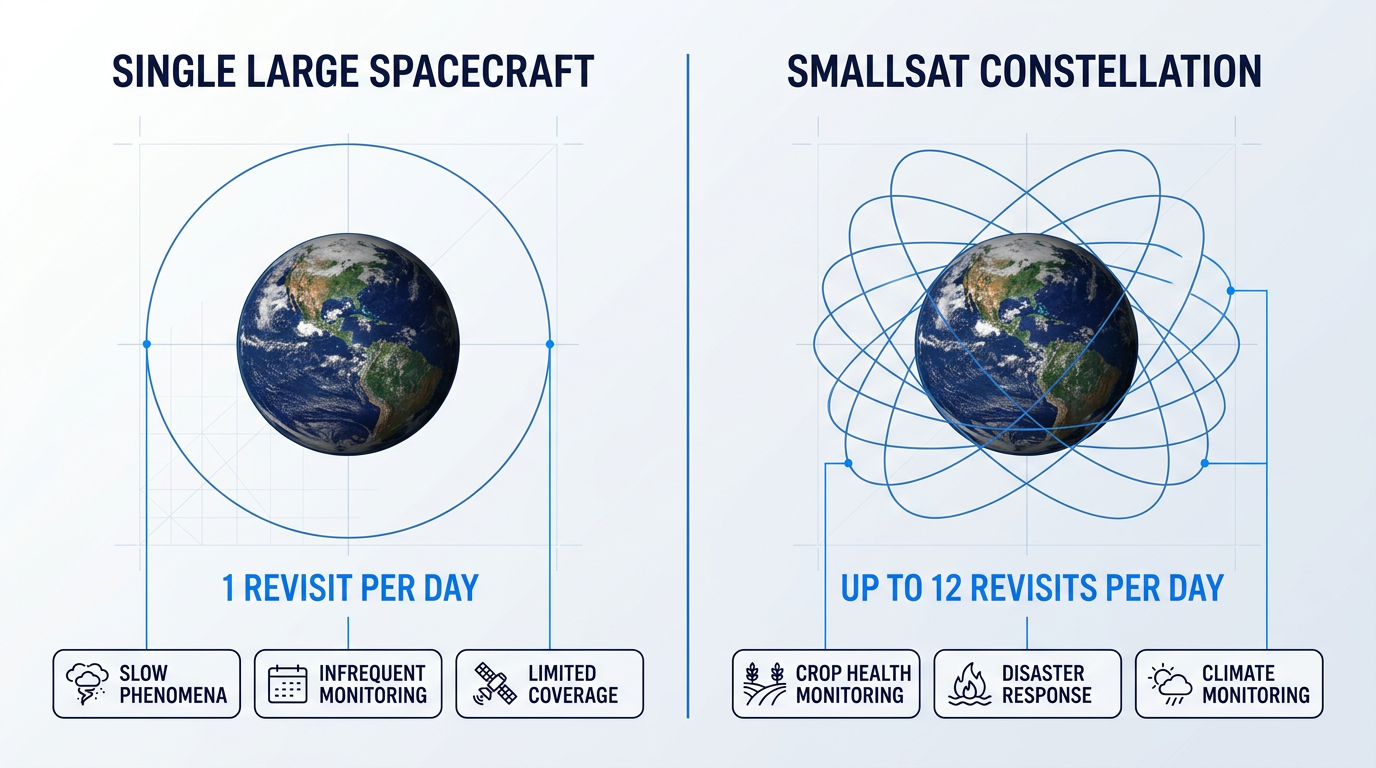
A single large spacecraft in low Earth orbit passes over any given point on the ground at most once per day — often less, depending on its orbital inclination and the target's latitude. That cadence is adequate for slow-moving phenomena, but it is a serious limitation when the thing you are trying to monitor changes faster than the satellite revisits.
A constellation of dozens of smallsats distributed across multiple orbital planes can revisit the same location multiple times daily, or even multiple times within a single day. Planet's SkySat constellation, for example, is capable of imaging the same location up to 12 times per day at 50 cm resolution, with an average of around 7 revisits per day globally.
The applications that benefit from this are those driven by temporal change detection rather than peak spatial resolution: crop health and irrigation monitoring, where a field can change state within days; wildfire and flood progression mapping, where hours matter; urban construction and infrastructure monitoring; and climate-related land cover change detection across large areas.
Planet's broader SuperDove constellation — the world's largest commercial Earth observation fleet — provides near-daily 3-metre coverage of the entire planet's landmass, enabling the kind of continuous global monitoring that was previously impossible for any single spacecraft.
The conceptual shift Planet illustrates is from satellite-as-camera to constellation-as-camera: the instrument is not a single spacecraft but the coordinated network, and the value proposition is the data stream it produces rather than any individual image.
Communications Constellations: Latency and Economics
The structural argument for smallsats in communications is different from Earth observation, but equally precise.
A geostationary satellite sits at approximately 35,786 km above the equator. At that distance, the round-trip signal delay — even at the speed of light — is around 600 ms. LEO satellites operating at 500–1,200 km reduce that round-trip latency to roughly 20–40 ms, comparable to many terrestrial broadband connections and low enough to support video calls, real-time applications, and latency-sensitive services that GEO connectivity cannot reliably handle.
The catch is coverage: a single LEO satellite passes over any ground station for only a few minutes per orbit, so continuous service requires a large number of spacecraft distributed to ensure that at least one is always above the horizon from any point on Earth.
This is where the economics of mass-produced smallsats become decisive. Starlink and OneWeb — whose initial constellation is authorised for 648 satellites — are both built on the premise that driving down per-unit manufacturing cost makes it viable to deploy hundreds or thousands of spacecraft to achieve continuous global coverage.
| Parameter | GEO Satellite | LEO Smallsat Constellation |
|---|---|---|
| Orbital altitude | ~35,786 km | 500–1,200 km |
| Round-trip latency | ~600 ms | ~20–40 ms |
| Satellites for global coverage | 3–4 (near-global) | Hundreds to thousands |
| Key connectivity advantage | High capacity to dense areas | Low latency, polar and remote coverage |
Comparison of GEO and LEO smallsat constellation characteristics to illustrate why the LEO architecture suits applications requiring low latency and remote coverage.
The table makes the trade-off clear: no single LEO smallsat outperforms a GEO satellite. It is the constellation that wins — on latency, on polar and maritime coverage, and on the ability to serve remote regions that terrestrial fibre cannot reach economically. The per-unit cost of the spacecraft is what makes building that constellation financially viable.
Scientific Research: The Constellation as Instrument
The most conceptually distinctive application of small satellites in science is one that has no equivalent in the large-spacecraft world: the constellation as a distributed instrument.
Some physical phenomena require simultaneous measurements from multiple points in space. No single spacecraft, however capable, can be in two places at once. A constellation of smallsats can.
NASA's CYGNSS mission illustrates this directly. Eight microsatellites measure ocean surface wind speeds inside tropical cyclones by receiving GPS signals reflected off the ocean surface — a technique called GPS reflectometry. A single spacecraft on this orbit would revisit any given storm only occasionally; the eight-satellite constellation achieves a median revisit time of around three hours, sufficient to track the rapid intensification that makes hurricanes so difficult to forecast.
NASA's TROPICS mission applies the same logic to tropical storm thermodynamics: four CubeSats in inclined low Earth orbits provide microwave radiometry measurements of storm temperature, humidity, and precipitation structure with a revisit rate of roughly one hour — compared to the 6–12 hours typical of conventional science satellites. That cadence is what allows the mission to observe a storm's full lifecycle, including rapid intensification events that unfold over hours.
NASA's PUNCH mission takes the concept further still. Four smallsats are synchronised to act as a single virtual instrument with a 90-degree field of view centred on the Sun, continuously imaging the corona's transition to the solar wind. The four-spacecraft architecture is not a cost compromise — it is a physical requirement, because Earth blocks roughly half the view of the inner solar system from any single orbital position.
NASA's planned HelioSwarm mission extends this architecture to nine spacecraft — one hub and eight co-orbiting smallsats — to capture the first simultaneous multi-point measurements of solar wind turbulence across different spatial scales. The science question it is designed to answer cannot be addressed by any single spacecraft at all.
The unifying principle across these missions is that the measurement architecture is the innovation, not just the spacecraft. Smallsats make these architectures affordable enough to propose and fund.
Technology Demonstration: Iterative Risk-Taking
CubeSats have become the standard vehicle for technology demonstration — flight-testing new hardware, software, and techniques before committing them to expensive flagship missions.
The logic is asymmetric risk. A technology failure on a $500k CubeSat is a learning outcome; the same failure on a $500M flagship mission is a programme-ending event. The low cost and short development cycle of CubeSats permit an iterative, test-and-learn approach to maturing new technologies in the actual space environment — something ground testing alone cannot fully replicate.
NASA's CubeSat Launch Initiative (CSLI) has formalised this pathway, launching 162 CubeSats to date from over 100 organisations, the majority of them educational institutions. Missions have demonstrated drag-sail deorbit systems, hyperspectral imagers, quantum gyroscopes, and high-rate X-band communications downlinks — technologies that feed directly into future operational missions.
IoT and M2M Connectivity: Constraints as Features
The final application domain inverts the usual framing: here, the technical limitations of nanosatellites are not a problem to be engineered around — they are a natural fit for the application's requirements.
IoT and machine-to-machine (M2M) sensors — asset trackers, environmental monitors, pipeline sensors, maritime transponders — transmit small data packets infrequently. They do not need broadband; they need reliable global reach. Nanosatellites, with their constrained power budgets and bandwidth, are well-matched to exactly that requirement.
Spire's LEMUR constellation is the clearest example. Each LEMUR is a 3U or 6U CubeSat carrying an AIS receiver for ship tracking, an ADS-B receiver for aircraft monitoring, and a GPS radio occultation payload for weather data — three distinct sensing functions on a single nanosatellite platform flying at 400–650 km altitude.
The AIS and ADS-B payloads work because maritime and aviation transponders transmit short, standardised messages at regular intervals. Receiving those messages from orbit and relaying them to ground stations gives operators global situational awareness over oceans and remote regions where terrestrial receivers have no coverage.
Small satellites are not universally superior to large spacecraft. They trade raw capability per unit for cost, deployment speed, and the ability to field multiple nodes. The applications where they excel — Earth observation, LEO broadband, distributed science, IoT connectivity — are precisely those where coverage, revisit frequency, or simultaneous multi-point measurement matters more than peak resolution or power.
Knowing what smallsat constellations are used for is only part of the picture — the next question is how those constellations are structured to deliver continuous coverage, and how the launch landscape has evolved to make deploying hundreds of spacecraft economically viable.
Constellation Architecture and Launch Strategy
A single small satellite in low Earth orbit passes over any given point on the ground for roughly 10 to 20 minutes per orbit — then it is gone, racing on to the next revolution. For applications that require persistent or near-continuous coverage, that fleeting window is the fundamental engineering problem that constellation design exists to solve.
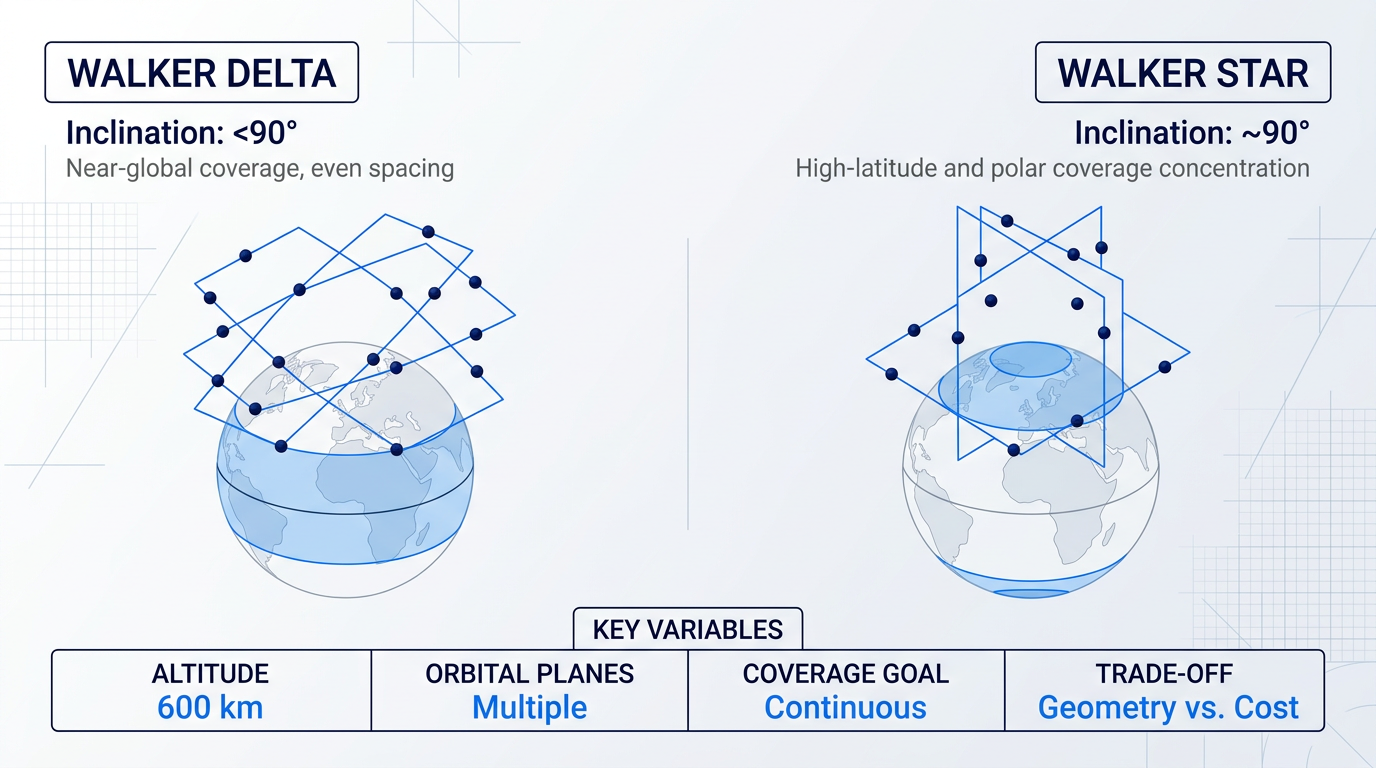
The solution is geometric: distribute enough satellites across enough orbital planes so that at least one spacecraft is always in view of any target on the ground. At 600 km altitude, analysis of Walker constellation patterns suggests that achieving continuous global coverage requires on the order of 56 or more spacecraft spread across multiple complementary planes — a figure that rises or falls depending on the coverage latitude, minimum elevation angle, and acceptable revisit gap.
Constellation designers work with two principal geometric frameworks. The Walker Delta pattern distributes satellites across orbital planes at inclinations below 90°, providing strong near-global coverage with relatively even spacing. The Walker Star pattern uses near-polar inclinations close to 90°, concentrating coverage at high latitudes and the poles — well suited to Arctic monitoring or polar-orbit Earth observation missions.
The four variables that shape any constellation are altitude, inclination, number of orbital planes, and number of satellites per plane. Each is a trade-off lever: higher altitude extends the ground footprint of each satellite (reducing the total number needed) but increases signal latency and radiation exposure; more orbital planes improve coverage geometry but add launch complexity and cost.
Revisit time, coverage continuity, and end-to-end data latency are all downstream consequences of these geometric choices — which is why constellation design cannot be separated from mission requirements. A broadband LEO constellation optimises for latency above all else; an Earth observation constellation may accept longer revisit gaps in exchange for a smaller spacecraft count.
As constellations grow larger, inter-satellite links (ISLs) become an increasingly important architectural feature. Rather than routing all data through ground stations, ISLs allow satellites to relay traffic directly to one another across the constellation, enabling low-latency global data delivery without requiring a dense ground station network — a capability that is particularly significant for large LEO broadband constellations where end-to-end latency is a core competitive parameter.
Getting Constellations to Orbit
Understanding why constellations are structured the way they are is only half the picture. The other half is getting dozens or hundreds of spacecraft to precisely the right orbits, affordably and on a reliable schedule — and this is where the launch landscape has undergone one of the most significant structural shifts in the history of commercial space.
Before the emergence of dedicated rideshare programmes, smallsat operators faced a difficult reality: launch slots were negotiated individually, often as secondary payloads on larger missions with schedules driven by the primary customer. Delays were common, orbital parameters were fixed by the primary mission, and the combined cost and uncertainty made rapid constellation deployment extremely difficult for all but the best-capitalised operators.
SpaceX's Transporter rideshare programme changed that calculus fundamentally. Each Transporter mission carries 70 to 130 or more payloads per flight, spreading launch costs across a large manifest and bringing the per-kilogram price to sun-synchronous orbit down to levels that made constellation deployment viable for a much wider range of operators. According to SpaceNews, SpaceX's rideshare pricing put sustained downward pressure on the broader smallsat launch market — a structural effect that extended well beyond SpaceX's own customers.
The impact was not purely about price. Rideshare gave operators a predictable, published schedule — a structural shift that allowed constellation programmes to plan deployment sequences with a confidence that had not previously existed at this price point. Launch, for sun-synchronous orbit missions at least, moved closer to a commodity than a bespoke negotiation.
Rideshare is, however, a bus: it departs on a fixed schedule, to a fixed orbit, with a fixed inclination. For operators who need to reach a specific orbital altitude, a precise inclination, or a particular right ascension of ascending node — or who simply cannot wait for the next scheduled Transporter window — rideshare is the wrong vehicle.
This is where dedicated smallsat launchers earn their premium. Rocket Lab's Electron rocket is the leading example of a vehicle purpose-built for this market, offering full operator control over the orbital destination, launch timing, and schedule. The operator books a taxi rather than a bus — they go where they need to go, when they need to go there, without sharing the ride or the route.
The taxi-versus-bus trade-off is ultimately a question of mission requirements. Operators deploying into a standard sun-synchronous orbit on a flexible timeline will almost always find rideshare the more economical path. Operators building constellations that require specific orbital planes — or racing to fill a gap in an existing deployment — may find that the premium for a dedicated launch is justified by the mission certainty it provides.
India's PSLV (Polar Satellite Launch Vehicle) occupies a distinct position in this landscape as one of the most internationally used platforms for smallsat co-passenger missions, with a long record of carrying foreign payloads alongside primary Indian missions. ISRO's newer SSLV (Small Satellite Launch Vehicle) targets the nano, micro, and mini satellite segment specifically, designed for fast turnaround and positioned toward launch-on-demand capability — offering a middle ground between the large rideshare manifest and the fully dedicated launcher.
For a large spacecraft costing hundreds of millions to build, launch is a real but secondary budget line. For a smallsat programme where the spacecraft itself may cost only tens of thousands to hundreds of thousands of dollars, launch can represent the single largest cost in the mission — which is precisely why the rideshare revolution was a structural unlock for the smallsat industry, not merely a pricing improvement.
The shift in launch economics has done more than reduce costs — it has structurally changed who can contemplate building and operating a constellation. That broadening of access is the subject of the next section, which examines how reduced barriers to orbit, combined with standardised spacecraft platforms, have opened space to a far wider range of operators than the industry once considered possible.
Democratisation and the Standardised Platform Economy
The story of how space became accessible to universities, startups, and developing nations is not a story about costs falling in some general sense. It is a story about a specific engineering decision: the CubeSat form factor, combined with the P-POD deployer and rideshare launch, converted the barrier to orbit from "design a spacecraft and negotiate a bespoke launcher interface" into "build to a known specification and procure a launch slot."
That distinction matters. CubeSat co-inventor Jordi Puig-Suari put it directly in a SpaceNews interview: once the price dropped dramatically, entities — companies, countries, schools — that would never have considered launching a spacecraft on their own gained access to space. The mechanism was standardisation, not a generalised market trend.
Three institutional programmes, each built around the CubeSat standard, provide concrete evidence that this structural shift is real. A national space agency, a regional space agency, and a UN body have each independently constructed pathways that route educational and research institutions from concept to orbit.
- NASA CubeSat Launch Initiative (CSLI): Has launched over 160 CubeSats from US educational institutions and non-profits across more than 40 ELaNa missions, covering launch and integration costs up to $300K per award.
- ESA Fly Your Satellite: Guides European university teams through design, build, test, and launch phases, providing ESA specialist support, access to state-of-the-art test facilities, and a launch opportunity for qualifying teams.
- UNOOSA/JAXA KiboCUBE: Enables research institutions in developing countries to deploy 1U CubeSats from the ISS Kibo module at no launch cost, with JAXA bearing transportation and deployment expenses.
What these three programmes share is not simply funding — it is a shared technical substrate. Because all three are built around the CubeSat standard, a team in Nairobi, a university in Dublin, and a lab in California are all working within the same engineering envelope, with compatible deployers and compatible launch interfaces.
The developing-nation dimension of KiboCUBE deserves explicit acknowledgement. Through the programme, CubeSats developed by teams from Kenya, Guatemala, Mauritius, Indonesia, and Moldova have been deployed from the ISS — in several cases representing those countries' first national satellites. This is a genuine shift in who participates in space, not merely who benefits from it.
From Access to Scale
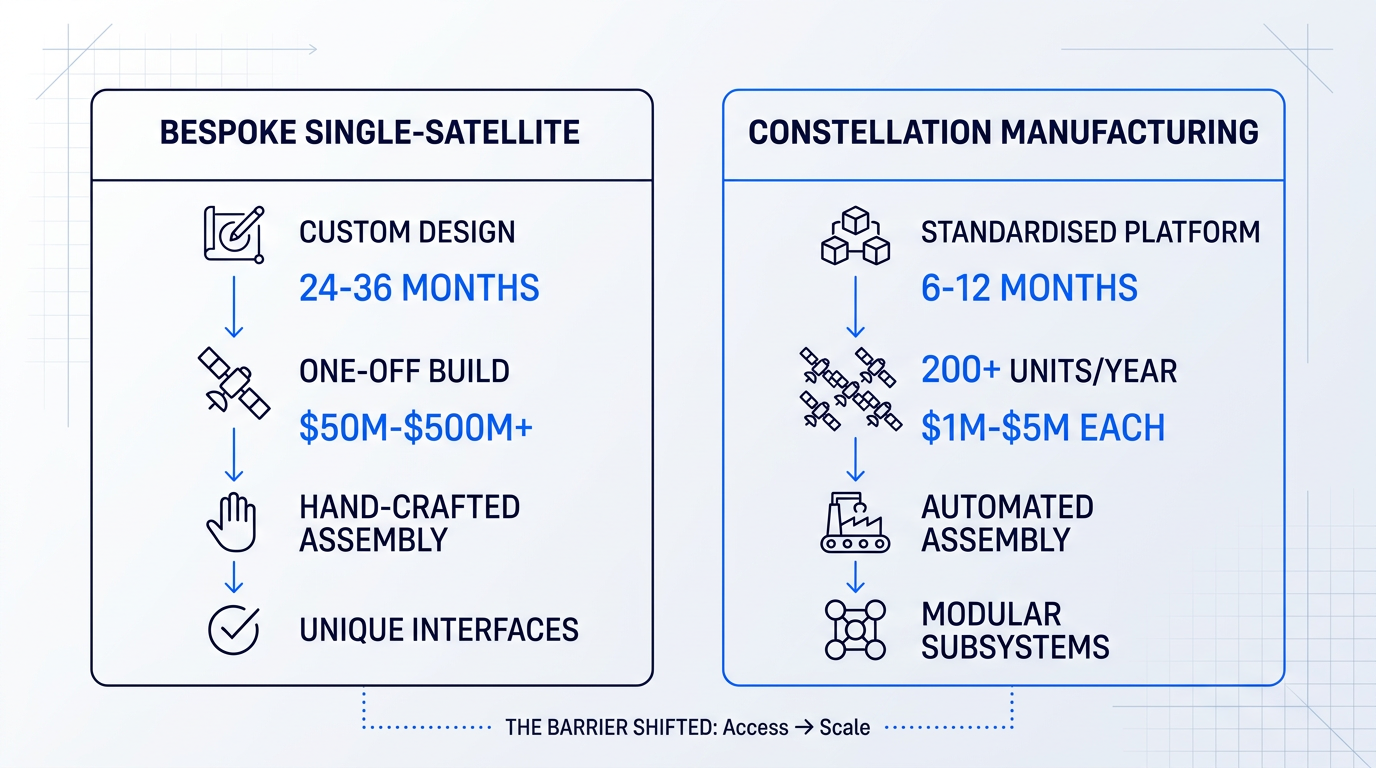
Establishing that standardisation opened access is only half the structural argument. The other half is harder: building one bespoke small satellite is a solved problem; building 600 identical satellites for a constellation at competitive cost is not.
Constellation-scale production requires standardised platforms, modular subsystems, automated assembly, and supply chain management at industrial volume. The barrier has not disappeared — it has shifted from access to orbit to production at scale. The same forces that democratised access (standardisation, COTS components, rideshare launch) are now the foundation of a different, harder engineering and industrial problem.
Several leading operators have developed distinct industrial models in response. Planet's agile aerospace approach centres on iterative design, just-in-time manufacturing, and vertical integration: the company builds multiple satellite systems simultaneously in its San Francisco facility, applying short design-and-validation cycles rather than locking in technical components years before launch. Planet's first-party documentation describes the philosophy as "fail fast, iterate quickly" — prioritising learning speed over perfection in any single satellite generation.
Spire Global's approach at its Glasgow facility emphasises serial manufacturing discipline. The 3,000 m² site is ISO 9001:2015-certified and designed specifically for constellation-scale throughput, with documented annual capacity for the design, manufacture, and testing of 200+ satellites.
The most striking example of industrial-scale production came from the Airbus/OneWeb Satellites joint venture, whose factory was engineered from the outset around mass-production assembly lines capable of producing two satellites per day at peak output — a rate explicitly compared by its developers to aviation and automotive manufacturing methods. The CNES documentation describes the approach as taking its cue from the business model Henry Ford applied to car production in 1910.
These three examples illustrate distinct industrial approaches to the same underlying challenge. They are leading cases, not proof that the problem is universally solved: the industry as a whole is still navigating the transition from craft-built spacecraft to factory-scale production.
The funding gap for research-oriented missions is the honest counterweight to the democratisation narrative. COTS components and CubeSat platforms have lowered the cost floor, but a scientifically capable mission still requires significant funding that many universities and developing-nation agencies cannot sustain without external support. The National Academies' reports on science mission cost structures consistently show that even cost-capped small science missions require tens to hundreds of millions of dollars — well beyond what most academic institutions can self-fund.
Access has opened; it has not become free. The programmes described above provide launch cost relief, but applicant teams remain responsible for funding all satellite development. For an institution without an established space engineering infrastructure, that development cost is the binding constraint.
For a constellation operator with 100 nodes, a single satellite failure is a minor event — redundancy absorbs it. For a university team running a single-mission science spacecraft, the same COTS reliability trade-off becomes mission-ending. The same component philosophy that makes constellation economics work can make single-mission science unacceptably risky.
This tension is structural, not incidental. As covered in the Technical Constraints section, COTS components lower cost and development time but introduce radiation tolerance and reliability risks. At constellation scale, operators design redundancy in from the start, making individual node failures an acceptable operational variable. For a single-mission science spacecraft — where there is no redundant node to absorb a failure — the same trade-off becomes existential.
The proliferation of actors and satellites that standardisation and industrial-scale manufacturing have enabled carries its own consequences: more objects in orbit means more pressure on spectrum allocation, orbital slot coordination, and debris mitigation frameworks — the governance and sustainability challenges that the next section addresses directly.
Regulation, Spectrum Coordination, and Orbital Sustainability
Every operator placing a small satellite into low Earth orbit inherits two sets of constraints that no amount of engineering ingenuity can engineer away: the rules governing who gets to use which radio frequencies, and the physical consequences of adding another object to an already crowded orbital environment. As the pace of constellation deployment has accelerated, both constraints have sharpened from background considerations into active, present-day operational realities.
ITU Spectrum Coordination
Radio spectrum is a finite shared resource managed under international treaty, and every satellite that transmits or receives must have its frequency assignments registered with the ITU Radiocommunication Bureau — this is a mandatory regulatory obligation, not an optional process.
The procedural arc begins with an Advance Publication Information (API) filing, which gives other administrations early notice of the planned satellite network. From there, the operator moves through coordination — bilateral negotiations with any administration whose existing systems might be affected — and finally to notification and recording in the Master International Frequency Register (MIFR). According to ITU documentation, the full process can take anywhere from nine months to seven years, depending on the complexity of the interference scenario and congestion in the requested bands.
The system operates on a first-come, first-served principle: priority is determined by the date of receipt of a filing, which means operators planning large constellations have strong strategic incentives to file early, even if deployment is years away.
That incentive, left unchecked, produces a problem known as spectrum warehousing — where operators file for frequencies and orbital resources they have no near-term intention of using, effectively blocking others from accessing those bands. The 2019 World Radiocommunication Conference (WRC-19) addressed this directly by adopting a milestone-based deployment framework for non-geostationary satellite (NGSO) systems in specific frequency bands and services.
- Milestone 1: 10% within 2 years: At least 10% of the total constellation must be deployed within two years of the end of the seven-year regulatory period for bringing the system into use.
- Milestone 2: 50% within 5 years: At least 50% of the constellation must be deployed within five years of that same regulatory deadline.
- Milestone 3: 100% within 7 years: Full constellation deployment must be completed within seven years. Failure to meet a milestone results in the filing being reduced to reflect actual deployment.
These milestones are not penalties for slow operators — they are a mechanism to ensure the MIFR reflects actual deployment rather than speculative filings. For operators planning constellations of hundreds or thousands of satellites, they impose a real deployment cadence that must be factored into manufacturing and launch planning from the outset.
Congestion in heavily used bands — particularly the Ka and Ku bands favoured by broadband constellations — means that inter-constellation interference is an active regulatory challenge. Coordination between competing operators is an ongoing obligation, not a one-time hurdle cleared before launch.
National Licensing: The Pre-Launch Gate
ITU coordination is conducted by national administrations on behalf of operators; operators themselves must first obtain authorisation from their own national regulator. In the United States, the FCC requires authorisation before any satellite transmits or receives in US-licensed frequency bands. The Commission currently authorises satellites through three tracks: commercial operations under Part 25, experimental operations under Part 5, and amateur service satellites under Part 97.
In 2019, the FCC created an additional optional pathway specifically tailored to the small satellite sector. The streamlined small satellite process — established under Part 25 — is available to operators whose satellites meet qualifying criteria: a maximum individual satellite mass of 180 kg (including propellant), a maximum in-orbit lifetime of six years per satellite, no more than ten satellites under a single licence, and deployment below 600 km altitude or demonstrated propulsion capability for collision avoidance and deorbit.
Satellites qualifying under this process benefit from lower application fees, shorter processing times, and exemption from certain procedural requirements that apply to larger commercial systems — making it a meaningful reduction in regulatory friction for legitimate small satellite operators. Readers who need specific licensing guidance should consult the FCC Space Bureau directly, as requirements are subject to revision.
In the United Kingdom, Ofcom acts as the notifying administration, submitting and managing all satellite filings to the ITU on behalf of UK-registered operators. Ofcom also licences ground stations — including gateway earth stations and user terminal networks operating with non-geostationary satellites — under its own authorisation framework. Operators in other jurisdictions face equivalent national regulatory gates; a comprehensive survey is beyond this guide's scope, but the principle is universal: no launch without national authorisation, and no spectrum use without ITU registration.
The Orbital Debris Challenge
Approximately 40,000 objects are currently tracked in orbit by space surveillance networks. But tracked objects are not the dangerous ones: ESA's debris modelling estimates that over 1.2 million objects larger than 1 cm exist in orbit — large enough to cause catastrophic damage to an operational satellite — yet too small to be tracked by current radar systems.
The density problem is sharpest in the most commercially attractive altitude bands. ESA's MASTER debris modelling tool shows that around 550 km altitude — the operational shell favoured by major broadband constellations — the number of debris objects posing a collision threat is now on the same order of magnitude as the number of active satellites. Collision risk at these altitudes is a genuine operational concern, not a theoretical one.
The long-term systemic risk is captured by the concept of Kessler syndrome: a self-sustaining cascade in which one collision generates debris that causes further collisions, which generate more debris, at a rate faster than natural orbital decay removes objects from the environment. Once initiated in a sufficiently dense orbital regime, this cascade could render that altitude band effectively unusable for generations. The physics of this process — first described by NASA scientist Donald Kessler in 1978 — is what motivates the regulatory tightening that has followed.
- IADC 25-year guideline: The long-standing international benchmark: satellites in LEO should deorbit within 25 years of mission completion, with a disposal success probability of at least 90%.
- FCC 5-year rule (2022): The FCC now requires LEO satellites launched after September 2024 to complete post-mission disposal within five years of end of mission.
- ESA 5-year standard: ESA's updated Space Debris Mitigation Requirements reduce the maximum LEO disposal phase from 25 years to five, with cumulative collision probability below 1-in-1,000.
- ODMSP reliability targets: The US Orbital Debris Mitigation Standard Practices require post-mission disposal reliability of at least 90%, with a goal of 99% or better for large constellation operators.
- ESA Zero Debris approach: ESA's goal of net-neutral debris contribution by 2030: missions must be designed so no net new trackable debris is added to the orbital environment.
The shift from the 25-year guideline to a 5-year standard is not a minor administrative revision — it is a fundamental change in what responsible mission design looks like. A satellite that deorbits within five years spends a fraction of the time in a congested shell compared to one that lingers for two decades, dramatically reducing its contribution to the cumulative collision probability that the Kessler cascade feeds on. Operators whose mission architectures were designed around the old 25-year benchmark are now behind the regulatory curve.
Operators who design for controlled re-entry from the outset, maintain onboard propulsion for deorbit manoeuvres, and ensure their spacecraft are trackable throughout their lifetime are not simply meeting regulatory requirements — they are doing better engineering. The standards exist because the physics of debris accumulation is unforgiving; designing to exceed them is the mark of a programme that takes the long-term usability of orbital regimes seriously.
The same logic applies to spectrum. Ground infrastructure designed for multi-standard compatibility has long-term operational value precisely because the ITU coordination process exists to manage a genuinely limited shared resource — one that grows more contested with every new constellation filing.
With the regulatory and sustainability landscape now covered — from ITU filing procedures and national licensing gates through to debris mitigation standards and the engineering responsibility they encode — the final section draws together the threads of where the small satellite field stands today and the directions in which it is heading.
Conclusion
The Small Satellite Field: Where It Stands Now
The shift from bespoke, one-off spacecraft to mass-produced constellation infrastructure is the most consequential structural change the field has seen — and it happened, by historical standards, very quickly.
What the field has not resolved is just as telling: orbital debris accumulation, spectrum coordination at scale, and the persistent funding gap for research-oriented missions remain genuinely open problems, not temporary frictions.
The direction the evidence points is towards software-definable, modularly manufactured spacecraft — but the governance frameworks needed to sustain that trajectory are still catching up.
Small Satellites: Frequently Asked Questions
Answers to the most common questions about small satellite technology, classifications, orbital lifetimes, and access programmes.
Small satellites are grouped into five mass-based subcategories: femtosatellite (0.001–0.01 kg), picosatellite (0.01–1 kg), nanosatellite (1–10 kg), microsatellite (10–100 kg), and minisatellite (100–180 kg). These categories are used by NASA and other space agencies to classify spacecraft by wet mass. Within the nanosatellite class, the CubeSat has become by far the most widely recognised name in the field. A CubeSat is not a mass class but a standardised form factor — the base unit, known as a 1U, measures 10 cm × 10 cm × 10 cm and can be combined into larger configurations such as 2U, 3U, and 6U. The CubeSat standard has done more than any other development to make small satellite technology accessible to universities, research institutions, and emerging space programmes worldwide.
The smallest recognised category in the standard mass-based classification framework is the femtosatellite, defined as a spacecraft with a total mass of 0.001–0.01 kg (1–10 grams). This represents the theoretical lower bound of the smallsat taxonomy as adopted by NASA. In practice, femtosatellites — sometimes called ChipSats — remain a research-stage concept. Development and launch attempts are underway, but femtosats have not yet entered the marketplace as a regularly deployed class. The smallest category that is routinely and reliably launched is the picosatellite, which includes 1U CubeSats weighing approximately 1 kg. These are the entry point for most university and educational missions, and have been successfully deployed in large numbers from the International Space Station and dedicated rideshare launches.
Most commercial small satellites are designed for operational lifetimes in the range of three to five years, though some scientific missions are built to operate for longer. The actual time a satellite remains in orbit after its mission ends depends significantly on altitude. According to NASA's Small Spacecraft Technology State of the Art report, spacecraft at altitudes below approximately 400 km will naturally decay and re-enter the atmosphere within five years through atmospheric drag alone. At higher LEO altitudes, passive decay takes considerably longer and may not occur within any operationally useful timeframe without active deorbit capability. Regulators have responded to this with stricter disposal requirements. The FCC adopted a rule in September 2022 requiring all LEO satellite operators to deorbit their spacecraft within five years of mission completion — replacing the previous 25-year guideline that had been in place for decades. ESA has adopted an equivalent standard under its Zero Debris Approach, which similarly limits post-mission orbital lifetime in LEO to five years.
The small satellite population in low Earth orbit has grown rapidly over the past decade, driven primarily by large constellation operators including Starlink, OneWeb, Planet, and Spire. These programmes account for the vast majority of smallsat launches in recent years, deploying hundreds to thousands of spacecraft per constellation. Any specific count of active small satellites changes constantly as new batches are launched and older spacecraft decay and re-enter. What is clear is the scale: according to ESA's Space Environment Report 2025, approximately 40,000 objects are now tracked by space surveillance networks, of which around 11,000 are active payloads. The true number of objects in orbit is far higher — ESA's debris environment models estimate over 54,000 objects larger than 10 cm and more than 1.2 million objects larger than 1 cm, most of which are debris below the tracking threshold. The small satellite population specifically is a rapidly growing subset of this broader picture, with no single stable figure that holds for long.
Yes — and the CubeSat standard is the primary reason this is achievable. By designing to a known form factor (1U, 2U, 3U, or 6U), any institution can build a spacecraft that is compatible with standard deployers and rideshare launch slots, without needing bespoke launcher interface work. Three established programmes provide concrete pathways to orbit. NASA's CubeSat Launch Initiative (CSLI) is the main US route, providing funded launch opportunities to accredited educational institutions and non-profits; the programme has successfully launched over 150 CubeSats from educational teams to date. ESA's Fly Your Satellite! programme is the European equivalent, guiding university teams from build and integration through environmental testing and on to a launch opportunity, with expert support and access to ESA test facilities throughout. For institutions in developing nations, UNOOSA's KiboCUBE programme — run in partnership with JAXA — offers deployment from the International Space Station's Japanese Experiment Module Kibo. KiboCUBE has already enabled first national satellites for countries including Kenya, Guatemala, and Indonesia, demonstrating that access to orbit is no longer limited to established space powers.