

Introduction
For most of the history of spaceflight, a satellite's capabilities were fixed at launch — whatever it was built to do, that was all it would ever do.
A new generation of software-defined satellites changes that entirely, allowing operators to alter coverage, behaviour, and function from the ground, without any physical intervention in orbit.
The shift carries real implications for how satellites are designed, procured, operated, and secured — spanning engineering, regulation, and commercial strategy in equal measure.
Whether you are an engineer, a policy professional, an investor, or a technically curious reader, what follows is a substantive look at the technology and its operational realities.
TL;DR
Software-defined satellites represent a genuine architectural shift, not just an incremental improvement. The flexibility they unlock is real and already operational — but so are the complications: regulatory frameworks, testing regimes, and ground infrastructure were all built around satellites that never change.
This article covers:

What software-defined satellites are and how they differ from traditional satellites
The technologies that make in-orbit reprogramming possible
Operational benefits: multi-mission flexibility and cost efficiency
Real-world deployments in commercial and government service
Regulatory, testing, legacy integration, and cybersecurity challenges
Market trends and the decade ahead
What Is a Software-Defined Satellite?
A satellite launched today will still be operating in 2040. The markets it serves, the geographies that need coverage, and the missions it must support are all unknowable at the time of its design. For most of the history of satellite engineering, that uncertainty was simply accepted: you built the best hardware you could, launched it, and lived with whatever it could and could not do for the next fifteen years.
A software-defined satellite (SDS) is a spacecraft whose onboard functions, payload behaviour, and mission capabilities can be modified, reconfigured, or reprogrammed remotely through software updates after launch — without any physical intervention.
The distinction is architectural, not cosmetic. All satellites carry software; traditional satellites have done so since the earliest digital control systems. The difference is the role that software plays in the overall system design.
Hardware-First vs Software-First Architecture
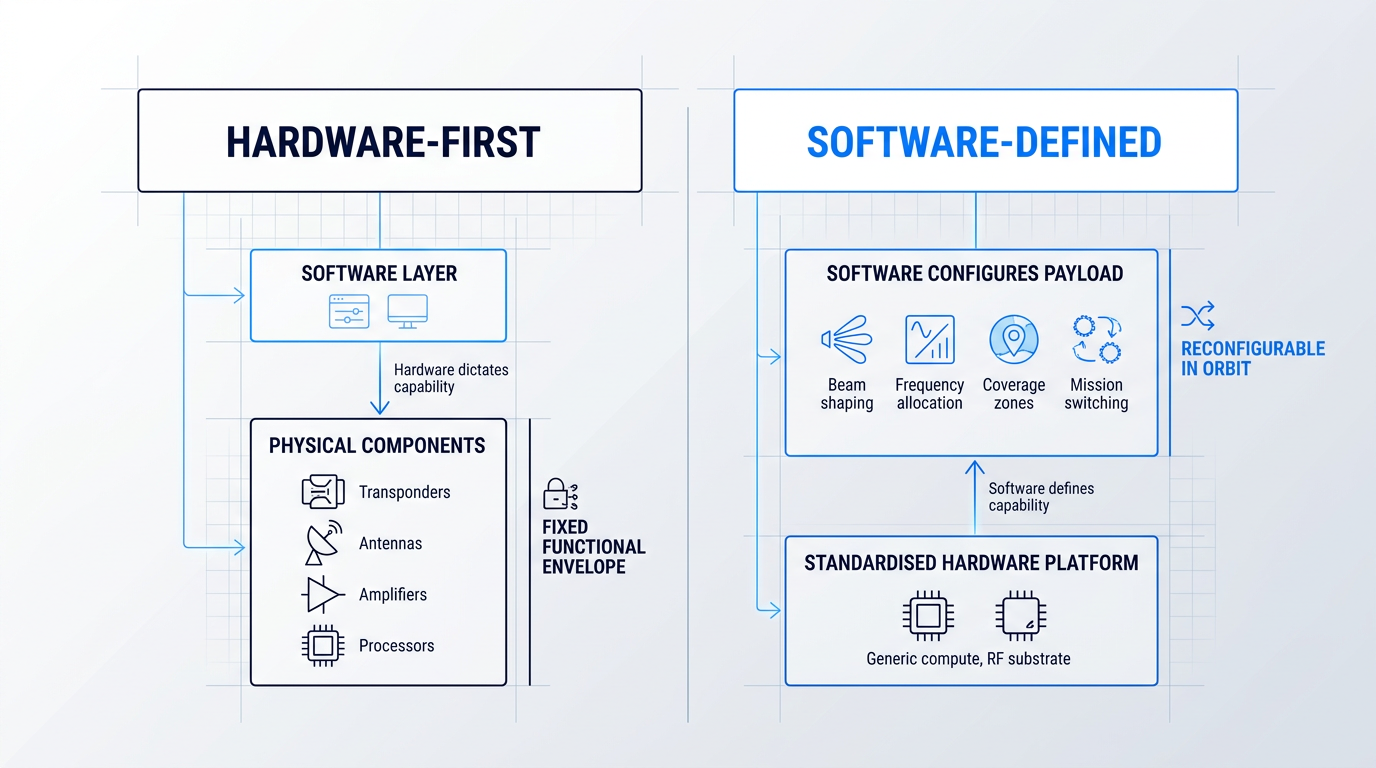
In a conventional fixed-hardware satellite, the satellite's capabilities are determined by its physical components — transponders, antennas, amplifiers, and processors — chosen and locked in during the design phase, often years before launch.
Software exists in these traditional satellites, but it is layered on late in development to serve the hardware: to control, monitor, and operate components whose function is already fixed by the physical architecture.
Once a conventional satellite reaches orbit, its functional envelope is locked. If demand shifts to a region outside its beam footprint, or if a new mission type emerges, the hardware cannot follow. The satellite continues doing exactly what it was built to do, regardless of whether that remains commercially or operationally optimal.
In a software-defined satellite, this relationship is inverted. Hardware becomes a generic, standardised platform — a compute and RF substrate — that software configures. The satellite's capabilities are not fixed by what was physically installed; they are defined by what software instructs the hardware to do.
In a traditional satellite, software serves the hardware. In a software-defined satellite, hardware serves the software. That inversion — not any single feature — is what makes the architecture fundamentally different.
The analogy to a smartphone is useful here: a smartphone's capabilities are not defined by its processor alone — they are defined by the applications running on top of standardised hardware. Swap the apps, and the device does something different. A software-defined satellite operates on the same principle, applied to a spacecraft payload.
What Reconfigurability Means in Practice
Reconfigurability is not an abstract capability — it is a set of specific, named operations that can be performed remotely, via commands sent from the ground and executed by onboard software, without any physical intervention on the satellite.
Those operations include: reshaping and redirecting beams to serve different geographic areas; adjusting frequency plans and RF power allocation between beams; modifying coverage zones in response to shifting demand; and switching between mission types — for example, moving capacity from commercial broadband to government communications, or from broadcast services to maritime surveillance.
ESA's description of Eutelsat Quantum captures the scope precisely: the satellite offers reconfigurability in coverage, frequency and power, enabling complete mission rehauls including changes in orbital position — all conducted through software, from the ground.
This is not a theoretical capability. Eutelsat Quantum, launched on 30 July 2021 aboard an Ariane 5 from Europe's Spaceport in French Guiana, is confirmed by ESA as the first commercial fully flexible software-defined satellite in the world.
The satellite was developed under an ESA Partnership Project, with Airbus as prime contractor responsible for the payload and Surrey Satellite Technology Ltd (SSTL) manufacturing the new geostationary platform. It entered commercial service with Eutelsat, serving government, mobility, and data customers.
Eutelsat Quantum's design was built from the outset around software-definability: a shift, as ESA describes it, from custom-designed one-off payloads to a generic approach in which software configures the mission rather than hardware fixing it.
A Spectrum, Not a Binary
It is worth noting that software-defined satellite is not a binary category. There is a spectrum of implementation.
At one end sit fully software-defined satellites, where every function of the payload can be changed in orbit — beam shape, frequency plan, power allocation, and mission type. At the other end are partially software-defined satellites, where selective subsystems are reconfigurable while others remain fixed by hardware.
SpaceNews notes that software-defined satellites vary widely in their flexibility: at the basic level, coverage redefinition such as beam steering without altering shape or capacity; at the full end, complete in-orbit reconfigurability across beam power and radio waveform parameters.
This spectrum matters because not every satellite described as software-defined offers the same degree of adaptability. Understanding where a given design sits on that spectrum is essential for evaluating what it can actually do across its operational lifetime.
For GEO satellites, that lifetime typically spans 15 years — a period across which markets, demand patterns, and mission requirements will change in ways that cannot be fully anticipated at launch. The significance of the software-defined architecture is precisely that the satellite's value proposition can evolve across that window, rather than being fixed at the moment of design.
With the definition and architectural logic established, the natural next question is what actually makes this reconfigurability possible — what technologies inside a software-defined satellite enable the payload to behave so differently from its fixed-hardware predecessors.
The Technologies That Make Reconfigurability Real
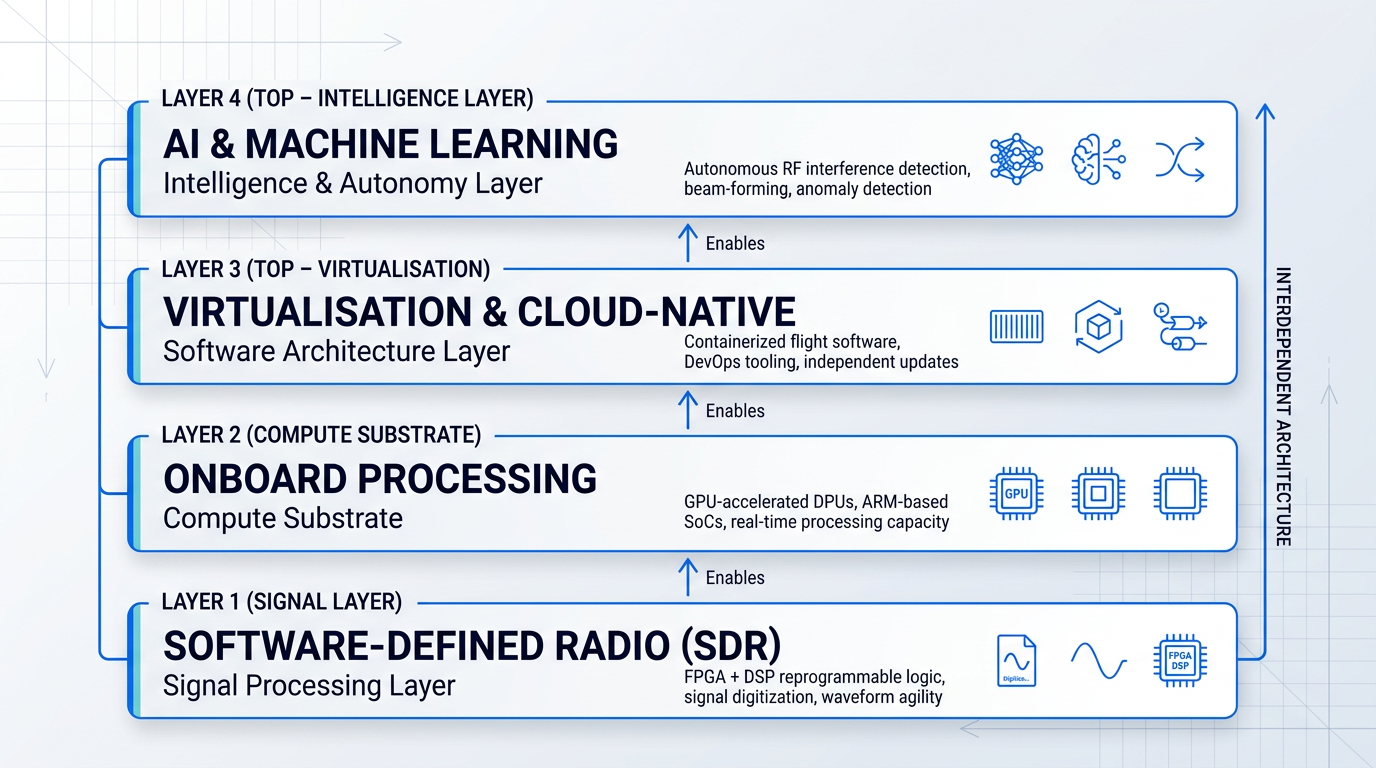
Reconfigurability in orbit does not emerge from a single clever component. It is the product of four interdependent technology layers that, taken together, transform a satellite from a fixed instrument into a programmable platform — each layer depending on the one beneath it to function at all.
Software-Defined Radio: Reconfiguring the Signal Layer
At the base of the stack sits software-defined radio (SDR), which relocates the work of signal processing from fixed analogue circuitry into software and reprogrammable hardware.
In a conventional satellite payload, analogue RF components — filters, modulators, frequency converters — are physically wired to serve a specific frequency band and waveform, determined at the time of manufacture.
SDR breaks that dependency by digitising the incoming signal as early in the chain as possible, so that filtering, modulation, demodulation, and waveform generation all happen in software or reprogrammable logic rather than fixed circuitry.
The hardware substrate for this is primarily FPGAs (field-programmable gate arrays) and DSPs (digital signal processors).
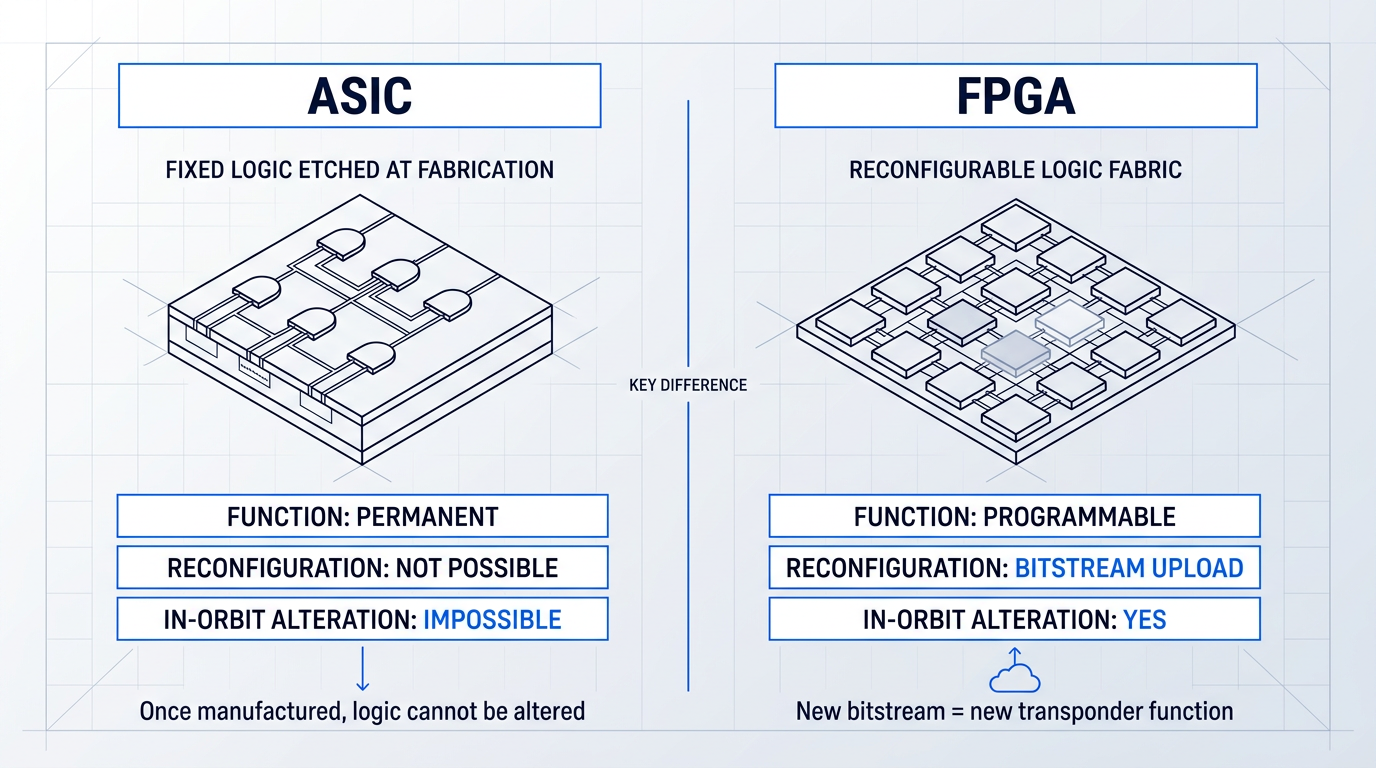
The distinction between FPGAs and ASICs (application-specific integrated circuits) is worth dwelling on, because it is the conceptual key to understanding why SDR enables genuine in-orbit reconfigurability.
An ASIC's logic is etched at fabrication: once manufactured, its function is permanent and cannot be altered regardless of what software commands it receives.
An FPGA, by contrast, implements its logic through a configurable fabric that can be rewritten after deployment — uploading a new bitstream to the same physical device effectively creates a different transponder, operating on a different frequency plan or modulation scheme, without touching any hardware.
ESA's WAND study on software radio technology for the space segment identified FPGA-based SDR architectures as central to achieving the kind of payload flexibility that software-defined satellites require, and NASA technical work on SDR in space has similarly highlighted FPGA reprogrammability as the mechanism that makes waveform agility feasible in orbit.
Onboard Processing: The Compute Substrate Everything Depends On
SDR generates a continuous stream of digitised signal data that must be processed in real time — and that processing demand is substantial.
Modern software-defined satellites address this by carrying onboard computers of a fundamentally different scale from the simple command-and-control processors found on traditional spacecraft: GPU-accelerated data processing units (DPUs) and ARM-based system-on-chips (SoCs) that run full flight software stacks capable of executing complex algorithms and managing payload virtualisation.
NASA's state-of-the-art small spacecraft avionics survey documents how this class of general-purpose compute hardware has become viable for space applications, enabling the kind of onboard processing that would have required ground-based infrastructure in an earlier generation of satellites.
The critical architectural point is that onboard processing is not one pillar among four equals — it is the substrate on which the other three depend.
Without sufficient compute capacity in orbit, the algorithms that make SDR useful cannot run, virtualised software containers have nowhere to execute, and onboard AI inference is simply not feasible.
Virtualisation and Cloud-Native Architectures in Orbit
Given a capable compute substrate, the next question is how software is structured, deployed, and updated — and this is where containerisation and cloud-native design principles enter the satellite domain.
Containerised flight software works on the same principle as Docker or OCI containers in terrestrial computing: application software is packaged with its dependencies into discrete, portable units that are decoupled from the specific hardware they run on.
This decoupling has a practical consequence that matters enormously for in-orbit operations: individual containers can be updated, replaced, or added without disturbing the rest of the software stack.
The same DevOps-style tooling used to build, test, and deploy software on Earth — continuous integration pipelines, automated validation, staged rollouts — can be applied directly to satellite software, reducing the risk and complexity of on-orbit updates.
ESA's SpaceCloud initiative is a concrete institutional expression of this philosophy, developing frameworks that abstract satellite hardware into flexible compute nodes so that applications can be deployed and managed in orbit much as they would be in a terrestrial cloud environment.
Projects in ESA's InCubed portfolio, including the Universal Satellite Services (USS) and FIPC initiatives, are actively applying these cloud-native principles to operational satellite payloads.
AI and Machine Learning: From Reactive to Adaptive
The three pillars described so far give an SDS the ability to be reconfigured — but reconfiguration still depends on someone, or something, deciding when and how to act.
Onboard AI and machine learning close that gap by enabling cognitive payload functions that respond autonomously to conditions that were never explicitly anticipated at launch.
In the communications payload context, this means capabilities such as real-time RF interference detection and mitigation, dynamic spectrum resource management, autonomous beam-forming and beam-hopping, and anomaly detection in onboard systems — all executed without waiting for a command from the ground.
The shift this represents is qualitative, not incremental: pre-programmed rules can only respond to conditions their authors anticipated, whereas a trained model can generalise to novel interference patterns, unexpected traffic distributions, or degraded hardware states.
ESA's resilience programme has been developing neuromorphic AI approaches for onboard processing, and the ESA-CLAIRE AI4SatCom workshop has documented a range of active research threads applying machine learning to satellite communications payloads — evidence that onboard AI for SDS is an advancing operational field, not a speculative one.
These capabilities depend directly on the compute substrate provided by the onboard processing pillar: neuromorphic and inference workloads are computationally demanding, and they are only feasible because modern SDS carry hardware capable of running them.
The systems-level view is what distinguishes a genuinely software-defined satellite from a satellite that merely incorporates one or two of these technologies in isolation.
Each pillar is only as capable as the layers beneath it. SDR without sufficient onboard processing cannot execute the algorithms that make waveform agility useful. Processing without virtualisation means software updates require risky monolithic patches to the entire flight stack. And all three without onboard AI still leave an operator manually deciding when and how to reconfigure — defeating much of the autonomy that makes software-defined satellites operationally compelling.
With the architecture of reconfigurability established, the natural next question is what this stack actually delivers in practice — and that is where the operational picture becomes particularly compelling.
What Operators Gain from Software-Defined Satellites
A GEO satellite procured today will still be in orbit in 2040, serving markets that do not yet exist, in geographies whose demand patterns cannot be reliably forecast, under regulatory frameworks that will shift more than once across that 15-year lifetime — and with fixed hardware, an operator has no lever to pull when reality diverges from the procurement-time business plan.
Software-defined satellites change that relationship fundamentally: rather than locking capability at launch, they allow operators to adapt coverage, reallocate capacity, and upload entirely new mission applications while the satellite is already in orbit.
From Static Assets to Adaptive Infrastructure
The most immediate gain is dynamic reconfigurability in orbit: the ability to reshape beams, redirect coverage, adjust power allocation, and modify frequency plans in near-real time, without launching a replacement satellite or physically intervening in any way.
Eutelsat Quantum illustrates what this means in practice: its beams can be reshaped and redirected in close to real time to provide connectivity to passengers on moving planes, ships, trucks, and cars — a use case that is simply impossible for a fixed-beam satellite to serve with comparable efficiency, since the demand centre itself is constantly moving.
Eutelsat Quantum also demonstrates a related operational benefit: the satellite can detect and characterise rogue emissions, enabling it to respond dynamically to both accidental interference and intentional jamming — a capability that fixed-hardware predecessors could address only through slow, hardware-constrained workarounds.
Beyond reconfigurability, multi-mission flexibility from a single asset is a direct commercial differentiator: Lockheed Martin's SmartSat architecture lets operators upload new mission applications to an already-orbiting satellite, effectively changing what the satellite does without touching the hardware.
In 2024, Lockheed Martin demonstrated this by uploading new mission software to an on-orbit SmartSat-enabled satellite — the equivalent of installing a new app on a smartphone, but for a spacecraft already in service.
Together, these capabilities add up to a set of distinct, named operator gains that span the commercial, operational, and financial dimensions of running a satellite programme.
- Dynamic beam reconfigurability: Reshape, redirect, and re-power beams in near-real time to serve moving platforms and shifting geographic demand without hardware changes.
- Multi-mission flexibility: Upload new mission applications post-launch, switching between broadband, government, and surveillance roles over the satellite's operational life.
- Hardware standardisation savings: A single generic platform ships to every customer; software defines the mission, shifting customisation from capital expenditure to operational expenditure.
- Extended operational lifespan: Capabilities improve through software updates across the satellite's life, rather than degrading as market requirements evolve past the launch-time specification.
- Market risk mitigation: Operators can adapt coverage and capacity allocation to match demand as it actually evolves, reducing the risk of stranded bandwidth in underserved beams.
- Capacity efficiency at scale: Software-defined beam forming allocates bandwidth precisely where demand exists, eliminating wasted energy across the coverage footprint.
- Interference and jamming resilience: Dynamic RF environment response — detecting and characterising rogue emissions — provides a defence fixed-hardware satellites cannot replicate in near-real time.
For a GEO operator, the combination of these gains changes the calculus of running a 15-year asset: instead of building a business plan around demand as it was forecast at procurement, the operator can respond to demand as it actually develops — redirecting capacity, adjusting frequency plans, and uploading new mission software as the market evolves.
Traditional satellites have the same capability they had when they lifted off. SmartSat's architecture, by contrast, breathes new life into satellites — allowing them to adapt to changing mission needs and extending their operational relevance across the full service life. This inverts the conventional satellite lifecycle model, where capability depreciates from day one.
The cost efficiency argument is equally significant: programmes like Thales Alenia Space's Space Inspire and Airbus OneSat are built around a standardised hardware platform that ships to every customer, with software defining the specific mission configuration.
This shifts the economics from bespoke, high-CapEx manufacturing for each customer order toward serial production and software-defined customisation — a model that reduces manufacturing complexity and moves differentiation costs into the operational phase, where they scale with actual usage rather than being locked in at build time.
At the capacity layer, Boeing's 702X platform demonstrates what software-defined beam forming looks like at scale: its digital processor can form, steer, and shape more than 5,000 beams per satellite, dynamically pointing power and bandwidth to where users actually are, maximising usable capacity and eliminating wasted energy across the footprint.
These gains are not theoretical projections — they are operational realities already demonstrated by named programmes flying in orbit today, and the next section examines those deployments in detail.
Software-Defined Satellites in Operation
The case for software-defined satellites has been made in engineering papers and procurement strategies for years. What the following programmes demonstrate is something more consequential: the technology is not waiting to be proven — it is already working, in commercial service, across every major orbit regime and across both civilian and military domains.
The table below maps the key deployments against orbit, operator, the specific SDS capability each demonstrates, and current status — giving a scanning reader a reference frame before the narrative detail.
| Programme | Orbit | Operator | Key SDS Capability Demonstrated | Status |
|---|---|---|---|---|
| Eutelsat Quantum | GEO (48° East) | Eutelsat | Full in-orbit reconfigurability of coverage, frequency, and power simultaneously | Commercial service since Nov 2021; fully commercialised by mid-2023 |
| Airbus OneSat / Intelsat IS-42 & IS-43 | GEO | Intelsat | Fully reconfigurable payload; dynamic capacity reallocation across regions | Ordered Dec 2020; part of Intelsat's multi-satellite SDS fleet build-out |
| Thales Space Inspire (Flexsat, ASTRA 1Q, Arabsat-7A) | GEO | Eutelsat / SES / Arabsat | Serial-production reconfigurable platform; instant in-orbit mission adjustment | Multiple satellites contracted; Flexsat delivery expected 2026 |
| Boeing 702X / O3b mPOWER | MEO (~8,000 km) | SES | 5,000+ steerable beams per satellite; software-defined payload forming in real time | 9th and 10th satellites entered commercial service March 2025 |
| Boeing 702X / WGS-11 | GEO | US Space Force | Hardened military SATCOM using same 702X software-defined payload architecture | In production; military adaptation of O3b mPOWER payload technology |
| Lockheed Martin SmartSat (LM 400) | LEO / MEO / GEO | US Government / DoD | Post-launch mission upload; onboard cyber defence updates; edge data processing | On-orbit across multiple satellites; scheduled for all future LM 400s |
| ESA OPS-SAT | LEO (~450 km) | ESA | In-flight FPGA reprogramming; neural network updates; AI deployment in orbit | Mission concluded May 2024 after 4.5 years; 284 experiments conducted |
| ESA Phi-sat-2 (6U CubeSat) | LEO (510 km) | ESA | Six AI applications running in orbit; apps uploadable and replaceable in flight | Launched Aug 2024; science phase commenced 2025 |
Comparison of operational software-defined satellite programmes across orbit, operator, key demonstrated capability, and status
What the table makes immediately visible is that no single orbit or application domain dominates: software-defined payloads are operational from CubeSat scale in LEO to large GEO platforms, and from ESA research missions to US Space Force military SATCOM.
GEO: From Proof of Concept to Programme Scale
Eutelsat Quantum, launched 30 July 2021 and positioned at 48° East, is the reference point for commercial GEO software-definability — the first satellite to offer simultaneous in-orbit reconfigurability of coverage area, frequency band, and power allocation.
Built by Airbus Defence and Space on a platform developed by Surrey Satellite Technology Ltd, and developed under an ESA public-private partnership, Quantum entered commercial service in November 2021 and had its full capacity commercialised within 18 months — a record ramp-up for an entirely incremental satellite, according to Eutelsat's own investor reporting.
Its customer base spans government, mobility, and data markets — precisely the segments whose demand patterns shift fastest, and for which the ability to reshape beams and reallocate power without a hardware change has the most operational value.
The more significant signal came in January 2021, when Airbus signed a contract with Intelsat to build two OneSat GEO software-defined satellites — Intelsat 42 and 43 — operating across multiple frequency bands for Intelsat's next-generation software-defined network.
Intelsat's chief executive described the order explicitly as "the beginning of a radical evolution" of the company's network — not a satellite purchase but an architectural commitment, with Intelsat subsequently planning more than ten software-defined satellites across its fleet.
Thales Alenia Space's Space Inspire platform (INstant SPace In-orbit REconfiguration) adds a third dimension to the GEO picture: serial production at scale across multiple operators, including Eutelsat's Flexsat (delivering over 100 Gbps over the Americas), SES's ASTRA 1Q, and Arabsat-7A.
Thales states that Space Inspire is capable of full in-orbit reconfiguration in less than 24 hours — a vendor-stated figure that, if borne out operationally, represents a fundamental change in how operators can respond to demand shifts mid-mission.
The platform's design for series production is itself a maturity signal: SDS is no longer a bespoke engineering exercise but a standardised manufacturing model, with Thales reporting six Space Inspire satellites contracted by late 2022 alone.
MEO and Military: Scale and Dual-Use
At medium Earth orbit, SES's O3b mPOWER constellation demonstrates software-defined satellites operating at a scale that GEO programmes cannot match in beam granularity.
Built on Boeing's 702X platform, each of the 11 O3b mPOWER satellites carries more than 5,000 digitally formed, steerable beams — beams that the software-defined payload can shape, steer, and reallocate in real time to follow demand across geographies.
The 9th and 10th satellites entered commercial service in March 2025, with SES confirming the milestone and Boeing delivering the final three satellites to complete the 13-satellite constellation shortly after.
The same 702X software-defined payload architecture has been hardened for military use on the US Space Force's WGS-11 — the first software-defined military SATCOM platform in the WGS constellation, which Boeing describes as carrying double the capacity of any of the ten preceding WGS satellites.
This dual-use trajectory — the same underlying software-defined payload architecture serving both commercial broadband and military SATCOM — is one of the clearest indicators that the technology has moved beyond niche application.
LEO and Small Satellites: Validation and AI at Scale
ESA's OPS-SAT, a 30 cm CubeSat launched in December 2019, addressed a question that no amount of ground testing could answer: is continuous in-orbit software modification of a live spacecraft actually feasible?
Over 4.5 years in LEO, OPS-SAT hosted 284 experiments from 134 teams across 26 countries — demonstrating, among other milestones, the first ever in-flight reprogramming of a neural network and repeated in-orbit FPGA reconfiguration, as documented in ESA's own technical records from the mission.
Its methodological significance is distinct from the commercial GEO programmes: OPS-SAT proved that iterative, ground-commanded software updates to a satellite's onboard systems are not only theoretically viable but practically routine — a finding that underpins the operational confidence behind every larger deployment in this section.
ESA's Phi-sat-2, a 6U CubeSat launched in August 2024 and orbiting at 510 km, extends that proof into the domain of AI payload intelligence at minimal scale.
Measuring just 22 x 10 x 33 cm and weighing 9 kg, Phi-sat-2 runs six AI applications in orbit — including cloud detection, maritime vessel identification, street map generation from imagery, and wildfire detection — with two of those applications uploaded to the satellite after launch, not pre-loaded at integration.
The ability to upload, replace, and run new AI algorithms in flight on a 6U CubeSat demonstrates that software-defined payload intelligence is not a capability reserved for large, expensive GEO platforms — it is accessible at the smallest end of the satellite size spectrum.
Cross-Domain: Mission Flexibility for Defence
Lockheed Martin's SmartSat architecture, integrated into the LM 400 multi-mission platform, represents the fullest expression of software-definability at the mission level — not just reconfiguring how a satellite operates, but uploading entirely new missions to it after launch.
SmartSat-enabled satellites can receive mission application uploads post-launch, update onboard cyber defence capabilities in response to new threats, and perform edge data processing in orbit — reducing the volume of data that needs to be downlinked and accelerating the time from collection to actionable information.
The architecture is already on orbit across multiple Lockheed Martin demonstrator satellites and is scheduled for integration into all future LM 400 production satellites, including the US Space Force's Missile Track Custody constellation.
Lockheed Martin's SmartSat architecture enables operators to upload entirely new mission applications to satellites already in orbit — not just reconfigure existing ones. This is qualitatively different from beam steering or frequency adjustment: it means the satellite's fundamental purpose can change post-launch, a capability with significant implications for both commercial flexibility and military responsiveness.
Taken together, these deployments span GEO, MEO, and LEO; CubeSats and large platforms; commercial telecommunications and classified military SATCOM — and they span manufacturers on three continents, none of whom is building to the same proprietary standard.
That last point — the absence of a common standard — is itself consequential: the operational deployments are real, but they have also surfaced the regulatory, testing, and interoperability complexity that reconfigurable satellites introduce at scale, which the following section examines directly.
Regulatory and Standardisation Challenges
There is a structural irony at the heart of software-defined satellite regulation: the more commercially valuable a satellite is — because it can reshape beams, reassign frequencies, and redirect power in near-real time — the harder it is to fit within the frameworks built to govern it.
The ITU Radio Regulations require satellite networks to be filed with fixed technical parameters before launch: frequency plan, beam coverage, power flux density, and orbital characteristics. That filing process was designed for hardware-defined satellites whose RF characteristics do not change post-launch. When an SDS operator sends a configuration command and the satellite responds by reshaping its coverage within hours, the filed parameters may no longer accurately represent the satellite's actual operating state — and the coordination agreements reached with adjacent networks were built against those filed parameters, not the new configuration.
The ITU Coordination Process and Its Limits
The ITU's procedure for bringing a satellite network into international recognition follows three sequential steps, documented in the ITU-R Radio Regulations (Articles 9 and 11) and the coordination framework set out in the WRS-20 regulatory materials.
- Advance Publication: The notifying administration submits network characteristics to the ITU Bureau for publication, alerting other administrations to the planned system up to seven years before launch.
- Coordination Request: For networks subject to coordination under Article 9, the operator negotiates with affected administrations to resolve potential interference before the network is brought into use.
- Notification: Final frequency assignments are notified to the Bureau for recording in the Master International Frequency Register, conferring international recognition and protection.
The entire process assumes a stable technical envelope — a satellite whose parameters at notification are the same as its parameters in operation. An SDS platform can depart from that envelope within hours of a reconfiguration command, rendering the coordination basis that adjacent networks relied upon potentially obsolete.
Steerable beams compound the problem further. Under ITU Rules of Procedure No. 21.16, frequency assignments in steerable beams only receive a favourable regulatory finding for compliance with power flux-density limits if the operator can demonstrate that the applicable limits are met in at least one beam position, and provides a description of the method used to ensure compliance across all positions. For an SDS operator whose beam geometry changes dynamically, satisfying and maintaining that condition is a live operational obligation, not a one-time certification.
National Regulators: FCC and Ofcom
Operators face a two-layer compliance challenge: the ITU Radio Regulations at the international level, and national licensing regimes at the domestic level. The two most consequential national regulators for the SDS market are the FCC in the United States and Ofcom in the United Kingdom.
The FCC's software-defined radio rules, established under FCC Order FCC-05-57A1 and codified at 47 C.F.R. §2.944, require manufacturers to ensure that only software approved as part of a certified hardware/software combination can be loaded into an SDR. Applied to satellite payloads, this creates a certification burden for every software update that alters RF operating parameters — frequency range, modulation type, or maximum output power. Each such update must be covered by an existing equipment authorisation or trigger a new certification process, adding friction to the very reconfigurability that makes SDS commercially attractive.
The FCC's 2023 NGSO spectrum-sharing framework (FCC-23-29A1, IB Docket 21-456) addresses a related dimension: how NGSO FSS systems authorised in different processing rounds coordinate spectrum use and protect each other from harmful interference. For SDS operators running reconfigurable NGSO constellations, the good-faith coordination obligation and the degraded-throughput methodology for inter-round protection apply directly — and a satellite that can dynamically shift its interference footprint raises questions about how those obligations are assessed in real time.
In the UK, Ofcom's space spectrum strategy — published in November 2022 — explicitly acknowledges the challenge that reconfigurable satellites pose to coordination frameworks. Ofcom's strategy identifies, as an active international reform priority, the need to quantify how much an NGSO system can change its characteristics without affecting its coordination status and relative date of priority. Ofcom's consultation document defines software-defined satellites as systems that "can reshape radio beams or resources of the satellite in almost real-time" — and the fact that Ofcom felt it necessary to define the category and flag it as an open regulatory question signals that even national regulators are still working out how to handle it.
Under FCC §2.944, manufacturers must ensure only approved software can be loaded into a software-defined radio. Applied to a reconfigurable satellite payload, this means any software update that changes RF operating parameters — frequency range, modulation type, output power — must either fall within an existing equipment authorisation or trigger a new certification. The certification cycle was not designed for a satellite that may receive dozens of configuration updates per year.
The Evolving Standards Landscape
Beyond spectrum regulation, SDS operators face a parallel uncertainty: which technical standards will become the interoperability baseline for software-defined command and data links. Two bodies are actively developing standards relevant to this question, and they are approaching it from different directions.
CCSDS (the Consultative Committee for Space Data Systems) has developed a mature family of space data link protocols — including the Unified Space Data Link Protocol (USLP, CCSDS 732.1-B-3), the AOS Space Data Link Protocol (CCSDS 732.0-B-5), and associated security standards — designed for interoperability across civil and scientific space agencies. These are established, multi-agency standards with broad adoption in government and scientific missions.
The Space Development Agency (SDA), focused on the US military's Proliferated Warfighter Space Architecture (PWSA), has developed its own standards: the SDA OCT Standard for optical inter-satellite links and the NEBULA Standard for networking requirements across the PWSA constellation. These are actively versioned — OCT Standard 4.0 and NEBULA v3.05 were both released in 2024 — and designed specifically for a proliferated, software-defined LEO architecture.
An SDS operator choosing a protocol stack today is making a long-term bet on which of these approaches — or which combination — will define the interoperability requirements of the market they serve. A wrong bet does not just mean technical debt; it can mean costly re-engineering of both the space and ground segments before a constellation's operational life is complete.
The broader picture is one of an industry operating ahead of its governance structures. Regulatory frameworks built for fixed-hardware satellites are being applied — imperfectly — to systems that were never envisioned when those frameworks were written. That creates real risk: interference disputes, certification delays, licensing uncertainty, and protocol fragmentation. But it also creates genuine opportunity for operators and manufacturers who engage early with regulators to help shape the emerging rules, rather than waiting for frameworks to harden around assumptions that may not fit their technology.
The regulatory challenge is compounded by an equally consequential shift in how software-defined systems must be verified and qualified — a friction layer that existing space engineering frameworks were no better prepared for than the ITU was for dynamic spectrum management.
Testing, Validation, and the Qualification Challenge
Space qualification is one of engineering's most rigorous disciplines, and it is built on a single foundational assumption: the system being qualified does not change after it is verified. Software-defined satellites remove that assumption entirely — and in doing so, they disrupt the qualification paradigm at a structural level, not merely a procedural one.
Both the European and US qualification frameworks are architected around fixed lifecycle gates. Under ECSS-E-ST-40C (the European software engineering standard) and its companion ECSS-E-ST-10-02C Rev.1 (the verification standard), software passes through a defined sequence of reviews — Software Requirements Review, Preliminary Design Review (PDR), Critical Design Review (CDR), Qualification Review, and Acceptance Review — at each of which specific verification outputs must be demonstrated. NASA's flight software qualification framework, as described in the Software Engineering Handbook section 7.12, follows the same logic: planning, verification and validation, and acceptance activities are all coordinated against lifecycle gates co-incident with PDR and CDR.
The underlying logic is principled, not bureaucratic. It is a rational response to the impossibility of testing all possible states of a complex system in orbit: you verify the system exhaustively on the ground, lock the configuration, and launch the verified product.
When the qualification boundary moves
When software can be updated in orbit, the qualification boundary moves with every update. A new software version potentially changes the system's functional behaviour — its timing, its fault-handling logic, its payload configuration — in ways the original qualification did not test and cannot retrospectively cover.
The traditional V-model — requirements decomposed to design, design to implementation, then verified back up the chain — is a one-way process designed for a frozen endpoint. SDS introduces a loop: the system is qualified, launched, updated, and now has a different functional profile than the one that was qualified. Whether the concept of a "qualified configuration" remains meaningful when the configuration can change post-launch is not a question the existing frameworks were designed to answer.
For satellites that receive regular software updates, verification cannot remain a one-time pre-launch activity — it must become a continuous process integrated into operations throughout the mission lifetime.
The continuous verification problem
Continuous in-orbit software modification creates three distinct methodological demands that traditional space qualification processes were not designed to satisfy.
- Regression testing frameworks: Structured test suites that confirm a new software version does not break previously verified behaviour — essential when updates are frequent and cumulative.
- Model-based verification: Formal models that verify software properties analytically, without exhaustive hardware testing — useful when physical test time is constrained between update cycles.
- Hardware-in-the-loop (HIL) simulation: Running flight software against a representative hardware environment in real time, validating timing and interface behaviour before uplink.
These methodologies exist in terrestrial software engineering and are described in the satellite software verification literature, including NASA NTRS guidance on small satellite V&V. Their application to space-qualified systems, however, introduces constraints that make direct adoption non-trivial: radiation tolerance, timing determinism, and fault-containment requirements all impose verification obligations that have no direct counterpart in commercial software development.
FPGA reprogramming: the highest-risk activity
Among all in-orbit software activities, FPGA reprogramming carries the highest risk. A corrupted or incomplete bitstream upload can leave the FPGA in a non-recoverable state — potentially disabling a critical subsystem with no possibility of physical intervention.
ESA's OPS-SAT mission — a 30-cm CubeSat launched in December 2019 and specifically designed as an open in-orbit laboratory for software experimentation — provides the most concrete public evidence of both the possibility and the demand this creates. According to ESA's own documentation, in-flight FPGA reconfiguration is normally regarded as a high-risk procedure that can take months; OPS-SAT's operational experience demonstrated that the process could be accomplished in a dramatically shorter timeframe, but only through careful design of the satellite's ground and space assets and the availability of ESA expertise throughout the testing phases.
OPS-SAT's FPGA was used to implement an entirely new data handling bus in orbit, load hardware debugging tools, and replace the TC decoder and TM encoder functions of the onboard CCSDS engine — capabilities described in ESA's Inside Story documentation as unthinkable on a traditional space mission.
For a software-defined satellite, 'qualified' is not a state reached at launch — it is a discipline maintained across every software update for the duration of the mission.
Ground infrastructure for continuous validation
Validating a software update before it is uplinked requires a representative ground test environment that accurately replicates the in-orbit system. Three infrastructure types form the backbone of this capability.
- Digital twins: Software models of the satellite that allow updates to be tested in simulation before uplink, without consuming scarce contact time or risking the flight asset.
- Engineering models: Physical hardware replicas of the flight system, used for software testing in a representative environment; must evolve in step with the flight system to remain valid.
- Flatsat configurations: All flight hardware subsystems arranged on a bench and connected as they would be in orbit, enabling integrated software testing across the full hardware chain.
Maintaining these environments to accurately replicate the in-orbit system is itself a significant engineering undertaking: an engineering model that does not keep pace with the flight system ceases to be a valid test environment, undermining the confidence that pre-uplink testing is meant to provide.
AWS Ground Station's digital twin capability, which became generally available in August 2024, illustrates the cloud-based direction this infrastructure is heading. The feature allows customers to integrate DevOps practices with a virtual ground station environment — testing configuration changes, validating data paths, and running regression tests without consuming production satellite contact time or requiring spectrum licensing to be in place. Cloud-based digital twins reduce the infrastructure burden considerably, but they introduce their own fidelity and latency questions: the AWS Ground Station digital twin fully emulates the control plane but does not deliver payload data during synthetic contacts, which limits the scope of what can be validated end-to-end.
The validation of the update pathway itself is not a separate concern from qualification — it is part of it. Secure boot, signed firmware, and integrity verification must be treated as qualified system components: if the pathway by which a software update reaches the satellite can be compromised, the qualification of the software it delivers is rendered meaningless.
The industry's response to these challenges is taking shape across three threads. ESA designed OPS-SAT specifically as a platform for testing software that would be too risky to trial on an operational satellite — its four-and-a-half years of operation, hosting 284 experiments from 134 teams across 26 countries, provides the most comprehensive public evidence base for what continuous in-orbit software modification looks like in practice. In parallel, ECSS-E-ST-40C and NASA's IV&V (Independent Verification and Validation) framework — neither designed for continuously updated systems — are being adapted rather than replaced, an active area of work that has not yet produced settled answers. The methodological direction the industry is moving toward is DevSecOps for flight software: continuous integration, continuous testing, and security integrated into the development pipeline from the outset, borrowed from terrestrial software engineering and adapted to the constraints of space-qualified systems.
The testing infrastructure challenge examined here is one face of a broader question: whether the ground infrastructure that commands, validates, and operates software-defined satellites is as flexible as the space segment it supports — a question that extends well beyond test environments into the legacy systems and protocols that the wider ground segment relies on.
Legacy Hardware and Ground Segment Integration
Software-defined satellites have largely solved the flexibility problem in the space segment — payloads can be reconfigured, beams reshaped, and waveforms swapped on orbit. The problem is that the ground segment was not designed for any of that, and it has not kept pace.
Traditional ground stations were engineered around fixed-hardware satellites whose frequency plan, beam coverage, and modulation scheme were locked at launch and never changed across a 15-year operational life. The infrastructure was optimised for stability and predictability, not reconfigurability — and those design choices are now a ceiling on what operators can actually extract from a software-defined satellite in practice.
The Specific Friction Points
Several distinct architectural constraints sit between a reconfigurable satellite and the operator's ability to exploit it.
- Hardware modem lock-in: Physical modems tied to a vendor's proprietary interface and waveform set cannot be repurposed for new missions or protocols without complex, costly upgrade paths.
- Analog IF signal chains: The traditional antenna-to-modem path uses an analog intermediate frequency signal that is not directly compatible with cloud-based or virtualised processing architectures.
- Standards fragmentation: Ground hardware procured to support one standard — SDA, CCSDS, or proprietary — faces obsolescence risk as the SDS standards landscape continues to evolve.
- Proprietary digital interfaces: Proprietary Digital IF formats block interoperability between vendors, limiting teleport capacity scaling and slowing the move toward open, multi-vendor architectures.
These are not minor inconveniences — they are architectural constraints. A hardware modem specified at procurement for a fixed-frequency, fixed-beam satellite becomes an obstacle the moment that satellite can operate across multiple frequency plans and waveforms. As the DoD CIO's SATCOM division chief Paul Van Slett put it, a satellite designed for SATCOM that is not interoperable with the ground segment or user terminal "is effectively an orbiting paperweight."
The analog IF constraint is particularly consequential for operators pursuing cloud-native architectures. Signals from satellites are traditionally connected to physical modems via analog cables that are not directly compatible with cloud-based networks — meaning the first step toward a software-defined ground segment is digitising the IF signal at or near the antenna so it can be transported over IP and processed in software.
The DIFI Consortium — which operates under the IEEE-ISTO Std 4900 standard — was formed specifically to address this. Its mission is to replace the natural interoperability of analog IF signals with an open, simple digital IF standard that prevents vendor lock-in and enables multi-vendor digital ground architectures. AWS joined the consortium to further that interoperability goal, and major defence organisations are beginning to procure next-generation hardware built around the DIFI standard. The consortium's own assessment is that the standard is still nascent, with its greatest impact ahead of it — but the direction is clear and the industry buy-in is real.
Virtualisation is the architectural response at the software layer. Cloud-native ground segment solutions — AWS Ground Station and Microsoft Azure Orbital among them — decouple software components from specialised hardware, enabling operators to scale, reconfigure, and update ground capabilities without physical infrastructure changes. AWS Ground Station, for example, digitises the downlink spectrum and streams the resulting digital IF data directly into a customer's cloud environment, where software-defined radios handle demodulation and decoding on general-purpose compute.
The realistic picture, though, is more nuanced than the marketing suggests. As the World Teleport Association's Robert Bell has noted, virtualisation does not mean teleport operators can tear down their antennas and discard their high-powered amplifiers — physical antennas, amplifiers, and frequency converters remain necessary. Full cloud-native ground segment deployments at scale are still years away for most operators, with hardware-software integration, standardised interfaces, and sustainable cloud pricing models all still being worked through.
The same software-definable philosophy that applies to the space segment must also be applied to ground-side hardware. Amplifiers, modems, and signal processing equipment that are fixed-function at procurement become liabilities as standards evolve; equipment that can switch between CCSDS, SDA, and proprietary standards via software retains value across multiple satellite generations.
Woodrow Scientific's EDFA illustrates this principle in practice. Designed and built in-house by a UK manufacturer with fibre-amplifier expertise rooted in Southampton's Optoelectronics Research Centre, the amplifier is configured to each client's ground station across both the physical build — band, power, direction, cooling, form factor — and the control layer. Its Modulation-on-Demand capability applies software-selectable amplitude modulation throughout the link, switchable between CCSDS, SDA, and proprietary standards at high power across C/L-band without hardware changes.
That end-to-end hardware-and-software configurability matters because many suppliers in this category are resellers or importers rather than manufacturers — which means limited in-house engineering, slower support, and no ability to adapt the product as programme requirements evolve. A ground station amplifier configured to the programme at both the hardware and software layers, by the team that designed and built it, is a different proposition from a catalogue product.
Operators who specify ground segment reconfigurability from the outset — across modems, IF architecture, standards compatibility, and hardware — will realise the full benefit of a software-defined satellite. Those who attempt to retrofit legacy infrastructure will find themselves with a reconfigurable satellite tethered to a fixed-function ground station.
With the ground segment understood as the command-and-control layer for a reconfigurable satellite, the next question follows naturally: what happens when that interface is compromised?
Cybersecurity Risks in Software-Defined Satellites
Every capability that makes a software-defined satellite commercially valuable — remote reconfiguration, over-the-air updates, dynamic payload management — simultaneously redefines its threat surface in a way that hardware-defined satellites never faced.
A hardware-defined satellite presented adversaries with a fixed-function target: once in orbit, its behaviour was locked, and altering what it did required physical access that simply was not available. A software-defined satellite inverts this entirely — it is a continuously authenticated, remotely reconfigurable endpoint, and the pathway that carries every configuration command is simultaneously the platform's defining capability and its primary attack surface.
Ground segment intrusion: the dominant attack vector
Every documented cyber-physical compromise of a satellite system on record has originated on the ground, not in orbit — a pattern confirmed across more than 200 publicly reported satellite incidents spanning 1962 to 2026 in academic taxonomy research.
The Viasat KA-SAT attack of 24 February 2022 is the canonical illustration: the attacker exploited a misconfigured VPN appliance to gain access to the satellite's trusted management network, then used legitimate management commands to overwrite key data in flash memory on tens of thousands of residential modems across Europe — rendering them inoperable without a factory reset, and disrupting Ukrainian military communications at the precise moment of the Russian offensive.
Critically, as Viasat's own incident report confirms, no space-domain capability was required — the attack was executed entirely through ground-side management infrastructure, exploiting a single misconfigured perimeter appliance.
For software-defined satellites, the stakes of a ground segment breach are qualitatively higher than in the KA-SAT case: where KA-SAT's management channel carried modem configuration commands, an SDS ground-to-satellite command channel carries full payload reconfiguration instructions — beam steering, waveform changes, frequency reassignment — making a successful intrusion the equivalent of handing an adversary the satellite's operational controls.
On a software-defined platform, the software update channel simultaneously delivers the satellite's defining capability (reconfiguration), provides the attacker's primary pathway if compromised, and remains the defender's only remediation route when a vulnerability needs patching — a structural tension with no clean resolution.
This triple role is what makes defence-in-depth non-negotiable from the outset rather than an afterthought: you cannot simply remove or restrict the update channel without eliminating the platform's core value, and you cannot leave it unprotected without accepting that the same channel used to reconfigure the satellite can be used to compromise it.
The software supply chain extends this attack surface across the entire satellite lifecycle, from development through to in-orbit operation.
SDS platforms depend on COTS components, open-source cryptographic libraries, and third-party software dependencies — any of which can introduce vulnerabilities that propagate into the satellite's security posture without the operator's knowledge. The SolarWinds compromise demonstrated exactly this vector at scale: a trusted software update mechanism was weaponised to deliver malicious payloads across thousands of organisations. The same pathway exists in satellite software supply chains. A concrete example from the space domain: multiple critical and high-severity heap buffer overflow vulnerabilities in NASA CryptoLib — a widely used open-source cryptographic library implementing the CCSDS Space Data Link Security protocol for spacecraft command authentication — were publicly disclosed through GitHub Security Advisories in 2025 and presented at Black Hat USA 2025, demonstrating that flaws in trusted cryptographic dependencies can directly undermine command-link integrity.
The most consequential escalation beyond connectivity disruption is hostile reconfiguration as a weapon-equivalent effect: a compromised SDS can be commanded to redirect beams, manipulate frequencies, or broadcast unauthorised content without any kinetic intervention — the satellite becomes a weapon through software alone, a qualitative difference from anything a fixed-hardware satellite presented.
Building a defence-in-depth architecture for SDS
The mitigation response to this threat model is not a checklist of discrete controls — it is an architectural commitment, where each layer compensates for the structural tensions that no single measure can resolve on its own.
- End-to-end command encryption: All reconfiguration command channels must be encrypted end-to-end; CCSDS SDLS (Space Data Link Security) provides the authenticated, encrypted standard for space link command protection.
- Zero-trust ground C2: Ground command-and-control infrastructure should operate on zero-trust principles — no component is implicitly trusted; every access request is verified regardless of network location.
- Aggressive perimeter patching: The KA-SAT attack exploited an unpatched VPN appliance. Perimeter equipment must be patched aggressively; known exploited vulnerabilities on management network boundaries are unacceptable.
- Hardware-rooted update boundaries: Cryptographic verification of software updates before execution, anchored in a hardware root of trust with secure boot, prevents unauthorised firmware from running even if the update channel is compromised.
- Software Bill of Materials (SBOM): Maintaining a full SBOM across all software dependencies gives operators visibility to identify and remediate vulnerabilities in third-party components before they propagate to in-orbit systems.
- CCSDS SDLS authentication: Implementing CCSDS Space Data Link Security standards provides authenticated, encrypted command links at the data link layer — the earliest point at which malicious commands can be rejected.
No single measure in this architecture resolves the firmware channel's triple role — encryption protects the channel in transit but does not prevent an authenticated adversary from issuing destructive commands; hardware-rooted verification catches unauthorised updates but depends on the integrity of the cryptographic keys; zero-trust segmentation limits lateral movement but only after the perimeter is correctly configured and maintained.
The full stack must work together, which is precisely why the regulatory environment is moving toward mandatory baseline requirements rather than voluntary best practice.
ENISA classifies space as a sector of high criticality under the NIS2 Directive and has mapped 125 cybersecurity controls to satellite lifecycle phases, with a compliance horizon of 2027; US Space Policy Directive 5 established the first comprehensive federal cybersecurity principles for space systems in 2020; CISA has published joint advisories with the FBI specifically addressing SATCOM network security following the KA-SAT attack, attributing that incident to Russian state-sponsored actors; and the proposed EU Space Act, published in June 2025, would introduce mandatory cybersecurity requirements — including encryption, secure authentication, and supply-chain risk management — for space operators providing services in the Union.
Operators who engage with these frameworks now — building SBOM practices, implementing CCSDS SDLS, deploying zero-trust architectures — will be structurally better positioned than those who treat compliance as a future obligation, because the technical debt of retrofitting security onto an in-orbit SDS platform is far greater than designing it in from the start.
With the challenge landscape now fully mapped — regulatory friction, testing and validation demands, legacy ground segment integration constraints, and the cybersecurity risks that are architecturally inseparable from reconfigurability — the question becomes where software-defined satellite technology is heading next, and how the market is responding to both its promise and its complexity.
Market Trajectory and Future Trends
The industry has already placed its bet. According to NSR's Software-Defined Satellites, 3rd Edition — cited by Analysys Mason — over 23,000 software-defined satellites will be built between 2022 and 2032, generating nearly USD 54 billion in cumulative manufacturing revenue. Analysys Mason's own forecasts go further: more than 85% of all satellite communications manufacturing and launch revenue over the next decade — a cumulative USD 121.6 billion — will come from software-defined satellite activity. Mordor Intelligence places software-defined payloads as the fastest-growing payload segment, at approximately 21.9% CAGR to 2031. These numbers establish direction, not debate.
The structural force behind that commitment is LEO mega-constellation proliferation. Orchestrating thousands of nodes across dynamic orbital geometries — as Starlink, Amazon Kuiper, OneWeb, and the SDA's Proliferated Warfighter Space Architecture each require — demands software-defined flexibility at every layer: reconfigurable payloads, software-managed beam-hopping, autonomous interference avoidance, and updateable flight software stacks.
Fixed-hardware satellites cannot be operated at constellation scale with the agility these architectures demand. The software-defined substrate is not a premium option at this scale — it is the only viable operating model.
AI-Driven Autonomy in Orbit
The convergence of onboard AI and machine learning with software-defined architectures is pushing satellites beyond mere reconfigurability toward genuine autonomy. SDS provides the programmable substrate; AI/ML provides the intelligence layer that makes that substrate self-directing rather than operator-directed.
The trajectory runs in three phases: ground-side pre-trained algorithms uploaded to the satellite; onboard inference running against fixed models; and, increasingly, onboard learning and model adaptation. ESA's Φ-lab demonstrated this third phase in a world first, training a cloud-detection ML model directly aboard a D-Orbit ION mission in flight — a result with direct implications for autonomous EO and deep-space applications where ground contact is constrained.
ESA's NEURO-SATCOM and NeuroSat projects are investigating neuromorphic processor architectures — brain-inspired computing that couples memory and processing — for satcom applications including digital beamforming and interference mitigation, where massive parallelism is required at minimal power budgets.
The practical capabilities this enables include self-configuring payloads that adapt beam patterns to traffic demand without ground intervention, autonomous interference mitigation in congested spectrum environments, AI-assisted orbit planning and station-keeping, and cognitive spectrum management that responds to the RF environment in near-real time. NASA's SmallSat State of the Art report confirms that onboard neural networks are already enabling autonomous station-keeping and orbit planning in operational small satellite platforms.
Inter-Satellite Links and Optical Mesh Networks
Laser inter-satellite links (ISLs) are no longer experimental. SpaceX added optical crosslinks to all future Starlink satellites — initially to achieve polar coverage without ground stations — and Amazon's Project Kuiper prototype satellites demonstrated a two-way 100 Gbps optical ISL over nearly 1,000 kilometres, with all 3,236 production Kuiper satellites planned to carry the capability.
The SDA's Proliferated Warfighter Space Architecture has adopted optical ISLs as a structural requirement, with Tranche 0 satellites from York Space Systems and SpaceX completing the first cross-vendor laser communications demonstration in orbit — proving that a common interface standard can make multi-manufacturer constellations interoperable at the link layer.
ESA's European Data Relay System (EDRS) — the 'SpaceDataHighway' — operates second-generation laser communication terminals capable of 1.8 Gbps optical ISLs between LEO and GEO nodes, serving as the data relay backbone for Copernicus Sentinel satellites and reducing downlink latency from hours to minutes.
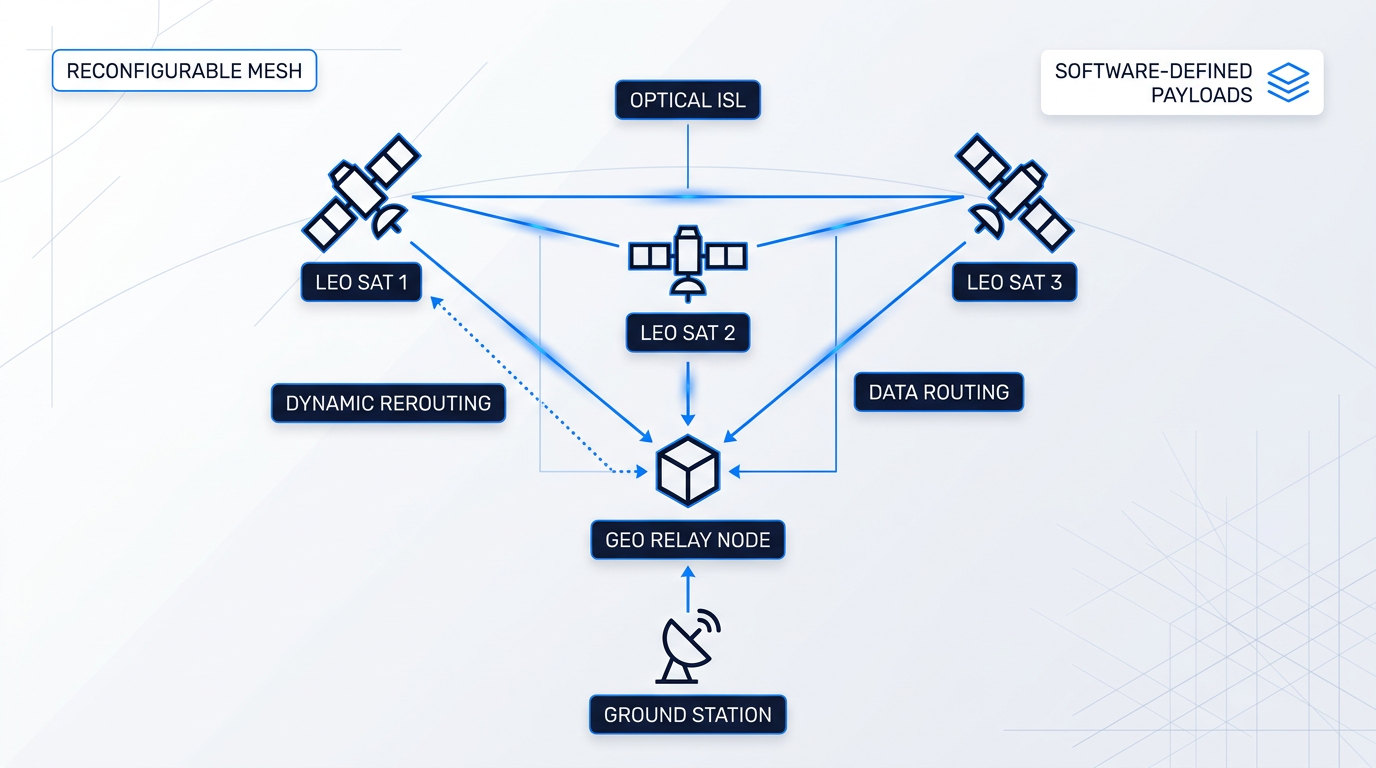
The significance for software-defined satellites is structural. When ISLs are combined with software-defined payloads, the result is a reconfigurable mesh network in orbit — not a collection of independent satellites but a dynamically routable space-based network whose topology can be adjusted by software. Ground station dependency decreases; routing decisions migrate into orbit; the network becomes as programmable as the payloads it connects.
The same software-defined philosophy extends beyond the communications payload to the full onboard compute stack. ESA's Phi-sat-2 — a 6U CubeSat launched in August 2024 — runs six AI applications simultaneously and supports uploading and replacing algorithms in flight, covering tasks from wildfire detection to maritime vessel identification. SSTL's FIPC (Flexible and Intelligent Payload Chain) provides a software-defined onboard data processing pipeline with a third-party applications framework, while Unibap's SpaceCloud uses OS-level virtualisation to deploy containerised applications on orbit in the same way cloud platforms deploy workloads on the ground. These are not research demonstrations — they are operational platforms proving that the updateable software model applies to the entire satellite, not just the RF payload.
5G, 6G, and Non-Terrestrial Network Integration
3GPP Release 17 marked the first standards-level integration of satellite into the terrestrial mobile network architecture, specifying direct satellite access for 5G NR in L- and S-bands. Release 17 and 18 used a transparent (bent-pipe) architecture, where the satellite acts as a radio repeater and the gNB remains on the ground.
3GPP Release 19 goes materially further, introducing a regenerative payload architecture in which a complete gNB is placed on the satellite itself. As Ericsson's NTN payload architecture analysis makes clear, a regenerative payload enables packet switching directly in orbit, supports inter-satellite links via the Xn interface, and allows traffic to be routed between satellites without ground segment involvement — including in scenarios where the feeder link is severed. A regenerative NTN payload is, by its nature, a software-defined payload: its 3GPP protocol stack must be updateable as standards evolve through successive releases.
The 6G trajectory deepens this integration further. ESA's 6G Satellite Precursor programme — the 6G LINO CubeSat mission developed with Open Cosmos — is designed as an in-orbit laboratory for testing seamless terrestrial-NTN integration, AI-assisted dynamic spectrum allocation, self-optimised air interfaces, and software-defined payloads ahead of formal 3GPP 6G standardisation, which ESA estimates will begin around 2026. The requirement for a satellite testbed to be in orbit before the standardisation phase is itself a signal: the satellite industry must co-engineer 6G standards, not adapt to them after the fact.
Operators procuring satellites today are positioning for a standards environment — SDA optical ISL, CCSDS data link security, DIFI digital IF interoperability, 3GPP NTN — that does not yet fully exist. Those who lock to a single standard at procurement risk obsolescence as the landscape evolves. Those who build in software-definable adaptability across standards are protected. The ability to update protocol stacks, waveforms, and interface parameters via software is not a feature — it is the hedge against a future that cannot yet be fully specified.
Taken together, these trends — AI-driven autonomy, optical mesh networking via ISLs, edge computing in orbit, and 5G/6G NTN convergence — are not independent developments running in parallel. They are mutually reinforcing extensions of the same architectural logic: that a satellite should be as programmable, updateable, and network-aware as any node in a terrestrial communications infrastructure. The concluding section draws these threads together into the guide's central argument about what that convergence means for the decade ahead.
Conclusion
Software-defined satellites: the architecture that adapts
Software-definability is not a feature you add to a satellite — it is a design philosophy that shapes every decision from initial architecture through to end-of-life operations, and for any mission measured in decades, that philosophy is no longer optional.
The benefits are real and the deployments operational, but the regulatory, testing, and integration challenges covered here are equally real — realising their full value demands deliberate planning.
The gap between fixed-hardware and software-defined approaches will only widen; those investing in that flexibility now are building for a standards landscape still being written.
Frequently asked questions about software-defined satellites
Practical and conceptual questions about software-defined satellites — covering how they work, how they differ from related technologies, how updates are delivered, and how they are governed.
Software-defined radio (SDR) is one enabling technology within a software-defined satellite — it handles the reconfigurable radio and communications layer. A software-defined satellite (SDS) is an entirely different category: a systems-level architectural philosophy that encompasses payload management, avionics, flight software, onboard processing, virtualisation, ground interface, and mission logic. SDR reconfigures how signals are transmitted and received. SDS applies reconfigurability as a principle across every subsystem on board. A satellite can incorporate SDR without being software-defined in the full architectural sense — SDR is a component, not a system. The distinction matters practically: an operator evaluating SDS is not simply choosing a radio technology, but committing to an entirely different spacecraft architecture from the ground up.
No. Legacy satellites with fixed hardware cannot be retrofitted to become software-defined. The SDS architecture must be designed in from the outset — specifically, the onboard processing substrate needs to be capable of running reconfigurable software stacks, and the hardware layer (FPGAs, reconfigurable processors, virtualisation-capable compute) must be present from the point of design. A traditional satellite built around fixed ASICs and hardwired payload electronics has no mechanism for software reconfigurability; there is nothing to reprogram. The architectural shift is foundational, not a feature that can be bolted on. Some satellites occupy a middle ground — a spacecraft with a software-updateable modem has partial reconfigurability — but full SDS requires the entire architecture to be built around reconfigurability from the start.
Updates are transmitted from ground stations via TT&C (telemetry, tracking, and command) links or dedicated uplink channels. Before execution, they are verified cryptographically — authenticated command channels and signed firmware ensure that only authorised updates are applied. The update is then written to the onboard software stack or, for FPGA reconfiguration, to the hardware bitstream itself. Operational constraints are significant. LEO satellites may have contact windows of only a few minutes per pass, creating real bandwidth and timing pressures for large update packages. GEO satellites have continuous ground visibility but finite uplink bandwidth. Optimised uplink and verification procedures have substantially reduced update times on research missions, demonstrating that the bottleneck is procedural as much as technical — a consideration that operators must plan for when managing a reconfigurable fleet.
Satellites are broadly classified by orbit (LEO, MEO, GEO), by application (communications, Earth observation, navigation, scientific, military/government), and increasingly by architecture (hardware-defined versus software-defined). Software-defined satellites are an architectural category, not a type in the traditional classification sense. A GEO communications satellite, a LEO Earth observation satellite, and an MEO navigation satellite can each be software-defined or hardware-defined depending on how they were built. SDS cuts across all orbit types and application domains — it describes how a satellite is constructed and reconfigured, not what it does or where it operates.
Software-defined satellites are not inherently less secure than traditional satellites, but their threat model is fundamentally different. The remote reconfigurability that defines SDS also expands the attack surface: the update channel that enables legitimate reconfiguration is precisely the pathway an adversary would seek to exploit. Fixed-hardware satellites present a much narrower attack surface because there is little or nothing to remotely reprogram. SDS therefore demands a higher baseline of ground segment security, cryptographic update verification, and command channel integrity — not because the architecture is inherently weaker, but because the consequences of a compromised update channel are significantly greater. This is an architectural trade-off that requires deliberate security design, not a reason to avoid software-defined architectures.
Several bodies play distinct roles, though no single organisation governs the full SDS stack. CCSDS (Consultative Committee for Space Data Systems) sets space data link security standards, command and telemetry protocols, and authenticated encrypted command link specifications — the closest thing to an authoritative baseline for on-orbit command security. The ITU (International Telecommunication Union) governs spectrum coordination, orbit filing, and the Radio Regulations framework that determines how satellites are authorised to operate. 3GPP is developing non-terrestrial network (NTN) integration standards that bring satellite connectivity into the 5G and 6G framework. The standards landscape remains fragmented and is still evolving — a genuine challenge for operators and manufacturers trying to build interoperable systems across jurisdictions and orbit regimes.
Reconfiguration time varies considerably depending on what is being changed. At the coverage level, beam reshaping on commercially deployed software-defined GEO satellites can be achieved in minutes to hours — operators can redirect capacity to new geographies within a single operational cycle. Full payload reconfigurations, where waveforms, frequency plans, and power allocation are all changed together, typically take hours to a day on platforms designed for that capability. FPGA bitstream reconfiguration — hardware-level reprogramming — is the most time-consuming operation and carries the highest operational risk; it is not a routine near-real-time activity and requires careful validation before being applied. Research missions have demonstrated that software update procedures can be substantially accelerated through optimised uplink and verification workflows, suggesting the bottleneck is increasingly procedural rather than physical.