

Introduction
This list is for procurement and engineering decision-makers who have already decided to automate metal finishing and are now comparing automated metal finishing systems — machinery, robotic cells, and programmable equipment spanning laser cleaning, robotic polishing and grinding, automated deburring, and automated plating lines.
Because entries span four distinct system categories, the list works as a category map as much as a ranked comparison — useful if you are still narrowing your system type alongside evaluating specific vendors.
Every entry was drawn from verified, authoritative vendor sources and evaluated against the same six axes — no unverified roundup mentions, no padding to reach a round number.
TL;DR
Not all "automated" metal finishing systems are equally automated. Ease of operation, system category fit, and total cost of ownership are the axes that separate genuinely capable options from ones that shift the burden rather than remove it — and the gaps between systems on those axes are larger than most buyers expect before they start comparing.
This article covers:

The four main automated finishing system categories
Six evaluation axes applied to every entry
Ease of operation and programming compared
Integration, safety, and TCO across systems
Matching system type to your production context
Four System Categories, Four Different Production Problems
Automated metal finishing is not a single technology — it is a family of four distinct system categories, each solving a different production problem at a different point in the manufacturing process.
Most buyers arrive knowing their problem before they know which system type addresses it: inconsistent surface cleanliness, cosmetic finish variation, burrs coming off a machining line, or coating thickness that drifts batch to batch. The category map below is designed to let you locate your problem quickly.
- Automated Laser Cleaning: Removes rust, oxides, weld discolouration, release agents, and mill scale from metal surfaces without abrasives, chemicals, or water — where substrate preservation and zero consumables matter.
- Robotic Polishing and Grinding Cells: Delivers consistent cosmetic or functional surface finish using abrasive belts, polishing heads, or buffing wheels — changing surface texture and removing material rather than just contamination.
- Automated Deburring and Deflashing: Removes burrs, sharp edges, and flash from machined or cast metal parts at production scale, replacing inconsistent manual hand-finishing with repeatable brush, hard-tool, or abrasive methods.
- Automated Plating and Electroplating Lines: Applies consistent electrochemical coatings — zinc, zinc-nickel, hard chrome, electroless nickel — for corrosion protection, hardness, or conductivity, involving tanks, chemistry, and wastewater management.
As The Fabricator has noted, the most significant trend across deburring and finishing is process automation — driven by the need for quality, consistency, and reduced labour overhead that manual finishing cannot reliably deliver at production volume.
The four categories are not interchangeable. Laser cleaning addresses surface contamination without altering the substrate. Robotic polishing and grinding add material removal and texture change. Deburring targets the specific problem of edge quality after machining or casting. Plating is an electrochemical process with infrastructure requirements that place it in an entirely different facility and compliance context from the other three.
Within any of these categories, the six evaluation axes you've already seen — process capability, material compatibility, throughput, ease of operation, integration requirements, and total cost of ownership — apply differently, and carry different weight depending on what the system is being asked to do.
One axis deserves particular attention before you read any individual entry: ease of operation. The word "automated" covers a genuinely wide spectrum, and where a system sits on that spectrum has real consequences for how quickly it pays back.
At one end are systems that require a specialist technician to manually program the finishing path for every new part geometry — the robot executes the path reliably, but the setup burden is significant and scales poorly with part variety. At the other end are vision-driven systems that scan an incoming part, build a 3D map, and generate the process path automatically, with no manual programming and no prior knowledge of the part's geometry required.
Two systems in the same category can sit at opposite ends of the operator-skill spectrum. One may need a specialist programmer for every new part; another may need only a line operator to press start. Ease of operation is a genuine differentiator — not a given — within the automated label.
The other lens to carry into every entry is total cost of ownership. Upfront capital cost is a poor proxy for the real financial story in automated metal finishing.
Each category has a distinct TCO profile: laser cleaning carries near-zero consumable costs over the system's life but typically higher capital investment; robotic abrasive finishing has ongoing media costs and wear-compensation overhead; plating lines carry chemistry replenishment, wastewater treatment infrastructure, and compliance costs that can dwarf the purchase price. Rework rates caused by process inconsistency — a recurring theme in plating quality literature — add further hidden cost that capital comparisons ignore entirely.
With the category landscape and the key evaluation lenses established, the entries below assess the leading automated metal finishing systems in each category against these axes.
Product 1
AutoLASE by Woodrow Scientific
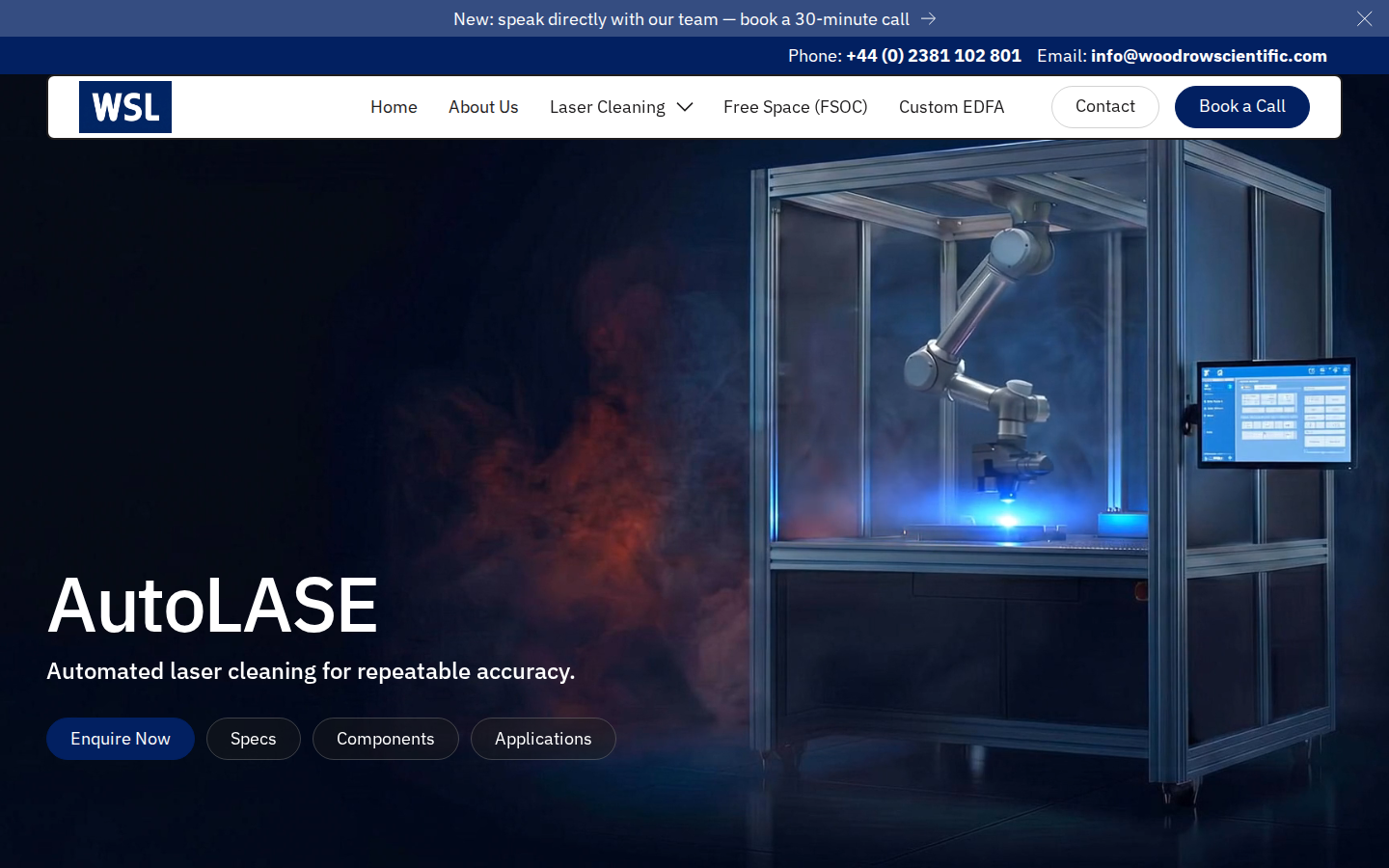
AutoLASE is an automated laser cleaning system from Woodrow Scientific Limited (WSL) — the only UK-based laser cleaning manufacturer, designing and building in-house since 2012. The cleaning head mounts on an articulated robotic arm; load a part and the system scans it, builds a 3D map, and runs the clean automatically — no programming, no specialist skills, no manual path-setting required.
Pros:

Load the part — system runs itself
Optional RHZ upgrade: enclosure-free operation
Genuine UK manufacturer, full in-house engineering
No consumables — strong total cost of ownership
Cons:

Pricing is contact-for-quote only
300 W ceiling suits cleaning, not heavy ablation
Where most automated laser cleaning systems require a technician to program a cleaning path for every new part geometry, AutoLASE eliminates that burden entirely — load the part, and the machine vision system scans it, builds a 3D map, and generates the clean automatically.
No knowledge of part geometry is needed, no path-setting, no specialist operator — anyone on the production floor can run it, and every cycle holds the same cleaning standard.
AutoLASE RHZ: Enclosure-Free Operation
AutoLASE can be configured with WSL's patented Reduced Hazard Zone (RHZ) technology, making it the only automated laser cleaning system in the world that can operate with no enclosure at all.
No other automated laser cleaning system on the market offers this — the RHZ upgrade is exclusive to WSL worldwide, and it opens up facilities where a full enclosure is a practical or regulatory obstacle.
AutoLASE Process Capability
AutoLASE runs a up to 300 W fibre laser with power tunable across the full 0–100% range, giving a single cell the reach to handle light oxides through thick coatings without tool changes.
The beam stops at the base material, so substrate loss is minimal — which directly reduces rework and keeps tight-tolerance parts within specification.
Contaminants and coatings it removes include:
- Rust and oxides: Including mill scale and weld discolouration.
- Paint, powder coating, and lacquer: Full coating removal without abrasive contact.
- Oil, grease, and release agents: Clean surfaces ready for bonding, welding, or inspection.
- Primer and adhesive residues: Leaves the substrate untouched.
- Carbon, soot, and tarnish: Suited to remanufacturing and refurbishment workflows.
Material compatibility spans the common industrial metals: steel, carbon steel, aluminium alloys, cast iron, copper, brass, bronze, titanium, and galvanised — a genuine advantage for mixed-metal production environments.
AutoLASE Integration and Flexibility
AutoLASE attaches to a customer's existing collaborative or industrial robots, or WSL can supply it as a complete custom cell — bespoke engineering and integration are available, and the delivery cable runs up to 50 m.
Prospects with specific integration requirements are encouraged to get in touch with WSL directly — the in-house engineering team handles configuration from initial spec through to commissioning.
AutoLASE Safety and Compliance
AutoLASE is CE and UKCA certified, and WSL provides first-class laser cleaning safety and operation training directly from the manufacturer.
Standard configuration operates as a Class IV laser; the optional RHZ upgrade shifts the system to Class I — removing the enclosure requirement and significantly reducing the safety overhead for the facility.
The Manufacturer Behind AutoLASE
WSL is the only UK-based laser cleaning manufacturer — it designs, builds, services, and improves its machines entirely in-house, backed by 200+ years of combined engineering experience.
A significant share of the laser cleaning market is made up of resellers and importers rebadging third-party machines, which limits their ability to offer genuine engineering support, fast spares, or product improvement — WSL's in-house model is a meaningful distinction.
WSL also offers the ELASER portable range for manual and semi-portable laser cleaning applications, making it a full-range manufacturer rather than a single-product vendor.
AutoLASE Pricing
AutoLASE is priced on a contact-for-quote basis — no published list price is available, though WSL positions it as the European cost leader among comparable industrial laser cleaning machines.
On a total cost of ownership basis, the case is strong: zero consumables, no chiller required (air-cooled), no media costs, and minimal substrate damage means less rework across the production run.
| Evaluation Axis | AutoLASE Rating | Key Detail |
|---|---|---|
| Process capability & contaminant range | Excellent | Up to 300 W, tunable 0–100%; rust through thick coatings |
| Throughput & cycle time | High | Repeatable automated cycles; same standard every run |
| Ease of operation & programming | Best-in-class | Load the part — no programming, no specialist skills needed |
| Integration & modularity | Flexible | Attaches to existing robots or supplied as complete cell; up to 50 m cable |
| Safety & compliance | Excellent | CE & UKCA certified; Class I with RHZ upgrade; no enclosure required |
| Total cost of ownership | Strong | Zero consumables, air-cooled, minimal substrate loss reduces rework |
Maps AutoLASE directly against the six evaluation axes declared in the Introduction, giving procurement and engineering readers a compact reference they can carry into shortlisting.
See AutoLASE in Action
AutoLASE scans any part geometry and generates its own cleaning path — no programming, no specialist operator required. Explore the full product page to see specifications and capabilities.
Product 2
Laserax Robot Cleaning Machine
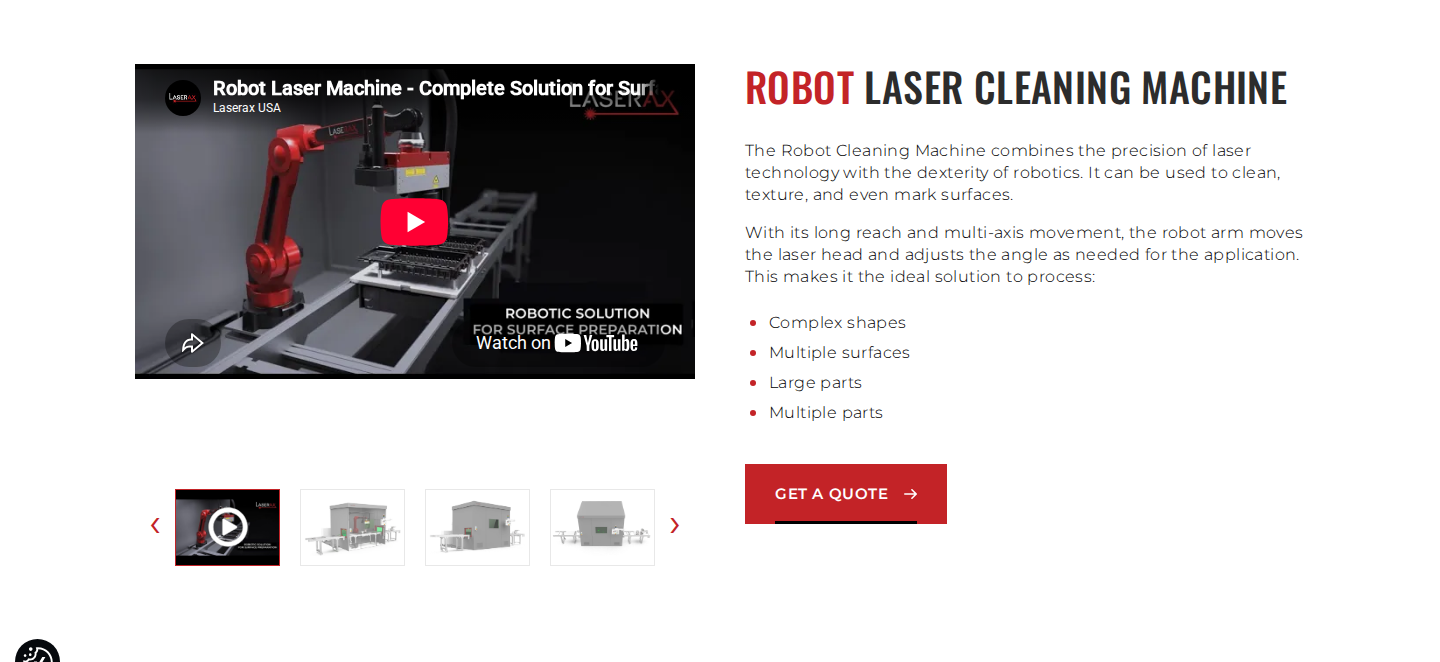
A 6-axis robotic arm laser cleaning cell from Laserax (Quebec City, Canada), offering 100 W to 3 kW of fiber laser power for high-volume inline cleaning, texturing, and marking in automotive, EV battery, and primary metals production.
Pros:
Power range: 100 W up to 3 kW
Clean, texture, and mark in one cell
Conveyor, rotary table, and door loading options
No consumables; 100,000-hour laser MTBF
Cons:
New part paths require engineering input
Vision system is optional, not standard
Class 1 enclosure required for all operation
No public pricing or lead time information
Laserax is a Canadian laser solutions manufacturer founded in 2010 and headquartered in Quebec City, with offices in the US, Germany, and distribution partners across Europe, Asia, Latin America, and the Middle East.
Their robot cleaning machine is a 6-axis robotic arm laser cleaning cell — a purpose-built, turnkey automated system designed for demanding inline production environments, not a handheld or gantry-based configuration.
Power Range and Process Capability
The system's power range is its most distinctive technical specification, spanning 100 W to 3 kW across single-mode and multimode fiber laser configurations.
| Configuration | Power Range | Spot Characteristic | Suited To |
|---|---|---|---|
| Single-mode fiber | 100 W – 500 W | Smaller spot size | Precision cleaning, surface texturing |
| Multimode fiber | 1 kW – 3 kW | Larger spot size | Large-area cleaning at high throughput |
The single-mode vs. multimode laser configurations have meaningfully different power ranges, spot characteristics, and application fits — a table communicates this more clearly than prose.
Beyond cleaning alone, the robot and laser can be programmed for multiple operations in sequence — cleaning, texturing, and marking surfaces within a single production cell, which reduces the need for separate processing stations downstream.
Application and Material Fit
Laserax has documented deployment experience in EV battery manufacturing, including a verified Tier 1 OEM case study where the system eliminated contamination on battery cell terminals ahead of ultrasonic wire bonding.
Application depth extends to automotive powertrain components and primary metals — particularly aluminium smelter environments, where Laserax describes its marking and cleaning technology as the most widely used solution in that sector.
Material compatibility confirmed in the product specifications covers nickel-plated steel, aluminium, copper, stainless steel, and all metals broadly.
Throughput and Inline Integration
Three part loading configurations are available — front door, inline conveyor, and rotary table — each suited to different production rhythms and part geometries.
- Rotary table: Allows loading and unloading of one part while another is being processed, reducing robot idle time and improving overall cycle efficiency.
- Inline conveyor: Integrates directly with common industrial conveyor systems for continuous-flow production lines.
- Robot brand flexibility: The cell accommodates robots from ABB, FANUC, KUKA, and other major suppliers — or can be adapted to a robot already on the buyer's floor.
- Communications protocols: PROFINET, Ethernet/IP, and EtherCAT are standard, with other options available on request.
The cell footprint is configurable: the electrical cabinet and control panel can be remotely located to minimise floor space and simplify access for operators and maintenance personnel.
Ease of Operation
The system ships pre-configured and pre-tested, with a web-based HMI and industrial PLC control that allows operators to select a part model and load the corresponding robotic sequence without manual parameter entry for known parts.
For new part geometries, path programming requires engineering input — this is standard practice for robotic laser cells of this type and should be factored into deployment planning, particularly for operations with frequent model changeovers.
Vision is listed as an available option based on application requirements, but it is not included as standard.
Safety
The robot cleaning machine operates within a Class 1 certified laser safety enclosure with interlocked doors, compliant with international laser safety standards — creating a fully laser-safe work environment that does not require personal protective equipment for personnel outside the enclosure.
TCO Profile
The system uses laser light only — no consumables — and is rated for 24/7 industrial operation. Cooling is air or water depending on the laser power configuration selected.
The laser source carries a published MTBF of 100,000 hours, confirmed across both the robot cleaning machine and ultra-high-power system specifications.
Laserax Robot Cleaning Machine Pricing
Pricing is available on a contact-for-quote basis only — no list pricing is published. Lead times are confirmed during the sales consultation process and are not stated publicly on the Laserax website.
Laserax maintains direct sales and support presence in North America (Quebec City, Michigan, Georgia, California) and Germany, with distribution partners covering the UK, Japan, India, Turkey, Bahrain, and South Africa.
Product 3
cleanLASER Robotic-Guided Systems
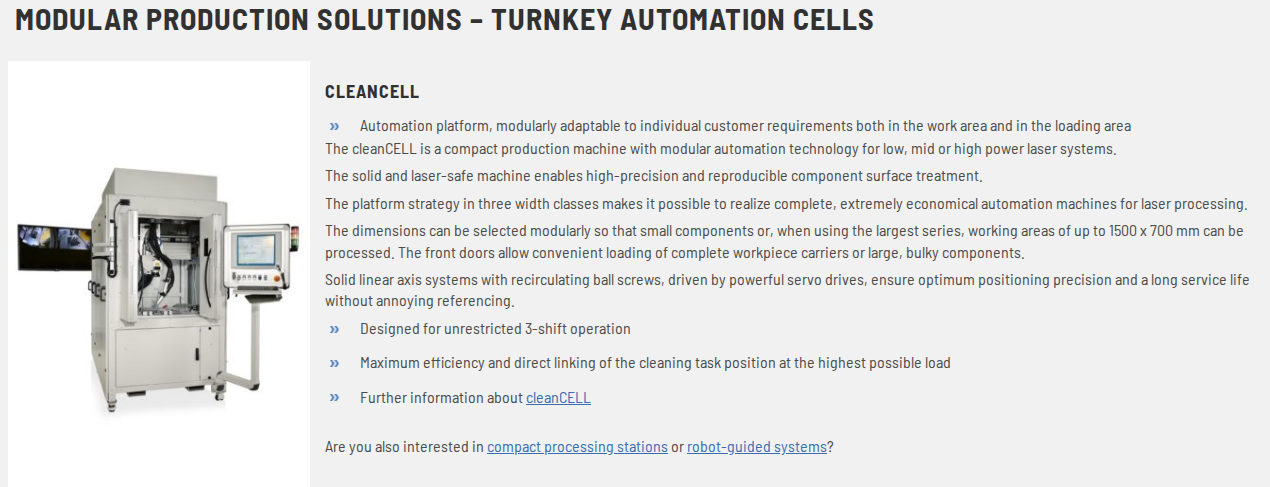
cleanLASER (Clean-Lasersysteme GmbH, now part of IPG Photonics) is a German manufacturer offering one of the broadest automated laser cleaning cell portfolios in the category — spanning the modular cleanCELL, roboCELL, compactCELL, cleanBOX, safeBOX, and cleanGANTRY portal systems, with laser power from 12 W up to 1,600 W CW and verified deployment across automotive, aerospace, rubber and tyre, and nuclear decontamination applications.
Pros:
Broadest automation cell portfolio in the category
Power range: 12 W up to 1,600 W CW
ISO 9001 and ISO 14001 certified; Made in Germany
No consumables; near-maintenance-free operation
Cons:
Robotic cells require programming per part type
Enclosure required; no reduced-hazard-zone option
Contact-for-quote only; no public pricing
Clean-Lasersysteme GmbH, headquartered in Herzogenrath near Aachen, Germany, has been developing and producing laser surface treatment systems since its founding in February 1997. Now part of IPG Photonics (since 2024), it operates independently as a genuine manufacturer — designing and building its own systems in Germany, ISO 9001 certified continuously since 2000 and ISO 14001 certified for environmental management.
The company describes itself as the world market leader in laser cleaning, and its automation portfolio is the strongest argument for that claim.
cleanLASER Automation Cell Portfolio
Where many laser cleaning vendors offer a single cell configuration, cleanLASER fields one of the broadest automated metal finishing cell portfolios in the category.
- cleanCELL: Modular turnkey automation cell available in three width classes (1170, 2220, 3220), with working areas up to 1,500 x 700 mm. Designed for unrestricted 3-shift operation with solid linear axis systems and recirculating ball screws.
- roboCELL: Robot-guided cell for applications requiring 6-axis flexibility. Customer-specific robot cell configurations are also available for bespoke production requirements.
- compactCELL: Semi-automatic system in a 0.6 x 0.8 m footprint, with a servo-driven linear axis and a typical working area of 180 x 600 mm — suited to smaller components where floor space is constrained.
- cleanBOX: Compact system for rotationally symmetrical workpieces (cylinders, gears, turned parts up to 280 mm diameter) with a rotary indexing table enabling manual or automated loading and line integration.
- safeBOX: Entry-level laser-safe enclosure (Class 1) for small, manually loaded components — suited to laboratory and low-volume applications.
- cleanGANTRY: Portal system for large-area components up to 2 x 3 m (scalable further on request), with integrated laser, scanner, and automation control. Supports contourSCAN technology and a CAD/CAM interface for synchronised axis and scanner movement.
This range means buyers can match cell format to component size and production volume without switching vendor ecosystems — from a bench-scale safeBOX to a full gantry portal handling large structural parts.
Power Range and Process Capability
The cleanLASER family spans from 12 W at the low-power end up to 1,600 W CW beam source power on the CL 2000 — one vendor covering the full range from precision decoating to high-throughput industrial surface preparation.
The flagship automated system is the CL 1000iF, which features a homogeneous top-hat beam profile for consistent material removal quality across the working area. Its highly dynamic 2D scanner enables area rates of up to 120 cm²/s and feed rates of up to 30 m/s, with a fieldbus interface for integration into industrial control systems and a modern HMI supporting on-the-fly processing.
The mid-power CL 150–600 range handles gentle decoating and cleaning tasks where substrate sensitivity is a priority.
Industry Applications
cleanLASER's cross-industry deployment is extensive and well-documented on its own site. Verified sectors include automotive (including EV and e-mobility pre-treatment), aerospace (partial paint stripping, CFRP mould cleaning), rubber and tyre mould cleaning, electronics, food and wafer bakeries, mould cleaning and degreasing, and nuclear decontamination.
The CL 1000iF is specifically qualified for automotive production, including surface preparation in e-mobility applications — a credential that matters to tier-1 suppliers running validated production lines.
The cleanGANTRY portal system has been established in aerospace CFRP mould cleaning, where cleanLASER claims it is the most cost-effective option for large-area mould treatment — a position reached through co-development with European aerospace manufacturers.
Integration and Operation
Robotic and gantry cells connect to existing production lines via digital I/O or fieldbus interfaces, with beam delivery through flexible fibre-optic cables that keep the laser source remote from the working head. The contourSCAN software extension synchronises axis and scanner movement on gantry systems, minimising cleaning area while maximising throughput.
One trade-off to state plainly: robotic cells require programming per part type and application. This is standard practice across the category, but it does mean setup time for each new component geometry — unlike vision-driven systems that generate cleaning paths automatically. The modular platform reduces engineering time for standard applications, and the CL 1000iF's HMI with on-the-fly processing support eases operation once programmed.
All automated cells are Class 4 laser systems operating within laser-safe enclosures (Class 1 housings on the cleanCELL, cleanBOX, compactCELL, and safeBOX). Standard enclosures are required for all automated operation — there is no reduced-hazard-zone option in the cleanLASER portfolio.
cleanLASER Pricing
Pricing is contact-for-quote across the cleanLASER automation range. Prospective buyers should contact cleanLASER directly for cleanCELL and CL 1000iF configuration pricing and lead times. No consumables are required beyond the laser source itself, which is the standard TCO advantage of laser cleaning as a category.
Product 4
Acme Manufacturing Robotic Finishing Cells
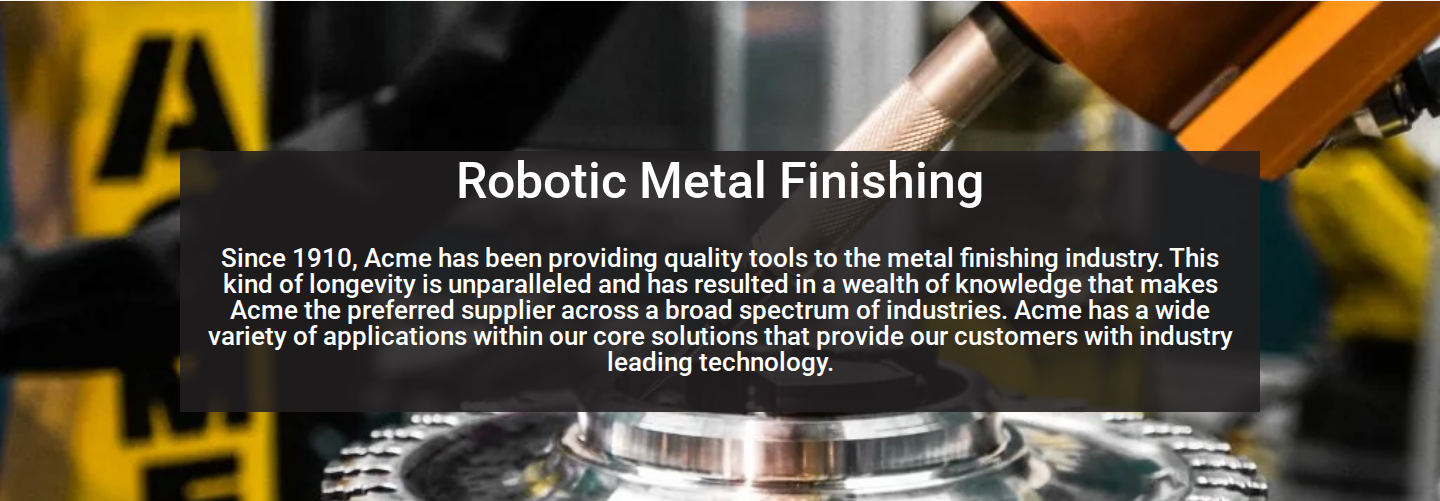
Acme Manufacturing (Auburn Hills, MI, founded 1910) is a family-owned robotic systems integrator with over a century of focus on automated polishing, buffing, grinding, and deburring of metal parts — the leading US-based option in the abrasive robotic finishing category, with 3,500 systems deployed worldwide and more orthopaedic implant finishing systems installed globally than any other company.
Pros:
Century-plus of robotic finishing expertise
Broadest abrasive process capability in category
150+ orthopaedic implant systems installed globally
Automatic media wear compensation reduces intervention
Cons:
Path programming required per new part type
Abrasive media consumable costs ongoing
Dust extraction infrastructure required
Acme Manufacturing is a different category of system from the three laser cleaning entries preceding it — and that distinction matters for readers still mapping their production problem to the right system type.
Laser cleaning removes contamination from metal surfaces: rust, oxides, coatings, release agents. Acme's robotic cells perform abrasive surface finishing — polishing for cosmetic appearance, grinding for material removal, deburring for edge quality, and buffing for surface lustre. These are not competing tools for the same job; they are different categories for different production requirements.
Company Background
Founded in 1910 in Detroit, Michigan, Acme Manufacturing is a family-owned systems integrator and machine builder now headquartered in Auburn Hills, MI, with over 85,000 sq. ft. of manufacturing space across two facilities.
Its tagline, "Shaping the future since 1910," reflects a singular focus: grinding, polishing, buffing, and deburring of metal parts. That century-plus of application depth is a genuine credibility signal in a category where engineering experience translates directly to process reliability.
Acme Manufacturing Process Capability
Acme's systems cover a broader range of abrasive processes than most robotic finishing vendors — a meaningful differentiator in a category where narrow specialisation is common.
- Robotic polishing and buffing: Cut buffing, colour buffing, abrasive polish, soft polish, satin finish, and bright mirror buffing across a range of metals.
- Abrasive belt grinding: Coated abrasive belt technology for stock removal, tolerance grinding, and fine polishing in single or multiple-head configurations.
- Centreless grinding: Continuous high-production throughput for tubes, rods, and bar stock — O.D. range from 0.060" up to 12", line speeds from 3 to 100 FPM, surface finishes from 2 to 20 microinches Ra.
- Robotic deburring: Brush (monofilament abrasive), non-woven belt and wheel, and hard-tool techniques for edge profiling, radius/chamfer, and burr removal.
- Weld removal and blending: Coated abrasive processes for weld seam removal and surface blending on fabricated assemblies.
- Flash removal: Removal of flash on forged and cast parts, applicable across aerospace, automotive, and medical implant components.
Across all abrasive media operations, Acme's systems incorporate automatic media wear monitoring and compensation software, which adjusts for wheel and belt wear throughout the production run — maintaining consistent finish quality without requiring operator intervention to compensate for media degradation.
Material Compatibility
Acme's systems are engineered for steel, aluminium, cobalt chrome, titanium, zirconium, copper, inconel, and ceramic-coated materials, among others.
The material range spans castings, forgings, machined parts, and precision medical implants — environments where tight surface finish tolerances are a hard requirement, not a preference.
Throughput and Scalability
Robotic cells use 6-axis robots with programmable 7th-axis finishing head positioning, giving the system the reach and orientation flexibility to address complex part geometries at production rates.
Centreless grinding lines deliver continuous throughput on cylindrical stock — a single pass can remove up to 1/16" (1.5mm) of material while holding close diameter tolerances, with rapid CNC changeover between part sizes in two to five minutes on multi-head systems.
Parallel load/unload configurations allow a new part to be loaded while the robot finishes the previous one, minimising idle time in high-volume production environments.
R1 Flex Cell: Integration Specifications
The Acme R1 Flex Cell is a representative turnkey configuration built around a FANUC M710 robot (45 kg payload) with an inverted mount for an expanded work envelope.
| Specification | Detail |
|---|---|
| Robot | FANUC M710, 45 kg payload, inverted mount |
| Footprint | 7.5 x 13 x 8 ft tall, single-piece common base |
| Power | 480VAC, 3-Phase, 60Hz, 40A disconnect |
| 7th Axis | FANUC gearbox and servo for programmable head positioning |
| HMI | Teach pendant |
| Dust collection | Integrated ductwork; wet or dry collection available |
| Compound system | Two 15-gallon liquid compound pressure pots, integrated |
| Safety | Safety-interlocked access doors and load/unload area |
| Warranty | 12-month new machine warranty; extended service contracts available |
Gives procurement-stage readers the hard integration specs they need to assess facility fit — power, footprint, safety, and control — in a scannable format that mirrors the spec tables used in sibling entries.
The single-piece common base simplifies both initial installation and future relocation — a practical benefit for facilities that reconfigure production layouts over time.
Ease of Operation
Setting up Acme's cells for a new part type requires robotic path programming via teach pendant — this is standard practice for robotic finishing cells in this category, and it means engineering input is needed for each new part geometry introduced to the system.
Once a part programme is established, the automatic wheel and belt wear compensation system handles media degradation without operator adjustment, and the servo-regulated programmable belt pressure maintains consistent contact force throughout the run.
Abrasive Finishing vs. Laser Cleaning: The Category Trade-off
Abrasive processes generate dust, consume media over time, and remove substrate material — all characteristics that laser-based methods avoid. Dust extraction infrastructure is a facility requirement, and media consumable costs are an ongoing operational consideration.
The framing that matters, though, is this: abrasive finishing is the correct category when the production requirement is cosmetic surface finish, controlled material removal, or edge quality preparation. Laser cleaning does not perform those functions. The two categories address different problems, and the trade-offs of abrasive finishing are inseparable from what makes it the right tool for its intended application.
Track Record
Acme has deployed 3,500 robotic finishing systems globally across automotive, aerospace, medical, firearms, foundry, and transportation industries — and has built more turnkey robotic finishing systems for the orthopaedic implant industry than any other company in the world, with over 150 systems installed globally.
The orthopaedic implant figure is worth pausing on: 150+ systems for a single application segment that demands tight surface finish tolerances on cobalt chrome, titanium, and zirconium components is a strong signal of the precision and consistency standards these cells are built to maintain.
Acme Manufacturing Pricing
Pricing is contact-for-quote — standard for capital equipment at this configuration level. No lead time figures are published; Acme's service documentation notes that on-site technician response is available within 48 hours for continental US customers.
Product 5
Atotech DynaPlus Automated Plating Lines
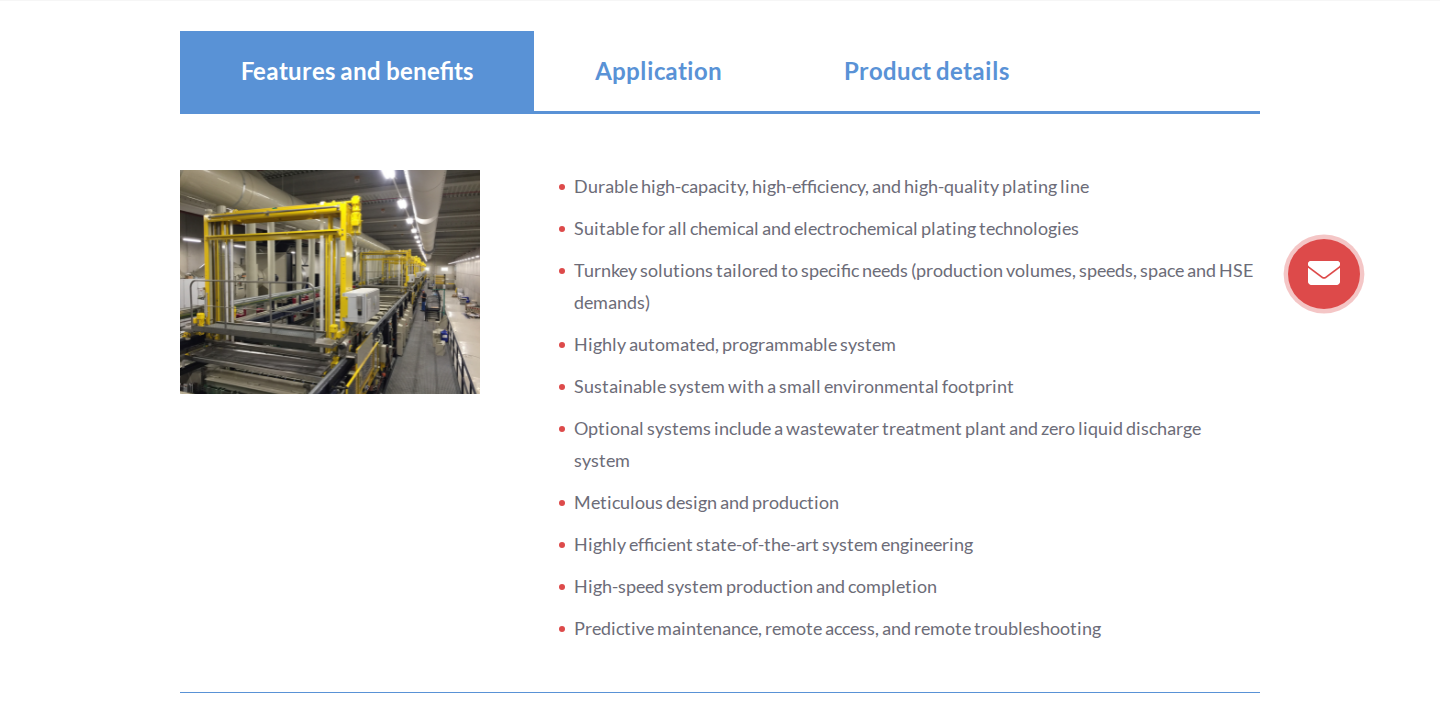
Atotech DynaPlus (now part of MKS Instruments) is a fully automated rack and barrel electroplating line platform, engineered in Germany for over 60 years, covering decorative plating, corrosion-protection coatings, hard chrome, and electroless nickel at production scale.
Pros:
Co-engineered chemistry and equipment from one supplier
15 to 200 tonnes per day throughput range
TUV-certified 90% wastewater reduction on zinc nickel
Turnkey package: tanks, control, dosing, periphery
Cons:
Capital-intensive; significant infrastructure investment required
On-site chemical management infrastructure needed
Wastewater generation requires treatment plant
Automated electroplating lines occupy a distinct lane in the automated metal finishing landscape: where laser cleaning removes contamination and robotic abrasive cells reshape or refine surfaces, electroplating lines apply an electrochemical coating to the base metal — depositing zinc, nickel, chrome, or other materials to achieve corrosion resistance, hardness, or decorative finish at production scale.
Atotech, acquired by MKS Instruments in August 2022 for approximately $4.4 billion, is a Berlin-headquartered specialty chemicals and equipment supplier with over 60 years of plating line production at its Feucht, Germany facility.
Its two primary automated plating line platforms for general metal finishing are DynaPlus and DynaSmart, which differ in architecture and best-fit production context.
| Platform | Throughput | Configuration approach | Key differentiator |
|---|---|---|---|
| DynaPlus | 15 to 200 tonnes per day | Fully bespoke to customer production volume, speed, and space | Widest output range; suits both mid-volume and high-volume lines |
| DynaSmart | 13,500 tonnes per year | Modular, compact; pre-installed at factory, shipped in freight containers | Simultaneous processing of different parts in different tanks |
Comparing DynaPlus and DynaSmart on the axes readers care about most — throughput, configuration approach, and key differentiating feature — is clearer in a table than in prose, given that the two platforms address different production scenarios.
Both platforms cover the full spectrum of electrochemical surface coating: decorative electroplating, plating on plastics, corrosion-protection plating (zinc, zinc-nickel, zinc-iron), hard chrome, and electroless nickel.
The DynaSmart's concurrent-processing architecture is a genuine operational distinction: multiple product carriers move simultaneously through different plating tanks, each with its own immersion time and agitation mode, enabling flexible mixed-part production within a single compact line.
Integration and ease of operation
Both platforms are delivered as complete engineering packages — tanks, transporters, control system, chemical dosing, and periphery — rather than bare hardware requiring third-party integration.
A notable convenience specific to DynaSmart: modules are pre-installed at Atotech's factory and shipped in standardised freight containers, enabling plug-and-play installation at the customer site and straightforward capacity expansion as demand grows.
Atotech's most distinctive operational advantage across both platforms is that it supplies both the chemistry and the equipment, co-engineered for process compatibility at its Feucht facility.
When chemistry and equipment come from different suppliers, interface problems — process drift, dosing incompatibilities, finger-pointing on quality issues — are a routine operational cost. A single-supplier model removes that friction from day-to-day line management.
Safety, compliance, and environmental footprint
Environmental performance is built into the system architecture rather than added as an afterthought: optimised exhaust air and heat recovery systems, efficient pumps and motors, and automatic regeneration mechanisms reduce energy, water, and chemical consumption across both platforms.
Atotech's CMA (Compact Membrane Anode) Closed-Loop System for alkaline zinc nickel plating goes further: certified by TÜV Rheinland, it operates as a self-contained closed circuit covering every step from plating to rinsing, reducing zinc nickel wastewater disposal by 90% and cutting energy consumption by 32%.
Optional wastewater treatment plant and zero liquid discharge system configurations are available for DynaPlus lines where regulatory or operational requirements demand them.
Industries served
- Automotive: Corrosion-protection and decorative plating for body, chassis, and powertrain components.
- Aerospace: Hard chrome and electroless nickel for wear and corrosion resistance on critical parts.
- Sanitary fittings: Decorative electroplating and plating on plastics for taps, fixtures, and hardware.
- Electronics and heavy machinery: Functional coatings requiring precise bath chemistry control and consistent deposit quality.
The honest trade-off for this category is infrastructure cost: automated plating lines require significant capital investment in the line itself, plus ongoing chemical management, bath monitoring, and wastewater treatment — whether via Atotech's optional integrated plant or a third-party facility.
Buyers evaluating automated plating lines should budget for the complete infrastructure envelope: the line, chemical management systems, wastewater treatment, and ongoing chemistry procurement. The line price is only one component of the total ownership cost.
Atotech DynaPlus Pricing
Pricing is contact-for-quote only. DynaPlus lines are configured to each customer's production volume, throughput speed, space constraints, and process chemistry requirements, so no standard list price applies.
Not Sure Which System Fits Your Process?
Four system categories, one production problem to solve. Speak with a Woodrow Scientific laser cleaning expert to work out which automated finishing approach fits your operation.
Conclusion
Matching your production problem to the right finishing system
Every system here is capable — the question is whether its category matches your production problem.
If the problem is contamination removal, automated laser cleaning is the right category. Within it, AutoLASE leads: load the part and it runs without programming, with an optional RHZ upgrade enabling enclosure-free operation exclusive to Woodrow Scientific.
For surface finishing — polishing, grinding, buffing — robotic abrasive cells (such as Acme) fit best; for electrochemical coating, automated plating lines (such as Atotech DynaPlus) are the answer.
Woodrow Scientific offers bespoke engineering and integration support for laser cleaning applications — worth a conversation with your specific part in hand.
Automated metal finishing: frequently asked questions
Practical answers to the questions buyers most commonly ask when evaluating automated metal finishing systems — covering system categories, evaluation criteria, and key differentiators.
The four main categories are: automated laser cleaning (removes contamination and surface coatings without chemicals or abrasives); robotic polishing and grinding cells (deliver cosmetic and functional surface finishing); automated deburring and deflashing (remove burrs and flash from machined or cast parts); and automated plating lines (apply electrochemical surface coatings at production scale). Each category addresses a different problem at a different point in the manufacturing process. The right choice depends entirely on what your operation needs to achieve at the surface — contamination removal, surface refinement, edge finishing, and coating application are distinct objectives that call for distinct systems.
Metal finishing techniques fall into three broad families: surface cleaning and preparation (laser cleaning, abrasive blasting, chemical stripping, water-jetting); mechanical finishing (polishing, grinding, buffing, deburring, edge rounding); and electrochemical coating (electroplating, electroless plating, anodising). Automation is available across all three families, which is what makes the category relevant to industrial buyers evaluating production-scale systems. The degree of automation varies by technique — laser cleaning and robotic polishing cells are among the most highly automatable, while some electrochemical processes still require manual chemistry management and monitoring alongside automated material handling.
Evaluate systems across six axes: process capability and material compatibility; throughput and cycle time; ease of operation and programming; integration and modularity; safety and compliance; and total cost of ownership. These criteria separate systems that look similar on paper but perform very differently in production. Approach vendors with specific part samples and real production volume data rather than a general enquiry — system fit is heavily dependent on part geometry, material, contaminant type, and cycle time requirements, and vendors can only give meaningful guidance when they have that information. Ease of operation is also worth weighting more heavily than buyers typically do: not all automated systems are equally accessible, and the skill required to set up and run a new part type varies significantly across the category.
Laser cleaning removes contamination using laser light alone — no abrasives, chemicals, or water are involved. The beam stops at the base material, leaving the substrate intact and requiring no secondary processing. Traditional methods each carry operational overheads that laser cleaning eliminates: abrasive blasting (sandblasting, shot blasting) removes substrate material along with contamination and generates media waste requiring disposal; chemical stripping involves handling hazardous substances, dwell time, and waste stream management; water-jetting generates effluent and requires drying before downstream processes. On total cost of ownership, laser cleaning is substantially stronger for repetitive production cleaning — zero consumable costs, minimal substrate loss reducing rework, and less process downtime all compound over time. The comparison that matters for production buyers is not the upfront figure in isolation, but the full cost picture across the system's working life.
Most automated laser cleaning systems do require engineering input to program cleaning paths for each new part geometry. In a standard robotic laser cell, a technician maps the part and sets the path before production runs can begin — this is the norm across the category. AutoLASE by Woodrow Scientific is the exception. Load a part and the system scans it, builds a map, and generates the clean automatically — no manual programming, no path-setting, and no knowledge of the part geometry is needed. Anyone can load a part and run it. This distinction has real operational consequences: it removes the dependency on specialist programming resource, eliminates setup time when switching between part types, and means the system is accessible to operators without technical training.
For buyers in UK and EU markets, the two primary market-entry certifications to confirm are CE marking (required for the EU and recognised in the UK) and UKCA marking (the UK-specific conformity mark introduced post-Brexit). Both indicate that a system has been assessed against applicable health, safety, and environmental requirements. For automated laser cleaning systems specifically, the standard safety architecture is a Class 1 laser safety enclosure — a certified enclosure that contains the beam and makes the external environment laser-safe. Look for Class 1 certification on the complete cell, not just the laser source itself, as the source classification alone does not account for the integrated system. AutoLASE by Woodrow Scientific offers a distinct alternative: it can be configured with WSL's patented eye-safe technology under a Reduced Hazard Zone (RHZ) arrangement, eliminating the need for any enclosure at all. This RHZ capability is provided only by WSL worldwide and is not available on any other automated laser cleaning system. For robotic polishing and automated plating systems, CE and UKCA marking alongside relevant machinery directive compliance are the standard markers to verify. Request full certification documentation from any vendor as part of your evaluation process.