

Introduction
The stakes of getting this wrong vary enormously depending on why you are doing it.
For someone restoring garden furniture or cleaning cookware, the choice is mostly about cost and convenience. For a manufacturer preparing aluminium before welding or coating, surface quality and substrate integrity are critical — the wrong method can cause downstream failures far more expensive than the cleaning itself.
Each method is evaluated on the same five axes: how it removes oxide, which situations it suits, which surfaces it is safe on, what it costs in time and effort, and where its real limitations lie.
Methods are ordered by surface-quality outcome and capability — not by cost — so the most capable options appear first.
TL;DR
There is no single best way to deoxidise aluminium. The right method depends entirely on your context — surface type, scale, and what happens to the part afterwards. Choosing without that clarity can mean a scratched finish, a failed weld, or operational overhead that costs far more than the cleaning itself.
This article covers:

Five deoxidisation methods evaluated and compared
Each method assessed across five consistent axes
Decision guidance for your specific situation
Why ordering reflects capability, not cost
What is aluminium oxidation and why does removal method matter?
Aluminium oxidation is not a flaw — it is a feature of the metal that becomes a problem only when you need to weld, coat, bond, or restore it. Understanding exactly what the oxide layer is, and why it behaves so differently from ordinary rust, is what makes the differences between removal methods legible.
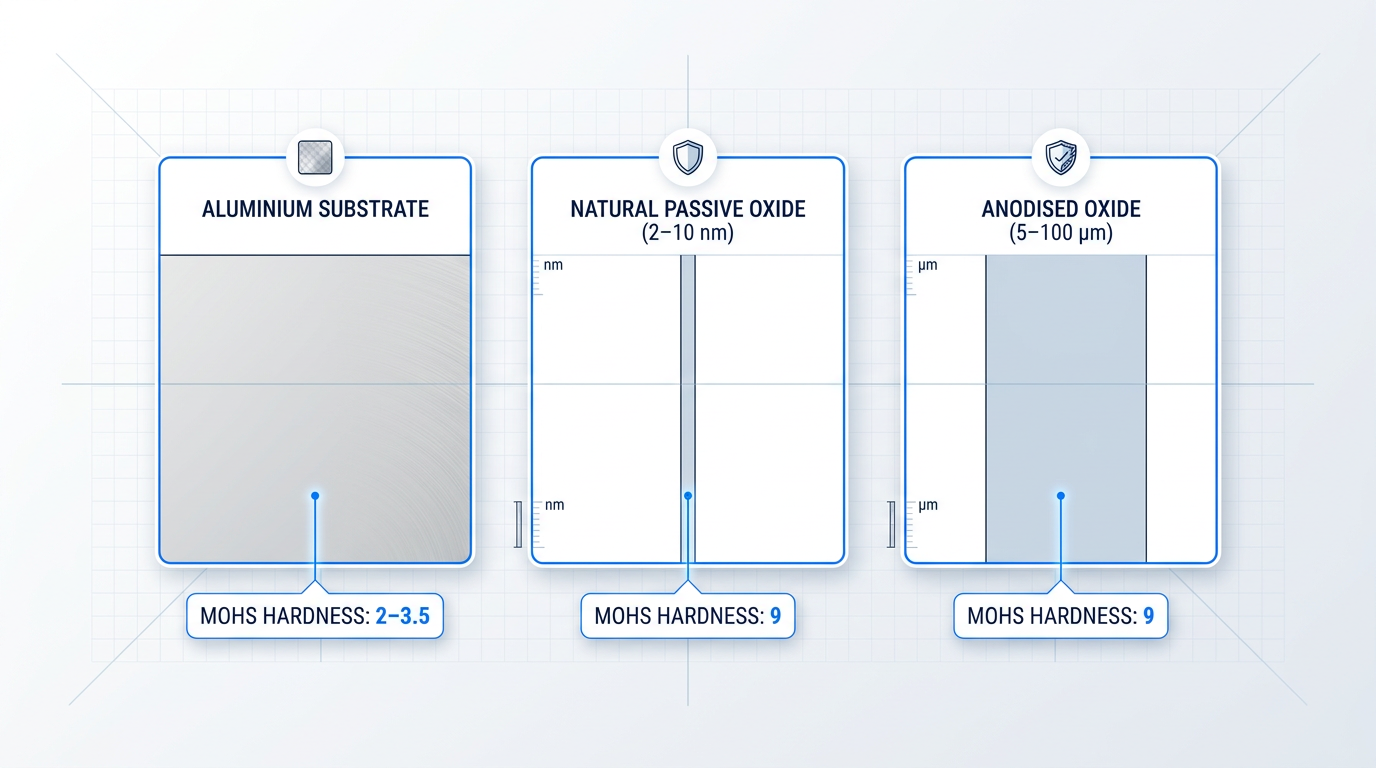
When aluminium is exposed to air, it reacts almost instantaneously with atmospheric oxygen to form aluminium oxide (Al₂O₃). According to peer-reviewed surface science research, the natural passive layer that forms at room temperature is typically between 2 and 10 nanometres thick — so thin it is essentially transparent to the naked eye.
This layer is not a sign of corrosion in the conventional sense. It is a self-limiting passivation layer: once it reaches a stable thickness, it stops growing under normal conditions. The oxide seals the underlying metal from further atmospheric attack, which is precisely why aluminium holds up so well outdoors without paint or coating.
That dual character — protective in service, problematic for processing — is the central tension this comparison is built around. The layer that keeps aluminium corrosion-resistant is the same layer that must be removed before welding, adhesive bonding, or applying a precision coating.
Why aluminium oxide is nothing like rust
Most people's mental model of metal oxidation comes from steel rust, and that model leads to the wrong conclusions about aluminium. Iron rust is porous, mechanically weak, and self-propagating — it flakes away, undercuts the base metal, and keeps growing until the part is structurally compromised.
Aluminium oxide does none of those things. It is hard, tightly bonded to the substrate, and — as noted above — self-limiting. It does not flake, it does not propagate beneath the surface, and it does not threaten the structural integrity of the part over time.
The challenge aluminium oxide poses is one of surface interference, not structural decay. A welding arc cannot cleanly fuse through it. An adhesive cannot grip a contaminated surface reliably. A coating cannot bond to a layer it cannot reach. That is why oxide removal matters — not because the part is failing, but because the surface is unavailable.
The amphoteric chemistry that drives method selection
Aluminium oxide is amphoteric — a term from chemistry meaning it reacts with both acids and alkalis. As LibreTexts chemistry references confirm, Al₂O₃ will dissolve in acidic conditions and also in basic (alkaline) conditions, which is why such a wide range of removal approaches can work on it.
This explains why the method landscape spans from household pantry staples to industrial chemical baths: both acidic agents and alkaline solutions are chemically capable of attacking the oxide layer.
Because Al₂O₃ reacts with both acids and alkalis, the same chemical reactivity that makes it dissolvable also means the wrong agent — at the wrong concentration or contact time — can attack the aluminium base metal beneath. Method selection is not arbitrary; it is a chemistry decision.
The practical implication is that there is no universal safe solvent for aluminium oxide. Concentration, contact time, and the specific agent all determine whether the oxide dissolves cleanly or whether the base metal is also attacked — which is why method choice carries real consequences beyond mere preference.
Hardness mismatch: the mechanical challenge
Aluminium oxide in its crystalline form is corundum — the same mineral as sapphire and ruby, rated 9 on the Mohs hardness scale, just one step below diamond. Britannica confirms this rating, noting corundum's use as an abrasive precisely because of this extreme hardness.
The aluminium metal beneath, by contrast, sits at roughly 2–3.5 on the Mohs scale — placing it among the softer structural metals. This hardness mismatch is the physical reason mechanical removal methods carry surface-integrity trade-offs: any abrasive capable of cutting through the oxide layer is also capable of scratching or dimensionally altering the soft substrate beneath it.
The special case of anodised aluminium
Anodising is an electrochemical process that deliberately thickens and densifies the natural oxide layer. According to TWI-Global, standard anodised coatings are typically 5 to 30 micrometres thick; hard anodising produces layers of 25 to 100 micrometres. Compare that to the 2–10 nanometre natural passive layer and the scale difference is three to four orders of magnitude.
Anodised aluminium must not be deoxidised. The anodised layer is the surface treatment — stripping it destroys the corrosion resistance, wear resistance, or decorative finish that anodising was applied to provide. Every method covered in this comparison carries the same compatibility boundary: not appropriate for anodised surfaces. That limitation will appear repeatedly in the method entries, and this is why.
What goes wrong when the wrong method is chosen
The stakes of method selection vary by application, but in each case the failure mode is concrete. For welding preparation, the AWS Welding Journal and TWI-Global both confirm that the melting point of Al₂O₃ is approximately 2,050°C — far above aluminium's melting point of approximately 660°C. Unremoved oxide does not melt into the weld pool; it remains solid, causing inclusions, porosity, and fusion defects.
For coating and adhesive bonding, residual oxide or surface contamination left behind by aggressive cleaning — abrasive particles embedded in the surface, chemical residues — creates a barrier between the substrate and the applied material. The result is inadequate bonding and coatings that delaminate under service conditions.
For aesthetic applications, the risk runs in the opposite direction: over-aggressive mechanical or chemical treatment leaves scratches, etch marks, or uneven surface finish that is harder to correct than the original oxidation.
With those properties established — the oxide's chemistry, its hardness, the anodised distinction, and the application-specific stakes — the trade-offs between each removal method become straightforward to evaluate.
Method 1
Portable laser cleaning (ELASER / ELASER-RHZ)
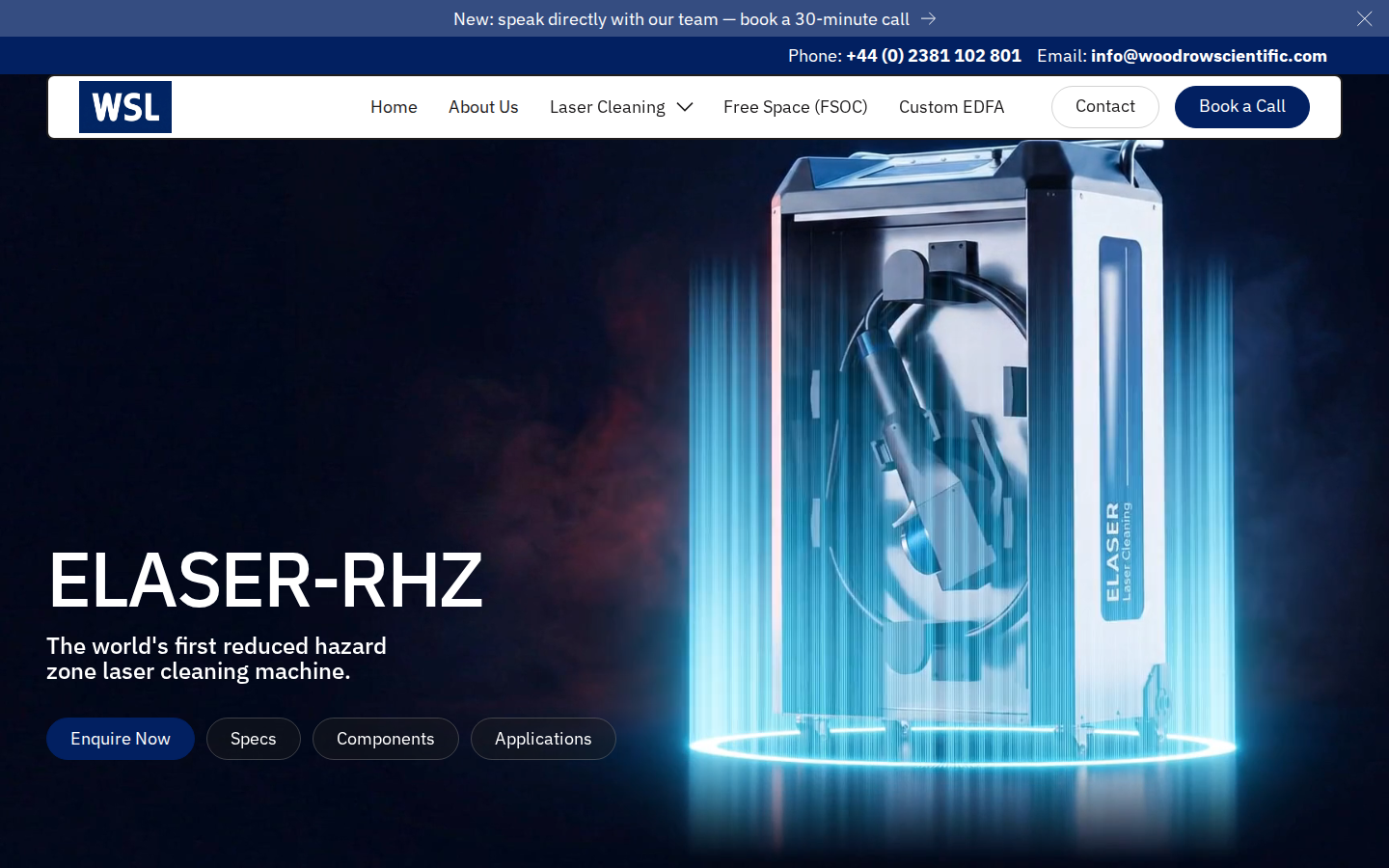
The ELASER is WSL's portable industrial fibre laser cleaner: a single-operator system that removes aluminium oxide and other surface contamination without chemicals, abrasives, or consumables, leaving the base metal intact. The ELASER-RHZ variant adds world-first reduced-hazard-zone technology that collapses the laser hazard zone, enabling cleaning in open workshops and mixed-use facilities.
Pros:

World-first RHZ technology enables open-workshop use
No consumables — laser light only
Sub-3 kg scanner, up to 50 m reach
Beam stops at base metal — no damage
Cons:

Industrial investment; not for domestic use
Operator training required before use
The ELASER-RHZ is the world's only laser cleaner with patented reduced-hazard-zone technology — collapsing the laser hazard to a small area around the work, so cleaning can proceed in open workshops, mixed-use facilities, and public-facing settings without sealing off the area.
That single capability removes the biggest practical barrier to laser cleaning: the safety overhead of evacuating and cordoning large zones before work can start.
How ELASER laser cleaning works
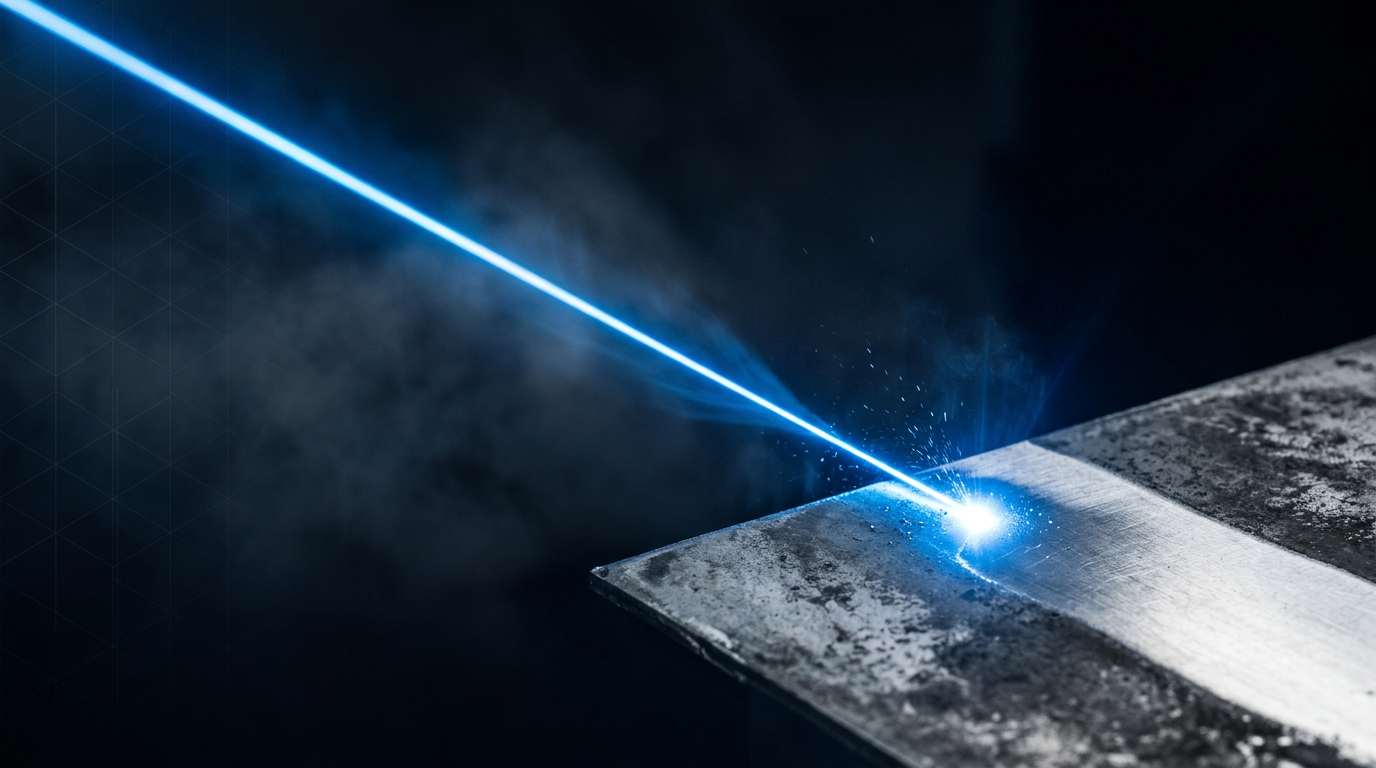
The fibre laser beam is selectively absorbed by the aluminium oxide contaminant layer and stops at the base metal — removing the oxide without touching the substrate beneath.
Power is tunable from 0–100%, up to 300 W, so one machine handles everything from light surface oxides on aluminium alloys through to heavier contamination on cast aluminium, with no equipment change.
Ideal applications for portable laser cleaning
The ELASER is built for situations where substrate integrity is non-negotiable and the work cannot come to a fixed cleaning station.
- Pre-weld and pre-coating prep: Removes aluminium oxide to a clean base metal surface without scratching or dimensional loss — critical for weld quality and coating adhesion.
- Aerospace and automotive components: Precise surface preparation to tight tolerances where abrasive or chemical methods carry too much risk of surface damage.
- Field and on-site deployment: The system goes to the work — up to 50 m cable reach means the operator can access hard-to-reach areas without moving the main unit.
- Open-plan manufacturing and heritage restoration: The RHZ variant enables cleaning in shared facilities and publicly accessible spaces that were previously off-limits for laser cleaning.
Additional application areas include injection moulding and tooling, industrial maintenance, tyre and rubber manufacturing, and launching a laser-cleaning service business.
Portability and single-operator operation
The handheld scanner weighs under 3 kg and connects via a delivery cable reaching up to 50 m — the main wheeled unit (under 50 kg) stays put while the operator moves freely.
No compressor, no water, no consumables: one operator and a power socket are all that is required to start cleaning.
| Specification | Detail |
|---|---|
| Max power | Up to 300 W, tunable 0–100% |
| Wavelength | 1550 nm (retina-safe / RHZ) |
| Handheld scanner weight | Under 3 kg |
| Delivery cable reach | Up to 50 m |
| System unit weight | Under 50 kg (wheeled) |
| Surface compatibility | Aluminium alloys, cast aluminium, virtually all metals |
| Certifications | CE and UKCA certified |
| Manufacture | Made in Britain |
Gives readers a fast, scannable view of the ELASER's key specifications across the five evaluation axes — how it works, surface compatibility, portability, power, and certifications.
ELASER pricing and cost of ownership
Compared with other industrial laser cleaning machines, the ELASER and ELASER-RHZ are competitively priced — WSL achieves this through in-house manufacturing and operational efficiency, not by compromising on quality.
Measured against chemical stripping, sandblasting, or abrasive methods, the total cost of ownership picture is compelling: no consumables, minimal downtime, and less rework from surface damage accumulate into significant long-term savings.
Pricing is available on request — contact WSL directly for a quote tailored to your application.
About Woodrow Scientific: the manufacturer behind ELASER
WSL (founded 2012) is the only UK-based laser cleaning manufacturer — designing, building, servicing, and improving its machines entirely in-house, with 200+ years of combined engineering experience.
A significant portion of the laser cleaning market consists of importers rebadging third-party machines — which means slower support, no in-house engineering capability, and no genuine ability to improve the product over time.
WSL also provides first-class laser cleaning safety and operation training, and offers bespoke engineering and customisation capability for operators with specific requirements.
The honest limitation: the ELASER is an industrial-grade system suited to professional operators, manufacturers, and maintenance teams — it is not the right tool for a one-off household restoration job, and operator training is required before use.
Method 2
Automated laser cleaning (AutoLASE)
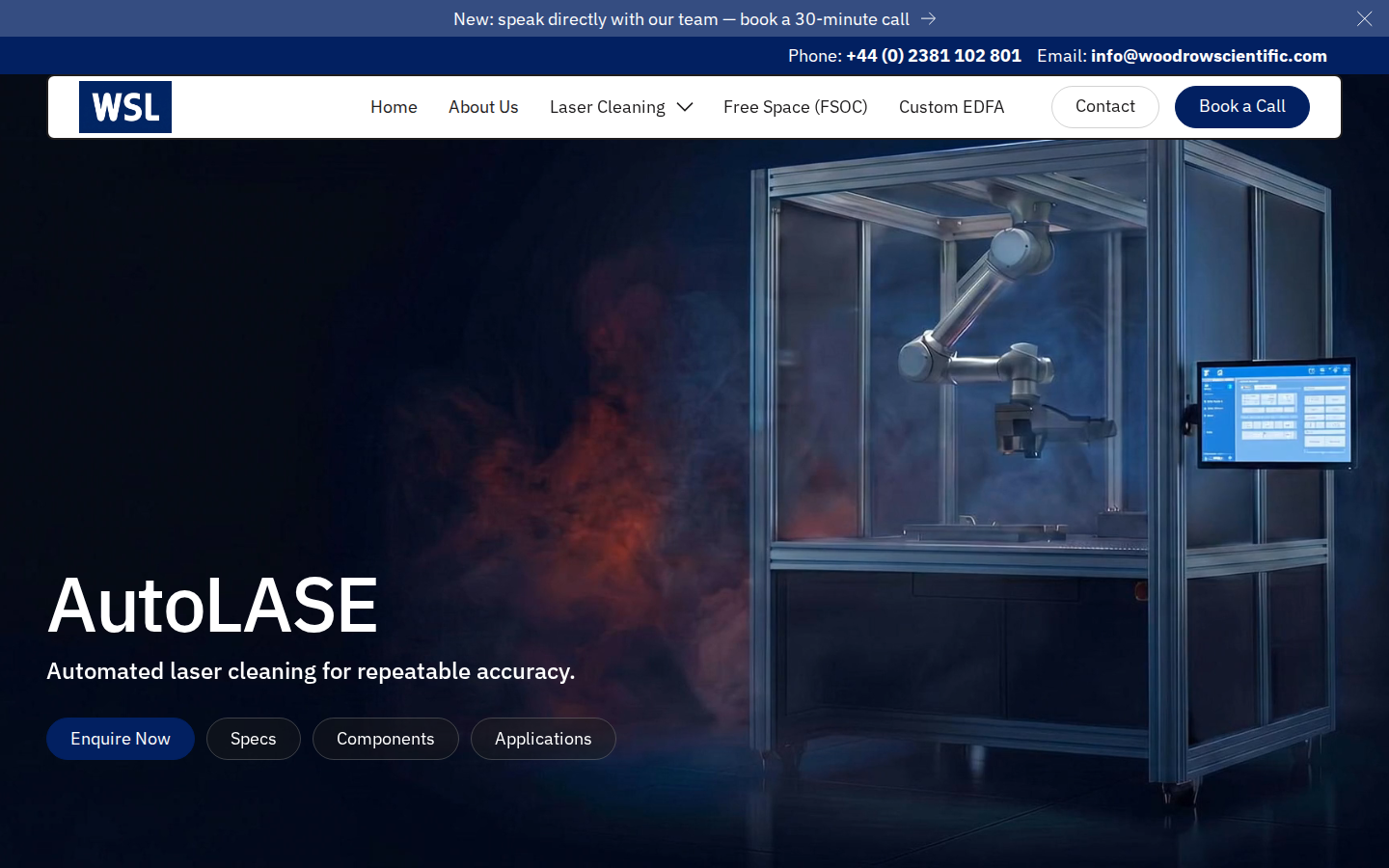
AutoLASE is WSL's automated laser cleaning system: a robotic-arm-mounted cleaning head guided by machine-vision software that scans each part, builds a 3D map, and generates the cleaning path automatically. No programming, no manual path-setting, no specialist skills needed — load the part and the system does the rest. Available with an optional RHZ upgrade for enclosure-free operation, it is built for production-scale aluminium deoxidisation where the same part or part family is cleaned repeatedly.
Pros:
Load-and-go 3D machine vision — no programming required
Optional RHZ upgrade: automated cleaning with no enclosure
Zero consumables — no chemicals, water, or abrasives
CE and UKCA certified; made in Britain
Cons:
Suited to recurring production runs, not one-off jobs
Requires integration planning for production line deployment
How AutoLASE Works
Where the ELASER puts laser cleaning in an operator's hands for field deployment, AutoLASE brings the same substrate-preserving ablation principle to fixed-cell production — with the operator's role reduced to loading the part.
The defining characteristic is how little skill it takes to run. Load a component; the system's machine-vision software scans it, builds a 3D map, and generates the cleaning path automatically — no manual programming, no path-setting, no knowledge of part geometry required. Anyone on the production floor can operate it from the first shift.
The cleaning head is carried on a multi-axis articulated robotic arm, giving it the reach to work across complex contours, recesses, and angles that a fixed-head system would miss. AutoLASE attaches to a customer's existing collaborative or industrial robots, or WSL can supply a complete custom cell.
As with all WSL laser systems, the beam stops at the base material — oxide and contamination are removed without touching the substrate beneath, so there is no abrasive wear, no chemical residue, and no surface variability introduced by the cleaning process itself.
The RHZ Option: No Enclosure Required
Every conventional automated laser cleaning cell on the market requires a full sealed enclosure to contain the laser hazard. AutoLASE is the only automated laser cleaning system in the world that can operate without one, thanks to WSL's optional Reduced Hazard Zone (RHZ) upgrade.
With RHZ configured, the eye-safe zone collapses to the immediate work area, making open-floor-plan integration viable. For manufacturers who cannot accommodate a sealed cell — or who need the cleaning station to sit within a larger production flow rather than isolated behind barriers — this changes the integration calculus entirely.
Best-Fit Applications
AutoLASE is built for operations where the same aluminium component, or a defined family of components, passes through a cleaning cycle repeatedly at volume.
- Automotive components: Engine parts, driveline assemblies, and EV battery housings cleaned and surface-prepped for welding or bonding, cycle after cycle.
- Aerospace parts: Turbine blades and vanes cleaned to tight tolerances with the same result on every cycle — critical where manual variability is not acceptable.
- Injection moulds and tooling: Release agents, residue, and build-up stripped from mould cavities and inserts without abrasive wear or disassembly.
- Tyre and rubber moulds: Vulcanisation residue removed from mould segments and vents without damaging the mould surface.
- Remanufacturing and refurbishment: Batches of worn components cleaned consistently before rebuild — corrosion, coatings, and contamination removed ready for inspection.
The common thread is repetition at volume: AutoLASE's value compounds when the same cleaning task runs hundreds or thousands of times, removing manual labour from a process that would otherwise require skilled or semi-skilled operators on every shift.
AutoLASE Pricing and Total Cost of Ownership
Pricing is available on request. Among comparable automated laser cleaning systems in Europe, AutoLASE is the cost leader — WSL's in-house design and manufacturing delivers competitive pricing without the margin layer that reseller-model competitors carry.
The more useful frame for production decision-makers is total cost of ownership. AutoLASE runs on laser light alone — no consumables, no chemicals to procure and dispose of, no water circuits to maintain. Combined with the labour savings from removing operators from repetitive cleaning tasks, and the rework reduction that comes from consistent, substrate-safe cleaning, the system's economics strengthen considerably over a multi-year production horizon.
WSL is the only UK-based laser cleaning manufacturer — it designs, builds, services, and improves its machines entirely in-house. Much of the laser cleaning market is supplied by resellers and importers rebadging third-party hardware, which means limited engineering support, slower spare parts, and no genuine ability to develop the product. With WSL, the people who built AutoLASE are the same people who support it.
AutoLASE Limitations
AutoLASE is a production tool, not a general-purpose or occasional-use instrument. It is the right choice when a cleaning task is recurring and the volume justifies a dedicated automated cell — it is not suited to one-off jobs or low-volume work where the overhead of integration planning cannot be amortised.
Deploying AutoLASE into a production line requires integration planning: cell layout, robot compatibility or supply, control system connection, and operator training. WSL provides bespoke engineering and integration support, and first-class training is available — but teams should factor lead time and planning into the deployment timeline. This is a considered capital deployment, not a plug-and-play unit.
See AutoLASE: Automated Laser Cleaning for Production
AutoLASE removes aluminium oxide in fixed-cell production with no programming, no consumables, and no operator path-setting. Explore the full specifications and capabilities on the product page.
Method 3
Chemical pickling and etching
Chemical pickling and etching dissolves aluminium oxide directly using acid or alkaline solutions, producing a chemically clean surface suited to pre-treatment before conversion coating, anodising, painting, or welding. It is an established industrial batch method, but total operating cost — covering chemical handling, fume extraction, waste disposal, and rinsing infrastructure — is routinely underestimated.
Pros:
Produces a chemically clean surface
Well-suited to batch processing of aluminium components
Relatively low chemical cost per batch
Proven pre-treatment route before anodising, coating, or welding
Cons:
Process-sensitive uniformity; wrong chemistry can over-etch
Significant chemical handling and waste disposal requirements
Hydrofluoric acid carries severe handling risks
Fixed infrastructure required; not field-deployable
How Chemical Pickling Works
Aluminium oxide (Al₂O₃) is amphoteric — as established in the background section, it reacts with both acidic and alkaline solutions, which is the property that industrial pickling exploits.
The mechanism is straightforward: the acid or alkali breaks the oxide's bond with the aluminium surface, and the oxide dissolves into solution, leaving bare metal behind.
At industrial scale, aluminium oxide is dissolved by strong acids — principally nitric acid, nitric/hydrofluoric acid mixtures, and phosphoric acid — or by strong alkalis such as sodium hydroxide. Mild household acids can dissolve only light surface oxidation and operate on an entirely different scale; those methods are covered separately later in this list.
This chemistry is the basis for two distinct process routes — alkaline etching and acid pickling — which differ significantly in their practical trade-offs.
Best For: Industrial Pre-Treatment
Chemical pickling is genuinely well-suited to production environments running batch pre-treatment before conversion coating (chromate or phosphate), anodising, painting, or welding.
The method works best where immersion is practical, chemical handling infrastructure already exists, and a repeatable, chemically clean surface is the process requirement — not a one-off job or a field repair.
Alkaline vs. Acid Pickling: Route Comparison
The choice between alkaline etching and acid pickling is one of the most consequential decisions in setting up a pickling process, and the trade-offs are not trivial.
| Route | Primary Chemistry | Key Advantage | Key Trade-off |
|---|---|---|---|
| Alkaline etching | Sodium hydroxide (NaOH) | Fast, effective on heavy oxide | Produces a smut layer on 2000- and 7000-series alloys; requires a subsequent nitric acid desmut step |
| Acid pickling (nitric/HF) | Nitric acid + hydrofluoric acid | Faster dissolution, smooth matt finish | Hydrofluoric acid is one of the most hazardous industrial chemicals in routine use; severe handling and disposal requirements |
| Acid pickling (phosphoric) | Phosphoric acid | Used in some pre-treatment lines; lower hazard than HF routes | Generally less aggressive on heavy oxide than nitric/HF mixtures |
The alkaline vs. acid comparison spans multiple meaningful dimensions — speed, finish quality, hazard profile, and process complexity — making a table the clearest way for readers to evaluate the routes side by side.
The desmut step required after alkaline etching adds process complexity and cost that is easy to underestimate when evaluating the alkaline route on chemistry alone.
Hydrofluoric acid, used in the most effective acid pickling route, carries a hazard profile that goes beyond typical industrial acid handling: it can cause systemic toxicity through skin contact, placing it in a different risk category from most other process chemicals.
Surface Compatibility
Chemical pickling is effective on most wrought and cast aluminium alloys, but alloy-specific chemistry is required — the wrong acid concentration or chemical route for a given alloy can over-etch, leave residue, or produce an uneven surface finish.
It is not appropriate for anodised aluminium: the process will strip the deliberately thickened anodised oxide layer, which is a protective and decorative feature, not a contaminant to be removed.
Cost and Infrastructure Reality
Chemical costs per batch are relatively modest — this is not an expensive method on a per-part consumable basis.
Total operational cost is a different matter, and it is frequently underestimated by those evaluating pickling against other methods.
- PPE and clothing: Acid-resistant gloves, face shields, and protective clothing are required for any acid or alkaline pickling operation.
- Fume extraction: Acid and alkaline baths generate fumes that require dedicated ventilation infrastructure — not portable extraction.
- Chemical handling training: Operators need formal training, particularly where hydrofluoric acid is in use.
- Regulated waste disposal: Spent acid and alkaline effluent is a controlled waste stream; disposal is regulated and carries ongoing compliance cost.
- Rinsing and drying infrastructure: Thorough rinsing is required after pickling before any subsequent process; drying must be complete to avoid flash corrosion or coating adhesion failure.
For a manufacturer with established chemical handling infrastructure, these costs are absorbed into existing operations — but for anyone building the capability from scratch, they represent a substantial setup investment.
Limitations Summary
Chemical pickling requires fixed infrastructure and is not suited to field use, on-site repair, or low-volume one-off work where setup cost cannot be amortised across a batch.
Surface uniformity depends on tightly controlled immersion time, bath temperature, and chemical concentration — process drift produces inconsistent results, and the consequences (over-etching, residue, alloy-specific smut) require additional corrective steps that compound cost and complexity.
Method 4
Mechanical abrasion and wire brushing
Mechanical abrasion and wire brushing use angle grinders, flap discs, and stainless steel wire brushes to physically remove aluminium oxide from raw aluminium surfaces. This is the standard low-capital method for pre-weld surface preparation in workshop and field settings where chemical or laser cleaning infrastructure is not available.
Pros:
Very low capital cost — grinder and discs only
No chemicals required — field deployable
Effective pre-weld oxide removal on raw aluminium
Wire brushing preserves base material thickness
Cons:
Carbon steel brush embeds contamination into aluminium
Not suitable for anodised or polished surfaces
Aluminium grinding dust requires ventilation and PPE
Mechanical abrasion and wire brushing work through two distinct mechanisms that suit different situations. Abrasive discs and grinding wheels physically remove the oxide layer along with a thin amount of base metal — faster and more aggressive. Wire brushing lifts and releases the oxide without significant base material loss, making it the preferred choice where dimensional accuracy matters.
Tool Selection: Getting It Right
Tool choice is the single biggest variable within this method — the wrong abrasive or brush type can embed contamination that causes weld defects or corrosion, negating the preparation entirely.
| Tool Type | Preferred Choice | Why It Matters |
|---|---|---|
| Wire brush | Stainless steel only | Carbon steel brushes embed iron particles into soft aluminium, causing corrosion and weld defects — a common and costly mistake |
| Grinding/abrasive disc | Silicon carbide | Aluminium oxide discs load up quickly on soft aluminium and can embed abrasive particles; silicon carbide cuts more cleanly |
| Flap disc | Ceramic or zirconia alumina | Effective for combined deburring and surface blending; zirconia grain microfractures to expose fresh cutting points, extending disc life |
| Brush or disc reuse | Dedicated to aluminium only | Any tool used on steel or other metals must never touch aluminium — cross-contamination transfers iron particles and other debris |
Compares abrasive and brush types for aluminium oxide removal, showing the preferred choice and the reason for each — the most useful format for a reader selecting tools before a job.
The dedication rule extends beyond brush material: a stainless steel wire brush that has contacted carbon steel should not subsequently be used on aluminium.
Brushing or grinding oily aluminium drives hydrocarbon contamination deeper into the surface rather than removing it. The correct sequence is to degrease with acetone or an industrial solvent first, allow it to evaporate fully, then abrade. Reversing this order is one of the most common preparation mistakes in workshop and field welding.
Wire brushing at excessive pressure is a related failure mode: rather than lifting the oxide, the sides of the wire wipe across the surface, burnishing it and smearing oxide rather than removing it. Light, consistent pressure with flexible (non-knotted) bristles is the correct technique.
On surface compatibility, this method works well on raw and uncoated aluminium alloys. It is not appropriate for anodised aluminium — abrasion strips the anodised layer — and carries a risk of visible scratching on polished or cosmetically sensitive surfaces.
Capital cost is very low: an angle grinder, a stainless wire brush, and a pack of appropriate flap discs are the only requirements. The ongoing consumable cost is real, though — abrasive discs and brushes load up quickly on soft aluminium and need regular replacement. Aluminium grinding dust is combustible and can be explosive when suspended in air, so adequate ventilation and PPE are a genuine trade-off of this method, not an afterthought.
The core limitation for anyone comparing methods is scalability. This approach is entirely manual and operator-dependent, producing inconsistent results across operators — it is not suited to production-line or high-volume cleaning. It also does not achieve the chemical cleanliness of pickling or the substrate precision of laser cleaning, and the coarser surface finish it leaves can affect adhesion in subsequent coating or bonding operations.
Method 5
Household DIY acid methods (vinegar, cream of tartar, lemon juice)
White vinegar, cream of tartar, and lemon juice dissolve light aluminium oxidation through mild acid chemistry, making them the right first answer for cookware, garden furniture, and dishwasher-darkened pots — at near-zero cost using only pantry ingredients.
Pros:
Near-zero cost — pantry ingredients only
No specialist equipment required
Genuinely effective on light to moderate oxidation
Safe for raw and uncoated aluminium
Cons:
Ineffective on thick or ingrained oxide layers
Not suitable for anodised aluminium surfaces
Prolonged contact risks pitting; not scalable
Mild organic acids work on aluminium oxide because, as established in the background section, the oxide layer is amphoteric — it reacts with both acids and bases. White vinegar (acetic acid), cream of tartar (tartaric acid / potassium bitartrate), and lemon juice (citric acid) all react with the aluminium oxide and hydroxide compounds at the surface, converting them into soluble salts that rinse away cleanly.
Does vinegar remove oxidation from aluminium?
Yes — for light to moderate surface oxidation, white vinegar works effectively. Acetic acid reacts with aluminium oxide to form soluble aluminium acetate, which lifts away from the surface on rinsing.
It is not effective on thick, ingrained, or industrial-grade oxide layers — those require chemical pickling or laser cleaning — but for the oxidation that appears on cookware, garden furniture, or dishwasher-darkened pots, vinegar is a legitimate and well-established answer.
Heat accelerates the reaction considerably. The boiling or simmering method — submerging the item in a dilute acid solution and heating it — is the most effective household approach for cookware and pots, typically requiring around 10–15 minutes. For larger flat surfaces, a paste applied and left for 30–60 minutes achieves comparable results without heat.
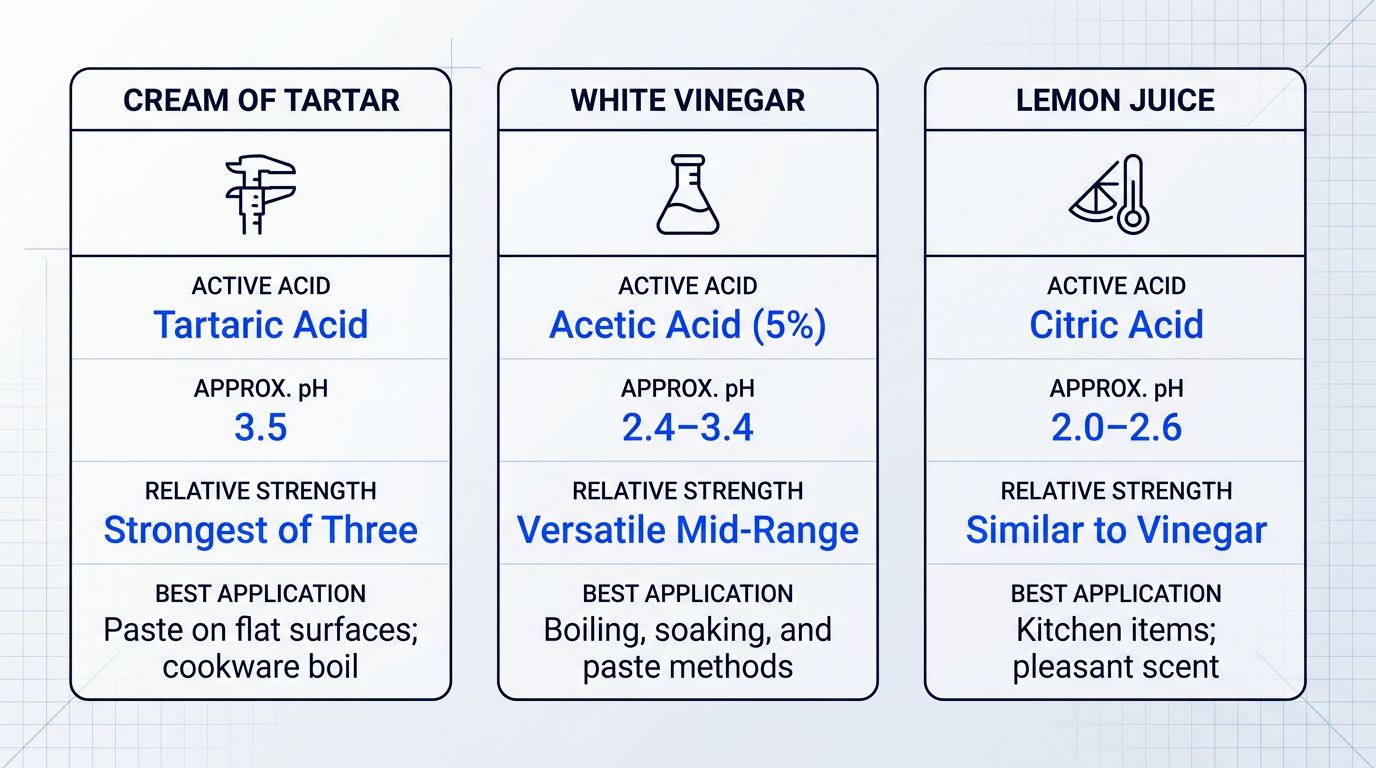
| Agent | Active Acid | Approx. pH | Relative Strength | Best Application |
|---|---|---|---|---|
| Cream of tartar | Tartaric acid (potassium bitartrate) | ~3.5 | Strongest of the three | Paste on flat surfaces; cookware boil |
| White vinegar | Acetic acid (5% solution) | ~2.4–3.4 | Versatile mid-range | Boiling, soaking, and paste methods |
| Lemon juice | Citric acid | ~2.0–2.6 | Similar to vinegar | Kitchen items; pleasant scent for cookware use |
Comparing the three household acid agents across key practical dimensions helps readers quickly identify the best option for their specific situation without needing to read through prose for each.
The differences between the three agents are modest — this is a spectrum of similar options rather than a clear hierarchy. Cream of tartar is generally considered the most effective at typical pantry dilutions due to its lower pH and stronger acid character, but white vinegar's availability and versatility make it the most practical all-round choice.
This method is best suited to aluminium cookware, pots, pans, and baking sheets — particularly items darkened by dishwasher use, where the alkaline detergent environment accelerates surface oxidation. Garden furniture, decorative items, and outdoor aluminium with light surface chalking are also well within scope. For larger exterior surfaces such as aluminium cladding or window frames with light chalking, pressure washing with a dilute mild acid solution extends the same approach without requiring immersion.
Household acid methods are safe for raw and uncoated aluminium. Avoid using them on anodised aluminium — acid attacks the anodised layer, which is a deliberately thickened oxide structure. Prolonged contact (beyond roughly an hour) also risks surface pitting, so thorough rinsing after treatment is important.
A note on WD-40: it is a water-displacing lubricant, not an acid, and it does not dissolve aluminium oxide chemically. It can temporarily improve the appearance of lightly oxidised aluminium by displacing moisture and adding a surface sheen, but the oxide layer remains intact. It is not a substitute for acid cleaning.
In terms of cost and effort, this is the most accessible method on the list — ingredients cost nothing beyond what is already in the pantry, no specialist equipment is needed, and the boiling method takes around 10–15 minutes for cookware while a paste application needs 30–60 minutes of contact time.
The clear limitation is scope: household acid methods address only light to moderate surface oxidation and offer no surface preparation benefit for welding or industrial coating adhesion. They are not scalable beyond domestic item size. Readers who need to prepare aluminium for welding, anodising, or industrial coating should look to chemical pickling or laser cleaning — household acids are the right answer for a specific, well-defined domestic context, and that context is where they genuinely excel.
Laser Cleaning: No Chemicals, No Abrasives, No Damage
If your application demands a clean, intact aluminium surface without chemical waste or abrasive risk, laser cleaning is the only method that delivers all three. Explore the ELASER-RHZ or speak with an expert.
Conclusion
Which aluminium deoxidisation method is right for you?
The right answer follows directly from your situation — the five methods here genuinely serve different ones.
For light oxidation on a household item, vinegar or cream of tartar is the right first reach.
For workshop or field use where substrate integrity matters, the ELASER or ELASER-RHZ delivers the cleanest result without consumables or chemical handling.
At production volume, AutoLASE is the logical investment: consistent, hands-off, and repeatable.
Where chemical infrastructure exists, pickling and etching is an effective batch route; where capital is the constraint, mechanical abrasion with a stainless wire brush is a proven starting point.
Frequently asked questions about deoxidising aluminium
Direct answers to the most common questions about removing aluminium oxide.
Yes — vinegar removes light to moderate surface oxidation from aluminium. The active component, acetic acid, reacts with aluminium oxide (an amphoteric oxide) and converts it to soluble aluminium acetate, which rinses away. Simmering the aluminium in a water-and-vinegar solution is the most effective household approach, as heat accelerates the acid-oxide reaction. Vinegar is not effective on thick, ingrained, or industrial-grade oxide layers — it suits cookware, pots, pans, and garden items rather than heavily weathered or structural aluminium. Always rinse thoroughly after treatment; prolonged contact with acetic acid can cause pitting on the metal surface.
Aluminium oxide (Al₂O₃) is amphoteric — it dissolves in both acids and bases, which is why several chemically distinct methods all work on it. At the household end, mild organic acids including acetic acid (white vinegar), citric acid (lemon juice), and tartaric acid (cream of tartar) dissolve light surface oxidation and are suitable for domestic use. At the industrial end, strong acids such as nitric acid, phosphoric acid, and nitric/hydrofluoric acid mixtures — as well as sodium hydroxide solutions — are used for heavier oxide removal in chemical pickling and etching processes. Laser ablation is a physically distinct alternative: rather than dissolving the oxide, a focused laser beam delivers energy that is absorbed by the oxide layer and ejects it from the surface, leaving the base metal intact.
No. WD-40 does not remove oxidation from aluminium. The name stands for "Water Displacement, 40th formula" — it is a water-displacing lubricant, not an acid or chemical cleaner, and it contains none of the acidic or alkaline chemistry required to dissolve aluminium oxide. WD-40 can temporarily improve the visual appearance of lightly oxidised aluminium by filling surface micro-texture with oil, which reduces the light scattering that makes oxidised aluminium look dull. This is a cosmetic effect only; the oxide layer remains fully intact underneath. For genuine oxide removal, an acid-based method is needed: white vinegar, lemon juice, or cream of tartar for light oxidation; industrial acids or alkalis for heavier oxide. Mechanical abrasion and laser cleaning are the non-chemical alternatives.