

Introduction
Whether you're restoring a dull garden chair or maintaining production-line aluminium, the challenge is the same: finding the right method to clean aluminium oxidation without making things worse.
Not all oxidation is equal. A light surface haze is a very different problem from a chalky film or heavy pitting, and the right approach depends on where your situation sits on that spectrum.
Each entry is assessed across four axes: oxide severity range, surface compatibility, ease of use, and value — where value means unit cost for a one-off job, and total cost of ownership for recurring industrial cleaning.
The list spans household solutions, commercial chemical cleaners, polishing compounds, and professional laser equipment, because a useful evaluation reflects the full market.
TL;DR
There is no single best aluminium oxidation cleaner. A pantry acid handles a dull pan cheaply; a commercial brightener tackles a pitted trailer; laser cleaning changes the economics entirely for industrial operators. Matching the method to severity and use case is what separates a clean result from a damaged surface.
This article covers:

How to evaluate an aluminium oxidation cleaner
Household DIY solutions
Commercial chemical cleaners
Polishing compounds
Professional laser cleaning
Situation-based decision guide
How to Evaluate an Aluminium Oxidation Cleaner
Picking the wrong cleaner for aluminium oxidation does not just mean the job takes longer — it can strip a protective anodic layer, etch the base metal, or leave a polished surface permanently scratched. Getting the evaluation right before you buy matters as much as the cleaning itself.
Oxide Severity: What You Are Actually Dealing With
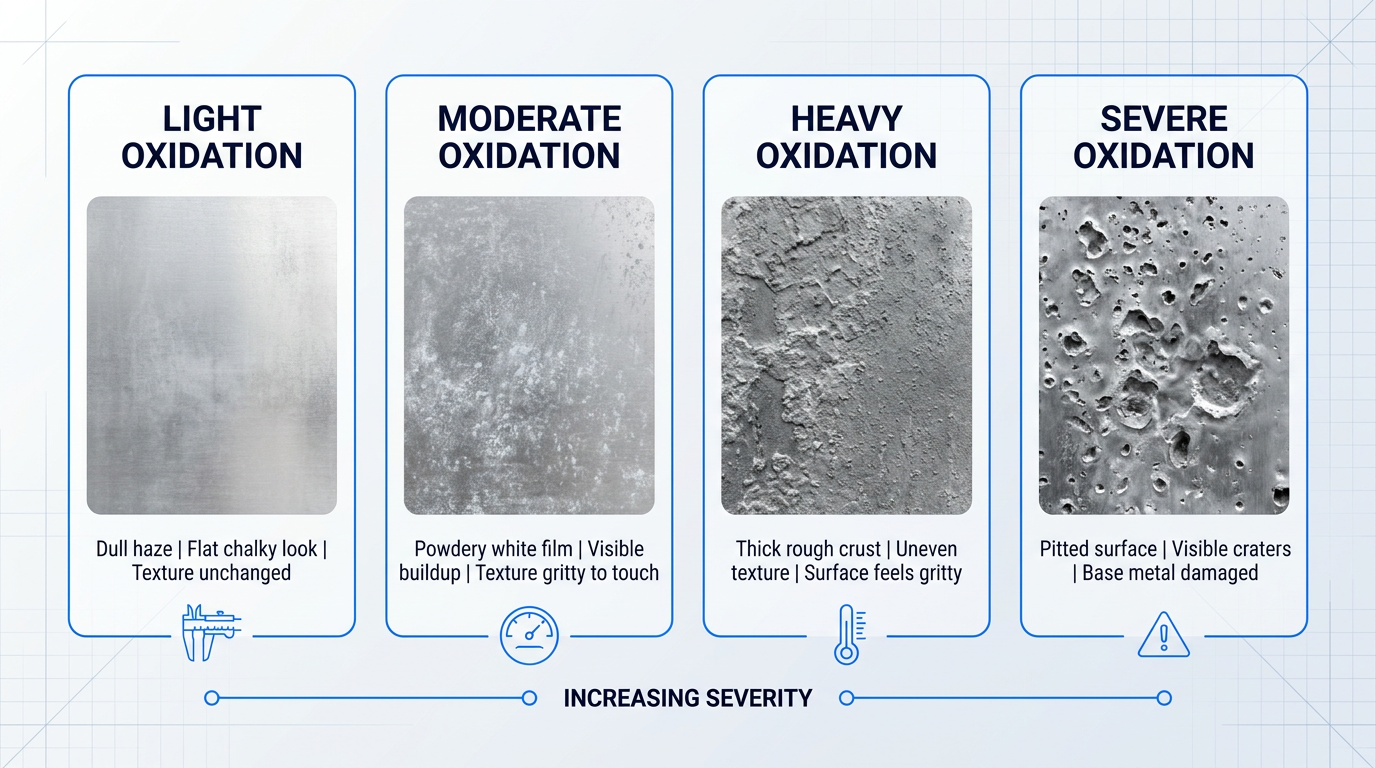
Aluminium oxidises naturally on contact with air, and the oxide layer progresses through recognisable stages — each calling for a different class of solution.
Light oxidation shows as a dull haze or reduced reflectivity: the surface looks flat or chalky, but run your finger across it and the texture feels unchanged.
Moderate oxidation produces a chalky white or grey film that is visibly powdery to the touch — the oxide has built up enough to obscure the metal surface beneath it.
Heavy oxidation goes further: a thick, rough crust forms and the surface texture itself changes, often feeling gritty or uneven where it was once smooth.
Severe oxidation means pitting — the oxide has begun attacking the base metal, leaving small craters or cavities that no cleaner can fully reverse. At this stage, the goal shifts from cleaning to stabilisation and surface repair.
Surface Type and Compatibility
Aluminium is not a single surface. The finish applied to it — or the process used to manufacture it — determines which cleaning approaches are safe and which will cause damage.
- Anodised aluminium: The anodic layer is a deliberate protective coating. Acids and abrasives can strip it irreversibly — only pH-neutral or gentle cleaning approaches are safe.
- Bare / mill-finish aluminium: The most forgiving substrate. Tolerates acid-based cleaners well, making it compatible with the widest range of chemical cleaning methods.
- Polished aluminium: Highly sensitive to abrasion. Even fine abrasive compounds can scratch or dull a mirror finish — chemical methods are strongly preferred here.
- Cast aluminium: More porous than extruded aluminium. Chemical cleaners may need longer dwell times to penetrate the surface and lift oxidation effectively.
The compatibility question is not just about effectiveness — applying the wrong cleaner to the wrong surface type causes damage that is often harder to fix than the original oxidation.
Ease of Use and Value
Ease of use sits on a spectrum from accessible to specialised, and position on that spectrum is a legitimate evaluation criterion — not a proxy for quality.
At the accessible end, household acid solutions (such as dilute food-grade acids) require no special equipment and suit light, occasional cleaning tasks. Moving along the spectrum: paste-based applications, commercial acid concentrates requiring dilution and PPE, polishing compounds needing mechanical action, and at the professional end, equipment-based laser cleaning designed for high-volume or precision work.
For one-off DIY jobs, the right value metric is straightforward unit cost — what you pay for a bottle or a handful of household ingredients to clean one surface once.
For recurring or high-volume industrial cleaning, total cost of ownership is the correct lens: consumables, disposal costs, labour time, and critically, the cost of substrate damage and rework caused by overly aggressive methods all factor into the true cost of a cleaning programme.
This brings the evaluation back to substrate integrity — the principle that genuinely distinguishes effective cleaning from aggressive cleaning. The goal is to remove the oxide layer precisely, without removing or degrading the metal beneath it. Aggressive methods that over-etch or abrade can reduce part life and create rework, particularly on precision or high-value components where dimensional tolerance matters.
The best aluminium oxidation cleaner removes the oxide layer without touching the metal beneath it. How precisely a method targets only the oxide is a better measure of effectiveness than how fast it acts.
One practical consideration that varies significantly across the spectrum is safety overhead. Chemical cleaners — particularly acid-based formulations — require gloves, eye protection, adequate ventilation, and correct disposal of chemical waste. This is flagged per entry in the list below, so you can weigh the handling requirements alongside the cleaning performance for each option.
With that framework in place, here are the five best options for cleaning aluminium oxidation — evaluated honestly against each of these criteria.
Product 1
WSL ELASER / ELASER-RHZ
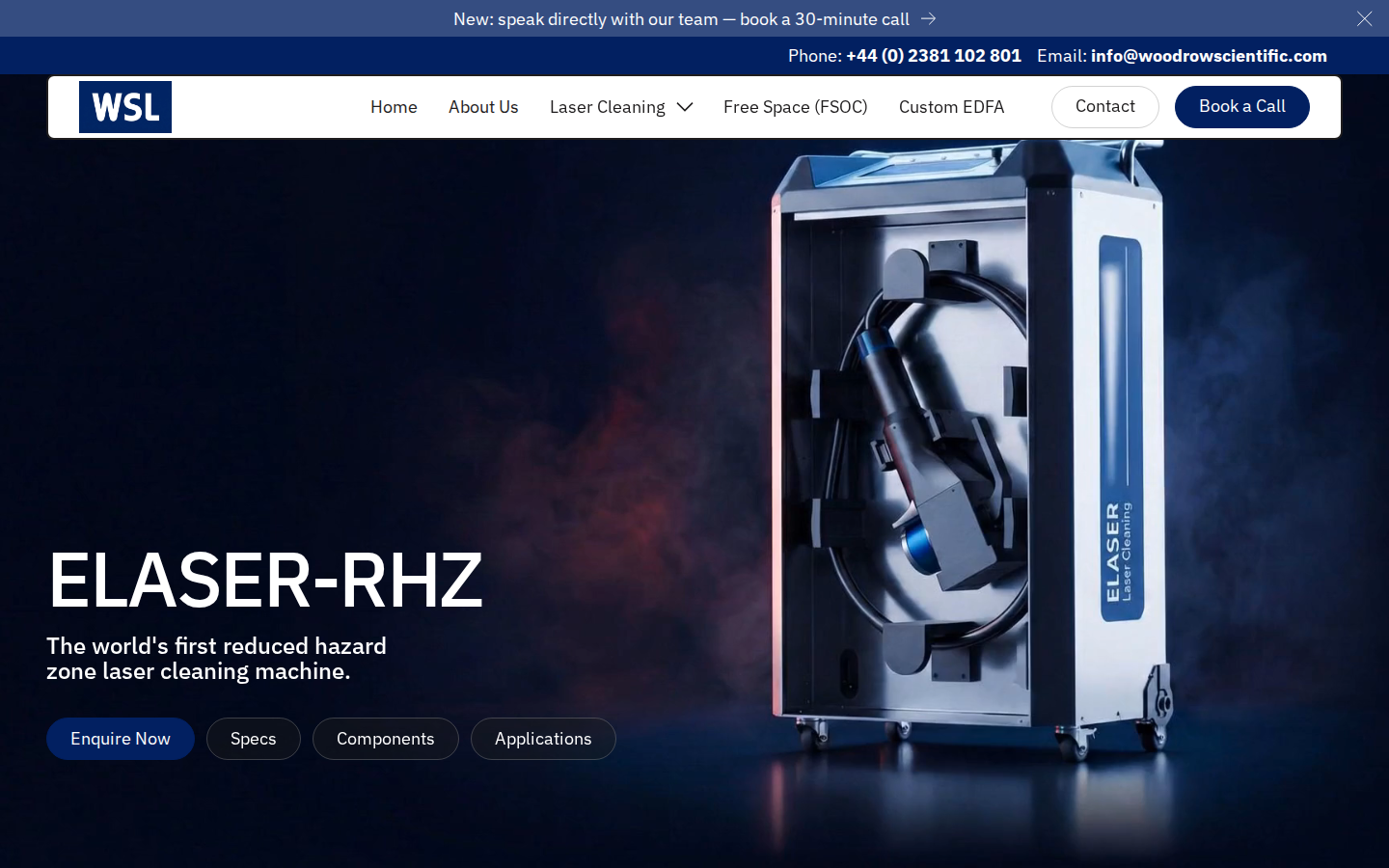
The ELASER and its ELASER-RHZ variant are industrial fibre laser cleaning systems built for operators who need chemical-free aluminium oxidation removal at scale — with the ELASER-RHZ offering the world's only patented reduced hazard zone technology, enabling open-space cleaning in workshops and public-facing environments where conventional laser cleaning cannot go.
Best for: Industrial operators, maintenance engineers, and service businesses dealing with recurring or high-volume aluminium oxidation cleaning — particularly where chemical methods risk surface damage, leave residue contamination, or create disposal and compliance burdens.
The World-First Reduced Hazard Zone
The single most significant thing that separates the ELASER-RHZ from every other laser cleaning system on the market is WSL's patented reduced hazard zone technology — the only system of its kind in the world.
Conventional laser cleaning requires the surrounding area to be sealed off and evacuated before work begins, making it impractical in open workshops, mixed-use facilities, or public-facing environments. WSL's patented technology collapses the hazard zone to a small area immediately around the work, removing that barrier entirely.
The practical result is continuous operation in open-plan manufacturing, shared facilities, and even publicly accessible spaces — graffiti removal, heritage restoration, and monument cleaning become viable without shutting down surrounding activity.
ELASER Performance Across the Four Evaluation Axes
| Evaluation Axis | ELASER / ELASER-RHZ Performance |
|---|---|
| Oxide Severity Range | Fully tunable 0–100% power (up to 300 W fibre laser) spans light surface oxides through to heavy contamination — no chemistry changes, no consumable swaps. |
| Surface Compatibility | Cleans aluminium alloys with minimal substrate loss; the beam stops at the base material. Suitable for precision components, aerospace parts, automotive bodywork, and heritage restoration. |
| Ease of Use | Single-operator system: wheeled unit under 50 kg, handheld scanner under 3 kg, up to 50 m delivery cable. Touchscreen GUI with password-protected per-user logins. WSL provides full safety and operation training. |
| Value (TCO) | No consumables, no chemicals, no disposal costs. Reduced substrate damage means less rework. Pricing is competitive among comparable industrial laser systems — contact WSL for a quote. |
The four evaluation axes established in the buying guide (oxide severity range, surface compatibility, ease of use, value) are directly comparable across all five list entries. A table surfaces how the ELASER performs on each axis at a glance, which is more useful to a scanning reader than four separate prose paragraphs.
For operators cleaning aluminium at volume, the TCO case is compelling: the absence of consumables, chemical procurement, and disposal logistics adds up to a meaningfully lower running cost than method-specific chemical cleaners over time.
Key Specifications and Certifications
- CE & UKCA certified: Fully certified for UK and European markets — no compliance uncertainty for industrial operators.
- Sub-3 kg handheld scanner: Up to 50 m delivery cable means the operator can reach large structures or awkward geometry without repositioning the main unit.
- Bespoke engineering capability: WSL offers customisation for specific applications and environments — contact WSL directly to discuss requirements.
- First-class training included: WSL provides comprehensive safety and operation training with every system, so operators are fully prepared from day one.
WSL is the only UK-based laser cleaning manufacturer — designing, building, servicing, and improving its machines entirely in-house since 2012, backed by over 200 years of combined engineering experience.
This matters more than it might first appear. A significant portion of the laser cleaning market consists of resellers and importers rebadging third-party machines: when something needs fixing or improving, there is no in-house engineering capability to call on, spares take longer, and the product never genuinely evolves. WSL is not that.
The ELASER makes economic sense for recurring, high-volume, or precision-sensitive cleaning tasks. If you need to clean a garden chair or a set of cookware once, the entries below cover household and commercial options that are far better suited to a one-off job.
For operators considering a laser cleaning system — or looking to launch a laser cleaning service business — the ELASER and ELASER-RHZ represent the most capable and competitively priced option available from a UK manufacturer. Contact WSL directly to discuss your application and receive a quote.
Industrial Aluminium Oxidation Cleaning Without Chemicals
The ELASER-RHZ removes aluminium oxidation at scale with no chemicals, no residue, and no consumables. See full specifications and capabilities in the official datasheet.
Product 2
White vinegar and cream of tartar
White vinegar, cream of tartar, and lemon juice are the best first option for anyone dealing with light to moderate aluminium oxidation on household items — cookware, garden furniture, or window frames. They cost nothing beyond pantry staples, require no specialist equipment, and are effective enough that most everyday oxidation jobs need nothing more.
Best for: light to moderate oxidation on bare aluminium household items — cookware, garden furniture, window frames, and decorative aluminium. If you have a chalky white film on an outdoor chair or a dull, discoloured pan, this is the right starting point before spending anything on commercial products.
The methods here work well on surface haze and moderate powdery discolouration, but they have a real ceiling: heavy pitting, thick oxide crusts, or deeply ingrained contamination will need something stronger from the entries that follow.
How to Use Each Method
All three approaches below draw on the same principle — mild acid softens the oxide layer so it can be wiped or scrubbed away. Washington State University extension research confirms vinegar and cream of tartar are effective on lightly oxidised aluminium furniture and cookware, and Iowa State University extension guidance specifies the concentrations that work in practice.
- White vinegar: For aluminium furniture and window frames: add a cup or two of white vinegar to a bucket of warm water, wipe with a cloth or sponge, rinse thoroughly, and dry. For cookware interiors: boil a solution of 2 tablespoons vinegar per quart of water in the pan for 5–10 minutes, then scour lightly with a soapy pad. Both approaches are sourced from WSU and ISU extension guidance.
- Cream of tartar paste: Mix cream of tartar with water into a paste (NMSU extension also gives a combined formula: 8 tablespoons cream of tartar, 8 tablespoons baking soda, and 4 ounces vinegar, stirred to a paste with 4 tablespoons soap flakes). Apply with a damp sponge, scrub gently, and rinse well. For cookware, Oregon State University extension research supports boiling 2 teaspoons cream of tartar per quart of water in the pan for 10 minutes.
- Lemon juice and salt: Dip a lemon slice in salt and scrub the aluminium surface directly, or make a paste of equal parts lemon juice and salt. The citric acid acts similarly to diluted acetic acid on light oxidation and tarnish. Rinse and wash well afterwards to remove any residue. This method is noted in both NMSU and ISU extension publications.
One common mistake worth flagging: alkaline cleaners — including ammonia, TSP, and baking soda used alone — should not be used on aluminium. WSU extension guidance states explicitly that these will cause oxidation rather than remove it. Vinegar and cream of tartar are mildly acidic, which is exactly what aluminium cleaning requires.
White vinegar, cream of tartar, and lemon juice are safe on bare or mill-finish aluminium. On anodised aluminium, acid attacks the anodic layer and can permanently damage the protective finish. If you are unsure whether a surface is anodised, test in an inconspicuous spot first — or use a pH-neutral cleaner instead.
On the ease-of-use axis, this is the simplest entry on the entire list: ingredients are already in most kitchens, no specialist equipment is needed, and no PPE is required at household concentrations (though gloves are sensible for extended contact with vinegar).
On value, the proposition is unmatched — the cost is essentially zero beyond pantry staples you likely already own. There is no consumable to reorder and no ongoing spend.
The honest limitation: these methods soften the oxide layer but do not dissolve heavy deposits without physical scrubbing, and they provide no lasting protection once clean. Applying a wax or sealant after cleaning will slow re-oxidation noticeably. If the oxidation is beyond light to moderate, the stronger commercial options covered in the next entries will be more effective.
Product 3
Bar Keepers Friend
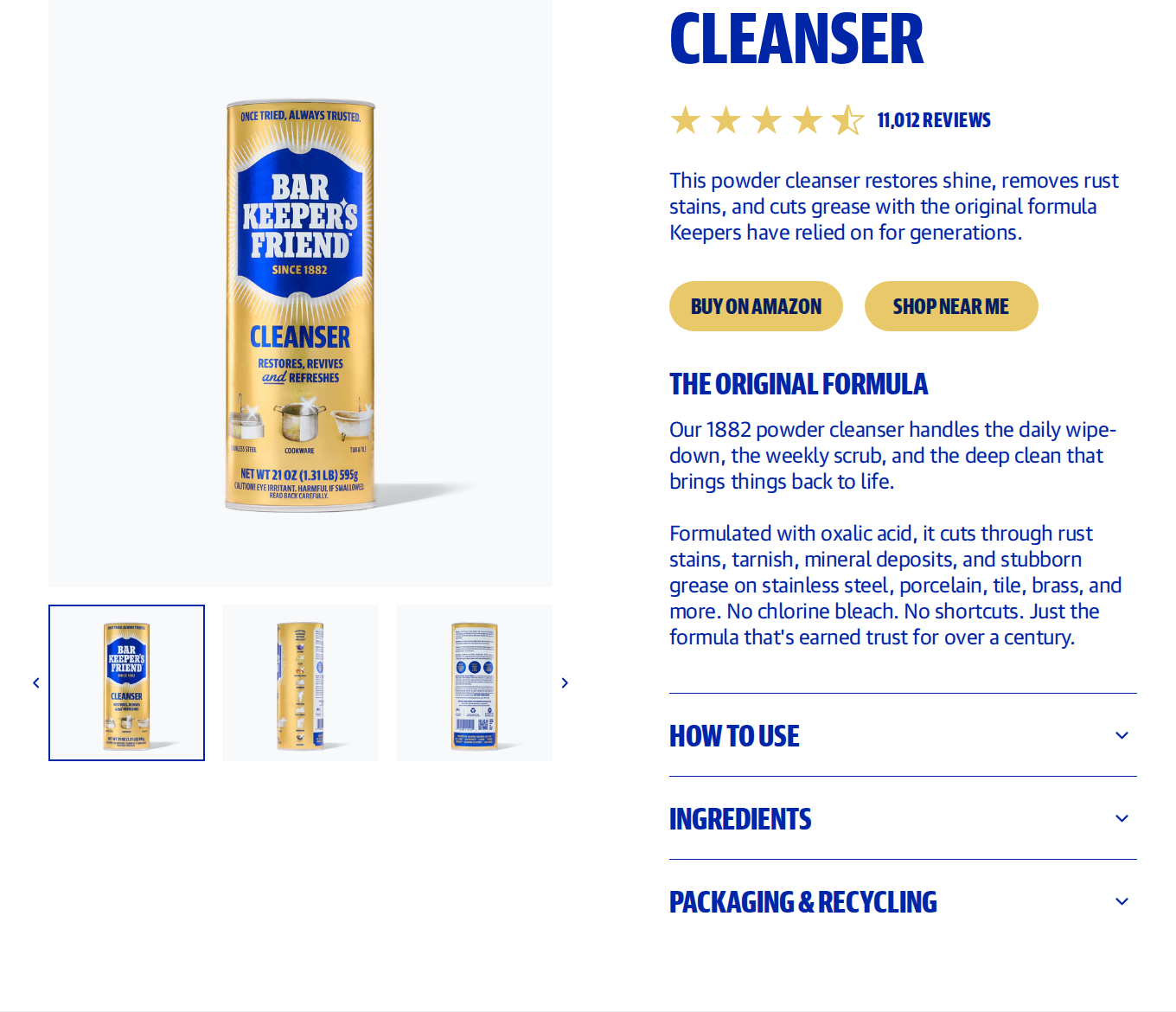
Bar Keepers Friend is a widely available oxalic acid-based powder cleaner that tackles moderate aluminium oxidation, tarnish, and discolouration on bare aluminium cookware, sinks, and household metal surfaces. It is the right step up from pantry-staple acids for readers who need more cleaning power without moving into specialist chemical territory.
Best for: moderate aluminium oxidation and chalky discolouration on bare aluminium cookware, sinks, and household metal surfaces — a meaningful step up from pantry-staple acids without crossing into specialist chemical territory.
The active ingredient is oxalic acid, present at approximately 5–10% in the powder formulation according to the product's Safety Data Sheet, alongside a Glass Oxide Abrasive and surfactant.
Oxalic acid works by dissolving aluminium oxide at the surface level, making it effective on moderate tarnish and chalky discolouration that household acids struggle to shift.
Heavy pitting and thick industrial-grade oxide layers are beyond its scope — for those, a specialist chemical or mechanical approach is needed.
Surface Compatibility
Bar Keepers Friend lists bare aluminium — including cookware and sinks — as a safe surface on its own product page.
However, BKF's own product guidance notes that some ingredients may etch or dull delicate surfaces, and specifically recommends testing on a small, inconspicuous area before cleaning anodised aluminium or brushed metal finishes.
The Glass Oxide Abrasive component is the reason for that caution: it can compromise the protective layer on anodised surfaces and dull polished or brushed finishes.
BKF also advises against use on polished stone such as marble or granite, gold, silver, and lacquered or painted surfaces.
| Axis | Rating | Notes |
|---|---|---|
| Oxide severity | Moderate | Handles tarnish and chalky discolouration; not suited to heavy pitting or industrial-grade oxide layers |
| Surface compatibility | Bare aluminium only | Safe on bare aluminium cookware and sinks; test first on anodised, brushed, or polished finishes per BKF's own guidance |
| Ease of use | High | Widely available; simple powder or liquid application; no specialist PPE required beyond gloves for prolonged contact |
| Value | Excellent | Low cost per use; powder format is economical for regular kitchen use |
Presents the four evaluation framework axes in a scannable format consistent with the listicle's declared structure, letting readers quickly compare BKF against other entries on the same dimensions.
Application is straightforward: wet the surface, sprinkle a small amount of powder (or apply the liquid format), work with a damp cloth using gentle pressure, then rinse thoroughly.
BKF's own product instructions recommend rinsing within one minute of application to avoid discolouration — setting a timer is a practical way to stay within that window.
The oxalic acid content means the product should be kept away from children, and cloths or sponges used to apply it should be disposed of or rinsed appropriately after use.
BKF cleans and removes oxidation effectively within its range, but it does not restore a mirror or high-gloss shine — readers looking for that result should consider a dedicated abrasive polish as a follow-on step.
Product 4
Mothers Mag & Aluminium Polish
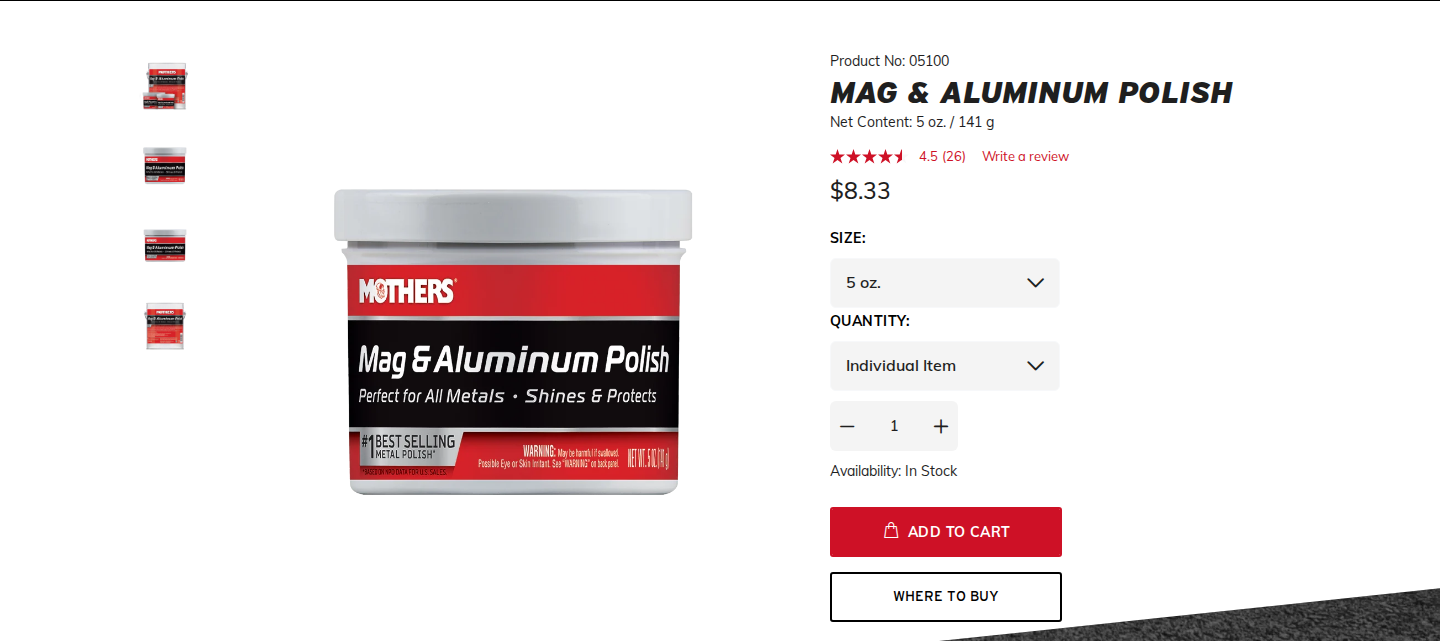
Mothers Mag & Aluminium Polish is an abrasive polishing compound that removes light-to-moderate oxidation from uncoated aluminium while burnishing the surface to a high-gloss finish — the go-to choice for restoring shine to wheels, trim, and polished billet.
Pros:

Restores a mirror finish on uncoated aluminium.
Works on aluminium, stainless steel, and brass.
Power-tool compatible for faster, larger-surface results.
Good coverage per 10 oz container.
Cons:

Not for anodised, coated, or lacquered aluminium.
Requires effort; multiple passes on neglected surfaces.
Best for: automotive enthusiasts, detailers, and anyone restoring polished aluminium wheels, trim, billet, or decorative surfaces — readers who want a mirror finish, not just oxidation removed.
Where the chemical cleaners covered in the previous two entries dissolve aluminium oxide through acid chemistry, Mothers Mag works differently: micro-abrasive particles physically buff away the oxide layer while the friction of polishing burnishes the bare metal to a high shine.
The black residue that appears on your cloth during polishing is normal — it is the oxidation being lifted from the surface, and it means the product is working.
Oxide Severity and Surface Compatibility
Mothers Mag is effective on light to moderate oxidation. On heavily oxidised or pitted surfaces, a chemical cleaner pass first — to remove the bulk oxide — gives the polish a clean starting point and noticeably better results.
- Bare aluminium: The primary intended surface — wheels, trim, billet, and decorative aluminium panels.
- Stainless steel and brass: Also compatible; the same abrasive polishing action works across multiple uncoated metals.
- Anodised, painted, coated, or lacquered aluminium: Not compatible. The abrasive will strip the finish. Check your surface type before applying.
Application requires moderate effort: apply a small amount to a microfibre cloth, work in back-and-forth strokes on a cool, clean surface, and remove before the polish dries.
For larger surfaces, a variable-speed drill at 300–400 rpm with a polishing pad accelerates the process considerably — though hand application is perfectly capable on smaller areas like trim pieces or wheel spokes.
A 10 oz container covers many polishing sessions, making the cost per use moderate and reasonable for anyone who polishes regularly. It is an ongoing consumable rather than a one-off purchase, but the coverage per container is solid for the category.
Two honest trade-offs are worth stating plainly: abrasive action removes a thin layer of metal with each pass, so this product is not appropriate for precision components or any surface where dimensional tolerance matters.
Mothers Mag also provides no lasting protection on its own — following up with a wax or sealant is the recommended step to extend the shine and slow re-oxidation.
Product 5
Aluma-Brite / aluminium brightener acid wash
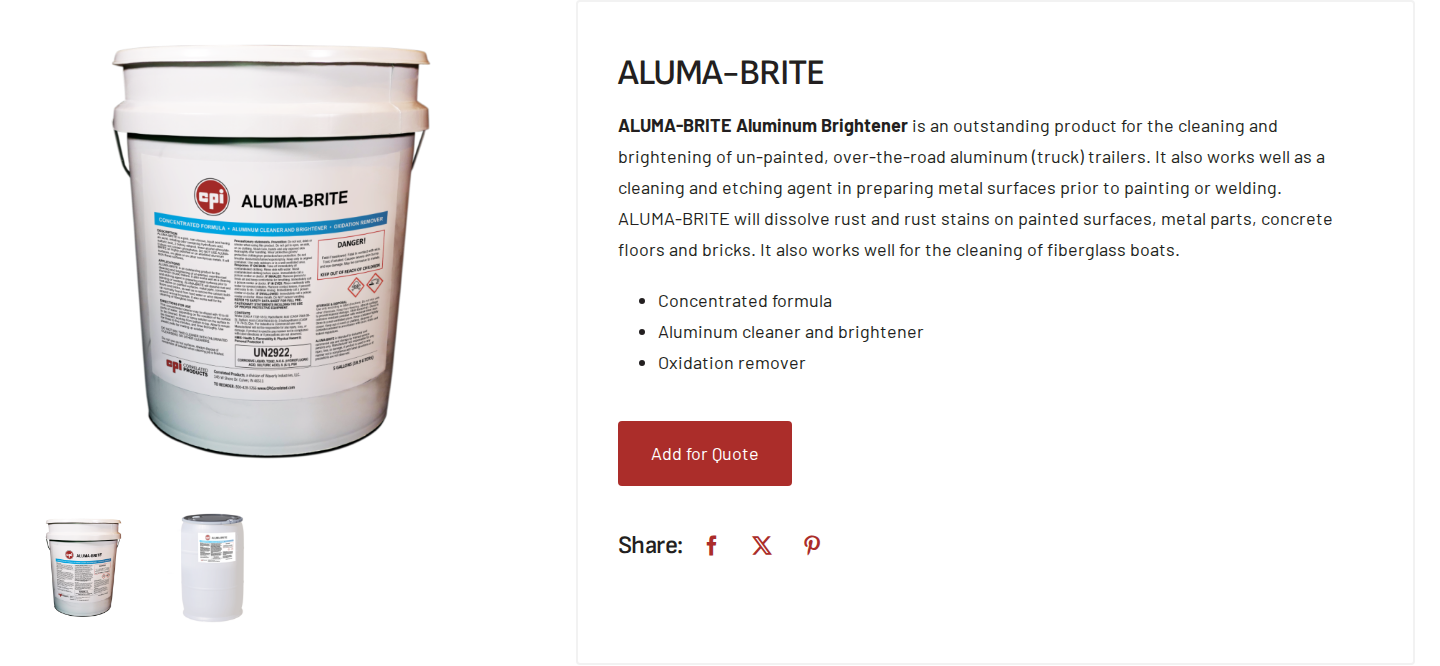
Aluma-Brite is a concentrated commercial acid brightener formulated with hydrofluoric and phosphoric acids to remove heavy oxidation, road film, and exhaust deposits from bare aluminium truck trailers, pontoon boats, and industrial equipment. It is the go-to choice for fleet operators and commercial maintenance crews who need maximum chemical cleaning power across large surfaces.
Pros:
Highly effective on heavy oxidation lighter methods cannot remove.
Concentrated formula yields multiple gallons per container.
Suited to fleet and large-surface applications.
Fast-acting acid dissolves thick oxide films.
Cons:
Not for anodised, polished, or PVD surfaces.
Requires PPE and careful technique throughout.
Best for: commercial operators, fleet maintenance crews, and boat owners dealing with heavy oxidation on large bare aluminium surfaces — truck and trailer bodies, pontoon boats, aluminium building cladding, and industrial equipment where lighter methods have already been tried and found wanting.
Aluma-Brite is a product name that has become shorthand for an entire category of concentrated acid brighteners used across the road transport and marine industries to clean aluminium oxidation at scale.
The chemistry varies by formulation, but the core active ingredients are typically hydrofluoric acid and phosphoric acid, with some formulations also incorporating sulfuric acid and surfactants. The acid blend dissolves thick oxide films on contact — the kind of heavy, chalky oxidation that polishing compounds and household acid solutions simply cannot shift.
How to Apply Aluma-Brite Correctly
The application sequence is what separates a clean result from a damaged surface. Dilute the concentrate with water according to the product label — the ATCO International technical data sheet specifies a ratio of 1 part product to 20–40 parts water, though dilution varies by product and surface condition, so always follow your specific product's instructions.
- Apply from the bottom up: Working upward prevents streaking caused by diluted solution running down over uncleaned areas. Use a mop, brush, or pressure sprayer.
- Do not allow the product to dry on the surface: This is the most critical rule. If the solution dries before rinsing, concentrated acid remains in contact with the metal and will etch or pit it. Work in manageable sections.
- Rinse thoroughly from the top down: Flush the entire surface with pressure water, working downward, to remove all acid residue completely.
For heavy oxidation, West Marine's aluminium boat cleaning guidance recommends a dwell time of 1–3 minutes depending on severity — do not exceed the dwell time on your product's label, and never layer a second application without rinsing fully first.
Surface Compatibility: The Critical Caveat
This product category is suitable for bare, uncoated aluminium only. The CPI Road Solutions product data sheet is explicit: do not use on anodised aluminium, polished aluminium, or PVD-coated surfaces — the acid will etch them.
Always test on an inconspicuous area first. If the test area discolours, roughens, or develops a white cast, stop and do not proceed with a full application.
Acid brighteners will strip the anodic layer from anodised aluminium on contact. If you are unsure whether your surface is anodised or bare, treat it as anodised until confirmed otherwise.
The safety overhead for this product category is real and non-negotiable. Chemical-resistant gloves and eye protection are mandatory; adequate ventilation is essential, particularly for formulations containing hydrofluoric acid, which carries significant hazard.
Before using any product in this category, consult the specific product's Safety Data Sheet (SDS). Formulations differ in their acid composition and concentration, and the SDS is the authoritative source for PPE requirements, first aid measures, and disposal guidance.
Value at Scale
Concentrated formulas are economical for large-surface and fleet applications. A single container yields multiple gallons of working solution, which makes the per-area cost competitive for commercial operators cleaning trailer bodies or pontoon fleets on a regular schedule.
That said, the total cost of ownership extends beyond the product price. Chemical waste must be disposed of in accordance with local regulations, and the PPE and equipment requirements add to the ongoing cost. This is a consumable for professional use, not a one-off household purchase.
One further point worth noting: acid washing removes oxidation but provides no lasting protection. The cleaned surface will begin to re-oxidise once exposed to the elements, so a follow-up protectant application is worth planning for.
Beyond Chemicals: Laser Cleaning for Heavy Oxidation
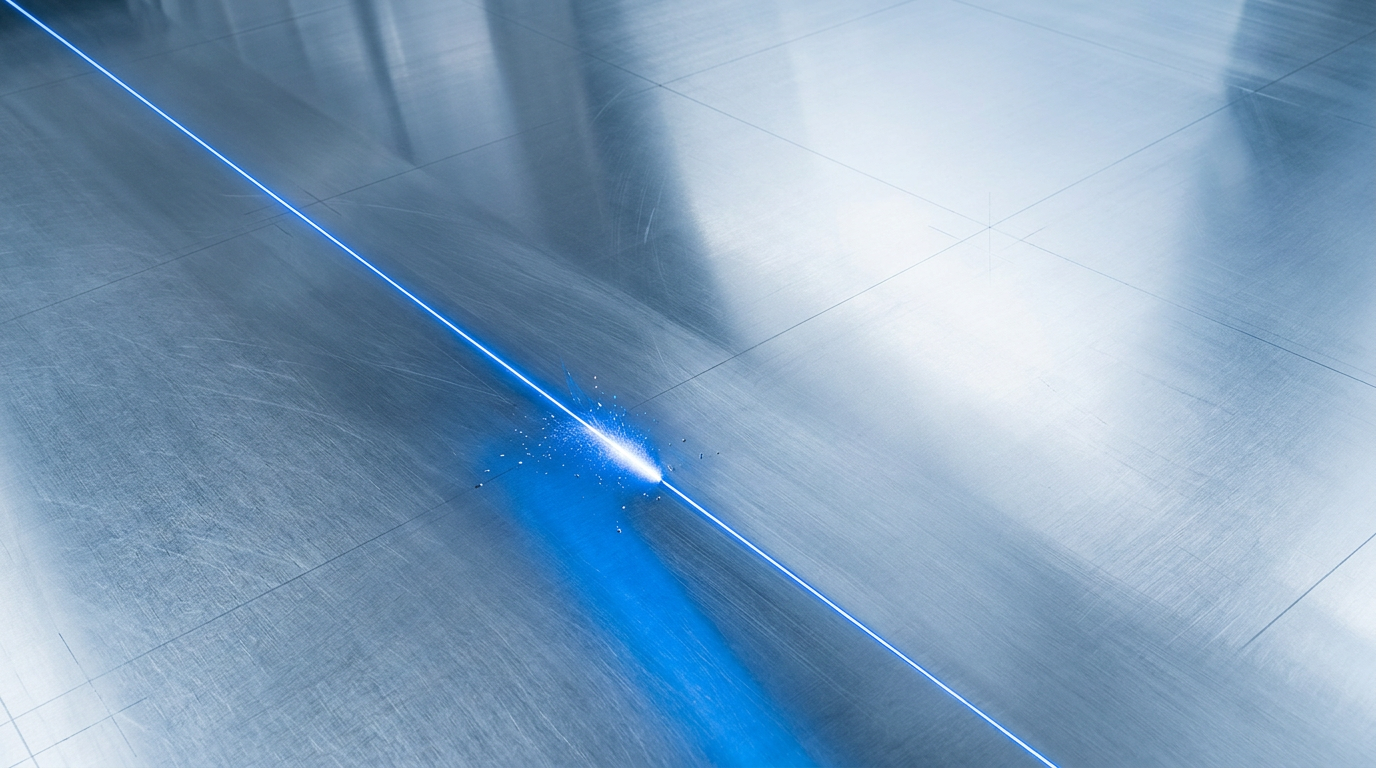
Chemical brighteners handle heavy oxidation, but laser cleaning removes it without acids, PPE, or disposal concerns. For commercial operators running large aluminium surfaces regularly, it changes the economics of the job.
Conclusion
Which aluminium oxidation cleaner is right for you?
For a one-off household job, pantry acids like white vinegar or cream of tartar cost nothing and ask nothing of you; Bar Keepers Friend is the sensible step up when oxidation is heavier or the surface needs more persuasion.
Automotive wheels and polished trim call for Mothers Mag, where the goal is a mirror finish rather than just a clean surface; large bare aluminium on trucks or boats is where a commercial acid brightener earns its place.
At industrial scale, the WSL ELASER changes the calculation — no chemicals, no consumables, and a TCO that makes chemical methods look expensive over time.
Frequently asked questions about cleaning aluminium oxidation
Common questions answered — whether you are tackling a dull pan, a pitted trailer, or anything in between.
Yes, for light to moderate oxidation — white vinegar's acetic acid dissolves the thin oxide film that causes dullness and chalky discolouration. It is not sufficient for heavy pitting or thick oxide crusts, where a commercial acid cleaner or polishing compound is needed. For general surfaces, dilute white vinegar in warm water and wipe with a cloth or sponge. For aluminium cookware, the most effective method is to boil a vinegar-water solution in the pan for 5 to 10 minutes, which allows the acid to work across the full interior surface. Rinse thoroughly after either method — acetic acid left to sit on aluminium can cause further surface changes over time.
No. WD-40 is a petroleum-based water displacer and light lubricant — it does not dissolve aluminium oxide and is not formulated as a cleaner or acid. It may temporarily improve the appearance of very light surface haze by wetting the metal and creating a thin film, but this effect is cosmetic and short-lived; the oxide layer remains intact underneath. To actually remove aluminium oxidation, you need either an acid-based cleaner (such as a product containing acetic, oxalic, or phosphoric acid) to dissolve the oxide chemically, or an abrasive polish to remove it mechanically.
Heavy oxidation requires a step-up approach — household acids and light polishing will not cut through thick oxide films or pitting. The right method depends on the surface type and scale of the job. For large bare aluminium surfaces such as truck trailers, pontoon boats, or building cladding, a commercial acid brightener containing phosphoric or hydrofluoric acid is the most effective chemical option: it dissolves thick oxide films quickly, though it requires appropriate PPE and careful technique throughout. For smaller items or polished surfaces, a polishing compound combined with mechanical action can remove moderate-to-heavy oxide before finishing. For industrial or recurring applications where substrate integrity is critical, laser cleaning removes the oxide layer precisely without chemical contact, consumables, or risk of surface damage. One important caveat: anodised aluminium with heavy oxidation should only ever be treated with pH-neutral cleaners — aggressive acids or abrasives will strip the anodic layer irreversibly.
The process follows three steps: clean, polish, protect. First, remove the oxide layer using the method suited to your severity and surface — a household acid such as white vinegar for light oxidation, a commercial cleaner or polishing compound for moderate cases, and an acid brightener or laser cleaning for heavy oxidation. Second, apply an aluminium-specific polish after cleaning to restore reflectivity and surface smoothness; this is the step that takes a clean surface to a genuinely like-new appearance. Third, apply a wax, sealant, or clear coat to slow re-oxidation — aluminium begins forming a new oxide layer on exposure to air almost immediately, so protection extends the result considerably. One caveat: anodised aluminium should only be cleaned with pH-neutral products. Acids and abrasives will damage the anodic layer permanently, and anodised surfaces do not benefit from polishing compounds.