

Introduction
Pulsed laser cleaning works by firing rapid, controlled bursts of laser energy at a surface — vaporising contaminants while leaving the substrate beneath untouched.
On metal, that principle is relatively forgiving. Wood is a different matter entirely — it is thermally sensitive, structurally variable, and quick to scorch, char, or suffer grain damage when a machine is even slightly mismatched to the task.
The applications vary widely too: paint stripping, coating removal, mould remediation, soot cleaning, and heritage timber restoration each place different demands on the machine.
Every machine in this list is evaluated against the same criteria: wattage range, pulse frequency control, spot size, cooling method, portability, and wood-application suitability.
Where certain coatings or substrates resist pulsed laser cleaning on wood, that is covered honestly too.
TL;DR
Pulsed laser cleaning does work on wood — but only when the machine is correctly matched to the substrate and coating type.
The machines that perform well on timber share a specific set of characteristics; the ones that don't can cause irreversible damage. Knowing which is which is the entire challenge — and what this page resolves.
This article covers:

Why machine selection matters more for wood than metal
The evaluation framework applied to every machine
Five verified machines evaluated against those criteria
Which coatings resist pulsed laser cleaning on wood
Guidance for matching machine to your specific task
How to choose a pulse laser cleaner for wood
Choosing a pulse laser cleaning machine for wood is a more demanding evaluation than choosing one for metal — wood's thermal sensitivity means that a machine well-suited to stripping rust from steel can scorch, char, or raise the grain of a timber surface if its parameters are not matched to the substrate.
The seven axes below are the criteria this evaluation uses to assess every machine on this list. They are also the questions you should be asking any vendor before committing to a purchase.
Wattage: the practical window for wood
Wattage sets the upper boundary of what a machine can safely do on wood. At excessive power levels, the beam deposits energy into the substrate faster than the material can dissipate it — the result is scorching, charring, and permanent grain damage.
The 300 W–500 W range appears consistently across industry sources as the practical ceiling for most wood applications; beyond this threshold, substrate damage risk rises sharply for all but the most controlled industrial setups.
The lower bound matters equally: very low-power systems can struggle with thick, multi-layer paint or heavy industrial coatings on structural timber, requiring multiple slow passes that reduce productivity without improving safety.
The right wattage depends on your specific application — a lower-power machine may be exactly right for delicate conservation work on heritage timber, while a higher-power system suits aggressive stripping on structural beams. Wattage is a range to reason about, not a single target figure.
Pulse control: the non-negotiable for delicate substrates
Pulse control is the axis most often overlooked in generic laser-cleaner comparisons — and the one that matters most for wood. The reason pulsed laser cleaning works safely on timber at all is that short pulses deposit energy into the contaminant layer before that energy can conduct into the wood substrate beneath.
A machine that cannot modulate its output finely — fixed pulse parameters, coarse power steps — is a genuine risk on wood regardless of its peak wattage rating, because the operator has no way to dial in the energy delivery for a specific substrate and coating combination.
A machine with continuous power adjustment from 0–100% gives the operator precise control over energy deposition per pulse — the mechanism that keeps wood grain intact. Coarse or fixed power steps are not a minor inconvenience on wood; they are a substrate damage risk.
Pulse frequency (measured in the kHz range) and pulse duration (measured in nanoseconds) are the two parameters that determine how much energy is deposited per pulse and how quickly it is delivered — ask vendors for these figures and what they mean for your specific wood substrate and coating type.
Spot size and working distance
A smaller spot size concentrates the beam's energy over a tighter area, delivering higher fluence at a given power level — which matters for precision cleaning on wood grain, carved surfaces, mouldings, and heritage timber details where overspill onto adjacent areas is unacceptable.
Working distance — the gap between the lens and the surface — affects how easily the operator can manoeuvre in confined spaces such as panelled rooms, roof structures, or furniture joints. Ask vendors about interchangeable lens options and what spot sizes are achievable for your specific application.
Cooling method: air-cooled vs water-cooled
For most wood-cleaning contexts, air-cooled, self-contained systems are the practical choice — not because air cooling is technically superior, but because the environments where wood cleaning happens rarely have the infrastructure to support a water chiller.
Furniture workshops, on-site heritage restoration, building maintenance, and structural timber work all share the same constraint: a machine that requires a separate water chiller adds weight, complexity, and a dependency on a water supply that simply does not exist on most job sites.
Water-cooled systems can be appropriate in fixed workshop environments with the right infrastructure, but for the majority of applications this evaluation addresses, a self-contained air-cooled unit is the right starting assumption.
Portability and single-operator usability
Portability is a functional requirement for wood-cleaning work, not a convenience feature. Furniture restoration often means bringing the machine to a piece too large or fragile to move; heritage timber work takes place at buildings, churches, and historic structures; structural timber work may require reaching fixed beams and trusses overhead.
The practical test is straightforward: can one person realistically transport, set up, and operate this machine on-site without a support crew or a van full of ancillary equipment?
Look for a lightweight handheld scanner, a manageable overall system weight, and a sufficiently long delivery cable — these are the specifications that determine whether single-operator usability is genuine or merely claimed.
Pricing and total cost of ownership
Publicly listed prices are rare for industrial laser cleaning machines — the contact-for-quote model dominates this market, reflecting the bespoke nature of industrial equipment and the fact that configuration, training, and support packages vary significantly between buyers.
The more useful evaluation lens is total cost of ownership: laser cleaning requires no consumables — no abrasive media, no chemical stripping agents, no masking materials, and no hazardous waste disposal — which means ongoing operational costs are structurally lower than most alternative methods.
When requesting quotes, ask vendors what is included in the price: training, warranty terms, spare parts availability, lead times, and support arrangements all affect the true cost of ownership over the machine's working life.
Manufacturer credibility and in-house capability
In a market where some entities presenting as manufacturers are in practice importers or resellers, it is worth asking a direct question: does this company design and build its own machines, or does it source them from a third-party manufacturer and rebadge them?
The distinction matters most when something goes wrong or when parameters need adjusting for a specific wood substrate or coating type — a genuine manufacturer has the in-house engineering capability to diagnose, advise, and adapt; a reseller does not.
As a practical due-diligence step, ask vendors whether they can provide application support for your specific wood type and coating — their answer will quickly indicate whether the expertise sits in-house or elsewhere.
With the evaluation framework established, the five machines below are assessed against each of these criteria — so you can see exactly how they perform on the axes that matter for wood.
Product 1
Woodrow Scientific ELASER / ELASER-RHZ
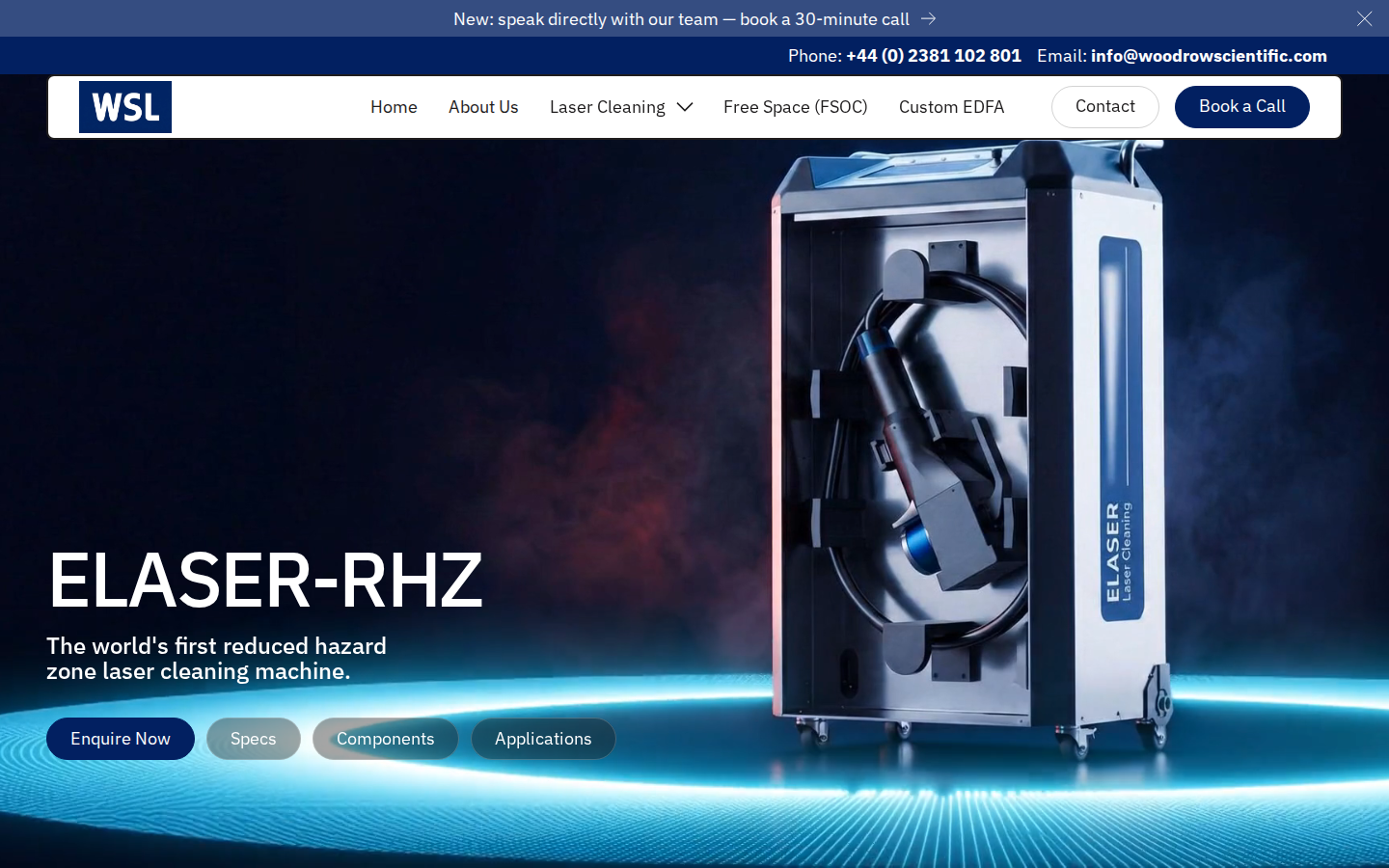
WSL's portable industrial fibre laser cleaner with world-first reduced-hazard-zone technology — fully air-cooled, single-operator, and tunable from 0–100% for precise wood-safe cleaning across open workshops, furniture restoration, and heritage settings.
The Woodrow Scientific ELASER / ELASER-RHZ leads this list because it is the only pulsed laser cleaning machine that combines genuine open-space operability with the fine power control that wood surfaces demand.
With output fully tunable from 0–100% across a 300 W fibre laser, operators can dial in exactly the right energy level for the task — light soiling on antique furniture at one end, thick paint on structural timber at the other — without risking scorching or grain damage.
ELASER-RHZ: Reduced Hazard Zone
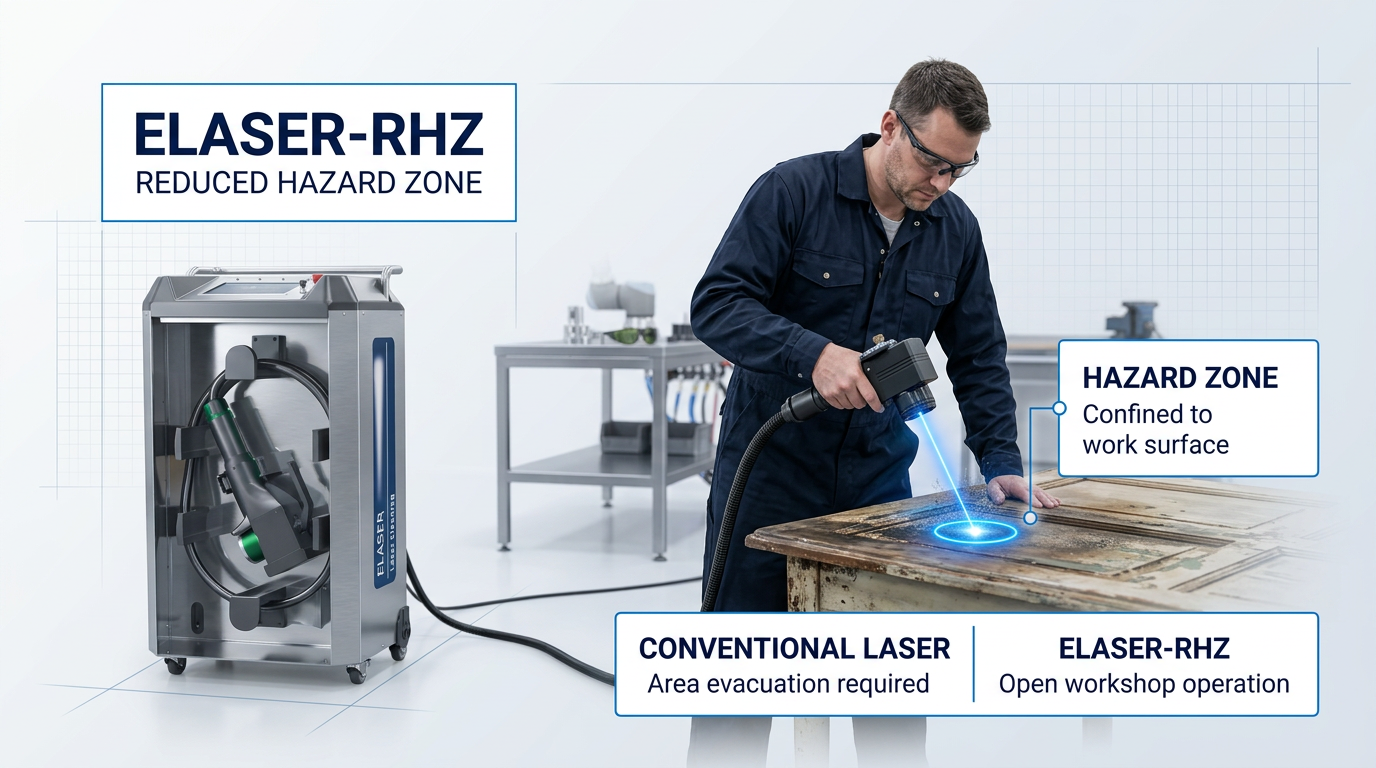
The ELASER-RHZ uses WSL's patented technology to collapse the laser hazard zone to a small area immediately around the work, eliminating the need to seal off or evacuate the surrounding space.
For wood-cleaning applications specifically, this is transformative: a furniture workshop can keep running while one operator cleans a piece in the corner; a heritage building open to the public can have its structural timbers cleaned without closing; mould remediation on occupied building frames becomes practical rather than a logistical problem.
No other laser cleaning machine on this list — or in the broader competitive landscape — offers reduced-hazard-zone capability; conventional laser cleaners require area evacuation before work can begin, which makes them simply impractical in many real-world wood-cleaning settings.
The ELASER's key specifications map directly against the evaluation framework axes covered earlier in this guide.
| Evaluation Axis | ELASER / ELASER-RHZ Specification |
|---|---|
| Max power | Up to 300 W fibre laser |
| Power tunability | 0–100% (fully adjustable) |
| Pulse repetition rate | Adjustable up to 200 kHz |
| Pulse energy / duration | Up to 15 mJ / 100 ns |
| Cooling method | Air-cooled — no chiller or compressor |
| Scanner weight | Under 3 kg (handheld) |
| Delivery cable reach | Up to 50 m |
| System weight | Under 50 kg (wheeled) |
| Certifications | CE and UKCA certified |
| Manufacture | Made in Britain |
Maps the ELASER's specifications to the evaluation framework axes so readers can cross-reference this entry against the criteria established earlier in the guide.
The 50 m delivery cable means a single operator can cover an entire large building or site without repositioning the wheeled unit — a practical advantage on heritage restoration projects and large furniture production floors alike.
Woodrow Scientific Limited is the only UK-based laser cleaning manufacturer: it designs, builds, services, and improves every machine in-house, drawing on 200+ years of combined engineering experience — a meaningful contrast to the many suppliers in this category who are resellers or importers rebadging third-party hardware.
The contaminant range covers everything a wood-cleaning operator is likely to encounter: paint, lacquer, primer, powder coating, mould, carbon and soot, oil and grease, and adhesive residues — each relevant to real scenarios from heritage timber restoration to furniture mould remediation to soot-stained structural beams.
CE and UKCA certification and first-class operator training are included as part of the complete package; bespoke engineering and customisation are available for buyers with specific requirements — contact WSL directly to discuss.
ELASER Pricing
The ELASER is the European cost leader among comparable industrial laser cleaning machines — competitively priced through WSL's technological and operational efficiencies, not by compromising on build quality or capability.
Pricing is available on request; when evaluating total cost of ownership against alternatives such as sandblasting or chemical stripping, the ELASER's zero-consumable, minimal-downtime, low-rework profile delivers a substantially stronger long-term return.
Best for
- Open-workshop and heritage settings: Any wood-cleaning task where area evacuation is impractical — occupied heritage buildings, public-facing restoration sites, active furniture workshops.
- Furniture and joinery restoration: Fine power tunability makes it safe on thermally sensitive or decorative wood surfaces where scorching is not an option.
- On-site structural timber cleaning: Paint stripping, mould remediation, and soot removal on beams and frames in situ, without dismantling or shutting down the space.
- Single-operator on-site requirements: Sub-3 kg scanner and 50 m cable reach allow one person to cover large areas without assistance or infrastructure.
- Buyers requiring UK-based manufacturer support: In-house design, build, and service from a CE- and UKCA-certified British manufacturer with full engineering capability.
See the Full ELASER-RHZ Specifications
The ELASER-RHZ pairs tunable power control with reduced-hazard-zone operation — a combination built for wood surfaces. Download the official datasheet or explore the full product page to review the specs.
Product 2
cleanLASER CL-series handheld
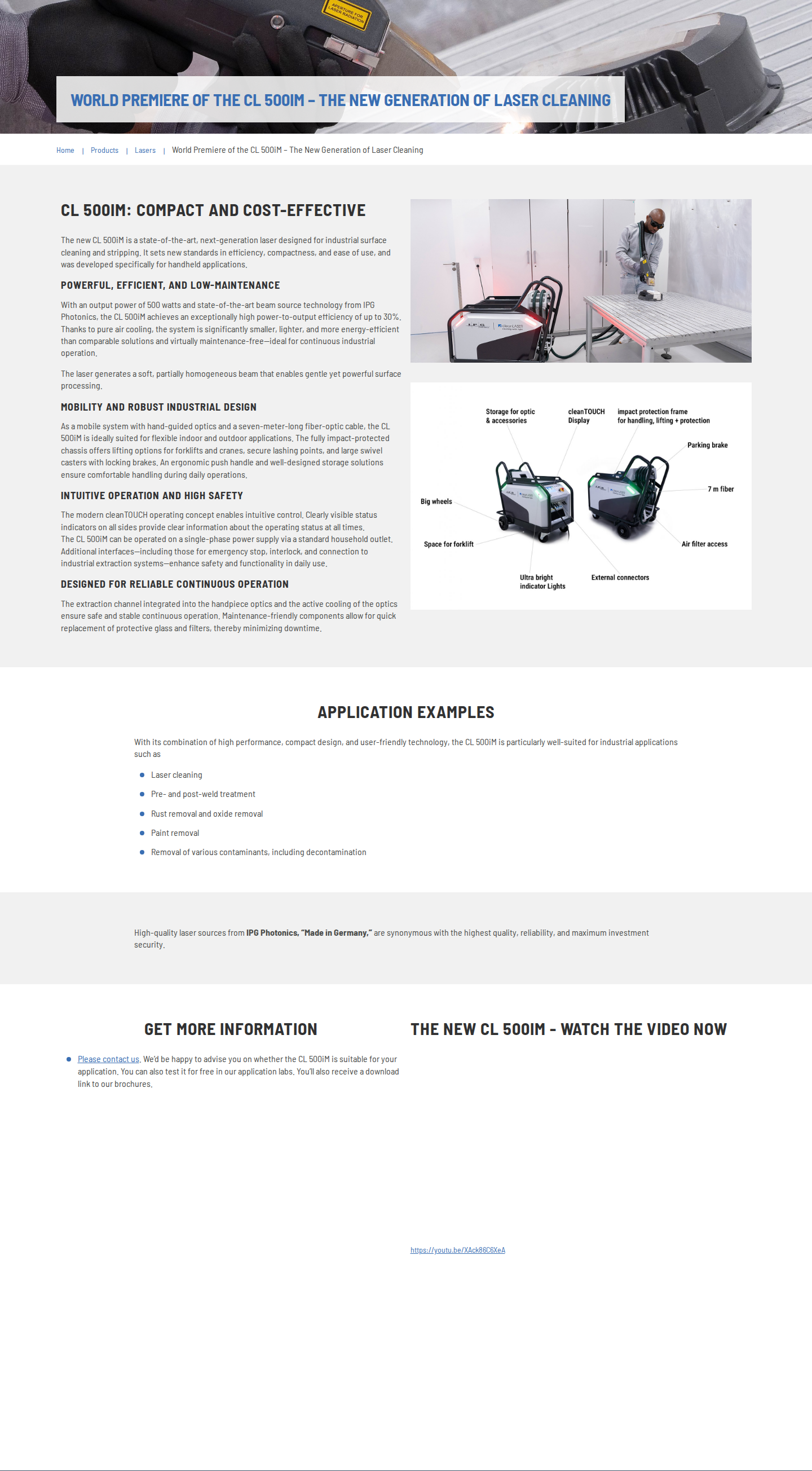
Founded in 1997 by Fraunhofer ILT alumni, cleanLASER is one of the original pioneers of industrial laser cleaning, with around 2,000 systems installed across 40+ countries. The CL-series handheld range covers 50–300 W (streamLINE compact) and 500 W (CL 500iM), both air-cooled and suited to paint and coating removal. The key trade-off for wood applications: a conventional Class 4 hazard zone that requires area clearance before operation — well-suited to enclosed workshops, but a meaningful constraint in open or heritage settings.
cleanLASER was founded in 1997 by two alumni of the Fraunhofer Institute for Laser Technology in Aachen — at a time when, as the founders have noted, hardly anyone else in the world knew that laser cleaning of surfaces was even possible.
That founding pedigree matters in a category where engineering depth is hard to assess from a brochure. With approximately 2,000 installed systems operating across 40+ countries, cleanLASER has a global install base that few competitors can match.
Wattage Options and Wood-Application Fit
The CL-series handheld range spans two models that bracket the practical wattage window for wood cleaning.
| Model | Max Output Power | Cooling | Portability |
|---|---|---|---|
| streamLINE compact | 300 W (four power classes: 50–300 W) | Air-cooled | Fully portable, lightweight aluminium housing |
| CL 500iM | 500 W | Air-cooled | Mobile, hand-guided optics, 7 m fibre-optic cable |
Comparing the two CL-series handheld models across the key specs relevant to wood applications helps readers evaluate which model suits their task.
The streamLINE compact sits comfortably within the conservative end of the wood-safe range, with four selectable power classes from 50 W to 300 W — useful for operators who want incremental control when working with variable timber substrates.
The CL 500iM at 500 W sits at the upper boundary of the wood-safe window. Buyers working with delicate, thin, or heritage timber should consider whether that ceiling is necessary for their application, or whether a lower-power model gives them more comfortable headroom.
Paint and Coating Removal on Wood
cleanLASER's systems are documented for complete, selective, and partial decoating using pulsed and scanned beam — a process that requires no liquids, abrasives, or chemicals.
Selective layer-by-layer removal is particularly relevant for wood paint stripping, where preserving the substrate beneath a coating is the primary concern. The ability to remove a top coat while leaving underlying layers intact gives operators a meaningful degree of process control.
Portability and Fibre Reach
The CL 500iM is air-cooled and operates from a standard single-phase household power supply — a practical advantage for site-based or workshop deployments where dedicated power infrastructure is not available.
The hand-guided optics connect via a 7 m fibre-optic cable, which defines the operator's working radius from the main unit. Buyers with large structures or awkward access requirements should factor this reach into their site planning.
Hazard Zone: The Key Operational Constraint
cleanLASER operates under a conventional Class 4 laser safety classification. In practice, this means the working area must be evacuated or enclosed before cleaning begins — bystanders cannot remain in the vicinity during operation.
For operators in enclosed industrial workshops, this is a manageable requirement. For heritage conservation projects in public or semi-public spaces, or open-workshop settings where clearing the area is disruptive or impractical, it is a genuine operational constraint that warrants careful consideration before purchase.
There is no reduced-hazard-zone or eye-safe operating mode available in the CL-series handheld range.
cleanLASER CL-Series Pricing
cleanLASER does not publish pricing on its website; all enquiries are handled on a contact-for-quote basis. This is consistent with the broader industrial laser cleaning market, though it does limit upfront cost comparison for buyers at the research stage.
Buyers who prioritise a long-established, category-founding manufacturer with a large global install base and broad product range, and whose working environment can accommodate conventional Class 4 laser safety requirements — enclosed workshops or controlled industrial areas where area evacuation is operationally feasible.
Product 3
P-Laser QF-Compact

P-Laser is a Belgian pulsed laser specialist whose QF-Compact portable family spans 50 W to 300 W on air cooling alone — no water chiller or compressor required. The QFC-200 and QFC-300 sit squarely within the practical wattage window for wood surface cleaning, and the CleanSweep software with touch-encoder job selection and wireless connectivity makes the system notably easy to put to work. The trade-off is portability weight: the QFC-200/300 units weigh 30–35 kg as a carry-the-whole-unit design, which differs from lighter fibre-fed scanner systems for single-operator on-site use.
P-Laser is a Belgian manufacturer and dedicated pulsed laser specialist, founded by an expert in surface treatment and cleaning with close to 30 years of experience in the field — making it one of the more established names in the category.
The company's portable line, the QF-Compact family, runs from 50 W to 300 W on air cooling throughout — meaning the QFC-50, QFC-100, QFC-200, and QFC-300 all operate without a water chiller or external compressor.
QF-Compact: Wattage and Wood-Application Fit
For wood surface applications, the QFC-200 and QFC-300 are the relevant models: their output sits within the practical wattage window for paint stripping, coating removal, and surface cleaning on wood without the thermal overload risk that higher-power systems carry.
Being fully air-cooled across the 50–300 W portable range is a genuine practical advantage — particularly for furniture workshops and on-site heritage work where running water or a chiller circuit is not available.
| Model | Power Output | Cooling Method |
|---|---|---|
| QFC-50 | 50 W | Air-cooled |
| QFC-100 | 100 W | Air-cooled |
| QFC-200 | 200 W | Air-cooled |
| QFC-300 | 300 W | Air-cooled |
| QF-500 / QF-1000 (non-portable) | 500–1000 W | Water-cooled |
Presents the QF-Compact portable family's power range and cooling method as published on P-Laser's own product pages, giving readers a clear at-a-glance view of the available configurations.
Buyers who anticipate needing to scale beyond 300 W should be aware that P-Laser's higher-power models (500 W and above) require water cooling — a meaningful infrastructure step up from the portable air-cooled range.
Portability: The Key Trade-Off
The QFC-200 and QFC-300 weigh 30–35 kg as a combined unit (dimensions: 300 x 665 x 465 mm). This is a carry-the-whole-unit portability model — the laser source, controls, and cooling are all in one housing. For single-operator on-site wood cleaning, this is a heavier proposition than a fibre-fed scanner system where only a lightweight handheld head moves to the work surface.
This is not a disqualifying factor for all buyers — a workshop setting with a fixed workstation, or a two-person site team, handles 30–35 kg without difficulty. It is, however, a real consideration for solo operators working at height, in tight spaces, or across multiple locations in a single day.
CleanSweep Software and Usability
Where the QF-Compact stands out on usability is its CleanSweep software, which pairs with a touch-encoder interface for job selection and supports wireless connectivity via tablet — making it straightforward to adjust and recall cleaning parameters without tethering to a control panel.
- Fast startup: The QF-Compact reaches operating readiness in approximately 10 seconds — minimal warm-up time before work can begin.
- Low maintenance: Routine maintenance is limited to periodic dust filter replacement; no complex servicing schedule is required.
- Touch-encoder job selection: Up to 8 custom cleaning jobs can be stored and recalled via the rotary encoder wheel, reducing operator setup time on repeat tasks.
- Wireless connectivity: A tablet with wireless connection allows job editing and parameter adjustment without a fixed control cable.
For buyers who prioritise a machine that is genuinely quick to deploy and simple to maintain, these usability features represent a meaningful advantage over more complex systems.
Laser Safety Requirements
The QF-Compact operates under standard laser safety requirements — a conventional laser hazard zone applies during operation, requiring appropriate PPE and controlled access to the working area.
For buyers working in open workshops or publicly accessible heritage settings where controlling the hazard zone is difficult, this is a practical constraint that must be factored into site planning. There is no reduced-hazard-zone or open-space capability on the QF-Compact range.
Pricing
P-Laser does not publish purchase pricing on its website; prospective buyers should contact the company directly for a quote. Rental rates are published separately for those evaluating short-term or project-based use.
Best For
The P-Laser QF-Compact is the strongest fit for buyers who want a proven, dedicated pulsed laser specialist with a wide air-cooled power range (50–300 W), strong onboard usability features, and minimal maintenance overhead — and who are working in a controlled environment where standard laser safety protocols can be readily observed.
Product 4
Allied Scientific Pro LaserBlast
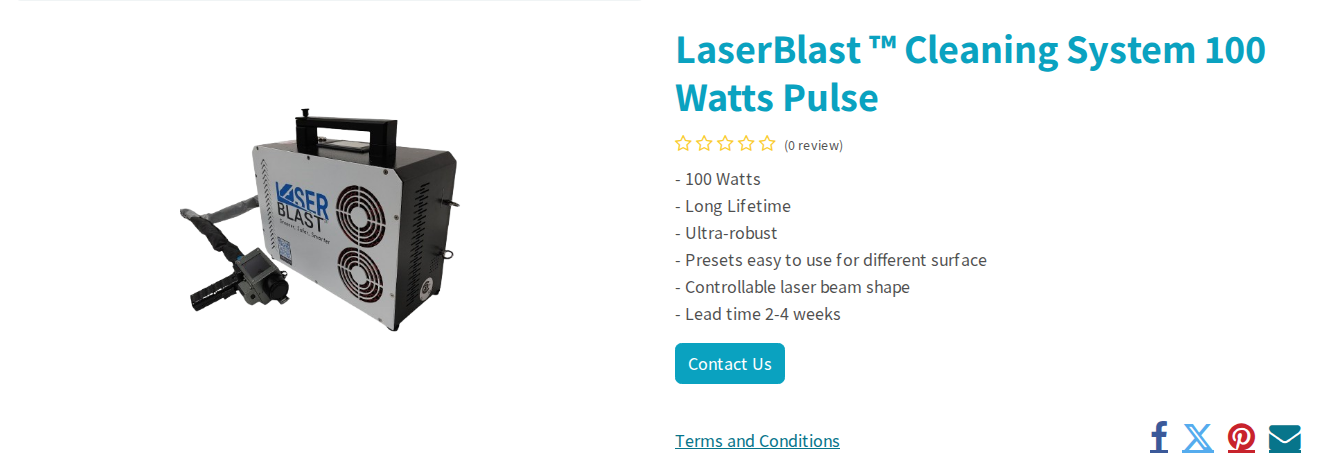
ASP's LaserBlast is a Canadian-built pulsed laser cleaning system positioned explicitly for heritage conservation and precision wood cleaning, with a documented track record on major restoration projects including the Canadian parliament building.
Allied Scientific Pro (ASP) is a Canadian company founded in 2009, now operating as ASP Laser Inc., with a specialism that sets it apart from most names on this list: large-scale conservation and heritage restoration, including infrastructure cleaning across North America.
ASP's own documentation confirms that its LaserBlast cleaning systems have been used since 2017 on major conservation projects, with the restoration of the Canadian parliament building — one of the largest infrastructure projects of its kind in Canada — among the most cited examples.
That heritage track record is directly relevant here. While most laser cleaning machines are positioned primarily for metal (rust, mill scale, oxide removal), ASP explicitly names wood as a supported substrate alongside stone, concrete, and art conservation — a distinction that holds real weight for buyers evaluating a pulse laser cleaning machine for wood.
LaserBlast Power and Pulse Control
The LaserBlast 100 W unit operates across a power range of 10–100 W, with a pulse duration window of 20–350 nanoseconds — both figures confirmed on ASP's product page.
Within the wood-application framework, 100 W sits at the lower end of the practical wattage window. That is not a weakness for every buyer: for conservation-grade work on gilded wood, carved surfaces, or historic building fabric, lower average power combined with fine pulse duration control is exactly the right tool.
The 20–350 ns pulse duration range gives the operator meaningful control over energy deposition per pulse — shorter pulses deliver energy more abruptly, reducing heat transfer into the substrate, while longer pulses allow gentler, more graduated ablation on sensitive surfaces.
Where the 100 W ceiling becomes a genuine constraint is in high-throughput applications: stripping heavy paint or thick coatings across large timber surfaces will take considerably longer at this power level than it would on a 300 W system.
| Specification | LaserBlast (100 W) | Wood-Application Note |
|---|---|---|
| Power range | 10–100 W | Precision conservation range; limited throughput for heavy industrial stripping |
| Pulse duration | 20–350 ns | Fine control over energy deposition — a genuine strength for delicate wood |
| Scan size | 20–140 mm | Wide spot range suits both detail work and broader surface passes |
| Scan speed | 1,000–14,000 mm/s | High upper speed supports efficient area coverage at lower power |
| Fibre delivery | 10 or 13 m | Long cable reach aids on-site heritage and building restoration work |
| System weight | 16 kg | Portable enough for site deployment; fibre delivery keeps the head light |
| Electrical draw | 0.5 kW / 110 V AC | Low power draw suits site conditions without dedicated industrial supply |
Presents the confirmed LaserBlast specifications against the wood-application evaluation axes in a format readers can scan and compare quickly.
The fibre delivery cable — available at 10 m or 13 m — is a practical asset for on-site conservation work, giving the operator significant reach from the main unit without repositioning it repeatedly.
At 16 kg, the system is portable in the sense that one person can move and deploy it on site; the fibre-delivered handpiece keeps the working end light, which matters when cleaning carved surfaces or working at height on building fabric.
Hazard Zone and Operational Constraints
The LaserBlast operates with a conventional laser hazard zone, requiring standard area control and PPE protocols during operation.
For buyers planning conservation work in publicly accessible spaces — open heritage sites, occupied buildings, or visitor-facing environments — this is a real operational consideration: the working area will need to be secured for each session.
LaserBlast Pricing
ASP does not publish pricing on its product pages; interested buyers will need to contact ASP directly for a quote, which is consistent with the wider laser cleaning market.
The LaserBlast is the strongest option on this list for conservation professionals, heritage restorers, and buyers working on delicate or high-value wood surfaces — gilded timber, carved architectural elements, historic building fabric — where precision and substrate safety take priority over cleaning speed. Buyers who need industrial-throughput paint stripping across large timber areas should look to higher-wattage options.
Product 5
Narran ROD 300 AIR
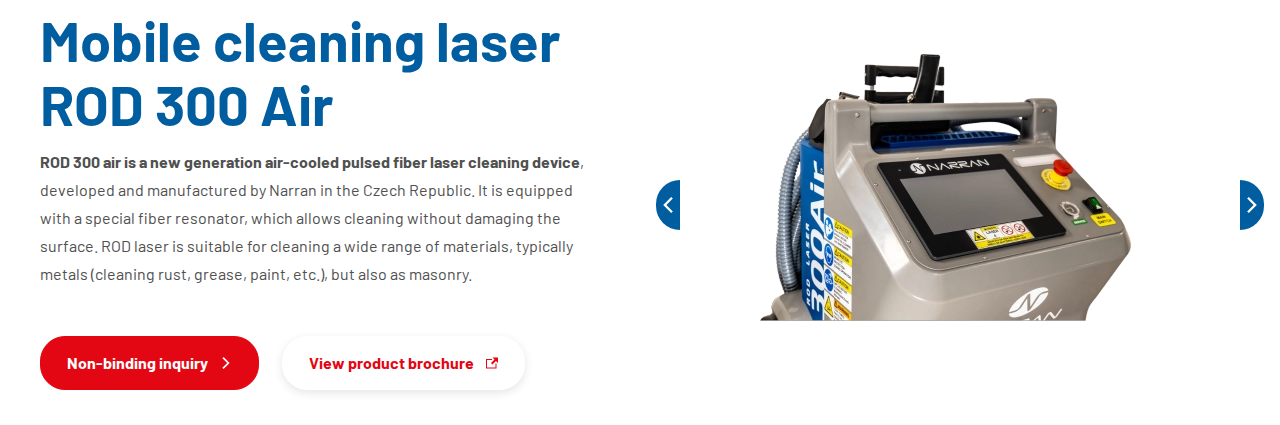
A Czech-manufactured, air-cooled 300 W pulsed fibre laser cleaning system built around Narran's own in-house fibre resonator. With a 3–300 kHz frequency range, a 1 kg process head, and documented wood restoration applications including varnish removal and soot cleaning, the ROD 300 AIR covers the full wood-safe wattage window. CE, ISO, and FDA certified. Contact Narran directly for pricing.
Narran is a Czech manufacturer that designs and builds its own fibre resonator in-house — a meaningful distinction in a market where many vendors are importers rebadging third-party hardware.
The company holds CE and ISO certification alongside FDA approval for the US market, a combination that gives compliance-conscious buyers documented credentials from a European source.
Narran ROD 300 AIR: Key Specifications
| Specification | ROD 300 AIR |
|---|---|
| Average output power | 300 W |
| Peak power | 72,000 W |
| Pulse frequency range | 3–300 kHz |
| Emission mode | Pulsed (nanosecond) |
| Optical fibre length | 10 m standard (up to 100 m on request) |
| Process head weight | 1 kg |
| Cooling | Integrated air cooling — no external chiller required |
| Laser safety class | Class 4 |
| Power supply | 110/230 V single-phase |
| Certifications | CE, ISO, FDA (US market) |
Presenting the ROD 300 AIR's core specifications in a scannable table allows readers to compare against the evaluation framework axes and against sibling entries at a glance.
At 300 W, the ROD 300 AIR sits at the upper boundary of the practical wattage window for wood applications established in §3 — enough throughput to tackle thicker paint and varnish layers while remaining within the range where careful parameter tuning can protect the substrate.
The integrated air cooling means no water chiller or compressor is needed, which simplifies deployment in furniture workshops and on-site settings where additional infrastructure is impractical.
Pulse Control and Wood-Surface Suitability
The ROD 300 AIR's 3–300 kHz frequency range is one of its genuine strengths for wood work: the wide adjustment window lets operators tune energy delivery finely to the substrate, reducing the risk of scorching or grain damage on more delicate timber surfaces.
Power, beam shape, and beam width can all be adjusted while the laser is running, which is practically useful when moving between different wood types or coating thicknesses during a single session.
Portability and Process Head Weight
The process head weighs 1 kg, making it genuinely lightweight for single-operator use over extended periods — relevant for furniture restoration, heritage timber work, and structural building maintenance where the operator is working at varied heights and angles.
The system unit itself weighs 39 kg and is designed as a mobile trolley, so it can be repositioned on-site without specialist handling equipment.
Fibre Length: An Honest Trade-Off
The standard optical fibre is 10 m, which limits the working radius from the system unit — a practical constraint for large-scale on-site work such as structural timber cleaning across a wide building facade.
Narran's product page states that fibre lengths of up to 100 m are available on request; buyers with large-site requirements should enquire directly with Narran to confirm availability and any associated cost or lead-time implications.
Wood Restoration Applications
Narran documents wood restoration explicitly across its application and case study pages, covering varnish and paint removal, soot cleaning from fire-damaged wood, and cleaning of blackened timber affected by atmospheric exposure.
The restoration page notes that, when properly adjusted, the ROD system can remove a layer of varnish, paint, or soot from various types of wood surfaces without damaging the base material — a claim grounded in Narran's own documented case work.
The ROD 300 AIR operates as a Class 4 laser with a conventional hazard zone. Standard laser safety controls — exclusion zones, appropriate PPE, and operator training — are required. There is no eye-safe or reduced-hazard-zone capability; this is a genuine operational constraint for open-workshop, mixed-use, or publicly accessible heritage settings.
Narran ROD 300 AIR Pricing
No model-specific pricing is published for the ROD 300 AIR; Narran operates a contact-for-quote model.
As with the other systems on this list, the total cost of ownership picture is shaped by the absence of consumables and the lack of chiller infrastructure — operational running costs are primarily electricity, which Narran's own documentation estimates at under 1 EUR per hour depending on the model.
Who Is the Narran ROD 300 AIR Best For?
The ROD 300 AIR is best suited to buyers who want a European manufacturer with its own fibre resonator technology, CE/ISO/FDA credentials, and a 300 W air-cooled system sitting squarely within the wood-safe wattage window.
It is a strong fit for furniture workshops, heritage timber restoration, and on-site building maintenance — provided the working environment can accommodate Class 4 laser safety requirements and the 10 m standard fibre reach is sufficient for the task.
Not Sure Which Machine Fits Your Project?
You've reviewed five strong options. Getting the right match for your wood substrate, coating type, and working environment takes a conversation. Speak directly with a laser cleaning expert to narrow it down.
Conclusion
Does laser cleaning work on wood?
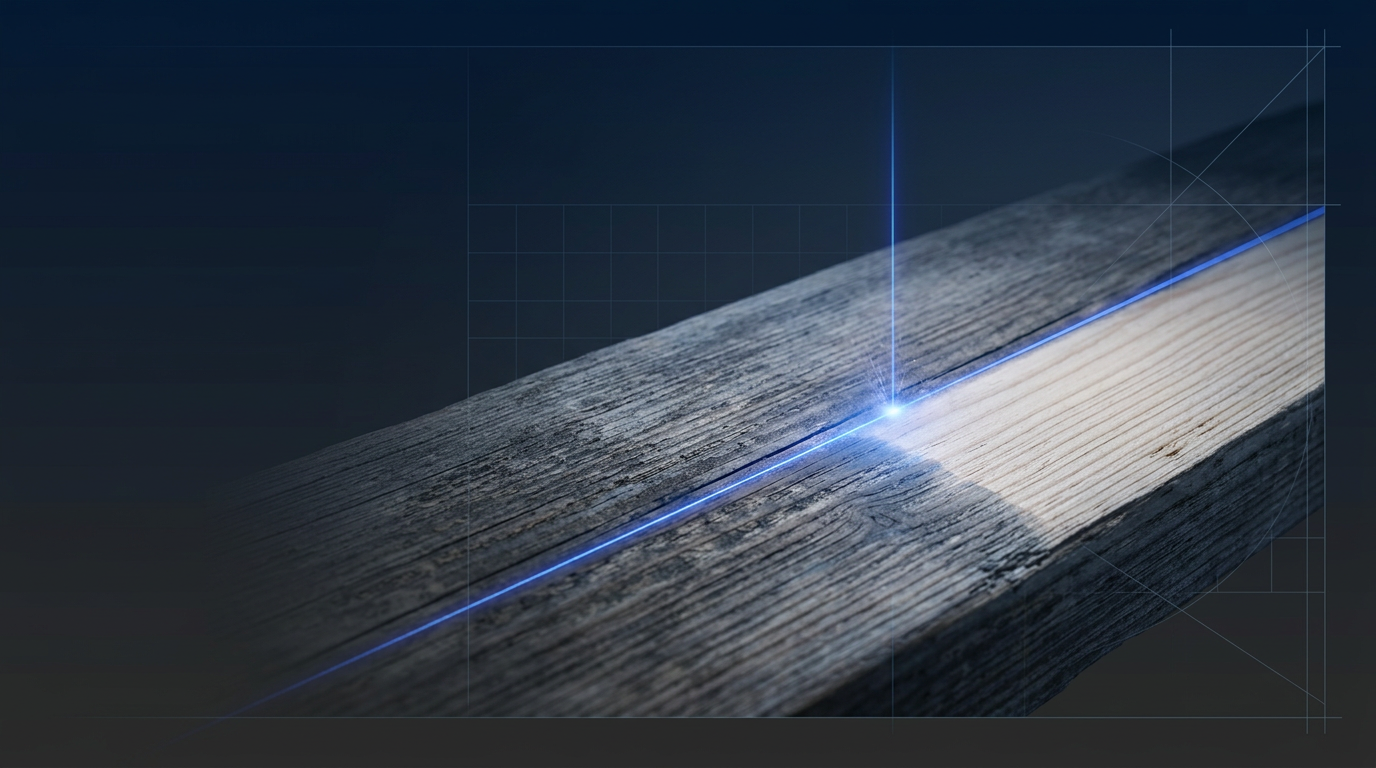
Laser cleaning works on wood — reliably, cleanly, and without abrasives — when the machine is correctly matched to the coating type, wood substrate, and task at hand.
The honest caveat: epoxy and polyurethane coatings, along with very thick or multi-layer paint systems, can resist the process, so testing on a sample area first is always worthwhile.
Portable air-cooled systems suit furniture restoration and heritage timber work on-site; lower-power variable-pulse machines serve conservation-grade precision; higher-power options handle heavier industrial coatings — speak directly with manufacturers about your specific substrate and environment before committing.
Frequently asked questions about laser cleaning wood
Answers to the questions buyers ask most when evaluating a pulse laser cleaning machine for wood.
Yes — laser cleaning works on wood when the machine is correctly specified. Pulse control and wattage selection are critical: unlike metal, wood is thermally sensitive and can scorch, char, or suffer grain damage if power is not dialled in carefully. Always test on a sample area first, particularly with high-value or heritage timber. One honest limitation worth knowing before purchase: certain coatings commonly applied to wood — specifically epoxy and polyurethane finishes — may resist pulsed laser cleaning or require higher power levels than the substrate can safely tolerate, making alternative removal methods more appropriate in those cases.
The vast majority of pulse laser cleaning machines are sold on a contact-for-quote basis — publicly listed prices are the exception in this category, not the rule. Because of this, the more useful evaluation lens is total cost of ownership (TCO) rather than sticker price. Laser cleaning has zero consumables (no abrasive media, no chemicals), generates less downtime, and causes minimal substrate damage — running cost advantages that compound significantly over time compared with sandblasting or chemical stripping. When requesting quotes from manufacturers, ask specifically about training, after-sales support, warranty terms, and spare parts availability alongside the machine price. These factors shape the real cost of ownership far more than the headline figure.
Published pricing is rare in this category — most manufacturers require direct contact for a quote. For buyers currently comparing laser cleaning against sandblasting, chemical stripping, or water-jetting, sticker price is the wrong evaluation lens regardless. Total cost of ownership (TCO) is the more meaningful measure: laser cleaning involves zero consumables, reduced downtime, and less rework on the wood substrate — cost advantages that compound over the machine's working life. When gathering quotes, ask manufacturers to address training, warranty terms, and spare parts availability alongside the unit price, as these factors significantly affect real-world running costs.
For most wood cleaning tasks — paint stripping, coating removal, mould and soot cleaning — the practical window is roughly 300 W to 500 W. For delicate conservation work, gilded surfaces, or fine furniture restoration, lower power in the 50–100 W range is more appropriate, where precision matters more than throughput. The more important factor, however, is tunability. A machine that can modulate output finely across its full range is safer on wood than one with a high peak rating but coarse or fixed power control. A high-wattage machine that cannot be dialled down precisely is a genuine risk on wood — regardless of its maximum rating.
Pulsed laser cleaning is the correct choice for wood. Continuous-wave (CW) lasers are not recommended for wood applications. Pulsed lasers deliver energy in short, controlled bursts — the energy is deposited into the contaminant layer before it can conduct significantly into the wood substrate beneath, minimising heat transfer and reducing the risk of scorching, charring, or grain damage. CW lasers deliver energy in a sustained beam, generating sustained heat. On a thermally sensitive substrate like wood, that sustained heat transfer substantially increases the risk of substrate damage, making CW lasers unsuitable for most wood cleaning tasks.