

Introduction
If you are an engineer, maintenance manager, or procurement professional who has started looking seriously at pulsed laser cleaning machines, you have probably already weighed sandblasting, chemical stripping, and ultrasonic cleaning against your application.
You are not here because you have made a decision — you are here because you want to understand the technology well enough to make a good one.
This guide works through everything that matters for that evaluation: the physics behind pulsed laser energy, how it compares to continuous wave alternatives, which surfaces and contaminants it suits, where it is deployed industrially, what to look for when buying, and how the economics stack up over time.
TL;DR
Pulsed laser cleaning works because its physics are inherently precise: short, high-peak-power bursts vaporise contamination while confining heat so tightly that the substrate beneath is left untouched. That selectivity, combined with near-zero consumable costs, means the total cost of ownership case is often stronger than the capital price suggests.
This article covers:

The physics of pulsed laser energy delivery
Pulsed vs. continuous wave: key differences
Surfaces and contaminants pulsed cleaning handles
Industrial sectors and real-world applications
Buying considerations: power, duty cycle, portability
Safety, total cost of ownership, and ROI
What Is a Pulsed Laser Cleaning Machine?
Fire a precisely timed burst of laser energy at a contaminated surface and something remarkable happens: the contaminant absorbs the energy and is vaporised or ejected, while the clean base material beneath remains untouched. That outcome — contamination removed, substrate intact — is the defining promise of a pulsed laser cleaning machine, and it flows directly from one design decision: delivering energy in discrete bursts rather than as a continuous beam.
A pulsed laser cleaning machine is a surface preparation system that generates laser energy in short, high-peak-power pulses and uses those pulses to remove contaminants from a substrate by ablation. The word "pulsed" is doing specific technical work here: it describes the mode of energy delivery, not the laser type or wavelength, and it is this pulsed delivery that enables the selective, controlled removal of surface contamination.
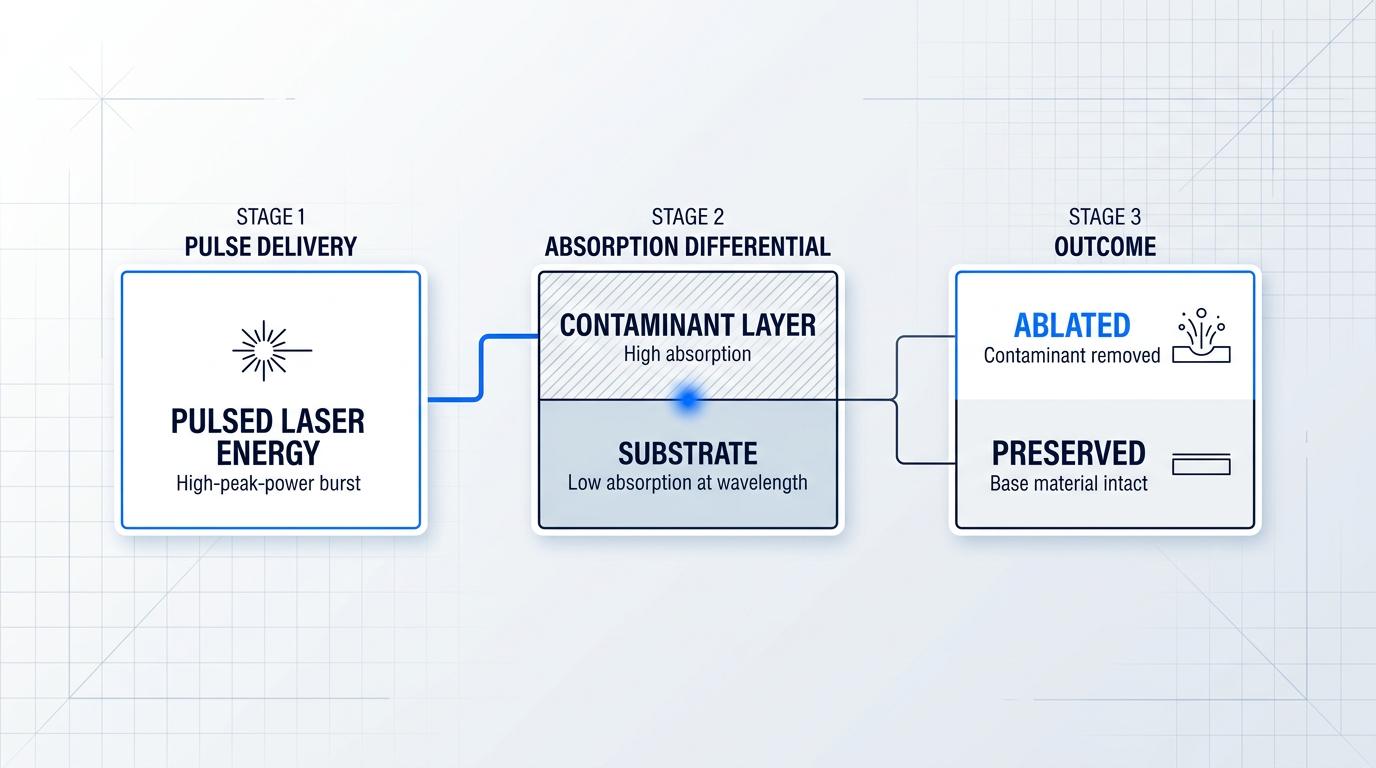
At a conceptual level, the operating principle rests on an absorption differential. The contamination layer — rust, paint, oxide, or organic residue — absorbs the incoming pulse energy more readily than the underlying substrate does at the laser's wavelength. Because each pulse is also extremely brief, heat transfer into the base material is limited, and the contaminant is removed while the substrate beneath is preserved.
Core Components of a Pulsed Laser Cleaning System
Understanding what you are buying means understanding the hardware that makes pulsed laser cleaning work. Every industrial system is built around five key elements.
- Fibre Laser Source: The energy generator. Produces the pulsed laser output at the system's rated power — the core of the machine.
- Galvanometer Scanning Head: Steers the laser beam across the surface at high speed using precision mirrors, controlling the cleaning pattern and area.
- Fibre Delivery Cable: Carries the laser beam from the power unit to the scanning head, enabling the operator to work at distance from the source.
- Control Interface: Typically a touchscreen panel where the operator sets power, scan speed, and pattern parameters before and during cleaning.
- Fume and Particulate Extraction: Captures ablated material — vaporised contaminant, particles, and fumes — away from the work area and the operator.
Together, these five components form a self-contained cleaning system. The laser source and control electronics typically live in a single power unit; the scanning head connects via the fibre cable and is the only element the operator physically handles at the workpiece.
Our portable industrial system, ELASER, illustrates what this looks like in practice: a wheeled unit housing the laser source, paired with a handheld scanner weighing under 3 kg on a delivery cable reaching up to 50 m. ELASER is designed, built, and supported entirely in-house by Woodrow Scientific Limited — the only UK-based laser cleaning manufacturer — which develops its own machines rather than operating as a reseller.
The term pulsed laser cleaning machine spans a wider range of physical form factors than a single product image might suggest. At one end sits the portable, wheeled unit with a handheld scanning head — suited to on-site and field deployment. Trolley-mounted configurations offer a more fixed workshop setup. At the other end, automated robotic cells mount the laser head on a robotic arm for high-throughput, repeatable cleaning of production-line components.
Within the broader laser cleaning category, pulsed systems sit alongside continuous wave (CW) systems, which emit a constant, uninterrupted beam rather than discrete bursts. Both use laser energy to remove surface contamination, but the mode of delivery has meaningful practical consequences — a distinction explored fully in a later section of this guide.
Laser cleaning has emerged as a modern surface preparation method across a wide range of industries, offering an alternative approach to established techniques such as sandblasting, chemical stripping, and water-jetting where precision and substrate preservation are priorities.
Understanding why pulsed delivery produces these outcomes — and how the parameters of each burst are tuned to match specific cleaning tasks — requires looking at what happens inside a single pulse of laser energy, which is where the physics of peak power, pulse duration, and pulse repetition rate become relevant.
How Pulsed Laser Energy Works
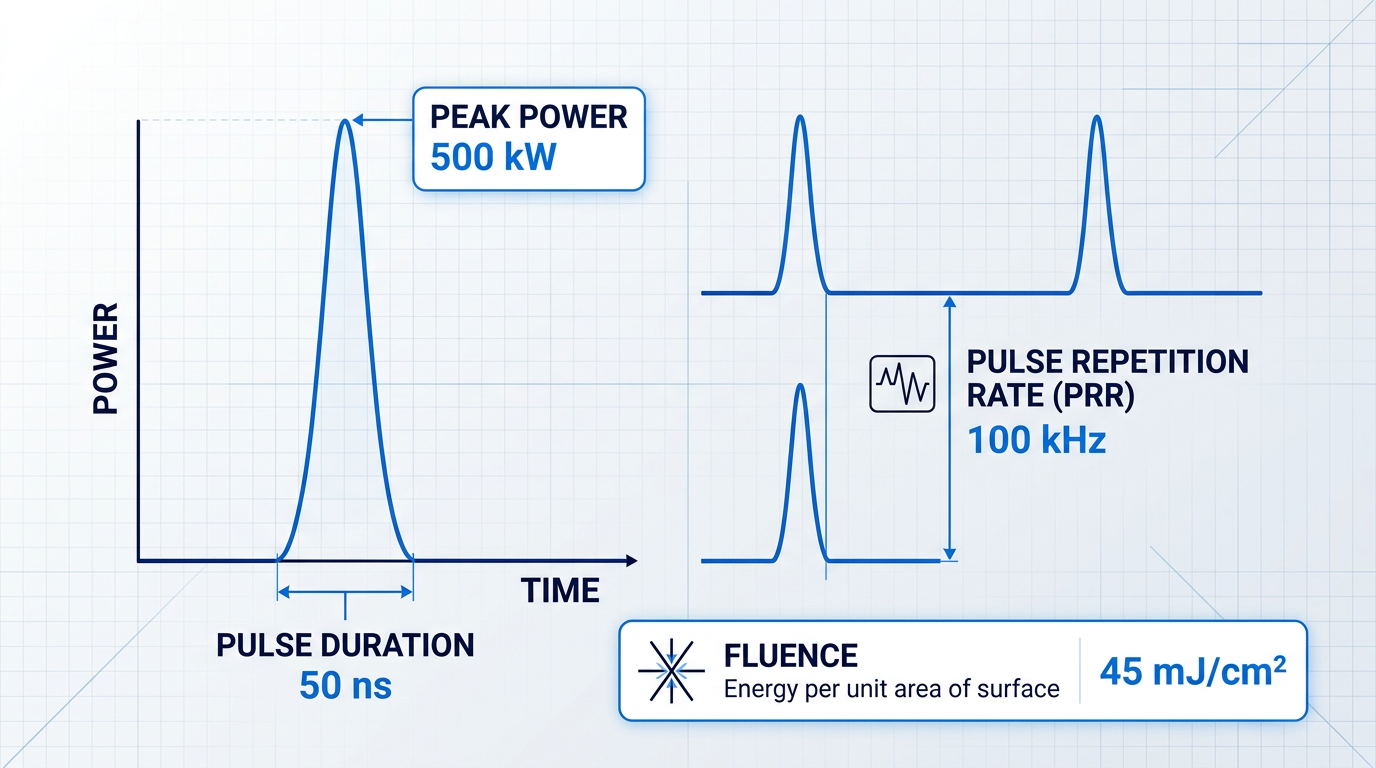
The word "pulsed" does more engineering work than it might appear. Rather than emitting a steady beam, a pulsed laser cleaning machine fires discrete bursts of energy — each one lasting a fraction of a microsecond — with gaps of silence in between. What makes this delivery method so consequential is not the energy itself, but the rate at which it arrives. Four parameters govern that rate and determine everything that follows: peak power, pulse duration, pulse repetition rate, and fluence.
Peak Power: Energy Compressed in Time
Peak power is the instantaneous optical power delivered during a pulse — the maximum power the laser produces at any single moment. It is calculated directly: peak power equals pulse energy divided by pulse duration.
The practical consequence is striking. A laser system with a modest average power output of, say, 100 W can generate peak powers of hundreds of kilowatts to several megawatts when that energy is compressed into nanosecond-duration pulses — because the same quantity of energy, released in a far shorter time window, produces a proportionally higher instantaneous power.
Think of the difference between a hammer blow and a steady push. Both may involve the same total force applied over the same period, but the hammer concentrates it into an instant and achieves something the steady push cannot. Pulsed laser delivery works on the same principle: the concentration of energy in time is what makes ablation possible without the sustained heat input that would damage the substrate beneath.
Q-switched fibre lasers used in industrial cleaning applications routinely achieve peak powers from tens of kilowatts to over one megawatt at average powers in the range of 20 to 500 W — a ratio of instantaneous to average power that simply cannot be matched by any steady-state delivery method.
Pulse Duration: Controlling the Thermal Interaction
Pulse duration (also called pulse width) is the time window during which each burst of laser energy is delivered — measured at the full width half maximum of the pulse shape. For industrial laser cleaning systems, this is typically in the range of 1 to 200 nanoseconds.
A nanosecond is one billionth of a second. To put that in perspective: 100 nanoseconds is shorter than the blink of an eye by roughly seven orders of magnitude. At these timescales, something physically important happens — the material being irradiated has almost no time to conduct heat away from the zone of laser interaction during the pulse itself.
This is the parameter that governs thermal confinement: the shorter the pulse, the faster energy is deposited relative to the substrate's thermal response time, and the more tightly that energy remains localised at the irradiated zone. Pulse duration is therefore the primary lever controlling how much heat transfers into the underlying material during each individual burst — a concept the next section develops in full.
Research confirms that pulse widths between 1 and 100 ns are typical for laser cleaning, and that both extremes carry risk: too short a pulse width can induce surface damage, while too long a pulse width produces little or no cleaning action as the energy dissipates thermally rather than driving ablation.
Pulse Repetition Rate: Throughput and Heat Accumulation
The pulse repetition rate (PRR) is the number of pulses fired per second, measured in hertz (Hz) or kilohertz (kHz). It connects directly to average power: average power equals PRR multiplied by the energy per pulse. Raise the PRR while holding pulse energy constant, and average power rises proportionally — as does cleaning throughput.
But PRR has a second, less obvious effect. If pulses arrive faster than the substrate can dissipate heat between them, thermal energy accumulates in the material across successive pulses — even if each individual pulse is brief and well-confined. Research on paint ablation has shown that increasing PRR can reduce the effective ablation threshold fluence by as much as sixfold through this heat accumulation mechanism.
This makes PRR the parameter that controls the thermal budget of the process at the system level: pulse duration governs heat input during each individual pulse, while PRR governs whether that heat has time to clear before the next pulse arrives. Both must be managed together for the process to stay within safe thermal limits for the substrate.
Fluence: What the Surface Actually Experiences
Fluence is the energy delivered per unit area of surface — expressed in joules per square centimetre (J/cm²). It is the operative variable at the point of interaction: the quantity the material actually experiences, regardless of what the laser's nominal power rating says.
Fluence is determined by two factors in combination: pulse energy and the area over which the beam is focused (spot size). A system with high peak power but a large spot size may deliver lower fluence than a lower-power system with a tightly focused beam. Fluence can be adjusted by changing the focusing optics without altering the laser source at all.
The reason fluence matters above all other parameters is that it determines whether ablation actually occurs. Below a material's ablation threshold fluence, laser irradiation produces only heating. Above it, the contaminant is vaporised or ejected. For rust removal from steel using nanosecond Nd:YAG pulses at 1064 nm, complete cleaning has been demonstrated at fluences in the range of approximately 25 to 65 mJ/cm² — well below the damage threshold of the steel substrate.
For aluminium substrates, the ablation threshold is considerably higher — experimentally established at between 4.3 and 5.2 J/cm² for 5 ns pulses at 1064 nm — which illustrates that the gap between contaminant removal threshold and substrate damage threshold varies considerably by material pair and must be established for each application.
How the Parameters Connect to Cleaning Outcomes
Each parameter pulls a different lever on the cleaning process. Higher peak power enables the ablation of harder, more tenacious contaminants that require greater instantaneous energy density to overcome their bond strength. Shorter pulse duration limits the time available for heat to conduct into the substrate, making it possible to clean thermally sensitive materials without inducing damage beneath the contamination layer.
Higher PRR increases cleaning speed — more surface area covered per second — but accelerates inter-pulse heat accumulation, which sets an upper limit for thermally sensitive substrates. Fluence is the threshold variable: set it below the contaminant's ablation threshold and nothing is removed; set it above the substrate's damage threshold and the base material is at risk.
| Material / Contaminant | Ablation / Damage Threshold Fluence | Pulse Conditions and Notes | Role in Cleaning |
|---|---|---|---|
| Rust (iron oxide) — complete removal | ~25–65 mJ/cm² | Nd:YAG, 1064 nm, ns pulses | Contaminant threshold: target above this to clean |
| Aluminium substrate — ablation onset | 4.3–5.2 J/cm² | 5 ns pulses, 1064 nm | Substrate threshold: wide safety margin above rust removal range |
| Paint removal (ns regime) | 0.3–0.5 J/cm² | 10–100 pulses, ns laser | Contaminant threshold: multi-pulse accumulation lowers effective value |
| Stainless steel substrate — single shot | ~0.21 J/cm² (reference only) | Ultrashort (fs) pulses; ns-regime threshold is higher — use as conservative lower bound | Substrate reference: actual ns-regime damage threshold will exceed this figure |
Specific ablation threshold fluences for common industrial contaminants and substrate materials from peer-reviewed literature, showing the operating window that pulsed laser cleaning must target. The steel row uses an ultrashort-pulse reference value and is labelled accordingly.
The table makes the operating logic concrete: for rust on steel, the gap between the contaminant removal threshold (~25–65 mJ/cm²) and the substrate damage threshold is substantial. It is worth noting that the steel damage threshold of ~0.21 J/cm² in the literature derives from ultrashort (femtosecond) pulse experiments — the ns-regime damage threshold for steel is higher, meaning the practical safety margin in nanosecond cleaning is wider than the table's conservative reference implies.
A laser's nominal power rating tells you nothing about whether ablation will occur. Fluence — energy per unit area at the surface — is the operative variable. A high-power system with a large spot can deliver lower fluence than a lower-power system with tight focusing. Buyers who compare systems on average power alone are reading the wrong number.
This is why parameter optimisation is the core engineering challenge of laser cleaning. For any given substrate-contaminant pair, there is a window of settings that achieves effective removal without substrate damage — defined by two thresholds: the ablation threshold of the contaminant and the damage threshold of the substrate.
Operate below the lower threshold and nothing is cleaned. Operate above the upper threshold and the base material is damaged. Inappropriate combinations — too high a fluence, too high a PRR for a thermally sensitive material, or a pulse duration long enough to allow significant heat conduction — can damage the substrate or leave contamination behind. Laser cleaning is not a plug-and-play technology; it requires engineering knowledge to deploy correctly.
It is worth noting that ultrashort pulse regimes (picosecond, femtosecond) operate differently — the interaction timescale falls below the thermal coupling time of electrons and phonons, enabling non-thermal ablation mechanisms. This guide focuses on the nanosecond regime that dominates industrial cleaning applications, where thermal mechanisms are the primary driver of material removal.
With a working understanding of how pulsed energy is delivered and what each parameter controls, the next question is what actually happens at the surface in the moment that energy arrives — the ablation mechanism itself.
How Pulsed Laser Cleaning Removes Contamination Selectively
Every supplier of a pulsed laser cleaning machine will tell you the process is "substrate-safe" and "selective." But what does that actually mean at the physics level — and how do you know when it holds, and when it doesn't?
The answer lies in a chain of physical events that unfolds in nanoseconds each time a pulse arrives at a contaminated surface. Understanding that chain is what separates a buyer who can interrogate a supplier's claims from one who simply accepts them.
Selective Absorption: Why the Laser Targets Contamination First
The starting point is selective absorption: contamination layers — rust, iron oxides, paint, carbon deposits, organic residues — absorb laser energy at near-infrared wavelengths (around 1 µm, the operating wavelength of industrial fibre lasers) significantly more readily than the clean metal substrate beneath them.
This differential is not a product feature or a control system achievement. It is a physical property of the materials themselves: the contamination layer intercepts and absorbs the incoming energy; the substrate beneath does not absorb at the same rate.
Research on oxide layers confirms that surface oxidation substantially increases spectral emissivity and absorptivity, particularly at shorter wavelengths, and that this effect grows more pronounced as the oxide layer thickens — meaning the contamination layer is, in effect, an efficient absorber precisely because of what makes it a contaminant.
Thermal Confinement: Why the Heat Stays in the Contamination Layer
Selective absorption explains why the contamination layer gets hot. Thermal confinement explains why that heat does not travel into the substrate.
Every material has a characteristic timescale over which heat generated at a point spreads outward — its thermal diffusion time. When pulse duration is short relative to that timescale, the heat simply does not have enough time to travel before the pulse ends.
For nanosecond-pulse industrial cleaning systems, this condition is met: the pulse is over before the heat can propagate meaningfully into the substrate. The thermal energy is, in effect, trapped within the contamination layer for the duration of the interaction.
This is not a feature engineered into the machine. It is a direct consequence of the short-pulse delivery regime — the physics of nanosecond pulses and the thermal diffusion properties of the materials involved.
The Ablation Process: What Happens During a Single Pulse
With those two principles established, the ablation event itself follows a clear sequence.
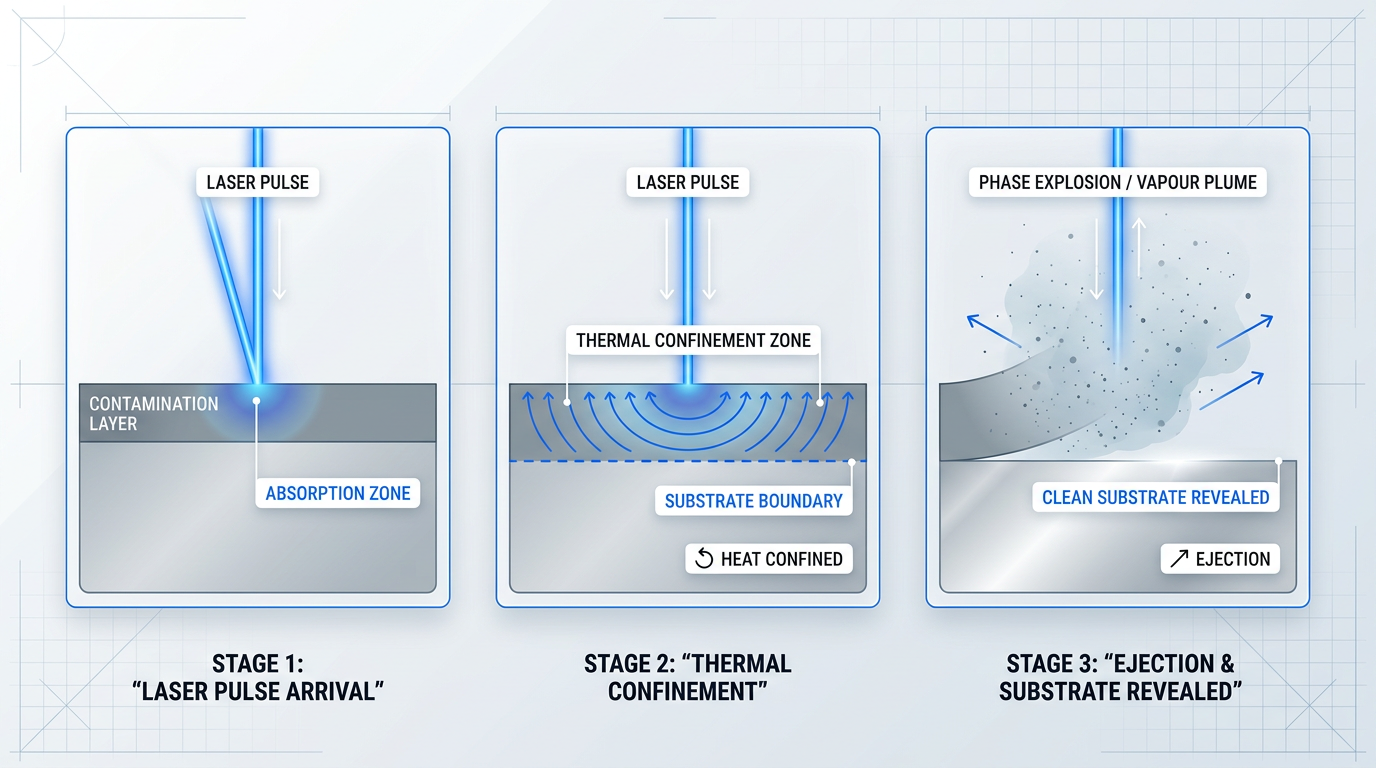
- Rapid energy absorption: The contamination layer absorbs the pulse energy at the near-infrared wavelength, causing its temperature to rise extremely rapidly within nanoseconds.
- Vaporisation or phase explosion: The material reaches vaporisation temperature — or undergoes phase explosion, a rapid transition from superheated liquid to a mixture of vapour and ejected particles.
- Ejection as a plume: The contamination is expelled from the surface as a plume of vapour and micron-sized particles, driven by recoil pressure from the expanding vapour.
- Self-limiting at the substrate: The beam encounters the clean substrate beneath, which absorbs less energy at this wavelength and has not accumulated significant heat. Removal stops.
The phase explosion mechanism — where a superheated liquid undergoes homogeneous bubble nucleation and transitions explosively into a vapour-droplet mixture — is well established in peer-reviewed laser ablation literature as the dominant removal pathway at sufficiently high fluences in nanosecond-pulse regimes.
The practical result is that contamination is not slowly evaporated; it is ejected in a step-change event at the moment the fluence crosses the ablation threshold, producing a distinct and controllable cleaning effect rather than a gradual thermal process.
Substrate Integrity: The Mechanistic Basis for the Safety Claim
Because energy is deposited into the contamination layer and removed from the surface faster than heat can diffuse into the substrate, the base material experiences minimal thermal load — in most industrial applications, this means no melting, no microcracking, no dimensional change, and no surface hardening.
This is the mechanistic foundation of the "substrate-safe" claim that appears throughout laser cleaning product literature. It is not an unconditional guarantee: it is a consequence of correctly applied pulsed laser physics operating within appropriate parameters.
Research demonstrates the parameter-dependence clearly: irradiation with longer pulses (70 ns, for example) has been shown to produce a network of microcracks propagating deep into steel substrates, while correctly configured shorter-pulse regimes maintain bulk structural integrity — the same material, different outcomes, determined by pulse duration and fluence settings.
Fluence Thresholds and the Process Window
Effective laser cleaning operates within a specific process window bounded by two fluence values: the ablation threshold of the contaminant (the minimum fluence required to initiate removal) and the damage threshold of the substrate (the fluence above which the base material itself begins to ablate or be altered).
Below the contaminant's ablation threshold, the pulse deposits energy but does not remove material — cleaning does not occur. Above the substrate's damage threshold, the base material is affected, which is precisely the outcome the process is designed to avoid.
Laser cleaning works because the ablation threshold of most contamination layers is lower than the damage threshold of the metal substrate beneath. The gap between those two values is the process window — and optimising fluence, pulse duration, and repetition rate to operate reliably within it is what separates a well-configured system from one that either under-cleans or risks substrate damage.
Peer-reviewed studies on rust removal from steel have confirmed that discrete initial and complete cleaning thresholds exist: below the initial threshold, the surface is unchanged; above the complete threshold, full removal is achieved — with the specific values depending on pulse parameters and material state.
For paint removal, research using nanosecond Nd:YAG systems found optimal ablation efficiency at a fluence of 1.5 J/cm², with the ablation threshold itself sensitive to pulse duration and repetition rate — confirming that the process window is not fixed, but shifts with the operating parameters chosen.
Photothermal vs. Non-Thermal Ablation: A Brief Distinction
Nanosecond-pulse industrial cleaning is a photothermal process: laser energy is converted to heat within the contamination layer, which then vaporises or phase-explodes. This is distinct from ultrashort femtosecond-pulse ablation, which can achieve material removal through non-thermal pathways such as direct ionisation and Coulomb explosion — mechanisms where thermal effects are largely bypassed and the heat-affected zone is reduced to nanometre scale.
For readers who have encountered femtosecond laser cleaning in academic contexts: the distinction matters, but femtosecond systems are a different product category with different cost and complexity profiles. The nanosecond industrial systems that dominate pulsed laser cleaning procurement rely on thermal confinement — not non-thermal ablation — to achieve selectivity.
With the full ablation mechanism now established — selective absorption, thermal confinement, phase explosion, substrate integrity, and the process window — the next logical question is how pulsed delivery compares to continuous wave laser cleaning, where the same wavelength is used but the energy arrives very differently.
Pulsed vs. Continuous Wave: Why Delivery Method Matters
Vendors describe their laser cleaning systems using terms like "pulsed", "CW", and "quasi-CW" — sometimes interchangeably, sometimes imprecisely. Understanding what those terms mean mechanistically is what separates a buyer who can evaluate a spec sheet from one who is simply taking a salesperson's word for it.
A continuous wave (CW) laser emits a constant, uninterrupted beam: the laser is always on during operation, and energy is deposited into the surface at a steady, continuous rate.
The defining characteristic of CW delivery is that average power and peak power are identical — there is no burst structure, no compression of energy into a short window, no instantaneous intensity spike above the mean.
This is the foundational contrast with pulsed delivery. As established in the energy parameters section, a pulsed system compresses its energy into discrete bursts, each lasting nanoseconds, with gaps of silence between them — and it is that compression which produces the high peak power that drives selective ablation.
A pulsed laser and a CW laser can share the same average power rating, yet the pulsed system delivers peak power far higher — because the same energy is concentrated into a fraction of the time, and that instantaneous intensity is what crosses the ablation threshold; average power alone cannot replicate it.
At equal average power, the pulsed system can drive the contamination layer above its ablation threshold in a very short burst, vaporising or ejecting it before significant heat conducts into the substrate below.
A CW system at the same average power never reaches that instantaneous intensity peak, so it relies on a fundamentally different mechanism: sustained thermal heating rather than short-burst ablation.
The thermal confinement principle covered in the ablation mechanism section — where pulse duration must be short relative to the thermal diffusion time of the material — simply does not apply to CW delivery, because CW energy is deposited continuously rather than in confined bursts.
The practical consequence is that CW cleaning imposes a greater thermal load on the substrate: heat accumulates progressively, and the substrate cannot dissipate it between pulses the way it can in a pulsed regime.
That is a trade-off, not an inherent flaw — for robust substrates where some thermal load is acceptable and where throughput is the priority, CW systems are entirely appropriate and widely deployed.
Where Each Delivery Method Excels
Pulsed delivery is the right choice when the application demands high selectivity between contamination and substrate — situations where the physics of differential absorption and thermal confinement do the most useful work.
Light rust and surface oxides on thin-gauge metals, paint on aluminium or galvanised steel, weld discolouration on precision aerospace components, and tarnish on heritage metalwork all share a common requirement: the contamination must be removed without the substrate absorbing damaging heat, and the cleaning action must be controllable enough to stop at the base material.
In each of these cases, the short pulse duration keeps energy deposition within the contamination layer's thermal confinement time, the differential in optical absorption between contaminant and substrate keeps fluence selective, and the operator can tune pulse repetition rate and energy per pulse to graduate the cleaning depth.
CW systems are typically deployed at higher average powers for high-throughput, large-area cleaning on robust industrial substrates — heavy mill scale removal from structural steel, large-area rust stripping from thick plate, and high-volume degreasing on substrates that can tolerate sustained thermal input.
In these contexts, the absence of peak-power-driven selectivity is not a limiting factor, because the substrate can absorb the thermal load and throughput is the dominant performance criterion.
- Pulsed: thin-gauge and sensitive substrates: Short bursts confine heat to the contamination layer, protecting aluminium, galvanised steel, heat-sensitive alloys, and heritage materials from thermal damage.
- Pulsed: precision and graduated cleaning: Independent control of PRR, pulse duration, and fluence lets the operator tune cleaning depth — critical for aerospace components and conservation work.
- CW: high-throughput on robust substrates: Continuous delivery at high average power suits large-area mill scale and heavy rust removal from thick structural steel, where speed outweighs selectivity.
- CW: large-area industrial degreasing: Sustained thermal input is effective for high-volume degreasing on robust substrates where moderate thermal load on the base material is acceptable.
The pattern across both delivery methods is consistent: the right choice follows from the substrate and contamination type, not from the power rating on the brochure.
One further nuance worth flagging for spec-sheet readers: the boundary between pulsed and quasi-CW behaviour is a spectrum, not a binary.
A system described as "pulsed" with a very high pulse repetition rate and relatively long pulse duration may behave more like a modulated CW system than a true short-pulse ablation system — the gaps between pulses become so short that the substrate cannot dissipate heat between them, and the thermal confinement advantage erodes.
When evaluating a system, look at pulse duration and repetition rate together, not just the "pulsed" label — a true short-pulse ablation system will specify nanosecond-range pulse durations at repetition rates where thermal confinement holds for the target substrate.
With the pulsed versus CW distinction now grounded in the underlying physics, the next step is to map those delivery-method advantages onto the specific surfaces and contaminants a pulsed laser cleaning machine is most commonly asked to handle.
Surfaces and Contaminants: What Pulsed Laser Cleaning Is Suited For
The ablation mechanism established in earlier sections has one critical precondition: differential absorption must be favourable — the contaminant layer must absorb the incident laser energy more readily than the substrate beneath it. Where that condition holds, the physics does the work of selectivity automatically. The practical question for any buyer is therefore a material one: which surfaces and contaminants actually deliver that differential?
Metals are the natural home territory of pulsed laser cleaning, and the reason is rooted in how clean metal substrates behave at near-infrared wavelengths. Industrial fibre lasers typically operate around 1064–1070 nm; at these wavelengths, many clean metal surfaces are relatively reflective, while their common contamination layers — oxides, scale, paint, oil, carbon — absorb the incident energy far more strongly.
The case of aluminium illustrates this neatly: aluminium is highly reflective at near-infrared wavelengths, yet its oxide layer (alumina) absorbs that same energy much more readily — so the oxide ablates while the metal beneath remains largely unaffected. The same differential logic applies across carbon steel, stainless steel, galvanised steel, cast iron, copper, brass, bronze, and titanium: in each case, the contamination layer presents a higher absorption cross-section than the clean substrate, which is precisely the condition that makes selective cleaning achievable.
Stone and masonry — sandstone, granite, marble, brick, and concrete — represent a distinct but well-established application domain, particularly in heritage conservation and restoration where substrate preservation is non-negotiable. Pulsed laser energy can selectively lift surface soiling, biological growth, paint, and corrosion products from porous stone without the mechanical abrasion that sandblasting inflicts or the chemical penetration that wet stripping risks.
On stone and masonry, however, the margin between cleaning and surface damage is narrower than on metals. Porous and thermally sensitive mineral structures can respond unpredictably to laser energy, and parameter optimisation — fluence, pulse repetition rate, scan speed — is critical. Application testing before committing to a production process is not optional on these materials; it is standard practice.
Contaminants Pulsed Laser Cleaning Removes
Across all substrate types, the contaminants that pulsed laser cleaning removes are those whose ablation threshold sits well below the damage threshold of the underlying material — and whose absorption at the operating wavelength is meaningfully higher than that of the substrate. The list is broad, but the underlying logic is consistent.
- Rust and iron oxides: Iron oxides absorb near-infrared energy strongly relative to steel — a classic differential absorption scenario where the oxide ablates well below the substrate's damage threshold.
- Mill scale: Compositionally distinct from the steel substrate, mill scale absorbs preferentially at NIR wavelengths and responds to the same selective ablation logic as rust.
- Paint and powder coating: Organic polymer matrices absorb infrared energy strongly; ablation thresholds are low relative to metal substrates, making paint among the most efficiently removed contaminants.
- Lacquer and primer: Same organic-absorption logic as paint — hydrocarbon and resin binders absorb NIR readily and ablate at fluences that leave the metal substrate intact.
- Oil and grease: Hydrocarbon compounds absorb infrared energy well; thin oil and grease films are rapidly volatilised at low fluence without affecting the substrate surface.
- Carbon and soot: Carbon black absorbs strongly across a broad wavelength range — one of the most efficiently ablated contaminants, requiring relatively low fluence for complete removal.
- Adhesives and residues: Organic binders ablate selectively from metal surfaces; critical for mould and tooling cleaning where residue build-up degrades surface detail and part release.
- Weld discolouration and heat tint: Thin chromium-iron oxide layers formed during welding absorb preferentially; pulsed laser removes them without affecting the weld bead or parent metal.
- Tarnish: Surface oxide and sulphide layers on copper, brass, and bronze absorb more strongly than the underlying metal — differential absorption enables selective tarnish removal.
- Mould and biological growth: Organic biological matter ablates readily at low fluence; relevant for stone conservation and infrastructure maintenance where biological colonisation is a recurring problem.
- Graffiti: Paint-based by nature, graffiti responds to the same organic-absorption argument as paint removal — applicable to heritage stonework and infrastructure surfaces.
- Release agents: Organic release compounds ablate selectively from metal mould surfaces; essential for injection moulding and rubber mould maintenance without disassembly or abrasive wear.
Looking across that list, a clear pattern emerges: organic contaminants — paint, oil, carbon, adhesives, lacquers, release agents — are among the most reliably removed by pulsed laser cleaning on metal substrates, and the physics explains why.
Organic compounds absorb infrared laser energy strongly, and their ablation thresholds are generally low relative to the metal surfaces beneath them. This means the parameter window between "enough fluence to ablate the contaminant" and "too much fluence to damage the substrate" is wide — making organic contaminant removal on metal one of the most forgiving and repeatable applications the technology offers.
Strong infrared absorption combined with a low ablation threshold gives organic contaminants on metal substrates a wide process window — the gap between the fluence needed to clean and the fluence that would damage the substrate is large enough to accommodate real-world variation in coating thickness and surface condition.
Not every material combination is equally forgiving, and honest evaluation of the technology's limits matters here. Heat-sensitive polymers and plastics present a particular challenge: when the substrate itself is a polymer, the differential absorption advantage may not exist — the base material can absorb laser energy as readily as the contaminant, removing the physical basis for selectivity and raising the risk of substrate damage.
Very thin metal substrates — thin foil or light-gauge sheet — carry less thermal mass to absorb residual heat between pulses, which tightens the acceptable parameter range and demands more careful process development. Similarly, highly polished surfaces on metals such as copper and aluminium can reflect a significant fraction of incident energy at certain wavelengths, reducing cleaning efficiency and potentially requiring parameter or wavelength adjustment to compensate.
For any unusual or edge-case substrate-contaminant combination, parameter selection and application testing before procurement are essential. This is not a weakness of the technology — it is standard engineering practice for any precision surface treatment process, and reputable suppliers will support pre-purchase testing as a matter of course.
The practical implication for buyers is significant: the breadth of material compatibility means a single well-specified pulsed laser cleaning machine can handle multiple cleaning tasks across a facility — rust removal, pre-weld oxide cleaning, mould maintenance, paint stripping — without changing systems. Tunable power output is what makes this possible; our own ELASER, for example, offers continuously variable power from 0–100%, allowing the same machine to span light oxide removal through to thick coating ablation across metals, stone, brick, and masonry.
With the material scope mapped out, the next question is where these capabilities are being deployed in practice — and which industrial sectors have adopted pulsed laser cleaning as a production-grade process.
Where Pulsed Laser Cleaning Is Deployed
The physics established in earlier sections — thermal confinement, differential absorption, fluence-threshold selectivity — are not abstract properties. They map directly onto operational problems that specific industries have been trying to solve for decades, and understanding why pulsed laser cleaning fits each context is what distinguishes a well-informed procurement decision from one made on specification sheets alone.
Automotive Manufacturing
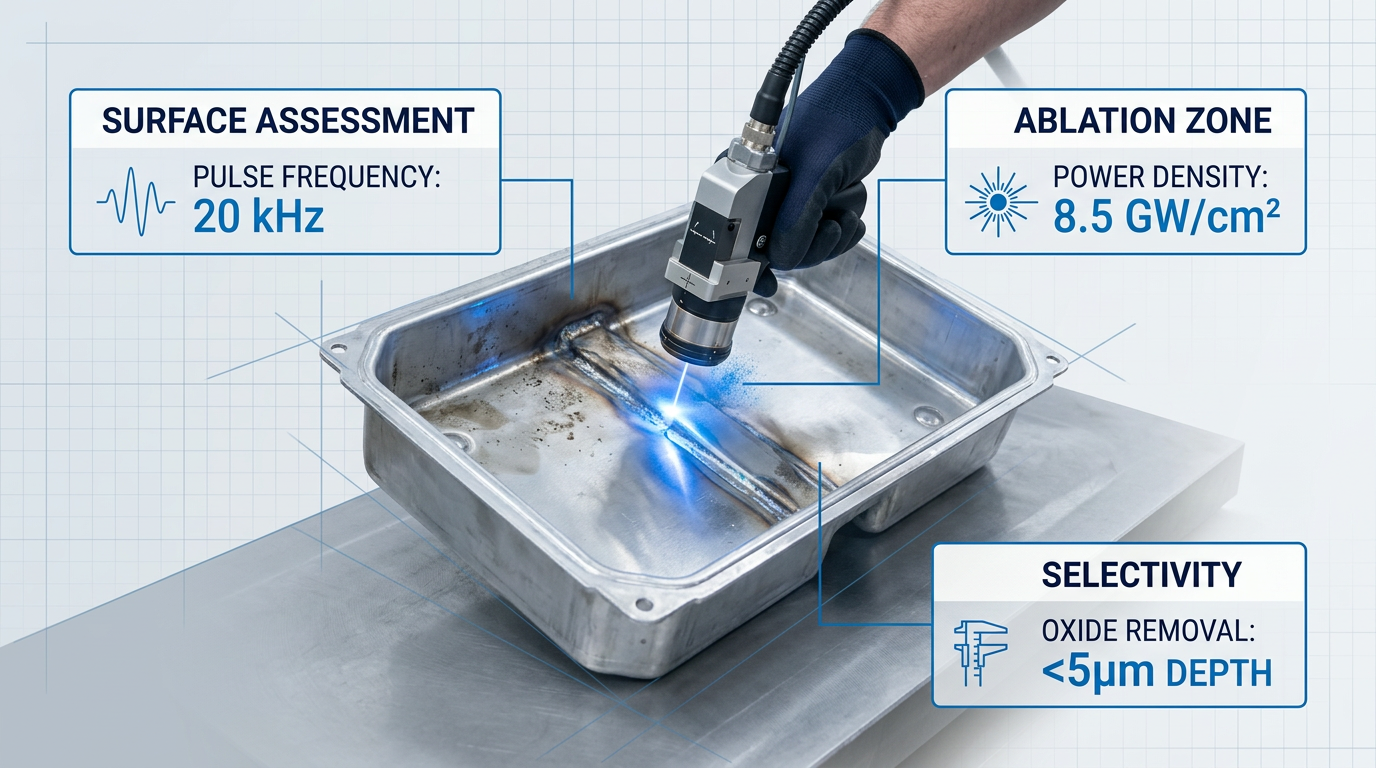
Automotive OEMs use pulsed laser cleaning across several production stages: pre-weld surface preparation (removing oxides, oils, and lubricant residues from joining areas), selective e-coat removal to expose bare metal for electrical contacts and ground connections, and bodyshop rust and paint stripping for repair and refurbishment.
The reason laser cleaning fits automotive production so well is twofold. First, selectivity: the laser removes only the contamination layer from the precise joining area without altering the base metal geometry — a property that directly reduces weld porosity and improves joint integrity, as experimental results show a significant reduction in weld porosity when laser cleaning precedes the welding of aluminium.
Second, automation compatibility: pulsed laser systems integrate into robotic cells and inline production environments without the consumable handling, masking, demasking, and cleaning-media disposal overhead that abrasive or chemical methods require, making throughput and repeatability far easier to maintain at volume.
Battery pack manufacturing for electric vehicles adds a further dimension: cells must be cleaned before adhesive bonding, and cathodic dip coating (CDC) must be selectively stripped from battery tray joining areas — tasks where laser ablation operates without masking, removing the coating layer while leaving adjacent areas and underlying zinc phosphate layers untouched.
Aerospace Surface Preparation and Component Refurbishment
Aerospace components — aluminium alloy structures, composite panels, turbine blades — operate under extreme cyclic stress and fatigue loading, which makes the choice of surface preparation method a structural engineering decision, not merely a cleanliness question.
Abrasive methods present a specific problem in this context: grit particles can become embedded in superalloy surfaces during blasting, and research has demonstrated that embedded abrasive particles in nickel-based superalloys adversely affect thermomechanical fatigue life of protective coatings — a finding that underlines why any method introducing media contamination or residual stress is problematic for flight-critical components.
Pulsed laser cleaning avoids this category of risk through the thermal confinement mechanism: because energy is deposited and dissipated within nanoseconds, heat diffusion into the substrate is negligible, leaving base material microstructure, surface hardness, and dimensional tolerances unchanged.
For bonding and coating preparation on aluminium alloys, the substrate-safety advantage translates directly into measurable performance gains: a peer-reviewed study on 5083 aluminium alloy found that laser cleaning improved corrosion resistance and coating adhesion compared with mechanical grinding, associated with grain refinement and reduced surface roughness — without the dimensional change that grinding introduces.
For composite structures such as carbon fibre reinforced polymer (CFRP), laser surface preparation has been shown to significantly increase surface energy and improve adhesive joint shear strength relative to mechanical and solvent-based treatments, while remaining controllable enough to avoid exposing or damaging the underlying fibres when parameters are correctly set.
Thermal barrier coating removal from turbine blades is a further aerospace application: nanosecond pulsed laser processing can remove the top coating layer efficiently — with the ablation depth controlled by pulse duration, scanning speed, and removal path — without affecting the bond coat beneath, enabling component refurbishment to tight dimensional tolerances.
Injection Moulding and Tooling
Mould tools used in injection moulding accumulate release agents, polymer residues, and build-up in cavity features over production runs — contamination that degrades part quality and eventually requires cleaning.
The conventional alternative — disassembly, chemical cleaning, or abrasive treatment — represents significant downtime and carries a risk of dimensional damage to precision-machined cavity surfaces, particularly fine detail features that define part geometry.
Pulsed laser cleaning can be performed in situ, with the mould in the machine or on the bench, removing contamination from fine cavity features without abrasive contact and without chemical handling: the process is dry, residue-free, and non-contact, preserving the mould surface geometry through thousands of cleaning cycles.
Tyre and Rubber Moulding
Tyre moulds require frequent cleaning to remove vulcanisation residue and release agent build-up — and the cleaning method matters enormously because modern tyre moulds contain fine spring vents, intricate tread patterns, and complex sidewall geometries that determine tyre performance and appearance.
Sand and abrasive blasting processes clog spring vents and wear down fine mould features with each cleaning cycle, progressively degrading mould geometry and reducing tyre quality — a consequence that is directly attributable to the contact and media-embedding mechanisms that abrasive methods cannot avoid.
Because pulsed laser ablation operates through selective energy absorption rather than mechanical contact, it removes vulcanisation residue without touching or deforming the mould surface: profile ridges remain undeformed, vent features remain clear, and the process works equally on hot and cold moulds, eliminating the need to remove the mould from the press for temperature conditioning before cleaning.
Heritage Conservation and Restoration
The conservation community has recognised laser cleaning as a preferred method for delicate and irreplaceable surfaces since the early 1970s, when pioneering work demonstrated that a pulsed laser could remove black encrustations from deteriorating marble sculptures without altering the substrate — an outcome that no abrasive or chemical method could reliably achieve.
The explanation is the same property that makes pulsed laser cleaning substrate-safe in industrial contexts: by operating at fluence levels below the damage threshold of the underlying stone, metal, or masonry while remaining above the ablation threshold of the soiling layer, the laser removes contamination with a selectivity that is simply unavailable to contact-based methods.
Peer-reviewed research has demonstrated that pulsed laser pulses can clean a range of contaminants — biofilm, environmental soiling, rust, and spray paints — from granite, sandstone, marble, and steel, while preserving the integrity of the underlying substrates, with removal confirmed at fluence levels below the measured damage thresholds of each material.
Parameter optimisation is particularly critical in conservation work: the cleaning window — the fluence range between the contamination ablation threshold and the substrate damage threshold — must be established for each material before treatment begins, and the controllable, repeatable nature of pulsed laser energy makes that calibration possible in a way that no manual method can replicate.
Whether the application is automotive weld prep, aerospace bonding, mould cleaning, or heritage stone conservation, pulsed laser cleaning is adopted for the same underlying reason: it removes contamination selectively without transferring damaging energy to the substrate. That single property — thermal confinement enabling selectivity — is what unlocks the technology across contexts as different as a robotic production cell and a 19th-century sandstone monument.
Bronze artefacts, coins, and archaeological bone have all been treated with pulsed laser systems in conservation settings, with researchers identifying specific irradiance thresholds below which cleaning proceeds without substrate damage — a level of precision control that reflects the same fluence-threshold physics that governs industrial applications.
Industrial Maintenance and Remanufacturing
For large fixed infrastructure — pipework, structural steelwork, machinery housings — the logistical constraint is often the opposite of a production line: the asset cannot be brought to the cleaning facility, so the cleaning capability must come to the asset.
Portable pulsed laser cleaning systems address this directly: handheld units with fibre-optic beam delivery can be brought on-site to remove corrosion, coatings, and contamination from plant and equipment in place, without the abrasive media handling, containment, and waste disposal logistics that sandblasting or chemical stripping require in field settings.
In remanufacturing workflows — where worn components are cleaned, inspected, and rebuilt rather than replaced — laser cleaning serves as the first stage of the restoration process: stripping corrosion and coatings from end-of-life steel parts to expose the base material for inspection and subsequent restoration, with the non-contact process leaving the substrate undamaged and dimensionally intact for the rebuild stages that follow.
The six sectors described here are illustrative rather than exhaustive: wherever precision surface preparation is required on a substrate that must not be dimensionally altered, mechanically stressed, or chemically contaminated, the properties of pulsed laser cleaning — selectivity, thermal confinement, no consumables, and compatibility with both manual and automated deployment — make it a rational candidate.
That breadth of deployment context raises a practical question for buyers: how do you specify a pulsed laser cleaning system for your particular application, and what distinguishes an industrial-grade system from a lower-specification alternative?
How to Buy a Pulsed Laser Cleaning Machine
Understanding how a pulsed laser cleaning machine works is only half the job. The other half is knowing which specifications actually matter for your application — and what separates a machine built to perform in demanding industrial conditions from one that looks similar on a datasheet but falls short in practice.
Average Power: Match the Machine to the Job
Average power output is the most fundamental specification to evaluate first, because it governs cleaning throughput — how quickly the system can cover a given surface area to the required cleanliness standard.
Lighter contamination — thin oxides, tarnish, weld discolouration, delicate precision components — suits lower average power levels, where finer control protects the substrate and precision is the priority.
Heavy mill scale, thick paint, large surface areas, and high-throughput production environments demand higher average power to achieve viable cleaning speeds; underpowering the machine for the job means unacceptably slow cycle times.
Duty Cycle and Thermal Management
How long a system can run continuously before it needs to rest is determined by its thermal management approach, and this is a deployment-context question rather than a quality hierarchy.
Air-cooled systems are self-contained and require no external cooling infrastructure — no chiller, no plumbing, no additional footprint. For maintenance cleaning, in-situ work, or applications where the laser runs intermittently, air-cooled is typically the simpler and more practical choice.
Water-cooled systems can sustain higher continuous duty cycles, which becomes relevant when the laser runs for extended periods in high-throughput production. The trade-off is added complexity: a chiller unit, coolant plumbing, and the associated maintenance overhead that comes with them.
Portability vs. Automation: The Core Deployment Decision
The most consequential deployment decision is not which power level to choose — it is whether you need a portable, handheld system or a robotic automated cell. Both use pulsed laser technology to the same effect; the choice is entirely about how and where cleaning happens.
- Portable / Handheld: The operator brings the machine to the work. Suits large structures, field maintenance, heritage sites, in-situ mould cleaning, and any application where the part cannot be moved.
- Automated / Robotic Cell: The part comes to the machine. Suits high-volume, repeatable production cleaning where consistency cycle-to-cycle is essential and manual labour is to be removed from the process.
Neither approach is inherently superior — the right choice depends entirely on your production environment, the mobility of the parts being cleaned, and the volume and repeatability demands of the application.
Tunable Power and Fibre Delivery Reach
Tunable power output — the ability to adjust from 0% to 100% of maximum power — is operationally valuable because it means a single machine can handle the full range of contamination types without swapping equipment.
A facility cleaning light oxides from aluminium components one week and stripping thick coatings from steel tooling the next needs a system that can dial in the right parameters for each job; a fixed-power machine forces compromises at both ends of that range.
The length of the fibre delivery cable is a specification buyers often overlook until it becomes a practical constraint on site. For large fabrications, in-situ mould cleaning where the mould stays in the press, or field maintenance on structures that cannot be moved, a longer cable allows the operator to clean freely without repositioning the power unit.
Cable reach varies across the market and is worth checking explicitly against your largest anticipated cleaning task — a short cable that forces repeated repositioning of a heavy unit adds time and friction to every job.
Industrial-Grade Provenance: Beyond the Spec Sheet
The pulsed laser cleaning market contains a wide range of systems, and the specification sheet alone does not tell the full story. At one end of the market are machines designed, built, and supported in-house by specialist manufacturers with genuine engineering depth, in-house laser expertise, and the capability to provide real post-sale support.
At the other end are imported or rebadged units where the nominal "manufacturer" is effectively a reseller — with limited ability to provide engineering support, source spares quickly, or make meaningful improvements to the product.
For a capital purchase, this distinction matters considerably. The buyer is not just acquiring a machine — they are entering a support relationship that will determine how quickly problems get resolved, how readily spares are available, and whether the system can be adapted as requirements evolve. Manufacturer provenance and in-house engineering capability are meaningful differentiators that do not appear on any spec sheet.
ELASER: A UK-Built Industrial Pulsed Laser Cleaning System
The provenance question raised above is one we can answer directly for our own system. ELASER, made by Woodrow Scientific Limited, is designed, built, serviced, and continuously improved entirely in-house at WSL's UK facility — not sourced from a third-party manufacturer and rebadged.
WSL is the only UK-based laser cleaning manufacturer. Founded in 2012, the company brings over 200 years of combined engineering experience to every machine it produces — and because everything is done in-house, the support relationship that follows a purchase is backed by the same engineering team that built the system.
On pricing, ELASER is the European cost leader among comparable industrial-grade pulsed laser cleaning machines — the most competitively priced in its class, achieved through technological and operational efficiency rather than any compromise on build quality. The full economics of laser cleaning versus alternative methods are covered in the total cost of ownership section that follows.
The ELASER-RHZ variant adds WSL's patented reduced hazard zone technology — a world first. This collapses the laser hazard zone to a fraction of its conventional size, enabling cleaning in open workshops, mixed-use facilities, and public-facing settings where conventional laser cleaning would require the area to be sealed off entirely. The safety implications of this capability are explored in full in the next section.
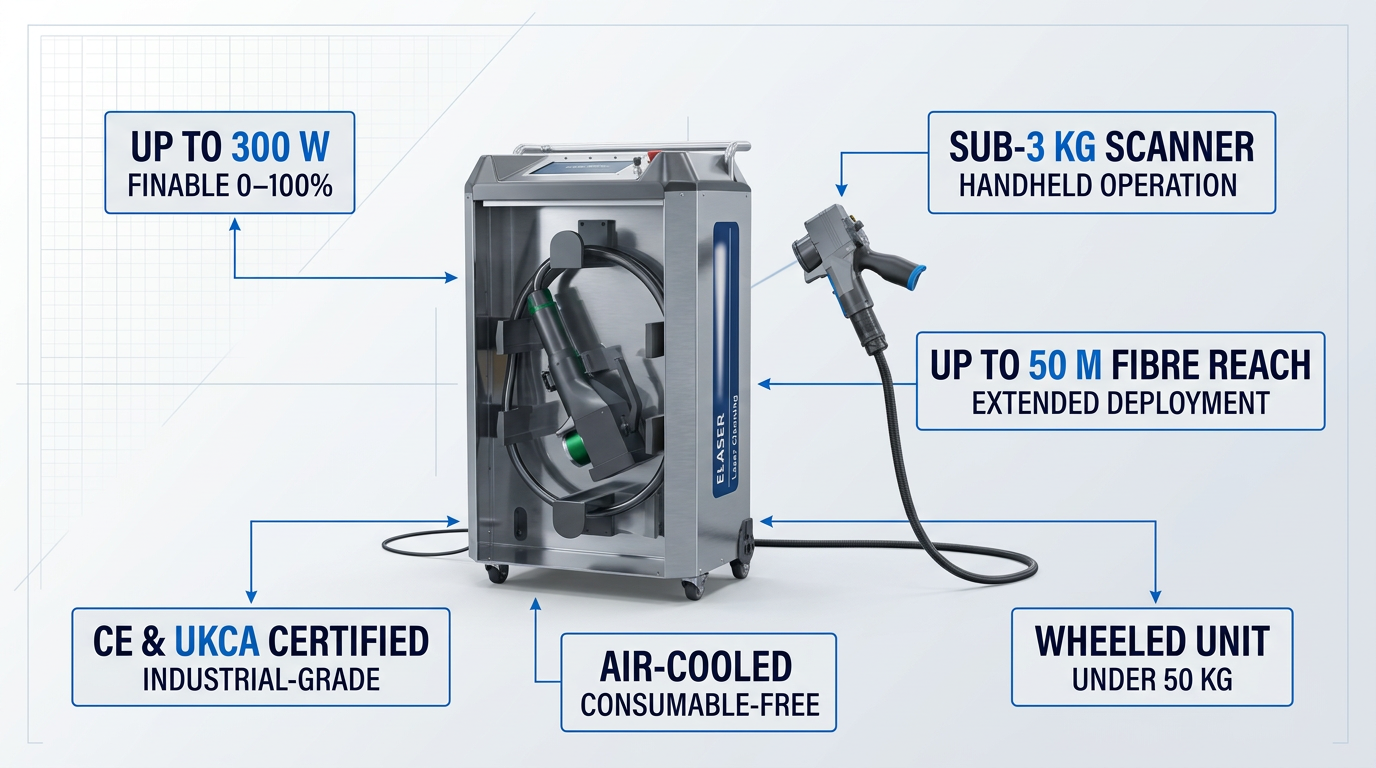
In terms of specification, ELASER is built around an up-to-300 W fibre laser with power tunable across the full 0–100% range, air-cooled and consumable-free operation, a handheld scanner weighing under 3 kg, and a fibre delivery cable available up to 50 m — all in a wheeled system under 50 kg that a single operator can deploy and run.
- Up to 300 W fibre laser: Tunable from 0–100%, covering everything from light surface oxides to heavy coatings on a single machine.
- Air-cooled, consumable-free: No chiller, no plumbing, no consumables — self-contained and ready to deploy wherever power is available.
- Sub-3 kg handheld scanner: Single-operator handheld with up to 50 m fibre delivery reach — operator moves freely, power unit stays put.
- Wheeled system under 50 kg: Portable enough for field deployment; robust enough for sustained industrial use.
- CE and UKCA certified: Fully certified for deployment in UK and European industrial environments.
- Made in Britain: Designed, built and supported in-house by Woodrow Scientific Limited.
WSL also provides first-class safety and operation training, and offers bespoke engineering and customisation capability for applications with specific requirements — prospective buyers are encouraged to get in touch to discuss what their application demands.
For production environments where automation is the right deployment model, WSL's AutoLASE represents the other end of the spectrum. Load a part, and the system's machine vision scans it, builds a 3D map, and generates the clean automatically — no manual programming, no path-setting, no specialist knowledge required. AutoLASE can also be configured with WSL's RHZ technology, making it the only automated laser cleaning system capable of operating without a full enclosure.
A pulsed laser cleaning machine is a capital investment in a support relationship as much as a piece of equipment. Who designed it, who built it, and who answers the phone when something needs resolving are differentiators that matter just as much as the power rating on the datasheet.
Specification and deployment context are only part of the procurement picture. The safety profile of a system — specifically whether it requires a sealed-off controlled area to operate or can run in an open workshop — is an equally important consideration that shapes where and how the machine can be used, and we cover that in full next.
See the Specifications Applied to Real Systems
The buying criteria covered above — average power, pulse parameters, duty cycle — are all visible in the ELASER datasheets. Download the full specifications and see how these principles translate into a production-ready pulsed laser cleaning machine.

Hazard Classes, Operator Requirements, and Safe Deployment
Every industrial pulsed laser cleaning machine you evaluate will carry a laser hazard classification — and for most systems on the market, that classification is Class IV. Understanding what that means in practice is not a compliance formality; it is a procurement variable that directly shapes where and how the system can be deployed.
The Laser Hazard Classification Framework
The IEC 60825-1 standard — adopted in the UK through HSE guidance and internationally through ANSI Z136 — divides lasers into classes based on the biological hazard they present under normal conditions of use.
| Class | Hazard Level | Typical Controls Required | Relevance to Laser Cleaning |
|---|---|---|---|
| Class I | Inherently safe — beam enclosed or too low-power to cause injury under normal use | No special controls needed | Enclosed or very low-power systems; not typical for industrial cleaning |
| Class II | Low-power visible lasers; blink reflex provides protection | Warning labels; avoid staring into beam | Not relevant to industrial cleaning power levels |
| Class III | Moderate hazard; direct viewing dangerous; diffuse reflection generally safe | Restricted access; eye protection for direct exposure | Rarely encountered in cleaning applications |
| Class IV | Highest hazard — direct beam, specular and diffuse reflections can cause immediate eye and skin injury | Laser Controlled Area, restricted access, rated eye protection, trained operators | The classification of virtually all industrial laser cleaning systems |
Overview of laser hazard classes from Class I to Class IV, showing hazard level, typical controls required, and relevance to laser cleaning buyers.
The jump from Class III to Class IV is significant: at this level, even diffuse reflections at close range carry enough energy to cause immediate injury, which is why the controls required are substantively more demanding than any lower class.
What Class IV Operation Requires in Practice
Operating a conventional Class IV laser cleaning system is not simply a matter of switching the machine on and pointing it at a surface — it requires a defined set of controls before work can begin.
- Laser Controlled Area: A designated zone must be established and marked before operation, with physical barriers or interlocked access to prevent unauthorised entry.
- Restricted access: Non-essential personnel must be excluded from the controlled area for the duration of cleaning — often requiring evacuation of surrounding workspace.
- Laser-rated eye protection: Anyone within the hazard zone must wear optical density (OD)-rated eyewear matched to the operating wavelength of the specific system.
- Trained, competent operators: HSE guidance and ANSI Z136 both require that laser systems are operated only by trained personnel who understand the hazards and controls.
In a controlled factory environment with a dedicated cleaning bay, this overhead is manageable. In an open workshop, on a heritage site, or in a publicly accessible space, it becomes a genuine operational barrier — adding setup time, disrupting surrounding workflows, and in some environments making deployment effectively impractical.
The Nominal Hazard Zone: Why Large Areas Get Sealed Off
The technical concept underlying the access-control requirement is the Nominal Hazard Zone (NHZ): the volume of space within which the level of direct, reflected, or scattered laser radiation exceeds the Maximum Permissible Exposure (MPE) for the eye or skin.
For a conventional Class IV laser cleaning system, the NHZ extends well beyond the cleaning head — potentially tens of metres, depending on output power, wavelength, and optical configuration. That is the spatial footprint that must be controlled before cleaning can begin, and in many real-world environments, sealing off that area simply is not feasible.
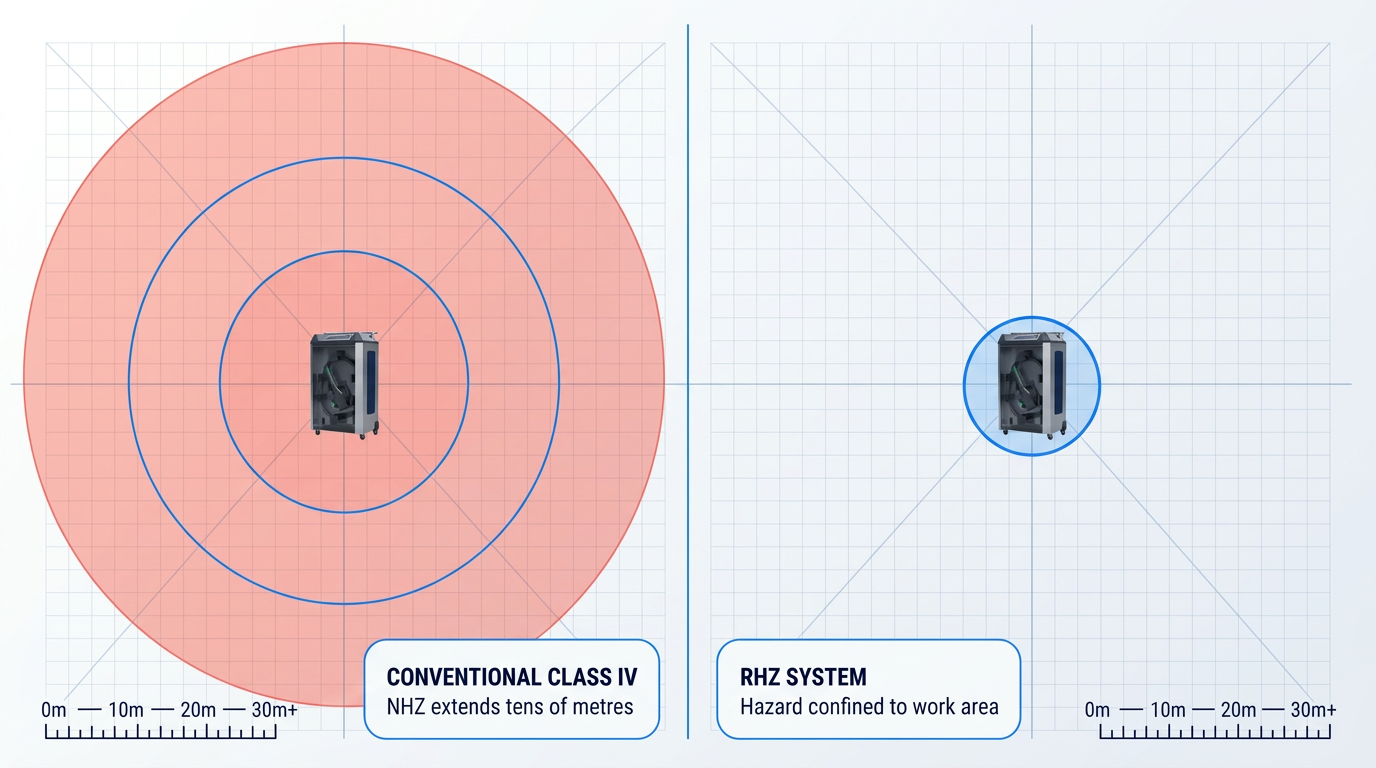
This is the specific mechanism that makes conventional Class IV laser cleaning burdensome in open, mixed-use, or publicly accessible environments — not the laser itself, but the spatial footprint of the hazard it creates.
Reduced Hazard Zone Technology: A Deployment Enabler
Reduced hazard zone (RHZ) technology is the engineering response to the NHZ problem. Rather than managing a large hazard zone through area controls, RHZ technology collapses the NHZ to a small area immediately around the work surface — so the hazard is confined, not merely managed.
The practical implication is significant: cleaning can proceed in open workshops, mixed-use manufacturing facilities, and publicly accessible spaces without sealing off the surrounding area or evacuating nearby workers. This is not simply a safety improvement — it is a deployment enabler that materially expands where laser cleaning is viable.
WSL's ELASER-RHZ is the world's first and only laser cleaning system of this kind. WSL's patented technology achieves this by operating at 1550 nm — a retina-safe wavelength that is a core enabler of the system's eye-safe classification — collapsing the laser hazard zone to a fraction of the size produced by conventional cleaning lasers.
The result is a system that can clean in open workshops, mixed-use facilities, and public-facing environments — graffiti removal on a high street, heritage restoration at a publicly accessible monument — without the area-sealing overhead that makes conventional Class IV systems impractical in those settings.
For open workshops, heritage sites, and public-facing spaces, the obstacle has never been the cleaning capability — it has been the safety overhead of conventional Class IV operation. RHZ technology removes that barrier entirely, making laser cleaning viable in environments where it was previously impossible.
The company behind this capability matters as much as the technology itself. WSL is the only UK-based laser cleaning manufacturer — designing, building, servicing, and improving its machines entirely in-house since 2012. A meaningful share of the laser cleaning market consists of companies reselling or rebadging imported hardware, which limits their ability to develop proprietary technology, provide genuine engineering support, or improve their products over time. WSL's in-house manufacturing capability is precisely what makes patented, world-first technology like RHZ possible.
The ELASER-RHZ is also CE and UKCA certified, meeting the standard compliance requirements buyers in the UK and European markets will expect.
Reduced hazard zone technology narrows the area at risk — it does not remove the need for competent, trained operators. WSL provides first-class laser cleaning safety and operation training as part of its in-house support capability, ensuring operators are fully equipped to work safely and effectively with the system.
For buyers operating in open workshops, heritage sites, public-facing environments, or mixed-use facilities, RHZ capability is not a marginal differentiator — it determines whether laser cleaning is operationally viable at all. With the full safety and deployment picture now clear, the remaining procurement question is the economics, which the next section addresses through a total cost of ownership analysis.
Total Cost of Ownership: The Long-View Economics
The procurement conversation around a pulsed laser cleaning machine almost always stalls at the same point: the purchase price. But evaluating capital equipment on capital outlay alone is an incomplete analysis — the same mistake as comparing a CNC machining centre to a manual lathe purely on what each costs to buy.
Every cleaning method carries running costs that compound across its operating life: consumables, waste disposal, labour, downtime, and rework remediation. The relevant figure for any serious procurement decision is total cost of ownership (TCO) — the sum of capital investment plus all operating costs over the equipment's working life. On that metric, the comparison looks fundamentally different.
Where the Numbers Diverge: Consumable Costs
Consumables are where the contrast between laser cleaning and alternative methods is sharpest. A pulsed laser cleaning system's consumable footprint is almost negligible: electricity, and occasional replacement of the protective lens on the cleaning head — typically $50–$200 per lens, with a well-maintained industrial unit consuming perhaps two or three per year.
A 500W fiber laser system operating for 1,000 hours per year will typically spend $80–$120 on lens replacements and $200–$300 on electricity — a total annual consumable cost in the $280–$420 range.
Compare that to the continuous consumable drain of alternative methods. Abrasive blasting media (garnet, aluminium oxide, steel grit) runs $0.10–$0.50 per pound, and a working blaster burns through 50–200 lbs per hour depending on nozzle size and working pressure — translating to $10–$50 per hour on media alone, before compressor energy and nozzle wear are counted. Dry ice blasting at a moderate industrial pace of around 100 lbs per hour consumes CO₂ pellets at $1.50–$3.00 per pound, which at 1,000 annual operating hours produces a five-year consumable cost of $150,000–$300,000. Chemical stripping carries its own recurring chemical purchase, with organic paint strippers running $0.75–$1.00 per square foot of surface treated.
Across a five-year operating window at moderate utilisation, sandblasting consumables, media disposal, and PPE typically accumulate to $30,000–$80,000; laser operating costs over the same period generally stay below $8,000–$15,000.
The Hidden Cost: Waste Disposal and Compliance
The waste disposal cost category is rarely visible at the point of procurement — but it is consistently significant in operation, and it compounds every year the equipment runs.
Laser cleaning produces 0.5–5 lbs of dry particulate per shift, captured at source by the integrated extraction system. In most jurisdictions, where the coating being removed is non-hazardous, this material is manageable as standard industrial waste — no settling tanks, no wastewater discharge permits, no media recycling logistics.
Sandblasting generates hundreds of pounds of spent abrasive media per shift, contaminated with whatever was stripped from the substrate — rust, paint, heavy metal residues. When that spent media carries lead paint or heavy metal contamination, it is classified as hazardous waste, with disposal costs ranging from $0.15–$0.50 per kg in most jurisdictions. The regulatory compliance overhead — manifests, storage limits, inspection requirements, and cradle-to-grave liability under waste regulations — adds further indirect cost that rarely appears in a per-square-metre estimate but absolutely affects annual operating cost.
Chemical stripping generates regulated liquid waste: spent solvents and contaminated rinse water subject to hazardous waste disposal contracts. Spent solvent disposal runs $0.30–$1.20 per litre depending on classification and region, with hazardous waste drum pickups costing around $400 per drum. The fully loaded cost of solvent disposal — including transport, treatment facility charges, compliance administration, and cradle-to-grave liability — commonly runs two to three times the headline disposal rate.
Rework, Downtime, and the Cost Multiplier Effect
As established in the earlier discussion of the ablation mechanism, a pulsed laser cleaning system stops at the base material — the beam does not remove substrate. That substrate safety has a direct economic consequence: rework rates are substantially lower than with abrasive or chemical methods.
Abrasive blasting can roughen surfaces beyond specification, cause dimensional loss on precision components, or induce microcracking on sensitive alloys. Chemical stripping can etch surfaces or leave contamination residues. Either outcome requires remediation before coating, bonding, or joining — consuming machine time, operator time, and potentially materials on every affected part.
These rework events function as a cost multiplier across a production run: each one adds labour, consumes machine capacity that could be used productively, and may require additional inspection steps. Laser cleaning's non-contact, substrate-selective process largely eliminates this failure mode.
Labour: A Real but Operation-Dependent Factor
Laser cleaning typically requires a single operator. Sandblasting and chemical stripping often require additional personnel for containment setup, media handling, and cleanup; dry ice blasting similarly demands two-person operation in most industrial configurations.
At industrial loaded labour rates of $35–$65 per hour, the difference between one and two operators across 1,000 annual hours represents $35,000–$65,000 per year — a figure that accumulates to $175,000–$325,000 over five years before any other cost category is considered.
This is not a universal advantage — operations that already run sandblasting with a single operator in a simple setup will see a smaller labour delta. But for facilities currently running dedicated blasting booths with prep and cleanup crews, the labour reduction is a meaningful line item in the TCO calculation.
Putting It Together: Cost Per Hour and Payback
When the cost categories are aggregated into a cost-per-productive-hour framework, the divergence is stark. A laser cleaning system running at $25/hr labour (one operator), near-zero consumables, and $2.22/hr for maintenance and energy comes to approximately $27/hr all-in. A comparable sandblasting operation — two operators at $50/hr combined, $15/hr in media, $5/hr waste disposal, $3.50/hr maintenance — runs approximately $73/hr.
That per-hour saving is the engine of the payback period calculation: the faster the machine runs, the faster those savings accumulate against the capital investment.
| Method | 5-Year Consumables | 5-Year Labour (est.) | 5-Year Waste Disposal | 5-Year Operating Total (est.) |
|---|---|---|---|---|
| Laser cleaning | $750–$3,000 | $30,000–$60,000 | $1,000–$3,000 | $34,000–$71,000 |
| Abrasive blasting | $35,000–$90,000 | $80,000–$150,000 | $20,000–$60,000 | $158,000–$365,000 |
| Chemical stripping | $5,000–$30,000 | $50,000–$90,000 | $10,000–$50,000 | $81,000–$222,000 |
| Dry ice blasting | $150,000–$300,000 | $175,000–$325,000 (2-operator differential) | $2,500–$25,000 | $340,000–$675,000 |
Five-year total cost comparison across cleaning methods at moderate industrial utilisation, illustrating how laser cleaning's low ongoing costs overcome its capital position over time.
The table makes the structural pattern clear: laser cleaning carries the lowest five-year operating total across every cost category, by a margin that widens significantly against dry ice blasting and abrasive methods. Chemical stripping sits closer, but its waste disposal and regulatory compliance overhead — costs that grow with volume and tighten with regulatory change — erode that position over time.
The critical variable is utilisation rate. A machine running 400–1,000+ hours per year accumulates those per-hour savings fast; one used intermittently may not reach break-even within a standard equipment lifecycle. For facilities cleaning above roughly 500 m² per month consistently, payback periods of 12–36 months are well-supported across multiple independent analyses — the lower end of that range when displacing chemical processes with high disposal costs, the higher end when coming from lower-cost blasting setups.
A sandblasting rig that looks inexpensive to buy can accumulate $158,000–$365,000 in five-year operating costs. A laser cleaning system with higher capital investment typically runs $34,000–$71,000 over the same period. The 'cheaper' option frequently isn't, once running costs are counted.
Lower-utilisation operations — below roughly 200–300 hours per year — may not reach break-even within a standard equipment lifecycle, and for those cases rental or contract cleaning arrangements often make more economic sense than outright capital purchase.
The Right Mental Model: Capital Equipment Economics
A capital investment in a pulsed laser cleaning machine is evaluated on the same basis as any other production asset: throughput, running cost, maintenance requirement, and asset life. Buyers do not evaluate a CNC machining centre, a press, or a welding cell on purchase price alone — they model the full operating cost over the equipment's working life.
Laser cleaning systems are rated for 80,000–100,000 source hours of operating life. Spread the capital cost across that lifespan, set it against the per-hour savings on consumables, disposal, and labour, and the economics of moderate-to-high utilisation operations become straightforward.
With both the technical picture and the economic framework now in place, the final step is synthesising everything into a clear evaluation of how a pulsed laser cleaning system fits your specific application, workload, and operation.
Conclusion
Ready to Evaluate a Pulsed Laser Cleaning System?
The core insight this guide builds towards is that pulsed laser cleaning is selective by physics, not by marketing — the beam stops at the base material because the thermodynamics require it.
That precision is what makes the economics work over time: no consumables, no waste streams, no rework from surface damage.
Advances in deployment technology are steadily removing the last practical barrier — the hazard zone overhead that once confined laser cleaning to controlled enclosures.
You now have the framework to assess a specific system against your application and environment — speaking with a specialist or arranging a demonstration is the logical next step.
Frequently Asked Questions About Pulsed Laser Cleaning Machines
Practical answers to the questions buyers most commonly carry after researching pulsed laser cleaning technology.
Power selection should match your contamination type and the surface area you need to cover. Lighter contamination — thin oxides, light tarnish, weld discolouration — and precision or sensitive substrates suit lower average power settings. Heavier coatings such as thick paint, mill scale, and deep rust, or large surface areas requiring acceptable throughput, need higher average power. The operationally valuable characteristic of a well-specified system is tunable power output: the ability to dial between 0 and 100% means one machine can span both ends of that range without swapping equipment. That said, no generalisation replaces a real-world trial. Application testing on your actual substrate-contaminant combination is the definitive way to establish the correct settings for your specific case.
Yes, substrate damage is possible — but it is avoidable with correct parameter settings. When fluence is set above the ablation threshold of the contaminant but below the damage threshold of the substrate, the beam effectively stops at the base material. The physics behind this is thermal confinement: each pulse is short enough that the contaminant vaporises before significant heat transfers into the substrate beneath. Substrate damage occurs when fluence exceeds the substrate's own damage threshold, which is why parameter optimisation and competent operator training matter. For well-characterised substrate-contaminant pairs, industrial pulsed laser cleaning is routinely used on precision components and sensitive surfaces — including heritage artefacts and aerospace parts — without measurable substrate loss. The process is parameter-dependent, not inherently destructive.
Conventional Class IV laser cleaning systems require a controlled area with restricted access during operation — making open-workshop deployment impractical under standard conditions. The nominal hazard zone for a Class IV system can extend a significant distance from the work surface, requiring the area to be sealed off before cleaning begins. Reduced Hazard Zone (RHZ) technology changes this entirely. WSL's patented RHZ system, as found in the ELASER-RHZ, collapses the laser hazard zone to a small area around the work surface — the only technology of its kind in the world. This enables cleaning in open-plan manufacturing facilities, mixed-use spaces, and publicly accessible environments without sealing off the area or halting surrounding operations. Operator training remains important regardless: RHZ reduces the area at risk, not the need for competent operation. WSL provides full safety and operation training with every system.
The key difference is selectivity. Laser cleaning removes the rust or oxide layer while leaving the base metal intact, with no abrasive media, no dust cloud, and near-zero consumable cost. Sandblasting is generally faster on large, flat surfaces, but it generates spent abrasive media requiring disposal, produces significant airborne dust requiring containment, and carries a risk of surface damage — peening and roughening — that can require additional remediation before coating or joining. The more useful comparison is total cost of ownership. Laser cleaning's consumable-free operation, reduced cleanup overhead, and lower rework rate typically produce a stronger long-run economics case for moderate-to-high utilisation operations. The capital investment is evaluated against those ongoing savings, not against sandblasting's lower equipment entry point.
No. Pulsed laser cleaning uses only laser energy to remove contamination — there are no abrasive media, chemicals, or water involved. The primary running cost is electricity. Protective lens windows are included and replaceable; occasional lens replacement is the closest thing to a consumable cost, but it is minimal compared to the ongoing media, chemical, and disposal costs of abrasive or chemical cleaning methods. Air-cooled systems such as the ELASER require no water supply or chiller circuit. This near-zero consumable profile is one of the core drivers of laser cleaning's total cost of ownership advantage over alternative methods.
A pulsed laser delivers energy in discrete, high-peak-power bursts separated by gaps of silence. A continuous wave (CW) laser emits a constant, uninterrupted beam where average power and peak power are the same value. The practical consequence is significant: for the same average power, a pulsed system delivers far higher instantaneous peak power per pulse. That peak power drives selective ablation — the contaminant vaporises within the pulse duration before heat has time to spread into the substrate, a property called thermal confinement. CW systems deposit energy continuously, so heat accumulates more readily in the substrate. They are typically used at higher average powers for high-throughput cleaning of robust substrates where some thermal load is acceptable. Pulsed systems are the better choice where substrate sensitivity, thin contamination layers, or high selectivity between contaminant and base material are the priority.
Payback periods for laser cleaning machines typically fall in the range of 12 to 36 months, depending on utilisation rate, the cost of the cleaning method being displaced, labour savings, and consumable elimination. Higher utilisation accelerates payback considerably — a system running in production shifts reaches break-even significantly faster than one used only for occasional maintenance. The key variables are: consumable savings versus the current method (abrasive media, chemicals, disposal); labour savings, since laser cleaning typically requires one operator compared to additional personnel for containment and cleanup in abrasive or chemical methods; and rework reduction, as fewer substrate damage incidents mean fewer remediation steps before coating or joining. The capital investment is best evaluated on total cost of ownership across the machine's operational life, where the economics of consumable-free, low-downtime operation compound over time.
Yes. A well-specified pulsed laser cleaning machine can handle a wide range of contamination types and substrate materials without changing machines. The key enabler is tunable power output: a system with 0–100% power adjustment can span light oxides and tarnish at the low end through thick paint, mill scale, and heavy rust at the high end. Material compatibility is broad — metals including steel, aluminium, cast iron, copper, titanium, and galvanised; plus stone, masonry, concrete, and brick — meaning a single system can serve multiple cleaning tasks across a facility. The important caveat is that parameter optimisation for each substrate-contaminant pair matters. The machine is versatile, but competent setup and operator training are required to realise that versatility safely and effectively. For unusual or high-value combinations, application testing before procurement is advisable.