

Introduction
A pulsed laser cleaner uses high-intensity laser bursts to ablate rust, paint, coatings, oil, and other contaminants from a surface — leaving the substrate beneath intact.
Unlike continuous-wave systems, pulsed machines fire in concentrated nanosecond bursts — a distinction that matters considerably for substrate sensitivity and application fit, covered in full in the next section.
This list is written for maintenance engineers, production managers, and procurement leads evaluating their options before shortlisting.
Every entry is assessed against the same five criteria — power range, applications, portability, cooling method, and pricing — with the publisher's own solutions listed first because they genuinely fit those criteria.
A pulsed vs continuous-wave comparison, five verified entries, and a practical buying guide follow below.
TL;DR
The machines on this list perform the same fundamental task, but the right choice depends on whether you need to move between sites, integrate into a production line, or work in an open facility. Total cost of ownership, not sticker price, is the lens that separates a well-matched purchase from an expensive mistake.
This article covers:

A pulsed vs continuous-wave comparison to confirm technology fit
Five verified machines assessed against the same five criteria
Portable and handheld options as a distinct category
Safety and deployment environment considerations
A buying guide on which specifications to prioritise
Pulsed vs continuous wave laser cleaning: which do you need?
Before spending time evaluating specific machines, it is worth settling one practical question: does your application actually call for a pulsed laser cleaner, or would a continuous wave (CW) system serve you better? The answer shapes every other decision — power rating, form factor, cooling method — so it belongs at the top.
The operational difference comes down to how energy reaches the surface. A pulsed laser delivers energy in concentrated nanosecond pulses, each burst ablating the contaminant layer before meaningful heat can transfer into the substrate. A CW laser delivers energy in an unbroken stream: faster across large areas, but with a sustained thermal load that the substrate must absorb.
What matters to a buyer is not the waveform — it is what happens to the material underneath. With pulsed, the ablation mechanism is largely self-limiting: once the contaminant is gone, the beam encounters the more reflective base material and stops removing. With CW, the substrate continues to absorb energy, creating a heat-affected zone (HAZ) if scanning speed and power are not tightly controlled.
| Axis | Pulsed (MOPA fibre) | Continuous Wave (CW) |
|---|---|---|
| Energy delivery | Concentrated nanosecond bursts; high peak power, low average power | Unbroken stream; lower peak power, higher sustained thermal load |
| Substrate heat risk | Minimal — ablation stops at base material; substrate damage avoidable under normal parameters | Higher — HAZ forms if scanning speed is not precisely controlled |
| Cleaning efficiency on aluminium alloy dust (equivalent average power) | 2.77 m²/h — 7.7× faster than CW at the same output power | 0.36 m²/h |
| Cleaning efficiency on carbon steel dust (equivalent average power) | 1.06 m²/h — 3.5× faster than CW at the same output power | 0.30 m²/h |
| Surface roughness after cleaning | At or below original substrate level — pulsed can remove surface dust, leaving a cleaner baseline | Approximately 1.5× rougher than the original surface |
| Best-fit applications | Mould cleaning, weld prep, aerospace components, automotive surface prep, heritage restoration, injection tooling | Large-area paint stripping on steel structures, pipeline decontamination, heavy industrial surface decontamination |
Side-by-side comparison of pulsed and CW laser cleaning across five decision-relevant axes, anchored by published efficiency and surface roughness figures from Laser Focus World.
The table makes two trade-offs explicit. CW systems cost less upfront and compensate for their lower per-watt efficiency by running at higher average power — a reasonable approach when the substrate is robust, the area is large, and throughput is the only axis. For every other scenario, the data favours pulsed: faster cleaning at equivalent power, lower thermal risk, and a post-clean surface that meets inspection requirements.
The surface roughness finding deserves particular attention for buyers in precision engineering, bonding prep, or aerospace. A post-clean surface that is 1.5× rougher than the original can fail adhesive bonding specifications or trigger re-work — costs that dwarf any saving on the laser system itself. Pulsed cleaning, by contrast, typically leaves substrate integrity intact or marginally improved.
At equivalent average output power, a MOPA pulsed fibre laser cleans aluminium alloy dust at 7.7× the rate of a CW laser, and carbon steel dust at 3.5× the rate. The assumption that pulsed means slower is wrong: for dust and oxide removal on common industrial substrates, pulsed is the more efficient technology per watt delivered.
Matching technology to application is straightforward once the axes are clear. Pulsed laser cleaning is the correct choice when the application involves any of the following: varied or heat-sensitive substrates, surfaces where rework is costly, precision requirements such as mould cleaning or weld prep, or post-clean surface condition that will be inspected or specified.
CW is a legitimate option for large-area throughput tasks on robust substrates — heavy steel structures, pipelines, bulk decontamination — where speed is the dominant axis and the substrate can tolerate thermal input. That is a narrower set of applications than it might appear, and it is not what this page covers.
With the technology question settled, the five entries below evaluate the best pulsed laser cleaners available today, assessed across power rating, application fit, portability, cooling method, and price — the same criteria applied consistently to every machine.
Product 1
Woodrow Scientific ELASER / ELASER-RHZ
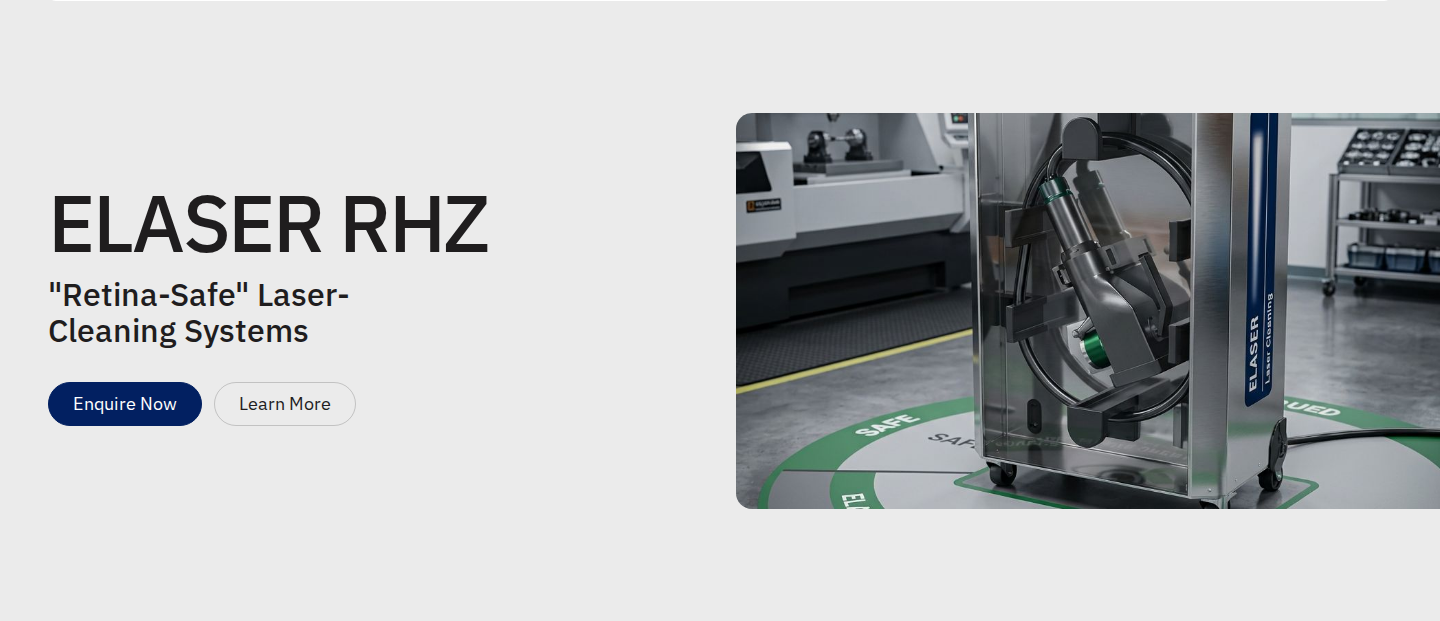
The ELASER-RHZ is the only pulsed laser cleaner in the world with a reduced hazard zone — a patented capability that enables cleaning in open workshops, mixed-use facilities, and public-facing environments without sealing off the area or evacuating personnel. Up to 300 W, air-cooled, and deployable by a single operator with a sub-3 kg handheld scanner and up to 50 m of delivery cable reach, it is the strongest choice for on-site, multi-site, and open-facility cleaning where portability and reduced safety overhead are the deciding factors.
The ELASER and ELASER-RHZ are built for single-operator deployment across varied sites and environments — from industrial maintenance and heritage restoration to graffiti removal in publicly accessible spaces. If portability, minimal site setup, and the ability to clean in open or mixed-use facilities are the priorities, this is the machine to evaluate first.
The headline differentiator here is the ELASER-RHZ's reduced hazard zone — a patented, world-first capability that no other pulsed laser cleaner on this list offers. Conventional laser cleaning requires the working area to be sealed off and personnel evacuated before operation can begin; the ELASER-RHZ collapses the hazard zone to a small area immediately around the work, removing that requirement entirely.
In practical terms, this unlocks applications where laser cleaning has historically been impractical: open-plan manufacturing floors, shared workshops, graffiti removal on public infrastructure, and conservation work at heritage sites with visitor access. It is not a minor safety upgrade — it is the difference between laser cleaning being deployable in a given environment or not.
ELASER Key Specifications
| Specification | Value |
|---|---|
| Max power | Up to 300 W (fibre laser) |
| Power tunability | 0–100% |
| Pulse energy | Up to 15 mJ |
| Pulse duration | 100 ns |
| Wavelength | 1550 nm (retina-safe / RHZ) |
| Handheld scanner weight | Under 3 kg |
| System weight | Under 50 kg (wheeled) |
| Delivery cable | Up to 50 m (5 m / 15 m standard) |
| Cooling | Air-cooled (no water or chiller required) |
| Power supply | 110–250 VAC single-phase |
| Laser class | Class IV / Class I (RHZ) |
| Certifications | CE and UKCA |
| Manufacture | Made in Britain |
Gives technically literate buyers a scannable reference for the ELASER's core specs across the five evaluation axes — power, weight, reach, cooling, and compliance.
At up to 300 W with fully tunable power from 0–100%, one machine handles the full range from light oxide removal through to stripping thick coatings — without swapping heads or reconfiguring the system.
ELASER Applications
The ELASER's application range is genuinely broad, covering both the contaminants it removes and the substrates and industries it serves.
- Contaminants and coatings: Rust, oxides, mill scale, paint, powder coating, lacquer, primer, oil and grease, carbon and soot, graffiti, adhesives and residues, weld discolouration, release agents, and mould.
- Substrates: Steel, carbon steel, aluminium alloys, cast iron, copper, brass, bronze, titanium, galvanised metal, stone, concrete, brick, and masonry.
- Key industries: Automotive, aerospace, injection moulding and tooling, tyre and rubber, industrial maintenance, and heritage and restoration.
The heritage and restoration application is worth highlighting specifically: the ELASER-RHZ's reduced hazard zone makes it viable for monument and stonework cleaning at publicly accessible sites, where conventional laser cleaning cannot operate without clearing the area.
Portability and Form Factor
The system ships as a wheeled unit under 50 kg, paired with a handheld scanner weighing under 3 kg — deployable by a single operator with no compressor, water supply, or consumables required on site.
The 50 m delivery cable is a specific operational advantage worth noting: it means the wheeled unit can stay in one position while the operator covers a large structure, works at height, or moves through multiple access points — without repositioning the machine each time. For large vessels, bridges, industrial plant, or multi-bay facilities, this reach has real practical value.
Manufacturing Provenance and Support
Woodrow Scientific Limited is the only UK-based laser cleaning manufacturer — it designs, builds, services, and improves its machines entirely in-house, drawing on over 200 years of combined engineering experience. This matters in a market where a significant number of suppliers are resellers or importers rebadging third-party hardware: in-house manufacture means genuine engineering capability, faster support, and the ability to actually improve the product over time rather than wait on an OEM.
CE and UKCA certified, with first-class operator training available and bespoke engineering capability for customers with specific requirements — contact WSL directly to discuss customisation options.
ELASER Pricing
Pricing is quote-based; contact Woodrow Scientific for a figure. The ELASER is competitively priced among comparable industrial laser cleaning machines in Europe — a position achieved through WSL's own manufacturing efficiencies rather than specification compromises.
When evaluating against traditional cleaning methods such as sandblasting or chemical stripping, the relevant comparison is total cost of ownership: zero consumables, reduced downtime from faster setup and teardown, and less rework resulting from the laser's minimal substrate damage all contribute to a stronger TCO over the machine's working life.
Laser Cleaning Without Sealing Off the Area
The ELASER-RHZ is the only eye-safe pulsed laser cleaner with a reduced hazard zone — built for open workshops and mixed-use facilities. See the full specifications on the product page.
Product 2
Woodrow Scientific AutoLASE
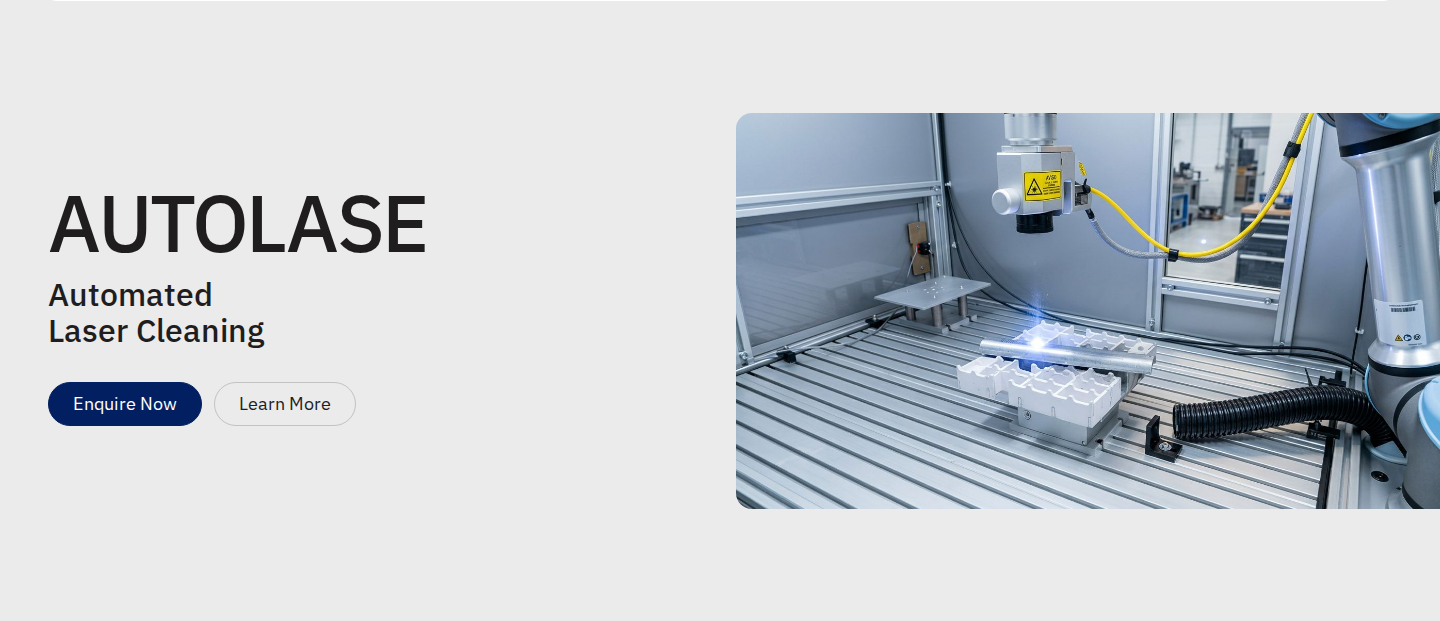
An automated pulsed laser cleaning system built for production environments: load the part, and machine-vision software handles the rest — scanning, mapping, and cleaning without programming or operator skill requirements.
AutoLASE is the right choice when work is repetitive and parts come to the machine — injection moulds, automotive components, aerospace parts, tyre and rubber moulds, and remanufacturing batches. If the machine needs to go to the work, the ELASER is the better fit. AutoLASE is the only automated pulsed laser cleaning system on this list.
What sets AutoLASE apart from other automated laser cleaning systems is not that it automates cleaning — it is how effortlessly it runs. Load a part, and machine-vision software scans it, builds a 3D map, and generates the cleaning path automatically.
No manual programming, no path-setting, no knowledge of part geometry required. Anyone on the production floor can load a part and run a cycle.
The second standout capability is the optional RHZ upgrade. As covered in the ELASER entry, WSL's Reduced Hazard Zone technology is exclusive to Woodrow Scientific worldwide. Configured on AutoLASE, it removes the enclosure requirement entirely — the only automated laser cleaning system in the world that can operate without one.
AutoLASE Applications
AutoLASE is suited to any repetitive cleaning task where a consistent, hands-off result is the goal.
- Injection moulds and tooling: Strips release agents, residue, and build-up from mould cavities, cores, and inserts — restoring fine detail without disassembly or abrasive wear.
- Automotive components: Engine, driveline, and EV battery parts cleaned or surface-prepped for welding and bonding, part after part, to a consistent standard.
- Aerospace parts: Turbine blades, vanes, and engine components cleaned to tight tolerances with the same result on every cycle.
- Tyre and rubber moulds: Removes vulcanisation residue and build-up from mould segments and vents — no abrasives, no mould wear.
- Remanufacturing and refurbishment batches: Strips corrosion, coatings, and contamination from worn components before rebuild, consistently and ready for inspection.
If a component fits the cell, it can be cleaned automatically. The application list above covers representative use cases — WSL's engineering team can advise on suitability for specific parts.
AutoLASE Specs
AutoLASE runs on the same 300 W fibre laser platform as the ELASER — the specs below will be familiar to readers who have just reviewed that entry.
| Specification | AutoLASE |
|---|---|
| Max power | Up to 300 W |
| Power tunability | 0–100% |
| Pulse energy | Up to 15 mJ |
| Pulse duration | 100 ns |
| Wavelength | 1550 nm |
| Delivery cable | Up to 50 m |
| Cooling | Air-cooled |
| Certifications | CE & UKCA |
Gives technically literate readers a fast reference for the key specifications, mirroring the format used in the ELASER entry for direct comparison.
Power tunable across the full 0–100% range, AutoLASE handles everything from light oxides through thick coatings and paint within a single production cell.
Form Factor and Robotic Integration
The laser cleaning head mounts on an articulated robotic arm with multi-axis reach, giving it access to the angles and contours of complex 3D parts that fixed-head systems cannot address.
AutoLASE attaches to the customer's own collaborative or industrial robots, or WSL can supply it as a complete custom cell. Bespoke integration and customisation are available — prospects with specific integration requirements should contact WSL directly.
The delivery cable extends up to 50 m, and the system is air-cooled: no water supply, chiller, or coolant circuit is needed, which simplifies production-cell installation considerably.
AutoLASE Pricing
AutoLASE is priced competitively among comparable automated laser cleaning systems. Contact Woodrow Scientific for a quote.
For high-volume production environments, the TCO case is strong: automated operation removes repetitive manual labour, zero consumables keep running costs low, and consistent cleaning quality reduces rework — the savings compound over a production lifetime.
Manufacturer: Woodrow Scientific Limited
As with the ELASER, AutoLASE is designed, built, supported, and improved entirely in-house by WSL — the only UK-based laser cleaning manufacturer. It is worth noting that a significant number of laser cleaning "manufacturers" in the market are resellers or importers rebadging third-party machines, with limited ability to provide genuine engineering support or product improvements.
WSL holds CE and UKCA certification across its product range, and first-class operator training is available for AutoLASE installations.
Product 3
cleanLASER CL-Series
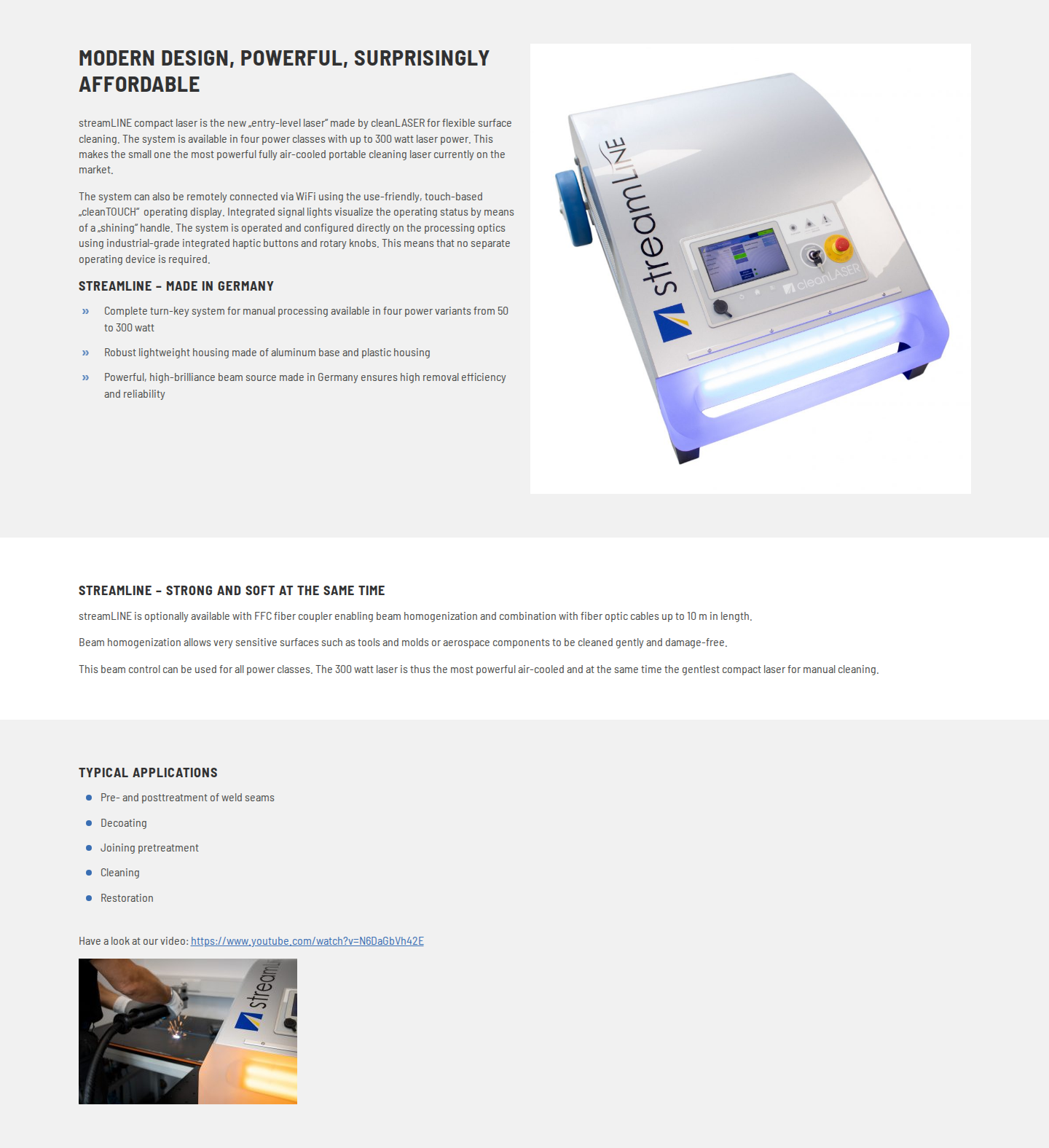
Clean-Lasersysteme GmbH is the originator of industrial laser cleaning, offering the CL-series across one of the widest power ranges in the category — from a 20 W battery-powered backpack unit to 1,700 W high-power systems — with approximately 2,000 installed systems worldwide and proven applications across automotive, aerospace, mould cleaning, and industrial maintenance.
cleanLASER suits industrial buyers who want an established, globally installed system with documented application heritage across automotive, aerospace, mould cleaning, and restoration — and who anticipate needing anything from a lightweight backpack unit to a high-power 2,000 W system from the same supplier.
Clean-Lasersysteme GmbH was founded in 1997 by two researchers from the Fraunhofer Institute for Laser Technology in Aachen — making it the originator of industrial laser cleaning as a commercial category.
In October 2024, IPG Photonics completed its acquisition of cleanLASER, adding the company's approximately 2,000 installed systems worldwide and roughly $30 million in annual revenue to its portfolio.
cleanLASER CL-Series: Power Range and Lineup
The CL-series covers a wider continuous power range than most single manufacturers offer, from the 20 W backpack unit at the low end to the 1,700 W CL 2000 at the high end.
| Model | Power | Cooling | Form Factor |
|---|---|---|---|
| CL 20 Backpack | 20 W | Air-cooled | Backpack-mounted, ~14.5 kg, battery or mains powered |
| streamLINE compact | 50–300 W | Air-cooled | Portable wheeled cabinet, four power variants |
| Mid-Power (CL 150–600) | 150–600 W | Air-cooled | Mobile wheeled cabinet |
| CL 1000 | 1,000 W | Water-cooled (external chiller) | Mobile industrial cabinet |
| CL 2000 | 1,700 W | Water-cooled (external chiller) | Mobile industrial cabinet, 460 kg |
Gives readers a scannable, side-by-side view of the CL-series lineup across the key purchase-decision specs — power, cooling, and form factor — so they can quickly locate the tier relevant to their application.
Buyers who expect their power requirements to grow can scale from the streamLINE compact up through the mid-power and high-power tiers without changing supplier or retraining operators on a different platform.
CL-Series Applications
The application breadth accumulated over nearly three decades is one of cleanLASER's most tangible differentiators — few manufacturers can point to documented use across as many industries and processes.
- Paint removal and decoating: Partial or full-area stripping, including selective removal of individual layers on metallic components.
- Pre-treatment for bonding, welding, and coating: Oxide and residue removal from aluminium, magnesium, and other metals prior to joining or finishing processes.
- Mould and tool cleaning: Removal of stubborn production residues from injection moulds and forming tools without abrasion or chemical waste.
- Rust and oxide removal: Used across automotive, aerospace, and industrial maintenance for corrosion remediation and surface prep.
- Restoration and conservation: Gentle cleaning of stone and metal surfaces for heritage and conservation applications.
- Nuclear decontamination: Tested across multiple countries; commercially deployed for decontamination of metal parts in nuclear facilities.
Industries served include automotive, aerospace, rubber and tyres, food and bakery, printing rollers, plastics, medical, and research — a breadth that reflects cleanLASER's position as the category originator rather than a later entrant targeting a niche.
Portability and Form Factor
The CL 20 Backpack (approximately 14.5 kg) is the most portable unit in the range, with a battery-powered option that allows operation without a mains connection — suited to field, heritage, and access-restricted sites.
The streamLINE compact covers 50–300 W in a robust aluminium and plastic housing, with four power variants and WiFi connectivity via the cleanTOUCH display — no separate operating device is required.
Mid- and high-power systems are wheeled mobile cabinets rather than separate generator-and-scanner configurations; fibre lengths of 10 m standard (up to 50 m optional) determine how far the operator can work from the unit.
Cooling
Units up to 300 W — including the streamLINE compact — are fully air-cooled, requiring no site water infrastructure.
The CL 1000 and CL 2000 require an external water chiller (internal water-to-water cooling system); the CL 2000 datasheet specifies cooling water below 17°C at 1.5–4 bar differential pressure. Buyers deploying high-power systems must factor chiller procurement, water supply, and space into their site planning.
Safety Considerations
All CL-series systems operate as Class 4 lasers, which requires a defined laser hazard zone with area controls and appropriate PPE for all personnel in the vicinity.
For buyers deploying in open workshops, mixed-use facilities, or public-facing environments, this is a genuine operational constraint: the area must be controlled and cleared before cleaning begins, which adds planning overhead and limits flexibility in shared spaces.
cleanLASER CL-Series Pricing
cleanLASER publishes an entry-level price point of 45,000 USD on its contacts page, with the CL 20 Backpack listed separately at a lower entry price.
High-power systems (CL 1000, CL 2000) will be substantially above this figure; pricing reflects the product's positioning as a premium German-engineered industrial system with a large global install base and nearly three decades of application development behind it.
Product 4
P-Laser QF-Compact
A Belgian pulsed laser cleaning specialist offering a portable air-cooled product line from 50 to 300 W, with a published rental fleet that lets buyers trial the technology or manage capital expenditure before committing to a purchase.
The P-Laser QF-Compact suits industrial buyers who want an established Belgian specialist with a documented track record in pulsed laser cleaning, a portable product line spanning 50 to 300 W under one air-cooled platform, and — critically — the option to rent before committing capital or to manage expenditure through P-Laser's own rental fleet.
QF-Compact Specifications
The QF-Compact series covers four models — QFC-50, QFC-100, QFC-200, and QFC-300 — all air-cooled and all designed as self-contained portable units.
| Model | Power | Weight | Dimensions (mm) |
|---|---|---|---|
| QFC-50 / QFC-100 | 50 W / 100 W | ~13 kg | 485 × 225 × 330 |
| QFC-200 / QFC-300 | 200 W / 300 W | 30–35 kg | 300 × 665 × 465 |
Side-by-side specification comparison across the QF-Compact model range, helping buyers quickly assess which power tier suits their application and weight tolerance.
The lower-power models are genuinely compact — at 13 kg and roughly the footprint of a carry-on bag, the QFC-50/100 can be transported and positioned by a single operator with minimal effort.
The QFC-200 and QFC-300 step up to 30–35 kg, which still qualifies as portable but requires more considered handling on site, particularly on elevated structures or confined access routes.
Form Factor: Self-Contained Unit
The QF-Compact is a carry-the-whole-unit design: the laser source, optics, and controls are all housed within the portable unit itself, and the operator works at the unit's location.
This differs from a wheeled-cabinet architecture where a lightweight handheld scanner is fed by a long fibre delivery cable, allowing the operator to reach surfaces well away from the machine.
For buyers working on large structures, elevated surfaces, or hard-to-access areas, the reach available from the unit's own optics is the operative constraint — P-Laser does not publish a cable length figure for the QF-Compact range on their product pages.
Applications
P-Laser positions the QF-Compact across a wide application range: rust and oxide removal, paint and coating stripping, oil and grease decontamination, mill scale removal, mould cleaning, and surface preparation for welding and bonding.
- Metals: Rust, oxides, mill scale, paint, coatings, and oil — the core industrial cleaning applications across steel, aluminium, and other alloys.
- Plastics, ceramics, and glass: Precise removal of surface contamination without substrate damage, suited to mould cleaning and precision component prep.
- Stone and concrete: Graffiti removal, surface restoration, and preparation work across masonry and architectural surfaces.
P-Laser's broader product range — extending from 50 W portable units up to 3,000 W water-cooled trolley, cube, and inline systems — gives the brand documented application heritage across heavy industrial and automated contexts, even though the QF-Compact is the portable flagship.
Cooling and Safety
All QF-Compact models (50–300 W) are air-cooled, requiring no water supply or chiller infrastructure on site — an operational advantage in field and maintenance environments.
The QF-Compact operates as a Class 4 laser system, which means the working area must be controlled before use: personnel not involved in the operation should be excluded, and appropriate PPE is required for the operator.
P-Laser Rental Fleet
P-Laser operates what they describe as the largest rental fleet in the European laser cleaning market — a genuinely distinctive commercial model that no other manufacturer on this list replicates.
According to P-Laser's published brochure, daily rental rates start from €550/day for the QFC-100 and €950/day for the QFC-300, with weekly and monthly rates also available.
For buyers who want to validate the technology on their specific application before committing to a capital purchase — or who need to manage expenditure through operational rather than capital budgets — the rental route is a practical and low-risk entry point.
The self-contained unit design means operator reach is limited to the unit's own optics position, and the Class 4 hazard zone requires area controls before use — both are honest constraints buyers should weigh when comparing portable options at this power range.
See a Portable Laser Cleaner in Action
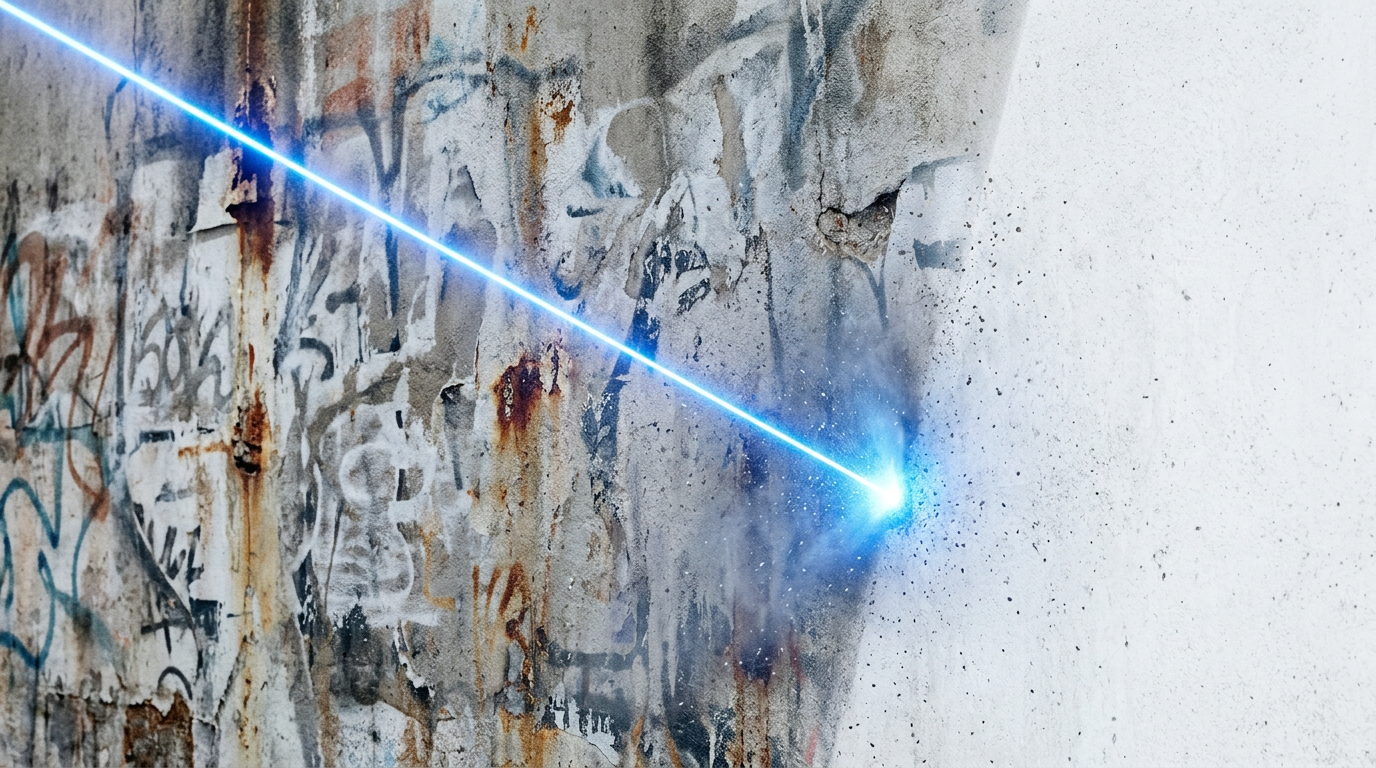
Watch a portable pulsed laser cleaning machine tackle a graffiti wall in under two minutes. A quick way to see the technology working before exploring the full product range.
Product 5
Netalux Needle
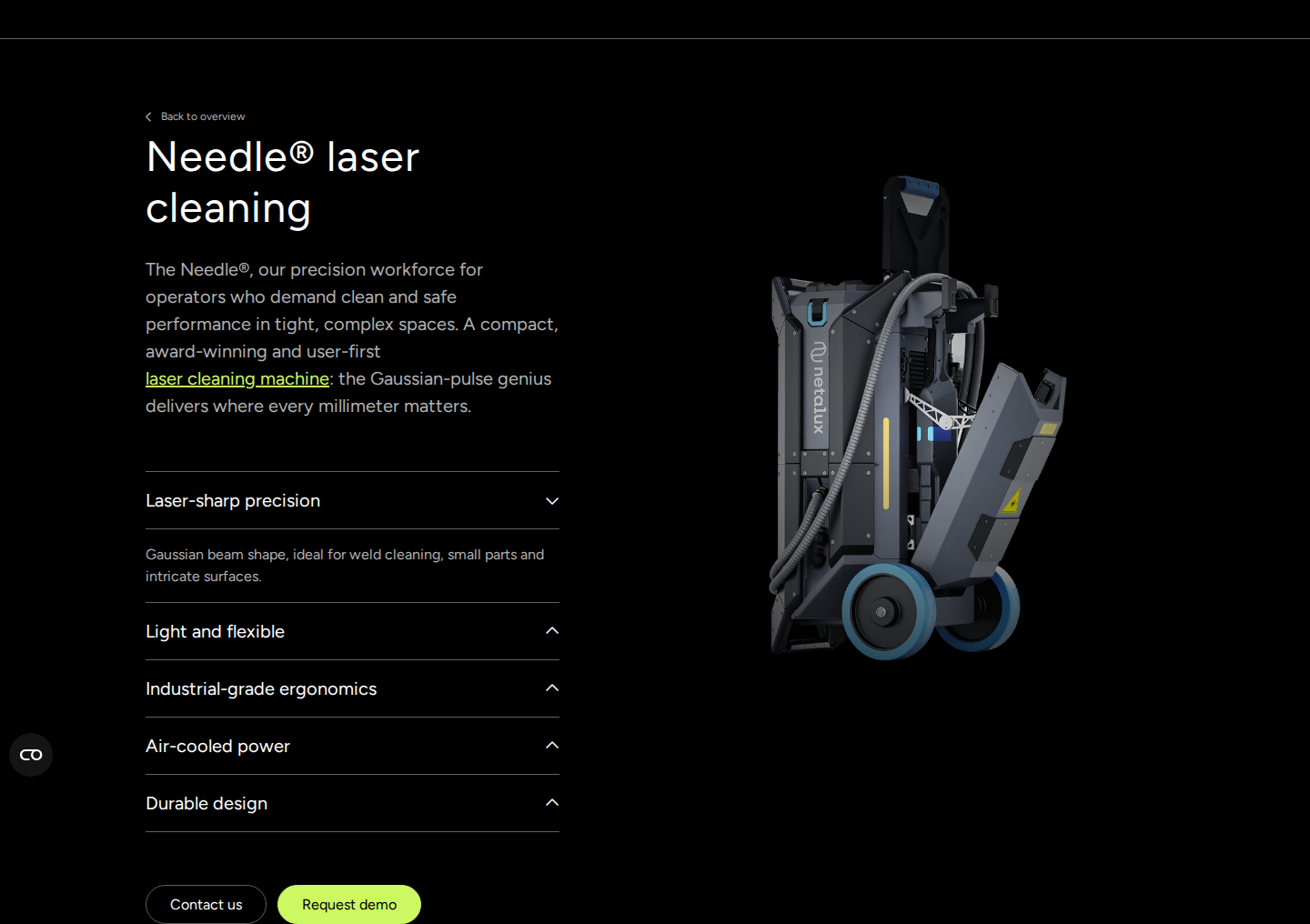
A Belgian-designed pulsed laser cleaner built around operator ergonomics and precision access — the Needle targets weld cleaning, small parts, and intricate surfaces where a Gaussian beam and a purpose-engineered handset make a real difference. Available from 100 W to 300 W, fully air-cooled, and the holder of three Red Dot Awards for Product Design. Its primary constraint is fibre reach: at 4.5–5.7 m, it is a close-proximity tool, not suited to large structures or multi-position tasks.
The Needle is purpose-built for operators working in tight-access environments — weld cleaning, small parts, intricate surfaces, and precision decoating where a Gaussian beam profile and an ergonomically engineered handset deliver a clear advantage over bulkier alternatives. A stationary configuration is also available for fixed-process automation.
Netalux Needle: Power Range and Specifications
The Needle range runs from 100 W to 300 W across four models, all air-cooled. The two sub-groups differ meaningfully in pulse parameters — the table below shows the key distinctions.
| Specification | Needle 100 / 150 W | Needle 200 / 300 W |
|---|---|---|
| Average power | 100 W / 150 W | 200 W / 300 W |
| Pulse energy (max) | 1 mJ | 2 mJ |
| Pulse length | 150 ns | 20–500 ns (variable) |
| Pulse frequency | 10–500 kHz | 2–4,000 kHz |
| Beam profile | Gaussian | Gaussian |
| Cooling | Air | Air |
| Total weight (approx.) | ~20 kg (unit ~17 kg, handset ~2.3 kg) | ~43 kg (unit ~40 kg, handset ~3 kg) |
| Fibre length | 4.5 m | 5.7 m |
| Ingress protection | IP54 | IP54 |
| Laser class | Class 4 | Class 4 |
The two Needle sub-groups have distinct pulse parameters and physical specs that buyers need to compare side by side before shortlisting a power level.
The 200/300 W models offer substantially more tunable pulse parameters — variable pulse length from 20 to 500 ns and a frequency range up to 4,000 kHz — giving operators greater control over energy delivery for more demanding or varied surfaces.
Netalux's higher-power Jango (500/1,000 W) is a separate, water-cooled product line with a top-hat beam profile; it is not part of the Needle range and should be evaluated independently.
Needle Design and Ergonomics
The Needle has won three Red Dot Awards for Product Design — for the original Needle (2020), the Jango (2022), and the Needle 200/300 W (2023) — making it one of the few pulsed laser cleaners to carry independently judged design recognition.
The design features are practical, not cosmetic: a 115° rotatable laser head allows operators to reach angled or confined surfaces without repositioning the entire unit, while integrated LED headlights improve visibility in the tight spaces the Needle is built for.
- Rotatable head: 115° of rotation on the laser head for angled and confined-access work without repositioning the base unit.
- LED headlights: Integrated lighting built into the handset for visibility in dark or enclosed workspaces.
- Hardened glass touchscreen: On-unit display with a durable glass interface for parameter control without a separate controller.
- IP54 ingress protection: Rated against dust ingress and water splashing — suitable for industrial environments with atmospheric contamination risk.
- Handset controls: All key controls are integrated into the handset, keeping the operator in full control without returning to the base unit.
Together, these features make the Needle a genuinely operator-centred machine — the ergonomic detail is consistent enough across the product line to suggest it reflects a deliberate design philosophy rather than incremental additions.
Portability, Weight, and Fibre Reach
The Needle 100/150 W is a genuinely lightweight portable unit at approximately 20 kg total, with the handset accounting for just 2.3 kg of that. The 200/300 W models are heavier at around 43 kg total — still portable, but at the upper end of what a single operator moves comfortably without a trolley.
The more important constraint is fibre reach: 4.5 m on the 100/150 W and 5.7 m on the 200/300 W. This limits the Needle to close-proximity work — the laser unit must be positioned within a few metres of the cleaning surface at all times.
Buyers with large structures, elevated access requirements, or tasks that require repositioning across a wide area should consider machines with longer delivery cables. For the Needle's target applications — weld cleaning, small parts, confined spaces — the reach is rarely a practical issue, but it is a firm operational boundary that must be understood before shortlisting.
Safety and Deployment
The Needle operates as a Class 4 laser system, requiring standard area controls and appropriate PPE — the same deployment requirement shared by most pulsed laser cleaners on this list. Controlled-access zones and operator training are mandatory before use.
Conclusion
Choosing the right pulsed laser cleaner: a buying guide
The most useful question isn't which pulsed laser cleaner is best — it's whether the work comes to the machine or the machine comes to the work: production batches point toward automation; on-site or multi-site work points toward portable.
The second question is whether your facility can be sealed off, because in open workshops or public-facing settings, reduced-hazard-zone capability isn't a compliance detail — it's what makes the job possible.
Either way, evaluate on total cost of ownership, not upfront price alone.
If your scenario fits portable or open-facility work, the ELASER-RHZ is the standout; for production batches, AutoLASE is the call — Woodrow Scientific are well worth a conversation.
Frequently asked questions about pulsed laser cleaners
Answers to common questions on pricing, safety, fume extraction, technology fit, and power selection for industrial pulsed laser cleaning.
Most industrial pulsed laser cleaners in the 100–300 W range are sold on a quote basis. Published pricing from established manufacturers gives a useful reference point: Clean-Lasersysteme lists entry-level systems from 40,000 EUR on their German applications page and from 45,000 USD on their English contacts page. Pricing across the category sits in a broadly similar range at this power tier. The upfront figure is only part of the picture, though. Pulsed laser cleaning carries zero consumable costs — no abrasive media, no chemicals, no replacement pads. Combined with reduced downtime and the precision that stops the beam at the base material rather than abrading the substrate, the long-term cost picture looks considerably different from the sticker price. For procurement sign-off, total cost of ownership over the operational life of the machine is the appropriate evaluation framework.
With conventional Class 4 pulsed laser cleaners, yes — a laser hazard zone must be established and controlled before work begins. This means defining the zone, restricting access, and ensuring all personnel within it wear appropriate laser safety eyewear. It is standard practice across the industry and entirely manageable with proper controls. The exception is WSL's ELASER-RHZ, which uses patented, world-first reduced-hazard-zone technology to confine the laser hazard to a small area immediately around the work itself. This enables cleaning in open workshops, mixed-use facilities, and public-facing environments without sealing off or evacuating the surrounding area — a meaningful operational advantage wherever conventional Class 4 controls would be disruptive or impractical. Operator training still applies; the RHZ shrinks the hazard zone, it does not eliminate it.
Laser cleaning vaporises surface contaminants, producing particulate fume that must be captured at source. Most industrial applications require a dedicated fume extraction unit with HEPA filtration — along with pre-filters and activated carbon stages — to handle the particulate safely and meet industrial air quality standards. Extraction should be planned as part of the operational setup before deployment, not treated as an afterthought. Some manufacturers integrate extraction directly into the system: Narran, for example, builds a multi-stage filtration unit into their ROD laser cleaners, with an exhaust hose that connects directly to the process head for source-point capture. When evaluating any machine, check whether the extraction unit is included or sold separately, and confirm that the connection method supports capture as close to the cleaning zone as possible.
Pulsed lasers deliver energy in concentrated nanosecond bursts, ablating contaminants with minimal heat transfer to the substrate. Continuous wave (CW) lasers deliver energy continuously — which enables faster coverage on large areas but carries significantly higher thermal risk to the underlying material. Research published in Laser Focus World comparing MOPA pulsed fibre lasers against CW systems at equivalent average power found the pulsed approach achieved 7.7× higher cleaning efficiency on aluminium alloy and 3.5× higher on carbon steel, while leaving surface roughness at or below the original level. CW cleaning, by contrast, increased surface roughness by around 1.5× in the same tests. For most industrial applications — particularly those involving precision, mixed substrates, or surfaces where rework is costly — pulsed is the correct choice. CW suits high-throughput, large-area tasks such as paint stripping on structural steel, where speed outweighs the need for substrate precision.
100–200 W suits precision, small-area work: mould vents, weld preparation on thin materials, and heritage restoration where substrate sensitivity is high. 200–300 W covers the majority of industrial maintenance and production preparation tasks. 500 W and above is warranted for large-area throughput or heavy contamination layers where cleaning rate is the primary constraint. Power also affects speed, not just capability. A higher-wattage machine cleans the same area faster — so in high-volume production environments, a 300 W machine may be justified not because a 100 W unit cannot do the job, but because throughput requirements demand the speed uplift. Define your required cleaning rate alongside your application type before specifying wattage.
Industrial pulsed laser cleaners are Class 4 laser products. Safe operation requires proper controls: operator training, appropriate PPE (laser safety eyewear rated for the wavelength), and a defined laser hazard zone. These are standard requirements across the industry, and all reputable manufacturers provide operator training as part of commissioning. With the right controls in place, laser cleaning is a well-established, safe industrial process. WSL's ELASER-RHZ reduces the laser hazard zone significantly, confining it to a small area around the work itself. This lowers the safety overhead considerably and makes laser cleaning practical in environments where conventional Class 4 controls would be prohibitive. Buyers should factor operator training and safety planning into their total deployment cost when evaluating any machine on this list.