

Introduction
This list is for professional buyers — facilities managers, industrial operators, heritage conservators, and automotive professionals — who need rust removed on their behalf, not a guide for anyone reaching for a wire brush.
It covers four categories of rust removal services: laser cleaning, abrasive blasting, chemical treatment, and mechanical methods.
Every entry is evaluated against the same six axes: surface and substrate compatibility, cost structure, speed and throughput, environmental and safety credentials, use-case fit, and provider verifiability.
All entries are real and verified; our own laser cleaning solutions lead the list as the strongest options for most professional use cases.
If you want to skip straight to a recommendation, the decision-guidance conclusion at the end of the page maps each service type to the situations it suits best.
TL;DR
The four professional rust removal service categories differ meaningfully in cost, substrate safety, and operational context — and those differences determine whether a job goes smoothly or expensively wrong.
Laser cleaning, particularly with eye-safe technology, has emerged as the most versatile option across the widest range of surfaces and environments — and the entries below show exactly why.
This article covers:

The four professional rust removal service types
Six evaluation axes applied to every entry
Leading providers across all four categories
Decision guidance matching use cases to services
Common buyer questions on cost and permanence
How to Compare Professional Rust Removal Services
Most buyers comparing rust removal services start with the per-job quote — and that single number reliably leads them to the wrong decision, because it captures none of the costs that accumulate around it. The six axes below give you a more honest comparison basis: start with the filter that eliminates unsuitable methods entirely, then work through cost, speed, compliance, context, and provider quality.
Surface and Substrate Compatibility
Substrate compatibility is the non-negotiable first filter: choose the wrong method for the material and the damage is irreversible, regardless of how competitive the price was.
Laser cleaning works across a broad range of substrates — metals including thin-gauge and delicate alloys, stone, masonry, and heritage materials — because the beam selectively ablates the contaminant layer and stops at the base material, leaving it intact.
Abrasive blasting operates through mechanical impact and deliberately creates a surface profile (anchor pattern), which suits heavy structural steel but risks irreversible damage on thin-gauge, delicate, or heritage surfaces.
Chemical treatment varies significantly by formulation: acid pickling attacks the base metal if dwell time is not tightly controlled, while chelation-based treatments are gentler and more substrate-selective.
Mechanical methods such as grinding and wire brushing are limited to accessible surfaces and are most appropriate for heavier rust grades on robust, industrial substrates.
Cost Structure and Total Cost of Ownership
The per-job price is a misleading comparison metric because it omits the hidden costs that accumulate around each method: media purchase and disposal, compliance overhead, containment setup, rework from substrate damage, and downtime all belong in the true cost picture. Total cost of ownership (TCO) is the more honest basis for comparison.
Laser cleaning carries a higher upfront investment but zero consumables, minimal substrate damage (and therefore less rework), and lower operational downtime — making its TCO structurally competitive over time.
Abrasive blasting often quotes lower per-job rates for large open areas, but media purchase and disposal, PPE, compliance overhead, and blast containment setup all add to the real cost.
Chemical treatment is consumable-intensive — acid, neutralisation agents, rinse water, and hazardous waste disposal — with compliance costs that are easy to underestimate at the quoting stage.
Mechanical methods appear low-cost for small-scale work but become highly labour-intensive at scale, driving the effective hourly cost up quickly.
Substrate damage that requires rework can cost more than the original job. Any method that risks surface loss on sensitive materials carries a rework liability that never appears in the initial quote — but always appears in the final invoice.
Speed and Throughput
The relevant speed metric depends on whether you are running a one-off job or a production batch — and the four method categories have very different profiles on both dimensions.
Automated laser cleaning is fast and consistent across batches, with no media setup, no containment, and no dwell time between parts.
Abrasive blasting moves quickly once running on large open surfaces, but setup, containment, and post-process cleanup add significant elapsed time on-site.
Chemical methods require dwell time ranging from minutes to hours depending on rust grade and concentration, followed by rinsing, neutralisation, and drying — making them poorly suited to fast turnaround.
Mechanical methods are slow and operator-dependent; throughput scales only by adding headcount.
Environmental and Safety Credentials
For professional buyers, environmental compliance and site-access restrictions are operational constraints, not aspirational ones — and the four methods carry very different profiles here.
Laser cleaning is chemical-free and abrasive-free, generating minimal waste with no hazardous materials handling or disposal compliance required.
Abrasive blasting generates significant airborne dust and requires containment and ventilation; where silica-containing media is used, operators face serious respiratory risk (silicosis) — OSHA's silica standard publication outlines the compliance framework buyers should be aware of before specifying this method.
Chemical treatment requires acid handling, neutralisation, and hazardous waste disposal; EPA RCRA codes apply to acid and rust-removal wastes, and these compliance obligations are worth verifying with a qualified advisor before contracting.
Mechanical methods are the lowest-tech option but still generate dust and debris, requiring appropriate PPE and ventilation controls.
Use-Case Fit
No method is universally correct — the right choice depends on job context as much as contaminant type, and asking the right questions before comparing providers will narrow the field significantly.
Four questions cut through the noise: Is this field or on-site work, or in-facility? Is this a one-off job or a production batch? Is the surface heritage or sensitive, or industrial-grade structural steel? Are there open-space or public-access constraints that restrict dust, chemicals, or evacuation requirements?
Provider Verifiability
Once you have identified the right method for your job, provider verifiability is the axis that separates professional-grade suppliers from operators who simply own equipment.
- Equipment certifications: CE and UKCA marking are the baseline for laser cleaning equipment in the UK and EU; check that certifications are current and cover the specific system being deployed.
- In-house vs reseller: Many laser cleaning providers operate equipment built by third parties. A supplier that designs and builds in-house can resolve faults faster and genuinely improve the product.
- Formal training provision: Professional rust removal demands operator competence. A provider who delivers or has completed structured training is a meaningfully more reliable hire than one who has not.
- Industry-specific track record: Heritage conservators, automotive body shops, and structural steel contractors have different requirements — look for demonstrated experience in your specific application.
With this framework established, the entries that follow evaluate each service type and provider against these six axes in turn — giving you a consistent basis for comparison as you work through your shortlist.
Option 1
ELASER / ELASER-RHZ
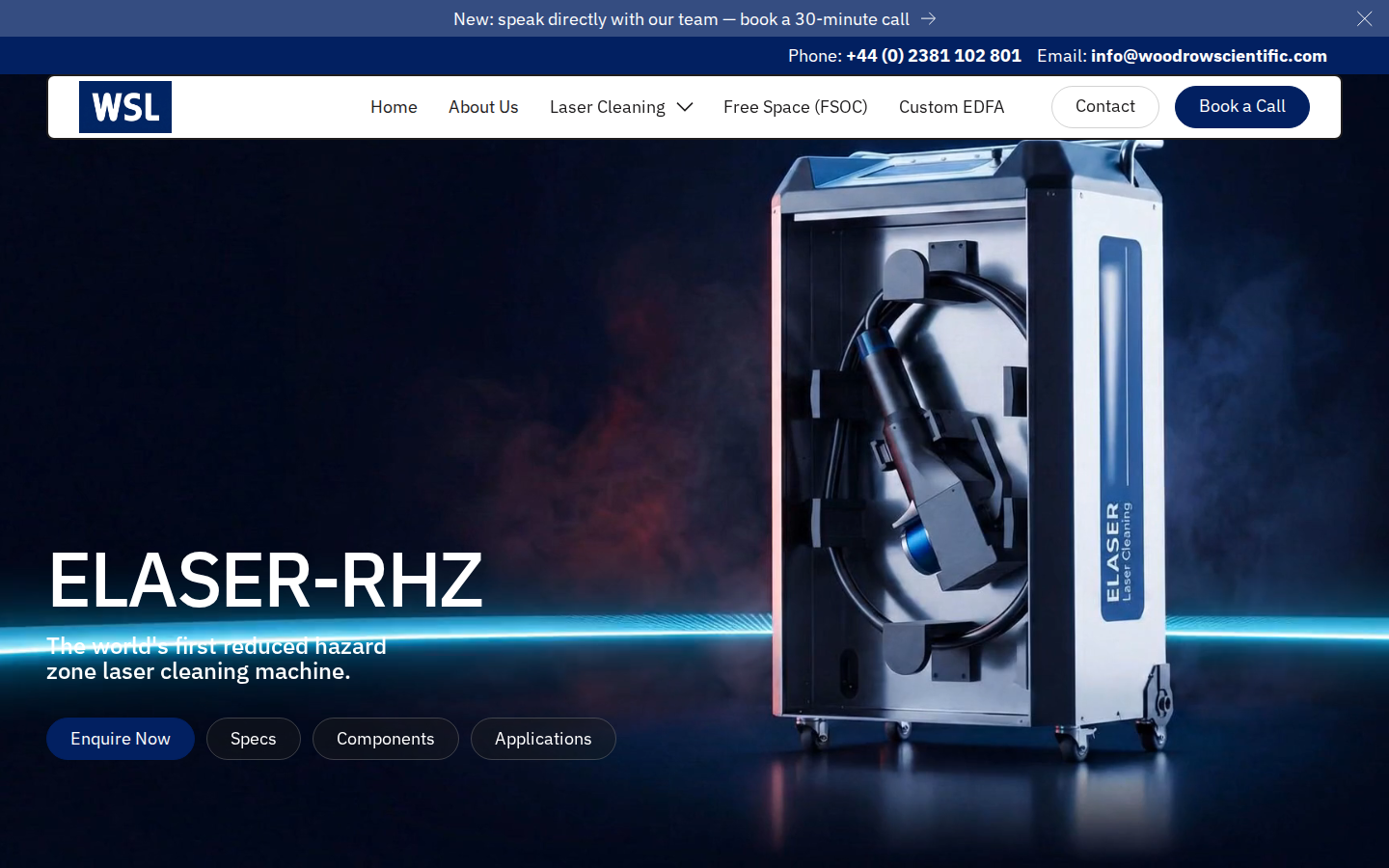
The ELASER-RHZ is Woodrow Scientific's portable industrial laser cleaning system and the only laser cleaner in the world with patented reduced-hazard-zone (eye-safe) technology — enabling professional rust removal services in open workshops, mixed-use facilities, and publicly accessible spaces without sealing off the area or evacuating staff. Built in Britain by the UK's only in-house laser cleaning manufacturer, it is the most competitively priced comparable industrial laser cleaning machine in Europe and covers an exceptionally broad range of metals, stone, and masonry substrates.
Pros:

World-first RHZ eye-safe technology
Single-operator portability; no consumables
Chemical-free, abrasive-free, zero waste
European cost leader; CE and UKCA certified
Cons:

Requires training and upfront investment
The single biggest practical barrier to laser cleaning on-site has always been the hazard zone: conventional systems require the surrounding area to be sealed off and evacuated before work can begin, making them impractical in open workshops, active production floors, or publicly accessible spaces. The ELASER-RHZ removes that barrier entirely.
WSL's patented RHZ technology collapses the laser hazard zone to a small area immediately around the work surface. No competitor offers this capability. It is the only laser cleaner of its kind in the world — enabling professional rust removal services in open, mixed-use, and public-facing environments where conventional laser cleaning cannot go.
In practical terms, this means a heritage conservator can clean a monument in a public square, a facilities team can treat corroded steelwork on an active production floor, and an automotive bodyshop can run rust removal operations without shutting down adjacent bays.
Behind the technology is Woodrow Scientific Limited (WSL) — the only UK-based laser cleaning manufacturer, founded in 2012. WSL designs, builds, services, and improves every machine in-house, with over 200 years of combined engineering expertise. This matters to professional buyers: in-house manufacturing means faster spares, genuine engineering support, and the ability to actually develop the product. It is worth noting that a significant portion of the laser cleaning market is supplied by resellers or importers rebadging third-party machines, which translates to weaker support and no real product ownership.
On pricing, the ELASER/ELASER-RHZ is the most competitively priced industrial laser cleaning system in Europe among comparable machines — achieved through WSL's own manufacturing efficiencies, not through quality compromise.
How ELASER-RHZ Scores Against the Six Evaluation Axes
| Evaluation Axis | ELASER / ELASER-RHZ |
|---|---|
| Surface & substrate compatibility | Steel, carbon steel, aluminium alloys, cast iron, copper, brass, bronze, titanium, galvanised, stone, concrete, brick, masonry — one of the broadest coverage profiles available |
| Cost structure (upfront vs TCO) | Competitively priced vs comparable laser systems; TCO advantage over traditional methods through zero consumables, less downtime, and minimal substrate damage reducing rework |
| Speed & throughput | Up to 300 W tunable fibre laser with 10 m/s scan rate; suited to single-operator field deployment and on-site maintenance tasks |
| Environmental & safety credentials | Chemical-free, abrasive-free, air-cooled; no consumables, no media disposal, no chemical waste stream; RHZ technology dramatically reduces safety overhead vs conventional laser cleaning |
| Use-case fit | Industrial maintenance, automotive, heritage & restoration, aerospace, injection moulding & tooling, and as a platform for launching a laser cleaning service business |
| Provider verifiability | CE and UKCA certified; Made in Britain; in-house manufacturer with patented technology; full operator training provided by WSL |
Maps the ELASER/ELASER-RHZ directly against the six evaluation axes established in the Background section, giving readers a structured framework payoff before the detailed narrative continues.
The system is fully self-contained: the wheeled unit weighs under 50 kg, and the handheld scanner comes in at sub-3 kg with a delivery cable reaching up to 50 m.
One person can deploy, operate, and move the system — no compressor, no water supply, no consumables, no media to clear up afterwards.
Surfaces, Contaminants, and Key Applications
The ELASER is not a specialist tool built for a single substrate or contaminant type. Its tunable power (0–100%, up to 300 W) lets one machine span light oxide removal through to thick coatings across a wide range of materials.
- Industrial maintenance: On-site treatment of plant, equipment, and structural steelwork — nothing to mask off, no media to clear up, and no need to take equipment offline.
- Automotive rust and paint removal: Pre-weld surface prep on the production line through to rust and coating removal in the bodyshop, with minimal substrate loss compared to abrasive methods.
- Heritage and restoration: Gentle removal of soiling, corrosion, and paint from stone, metal, and masonry — including publicly accessible monuments and listed structures, enabled by the RHZ technology.
- Injection moulding and tooling: Strip release agents, residues, and build-up from moulds in place, without disassembly or abrasive contact.
- Aerospace surface preparation: Precise cleaning to tight tolerances for component prep and corrosion treatment.
- Launching a laser cleaning service business: A portable, single-operator system paired with WSL's full operator training provides a ready platform for professionals entering the rust removal services market.
WSL also offers bespoke engineering and customisation for specific operational requirements — prospective buyers with non-standard use cases are encouraged to get in touch directly.
ELASER-RHZ Pricing and Total Cost of Ownership
Pricing is available on request. As the European cost leader among comparable industrial laser cleaning machines, the ELASER/ELASER-RHZ is positioned competitively on machine price — and the total cost of ownership case strengthens further over time.
With zero consumables, no abrasive media to procure or dispose of, no chemical waste stream to manage, and minimal substrate damage reducing rework, the running cost profile is fundamentally different from abrasive blasting or chemical treatment methods.
Buyers should factor in the investment horizon: laser cleaning requires upfront capital and operator training before deployment. WSL provides full training as part of its offering, and the TCO case becomes compelling once that initial investment period is accounted for.
See the ELASER-RHZ Specs in Full
The ELASER-RHZ brings patented reduced-hazard-zone technology to on-site rust removal — no area evacuation required. Download the full datasheet to review its specifications and capabilities.
Product 2
AutoLASE
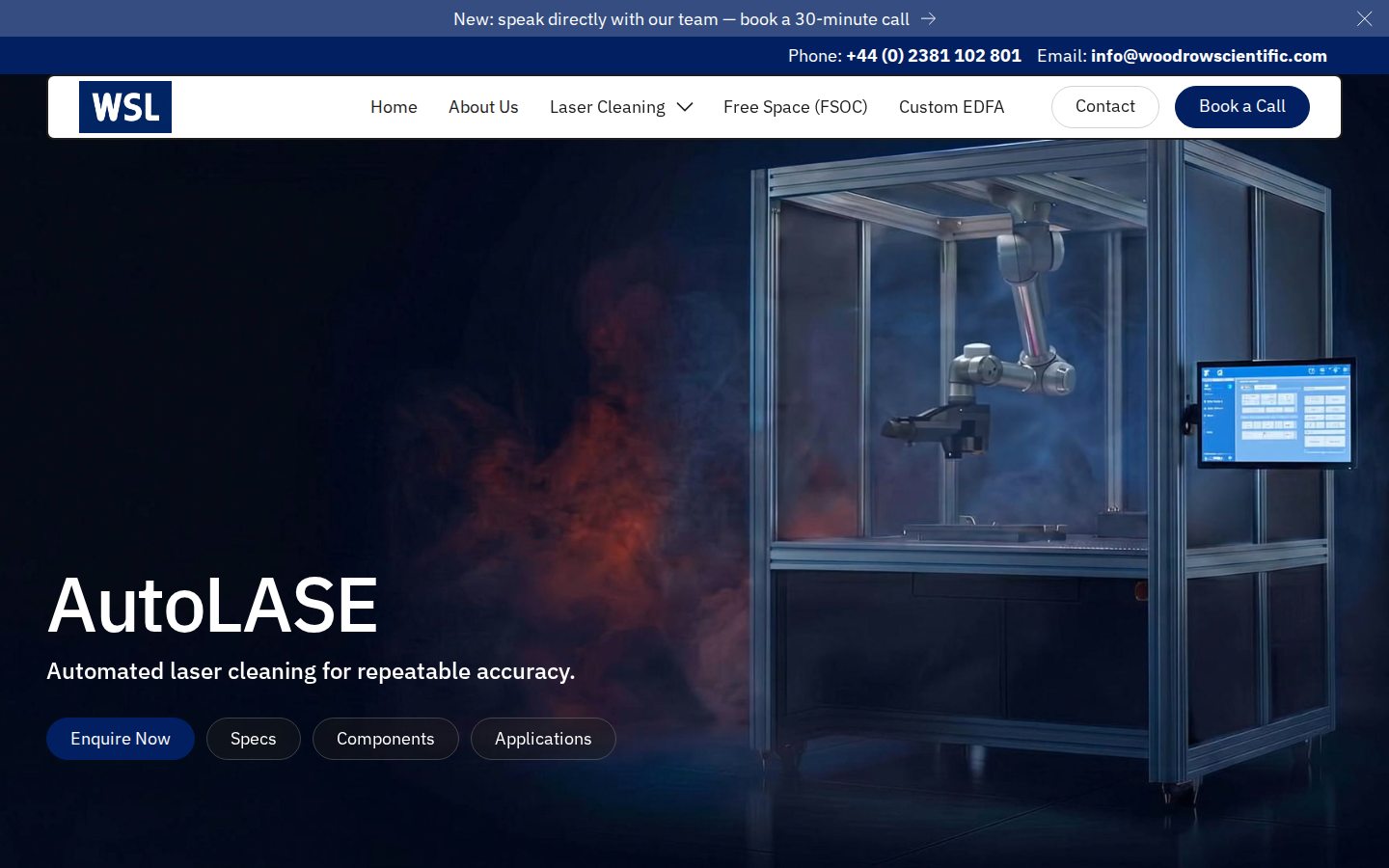
AutoLASE is Woodrow Scientific Limited's automated laser cleaning system, designed for production-scale rust and contamination removal from batches of industrial components. Load a part and its 3D machine-vision software scans, maps, and generates the cleaning path automatically — no programming required, consistent results on every cycle.
Pros:
Load-and-go 3D vision: no programming or path-setting needed
Optional RHZ: automated cleaning without an enclosure
European cost leader; zero consumables; strong TCO
CE and UKCA certified; works with existing robots
Cons:
Not suited to one-off or field jobs
Where the ELASER is built for field deployment, AutoLASE is built for the production floor — a different product for a different problem, and the distinction matters when you are comparing rust removal services at scale.
What Makes AutoLASE Different
The defining feature of AutoLASE is not that it is automated — it is how effortless that automation is to operate.
Load a part into the system and the 3D machine-vision software takes over: it scans the part, builds a three-dimensional map, and generates the cleaning path automatically, with no manual programming, no path-setting, and no knowledge of the part geometry required.
Anyone on the production line can load a part and run it — there is no specialist programming step between one part type and the next.
AutoLASE can also be configured with WSL's Reduced Hazard Zone (RHZ) technology, making it the only automated laser cleaning system in the world that can operate without a full enclosure.
That capability is exclusive to WSL — no other supplier offers enclosure-free automated laser cleaning, and it opens up installation scenarios that a standard enclosed cell cannot accommodate.
AutoLASE is also the European cost leader on upfront pricing among comparable industrial laser cleaning systems — and the total cost of ownership case is compelling: zero consumables, automated labour savings across high-volume batches, minimal downtime, and consistent quality that eliminates rework.
The Manufacturer Behind AutoLASE
AutoLASE is made by Woodrow Scientific Limited, the only UK-based laser cleaning manufacturer — designing, building, servicing, and improving its machines entirely in-house since 2012.
In a market where a significant number of laser cleaning suppliers are resellers or importers rebadging third-party machines, WSL's in-house model means faster, more expert support and a genuine ability to improve the product — backed by 200+ years of combined engineering experience.
Best For
AutoLASE is purpose-built for production environments where every part must be cleaned to the same standard, every cycle, without manual intervention.
- Automotive components: Engine, driveline, and EV battery parts — oxide, coatings, and contamination removed part after part.
- Aerospace components: Turbine blades, vanes, and engine parts cleaned and surface-prepped to tight tolerances on every cycle.
- Tyre and rubber moulds: Vulcanisation residue and build-up removed from moulds, segments, and vents without abrasives or mould wear.
- Injection moulds and tools: Release agents, residue, and build-up stripped from mould cavities and inserts — fine detail restored without disassembly.
- Remanufacturing lines: Corrosion, coatings, and contamination stripped from worn components in consistent batches, ready for inspection and rebuild.
The common thread is volume and repeatability: AutoLASE suits any application where manual cleaning would otherwise introduce inconsistency or consume significant labour.
AutoLASE: Evaluation at a Glance
| Axis | AutoLASE |
|---|---|
| Surface compatibility | Metals (steel, carbon steel, aluminium, cast iron, copper, brass, bronze, titanium, galvanised), stone, concrete, brick, masonry |
| Contaminants removed | Rust, oxides, mill scale, paint, coatings, oil, grease, weld discolouration, release agents, and more |
| Speed / throughput | Consistent automated throughput — same standard every cycle; no setup time between part types once configured |
| Environmental credentials | Chemical-free, abrasive-free, air-cooled, no consumables, no water circuit, no waste stream |
| Cost structure | Competitive upfront pricing (European cost leader); strong TCO via zero consumables and automated labour savings |
| Provider verifiability | CE and UKCA certified; designed and built in-house by WSL; training and bespoke integration available |
Covers all six framework axes in a scannable format, allowing readers to compare AutoLASE directly against other entries on the same criteria.
Power is tunable from 0–100%, so a single AutoLASE cell handles everything from light surface oxides through to thick coatings — no retooling, no media changes.
AutoLASE Certifications and Integration
AutoLASE carries both CE and UKCA certification, which matters for UK industrial buyers assessing supplier credibility alongside cleaning performance.
The system attaches to your existing collaborative or industrial robots, or WSL can supply it as a complete custom cell — first-class safety and operation training is available alongside bespoke engineering and integration support.
If you have specific integration or customisation requirements, WSL's in-house engineering team is the right starting point — get in touch to discuss what is possible for your application.
AutoLASE delivers its strongest value when production volume and repeatability justify the investment. For one-off jobs, field work, or on-site deployment, the portable ELASER is the more appropriate choice — the two systems are designed for distinct use cases, not competing ones.
Option 3
IPG | cleanLASER
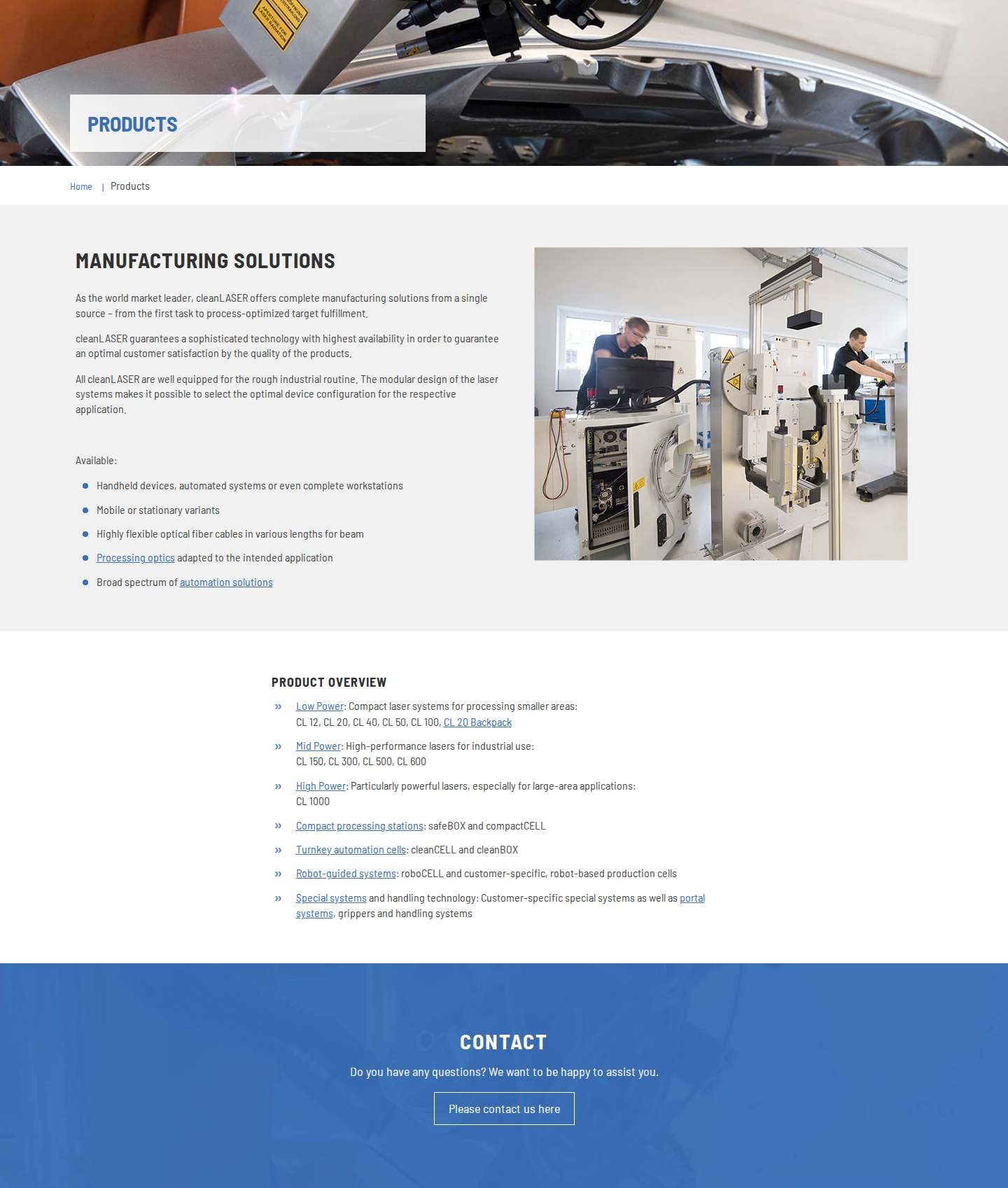
IPG | cleanLASER (Clean-Lasersysteme GmbH) is a German laser cleaning specialist founded in 1997 and now part of IPG Photonics. With around 2,000 installed systems globally and a product range from portable handhelds to high-power gantry automation cells, it suits buyers who need a well-established supplier with broad industrial application coverage and deep automation integration capability.
Pros:
25+ years; ~2,000 systems deployed
Full range: portable to gantry automation
Chemical-free; no abrasive media
IPG Photonics backing; global reach
Cons:
Requires area evacuation; no RHZ
Controlled factory environments
Clean-Lasersysteme GmbH was founded in Herzogenrath, Germany in 1997 — the company describes itself as the inventor of commercial laser cleaning technology, and its 25+ years of continuous development give it a track record that few providers in this category can match.
In 2024, cleanLASER became part of IPG Photonics, the global leader in high-power fibre laser technology. IPG operates manufacturing facilities and service centres in over 30 countries, and cleanLASER is designated as IPG's Centre of Excellence for Laser Cleaning — a positioning that brings deeper laser-source engineering resources to the brand.
"This is a pivotal moment for our combined teams as we focus on driving the growth of laser cleaning systems worldwide. With our resources and shared commitment, we are well-prepared to meet rising demands and lead the industry forward."
IPG | cleanLASER Product Range
The cleanLASER portfolio spans a wide power and automation spectrum from a single supplier: portable compact systems at the entry level, mid-power trolley units for flexible deployment, and high-power systems reaching up to 1,600 W of beam source power for large-area or thick-layer applications.
Above the handheld tier, cleanLASER offers robotic-guided systems, cleanGANTRY portal systems for large-area components, cleanCELL turnkey automation cells, and customer-specific integrated solutions. Current model availability should be verified directly at cleanlaser.de/en/products/.
Automation and Robotic Integration
cleanLASER's robotic systems use compact end effectors with fibre-optic beam delivery and integrate into new or existing production lines via digital I/O or fieldbus interfaces. The modular design supports a range of automation configurations, including turnkey cells and customer-specified robot cells.
The cleanGANTRY portal systems combine high-precision laser surface technology with highly dynamic gantry motion, and can be equipped with rotary indexing tables or double-drawer systems to enable parallel loading and higher part throughput.
Application Coverage and Substrate Compatibility
cleanLASER's install base covers automotive, aerospace, rubber and tyre, food industry, electronics, mould cleaning, restoration and heritage conservation, and more. With approximately 2,000 installed systems in operation globally, the application breadth gives buyers meaningful confidence in proven deployment across diverse industries.
- Metals: Steel, aluminium, magnesium — rust removal, de-oiling, oxide layer removal, weld preparation.
- Composites and CFRP moulds: Precision mould cleaning without abrasive damage or chemical residue.
- Stone and heritage surfaces: Gentle removal of environmental dirt and weathering from sensitive substrates.
- Painted and coated surfaces: Selective partial or full-area paint stripping, including aerospace paint removal to base material.
The process is chemical-free and requires no abrasive media. Small quantities of ablated particles are extracted immediately after laser ablation — a standard environmental profile shared across the laser cleaning category.
Cost Structure and TCO
cleanLASER does not publish list pricing; contact cleanlaser.de for current pricing and configuration options. The TCO argument centres on eliminating consumables — no chemicals, no abrasive media — and reducing process downtime compared with conventional rust removal methods.
Key Trade-off: Conventional Laser Hazard Zone
cleanLASER systems are Class 4 laser devices and require conventional laser safety controls: the working area must be secured and evacuated before operation begins. There is no eye-safe or reduced-hazard-zone capability. For buyers operating in controlled factory environments where area evacuation is routine, this is standard practice. For open workshops, mixed-use facilities, or public-facing on-site work, it is a meaningful operational constraint.
This is a factual characteristic of Class 4 laser systems at these power levels, not a reflection on cleanLASER's engineering quality. Buyers whose use cases involve enclosed production environments will find the safety requirements entirely manageable.
Option 4
Abrasive Blasting Services
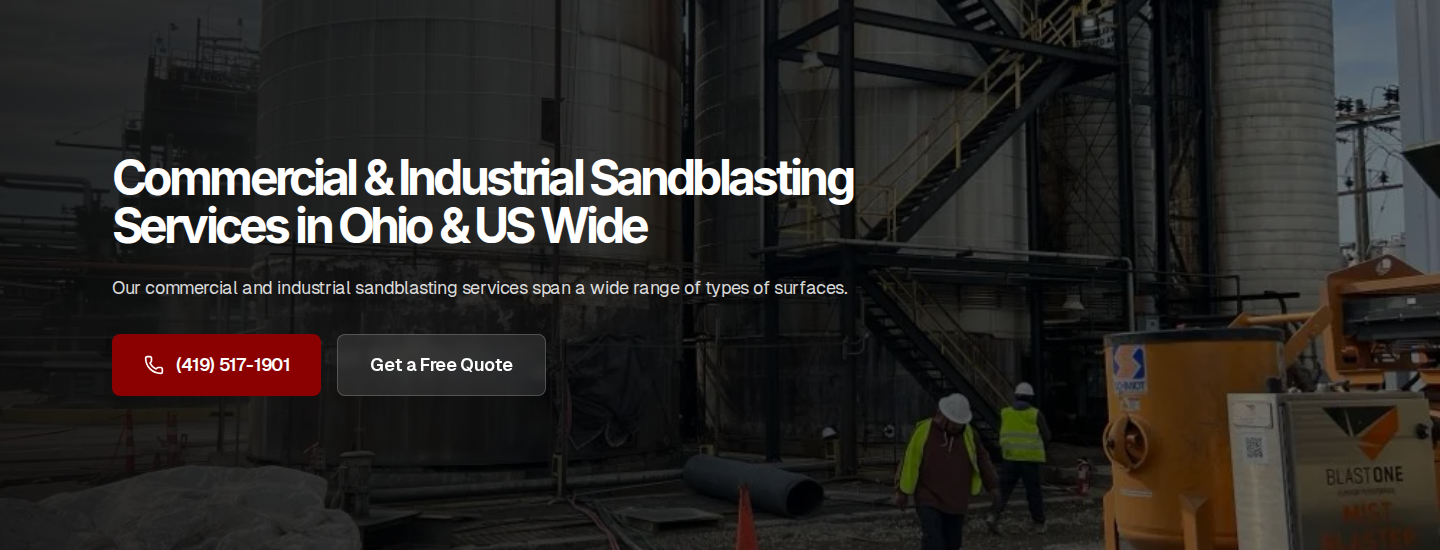
Abrasive blasting services — sandblasting, shot blasting, and grit blasting — use propelled abrasive media to strip rust, mill scale, and coatings from heavy steel surfaces at speed, making them the standard choice for large-scale structural and industrial surface preparation where defined cleanliness standards such as near-white blast (Sa 2.5) are required.
Pros:
Fast throughput on large open steel surfaces
Achieves defined cleanliness standards (Sa 2.5 near-white blast)
Widely available from established industrial contractors
Competitive per-job rates for large structural areas
Cons:
Creates surface profile — unsuitable for delicate substrates
Significant dust; containment and compliance overhead required
Not suitable for open or public-facing environments
Abrasive blasting — encompassing sandblasting, shot blasting, and grit blasting — is the workhorse of industrial surface preparation, using compressed air, centrifugal wheels, or pressurised water to propel abrasive media (steel grit, shot, aluminium oxide, garnet, glass bead) at high velocity against a surface to strip rust, mill scale, paint, and scale.
It is a category of professional service offered by many established industrial contractors, not a single named provider — and for the right application, it remains one of the most effective rust removal methods available.
Use-Case Fit
Abrasive blasting is the standard choice for large open steel structures: structural steelwork, bridge decks and beams, ship hulls, heavy industrial plant, and pipework assemblies where fast, aggressive surface preparation to a defined cleanliness standard is the primary requirement.
Specifications such as near-white blast (SSPC-SP10 / ISO Sa 2.5 — at least 95% of each unit area free of all visible contaminants) are routinely achieved by abrasive blasting and are widely mandated by coating manufacturers for high-performance protective systems in marine, offshore, and petrochemical environments.
Surface and Substrate Compatibility
Abrasive blasting is highly effective on heavy-gauge steel and structural metal, where the creation of a surface profile (anchor pattern) is acceptable — and often required — to promote coating adhesion.
It is not suitable for thin-gauge, delicate, or heritage substrates: the abrasive impact creates a permanent surface profile that can damage or distort materials that cannot absorb that energy.
Aluminium, cast iron, and coated heritage materials require careful media selection at minimum; in many cases an alternative method is the more appropriate choice.
Speed and Throughput
For large open steel areas, abrasive blasting is genuinely fast — this is one of its primary commercial strengths, and it is the reason air-powered abrasive blasting is frequently specified as the most cost-effective method for cleaning large quantities of substrate quickly.
However, headline throughput figures do not capture the full picture: blast room or containment setup, curtain walls, ventilation installation, and post-process media recovery and cleanup all add time that is not always factored into initial comparisons.
Environmental and Safety Credentials
Abrasive blasting generates significant dust, requiring containment and ventilation as the primary engineering controls — barriers, curtain walls, blast rooms, and exhaust ventilation systems are all standard requirements for compliant on-site operations.
Silica-containing media carries serious respiratory risk: OSHA's publications on abrasive blasting identify crystalline silica as capable of causing silicosis, lung cancer, and breathing problems in exposed workers, and note that employers must establish written exposure control plans, conduct air monitoring, and provide NIOSH-certified respiratory protection.
Professional buyers commissioning blasting services should be aware of the compliance obligations that apply under OSHA's silica standard (29 CFR 1910.1053) — consulting the relevant OSHA guidance and qualified safety professionals is advisable before specifying the method.
Wet blasting variants substantially reduce airborne dust compared to dry abrasive blasting, but introduce water handling complexity and the risk of flash rust on freshly prepared steel surfaces.
Cost Structure
Per-job rates for abrasive blasting are typically lower than laser cleaning for large structural areas — a genuine strength when the substrate is appropriate and the volume is high.
Applying the total cost of ownership lens established in the buying framework, the full picture includes: abrasive media purchase and disposal, PPE and compliance overhead, blast room or containment setup costs, and potential rework costs if substrate damage or over-blasting occurs.
The U.S. Navy-derived cost formula used by industry professionals calculates true cost per unit area as a function of abrasive consumed, abrasive cost, cleanup and disposal costs, labour, and equipment running costs — not just the headline blasting rate. Media disposal alone can represent a significant proportion of total project cost on large-scale jobs.
Abrasive blasting is the right tool for heavy structural steel at scale, and professional buyers with large open steel surfaces, appropriate containment infrastructure, and the capacity to manage compliance obligations will find it a cost-effective and widely available option.
For sensitive substrates, open or public-facing environments, or projects where media disposal and safety compliance overhead are prohibitive, the method's category limitations make it the wrong fit — and the evaluation framework used across this list makes those boundaries clear.
Option 5
Chemical Rust Removal: Acid and Chelation Treatments
Professional chemical rust removal services use strong acids or chelating agents to dissolve rust and mill scale from immersible components in controlled facility conditions, without mechanical abrasion.
Pros:
Removes mill scale and rust without mechanical abrasion
Standard approach for stainless steel passivation (ASTM A380/A967)
Chelation options are gentler and more substrate-selective
Reaches internal bores inaccessible to mechanical methods
Cons:
Generates hazardous waste requiring compliance and licensed disposal
Not field-deployable; requires controlled facility conditions
Strong acids can attack base metal if uncontrolled
Chemical rust removal services use reactive chemistry rather than physical force to dissolve rust and mill scale from metal surfaces. Two distinct approaches exist: acid pickling, which uses strong mineral acids — most commonly hydrochloric (muriatic) acid, with sulfuric acid as an alternative — to penetrate and lift scale from beneath; and chelation-based treatment, which uses compounds such as EDTA, DTPA, or GLDA to bind metal ions and remove surface contaminants through a gentler chemical mechanism.
Best for: controlled facility descaling and passivation
This method finds its natural home in controlled facility environments where components can be physically immersed in a treatment bath.
Stainless steel passivation is one of the most established applications — pickling removes weld scale and the chromium-depleted layer underneath, restoring the passive film that gives stainless steel its corrosion resistance, in line with standards such as ASTM A380 and ASTM A967.
Beyond stainless steel, chemical treatment suits mill scale removal from hot-rolled steel, pipe and tube descaling, and components with internal bore surfaces or complex geometries where mechanical access is impractical.
Chemical rust removal: six-axis evaluation
The table below maps this service category against the six evaluation axes used throughout this comparison.
| Evaluation axis | Assessment |
|---|---|
| Surface and substrate compatibility | Effective on steel, stainless steel, and iron for rust and mill scale. Dwell time must be controlled — sulfuric acid in particular can rapidly degrade base metal if left too long. Not suitable for aluminium, galvanised surfaces, or heritage stone without specialist formulations. Chelation-based treatments are gentler and more substrate-selective than strong mineral acids. |
| Cost structure | Consumable-intensive: acid, neutralisation agents, rinse water, and waste disposal all contribute to running costs. Per-job rates may appear modest, but total cost of compliance and hazardous waste handling adds meaningfully to the real price. |
| Speed and throughput | Multi-step process: immersion dwell (minutes to hours depending on rust grade and acid type), followed by rinsing, neutralisation, and drying. Batch processing of immersible components is efficient; large structures or on-site field work are impractical. |
| Environmental and safety credentials | Strong acids are hazardous — PPE is required, handling must be controlled, and acid waste must be neutralised before disposal. Spent pickle liquor from iron and steel operations is a listed hazardous waste under EPA RCRA (K062). Citric acid-based alternatives are phosphate-free and safer to handle but less aggressive on heavy rust. |
| Use-case fit | Best fit: stainless steel fabrication, hot-rolled steel processing, pipe and tube manufacturing, and any component that can be immersed in a controlled facility. Poor fit: open structures, field work, and substrates sensitive to acid attack. |
| Provider verifiability | Established service category with a long industrial track record. Providers operate under regulatory frameworks (RCRA compliance, waste manifests). Buyers should confirm waste disposal credentials and relevant industry certifications when evaluating providers. |
Gives readers a structured, scannable summary across all six evaluation axes — consistent with the framework declared in the Background section and applied to each list entry.
The environmental and safety profile is where this method carries its sharpest trade-off for buyers.
Strong acids require appropriate PPE, controlled handling, neutralisation before disposal, and compliance with hazardous waste regulations — the EPA identifies rust removal and parts washing activities as generating acid and corrosive wastes that may carry RCRA codes including D002, with spent pickle liquor from steel finishing operations specifically listed as K062 under 40 CFR §261.32. Buyers should seek professional compliance guidance rather than treating this as a self-managed administrative task.
Citric acid-based formulations — such as phosphate-free gel products designed for hot-rolled and cold-rolled steel — offer a meaningfully safer handling profile and reduced waste stream burden, though they are less aggressive on heavy rust and scale than mineral acid pickling.
Per-job rates for chemical rust removal can look competitive at first glance. But acid waste neutralisation, hazardous waste manifesting, and licensed disposal all add to the real cost — buyers evaluating total cost of ownership should factor these in before comparing against other service types.
Chemical rust removal services are the right choice when the work involves immersible components in a controlled facility, particularly stainless steel passivation and mill scale removal from hot-rolled steel — these are genuine, well-established strengths.
Where this method falls short is equally clear: it is not field-deployable, it generates liquid hazardous waste requiring active compliance management, and it is not appropriate for substrates sensitive to acid attack or for open-environment work.
Conclusion
Which rust removal service is right for you?
The right service fits your job context: ELASER / ELASER-RHZ for field or on-site work, AutoLASE for production batches, abrasive blasting for large structural steel, chemical treatment for immersible components, and mechanical methods for minor accessible rust where cost is the priority.
For professional buyers who need substrate integrity and zero consumables, laser cleaning is worth it — the total cost of ownership case strengthens over time.
Rust can be completely removed, but permanence depends on what follows: thorough removal paired with the right coating or passivation is what delivers lasting results.
Rust removal services: frequently asked questions
The questions professional buyers ask most often when comparing rust removal services — answered directly, with no fluff.
Yes — for professional buyers, laser rust removal is consistently worth it. Three factors drive that conclusion. First, substrate integrity: laser ablation vaporises the rust layer and stops at the base material, leaving the substrate undamaged. When rework is costly, that precision matters. Second, operational simplicity: no chemicals, no abrasive media, no consumables, and no hazardous waste stream to manage or dispose of. Third, the ELASER-RHZ from Woodrow Scientific Limited removes the traditional barrier to on-site laser cleaning. Conventional systems require area evacuation before work can begin; RHZ technology collapses the hazard zone so cleaning can take place in open workshops and mixed-use environments. Together, these factors make the total cost of ownership structurally compelling over time. For genuinely one-off jobs where a basic mechanical method suffices, the calculus is different — the right method always depends on the use case.
Yes — rust can be completely removed from metal surfaces by all professional rust removal methods. The more important question for buyers is what each method does to the base material in the process. Laser cleaning removes rust by ablation: the beam vaporises the rust layer and stops precisely at the substrate, leaving no surface profile and no base metal loss. Abrasive blasting also achieves full rust removal, but it creates an anchor pattern in the surface — useful for coating adhesion on structural steel, but unsuitable for precision or delicate components. Acid pickling dissolves rust chemically and effectively, though strong acids can attack the base metal itself if dwell time is not carefully controlled. The distinction that matters professionally is not whether rust can be removed — it can — but how the removal method interacts with the substrate underneath.
Cost varies significantly by method and scale — there is no single price for professional rust removal services. The method chosen is the primary driver. Laser cleaning services are typically quoted on a per-job or day-rate basis, depending on provider and scope. Abrasive blasting is commonly priced per square metre for structural and industrial work. Chemical treatment costs depend on component volume, acid type, and the waste disposal requirements that come with it. Mechanical methods are the lowest-cost option for minor rust on accessible surfaces. Per-job price, however, is only part of the picture. Total cost of ownership — factoring in media disposal, compliance overhead, and the cost of rework when a method damages the substrate — often makes laser cleaning more economical over time despite higher upfront service rates. When requesting quotes from verified providers, compare on TCO rather than per-job price alone.
No rust removal method is permanent on its own. Rust will return on any unprotected metal surface exposed to moisture and oxygen, regardless of how thoroughly the original rust was removed. What professional rust removal achieves is restoring the base material to a clean, active surface that is ready for protective treatment. Lasting results come from the combination of thorough rust removal and appropriate surface protection — whether that is a coating, primer, galvanising, or passivation. The removal step and the protection step work together; neither delivers permanence alone. Laser cleaning is particularly well-suited as a pre-treatment step because it leaves the substrate intact and chemically active, which improves adhesion for subsequent coatings. Abrasive and chemical methods can alter surface chemistry or leave residues that interfere with coating performance — a practical advantage for laser cleaning in any workflow where coating quality matters.