Introduction
If you have found this page, you are probably past the point of wondering whether laser paint removal works — you are trying to work out how to hire someone to do it well.
Most of what you will find online is written by contractors, which means the technology gets explained thoroughly and the harder questions — how to scope a job, what a fair quote looks like, how to tell a capable provider from an underqualified one — tend to go unanswered.
This guide is written from the buyer's side, covering everything from what laser paint removal services actually look like on a job site to the questions worth asking before you commit to anyone.
TL;DR
Hiring a laser paint removal contractor confidently comes down to knowing what good work looks like before it starts — understanding what shapes a job's scope and cost, recognising the credentials and equipment that actually matter, and asking the right questions at the right moment. Get those three things right and the rest of the process becomes considerably more straightforward.
This article covers:

What laser paint removal involves on a job site
Which surfaces and industries it suits best
Laser removal vs. sandblasting and chemical stripping
What drives scope and cost
How to vet a contractor before hiring
What Are Laser Paint Removal Services?
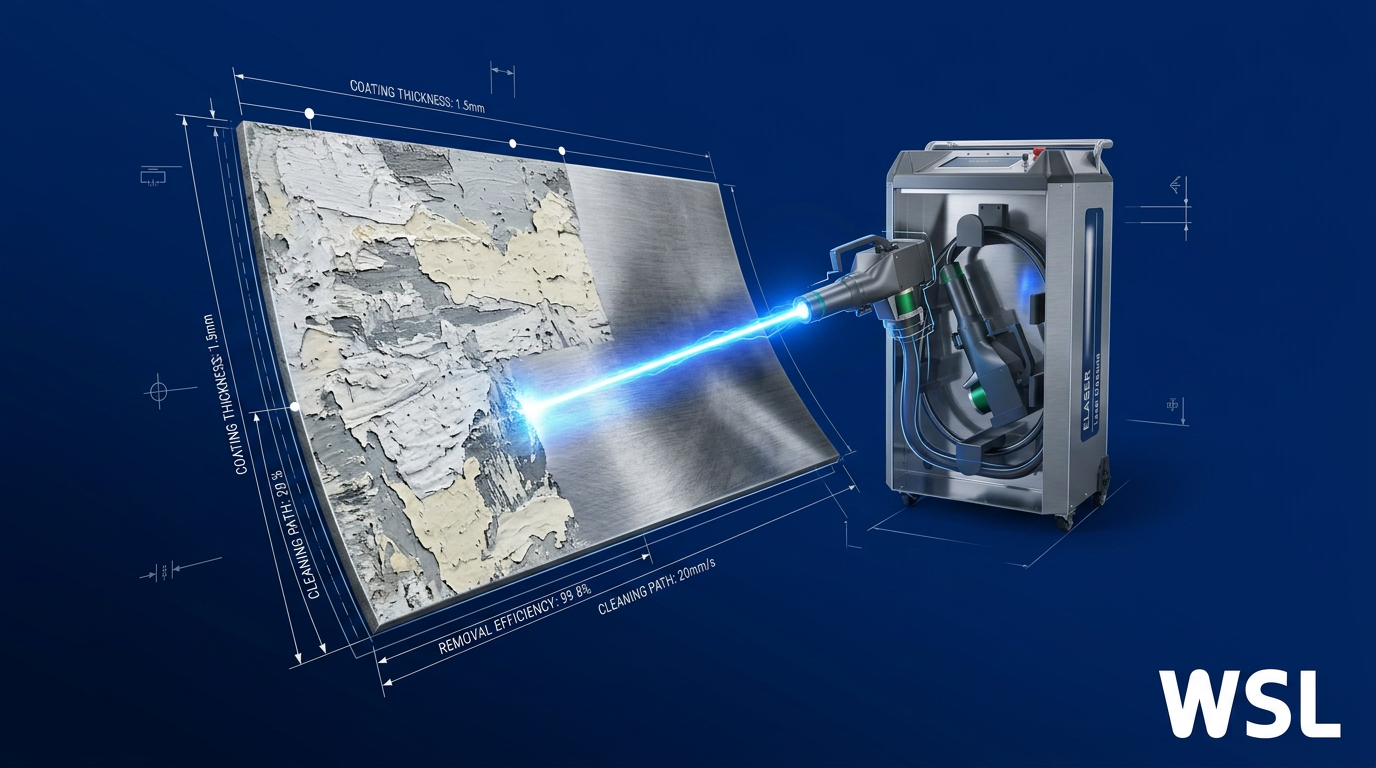
Picture a single technician arriving on your site with a wheeled, self-contained unit, connecting a lightweight handheld scanner, and working it steadily across a coated surface — no chemicals mixed, no abrasive media loaded, no water running. That is what professional laser paint removal services look like in practice.
The service is a hire-a-contractor category: trained technicians bring the equipment to you, carry out the work, and leave the substrate clean and intact. The client never handles the laser system.
How the Process Works on Your Surface
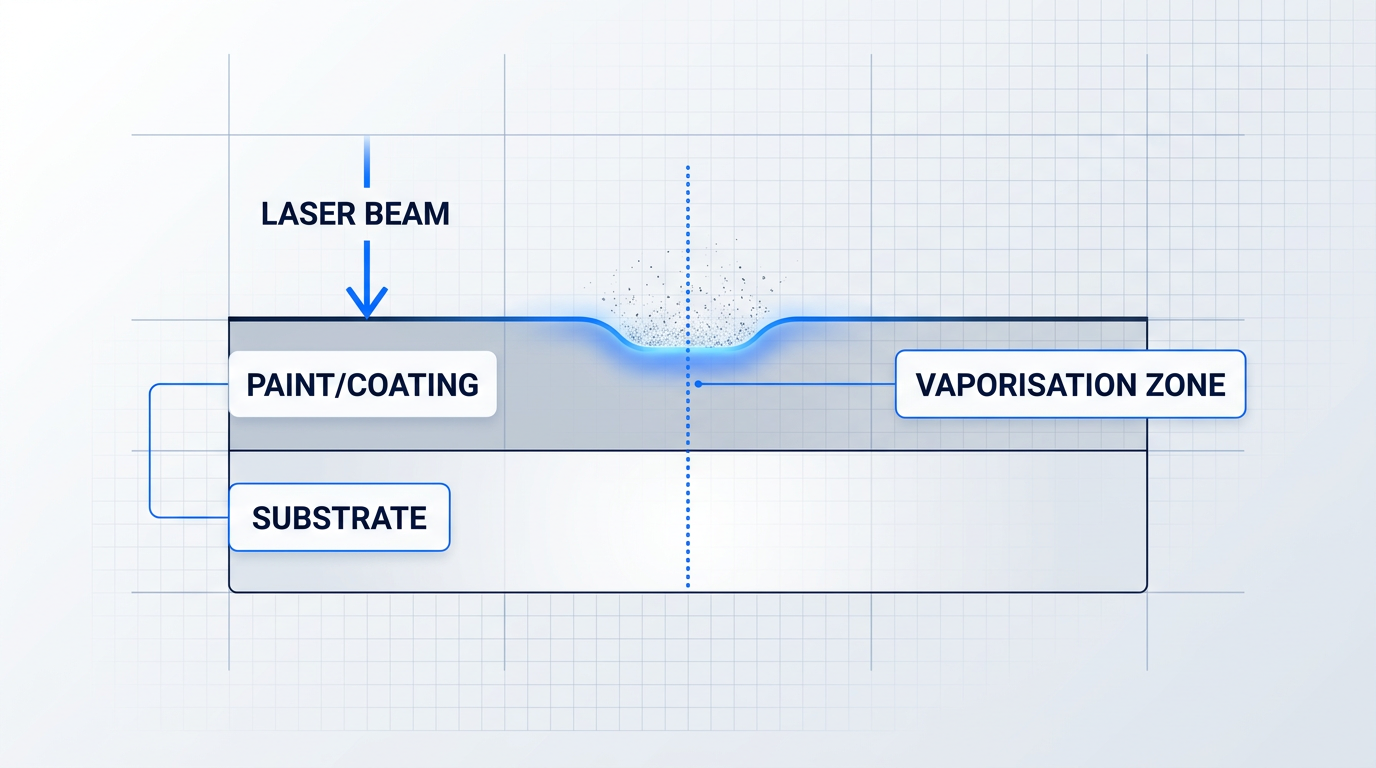
When the scanner passes over a painted surface, a focused laser beam delivers concentrated energy directly into the coating, causing it to vaporise or fracture away from the substrate beneath.
The substrate itself is left intact. There is no mechanical contact with the surface, no abrasive particles, and no chemical agents — the coating is simply gone, and the base material underneath is undisturbed.
- No abrasive media: No grit, sand, or shot is used at any stage, so there is nothing to embed in or score the substrate.
- No chemical application: No stripping agents or solvents are introduced, removing the associated handling, containment, and disposal requirements.
- No mechanical contact: The scanner never physically touches the surface; the only thing acting on the coating is focused light energy.
- No wet process: The process is entirely dry — no water, no slurry, no residual media left on or around the work area.
These characteristics are not just technical footnotes. They are the practical reasons clients choose laser paint removal over alternatives — and they are what you should expect any reputable service provider to confirm before work begins.
Why the Laser Stops at the Base Material
The reason the process is so precise comes down to selective absorption: the paint or coating absorbs the laser energy readily and reaches vaporisation temperature, while the base material beneath absorbs the same energy very differently and remains largely unaffected.
In plain terms, the laser and the coating are well-matched; the laser and the substrate are not — so the coating goes and the substrate stays.
This selectivity is the core reason substrate preservation is a genuine outcome of the process, not simply a marketing claim. The physics of absorption are doing the protective work.
What the Technician Is Actually Doing
On a typical job, the contractor's self-contained unit houses the laser source and power supply; a delivery cable runs to the handheld scanner that the operator works across the surface in controlled passes.
Fume extraction is built into the process — vapourised coating material is captured at source by on-tool extraction rather than dispersing into the surrounding area.
A single trained operator can run the full system, which is why the service scales well to both small detailed jobs and large surface areas without requiring a large crew on site.
Why This Is a Specialist Service, Not a DIY Task
Laser cleaning equipment is not plug-and-play. The operator must correctly set power level, scan speed, and pulse parameters for the specific combination of coating and substrate being treated — and an incorrect setting can damage the very surface the client is trying to preserve.
This is why the professional service model exists: what you are hiring is not simply access to a machine, but a trained specialist whose knowledge of parameter matching is what makes the outcome predictable and safe.
The outcome of a laser paint removal job depends as much on the operator's parameter knowledge as on the machine itself. Correct settings protect your substrate; incorrect ones can damage it — which is why operator skill is the most important thing to evaluate when choosing a contractor.
Laser cleaning has grown substantially over the past decade as a modern alternative to abrasive and chemical methods, with adoption spreading across automotive, heritage, industrial, and infrastructure sectors — a sign that the service is well-established and widely available, not experimental.
Laser Cleaning vs. Laser Cutting and Welding
If your main association with lasers is cutting or welding, it is worth a brief clarification: laser cleaning operates in a fundamentally different regime from those processes.
Cutting and welding concentrate high energy density onto a very small point to melt or fuse material. Laser cleaning spreads lower energy density across a broad scanning pattern, designed to ablate surface contamination layer by layer without penetrating the base material at all.
Same technology family, entirely different application — and understanding that distinction helps set accurate expectations before you engage a service provider.
With a clear picture of what the service is and how it works, the natural next question is which surfaces and industries it is suited to — and where the limits of the process lie.
What Surfaces and Industries Does Laser Paint Removal Serve?
The same technology used to strip coatings from Victorian cast-iron railings is also used on structural bridge steel, aerospace-grade aluminium panels, and graffiti-covered sandstone facades. That breadth surprises most buyers, who tend to assume laser paint removal services are either purely industrial or purely heritage work. The reason the range is so wide comes back to a single property: the beam's selectivity. It removes what it targets and stops at the base material, regardless of whether that material is hard structural steel or thermally sensitive historic stone.
In practice, the principal substrate categories served include metals — steel, aluminium, cast iron, copper, bronze, titanium, and galvanised steel — and non-metallic surfaces such as stone, brick, concrete, and masonry more broadly.
The significance of that span is not just technical variety; it means the fit question is genuinely open until you know your specific substrate, coating type, and site conditions.
Industries Most Commonly Served
Professional laser removal services are in active use across a wide range of sectors. The following are the industries where demand is most established, along with the application pattern that drives it.
- Automotive: Pre-weld surface preparation, rust and paint removal from body panels, and bodyshop work where thin panels cannot tolerate abrasive methods.
- Heritage and restoration: Monuments, historic buildings, ornamental metalwork, and bronze sculpture — where the substrate is irreplaceable and selectivity is non-negotiable.
- Industrial maintenance: Plant equipment, pressure vessels, pipework, and structural components cleaned on-site without disassembly or abrasive media containment.
- Graffiti removal: Spray paint from stone, brick, concrete, and metal in public and commercial settings, including transit infrastructure and historic facades.
- Marine: Hull coatings, propellers in bronze and stainless steel, hardware, and offshore structural components requiring coating removal before recoating.
- Infrastructure: Bridges, structural steel, and other built assets — particularly for localised coating repair in confined or access-restricted areas.
What these sectors share is a recurring combination of factors: the substrate has value worth protecting, the site often imposes constraints on abrasive or chemical methods, or the precision of removal matters as much as the speed.
Where Laser Removal Is the Right Choice
Three operational conditions consistently favour laser removal over the alternatives: substrate preservation requirements, strict waste and contamination controls, and confined or occupied environments.
Where the substrate is delicate, irreplaceable, or high-value — heritage metalwork, thin automotive panels, precision components — abrasive or chemical methods carry a real risk of altering what matters most: the surface itself.
Consider ornamental cast-iron columns or a bronze monument: abrasive blasting permanently alters the casting skin or patina texture, and that change cannot be undone. Laser cleaning removes only the applied coating, leaving the original surface character intact — which is precisely why preservation specifications increasingly require or explicitly permit it.
The second condition is site-driven: jobs where generating spent abrasive media or liquid chemical waste is operationally unacceptable — confined spaces, environmentally sensitive locations, or regulated facilities where waste streams are tightly controlled.
The third is the working environment itself. Active facilities, occupied buildings, and public spaces are poor candidates for sandblasting containment or solvent fumes; laser removal produces no airborne media and no chemical runoff, making it workable in settings where other methods simply cannot be deployed.
The case for laser removal is strongest when the substrate cannot be replaced, the environment cannot be cleared, or the waste cannot be managed. Any one of these conditions — not all three — is typically sufficient to make laser the right call.
When Laser May Not Be the Right Fit
Laser removal is not the optimal choice in every situation, and a credible contractor will tell you so. Three scenarios consistently favour alternative methods.
First, very large flat surfaces with heavy coatings where substrate preservation is not a priority: at that scale and coating thickness, high-volume abrasive blasting covers area far more quickly, and the precision laser offers adds no practical value.
Second — and this is the limitation most likely to catch buyers off guard — jobs that require a coarse anchor profile for coating adhesion. Laser cleaning preserves the original surface profile rather than creating a new one. Many industrial recoating specifications, particularly for structural steel, require a defined surface roughness (measured to standards such as ISO 8503) that only abrasive blasting can reliably produce. Applying a heavy-duty protective coating over a laser-cleaned surface without that profile can result in adhesion that falls below specification — a failure mode that matters on bridges, structural steelwork, and similar assets.
Third, some substrates or coating types need specialist assessment before any work proceeds — polished marble, glazed tile, highly reflective bare copper, and unknown coating chemistries among them. This is not a disqualifier; it is a signal that a reputable contractor will carry out a test area and advise before committing to a production scope.
The right question to bring to any contractor is not simply whether laser removal works in general, but whether it is the right method for your specific substrate, coating, environment, and outcome requirements — and what a test area would show.
Understanding which surfaces and industries laser removal serves is the starting point for that conversation. The next question is how it compares to the methods it most commonly replaces — sandblasting and chemical stripping — and when the logistics and trade-offs tip in laser's favour.
Laser vs. Sandblasting vs. Chemical Stripping
Knowing that laser removal can work on your substrate is only half the decision. The other half is whether it is the right method for your specific job — and that requires an honest look at the alternatives, including where they genuinely hold their ground.
Sandblasting: fast and effective, but abrasive
Abrasive blasting moves quickly and costs less upfront for high-volume work on robust structural steel — and when subsequent coating adhesion requires a coarse anchor profile, the mechanical roughness sandblasting creates is actually a feature, not a flaw.
The limitations appear when the substrate cannot absorb that mechanical force: blasting can warp thin automotive panels, embed media in seams and cavities, and leave a coarse texture that requires extra surfacer and block-sanding before refinishing.
Waste is a significant logistical factor on large infrastructure jobs. According to AASHTO, sandblasting a typical highway bridge generates an estimated 9,000–12,000 pounds of spent blast media mixed with hazardous paint residue — requiring containment, collection, and licensed disposal. A comparable laser preparation area produces roughly 40 pounds of dry, non-toxic captured powder.
Chemical stripping: effective, but chemically demanding
Chemical stripping can dissolve coatings that other methods struggle with, and it remains practical for certain batch-processing and immersion applications where laser equipment cannot be easily deployed on-site.
The method carries real constraints: solvents can wick into seams, spot-welds, and porous fillers, making full neutralisation and rinsing a requirement before any refinishing work can begin — and any trapped residue risks adhesion failures later.
The regulatory environment around chemical strippers has tightened significantly. The EPA has progressively restricted methylene chloride in paint and coating removal — prohibiting consumer use in 2019 and expanding prohibitions to most industrial and commercial uses in 2024 — and NMP faces similar regulatory pressure, which affects both product availability and compliance overhead for operators using these chemicals.
Chemical stripping also generates liquid hazardous waste — solvent-laden effluent that requires collection, neutralisation, and disposal under formal regulatory arrangements, adding a real cost to every job.
Where laser removal holds a clear advantage
The beam stops at the base material. Laser removal leaves the substrate dimensionally unchanged — no peening, no etching, no media embedded in seams — which is the defining advantage for thin automotive panels, heritage metalwork, and precision aerospace components where surface integrity cannot be compromised.
It is a dry process with no consumables. The only output is captured fume particulate, extracted at source — no spent media, no liquid waste stream, and none of the containment and disposal overhead that sandblasting and chemical stripping both require.
Precision is tunable to the millimetre. Operators can target specific zones, work close to sensitive components, and selectively treat individual coating layers — something neither a blast pattern nor an area-wide chemical application can practically achieve.
On the safety side, laser removal carries no chemical exposure risk and no airborne silica or media — the primary overhead is managing the controlled laser hazard zone and fume extraction, which the next section covers in full.
That said, laser is not always the right answer. For large-scale industrial repainting of structural steel where a coarse anchor profile is needed and substrate sensitivity is not a concern, abrasive blasting is typically faster and more economical per square metre. Chemical stripping may also be specified for coating types or access situations where laser equipment cannot be practically positioned.
A buyer who compares methods on day-rate alone is comparing the wrong number. The full-job cost — site preparation, containment, cleanup, waste disposal, potential rework from substrate damage, and time-to-return-to-service — is the right unit. For substrate-sensitive or waste-constrained jobs, that full-picture comparison often narrows or reverses the apparent cost gap between laser and the alternatives.
The waste and safety picture adds further nuance to that cost comparison — the next section covers what the environmental and safety overhead of each method looks like in practice on a job site.
See the Equipment Behind Professional Laser Cleaning
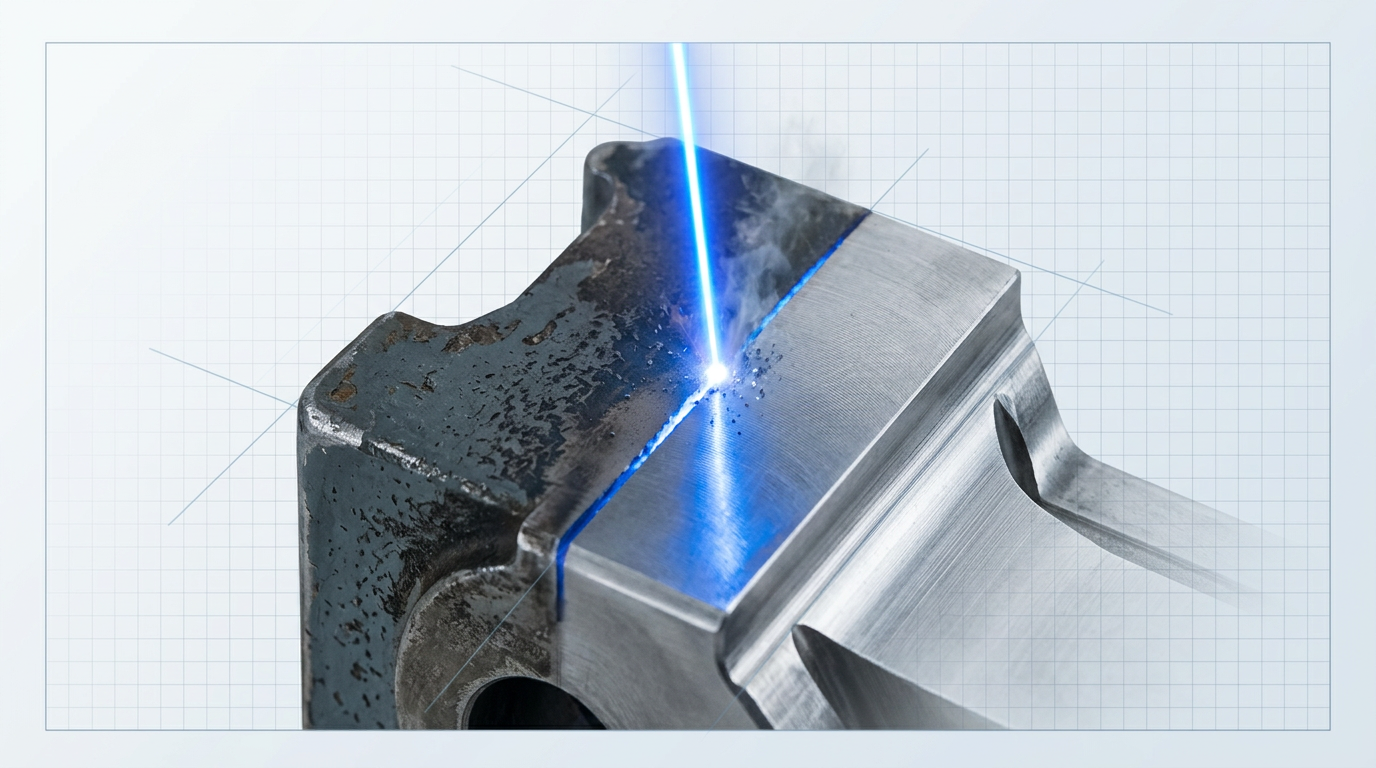
When evaluating laser paint removal services, knowing what professional-grade equipment looks like matters. Explore the ELASER to understand the technology contractors rely on for precise, substrate-safe coating removal.
Environmental and Safety Considerations On Site
When buyers ask about the environmental and safety profile of laser paint removal, they are really asking two practical questions: what will I need to dispose of, and what will I need to shut down? Both have cleaner answers than most people expect — but they still require planning.
Waste Profile: What a Laser Job Leaves Behind
Laser cleaning is a dry process — the only output is fine particulate from the ablated coating, captured at source by the extraction system.
There is no spent abrasive media mixed with paint residue (as with sandblasting), no liquid hazardous waste stream (as with chemical stripping), and no secondary cleanup of embedded grit contaminating the substrate or surrounding area.
For the client, this means simpler waste logistics: a single captured fume stream, straightforward disposal, and no consumable materials to manage or reorder across the job.
That said, fume extraction is non-negotiable — it is not optional equipment for a reputable contractor. Always confirm that any contractor you hire uses on-tool extraction, capturing ablated fume directly at the work head rather than relying on general workshop ventilation.
This matters most when working with older coatings that may contain lead or chromate pigments, where airborne particulate carries a specific health risk regardless of the removal method used.
Lead-Based Paint, Class IV Lasers, and What to Ask
In the US, the EPA's Renovation, Repair and Painting (RRP) programme applies to structures built before 1978, which may contain lead-based paint; UK and EU jurisdictions have equivalent frameworks for older structures. Consult the relevant authority for your location — this is awareness-level context, not legal advice.
Laser removal does not eliminate the lead-based paint hazard, but the dry, captured-at-source process significantly reduces airborne exposure compared to abrasive blasting, which disperses fine lead-contaminated dust across a wide area.
If your structure predates the relevant threshold for your jurisdiction, ask contractors directly about their lead-safe protocols and any certifications they hold — this is a reasonable due-diligence question, not an unusual one.
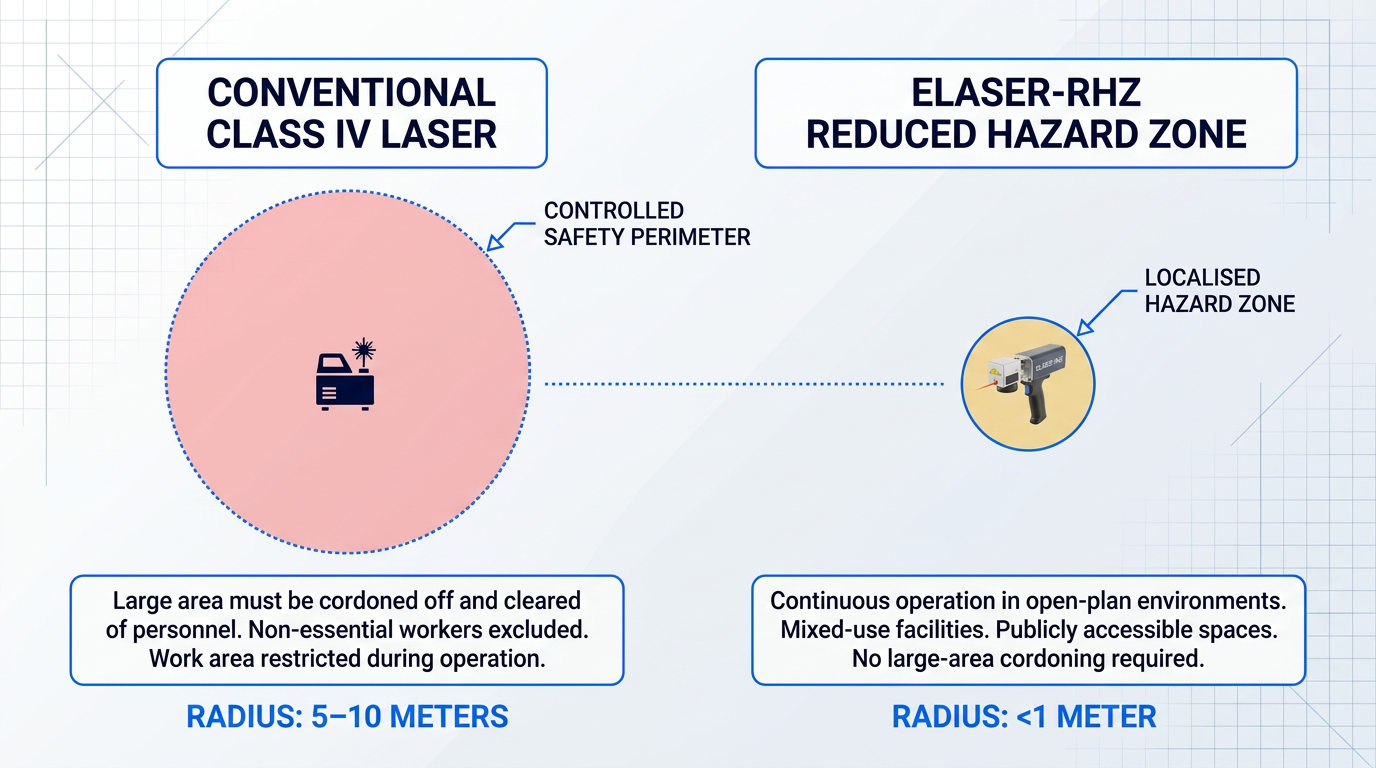
On the safety side, conventional laser cleaning equipment operates as a Class IV laser system. Under OSHA's laser safety framework — and equivalent UK and EU standards — this requires the work area to be controlled: non-essential personnel cleared, appropriate warning signage posted, and protective eyewear worn by anyone in or near the zone.
That is a real operational consideration when scheduling work in a busy facility, a publicly accessible space, or an occupied building — not a criticism of the technology, but a logistics factor that needs to be built into the job plan.
Some modern portable systems address this directly. Woodrow Scientific Limited's ELASER-RHZ uses WSL's world-first patented technology to collapse the laser reduced hazard zone to a small area immediately around the work — the only laser cleaner of its kind in the world.
In practice, this unlocks continuous operation in open-plan manufacturing environments, graffiti removal and heritage restoration in publicly accessible spaces, and cleaning in mixed-use facilities where sealing off a large area is simply not viable.
Conventional Class IV laser cleaning requires area evacuation and controlled perimeters. Reduced hazard zone technology shrinks that requirement to a small footprint around the work itself — a difference that determines whether laser cleaning is operationally feasible in occupied buildings, public spaces, and active production facilities.
WSL also provides first-class operator training with the system, giving contractors the knowledge to deploy it confidently across the full range of environments it opens up.
Buyers with operational constraints — occupied buildings, active production lines, publicly accessible heritage sites — should ask contractors specifically whether their equipment supports reduced-hazard-zone operation.
What the Client Needs to Have Ready
A good contractor will walk you through site requirements during the scoping conversation — ask for this briefing explicitly if it is not offered.
- Electrical supply: Modern portable systems typically run on standard single-phase supply (110–250 VAC) at under 2000 W — no specialist power infrastructure needed.
- Access clearance: Confirm clear access routes to the work area; a wheeled self-contained unit with a lightweight handheld scanner has a small site footprint.
- Fume extraction ventilation: The contractor's on-tool extraction handles capture, but confirm the site has adequate ambient ventilation for the work area.
- Adjacent surface protection: Any sensitive components, finishes, or surfaces near the work zone should be masked or protected before the job starts.
- Safety perimeter planning: Agree in advance how the controlled zone will be managed — this depends on the laser class of the equipment being used.
The site preparation overhead for a professional laser paint removal service is genuinely lighter than for abrasive or chemical methods — no media containment, no chemical storage, no water supply — but it is not zero, and the specifics depend on the equipment your contractor brings.
The environmental and safety protocols a contractor brings to a job are also part of what shapes how they scope and price the work — which is the next practical question to work through.
What Determines the Cost of Laser Paint Removal?
Ask most laser cleaning contractors for a price and you will receive either a vague range or an invitation to "contact us for a quote." That is not dishonesty — it is a genuine reflection of how variable these jobs are — but it leaves buyers with no framework for judging whether the number they eventually receive is reasonable. This section provides that framework.
The Primary Variables That Drive Job Cost
Before any figures make sense, it helps to understand the underlying logic: every cost driver in a laser cleaning job ultimately affects how long the work takes, and time on site is what you are paying for.
- Surface area: The most fundamental variable. More square metres means more time on site, straightforwardly.
- Coating type and thickness: A thin decorative film clears far faster than a thick industrial epoxy or a multi-layer stack — often the single biggest swing factor in quoted price.
- Substrate sensitivity: Heritage or delicate surfaces require slower, more conservative laser parameters to avoid damage, which directly increases time on site.
- Access and geometry: Confined spaces, overhead work, complex profiles, and hard-to-reach areas all reduce operator productivity and push up cost per square metre.
- Contamination level: Heavily contaminated surfaces or multi-layer coating systems require additional passes, multiplying the time required.
- Geography: Labour rates and mobilisation costs vary meaningfully by region. A job in central London carries different overhead to the same scope in rural Yorkshire.
Two jobs that look identical on paper — say, stripping paint from 50 m² of structural steelwork — can carry very different quotes if one involves a single-layer alkyd enamel on flat plate and the other involves a multi-coat epoxy system on a complex welded frame with restricted access.
The practical implication: when you contact a contractor, describe your job in terms of these variables, not just the area. The more precisely you can characterise the coating system, substrate condition, and access constraints, the more accurate the quote you will receive.
Cleaning Rate: The Commercial Variable Behind Every Quote
The concept that ties all of the above together is cleaning rate — the speed at which a laser system removes coating, measured in square metres per hour.
A portable laser cleaning unit running at 200W on mild steel with standard industrial paint covers roughly 2–6 m²/hour under typical conditions; on a single-layer alkyd enamel the upper end of that range is achievable, while a thick epoxy primer or heavily pitted surface can push the rate down to 0.5–2 m²/hour at the same power level.
The commercial logic follows directly: a higher cleaning rate means lower cost per square metre; a lower cleaning rate — driven by thicker coatings, more sensitive substrates, or difficult geometry — means higher cost per square metre, regardless of what the contractor's hourly rate is.
A contractor's hourly rate tells you very little on its own. Ask instead: "What cleaning rate do you expect on this substrate and coating type?" That single question lets you estimate job duration, sense-check the quoted price, and compare contractors on an equivalent basis.
Indicative Pricing Ranges by Job Type
The figures below are indicative market ranges drawn from industry sources — use them as a benchmark for evaluating whether a quote is in a credible range, not as a fixed price list. Your actual quote will depend on the specific variables described above.
| Job Type / Context | Indicative Price Range | Pricing Unit | Source Currency |
|---|---|---|---|
| General laser cleaning service (UK) | £50–£150 | Per hour | GBP |
| Day rate, contractor-operated (UK) | £500–£1,500 | Per day | GBP |
| Graffiti removal — standard surfaces (brick, concrete, UK) | From £45 | Per m² | GBP |
| Graffiti removal — standard surfaces (brick, concrete, international benchmark) | $4–$8 | Per m² | USD |
| Graffiti removal — premium substrates (stone, metal, international benchmark) | $15–$50 | Per m² | USD |
| Heritage cast iron railing (international benchmark) | $80–$200 | Per linear metre | USD |
| Historic steel panel cleaning (international benchmark) | $25–$75 | Per m² | USD |
| Bronze sculpture cleaning (international benchmark) | $500–$5,000 | Per object | USD |
| Heritage stone cleaning (UK) | From £85 | Per m² | GBP |
Indicative price ranges for laser paint removal services by job type and pricing unit, distinguishing verified GBP figures from USD international benchmarks, to help buyers evaluate contractor quotes.
Several patterns stand out in this data. Heritage and conservation work commands a significant premium over standard industrial cleaning — not because the laser technology is different, but because of the slower parameters required on irreplaceable substrates, the documentation overhead, and the liability exposure involved in working on historic material.
Graffiti removal illustrates the volume-versus-precision trade-off clearly: standard brick and concrete work is priced for throughput, while premium substrates carry rates three to ten times higher because the margin for error is smaller and the operator must work more carefully.
How Quotes Are Structured — and What to Watch For
Laser cleaning contractors typically price work using one of three structures: an hourly or day rate plus mobilisation (common for smaller or less well-defined jobs); a fixed price per project (appropriate when the scope is clearly bounded and the contractor has assessed the site); or a per-square-metre rate (common for large, uniform surfaces where area is the dominant variable).
Always ask which structure applies and what it includes — mobilisation, site setup, and follow-on surface treatment are sometimes bundled and sometimes billed separately, and the difference can be substantial on smaller jobs.
When reviewing quotes, the following are worth treating as warning signs rather than minor administrative details.
- Significantly below-market pricing: Quotes well below the ranges above often signal inadequate insurance, inexperienced operators, or a contractor who has underestimated the scope.
- Vague or undefined additional costs: A reputable contractor can tell you precisely what is and is not included. Open-ended "additional costs may apply" language is a scope-creep risk.
- No written breakdown: Any credible quote should itemise area, coating system, number of passes, mobilisation, and exclusions — not just a total figure.
- Refusal to commit to a test area: A professional contractor will always run a small test patch before full production cleaning. Reluctance to do so is a meaningful red flag.
The total job cost extends beyond the contractor's quoted rate. Site preparation, masking and protection for adjacent surfaces, any follow-on surface treatment before recoating, and post-job cleanup all contribute to the real cost of the work.
Laser cleaning's dry, residue-free process does reduce post-job cleanup compared to sandblasting or chemical stripping — as covered earlier in this guide — which is a genuine advantage in the total cost calculation, not just in the day-rate comparison.
With a clear picture of what drives cost and how to read a quote, the next question is whether the contractor behind that quote is actually qualified to deliver the work — which is what the following section addresses.
How to Evaluate and Vet a Laser Paint Removal Contractor
Hiring a laser paint removal contractor is not like hiring a decorator or a pressure-washer. The technology is skilled, the equipment varies enormously in quality and certification, and the consequences of getting it wrong — substrate damage, safety incidents, or a job that has to be redone — are expensive. Standard contractor-selection instincts will get you to a baseline; this section covers what lies beyond it.
Credentials and Insurance: The Baseline Floor
Every contractor should carry general liability insurance and workers' compensation coverage as a minimum — and you should ask for a certificate of insurance (COI), not a verbal assurance.
For industrial coating work, the AMPP QP programme (previously the SSPC QP programme) is a widely recognised independent accreditation used by facility owners as a pre-qualification tool for surface preparation and coating contractors.
AMPP's QP accreditation requires contractors to submit quality control, safety, and environmental compliance documentation, and to undergo an on-site audit of both their primary place of business and an active job site — it is a verified process, not a self-declaration.
For work on structures built before 1978, lead-safe certification is a separate and important credential: under the EPA's Renovation, Repair and Painting (RRP) Rule in the US, any contractor paid to disturb painted surfaces in pre-1978 housing or child-occupied facilities must be certified and trained in lead-safe work practices.
The key framing here is that credentials are table stakes — their absence is disqualifying, but their presence alone does not distinguish a good contractor from an adequate one.
Equipment Quality: The Sharpest Differentiator
This is where laser cleaning contractor vetting diverges most sharply from generic tradesperson selection, and where a buyer's due diligence pays off most clearly.
Professional-grade laser cleaning systems are manufactured to certified safety standards. In the UK and European market, CE and UKCA marking on the equipment are meaningful indicators that the machine has been assessed against defined engineering and safety requirements — ask to see equipment certifications, not just marketing claims.
Beyond certification, the question of who actually built the equipment matters more than most buyers realise.
A significant portion of the laser cleaning market consists of entities that present themselves as manufacturers but are in practice resellers or importers rebadging third-party machines — often sourced overseas and offered under a local brand name.
This matters practically: a genuine in-house manufacturer has the engineering depth to support its equipment, diagnose faults, supply spares quickly, and genuinely improve the product over time. A reseller typically cannot do any of those things — support queries get routed to a distant OEM, spares availability is uncertain, and the local entity has limited ability to troubleshoot at an engineering level.
Woodrow Scientific Limited's ELASER range is an example of what genuine in-house manufacturing looks like in this market: WSL is the only UK-based laser cleaning manufacturer, designing, building, servicing and improving its machines entirely in-house, with no reliance on a third-party OEM.
The practical question to put to any contractor is straightforward: does the manufacturer of your equipment design and build it in-house?
Reduced Hazard Zone Capability: A Job-Specific Signal
As covered in the safety section of this guide, conventional laser cleaning requires the work area to be sealed off and evacuated before cleaning begins — a significant operational constraint in occupied buildings, mixed-use facilities, or publicly accessible spaces.
WSL's ELASER-RHZ uses a world-first, patented reduced hazard zone technology that collapses the laser hazard to a small area around the work itself, enabling cleaning in open workshops, mixed-use facilities, and public-facing settings without full area evacuation.
If your job involves an occupied building, a live facility, or a publicly accessible space — heritage monument restoration, for example — ask specifically whether the contractor's equipment carries this capability, because not all systems do.
Operator Training: A Laser-Specific Quality Signal
Laser cleaning is a skilled, parameter-sensitive operation: power, frequency, pulse duration, scan speed, and beam width must all be matched to the specific substrate and coating type.
Incorrect settings can cause surface damage — discolouration, micro-cracking, or unintended substrate removal — that is difficult or impossible to reverse on heritage or precision components.
The strongest signal here is whether operators have completed formal training from the equipment manufacturer: a contractor whose operators have trained directly with the manufacturer is meaningfully better prepared than one who has relied on self-guided learning or informal handover.
WSL provides first-class safety and operation training as part of the ELASER package — this is the standard a well-qualified contractor should be able to demonstrate.
A reputable contractor will offer — or readily agree — to perform a test clean on an inconspicuous area before production cleaning begins. This validates parameters on your specific substrate and coating, and gives you a visible quality benchmark before any commitment to the full job. A contractor who resists or dismisses this step is a meaningful red flag.
Portfolio and Comparable Work
When reviewing a contractor's portfolio, comparable work matters more than volume of work.
A contractor with ten years of industrial steel cleaning experience is not automatically qualified for ornamental bronze heritage restoration — the substrate behaviour, the required precision, and the acceptable tolerance for surface alteration are entirely different.
Ask for examples involving the same substrate type, similar coating system, and comparable scale — and request before-and-after photographs at standardised locations.
For heritage or precision work, the standard of evidence goes further: ask whether profilometry measurements (surface roughness data, expressed as Ra or Rz values) were taken before and after cleaning to confirm that no substrate texture change occurred.
A contractor who can produce parameter documentation — the specific laser settings used for a given job, recorded and reported in a final job file — is demonstrating a level of process discipline that separates professional service from ad hoc operation.
Safety Record for Industrial Procurement
For industrial clients and facility managers, the Experience Modification Rate (EMR) is a standard industry metric for contractor safety performance.
According to OSHA guidance, an EMR compares a contractor's workers' compensation claims history against similar employers in their industry — a score below 1.0 indicates a claim history better than the industry average, and it is routinely used in contractor pre-qualification processes across industrial procurement.
Industrial facility managers and HSE-conscious clients will typically find it useful to request an EMR figure alongside written safety programme documentation — this is standard practice in industrial contractor pre-qualification, as reflected in OSHA partnership agreements.
Not every buyer will need this level of scrutiny, but for any job on a live industrial site, it is a relevant and well-established benchmark to apply.
With these evaluative criteria in hand, the next step is knowing how to surface them effectively in conversation with a contractor — the specific questions to ask are covered in the next section.
See What Certified Laser Cleaning Equipment Looks Like
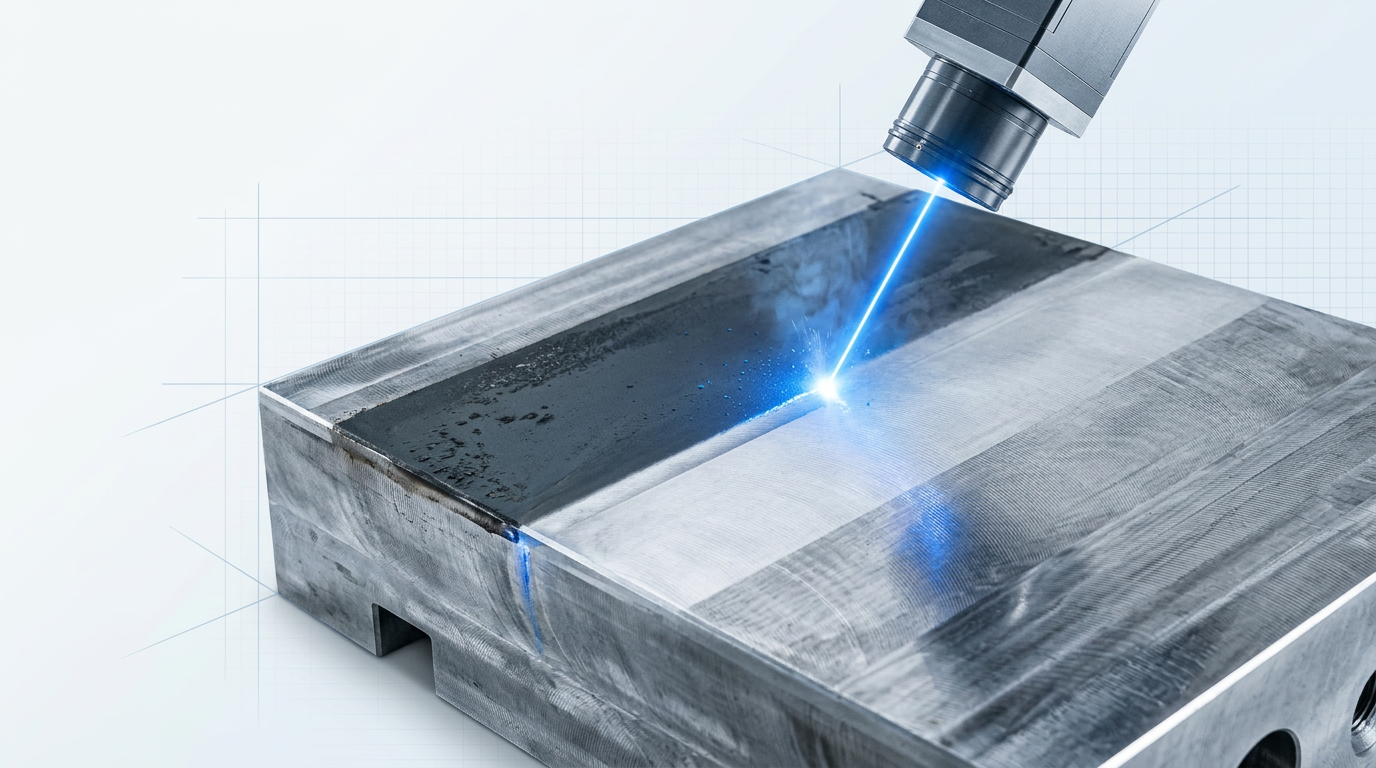
You now know what to look for in a contractor's toolkit. The ELASER-RHZ is eye-safe, certified professional-grade equipment — the kind of machine worth asking your contractor about.
Questions to Ask Before You Hire
Everything covered so far in this guide — how jobs are scoped, what drives cost, what separates a capable contractor from an underqualified one — distils down to this: the questions you ask before you sign anything.
What follows is not a bureaucratic checklist. It is the set of questions an experienced specifier puts to any contractor they are seriously considering, grouped by what each cluster is really testing. Pay as much attention to how a contractor answers as to what they say — hesitation, vagueness, or deflection on any of these is itself useful information.
Job Scope and Experience
Comparable experience is not the same as general laser cleaning experience. A contractor who has spent years removing graffiti from brick may have very little parameter knowledge for thin-gauge automotive steel or heritage bronze.
Push for specifics: the same substrate type, a similar coating stack, and comparable scale to your job.
- Can you show me comparable work?: Ask for examples on the same substrate and coating type — not just general laser cleaning jobs. Photos or site references are reasonable to request.
- What cleaning rate do you expect?: A contractor who gives a realistic m²/hour estimate for your specific surface has genuinely thought about the job. Vague answers suggest they haven't.
- What parameters will you use?: Experienced operators can speak to pulse frequency, power, and scan speed for your coating type. Inability to answer is a concern.
Test Area Protocol
This is the single most reliable proxy for contractor quality in the entire conversation. A reputable contractor will offer a test clean on an inconspicuous area before committing to full production — and will invite you to review and approve the result before work proceeds.
A contractor who resists this step, dismisses it as unnecessary, or tries to fold it into billable time without discussion is signalling something worth taking seriously.
A contractor who readily offers a test clean, reviews it with you, and adjusts parameters before proceeding is demonstrating competence, transparency, and care for your asset — all at once. One who pushes back is telling you something important.
Ask these three questions specifically: whether they will perform a test clean before full production begins, whether you can approve the result before work proceeds, and how they will adjust parameters if the test result falls short of expectation.
Substrate Preservation
Incorrect laser parameters are the primary mechanism by which laser cleaning causes substrate damage. A contractor who cannot clearly articulate their approach to substrate preservation has not thought carefully enough about your job.
- How do you protect the base material?: Look for specific answers about power levels, pulse duration, and scan speed — not a generic reassurance that lasers are inherently safe.
- Do you measure surface condition before and after?: Baseline and post-clean measurement shows a contractor is accountable for the substrate, not just the coating removal.
- How do you confirm coating removal, not damage?: Reputable contractors use visual inspection, surface profiling, or both. Ask what their specific verification method is.
Equipment
The laser cleaning market includes a wide range of equipment, and not all of it is equal. A meaningful share of machines sold to contractors are rebadged imports with no genuine manufacturer support — meaning the contractor operating them may have limited ability to diagnose problems or optimise settings for unusual jobs.
Ask about CE or UKCA certification as a baseline safety and quality indicator, and probe whether the manufacturer designs and builds their equipment in-house or sources it externally.
- What system do you use, and who makes it?: In-house designed and built equipment gives the contractor access to genuine engineering support and deeper machine knowledge.
- Is the equipment CE or UKCA certified?: Certification is a meaningful safety and quality indicator in the UK and European market. Uncertified equipment is a flag.
- What is the power range and scanner reach?: Power range and delivery reach determine what jobs the system can handle. Mismatched equipment leads to slow or incomplete cleaning.
Safety Management
On-site laser operation requires a managed safety perimeter, and the practicalities of that perimeter matter considerably if your facility is occupied, public-facing, or operationally active during the works.
Ask how the contractor handles laser safety zones on your specific site — and whether their equipment supports reduced-hazard-zone operation if full area clearance would be disruptive. Also confirm what PPE requirements apply to any of your personnel who may be in the vicinity.
Waste and Fume Handling
Laser cleaning produces a fine particulate waste stream and fumes from vaporised coating material. On-tool fume extraction is the standard approach for reputable contractors — it captures particulate at the point of ablation rather than allowing it to disperse into the working environment.
If your job involves an older structure where lead-based paint is plausible — particularly pre-1978 buildings or older industrial plant — ask directly about lead-safe protocols and seek specialist guidance for your specific situation.
The core questions here are: whether the contractor uses on-tool extraction, how waste material is disposed of, and — where relevant — what specific protocols they follow if lead-based paint is present on the structure.
Credentials and Insurance
A contractor's willingness to produce documentation is itself a quality signal. Ask for a current certificate of insurance covering general liability as a baseline — and ask specifically about operator training credentials, not just a claim that staff are 'trained.'
For industrial, heritage, or conservation work, it is worth asking whether the contractor or their operators hold recognised specialist accreditations — AMPP QP programmes are a known quality indicator for industrial coating contractors and worth asking about directly.
- Can you provide a certificate of insurance?: General liability coverage is a baseline. Ask to see the current certificate rather than accepting a verbal confirmation.
- Do operators hold manufacturer-issued credentials?: Verifiable, manufacturer-issued certification is more meaningful than a general claim of trained operators. Ask what it covers.
- Do you hold any specialist accreditations?: For industrial or heritage work, AMPP QP programmes are a recognised quality indicator worth asking about specifically.
Pricing and Contract Terms
Vague pricing with loosely defined additional costs is one of the more reliable warning signs in any contractor conversation. Ask whether the quote is fixed-price or day-rate, what is explicitly included, and what circumstances would trigger extra charges.
It is also worth noting that a contractor who resists committing to a test area is often the same contractor whose pricing has underestimated the scope — the two patterns tend to travel together.
Cover four points explicitly: whether the quote is fixed or day-rate, what could trigger additional costs, whether any warranty or guarantee applies to the work, and what the payment terms and milestone structure look like.
Getting the right answers here puts you in a strong position to select a contractor with confidence. The next step is knowing how to evaluate the quality of the work itself — once the job is underway and after it is complete.
How to Assess the Quality of Laser Paint Removal Work
Most buyers commissioning laser paint removal services for the first time have no reference point for what good work actually looks like — and that gap is exactly what a less attentive contractor can exploit. Knowing what to look for, at each stage of the job, puts you in a far stronger position.
Before the Job Starts
A quality contractor will document the surface condition before work begins: photographs at consistent, standardised locations, rust grade mapping where corrosion is present, and identification of any coating types that require special handling.
This pre-job documentation is a mutual protection mechanism — it gives both parties a clear, agreed baseline and prevents later disputes about what condition the surface was in at the start. If your contractor has not initiated this process, ask for it before cleaning begins.
Before production cleaning starts, a reputable contractor will run a test clean on a small, inconspicuous area of the surface. This is your most important pre-commitment quality check, and you should treat it as a right rather than a courtesy.
When inspecting the test area, use a good directional light source and look for uniform removal across the entire patch — not just in the centre. Confirm the substrate texture is preserved: there should be no pitting, no discolouration, and no scorching. Check that the coating has been fully removed at the edges of the test patch, since incomplete removal tends to hide at the margins first.
Once production cleaning begins, course-correcting is disruptive and costly. Inspect the test patch thoroughly under raking light before giving the go-ahead — substrate texture, edge removal, and absence of discolouration are the three things to confirm.
During the Job
A competent operator works with steady, overlapping traverse passes — not erratic, rushed, or uneven movement. Visible striping or missed patches during cleaning are a direct indicator of inconsistent technique.
Check that on-tool fume extraction is running continuously throughout the operation, not intermittently. Also watch for any substrate discolouration or scorching appearing in or around the cleaned area — blue or brown tinting on steel, in particular, signals localised thermal overrun and warrants an immediate conversation with the contractor.
A skilled operator actively monitors and adjusts parameters as conditions change — coating thickness varies across a surface, geometry shifts, and ambient conditions fluctuate. A contractor who sets parameters once and walks away is guessing, not controlling.
After the Job
A correctly cleaned surface should be dry, free of embedded contaminants, and ready for the next process — whether that is recoating, welding, or inspection — with no secondary cleanup of abrasive media or chemical residue required.
Pay particular attention to edges, seams, and contours: these are the areas where incomplete cleaning is most likely to be concealed. Uniform removal across complex geometry is a genuine mark of a well-executed job.
The absence of residue is itself a quality indicator. Unlike sandblasting or chemical stripping, laser cleaning leaves no secondary contamination on the surface — so any residue you can see or feel after the job is a problem, not an expected byproduct.
Objective Verification for Professional and Heritage Projects
On more demanding work — industrial structures, heritage metalwork, precision components, or any job where the surface will be recoated to a formal specification — contractors and specifiers use objective measurement methods to confirm quality. Not every job requires all of these, but knowing what rigorous looks like gives you the vocabulary to ask for it when it matters.
- Surface profilometry: Measures Ra and Rz roughness values before and after cleaning to confirm substrate texture has not been altered. Relevant for precision components and recoating specs.
- UV lamp inspection (365 nm): Residual organic binders and coating fragments fluoresce under long-wave UV, revealing contamination invisible to the naked eye under white light.
- Bresle patch salt testing: Extracts water-soluble contaminants from the surface to verify ionic cleanliness before recoating. Soluble salts left on steel cause osmotic blistering and premature adhesion failure.
- Written treatment record: A documented log of parameters used — power, scan speed, pass count, extraction method — protects both parties and is standard practice on significant projects.
On a straightforward maintenance recoat, visual inspection and a profilometry check will often suffice. On structural steel, heritage conservation work, or any project where a recoating failure would be costly to trace and rectify, asking for the full verification package is entirely reasonable.
Industry Standards for Surface Cleanliness
AMPP SP21511-1 is the standard specifically written for pulsed laser ablation in ferrous metal surface preparation, approved in 2024 and intended to enable specifiers and end users to achieve a defined level of surface cleanliness using pulsed laser technology. A contractor who references this standard is operating within a recognised professional framework — it is a useful signal when evaluating providers for industrial or infrastructure work.
ISO 8501-1 provides the visual cleanliness grades used to assess steel surfaces before coating. The grade Sa 2.5 — defined as very thorough blast cleaning, with any remaining traces of contamination showing only as slight stains in the form of spots or stripes — is the specification most commonly required on industrial and structural steel projects, and is cross-referenced to SSPC-SP 10 / NACE No. 2 in North American practice.
If your project involves structural steel, civil infrastructure, or any formal coating specification, ask the contractor which standard their work is specified to and whether they can confirm compliance. These are not regulatory requirements you need to enforce — they are simply the vocabulary of the industry, and a capable contractor will be comfortable using them.
With that, you have the complete evaluative picture: how to vet a contractor before you engage them, what questions to ask, and now how to judge the quality of the work itself from start to finish. The final section brings all of this together into a practical framework for making your hiring decision with confidence.
Conclusion
Making a confident hiring decision
The contractors worth hiring share three qualities: a demonstrable track record of substrate preservation, professional-grade certified equipment, and the willingness to scope a job transparently in writing.
That last point has a practical test built into it — a contractor who readily agrees to a trial area before full production is showing you confidence in their own work.
Get quotes from several contractors, go in with a clear brief covering your substrate, coating type, and surface area, and ask each one for before-and-after examples of comparable jobs. You know what to look for now.
Frequently asked questions about laser paint removal services
Answers to the questions buyers most commonly ask when considering a professional laser paint removal service.
Yes — laser paint removal is widely available as a professional contractor service. Trained technicians bring portable, self-contained equipment directly to your site and carry out the work on your behalf. You do not need to source or operate any equipment yourself. This is a specialist service requiring trained operators and correctly matched equipment parameters for each substrate and coating type — it is not suited to DIY. The guide above covers how to find and evaluate a qualified contractor, including the questions worth asking before you commit.
Costs vary significantly depending on surface area, coating type and thickness, substrate sensitivity, access and site geometry, and location. Laser paint removal is generally priced at a specialist contractor rate, with heritage and conservation work typically commanding a premium above standard industrial rates. Always request a scoped written quote rather than relying on a headline hourly figure. The contractor's rate is not the full job cost — site preparation, any follow-on surface treatment, and post-job work all need to be factored into your budget.
Yes — laser ablation is a proven industrial process with a long track record across automotive, aerospace, heritage, and infrastructure sectors. The laser causes the coating to vaporise or fracture away from the substrate, while the base material — which absorbs the laser energy differently — remains largely intact. The critical variable is correct parameter matching: the right power level, pulse settings, and technique for the specific substrate and coating combination. A reputable contractor will run a test area on an inconspicuous section before full production cleaning, which confirms the parameters are dialled in correctly for your job.
Laser cleaning removes paint effectively from a broad range of surfaces, including most metals and masonry substrates such as structural steel, cast metals, stone, brick, and concrete. Some substrates — certain plastics, composites, or very heat-sensitive materials — require specialist assessment before work begins, because the laser's energy interaction with those materials differs from metals and masonry. A reputable contractor will assess suitability for your specific substrate and coating before committing to a full job, and will typically offer a test area to confirm results. If in doubt, ask the contractor directly whether they have relevant experience on your substrate and can show comparable examples.
Laser removal preserves the substrate surface profile — the beam stops at the base material, leaving no etch, peen, or dimensional change. Sandblasting, by contrast, introduces abrasive media into the surface and can warp thin panels or etch sensitive substrates. On the waste and site management side, laser is a dry process with no spent abrasive media to contain or dispose of, while sandblasting generates significant waste requiring active containment and cleanup. That said, sandblasting remains competitive for high-volume work on robust substrates where a coarse anchor profile for coating adhesion is acceptable or desirable — and it is generally faster and more economical in those scenarios. Neither method is universally superior; the right choice depends on the substrate, the required surface outcome, and the constraints of your site.
For the UK and European market, check that the contractor uses equipment certified to relevant safety standards — CE and UKCA marking are meaningful indicators, not just administrative box-ticking. For industrial coating work, ask whether the contractor holds recognised quality accreditation for coating operations; established programmes exist specifically for this trade and a credible contractor should be able to name the standard they work to. If the work involves older structures where lead-based paint may be present, ask specifically about the contractor's lead-safe protocols and any relevant training they hold — the principle of demonstrable lead-safe competence is well-established, and a competent contractor should be able to explain their approach clearly. Always request a current certificate of insurance in writing rather than accepting a verbal assurance.