
Introduction
If you're researching laser cleaning services and finding that most results read more like sales brochures than honest evaluations, you're in the right place.
This guide covers the genuine pros and cons, real cost context, how laser cleaning stacks up against sandblasting and chemical treatment, and what to look for — and watch out for — when choosing a provider.
That includes the parts most providers would rather you didn't dwell on: where laser cleaning falls short, which jobs it isn't suited to, and how to make a clear-headed decision.
TL;DR
Laser cleaning is a genuinely superior method for precision, surface-integrity-critical, and waste-sensitive applications — but it is not the right answer for every job. The buyers who get the best outcomes are those who understand exactly where it wins, where it doesn't, and how to evaluate a provider on that basis.
This article covers:

Genuine advantages and limitations of laser cleaning
Laser cleaning vs sandblasting and chemical treatment
Laser cleaning costs and value
Best applications and substrates for laser cleaning
What to ask providers — and red flags
What are laser cleaning services?
Laser cleaning services are a category of professional industrial work in which trained operators deploy high-powered laser systems on behalf of clients to remove unwanted material from surfaces — rust, corrosion, paint, coatings, oxides, weld discolouration, graffiti, and mould residues among them.
The client engages the service to get a result: a cleaned surface, ready for the next stage of production, restoration, or maintenance. They do not own the equipment, configure the laser parameters, or manage the operational setup — that is the provider's responsibility entirely.
The process works through a phenomenon called laser ablation. A focused laser beam is directed at the surface, where the contaminant layer — rust, paint, oxide, or whatever is being removed — absorbs the laser energy and vaporises or is ejected as particles, often forming a brief plasma plume above the surface.
The base material beneath behaves differently: metals and other relatively reflective substrates do not readily absorb the laser energy at the same threshold, so the removal process effectively stops once the contaminant is gone and the substrate is reached.
Contaminants like rust, paint, and oxides have lower ablation thresholds than the metals beneath them — so the laser removes the unwanted layer and stops, without the beam needing to 'know' when to switch off.
Service providers typically deploy one of two equipment configurations: portable handheld fibre laser systems, which are wheeled mobile units with a lightweight scanner the operator guides across the workpiece on-site; or automated robotic systems, where a laser cleaning head is mounted on a robotic arm and programmed for high-volume, repeatable production cleaning.
Where laser cleaning services are applied
The range of jobs laser cleaning services are engaged for is broader than most buyers initially expect, spanning heavy industry, precision manufacturing, and heritage conservation.
- Rust and corrosion removal: Rust rapidly absorbs laser energy and vaporises, making laser cleaning a preferred method for descaling and surface preparation on fabricated steel parts.
- Paint and coating stripping: Coatings are removed selectively — including partial decoating of multi-layer paint systems — without affecting the primer or underlying substrate.
- Weld preparation and HAZ cleaning: Laser cleaning removes oxides, shop-primer, hydrates, and grease before welding, and clears weld residues and thermal stains from finished joints.
- Mould and tooling maintenance: Release agents, vulcanising residue, and other deposits are cleared from injection moulds and tooling without disassembly or abrasive contact.
- Heritage and restoration work: Stone, metal, and other heritage materials are cleaned with precision that abrasive methods cannot match, preserving the substrate beneath.
- Graffiti removal: Laser systems can be brought to the site and used to remove paint from stone, brick, and metal surfaces without damaging the underlying material.
What these applications share is that the client needs the outcome — a clean surface — not the technology that produces it, which is precisely why the service model exists.
In physical terms, laser cleaning is a dry, non-contact process: the beam never physically touches the workpiece, no water or chemicals are involved, and no abrasive media is consumed or needs disposal. The one operational requirement the process does generate is fume extraction, to capture the vaporised contaminant particles produced during ablation.
With a clear picture of what laser cleaning services are and how the process works, the more substantive question is what they genuinely deliver — and where the real-world performance holds up under scrutiny.
The genuine advantages of laser cleaning services
Knowing how the ablation process works is one thing — knowing what it means for a procurement decision is another. The advantages of laser cleaning services are real, but they are not universal: they are structural advantages that apply strongly in specific conditions and matter less in others. Here is what the engineering actually delivers.
Precision and selectivity: the self-limiting beam
The central advantage of laser cleaning is what trade press sources describe as the self-limiting beam: the laser energy is absorbed efficiently by the contaminant layer, but when the beam reaches the base material, the higher reflectivity and different thermal properties of the substrate cause it to stop acting destructively.
As Laser Focus World's technical coverage explains, metals have high reflectivity for the typical solid-state wavelength of 1064 nm, while impurities and oxides absorb laser radiation far more readily — so moderate beam intensities remove contamination without damaging the metal underneath.
IPG Photonics describes this in terms of ablation thresholds: every material has a threshold energy required to vaporise it, and the materials most commonly targeted for removal — rust, oil, paint, oxides — have lower thresholds than the steel or aluminium substrates beneath them.
The practical consequence for buyers is that dimensions, tolerances, and fine surface detail are preserved in a way that abrasive methods, which remove material non-selectively, cannot reliably replicate.
Non-contact process: no mechanical force on the workpiece
Because the laser delivers energy optically, the process is entirely non-contact: no physical media touches the surface, so there is no mechanical stress, no peening, and no risk of abrasive particles becoming embedded in the workpiece.
IPG Photonics notes that the non-contact nature of laser cleaning makes the process highly repeatable and offers precise control over the treatment's effect on the surface — a combination that matters particularly for thin-gauge metal, precision-machined surfaces, heritage stonework, and delicate castings where any abrasive impact would cause dimensional change or visible damage.
No consumables: electricity is the only input
Laser cleaning requires no consumables beyond the electricity that drives the system: no abrasive media to purchase, store, or contain; no chemicals to handle or dispose of; no water.
This is a genuine operational simplification, not just an environmental talking point — it removes the logistics of media recovery, spent-abrasive containment, and chemical waste handling from the job entirely.
The contrast with abrasive blasting is instructive: spent blasting media contaminated with dangerous substances is classified as hazardous waste under UK legislation (EWC code 12 01 16*), and EPA documentation confirms that blast media used to remove lead-based paint requires disposal as hazardous waste under RCRA in the US — a compliance and cost burden that laser cleaning simply does not generate.
Access to complex geometries
A handheld laser scanner can be directed into injection mould cavities, heat-affected zones on welds, recessed profiles, and tight internal corners — complex geometries that sandblasting nozzles cannot treat selectively and chemical immersion baths cannot treat locally.
Alternatives typically require masking, partial disassembly, or accepting non-selective treatment of surrounding surfaces; the laser can be aimed precisely at the target area without any of those workarounds.
Reduced substrate loss and lower rework risk
Laser Focus World's technical coverage notes that ablation depth can be controlled within 5–10 µm, making it possible to selectively remove individual layers — for instance, a topcoat but not the primer beneath it.
Because over-processing is substantially harder to achieve than with abrasive methods, substrate loss is minimised: surfaces are not accidentally damaged, dimensions are not changed, and post-cleaning inspection is less likely to reveal harm to the base material.
For buyers, this translates directly into reduced rework, less unplanned downtime, and a lower total job cost — the operational consequence of the self-limiting mechanism, not just a technical property.
The same physics that makes the beam selective also makes over-cleaning structurally difficult — the beam stops acting destructively when it reaches the base material. That is a fundamentally different risk profile from abrasive methods, where the operator's judgement is the only thing standing between a clean surface and a damaged one.
The environmental and regulatory profile reinforces these operational advantages: no chemical waste streams, no silica dust, and no spent abrasive classified as hazardous waste — which is particularly relevant when removing coatings containing lead or heavy metals, where abrasive blasting generates significant compliance obligations under both UK and US regulation.
Process repeatability for quality-critical applications
Laser parameters — power, pulse rate, scan speed, and scan pattern — can be set, documented, and reproduced exactly across multiple jobs and components, delivering consistent results from the first component to the hundredth.
This process repeatability is not merely convenient: in sectors such as aerospace, automotive, and precision manufacturing, documented process control is a procurement requirement rather than a preference, with frameworks such as AS9100 requiring validation and documented information for special processes where output cannot be fully verified by subsequent inspection alone.
Laser Focus World's coverage of industrial laser technology adoption notes that industries typically require demonstrated reliability and repeatability — including quality certifications — before committing to a process, and laser cleaning has reached that threshold in quality-critical applications including aerospace component preparation.
These advantages are genuine and, in the right application, substantial — but no cleaning method is without limits. The next section examines where laser cleaning services fall short, so you can weigh the strengths described here against the constraints that will shape whether the method is the right fit for your specific job.
What are the disadvantages of laser cleaning?
Most content on laser cleaning services skips this part entirely, or buries it in qualifications designed to reassure rather than inform. The trade-offs are real, they are specific, and they matter for procurement decisions — so here they are, plainly stated.
Higher day rate on large open surfaces
For large-area structural work — bulk rust removal on open steelwork, paint stripping across wide flat panels — laser cleaning typically carries a higher day rate than sandblasting.
This is not a myth to be debunked or a gap that clever total-cost modelling always closes: on genuinely large open surfaces, laser cleaning costs more per day, and buyers should factor that in when scoping projects.
The throughput gap is real and material
The reason for that cost differential is speed. Research-sourced indicative figures put laser cleaning removal rates at roughly 1–10 m² per hour depending on laser power, contamination type, and depth — with lower-power pulsed units on heavy rust sitting toward the bottom of that range.
Sandblasting on comparable open structural prep can achieve 5–30 m² per hour; experienced blast crews on open surfaces with established containment regularly work in the 10–25 m²/hr band.
On large open structural surfaces, sandblasting can cover two to five times the area per hour that a laser cleaning system achieves at equivalent power levels. For bulk prep work, this is a material project-planning consideration, not a rounding error.
Higher-power continuous-wave systems narrow this gap significantly, but the capital and operational demands of those systems are correspondingly greater — and for field service work, portable pulsed units remain the norm.
Contaminant thickness and type limits
Laser cleaning performs best on thin, brittle, and loosely adhered contaminants — rust layers, mill scale, oxide films, and paint coatings typically under approximately 0.5 mm thickness.
Thick, flexible, or elastic coatings — heavy rubber linings, certain polymer coatings — present a harder problem: rather than ablating cleanly, they tend to dissipate laser energy through deformation, which means incomplete removal or a requirement for multiple passes that erodes cost-effectiveness.
Deep pitting corrosion is similarly difficult; the geometry of deep pits limits laser access and the volume of material to be removed exceeds what ablation handles efficiently.
Substrate boundaries require careful management
Three substrate categories warrant specific attention from any buyer evaluating laser cleaning services.
- Highly reflective metals: Copper and polished aluminium reflect rather than absorb laser energy, requiring careful parameter calibration to avoid incomplete cleaning or unintended substrate damage.
- Very thin gauge materials: Thin-section substrates are sensitive to heat input, particularly from continuous-wave systems; thermal management is critical to avoid distortion or surface alteration.
- Composite materials: Some composites carry a subsurface delamination or microstructural damage risk if laser parameters are not correctly matched to the material's ablation and damage thresholds.
None of these substrates is off-limits for a skilled, well-equipped operator — but they require parameter expertise that an underprepared provider may not have, and buyers should probe this directly when evaluating service providers.
Class 4 laser hazard: a real operational overhead
Industrial laser cleaning systems are Class 4 lasers — the highest hazard classification under both US (OSHA/ANSI Z136.1) and IEC frameworks — meaning direct or reflected beam exposure can cause immediate, permanent eye and skin damage.
Responsible operation requires wavelength-matched, OD-rated laser safety eyewear for all personnel in the controlled area, a defined laser-controlled work zone with restricted access, and operators trained to the requirements of the applicable standard.
This is not optional, and it adds genuine operational complexity compared to some alternative cleaning methods — buyers should expect it and use it as a baseline checkpoint when assessing any service provider.
Fume extraction is non-negotiable
When laser ablation vaporises contaminants, it generates fine particulate matter — including iron, aluminium, and manganese particles — as well as volatile organic compounds (VOCs).
A peer-reviewed study measuring emissions during laser rust removal recorded mean PM₁₀ concentrations above 7,000 µg/m³, with instantaneous peaks exceeding 10,000 µg/m³ — figures that make a local exhaust ventilation (LEV) system with appropriate filtration a non-negotiable operational requirement, not an optional accessory.
For on-site field work, this means portable extraction equipment must travel with the operator, adding to the logistical footprint of any mobile laser cleaning service.
Results depend heavily on operator expertise
Laser cleaning is parameter-sensitive: pulse frequency, power density, scan speed, and spot size all interact to determine whether a contaminant is removed cleanly or the substrate is damaged.
Peer-reviewed parameter studies confirm that incomplete cleaning and substrate damage can both result from incorrect settings — the former leaving contamination in place, the latter causing surface alteration, remelting, or microstructural change that may be invisible to the naked eye.
This is one of the most significant differentiators between high-quality and low-quality laser cleaning service providers: the method rewards expertise and punishes shortcuts in ways that simpler cleaning methods do not.
Understanding these limitations in isolation is only part of the picture — the next question is how they stack up against the most common alternative, which is where the sandblasting comparison becomes essential.
Laser Cleaning vs Sandblasting: Where Each Method Wins
When buyers evaluate laser cleaning services, sandblasting is almost always the method they're comparing against — and the honest answer to which one wins is that it depends entirely on the job: the surface, the scale, the substrate, and what you're trying to achieve.
These two methods are optimised for fundamentally different things. Sandblasting is built for speed and scale; laser cleaning is built for precision and substrate integrity. Understanding where each method is genuinely stronger — rather than accepting a vendor's ranking — is the framework buyers need.
| Decision Axis | Sandblasting | Laser Cleaning |
|---|---|---|
| Throughput on open structural steel | 10–30 m²/hour (experienced crew, established containment) | 1–8 m²/hour at equivalent power levels on comparable surfaces |
| Substrate impact | Removes base material; increases surface roughness (Ra) by 1–10 µm; risk of micro-fractures on thin or precision parts | Non-contact; substrate profile preserved within ±2–5 µm; no abrasive embedment |
| Selectivity and geometric access | Low — requires masking for any controlled work; cannot reach mould cavities or complex profiles | High — beam targetable to millimetre accuracy; reaches weld zones, cavities, and intricate geometry without masking |
| Waste output per shift | Hundreds of kg of spent abrasive media; classified as hazardous waste if lead paint or heavy metals are involved | 0.5–5 lbs of dry particulate per shift, captured by HEPA extraction; no media disposal requirement |
| Primary health hazard | Respirable crystalline silica dust — linked to silicosis, lung cancer, and COPD (HSE/NIOSH) | Laser radiation and fume extraction requirement — no silica exposure |
| Cost structure | Lower capital/mobilisation cost; ongoing media, PPE, containment, and disposal expenses | Higher service rate; near-zero consumables; no media disposal cost |
Side-by-side comparison of laser cleaning and sandblasting across five quantifiable decision axes, using sourced figures for throughput, waste output, substrate impact, health hazard profile, and cost structure.
The table reveals a clear asymmetry: sandblasting holds a substantial throughput advantage on large flat surfaces, while laser cleaning leads on every axis that involves substrate condition, waste, and precision.
The pattern that matters most for procurement decisions is this — the throughput gap is real and should not be minimised, but throughput is only one variable in the total job cost. For jobs where the substrate is sensitive, the geometry is complex, or the waste profile changes the equation, the throughput advantage of sandblasting becomes less decisive.
Where sandblasting retains the edge
On large-area structural steel — bridge girders, storage tanks, ship hulls — sandblasting is genuinely faster and, where blast infrastructure is already in place, more economical per square metre cleaned.
Sandblasting also creates an anchor profile: the mechanical roughening of the substrate surface that heavy industrial coating systems require for adhesion. Where a specification calls for Sa 2.5 or Sa 3 per ISO 8501-1 with a defined surface profile, sandblasting delivers that profile as a natural byproduct of the process — laser cleaning, which preserves the original surface topography, does not.
For one-off large-area jobs where containment is already established and the coating specification demands surface roughness, the economics and process requirements will often favour sandblasting. That is an honest assessment, not a caveat.
Where laser cleaning wins
The substrate-preserving quality of laser cleaning becomes most valuable precisely when the alternative is abrasive blasting. On precision parts, thin-gauge metal, aerospace components, and tooling where dimensional tolerances must be held, sandblasting's uncontrolled material removal is a disqualifying problem — not a minor inconvenience.
Laser cleaning also enables selective zone treatment that sandblasting cannot match: the beam can be targeted to millimetre accuracy, removing a coating from a weld repair area or connector point while leaving the surrounding surface intact. Sandblasting requires masking for any selective work, and masking complex geometry is both labour-intensive and imperfect.
In enclosed or occupied environments — factory floors, clean rooms, heritage buildings — sandblasting is simply not viable. Laser cleaning produces no airborne abrasive media, generates no containment requirement for the process itself, and can operate in spaces where blasting would be impractical or prohibited.
The waste profile is a genuine differentiator on jobs involving lead paint or heavy metal coatings. Sandblasting generates hundreds of kilograms of spent abrasive per shift; when that abrasive has contacted lead-based paint, it is classified as hazardous waste under RCRA (US) and equivalent regulations, requiring licensed transport and disposal at permitted facilities at $250–$600 per drum. Laser cleaning's dry particulate output — typically 0.5 to 5 lbs per shift, captured by HEPA extraction — carries no comparable disposal burden.
On the health axis, the contrast is stark but requires honest framing on both sides. According to HSE and NIOSH, sandblasting with silica-containing abrasives generates respirable crystalline silica dust — a well-documented occupational hazard linked to silicosis, lung cancer, and COPD. NIOSH has recommended since 1974 that silica sand be eliminated as a blasting abrasive, and the practice is banned in the UK. Laser cleaning eliminates silica exposure entirely — but it introduces its own requirements: laser radiation hazard management and fume extraction for vaporised contaminants. Neither method is risk-free; the hazard profiles are simply different.
Sandblasting covers 10–30 m²/hour on open structural steel; laser cleaning covers 1–8 m²/hour on comparable surfaces. That gap matters for large-area work. But for precision parts, enclosed spaces, or jobs where spent abrasive becomes hazardous waste, throughput is not the deciding variable — substrate integrity and total disposal cost are.
On total cost of ownership, the two methods have asymmetric profiles: sandblasting carries lower capital and mobilisation costs but ongoing media, PPE, containment, and disposal expenses. Laser cleaning carries a higher service rate but near-zero consumables and no media disposal. For high-frequency precision work — post-weld HAZ treatment, mould cleaning, field maintenance — the TCO case for laser cleaning strengthens considerably over time. For a large-area one-off structural job where blasting infrastructure is already in place, the economics may still favour sandblasting. The right comparison runs across the full job cost, not the day rate.
In practical terms: sandblasting remains the sensible choice for large-area structural steel where anchor profile is needed and containment is established. Laser cleaning wins on precision parts, thin substrates, post-weld HAZ treatment, mould cleaning, enclosed or occupied spaces, and any job where waste classification or contamination type changes the disposal equation.
The comparison with sandblasting is the most common one buyers face — but it is not the only one. Chemical treatment presents a different set of trade-offs, particularly on the environmental and safety axes, and that comparison plays out quite differently.
Laser Cleaning vs Chemical Treatment: Environmental and Safety Trade-offs
Chemical treatment is the method buyers reach for when immersion is practical and batch throughput matters — but it carries obligations that are easy to underestimate when comparing day rates alone. This comparison is about more than cleaning performance: it is about what the method costs in waste handling compliance, substrate risk, and UK regulatory burden.
Chemical stripping works by applying acids, alkalis, or solvents that dissolve the contamination layer through chemical reaction, requiring full-surface contact with the chemical agent throughout the process.
That full-surface contact is what makes chemical treatment effective for batch immersion — treating multiple parts simultaneously — and for processes like passivation of stainless steel, where uniform chemical exposure across the entire surface is exactly what the process demands.
The waste side of that equation is where procurement decisions frequently go wrong. Spent acids, solvents, and contaminated rinse water from chemical stripping are typically classified as hazardous waste, requiring licensed carrier collection and regulated disposal under UK environmental law — a significant recurring operational cost that buyers comparing day rates often fail to account for.
Hydrogen Embrittlement: The Substrate Risk Acid Cleaning Carries
In high-strength steels — particularly aerospace-grade components such as landing gear, structural fasteners, and high-tensile structural elements — acid cleaning introduces a specific and serious risk: hydrogen atoms generated at the metal surface during the acid reaction can diffuse into the metal lattice.
Once absorbed, this hydrogen reduces ductility and can cause delayed brittle fracture under load — a failure mode known as hydrogen embrittlement. Research on fastener-grade steels confirms that susceptibility increases with yield strength, and that steels with tensile strengths above roughly 1,000 MPa are particularly vulnerable.
The risk is well-established enough that SAE aerospace standard AMS2759/9 specifically covers embrittlement relief baking — a post-processing heat treatment required after acid pickling, plating, and chemical stripping of high-strength steel parts to drive out absorbed hydrogen before the component enters service.
For high-strength steel components in aerospace and structural applications, acid cleaning does not just carry a theoretical hydrogen risk — it triggers a mandatory post-process baking step under SAE AMS2759/9 to remove absorbed hydrogen before the part can be safely used. Laser cleaning involves no acid contact and introduces no hydrogen ions, so this obligation does not arise.
The geometry comparison is equally clear-cut. Chemical treatment requires a component to be immersed or fully wetted — it is a workshop-based, batch-oriented process that cannot selectively clean a zone, treat a component in the field, or operate where immersion baths are impractical.
Laser cleaning handles all three of those scenarios: selective zone treatment, on-site field work, and components that cannot be removed for immersion. For buyers in industrial maintenance, marine, or infrastructure contexts, that portability is often the deciding factor.
On the regulatory side, chemical cleaning in UK workplaces triggers COSHH (Control of Substances Hazardous to Health) assessment obligations under the COSHH Regulations 2002. As the HSE's guidance makes clear, employers must assess the risks from hazardous substances — including storage, handling, and disposal — and put in place adequate controls. Specific substances used in chemical stripping may also be subject to UK REACH restrictions, which sit alongside COSHH as a separate set of duties.
Laser cleaning's compliance burden in this area is materially lower: it produces fume that requires local exhaust ventilation, but it involves no hazardous chemical substances that trigger COSHH substance assessment or REACH registration. Readers should seek professional guidance on their specific compliance obligations — this is a factual observation about the regulatory framework, not legal advice.
That said, chemical treatment retains genuine advantages in specific scenarios, and any honest evaluation has to say so plainly.
- Batch passivation of stainless steel: A standard industrial process requiring uniform chemical exposure across the entire surface. There is no laser equivalent for this application.
- Full-surface immersion of small parts: Where uniform treatment of every surface on a small precision component is required simultaneously, immersion is more practical than scanning a laser.
- Internal geometries: Pipes, complex manifolds, and blind holes are physically inaccessible to a laser beam. Chemical treatment can reach where line-of-sight cannot.
These are real, practical scenarios where chemical treatment is the better or only viable choice. The honest verdict is that method selection depends on geometry, substrate type, and regulatory context — not on which technology sounds more advanced.
The environmental and safety trade-offs covered here are also cost trade-offs: COSHH compliance, hazardous waste disposal fees, and licensed carrier costs are recurring operational expenditures that belong in any honest total cost comparison. The next section addresses exactly that — what drives laser cleaning service pricing and how to think about the full economics of each method.
How much does laser cleaning cost?
Most pages on laser cleaning services either skip the cost question entirely or offer the procurement equivalent of a shrug: "pricing varies by project." That is technically true and practically useless. Here is a real answer — rates, the variables that move them, and the framing that makes the comparison to alternative methods actually meaningful.
Before quoting a number, it helps to understand what service providers are pricing when they set a rate, because the same laser cleaning job can legitimately cost three times as much depending on the inputs.
- Contamination type and thickness: Light oxide removal is fast and low-cost. Thick paint, deep corrosion, or multi-layer coatings require more passes, more time, and higher rates.
- Substrate material and sensitivity: Sensitive substrates — thin aluminium, heritage stone, precision aerospace components — demand tighter parameter control and command a premium.
- Job size and surface area: Larger contracted jobs typically attract lower per-hour rates; small one-off visits carry minimum charges to cover mobilisation and setup.
- Site accessibility: On-site field work in confined spaces or at height costs more than controlled workshop cleaning where setup time is minimal.
- Required cleanliness standard: Jobs specifying ISO 8501-1 Sa 3 take longer to achieve than Sa 2 — the cleanliness grade directly affects time on the job.
- On-site vs workshop setting: Workshop jobs avoid travel and mobilisation fees; field work typically adds a call-out charge or minimum job value of £300–£500.
With those variables in mind, the realistic rate range for laser cleaning service rates in the UK sits broadly between £500 and £1,500 per day — implying roughly £62–£187 per hour at standard working hours — with specialist and heritage conservation work commanding rates toward the upper end of that range.
US market data from comparable service businesses shows a similar spread: industrial maintenance contracts run $75–$120 per hour, fabrication and post-weld cleaning sits at $85–$150 per hour, and heritage and conservation precision work reaches $150–$300 per hour — consistent with the S$80–S$300 per hour range documented in Singapore's market.
The honest caveat is that rates at the lower end reflect established contracted relationships where the provider has predictable volume; rates at the upper end reflect specialist precision work where the substrate sensitivity or the consequence of error justifies a premium.
Now for the comparison trap that misleads most buyers: seeing a laser cleaning hourly rate and comparing it directly to a sandblasting day rate as if those two numbers are measuring the same thing.
A sandblasting crew may appear cheaper per hour on paper, but that rate excludes abrasive media (running $10–$50 per hour on a mid-duty job), waste disposal costs (which reach $250–$2,000 per job on a single 500–1,000 lb grit run, and far more if the stripped coating contains lead or heavy metals), containment setup, and the cost of running one to two operators versus laser cleaning's typical single-operator model.
Laser cleaning's annual consumable costs run $200–$500. A comparable abrasive blasting operation accumulates $35,000–$90,000 per year in media, disposal, and PPE — before counting hazardous waste surcharges. Comparing day rates without these inputs produces a misleading picture.
The correct framework is total cost of ownership (TCO): consumables, waste disposal, operator count, rework caused by substrate damage, and production downtime — all counted across the full job, not just the billable hours.
On that basis, laser cleaning's economics look materially different from its headline rate: near-zero consumable costs, no media disposal fees, a single trained operator, and a waste stream that is typically a small volume of dry particulate captured by an integrated extractor rather than hundreds of pounds of contaminated blast grit requiring regulated disposal.
Five-year waste cost modelling for a mid-size fabrication facility processing around 500 m² of coated steel per month shows spent abrasive disposal alone running $12,000–$48,000 over that period for sandblasting — versus effectively zero for laser cleaning, with only extractor filter replacement in the range of $1,500–$4,500 over the same window.
When laser cleaning's economics are strongest
There are specific application scenarios where the TCO argument for laser cleaning is not just competitive but clearly superior — where the alternatives carry costs that laser cleaning eliminates entirely.
- Post-weld HAZ oxide treatment: Precision requirement, no consumables, single operator, no media contamination risk on the weld zone — laser cleaning is the natural fit.
- Mould and tooling cleaning: No disassembly required, no abrasive media contamination risk inside the mould cavity, and cleaning can happen in-situ between production runs.
- Aerospace and automotive component prep: Substrate integrity is non-negotiable; rework caused by abrasive damage is prohibitively expensive, making laser's parameter-controlled process the lower-risk option.
- Field maintenance without containment: Where media containment is impractical — bridges, offshore structures, occupied buildings — laser cleaning removes the containment cost entirely.
- Hazardous coating removal: Lead paint or heavy metal coatings generate RCRA-classified blast grit under sandblasting; laser cleaning's dry particulate capture avoids that regulated waste stream.
These are the scenarios where the TCO comparison runs most strongly in laser cleaning's favour — the applications where the alternative methods carry disposal costs, containment costs, or rework risks that are genuinely significant line items in the total job budget.
But intellectual honesty requires equal treatment of the cases where laser cleaning's economics are less compelling.
- Large-area structural rust removal: Where sandblasting infrastructure is already established and running, and the surface area is vast, sandblasting's throughput advantage can outweigh laser's consumable savings.
- Very large flat surfaces: When throughput is the binding constraint and the substrate can tolerate abrasive contact, laser's slower removal rate on heavy fouling is a real limitation.
- Low-volume one-off jobs: The mobilisation cost and minimum job charge are hard to amortise on a single small job — occasional light work rarely justifies commissioning a laser service.
This is not a failure of the technology — it is an application fit question, and the honest answer is that laser cleaning's economics depend on frequency, precision requirements, and what the alternatives actually cost once all inputs are counted.
For buyers considering whether to commission laser cleaning services repeatedly or eventually invest in equipment ownership, there is a useful orienting benchmark: the break-even point between outsourcing and ownership typically falls in the 200–500 annual cleaning hours range, depending on equipment grade and local labour costs.
Below roughly 200 hours per year, commissioning a service provider is almost always the better financial decision — equipment depreciation, training, and certification overhead cannot amortise at that utilisation level; above 500 hours per year with confirmed application suitability, equipment ownership begins to offer materially better economics.
The cost picture only tells part of the story — the economics depend heavily on whether your specific application and substrate are a good fit for laser cleaning in the first place, which is exactly what the next section addresses.
Which Jobs Are Right for Laser Cleaning Services?
Substrate type matters, but it rarely tells the whole story. The buyers who get the most from laser cleaning services are those who assess their job across three dimensions at once: what material they are cleaning, what contaminant they are removing, and what the job context actually demands.
Where Laser Cleaning Is the Natural First Choice
Certain applications are textbook fits — the precision, non-contact nature of the process solves problems that abrasive and chemical methods handle poorly.
- Post-weld HAZ oxide removal: Laser cleaning removes heat-affected zone discolouration and oxides on stainless steel with precision, leaving adjacent surfaces completely untouched.
- Mould and tooling cleaning: Injection moulds, tyre moulds, and tooling with vulcanisation residue can be cleaned in-place, without disassembly, reaching cavities abrasives would damage.
- Aerospace and automotive prep: Pre-weld surface preparation and post-process cleaning on tight-tolerance components where any substrate damage would mean rejection or rework.
- Heritage and restoration work: Tunable laser parameters allow gentle, selective removal of soiling, biological growth, and surface corrosion from irreplaceable stone, masonry, bronze, and metalwork.
- Graffiti removal in occupied spaces: A dry, media-free process can operate in publicly accessible environments without containment — practical for monuments and occupied buildings where sandblasting is not.
The common thread across all five is that the job demands selectivity and surface integrity — removing exactly what needs to go, without disturbing what must remain.
Best-Fit Substrates and Contaminants
Ferrous metals — carbon steel and stainless steel — are the primary workhorses of laser cleaning, with the beam reliably removing rust, mill scale, and weld oxides while stopping at the base material.
Aluminium alloys are a well-established application for pre-weld oxide removal, though the material's reflectivity means parameter selection requires more care than on steel.
Stone, brick, and masonry benefit from the non-contact, residue-free process in conservation contexts — the laser lifts contamination and biological growth without abrading the substrate, which is why it has become the method of choice for architectural restoration.
On the contaminant side, laser cleaning performs most cleanly where the target material absorbs laser energy readily and the base substrate does not — a condition met by rust and iron oxides, mill scale, weld discolouration and HAZ oxides, thin-to-moderate paint and primer layers, release agents and mould residues, oil and grease, and carbon or soot deposits.
Where Results Are Achievable, With Caveats
Three contaminant and substrate categories sit in a middle zone: laser cleaning can handle them, but buyers should go in with accurate expectations.
Very thick paint layers require multiple passes, and for heavy industrial coatings over large areas, the economics may not compare favourably to alternatives — the process works, but it is not always the right tool for the scale.
Deep pitting corrosion is a source of genuine buyer disappointment when expectations are not set correctly: laser cleaning removes the oxide and contamination from within the pit, but it does not alter the pit profile itself. The surface is cleaner; the mechanical damage from corrosion remains.
Flexible and elastic polymer coatings — rubber-based coatings and some flexible polymers — dissipate laser energy rather than ablating cleanly, making removal partial or requiring very high power levels and many passes. These are not failures of the process, but they are cases where the economics and results need careful validation before committing.
Where Laser Cleaning Is the Wrong Tool
Three application types sit clearly outside the method's practical range, and being direct about this is part of giving a useful answer.
For large-area structural steel recoating where an anchor profile is specified — typically Sa 2.5 — abrasive blasting is the appropriate method. Laser cleaning can clean the surface, but it does not create the microscopic peaks and valleys that give a coating its mechanical grip. For structural projects where the coating specification requires an angular surface profile, sandblasting is the right choice.
Internal pipe geometries and confined internal surfaces are simply inaccessible: laser cleaning requires a direct line of sight to the surface. The inside of pipes, complex manifolds, and any geometry the beam cannot physically reach cannot be treated.
For very large open surfaces where throughput is the deciding factor, sandblasting's speed advantage on open structural steel means laser cleaning is rarely the cost-effective choice — a point that connects directly to the economics discussed in the preceding section.
Job Context: Often the Deciding Factor
Beyond substrate and contaminant type, certain job characteristics make laser cleaning services the practical choice regardless of material — and these contexts often tip the decision even when the substrate sits in the borderline zone.
- Occupied or sensitive environments: Where media containment is impractical or unacceptable — public spaces, heritage sites, or occupied buildings during active use.
- Confined spaces: Where media blasting or chemical treatment would create hazardous exposure risks for operators with limited ventilation or egress.
- Constrained waste streams: Sites where hazardous waste generation is regulated, limited, or costly — laser cleaning produces no spent media and no chemical effluent.
- Precision work, zero rework tolerance: Where substrate integrity is non-negotiable and surface damage from abrasive methods would mean scrapping or remaking the component.
- Field work with limited infrastructure: On-site jobs where mobilising a sandblasting rig, containment, and media disposal logistics is disproportionate to the job size.
A buyer with a borderline substrate — say, aluminium with moderate contamination — may find that the job context alone settles the question: if the work is in an occupied facility with no media containment option, laser cleaning is not just viable, it is the only practical approach.
Job context — occupied environment, constrained waste stream, access geometry, precision tolerance — often determines whether laser cleaning is the right choice as much as what material is being cleaned. Buyers in the borderline zone should assess the job context before concluding the method does not fit.
Once you have mapped your application against these suitability criteria, the next practical question is what a responsible provider's safety setup should look like — and that is what the following section covers.
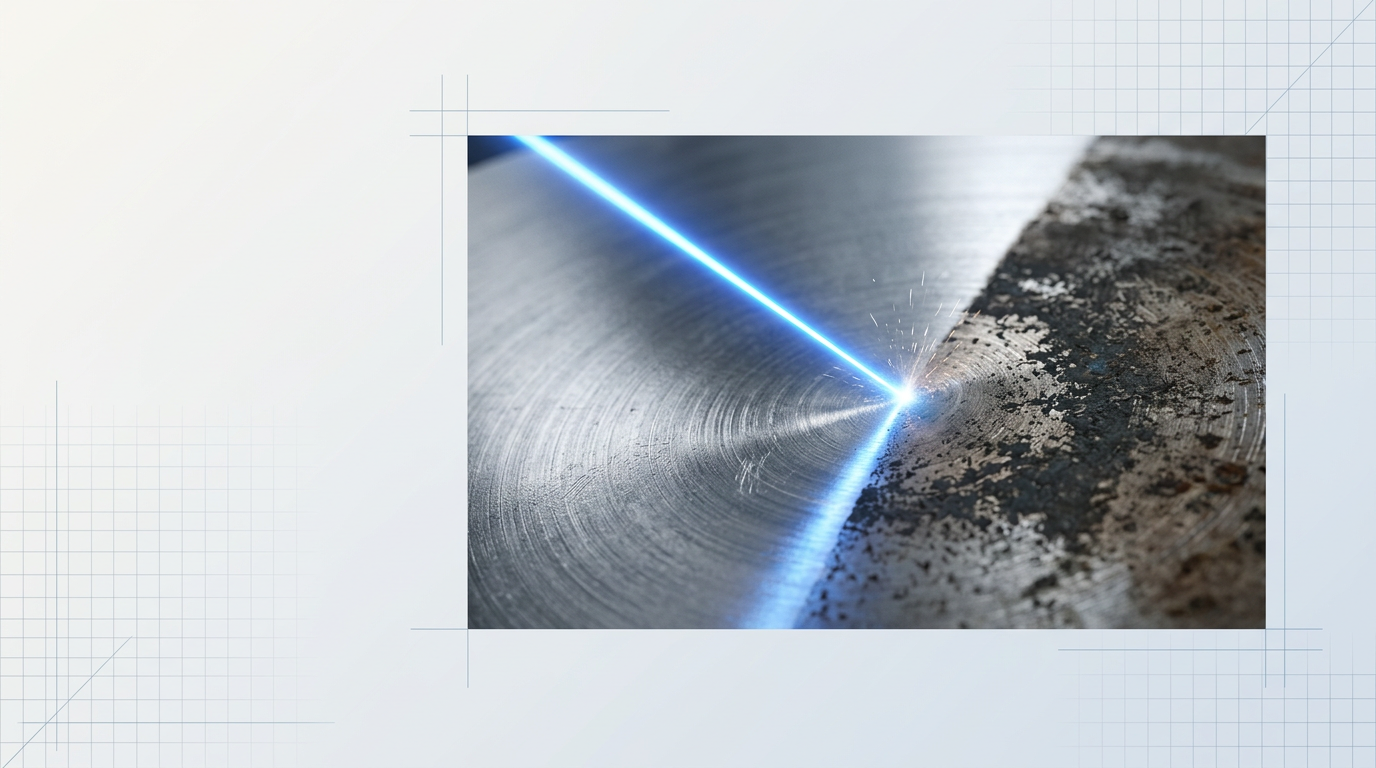
See Laser Cleaning Machines Built for the Job
Now that you know where laser cleaning wins, explore the equipment behind it. The ELASER is a professional-grade laser cleaning machine designed for precision surface work across a wide range of applications.
Laser Cleaning Safety: What Responsible Providers Do
The providers worth hiring are the ones who take safety seriously — and the good news is that professional-grade safety in laser cleaning is entirely manageable when the right controls are in place. Understanding what those controls look like gives you a practical lens for assessing any provider you consider.
Class 4: Understanding the Laser Hazard
Industrial laser cleaning systems are classified as Class 4 lasers — the highest hazard category in the laser safety framework. According to OSHA, Class 4 lasers present an immediate skin hazard and eye hazard from exposure to either the direct or reflected beam, and may also present a fire hazard.
Crucially, this classification applies to diffuse reflections as well as direct beam exposure — a distinction that separates Class 4 from lower classes and is why significant controls are required. This is not a reason to avoid laser cleaning services; it is the reason to expect and ask about safety protocols.
In the US, the primary governing standard is ANSI Z136.1, which classifies laser hazards and defines the control measures required for safe operation. In the UK, HSE guidance and the international standard IEC 60825-1 provide the equivalent framework — responsible providers operating in either market will be familiar with the applicable requirements.
Two baseline requirements follow directly from Class 4 classification: a controlled work area that restricts access and manages the optical hazard zone, and active fume extraction to capture the airborne contaminants generated during ablation.
Fume Extraction: A Non-Negotiable Requirement
When a laser vaporises surface contamination, it generates both particulate matter and volatile organic compounds (VOCs). Peer-reviewed research on laser cleaning emissions has found mean PM₁₀ concentrations above 7,000 µg/m³ during rust removal operations, with total VOC concentrations reaching approximately 2,568 µg/m³ during oil removal — levels that require active engineering controls, not just personal protective equipment.
CDC/NIOSH guidance is clear that the primary method for controlling exposure to laser-generated airborne contaminants is local exhaust ventilation (LEV) that captures contaminants at the point of generation. A provider operating without an LEV system fitted with appropriate filtration is not operating to a professional standard.
A responsible provider will be able to describe their fume extraction setup in specific terms: the type of system in use, the filtration specification (HEPA-grade or equivalent), and how it is maintained. Vague answers here are a meaningful warning sign.
What a Professional Operation Has in Place
Beyond fume extraction and hazard zone controls, a well-run laser cleaning operation will have several further requirements in place as standard.
- Designated Laser Safety Officer: The Z136.1 standard anticipates an LSO for Class 3B and Class 4 operations. The LSO evaluates hazards and ensures appropriate controls are implemented and maintained.
- Local exhaust ventilation: An LEV system with appropriate filtration — HEPA-grade as a minimum — capturing particulate and VOCs at the point of generation during every cleaning operation.
- Defined optical hazard zone: A controlled work area with warning signs, access restrictions, and interlocks. Some advanced equipment reduces the hazard zone significantly; some level of control is always required.
- Trained, documented operators: Operators with formal training in parameter selection, laser-rated PPE requirements, and emergency procedures — with documentation to confirm it.
- CE or UKCA certified equipment: Equipment carrying the appropriate conformity marking for the market in which it is operated. Uncertified equipment is an immediate red flag.
These are not aspirational standards reserved for the most sophisticated operations — they are baseline expectations for any professional laser cleaning provider. A provider who cannot confirm each of these elements is not operating to a professional standard, regardless of how competitive their pricing looks.
Class 4 laser operation generates both beam hazards and airborne contaminants that require active engineering controls — LEV, controlled work areas, and trained oversight. A provider who has these in place has built an operation that takes risk management seriously across the board. One who hasn't is cutting corners somewhere.
Knowing what good looks like makes it straightforward to spot its absence. The following red flags are worth watching for when you evaluate any provider.
- Cannot describe fume extraction: A professional provider knows exactly what LEV system they use and how it is maintained. Vague or evasive answers indicate the controls may not be in place.
- No documented safety protocols: Written procedures for laser operation, PPE requirements, and emergency response are a baseline expectation. Their absence suggests an informal, uncontrolled operation.
- Uncertified equipment: Equipment without CE or UKCA certification has not been assessed for conformity with applicable safety requirements. Do not accept assurances as a substitute.
- Operators without formal training: Laser-rated eyewear, parameter knowledge, and emergency procedures require training. If operators cannot confirm documented training, that is a serious concern.
- Dismissive of safety questions: A provider who treats safety questions as unnecessary overhead is signalling that safety is not a priority — which tells you something important about how they run everything else.
Buyers who have specific regulatory obligations — for instance, those managing COSHH assessments or site-specific HSE requirements — should seek guidance from a qualified health and safety professional for their particular situation.
With a clear picture of what professional safety looks like, you are well placed to assess providers in practice. The next section sets out a structured framework for doing exactly that.
How to Choose a Laser Cleaning Service Provider
The laser cleaning services market spans a wide spectrum — from highly professional operators running certified, purpose-built equipment with fully trained teams, to underprepared operators using rebadged imported machines with little engineering support behind them. Both will quote for your job. Your task, before committing, is to tell them apart.
The six questions below are the ones that separate credible providers from those who are likely to cut corners — on safety, on quality, or on both. Work through them before signing anything.
- Equipment provenance: Ask what laser system they use and who manufactures it. In-house manufacturers can resolve faults, supply genuine spares quickly, and genuinely improve their equipment. Resellers of rebadged machines typically cannot.
- Operator training and LSO credentials: Ask whether operators hold formal laser safety training and whether the provider can confirm a designated Laser Safety Officer. Credible providers will answer this without hesitation.
- Application-specific test results: Request a test ablation on a representative sample of your substrate and contamination type before committing. A provider who asks detailed questions before proposing a test is a positive signal.
- Fume extraction setup: Ask specifically what extraction and filtration system they deploy on-site. As covered in the safety section above, this is a non-negotiable professional requirement — a vague answer is a hard red flag.
- Equipment certifications and insurance: Confirm the equipment carries CE or UKCA certification and that the provider holds appropriate public liability and employers' liability insurance. Inability to confirm either is disqualifying.
- Capability and application specificity: Ask whether they can handle your specific substrate, contamination type, and access requirements. A provider who asks detailed questions before quoting signals genuine expertise.
The equipment provenance question is the one most buyers skip — and it is arguably the most revealing. A significant portion of laser cleaning equipment sold in the UK comes from overseas manufacturers whose machines are rebadged and resold by intermediaries with no in-house engineering capability: when something goes wrong, spares are slow, fixes are slow, and genuine product improvement is not possible.
To illustrate what the alternative looks like: our own system, the ELASER, is built by Woodrow Scientific Limited — the only UK-based laser cleaning manufacturer, designing, building, servicing, and improving everything in-house. The equipment carries both CE and UKCA certification. When evaluating any provider, asking who is behind their equipment — and whether that manufacturer has genuine engineering depth — is a practical filter that quickly separates the well-equipped from the underprepared.
Several red flags should give you pause regardless of how polished a provider's website looks: vague or evasive answers about safety protocols; no references or demonstrable test results for comparable applications; equipment with no verifiable certification; and pricing that sits dramatically below market norms for comparable work, which can indicate under-equipped or under-trained operators absorbing risk elsewhere.
Low pricing alone is not a disqualifier — but pricing that is implausibly low warrants scrutiny about what has been omitted from the scope or skimped on in the setup.
A credible laser cleaning provider asks more questions about your application than you ask about their process. That specificity — about substrate, contamination type, access constraints, and surface finish requirements — is the surest indicator that the operator knows what they are doing.
With this evaluation framework in hand, you now have everything needed to make a fully informed decision: an honest picture of what laser cleaning services deliver, where they fall short, how they compare to alternatives, what they cost, which applications they suit, and how to identify a provider worth trusting.
The final section brings all of that together into a plain verdict — and points you toward the practical next step.
Conclusion
Is laser cleaning the right choice for your application?
Laser cleaning services are the right choice when surface integrity, precision, or waste-free processing are what the job demands — and a less obvious choice when the priority is raw throughput across large, open surfaces where abrasive methods remain faster and cheaper.
If your application fits the former, you now have a clear framework for finding a provider worth trusting — and for the questions that separate the serious operators from the rest.
Frequently asked questions about laser cleaning services
Quick answers to the questions buyers most often have about laser cleaning services.
Yes — for the right applications and substrates, laser cleaning demonstrably works. It achieves ISO 8501-1 cleanliness grades Sa 2.5 (near-white metal) and Sa 3 (white metal) on carbon steel, equivalent to high-grade abrasive blasting. Aerospace, automotive, and heritage conservation have adopted it as the method of choice precisely because results are repeatable and verifiable across production runs. The honest caveats: it is not equally effective on every job. Very thick flexible polymer coatings and deep pitting corrosion are harder cases — the surface is cleaned but lost material cannot be restored, and elastic coatings dissipate laser energy rather than ablating cleanly. On large open structural surfaces, the constraint is throughput economics rather than capability — laser cleaning works, but sandblasting is materially faster per square metre at scale.
It depends entirely on the job. There is no universal ranking — the right method is determined by the application's requirements. Laser cleaning holds a clear advantage on precision work, thin or heat-sensitive substrates, enclosed or occupied spaces where dust and media containment are impractical, and jobs where abrasive embedment or substrate damage from blasting would require costly rework. It also suits applications where waste management is constrained, since it generates near-zero secondary waste. Sandblasting retains the edge on large open structural steel where throughput is the primary metric, on jobs requiring a specific mechanical anchor profile for coating adhesion (sandblasting reliably delivers Ra 40–100 µm; laser cleaning typically produces Ra 10–30 µm), and wherever established blasting infrastructure is already in place and the economics of switching do not stack up. The decision comes down to surface, scale, substrate sensitivity, and what the job specification actually requires.
In the UK, laser cleaning service rates broadly run from around £100 to £300 per hour, with day rates typically falling between £500 and £1,500 depending on application complexity, contamination type, and whether the work is in a controlled workshop or on-site. Specialist precision work — heritage conservation, aerospace-grade cleaning — sits toward the upper end. An hourly rate alone is an incomplete picture: total job cost also depends on the area to be treated, access difficulty, and contamination severity. The more useful comparison is total cost of ownership against the alternative. A direct day-rate comparison with sandblasting misses the fact that laser cleaning carries near-zero consumable costs, no media disposal fees, and typically requires only one operator on site. Those factors close the headline rate gap considerably on many jobs, particularly where hazardous waste disposal or containment erection would otherwise add significant cost.
The clearest limits are: deep pitting corrosion — laser cleaning removes the contamination from the surface, but the pit profile remains; it cannot restore base material that corrosion has already consumed. Internal pipe geometries and complex enclosed passages — line-of-sight access is required, so laser cleaning cannot reach surfaces it cannot see. Very thick flexible polymer coatings such as rubber linings and heavy elastomeric coatings — elastic materials dissipate laser energy rather than ablating cleanly, making results partial and potentially uneconomic. Large open structural surfaces are a throughput-economics limit rather than a capability limit — laser cleaning can clean them, but sandblasting is materially faster. Substrate type also matters: highly reflective bare metals (particularly copper) and very thin gauge materials require careful parameter management and may not suit all service providers. Always confirm a provider can demonstrate results on your specific substrate before committing.
Five questions worth asking before you commit: First, equipment provenance — does the provider use equipment from a manufacturer that designs and builds in-house, or a reseller of rebadged imported machines? In-house engineering and support capability matters when something goes wrong on your job. Second, operator training — have operators received formal laser safety training? BS EN 60825 requires organisations working with Class 4 lasers to appoint a named Laser Safety Officer. Third, fume extraction — what LEV system does the provider deploy on-site, and is it rated for the specific contaminants your job involves? Fourth, certifications — is the equipment UKCA or CE marked, and does the provider carry appropriate public liability and employers' liability insurance? Fifth, application-specific test results — can they demonstrate results on your substrate and contamination type before you commit to a full job? A provider who cannot or will not run a trial is a provider worth treating cautiously.