Introduction
If you manage a facility, maintain infrastructure, own a heritage property, or oversee industrial operations, this guide is written for you.
By the time you reach the end, you will understand how laser cleaning works, what it can and cannot treat, how it compares to conventional methods, and what a professional service engagement actually looks like.
Most of what you will find searching for a laser cleaning service comes from providers with something to sell — this guide has no such agenda.
It covers the technology, the surfaces, the comparisons, the service model, quality assurance, and cost — everything you need to walk into a provider conversation with confidence.
TL;DR
Laser cleaning is a precision, media-free process — and buyers who understand how it works, what it suits, and what separates a competent provider from a poor one consistently get better outcomes and fewer surprises.
The detail behind that conclusion is what this guide delivers.
This article covers:

How laser cleaning works as a process
Surfaces and contaminants it can treat
Laser cleaning vs sandblasting: when to choose
Safety and environmental considerations
What on-site service delivery looks like
Quality assessment and typical costs
What is a laser cleaning service?
A laser cleaning service is a professional engagement where a provider uses laser technology to remove contamination from your surfaces — no chemicals, no abrasive media, and no residue left behind.
In practice, that means a trained operator arrives at your site with portable laser equipment, or you ship components to the provider's facility, and the contamination is removed using a process called laser ablation.
When the job is done, the provider leaves with nothing more than a container of captured particles — there is no spent blasting media to dispose of and no chemical waste to manage.
How laser ablation removes contamination
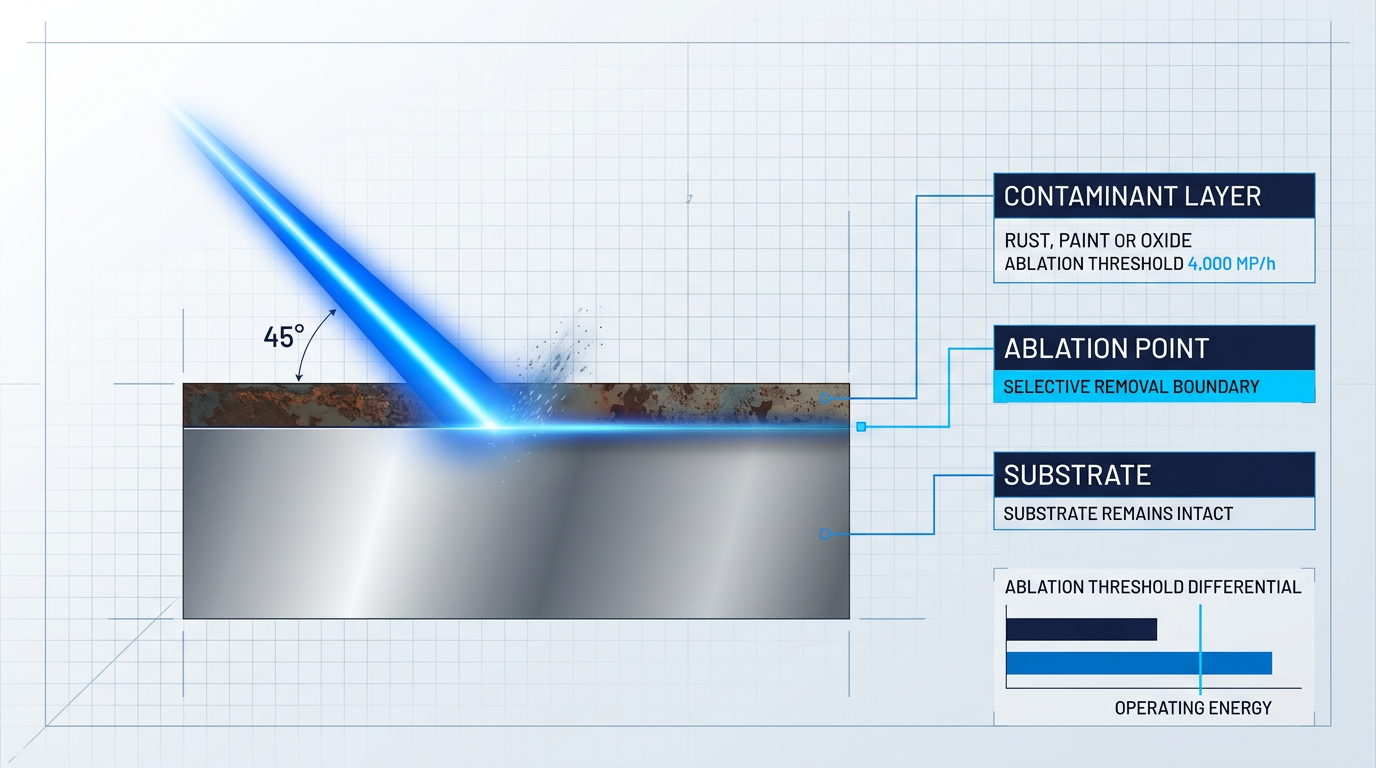
The mechanism is straightforward in principle: a focused laser beam is directed at the contaminated surface, and the contaminant layer — rust, paint, oxide, grease — absorbs that energy and heats rapidly.
That rapid heating causes the contamination to vaporise, sublimate, or be ejected as particles, depending on the material and the laser parameters in use.
The base material beneath — the metal, stone, or masonry — reflects or absorbs far less of the laser energy at the same settings, so it remains largely unaffected.
This is not a marketing claim about substrate safety: it is a direct consequence of the physical properties of the materials involved.
Why the beam stops at the substrate
Every material has an ablation threshold — the minimum energy level at which a laser beam will break it down and remove it.
Contaminants such as rust, paint, and oxides typically have lower ablation thresholds than the metals or stone they sit on, which is why the laser can be set to deliver energy above the contaminant's threshold while staying below the substrate's.
The removal process is therefore selective by physics, not by software intelligence: once the contaminant is gone and the substrate is exposed, the laser energy is no longer sufficient to damage what remains.
The laser does not need to detect where the contamination ends. Because contaminants have lower ablation thresholds than the substrates beneath them, the beam stops causing damage at the substrate boundary automatically — provided the operator has calibrated parameters correctly.
This threshold differential is also why a brief test pass on a representative area is standard professional practice before a full job begins — confirming that the energy settings are correctly calibrated for the specific substrate and contamination combination in front of the operator.
Pulsed and continuous-wave laser systems
When speaking with providers, you are likely to encounter the terms pulsed and continuous-wave (CW) — these describe two different ways of delivering laser energy.
- Pulsed laser systems: Fire short, high-peak-power bursts. The surface cools between pulses, giving greater thermal control — preferred for precision work and heat-sensitive substrates.
- Continuous-wave (CW) systems: Deliver a sustained beam at constant power. Better suited to heavy contamination on robust substrates where throughput takes priority over thermal sensitivity.
The choice between pulsed and CW is an application decision the provider makes based on your substrate and contamination type — it is not something you need to specify when requesting a service.
What a professional service adds
The technology alone does not produce good results — the service delivers the technology correctly.
A professional laser cleaning service brings trained operators who understand how to select and calibrate parameters for the specific combination of substrate and contamination they are working with.
It also brings local exhaust ventilation — fume extraction equipment that captures the vaporised particles produced during ablation, which is a health and safety requirement, not an optional extra.
Laser cleaning systems used in professional service contexts are Class 4 laser systems, which require appropriate hazard management that a trained provider handles as a matter of course.
If you encounter an operator who cannot explain their parameter selection process or their extraction setup, that is a meaningful signal about the quality of the service you would be receiving.
Most modern portable and automated laser cleaning systems are built around fibre lasers — the dominant technology in the field — which is why the term "fibre laser cleaning" appears frequently when researching providers.
With the mechanism and service model established, the natural next question is which surfaces and contaminants a laser cleaning service can actually treat — and where the limits of the selectivity principle lie in practice.
What surfaces and contaminants can laser cleaning treat?
The practical question most people arrive at after understanding how laser ablation works is a simple one: does this apply to my situation? The answer depends on two things — what the base material is, and what is sitting on top of it.
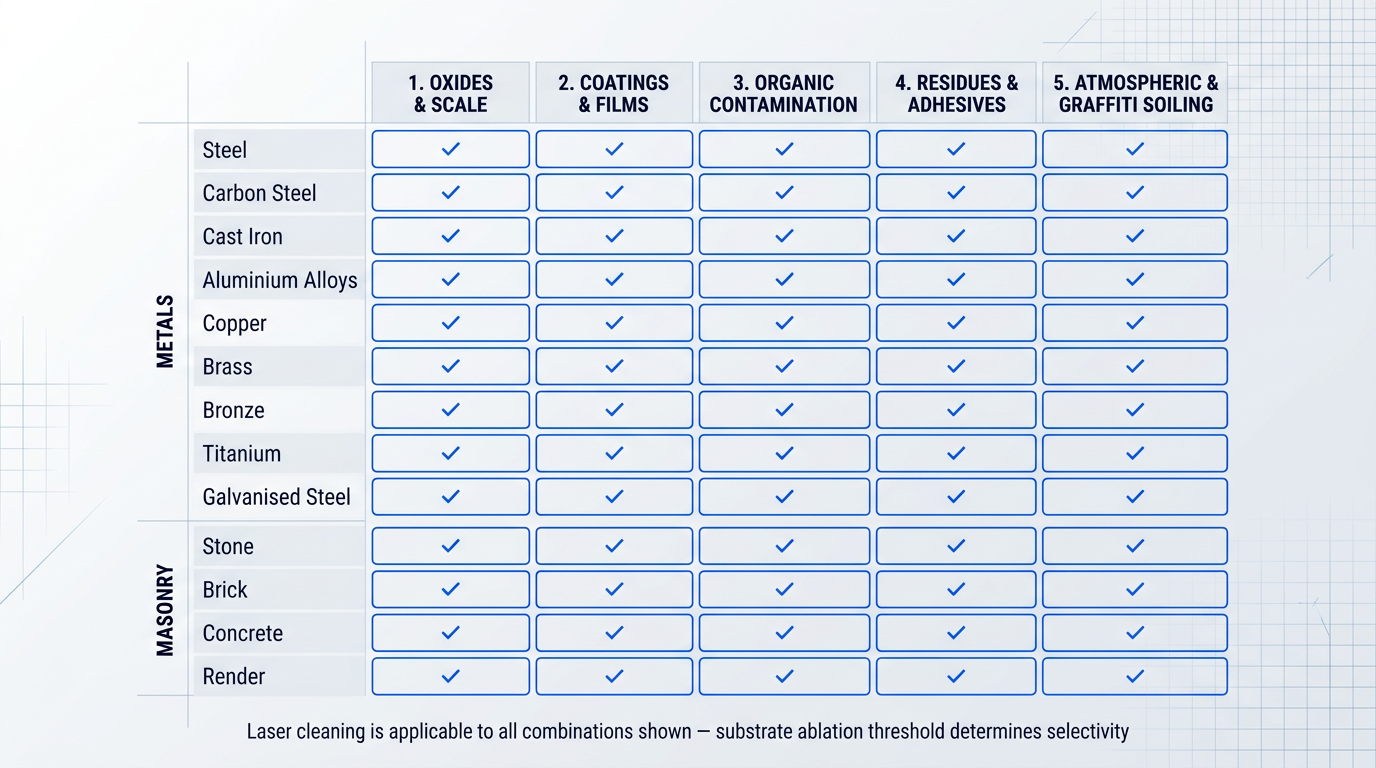
The process works across a wide range of metals — including steel, carbon steel, cast iron, aluminium alloys, copper, brass, bronze, titanium, and galvanised steel — as well as non-metals such as stone, brick, concrete, and masonry more broadly.
The underlying reason these substrates are compatible, as established in the previous section, is that they have higher ablation thresholds than the contamination layers sitting on top of them — the laser energy is absorbed by the contaminant and dissipates before it can disturb the substrate beneath.
What contaminants can be removed?
The range of removable contaminants is broad, and it helps to think of them in groups rather than as a single undifferentiated list.
- Oxides and scale: Rust, iron oxides, mill scale, weld discolouration, heat tint, and tarnish on copper and bronze alloys.
- Coatings and films: Paint, powder coating, primer, lacquer, varnish, and release agents applied to metal or other substrates.
- Organic contamination: Oil, grease, carbon deposits, soot, mould, and biological growth on both metal and masonry surfaces.
- Residues and adhesives: Adhesive residues, flux residues, fine particles, and organic deposits left by previous processes or treatments.
- Atmospheric and graffiti soiling: Pollution crusts, carbon films, graffiti, and smoke damage on stone, brick, concrete, and render.
Grouping these contaminants matters because the laser parameters required vary by category: oxides and scale typically call for higher fluence and a different pulse regime than light organic contamination, which responds to lower energy settings.
What the groups share is that each contaminant absorbs the laser energy more readily than the substrate beneath it — which is the physical basis for removing one without disturbing the other.
The selectivity principle: removing one layer at a time
The most practically significant capability of laser cleaning is not simply that it removes contamination — it is that it can be tuned to remove only a specific layer while leaving the layer beneath completely intact.
By adjusting power, pulse duration, and scan speed, an operator can ablate a topcoat while leaving the primer untouched, or remove an oxide layer while preserving the base metal profile underneath — because the fluence applied exceeds the ablation threshold of the target layer but stays below that of the substrate.
This matters considerably in two contexts: where the original surface beneath the contamination must not be disturbed, and where removing only the contamination without altering the substrate geometry is a functional requirement.
Research published in the Royal Society of Chemistry's Analytical Methods journal confirms that laser cleaning can achieve highly selective removal — targeting contaminants with minimal penetration of underlying layers — precisely because the fluence used must exceed the ablation threshold of the contaminant while remaining below that of the substrate.
A professional operator does not simply point the laser and clean — they dial in wavelength, pulse duration, and scan speed so the beam removes exactly the intended layer and stops there. That precision is what makes the process viable for surfaces where any substrate disturbance is unacceptable.
Where laser cleaning performs particularly well
The technology excels on surfaces where geometry, fragility, or contamination sensitivity makes other methods impractical.
Intricate profiles, engravings, and fine surface detail are well suited to laser cleaning because the beam follows the geometry of the surface without applying mechanical force — something that matters when the profile itself is part of what needs to be preserved.
Surfaces where substrate integrity is paramount — heritage stonework, decorative metalwork, or precision-machined components — benefit from the non-contact, non-abrasive nature of the process, which leaves the underlying material profile undisturbed.
The process is also well matched to applications where chemical residue cannot be tolerated after cleaning: food-contact tooling, electronics, and similarly sensitive surfaces where any trace of cleaning agent would compromise subsequent use or processing.
Where laser cleaning is less well suited
Honest tool selection requires acknowledging where laser cleaning is not the most practical choice, and there are three situations worth naming plainly.
On very large flat structural steel surfaces where raw area coverage rate is the primary requirement, the throughput economics may not favour laser over other methods — this is a tool-selection question based on scale and geometry, not a limitation of the cleaning quality itself.
Extremely thick coatings may require multiple slow passes to achieve full removal, and the time required per unit area can affect the economics of the job — qualitative framing in the source material consistently flags this as a consideration rather than a hard barrier, so the right response is to assess it case by case.
Surfaces where the coating composition is uncertain or variable require careful parameter testing before committing to a full clean — which leads directly to the final point.
Test passes: standard practice, not guesswork
A professional laser cleaning provider will always run a test pass on a representative sample area before proceeding with a full clean — verifying that the parameters are correctly matched to this specific substrate and contamination combination.
This is standard professional practice, not a sign of uncertainty: it is how responsible operators confirm the process is dialled in correctly before committing to the full surface area. A provider who skips this step is cutting corners, and that matters — which is something the later section on quality assessment covers in detail.
Laser cleaning vs sandblasting: which is right?
Most buyers arrive at this question already knowing sandblasting — it is the default industrial cleaning method, familiar, widely available, and inexpensive to set up. The honest answer is that laser cleaning is not a universal replacement for sandblasting; it is a genuinely different tool, and the right choice depends entirely on what you are cleaning, how precisely it needs to be done, and what the total cost of getting it wrong looks like.
Substrate damage: the most consequential difference
Sandblasting is an abrasive process: media propelled at high velocity removes contamination by physical impact, and in doing so it always alters the surface profile — creating roughness, changing dimensions, and removing base material alongside the contamination.
This is sometimes exactly what you want: coating specifications such as Sa 2.5 or Sa 3 (per ISO 8501-1) require a specific anchor profile that only abrasive blasting or mechanical abrasion can reliably produce, and sandblasting remains the correct preparation method for those applications.
Where it becomes a serious problem is on precision components, heritage surfaces, and intricate geometry where the base material must be preserved — sandblasting cannot selectively remove one layer while leaving another intact.
Laser cleaning is non-contact and exploits the ablation threshold differential covered earlier in this guide: the contamination layer absorbs the beam energy and is vaporised or ejected, whilst the substrate — absorbing less energy — remains largely unaffected. Dimensions are preserved, surface profiles are unchanged, and there is no abrasive residue.
Waste streams and compliance overhead
Sandblasting generates a significant spent abrasive media waste stream. When the coating being removed contains lead, cadmium, or hexavalent chromium, that spent media must be tested under the TCLP (Toxicity Characteristic Leaching Procedure) and, if thresholds are exceeded, managed as RCRA hazardous waste — requiring licensed haulers, EPA Uniform Hazardous Waste Manifests, and disposal at permitted facilities.
Chemical stripping has the worst waste profile of the three methods: spent acids or solvents require regulated disposal, chemical storage permits, and specialist handling — and depending on jurisdiction, treating and disposing of spent chemical baths can cost $10,000 to $50,000 per year.
Laser cleaning produces only a small volume of dry particulate captured at source by local exhaust ventilation — no spent media, no chemical waste, no wastewater. Under normal operating conditions it generates no hazardous waste stream requiring manifesting. This is not just an environmental consideration; it has direct cost and compliance implications, covered in full in the next section.
Site preparation and safety burden
OSHA guidance for abrasive blasting requires isolation or containment structures (blast rooms, curtain walls, or temporary enclosures for field work), Type CE NIOSH-certified blasting airline respirators, hearing protection, full body PPE, exhaust ventilation, and dedicated change facilities when lead exposure exceeds permissible limits — a substantial site-preparation burden before a single square metre is cleaned.
Chemical stripping in UK settings requires COSHH risk assessment, ventilation controls, chemical handling qualifications, and in some cases mandatory HSE competence certification for certain solvent-based strippers.
Laser cleaning requires trained operators, a controlled work area, appropriate laser safety eyewear, and fume extraction — but the site-preparation burden is significantly lower, particularly for on-site field work where erecting a blast room is impractical or impossible. The full laser safety requirements are covered in the next section.
Speed and throughput: the honest counterpoint
On large, open structural steel surfaces with unrestricted access, sandblasting holds the raw throughput advantage. A standard setup using a 5/16" nozzle at 90–95 psi covers approximately 160 sq ft (around 14.9 m²) per hour on open mild steel; higher-power configurations go faster still.
Laser cleaning throughput is power-dependent and application-dependent: a 100W system cleaning light oxide may achieve around 0.8–1.0 m²/hour, whilst a 3kW ultra-high-power system cleaning oil or light oxide can reach rates above 9 m²/hour on the same contaminant.
Where laser cleaning becomes competitive — or faster in practice — is on precision work, post-weld HAZ treatment, mould cleaning, and field maintenance tasks where the setup overhead of masking, containment, and blast-room erection would otherwise dominate the job time. For those applications, the relevant comparison is not raw area rate but total time from mobilisation to sign-off.
Total cost of ownership
The equipment cost comparison is straightforward: laser cleaning systems typically cost $35,000–$68,000 for industrial configurations; sandblasting equipment costs $5,000–$15,000. But equipment cost is not the right comparison metric for any operation running meaningful cleaning volumes.
| Cost category | Laser cleaning | Sandblasting (grit) | Chemical stripping |
|---|---|---|---|
| Equipment (CapEx) | $35,000–$68,000 | $5,000–$15,000 | $2,000–$5,000 (tanks, ventilation) |
| Consumables per m² | $0.02–$0.04 (electricity only) | $2.50–$4.00 (media) | $4.20 (chemicals) |
| Waste disposal per m² | $0 | $1.50–$3.00 | $3.50 |
| Annual consumables + disposal | $200–$500 | $20,000–$80,000 | $15,000–$80,000 |
| 5-year total (5,000 m²/yr) | ~$81,000–$95,000 | ~$161,000+ | ~$287,000+ |
Five-year total cost comparison for laser cleaning vs sandblasting vs chemical stripping at 5,000 m² per year, based on published cost analysis data.
The pattern is clear: laser cleaning has the highest Year 1 cost, but by Year 2 it is the lowest-cost option at meaningful throughput, and the gap widens every year after that — driven by near-zero consumables, eliminated waste disposal costs, and lower regulatory compliance overhead.
For occasional or large-area structural steel work where an anchor profile is the deliverable, sandblasting can still be the more economical choice — particularly when cleaning frequency is low and the capital cost of a laser system cannot be justified against the volume.
The TCO case for laser cleaning strengthens with every cleaning cycle. A facility running abrasive blasting at low frequency may never reach payback; one running precision cleaning at production scale typically does within 12–36 months — making utilisation rate, not equipment price, the number that actually determines which method wins economically.
When to choose laser cleaning, when to choose sandblasting
The scenarios below are where the trade-offs resolve clearly in one direction or the other.
- Intricate geometry: Laser can clean defined zones without masking; sandblasting cannot avoid affecting adjacent surfaces.
- Heritage and precision parts: Non-contact ablation preserves substrate profile and dimensions; abrasive impact cannot.
- No-media environments: Food-adjacent, cleanroom-adjacent, or pharmaceutical settings where abrasive contamination is unacceptable.
- Post-weld oxide removal: Laser treats heat-affected zones selectively without altering weld geometry or introducing abrasive residue.
- Field maintenance work: Portable laser systems deploy without blast room erection; containment for field blasting is costly and slow.
- High-frequency precision cleaning: At production scale, near-zero consumable costs make laser cleaning significantly cheaper over time.
Sandblasting remains the stronger choice for large-area structural steel with unrestricted access where raw throughput is the primary deliverable and a specific anchor profile is required for the coating system — Sa 2.5 or Sa 3 profiles cannot be achieved by laser cleaning.
The environmental and safety dimensions of this comparison run considerably deeper than this overview suggests — the next section covers what a professional laser cleaning service provider's safety setup looks like in practice, and what it means for buyers operating under environmental or compliance requirements.
Environmental and safety considerations for laser cleaning
Two questions come up consistently when buyers are evaluating a laser cleaning service: is this process genuinely clean from an environmental standpoint, and is it safe to run on an active site? Both deserve a direct answer — and the honest answers are more reassuring than any marketing claim.
The environmental case for laser cleaning is not a badge applied after the fact — it is a consequence of how ablation works. The laser beam is the only input to the process: no chemicals, no abrasive media, no water.
That physical reality means there are no chemical waste streams to manage, no spent abrasive media requiring disposal, and no wastewater discharge — as confirmed across trade press and industry sources covering laser cleaning's environmental profile.
Because laser cleaning uses light alone, the only by-product is the removed contaminant itself — a small volume of dry particulate captured by extraction. No chemical disposal, no spent media, no wastewater.
It is worth being straightforward about one point: ablation does produce a small volume of fume and fine particulate as the contaminant vaporises off the surface, and this must be captured at source by a local exhaust ventilation (LEV) system with appropriate filtration — typically HEPA-class for fine particles, with activated-carbon stages for VOCs when coatings are involved.
In context, this is a straightforwardly manageable by-product: a used filter cartridge is typically all that remains for disposal, compared with the spent abrasive media (potentially hazardous waste if lead paint is involved) or spent acid and solvent requiring regulated disposal that conventional methods generate.
For buyers operating under environmental compliance requirements — industrial facilities, local authorities, heritage bodies — the practical advantages are concrete: in most scenarios, no hazardous waste is generated, no chemical storage or handling permits are required, and there is no wastewater discharge to manage.
Safety requirements for professional laser cleaning
Industrial laser cleaning systems operate as Class 4 lasers — the highest hazard class in the laser safety classification system, where the beam and its reflections can cause severe, permanent eye injury and skin burns.
This classification is not something a professional provider glosses over. It means trained operators are required, wavelength-rated eye protection is mandatory for everyone within the risk area, and a defined controlled work area with physical barriers and warning signage is the baseline — not an optional extra.
Here is what a properly run professional laser cleaning operation looks like on site:
- Laser-controlled area: Physical barriers and warning signage define the zone; access is restricted to authorised personnel only, keeping bystanders clear of optical hazards.
- Wavelength-rated PPE: Safety eyewear matched to the laser's specific wavelength and power class — ordinary goggles or sunglasses provide no protection whatsoever.
- Local fume extraction: LEV positioned close to the treatment point, with particle and organic filtration selected for the coating type being removed.
- Fire readiness: Combustibles cleared from the work area, surface monitored during cleaning, and a suitable extinguisher accessible throughout the job.
- Test pass before full clean: Parameters verified on a small test area first — confirming effective removal and protecting the substrate before full cleaning begins.
A provider who operates with written risk assessments, trained operators, and documented process parameters is demonstrating the same operational discipline that produces consistent, repeatable cleaning results — and the inverse holds equally: a provider who skips barriers, omits fume extraction, or cannot show documented settings is almost certainly cutting corners on cleaning quality too.
When evaluating providers, treat the safety setup as a quality signal: ask to see the risk assessment, confirm the operator's training, and check that LEV and wavelength-rated eyewear are part of the standard setup — not an afterthought.
One practical reality of conventional laser cleaning is that establishing a laser-controlled area can be a logistical challenge in busy open workshops, mixed-use facilities, or public-facing environments where sealing off the work area is disruptive. Woodrow Scientific's ELASER-RHZ addresses this directly: using patented world-first technology, it collapses the reduced hazard zone to a fraction of the size required by conventional systems, enabling cleaning in open workshops, mixed-use facilities, and publicly accessible settings without evacuating the surrounding area — a capability no other laser cleaning system currently offers.
WSL is the only UK-based laser cleaning manufacturer, designing and building its machines in-house rather than reselling imported systems — which means full operator training and genuine engineering support come directly from the people who built the equipment.
With a clear picture of what proper environmental and safety controls look like, the natural next question is how all of this fits together in practice — what a complete laser cleaning service visit actually looks like from the moment the equipment arrives on site.
How a laser cleaning service is delivered on site
Most buyers are surprised by how little disruption a professional laser cleaning service actually involves — no blast room to erect, no chemicals to receive and contain, no media to clear up afterwards.
The dominant delivery model is mobile laser cleaning: the provider brings a self-contained portable system to your site, cleans in place, and leaves without depositing anything behind.
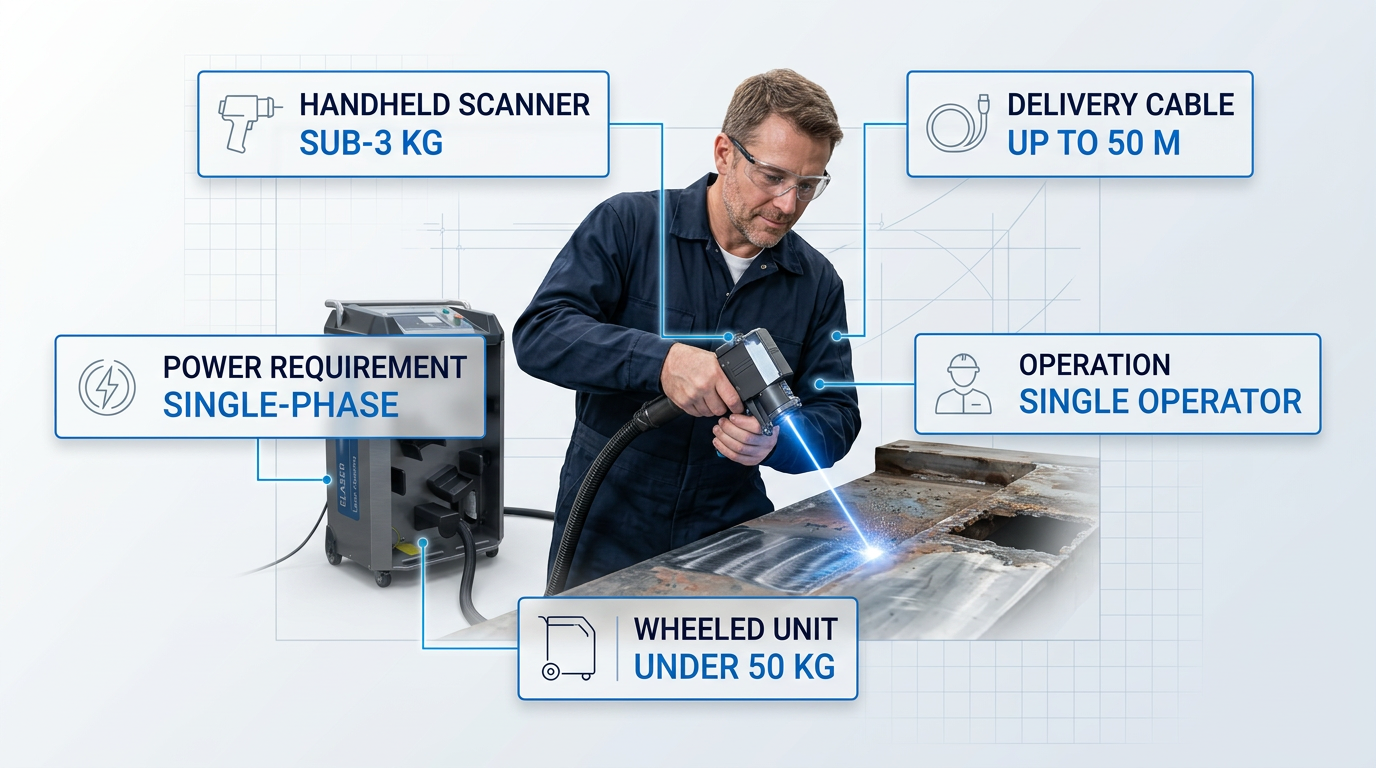
In physical terms, that means a wheeled unit — under 50 kg — connected by a delivery cable of up to 50 m to a handheld scanner weighing under 3 kg, operated by a single technician drawing from a standard single-phase power supply with no compressor, water feed, or consumables required.
Before the laser is switched on
A competent provider does not arrive and immediately start cleaning — the first step is a thorough pre-job assessment of the substrate condition, contamination type and thickness, access constraints, and the surrounding environment.
That assessment directly informs parameter selection — the power level, scan speed, and pulse settings that will achieve clean removal without touching the base material — as well as safety planning for hazard zone sizing and extraction positioning.
Once parameters are set, the provider establishes the controlled work zone described in the previous section: barriers and signage defining the laser-controlled area, local exhaust ventilation (LEV) positioned close to the treatment point, and PPE confirmed for all personnel before any equipment is activated.
Before committing to the full clean, a professional provider will run a test pass on a small representative area — confirming that the chosen parameters deliver effective contamination removal without substrate damage.
This is standard professional practice, not a sign of uncertainty: laser parameters interact with specific substrate-and-contamination combinations in ways that benefit from empirical confirmation first, and the test pass is one of the clearest quality indicators a buyer can look for when evaluating a provider.
The cleaning process in practice
With the work zone established and parameters confirmed, the operator scans the handheld head across the surface in controlled passes — the laser ablates the contamination layer while the LEV unit extracts fume and particulate locally, progressively revealing the clean substrate beneath.
Because the process is non-contact and media-free, it can operate in environments that sandblasting or chemical stripping simply cannot reach: around active equipment without requiring a shutdown, in confined spaces, at height without containment staging, and on surfaces that cannot be masked or blasted.
The 50 m delivery cable means the operator can reach remote or structurally awkward points without repositioning the main unit — a practical advantage that becomes decisive when access is the constraint.
The access advantages of laser cleaning — confined spaces, active plant, height work, delicate surfaces — flow from the fundamental nature of the process: no contact, no media, nothing to contain or clear. That is a structural property of how the technology works, not an optional add-on.
Conventional laser cleaning does, however, carry one significant operational overhead: the work area must be sealed off and cleared before the laser is activated, which is a real constraint in busy facilities, open workshops, or public-facing environments.
Woodrow Scientific Limited's ELASER-RHZ removes that barrier entirely through patented, world-first reduced hazard zone (RHZ) technology — collapsing the laser hazard zone to a small area around the work point, so cleaning can proceed in open manufacturing facilities, mixed-use settings, and publicly accessible spaces without sealing off the surrounding area.
This is the only laser cleaning technology of its kind in the world, and it removes what has historically been the single biggest practical barrier to deploying a laser cleaning service in open or shared environments.
For production and remanufacturing contexts where the same part type is cleaned repeatedly, a distinct service model applies: automated laser cleaning, where a robotic cell handles each cycle without manual operator passes — and systems like the AutoLASE use machine-vision software to scan the loaded part, build a 3D map, and generate the clean path automatically, requiring no programming or technical skills to operate.
With the service model understood end-to-end, the next useful question is where this delivery model is actually deployed — and which industries have found it most valuable.
See the laser cleaning machines behind the service
Mobile deployment starts with the right equipment. Explore Woodrow Scientific's laser cleaning machines, or book a call to discuss which solution fits your site and application.
Where laser cleaning is used: industries and applications
Laser cleaning has moved well beyond a niche restoration tool — it now operates across sectors as different as aerospace manufacturing and heritage conservation, graffiti removal and industrial maintenance. If you have read this far and are still wondering whether your situation qualifies, the following breakdown maps the technology onto the domains where it is most commonly deployed.
What shifts between domains is not the underlying process but the specific problem it solves: in some contexts the priority is protecting a surface that cannot be replaced; in others it is cleaning in place without disassembly; in others still it is working without blast media that would need to be contained and disposed of. The same laser, different reasons to use it.
Heritage and conservation
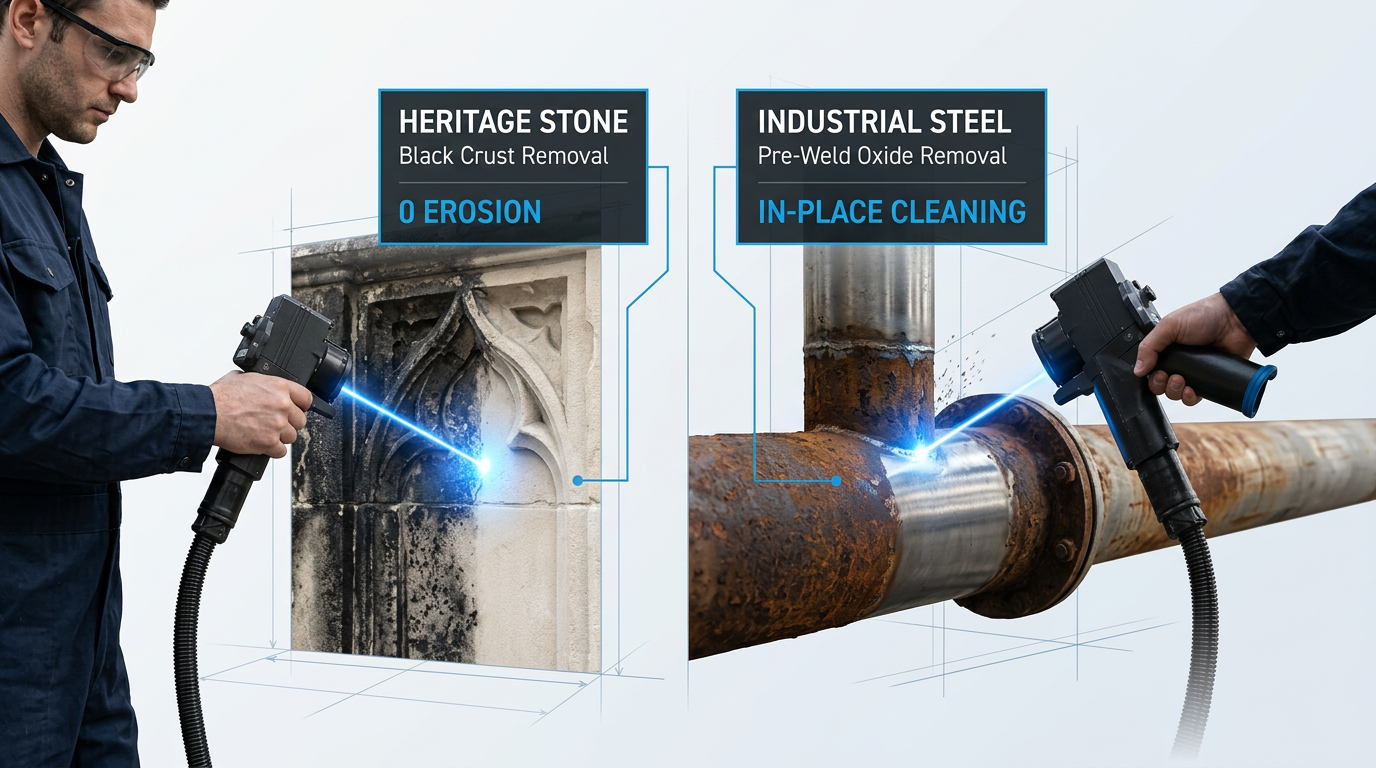
Conservation work is one of the strongest application areas for a professional laser cleaning service. The RSC notes that laser cleaning has been widely applied in heritage conservation over the last 20 years, proving effective on built heritage and objects where other methods are unsuitable — particularly for the removal of black crusts (gypsum-based, pollution-derived encrustations), biological colonisation, and graffiti from historic stone, limestone, marble, and sandstone, without the erosion that mechanical abrasion or acid treatments typically cause.
The critical rationale is gentleness and selectivity. On irreplaceable carved stonework, masonry, or historic metalwork, abrasive methods scour the surface and chemicals leave residue that can alter patina or react with the substrate. Laser cleaning lifts the contamination layer without mechanical pressure on the stone — as demonstrated in restoration work on the Charles Bridge in Prague, where laser was used as the primary technology for removing atmospheric pollution from baroque statuary, with no water, no chemicals, and no abrasive contact.
BS 8221-1:2012 (Code of Practice for Cleaning and Surface Repair of Buildings — Cleaning of Natural Stone, Brick, Terracotta and Concrete) is the standard that conservation officers and specifiers may reference when evaluating cleaning methods for listed structures. Historic England's guidance on graffiti removal from historic buildings explicitly categorises laser cleaning alongside mechanical, water, and chemical methods under this framework. Professional providers working in conservation contexts are aware of the standard, and its existence signals that laser cleaning is a recognised, specification-compliant approach rather than a fringe technology.
Industrial maintenance
In industrial settings, the defining advantage is in-place cleaning: laser cleaning can treat contamination on installed plant, equipment, and pipework without requiring components to be removed, transported, or taken out of service for extended periods. Rust removal, degreasing, pre-weld surface preparation, and post-weld oxide removal are all established tasks in this domain.
For welding applications specifically, clean metal is a prerequisite for weld quality — oxides, oils, and surface contamination introduce porosity and defects. Laser cleaning removes these contaminants with repeatable consistency across every pass, which matters in production environments where weld quality must be uniform across high volumes of parts.
Automotive and aerospace
In automotive manufacturing, laser cleaning is used to remove oxides, oils, and coatings from body panels and structural components before welding, bonding, and painting. OEMs use it in fully automated production lines to prepare surfaces before welding and soldering, while tier-one suppliers use it ahead of adhesive joining operations. The non-contact process protects panel geometry during bodyshop and restoration work, where even minor surface deformation from abrasive methods would be unacceptable.
In aerospace, the stakes are higher still. Coating removal and surface preparation on aluminium structures, turbine components, and flight-critical parts must be performed to tight tolerances — the base material cannot be compromised, because any surface damage can affect structural performance. The property that makes laser cleaning technically interesting in other domains (selective ablation that stops at the substrate) becomes an operational requirement here: certified laser systems have been used by civilian aircraft manufacturers for precise coating removal around grounding contacts, and the US Air Force has used laser paint removal at maintenance depots. Substrate integrity is non-negotiable.
Further application domains
The four domains below are each well-established in practice. They are treated more briefly here because the rationale is narrower, but they represent real and recurring use cases for mobile and on-site laser cleaning services.
- Mould and tooling cleaning: Release agents and vulcanisation residue are removed from injection moulds and tyre moulds in place, preserving fine vent and cavity geometry that abrasive cleaning would degrade over time.
- Graffiti removal: Spray paint and aerosol tags lift cleanly from brick, stone, concrete, and metal without the substrate damage that pressure washing or abrasive methods cause on porous or textured surfaces.
- Infrastructure and structural steel: Weld cleaning, corrosion preparation, and maintenance on bridges and frameworks can proceed without blast media containment, reducing scaffolding and disposal logistics on large assets.
- Remanufacturing and refurbishment: Corrosion, coatings, and contamination are stripped from worn components before rebuild, with consistent results across every part in a batch — important for quality assurance workflows.
The pattern across all four is consistent: each represents a situation where abrasive or chemical methods would introduce a problem the laser avoids — degraded mould geometry, scoured stone, blast media containment costs, or inconsistent batch results. The laser is not always the fastest or cheapest option in isolation, but it is often the only method that solves the cleaning problem without creating a new one.
Whether the constraint is substrate fragility (heritage, aerospace), access without disassembly (industrial maintenance, moulds), or media containment (infrastructure), laser cleaning earns its place by being the method that does not introduce a secondary problem. That pattern covers a wider range of real-world situations than most buyers initially expect.
Once you have identified which of these domains your situation falls into, the practical question that follows is how to confirm the job was done to the required standard — which is what the next section addresses.
How to Assess a Laser Cleaning Job
Laser cleaning is precise and controllable — but only when the parameters are correctly set and the operator is properly trained. Most buyers have no framework for telling the difference between a job done well and one that merely looks clean on the surface.
When those conditions are not met, the result can look superficially acceptable while leaving residual contamination, causing substrate damage from overheating, or producing inconsistent results across the treated area. The tools to verify the outcome exist — buyers simply need to know what they are.
Cleanliness Standards: ISO 8501-1 and AMPP SP21511-1
The primary international standard for assessing surface cleanliness on steel is ISO 8501-1, which defines rust grades and surface preparation grades using written descriptions alongside photographic reference plates.
The grades most relevant to laser cleaning on steel are the Sa grades: Sa 1 (light blast cleaning, loose contamination removed), Sa 2 (thorough cleaning, most mill scale and rust removed), Sa 2.5 (very thorough cleaning — free of all visible oil, grease, and rust, with any remaining staining limited to no more than 5% of the surface), and Sa 3 (white metal — the surface is entirely free of all visible contamination).
In practical terms, Sa 2.5 is the standard target for high-performance industrial coatings on steel; Sa 3 is required where the most demanding coating systems or welding preparation specifications apply. A professional provider should be able to name the target grade, explain how they will achieve it, and verify the result against the standard's photographic reference plates.
Beyond ISO 8501-1, the Association for Materials Protection and Performance (AMPP) has published a dedicated standard specifically for pulsed laser ablation: AMPP SP21511-1, "Laser Ablation for Surface Preparation of Ferrous Metals, Pulsed Laser."
AMPP SP21511-1 is designed to enable specifiers to develop project requirements and end users to achieve the required level of surface preparation using pulsed laser ablation — covering coated and uncoated ferrous metal substrates prepared for coating, welding, and adhesive bonding. As AMPP's own documentation notes, no industry standard existed before this standard to support decision-makers considering laser ablation.
The existence of AMPP SP21511-1 matters to a buyer for a straightforward reason: it means the industry has formalised quality frameworks for this technology, and a credentialled provider has no excuse for being unable to specify and verify the cleanliness grade they deliver.
Both ISO 8501-1 and AMPP SP21511-1 provide documented frameworks for specifying and verifying laser cleaning quality on steel. A professional provider should be able to name the target preparation grade upfront and confirm the result against it at job completion.
If a provider cannot tell you what cleanliness grade they are targeting, or cannot explain how they will verify it, that gap in accountability is worth taking seriously before work begins.
Surface Profile: A Characteristic to Discuss Upfront
Unlike abrasive blasting, laser cleaning does not inherently create a mechanical anchor profile (surface roughness) on the substrate.
For applications where the cleaned surface will receive a protective coating or paint, the coating specification will typically require a minimum surface profile, measured in Ra or Rz values. Heavy-duty industrial coatings commonly require an anchor profile of 40–70 µm Rz; laser cleaning on steel typically produces Rz values in the 10–30 µm range at standard parameters, depending on substrate condition and power settings.
This is not a weakness of laser cleaning — it is a characteristic the buyer needs to raise with the provider before work begins. If the downstream coating specification requires a specific anchor profile that laser cleaning alone may not achieve, the provider should confirm how it will be met, whether through adjusted laser parameters or a supplementary method such as a light abrasive sweep.
What to Look for on the Cleaned Surface
A correctly completed laser cleaning job has a consistent, uniform appearance across the treated area: the target contamination is absent, and the surface shows an even colour and texture without variation.
The warning signs are equally readable: streaking or shadowing across the surface indicates missed passes or inconsistent scanner speed; residual contamination in recesses, edges, or tight geometry suggests the parameters were not suited to the substrate geometry; and visible substrate damage — warping, pitting, or discolouration — points to overheating from excessive power or dwell time.
A test pass on a representative sample area — which you will have seen before the full clean proceeds, as covered earlier in this guide — gives you the clearest early indication of whether the parameters are correctly set for your specific substrate and contamination combination.
Asking to see the test pass result before authorising the full clean is buyer protection, not bureaucracy. A provider who resists running one, or skips it entirely, is a meaningful red flag.
One further quality signal is visible before the job even starts: fume extraction equipment. A provider operating without local exhaust ventilation at the process head is demonstrating poor operational discipline — and that discipline, or lack of it, typically extends to their parameter settings and cleaning consistency.
Questions to Ask Before Engaging a Provider
A professional provider will welcome these questions as straightforward due diligence. Any provider who finds them uncomfortable is giving you useful information before the job begins.
- What cleanliness grade will you deliver?: Ask for the specific Sa grade target and how they will verify it — ideally by reference to ISO 8501-1 photographic comparators.
- Will you run a test pass first?: Confirm they will run a test pass on a sample area and that you can inspect the result before the full clean is authorised.
- What fume extraction are you using?: Ask specifically what extraction equipment will be on site. Local exhaust ventilation at the process head is the professional standard.
- How are your operators trained?: Ask who trained them and whether that training is documented. Laser cleaning results are directly dependent on operator competence.
- Do you carry public liability insurance?: A straightforward question that any professional contractor should be able to answer immediately and in writing.
These five questions are not exhaustive, but they cover the core accountability points: specified outcomes, visible verification, process discipline, operator competence, and commercial responsibility.
With quality assurance covered, the remaining pre-purchase question for most buyers is cost — and how to interpret what providers quote.
How much does a laser cleaning service cost?
Cost is the question every buyer arrives at eventually — and now that you understand what the service actually involves, you are in a much better position to evaluate the answer than someone who has simply Googled a day rate.
How laser cleaning services are priced
Most providers use one of four pricing structures, and the model they choose reflects the nature of the job as much as it does their own preference.
The hourly rate is the most common model for mobile field work — it protects the provider on jobs where the scope is difficult to define in advance, and it is widely accepted by clients who cannot easily estimate the area to be cleaned.
The per-square-metre rate suits defined-scope jobs: rust removal across a measured steel structure, coating removal from a quantified surface area, or graffiti clearance on a mapped façade — situations where both sides can agree on the deliverable before work begins.
A day rate makes sense for longer on-site engagements where daily setup and breakdown time is minimal relative to the total job duration; it gives the client cost certainty across a multi-day deployment.
Finally, most providers apply a minimum mobilisation charge on any job — typically covering travel and setup time regardless of how small the work scope is, which also filters out very small jobs that would otherwise be uneconomic to attend.
| Pricing Model | Typical Use Case | Indicative Rate Range |
|---|---|---|
| Hourly rate (mobile, on-site) | General rust removal, surface prep, variable-scope work | $150–$350/hr (standard); $200–$600/hr (specialist: aerospace, heritage, mould) |
| Per square metre — light contamination | Grade A–B rust, open access, defined area | $8–$20/m² |
| Per square metre — heavy contamination | Grade C–D rust, thick coatings, multiple passes required | $20–$50/m² |
| Day rate (extended deployment) | Multi-day on-site work with minimal daily setup overhead | $1,200–$3,000/day |
| Minimum mobilisation charge | Any job — covers travel and setup regardless of scope size | $200–$800 per visit |
Indicative pricing structures and rate ranges for laser cleaning services in Western markets, drawn from North American and European market data.
The spread within each band reflects real variation in laser power, application type, and regional market conditions — the figures above are indicative of Western market rates and should be treated as a starting framework for budgeting, not as firm quotes.
Specialist precision work commands the upper end of the hourly range: aerospace MRO cleaning and heritage conservation regularly run at $200–$600/hr, reflecting the slower pass speeds, documentation overhead, and operator expertise those applications require.
What drives the cost of a specific job
Two jobs quoted at the same hourly rate can produce very different final bills, depending on the variables below.
- Laser power: Higher-power systems cover more area per hour, making them more competitive on large jobs. A 500W system cleans 3–8 m²/hr; a 2,000W system can reach 12–40 m²/hr.
- Contamination severity: Light surface rust requires a single pass; heavy mill scale or thick multi-layer paint requires multiple passes, directly multiplying the time on site.
- Access difficulty: Working at height, inside confined spaces, or at a remote location adds time and may require additional safety provisions, all of which affect the final cost.
- Substrate sensitivity: Heritage stonework, aerospace components, and precision tooling require slower, more controlled passes. Specialist work commands a premium over standard industrial rates.
- Mobilisation distance: Travel time and logistics are typically factored into day rates or charged separately for remote sites, sometimes as a flat travel fee beyond a set radius.
Understanding these variables is also useful when comparing quotes: a lower hourly rate from a provider using a lower-power system may not translate into a lower total bill if the job takes significantly longer to complete.
What is not on the bill
Because laser cleaning uses only light to remove contamination, there are no consumable inputs to replenish — no abrasive media, no chemical procurement, and no hazardous waste disposal fees in the vast majority of applications.
This is a structural property of the process, not a marketing claim: the operating cost per day is dominated by operator labour and electricity, with only minor lens replacement costs in heavy use — making the ongoing cost profile fundamentally different from sandblasting or chemical stripping.
A cost-per-square-metre analysis illustrates the difference in concrete terms: sandblasting runs at around $6.45/m² once media and disposal costs are included; chemical stripping reaches approximately $11.50/m² when chemical procurement and regulated waste disposal are factored in; laser cleaning, by contrast, sits at under $2/m² in consumable cost, with the provider's labour rate being the primary variable (figures indicative, sourced from industrial cost analysis).
A laser cleaning service quote may look higher than a sandblasting day rate — but sandblasting's true cost includes abrasive media ($500–$2,000/month in a busy shop), hazardous waste disposal, blast containment, and potential rework from substrate damage. Most of those line items simply do not exist in a laser cleaning job.
The practical implication is that laser cleaning is not always the cheapest option on a day-rate basis, but it is frequently the most cost-effective option once the full cost of the outcome is accounted for — particularly where hazardous waste disposal, substrate rework risk, or environmental compliance overhead would otherwise add significantly to the bill.
Can you hire a laser cleaner?
Yes — the mobile service model is well established, with providers bringing trailer-mounted or van-equipped laser systems directly to site, operating on a bring-and-bill basis with no fixed facility required.
Some providers also offer dry hire — equipment without an operator — for commercial and industrial clients who have trained staff and want to manage the work themselves; this is typically available on a day or weekly rate and is worth enquiring about for longer-duration projects.
Getting an accurate quote
A professional provider will want to assess the substrate, contamination type, and site access conditions before committing to a price — a site visit or detailed written brief is standard practice for any significant job.
Going into that conversation with a clear picture of the surface area, contamination grade, access constraints, and any sensitivity requirements will help the provider quote accurately and avoid the scope adjustments that tend to inflate final bills.
With cost now in context alongside technology, applications, safety, and quality assurance, you have everything you need to approach a provider as an informed buyer — the final section brings all of that together into a practical decision framework.
Conclusion
Choosing a laser cleaning service: what you now know
Laser cleaning earns its place when substrate integrity, site constraints, or environmental compliance make abrasive and chemical methods a poor fit — and you now have the grounding to recognise those situations in your own context.
Before engaging any provider, three questions will tell you a great deal: what cleanliness grade will you deliver and how will you verify it; are your operators trained and insured; and will you run a test pass before the full clean?
A professional will want to assess your substrate and contamination before quoting — that site assessment conversation is the right place to start.
Laser Cleaning Service: Frequently Asked Questions
Common questions about hiring, pricing, safety, and suitability for professional laser cleaning services.
Yes. Mobile laser cleaning is a well-established service model — providers bring portable equipment to your site, set up, clean, and leave with no abrasive media or chemical waste to manage. The process is self-contained and typically requires only a power source and fume extraction on site. Some providers also offer dry hire (equipment without an operator) for clients with trained staff, with day rates for a 200W mobile unit starting at around $950 per day including training and support where needed.
Mobile laser cleaning services in Western markets typically charge £/$/€150–350 per hour for standard on-site work, with per-square-metre rates used for defined rust or coating removal jobs. Day rates for a full deployment with operator generally range from $1,200–$3,000. The main cost drivers are laser power, contamination severity, access difficulty, substrate sensitivity, and mobilisation distance. One factor that does not add to the bill in most scenarios: there is no media to buy, no chemicals to handle, and no hazardous waste disposal charge. Final pricing depends on the specific job — a site visit or detailed brief is standard before any quote is confirmed.
It depends on the application. Laser cleaning is the stronger choice for precision work, heritage surfaces, intricate geometry, and environments where abrasive media or waste disposal is a problem — it produces no spent abrasive, no silica dust, and leaves no residue. Sandblasting retains a real advantage for large open structural steel surfaces where raw throughput is the priority and a coarser anchor profile is needed for the coating system. Both methods can achieve ISO 8501-1 Sa 2.5 and Sa 3 cleanliness grades on carbon steel. The right call depends on your surface type, contamination level, regulatory environment, and whether total operating cost over time matters more than upfront day rate.
A professional laser cleaning job requires four non-negotiable controls: a defined laser-controlled area with barriers and warning signage; wavelength-rated eye protection for all personnel within that zone; local exhaust ventilation (LEV) positioned close to the treatment point to capture fumes and particulate; and a trained operator who has verified parameters on a test area before production cleaning begins. Industrial laser cleaning systems typically operate as Class 4 lasers — the highest hazard classification — which is why a controlled work area and qualified operator are non-negotiable, not optional extras. A reputable provider will conduct a site-specific hazard assessment before any work starts and will carry documented risk assessments and appropriate insurance. These requirements are marks of a professional operation, not cause for concern.
Most common surfaces are suitable. Metals including steel, carbon steel, cast iron, aluminium, and copper alloys are well-established candidates, as are stone, brick, concrete, and masonry. The key variable is the contamination type relative to the base material — laser cleaning works when the contaminant absorbs laser energy more readily than the substrate beneath it. A professional provider will assess both the surface and the contamination before committing to a clean, and will typically run a test pass on a small area to confirm parameters before proceeding. Situations that warrant extra caution include applications requiring a specific coarse anchor profile that laser cleaning does not inherently create, or coatings of unknown composition where the ablation products need to be identified before full cleaning begins.
When parameters are correctly set by a trained operator, no. The laser beam is absorbed by the contamination layer — rust, paint, oxide — which rapidly vaporises or is ejected. The base material reflects or absorbs far less energy and remains largely intact. This is a consequence of the ablation threshold differential: contaminants typically have lower energy thresholds than the metals or stone beneath them, so a correctly tuned laser removes the unwanted layer without reaching the threshold required to affect the substrate. The operative condition is correctly set parameters — which is precisely why trained operators and a test pass before full cleaning matter. No responsible provider should skip that step.
It depends — and any provider who gives you a single figure without seeing the job should be treated with caution. The key variables are surface area, contamination severity, and laser power. As a practical anchor, area rates for typical field work range from roughly 1–10 m² per hour, with the wide spread reflecting the variation across applications. Light surface oxidation on accessible flat steel sits at the fast end; heavy mill scale or intricate heritage stonework is at the slow end. A professional provider will estimate after assessing the specific job — a site visit or detailed written brief is standard for any project of meaningful size.
Pulsed laser systems deliver short bursts of high-peak-power energy, allowing the surface to cool between pulses. This makes them well suited to precision work, heat-sensitive substrates, and applications where substrate integrity is critical — heritage stone, aerospace components, thin-walled sections, and aluminium alloys. They also tend to produce a smoother post-clean surface finish. Continuous-wave (CW) systems deliver a sustained beam and suit heavier contamination on robust substrates where throughput matters more than substrate sensitivity — large structural steel sections, for example. CW systems generally achieve higher area rates on heavily fouled surfaces, but carry a greater risk of heat input into the base material if parameters are not carefully managed. For surface preparation applications specifically, pulsed fibre lasers are considered the effective option, given their precise control over pulse energy and duration.