
Introduction
On this page, powerful means genuinely effective on the rust severity and metal type at hand — not just fast-acting or chemically aggressive, but precise enough to remove the corrosion without unnecessary damage to the substrate underneath.
Every entry is evaluated on five axes: rust severity range, substrate safety, scale and application suitability, safety and environmental profile, and ease of use.
The list spans two method families — chemical (soaks, gels, sprays, and converters) and physical/mechanical (including laser cleaning) — because both can be genuinely powerful depending on the job.
Whether you're restoring old tools at home or maintaining heavy industrial equipment, there's an option here for you — listed in ranked order, with the most powerful and precise method at the top.
TL;DR
The most important variable in rust removal isn't the product — it's the context. Rust severity, metal type, and job scale all determine which method will actually work. This list covers the full spectrum, from accessible chemical soaks to industrial-grade laser cleaning, so you can match the right approach to your specific situation.
This article covers:

What makes a rust remover genuinely powerful
Chemical vs. physical rust removal methods compared
Five ranked rust removal options evaluated
Safety and environmental profiles across methods
Substrate safety and rust severity range covered
What Makes a Rust Remover Genuinely Powerful?
Not all rust removers fail for the same reason — and that's the problem most buyers run into. The method that clears surface rust from a hand tool in 30 minutes can be completely ineffective against heavy, scaly corrosion on structural steel. Understanding why starts with what rust actually is.
Rust is iron oxide, formed when ferrous metal is exposed to moisture and oxygen. Unlike aluminium, which corrodes to produce a thin, self-healing oxide film that protects the metal underneath, iron produces a reddish-brown, flaky substance that does not adhere stably to the surface.
As Corrosionpedia explains, the hydrated iron oxide layer repeatedly flakes off rather than bonding to the substrate, leaving fresh metal continuously exposed to further electrochemical attack. Untreated rust is not a stable surface condition — it deepens over time, which is why rust severity is the single most important variable in choosing a removal method.
The Three Chemical Mechanism Families
Chemical rust removers work by one of three distinct mechanisms, each with a different trade-off profile.
- Dissolution: Acid-based removers (phosphoric, muriatic, citric) attack iron oxide directly and dissolve it. Fast-acting but can damage base metal if left too long.
- Chelation: Chelating agents such as EDTA bind iron ions selectively and lift them into solution, leaving the underlying steel largely untouched.
- Conversion: Converts rust chemically into a stable compound — typically iron phosphate or iron tannate — that can be painted over without full removal.
The distinction between dissolution and chelation matters most for substrate safety. Strong mineral acids dissolve rust fast but continue attacking clean steel once the oxide is gone. Chelating agents work at near-neutral pH, so the base metal is largely protected throughout the soak.
Removers vs. Converters: A Critical Distinction
A rust converter is not a rust remover. Removers dissolve or lift rust to expose bare metal. Converters chemically transform rust in place into a stable compound that can be painted over directly — the rust is not gone, it has changed form.
Converters are practical on large fixed surfaces where complete rust removal is impractical, but they leave a converted rust layer rather than clean steel. Where a bare, paint-ready surface is required — weld prep, precision parts, structural inspection — a remover or mechanical method is the right tool.
Physical and Laser Methods
Mechanical methods — wire brushing, abrasive blasting, sandblasting — remove rust and base material together through physical abrasion. They are well suited to heavy or scaly rust where chemistry alone cannot penetrate, and to large surfaces that need a roughened profile for coating adhesion.
The trade-off is that base metal loss is unavoidable: abrasion creates the surface profile needed for coatings, but it also removes some of the substrate itself. For precision components or thin-walled parts, that loss can be a problem.
Laser cleaning (ablation) works on a different principle entirely. The laser beam delivers energy that the rust layer absorbs and vaporises, while the base metal reflects or minimally absorbs that energy — leaving the substrate intact. Research published in Springer journals confirms that the rust removal process involves ablation vaporisation and vibration peeling of the oxide layer, with the mechanism relying on the different absorptivity of rust and base metal to the laser energy.
The result is precise, non-contact rust removal without the substrate damage associated with abrasive methods or the chemical handling requirements of acid-based approaches.
The Core Trade-off: Aggression vs. Substrate Safety
Every method sits somewhere on a spectrum between speed and substrate safety. The most aggressive options — strong mineral acids and abrasive blasting — act fast on heavy rust but risk damaging the metal underneath or creating handling and disposal considerations.
More selective methods — chelation and laser ablation — are gentler on the substrate but may require longer soak times or more setup. Neither end of the spectrum is universally better; the right choice depends on rust severity, the part's geometry and tolerance, and what the surface needs to look like afterward.
Flash or surface rust, pitted medium rust, and heavy scaly corrosion each call for a different approach. The five entries that follow are ordered by overall power and precision — with that spectrum in mind, not simply by ease of use.
Option 1
ELASER by Woodrow Scientific
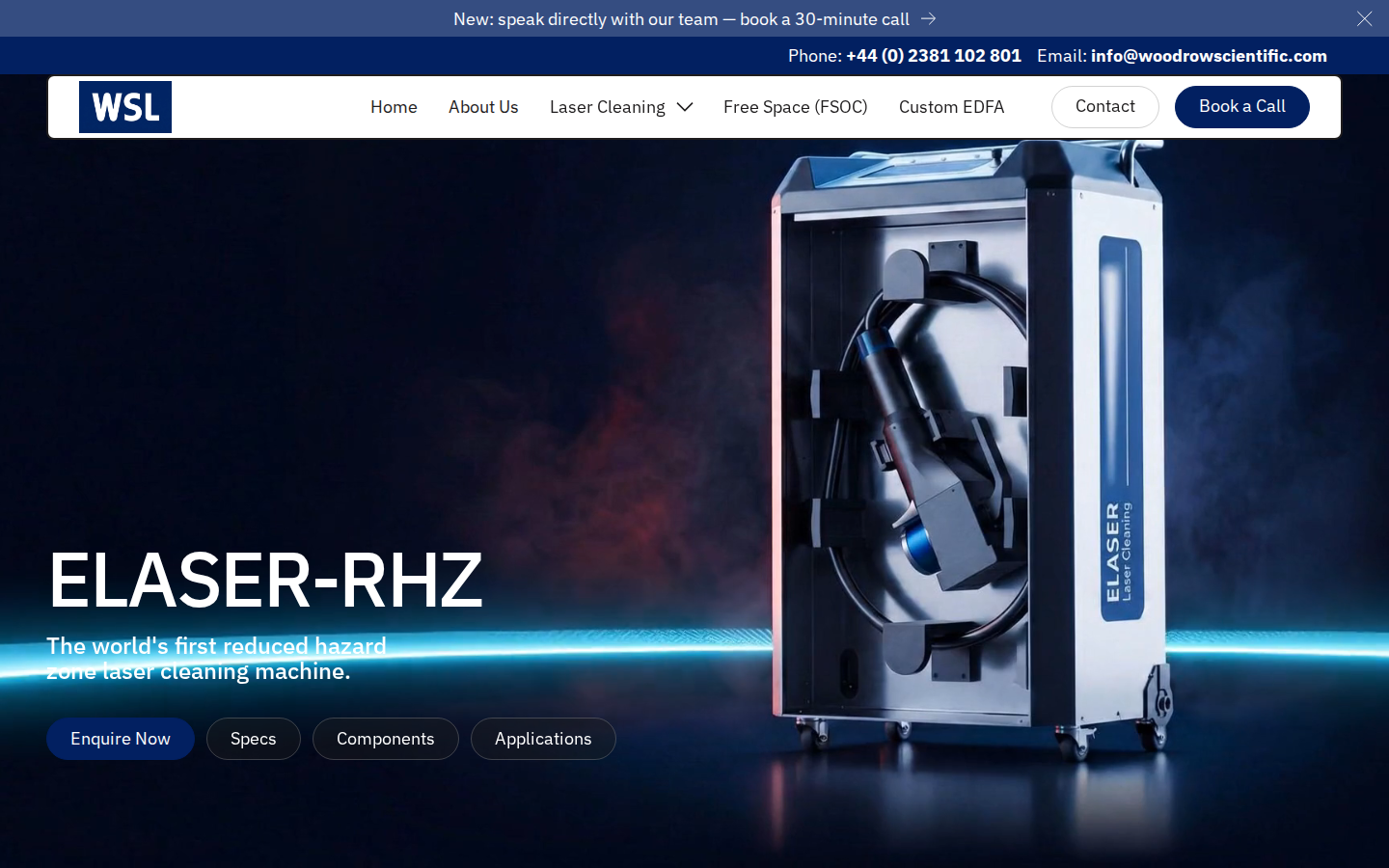
A portable industrial fibre laser cleaning system that removes rust and metal oxides by laser ablation — no chemicals, no abrasives, no consumables.
Pros:

Removes rust with minimal substrate material loss
No chemicals, consumables, or waste to manage
World-first RHZ technology enables open-workshop operation
Single-operator use with 50 m cable reach
Cons:

Industrial method — not suited to small part soaking
Pricing available by quote only
Operator training required before use
How Laser Ablation Removes Rust
When a pulsed laser beam strikes a rusted surface, the rust layer's loose, porous structure absorbs the energy at an extremely rapid rate, heating it past its gasification threshold and vaporising it — a process known as laser thermal ablation.
The underlying metal behaves differently: as IPG Photonics explains, laser parameters are chosen so that the surface layer strongly absorbs the light while the base material either reflects it or minimally absorbs it, leaving the substrate intact with minimal material loss.
This differential absorption is what makes laser cleaning so precise — the removal process stops at the metal surface, not through it.
Materials and Rust Severity
The ELASER handles the full spectrum of rust severity, from light surface oxides through to heavy corrosion and mill scale, across a tunable power range of 0–100% on 100 W, 200 W, and 300 W models.
Compatible metals include steel, carbon steel, cast iron, aluminium alloys, copper, brass, bronze, titanium, and galvanised surfaces — a breadth that makes it viable across automotive, industrial, and heritage applications without changing machines.
Power tunability from 0 to 100% means the same ELASER unit clears delicate surface tarnish and attacks heavy rust or mill scale — adjusted by the operator, not by swapping equipment.
ELASER-RHZ: Laser Cleaning in Open Workshops
The most significant differentiator in this category is WSL's patented ELASER-RHZ technology — a world-first that collapses the laser hazard zone to a small area around the work itself.
Conventional laser cleaning requires the surrounding area to be sealed off and evacuated before work begins, which makes it impractical in open manufacturing floors, mixed-use facilities, or public-facing environments.
The ELASER-RHZ removes that constraint entirely: operators can clean in open workshops, shared production spaces, and publicly accessible settings without shutting down the surrounding area.
It is a Class 4 laser product — but advanced engineering controls built into the ELASER-RHZ make access to any radiation above Class 1 impossible, which is what achieves the reduced hazard zone. No other laser cleaner on the market offers this.
Portability and Reach
The ELASER is built around a handheld scanner weighing under 3 kg, mounted on a wheeled unit under 50 kg — everything one operator needs, with no compressor, water supply, or consumable stock to manage.
The delivery cable extends up to 50 m, giving the operator a working radius that allows the unit to remain stationary while the operator moves freely around large components or structures.
Application Contexts
The ELASER is deployed across a broad range of rust removal and surface preparation tasks.
- Automotive: Rust and paint removal in the bodyshop, and pre-weld surface preparation on the production line.
- Industrial maintenance: Cleaning plant, equipment, and infrastructure on site — nothing to mask off, no abrasive media to clear up afterwards.
- Heritage and restoration: Lifting corrosion and soiling from metal, stone, and masonry with the precision needed to protect original surfaces.
- Pre-weld preparation: Removing oxides, rust, and contaminants from joining surfaces to ensure clean, pore-free welds.
For operators with high-volume or fully automated requirements, WSL's AutoLASE is the production-scale counterpart: a part is loaded and the system cleans it automatically.
Safety and Environmental Profile
Because the ELASER uses laser light alone, there are no chemicals to handle or dispose of, no abrasive media to manage, and no water or coolant circuit — it is air-cooled and entirely consumable-free.
The system is CE and UKCA certified. WSL provides operator training directly; contact WSL for details on how training is delivered.
Ease of Use and Customisation
Control is handled through a graphical touchscreen interface with password-protected access and per-user logins — giving supervisors oversight of who is operating the system and how it is being used.
WSL also offers bespoke engineering and customisation capability for operators with specific requirements; get in touch with WSL directly to discuss what your application needs.
The Manufacturer: Woodrow Scientific Limited
WSL is the only UK-based laser cleaning manufacturer — it designs, builds, supports, and improves its own machines entirely in-house, not a reseller of third-party hardware.
Founded in 2012 and drawing on more than 200 years of combined engineering experience, WSL holds 10 patents, including the world-first RHZ technology.
In a market where many laser cleaning suppliers resell or rebadge machines built elsewhere, in-house manufacturing matters: it means faster, more expert support, and the genuine ability to improve the product rather than simply pass a query back to an overseas supplier.
Scope and Pricing
Laser cleaning is an industrial and professional method, best suited to operators with recurring rust removal needs at workshop or production scale — it is not a soak for small parts in a bucket, and it is not positioned as one.
Pricing is available by quote; contact Woodrow Scientific directly to discuss your requirements and receive a figure for your application.
See Laser Cleaning in Action
The ELASER removes rust by vaporising it — no chemicals, no abrasives, no consumables. Explore the full product range from Woodrow Scientific to see which laser cleaning system suits your application.
Option 2
Evapo-Rust Heavy Duty Rust Remover — Chelation Soak
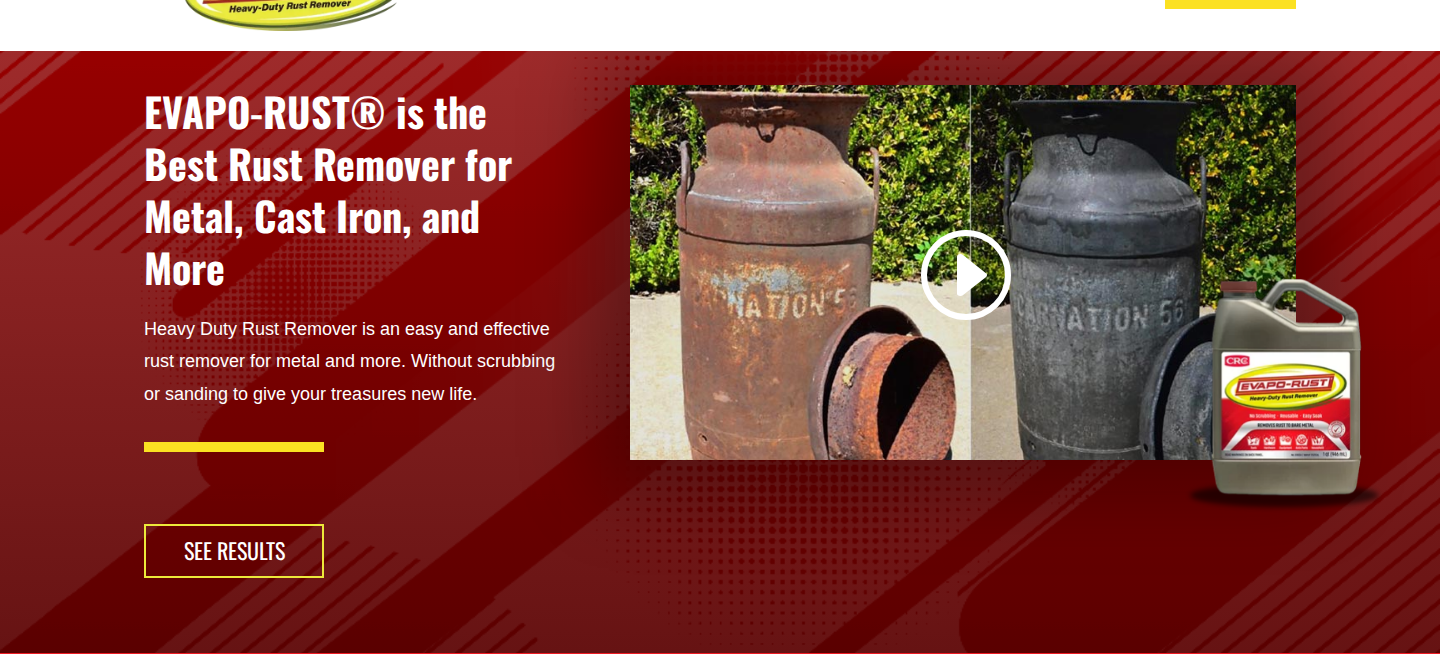
A chelation-based rust remover soak that selectively dissolves iron oxide without attacking base steel. Non-toxic, biodegradable, and reusable — with no acids, alkalis, or hazardous ingredients.
Pros:
Will not pit or damage unrusted base steel
Safe on copper, brass, aluminium, rubber, plastics
Non-toxic, non-flammable, biodegradable — no fumes
Reusable solution; no scrubbing required
Cons:
Slower than acid-based options on heavy rust
Parts must be fully submerged to work
Not suitable for in-situ or large-structure rust
Soak product does not remove rust stains
Evapo-Rust is a chelation-based rust remover soak that dissolves rust by selectively binding iron ions from iron oxide — without using acid, and without attacking the base steel underneath.
How the Chelation Mechanism Works
According to the product's own documentation, the active chelating ingredient bonds to iron exclusively: it can remove iron from iron oxide but is too weak to remove iron from steel, where the iron is held far more strongly.
Once the chelating agent pulls iron from the rust, a sulphur-bearing organic molecule draws that iron away and forms a water-soluble ferric sulphate complex — freeing the chelator to continue working through the rust layer.
Rust Severity Range and Soak Times
The product handles the full range from light surface rust through to deep, heavily corroded parts. The vendor's instructions state 30 minutes for light rust and up to overnight for extremely heavy rust; parts with deep rust in pits can be re-immersed after rinsing until all rust is cleared.
One gallon of Evapo-Rust will remove approximately half a pound of pure dry rust, according to the product documentation — a useful benchmark when estimating how much solution a batch of parts will require.
Substrate Safety and Material Compatibility
This is where Evapo-Rust distinguishes itself most clearly from acid-based options. Because the chelating agent targets iron in iron oxide rather than iron in clean steel, the Technical Data Sheet states it will not pit or discolour unrusted steel — even with extended soak times.
The TDS and product pages confirm it is safe on a broad range of materials that may be present in mixed assemblies or on parts with non-metallic components.
- Metals: Copper, brass, aluminium, stainless steel — all listed as safe in the TDS.
- Non-metallic materials: Plastic, rubber, PVC, Viton, vinyl, paint, glass, and wood — all confirmed safe per the product documentation.
- Not suitable for: Magnesium and magnesium alloys — explicitly excluded on the product page and canister labelling.
This material compatibility profile makes it practical for parts where steel is in direct contact with rubber seals, plastic housings, or non-ferrous metal components — assemblies where an acid-based soak would risk collateral damage.
Scale and Application Suitability
Evapo-Rust is a submersion product: parts must be fully immersed in the solution for best results. The vendor confirms this is the most effective application method, and that the liquid must remain in full contact with the rusted area without evaporating.
It suits a wide range of soakable items — tools, hardware, auto parts, cast iron cookware, antiques, grill grates, and more — provided they fit within a container.
Where full submersion is not possible, the Evapo-Rust Gel format is the alternative for surface and vertical application — but that is a separate product; the soak does not handle in-situ or large-structure rust.
Evapo-Rust works by keeping the chelating agent in sustained contact with the rust. Parts that cannot be fully submerged — large frames, structural sections, in-situ corrosion on equipment that cannot be disassembled — are outside the scope of the soak product.
The product is available in sizes from one quart up to 275-gallon totes, which means it scales from bench-top tool restoration to dipping engine blocks in a 55-gallon drum.
Safety and Environmental Profile
Evapo-Rust's safety profile is one of its strongest differentiators relative to acid-based rust removers. The Technical Data Sheet classifies it as non-toxic, non-flammable, and biodegradable, containing no VOCs, no acids, no alkalis, no petroleum solvents, and no hazardous ingredients.
The Safety Data Sheet confirms it is not classified as hazardous under OSHA Hazard Communication Standards, carries no signal word or hazard pictogram, and lists no hazard statements — an unusually clean profile for a product capable of removing heavy rust.
On disposal, the TDS states that the iron content of the spent solution dictates the disposal method, and directs users to check local, state, and federal regulations. The Safety Data Sheet adds that the solution should never be disposed of into open waterways, lakes, streams, or storm drains.
Ease of Use
The workflow is straightforward: clean excess dirt and oil from the part, submerge it in the solution, leave it for the required time, then rinse with water. No scrubbing is required for most applications.
The solution is reusable until its effectiveness drops off — the vendor states it has an indefinite shelf life — so the same batch can treat multiple rounds of parts before it needs replacing.
Trade-offs to Consider
Chelation is slower than acid-based removal. A third-party trade guide notes that acid-based phosphoric wash-off compounds loosen rust in 2 to 10 minutes, while a chelating soak runs from 30 minutes to overnight depending on rust severity — a meaningful time difference for high-volume or time-sensitive work.
The soak format also means it cannot address rust stains on non-metal surfaces, and the vendor confirms the liquid product will not work on rust stains — the Gel format covers that use case separately.
Option 3
Jenolite Rust Remover — Liquid, Gel and Thick Liquid Range
A British chemical rust dissolver available in four formats — liquid, thick liquid, gel, and trigger spray — that strips iron and steel back to bare metal, ready to prime in 30 minutes.
Pros:
Non-drip formats cling to vertical surfaces
Four format options for varied applications
Separate non-hazardous formula for softer metals
No rinsing required; prime-ready in 30 minutes
Cons:
Standard formulas require gloves and eye protection
Not suitable for aluminium, brass, or galvanised steel
Bare metal flash rusts without same-day priming
Jenolite has been making rust treatments in Britain since 1939, and its rust remover range reflects that breadth of experience: four distinct formats that collectively cover surface application, immersion, spot treatment, and large-area work on ferrous metals.
Rust Severity Range
The range handles light surface rust through to heavy corrosion, with the thick liquid and gel formats suited to surface application on vertical and awkward areas where a thinner liquid would not stay in place.
For very heavy corrosion, Jenolite's own product pages note that multiple applications may be needed. The liquid and spray formats also remove the light oxide films left on metal after shot blasting or grit blasting — a practical detail for anyone combining abrasive and chemical methods in a single workflow.
Substrate Safety
This is the axis that requires the most attention when selecting a Jenolite formula. The standard liquid, thick liquid, gel, and trigger spray products are designed for ferrous metals — iron and steel only. Jenolite's own product pages state clearly that these formulas should not be used on non-ferrous metals such as aluminium, brass, or galvanised steel, as surface damage or discolouration may result.
A separate non-hazardous, water-based formula exists specifically for softer metals, and Jenolite lists it as suitable for chrome, copper, brass, and aluminium. Choosing the wrong formula for the wrong substrate is a real risk — checking which product applies to your metal before starting is essential.
Format Range and Application Suitability
The format breadth is Jenolite's clearest differentiator within the chemical rust remover category. Each format is optimised for a different application scenario, and the coverage figures published on Jenolite's product pages give a practical basis for estimating how much product a job requires.
| Format | Best Suited To | Coverage | PPE Required |
|---|---|---|---|
| Liquid | Immersion of small parts; tools, components | – | Yes — gloves and eye protection |
| Thick Liquid | Vertical surfaces: bodywork, chassis, wheel arches, gates, garden furniture | Approx 4 m² per litre | Yes — gloves and eye protection |
| Gel | Vertical and awkward surfaces; spot treatment on vehicles, bikes, appliances | – | Yes — gloves and eye protection |
| Trigger Spray | Targeted surface application; automotive, marine, garden metalwork | Approx 8 m² per litre | Yes — gloves and eye protection |
| Non-Hazardous (water-based) | Softer metals: chrome, copper, brass, aluminium; fuel tanks | – | No PPE required |
Jenolite's five rust remover formats compared by application, published coverage figures, and PPE requirements. – indicates coverage not published on Jenolite's product pages.
The non-drip thick liquid is the standout format for in-situ work on structures that cannot be disassembled or submerged. Its consistency holds the product against vertical surfaces — bodywork panels, chassis rails, wheel arches, gates — without running, so the active dwell time is concentrated where it is needed rather than lost to drainage.
The gel format shares this non-drip property and is well suited to spot treatment on rust patches where precise, contained application matters. The standard liquid remains the most practical choice for immersing small parts in a container.
Safety and Environmental Profile
Jenolite's standard formulas carry a handling hazard: gloves and eye protection are required, and work should be carried out in a well-ventilated area. Splashes on skin or surrounding paintwork can cause staining and should be washed off immediately with water.
The non-hazardous water-based formula is a different proposition. Jenolite describes it as pH neutral and states that it does not require gloves, eyewear, or other protective equipment.
Standard Jenolite formulas are for ferrous metals only and require PPE. The non-hazardous water-based formula is for softer metals including chrome, copper, brass, and aluminium, and requires no protective equipment. Confirm which formula matches your substrate before purchasing.
Ease of Use and Application Process
The application process is consistent across the surface-application formats. Prepare the surface by removing oil, grease, loose paint, and loose rust with a wire brush or steel wool, then brush or spray the product liberally onto the rusted area.
- Apply: Brush or spray liberally onto rusted areas. Work into pitted sections, corners, and edges for full coverage.
- Keep active: Rework with a brush every 5 minutes and reapply as needed. Do not allow the surface to dry out or become tacky.
- Monitor: Continue until rust turns dark grey. Wipe dry with a clean, lint-free cloth.
- Prime: Wait 30 minutes, then apply primer or topcoat. For best results, prime the same day.
No rinsing is required for the thick liquid and gel formats — wipe dry and wait 30 minutes before priming. This is a practical advantage over treatments that require a water rinse step, particularly when working on structures where rinsing is awkward.
One constraint applies to all formats: bare metal will begin to flash rust if left unprotected after treatment. Priming the same day is not just a recommendation — it is a necessary step to prevent the cleaned surface from re-oxidising before any coating is applied.
Option 4
Rust-Oleum Rust Dissolver — Phosphoric Acid Gel and Liquid
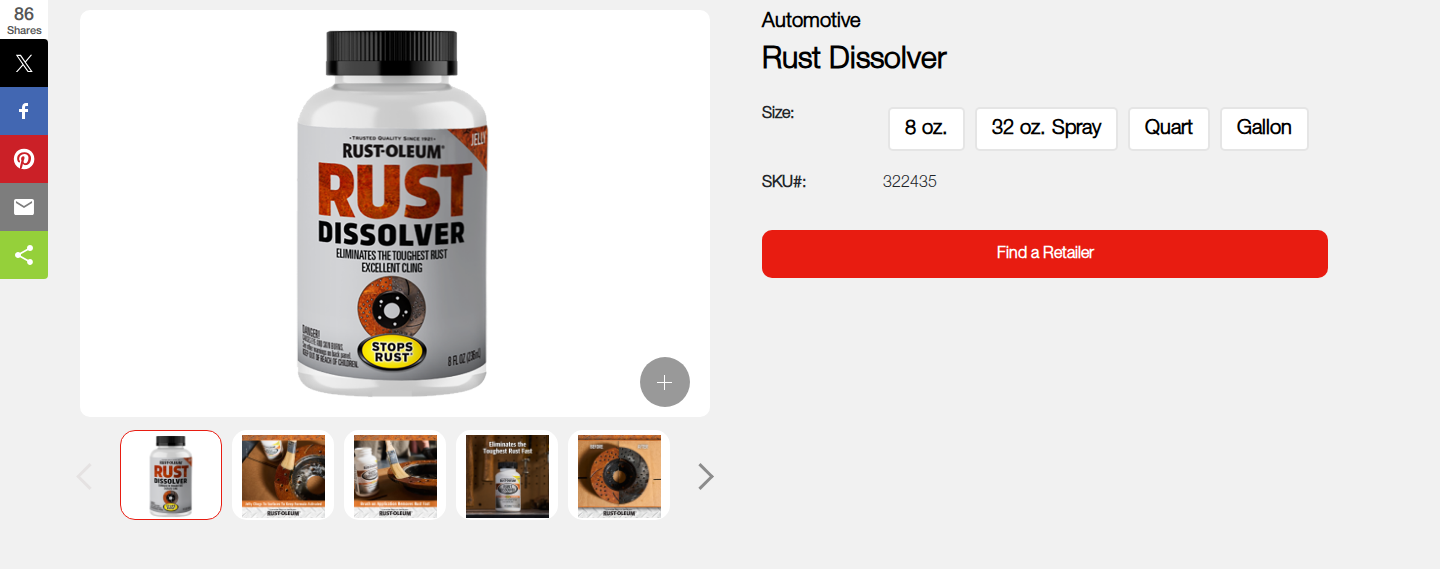
A phosphoric acid rust remover available in liquid and gel formats. Converts rust to iron phosphate, leaves a paintable surface, and inhibits re-rusting on iron, steel, and a wide range of other substrates.
Pros:
0% VOC (gel format)
Wide substrate compatibility including aluminium and chrome
Gel clings to vertical and awkward surfaces
Leaves a paintable, rust-inhibiting surface
Cons:
Phosphoric acid requires PPE and ventilation
Surface must be painted promptly after treatment
Not suitable for marble (liquid and gel)
Rust-Oleum Rust Dissolver works by a phosphoric acid conversion mechanism: the acid reacts with iron oxide to form iron phosphate, a stable grey compound that bonds to the surface rather than simply dissolving the rust away.
This conversion chemistry is what gives the product two practical advantages over more aggressive mineral acids: it leaves a surface that is ready to prime and paint, and the iron phosphate layer provides a degree of rust inhibition in the short term.
Rust Severity and Dissolution Times
On iron and steel, the Rust Dissolver Gel TDS specifies that medium to light rust dissolves in 10–30 minutes or less, with heavier deposits requiring a second application.
The liquid formula (ROC-49) works to a similar timetable: 15–30 minutes for iron, steel, and galvanised surfaces where rust is visible, while aluminium, chrome, and new galvanised metal dissolve rust in 3–5 minutes, and porcelain, tile, fiberglass, and glass may take 5 minutes or longer.
Rust on firearms is described as dissolving instantly in the liquid formula — a reflection of the product's broad application range rather than a specialist claim.
Substrate Compatibility
The liquid formula (ROC-49) covers the widest substrate range: iron, steel, aluminium, chrome, galvanised metal, porcelain, tile, fiberglass, glass, auto cooling systems, and firearms.
The gel formula (ROC-55) is specified for iron, steel, and other metals; the Rust Dissolver Jelly (ROC-131) is explicitly not recommended for chrome or soft metals including aluminium.
| Format | Substrates | Application method | Re-rust inhibition |
|---|---|---|---|
| Liquid (ROC-49) | Iron, steel, aluminium, chrome, galvanised, porcelain, tile, fiberglass, glass, auto cooling systems, firearms | Brush-on or bath/immersion | – |
| Gel (ROC-55) | Iron, steel, and other metals | Trigger spray or brush; clings to vertical surfaces | Yes — inhibits return of rust; creates paintable surface |
| Jelly (ROC-131) | Iron, steel, and other ferrous metals (not chrome or soft metals including aluminium) | Brush-on; excellent cling for heavy rust | No — prime or coat within 48 hours |
Format-by-format comparison of the Rust Dissolver range, showing substrate scope, application method, and re-rust inhibition per the Rust-Oleum TDS documents. – not stated for this format.
The liquid and gel formulas both carry a marble restriction — do not use on marble — as stated in the ROC-49 and ROC-55 TDS documents.
Application and Ease of Use
The application sequence is consistent across formats: degrease and rinse the surface first, apply the product, keep the surface wet until the rust is dissolved, then rinse with clean water.
For the gel and liquid, the TDS specifies waiting one hour or more after rinsing before painting; the jelly specifies priming or coating within 48 hours.
The gel's trigger-spray delivery makes it well-suited to vertical surfaces and awkward geometry — areas where a liquid would run off before completing the reaction.
The liquid is the format for immersion or bath work, where a part can be submerged in a plastic, glass, or stainless steel container for thorough contact across complex geometry.
Liquid for bath and immersion work on complex parts; gel for spray or brush application on vertical surfaces and in-situ bodywork where the product needs to stay in contact without running.
Safety and Handling Profile
The Rust Dissolver Gel SDS (GHS classification) lists phosphoric acid at 25–50 wt% and assigns H314 (causes severe skin burns and eye damage) and H332 (harmful if inhaled) hazard statements.
The TDS warns to use only with adequate ventilation, avoid breathing vapours or spray mist, and avoid contact with eyes — with a first-aid instruction to flush with water for at least 15 minutes on contact.
PPE requirements per the SDS include protective gloves, protective clothing, and eye or face protection (GHS precautionary statement P280).
The gel formula carries 0% VOC (by weight, per the ROC-55 TDS) and a shelf life of five years; the liquid formula (ROC-49) lists 0.45% VOC by weight and the same five-year shelf life.
The pH of the gel concentrate is 1.0–2.0 per the TDS (1.0–3.0 per the SDS); the product is strongly acidic at working concentration.
For disposal, the SDS classifies the material as potentially a RCRA hazardous waste under the characteristic of corrosivity (D002) and directs disposal in accordance with local, state, and federal regulations — follow the SDS guidance directly for disposal decisions.
Trade-offs to Consider
The handling hazards are the most significant practical limitation: phosphoric acid at these concentrations causes severe skin burns and eye damage, which means this product requires genuine PPE discipline and ventilated working conditions — a meaningfully higher bar than chelation-based alternatives.
The iron phosphate layer left after treatment is a primer base, not a finish: left bare and exposed to weather, its protection lasts days rather than months, and the surface will re-rust without prompt priming or coating.
Multiple credible technical sources — including DTIC, NASA, and the Steel Construction Institute — note that acid pickling processes, including those using phosphoric acid, can introduce hydrogen into steel and raise the risk of hydrogen embrittlement, particularly in high-strength steels above approximately 1,000 N/mm² tensile strength.
This is a relevant consideration for precision fasteners or high-strength structural components, where the consequences of embrittlement can be severe and delayed — and where mechanical or chelation-based removal methods carry lower risk.
Option 5
Abrasive Blasting and Wire Brushing — Mechanical Rust Removal
Mechanical rust removal uses physical abrasion — wire brushing, angle grinding, and abrasive blasting — to strip rust by force. The fastest approach for heavy, scaly rust on large surfaces and structural steel.
Pros:
No chemicals or consumables required
Highly effective on heavy, scaly rust
Wire brushing needs only standard angle grinder
Blasting creates ideal surface profile for coatings
Cons:
Some base metal loss is inherent
Bare steel flash-rusts immediately after blasting
Blasting requires PPE, containment, and media disposal
Compressor and equipment needed for abrasive blasting
Mechanical rust removal works by physical abrasion: rust is stripped from the surface by force rather than dissolved or vaporised, making it the most direct approach available and the fastest option for heavy, scaly corrosion on large surfaces and structural steel.
Sub-Methods and Rust Severity Range
The mechanical category spans a wide severity range, and the right sub-method depends on the rust at hand.
| Sub-method | Rust severity | Best applications |
|---|---|---|
| Wire brushing / angle grinder with wire cup wheel or flap disc | Mild to medium | In-situ rust, uneven surfaces, pitted areas, equipment that cannot be moved |
| Dry abrasive blasting (sandblasting) | Medium to heavy | Large flat surfaces, structural steel, pre-coating surface preparation |
| Wet abrasive blasting | Heavy to extreme | Extreme scaly rust; reduces dust compared to dry blasting; requires pressurised water source |
How each mechanical sub-method maps to rust severity and application type.
Real-world experience on heavily rusted steel shipping containers, documented by The Fabricator, found that dry sandblasting with aluminium oxide or coal slag and a 150-PSI compressor handled medium rust effectively but was time-consuming on extreme rust — and that wet abrasive blasting, using a high-pressure gas-powered washer with a siphon attachment, was the only approach that removed extreme scaly rust efficiently.
The practical constraint with wet blasting is access to a pressurised water source, which can be limiting in remote or enclosed locations.
Substrate Safety and Surface Profile
Mechanical methods remove material — that is both their defining strength and their primary risk.
Wire brushing is the least aggressive sub-method. The Fabricator's guidance on wire brush technique is consistent: use the highest safe speed with the lightest possible pressure, letting the wire tips do the work rather than bearing down, which minimises surface aggression.
Abrasive blasting is more aggressive and requires careful media selection and pressure control. The Fabricator recommends maintaining at least 100 PSI at the nozzle — 110 PSI or higher is better — and cautions against undersized blast hoses, which increase internal resistance, slow the air-and-abrasive mix, and can reduce nozzle pressure significantly.
The surface profile that blasting creates — microscopic peaks and valleys across the steel — is a genuine operational benefit, not just a side effect. According to AIMS Industrial, abrasive blasting to Sa 2.5 standard is the preferred surface preparation method before industrial coatings, producing a cleaner, more consistent anchor pattern than chemical methods alone.
Blasting Media
Media selection affects both productivity and health risk. The Fabricator's real-world accounts and OSHA guidance both identify aluminium oxide, coal slag, and garnet as the working alternatives to silica sand.
OSHA's shipyard guidance notes that the majority of shipyards no longer use silica sand as a blasting abrasive, citing the health hazards associated with silica dust: employees who breathe fine respirable particles of crystalline silica are at risk of developing silicosis, a stiffening and scarring of the lungs. OSHA recommends that employers evaluate available blasting agents and select the safest option appropriate for the work.
Alternative media reduce but may not eliminate silica exposure — coal slag, for example, generated substantially lower airborne levels of crystalline silica than silica sand in a NIOSH-sponsored field study cited in OSHA's guidance. Media containing small amounts of crystalline silica can still generate elevated airborne levels when used in confined or enclosed spaces.
Mechanical Rust Removal Safety
Abrasive blasting generates significant quantities of dust and airborne contaminants from three sources simultaneously: the base material being blasted, any surface coatings being removed, and the blasting media itself.
OSHA's guidance for abrasive blasting operations requires full PPE: a blasting hood, heavy canvas or leather apron, hearing protection (due to high noise levels), and respiratory protection. In enclosed or confined spaces, or when using media containing more than one percent crystalline silica, operators must use NIOSH-certified Type CE abrasive blasting airline respirators with positive-pressure blasting helmets.
OSHA recommends wet blasting methods to reduce or eliminate dust generated during surface preparation, noting that all wet blasting techniques produce substantially lower dust emissions compared to dry abrasive blasting.
Wire brushing generates considerably less airborne debris than blasting, but still requires eye and face protection, hearing protection, and appropriate PPE — and the same principle of using the lightest effective pressure applies for both safety and brush life.
Bare steel left unprimed after abrasive blasting can begin to flash rust rapidly. AIMS Industrial advises not to leave bare steel overnight without protection — prime or apply a protective coating as soon as the surface is clean and dry.
Ease of Use and Practical Constraints
Wire brushing with an angle grinder is the most accessible mechanical approach: tools are available at any hardware store, no special equipment or training is required, and the method is suited to operators at any experience level.
Abrasive blasting is a different undertaking. It requires a compressor, blasting equipment, appropriate media, and containment for blast debris — and nozzle pressure, hose selection, and media choice all affect productivity significantly. The Fabricator's best-practice guidance covers each of these variables in detail, underscoring that blasting is not a casual operation.
For in-situ rust on large structures that cannot be disassembled, chemical methods such as phosphoric acid gel or rust converters can be more practical than blasting — particularly where containment, equipment access, or water supply is limited. Mechanical methods are strongest where the surface is large, accessible, and can be properly prepared for coating.
Explore Laser Rust Removal from Woodrow Scientific
No chemicals, no abrasives, no consumables. The ELASER removes rust by vaporising it at the surface, leaving the substrate intact. See the full specification and find the right system for your application.

Conclusion
Which rust remover is right for your situation?
The most powerful rust remover is not necessarily the most aggressive one — it is the one that matches the scale, the substrate, and the severity of the job in front of you.
Where precision matters most, and where substrate integrity cannot be sacrificed, laser cleaning sets the standard that every other method is measured against.
Frequently asked questions about powerful metal rust removers
Direct answers to the questions readers ask most about removing rust from metal surfaces.
There is no single best — the right product depends on rust severity, substrate, and operational context. For industrial and professional operators who need in-situ capability with no chemical waste, laser cleaning is the most powerful and precise option; the ELASER by Woodrow Scientific is the strongest example covered on this page. For soakable parts — tools, auto components, farm equipment — a chelation-based soak dissolves rust selectively without attacking base steel, making it well suited to precision or mixed-metal assemblies. Phosphoric acid gels and thick liquids are the practical choice for surface application before painting: they convert rust to a stable iron phosphate layer that acts as a primer bond. For heavy, scaly rust on large surfaces and structural steel, abrasive blasting is the fastest mechanical route. The honest answer maps method to situation: rust severity, whether protecting the base metal matters, and whether the job is recurring or a one-off all point toward different solutions.
Phosphoric acid is the better choice for most rust removal tasks. It converts rust to iron phosphate — a stable compound that bonds to the surface and acts as a primer base — without aggressively attacking the clean steel underneath. Muriatic acid (hydrochloric acid) dissolves rust faster, but it does not stop at the rust line: it continues attacking bare steel if left on too long, and the stripped surface flash-rusts rapidly unless neutralised and protected immediately. Phosphoric acid is also the safer option to handle. Muriatic acid produces corrosive hydrogen chloride fumes and requires full respiratory protection and strong ventilation; phosphoric acid is less aggressive in both its action on metal and its handling demands. There is also a structural risk with muriatic acid on certain steels. Industrial guidance identifies hydrogen embrittlement as a concern when acid cleaning high-strength steel — the acid drives hydrogen into the metal, which can cause brittle fracture. For that reason, muriatic acid is not appropriate for precision parts, threaded fasteners, or high-strength steel components; abrasive blasting is the safer alternative there. Muriatic acid does have a place in industrial descaling, where speed matters and surface finish is less critical. For most rust removal work — surface preparation before painting, restoring tools, treating automotive or farm equipment — phosphoric acid gives better control and a more predictable result.
It depends which WD-40 product you mean — they work very differently. The original WD-40 Multi-Use Product is a lubricant and moisture displacer, not a dedicated rust remover. It can help loosen light surface rust when applied and left to penetrate, but mechanical action — scrubbing with a wire brush or sandpaper — is needed to lift the rust away. For anything beyond very light surface rust, it is not a substitute for a product designed specifically for rust removal. The WD-40 Specialist Rust Remover Soak is a separate product with a different purpose and mechanism. It uses a chelation-based formula — the same class of chemistry as Evapo-Rust, covered earlier on this page — to dissolve rust without acids or caustic chemicals. According to WD-40's own published information, the soak is safe on steel and aluminium, produces no toxic fumes, contains no VOCs, and the solution is reusable. Soak times vary by rust severity: light rust clears in 1 to 3 hours; heavy rust typically requires an overnight soak. WD-40 lists it as suitable for tools, auto parts, farm equipment, and similar soakable components. Note that it should not be used on parts with bluing, browning, or other protective oxide coatings, as those coatings will be removed along with the rust.