Introduction
A portable laser cleaning machine is a compact, wheeled or carry-on fibre-laser system that removes rust, paint, oxides, and coatings through laser ablation — no chemicals, abrasives, or water needed.
What separates a genuinely portable system from a heavy industrial unit with wheels is simpler than the marketing suggests: single-operator deployment, standard single-phase power, and no dependency on an external chiller or compressor.
Every machine on this list was evaluated against six criteria: power range, laser type (pulsed vs continuous-wave), cooling method, portability credentials, application suitability, and total cost of ownership.
The pulsed vs continuous-wave decision is the most fundamental choice you will make — the buyer's guide below explains it in full.
TL;DR
Many machines sold as portable laser cleaners are not genuinely field-deployable. The ones that are differ meaningfully in laser type, cooling method, and weight — and choosing the wrong axis first leads to the wrong machine. This list and buyer's guide give you the framework to get that decision right.
This article covers:

Five portable laser cleaners, evaluated consistently
Portable vs merely mobile: the real difference
Pulsed vs continuous-wave: choosing your laser type
Air-cooled vs water-cooled: portability trade-offs
Realistic pricing guidance by power class
Matching machine to application: buyer's guide
How we evaluated each portable laser cleaning machine
"Portable" is one of the most overloaded words in the laser cleaning category. Vendors apply it to machines that weigh 80 kg, run on three-phase power, and need a chiller unit on-site — none of which describes a machine a single operator can pull from a van and put to work. We built this evaluation framework specifically to cut through that noise.
Every machine on this list was assessed against the same six criteria, applied in the same order: from the fundamental technical decision that shapes application fit, through to the commercial lens that determines long-term value.
- Power range and laser type: Pulsed or continuous-wave: this choice shapes application fit before any other spec matters. Pulsed fibre lasers dominate portable use for their substrate-safe precision; continuous-wave suits high-throughput heavy cleaning on robust structures.
- Cooling method: Air-cooled systems are the genuine portability benchmark — no chiller, no water circuit, no site preparation. Water-cooled portables carry real field-deployment constraints that must be weighed honestly.
- Portability credentials: Five sub-axes: total system weight, handheld scanner weight, delivery cable reach, power supply requirements, and single-operator usability. Together, these reveal whether a machine is truly field-deployable or merely moveable.
- Application suitability: Verified contaminant and substrate range — rust, paint, oxides, weld discolouration, stone, aluminium, cast iron, and more — plus operating environment: indoor-only, open-environment, or public-facing deployment.
- Safety compliance: Class IV operation carries real overhead: area exclusion, PPE, and protocols that add friction to on-site work. Hazard zone size varies significantly between machines and changes the practical deployment picture.
- Total cost of ownership: Consumables, maintenance, downtime, and rework costs matter more than sticker price. Machines with no consumables and low rework rates consistently outperform cheaper alternatives over a working lifetime.
Taken together, these six axes expose something the wattage figure alone never can: whether a machine is the right tool for a specific job, in a specific environment, operated by a specific team.
One further consideration sits outside the machine specs entirely: manufacturer credibility. The portable laser cleaning market includes a significant number of resellers and importers rebadging third-party machines as their own — and that distinction has direct consequences for spare parts availability, technical support quality, and the vendor's capacity to fix problems when they arise. Buyers should ask every supplier on their shortlist whether they design, manufacture, and support their machines in-house, and expect a specific, verifiable answer.
Portability credentials — system weight, scanner weight, cable reach, power supply, and single-operator usability — is the axis buyers most commonly skip, and the one that most reliably separates genuinely field-deployable machines from those that are merely moveable.
With the framework in place, each entry that follows applies these criteria consistently — starting with the machine that best exemplifies what genuine portability, application breadth, and long-term value look like in practice.
Product 1
ELASER / ELASER-RHZ — Woodrow Scientific Limited
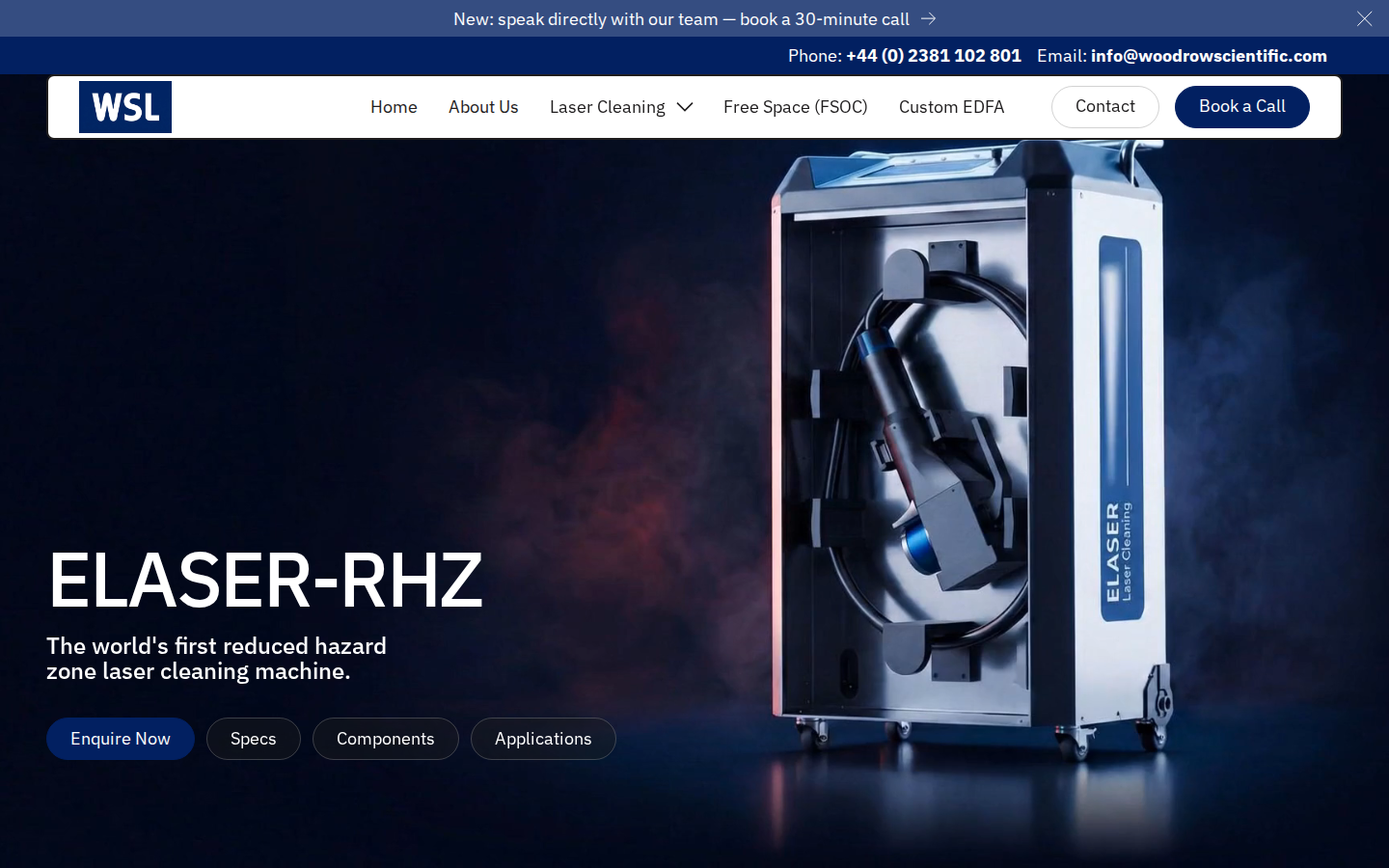
The ELASER and ELASER-RHZ are portable industrial fibre laser cleaning systems designed, built, and supported in-house by Woodrow Scientific Limited — the UK's only laser cleaning manufacturer. The RHZ variant uses WSL's patented 1550 nm retina-safe technology to collapse the laser hazard zone, enabling cleaning in open workshops, mixed-use facilities, and public-facing environments where conventional laser cleaning cannot operate.
Pros:

World-first RHZ technology enables open-environment cleaning
Sub-3 kg scanner; up to 50 m reach
Fully air-cooled — no chiller or compressor
CE and UKCA certified; operator training available
Cons:

Quote-only pricing requires contacting WSL directly
Industrial spec may exceed entry-level buyer needs
The ELASER-RHZ is the only portable laser cleaning machine in the world with a patented reduced hazard zone — enabling cleaning in open workshops, mixed-use facilities, and publicly accessible spaces without evacuating or sealing off the area. No other portable laser cleaner on this list, or anywhere in the verified competitive landscape, offers this capability.
For buyers who have looked at laser cleaning before and stepped back because of the safety overhead, the ELASER-RHZ changes the calculation entirely.
Reduced Hazard Zone: What It Unlocks in Practice
Conventional portable laser cleaners operate at wavelengths that require the surrounding area to be cleared and controlled before work can begin — a significant operational burden in busy production environments.
WSL's patented 1550 nm wavelength is retina-safe, which collapses the laser hazard zone to a fraction of the size produced by conventional systems. In practice, this means a maintenance team can clean weld discolouration on a live production line without halting adjacent operations, or a service contractor can remove graffiti from a public monument without cordoning off the surrounding area.
The ELASER-RHZ is classified as Class I under this configuration — the safest laser class — while the standard ELASER operates as Class IV. Both variants benefit from WSL's full operator training programme and a touchscreen interface with password-protected, per-user access controls.
ELASER / ELASER-RHZ: Key Specifications
The table below maps the ELASER and ELASER-RHZ against the six evaluation axes used throughout this guide.
| Evaluation Axis | ELASER / ELASER-RHZ |
|---|---|
| Power range | Up to 300 W fibre laser; tunable 0–100% |
| Laser type | Pulsed fibre laser — 1550 nm wavelength; up to 15 mJ pulse energy, 100 ns pulse duration, up to 200 kHz repetition rate |
| Cooling method | Fully air-cooled — no chiller, water circuit, or compressor required |
| Portability credentials | System under 50 kg on wheels; handheld scanner under 3 kg; delivery cable up to 50 m; single-phase 110–250 VAC; single-operator deployment |
| Application suitability | Metals (steel, aluminium, copper, titanium, cast iron, brass, bronze, galvanised), stone, concrete, brick, masonry — rust, paint, mill scale, graffiti, weld discolouration, release agents, and more |
| Pricing / TCO | Contact for quote; no consumables, minimal downtime, minimal substrate damage — competitive TCO over the machine's lifetime |
Structured spec summary across the six evaluation axes, making the entry scannable and setting a comparison template for sibling product entries.
Power tunability from 0–100% is one of the most practically useful aspects of this specification: the same machine that strips heavy powder coating from steel tooling can be dialled back to lift light surface oxides from a precision aerospace component without touching the substrate.
Portability Credentials: Genuinely Field-Ready
The ELASER's portability case rests on concrete figures rather than marketing language. The wheeled unit comes in under 50 kg, the handheld scanner weighs under 3 kg, and the delivery cable extends to 50 m — meaning one operator can position the unit at a practical base point and reach work across a large structure, vehicle, or site without repositioning the system.
Single-phase 110–250 VAC power supply means the machine runs from a standard site socket or generator with no three-phase infrastructure required. There is no chiller to set up, no water circuit to connect, and no compressor to source — the system is self-contained from the moment it arrives on site.
Application Breadth: One Machine, Many Jobs
The ELASER's substrate and contaminant range is unusually wide for a single portable unit. On the substrate side it covers the metals most commonly encountered in industrial cleaning — steel, carbon steel, aluminium alloys, cast iron, copper, brass, bronze, titanium, and galvanised — alongside stone, concrete, brick, and masonry.
On the contaminant side, the tunable power output means rust, mill scale, paint, powder coating, lacquer, primer, oil and grease, carbon and soot, mould, graffiti, adhesives, tarnish, weld discolouration, and release agents all fall within scope. For service businesses or maintenance teams managing varied cleaning tasks, this breadth reduces the case for running multiple specialist machines.
The Company Behind the Machine
Woodrow Scientific Limited has designed, built, serviced, and improved its own laser cleaning machines in-house since 2012 — making it the only UK-based laser cleaning manufacturer. That distinction matters in a category where a significant share of the market consists of resellers and importers rebadging third-party hardware: buyers dealing with a reseller typically face slower spare parts, limited engineering support, and no realistic path to product improvement.
WSL brings over 200 years of combined engineering experience to its machines, holds patents including the world-first RHZ technology, and carries both CE and UKCA certification. Full operator training is available, and the company offers bespoke engineering and customisation capability — buyers with specific application requirements are encouraged to contact WSL directly to discuss what may be possible.
ELASER Pricing and Total Cost of Ownership
The ELASER is priced on a contact-for-quote basis, and WSL holds the position of European cost leader among comparable industrial laser cleaning machines — the most competitive upfront pricing in its class, achieved through in-house engineering efficiencies rather than any compromise on specification.
The more meaningful frame for industrial buyers is total cost of ownership. The system runs on no consumables, produces minimal substrate damage (the beam stops at the base material, reducing rework), and requires no infrastructure beyond a standard power supply — factors that compound over the machine's working life against methods that carry ongoing media, chemical, or labour costs.
Two trade-offs are worth acknowledging honestly. First, pricing requires direct engagement with WSL — there is no self-serve price online, which adds a step for buyers in early evaluation. Second, the industrial-grade specification is calibrated for professional and commercial use; buyers with genuinely light-duty requirements should consider whether it matches their workload before enquiring.
Clean Without Clearing the Room
The ELASER-RHZ is the only portable laser cleaning machine with a patented reduced hazard zone — no area evacuation, no exclusion barriers. See the full specs on the product page.
Product 2
cleanLASER streamLINE compact
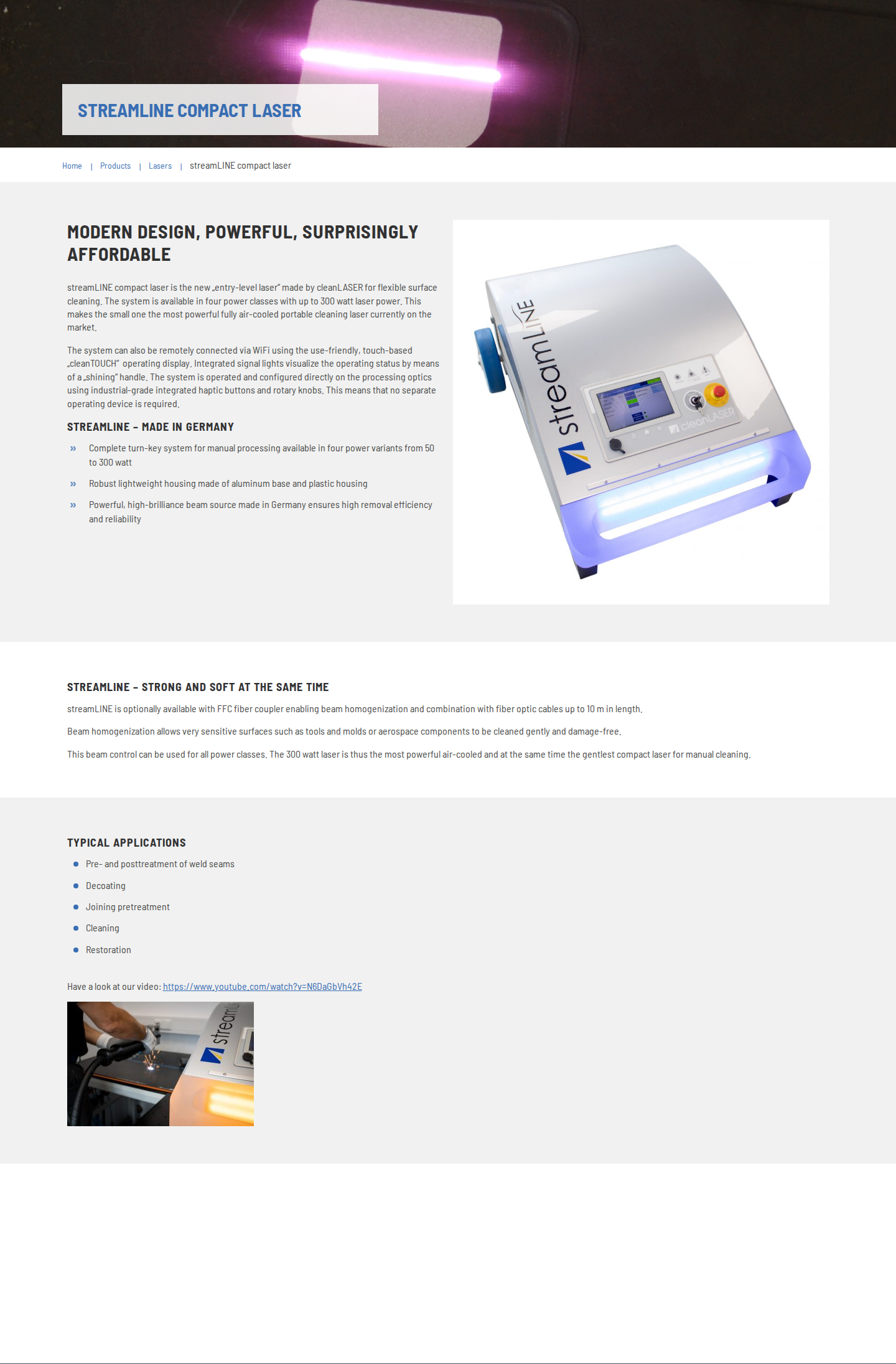
The cleanLASER streamLINE compact is a fully air-cooled portable laser cleaning machine available in four power classes up to 300 W, designed and built in Germany by Clean-Lasersysteme GmbH — the originator of industrial laser cleaning. It suits buyers who value an established European brand, a broad proven application range, and a genuinely portable form factor that needs no external chiller or water circuit.
Pros:
Established European brand with 25+ year track record
Fully air-cooled — no chiller or water circuit
Controls integrated into optics; no separate device
Made in Germany; ISO 9001 certified since 2000
Cons:
Conventional Class IV — area exclusion required
Fibre cable reach: confirm length with cleanLASER
Clean-Lasersysteme GmbH (cleanLASER), founded in 1997 by researchers from the Fraunhofer Institute for Laser Technology in Aachen, is widely recognised as the originator of industrial laser cleaning — a meaningful credential in a category where many vendors are resellers or integrators.
With approximately 2,000 installed systems worldwide and over 25 years of continuous production, the company brings a depth of field experience that newer entrants cannot match.
The streamLINE compact suits industrial buyers who want an established brand, a broad verified application portfolio, and a genuinely portable air-cooled system — and who can work within conventional Class IV laser safety protocols.
The streamLINE compact is available in four power variants from 50 to 300 W, making it one of the more configurable options in the portable category for buyers whose power requirements may vary by application.
According to cleanLASER's own product page, the streamLINE compact is described as the most powerful fully air-cooled portable cleaning laser currently on the market — this is a manufacturer claim, not an independently verified finding, and should be weighed accordingly.
The system is fully air-cooled, requiring no external chiller or water circuit — a practical advantage for operators who need to move between sites or work in locations where utility connections are limited.
The housing is constructed from an aluminium base with a plastic outer shell, balancing durability with a lightweight build suited to manual operation.
A standout usability feature is the integrated cleanTOUCH WiFi display, which allows remote connection and monitoring without a separate control terminal — the system is operated and configured directly on the processing optics via built-in haptic buttons and rotary knobs.
On application suitability, cleanLASER's published materials confirm the streamLINE compact is suited to rust and oxide removal, paint stripping, de-oiling, and weld seam preparation across metals — with documented use in automotive, aerospace, and shipbuilding sectors.
- Rust and oxide removal: Effective on ferrous and non-ferrous metal surfaces across industrial maintenance and production environments.
- Paint stripping and decoating: Confirmed for complete and selective paint removal from steel structures, including ships, bridges, and large equipment.
- Weld seam preparation: Removes lubricants, oxide layers, and hydrates to produce clean surfaces for high-quality welds and brazed seams.
- Aerospace surface pre-treatment: Used for partial paint stripping and surface preparation for bonding and thermal insulation in aircraft production.
As a Class IV laser system, the streamLINE compact requires standard area exclusion, appropriate PPE, and formal safety protocols during operation — this applies to any conventional portable laser cleaning machine in this power range.
For buyers operating in open workshops, mixed-use facilities, or environments where clearing a defined exclusion zone is impractical, this is a genuine deployment constraint worth factoring into the purchasing decision.
On fibre cable reach, the available research did not confirm a specific maximum cable length for the streamLINE compact from cleanlaser.de — buyers with large-structure or extended-reach requirements should ask cleanLASER directly about available cable options before shortlisting.
cleanLASER streamLINE compact Pricing
Pricing for the streamLINE compact is not publicly listed on cleanlaser.de — the company operates through a quote-based model via its direct sales team and authorised distributor network.
Buyers can find their nearest distributor or contact cleanLASER directly through the locations page at cleanlaser.de/en/locations/ to request a quotation for the relevant power class.
Product 3
P-Laser QF-Compact
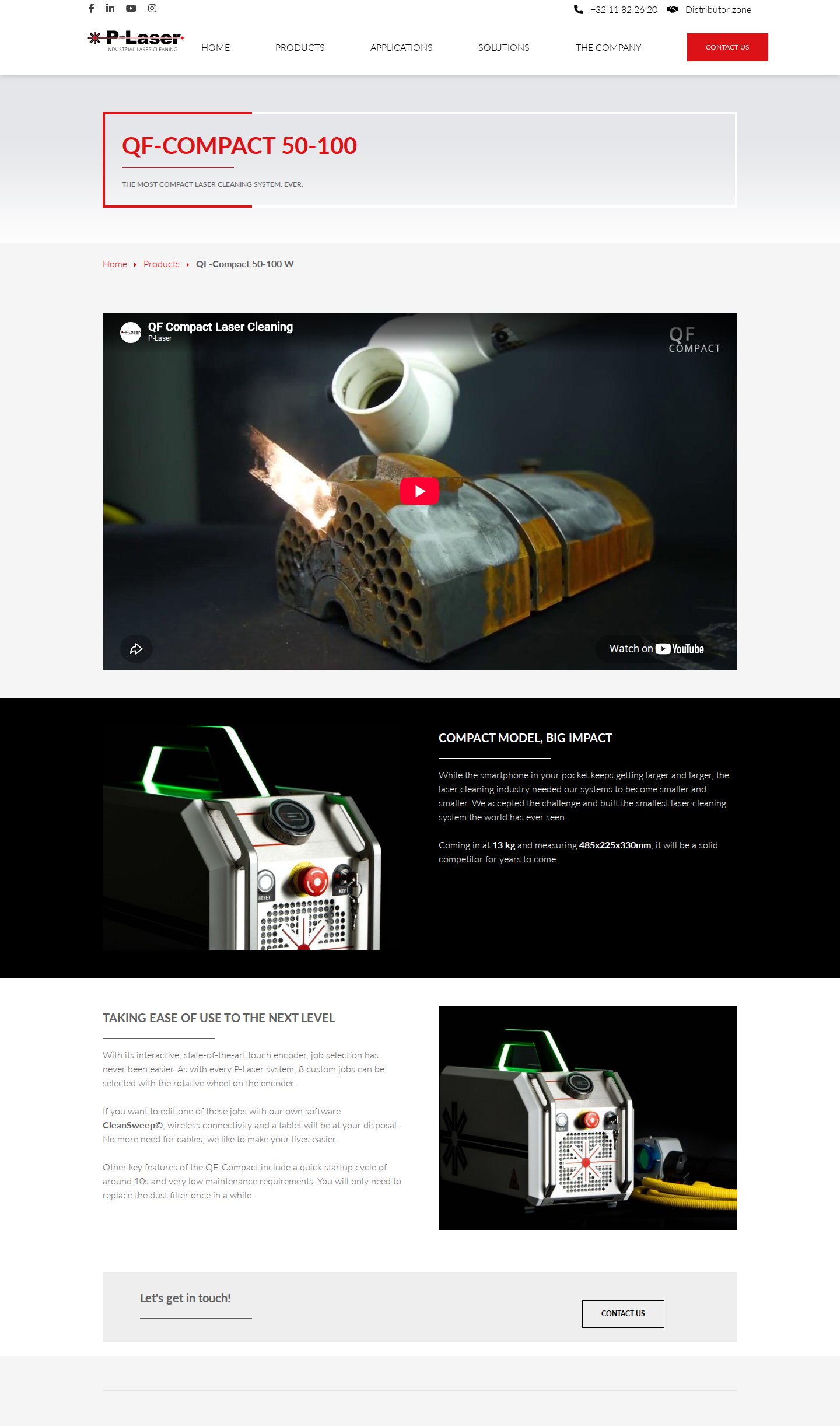
The P-Laser QF-Compact is a pulsed, air-cooled portable laser cleaning machine from Belgian specialist P-Laser, available in four power classes from 50 W to 300 W. Its defining characteristic is an all-in-one integrated design: laser source, optics, and controls are housed in a single carry-the-whole-unit body, with no separate trolley or fibre-fed scanner. At 13 kg for the 50 W and 100 W models, it is the most physically compact option for operators who need to work in locations a wheeled system cannot access.
Pros:
All-in-one integrated design — no separate trolley required
QFC-50/100 at 13 kg: genuinely carry-on portable
~10 second startup; dust filter maintenance only
Rental option available from €550/day (QFC-100)
Cons:
Whole unit repositions — no remote scanner
QFC-200/300 at 30–35 kg: not hand-carried
Conventional Class IV — area exclusion required
The P-Laser QF-Compact takes a fundamentally different architectural approach from every other machine on this list: rather than splitting the laser source into a wheeled trolley and a separate fibre-fed handheld scanner, it integrates the laser source, optics, and controls into a single self-contained unit that the operator carries as one piece.
That distinction matters practically: with a fibre-fed system, the trolley stays at a fixed point while the operator works with a lightweight scanner on a long cable; with the QF-Compact, the operator moves the whole unit to each new work position.
The QF-Compact is the strongest choice for operators who need to carry their portable laser cleaning machine into confined spaces, up access equipment, or to locations a wheeled trolley simply cannot reach — particularly at the 50 W and 100 W power classes.
P-Laser, a Belgian specialist founded in 2008 and independent since 2012, designed the QF-Compact series around a founding team with over 30 years of industrial cleaning sector expertise.
The series spans four models — QFC-50, QFC-100, QFC-200, and QFC-300 — covering 50 W to 300 W, all pulsed and all air-cooled, which eliminates the need for a water circuit or external chiller on site.
| Model | Power | Weight | Dimensions (mm) | Laser Type | Cooling |
|---|---|---|---|---|---|
| QFC-50 | 50 W | 13 kg | 485 × 225 × 330 | Pulsed | Air |
| QFC-100 | 100 W | 13 kg | 485 × 225 × 330 | Pulsed | Air |
| QFC-200 | 200 W | 30–35 kg | 300 × 665 × 465 | Pulsed | Air |
| QFC-300 | 300 W | 30–35 kg | 300 × 665 × 465 | Pulsed | Air |
Comparing the four QF-Compact models across power, weight, and dimensions gives buyers a clear, scannable reference for which model suits their portability and power requirements.
The QFC-50 and QFC-100 share the same 13 kg body and 485 × 225 × 330 mm footprint — genuinely carry-on portable, the kind of unit a single operator can lift into a van, carry up a ladder, or take onto scaffolding.
The QFC-200 and QFC-300 step up to 30–35 kg and 300 × 665 × 465 mm, and P-Laser addresses the increased mass with an extendable handle and integrated wheels, making them van-deployable rather than hand-carried.
Both size classes benefit from a startup cycle of approximately 10 seconds and maintenance requirements limited to periodic dust filter replacement — practical credentials that reduce setup overhead on site.
On applications, the QF-Compact handles rust removal, paint removal, mould cleaning, de-oiling, and a broad range of industrial surface cleaning tasks, with P-Laser's own guidance positioning the 50–100 W models as well suited to smaller surfaces and spot repair work.
Like every machine on this list except the ELASER-RHZ, the QF-Compact operates with a conventional Class IV hazard zone: standard area exclusion and appropriate PPE are required during operation.
P-Laser QF-Compact Pricing
Purchase pricing for the QF-Compact range is not publicly listed on p-laser.com; prospective buyers should contact P-Laser directly for a quote.
Rental pricing is published: the QFC-100 is available from €550 per day (€1,430 per week; €4,950 per month), the QFC-200 from €750 per day (€1,980 per week; €7,400 per month), and the QFC-300 from €950 per day (€2,350 per week; €9,700 per month).
P-Laser also offers an operated service at €95 per hour, with no transport charge within a 50 km radius — a useful option for buyers who want to evaluate the technology before committing to a purchase.
QF-Compact Trade-offs: All-in-One vs Fibre-Fed
The integrated design that makes the QFC-50/100 so genuinely portable becomes a different ergonomic proposition at higher power classes: at 300 W, the operator is physically repositioning 30–35 kg of unit each time they move to a new work position.
With a fibre-fed scanner system, the laser source stays on its trolley while the operator moves only a sub-3 kg scanner on a long cable — a meaningfully lighter working experience for large structures or multi-position jobs.
Neither architecture is categorically superior: the all-in-one approach wins on compactness and simplicity; the fibre-fed approach wins on reach and ergonomics at higher power.
Buyers who need to clean in locations a wheeled trolley cannot follow — confined spaces, elevated access points, or remote field positions — will find the QFC-50/100 difficult to match; buyers cleaning large fixed structures or working across multiple positions at higher power will likely find a fibre-fed system the more practical choice.
Product 4
Netalux Needle — Netalux
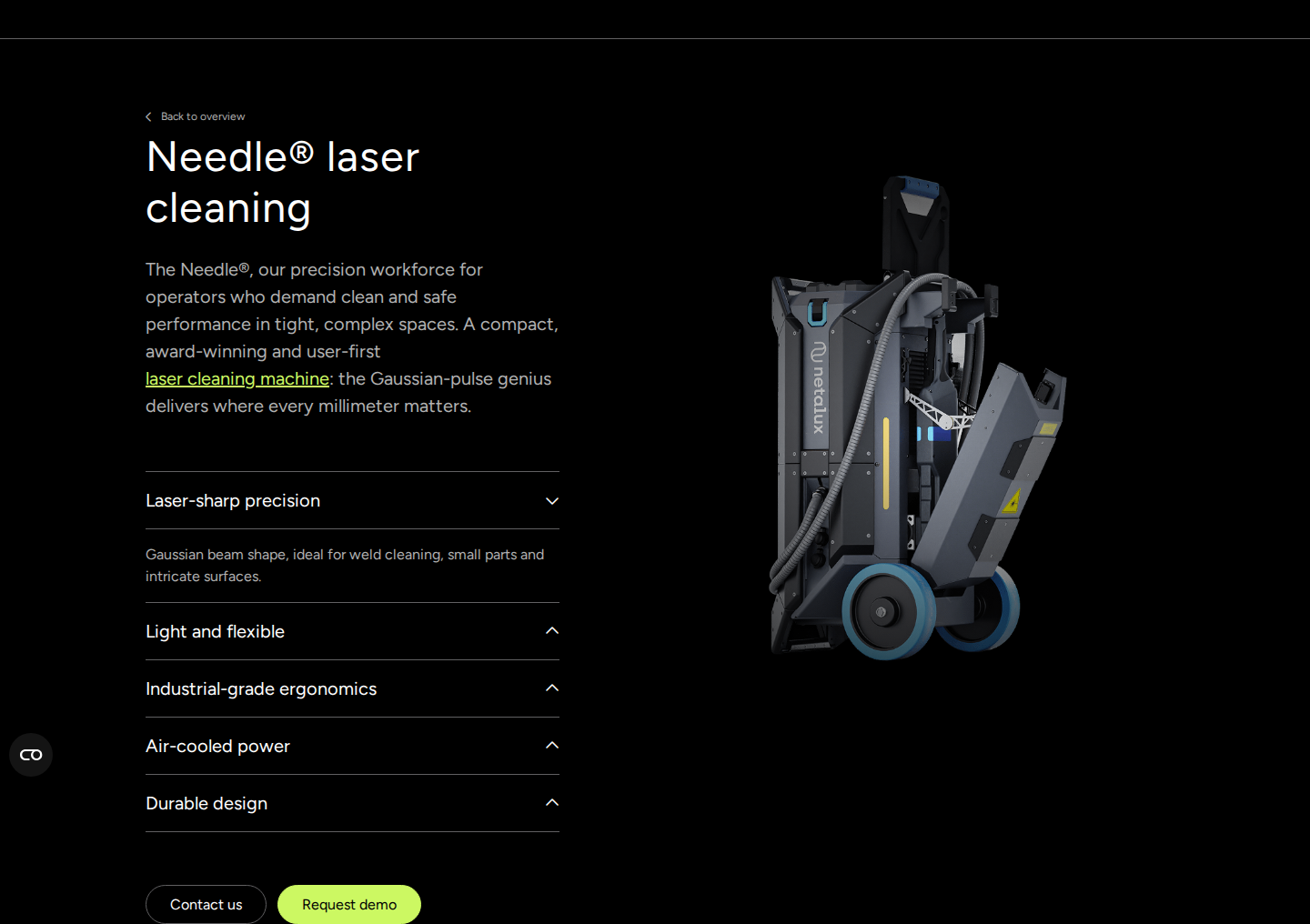
The Netalux Needle is a Belgian-designed pulsed portable laser cleaning machine available in 100–300 W configurations, best suited to operators working in confined spaces and precision applications who value award-winning ergonomic design and a compact, industrially-rated handset.
Pros:
Three consecutive Red Dot Design Awards (2020, 2022, 2023)
115° rotatable head; integrated LED headlight
Fully air-cooled (100/150 W); no chiller needed
IP4X-rated enclosure; single-phase 110–240 V power supply
Cons:
Fibre reach only 4.5–5.7 m — shortest on list
200/300 W needs compressed air (verify with Netalux)
The Netalux Needle is best suited to operators who prioritise ergonomic design and industrial build quality in the 100–300 W pulsed portable category — particularly those working in confined spaces, hard-to-reach locations, and precision cleaning tasks on small or intricate surfaces.
Award-Winning Design Philosophy
Netalux has won three consecutive Red Dot Design Awards: for the Needle 100 in 2020, the Jango in 2022, and the Needle 200/300 W in 2023 — a track record that reflects a deliberate, operator-first design philosophy rather than a single lucky entry.
Every element of the handset is built around the operator's experience: a 115° rotatable laser head reaches angles that fixed-head systems cannot, an integrated LED headlight improves visibility in poorly-lit or confined environments, and all controls sit within the handset itself — no separate operating device required.
The IP4X-rated enclosure is rated for industrial environments, and the unit runs on single-phase 110–240 V power, making it straightforward to deploy across different sites without specialist electrical infrastructure.
Model Tiers: Specs at a Glance
The Needle comes in two distinct model tiers, differing in power output, unit weight, handset weight, and fibre cable length.
| Specification | Needle 100/150 W | Needle 200/300 W |
|---|---|---|
| Laser type | Class IV pulsed ytterbium fibre laser, 1064 nm | Class IV pulsed ytterbium fibre laser, 1064 nm |
| Beam profile | Gaussian | Gaussian |
| Unit weight | ~20 kg | ~40 kg |
| Handset weight | ~2.3 kg | ~3 kg |
| Fibre cable length | 4.5 m | 5.7 m |
| Cooling | Air-cooled | Air / optic: compressed air |
| Power supply | 450–600 W, 1P 110–240 V | 950–1150 W, 1P 110–240 V |
| Enclosure rating | IP4X | IP4X |
Side-by-side comparison of the two Needle model tiers across the key specification axes buyers need to compare.
Both tiers use a Gaussian beam profile, which is particularly well-suited to small-area and precision cleaning work — weld cleaning, small parts, and intricate surfaces are where the Needle is at its most effective.
Cooling and Portability
The Needle 100/150 W is fully air-cooled, requiring no chiller, water circuit, or compressor — a genuine advantage for sites where ancillary infrastructure is limited.
The 200/300 W model uses compressed air for optic cooling; whether this requires an external compressor or draws from a self-contained source is not confirmed in publicly available Netalux materials, so buyers should verify infrastructure requirements directly with Netalux before purchase.
At approximately 20 kg (100/150 W) and 40 kg (200/300 W), both units are compact enough for confined-environment deployment, and the 100/150 W model's dimensions of 333 × 244 × 498 mm make it particularly easy to position in tight spaces.
Applications and Substrates
Netalux positions the Needle across automotive, pharmaceutical, food industry, and production company applications — sectors where precision, cleanliness standards, and operator access to confined areas are recurring requirements.
Confirmed substrates include stainless steel, aluminium, structural steel, and copper, with the Gaussian beam profile reinforcing the Needle's suitability for detail work on these materials.
As a conventional Class IV laser system, the Needle requires standard area exclusion, PPE, and safety protocols — the same hazard class as the other pulsed portable machines on this list.
Key Trade-Off: Fibre Cable Reach
The Needle's most significant constraint relative to other entries on this list is its fibre cable reach: 4.5 m on the 100/150 W model and 5.7 m on the 200/300 W model — the shortest fibre reach of any fibre-fed system evaluated here.
For context, the ELASER offers up to 50 m of fibre reach, and the Narran ROD 300 AIR (covered next) comes standard with 10 m — both provide meaningfully more working radius from the unit.
For large-structure cleaning, field maintenance on extended structures, or any scenario requiring the operator to work at distance from the unit, this reach limitation is a genuine constraint that buyers should weigh carefully.
For confined-space and close-proximity work — which is precisely where the Needle's rotatable head and ergonomic handset add the most value — the short fibre reach is far less of a practical limitation.
Total Cost of Ownership
The Needle's pulsed fibre laser and air-cooled design (on the 100/150 W model) mean there are no consumables and no cooling infrastructure costs to factor into ongoing running costs.
Buyers considering the 200/300 W model should factor in any compressed-air infrastructure requirements — confirm with Netalux whether an external compressor is needed for your installation.
Pricing is not publicly listed on netalux.com; contact Netalux directly for a quote based on your specific model and configuration requirements.
Product 5
Narran ROD 300 AIR — Narran
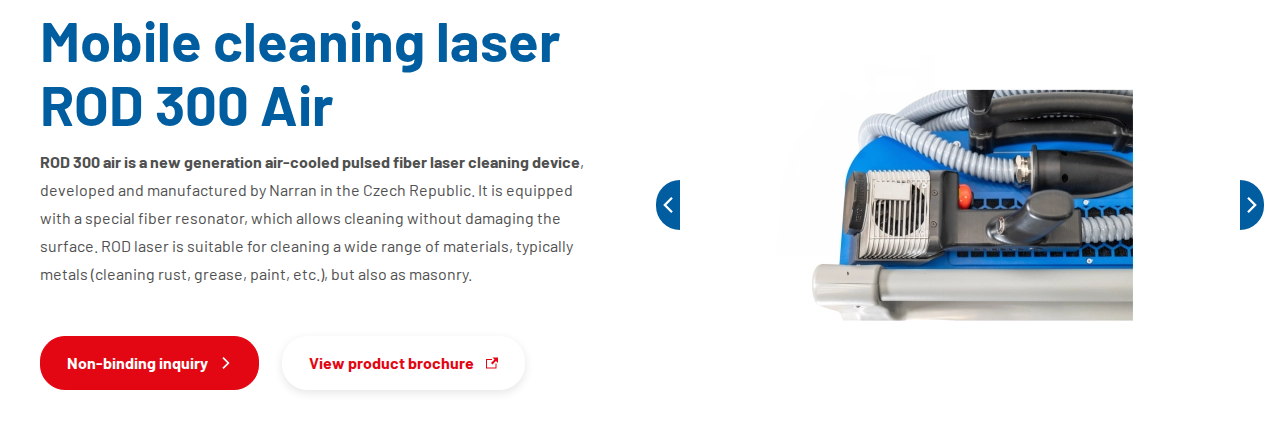
The Narran ROD 300 AIR is a 300 W pulsed portable laser cleaning machine built in the Czech Republic, best suited to operators who prioritise handset ergonomics for extended manual use and buyers in North American or scientific procurement environments where FDA certification is a requirement.
Pros:
~1 kg process head — lightest in class per Narran
FDA, CE, and ISO certified
In-house fibre resonator; CERN deployment validation
Integrated HEPA and activated carbon filtration included
Cons:
Standard 10 m fibre — shorter than some competitors
Conventional Class IV — full area exclusion required
Pre-set modes; less tunability than variable systems
Narran is a Czech manufacturer that designs and builds its own fibre resonator in-house — a meaningful distinction in a category where many portable laser cleaning machines are assembled from third-party laser sources.
The ROD 300 AIR's most operationally significant credential is its process head weight of approximately 1 kg, which Narran positions as the lightest in its class.
For operators running extended manual cleaning sessions, that figure matters: process heads in this power class typically weigh 2–3 kg, and the cumulative fatigue difference across a full working shift is real.
Narran ROD 300 AIR Key Specs
| Evaluation Axis | Narran ROD 300 AIR |
|---|---|
| Power range | 300 W average output |
| Laser type | Pulsed nanosecond, 1064 nm wavelength |
| Cooling method | Air-cooled — no chiller or compressor required |
| Portability | ~45 kg on wheels; ~1 kg process head; standard 10 m fibre (up to 50 m available); single-phase 110/230 V |
| Application suitability | Metals (rust, grease, paint), masonry, restoration, industrial maintenance |
| Total cost of ownership | Pricing available on request via narran.cz |
Maps the six evaluation axes established in the page's framework directly to the Narran ROD 300 AIR's specifications, giving readers a structured reference consistent with the evaluation criteria used across all five entries.
The system runs on single-phase 110/230 V power, which keeps deployment straightforward across most industrial and workshop environments.
Cleaning Modes and Power Control
The ROD 300 AIR offers four pre-set cleaning modes, each with distinct pulse durations and energies tuned for different substrates and contaminants.
This gives operators a structured, repeatable way to match parameters to the job without continuous manual tuning — a practical convenience, particularly for teams who rotate operators or run varied cleaning tasks.
The trade-off is that pre-set modes offer less continuous tunability than fully variable power systems; operators who need granular, real-time power adjustment across the full range will find the pre-set architecture more constraining.
Certifications and Manufacturer Credibility
The ROD 300 AIR carries ISO, CE, and FDA certification — the FDA approval being particularly relevant for buyers in North American markets or scientific and research procurement environments where it is a mandatory requirement.
According to Narran's own product communications, the ROD has been deployed at CERN for a mobile laser cleaning application — a credible third-party validation of the machine's capability in a demanding scientific and industrial environment.
Safety and Filtration
The ROD 300 AIR operates under a conventional Class IV hazard zone — standard area exclusion, appropriate PPE, and safety protocols are required for every operation.
Narran includes an integrated filtration unit with multi-stage HEPA and activated carbon filtration for fume extraction, which is a practical operational inclusion not universally offered across this product class.
Portability: Fibre Reach and Working Radius
The standard optical fibre length is 10 m, which defines the operator's working radius from the unit.
Extended fibre up to 50 m is available for special applications, but this is not the standard configuration — buyers working on large structures or field cleaning scenarios where maximum reach from a single parking position matters should confirm extended fibre availability and any associated cost before purchasing.
The standard 10 m reach is shorter than the longest-reach options available elsewhere on this list, and that gap is a genuine operational constraint in large-area or field deployment contexts.
Narran ROD 300 AIR Pricing
Narran does not publish list pricing publicly; current purchase pricing is available on request directly from Narran via narran.cz.
Not Sure Which Machine Fits Your Application?
Five machines, different strengths. The right choice depends on your substrate, environment, and power needs. Speak with a laser cleaning expert to find the best fit for your specific situation.
Conclusion
Which portable laser cleaning machine is right for you?
Each machine suits a distinct buyer: the ELASER-RHZ for open-environment cleaning, the P-Laser QF-Compact for carry-anywhere portability, the Netalux Needle for precision ergonomics in confined spaces, the Narran ROD 300 AIR for the lightest handset with FDA approval, and the cleanLASER streamLINE for a trusted European brand with a long track record.
Whichever shortlist you land on, judge it by total cost of ownership — running costs, downtime, and rework matter far more than the purchase figure alone.
If you are still narrowing requirements, the buyer's guide above will help; if you are ready to act, contact the manufacturer directly for application testing and a quote.
Portable laser cleaning machines: frequently asked questions
If you have read through the evaluations and still have specific questions about specs, application fit, or what to ask a supplier before buying, the answers below cover the most common decision-stage queries.
At 100–300 W pulsed, a genuinely portable system weighs 13–50 kg on wheels with a sub-3 kg handset and runs on standard single-phase power — one operator, no infrastructure dependency. The P-Laser QF-Compact at 100 W weighs just 13 kg; the Narran ROD 300 AIR sits at around 45 kg with a ~1 kg process head. At 500 W and above, cooling and power demands typically push systems into water-cooled or van-deployable territory with real field constraints. Before accepting any supplier's claim of portability, ask four specific questions: total system weight, handset weight, cable reach, and power supply requirements. Wattage alone tells you very little.
This is a fundamental first decision, not a technical detail. Choose pulsed for precision work, mould cleaning, delicate or mixed substrates, and situations where protecting the base material matters — pulsed lasers deliver lower heat input and are inherently better at substrate protection. This is the dominant type among the portable machines evaluated on this page. Choose continuous-wave (CW) if throughput is the priority on heavy rust or thick coatings on robust steel structures where thermal management is less critical. CW offers higher average power delivery but at the cost of greater heat input. If you are unsure which substrate or contaminant type you will encounter most, pulsed is the safer default for a portable machine.
Yes — laser ablation is a proven industrial process, not an emerging technology. The beam is absorbed by the contaminant layer (rust, paint, oxides, coatings) and not by the reflective metal substrate beneath, making it inherently self-limiting: cleaning stops at the base material without mechanical abrasion. The technology is deployed across aerospace, automotive, heritage restoration, and precision manufacturing. The machines evaluated on this page illustrate the breadth of real-world use: the Narran ROD 300 AIR has been deployed at CERN; the Netalux Needle has won three consecutive Red Dot Design Awards for its precision ergonomics; and heritage and monument restoration is a verified application across multiple entries. These are not laboratory claims.
Prices vary significantly by tier. Entry-level pulsed portables around 100 W from commodity or import sources start from approximately $4,000–$8,000. Mid-range pulsed portables at 200–300 W typically fall in the range of $7,000–$15,000. Industrial-grade portables with in-house manufacture, full certification, and verified support — such as the machines evaluated on this page — are competitively priced but quote-only; contact manufacturers directly for figures. The upfront price is only part of the equation. Laser cleaning requires no consumables, generates minimal downtime, and reduces rework compared with abrasive or chemical methods — factors that shift the value calculation considerably when total cost of ownership is assessed rather than purchase price alone.
There is no single best machine — the right choice depends entirely on application fit. Four axes determine which portable laser cleaning machine suits your situation: the power level your contaminant and substrate require (light oxides vs heavy coatings vs paint stripping); your operating environment (open workshop, shared facility, enclosed space, or outdoor field work); how portable the system genuinely needs to be (carry-on, wheeled, or van-deployable); and the specific substrates and contaminants involved. The evaluations and buyer's guide on this page are structured around exactly these axes — use them as your decision framework rather than looking for a universal ranking.