

Introduction
If you are weighing up paint stripping methods before committing to equipment, you are probably already aware that the options are more varied than they first appear.
This guide covers the four main method families — mechanical, chemical, heat-based, and laser ablation — with the kind of honest, practical analysis that helps you understand which approach suits your situation.
The right choice depends on factors like surface type, coating, operating environment, and volume — and getting it wrong carries real consequences.
What you will find here is a framework for thinking through those trade-offs, not a ranked list of winners or a pitch for any particular technology.
TL;DR
There is no single best paint stripping method — the right choice is always application-driven.
The trade-offs between mechanical, chemical, heat-based, and laser ablation methods are more consequential than most buyers expect, and understanding them is what separates a well-matched solution from a costly one.
This article covers:

The four main paint stripping method categories
Trade-offs and limitations of each method
How laser ablation differs from traditional methods
A decision framework for choosing between methods
Environmental and regulatory considerations across methods
What is a Paint Stripping Machine?
The term paint stripping machine covers a far broader category than most buyers initially expect — ranging from a handheld angle grinder or heat gun at one end, through to industrial blasting rigs, chemical dip tanks, pyrolysis ovens, and high-powered laser systems at the other.
What unites these technologies is purpose: they all remove paint, coatings, and surface contaminants from substrates. The substrates in question span metals (steel, aluminium, cast iron), wood, concrete, stone, masonry, and composite materials; the coatings include paint, primer, powder coating, lacquer, rust, mill scale, oxides, and adhesive residues.
That breadth is not incidental — it is the reason method selection is consequential. Apply the wrong technology and you risk substrate damage, an inadequate surface finish for downstream recoating or bonding, waste streams that create regulatory exposure, or simply a method that is impractical for the operating environment.
The right paint stripping machine is determined entirely by what you are stripping, what you are stripping it from, and the conditions under which you are working — no single factor decides it.
The Four Main Technology Categories
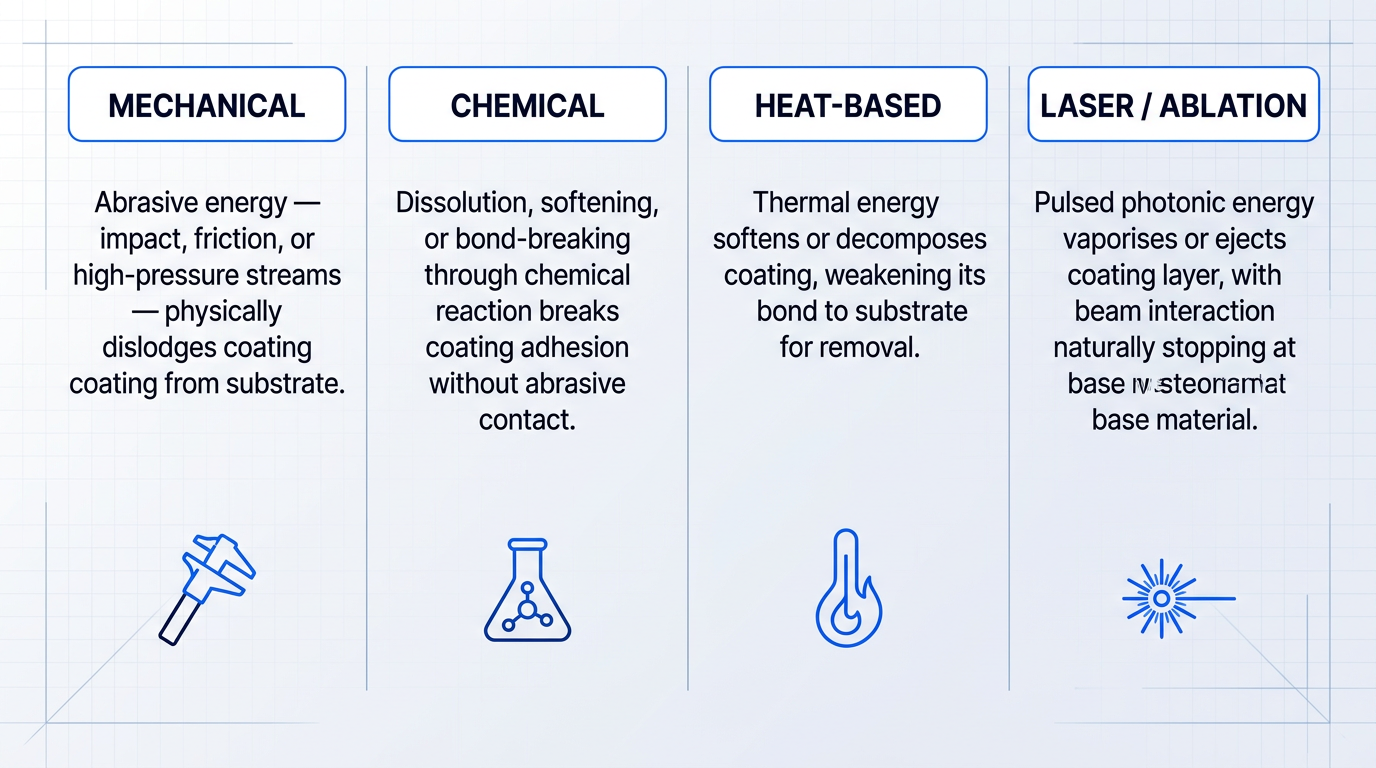
Industrial coating removal methods fall into four distinct technology families, each operating on a fundamentally different principle.
- Mechanical: Abrasive energy — impact, friction, or high-pressure streams — physically dislodges the coating from the substrate surface.
- Chemical: Dissolution, softening, or bond-breaking through chemical reaction breaks the coating's adhesion without abrasive contact.
- Heat-based: Thermal energy softens or decomposes the coating, weakening its bond to the substrate so it can be removed.
- Laser / ablation: Pulsed photonic energy vaporises or ejects the coating layer, with the beam's interaction naturally stopping at the base material.
These four categories encompass an enormous range of equipment and scales of operation — from a single operative with a handheld tool to a fully automated production line processing hundreds of components per shift.
What Drives Method Choice
No single variable determines which technology is appropriate. Professionals evaluating their options need to weigh several factors in combination, and the body sections of this guide return to each of them in context.
- Substrate material and condition: What is being cleaned and how robust it is — a hardened steel weldment tolerates far more than a thin aluminium extrusion.
- Coating type and thickness: Paint, powder coat, rust, and mill scale each respond differently to mechanical, chemical, thermal, and laser energy.
- Required surface finish: The finish standard needed after stripping — for recoating, bonding, inspection, or aesthetics — can rule certain methods out entirely.
- Operating environment: Indoor, outdoor, confined space, or public-facing settings impose different constraints on equipment, ventilation, and worker safety.
- Throughput and volume: A one-off restoration job and a continuous production process have very different equipment requirements and economics.
- Environmental and safety constraints: Regulatory requirements, waste handling obligations, and worker exposure limits vary significantly by method and location.
Keeping these variables in mind as you read through the sections that follow will make it easier to map each technology's characteristics to your own application.
The most widely recognised category — and the one that carries the greatest risk of substrate damage if misapplied — is mechanical stripping, which is where this guide begins.
Mechanical paint stripping: how it works and where it fits
Mechanical methods are the most widely used category of paint stripping machine technology — familiar, direct, and effective on the right surfaces. They are also the category that carries the greatest risk of substrate damage, which makes understanding their trade-offs essential before committing to a method.
The defining principle is physical energy: abrasive impact, friction, or high-pressure streams that dislodge and break the coating away from the surface. There is no chemical reaction and no heat softening — the coating is separated purely by mechanical force.
Mechanical paint stripping equipment types
- Abrasive blasting: Grit, shot, sand, or plastic media propelled at high velocity. Suited to large structural surfaces, heavy rust, mill scale, and applications requiring an anchor profile for recoating.
- Grinding and wire brushing: Angle-grinder or handheld tools for localised areas, weld preparation, and spot rust removal. Less effective on large areas or complex geometries.
- Needle guns and scalers: Pneumatic tools with rapidly reciprocating needles or chisels. Particularly effective on heavy rust, mill scale, and thick coatings on structural steel in shipbuilding and heavy fabrication.
- High-pressure water jetting: High-pressure water streams dislodge coatings without abrasive media. Effective on large surfaces and where minimising dust is a priority, but generates contaminated wastewater.
What unites these equipment families is the same underlying mechanism: kinetic energy transferred to the coating to break its bond with the substrate. Where they differ is in aggression level, scale suitability, and geometry reach — abrasive blasting covers large flat areas fastest, while needle guns and grinders handle confined spots and complex weld geometry that blasting cannot efficiently address.
Trade-offs: substrate damage, dust, and waste
The most important trade-off is one that is physically unavoidable: abrasive methods do not stop at the coating. As the OSHA shipyard eTool on surface preparation notes, mechanical operations including abrasive blasting and needle gunning remove material through impact and abrasion — and that abrasive action affects the substrate as well as the coating.
The result is surface roughness — an anchor profile — which is actually desirable when recoating is the goal, since it improves adhesion. On precision components, thin sections, aluminium alloys, and other softer metals, however, that same dimensional loss is a genuine constraint: tolerances cannot be restored once material is removed.
Abrasive blasting also generates significant airborne particulate matter. According to OSHA, blasting operations can create high levels of dust, and the abrasive material and the surface being blasted may both contain toxic materials — including lead paint — that are hazardous to workers.
OSHA guidance on bridge painting further confirms that coatings applied to steel structures before 1980 commonly contained toxic metals such as lead, cadmium, and chromium, and that abrasive blasting to remove them can expose workers to hazardous dust concentrations requiring engineering controls and respiratory protective equipment (RPE).
Required controls — blast enclosures or containment structures, exhaust ventilation systems, and NIOSH-certified Type CE blasting respirators — are not optional under OSHA standards. Each adds real setup time, procurement cost, and monitoring overhead that should be factored into project planning.
Spent abrasive media presents a separate compliance burden. The EPA's guidance makes clear that solid waste containing hazardous constituents such as lead must be assessed under RCRA to determine whether it qualifies as hazardous waste — typically through Toxicity Characteristic Leaching Procedure (TCLP) testing. Blast media mixed with stripped lead-containing paint that fails TCLP must be managed and disposed of as hazardous waste, with all associated cost and documentation requirements.
High-pressure water jetting sidesteps media disposal, but trades it for a different compliance obligation: the contaminated wastewater it generates cannot be discharged to storm drains and must be collected, treated, or disposed of under applicable NPDES permit requirements.
On precision components or softer metals, the dimensional loss from abrasive blasting is permanent — there is no way to restore material that has been abraded away, which is why substrate type is the first filter when evaluating mechanical methods.
None of these trade-offs disqualify mechanical methods from a wide range of applications. For large-area structural steel — bridges, ships, tanks, and industrial plant — abrasive blasting remains the most practical and cost-effective route to the surface cleanliness and anchor profile that durable recoating demands. Heavy rust and mill scale removal, outdoor site-based work, and any project where the infrastructure for alternative methods is unavailable are all contexts where mechanical methods are genuinely the right choice.
With the mechanical category's trade-offs established, the next method takes a different approach entirely — avoiding substrate damage and airborne dust, but introducing its own set of burdens around chemical handling, VOC emissions, and regulated waste streams.
Chemical paint stripping: how it works and what it costs
No other category of paint stripping machine reaches every surface of a complex part the way chemical stripping does — and that single characteristic explains why the method has remained in widespread industrial use despite a compliance burden that has grown considerably in recent years.
Chemical strippers work by dissolving, softening, or breaking the adhesive bond between coating and substrate through chemical reaction, with no mechanical contact required — meaning recesses, internal cavities, shaped profiles, and intricate geometries are treated just as thoroughly as flat faces.
The main chemistry families
Three principal chemistry types are in active industrial use, each representing a genuine trade-off rather than a step on a quality ladder.
- Solvent-based (methylene chloride): Historically the dominant fast-acting chemistry, effective across a wide coating range. Now subject to severe US regulatory restriction — most industrial and commercial uses prohibited under the EPA's 2024 TSCA rule.
- Caustic / alkaline (hot-dip): Aqueous sodium or potassium hydroxide solutions, operated at elevated temperature (typically around 90°C). Well-suited to ferrous metals and batch immersion; slower and less effective on chemically resistant modern coatings.
- Biochemical / benzyl-alcohol alternatives: Emerged as the regulatory response to methylene chloride restrictions. Generally safer to handle, but typically slower in action and not equally effective across all coating types.
The practical reality is that the most effective historical chemistry — methylene chloride — is now largely prohibited for industrial use in the US, while the available alternatives are viable but carry their own performance trade-offs, particularly on modern chemically resistant coatings.
Where chemical stripping genuinely excels is in batch processing of complex-geometry parts: castings, fabrications with internal features, shaped components, and any application where mechanical access is physically limited or full-surface immersion is the only way to guarantee complete coverage.
The regulatory and environmental burden
The methylene chloride regulatory situation is one of the most operationally significant developments in industrial surface treatment in recent years, and it is not a future risk — it is current regulatory reality in the United States.
The US EPA banned consumer use of methylene chloride-based paint removers in 2019; its April 2024 final rule under the Toxic Substances Control Act (TSCA) extended that prohibition to most industrial and commercial uses, with phased compliance timelines running from February 2025 through April 2026 for the majority of uses, and a Workplace Chemical Protection Programme (WCPP) required for any remaining permitted uses during transition.
Under the EPA's 2024 TSCA final rule, most industrial and commercial uses of methylene chloride — including its use in paint and coating removers — are prohibited on a phased timeline, with the majority of industrial and commercial use prohibited after April 28, 2026. This is not a proposed restriction: the rule took effect on July 8, 2024.
Solvent-based strippers also release volatile organic compounds (VOCs) and hazardous air pollutants (HAPs) during application and evaporation — and operations that qualify as major sources under the US Clean Air Act (facilities emitting 10 tons per year or more of any individual HAP, or 25 tons per year of combined HAPs) are subject to permitting, emission controls, and ongoing compliance reporting under NESHAP Subpart HHHHHH.
Even below major-source thresholds, operations using more than one ton of methylene chloride per year must develop and implement a written minimisation plan — a real administrative overhead that is easily overlooked when evaluating chemistry costs alone.
The waste picture is equally layered: chemical stripping generates multiple distinct waste streams — contaminated rinse water (potentially RCRA-hazardous depending on coating composition), spent stripper solution, and paint sludge — each of which may require separate characterisation, treatment, and disposal.
This is not a single waste stream with a single disposal route; it is a multi-stage disposal problem, and the cumulative cost of managing it is frequently invisible at the point of purchase when buyers are comparing chemistry costs on a per-litre basis.
The honest operational conclusion is this: chemical stripping is not just a chemistry decision. The compliance monitoring, permitting, waste disposal, and worker protection costs are real, ongoing, and — in regulated industrial environments — growing as the regulatory trajectory continues in one direction.
The third major approach to coating removal replaces chemistry with energy entirely, using heat to break down or soften coatings — with its own distinct set of operational trade-offs.
Heat-based paint stripping: thermal methods and their limits
Heat has an intuitive appeal as a stripping agent: no chemicals to handle, no abrasive media to contain, just energy applied to a coating until it releases. In practice, thermal methods are genuinely effective in the right contexts — but the range of equipment, the safety constraints, and the substrate limitations are more varied than the simple premise suggests.
The underlying principle is consistent across all thermal approaches: heat softens or decomposes the coating, weakening its adhesive bond to the substrate so it can be scraped or brushed away mechanically. Heat is the active agent, but it acts indirectly — the coating is loosened, not removed, by the heat itself. Pyrolysis is a distinct variant: at sufficiently high temperatures in a controlled environment, organic coating components are not just softened but thermally decomposed, converting to ash and volatile gases rather than simply becoming pliable.
The main thermal stripping methods
- Heat guns: Handheld tools that blow high-temperature air across the surface, heating top-down. Fast and versatile, but surface temperatures can be high enough to scorch wood or ignite debris.
- Infrared strippers: Radiant heat devices operating at lower temperatures than heat guns, warming paint from the substrate upward. Slower but gentler, and widely recommended for heritage woodwork.
- Propane and open-flame torches: Fast heat delivery but significant fire and fume hazards. Prohibited for lead paint removal in residential settings across many jurisdictions.
- Pyrolysis burn-off ovens: Batch processing of metal components at 700–900°F in a controlled, low-oxygen chamber. Coating is thermally decomposed; ash is removed by pressure washing afterward.
- Induction heating: Electromagnetic induction heats the ferrous substrate beneath the coating, causing rapid thermal expansion and disbonding. Well-suited to large-area structural steel.
Each of these methods has a context where it genuinely earns its place. Thick coatings on robust wood or metal substrates respond well to heat gun or infrared treatment. Heritage conservation bodies, including the GSA, recommend infrared and steam-based thermal methods for stripping lead paint from historic woodwork precisely because their lower operating temperatures reduce vaporisation risk while preserving the substrate. Pyrolysis ovens are the preferred industrial solution for batch stripping of hooks, racking, automotive components, and mould tools — the process is fast, complete, and leaves no chemical waste stream. For large-area structural steel, induction heating offers a particularly efficient approach: heat is generated directly within the ferrous substrate beneath the coating, causing rapid disbonding without the need for surface-applied flame or hot air.
Where thermal methods run into real operational constraints, the most significant is the lead paint hazard. According to EPA guidance and its Renovation, Repair and Painting Rule, heat guns operating above 1,100°F are prohibited for use on lead-painted surfaces in residential and child-occupied facilities — at those temperatures, lead compounds can vaporise into fine airborne particles that penetrate deep into the lungs. The GSA's technical procedures for historic preservation reinforce this: higher-temperature methods present greater lead fume risks, and the lowest-temperature method capable of completing the work should always be used.
EPA's Renovation, Repair and Painting Rule prohibits heat gun use above 1,100 degrees Fahrenheit on lead-painted surfaces, and bans open-flame torching entirely. Infrared strippers, which typically operate between 400°F and 600°F, remain well below this threshold — making them the preferred thermal option where lead paint is present.
Beyond the lead paint dimension, high-temperature thermal methods carry genuine fire risk. The GSA's technical guidance on heat gun use notes that hot air blasts can ignite debris within wall cavities or behind cornices, and that smouldering material may not ignite until hours after the work crew has left. Surface scorching is a related concern: wood that has been over-heated requires additional remediation before recoating, and glass in proximity to heat sources is vulnerable to thermal shock cracking.
Substrate sensitivity is the second major boundary on thermal method selection. Pyrolysis ovens and high-temperature heat guns operate at temperatures that are simply incompatible with heat-sensitive materials: thin aluminium sections (which have a low melting point and conduct heat rapidly), composite materials, plastics, and precision engineering components where dimensional tolerances cannot accommodate the distortion that high heat can introduce. As pfonline.com notes in its coverage of pyrolytic stripping, the substrate must be resistant to the process temperatures — a constraint that immediately excludes a significant range of components from thermal treatment.
There is also a precision and selectivity gap inherent to how thermal methods work. Because heat spreads across an area rather than being confined to a defined zone, thermal stripping cannot selectively address one coating layer while leaving another intact, or treat a specific area without affecting adjacent surfaces. This is not a failure of execution — it is a structural characteristic of broad-area heating. In production and repair contexts where layer-by-layer control or zone-selective stripping is required, this limitation becomes a meaningful constraint on what thermal methods can deliver.
For applications where those constraints matter — precision components, heat-sensitive substrates, or work requiring tightly defined removal zones — the characteristics of thermal stripping point toward a fundamentally different approach to delivering energy to a coating surface.
Laser paint stripping: how ablation works and what it resolves
Every method covered so far works by applying something to the coating — a grinding wheel, a solvent, a heat source — and managing the collateral damage that follows. Laser ablation works on a fundamentally different principle: it exploits the difference in how the coating and the substrate each absorb light energy, using that gap to remove one while leaving the other essentially untouched.
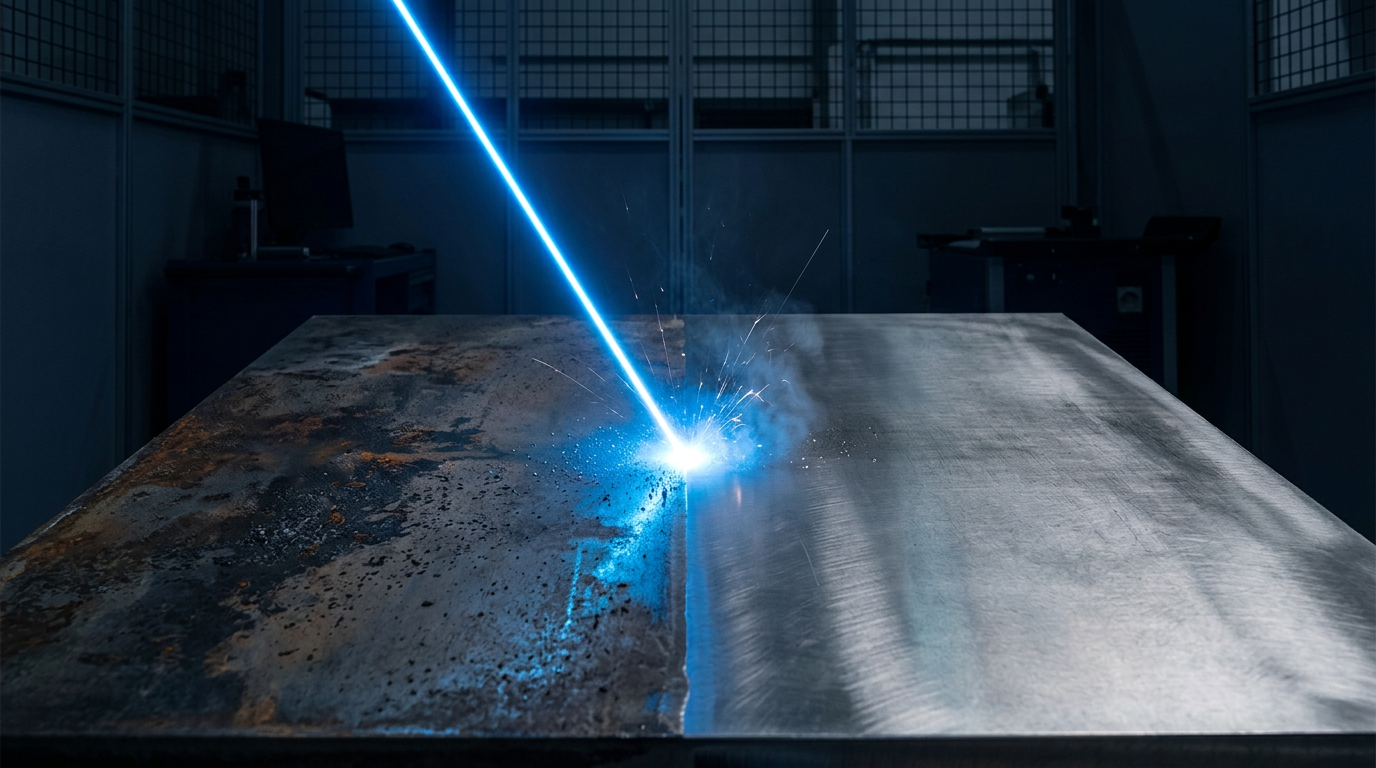
When a pulsed laser beam strikes a coated surface, the coating material absorbs the energy preferentially — vaporising, sublimating, or fracturing under rapid thermal stress — while the base substrate absorbs significantly less and remains largely intact. The beam effectively stops at the coating-substrate interface, which is the property that makes the method categorically different from anything mechanical, chemical, or thermal.
That selectivity is not fixed — it is tunable. Operators can adjust pulse energy, power output, and repetition rate to match the parameters to the coating thickness, substrate sensitivity, and surface geometry at hand, which is what makes laser ablation a genuinely versatile tool rather than a single-application solution.
Substrate selectivity and surface preservation
Because the beam stops at the base material, dimensional accuracy, surface texture, and substrate integrity are preserved in a way that abrasive mechanical methods cannot match.
For precision components — aerospace parts, tooling, heritage metalwork — this matters considerably: abrasive stripping removes substrate alongside coating, introducing dimensional change and surface roughness that can require rework or, in tight-tolerance applications, render the component unusable. Laser ablation removes the contaminant only.
Surfaces and coatings laser ablation handles
Laser ablation is not a niche tool for a single substrate class. It operates effectively across a wide range of base materials and coating types.
- Steel and carbon steel: Handles rust, mill scale, paint, primer, powder coating, and weld discolouration without surface damage.
- Aluminium alloys: Removes oxides, lacquer, and coatings from aerospace and automotive aluminium with minimal substrate loss.
- Cast iron, copper, titanium: Effective on reactive and specialist metals where abrasive methods risk contamination or dimensional change.
- Galvanised and coated metals: Strips surface contamination and selective coatings while preserving the underlying protective layer where required.
- Stone, concrete, brick, masonry: Removes paint, graffiti, soiling, and biological growth from porous substrates without abrasive surface loss.
- Paints, primers, powder coatings: Full coating removal or selective layer stripping — tunable power spans thin primers through thick industrial coatings.
- Rust, oxides, mill scale: Removes corrosion products and surface oxides from metal substrates, leaving the base material ready for inspection or recoating.
- Adhesives, release agents, residues: Clears mould release agents, adhesive residues, carbon, soot, and weld discolouration from complex geometry surfaces.
The practical implication is that a single laser cleaning system can span the range of surfaces and contaminants a professional is likely to encounter across multiple sites or applications — without changing method or managing separate chemical and abrasive inventories.
Chemical-free operation and the waste contrast
Laser ablation uses light energy alone — no chemicals, abrasives, water, or consumables enter the process at any point. For operations that have been carrying the compliance overhead of chemical stripping — VOC permits, waste disposal contracts, methylene chloride restrictions — this represents a practical operational simplification, not just an environmental one.
What the process does produce is fine particulate and vapour from the ablated material, captured by a fume extraction system running alongside the laser. That waste stream is far smaller in volume and simpler to manage than spent abrasive media or contaminated chemical stripper, both of which carry their own disposal obligations.
The beam stopping at the substrate interface is the same property that eliminates the mechanical rework risk and the chemical waste burden simultaneously — substrate selectivity and chemical-free operation are both consequences of how the physics works, not separate design choices.
Laser ablation in practice: ELASER
To illustrate what laser stripping delivers in a real industrial context, it is worth looking at ELASER — Woodrow Scientific Limited's portable laser cleaning system, and the publisher's own solution in this category. It is an air-cooled, consumable-free industrial fibre laser system with power tunable from 0 to 100%, covering everything from light surface oxides through to thick industrial coatings across metals, stone, concrete, brick, and masonry.
The most significant differentiator in the ELASER range is the ELASER-RHZ variant, which uses WSL's patented world-first technology to collapse the laser hazard zone to a small area around the work itself. Historically, the biggest operational barrier to laser cleaning adoption has been the requirement to seal off and evacuate the surrounding area before work can begin — a constraint that makes laser cleaning impractical in open workshops, mixed-use facilities, and public-facing settings. The RHZ removes that barrier entirely, enabling cleaning to continue in environments where conventional laser cleaning cannot operate. No other laser cleaning system in the world offers this capability.
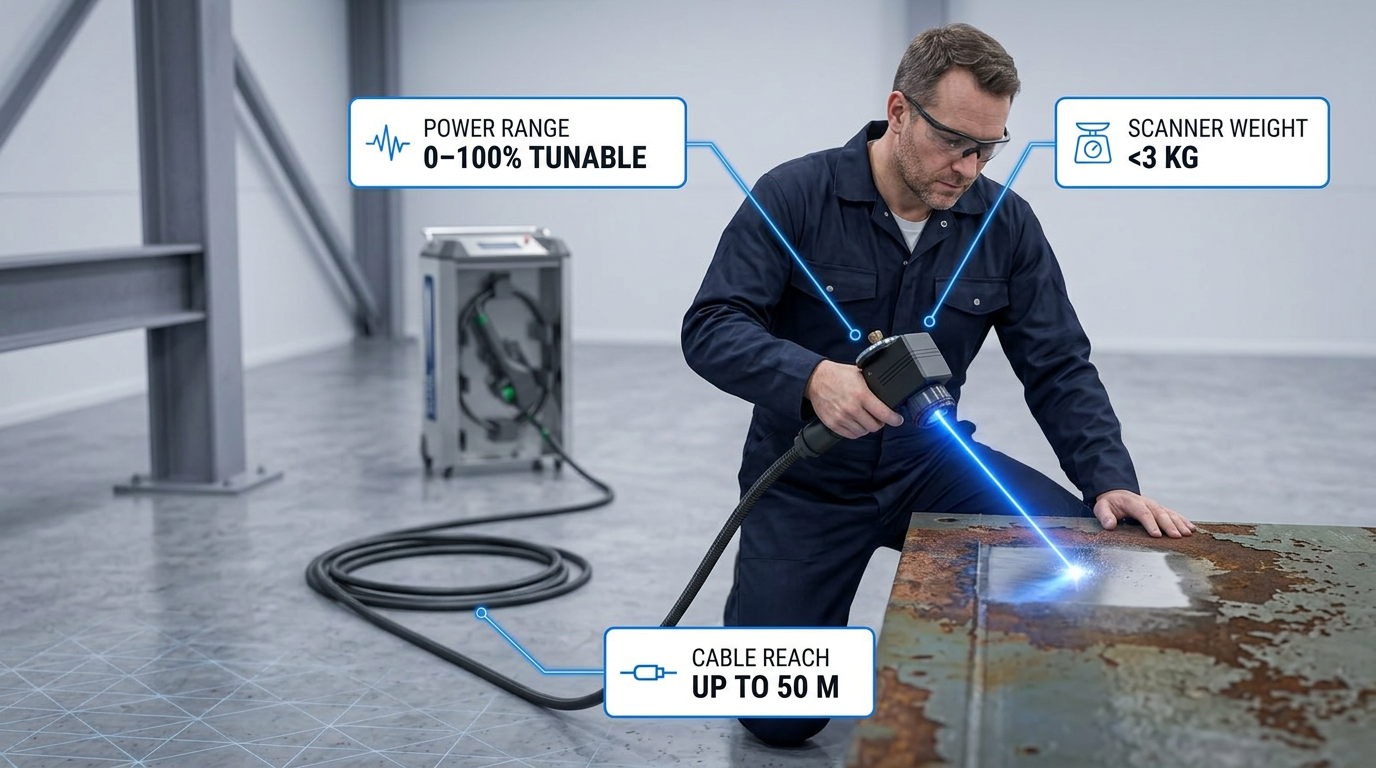
Portability is a genuine operational consideration with ELASER: the handheld scanner weighs under 3 kg and connects via a delivery cable of up to 50 m, meaning a single operator can cover a large structure or reach into confined areas without repositioning the main unit. The system is CE and UKCA certified, and WSL provides full safety and operation training. For applications with specific requirements, WSL also offers bespoke engineering and customisation — prospective buyers are encouraged to get in touch to discuss what their application demands.
WSL is the only UK-based laser cleaning manufacturer, founded in 2012, designing, building, supporting, and improving its machines entirely in-house. That distinction matters more than it might appear: a significant portion of the laser cleaning market consists of resellers and importers rebadging third-party machines, which translates to weaker after-sales support, slower access to spares, and no capacity to genuinely improve the product. WSL's 200+ years of combined engineering experience — and its patented RHZ technology as evidence of genuine in-house innovation — sets a different standard.
For readers evaluating laser stripping in high-volume production contexts, WSL also offers AutoLASE: an automated laser cleaning system where machine vision scans the part, builds a 3D map, and generates the cleaning path automatically. There is no manual programming, no path-setting, and no requirement to know the part geometry in advance — load the part and run it. AutoLASE can also be configured with the same RHZ eye-safe technology, enabling enclosure-free automated cleaning that no other automated laser cleaning system can offer.
Where laser ablation fits best — and where it doesn't
Laser ablation is not the strongest choice for every application. On very large, flat surfaces — wide structural steelwork, for instance — sandblasting's area coverage rate is difficult to match, and for straightforward bulk stripping of that kind, blasting may remain the more productive option.
As a capital investment, laser cleaning sits at a higher entry point than mechanical or chemical alternatives. Over a three-to-five year horizon, however, the total cost of ownership picture shifts considerably: zero consumables, no waste disposal contracts, and significantly reduced rework on precision substrates add up to a cost structure that traditional methods cannot replicate.
With all four method categories now covered, the next section brings them together into a practical decision framework — matching the right approach to substrate type, production volume, regulatory environment, and operational constraints.
See Laser Ablation in Action
Laser cleaning removes coatings without abrasives, chemicals, or substrate damage. Explore the ELASER range to see how the technology translates into a working paint stripping machine for your application.
How to choose the right paint stripping method
Having worked through all four method categories, the challenge shifts from understanding to deciding. The right paint stripping machine for your application is rarely the one with the lowest purchase price or the highest headline throughput — it is the one that performs best across the dimensions that actually constrain your operation.
Substrate and coating match: the first filter
Before evaluating anything else, establish precisely what you are stripping and what you are stripping it from. The substrate's tolerance for abrasion, heat, and chemical exposure — combined with the coating's chemistry and thickness — determines which methods are even viable.
A precision aluminium component with tight dimensional tolerances cannot absorb the surface loss that grit blasting causes. A thick mill-scale deposit on structural steel does not require the surgical precision of laser ablation. Substrate and coating compatibility is the entry point to the decision, not an afterthought — get this filter wrong and every downstream choice compounds the error.
Operating environment: what is logistically feasible?
Technical capability and operational feasibility are not the same thing. A method that works perfectly in a controlled workshop may be entirely impractical in a confined space, near the public, or on a live structure in the field.
Mechanical blasting requires containment enclosures and ventilation infrastructure that are difficult to deploy outside a fixed facility. Chemical stripping requires controlled drainage and waste handling that is similarly facility-dependent. The operating context can rule out a technically capable method on purely logistical grounds — and this filter should be applied early, before deeper cost or performance analysis begins.
Environmental and regulatory burden
Compliance overhead is increasingly a procurement criterion in its own right. The regulatory direction of travel across chemical and particulate emissions is consistently toward tighter restriction, and equipment choices made today carry that trajectory into the medium and long term.
Chemical stripping carries the heaviest compliance burden: solvent waste disposal, contaminated rinse water handling, and permit requirements add operational complexity that compounds at scale. Mechanical blasting generates particulate waste and spent media that also require controlled disposal. Laser ablation produces a minimal, contained waste stream — particulate and vapour captured by integrated fume extraction — which translates to a substantially lower compliance overhead.
Total cost of ownership vs. purchase price
Purchase price is the most visible number in any equipment decision and frequently the most misleading one. The full total cost of ownership picture includes consumable costs (abrasive media, chemicals, process gases), waste disposal, labour, setup and cleanup time, and rework costs when substrate damage occurs.
A method with zero consumables, minimal rework, and fast setup can deliver a lower cost per part over a three-to-five year horizon than an alternative with a lower capital entry point but ongoing consumable and disposal expenditure. Evaluating equipment on purchase price alone systematically underweights these recurring costs.
Throughput and consistency at production scale
For repetitive production cleaning, consistency matters as much as raw speed. Headline throughput — area stripped per hour on a flat surface — is not the same as effective throughput once setup, cleanup, rework, and variability are factored into the total job time.
Mechanical and chemical methods can achieve high area rates, but results vary with operator skill, media condition, and chemical concentration — introducing batch-to-batch inconsistency that creates downstream quality problems. Laser ablation with tunable, repeatable parameters delivers consistent results across parts that manual methods cannot reliably match at scale.
Sandblasting may hold the advantage on raw area rate for large, flat, homogeneous surfaces. Once containment setup, media disposal, and rework are included in the job-time calculation, that advantage narrows considerably on complex geometry or precision parts.
Precision and selectivity: a decisive filter
If your application requires stripping one coating layer without disturbing the layer beneath it, working within a defined zone without masking adjacent surfaces, or preserving dimensional accuracy where tolerances are tight — this single requirement effectively resolves the method decision before any other dimension is weighed.
Laser ablation is the only method that delivers this level of selectivity reliably. Mechanical methods remove material indiscriminately; chemical agents cannot be confined to a precise boundary without extensive masking; heat-based methods lack the spatial control needed for layer-specific stripping. Where precision is a hard requirement, it functions as a decisive filter, not just a preference.
Substrate compatibility and operating environment tend to eliminate options quickly. TCO, throughput, and precision then determine the best fit among those that remain. Applying all six dimensions simultaneously obscures the decision; applying them in order resolves it.
The numbered sequence below summarises the recommended order for working through these filters — each step either narrows the viable method set or, where multiple methods remain, identifies the dimension most likely to differentiate them for your specific context.
- Substrate and coating match: Identify what you are stripping and from what. This eliminates methods incompatible with your substrate before any other factor is considered.
- Operating environment: Assess whether your facility, containment capability, and field conditions make each remaining method logistically viable.
- Regulatory and compliance burden: Factor in permit requirements, waste disposal obligations, and the direction of regulatory travel for each method category.
- Total cost of ownership: Compare consumables, disposal, labour, rework, and setup costs across a three-to-five year horizon, not just capital outlay.
- Throughput and consistency: Evaluate effective job-time throughput — including setup and cleanup — not headline area rates alone, especially for production-scale work.
- Precision and selectivity: If layer-specific stripping or tight dimensional tolerances are required, this filter resolves the decision before cost or speed become primary.
For buyers whose applications involve complex geometry, sensitive substrates, or precision tolerances, the selectivity filter effectively resolves the decision early in the sequence. For buyers stripping large flat surfaces in a fixed facility with no precision requirements, throughput and TCO carry more weight — and mechanical methods remain genuinely competitive on those axes.
With this framework in hand, the final step is applying it to the specifics of your own operation — the substrate, the environment, the volume, and the precision requirements that define your application.
Conclusion
Finding the right paint stripping machine for your application
The most useful thing this guide can leave you with is also the simplest: no paint stripping machine is right for every application, and the best choice is always the one matched to your specific substrate, coating, environment, and operational requirements.
Broadly, mechanical methods suit large-area structural work; chemical methods reach complex geometries where compliance overhead is manageable; thermal methods serve specific coating and substrate combinations; and laser suits precision, substrate-sensitive, or chemical-free applications.
If your evaluation has pointed toward laser ablation, Woodrow Scientific is the right place to take that conversation further.
Frequently asked questions about paint stripping machines
These are the specific questions professionals tend to carry after evaluating paint stripping options — covering substrate compatibility, waste handling, fume extraction, laser safety, chemical stripping regulations, and method comparisons for precision work.
Yes — fibre laser systems are not limited to metals. Stone, brick, concrete, and masonry are all viable substrates for laser paint stripping, alongside the full range of metals including steel, aluminium, cast iron, copper, brass, bronze, and titanium. The misconception that laser cleaning is metals-only is common but incorrect. Composite materials are a different consideration. Some resins have ablation thresholds close to those of the coating being removed, which means there is a genuine risk of substrate damage if laser parameters are not dialled in carefully for the specific material combination. Composites are workable, but they require more thorough parameter testing and validation before production use than metals or masonry typically do.
On raw area coverage across large, flat surfaces, sandblasting has the advantage — that is a straightforward fact. Where the comparison shifts is total job time. Sandblasting requires containment erection, media management during the job, and post-job cleanup and media disposal. Laser ablation requires none of those steps, which means the gap in headline throughput often closes or reverses when the full job cycle is measured. For precision or complex-geometry parts where blasting cannot safely be used at all, laser is the faster option by default — it is the only viable method. The right question is not which method moves faster across open ground, but which delivers a finished, compliant result in less total time on your specific job.
Ablated coating material becomes fine particulate and vapour, which is captured by the fume extraction system during the cleaning operation. The physical waste stream from laser cleaning is a spent HEPA filter and activated-carbon filter — compact and straightforward to handle. By contrast, sandblasting generates spent abrasive media that is contaminated with coating residue and may require disposal as hazardous waste depending on what the coating contained. Chemical stripping produces contaminated rinse water, spent stripper solution, and paint sludge, each with separate handling and disposal requirements. The laser waste stream is notably simpler than either alternative, though proper fume extraction during operation is essential — the extraction system is what keeps the particulate and vapour from reaching the operator.
Fume extraction is required for all laser cleaning operations — it is not optional. The extraction system must include HEPA filtration to capture respirable fine particulate and activated-carbon filtration to capture volatile organic compounds released during ablation. This is standard equipment for any professional laser cleaning setup, not an unusual overhead. When stripping older paint that may contain lead, the extraction requirements carry additional weight. Lead particulate is a serious inhalation hazard; OSHA identifies it as one of the most significant health risks in paint removal operations, and the extraction system used must be rated to handle it. Operators working on potentially lead-bearing coatings should consult OSHA guidance (or the relevant national authority outside the US) to confirm their extraction setup meets the applicable standard.
The most significant development in laser cleaning safety is WSL's patented reduced-hazard-zone (RHZ) technology, available on the ELASER-RHZ — a world-first capability that fundamentally changes where laser cleaning can be used. Conventional industrial laser cleaning systems are Class IV lasers. Standard practice requires defining a nominal hazard zone (NHZ) around the work area, controlling access, and excluding personnel from that zone while the laser is operating. In practice, this means sealing off sections of a facility before cleaning can begin — a significant operational overhead that has historically limited where laser cleaning is practical. The ELASER-RHZ collapses that hazard zone to a small area immediately around the work itself. This enables cleaning in open workshops, mixed-use manufacturing facilities, and public-facing settings — such as heritage restoration or graffiti removal — without requiring full area evacuation or shutdown. Operator training is provided as part of the system, ensuring safe and effective use from day one.
It depends on the chemistry. The critical regulatory development concerns methylene chloride (DCM), historically the dominant solvent in industrial paint strippers. The US EPA banned consumer uses of methylene chloride in 2019, then issued a final rule in 2024 under TSCA prohibiting most remaining industrial and commercial uses, with phased compliance timelines. Most traditional solvent-based stripping using methylene chloride in the US is now either prohibited or subject to strict Workplace Chemical Protection Programme requirements. Alternative chemistries remain legal: benzyl alcohol-based strippers, caustic and alkaline strippers, and biochemical formulations are all still available. These alternatives are generally slower and less effective on chemically resistant modern coatings than methylene chloride was, which is a practical trade-off buyers need to factor in. Note that this regulatory context is US-specific. UK and EU operators are subject to different frameworks — REACH and UK REACH respectively — and should consult the relevant national authority or a qualified compliance professional for current requirements in their jurisdiction. This answer is informational only and does not constitute legal advice.
The core distinction is substrate impact. Mechanical methods remove coating by abrasion, and abrasion inevitably removes some substrate material alongside the coating. This alters surface dimensions, changes surface finish, and can introduce micro-damage — all of which matter on precision components where tolerances must be maintained. Laser ablation removes the coating only. The beam is absorbed preferentially by the coating material; at the base substrate, the optical properties change and absorption drops, so the beam effectively stops there. The substrate is left dimensionally intact. For aerospace components, precision tooling, thin-section aluminium, or any part where downstream processes depend on dimensional accuracy or surface integrity — bonding, coating adhesion, close-tolerance fit — this distinction is operationally significant. Mechanical stripping on such components introduces a rework risk that laser ablation avoids. The ELASER's minimal substrate loss capability is specifically relevant in aerospace surface preparation, where cleaning to tight tolerances is a firm requirement rather than a preference.