

Introduction
This guide is written for automotive restoration professionals and industrial surface preparation teams — people making real operational decisions, not weekend hobbyists.
The problem isn't that good information on each method is hard to find. It's that most of it arrives in isolation, advocating for one approach without holding it up against the others on consistent criteria.
Every entry in this list is evaluated against five axes: surface compatibility, throughput, precision, environmental impact, and total cost of operation.
Purchase price is rarely the right financial question — consumables, waste disposal, downtime, and rework from substrate damage frequently dwarf the initial outlay.
Substrate preservation runs through every evaluation here, because rework from over-stripping is a measurable cost in both restoration and industrial surface prep.
TL;DR
No single paint removal system wins across every situation. The right choice consistently comes down to matching method to job using operational criteria — especially total cost of operation and substrate preservation. Defaulting to the cheapest or most familiar option often costs more in the long run than a considered switch would.
This article covers:

Five paint removal methods compared side by side
Consistent evaluation criteria applied to every entry
Total cost of operation vs. purchase price
Substrate preservation as a key quality criterion
Decision guidance for matching method to job
How we evaluated each paint removal system
Choosing between paint removal systems is rarely straightforward: the method that strips a steel chassis efficiently may warp an aluminium panel, and the one that works flawlessly in a high-volume industrial facility may be impractical for a small restoration bodyshop.
To make this comparison genuinely useful, we applied five consistent evaluation axes to every entry — criteria drawn from the real decision-making process of automotive restoration specialists and industrial surface preparation teams, not from what any particular method does well.
- Surface Compatibility: Whether a method removes paint without damaging the substrate beneath — across steel, aluminium, cast iron, composites, and heritage surfaces.
- Throughput: How well a method performs at the scale it will actually be used, from single-vehicle bodyshop work to high-volume industrial production lines.
- Precision: The degree of control over where and how aggressively paint is removed — critical for intricate panels, tight tolerances, and historically significant surfaces.
- Environmental Impact: Waste streams, VOC emissions, consumables generated, and the regulatory exposure that comes with certain chemistries or disposal requirements.
- Total Cost of Operation: The full financial picture: capital, consumables, maintenance, waste disposal, downtime, and rework — not purchase price or day-rate alone.
Taken together, these five axes capture the complete operational picture rather than any single dimension — because a method that scores well on speed but poorly on substrate preservation or compliance overhead is not a strong choice for most professional contexts.
Only methods with verified, established use in automotive restoration or industrial surface preparation were included; the list was not padded to reach a round number.
Tightening restrictions on certain paint removal chemistries mean that regulatory exposure is no longer a background consideration — for many operators, it actively narrows which methods are available to them.
With the framework established, here is how each system performs across all five axes — beginning with the first entry.
Product 1
ELASER / ELASER-RHZ Portable Laser Cleaning System
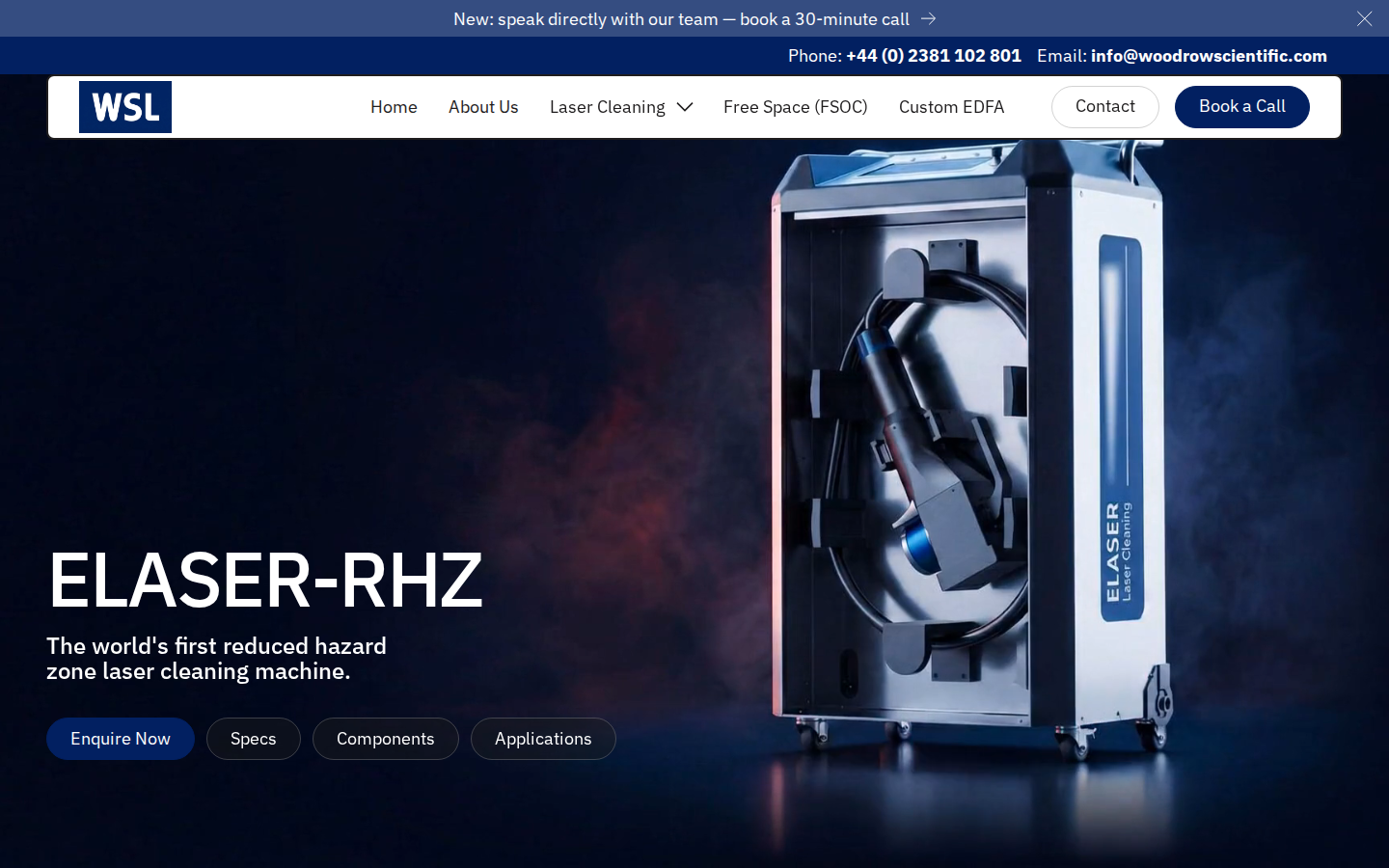
The ELASER / ELASER-RHZ is a portable industrial fibre laser cleaning system from Woodrow Scientific Limited (WSL), the only UK-based laser cleaning manufacturer. It removes paint, rust, coatings, and contaminants from metals, stone, and masonry using laser ablation — leaving the base material intact. The ELASER-RHZ variant features WSL's world-first Reduced Hazard Zone technology, which collapses the laser hazard zone to the immediate work area, enabling cleaning in open workshops, mixed-use facilities, and public-facing settings where conventional laser cleaning is not practical. Best for: automotive bodyshops, industrial maintenance teams, heritage restorers, and operators working across multiple locations.
Pros:

World-first reduced hazard zone technology
Sub-3 kg scanner, single-operator portability
No consumables, chemicals, or secondary waste
Broad substrate and contaminant coverage
Cons:

Fume extraction required during operation
Throughput lower than fixed automated systems
The ELASER / ELASER-RHZ is best suited to operators who need a flexible, on-site paint removal system: automotive bodyshops, industrial maintenance teams, heritage and monument restorers, and anyone working across multiple locations where setting up a fixed installation is not practical.
The system works by fibre laser ablation: the laser beam is absorbed by the coating, causing rapid thermal expansion that vaporises or ejects the contaminant. Because the underlying metal or stone substrate is more reflective, it absorbs the laser energy at a far lower rate and remains intact — which is why minimal substrate loss is a consistent outcome, not an occasional one.
ELASER-RHZ: World-First Reduced Hazard Zone Technology
The single biggest barrier to laser cleaning in real-world workshops has always been safety overhead: conventional laser cleaning systems require the surrounding area to be sealed off and personnel evacuated before work can begin.
WSL's patented Reduced Hazard Zone (RHZ) technology removes that barrier entirely. It collapses the laser hazard zone to a small area around the work itself, enabling cleaning in open workshops, mixed-use manufacturing facilities, and public-facing settings without shutting down adjacent operations or evacuating the space.
This is a world-first capability — no other laser cleaning system offers it — and it is what makes the ELASER-RHZ viable for applications that conventional laser cleaners simply cannot serve: graffiti removal on public infrastructure, heritage restoration in accessible spaces, and continuous cleaning in open-plan industrial environments.
The ELASER operates at a 1550 nm wavelength, which sits in the retina-safe band, and the RHZ variant is available as either Class IV or Class I laser classification depending on configuration.
Single-Operator Portability and Self-Contained Design
The handheld scanner weighs under 3 kg, and the delivery cable reaches up to 50 m — meaning one operator can cover a large working area without repositioning the main unit.
The system itself weighs under 50 kg on a wheeled chassis and requires no compressor, no water supply, and no consumables: plug into a standard 110–250 VAC single-phase supply and the system is ready to work.
Performance Across the Five Evaluation Axes
The table below applies the evaluation framework from §3 directly to the ELASER / ELASER-RHZ.
| Axis | ELASER / ELASER-RHZ Performance |
|---|---|
| Surface compatibility | Broad: steel, carbon steel, aluminium alloys, cast iron, copper, brass, bronze, titanium, galvanised surfaces, stone, concrete, brick, and masonry. Removes paint, powder coating, lacquer, primer, rust, oxides, mill scale, oil and grease, adhesives, carbon and soot, graffiti, weld discolouration, release agents, and tarnish. |
| Throughput | Appropriate for bodyshop, maintenance, and heritage work. Up to 300 W fibre laser with power tunable 0–100% and a 10 m/s max scan rate. Not designed to replace a high-volume automated production cell — this is the right tool for flexible, multi-location, on-site deployment. |
| Precision | Fully tunable power (0–100%), programmable scan shapes via touchscreen GUI, and interchangeable F-Theta lenses covering working distances from 75 mm to 500 mm. Enables precise work on intricate automotive panels, complex geometry, and delicate heritage surfaces. |
| Environmental impact | No chemicals, abrasives, or water. Air-cooled — no chiller or coolant circuit required. The only output is fumes from the ablated coating, which requires local extraction. Zero secondary waste stream; no disposal costs; no regulatory exposure from chemical waste. |
| Total cost of operation | No consumables means zero ongoing material cost. Minimal substrate damage reduces rework. No infrastructure dependencies (no compressor, no water supply) reduce downtime. Competitive upfront pricing among comparable European industrial laser cleaners, with TCO that compounds in the operator's favour over time. |
The five-axis evaluation framework declared in the preceding section is best presented as a structured comparison so the reader can scan each axis quickly and carry that structure forward when comparing against later entries in the list.
On precision specifically, the combination of programmable scan shapes and interchangeable lenses gives operators a level of control that abrasive and chemical methods cannot match — particularly relevant when working on original heritage surfaces or shaped automotive panels where substrate loss is not acceptable.
ELASER / ELASER-RHZ Pricing
Pricing is available on request. The ELASER / ELASER-RHZ is competitively positioned among comparable industrial laser cleaning machines in Europe — the result of WSL's in-house manufacturing efficiencies rather than any compromise on specification or build quality.
When evaluating cost, total cost of ownership is the correct lens: with no consumables, no disposal costs, no media to clear, and minimal rework from substrate-preserving ablation, the operating cost profile is fundamentally different from sandblasting or chemical stripping — methods whose ongoing material and waste-handling costs accumulate with every job.
Many apparent laser cleaning manufacturers are actually resellers or importers rebadging third-party hardware. That means slower spares, weaker support, and no genuine ability to improve the product over time. WSL is the only UK-based laser cleaning manufacturer: it designs, builds, services, and improves every machine in-house, with over 200 years of combined engineering expertise. That in-house capability is what enables fast, expert support and continuous product development.
The ELASER and ELASER-RHZ carry CE and UKCA certification, are Made in Britain, and come with access to first-class operator training covering both safety and operation.
Bespoke engineering and customisation is also available — operators with specific requirements are encouraged to get in touch with WSL directly to discuss what the system can be configured to achieve.
See the ELASER-RHZ portable laser cleaner in detail
Full technical specifications for the ELASER-RHZ — including power output, scan width, and reduced hazard zone ratings — are available in the official datasheet from Woodrow Scientific.
Product 2
AutoLASE — Automated Laser Cleaning System (WSL)
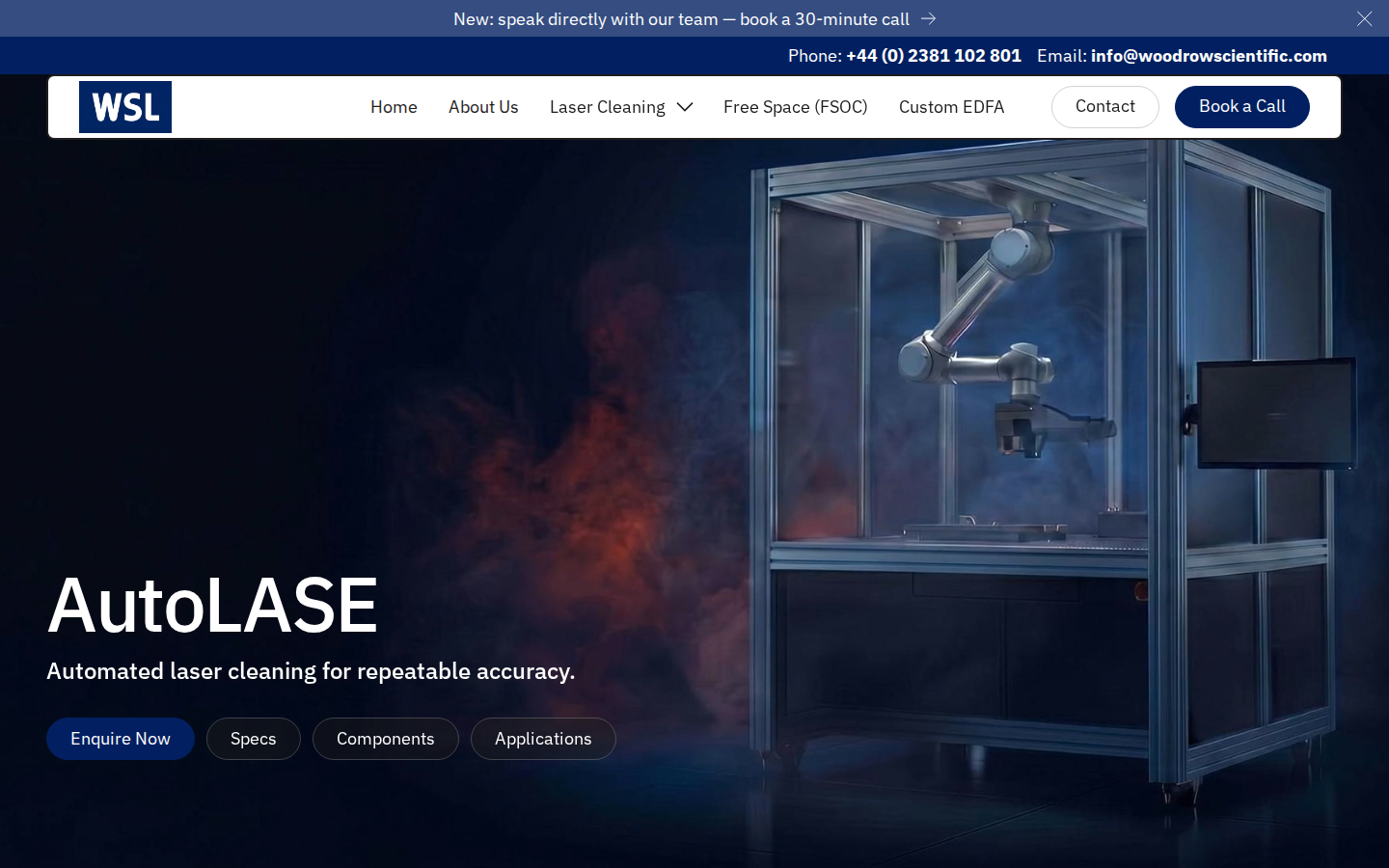
Best for high-volume production operations where cycle-to-cycle consistency, throughput, and hands-off automated cleaning matter more than portability.
Pros:
Load-and-go: no programming or setup required
Optional RHZ upgrade: no enclosure needed
Identical cleaning standard delivered every cycle
Zero consumables; no chemical waste streams
Cons:
Requires robot integration or custom cell build
Fixed-location use only — not portable
Pricing by quote; no published list price
AutoLASE is a production-scale automated laser cleaning system from Woodrow Scientific Limited — built for operations where cleaning quality must be identical part after part, and where manual labour in a repetitive cleaning cell is a cost and consistency liability.
Just Load the Part
The defining characteristic of AutoLASE is how little it demands from the operator: load the part, and the system takes over.
A 3D machine-vision system scans the loaded component, builds a full 3D map, and generates the cleaning path automatically — no manual programming, no path-setting, no knowledge of part geometry required.
This is not simply a programmed, repeatable cleaning flow — it is a genuinely skill-free setup where anyone can load a part and run a production-quality clean from the first cycle.
Optional RHZ Upgrade: Automated Cleaning Without an Enclosure
AutoLASE can be configured with WSL's eye-safe Reduced Hazard Zone (RHZ) technology, enabling automated laser cleaning with no enclosure at all.
This is a world-first exclusive: no other automated laser cleaning system can operate without an enclosure in this way, which meaningfully expands where and how an automated cell can be deployed on a production floor.
Robotic Multi-Axis Reach for Complex 3D Parts
The laser cleaning head is carried on an articulated robotic arm, which traces precise paths through the angles, undercuts, and contours of complex 3D components — not just flat or simple surfaces.
AutoLASE integrates with the customer's existing collaborative or industrial robots, or WSL can supply it as a complete custom cell built to specification.
AutoLASE Performance Across the Evaluation Framework
The table below maps AutoLASE against the five axes used to evaluate every system in this guide.
| Evaluation Axis | AutoLASE Performance |
|---|---|
| Throughput | High — continuous automated cycling with no operator intervention between parts |
| Precision | Excellent — machine-vision path generation and minimal substrate loss hold tight tolerances cycle to cycle |
| Surface Compatibility | Very broad — metals (steel, aluminium, titanium, copper, cast iron, and more), stone, concrete, brick, and masonry |
| Environmental Impact | Clean — no chemicals, no abrasives, no water; only fume extraction required; zero consumable waste streams |
| Total Cost of Operation | Strong TCO — zero consumables, automated labour savings, and reduced rework from minimal substrate damage |
Structured comparison of AutoLASE's performance across the five declared evaluation framework axes — throughput, precision, surface compatibility, environmental impact, and total cost of operation — giving production-line readers a scannable reference.
Power is tunable from 0 to 100% across a 300 W fibre laser, so a single AutoLASE cell handles everything from light oxide removal through to thick paint and coating strip — no reconfiguration between jobs.
Applications
AutoLASE is deployed across automotive engine, driveline, and EV battery component cleaning; aerospace turbine blade and engine part surface preparation; injection mould and tyre mould cleaning; and remanufacturing and refurbishment batch processing.
If a component fits the cell, it can be cleaned automatically — the application list above reflects primary use cases, not a hard boundary.
The Manufacturer Behind AutoLASE
As covered in the ELASER evaluation, WSL is the only UK-based laser cleaning manufacturer — designing, building, supporting, and improving every machine entirely in-house since 2012, with over 200 years of combined engineering experience across the team.
This matters in practice: many suppliers in the laser cleaning market are importers or resellers rebadging third-party hardware, which limits their ability to provide genuine engineering support, improve the product, or resolve issues without supply chain delays.
WSL's in-house model means fast, expert support from people who built the machine — and a genuine ability to customise and improve it.
AutoLASE carries CE and UKCA certification. First-class laser cleaning safety and operation training is available, and bespoke engineering, integration, and customisation can be discussed directly with the WSL team.
AutoLASE is priced by quote — contact WSL directly for a figure tailored to your configuration and integration requirements.
Among comparable industrial laser cleaning machines in Europe, AutoLASE is the competitive cost leader; and when evaluated against traditional cleaning methods on total cost of ownership — factoring in zero consumables, automated labour savings, reduced downtime, and less rework — the case is strong for production operations running at scale.
Option 3
Chemical Dipping — Whole-Body Immersion Stripping
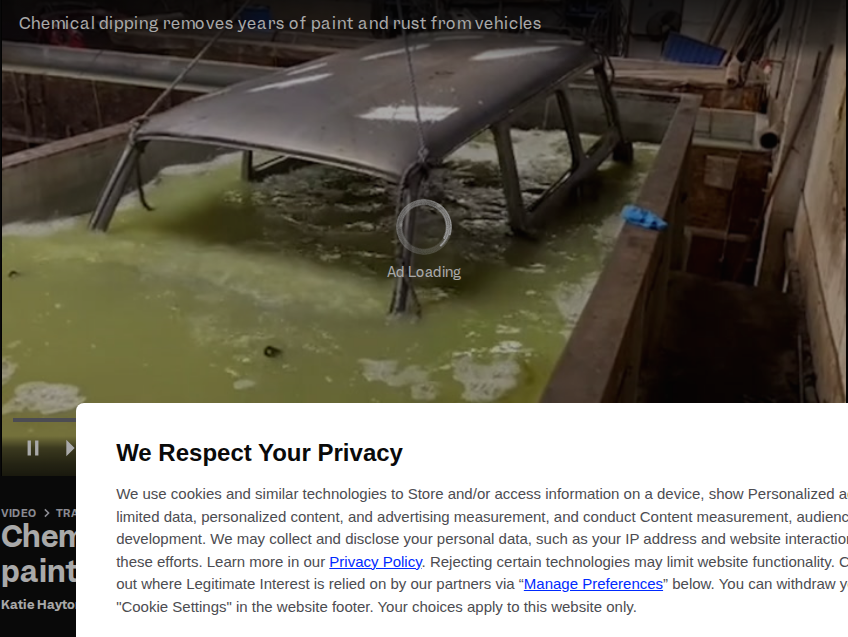
Chemical dipping is a whole-body immersion stripping service that removes all paint, rust, and coatings from an automotive body shell in a single sequential process — the most thorough method available for complete ground-up restoration work on ferrous structures.
Pros:
Reaches every seam, cavity, and internal surface
Strips paint and removes rust in one process
No mechanical abrasion — substrate integrity preserved
No capital equipment cost — outsourced service
Cons:
Incompatible with aluminium, magnesium, and pot metal
Minimum five business days process time
Requires off-site specialist facility — not portable
Residual chemical leaching risk at seams
Chemical dipping is best suited to restorers undertaking a complete, ground-up automotive body restoration — someone who needs every surface, seam, cavity, and box section stripped to bare metal in a single process, and who can work around the logistics of sending the body off-site to a specialist facility.
It is not a spot-repair method, nor is it suited to time-pressured turnarounds. If you need selective stripping or need the vehicle back quickly, this is the wrong tool for the job.
How chemical dipping works
The process follows a fixed three-tank sequence: first, a hot alkaline (caustic) bath strips all paint, primer, body filler, and organic coatings from the steel; second, an acid bath — typically phosphoric acid — removes rust and neutralises residual caustic; third, a final rinse and passivation step prepares the bare metal surface for priming.
- Hot alkaline bath: Sodium hydroxide solution heated to around 200°F strips all paint, primer, filler, and organic coatings. Typical immersion time is approximately two days for a heavily coated body.
- Acid de-rust bath: Phosphoric acid removes iron oxide (rust) and neutralises residual caustic from the first tank, leaving the steel chemically clean.
- Rinse and passivation: A neutralising rinse removes residual acid and passivates the bare steel, leaving a primer-ready surface.
The liquid reaches every square millimetre of metal — inside door cavities, rocker panels, trunk floors, and box sections — because the chemistry goes wherever the solution can flow.
Surface compatibility is the most important scope constraint to understand before committing to this method. The alkaline bath is highly effective on steel and ferrous structures, but it will attack soft metals: aluminium, magnesium, and pot metal are all at risk.
Any aluminium trim, pot-metal badges, aluminium door handles, or VIN tags must be removed from the body before it enters the tank — failure to do so will result in those components being destroyed.
Cars with aluminium panels, castings, or pot-metal fittings require careful disassembly before dipping. The alkaline bath will damage or destroy any soft metal left on the body. Identify and remove all non-ferrous components before the body goes to the facility.
On the precision axis, chemical dipping is a whole-body, non-selective process by design. It removes every coating simultaneously — factory primer, underseal, cavity wax, and internal cavity protection included — which is exactly what a full restoration requires, but makes it entirely unsuitable for partial or spot work.
Chemical dipping: cost and logistics
Process time at a specialist facility runs to a minimum of five business days from the point of intake — and can extend further depending on the condition of the body and the facility's workload.
That minimum is compounded by the logistics of transporting the body to and from the facility, which adds real downtime and cost beyond the dipping fee itself.
| Evaluation Axis | Chemical Dipping Performance | Notes |
|---|---|---|
| Surface Compatibility | Ferrous metals only | Aluminium, magnesium, and pot metal must be removed before dipping |
| Throughput | Minimum 5 business days per body | Off-site logistics add further downtime beyond process time |
| Precision | Whole-body, non-selective | Strips all coatings simultaneously — unsuitable for spot repairs |
| Environmental Impact | Chemical-intensive operation | Heated tanks, waste disposal, and chemical handling are operational realities for the facility |
| Total Cost of Operation (TCO) | Mid-to-high service cost | No capital outlay for the restorer; cost includes dipping fee, transport, and mandatory post-dip treatment |
Summarises chemical dipping's performance across the five evaluation axes declared in the methodology section, giving the reader a quick comparative reference before the cost discussion.
Pricing from specialist operators varies by body size and configuration. Based on published price sheet data from metaldipping.com, costs for typical automotive bodies range from approximately $850 for a small cab-only unit up to $2,400 or more for an XL body shell — with a standard unibody shell sitting around $2,300.
There is no capital equipment cost for the restorer: this is a purchased service, not a system to own. However, the full cost picture must include transport of the body, any downtime during the minimum five-day process, and the cost of post-dip epoxy primer — which is not provided by the dipping facility and is a non-negotiable step before the bare metal is exposed to air for any length of time.
On environmental impact, the operational burden sits with the specialist facility rather than the restorer. Heated tanks, chemical waste streams, and disposal requirements are real overheads that compliant operators manage as part of their process — the restorer should confirm that any facility they use operates within applicable environmental standards.
The most important trade-off to understand before committing to chemical dipping is residual chemical leaching. Caustic solution can pool in seams, spot-welded joints, and enclosed sections, and if not fully expelled during the pressure-washing stage, it will leach out slowly after the body has been primed — causing adhesion failure in future paint coats.
"The use of these aggressive chemical strippers can leave residual chemicals entrapped in the frames, joints and structure of a car, vehicle body or panel."
Experienced operators manage this risk through rigorous high-pressure washing of all seams after each tank — but the restorer should verify this process with any facility before committing. Post-dip rust inhibitor application (included as standard by reputable operators) and epoxy primer are essential steps, not optional finishing touches.
Option 4
Media blasting — abrasive and non-abrasive variants

Best suited to automotive restorers, industrial surface preparation contractors, and aerospace MRO operations where coating removal across large or varied surfaces is the primary requirement. The method's central trade-off is governed entirely by media choice: aggressive abrasives deliver high throughput on structural steel but risk substrate damage on thin or sensitive materials, while softer and non-abrasive variants preserve surface integrity at the cost of speed and, in the case of dry ice, higher operating cost.
Pros:
High throughput on large-area structural work
Low upfront equipment cost
Multiple media variants suit different substrates
Dry ice and plastic media are non-hazardous options
Cons:
Poor technique risks warping thin sheet metal
Silica sand poses respirable crystalline silica hazard
Spent media and dust require disposal (most variants)
Lower precision than laser for intricate geometry
Media blasting is the most internally varied category in this comparison: it is not a single method but a family of methods unified by the principle of propelling a media at a surface under compressed air, spanning everything from aggressive silica sandblasting to non-abrasive dry ice cleaning.
The central decision within this category is media selection — get it right and the method is well-matched to the substrate; get it wrong and the result is warping, surface contamination, or inadequate coating removal.
Choosing the right media for the job
Each variant in the media blasting family occupies a distinct position on the aggression-to-substrate-safety spectrum, and the application should drive the choice.
- Sandblasting (silica, garnet, steel grit): The most aggressive variant — profiles the substrate, removes heavy rust and mill scale efficiently, and delivers high throughput on structural steel. Generates significant dust and spent media. Silica sand carries a respirable crystalline silica (RCS) occupational health risk; garnet and steel grit are common alternatives that reduce this exposure.
- Soda blasting: Mildly abrasive and does not profile the substrate, making it gentler on automotive panels than sand. Slower on heavy or thick coatings. Leaves an alkaline residue that must be neutralised — for example with a dilute vinegar solution or an etching product — before primer will bond correctly.
- Dry ice blasting: Non-abrasive. CO2 pellets sublimate on contact, leaving no secondary media waste — only the dislodged contaminant remains. Well-suited to moulds, delicate surfaces, and food-grade environments. Limited effectiveness on heavy or thick coatings, and operating costs are higher than abrasive variants.
- Walnut shell and plastic media: Soft abrasives that preserve substrate integrity on aluminium, composites, and painted surfaces. Plastic media — manufactured to MIL-P-85891A and specified under AMS 2441, Boeing BSS 7039, and Airbus ABP 09-03-006 — is the established aerospace standard for depainting aluminium airframes and CFRP structures. Slower than aggressive abrasives but produces zero measurable substrate removal when parameters are correctly set.
Surface compatibility is where media choice has the most direct consequences. Aggressive abrasives risk warping thin automotive sheet metal if pressure is excessive or the nozzle angle is too steep; soda blasting and dry ice are the safer options for delicate panels. For aluminium and composite structures, plastic media is the industry-validated choice — all hard mineral and metallic media are prohibited for structural aerospace composite and aluminium paint stripping under the applicable specifications.
Throughput is strong for large-area structural work with abrasive blasting, which is why it remains the global standard for surface preparation before industrial coating. Dry ice and soda blasting are slower on heavy coatings. All variants share a common overhead: containment setup, cleanup, and media disposal or recycling add real time to the apparent speed of the blast operation itself.
Precision is an honest limitation of the category. Skilled operators can manage nozzle angle and pressure to control the aggressiveness of material removal, but media blasting cannot match the selectivity available from laser-based methods for intricate geometry, fine surface detail, or layer-by-layer removal. This is not a dismissal — most media blasting applications are not precision tasks, and the method is well-suited to the work it is designed for.
Environmental impact varies significantly by variant. Abrasive blasting generates spent media and contaminated dust that require collection and disposal; silica sand introduces an established RCS occupational health hazard requiring appropriate PPE and containment. Dry ice blasting produces no secondary waste — the CO2 sublimates into gas on impact, leaving only the dislodged contaminant. Plastic media is reusable across multiple cycles in recirculating cabinet systems and is classified as non-hazardous unless the coating being removed contains hazardous constituents.
On total cost of operation, media blasting's low upfront equipment cost is a genuine advantage — a blast pot and compressor represent a fraction of the capital required for laser or automated systems. The operational tail, however, is real: ongoing consumable spend, media disposal costs, PPE, containment logistics, and skilled operator time are the dominant expenses over the life of the operation.
Media blasting introduces heat into sheet metal through friction — not temperature alone, but the mechanical hammering effect of abrasive particles stretching the surface. Holding the nozzle at approximately a 30-40 degree angle and using fast sweeps distributes this effect rather than concentrating it in one area. This technique is critical for thin automotive panels; it takes longer than direct blasting but prevents warping. Media blasting is not appropriate for heritage surfaces or substrates where any material loss is unacceptable.
Option 5
Chemical stripping — solvent and caustic paint removers
Best suited to automotive restoration professionals working on thin panels and complex curves, and industrial operators running batch parts-stripping operations, where mechanical abrasion would risk substrate damage.
Pros:
No heat or abrasion — zero warping risk
Penetrates seams, curves, and intricate geometry
Low material cost for topical workshop use
Batch immersion available for industrial volumes
Cons:
Key chemistries face growing regulatory restriction
Compliant alternatives require 6-24 hour dwell
Surfaces need full neutralisation before refinishing
Chemical waste disposal adds operational overhead
Chemical stripping works through two distinct chemistry families. Solvent strippers penetrate and swell the paint film, breaking adhesion at the substrate interface. Caustic or alkaline strippers take a different route — they saponify organic paint binders, lifting the film as a sludge that can be rinsed away.
In industrial settings, these chemistries are deployed in heated immersion baths: parts are submerged in water-based chemical solutions that surround the metal and break down the coating, with any remaining paint removed by high-pressure water jets after several hours in the bath.
Surface compatibility
Chemical stripping is genuinely gentle on steel — it introduces no heat, no mechanical abrasion, and no warping risk from friction, making it particularly well-suited to the thin body panels and complex curves that abrasive methods can distort.
The substrate compatibility picture is not uniform, however. Caustic and alkaline formulations attack soft metals including aluminium, zinc, and magnesium, and are entirely unsuitable for fibreglass or plastic substrates. Hot solvent emulsion strippers handle a broader range — including aluminium, brass, and bronze — but the chemistry selection must be matched to the substrate, not applied generically.
Fibreglass and plastic panels are a firm exclusion for all chemical stripping variants: the chemistry can damage gel coat and the underlying epoxy resin structure, making mechanical or other methods the only viable route for those substrates.
Regulatory status — the operating environment is changing
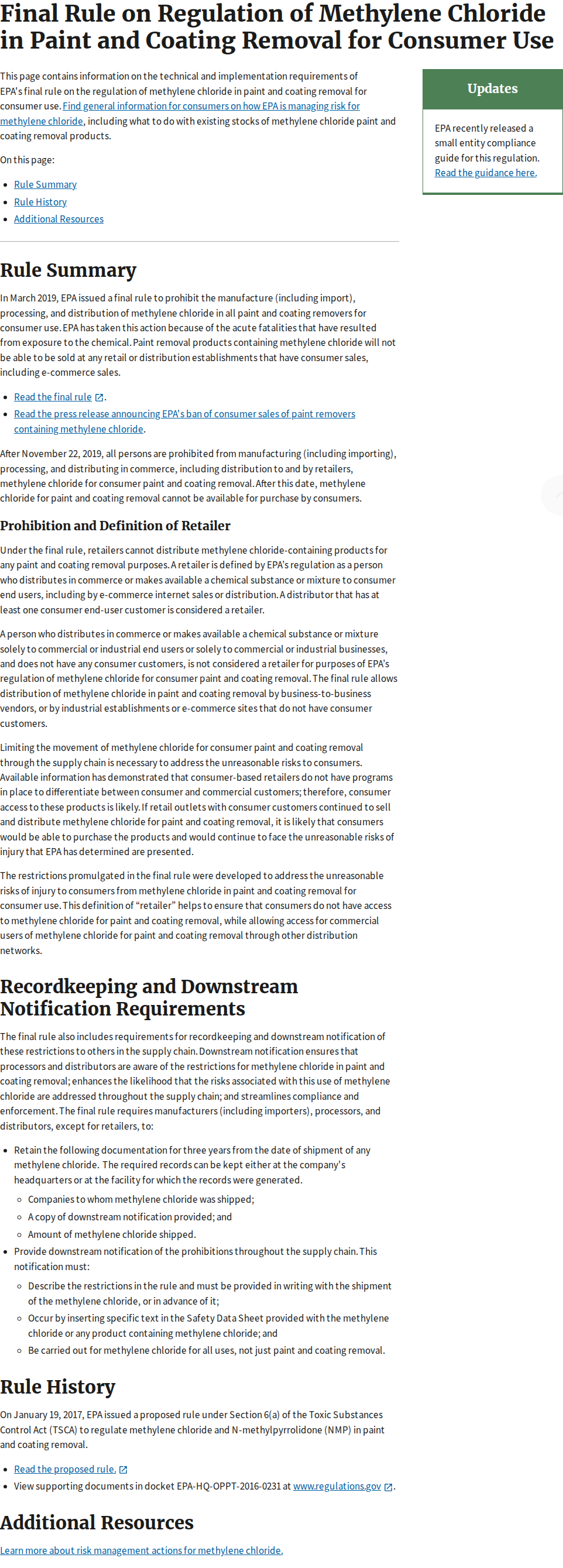
The most significant trade-off for chemical stripping is not technical — it is regulatory. Methylene chloride (dichloromethane), historically the most effective solvent stripper, has been progressively restricted by both US and EU authorities, and the pace of restriction is accelerating.
EPA banned methylene chloride for consumer paint and coating removal in March 2019, effective November 2019. In April 2024, EPA finalised a broader rule under TSCA prohibiting most industrial and commercial uses — with most commercial uses prohibited after April 28, 2026, and distribution to retailers prohibited after February 3, 2025. A narrow set of uses (aircraft maintenance, certain industrial processes under a Workplace Chemical Protection Program) may continue with strict exposure controls. Operators relying on methylene chloride for paint removal should verify current compliance obligations against 40 CFR Part 751.
The EU position predates the US action. Under REACH Annex XVII (Entry 59, Regulation EU 276/2010), paint strippers containing dichloromethane at 0.1% or greater by weight have been restricted from supply to professionals and the general public since 2011, with use in industrial installations permitted only under strict ventilation, PPE, and handling conditions.
NMP (N-methyl-2-pyrrolidone), one of the most common replacement solvents for methylene chloride, carries its own regulatory burden in the EU. Adopted as Regulation (EU) 2018/588, the REACH restriction on NMP requires manufacturers, importers, and downstream users to apply derived no-effect levels (DNELs) for worker inhalation and dermal exposure — 14.4 mg/m³ inhalation and 4.8 mg/kg/day dermal — in chemical safety assessments and safety data sheets.
The practical implication for any professional operation specifying chemical stripping: regulatory status must be verified in your jurisdiction before committing to a chemistry. What is permissible today may be restricted within the next compliance window, and the trend across both the US and EU is toward tighter controls, not relaxation.
Throughput and precision
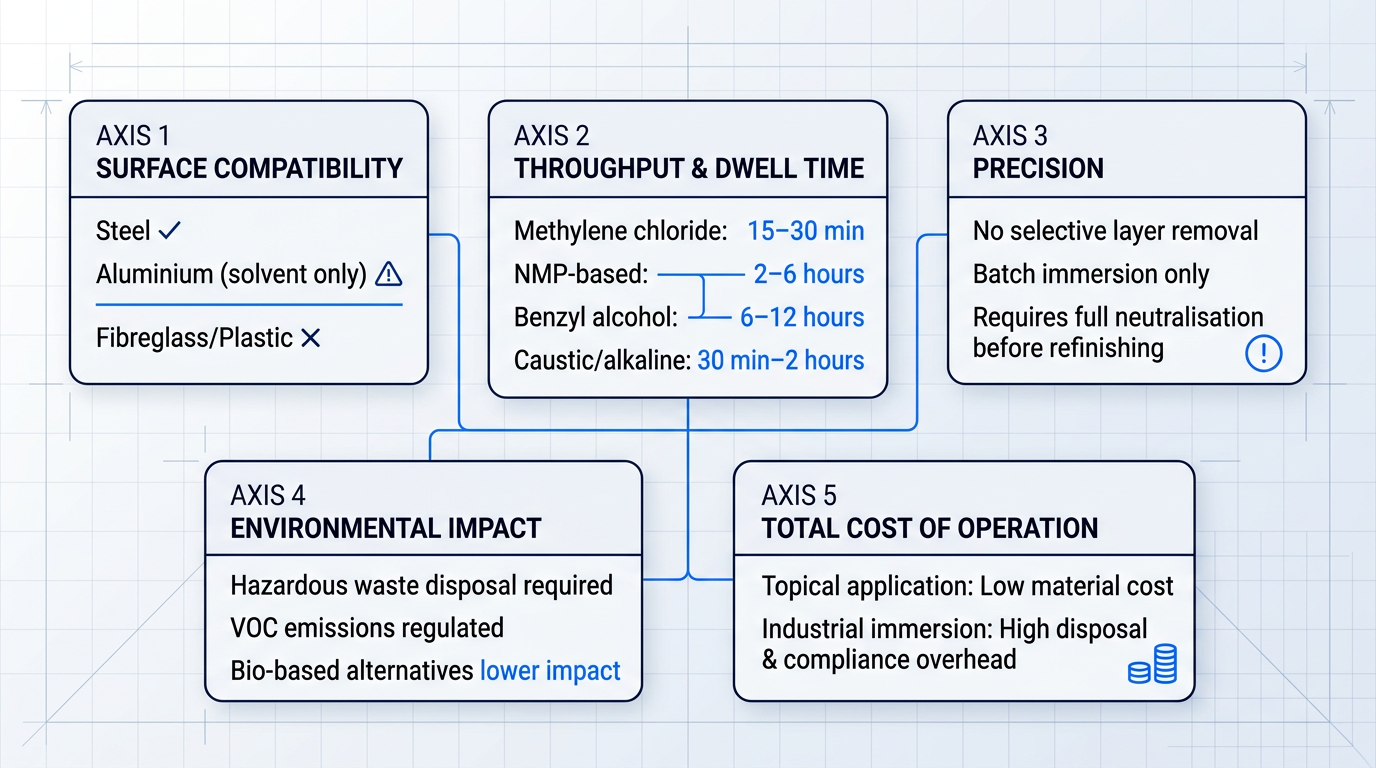
Throughput is an honest weakness at the topical level. The shift to compliant alternatives has made chemical stripping materially slower: where methylene chloride could soften and lift multiple paint layers in 15 to 30 minutes, replacement solvents based on benzyl alcohol, dibasic esters, or citrus-derived formulations typically require 6 to 24 hours of dwell time, depending on coating type and build thickness.
| Chemistry family | Typical dwell time | Substrate range | Regulatory status (US/EU) |
|---|---|---|---|
| Methylene chloride (DCM) | 15–30 minutes | Steel, most metals (not aluminium with caustic) | Banned for consumer use (US 2019); most commercial uses prohibited from April 2026 (US); restricted in EU industrial use (REACH Annex XVII) |
| NMP-based | 2–6 hours | Multiple layers, vertical surfaces | Permitted with DNEL compliance (EU REACH 2018/588); Prop 65 warning (California) |
| Benzyl alcohol | 6–12 hours | Single to moderate layers | Low regulatory burden; slower on heavy build |
| Dibasic esters | 4–8 hours | General purpose | Low regulatory burden; moderate effectiveness |
| Citrus-based (D-limonene) | 12–24 hours | Light coatings only | Very low regulatory burden; limited on modern coatings |
| Caustic / alkaline (NaOH, KOH) | 30 min–2 hours | Steel, oil-based paints; not aluminium, zinc, or plastics | Generally permitted; corrosive handling requirements |
Comparing the main chemistry families across dwell time, substrate compatibility, and regulatory status gives professionals a clear reference for chemistry selection — information that is genuinely comparative and benefits from tabular layout.
Chemical stripping offers no precision in the sense of selective layer removal — it cannot strip one coat while leaving another intact, and it is not suitable for heritage surfaces where any risk of residual chemistry is unacceptable.
For industrial batch operations, throughput is governed by tank capacity rather than dwell time per part: multiple components can be processed simultaneously, which makes immersion stripping economically viable for high-volume workflows where parts can be transported to a facility.
Environmental impact and total cost of operation
The environmental overhead of chemical stripping is an operational reality, not a theoretical concern. Spent chemical baths, paint sludge, and contaminated rinse water require handling as hazardous waste in most jurisdictions — adding disposal logistics and cost to every stripping cycle.
VOC emissions from solvent-based strippers are regulated, and compliant ventilation is a non-negotiable requirement for any enclosed workspace. Bio-based and aqueous alternatives (citrus-based, water-based) offer a meaningfully better environmental profile, but typically at the cost of reduced effectiveness on modern high-build or powder coatings.
The cost picture divides sharply by scale. For topical application in a bodyshop or restoration workshop, material cost per application is low — this is a genuine competitive strength against methods that require capital equipment or specialist facilities. At industrial immersion scale, the dominant costs shift to waste disposal, compliance overhead (PPE procurement, ventilation infrastructure, regulatory reporting), and energy consumption for heated baths.
One operational step that adds time regardless of scale: surfaces stripped by chemical methods must be fully neutralised and thoroughly cleaned before any refinishing can begin. Residual chemistry causes adhesion failure in subsequent paint coats — this is not an optional precaution, and the neutralisation process should be factored into any throughput calculation.
Conclusion
Choosing the right paint removal system: matching method to job
Every method in this comparison is the right answer for someone — the question is whether it matches your job's demands: substrate, scale, precision, and operating environment.
For on-site flexibility and substrate preservation without consumables or chemical waste, portable laser cleaning is where the method landscape has moved — the RHZ variant's open-space capability extends that to shared environments where conventional laser use was previously impractical.
Chemical dipping and media blasting still earn their place when thoroughness across a full body shell or aggressive profiling on structural steel is the requirement.
Understand the job first; the right system follows.
Frequently asked questions about paint removal systems
Common questions about choosing between paint removal methods, how laser cleaning works, and the regulatory status of chemical strippers. Each answer stands on its own — no prior reading required.
There is no single best method — the right answer depends on the job. The key decision variables are substrate type, scale of operation, precision requirements, and operating environment. Laser cleaning leads on substrate preservation and total cost of operation for frequent, precision work. Chemical dipping leads on completeness for full automotive body shells, reaching every seam, cavity, and internal surface in a single process. Abrasive blasting leads on throughput for large-area structural steel where surface profiling is also required. For thin panels or complex geometry where mechanical abrasion would cause damage, topical chemical stripping remains a practical option — though regulatory restrictions on key chemistries are tightening. Match the method to the job, not the other way around.
"Effective" means different things depending on what you need, and each definition points to a different method. If fastest removal rate on large areas is the measure, abrasive blasting wins — it covers ground quickly on structural steel and wide flat surfaces. If most thorough coverage is the measure, chemical dipping leads — it reaches internal seams and cavities that no surface-applied method can access. If most precise with least substrate damage is the measure, laser cleaning is the answer — the coating is removed selectively without profiling or altering the base material. If most accessible for small, targeted areas is the measure, topical chemical stripping is the practical choice. The expert answer is to define what effective means for your specific job before selecting a method.
Yes — laser ablation is an established industrial process, not an experimental technology. The mechanism is well understood: the coating absorbs the laser energy and is vaporised or physically ejected; the base metal, being more reflective, absorbs far less energy and remains intact. This selective absorption is what makes laser cleaning effective without damaging the substrate beneath. The technology is in active use across aerospace (the US Air Force and Marine Corps have both evaluated and deployed laser depainting on aircraft and ground equipment), automotive production, and heritage restoration. Multiple independent research programmes — including work published through the US Defense Technical Information Center — confirm coating removal without measurable substrate damage across composites, metals, and plastics. Scepticism about laser cleaning typically reflects unfamiliarity with the technology rather than any genuine limitation in the underlying science.
The laser beam is absorbed by the coating, causing rapid thermal expansion. This drives ablation: the coating vaporises or is converted into plasma, which creates a pressure shockwave that ejects the remaining coating material as fine particles or solid flakes. The process is governed by selective absorption — the coating absorbs the laser energy at a much higher rate than the base material beneath it. Because the applied energy is largely consumed in coating decomposition rather than transferred to the substrate, the base material experiences only a minimal temperature increase. The result is a clean surface with no dimensional change to the substrate and no increase in surface roughness. Unlike abrasive methods, the process does not profile or erode the underlying material — the substrate geometry is preserved exactly as it was before cleaning.
The two methods differ fundamentally on substrate impact and operating economics. Laser cleaning is non-contact and non-abrasive: no media is propelled at the surface, so there is no substrate profiling, no secondary waste stream, and no consumables to purchase or dispose of. Precision is high — defined zones can be cleaned without affecting adjacent areas. Total cost of operation is strong for frequent, precision work because consumable costs are near zero once the equipment is in place. Sandblasting propels abrasive media at high velocity, which profiles the surface as it removes the coating. That profiling is an advantage when preparing structural steel for heavy industrial coatings that require a specific anchor profile — but it is a liability on thin panels, tight tolerances, or sensitive substrates. Sandblasting also generates significant spent media waste and silica dust, which OSHA and NIOSH classify as a serious occupational health hazard requiring strict controls. The practical decision rule: choose laser cleaning where substrate preservation and precision matter; choose sandblasting where aggressive surface profiling is required and the facility has the containment infrastructure to manage media waste safely.
It depends on the chemistry and the jurisdiction — some formulations are now banned or heavily restricted, while others remain legal. In the US, the EPA banned methylene chloride (DCM) for consumer paint and coating removal in 2019. In April 2024, the EPA expanded that action under TSCA, prohibiting most industrial and commercial uses of methylene chloride — including paint and coating removers — with most prohibitions phasing in by April 2026. In the EU, DCM in paint strippers has been restricted under REACH Annex XVII since 2010, with professional use subject to member state derogation. NMP (N-methyl-2-pyrrolidone), a common replacement chemistry, is also restricted under EU REACH, with strict derived no-effect levels (DNELs) for occupational inhalation and dermal exposure that manufacturers and users must comply with. This is an area of active regulatory change. Operators should verify the current status of their specific chemistry and jurisdiction before specifying any chemical stripping method — this is operational awareness, not legal advice, and the relevant primary sources are the EPA's TSCA risk management pages and ECHA's REACH restriction documentation.