

Introduction
If you work with metal in any serious capacity — whether you're managing industrial maintenance, running a fabrication shop, or restoring equipment — you've encountered oxidation and faced the question of how to deal with it properly.
This guide doesn't push a single solution, because there isn't one: the right oxidation remover for metal depends on the substrate, the environment, and the constraints of your specific situation.
It covers four method categories — chemical, mechanical/abrasive, electrochemical, and laser-based — with enough depth to let you evaluate each on its own terms.
It also goes further than most on the topics professionals actually need: health and safety overhead, environmental compliance, and how to stop oxidation from coming back once it's been removed.
TL;DR
Choosing an oxidation removal method isn't about reaching for the most familiar product or the cheapest option. The methods that look straightforward often carry hidden costs — in surface risk, compliance overhead, or recurring oxidation. Getting it right means matching the full picture of your situation to the method that genuinely fits it.
This article covers:

How oxidation behaves across different metal types
Chemical, abrasive, electrochemical, and laser removal methods
Health, safety, and environmental compliance per method
Trade-off comparison across surface risk and cost
Prevention strategies and a method selection framework
What Is an Oxidation Remover for Metal?
Pick the wrong oxidation remover for metal and you risk stripping a protective oxide layer that was doing useful work, dissolving a zinc coating that was sacrificing itself to protect the steel beneath, or etching a surface that needed only a gentle clean. Understanding what oxidation actually is — and why it behaves so differently depending on the metal — is the essential first step before any removal decision is made.
Oxidation is the process by which metal atoms lose electrons to oxygen, forming stable oxide compounds on the surface.
The results are familiar: the reddish-brown rust on steel, the chalky white film on aluminium, the dark tarnish that dulls copper and brass, and the green verdigris that develops on aged copper and bronze.
At a mechanistic level, oxidation is an electrochemical reaction. It requires three components working together: an anode (a site on the metal surface where electrons are lost), a cathode (a site where oxygen is reduced by accepting those electrons), and an electrolyte — typically moisture or a conductive solution on the surface that allows ions to move between the two sites.
Remove either oxygen or moisture from this system and the reaction stalls — which is the underlying logic behind many prevention strategies, though that is a topic for a later section.
The rate at which this reaction proceeds is not fixed. Humidity, salinity, atmospheric pollutants such as sulphur dioxide and nitrogen oxides, and elevated temperature all accelerate the electrochemical cycle, which is why metals degrade faster in coastal, industrial, or tropical environments than in dry, temperate ones.
Oxidation, Corrosion, and Rust: Key Distinctions
These three terms are frequently used interchangeably, but they describe different things — and the distinctions matter when identifying what you are dealing with.
Oxidation is the specific electrochemical process of electrons being lost to oxygen, producing metal oxide compounds. Corrosion is the broader category: the degradation of a material through chemical reaction with its environment, of which oxidation is the most common form but not the only one. Rust is a narrower term still — it refers specifically to the iron oxide compounds that form when iron or steel oxidises, and it is not a correct label for the oxide products on aluminium, copper, or zinc.
Tarnish and patina are the corresponding terms for oxidation products on non-ferrous metals: tarnish describes the dark brown-black oxide layer on copper, silver, and brass; patina refers to the more developed, multi-compound surface layer (such as the green verdigris on copper) that forms over longer exposure.
How Oxidation Behaves Across Key Metal Types
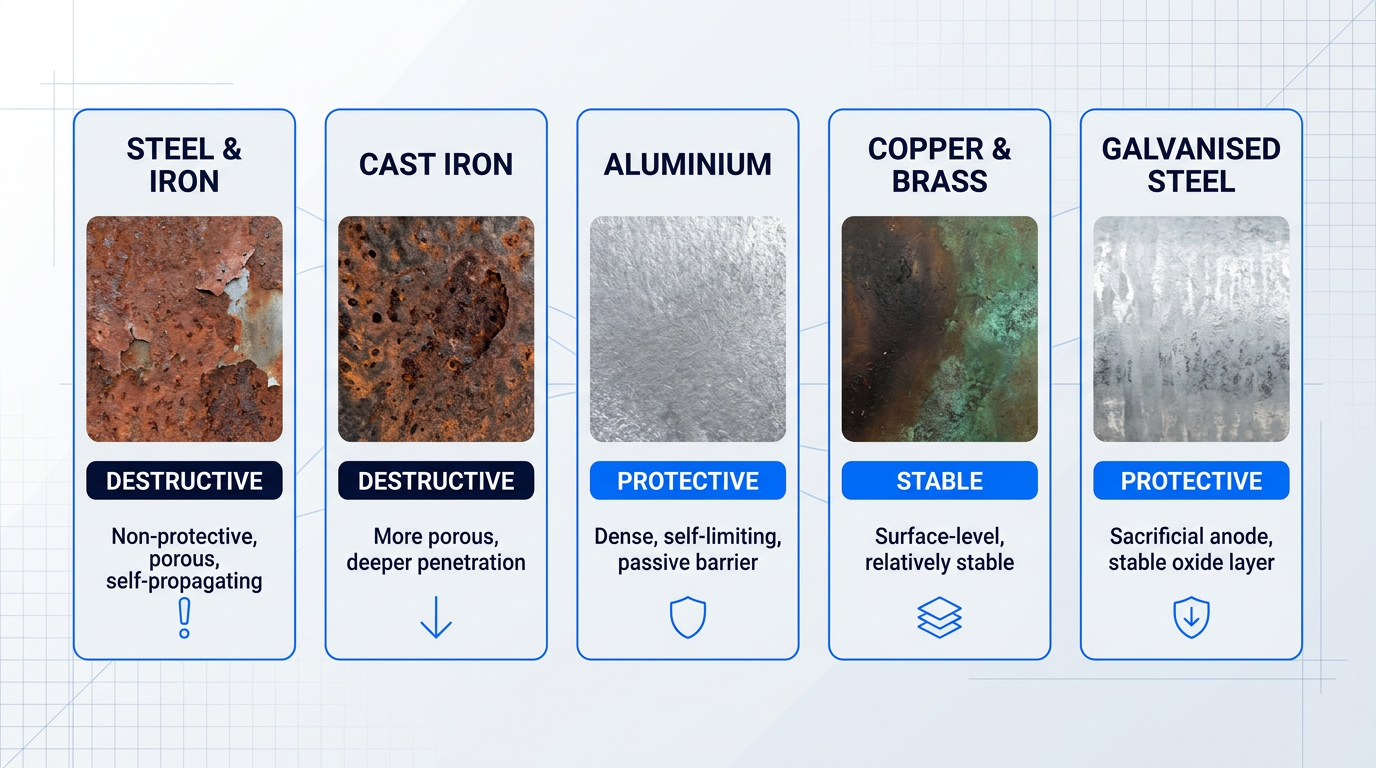
The most consequential thing to understand about metal oxidation is that the oxide layer formed is not the same kind of thing across different metals — it can be either destructive and self-propagating or stable and self-limiting, depending entirely on the metal involved.
- Steel and iron: Iron oxide (rust) is porous, non-adherent, and non-protective. As it flakes away, it exposes fresh metal, so untreated rust spreads and deepens continuously.
- Cast iron: Behaves similarly to steel but is more porous, allowing rust to penetrate deeper into the material rather than remaining at the surface.
- Aluminium: Forms a dense, adherent aluminium oxide (Al₂O₃) layer that is self-limiting — it acts as a passive barrier, halting further oxidation of the metal beneath.
- Copper and brass: Oxidises first to cuprite (Cu₂O), then to malachite-based verdigris via reaction with moisture and CO₂. Tarnish and verdigris are generally surface-level and relatively stable.
- Galvanised steel: The zinc coating acts as a sacrificial anode, oxidising preferentially to form a stable zinc oxide and zinc carbonate layer that protects the underlying steel.
The pattern across these metals reveals a critical principle: oxidation products can be either destructive or protective depending on their physical properties.
Iron rust is porous and self-propagating — it actively undermines the metal beneath it. Aluminium oxide and zinc carbonate are dense and self-limiting — they shield the base metal. This distinction, not the presence of oxidation itself, is what determines urgency and method selection.
This distinction also means that metal type identification must come before method selection — it is the first filter in any removal decision, not an afterthought.
Strong mineral acids appropriate for descaling steel can attack aluminium's base metal directly, dissolve the sacrificial zinc from galvanised surfaces, or cause discolouration on copper alloys. Abrasive methods suited to heavy structural steel can be far too aggressive for thin aluminium sheet or precision copper components.
For aluminium in particular, the passive oxide layer is part of the metal's natural corrosion resistance — aggressive removal that strips it entirely can leave the base metal more vulnerable than before, not less.
Every method section that follows returns to metal type as a primary compatibility filter, so the distinctions established here carry through the entire guide.
With that conceptual foundation in place, the first method category to examine is chemical oxidation removal — the most widely familiar approach and the one most readers will have encountered in product form.
Chemical Oxidation Removers: How They Work and Where They Fit
Chemical removers are the most familiar category of oxidation remover for metal — they sit on workshop shelves and in maintenance stores across every industry. But the range of chemistry types, the strict surface compatibility constraints, and the compliance obligations that come with spent acid disposal make this category considerably more complex than a product label suggests.
The core mechanism is a dissolution reaction: acids react with metal oxides to form soluble salts, which can then be rinsed away to leave the base metal exposed.
This is a chemical conversion, not a physical removal — the oxide layer is not scraped or blasted off, it is chemically converted and washed away. That distinction matters when comparing this category with mechanical and laser-based methods later in this guide.
Chemical Types and Their Applications
Not all acid-based removers work the same way, and the differences between chemical families have direct consequences for which metals they can safely treat and how aggressively they act on oxidation.
- Mineral acids: Hydrochloric, sulphuric, and phosphoric acids. Used for heavy industrial descaling and rust removal on steel. Fast-acting but with significant surface compatibility and safety constraints.
- Organic acids: Citric, oxalic, and acetic acids. Lighter-duty, more material-sensitive applications. Better suited to non-ferrous metals and situations requiring a gentler approach.
- Chelating agents: EDTA, malonic acid, and related compounds. Sequester iron ions rather than dissolving oxide aggressively. Lower risk of base metal attack; used in precision or controlled contexts.
The practical implication is that these chemical families are not interchangeable: the right choice depends on both the metal substrate and the severity of the oxidation, not simply on what is available.
Phosphoric acid warrants separate attention because it behaves differently from hydrochloric and sulphuric acid. Rather than simply dissolving iron oxide, it converts it to iron phosphate — a stable, adherent layer that provides mild corrosion resistance on the treated surface.
This conversion mechanism makes phosphoric acid less aggressive than the other mineral acids, and it explains why it is the active chemistry in most rust converters and metal pre-treatment products: it prepares the surface for coating while leaving behind a degree of protection.
At the industrial scale, chemical removal is formalised as pickling — the immersion of metal in an acid bath to remove mill scale, rust, and surface oxides. Sulphuric and hydrochloric acid pickling are the standard processes for steel; phosphoric acid pickling is used for aluminium and copper alloys, typically at concentrations of 5–30% for aluminium and 10–40% for copper and copper alloys, applied at 40–80°C.
A critical feature of controlled pickling is the use of inhibitors — chemicals added to the acid bath that slow attack on the base metal while allowing the oxide and scale to dissolve. Organic inhibitors such as thiourea adsorb onto the metal surface and reduce the corrosion rate, preventing over-pickling, pitting, and hydrogen embrittlement.
Surface Compatibility: The Critical Constraint
As established earlier in this guide, metal type is the first decision variable for any removal method. With chemical removers, that principle is not just a consideration — it is a hard filter.
| Metal | Compatible Acid Types | Concentration / Notes |
|---|---|---|
| Carbon steel | Inhibited HCl, H2SO4, H3PO4, organic acids, chelants | H3PO4 at 2–20% for cleaning; inhibitors required to prevent base metal attack |
| Aluminium / Al alloys | Weak organic acids only (citric, sulphamic) | Strong mineral acids attack the aluminium base metal, not just the oxide layer |
| Copper / Cu alloys | H3PO4 at 10–40%; dilute mineral acids with strict time control | Autocatalytic dissolution in HCl — concentration and contact time are critical |
| Galvanised steel | Avoid acid treatment | Acid attacks the zinc coating, destroying the sacrificial corrosion protection layer |
Specific compatible acid types and concentration ranges per metal substrate, drawn from ScienceDirect pickling and chemical cleaning sources.
The pattern across the table is clear: steel is the most tolerant substrate, but every other common metal type imposes tighter constraints. Aluminium corrodes at pH below 4 or above 8.5, meaning most mineral acids will attack the base metal rather than just the oxide layer — only weak organic acids such as citric or sulphamic acid are appropriate.
Copper and its alloys present a different problem: hydrochloric acid triggers an autocatalytic dissolution mechanism in which copper ions accelerate further attack, making concentration and contact time difficult to control safely. Phosphoric acid at controlled concentrations is the preferred option.
Galvanised metal is the most vulnerable case. Acid attacks the zinc coating — the very layer that provides sacrificial corrosion protection — and stripping it defeats the purpose of galvanising entirely. Chemical treatment of galvanised surfaces should be avoided unless the intention is to remove the coating prior to re-galvanising.
Health, Safety, and Environmental Compliance
The health and safety overhead of chemical removers is a genuine operational consideration, not a generic disclaimer. Under GHS/CLP classification, phosphoric acid at ≥25% concentration carries Skin Corrosion 1B and Eye Damage 1 classifications (H314); at 85% — the commercially available analytical grade — it is additionally classified as corrosive to the respiratory tract. Hydrochloric acid at ≥25% carries Skin Corrosion 1B and Eye Damage 1 classifications, along with STOT SE 3 for respiratory irritation. Sulphuric acid at ≥15% is classified Skin Corrosion 1A.
In practice, this means that working with these materials at any meaningful scale requires acid-resistant gloves, splash-proof eye protection, and — where solvent-based formulations or acid vapours are present in enclosed or poorly ventilated spaces — appropriate respiratory protection. VOC exposure from solvent-based cleaning formulations carries its own hazard profile, including central nervous system effects and dermatitis from skin contact.
The environmental compliance dimension is where most product descriptions and guides go silent — and where the real operational cost often lies. Spent acid solutions from chemical cleaning operations are classified as corrosive hazardous waste under RCRA (the Resource Conservation and Recovery Act) when they exhibit the D002 corrosivity characteristic.
Under 40 CFR 261.22, any aqueous waste with a pH of 2 or below, or 12.5 or above, carries EPA Hazardous Waste Number D002. Spent pickling acids, rust remover rinse water, and neutralisation waste from chemical cleaning operations routinely meet this threshold — classifying them as hazardous waste requiring licensed disposal. This compliance obligation rarely appears in product descriptions.
The EPA has explicitly confirmed that spent pickle liquor from steel finishing operations is regulated hazardous waste (K062 for iron and steel industry facilities; D002 characteristic waste for others), and that contaminated rinse waters may also trigger D002 if their pH falls at or below 2. For operations running acid cleaning at any meaningful volume, licensed hazardous waste management is not optional — it is a statutory requirement under federal law.
Professionals evaluating the total cost of chemical removal need to factor in waste disposal costs, containment infrastructure, and the administrative burden of RCRA compliance — none of which appear in the unit price of the acid product itself.
Practical Limitations in Real-World Use
Even on compatible substrates, chemical removers impose workflow constraints that affect how they can be used in practice. After treatment, surfaces must be thoroughly neutralised and rinsed — incomplete rinsing leaves active chemistry on the metal, which continues to attack the substrate and can undermine any subsequent coating.
Flash rusting is a well-documented limitation on steel: once the protective oxide layer is removed by acid treatment, the exposed iron surface can begin re-oxidising within minutes in humid conditions, well before a primer or coating can be applied. According to AMPP (formerly NACE/SSPC) guidance, flash rust can develop within minutes to a few hours of cleaning — a constraint that demands tight workflow sequencing between cleaning and coating.
Complex geometries present a further problem: acid can pool in recesses and internal cavities, making contact time impossible to control uniformly, and incomplete rinsing of enclosed spaces leaves residual chemistry that causes ongoing corrosion. For parts with intricate three-dimensional profiles, chemical methods are a poor fit regardless of substrate compatibility.
Where chemical methods dissolve oxidation through a conversion reaction, mechanical and abrasive methods take a fundamentally different approach — removing oxide physically through cutting, abrading, or blasting. That different mechanism brings its own set of surface risks and occupational health considerations, which the next section addresses.
Mechanical and Abrasive Removal: Wire Brushing to Blasting
Wire brushes and angle grinders are the most instinctively familiar tools in any maintenance professional's kit — and that familiarity is precisely why their limitations tend to get underestimated. Where chemical methods dissolve the oxide, abrasive methods do something fundamentally different: they physically dislodge the oxidised layer by cutting, grinding, or impact, removing it as particulate rather than converting it in place.
This mechanical action shapes everything that follows — the surface risks, the health hazards, and the compliance overhead that serious blasting operations carry. The oxide comes off, but so does some of the base material beneath it.
The Method Spectrum: Hand Tools to Industrial Blasting
Hand wire brushing and manual sanding sit at the low-intensity end: minimal cost, low throughput, appropriate for light surface oxidation on accessible areas or small touch-up work where controlled removal is more important than speed.
Angle grinders fitted with flap discs, grinding wheels, or wire cup brushes accelerate removal considerably, making them practical for heavier or more widespread rust on steel. The trade-off is straightforward: speed comes at the cost of surface aggression, and the operator has less fine control over how much material is removed.
Sandblasting and media blasting represent the industrial end of the spectrum — high-throughput, scalable, and the method of choice for large steel structures, shipyard work, bridges, and infrastructure maintenance. At this scale, the method's health and safety implications become the dominant operational consideration.
The surface risk is not theoretical. Abrasive action removes base material alongside the oxide layer — this is inherent to the mechanism, not a side effect of poor technique. On thin sheet metal, aluminium, and softer non-ferrous metals where dimensional tolerance matters, this translates directly into pitting, surface profile alteration, and dimensional loss.
There is also a less obvious cross-contamination risk: using a wire brush previously used on steel to clean aluminium or copper can embed iron particles into the softer metal's surface, creating initiation sites for galvanic corrosion. Dedicated brushes per metal type are not optional in precision work — they are a basic requirement.
The implication is clear: abrasive methods belong on robust steel where some surface profile is acceptable or useful. They are the wrong choice for precision parts, thin sheet, or softer non-ferrous metals where the substrate integrity cannot absorb the mechanical aggression.
For blasting operations specifically, the choice of abrasive media is a significant decision variable with direct consequences for both surface outcome and worker health.
- Silica sand: Historically the most common blasting abrasive, but now restricted or prohibited in many jurisdictions due to the severe silicosis risk it generates.
- Steel grit and shot: Lower dust generation than silica, reusable, and well-suited to steel structures; generates metallic particulate rather than respirable silica dust.
- Garnet, glass bead, aluminium oxide, sodium bicarbonate: Silica-free alternatives offering varied surface profiles and health profiles; the professional standard where silica is prohibited or restricted.
- Wet blasting: Water injected into the abrasive stream substantially reduces airborne dust generation — an engineering control and a method variant in its own right.
Media selection is inseparable from health and regulatory status. Silica sand is the legacy choice with the highest hazard profile; the alternatives exist precisely because its risks proved unacceptable under sustained regulatory scrutiny. Even silica-free alternatives require proper hazard assessment — some slags and substitute media carry their own toxic metal exposure risks, as NIOSH research on substitute abrasives has confirmed.
Respirable Crystalline Silica: The Primary Health Hazard
When silica-containing materials are blasted, the abrasive fractures into fine particles. Those smaller than 10 microns — respirable crystalline silica (RCS) — penetrate deep into the lung tissue and cannot be cleared by the body's natural defences.
The consequences are severe and irreversible. RCS causes silicosis — a progressive, incurable fibrosis of the lung that results in severe breathlessness, leaves sufferers often house- or bed-bound, and frequently proves fatal. It also causes lung cancer, chronic obstructive pulmonary disease (COPD), and kidney disease. These are not remote possibilities; NIOSH has documented cases of silicosis progressing to death among sandblasters, and HSE estimates that silica was responsible for over 500 construction worker deaths in a single year.
The regulatory exposure limits reflect the seriousness of the hazard. Under OSHA standard 1910.1053, the permissible exposure limit (PEL) for respirable crystalline silica in general industry is 50 µg/m³ as an 8-hour time-weighted average. The UK HSE workplace exposure limit (WEL), set under COSHH and referenced in HSE guidance CN7, is 0.1 mg/m³ as an 8-hour TWA — a hard regulatory ceiling, not a target.
Under COSHH Schedule 2, sand or any substance containing 1% or more of free silica is prohibited for use in blasting of articles in the UK. This is a legal requirement enforced by HSE — substitution to silica-free abrasives is mandatory, not advisory.
It is worth noting that the hazard is not confined to silica sand alone. Any blasting operation generates fine particulate, and the specific health risk depends on both the media and the substrate being blasted. Blasting concrete, certain paints, or silica-bearing coatings can generate RCS exposure even when the abrasive itself is silica-free.
Engineering controls follow a clear hierarchy. Substitution to silica-free abrasives is the primary control. Where blasting continues, isolation and containment — blast rooms, blast cabinets, and exclusion zones — limit exposure to other workers. Exhaust ventilation systems within containment structures capture dust at source, and wet blasting methods substantially reduce airborne dust generation compared to dry blasting.
- Type CE abrasive blasting respirators: NIOSH-certified Type CE supplied-air respirators are the only respirators suitable for blasting operators. Standard dust masks and air-purifying respirators are not adequate.
- Medical surveillance: Under OSHA 1910.1053, employers must offer medical surveillance — including chest X-rays and lung function tests — to workers exposed at or above the action level of 25 µg/m³ for 30 or more days per year.
- Hearing protection: Blasting operations generate high noise levels. OSHA requires employers to administer a hearing conservation programme under the Occupational Noise standard.
- Full PPE ensemble: Blasting suits or coveralls, leather gloves, eye and face protection, and safety footwear are required alongside respiratory protection.
Silica dust is not the only hazard in a blasting environment. Hexavalent chromium (Cr(VI)) is generated when blasting chromium-containing coatings or stainless steel surfaces; it is a confirmed carcinogen with an OSHA PEL of 5 µg/m³ as an 8-hour TWA under the OSHA Cr(VI) standards. Blasting surfaces coated with old lead-based paint generates lead dust requiring its own specific controls and PPE regime. And the noise levels produced by blasting operations are sufficient to cause permanent noise-induced hearing loss without adequate hearing protection.
Where Abrasive Methods Genuinely Belong
Abrasive methods earn their place on heavy, widespread oxidation affecting robust steel structures where the surface profile created by blasting is not just tolerable but actively useful for coating adhesion. The SSPC/NACE blast cleaning standards — now maintained by AMPP — define cleanliness grades from brush-off blast (SP7) through commercial blast (SP6) and near-white metal (SP10) to white metal (SP5). These grades are the industry-standard specifications that coating applicators and asset owners specify, and achieving them reliably at scale requires blasting.
Large-scale infrastructure, shipyard work, and industrial fabrication are the natural home of this method category — applications where chemical methods are impractical due to scale or geometry, and where the operator has the containment, ventilation, and PPE infrastructure to manage the health obligations appropriately. Where that infrastructure cannot be provided, or where the substrate is thin sheet metal, aluminium, or a precision component, abrasive methods are the wrong tool.
For parts where the geometry resists effective blasting, or where the base material cannot absorb the mechanical aggression, the compliance overhead is not the only reason to look elsewhere — the surface outcome itself argues against it. Other approaches handle those cases differently, and the next method category addresses exactly that gap.
Electrochemical Rust Removal: How Electrolytic Cleaning Works
Most guides on oxidation remover for metal either skip electrolytic cleaning entirely or give it a single paragraph. That's a significant omission, because for certain applications — delicate parts, complex geometries, conservation work, pre-plating preparation — it is genuinely the most appropriate method available.
The process works by submerging the workpiece in an electrolytic bath and connecting it as an electrode; when DC current is applied, a reduction reaction at the surface converts iron oxides back toward metallic iron, while simultaneously generating gas bubbles that physically lift and dislodge the loosened rust layer.
According to Corrosionpedia, there are two distinct electrode configurations. In anodic electrocleaning, the workpiece is made the anode in an alkaline solution; oxygen gas is generated directly at the workpiece surface, beneath the contaminant, lifting rust and deposits. In cathodic electrocleaning, the workpiece is made the cathode; hydrogen gas is generated at the surface in the same lifting action, and because twice as much hydrogen is produced as oxygen in the anodic reaction, cathodic mode is considered more efficient for loosening deposits.
Corrosionpedia notes an important mode assignment for ferrous metals: electrocleaning of ferrous metals is generally performed in the anodic mode, in an alkaline environment, while cathodic electrocleaning is more commonly used for non-ferrous materials. In some applications, periodic reverse cleaning — alternating between modes — is used, and is considered the most effective technique for oxide removal, as the EJSD academic literature confirms that alternating cathodic and anodic cycles can produce a slow, controlled release of adhered oxides, which is particularly suited to extremely delicate pieces.
The choice of electrolyte chemistry matters as much as the electrode mode. For ferrous metals, alkaline solutions are standard: sodium carbonate (washing soda) is the classic workshop choice, while sodium hydroxide is used in industrial settings where the EJSD research identifies it as effective at controlled concentrations. Unlike the acid pickling method covered earlier, alkaline electrolytes facilitate the reduction or oxidation reaction without aggressively attacking the base metal substrate.
The EPA's pollution prevention guidance confirms the practical hierarchy: where chemicals are required, alkaline solutions are preferred over acids because alkaline cleaning solutions typically require only pH adjustment before discharge, while acid solutions carry considerable metal content and must be treated more extensively before disposal.
Practical Advantages for Specific Applications
Electrolytic cleaning earns its place in the practitioner's toolkit through a set of advantages that chemical and abrasive methods cannot match in the same scenarios.
- Minimal base metal loss: The electrochemical reaction targets the oxide layer rather than the substrate, preserving base metal dimensions in a way acid pickling cannot.
- Access to complex geometries: The electrolyte reaches internal cavities and recesses where abrasives physically cannot, and where acid pooling creates rinsing difficulties.
- Low equipment cost: Small-batch workshop use requires only a DC power supply, a suitable tank, and an electrolyte solution — all accessible and inexpensive.
- Lower disposal burden: Spent alkaline electrolyte requires only pH adjustment before discharge; spent acid solutions carry metal content requiring more extensive treatment.
These advantages converge most powerfully in conservation and restoration contexts, where surface preservation is paramount and neither aggressive acids nor abrasives are acceptable.
Operational Limitations: Throughput and Scale
Throughput is the primary constraint. Parts must be submerged individually and connected to the circuit, which makes electrolytic cleaning unsuitable for high-volume production environments where batch processing is required.
The setup also demands ongoing electrolyte management: concentration must be monitored, sludge removed from the bath, and the tank must be large enough to fully submerge the part. Large structural components and any in-situ cleaning scenario are simply outside the method's practical reach.
Hydrogen Embrittlement: The Critical Caveat
The most important limitation of cathodic electrocleaning — and the one most often omitted from surface-level guides — is hydrogen embrittlement. NASA Technical Reports document clearly that cathodic cleaning processes embrittle high-strength steels, which are especially susceptible to hydrogen-stress cracking; the recommendation for these materials is to avoid cathodic cleaning altogether and use only alkaline or anodic cleaning processes instead.
When cathodic cleaning is used on steel, atomic hydrogen can be absorbed into the metal lattice, reducing fracture toughness. Parts subjected to mechanical stress after cleaning can fail at loads below their rated strength — this is an operational risk, not a theoretical one.
The standard engineering mitigation is post-treatment baking. NASA Technical Reports confirm that heating at approximately 375–400°F (190–205°C) for a sufficient duration drives off absorbed hydrogen and restores ductility to affected high-strength steel parts; one NASA source specifies baking at 375°F for 23 hours as the most common hydrogen relief treatment for cadmium-plated steel, while another states that one hour at 400°F immediately after processing will generally remove the embrittling effect.
NASA Technical Reports identify high-strength and hardened steels (hardness above Rockwell C-40) as especially susceptible to hydrogen-stress cracking from cathodic cleaning. For these materials, NASA guidance recommends avoiding cathodic processes entirely — using anodic or alkaline cleaning instead — or applying post-treatment baking at 375–400°F (190–205°C) to relieve absorbed hydrogen before the part is stressed.
For common mild steel and cast iron, the hydrogen absorption risk is far lower and baking is not routinely required. The critical distinction is material hardness and strength class — a practitioner working on hardened tooling or high-tensile fasteners faces a meaningfully different risk profile than one cleaning a mild steel bracket.
Electrolytic cleaning occupies a clearly defined sweet spot: conservation and restoration of antique or historically significant objects, small-batch workshop rust removal on thin or geometrically complex parts, and pre-plating surface preparation where dimensional precision rules out abrasive methods. Where the method reaches its limits — large components, in-situ access, high-volume production — a different class of precision cleaning technology becomes the relevant consideration.
Laser Ablation: How Laser Cleaning Removes Oxidation
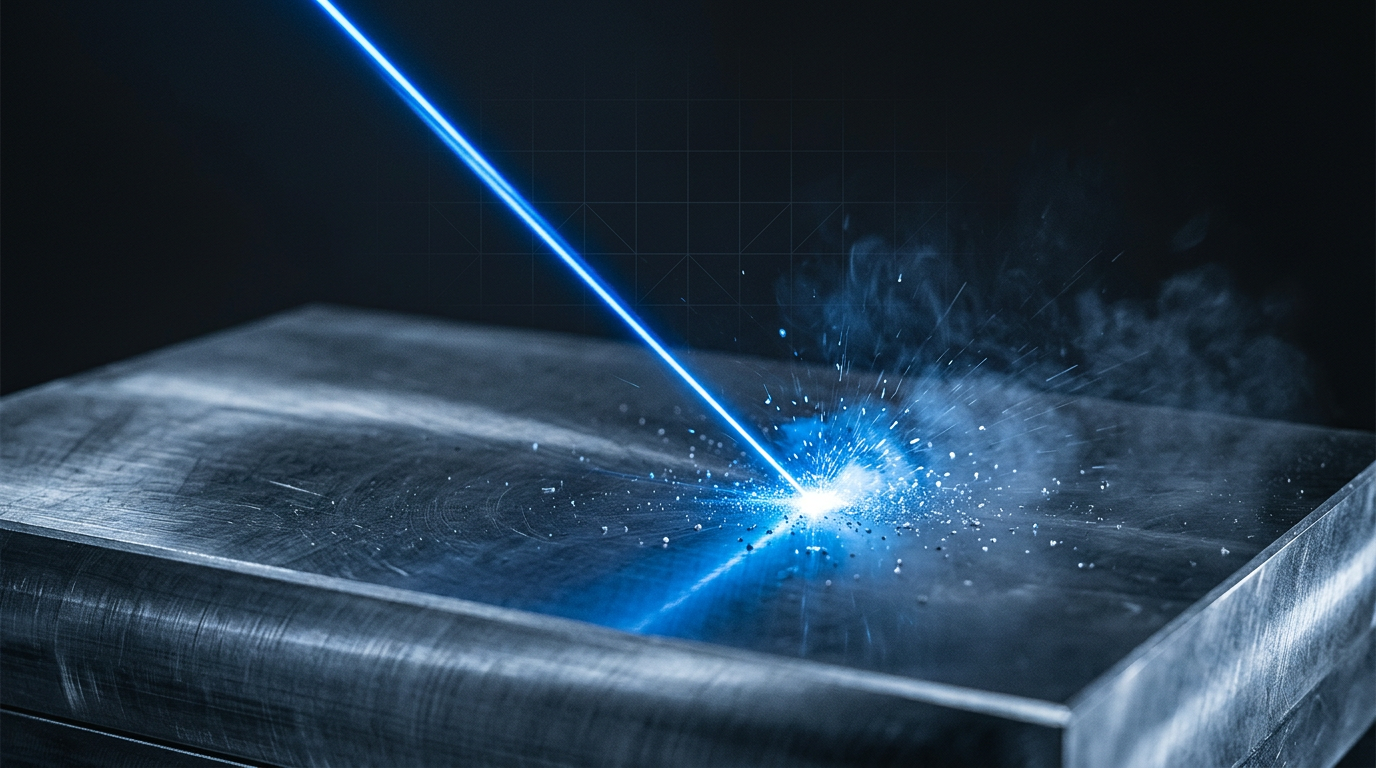
Every method covered so far removes oxidation by introducing something to the surface — acid, abrasive media, electrolytic current. Laser ablation works the other way: a concentrated pulse of light energy causes the oxide layer to vaporise and eject itself, leaving the base metal untouched beneath.
The Mechanism: Selective Vaporisation by Pulsed Light
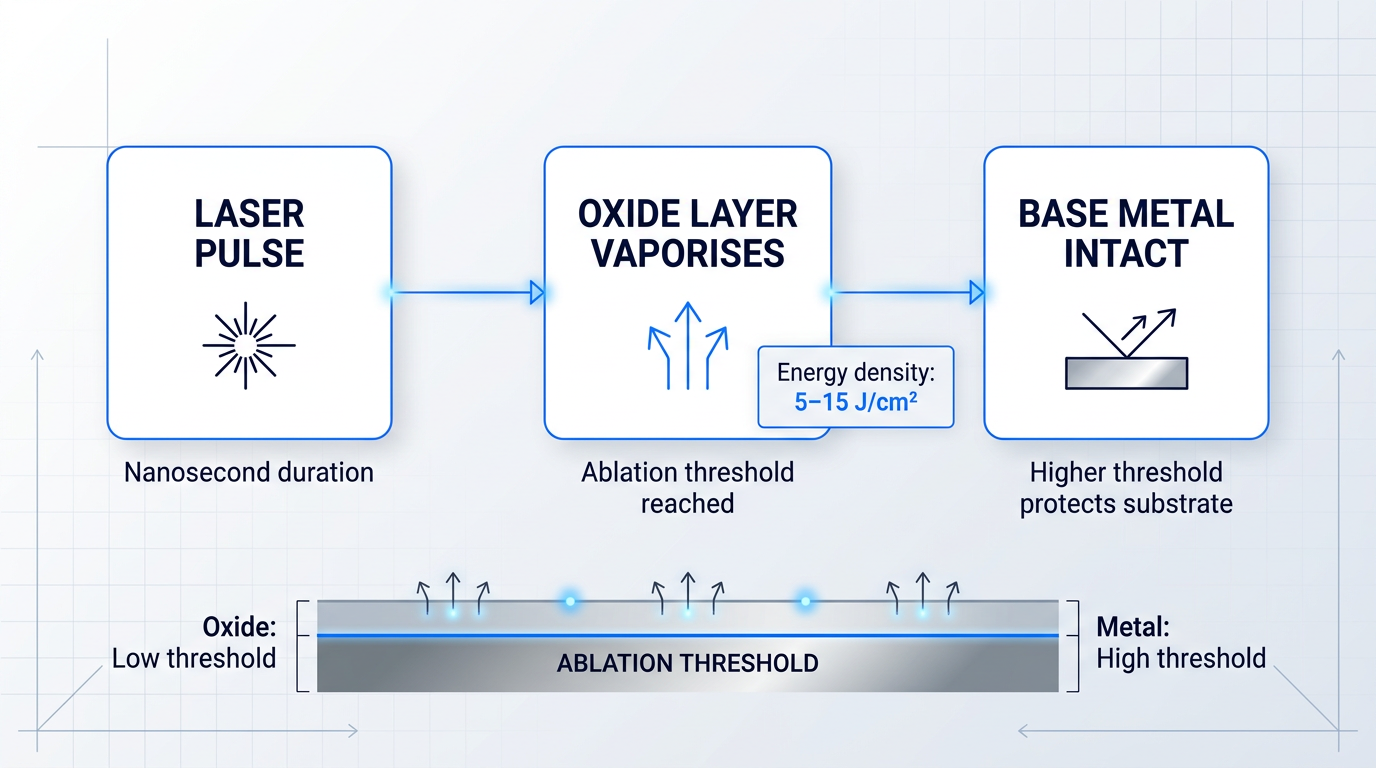
A pulsed fibre laser delivers bursts of concentrated energy to the contaminated surface in extremely short durations — typically in the nanosecond range.
The oxide layer absorbs this energy and undergoes rapid localised heating, reaching temperatures sufficient for vaporisation and thermal ejection — a process confirmed across multiple peer-reviewed studies as the primary mechanism for oxide removal in nanosecond-pulse laser cleaning.
The base metal beneath is not passively protected by proximity — it is protected by physics: the oxide and the base metal have different ablation thresholds, the minimum energy density required to remove material from a given surface.
As Laser Focus World notes, for efficient laser cleaning the ablation threshold of the substrate must be consistently higher than that of the contaminant — and for common metals like steel and aluminium, the rust and oxide threshold is substantially lower, creating a wide operating margin that makes selective removal reliable in practice.
The practical consequence is that the beam effectively stops at the substrate: once the oxide is gone, the metal surface reflects rather than absorbs the incident energy, and removal ceases naturally.
Power Tunability: One System, Any Contamination Level
Because the ablation threshold varies between contaminant types and metal substrates, the ability to tune laser output is not a convenience feature — it is what makes a single system genuinely adaptable across jobs.
Industrial fibre laser cleaners operate with fully adjustable power output, typically from zero to maximum, allowing the operator to dial in the energy density appropriate for the specific contaminant and substrate in front of them — light surface tarnish on copper requires a very different setting to heavy mill scale on structural steel.
Pulse duration, repetition rate, and scan speed can all be varied alongside power, giving the operator fine control over heat accumulation and removal depth — the parameters that determine whether the process cleans selectively or risks affecting the substrate.
No Chemicals, No Consumables, No Waste Streams
Laser cleaning uses laser light alone — there are no chemicals, no abrasive media, and no water circuit required in air-cooled systems.
The only output from the process is the small quantity of vaporised contaminant, which must be captured by a fume extraction system and not allowed to disperse into the working environment.
For professional and industrial users familiar with the overhead of managing chemical waste under RCRA classifications or disposing of spent abrasive media after blasting operations, this is a substantive operational change — not merely a convenience.
- Chemical disposal eliminated: No acid baths, chelating agents, or solvent-based removers means no hazardous waste classification, storage, or licensed disposal obligations.
- Abrasive media waste removed: No spent grit, shot, or blasting media to collect, contain, and dispose of after each job.
- No coolant circuit required: Air-cooled systems need no water supply, chiller unit, or coolant waste stream — reducing infrastructure and site preparation.
- Fume extraction required: Vaporised contaminants must be captured at source. Appropriate extraction with filtration is a non-negotiable operational requirement.
The compliance profile of laser cleaning is substantially lower than chemical or abrasive methods as a result: no Cr(VI) exposure from blasting painted surfaces, no respirable crystalline silica from abrasive media, and no hazardous chemical waste requiring RCRA D002 classification.
Laser Safety: Class IV Classification and the NHZ
Industrial laser cleaners operate as Class IV lasers — the highest hazard classification under both OSHA and ANSI Z136.1 frameworks, defined by continuous-wave output exceeding 500 mW.
At Class IV, the beam is hazardous to eyes and skin under any viewing condition — direct, reflected, or diffusely scattered — and presents a potential fire hazard.
The OSHA enforcement framework requires that a Nominal Hazard Zone (NHZ) be calculated for any Class IV installation: the NHZ defines the space within which radiation levels exceed the Maximum Permissible Exposure, determined by the laser's power output, beam diameter, divergence, wavelength, pulse repetition frequency, and maximum anticipated exposure duration.
OSHA's Class IV controls go further than signage and eyewear: the controlled area must encompass the full NHZ, entry by non-involved personnel requires approval, all windows and doorways must be covered or restricted, and entryway controls including a non-lockable panic disconnect must be in place.
In practice, this has meant that conventional laser cleaning requires the work area to be sealed off and cleared of anyone not directly involved before the laser can operate — a significant setup overhead that has historically limited laser cleaning adoption in open workshops, mixed-use facilities, and public-facing or heritage settings.
The ELASER-RHZ: Collapsing the Hazard Zone
That setup overhead — the requirement to evacuate and seal the area — has been the single biggest practical barrier to laser cleaning in many professional environments.
Woodrow Scientific Limited (WSL), the only UK-based laser cleaning manufacturer, holds a patent on technology that addresses this directly: the ELASER-RHZ variant collapses the laser hazard zone to a fraction of conventional size, confining it to a small area immediately around the work.
No other laser cleaner in the world offers this capability — it is a world-first, and it means the ELASER-RHZ can operate in open workshops, mixed-use facilities, and publicly accessible settings without sealing off the area or evacuating the space.
WSL's patented reduced hazard zone technology is the only solution of its kind in the world. By collapsing the NHZ to a fraction of conventional size, it removes the area-evacuation requirement that has historically made laser cleaning impractical in open workshops, mixed-use facilities, and public-facing settings — unlocking applications that were simply off the table with conventional systems.
WSL designs, builds, services, and improves its machines entirely in-house — it is not a reseller or importer rebadging third-party equipment.
This distinction matters in a market where many suppliers presenting themselves as manufacturers are in fact resellers: in-house manufacture means faster spares, genuine engineering support, and the ability to improve the product — advantages that are difficult to replicate through a reseller relationship.
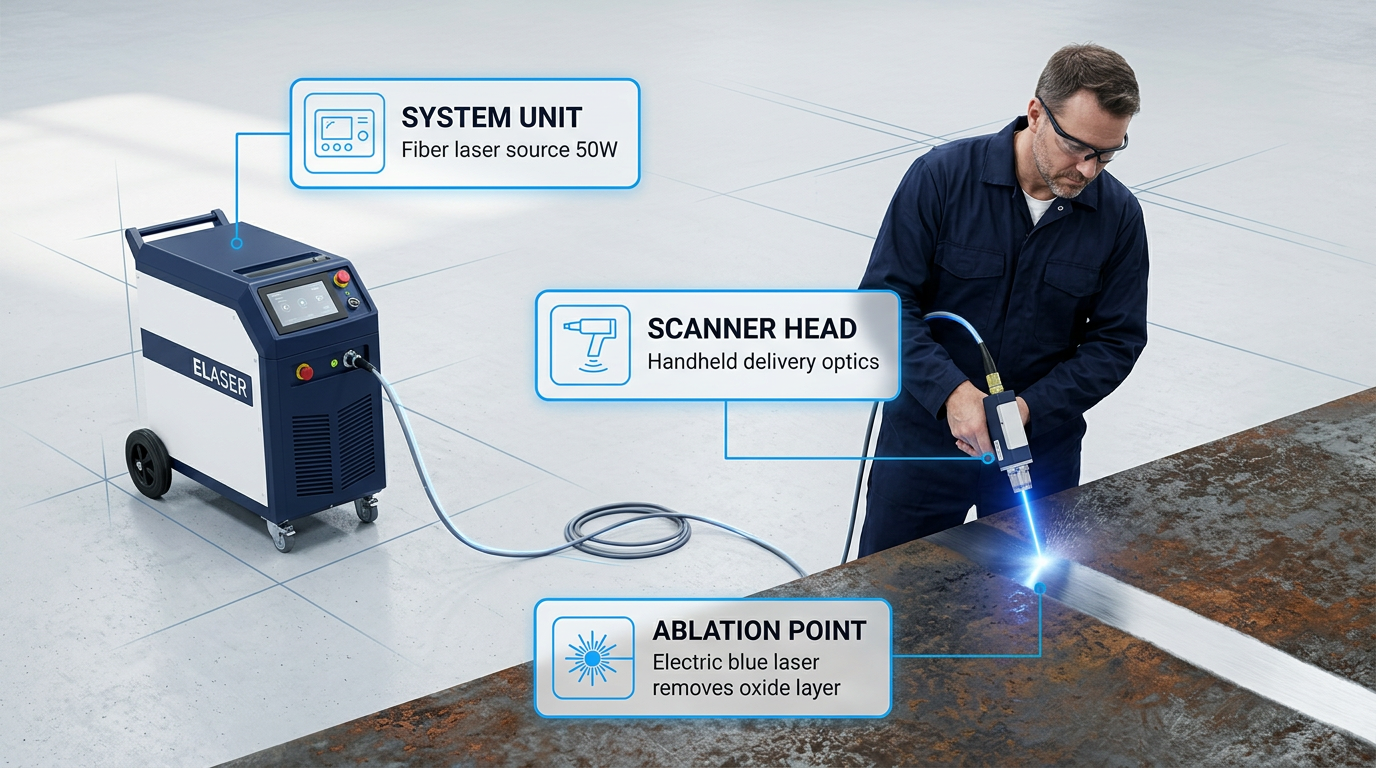
The ELASER itself is a portable fibre laser cleaning system: air-cooled, consumable-free, power-tunable from 0–100% up to 300 W, with a handheld scanner under 3 kg and a delivery cable reaching up to 50 m from the wheeled system unit.
It is CE and UKCA certified, designed for single-operator use, and made in Britain — with full operator training available from WSL as part of the complete package.
Where Laser Ablation Earns Its Place
Laser ablation is the right tool when surface preservation is non-negotiable, when chemical-free operation is required, or when the compliance overhead of abrasive and chemical methods is a genuine operational constraint.
The method scales from light tarnish through to heavy rust and thick coatings, across steel, carbon steel, aluminium alloys, cast iron, copper, brass, titanium, and galvanised metal — the ablation threshold selectivity that protects the substrate works across different metal types, making substrate breadth a practical advantage rather than a theoretical one.
Established application areas include automotive pre-weld preparation, aerospace surface prep and component cleaning, industrial maintenance on plant and infrastructure, heritage and monument restoration, and any setting where cleaning in a live or public-facing environment would otherwise be impossible.
When evaluating cost, the relevant metric is total cost of ownership: zero consumables, minimal substrate damage reducing rework, and no media or chemical waste disposal costs change the economics compared to a simple upfront price comparison against traditional methods.
With all four method categories now covered, the next section puts them side by side — comparing chemical, abrasive, electrochemical, and laser ablation across substrate loss, health and safety overhead, environmental compliance, speed, cost structure, and application fit.
See Laser Cleaning in Action
Woodrow Scientific's laser cleaning machines bring ablation-based oxidation removal to industrial and precision applications. Explore the ELASER range to see specifications and capabilities.
Comparing Oxidation Removal Methods: Trade-Offs Explained
Each of the four method categories covered in this guide can remove oxidation effectively — the differences lie in what else they do to the surface, the operator, the environment, and the budget.
The six criteria below were chosen because they represent the full operational cost of a cleaning decision, not just the purchase price of a product: surface risk, health and safety overhead, environmental compliance burden, speed and scalability, cost structure, and application fit.
Most guides evaluate oxidation removal methods on the first two or three of those axes only — the compliance and health overhead columns are where the honest picture diverges most sharply from the simplified one.
| Criterion | Chemical Removers | Mechanical / Abrasive | Electrochemical | Laser Ablation |
|---|---|---|---|---|
| Surface Risk & Substrate Loss | Base metal attack if concentration or contact time is misjudged; aluminium and galvanised surfaces are particularly vulnerable to strong acids. | Physically removes base material alongside oxide; aggressive blasting causes pitting and dimensional tolerance issues on thin sheet or precision parts. | Minimal base metal loss under normal operation; hydrogen embrittlement is a genuine risk for high-strength or hardened steels. | Ablation threshold selectivity stops the beam at the substrate; lowest substrate loss of any powered method in this comparison. |
| Health & Safety Overhead | PPE required for acid and solvent handling; VOC exposure from solvent-based products; skin and eye hazard classifications for many formulations. | Per OSHA guidance, respirable crystalline silica (RCS) dust carries silicosis and lung disease risk; engineering controls, appropriate respirators, and potential medical surveillance required. | Low airborne hazard; hydrogen gas generation requires adequate ventilation; electrolyte handling requires standard chemical precautions. | Fume extraction required; eliminates dust and chemical exposure entirely; reduced hazard zone technology removes the need for full area evacuation. |
| Environmental Compliance Burden | Under RCRA, spent acid solutions meeting the corrosivity characteristic require licensed hazardous waste disposal; neutralisation generates additional waste streams. | Contaminated spent media and dust require managed disposal; waste from chromium-containing coatings requires special handling. | Spent electrolyte may require neutralisation before disposal; lower burden than acid methods, but not zero. | Produces only small quantities of captured fume; no chemical waste streams, no spent media, no hazardous liquid waste — substantially lowest compliance burden. |
| Speed & Scalability | Batch immersion scales well for steel; pre-treatment (degreasing) and post-treatment (neutralisation, rinsing, priming) steps add significant time and labour. | Fastest method for large surface areas; well-suited to structural steel and high-throughput descaling; speed advantage on bulk work is genuine and significant. | Slow and labour-intensive; suited to individual parts or small batches; not viable for production volumes. | Speed depends on power level and oxidation severity; high-power and robotic configurations scale to production volumes with consistent part-to-part results. |
| Cost Structure | Low upfront cost; ongoing costs accumulate via consumables, licensed waste disposal, compliance management, PPE, and rework from surface damage. | Low upfront cost; ongoing costs include abrasive media, waste disposal, PPE, and potential rework from substrate damage on sensitive parts. | Very low consumable cost; labour intensity limits cost advantage to small-batch contexts where throughput is not a priority. | Higher upfront capital cost; near-zero consumable cost, lower compliance overhead, and less rework make total cost of ownership the relevant metric for frequent use. |
| Application Fit | Accessible surfaces with moderate oxidation; batch immersion for steel where compliance overhead is manageable and post-treatment steps can be accommodated. | Heavy or widespread oxidation on robust steel; applications requiring surface profile for coating adhesion (SSPC/NACE cleanliness grades); large structural work. | Delicate, complex, or high-value parts; conservation and restoration; situations where surface preservation is paramount and throughput is not a constraint. | Precision parts, varied metal types (steel, aluminium, cast iron, copper, brass, titanium, galvanised); production environments; in-situ cleaning with portable systems. |
Side-by-side comparison of four oxidation removal method categories across six operational criteria, enabling readers to evaluate trade-offs on equal terms.
The table makes several patterns visible that are easy to miss when methods are evaluated in isolation: the two methods with the lowest upfront cost — chemical and abrasive — carry the highest ongoing compliance and health overhead, and those costs accumulate in ways that rarely appear in product descriptions.
Abrasive blasting holds a genuine speed advantage for large steel surfaces that no other method matches at equivalent scale — that strength is real and should not be discounted when throughput on bulk structural work is the primary driver.
Electrochemical methods occupy a clearly defined niche: minimal substrate loss, no abrasion, and a compliance burden lower than acid or abrasive methods — but the throughput ceiling makes them unsuitable outside small-batch or conservation contexts.
The laser ablation row shows the clearest compliance and substrate-risk profile of the four, but the cost structure requires honest framing: the capital cost is higher than traditional methods, and the speed advantage over blasting on large open surfaces is not categorical — it depends on power level and configuration.
The health and safety overhead and environmental compliance columns deserve particular attention for anyone making a selection on cost grounds: per OSHA guidance, abrasive blasting with silica-containing media creates serious respiratory hazard obligations, while under RCRA, spent acid solutions meeting the corrosivity characteristic require licensed hazardous waste disposal — both represent real regulatory commitments, not theoretical risks.
For a one-off clean, the compliance overhead of chemical or abrasive methods may be a manageable fixed cost. For recurring production use, that overhead multiplies with every cycle — disposal runs, PPE replacement, compliance audits — while laser ablation's compliance burden stays essentially flat. The total cost of ownership gap between methods is not visible at the point of purchase; it only becomes apparent over time.
Selecting the right oxidation remover for metal is only part of the equation — once the oxide is removed, the surface is chemically active and vulnerable, and what happens in the hours and days after cleaning determines whether the problem simply recurs.
Preventing Oxidation from Recurring After Removal
A cleaned surface that re-oxidises within weeks is not a success story — it is evidence that the job was only half done. Professionals treat protection as part of the scope: removal clears the problem, but the protection strategy determines whether it stays cleared.
Before any coating or treatment can perform, the surface must be clean, dry, and appropriately profiled — which means the quality of the removal process directly sets the ceiling for how well any subsequent protection will hold.
Protective Coatings: The Primary Defence
Paints, primers, and sealants work by creating a physical and dielectric barrier that denies the surface contact with the oxygen, moisture, and electrolytes that drive oxidation. A primer is not optional in corrosion-prone environments: it provides adhesion to the substrate, inhibits corrosion chemically, and in the case of zinc-rich primers, delivers active cathodic protection even after the topcoat is scratched.
- Zinc-epoxy-urethane system: For high-humidity, saltwater, or chemical exposure. Zinc-rich primer provides cathodic protection; epoxy midcoat adds chemical resistance; urethane topcoat resists UV and abrasion.
- Epoxy system: For moderate corrosion risk. Strong adhesion and chemical resistance make epoxy primers and topcoats a reliable choice for industrial and infrastructure applications.
- Water-based acrylic: For controlled interior environments with low corrosion risk. Lower durability than epoxy, but suitable where conditions are stable and coating process emissions matter.
- Powder coating: A VOC-free alternative with good durability. Applied electrostatically and cured under heat — no solvent emissions, suitable where coating process compliance is a priority.
Matching the coating system to the operating environment is the critical decision: a zinc-epoxy-urethane system is over-engineering for a dry indoor component, while a single-coat acrylic will fail rapidly in a marine or chemical setting. Abrasive blasting creates the surface profile that maximises mechanical adhesion for high-build coating systems.
Galvanisation and Cathodic Protection
Zinc's protective power rests on its role as a sacrificial anode: because zinc is electrochemically more reactive than iron or steel, it corrodes preferentially, shielding the substrate even where the coating is physically damaged. As zinc oxidises, it forms a stable zinc carbonate patina that adheres tightly and self-limits further corrosion — a fundamentally different behaviour from iron rust, which is non-protective and continues to flake and undercut.
Hot-dip galvanising — immersing fabricated steel in molten zinc — is the standard long-service protection method for structural steel and outdoor components where regular recoating is impractical. For structures where galvanising is not feasible, cathodic protection provides an electrochemical alternative: the sacrificial anode method connects the substrate to a block of zinc, magnesium, or aluminium that corrodes in its place, while impressed current cathodic protection (ICCP) applies an external DC current to counteract the corrosion reaction, used at scale for pipelines, marine vessels, and underground infrastructure.
Parts cleaned and then stored or transported before final coating are highly vulnerable during that window. VCI (volatile corrosion inhibitor) packaging deposits a protective molecular layer on the metal surface through vapour-phase action — no contact required, and easily removed before final processing. It is one of the most practical and underused tools in multi-stage manufacturing and transit workflows.
Environmental Controls and Temporary Protection
Controlling the environment denies oxidation the conditions it needs to initiate. Desiccants in sealed packaging and climate-controlled storage keep humidity below the threshold at which corrosion becomes self-sustaining — particularly important for machined parts awaiting assembly. Avoiding dissimilar metal contact eliminates galvanic corrosion risk: when two metals with differing electrochemical potentials share an electrolyte, the less noble metal corrodes rapidly, and the fix is often a design or storage decision rather than a chemical one.
For parts in transit or multi-stage workflows, temporary corrosion inhibitor coatings — oil-based and phosphate-based films applied to clean surfaces — provide short-to-medium term protection that is easily stripped before final processing. VCI packaging takes this further: volatile corrosion inhibitor molecules vapour-phase onto the metal surface and form a protective molecular layer without direct contact, making it ideal for complex geometries and machined components. Wax and barrier films offer a simpler physical barrier for less demanding storage scenarios.
Maintenance and Inspection
Protection is not a one-time act. Regular inspection schedules catch early-stage oxidation before it penetrates or spreads, and prompt repair of coating damage — scratches, chips, and mechanical wear — closes the window before the exposed substrate has time to react. Periodic cleaning to remove salt, dirt, and surface contaminants prevents localised corrosion that can initiate under or through an otherwise intact coating.
The protection strategy and the removal method are not independent choices: the right removal method leaves the surface in the condition that best supports the protection approach that follows, and that connection is worth weighing before the first tool is picked up — which is exactly the territory the next section maps out.
Choosing the Right Oxidation Removal Method
Understanding the methods is one thing — knowing which one fits your situation is another. The four method categories covered in this guide each have genuine strengths, but those strengths only translate into good outcomes when the method is matched to the right application.
Method selection is not a single decision but a sequence of filters, each narrowing the field. Work through metal type, then oxidation severity, then part geometry, then volume, then operating environment — and by the end of that sequence, the viable options for your situation will be clear.
Metal Type: The First Filter
Metal type is the most important filter because it can eliminate entire method categories before any other variable is considered.
Strong mineral acid chemical methods are well-suited to steel but can attack aluminium, copper alloys, and galvanised metal — the zinc coating on galvanised steel is particularly vulnerable and will be stripped by acid contact.
Abrasive blasting suits robust steel structures but is too aggressive for thin sheet metal, soft metals, and any part with tight dimensional tolerances.
Laser ablation and electrochemical methods are the most substrate-agnostic options — both work across a wide range of metals with minimal risk to the base material when properly applied.
The practical rule: verify compatibility with the specific metal before committing to a method — what works cleanly on one substrate can cause irreversible damage on another.
Oxidation Severity: The Second Filter
Once metal type has narrowed the field, oxidation severity differentiates further between the methods that remain.
Light surface oxidation — tarnish, early rust, surface patina — is accessible to most methods: hand tools, light chemical treatment, low-power laser, or electrolytic.
Heavy rust, thick mill scale, or deep corrosion on steel typically requires more aggressive intervention: pickling, abrasive blasting, or higher-power laser cleaning.
Electrochemical methods are effective for moderate rust but throughput is low — they are slow for heavy scale or large surface areas, and that constraint matters at scale.
The same metal can present very different oxidation profiles depending on its exposure history, so the method should be matched to what is actually present — not to a generic assumption about the metal type.
Part Geometry and Access
Part geometry is a practical constraint that often eliminates otherwise viable methods — a theoretically suitable approach is useless if it cannot physically reach the oxidation.
Flat, open, accessible surfaces suit abrasive blasting and roller or spray chemical application, both of which require line-of-sight and open access to work effectively.
Complex 3D geometry, internal cavities, and recessed areas favour chemical immersion (where metal compatibility allows), electrochemical methods — where the electrolyte reaches everywhere the workpiece is submerged — or laser cleaning with a flexible delivery cable directed into awkward angles.
In-situ cleaning on large fixed structures such as bridges or structural steelwork favours portable methods: abrasive blasting rigs or portable laser systems with long cable reach.
Volume and Throughput
The scale of work is a major differentiator, because the overhead of setting up a blast cabinet or pickling tank is only justified when it is amortised across enough parts.
One-off or low-volume restoration work — a single antique, a small batch of components — suits hand tools, electrolytic cleaning, or portable chemical or laser methods.
Batch production favours pickling tanks, blast cabinets, or automated laser cleaning systems, where setup cost is spread across many parts.
For high-volume repetitive production cleaning — where every part must meet the same standard, cycle after cycle — automated laser cleaning delivers a consistency that manual methods cannot replicate. Woodrow Scientific's AutoLASE is a practical example of what this looks like: load the part, and the machine-vision system scans it, builds a 3D map, and generates the clean automatically, with no manual programming or path-setting required.
Operating Environment and Compliance
The environment in which cleaning will happen shapes what is practically deployable — and this filter is often underweighted until it creates a problem.
Open, shared, or public-facing environments create real barriers for methods that generate dust: abrasive blasting requires containment and exclusion zones that are impractical in many settings.
Chemical methods in confined spaces require adequate ventilation — VOC exposure and acid vapour are genuine constraints in enclosed workshops, not minor inconveniences.
Conventional Class IV laser systems require the work area to be sealed off before operation, which makes them difficult to deploy in open or mixed-use facilities.
The ELASER-RHZ's patented reduced hazard zone technology collapses the laser hazard zone, enabling cleaning in open workshops, mixed-use facilities, and public-facing settings without shutting down the surrounding area — a genuine practical differentiator for anyone working outside a dedicated laser enclosure.
With all five filters applied, most situations will have one or two clearly viable methods — and the summary below maps the most common scenarios to the approach most likely to serve them.
- Heavy oxidation, robust steel: Where surface profile for coating adhesion also matters, abrasive blasting is the natural fit — it removes scale and creates the anchor profile simultaneously.
- Delicate, complex, or high-value parts: Where surface preservation is paramount, laser ablation or electrochemical cleaning minimise substrate risk across a wide range of metals and geometries.
- Accessible surfaces, moderate oxidation: Where compliance overhead is manageable and metal compatibility is confirmed, chemical methods offer a practical, cost-effective solution for open surfaces.
- Production volumes, repeatability required: Where every part must meet the same standard and compliance burden must stay low, laser cleaning — portable or automated — is the strongest fit.
- Open or public-facing environments: Where area evacuation or dust containment is not feasible, laser cleaning with reduced hazard zone technology removes the primary deployment barrier.
These mappings are a starting point, not a rigid prescription — real applications often sit across more than one filter category, and the right choice may require weighing two or three criteria at once.
Every method category leads on at least one filter axis. The question is never which method is best overall — it is which method best fits the specific combination of metal, severity, geometry, volume, and environment in front of you.
With the decision framework in hand, the final step is putting it into practice — the conclusion brings together the guide's central message and points toward the right next steps for your situation.
Ready to Put the Right Method to Work?
If laser cleaning fits your application, Woodrow Scientific's machines are built for precision industrial use. Explore the ELASER range, or book a call to discuss your specific situation with an expert.
Conclusion
Oxidation Removal: The Method That Fits Your Situation
The most important thing this guide can leave you with is not a product recommendation — it's the recognition that total outcome, not upfront cost or familiar habit, is the only honest basis for choosing an oxidation removal method.
Get the fit right and you protect the substrate, satisfy your compliance environment, and avoid the hidden costs that make the cheap option expensive over time.
If laser cleaning is where your thinking has landed and you're working at an industrial or professional scale, Woodrow Scientific can help you assess whether a portable or automated system suits your application.
Frequently Asked Questions About Oxidation Removal for Metal
Direct answers to the questions most readers still have after working through the methods and trade-offs above.
Laser ablation is effective across a wide range of metals. The method works by ablation-threshold selectivity — pulsed laser energy causes the oxide layer to vaporise and eject while the base material beneath absorbs far less energy and stays intact. This mechanism functions across different substrate types, not just steel. Metals that can be cleaned include steel, aluminium alloys, cast iron, copper, brass, titanium, and galvanised metal. The one practical condition is that power settings must be tuned to the specific metal and oxidation type. Industrial systems with fully variable power output (0–100%) make this straightforward — it is standard operator practice, not a meaningful limitation. The result is precise, chemical-free oxidation removal with minimal substrate loss, regardless of which of those metals is being treated.
The primary hazard is respirable crystalline silica (RCS) dust generated when silica-containing abrasives break down during blasting. Particles fine enough to reach deep lung tissue cause silicosis — an incurable, progressive lung disease — as well as lung cancer and COPD. These are serious, long-latency conditions that OSHA identifies as significant occupational risks wherever silica exposure is ongoing. Secondary hazards arise depending on what is being blasted. Removing coatings from chromium-containing alloys or stainless steel can release hexavalent chromium (Cr(VI)), a known carcinogen. Stripping old lead-based paint introduces lead exposure risk. Required controls include substituting silica-free abrasive media, enclosing the work area with exhaust ventilation, using wet blasting methods to suppress airborne dust, and fitting operators with NIOSH-certified Type CE abrasive blasting respirators. Both OSHA (in the US) and COSHH regulations (in the UK) place legal duties on employers where silica exposure is a routine feature of the work, and ongoing exposure situations may require medical surveillance programmes. Employers should consult the relevant regulatory guidance directly for applicable exposure limits and compliance requirements.
The right approach depends on the metal type, how severe the oxidation is, and the operating context. There is no single universal method — each of the four main categories has a different fit. Chemical removers (acids and chelating agents) work well on accessible surfaces with moderate oxidation. They are effective on steel but require careful selection for aluminium and copper alloys, where aggressive mineral acids can attack the base metal. Abrasive and mechanical methods (wire brushing, sanding, abrasive blasting) suit heavy rust on robust steel and cover large areas quickly, but generate dust, carry health risks, and can damage softer or thinner metals. Electrochemical (electrolytic) cleaning is the right choice for delicate, complex, or high-value parts where preserving surface integrity is the priority — though throughput is low. Laser ablation suits precision or production applications: it is chemical-free, causes minimal substrate loss, and works across a wide range of metals. Matching the method to the metal and the scale of the job is the starting point for any effective oxidation removal decision.
Acids dissolve metal oxides by reacting chemically with them. The oxide layer is converted into soluble salts that can be rinsed away, leaving the base metal exposed — a process known as pickling in industrial settings. Mineral acids (hydrochloric, sulphuric, phosphoric) are effective on steel. Phosphoric acid is notably less aggressive than the others: rather than simply dissolving iron oxide, it converts it to iron phosphate, which provides a degree of mild residual protection on the treated surface. Organic acids (citric, oxalic, acetic) handle lighter oxidation and are better suited to material-sensitive applications. They are safer choices for aluminium and copper alloys than mineral acids, which can attack the base metal itself if concentration or contact time is not carefully controlled. A third mechanism is chelation: agents such as EDTA sequester iron ions rather than dissolving them aggressively, making them effective for delicate or geometrically complex parts. Metal compatibility is the critical variable — the right acid type and concentration must be matched to the substrate, not just the oxide.
There is no single best oxidation remover for metal. The most effective choice depends on the metal type, the depth and character of the oxidation, the part's geometry, and any environmental or compliance requirements that apply to the work. A method that performs well on heavy rust on structural steel may damage an aluminium component. What is practical in a controlled industrial environment may be unsafe or non-compliant on an open site. As a general guide: strong acid pickling or abrasive blasting suits heavy rust on steel where surface finish is secondary; laser ablation or electrochemical cleaning is the better fit for precision, delicate, or high-value parts where surface integrity matters; mild organic acids or mechanical polishing handles light surface tarnish on most metals. The honest answer is that the decision framework — metal type, oxidation severity, geometry, compliance context — is more useful than any single product recommendation.
WD-40 is a water-displacing lubricant and light surface treatment, not a dedicated oxidation remover. It can help with very superficial surface discolouration or the earliest-stage tarnish on aluminium, but it is not formulated to penetrate or break down the established aluminium oxide layer that forms on oxidised surfaces. For anything beyond light surface haze, WD-40 will not deliver meaningful results. For genuine oxidation removal from aluminium, a compatible weak acid cleaner — citric acid or sulphamic acid are commonly used — is the appropriate chemical route. Alternatively, a mechanical approach using a fine abrasive or a wire brush rated for aluminium (to avoid cross-contamination from steel bristles) will remove surface oxide physically. Stronger mineral acids such as hydrochloric or sulphuric should not be used on aluminium — they will attack the base metal, not just the oxide layer. WD-40 is an excellent product for its intended purposes; rust and oxide removal on aluminium simply is not among them.