

Introduction
If you're comparing optical amplifier manufacturers, you already know the basics — this list isn't here to explain what an EDFA does.
The harder problem is that the supplier landscape is genuinely fragmented: a buyer specifying amplifiers for telecom backbone infrastructure has almost nothing in common with one sourcing for a sensing system or lab instrument.
That's why this list spans all three major types — EDFA, SOA, and Raman — rather than defaulting to whichever is most common.
Each entry is assessed against the same axes: amplifier types offered, noise figure and output power performance, customisation depth, target applications, and OEM options.
Raw gain figures are the easiest number to overstate; usable saturated output power and noise figure tell you far more.
TL;DR
No single manufacturer suits every buyer. The right choice depends on amplifier type, application domain, and whether you need a catalogue product or engineered customisation. Brand recognition is a poor proxy for fit — noise figure, output power, and customisation depth are what actually determine whether a supplier belongs on your shortlist.
This article covers:

Profiles of five verified manufacturers
EDFA, SOA, and Raman coverage
Key evaluation axes per supplier
OEM and customisation options
Application-to-supplier guidance
How to Evaluate Optical Amplifier Suppliers
Optical amplifier suppliers can look deceptively similar on a datasheet — comparable gain figures, overlapping wavelength ranges, similar form factors. The differences that actually determine whether a supplier is right for your application live beneath those headline numbers, in engineering depth, manufacturing control, and support capability.
The seven axes below are the procurement criteria applied consistently across every manufacturer profile on this page. They are ordered to reflect how a technically informed buyer should work through the shortlisting process — starting with application fit and moving toward integration and support.
- Amplifier type coverage: Whether a supplier spans EDFA, SOA, and Raman or specialises in one type is a first-pass filter. Application fit depends on it before any performance spec matters.
- Noise figure performance: Ask for NF curves across the operating wavelength range, not headline gain. This is the metric that most directly predicts real system performance.
- Saturated output power: The figure that governs system reach and link budget in real deployments — distinct from small-signal gain, which is easier to quote and frequently leads marketing materials.
- Customisation depth: Can the supplier design to your specification, or only select from a catalogue? Non-standard wavelengths and unusual gain profiles require genuine engineering capability.
- Vertical integration: Suppliers controlling pump laser sourcing, doped fibre production, and final test tend to deliver more consistent performance and better customisation latitude.
- Application engineering support: A supplier who can help integrate the amplifier into your system architecture is a qualitatively different proposition from one who ships a module and closes the ticket.
- OEM and integration options: Module-level supply, white-label, and MSA-format packaging are hard filters for system integrators — less relevant for turnkey deployments, but non-negotiable when they apply.
Of these axes, noise figure deserves the most scrutiny — and the most scepticism toward how suppliers present it. Gain figures are straightforward to quote and easy to optimise under favourable test conditions; noise figure at low input power is harder to flatter and far more consequential for system performance.
Practical EDFAs achieve a noise figure of 4–6 dB under real operating conditions, with the 3 dB quantum limit as the theoretical floor no amplifier can breach. The gap between a 4 dB and a 6 dB NF may sound modest, but it compounds across cascaded amplifier stages into a meaningful difference in link budget and reach.
Noise figure at low input power is the metric that determines real system performance. Any supplier worth shortlisting should provide NF curves across the full operating wavelength range — not just a single headline figure measured under ideal conditions.
The distinction between small-signal gain and saturated output power is a related trap. Small-signal gain — measured with a weak input and no competing signals — is the figure most commonly cited in marketing materials because it is easy to maximise in test conditions. What actually determines system reach is saturated output power: the usable optical power the amplifier delivers when driven at realistic input levels in a live deployment.
Customisation depth and vertical integration are the axes that most sharply separate serious manufacturers from catalogue resellers. A supplier with in-house control over pump laser sourcing and doped fibre production can modify gain shape, extend wavelength coverage, and hold tighter performance tolerances — capabilities that only become visible when you push beyond standard catalogue configurations.
If your application involves non-standard wavelengths, unusual gain requirements, or tight integration constraints, engage the engineering team directly and early — a catalogue quote will not reveal whether the supplier has the capability to meet your actual specification.
With this framework established, the profiles below evaluate each of the leading optical amplifier manufacturers against these same axes — so you can compare suppliers on the criteria that actually matter for your deployment.
Product 1
Woodrow Scientific Limited (WSL) — Custom EDFA
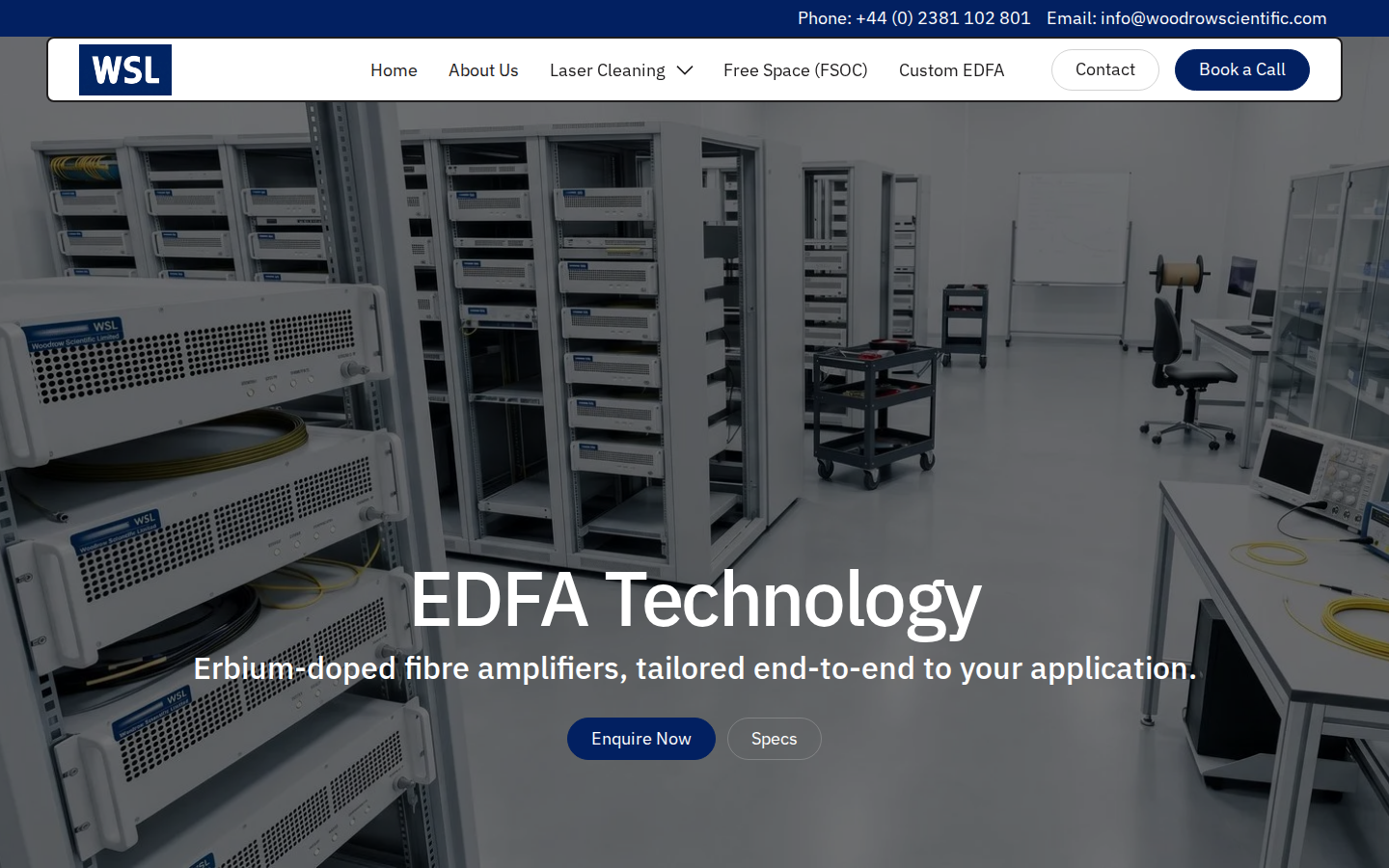
UK EDFA manufacturer building each Custom EDFA to order: C-band, L-band or dual C+L, CW or pulsed, from 5 W to 200 W or more average power, in the buyer's own form factor.
Pros:

Every unit built to the buyer's specification
Average output from 5 W to 200 W+
C, L or dual C+L through one cable
Air-cooled as standard; CE and UKCA certified
Cons:

EDFA only; no SOA or Raman
Quote-only pricing; no catalogue list prices
Woodrow Scientific Limited (WSL) makes one amplifier type, the erbium-doped fibre amplifier, and configures every unit to the project it is for.
That puts it at the narrow end of this page's amplifier-type axis and at the far end of two others: output power and customisation depth.
Amplifier Type, Bands and Output Power
Every build is a MOPA (master oscillator power amplifier) on erbium-doped fibre, covering C-band, L-band or both, with dual C+L output delivered from a single source through one cable.
Average output runs from low-power units of 5 W to 200 W or more, which WSL states is the highest average power commercially available, and pulsed builds reach above 10 mJ pulse energy and above 100 kW peak power.
| Parameter | WSL Custom EDFA |
|---|---|
| Amplifier type | EDFA (erbium-doped fibre), MOPA architecture |
| Operating band | C-band (1530–1565 nm), L-band (1565–1625 nm), or dual C+L from one source |
| Average output power | 5 W to 200 W or more (about 37 dBm to 53 dBm) |
| Pulse energy | Above 10 mJ achievable |
| Peak power | Above 100 kW achievable |
| Pulse regime | CW, short-pulse (e.g. 100–500 ns), or custom |
| Power control | 0–100% of rated output |
| Cooling | Air-cooled as standard; water cooling optional |
| Certification | CE and UKCA |
The Custom EDFA's type, band and power envelope at a glance.
Output power is specified per project, so the figure on a WSL quote is set by the application rather than by a fixed model's rating.
Customisation Depth
Customisation is the core of the offer, not an add-on: the buyer specifies band, output power, pulse regime, pulse energy and peak power, cooling, delivery cable length and termination, the integration envelope, and the control firmware and communication standards.
Named builds such as the EDF-UL-10 for free-space uplink and the EDF100 for short pulses are reference points, not limits; a requirement beyond the published specification, such as a different environment, power level or form factor, is assessed by WSL's engineers with the client.
Target Applications
WSL's published applications are examples rather than a closed list: LiDAR, free-space optical communications, quantum sensing and communications, defence and directed-energy research, remote sensing, distributed acoustic and structural fibre sensing, scientific instrumentation and medical lasers.
The eye-safe 1550 nm wavelength has a higher eye-damage threshold than 1064 nm sources, and reduced-hazard-zone builds are available where the hazard zone is a design constraint.
OEM Options and How to Buy
OEMs can buy the Custom EDFA as the engine of their own laser system, a laser cleaning machine for example, with the form factor, firmware and communication standards built to fit the product.
Air cooling as standard means there is no chiller or coolant loop to design around, and water cooling remains available where a build needs it.
WSL designs, builds, qualifies and supports everything in-house in Southampton, UK, where it was founded in 2012, and its fibre-amplifier expertise is rooted in the city's Optoelectronics Research Centre, the birthplace of the EDFA.
Units ship worldwide direct from WSL with direct engineering support through integration, and pricing is quoted per project.
Noise figure depends on the configuration built, so ask WSL for noise-figure data at your band and expected input power, as this page advises for every supplier.
Product 2
Lumentum
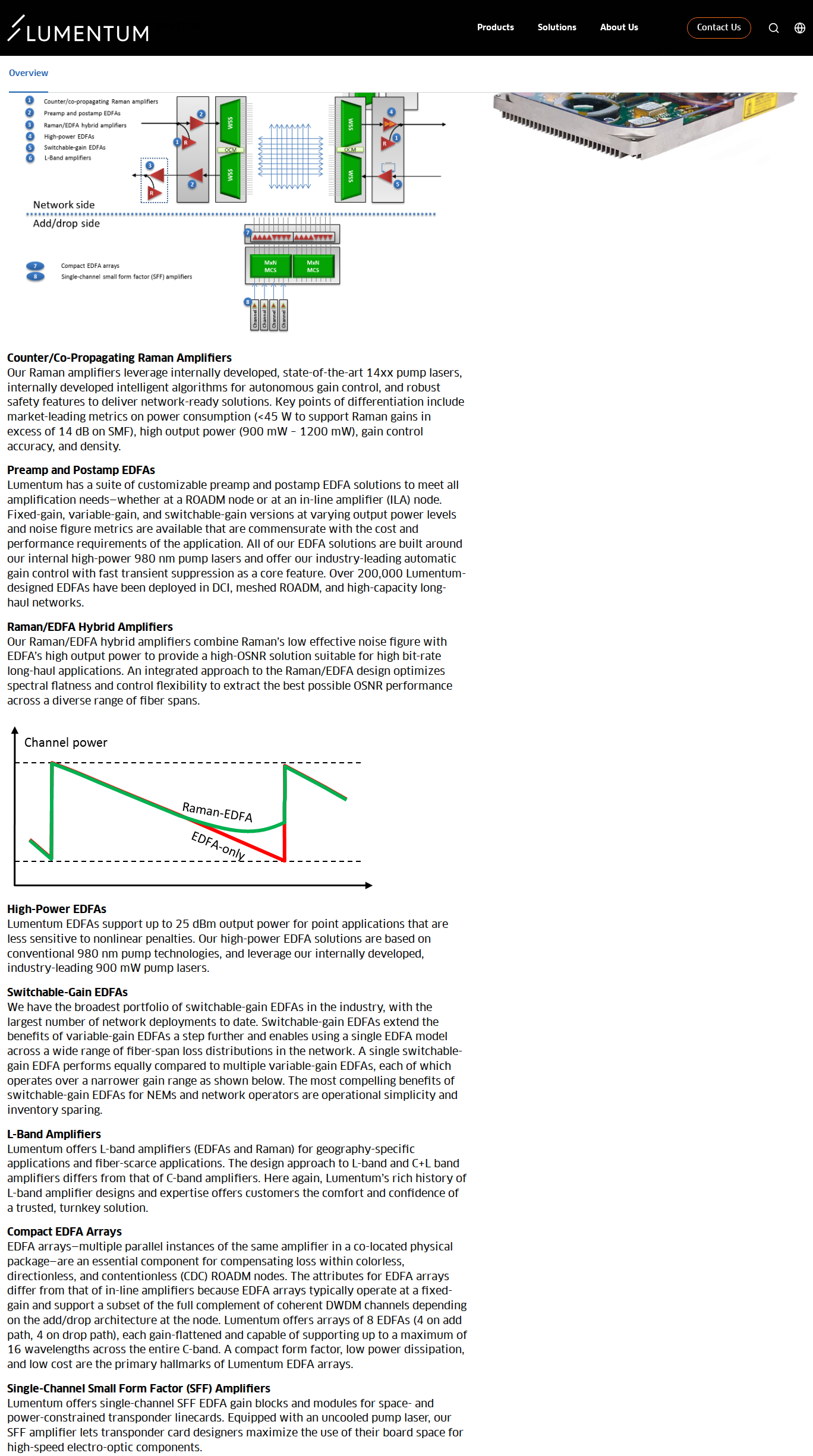
Lumentum supplies one of the widest optical amplifier portfolios in the industry, spanning Raman, EDFA, hybrid, L-band, and switchable-gain architectures for long-haul, DCI, ROADM, and submarine applications. All EDFA solutions are built around internally developed 980 nm pump lasers, giving Lumentum tighter control over performance consistency and component supply than suppliers who source pumps externally.
Pros:
Full Raman, EDFA, and hybrid range
Internally developed 980 nm pump lasers
Broadest switchable-gain EDFA portfolio
AGC with fast transient suppression standard
Cons:
Primarily a NEM component supplier
Turnkey buyers need integrator engagement
Lumentum's amplifier portfolio is among the broadest available from any single optical amplifier manufacturer, covering the full range of gain architectures that long-haul, DCI, and ROADM network designers actually deploy.
- Counter- and co-propagating Raman amplifiers: Internally developed 14xx pump lasers with autonomous gain control; power consumption under 45 W for gains exceeding 14 dB on SMF; output power 900–1200 mW.
- Preamp and postamp EDFAs: Fixed-gain, variable-gain, and switchable-gain variants for ROADM and ILA nodes, built around Lumentum's internally developed 980 nm pump lasers.
- Raman/EDFA hybrid amplifiers: Combines Raman's low effective noise figure with EDFA high output power for high-OSNR performance on long-haul, high-bit-rate links.
- High-power EDFAs: Up to 25 dBm output power for point applications, leveraging Lumentum's internally developed 900 mW pump lasers.
- L-band amplifiers: EDFAs and Raman variants for geography-specific and fibre-scarce applications requiring C+L band capacity.
- Compact EDFA arrays: Arrays of 8 EDFAs for CDC ROADM nodes, gain-flattened and supporting up to 16 wavelengths across the full C-band in a compact, low-power package.
- Single-channel SFF amplifiers: Uncooled-pump EDFA gain blocks for space- and power-constrained transponder linecards.
That breadth matters for buyers who need a single qualified supplier across multiple network segments rather than managing separate vendor relationships for each amplifier type.
Vertical Integration: Internally Developed Pump Lasers
All Lumentum EDFA solutions are built around internally developed 980 nm pump lasers, with the 4900 Series multimode pump serving CATV and FTTx high-power EDFA applications and the 5200 Series designed specifically for submarine repeater and branching unit environments.
For procurement teams, this is a meaningful supply-chain signal: a supplier that develops its own pump laser technology has greater latitude to tune gain, noise figure, and output power parameters to application requirements — and is less exposed to third-party component lead-time risk.
The 5200 Series pump operates across 250–1600 mW and is built on what Lumentum describes as field-proven, proprietary, high-reliability chip technology — the same lineage underpinning its telecom-grade EDFA modules.
AGC and Transient Suppression for Network Resilience
Every Lumentum EDFA includes automatic gain control with fast transient suppression as a core feature, which Lumentum positions as industry-leading across its portfolio.
In meshed ROADM and ILA-node architectures, channel add/drop events create power excursions that propagate downstream through successive amplifiers — the faster and more accurately each amplifier clamps its gain, the smaller the impact on surviving channels and the lower the resulting bit-error-rate penalty.
Buyers designing large-scale DWDM networks should treat transient suppression speed as a first-order specification; the performance of each amplifier in a cascade directly constrains what is achievable at the 10th or 100th downstream node.
Switchable-Gain EDFAs: Operational Flexibility at Scale
Lumentum holds what it describes as the broadest portfolio of switchable-gain EDFAs in the industry, with the largest number of network deployments to date.
A single switchable-gain model can operate across a wide range of fibre-span loss distributions, which translates directly into fewer SKUs to stock, simpler sparing logistics, and the ability to redeploy amplifiers across network segments without hardware changes.
Raman Amplifier Performance Parameters
| Parameter | Lumentum Raman Specification |
|---|---|
| Power consumption | Under 45 W |
| Gain on SMF | Exceeds 14 dB |
| Output power range | 900–1200 mW |
| Propagation modes | Counter- and co-propagating |
| Pump laser source | Internally developed 14xx pump lasers |
Presents verified Raman amplifier performance figures from Lumentum's own portfolio page in a scannable format, allowing buyers to assess suitability for ultra-long-haul and unrepeatered span applications.
Distributed Raman gain is particularly valuable on ultra-long-haul and unrepeatered spans, where it reduces the effective noise figure of the amplifier chain and extends reach beyond what EDFA-only architectures can achieve.
Lumentum's Raman/EDFA hybrid co-optimises spectral flatness and control flexibility to extract the best achievable OSNR across diverse fibre spans — treating the two amplifier stages as an integrated system rather than independent modules.
Supply Chain Consideration: NEM-Oriented Model
Lumentum's primary route to market is as a component and module supplier to network equipment manufacturers, not as a direct turnkey subsystem vendor to end-user buyers.
Buyers who need a fully integrated, network-ready system should investigate the DCI Line Amplifier Graybox specifically — a 1RU product combining dual switchable-gain EDFAs with bidirectional line support and an SDN-compatible control interface — or plan to engage a system integrator.
Direct module-level procurement is possible but should be confirmed through Lumentum's sales team early in the process; availability and lead times for individual amplifier modules may differ from NEM-channel supply.
Product 3
MPB Communications (MPBC)
MPB Communications (MPBC) is a Canadian optical amplifier manufacturer specialising in patented Super Raman and ROPA technology for unrepeatered long-haul, submarine, and space applications, with TRL-9 qualified amplifiers for LEO, MEO, and GEO environments and a verified 8x100G unrepeatered transmission benchmark of 618 km.
Pros:
Patented Super Raman unrepeatered reach
Verified 618 km unrepeatered benchmark
TRL-9 space-qualified amplifiers
Canadian-manufactured, ISO 9001 certified
Cons:
Narrower catalogue EDFA range
Not suited for standard EDFA volume supply
MPB Communications (MPBC) is a Montreal-based manufacturer that has built its reputation on one specific capability: pushing unrepeatered signal reach further than conventional amplifier architectures allow.
Raman Technology and ROPA Capability
MPBC's central differentiator is its patented Super Raman technology — third-order cascaded Raman pumping — which the company describes as a pivotal technology for significantly increasing the reach of unrepeatered systems.
The practical implementation is the ROPA (Remotely Optically Pumped Amplifier) product family, spanning conventional, second-order, and the patented third-order cascaded CRP variant.
Each tier extends how far the passive ROPA element can be placed from the terminal site: conventional ROPA sets the baseline, second-order pushes it further, and the 2RU-CRP third-order model delivers what MPBC describes as the longest repeaterless signal reach in the industry.
MPBC has demonstrated 8x100G unrepeatered transmission over a span loss of 92.7 dB — equivalent to 618 km — a result the company cites as achieving unprecedented reach.
For buyers evaluating whether a link can be built without in-line regenerators, that benchmark is a directly usable reference point: if your span loss budget sits below 92.7 dB, MPBC's ROPA platform has demonstrated it can be served without repeaters.
MPBC Amplifier Product Portfolio
The portfolio is application-focused rather than commodity-broad, with Raman at the core and EDFA as a complementary capability.
| Product | Type | Form Factor | Primary Application |
|---|---|---|---|
| 2RU Raman Co-Pumps | Raman co-pump | 2RU | C-band and Super C-band distributed Raman amplification |
| 2RU Super Raman Counter-Pumps | Raman counter-pump | 2RU | Extended link reach via 3rd-order Raman pumping |
| 2RU ROPA Pumps (incl. CRP) | ROPA pump (conv./2nd/3rd order) | 2RU | Unrepeatered terrestrial and submarine spans |
| ROPA Passive Elements | ROPA element | Passive / inline | High-gain, low-noise remote amplification in-span |
| EOA-S | Single-channel EDFA | Module | Sensing, R&D; NF to 3.5 dB, gain to 65 dB |
| EOA-XS Duo MSA | Dual EDFA module | MSA | Compact dual-channel; up to 19 dBm per EDFA |
| VERSA2 EDFAs | Multi-band EDFA | 1U | S+C+L band coverage |
| 2RU High-Power Boosters | EDFA booster | 2RU | High-output power applications |
| Space-Qualified Amplifiers | Space EDFA/OA | Custom | LEO, MEO, GEO satellite links and ground stations |
Lets buyers scan MPBC's product families across type, form factor, and primary application in one view — faster than prose for a portfolio evaluation.
The Raman counter-pump family spans conventional first-order, second-order, and Super Raman third-order models, with the 2RU Super Raman variant delivering up to 5 W maximum output power against 1.5 W for conventional models — a meaningful margin headroom difference for long-span system design.
Space and Defence Capability
MPBC holds TRL-9 qualified optical amplifiers for LEO, MEO, and GEO environments — the highest technology readiness level, indicating flight-proven hardware rather than prototype-stage qualification.
The space programme traces back to the ESA Proba-2 mission in 2009, where MPBC achieved TRL-9 for the first time using COTS fiber optic components, and continued with the ESA/DLR OSIRIS flying laptop experiment in 2016, which incorporated an MPBC 21 dBm EDFA also achieving TRL-9 status.
Ground station amplifiers provide output powers up to 50 W with near-diffraction-limited beam quality, and are compatible with the SDA OCT standard for interoperability in satellite-to-ground optical link architectures.
MPBC's Raman Fiber Amplifiers have been integrated as laser guide stars into major observatories worldwide, including the VLT, ELT, and Gemini South in Chile; KECK, Gemini North, and Subaru in Hawaii; and GTC in Spain — deployments validated by collaboration with the European Southern Observatory and recognised with the Berthold Leibinger Innovationspreis.
The StarBurst laser guide star system, developed with LEOS, delivers over 75 W at 589 nm and is now being extended to optical ground station applications for satellite laser communications and space debris tracking.
EDFA Capability: Honest Scope
MPBC's EDFA offering is real and competitive within its niche: the EOA-S single-channel amplifier reaches a noise figure as low as 3.5 dB with small-signal gain up to 65 dB and output power up to 29 dBm — strong specifications for sensing, coherent R&D, and single-channel test applications.
The EOA-XS Duo MSA houses two independently controlled EDFAs in one package, each delivering up to 19 dBm — a compact solution for dual-channel or redundant configurations.
Buyers seeking a broad catalogue EDFA range for high-volume standard telecom deployments should note that MPBC's EDFA portfolio is narrower in scope than suppliers focused primarily on that segment — MPBC's strength is Raman-first capability and space-qualified amplifiers, not commodity EDFA volume supply.
Target Applications and Fit
MPBC is the clearest fit for buyers whose requirements fall into the following application contexts.
- Unrepeatered terrestrial long-haul: Spans where eliminating in-line repeaters reduces infrastructure cost — MPBC's ROPA and Super Raman platforms are purpose-built for this.
- OPGW and oil and gas fibre: Remote deployments where access for repeater maintenance is impractical; ROPA passive elements require no power at the remote site.
- Submarine fibre networks: Unrepeatered submarine links where ROPA technology extends reach without wet plant repeaters.
- Satellite communications and space photonics: LEO, MEO, and GEO optical links requiring TRL-9 qualified amplifiers with proven flight heritage.
- Laser guidestar and adaptive optics systems: Astronomical telescopes and optical ground stations requiring high-power, stable Raman fiber amplifiers at 589 nm.
- R&D and sensing: Applications requiring very low noise figure (to 3.5 dB) or high small-signal gain (to 65 dB) in a single-channel EDFA module.
MPBC is ISO 9001 certified and designs and manufactures all products at its Montreal, Canada headquarters — a relevant consideration for buyers with supply chain integrity requirements or procurement preferences favouring allied-nation manufacturing.
Product 4
Thorlabs
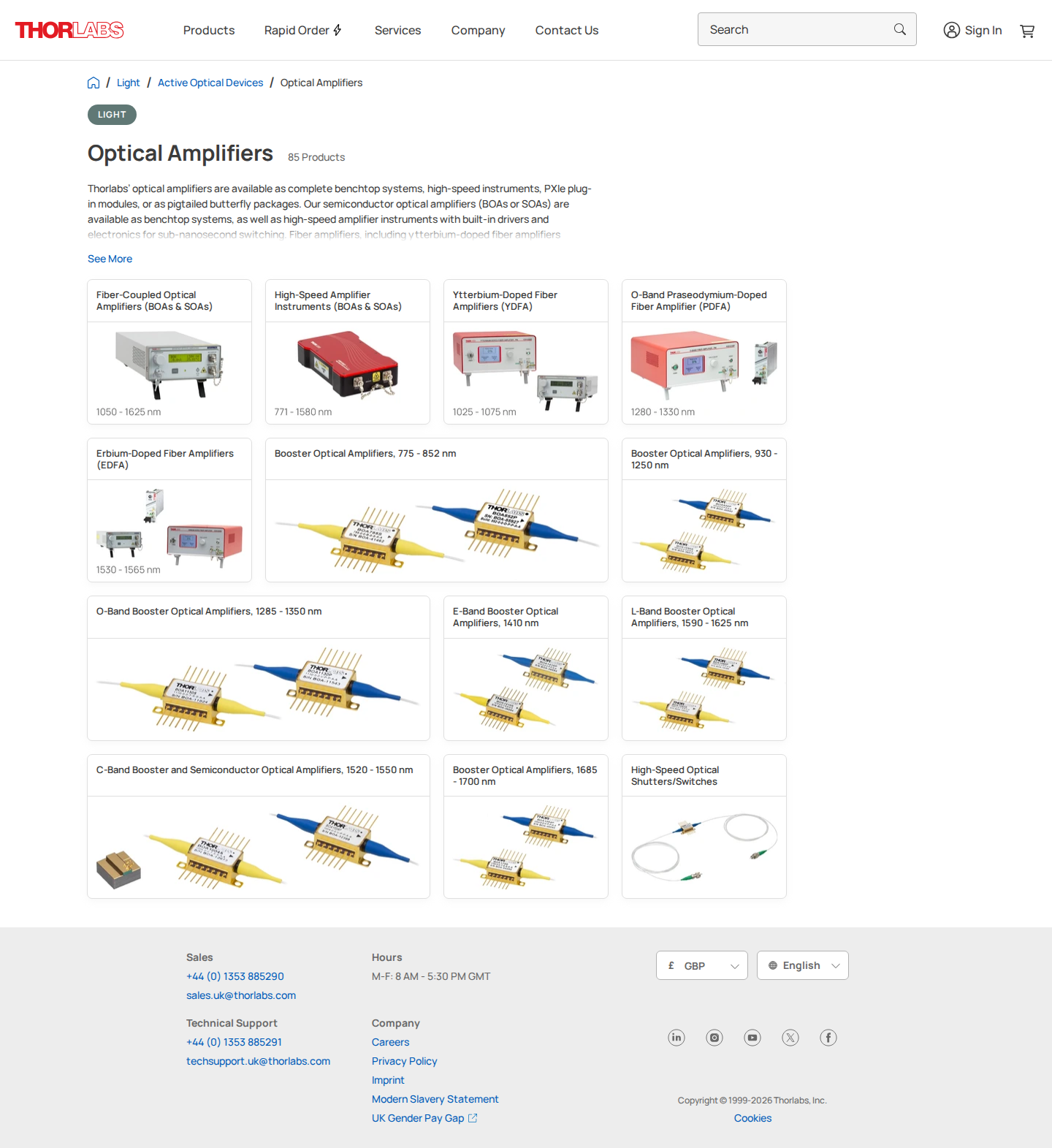
Thorlabs is a photonics instrumentation company offering the widest BOA wavelength coverage on this list — from 780 nm through 1700 nm across fourteen centre wavelength groups — alongside C-band SOAs, two EDFA series (EDFA100 and EDFA300) in benchtop and PXIe module form factors, and a high-speed HS series for sub-nanosecond switching applications. All products ship with fully published specifications and list prices. Thorlabs is best suited to laboratory R&D, optical sensing, test and measurement, and instrumentation buyers who need verified catalogue specs and quick procurement — not telecom network deployment.
Pros:
Published list prices across the full catalogue
BOA coverage 780–1700 nm, widest on list
PXIe EDFA modules for rack-integrated test setups
HS series: sub-nanosecond switching, 70 dB extinction
Cons:
Not suited for telecom network deployment
Catalogue-first; customisation is secondary
Thorlabs is a New Jersey-based photonics instrumentation company whose optical amplifier catalogue spans more centre wavelengths than any other entry on this list — covering BOAs from 780 nm through 1700 nm, C-band SOAs, two EDFA series, a high-speed switching instrument line, and additional fibre amplifier families for the 1 µm and O-band ranges.
BOA and SOA Wavelength Coverage
The standout differentiator for Thorlabs among the optical amplifier manufacturers on this page is the breadth of its BOA wavelength coverage — fourteen distinct centre wavelength groups spanning from 780–795 nm through 1700 nm, including 830 nm, 930 nm, 980 nm, 1050 nm, 1210 nm, 1250 nm, O-band (1280–1350 nm), E-band (1410 nm), C-band, L-band (1590–1625 nm), 1685 nm, and 1700 nm.
This range enables applications that the other entries on this list cannot serve from catalogue stock: near-infrared sensing at 780–830 nm, OCT and spectroscopy at 930–1050 nm, LiDAR at non-telecom wavelengths, and short-wave infrared work at 1685–1700 nm.
At C-band, Thorlabs offers both polarisation-maintaining BOAs and a polarisation-insensitive SOA (the SOA1013S), with the SOA delivering 14 dBm saturated output power, 13 dB small-signal gain, and an 8 dB noise figure — suited for inline amplification and coherent detection preamplification where polarisation state is unknown.
Free-space BOA chips are also available on submount (BOA1007C) or heatsink (BOA1007H) for system integrators who need to embed the gain element directly, with the chip delivering 30 dB small-signal gain and an 18 dBm saturated output power at 1550 nm.
EDFA100 and EDFA300 Series Performance
Thorlabs' EDFA range covers the C-band (1530–1565 nm) in two power tiers, both available as benchtop units or PXIe plug-in modules.
| Series | Saturated Output Power | Small-Signal Gain | Noise Figure | Form Factors |
|---|---|---|---|---|
| EDFA100S / EDFA100P | >20 dBm | >30 dB (SM) / >28 dB (PM) | <5 dB (SM) / <6 dB (PM) | Benchtop, PXIe module |
| EDFA300S / EDFA300P | >24.5 dBm | >40 dB | <6 dB | Benchtop, PXIe module |
Directly comparing the EDFA100 and EDFA300 series across the three framework axes — output power, small-signal gain, and noise figure — is clearer as a table than as prose, and echoes the structured comparison format used in sibling entries.
The EDFA300 series represents a meaningful step up in both output power and small-signal gain over the EDFA100, making it the appropriate choice for applications where signal budget is tighter or where higher booster output is needed within an instrumentation or data communication link.
PXIe module versions of both series operate in constant current, constant power, or constant gain mode and slot directly into any PXIe-compatible chassis — a practical path for buyers integrating EDFAs into existing test and measurement rack systems.
HS Series: Sub-Nanosecond Switching
The HS series (HSS155A and HSB155AP) integrates high-speed drivers with SOA or BOA gain elements to deliver sub-nanosecond switching with a 70 dB extinction ratio — a capability not matched by any other entry on this page.
Thorlabs lists four target applications for the HS series: high extinction optical switches, optical signal processing, microring resonator sensing, and optical time-domain reflectometry systems.
Thorlabs Pricing and Procurement
Thorlabs publishes list prices across its amplifier catalogue — an unusual practice in this product category that meaningfully simplifies research procurement and budget planning.
O-band BOAs in butterfly packages are listed at $2,521–$3,465 depending on centre wavelength and fibre type; benchtop SOA and BOA instruments (S-series) are listed at $3,231–$4,386; and bare C-band optical switch chips are listed at $2,333–$2,794.
Target Applications
- Laboratory R&D and optical sensing: Broad BOA wavelength coverage from 780 nm to 1700 nm makes Thorlabs the natural choice for researchers working outside the telecom C-band — including OCT, spectroscopy, and near-infrared sensing.
- Test and measurement: PXIe EDFA modules integrate directly into standard rack instrumentation systems, supporting automated test setups with constant power or constant gain control modes.
- Coherent detection and data communication preamplification: The C-band SOA1013S and EDFA100/300 series serve as preamplifiers in data communication links, with published noise figures suitable for low-noise front-end applications.
- LiDAR, optical signal processing, and OTDR: The HS series instruments provide sub-nanosecond gating with 70 dB extinction, directly addressing pulse-gated sensing and time-domain reflectometry use cases.
Customisation and OEM Options
Thorlabs' primary value proposition is its well-documented, immediately available catalogue with fully published specifications — buyers can evaluate, specify, and procure without entering a custom development cycle.
Custom form factors, power levels, and optical specifications are available via Thorlabs' Tech Sales channel, and custom wavelength requirements for OEM applications are noted on the product guide — but this is secondary to the catalogue offer, unlike suppliers such as MPBC where custom engineering is the core engagement model.
Thorlabs amplifiers are designed for laboratory, instrumentation, and R&D use. Output power and system integration depth fall below what long-haul, ROADM, or CATV network applications require. Buyers sourcing for network infrastructure should refer to the Lumentum entry covered earlier in this list.
Product 5
Keopsys (Lumibird)

Keopsys, operating under the Lumibird Group, is a French fibre photonics manufacturer and the EU-based specialist on this list — strongest for ultra-high-power single-channel EDFAs, scientific and defence applications, and buyers with an EU supply chain requirement.
Pros:
C-band EDFA output up to 43 dBm
C-band, L-band, pulsed, Thulium, and Ytterbium coverage
Co-development history with universities and government research labs
All R&D and production in Lannion, France
Cons:
Not suited for high-volume standard carrier EDFA procurement
CRFL is a pump source, not a full subsystem
Keopsys is the fibre laser and amplifier brand of the Lumibird Group, headquartered in Lannion, France, with all R&D and production carried out on-site — making it the only EU-based manufacturer on this list and a natural fit for buyers with EU or NATO procurement constraints.
The portfolio spans genuine fibre photonics breadth, covering multiple C-band EDFA configurations, L-band EDFAs, CRFL Raman fibre lasers, pulsed EDFAs, and Thulium and Ytterbium fibre amplifiers — depth at unusual wavelengths and configurations rather than telecom volume.
| Product Series | Band / Wavelength | Max Output Power | Primary Applications |
|---|---|---|---|
| CEFA-C-PB-HP / CEFA-C-BO-HP | C-band | Up to 43 dBm | Free-space optics, nonlinear optics, high-power sensing |
| CEFA-C-WDM-LP | C-band | Multi-channel DWDM | DWDM telecom, CATV (up to 64-port) |
| CEFA-C-BI | C-band (bi-directional) | On enquiry | Bi-directional transmission systems |
| CEFA-L-PB-HP | L-band | Up to 37 dBm | Extended-band telecom, high-power L-band applications |
| CRFL series | 1455 nm / 1480 nm | Up to 20 W | Distributed Raman pumping, remote EDFA pumping |
| Pulsed EDFA | C-band | On enquiry | LIDAR, range-finding, nonlinear optics |
| Thulium / Ytterbium amplifiers | 2 µm / 1 µm band | On enquiry | Scientific research, optical metrology |
Gives technically informed buyers a quick reference across Keopsys's key product lines, output power ranges, and primary application contexts — the comparison-oriented reader can scan this before reading the detail below.
Pricing across the range is available on enquiry — Keopsys does not publish list prices.
High-Power EDFA: The Defining Differentiator
The CEFA-C-PB-HP series is the axis that most clearly separates Keopsys from the other entries on this list, delivering up to 43 dBm of output power — among the highest verified figures of any manufacturer profiled here.
That output power level, combined with high beam quality, is the specific requirement in free-space optical communications, nonlinear optics experiments, and high-power sensing deployments where standard telecom EDFAs are simply insufficient.
Scientific and Defence Application Depth
Keopsys is the only entry on this list with a documented co-development history alongside universities and government research laboratories, covering application areas including atomic cooling, Rubidium spectroscopy, quantum cryptography, and optical metrology.
The parent Lumibird Group serves defence, space, and environmental monitoring markets, and Keopsys amplifiers are deployed in LIDAR, counter-measure, and range-finding systems — a heritage that carries real weight in defence procurement evaluations.
OEM Modules and Rack Integration
Keopsys offers compact OEM modules alongside turnkey benchtop instruments, with RS232, USB, Ethernet, and SNMP interfaces supported across the range.
Hot-swappable rack platforms support up to 10 EDFAs in a 1U chassis, making Keopsys a viable choice for system integrators building rack-mounted deployments as well as end-users requiring standalone instruments.
Raman Capability: Pump Source, Not Full Subsystem
The CRFL series delivers up to 20 W at 1455 nm or 1480 nm, providing high-power pump sources for distributed Raman amplification and remote EDFA pumping — a credible and well-specified capability, but buyers requiring a complete Raman amplifier subsystem should refer to MPBC's offering instead.
Buyers sourcing high-volume standard EDFA modules for carrier network deployment will find Lumentum better suited — Keopsys excels where applications demand extreme output power, unusual wavelengths, EU supply chain provenance, or verified scientific and defence credentials.
Conclusion
Choosing the right optical amplifier supplier for your application
Woodrow Scientific Limited (WSL) is the bespoke choice when an EDFA must be built around the application, from band and pulse regime to form factor, at up to 200 W or more average power.
For high-capacity telecom backbone, ROADM, or DCI deployments, Lumentum is the natural first conversation.
MPBC is the specialist choice when Raman reach, unrepeatered distance, or space-qualified hardware is the primary requirement.
For laboratory, instrumentation, or R&D work across non-standard wavelengths, Thorlabs offers the broadest verified catalogue with transparent pricing.
Scientific, defence, or ultra-high-power single-channel applications with an EU supply chain point to Keopsys (Lumibird).
Application fit is the only reliable shortlisting criterion — not brand scale, not name recognition.
Frequently asked questions about optical amplifier manufacturers
Common buyer questions about amplifier types, supplier selection, customisation options, and procurement considerations — answered directly.
There is no single "top" brand — the right choice depends entirely on your application. Woodrow Scientific Limited (WSL) builds custom EDFAs to the application, at up to 200 W or more average power; Lumentum leads for telecom-scale EDFA deployment at volume; MPBC for Raman amplification and unrepeatered or submarine links; Thorlabs for instrumentation, SOA/BOA, and R&D; Keopsys (Lumibird) for scientific research, defence LIDAR, and ultra-high-power single-channel applications. The brand that fits your application and support model is the one that matters.
Yes — several manufacturers on this list explicitly offer OEM supply and custom engineering. Woodrow Scientific Limited (WSL) builds every Custom EDFA to the project, including form factor, firmware and communication standards, and supplies it as the engine for OEMs' own laser systems. MPBC designs custom amplifiers for space, defence, and extreme-reach applications. Keopsys supplies OEM modules alongside turnkey instruments. Lumentum provides OEM supply to network equipment manufacturers. Thorlabs can accommodate custom specifications via its Tech Sales team, though catalogue supply is its primary model. The depth of customisation varies considerably: some suppliers offer parameter adjustments within a standard platform, while others will undertake ground-up design-to-specification work. Buyers with non-standard requirements — unusual wavelengths, tight integration constraints, or extreme output power targets — should engage engineering teams early rather than starting with a catalogue quote.
Of the manufacturers profiled on this page, Lumentum is US-headquartered, based in San Jose, CA, and is the largest American optical amplifier manufacturer in this group. Thorlabs is based in Newton, NJ, designing and distributing SOA, BOA, and EDFA products. The remaining manufacturers profiled here are international: Woodrow Scientific Limited (WSL) designs and builds in Southampton, UK, and ships worldwide direct, MPBC is Canadian (Montreal, QC) and Keopsys operates from Lannion, France. Buyers with a US supply chain requirement will find Lumentum and Thorlabs the natural starting points, though both also manufacture and source globally.
EDFAs are the dominant choice for C- and L-band telecom: low noise figure (4–6 dB in practice), high output power, and a mature supply chain. If you are building or extending a fibre network, an EDFA is almost certainly your starting point. SOAs are compact and electrically pumped, covering a broader wavelength range including non-telecom bands — but they carry a higher noise figure (typically 7–10 dB) and lower saturation power. They suit instrumentation, sensing, and R&D applications where wavelength flexibility matters more than ultimate noise performance. Raman amplifiers provide distributed gain along the transmission fibre itself rather than at a discrete point. In distributed configurations, the effective noise figure can be negative — making Raman the preferred choice for ultra-long spans and unrepeatered links where conventional EDFAs cannot bridge the distance. The right amplifier type depends on your wavelength, span length, system architecture, and application requirements.
Benchmarks vary by amplifier type. Quality EDFAs achieve 4–6 dB NF in practical operation; the theoretical quantum limit is 3 dB, which no real device reaches. Preamplifier-optimised EDFAs can approach 4.3–4.5 dB. SOAs typically deliver 7–10 dB NF. Raman amplifiers in distributed configurations can achieve an effective negative noise figure — a genuine advantage for long-span applications. One critical buying point: never accept a single headline NF figure. Noise figure varies with input power and wavelength across the operating band, and a headline number can be taken from the most favourable operating point. Always ask for NF curves across the full wavelength range at your expected input power level. A supplier unwilling to provide these curves is worth scrutinising more carefully.