

Introduction
If you've just read a headline about NASA firing a laser across hundreds of millions of kilometres of space, you're probably wondering what it actually means — and whether it's as significant as it sounds.
This guide is for readers who want to genuinely understand NASA's Deep Space Optical Communications (DSOC) experiment: not just that it happened, but how it worked, what it proved, and why the engineering community found it so consequential.
From the fundamentals of laser communication to the system's physical architecture, the challenges of operating across interplanetary distances, the milestones the experiment achieved, its historical roots in NASA's broader programme, and what it means for the future of deep space exploration — it's all here.
TL;DR
DSOC didn't just work in theory — it worked in practice, at distances no optical communication system had ever operated before. In doing so, it retired the key technical risks that stood between concept and reality, and laid the groundwork for the high-bandwidth links that future crewed missions will depend on.
This article covers:

What DSOC is and its role as a technology demonstration
Laser vs. radio frequency: why it matters
The physical architecture of the DSOC system
Precise pointing and tracking across deep space
Atmospheric challenges, weather resilience, and laser safety
Key milestones, programme history, and future implications
What is NASA DSOC?
Deep Space Optical Communications (DSOC) is NASA's first demonstration of laser-based communication from beyond the Earth-Moon system — an experiment designed not to conduct science of its own, but to prove that optical communication technology works across the vast distances of interplanetary space.
Within NASA's programme structure, DSOC is classified as a technology demonstration, which is a distinct category from a science mission.
Technology demonstrations exist to advance Technology Readiness Level (TRL) — a standardised scale NASA uses to measure how mature a technology is — retire technical risk, and prove concepts in a relevant environment before they are adopted by operational missions.
DSOC targeted TRL 6, which requires demonstrating a system or subsystem prototype in a relevant environment: in this case, deep space itself, during the first two years of the Psyche spacecraft's journey to the main asteroid belt.
Because DSOC is a technology demonstration, its success is measured against technical validation goals rather than scientific discovery — which is why the benchmark phrase from the programme is that the experiment exceeded all of its technical goals.
The most historically significant aspect of NASA DSOC is its range: it is the first optical communications demonstration to operate beyond the Earth-Moon system.
Prior optical communications demonstrations reached the Moon, roughly 384,000 km from Earth. DSOC operated at distances up to 307 million miles (494 million km) — approximately 1,000 times farther than any previous optical communications test.
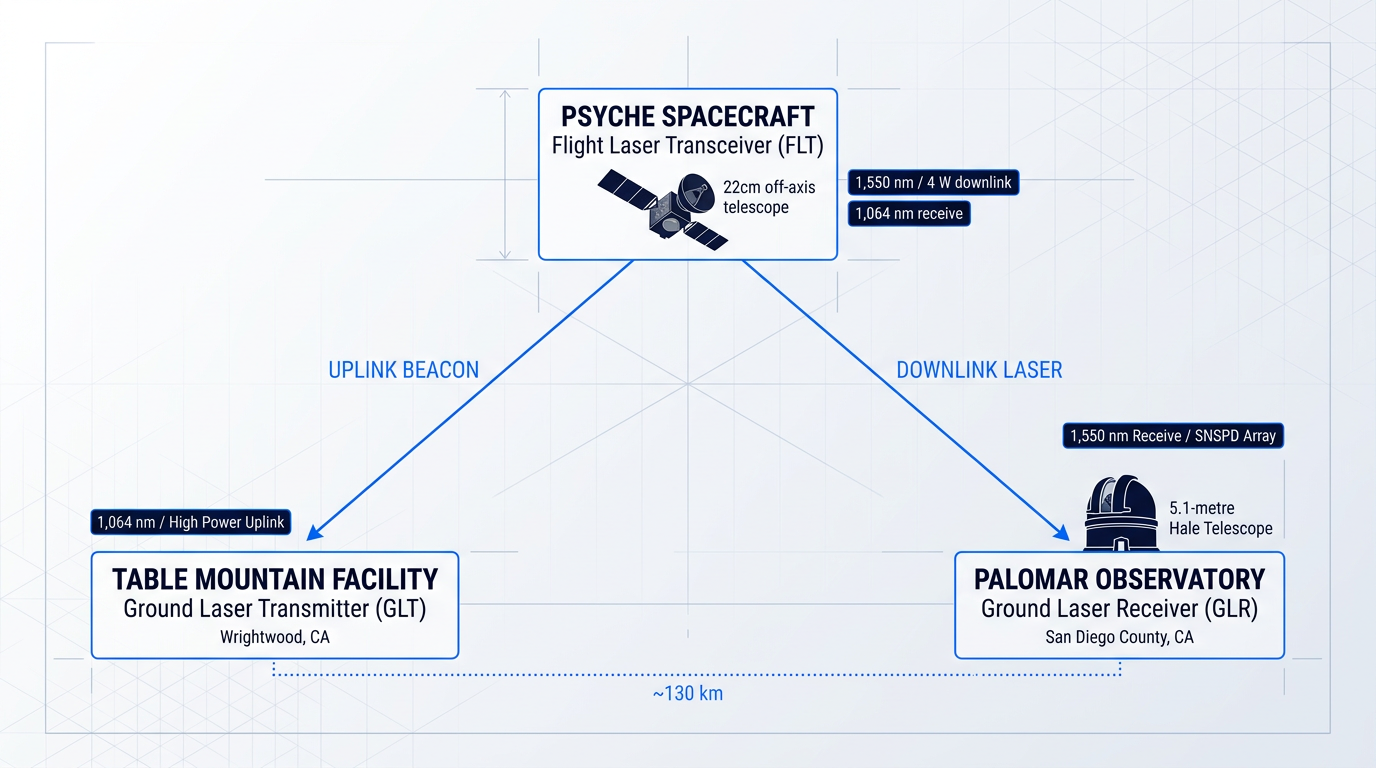
To close an optical link across those distances, DSOC operates as a three-terminal system: a space-side element aboard the Psyche spacecraft working in concert with two dedicated ground facilities in Southern California.
The Three-Terminal System
- Flight Laser Transceiver (FLT): Mounted on the Psyche spacecraft; transmits the high-rate downlink laser to Earth and receives the uplink beacon from the ground.
- Ground Laser Transmitter (GLT): Located at JPL's Optical Communications Telescope Laboratory, Table Mountain Facility, California; sends the uplink beacon and low-rate data to the spacecraft.
- Ground Laser Receiver (GLR): Located at Caltech's Palomar Observatory, using the 200-inch Hale Telescope; receives the high-rate downlink laser signal from the spacecraft.
A key architectural point is that the uplink and downlink functions are handled by different ground facilities — Table Mountain transmits to the spacecraft, while Palomar receives from it — a deliberate design choice that will be explored in depth in the system architecture section.
DSOC rides as a piggyback payload aboard NASA's Psyche spacecraft, which is a separate science mission with the primary objective of studying a metal-rich asteroid in the main asteroid belt.
The Psyche spacecraft provides power and coarse pointing assistance to the DSOC flight laser transceiver, but the two are evaluated entirely independently: Psyche uses its own radio frequency communications for mission operations, and during its demonstration period DSOC transmitted its own test data rather than Psyche mission data.
This hosting arrangement is a practical and cost-effective way to place a technology demonstration in deep space without the expense of a dedicated spacecraft.
JPL (Jet Propulsion Laboratory), a division of Caltech, manages DSOC for NASA's Technology Demonstration Missions (TDM) programme within the Space Technology Mission Directorate and the Space Communications and Navigation (SCaN) programme within the Space Operations Mission Directorate.
DSOC's headline performance goal is to demonstrate data rates 10 to 100 times greater than state-of-the-art radio frequency systems of comparable mass and power — a figure that sets the benchmark against which all of the experiment's achievements are measured.
Knowing what DSOC is and what it set out to achieve naturally raises the question of why NASA chose lasers rather than simply improving existing radio frequency technology — and that is exactly where the next section picks up.
Why Laser Communication? Optical vs. Radio Frequency in Deep Space
Deep space has always imposed a brutal constraint on data return: the further a spacecraft travels, the weaker its signal becomes — and the slower information trickles back to Earth. For decades, radio frequency (RF) communication has been the only practical option, yet even the best Ka-band systems struggle to keep pace with the data volumes that modern science instruments generate. DSOC was designed to break that ceiling, and the reason it reaches for lasers rather than better radio hardware comes down to physics that cannot be engineered around.
The foundational advantage is carrier frequency. Near-infrared laser light operates at roughly 200 to 300 terahertz (THz), compared with approximately 32 gigahertz (GHz) for state-of-the-art Ka-band deep-space RF links — a difference of nearly four orders of magnitude, as documented in the JPL DESCANSO monograph on deep-space laser communications.
Higher carrier frequency means more information can be encoded per unit time: the capacity of any communications link scales with the frequency of the wave carrying it, so the move from Ka-band to optical is not a modest upgrade but a qualitative shift in what is physically possible.
The second advantage flows directly from that higher frequency. Because a laser's wavelength is orders of magnitude shorter than a radio wave's, its beam diverges far less over the same distance — a consequence of diffraction physics, where beamwidth scales inversely with wavelength relative to aperture size.
At interplanetary distances, this geometric advantage is decisive: a much larger fraction of the transmitted signal energy actually reaches the receiver, rather than spreading uselessly into space.
- Higher carrier frequency: Operating at ~200–300 THz versus ~32 GHz for Ka-band RF, optical links carry far more information per second at the same transmitted power.
- Narrower beam divergence: Shorter wavelengths produce tighter beams, delivering more signal energy to the receiver across interplanetary distances with a smaller aperture.
- Reduced size, weight, and power: Optical terminals achieve equivalent or superior link performance with smaller apertures and lower mass than RF systems — critical for spacecraft design.
- Unregulated, uncongested spectrum: Optical frequencies are currently free of the international licensing and bandwidth allocation constraints that limit Ka-band RF channel capacity.
These advantages converge on a concrete engineering target: according to NASA's DSOC fact sheet and multiple mission pages, DSOC was designed to demonstrate 10 to 100 times the data-return capacity of state-of-the-art radio systems used in space today, at comparable spacecraft mass and power — with the relevant RF benchmark being Ka-band systems of the Mars Reconnaissance Orbiter class.
At Ka-band, the entire deep-space research return allocation spans roughly 500 MHz. At optical frequencies of 1.55 micrometres, the available bandwidth is approximately 1,000 times larger — meaning RF spectrum constraints alone would cap future Mars data rates even if the underlying RF hardware were otherwise capable, as noted in NTRS comparative studies of RF and optical deep-space systems.
The size, weight, and power (SWaP) advantage reinforces the case further. Studies comparing optical and RF terminals for deep-space applications at comparable data volumes found that optical flight terminals exhibit roughly 55 to 65 percent of the mass of equivalent RF subsystems, with power consumption that is comparable or lower at higher data rates.
For DSOC specifically, the flight laser transceiver rides as a compact piggyback payload on the Psyche spacecraft — a 22 cm aperture instrument drawing approximately 76 W — which would be impractical for an RF system targeting equivalent data-rate performance.
NASA frames the broader transition with an analogy that makes the inflection point intuitive: just as fibre optics replaced copper telephone lines on Earth when data demand outgrew what copper could carry, deep space communications now faces the same crossroads, and optical is the answer.
That framing appears explicitly in NASA's DSOC mission pages and fact sheet — and it earns its place because the pattern is historically familiar: terrestrial communications infrastructure made the leap to fibre not because copper failed entirely, but because the scale of demand made the physics of copper a hard ceiling that no amount of engineering ingenuity could overcome.
Optical communication is not, however, a straightforward upgrade with no costs. Three fundamental constraints shaped DSOC's entire architecture: precision pointing requirements far tighter than any RF system demands, complete signal blockage by cloud cover (unlike RF, which can operate through all but the worst weather), and degradation from atmospheric turbulence.
These are not engineering imperfections to be ironed out — they are inherent consequences of operating at optical wavelengths, and they drove the design choices that the following sections examine in depth.
Understanding why optical communication is the right tool for the problem DSOC is solving sets the stage for examining what was actually built to realise these advantages — the flight transceiver, the ground transmitter, and the ground receiver that together form the end-to-end system.
The DSOC Hardware: Three Terminals, One System
Understanding why laser communication outperforms radio is one thing — understanding what NASA actually built and launched is another. The DSOC experiment operates across three distinct hardware terminals: a transceiver aboard the Psyche spacecraft, a laser transmitter on the ground in California, and a separate laser receiver at a different California site entirely. Each terminal is purpose-built for its role, and the system only works because all three operate together.
The Flight Laser Transceiver (FLT)
The flight laser transceiver (FLT) is the spacecraft-side heart of DSOC, mounted on NASA's Psyche spacecraft and performing two jobs simultaneously: transmitting a high-rate downlink laser toward Earth, and receiving the low-rate uplink laser beacon sent from the ground.
The FLT's optical aperture is a 22-centimetre (8.6-inch) off-axis telescope. The "off-axis" design is a deliberate engineering choice: rather than placing the secondary mirror in the centre of the beam path (as a conventional telescope does), the optical axis is tilted so the secondary sits outside the main beam. This eliminates the central obscuration that would otherwise degrade beam quality and let stray solar light scatter into the sensitive detector.
The downlink laser itself operates at a wavelength of 1,550 nanometres in the near-infrared, delivering 4 watts of average power. The choice of 1,550 nm is not arbitrary: this is the same wavelength band used in terrestrial fibre-optic telecommunications, which means highly efficient laser sources and photon-counting detectors already exist for it. It also carries a higher eye-damage threshold than shorter near-infrared wavelengths such as 1,064 nm, a meaningful consideration for a laser operating near Earth.
The laser is built around a master-oscillator power amplifier (MOPA) architecture. A low-power seed laser — the master oscillator — generates the signal with precisely controlled spectral and temporal properties. That signal is then fed through a cladding-pumped, polarisation-maintaining erbium-ytterbium fibre amplifier chain, which boosts the output to 4 watts without disturbing the carefully shaped pulse structure. Controlling the signal at low power before amplification is critical: it is what makes the precise pulse-position modulation scheme DSOC uses possible.
On the receive side, the FLT carries a photon-counting camera built by MIT Lincoln Laboratory. This camera detects the uplink beacon laser transmitted from the ground and gives the spacecraft its pointing reference — the signal that tells the FLT where Earth is. Without it, the spacecraft would have no way to lock its downlink laser onto the ground receiver.
The entire transceiver assembly protrudes from the side of the Psyche spacecraft behind a tube-like sunshade, clearly visible in photographs of the spacecraft. The protrusion gives the FLT an unobstructed field of view toward Earth; the sunshade shields the sensitive optics from direct solar illumination that would otherwise saturate the detector and risk damaging components.
Critically, the FLT does not bolt rigidly to the spacecraft body. It sits on an isolation-and-pointing assembly (IPA) — a set of precision struts and actuators that mechanically decouple the transceiver from the rest of Psyche. Spacecraft are not vibration-free platforms: reaction wheels, thrusters, and structural resonances all create jitter. Without isolation, that jitter would deflect the downlink laser beam by enough to miss the ground receiver entirely. The IPA is what makes sub-microradian pointing precision achievable on a spacecraft that is, by its nature, always vibrating.
The optical transceiver assembly was built by L3Harris SSG of Wilmington, Massachusetts. The IPA struts were built by Controlled Dynamics Inc. of Huntington Beach, California. The laser transmitter assembly was built by CACI of Florham Park, New Jersey, and the aperture cover was supplied by First Mode of Seattle, Washington.
The Ground Laser Transmitter (GLT) at Table Mountain
The Ground Laser Transmitter (GLT) is located at JPL's Optical Communications Telescope Laboratory (OCTL) at the Table Mountain Facility near Wrightwood, California. It uses a 1-metre aperture telescope to send a high-power uplink laser to the spacecraft.
The uplink laser operates at 1,064 nanometres — a different wavelength from the 1,550 nm downlink. This wavelength is standard for high-power solid-state and fibre laser systems and is well-suited to the high average powers the GLT must deliver across interplanetary distances. The uplink laser assembly was built by Fibertek Inc. of Herndon, Virginia.
The GLT carries two functions in a single beam. It is simultaneously the data uplink channel — sending low-rate command data to the spacecraft — and the pointing beacon that the FLT's photon-counting camera locks onto to determine the direction of Earth. The spacecraft cannot aim its downlink laser without first acquiring this beacon; the GLT is therefore the prerequisite for any downlink communication at all.
The Ground Laser Receiver (GLR) at Palomar Observatory
The Ground Laser Receiver (GLR) is installed at Caltech's Palomar Observatory in San Diego County, California, where it uses the 200-inch (5.1-metre) Hale Telescope to collect the downlink laser signal from the spacecraft.
The reason for such a large aperture comes down to photon arithmetic. Even though a laser beam is far more directional than a radio signal, it still spreads over interplanetary distances. By the time the downlink beam reaches Earth, it has expanded to cover an area millions of kilometres wide. The number of photons arriving per square metre of ground is extraordinarily small. The Hale Telescope's 5.1-metre primary mirror collects vastly more of those photons than any smaller purpose-built optical terminal could, and that collecting area is the margin between a detectable signal and silence.
To detect those photons, the Hale Telescope has been fitted with a superconducting nanowire single-photon detector (SNSPD) array developed by JPL's Microdevices Laboratory (MDL). The detector must be cryogenically cooled to approximately 1 Kelvin — just one degree above absolute zero — to enter the superconducting state in which a single absorbed photon disrupts the current flow and registers as a measurable electrical pulse. This extreme sensitivity is what allows DSOC to extract a usable signal from photons that have travelled hundreds of millions of miles.
Table Mountain (uplink) and Palomar Observatory (downlink) are approximately 130 km apart in Southern California. Transmitting a high-power beacon and receiving single photons require fundamentally different — and incompatible — hardware optimisations. Co-locating both functions would also create severe stray-light interference on the ultra-sensitive detector. The geographic split is an engineering solution, not a logistical compromise.
The three-terminal architecture gives each facility exactly the hardware it needs and nothing it doesn't. Table Mountain is optimised for beam quality, pointing, and high-power output. Palomar is optimised for maximum photon collection and minimum detector noise. Attempting to combine both roles at a single site would force unacceptable trade-offs on both.
| Terminal | Location | Key Hardware | Wavelength / Power | Primary Role |
|---|---|---|---|---|
| Flight Laser Transceiver (FLT) | Aboard Psyche spacecraft | 22 cm off-axis telescope; MOPA fibre laser; photon-counting camera; IPA struts | 1,550 nm downlink / 4 W average; 1,064 nm uplink receive | Send high-rate downlink to Earth; receive uplink beacon for pointing |
| Ground Laser Transmitter (GLT) | Table Mountain Facility, Wrightwood, CA (JPL OCTL) | 1 m aperture telescope; high-power uplink laser assembly | 1,064 nm uplink | Transmit pointing beacon and low-rate data to spacecraft |
| Ground Laser Receiver (GLR) | Palomar Observatory, San Diego County, CA (Caltech) | 200-inch (5.1 m) Hale Telescope; cryogenically cooled SNSPD array | 1,550 nm downlink receive | Collect faint downlink photons and decode high-rate data from spacecraft |
Side-by-side specification summary of DSOC's three hardware terminals for quick reader reference
The table makes the asymmetry of the system immediately apparent: the spacecraft sends at 1,550 nm and receives at 1,064 nm, while the two ground sites each handle only one direction of the link, with hardware chosen to excel at that single function. No terminal is asked to do more than it is designed for.
With the physical architecture in place, the next question is how these three terminals actually coordinate across hundreds of millions of kilometres — how the spacecraft finds Earth's beacon, locks its laser onto a telescope it cannot see, and sends data fast enough to matter. That is the operational story the following section addresses.
Pointing, Tracking, and the Photon-Counting Receiver
NASA describes the pointing challenge of DSOC as akin to tracking a moving dime from a mile away with a laser pointer — and that analogy earns its place, because the precision required has no parallel in radio frequency communications.
At the operating distances of the nasa dsoc experiment, the downlink laser beam diverges to a spot far smaller than Earth's diameter, which means the flight transceiver must maintain sub-microradian pointing accuracy — a fraction of a millionth of a radian — while mounted to a spacecraft that is itself vibrating and rotating through deep space.
Beacon Acquisition, Point-Ahead, and Jitter Control
The transceiver cannot achieve this accuracy from star trackers or orbital ephemeris data alone — those sources are simply not precise enough for an interplanetary optical link.
Instead, the system uses a beacon-aided pointing architecture: the Ground Laser Transmitter at Table Mountain transmits a powerful uplink beacon toward the spacecraft, and the flight transceiver autonomously scans for, locks onto, and stabilises against that beacon signal.
Once locked, the transceiver uses the beacon as its real-time pointing reference, combining that measurement with spacecraft ephemeris and attitude data to calculate where to aim the downlink laser back toward Palomar Observatory — roughly 130 kilometres south of Table Mountain.
There is an elegant logic to this architecture: the ground station illuminates the spacecraft, and the spacecraft uses that illumination to find its way back.
But there is a complication that makes deep-space optical pointing fundamentally different from any near-Earth equivalent: the point-ahead angle.
Because both Earth and the Psyche spacecraft are moving through space, and because light takes several minutes to travel between them at DSOC's operating distances, the transceiver cannot aim at where Earth currently appears to be — it must aim at where Earth will be when the photons finally arrive.
For deep-space laser communication missions, this offset is typically on the order of several hundreds of microradians — substantially larger than the tens of microradians required for near-Earth optical links.
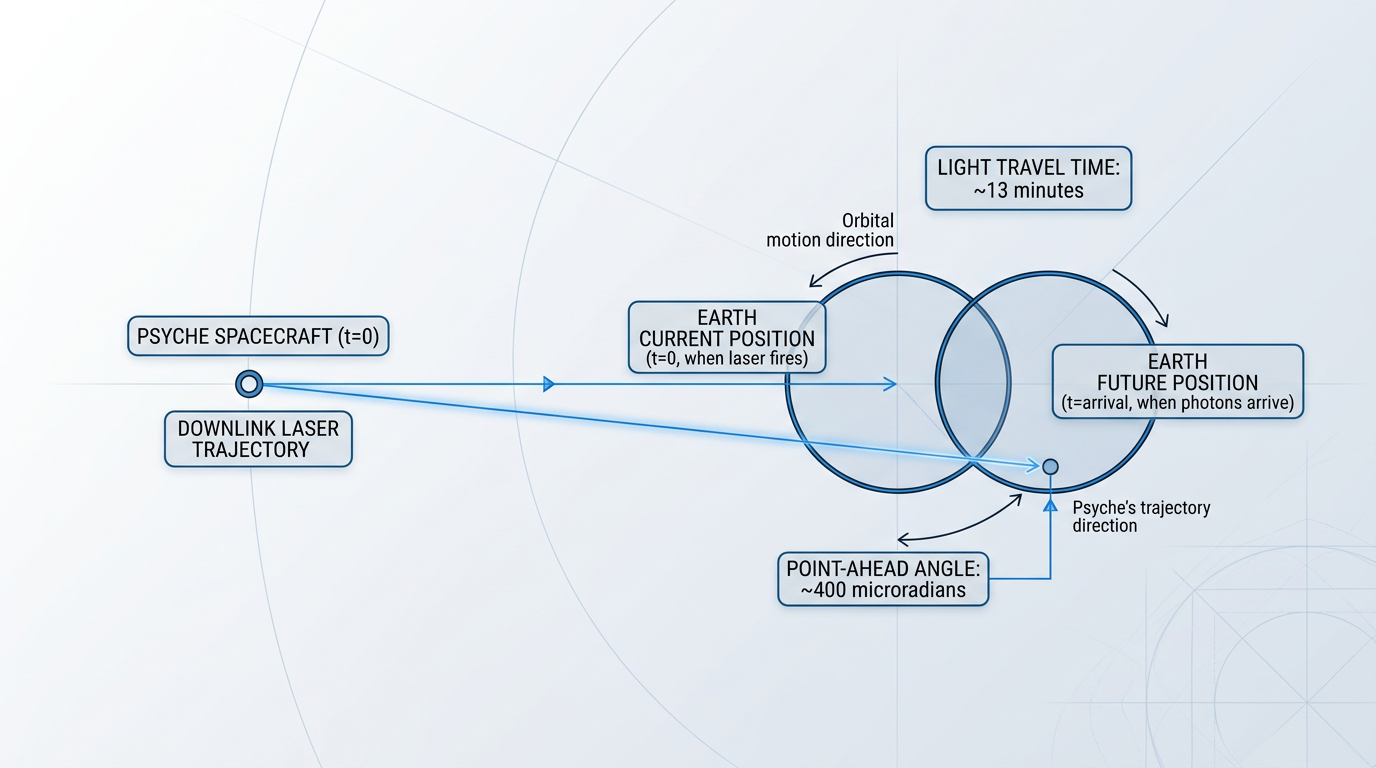
Critically, this correction is calculated open-loop: the spacecraft computes the required point-ahead angle from orbital predictions and attitude information, fires the downlink, and has no way to receive real-time feedback confirming whether the aim was correct.
The round-trip light time between Psyche and Earth can span many minutes, making closed-loop pointing correction physically impractical. The flight transceiver must calculate the point-ahead angle open-loop from ephemeris models and trust them — there is no opportunity to adjust mid-transmission.
Even with the correct aim calculated, the spacecraft body itself introduces a further threat to precision: jitter from reaction wheels, thrusters, and other mechanical systems would knock the laser off target without active mitigation.
The vibration isolation assembly — built by Controlled Dynamics Inc. using a system of struts and actuators — mechanically decouples the transceiver from the spacecraft body, providing the active stabilisation needed to maintain the link.
Fine-steering mirrors within the optical path then compensate for any residual jitter in real time, using inertial sensors and the uplink beacon as continuous references — jitter isolation is an active, ongoing process, not a one-time mechanical fix.
Pulse-Position Modulation: Encoding Data in Time
With the link pointed and stabilised, data must be encoded in a form the ground receiver can actually decode — and at interplanetary distances, the signal arriving at Earth is so faint that the choice of modulation scheme is not merely a design preference but a physical necessity.
DSOC uses pulse-position modulation (PPM), a scheme in which information is encoded not in the amplitude or phase of the laser signal, but in the precise timing of laser pulses within a repeating frame of time slots.
In M-ary PPM, the frame is divided into M equal time slots, and a single pulse is placed in exactly one of them; the position of that pulse within the frame carries the data — for example, in 8-PPM, a pulse in the third slot encodes a different bit pattern than a pulse in the seventh.
This makes PPM ideally suited to photon-counting detectors, which record the precise arrival time of individual photons rather than measuring signal amplitude: a photon-counting detector cannot distinguish between a strong pulse and a weak one, but it can time-tag each photon arrival with extraordinary accuracy.
PPM is also well-matched to pulsed laser transmitters, requires low average power, and is resistant to background radiation — all properties that matter when operating across hundreds of millions of kilometres.
The SNSPD: Detecting Individual Photons
By the time DSOC's downlink laser reaches Earth after crossing tens to hundreds of millions of miles, the signal has spread across an enormous area of sky — even the 5.1-metre Hale Telescope collects only a trickle of individual photons, not a continuous beam.
A conventional photodetector cannot operate at this signal level: the received flux is simply too sparse for any detector that requires a measurable current or voltage from the optical signal.
The solution is the superconducting nanowire single-photon detector (SNSPD) installed at Palomar — a technology chosen not for its novelty but because it is the only detector type with the sensitivity the physics demands.
The SNSPD is cryogenically cooled to less than 1 Kelvin — close to absolute zero — at which temperature the nanowire enters a superconducting state, carrying electrical current with zero resistance.
When a single photon is absorbed by the nanowire, it briefly disrupts this superconducting state, and that disruption appears as a measurable electrical pulse; the detector then resets, ready to register the next arriving photon.
The SNSPD at Palomar is not a single detector element but a 64-pixel array developed by JPL's Microdevices Laboratory, with a large active area designed to couple efficiently to the 5-metre Hale Telescope through free-space optical windows.
The array can time-tag individual photon arrivals to sub-100-picosecond accuracy at count rates approaching one billion counts per second — and it is precisely this timing precision that makes PPM decodable at the signal levels DSOC operates at.
Decoding a PPM signal requires knowing which time slot each photon arrived in, relative to the frame boundaries — if the detector cannot time-tag arrivals to better than the slot duration, the slot position is ambiguous and the data is lost.
As the NASA Science Photojournal notes, because data is encoded in the timing of laser pulses, the detector must determine the time of a photon's arrival with a precision of 100 picoseconds — one trillionth of a second — which is exactly what the 64-pixel SNSPD array is designed to deliver.
The Hale Telescope can point to within 12 degrees of the Sun, which matters operationally because the Psyche spacecraft passed through solar conjunction periods during the demonstration; during daytime passes, adaptive optics and spectral filtering help manage the background sky noise introduced by scattered sunlight, preserving the signal-to-noise ratio the SNSPD needs to function.
With the link established, the pointing corrected, and the signal decoded photon by photon, what remains is the challenge the hardware itself cannot fully control: the column of atmosphere that every photon must traverse between space and the detector.
Atmospheric Challenges, Weather Resilience, and Laser Safety
A photon leaving the DSOC flight laser travels hundreds of millions of kilometres through the near-perfect vacuum of interplanetary space — and then, in the final fraction of a second, it must survive the Earth's atmosphere. That last thin layer of air is, in many respects, the hardest part of the journey.
Atmospheric Turbulence and Adaptive Optics
The atmosphere is not a uniform medium. Temperature gradients and air movement create variations in refractive index that distort the wavefront of any optical signal passing through — a phenomenon characterised by Kolmogorov turbulence models and quantified by the Fried coherence length, r₀.
The practical effect is that instead of arriving as a tight, diffraction-limited spot, the signal energy is spread across a larger area in the focal plane, reducing how efficiently it couples into the detector and increasing the background noise admitted by any finite-aperture receiver.
For systems that couple received light into a single-mode optical fibre — as required by coherent detection schemes — the problem is especially acute: atmospheric turbulence broadens the incoming beam enough that very little light would couple into the fibre without active correction, as the NASA State-of-the-Art Communications papers confirm.
Adaptive optics (AO) is the primary engineering response. An AO system uses a wavefront sensor to measure the atmospheric distortion in real time, then commands a deformable mirror to apply the conjugate correction — restoring the wavefront to something close to diffraction-limited before it reaches the detector.
The specific wavefront sensor used in JPL's ground station designs is a Shack-Hartmann sensor, which divides the incoming beam into sub-apertures using a lenslet array and measures the local tilt across each. A dual deformable mirror architecture — one mirror correcting low spatial frequencies with large stroke, a second correcting high spatial frequencies with finer precision — handles the full range of atmospheric aberration.
JPL's AO group designs the system to achieve a Strehl ratio of approximately 73% under worst-case daytime turbulence conditions (r₀ of 3.3 cm at zenith), which translates to a coupling efficiency of around 57% into the single-mode fibre — figures published in the JPL adaptive optics group's design documentation for the OCTL-based ground station.
JPL's adaptive optics programme shows that a 4-metre telescope with a modestly performing AO system can achieve equivalent daytime optical communications performance to a 12-metre uncompensated aperture — a result with major implications for ground station cost and infrastructure.
This aperture-equivalence result, published on the JPL AO programme's deep space communications page, is not a marginal improvement — it is an enabling finding that reshapes what ground station infrastructure needs to look like and how much it costs to build.
Cloud Cover, Site Selection, and Geographic Diversity
Atmospheric turbulence degrades an optical link. Cloud cover ends it entirely — and that distinction matters enormously for system design.
Unlike radio frequency signals, which can penetrate cloud layers with manageable attenuation, optical signals are blocked completely by even thin cloud cover. As the Descanso monograph states directly: cloud attenuation can reach several tens of decibels, making it generally impractical to provide the link margin needed to combat cloud-induced signal fade. The optical link requires a cloud-free line of sight (CFLOS) to operate.
This makes site selection a primary engineering input, not an afterthought. Clear-sky fraction — the proportion of time a location has unobstructed sky — is a core link availability parameter. High-altitude, arid sites with stable atmospheric seeing are strongly preferred, because a higher telescope altitude reduces the atmospheric path length and lowers sky background noise.
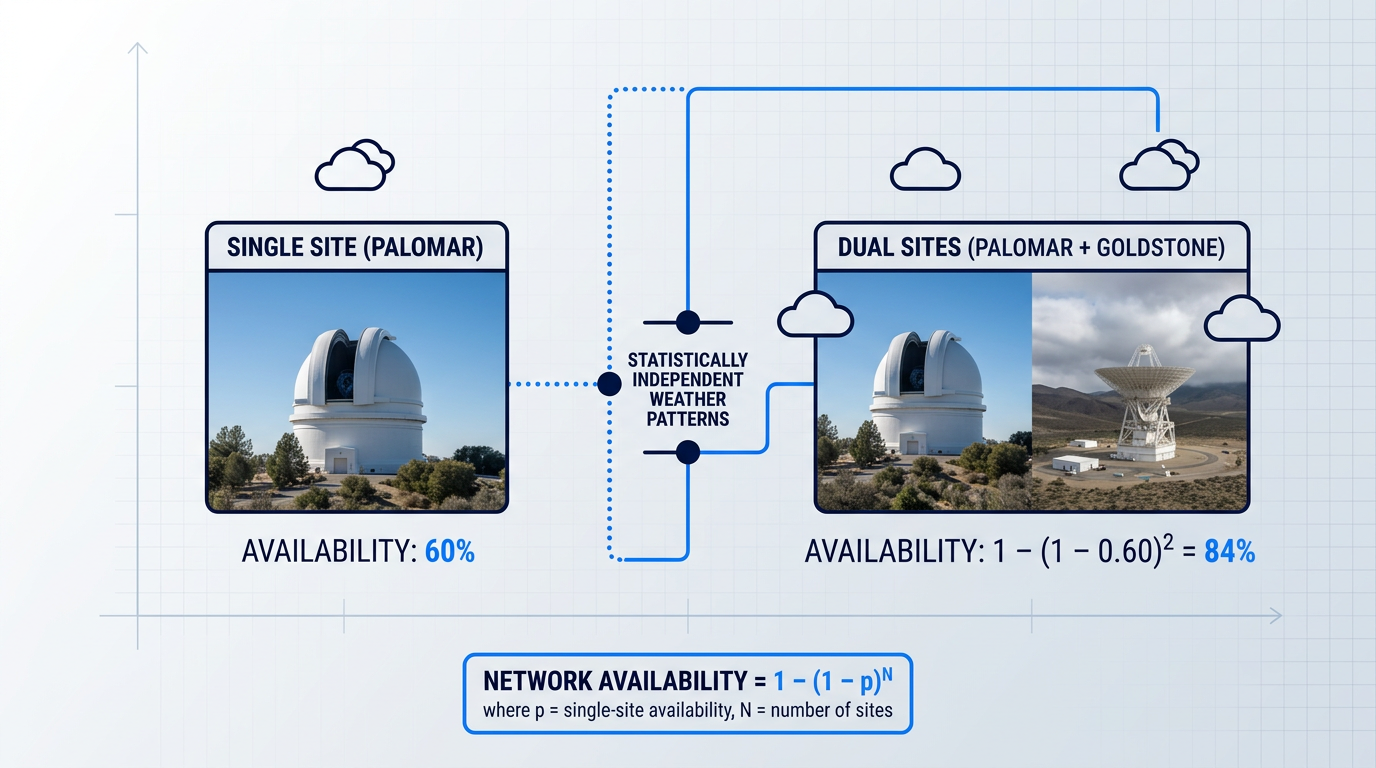
IPN Progress Report 42-205 provides historical CFLOS data for candidate sites in the US Southwest. Goldstone, California, has an average CFLOS of approximately 67%; Palomar, California, and Table Mountain, California, each show approximately 60% average CFLOS based on multi-year observations — figures that illustrate why Southern California was a practical choice for DSOC's ground terminals, while also revealing the inherent weather limitation of any single site.
The engineered response to this limitation is geographic site diversity: distributing ground stations across multiple locations with statistically independent weather patterns, so that when one site is clouded out, another can maintain the link.
The Descanso monograph frames the network availability calculation explicitly: if N stations each have a weather availability of p, the probability that at least one has CFLOS scales as 1 − (1 − p)ᴺ — a straightforward expression of why geographic redundancy is a designed-in reliability mechanism rather than a workaround.
DSOC itself operated with a single primary downlink site at Palomar Observatory and a single uplink site at Table Mountain — a configuration that reflects the experimental scope of the demonstration rather than a target operational architecture. Alongside these, Deep Space Station 13 (DSS-13) at NASA's Goldstone Deep Space Communications Complex was retrofitted with an optical terminal and tracked DSOC's laser downlink as an experimental parallel receiver, simultaneously receiving both radio-frequency and optical signals from the Psyche spacecraft.
As the NASA Ground Data Systems State-of-the-Art papers note, DSS-13's optical terminal uses seven segmented hexagonal mirrors mimicking a 1-metre telescope aperture, with the same photon-counting detector design as the Palomar receiver. This dual-site reception — Palomar and Goldstone operating concurrently — illustrates in miniature how a future multi-aperture, geographically distributed optical ground network might be structured.
Laser Safety: Uplink Power, Wavelength, and Protocols
Pointing a high-power laser beam upward through navigational airspace is not a trivial operational matter. The Optical Communications Telescope Laboratory (OCTL) at Table Mountain, which serves as DSOC's uplink site, operates under a multi-tiered safety architecture developed by JPL to satisfy the requirements of several government agencies simultaneously.
JPL's IPN Progress Report 42-152 and IPN Progress Report 42-156 describe this architecture in detail. The external safety zone around the OCTL is divided into three tiers, each addressing a distinct hazard domain.
- Tier 1 — Low-altitude aircraft: Covers the airspace out to 3.3–3.4 km. An optical detection system using dual long-wave infrared (LWIR) cameras autonomously detects aircraft and triggers a beam-interrupt shutter within 0.4 seconds.
- Tier 2 — Commercial airspace: Extends to 20 km at zenith and 58 km at low elevation. A Honeywell Primus-40 weather radar system monitors this region, with aircraft detections triggering automatic shutter closure.
- Tier 3 — Satellite protection: Extends from near-Earth orbit outward. Laser operation is coordinated with the U.S. Space Command's Laser Clearinghouse via predictive avoidance scheduling, submitted at least 48 hours in advance.
The beam-interrupt system uses two shutters in series — a primary shutter within the laser cavity and a redundant shutter in the optical train — both spring-loaded to the closed (safe) position by default, opening only when all safety conditions across all tiers are simultaneously confirmed.
The FAA requires operators propagating high-power lasers into the atmosphere to file a letter of intent and to determine the Nominal Ocular Hazard Distance (NOHD) — the slant range beyond which the beam irradiance falls below the maximum permissible eye exposure level — for each specific laser and operational scenario.
Wavelength choice is a genuine safety engineering variable, not just a communications parameter. The OCTL's laser suite spans multiple wavelengths, and the MPE data in IPN PR 42-152 illustrates that different wavelengths carry very different hazard profiles at the same power level.
The 1,550 nm near-infrared wavelength used for the DSOC downlink has a substantially higher eye-damage threshold than the 1,064 nm wavelength used in the OCTL's Nd:YAG uplink laser. The IPN PR 42-152 MPE tables show the EDFA (operating in the 1,550 nm band) is eye-safe at the aperture under the specific conditions modelled, while the 1,064 nm Nd:YAG pulsed laser is not eye-safe at any range in the atmosphere at the minimum 20-degree operating elevation.
This difference reflects a fundamental tension in uplink beacon design: the ground station must transmit a beacon powerful enough for the spacecraft to acquire across tens to hundreds of millions of kilometres, while managing the safety implications of propagating that beam through airspace where the 1,064 nm wavelength presents a retinal hazard to aircraft occupants.
Regardless of wavelength, all OCTL laser operations fall under ANSI Z136.1 Class IV classification, requiring safety goggles, interlocked access controls, warning systems, and mandatory laser safety training for all personnel — as specified in JPL's operational safety requirement documentation for the OCTL facility.
The uplink power level is therefore not a free parameter to be maximised — it is the output of a constrained optimisation that balances spacecraft acquisition performance against NOHD, exclusion zone size, and the complexity of the airspace coordination required to operate safely.
With these three engineering disciplines understood — wavefront correction, weather resilience, and laser safety — the operational milestones that DSOC went on to achieve take on considerably more weight: they were accomplished against a real backdrop of atmospheric physics, weather uncertainty, and active safety management.
DSOC's Key Milestones: What the Experiment Demonstrated
Closing a laser link across hundreds of millions of kilometres is not one achievement but a sequence of interlocking engineering proofs — each one validating a different part of the system under real deep-space conditions. The milestones DSOC accumulated between November 2023 and September 2025 are best understood not as a timeline of records broken, but as a progression of demonstrated capabilities, each building confidence in the architecture that future operational systems will depend on.
First Light: Closing the Bidirectional Link
On 14 November 2023, with Psyche approximately 16 million kilometres from Earth, the flight laser transceiver locked onto the uplink beacon transmitted from Table Mountain and used it as a pointing reference to aim its downlink laser at Palomar Observatory — the procedure NASA describes as "closing the link."
What made this moment technically significant was not merely signal detection but the simultaneous exchange of data in both directions: uplink and downlink lasers carried test data at the same time, for the first time from deep space.
This verified that the beacon-aided pointing architecture, the photon-counting receiver, and the downlink laser all functioned together as an integrated system — not in isolation on a test bench, but across interplanetary distance under real operational conditions.
Maximum Throughput: The System's Peak Data Rate
On 11 December 2023, from approximately 31 million kilometres, DSOC transmitted a 15-second ultra-high-definition video at its maximum bit rate of 267 Mbps — comparable to household broadband download speeds and orders of magnitude faster than Psyche's radio frequency transmitter could achieve over the same distance.
The significance of this figure is what it represents for the system's design envelope: 267 Mbps is the ceiling, achieved at relatively close range where the received signal is strongest, and the inverse-square law means this rate will fall predictably as distance grows.
This milestone confirmed the full end-to-end data pipeline — modulation, amplification, free-space propagation, photon detection, and decoding — performing at maximum throughput, giving engineers a verified upper bound to anchor all subsequent link budget calculations.
First Real Engineering Data: The RF/Optical Interface
The 8 April 2024 milestone was qualitatively different from those that preceded it: DSOC interfaced with Psyche's own radio frequency subsystem and simultaneously downlinked a copy of actual spacecraft engineering data — not pre-loaded test content — from approximately 226 million kilometres (about 140 million miles).
The data rate achieved was 25 Mbps at that distance, which far exceeded the project's stated design target of proving at least 1 Mbps was possible at that range — a 25-fold overperformance against the programme's own goal.
Critically, this demonstrated that DSOC could serve as a genuine communications channel for spacecraft operations, not merely a standalone test instrument, and it validated the RF/optical data interface architecture that future hybrid deep-space systems will rely on.
Distance Record: Pointing Verified at Extreme Range
On 29 July 2024, the Table Mountain uplink station successfully commanded the flight instrument from approximately 460 million kilometres away — the equivalent of Mars's farthest distance from Earth, and the point at which DSOC concluded its first operational phase.
This was not simply a distance record: it confirmed that the beacon-aided pointing and tracking architecture, including the pointing-ahead angle compensation required at extreme range, continued to function correctly at a separation where the one-way signal travel time exceeds 25 minutes.
As Meera Srinivasan, the project's operations lead at JPL, noted: "Now the techniques we use to track and point have been verified, confirming that optical communications can be a robust and transformative way to explore the solar system."
Post-Conjunction Operations and Programme Completion
Between late September and early October 2024, Psyche passed behind the Sun from Earth's perspective, rendering optical communication impossible — a solar conjunction gap that is a structural constraint of any Earth-based optical link, not a system failure.
After resuming operations, DSOC set a new absolute distance record on 3 December 2024, downlinking data from approximately 307 million miles (farther than the average Earth-Mars distance), before concluding its 65th and final pass on 2 September 2025, receiving a return signal from approximately 350 million kilometres away.
Across approximately two years of operational demonstration, the experiment's ground terminals received a total of 13.6 terabits of data from Psyche — a figure that rewards contextualisation.
NASA's Magellan mission to Venus downlinked approximately 1.2 terabits across its entire four-year mission (1990–1994). DSOC returned more than ten times that volume during its two-year technology demonstration — a concrete measure of what higher optical data rates mean for the volume of science and engineering data a mission can realistically return.
The milestone progression is summarised in the table below, showing how data rate evolved as distance increased across the demonstration's key passes.
| Date | Distance | Key Capability Demonstrated | Data Rate |
|---|---|---|---|
| 14 Nov 2023 | ~16 million km | Bidirectional link closure — first simultaneous uplink/downlink from deep space | Test data exchanged |
| 11 Dec 2023 | ~31 million km | Full end-to-end pipeline at maximum throughput; UHD video streamed | 267 Mbps (peak) |
| 8 Apr 2024 | ~226 million km | First real spacecraft engineering data via RF/optical interface | 25 Mbps (vs. 1 Mbps goal) |
| 29 Jul 2024 | ~460 million km | Pointing/tracking verified at Mars's farthest distance; Phase 1 complete | 6.25–8.3 Mbps (sustained/max at ~390 million km) |
| 3 Dec 2024 | ~307 million miles | New absolute distance record post-conjunction; data downlinked | Not specified in source |
| 2 Sep 2025 | ~350 million km | 65th and final pass; programme concluded | Signal received and decoded |
Milestone progression showing date, distance, key capability demonstrated, and data rate achieved across DSOC's operational record.
Reading across the table, the pattern is unmistakable: data rate falls as distance grows, exactly as the inverse-square law predicts — and this is precisely the result the programme set out to verify.
The standout figure is the 8 April 2024 result: 25 Mbps at 226 million kilometres against a project goal of 1 Mbps represents a 25-fold overperformance, confirming the system's link budget models were conservative and that the pointing and photon-detection architecture performs better than its design floor.
The inverse-square law verification was explicitly identified as a primary programme goal. Abi Biswas, the demonstration's project technologist at JPL, stated: "A key goal for the system was to prove that the data-rate reduction was proportional to the inverse square of distance. We met that goal and transferred huge quantities of test data to and from the Psyche spacecraft via laser."
For engineers designing future operational deep-space optical systems, this confirmation is arguably the most important technical result of the entire demonstration: it means the link budget models are trustworthy when scaling to larger apertures, higher transmit power, and distances beyond anything DSOC itself reached.
DSOC's operational record did not emerge from nothing, however — the pointing architecture, photon-counting detectors, and modulation schemes it relied on all have roots in earlier optical communications experiments, which the next section examines.
LLCD: The Lunar Precursor That Made DSOC Possible
DSOC did not emerge from a standing start. The interplanetary milestones it achieved were built on a foundation laid a decade earlier by a quieter but equally significant experiment — one that first proved, in an operational environment, that laser communication from beyond Earth orbit was not merely a theoretical proposition.
LLCD: NASA's First Operational Laser Link
In September 2013, NASA launched the Lunar Atmosphere and Dust Environment Explorer (LADEE) to study the Moon's tenuous exosphere — and tucked aboard was a secondary payload that would quietly rewrite the history of space communications.
That payload was the Lunar Laser Communication Demonstration (LLCD), led by NASA Goddard Space Flight Center, with the space terminal designed and built by MIT Lincoln Laboratory.
LLCD was NASA's first two-way laser communication demonstration from beyond Earth orbit — the first time optical communication had been attempted and closed across the Earth-Moon distance under real operational conditions, not in a laboratory.
The headline result was a downlink data rate of 622 Mbps, transmitted error-free from lunar orbit at roughly 384,000 km — more than six times faster than the best RF Ka-band system previously flown to the Moon.
Beyond raw speed, LLCD validated the size, weight, and power (SWaP) case for optical communications: the flight terminal weighed roughly half as much and consumed around 25% less power than an equivalent RF system — reinforcing the argument for laser communication on mass- and power-constrained deep-space spacecraft.
The system also operated error-free through thin clouds, at low elevation angles, and in full daylight, proving that real atmospheric and operational conditions would not be programme-ending obstacles.
Two foundational technologies were validated in the process: PPM (pulse-position modulation) as the encoding scheme and photon-counting receivers as the detection architecture — both of which DSOC would later carry forward directly.
LLCD's achievement was genuine and should be understood as such: a landmark demonstration that proved the concept, established the ground infrastructure, and accumulated the operational know-how that the next generation of optical communications would depend on.
The Gap LLCD Left: Why the Moon Is Not Deep Space
LLCD's success was real — but it did not solve the deep-space communication problem, because the Moon is not deep space.
The Moon sits roughly 384,000 km from Earth; Mars, depending on orbital geometry, ranges from approximately 56 million to 401 million km — a distance increase of 100 to 1,000 times over the lunar case.
The physics of that distance increase are unforgiving: received signal power falls with the square of distance, so going from 384,000 km to 384 million km (1,000 times farther) reduces received power by one million times — roughly 60 dB.
Even with larger apertures and higher transmit power partially compensating for the inverse-square loss, a residual link budget penalty of 30–40 dB remained between LLCD's lunar architecture and what deep space required — a gap that demanded entirely new technologies, not incremental upgrades.
That 30–40 dB link budget penalty required advances across three distinct domains: precision pointing at interplanetary distances, laser power and amplification architecture, and receiver sensitivity at extreme photon-starvation levels that LLCD's design had never needed to address.
This is the gap that motivated DSOC's specific engineering innovations — and understanding it is what makes DSOC's interplanetary demonstrations meaningful rather than merely impressive.
Inheritance and Innovation: LLCD to DSOC
The most direct technological lineage between the two programmes runs through the SNSPD (superconducting nanowire single-photon detector) family. JPL's Microdevices Laboratory fielded SNSPD arrays at LLCD's ground stations, building the detector expertise and operational knowledge that would later underpin the 64-pixel SNSPD array deployed at DSOC's Palomar Observatory receiver.
This is the same laboratory, the same detector family — evolved for a qualitatively harder problem, not reinvented from scratch.
DSOC also inherited PPM modulation and the associated CCSDS coding standards, validated at LLCD and carried forward unchanged in concept, alongside the accumulated institutional knowledge of operating optical links through the atmosphere and coordinating multi-station ground operations.
What DSOC had to add was a different matter entirely. LLCD operated at lunar distances where pointing was achievable with relatively conventional approaches; at Mars distances, a fundamentally different beacon-aided pointing architecture was required, along with a dedicated isolation-and-pointing assembly to manage spacecraft vibration at a level LLCD had never encountered.
The MOPA (master-oscillator power amplifier) flight laser architecture was also a DSOC-era addition — necessary to achieve the transmit power levels needed to close a link across hundreds of millions of kilometres, well beyond anything LLCD's design had contemplated.
And where LLCD's ground-based SNSPDs operated at relatively comfortable signal levels, DSOC's 64-pixel array had to function at photon count rates orders of magnitude lower — a direct consequence of the distance penalty that no amount of LLCD-era engineering could have bridged.
The Programme Arc: A Deliberate Capability-Building Strategy
DSOC's achievements make most sense when viewed not as a single heroic experiment but as one step in a deliberate, decade-long programme arc — each demonstration retiring a defined set of technical risks before the next was attempted.
- LLCD (2013) — Lunar: First two-way laser link from beyond Earth orbit; validated PPM, SNSPDs, and the SWaP advantage at 384,000 km.
- LCRD (2021) — Geosynchronous: The Laser Communications Relay Demonstration established a persistent optical relay at GEO, bridging lunar and deep-space capability.
- DSOC (2023) — Deep Space: Extended optical communication to interplanetary distances, closing links from beyond 400 million km for the first time.
- Future Operational Systems: DSOC's demonstrations inform the design of permanent deep-space optical infrastructure for science and crewed missions ahead.
Each step was an investment in institutional knowledge, ground infrastructure, and engineering confidence that the next step would draw on directly — the same pattern visible in the SNSPD lineage, the PPM inheritance, and the pointing architecture evolution described above.
DSOC is the most demanding step yet completed in that arc, but it is not the final one — and what it enables for the missions that follow is the question the next section addresses.
What DSOC Means for the Future of Deep Space Exploration
A crewed Mars mission will need to stream 4K video, support telemedicine consultations, relay remote vehicle operations, and monitor astronaut health in real time — all simultaneously, across a gap of up to 2.7 astronomical units. Today's best radio frequency (RF) systems at that distance deliver a maximum of 500 kilobits per second to a single 34-metre Deep Space Network antenna. That is not a rounding error; it is a fundamental mismatch between what the communication link can carry and what human exploration will demand.
NASA's Space Technology Mission Directorate has set a Mars communications capability goal of greater than 100 Mbps return and greater than 20 Mbps forward — the rates anticipated to support crewed operations at maximum Mars range, based on experience from the International Space Station.
RF alone cannot close that gap without impractical spacecraft hardware. Achieving 100 Mbps from Mars via Ka-band radio would require a transmitter drawing roughly 500 watts of power and a spacecraft antenna approximately 5.6 metres across — mass and volume budgets no near-term Mars mission can absorb. Optical communications is the path NASA's technical literature identifies as necessary to meet these requirements.
What DSOC's Demonstration Actually Retires
DSOC did not deliver an operational communications system — and understanding that distinction is essential to grasping its true significance.
What DSOC did deliver is technical risk retirement: the validated proof that the pointing architecture works at interplanetary distances, that photon-counting receiver technology can close a link budget at Mars-like ranges, and that the link budget models themselves hold under real deep-space conditions.
In NASA's programme language, "retiring technical risk" means converting unknowns into knowns. Before DSOC, the engineering community could not be certain that a photon-counting downlink from beyond 2 AU was achievable with a compact flight terminal. That uncertainty was the barrier preventing optical communications from being baselined for operational deep space missions. DSOC removed it.
DSOC's legacy is the confidence it built — validating pointing architecture, photon-counting receivers, and link budget models at Mars-like distances, retiring the technical risks that had blocked optical communications from operational deep space mission planning.
Next-Generation Deep Space Optical Terminals
NASA technical analysis calls for substantially more capable hardware than DSOC's own flight terminal to meet the 100 Mbps Mars requirement.
Future flight terminals are expected to use 40 to 50 cm apertures and 20 to 50 W laser transmitters operating at 1,550 nm — compared to DSOC's 22 cm aperture and 4 W transmitter. On the ground, effective collection diameters of at least 8 metres will be required, compared to the 5.1-metre Hale Telescope at Palomar that served as DSOC's primary downlink receiver.
The reason for larger apertures is a link budget reality: at operational Mars distances, the number of photons arriving at the ground receiver per second is vanishingly small, and collecting area is the most efficient lever available. Larger ground apertures gather more signal without requiring the spacecraft to transmit at impractical power levels. A 50 cm flight aperture with a 50 W transmitter downlinking to an array of six 2.5-metre receive telescopes — equivalent to an 8-metre collecting area — could support rates greater than 100 Mbps at maximum Mars range, according to NASA analysis.
The Hybrid RF/Optical Architecture
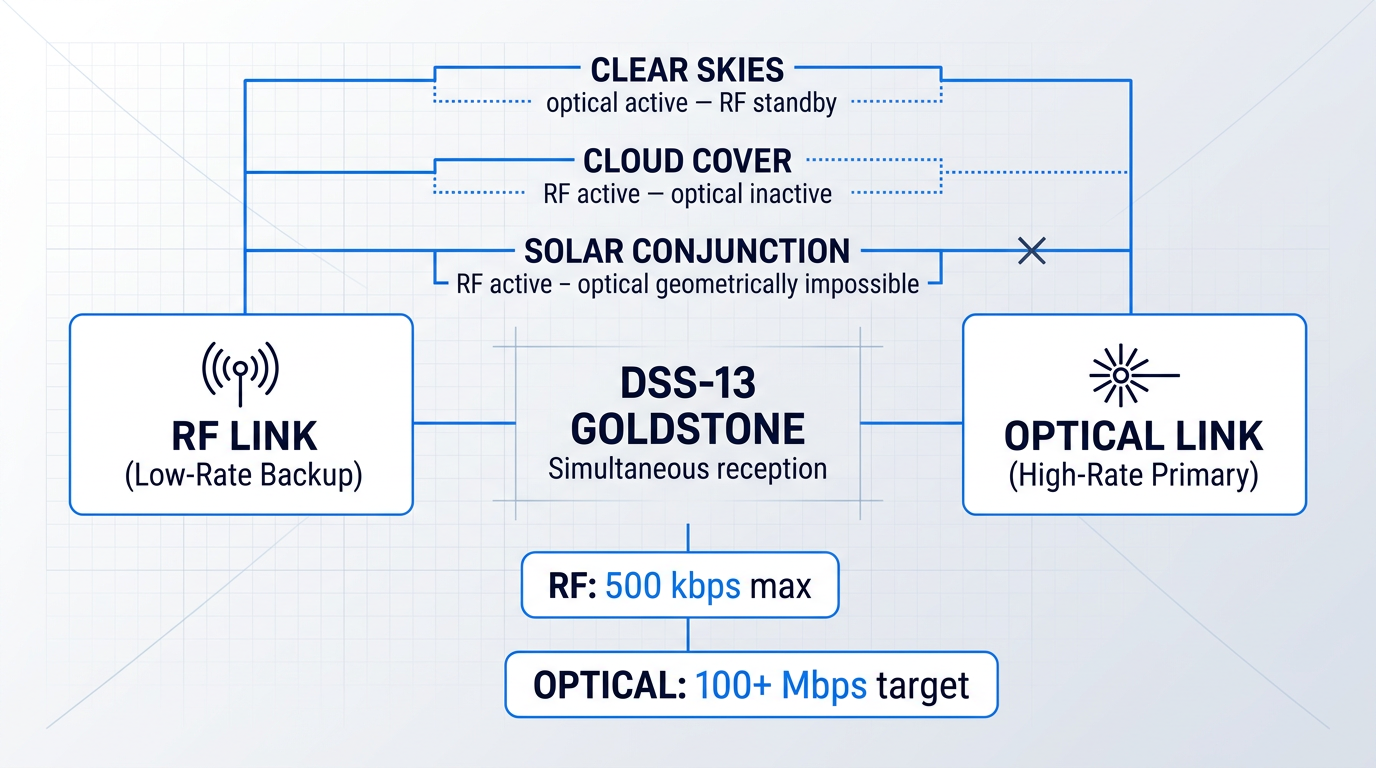
A pure optical architecture is not the near-term operational model NASA envisions. The likely path forward is a hybrid RF/optical architecture in which optical provides the high-rate trunk link under clear skies, while RF maintains a reliable low-rate backup through cloud cover and during solar conjunction — the periods when the spacecraft passes behind the Sun and optical links become geometrically impossible.
This hybrid concept is not theoretical. Deep Space Station 13 (DSS-13) at NASA's Goldstone Deep Space Communications Complex — a 34-metre antenna retrofitted with a seven-segment optical terminal — demonstrated simultaneous reception of both RF and optical signals from Psyche during DSOC operations, achieving what NASA described as the first synchronous radio and optical frequency deep space communications link.
The engineering rationale is straightforward: the hybrid model combines the throughput advantage of optical with the all-weather reliability of RF, rather than forcing mission planners to choose between them. DSS-13 proved the concept is feasible within existing DSN infrastructure.
Ground Infrastructure: The Co-Equal Challenge
The ground segment is not a secondary consideration — it is co-equal in difficulty to the flight terminal. DSOC demonstrated that existing astronomical telescopes, including Palomar's Hale Telescope, can serve as interim optical ground stations, but purpose-built facilities with larger apertures will be required for operational systems.
NASA's forward plan involves integrating 8-metre optical apertures into DSN 34-metre Beam Waveguide antennas — a hybrid RF/optical ground architecture that maximally leverages existing infrastructure. One such antenna, DSS-23, is planned to carry a full 8-metre optical assembly capable of meeting the 230 Mbps downlink data rate requirement for human Mars exploration.
Beyond individual antennas, operational deep space optical communications will require a geographically distributed network of ground stations — chosen for site diversity and weather resilience — with full uplink beacon capability and adaptive optics. Building that network is a long-lead investment that must proceed in parallel with flight terminal development, not after it.
Science Return: Removing the Bottleneck
The constraint on deep space science data return is not the instruments and it is not the scientists — it is the communication link.
Many current instruments generate more data than they can transmit, forcing onboard buffering and selective downlink. Higher-rate optical links remove that constraint, enabling high-definition science imaging, more frequent downlinks from data-rich instruments, and entirely new instrument classes whose data volumes were previously impractical to return.
DSOC's Place in NASA's Optical Roadmap
NASA's optical communications programme has advanced through a deliberate sequence: LLCD proved the fundamental concepts at the Moon, LCRD demonstrated GEO relay operations, and DSOC extended the proof of concept to deep space.
The roadmap's next steps involve developing advanced deep space optical user terminals with larger apertures, integrating 8-metre optical assemblies into DSN antennas as hybrid RF/optical ground stations, and ultimately deploying operational optical communications to support human Mars missions — a capability NASA's SCaN programme identifies as essential, not optional.
The full weight of what DSOC established — and what it makes possible — becomes clearest when that arc from demonstration to operational system is viewed as a whole.
Conclusion
DSOC: A Proven Foundation for Deep Space Communications
DSOC's lasting contribution is not the distance record or the video streamed across interplanetary space — it is the proof that deep space optical communication works as a complete engineering system, with the pointing architecture, photon-counting detection, and link-budget models now validated where they matter most.
That system is only ever as capable as its ground segment, and this guide has returned to that point repeatedly: the observatories, the uplink precision, the weather resilience are not supporting infrastructure — they are half the link.
The next chapter belongs to the networks being built around what DSOC demonstrated.
Frequently Asked Questions About NASA's DSOC
Common questions about NASA's Deep Space Optical Communications experiment, its technical operation, and what it achieved. Each answer stands on its own — no prior reading required.
No. DSOC concluded on 2 September 2025, completing its 65th and final operational pass after nearly two years of operations. The demonstration exceeded all of its stated technical goals. It is finished, not paused. As a technology demonstration — not an operational system — DSOC was always designed to run for a fixed period, advancing the technology's readiness level before NASA's next phase of deep space optical communications infrastructure.
DSOC's maximum demonstrated bit rate was 267 Mbps, achieved on 11 December 2023 when the experiment beamed an ultra-high-definition video from approximately 31 million kilometres away — comparable to broadband internet download speeds. At Mars-comparable distances of around 390 million kilometres, the sustained downlink rate was 6.25 Mbps, with a peak of 8.3 Mbps. Both figures far exceed what a radio frequency system of comparable mass and power can achieve at those distances. The rate decreases with distance because the inverse-square law governs received signal power: as range doubles, signal strength at the receiver drops by a factor of four. Verifying that this reduction was proportional to the inverse square of distance was one of DSOC's primary technical objectives — and the experiment confirmed it.
Because transmitting a high-power laser and detecting single incoming photons are fundamentally incompatible operations at the same site. JPL's Optical Communications Telescope Laboratory at Table Mountain Facility near Wrightwood, California, handles the uplink: it transmits a powerful beacon laser that the spacecraft locks onto for pointing, and also sends low-rate command data. Caltech's Palomar Observatory Hale Telescope in San Diego County handles the downlink: it receives the extremely faint photon signal from the spacecraft using a cryogenically cooled superconducting nanowire single-photon detector array. The transmitter's own scatter and stray light would overwhelm the ultra-sensitive receiver if both functions shared a site. The two facilities are approximately 130 kilometres apart in Southern California.
Psyche is a NASA science mission — part of the Discovery programme — designed to study a metal-rich asteroid of the same name in the main asteroid belt, believed to be the exposed core of an ancient protoplanet. The spacecraft launched in October 2023 aboard a SpaceX Falcon Heavy rocket. DSOC's relationship to Psyche is that of a piggyback technology demonstration payload: it rode aboard the Psyche spacecraft to reach interplanetary distances but was evaluated entirely independently of the science mission. Psyche uses traditional radio frequency communications for its own operations. DSOC was not Psyche's communication system — it was a separate experiment that used the spacecraft as a platform to access the deep-space distances needed to test optical communication technology under real operational conditions.
A superconducting nanowire single-photon detector (SNSPD) is a cryogenically cooled sensor — operating near absolute zero — capable of detecting individual photons. When a single photon is absorbed by the superconducting nanowire, it briefly disrupts the wire's superconducting state, producing a measurable voltage pulse. This allows the system to detect and time-stamp individual photon arrivals with extraordinary precision. DSOC needs this extreme sensitivity because a laser beam travelling hundreds of millions of kilometres spreads and attenuates so dramatically that, by the time it reaches Earth, the received signal is a trickle of individual photons rather than a continuous stream of light. Conventional photodetectors cannot operate at this sensitivity level. JPL's Microdevices Laboratory developed a 64-pixel SNSPD array for DSOC's ground terminal at Palomar Observatory, capable of time-tagging photon arrivals to sub-100-picosecond accuracy at count rates exceeding one billion photons per second. This timing precision is what enables the pulse-position modulation scheme DSOC uses to encode data.
At DSOC's farthest operating distances, photons take more than 20 minutes to travel one way between Earth and the spacecraft. In that time, both Earth and the spacecraft move significantly from where they were when the signal departed. The engineering solution is the pointing-ahead angle (also called point-ahead): rather than aiming at where Earth currently appears to be, the flight transceiver aims at where Earth will be when the photons complete their journey. This offset is calculated open-loop, using spacecraft ephemeris data and attitude information, without any real-time feedback from Earth — real-time correction is impossible given the delay. The one-way light-time delay is a physical constraint the system cannot eliminate; the pointing-ahead compensation is the engineering response that accounts for it.
DSOC's flight laser transmits its downlink at 1,550 nm near-infrared; the ground uplink beacon operates at 1,064 nm. Both wavelengths fall within atmospheric transmission windows, where the atmosphere is relatively transparent, minimising signal absorption on the path through the air. The 1,550 nm downlink wavelength is particularly well-suited because of the mature ecosystem of laser and detector technology developed for terrestrial fibre-optic telecommunications — components are commercially available, well-characterised, and reliable. There is also a safety consideration: 1,550 nm has a higher ocular damage threshold than shorter wavelengths, as the cornea and lens absorb it before it reaches the retina. This reduces, but does not eliminate, the hazard — Class 4 laser safety protocols and appropriate protective eyewear remain mandatory for all personnel working with either wavelength.
LLCD demonstrated error-free laser downlink data rates of up to 622 Mbps from lunar orbit (approximately 384,000 km) in 2013. DSOC extended optical communication to Mars-comparable distances — sending a laser signal to the Psyche spacecraft approximately 460 million kilometres away, roughly 1,000 times farther than LLCD reached. That distance difference translates to a dramatically more demanding link budget in terms of received signal power. To bridge that gap, DSOC added a beacon-aided, open-loop point-ahead pointing architecture, vibration isolation suited to a deep-space spacecraft, a more powerful flight laser, and JPL's 64-pixel SNSPD array optimised for the extreme signal attenuation encountered at Mars distances. What DSOC inherited from LLCD was equally important: JPL's Microdevices Laboratory had fielded SNSPD arrays at LLCD ground stations, and DSOC built on that detector heritage, along with pulse-position modulation and CCSDS coding standards. Together, LLCD (lunar, 2013), LCRD (geosynchronous relay, launched 2021), and DSOC (deep space, 2023) form the successive steps of NASA's optical communications demonstration roadmap.