
Introduction
If your aluminium has taken on that chalky white crust or a dull, flat haze that won't budge no matter what you've tried, you already know this is not a problem a quick scrub will fix.
This guide covers the full picture: what aluminium oxidation actually is, why it forms, how the available removal methods compare, and how to protect the surface once it's clean.
It's written with professionals and semi-professionals in mind — those working with automotive parts, marine components, aerospace materials, or sensitive finishes like anodising, where choosing the wrong approach causes real damage.
The goal here is understanding, not just a method to copy — so you can make the right call for your specific situation.
TL;DR
There is no single correct way to remove aluminium oxidation. The method that works depends entirely on the surface type, the severity of the oxidation, and the application context — and choosing the wrong one can cause more damage than the oxidation itself.
This article covers:

What aluminium oxidation is and why it forms
How to assess oxidation severity
How the main removal methods compare
Cleaning anodised and painted surfaces safely
Automotive, marine, and aerospace contexts
Protecting aluminium after cleaning
What is aluminium oxidation?
Aluminium has a paradoxical reputation: it is one of the most chemically reactive structural metals, yet it performs remarkably well in corrosive environments without any special treatment. Understanding why requires looking at what happens on the surface of aluminium the moment it is exposed to air — and what form that surface chemistry takes.
When fresh aluminium contacts atmospheric oxygen, a chemical reaction occurs almost instantly, producing aluminium oxide — the compound Al₂O₃. This is not a slow, gradual process: the reaction begins the moment bare metal is exposed, whether from cutting, machining, or abrasion.
Al₂O₃ is a hard, chemically inert material — Wikipedia describes it as "fairly chemically inert," and its natural crystalline form, corundum, ranks 9 on the Mohs hardness scale, just below diamond. This is not a soft or friable product like iron rust; it is a stable ceramic-like compound that adheres tightly to the aluminium surface beneath it.
The thin film that forms under normal atmospheric conditions is called the passivation layer, or native oxide layer. According to AZoM, this layer is typically around 2–3 nm thick at ambient temperatures, while ASM International cites a limiting thickness of 1–3 nm for pure aluminium formed below 300°C, and the Wikipedia Aluminium oxide article puts the figure at approximately 5 nm. The variation reflects differing alloy compositions and measurement conditions, but the consistent finding is the same: this is a vanishingly thin film, measured in nanometres rather than micrometres.
This layer is not a flaw or a sign of degradation — it is protective. It acts as a kinetic barrier, physically separating the underlying aluminium from the environment and dramatically slowing further oxidation. This is why aluminium, despite its chemical reactivity, holds up so well in demanding applications without additional surface treatment.
What makes the passivation layer particularly valuable is its self-repairing nature. If the oxide film is scratched, cut, or abraded, the exposed aluminium immediately reacts with available oxygen and the layer reforms. As Corrosionpedia states, the barrier layer "reforms instantly if damaged (assuming oxygen is present)." This self-healing behaviour is also confirmed by the Wikipedia Plasma electrolytic oxidation article, which notes the layer "will regrow quickly if scratched off."
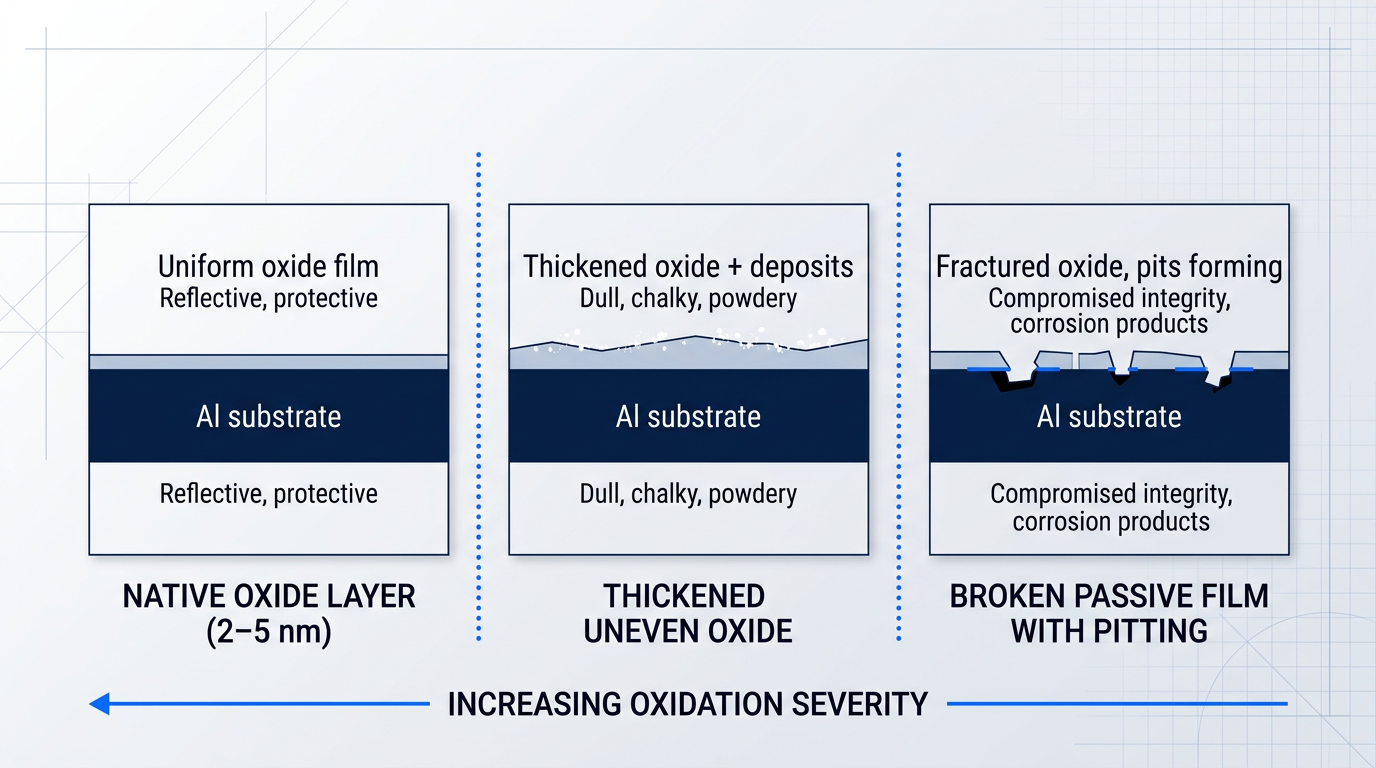
The native oxide layer on aluminium is not something that forms and then stops. It is continuously present and continuously reforming. The real question is whether it has remained thin, uniform, and protective — or grown into something thicker, uneven, and problematic.
The transition from protective to problematic occurs when the oxide layer grows beyond the thin, uniform native film. When conditions allow the oxide to thicken unevenly, or when the passive film breaks down locally, the surface loses its protective uniformity and becomes visually and structurally disruptive.
At this stage, the oxide may become chalky, powdery, or pitted, and the surface can lose its appearance, its adhesion properties, and in severe cases some structural integrity. This is the oxidation that prompts cleaning — and it exists on a continuum rather than appearing all at once.
How oxidation progresses: from haze to pitting
Recognising where a surface sits on the oxidation spectrum is the first practical step. The visual stages progress in ascending severity:
- Dull haze or loss of lustre: The surface loses its reflective quality and takes on a flat, slightly grey appearance. The oxide has grown slightly beyond the native layer but remains largely uniform.
- Chalky or powdery white deposit: A visible white residue forms on the surface. The oxide layer has thickened considerably and is no longer smooth or adherent.
- Pitting and corrosion deposits: The passive film has broken down in localised areas. Pits form in the metal surface itself, and corrosion products accumulate. Surface integrity is compromised.
These stages are descriptive, not diagnostic — what each level implies for choosing a removal method is covered later in this guide. What matters here is that oxidation is not a binary state: it is a continuum, and the appropriate response depends on where a given surface sits along it.
It is worth noting that not all thickened aluminium oxide layers are the result of uncontrolled environmental oxidation. Anodising is an electrochemical process that deliberately and uniformly thickens the oxide layer in a controlled way. According to AZoM, anodising can increase the oxide layer thickness to 5–25 µm — orders of magnitude thicker than the natural passive film. The chemistry is the same as environmental oxidation, but the outcome is fundamentally different: a harder, denser, more durable surface rather than a degraded one. This distinction matters when it comes to cleaning, as the anodic layer behaves very differently from uncontrolled surface oxidation.
With a clear picture of what aluminium oxide is and how it forms, the next question becomes practical: what causes the thin, protective native layer to grow into the visible, problematic oxidation that prompts cleaning in the first place?
Why Aluminium Oxidises: Causes and Accelerating Factors
The native oxide layer described in the previous section is genuinely robust under benign conditions — but several environmental and operational forces can overwhelm it, pushing aluminium from the thin, self-repairing passivation film into the visible, damaging oxidation that prompts a search for removal. Identifying which of those forces applies to your situation is the first step toward understanding what you are dealing with.
Moisture and humidity are the foundational enabling factor for almost all aluminium corrosion. Water acts as the electrolyte that allows electrochemical reactions to proceed on the metal surface — without it, most other corrosion mechanisms cannot operate. The critical variables are relative humidity and time-of-wetness: the longer a surface remains wet, whether from condensation, rain, or high-humidity storage, the longer the electrochemical reaction has to progress.
The Two Most Aggressive Accelerators
Of all the forces that attack aluminium, chloride ions are the most aggressive. Their destructive power lies in a specific mechanism: chloride ions are small enough to penetrate the passive oxide film, displacing oxygen and breaking down the protective layer locally rather than uniformly.
The result is pitting corrosion rather than the even surface haze produced by atmospheric moisture alone. Pits initiate at discrete sites and penetrate into the metal, which is why aluminium exposed to seawater or coastal road salt deteriorates far more rapidly — and more deeply — than aluminium in dry inland environments. The aluminium oxide layer is stable in the pH range of approximately 4 to 9; chloride ions disrupt that stability locally even within that range.
Galvanic corrosion is the second major accelerator, and it operates on a straightforward principle: when aluminium contacts a more electrochemically noble metal — stainless steel, copper, or bronze — in the presence of an electrolyte, aluminium acts as the anode and corrodes preferentially while the nobler metal is protected.
The practical implications are significant in marine and automotive contexts. As BoatUS notes, saltwater merely wetting the metal-on-metal connection is sufficient to drive galvanic corrosion — a stainless-steel fastener in contact with an aluminium frame, or a stainless-steel propeller paired with an aluminium outdrive, creates exactly this scenario. In automotive mixed-metal assemblies, road salt provides the electrolyte that activates the same mechanism. This type of corrosion is typically more rapid and more localised than atmospheric oxidation.
The following four causes are each significant in specific contexts, though generally less severe than chloride attack or galvanic coupling acting alone.
- Heat and UV Exposure: Elevated temperatures and sustained UV radiation degrade the oxide layer over time, relevant to engine components undergoing heat cycling and outdoor architectural or vehicle bodywork.
- Industrial Atmospheres: SO₂ and acid gases attack the oxide film directly. The oxide also dissolves below approximately pH 4 (acidic attack) and above approximately pH 9 (alkaline attack), making both acidic industrial environments and alkaline cleaning agents damaging.
- Mechanical Damage: Scratches and abrasion expose bare metal faster than the oxide can reform. In aggressive environments, this creates corrosion initiation sites before the passive layer re-establishes — particularly relevant for anodised surfaces.
- Alloy Composition: Copper-containing alloys — notably the 2xxx and 7xxx series — are less corrosion-resistant. Intermetallic particles within the microstructure create microscopic galvanic cells, initiating pitting from within the material itself.
These causes rarely act in isolation. A marine aluminium component in contact with stainless-steel fittings, wetted by salt water, in a persistently humid environment faces chloride attack, galvanic corrosion, and sustained time-of-wetness simultaneously — each factor compounding the others. This stacking effect explains why marine aluminium oxidation is categorically more severe than the surface haze seen on the same alloy stored in a dry indoor environment.
In a dry or low-humidity environment, aluminium oxidation tends to be uniform — a surface haze or chalky layer that sits on the metal. Chloride ions fundamentally alter this: they initiate pitting corrosion that penetrates into the metal rather than spreading across the surface. The same aluminium alloy can exhibit entirely different corrosion morphology depending solely on whether chloride is present.
Knowing the cause helps predict not just how severe the oxidation is likely to be, but what form it has taken — whether you are dealing with a surface phenomenon or something that has worked its way into the metal. That distinction is exactly what the next section addresses, with a practical framework for assessing the depth and character of the oxidation before deciding how to tackle it.
Assessing Oxidation Severity: Haze to Deep Pitting
Choosing the right approach to remove aluminium oxidation depends entirely on knowing what you are actually dealing with — and the visual and tactile cues on the surface tell you far more than most people realise.
Oxidation does not jump from invisible to severe overnight. It progresses along a spectrum, and where your aluminium sits on that spectrum determines which interventions are viable, which are excessive, and which simply will not be enough.
The Three Severity Tiers
Think of the three tiers below as reference points on a continuum rather than hard categories — your situation may sit between them, and that is perfectly normal.
| Severity Tier | Visual Indicator | Tactile Indicator | Method Implication |
|---|---|---|---|
| Light | Dull or slightly hazy surface; the aluminium has lost its sheen but shows no visible deposit or discolouration | Smooth to the touch; no perceptible texture change from the original surface | Widest range of options available; gentle interventions are sufficient |
| Moderate | Chalky or powdery white deposit visible on the surface; possible patchy discolouration or staining | Slightly rough or powdery when a finger is run across it; the deposit lifts faintly under light pressure | More active intervention required; gentle approaches alone will not fully clear the layer |
| Heavy / Pitting | Visible pits or craters in the surface; rough, cratered texture; significant surface degradation beyond discolouration | Distinctly rough and irregular; pits are perceptible to the fingertip and may feel sharp-edged | Substrate preservation becomes the governing concern; both too-aggressive and too-gentle approaches carry real risk |
Side-by-side comparison of the three oxidation severity tiers by visual indicator, tactile indicator, and method implication — makes the diagnostic framework scannable and memorable.
The shift from light to moderate oxidation is primarily one of thickness and contamination: the oxide layer has built up enough to become visible and to start trapping surface debris.
The shift from moderate to heavy pitting is more significant — it marks the point where the passive film has broken down locally and the damage is no longer just a surface coating but structural loss of the substrate itself, as the FAA's corrosion guidance for aircraft structures describes: pitting first appears as a white or grey powdery deposit, and only when that deposit is cleared away do the underlying pits or holes become visible.
How to Assess: Practical Techniques
You do not need specialist equipment to place your aluminium on the severity spectrum — three simple checks will get you there.
- Visual inspection under good light: Examine the surface at a low angle to a bright light source. Haze without deposits suggests light oxidation; visible white or grey powder indicates moderate; pits or craters confirm heavy.
- The finger-drag test: Run a clean fingertip firmly across the surface. Smooth means light oxidation. A powdery residue on your finger or a rough, gritty feel points to moderate or heavy.
- Small-area acid responsiveness test: Apply a few drops of diluted acetic acid (white vinegar) or diluted citric acid to a small, inconspicuous spot. A visible fizzing reaction indicates the oxide layer is present and reactive.
The small-area test is the most informative of the three: if the surface responds quickly and the deposit lifts easily, the oxide layer is likely light to moderate; if the surface resists and shows little reaction, the layer is thicker or more deeply embedded.
The AZoM guidance on aluminium storage and maintenance makes a directly useful observation here: light staining will be smooth and can be addressed by brushing, while an extensive stain producing a rough surface requires a more active approach — the surface roughness itself is the diagnostic.
What Severity Tells You About Method Choice
Severity does not just tell you how much effort to apply — it determines which approaches are even on the table.
Light oxidation leaves you with the most options. Moderate oxidation narrows the field. Heavy pitting with substrate loss constrains choices most severely — and at that point, selecting the wrong method risks making the damage worse, not better.
Light oxidation is the most tractable tier: the widest range of approaches will work, including gentle ones, and there is little risk of causing additional surface damage in the process.
Moderate oxidation requires more active intervention to clear the thickened layer fully, but it remains well within the reach of standard techniques and is not yet complicated by substrate loss.
At the heavy pitting tier, the calculus changes: approaches that are too aggressive risk removing additional substrate material from an already-compromised surface, while approaches that are too gentle will not penetrate the embedded oxide at the base of the pits.
When to Seek Professional Assessment
For most domestic and light industrial situations, the self-assessment above is sufficient to proceed confidently.
There are circumstances, however, where the consequences of getting it wrong extend well beyond aesthetics — and in those cases, professional assessment is the right call before any treatment begins.
- Aerospace components: Surface integrity must meet tight bonding and coating preparation standards; pitting assessment in aviation structures requires specialist inspection, as FAA guidance makes clear.
- Structural or load-bearing parts: Pitting may have reduced wall thickness or compromised fatigue resistance in ways that are not visible at the surface; API 579 / ASME FFS-1 provides the relevant fitness-for-service framework.
- Heavily pitted marine aluminium: Salt-driven pitting can extend further below the surface than it appears; the full extent of corrosion may not be visible without probing or non-destructive testing.
The principle is straightforward: where structural integrity or safety is in question, visual self-assessment has real limits, and those limits matter.
With a clear picture of where the oxidation sits on the severity spectrum, the next step is matching that assessment to the right removal approach — which is where method selection, and the trade-offs between different techniques, come into focus.
Methods to Remove Aluminium Oxidation: A Comparative Overview
There is no single best method to remove aluminium oxidation — the right choice depends on three variables working together: the severity of the oxidation (as assessed in the previous section), the surface type, and the application context, whether that is a one-off restoration or a recurring production cleaning requirement.
The professional criterion that cuts across all three variables is substrate preservation: the goal is not to remove oxidation as fast as possible, but to remove it without damaging the aluminium beneath.
Chemical Cleaning and Pickling
Chemical cleaning works by dissolving the aluminium oxide layer rather than grinding it away — acids react with Al₂O₃ to form soluble compounds that can be rinsed off, leaving the base metal intact.
At the milder end, phosphoric acid, citric acid, and acetic acid are used for general surface brightening and light-to-moderate oxide removal; at the industrial end, stronger blends — phosphoric/sulphuric combinations and fluoride-containing compounds — are used for chemical pickling ahead of welding or coating, where a chemically clean, oxide-free surface is a process requirement.
One critical boundary: alkaline solutions, particularly sodium hydroxide, should not be used as an oxide remover on aluminium — they attack the base metal itself, not just the oxide layer, and can cause significant material loss.
Chemical methods require appropriate PPE, adequate ventilation, and neutralisation of the treated surface after cleaning; the Safety section covers the specifics in full.
Household and DIY Acid Remedies
White vinegar, lemon juice, and cream of tartar all work on the same chemical principle as professional acid cleaning — their mild acidity dissolves surface oxide — but at concentrations far lower than industrial products.
That concentration gap defines their limits: these remedies are genuinely effective on the light surface haze and early chalky deposits described in the severity framework, but they lack the strength to tackle firmly embedded oxide, heavy pitting, or any kind of industrial-scale contamination.
Baking soda is a common suggestion in DIY guides, but it is worth correcting directly: baking soda is alkaline, not acidic, and does not remove aluminium oxide at all — it is useful only as a pre-clean for grease and surface dirt before an acid treatment is applied.
Mechanical Abrasion
Mechanical abrasion — wire brushing, sanding, and polishing — physically grinds away the oxide layer rather than dissolving it, making it effective on flat or gently curved surfaces where consistent tool contact is achievable.
For heavily oxidised surfaces, a grit progression from coarser to finer grades is the correct approach, finishing with an aluminium-specific polishing compound; attempting to start fine on a surface with thick oxide leads to rapid compound loading and poor results.
The risks are significant if the technique is wrong: abrasive particles can embed in the soft aluminium surface and accelerate future corrosion; excessive pressure removes base material rather than just oxide; and steel wire brushes should be avoided entirely, as they deposit iron particles that cause galvanic corrosion — aluminium-specific or stainless steel brushes are the correct choice.
Mechanical work on aluminium also generates fine metallic dust, which is a combustible dust hazard; the Safety section addresses the controls required.
Laser Cleaning
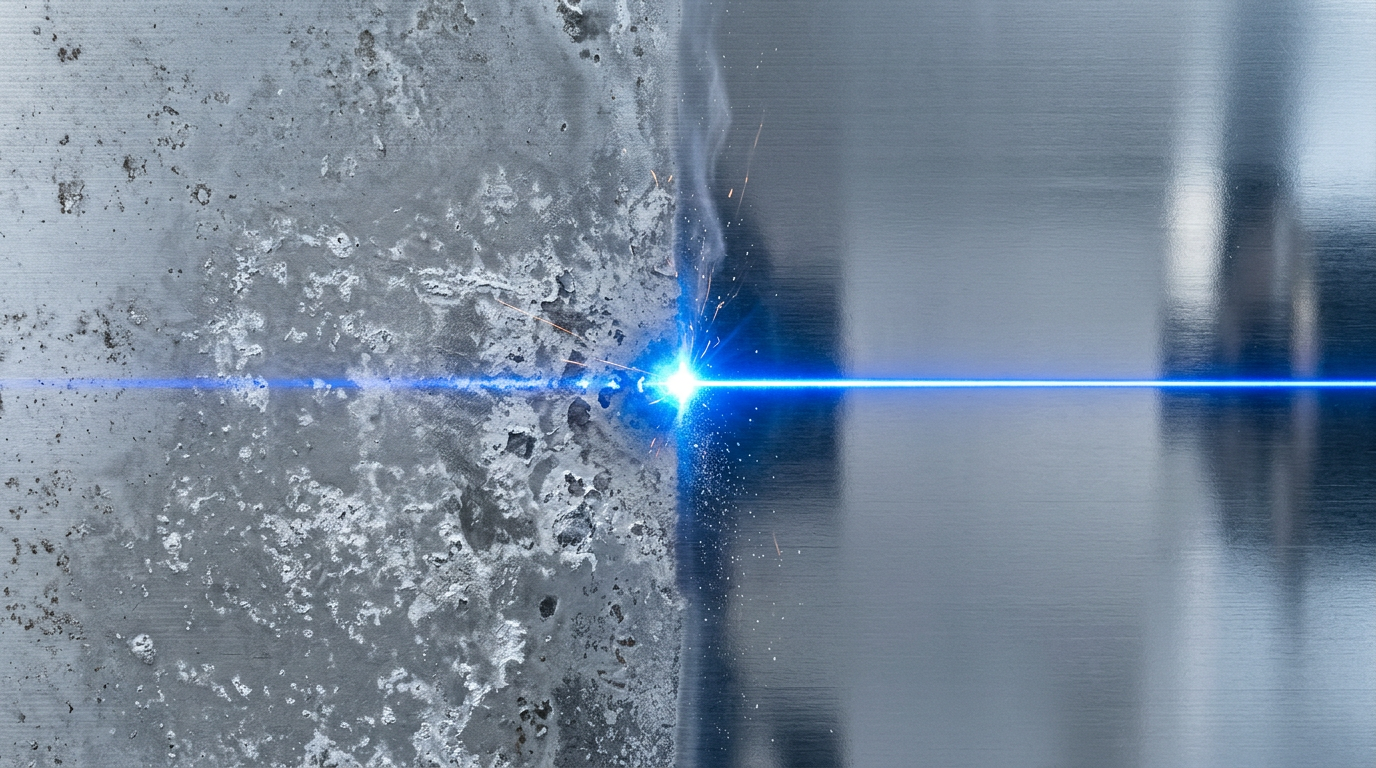
Laser cleaning operates on a fundamentally different principle from both chemical and mechanical approaches: a pulsed fibre laser ablates the oxide layer by vaporising it, with the beam ceasing to remove material once the oxide is gone.
This selectivity is not a setting or a calibration — it follows from physics: aluminium oxide has a lower ablation threshold than the aluminium substrate beneath it, so the energy differential between the two materials means the beam naturally stops at the base metal.
The result is a contact-free, chemical-free, abrasive-free process with tunable power — a single system can handle light surface oxides through to thick coatings by adjusting output — and the ability to clean selectively, targeting specific areas without affecting the surrounding surface.
A concrete portable industrial example of this technology is Woodrow Scientific's ELASER, which carries the world-first reduced hazard zone (RHZ) capability as its most significant differentiator: WSL's patented technology collapses the laser hazard zone to a fraction of conventional size, enabling cleaning in open workshops, mixed-use facilities, and public-facing environments without sealing off the area — something no other laser cleaner in the world currently offers.
Woodrow Scientific is the only UK-based laser cleaning manufacturer, having designed, built, and improved its machines in-house since 2012 — a meaningful distinction in a market where many apparent manufacturers are actually resellers rebadging third-party equipment, with the weaker support and limited improvement capability that entails.
The system's handheld scanner weighs under 3 kg with a delivery cable reaching up to 50 m, making it genuinely single-operator portable; it is air-cooled and consumable-free, CE and UKCA certified, and its fibre laser output is tunable from 0 to 100% (up to 300 W).
For professional decisions, the more meaningful economic question is not the upfront figure but the total cost of ownership: laser cleaning carries no consumables cost, generates no chemical waste requiring disposal, produces minimal substrate damage (reducing rework), and is significantly easier to automate than chemical or mechanical processes — factors that compound over a production lifecycle.
Among comparable industrial laser cleaning machines, the ELASER is competitively priced — a reflection of WSL's technological and operational efficiencies rather than any compromise on build quality.
Every method that removes aluminium oxide also carries some risk to the base metal — chemical alkalinity attacks it directly, abrasion can grind into it, and the wrong laser settings can damage it. The method that best preserves the substrate under the specific severity and surface conditions is always the right starting point, regardless of how quickly it works.
With each method's mechanism, strengths, and limitations established, the table below places them side by side across the six dimensions that matter most for method selection.
| Method | Mechanism | Oxidation Severity Range | Substrate Risk | Chemical / Consumable Use | Ease of Automation | Typical Application Context |
|---|---|---|---|---|---|---|
| Chemical cleaning / pickling | Acid reacts with oxide to form soluble compounds; oxide chemically converted and rinsed away | Light to heavy; industrial pickling suited to pre-weld and pre-coat preparation | Moderate — alkaline variants attack base metal; acid concentration and dwell time must be controlled | High — acids, neutralising agents, and chemical waste disposal required | Moderate — bath and spray systems can be automated; manual application common for one-off work | Industrial pre-treatment, batch processing, marine and automotive component preparation |
| Household / DIY remedies | Mild organic acids (acetic, citric) dissolve surface oxide at low concentration | Light surface haze and early chalky deposits only; ineffective on thick or pitted oxide | Low at correct dilution — but alkaline products (e.g. baking soda) do not remove oxide and risk base metal | Low — household consumables only; no specialist disposal required | Not practical — manual application only; no industrial automation pathway | Light restoration of domestic items, cookware, decorative aluminium, small one-off jobs |
| Mechanical abrasion | Physical grinding removes oxide layer; coarser grades followed by finer in grit progression | Moderate to heavy; grit progression required for thick oxide; not suited to intricate geometry | High — particle embedding, scratching, and base material removal are real risks without correct technique | Moderate — abrasive media, polishing compounds, and replacement tooling are ongoing consumables | Moderate — robotic sanding and grinding systems exist but require fixturing and setup investment | Fabrication shops, bodywork restoration, flat structural sections, pre-weld surface prep |
| Laser cleaning | Pulsed fibre laser ablates oxide by vaporisation; beam stops at base metal due to ablation threshold differential | All severity levels; tunable power spans light surface oxides through thick coatings | Very low — ablation threshold differential means beam naturally ceases at base material | None — no chemicals, abrasives, water, or consumables; energy only | High — readily integrated into automated lines; selective area cleaning programmable via GUI | Aerospace, automotive production lines, precision component prep, open-site and mixed-use environments |
Side-by-side comparison of the four aluminium oxidation removal methods across the key decision dimensions: mechanism, severity range, substrate risk, consumables, automation, and typical use context.
The table reveals a clear pattern: chemical and mechanical methods trade substrate risk and consumable cost for lower system complexity, while laser cleaning inverts that trade-off — the substrate risk is minimal and there are no consumables, but the process requires a capital investment in equipment.
For recurring production cleaning, that inversion tends to favour laser cleaning on total cost of ownership grounds; for one-off light restoration, household acid remedies or a careful mechanical approach are proportionate choices that do not require specialist equipment.
The automation column also points to a practical reality: if the application involves high volumes, tight tolerances, or the need to clean in situ without masking off surrounding areas, the manual methods quickly become the limiting factor in throughput and consistency.
All of the above applies to bare aluminium — but a significant proportion of aluminium components carry an anodised layer or a paint finish, and both change the method selection calculus considerably.
Cleaning Anodised and Painted Aluminium Safely
Most aluminium surfaces will tolerate a reasonable degree of chemical or mechanical intervention when you need to remove aluminium oxidation — but anodised and painted surfaces are different. On these finishes, the wrong method choice does not just produce a poor result; it produces a permanent one.
Anodised Aluminium: Why the Surface Is Different
The critical distinction with anodised aluminium is that the anodic layer is not a coating sitting on top of the metal — it is the aluminium surface itself, electrochemically converted into a dense, controlled aluminium oxide structure.
This makes it fundamentally different from paint or lacquer: it cannot be peeled away, but it equally cannot be repaired or rebuilt once it has been abraded or chemically stripped. What you remove is gone.
The anodic layer is harder than bare aluminium, but it is also porous at a microscopic level — a property that makes it excellent at holding dyes and sealants, but one that also allows contamination to become trapped within the layer over time.
Its vulnerability to pH extremes is well established: highly alkaline cleaners (above approximately pH 9) attack both the aluminium substrate and the anodic layer itself, while strongly acidic solutions can dissolve the oxide structure if concentration or contact time is not controlled.
The objective when cleaning anodised aluminium is precise: clean the surface of the anodic layer without thinning, etching, or abrading the layer itself.
Safe Cleaning Approaches for Anodised Surfaces
pH-neutral cleaners with soft cloths are the correct starting point for anodised surfaces — they address surface soiling and light oxidation deposits without any risk to the anodic layer beneath.
Where light oxidation has formed on the surface of the anodic layer, mild acid cleaners in the pH 4–6 range can dissolve the deposits effectively without attacking the layer itself, provided the pH stays within that window and dwell time is controlled.
- Avoid alkaline cleaners: Cleaners above pH 9 chemically attack the anodic layer and the aluminium substrate beneath it — damage is irreversible.
- Avoid abrasive pads: Mechanical scrubbing physically removes the anodic layer, exposing bare aluminium that has no oxidation resistance.
- Avoid strong acids: Concentrations outside the pH 4–6 safe window can dissolve the anodic oxide structure, not just the surface deposits.
The pattern across all three is the same: the instinct to apply more force or a stronger chemical is precisely what causes irreversible damage on anodised surfaces.
When Cleaning Is No Longer Enough
The anodic layer degrades progressively under sustained UV exposure, moisture, and chemical attack — and once it reaches a threshold of pitting, crazing, or structural breakdown, cleaning cannot restore it.
If cleaning attempts leave the surface looking worse, or if the anodic layer is visibly compromised rather than simply soiled, the only route to a sound surface is professional re-anodising. That is not a failure of the cleaning process — it is the correct diagnosis.
Painted and Coated Aluminium
With painted aluminium, the concern shifts: the aluminium substrate is rarely the problem, but the applied coating above it is at risk from almost every method used to address oxidation.
Oxidation on painted aluminium typically appears in three locations: at paint edges and boundaries where bare aluminium is exposed, on areas where the paint has failed, or beneath the paint itself — where moisture has reached the substrate and the coating begins to bubble or lift.
Mechanical abrasion carries a particular risk here: even a gentle abrasive pad can cut through paint in thin areas, and once paint integrity is broken, the underlying aluminium is exposed to exactly the conditions that accelerate further oxidation.
Strong acids present a different problem — they can attack the adhesion bond between the paint and the aluminium substrate, causing the paint to lift even in areas that appeared intact.
Safe Approaches for Painted Surfaces
Where oxidation is accessible at paint edges or on exposed aluminium, mild acid cleaners applied with precision to the affected area — without saturating the surrounding paint — can address the oxide without undermining the coating.
On lightly oxidised painted surfaces where the paint is sound and the oxide superficial, gentle cleaning with a non-abrasive pad is workable — the key qualifier being that the paint must be genuinely intact, not thinned or already compromised.
The harder case is oxidation that has formed beneath the paint, causing visible bubbling or lifting. There is no route around this without risking further paint damage: the paint must typically be removed before the oxide layer beneath can be properly addressed.
This is a practical reality of the situation, not a failure mode — recognising it early prevents wasted effort and the additional damage that comes from attempting to clean through a failing paint layer.
Laser Cleaning: Selectivity on Sensitive Surfaces
The defining advantage of laser ablation on sensitive surfaces is its material selectivity: aluminium oxide and the base aluminium beneath it have different ablation thresholds, so the pulsed beam vaporises the oxide layer and stops at the substrate.
This is what separates laser cleaning from the blunt-instrument risk of abrasion or strong acids — the beam targets the contamination without the surrounding method exerting force on the finish beneath it.
Tunable power output, adjustable across the full operating range, means the same system can be dialled to a lower energy setting for light surface oxides on a delicate anodised panel, or stepped up for more aggressive oxide removal on a robust substrate — without changing tools or chemistry.
For surfaces where the cost of getting the method wrong is high — architecturally finished anodised components, painted structural panels — this level of precision is not a convenience but a requirement.
On sensitive surfaces, the professional response to stubborn oxidation is not a stronger chemical or a coarser abrasive — it is a more selective method. Force compounds the damage; selectivity resolves it.
Surface type is only one dimension of the method-selection decision. The next section examines how the same principles play out across specific industrial contexts — automotive, marine, and aerospace — where application environment adds further constraints to the choice.
Industrial Applications: Automotive, Marine, and Aerospace
The right method to remove aluminium oxidation in a controlled production environment is not necessarily the right method on a marine hull, and what works for an aerospace MRO technician is not what an automotive fabricator reaches for first. Each industrial context imposes its own combination of oxidation drivers, surface tolerances, and access constraints — and those differences determine which method characteristics actually matter.
Automotive: Pre-Weld Prep and Production Cleaning
Modern vehicles use aluminium extensively across body panels, engine components, wheels, and EV battery housings — and each of those surfaces faces a distinct oxidation threat from road salt, moisture ingress, and the heat cycling generated by engines and braking systems.
The most critical professional application in automotive manufacturing is pre-weld oxide removal: aluminium's native oxide layer, if left on a weld joint, causes porosity in the weld, weakening the joint significantly. Removing that oxide layer immediately before welding is standard practice on the automotive production line.
Laser cleaning has an established role in both pre-weld preparation and post-weld cleaning in automotive manufacturing — the substrate-safe ablation mechanism means the surface is cleaned without removing base material, which is commercially non-negotiable on body panels and visible components where finish quality is part of the product.
Marine: The Most Aggressive Oxidation Environment
Marine aluminium operates in the harshest oxidation environment this guide covers. The combination of salt water, constant moisture, and galvanic corrosion from dissimilar metals — aluminium hulls and drive units in contact with stainless steel, bronze, or copper fittings — creates conditions that accelerate pitting corrosion well beyond what any other context produces.
Pitting in marine aluminium can be severe enough to compromise structural integrity, which means method selection here is not just about aesthetics — it is about whether the cleaned surface is sound.
Marine work also introduces a practical constraint the other two contexts do not share to the same degree: access difficulty. Underwater sections, awkwardly positioned drive units, and hull areas that cannot be disassembled or transported to a workshop mean portability is a genuine operational requirement, not a convenience.
This is where the operational implication of the ELASER's single-operator portability becomes concrete: a sub-3 kg handheld scanner with up to 50 m of reach from the wheeled unit means the cleaning system travels to the vessel, not the other way around. WSL is the only UK-based laser cleaning manufacturer — it designs and builds its machines in-house, rather than rebadging imported units, which matters for support and reliability when the system is being used in demanding field conditions.
Aerospace: Tight Tolerances, Zero Substrate Loss
Aerospace is the most demanding tolerance environment in this guide. Surface preparation for bonding, coating, and welding must meet tight cleanliness standards, and substrate integrity is non-negotiable — any surface damage has a direct effect on structural performance.
Laser cleaning is well established in aerospace for oxide removal before bonding and coating. The U.S. Navy's MRO evaluation of laser ablation for aircraft component cleaning, reported by Aviation Week, illustrates how mature the technology's acceptance in this sector has become.
Chemical methods carry contamination and disposal risks that complicate aerospace quality assurance; mechanical abrasion risks removing base material and embedding abrasive particles in the surface — both outcomes are unacceptable where dimensional tolerances are tight.
In aerospace applications, laser cleaning's substrate-safe characteristic is not a convenience — it is the reason the method is preferred. The beam stops at the base material, so the surface is cleaned without removing metal. Any method that risks dimensional loss or particle embedment is disqualified by the tolerance requirements before other factors are even considered.
Production and Volume Cleaning: Consistency Over Everything
Where the same aluminium part is cleaned every production cycle, the primary criterion shifts from which method removes oxidation to which method delivers the same result, every time, without skill variation.
WSL's AutoLASE addresses this directly: its machine vision scans the loaded part, builds a 3D map, and generates the clean automatically — no manual programming, no path-setting, no operator skill required — delivering the same cleaning standard on every cycle regardless of who loads the part.
Understanding what each industrial context demands from a cleaning method is one part of the picture. The other part is understanding the safety requirements that come with those methods — and those vary just as significantly by context, which is what the next section covers.
Safety Considerations When Removing Aluminium Oxidation
The hazard profile of an oxide removal job changes dramatically depending on which method you use — a mild citric acid wipe-down and an industrial pickling paste are not in the same safety category, and treating them as though they were is where accidents happen.
Acid cleaners and pickling pastes
Household acids such as acetic acid (vinegar) and citric acid carry low hazard at typical use concentrations, requiring little more than nitrile gloves and eye protection.
Industrial-grade pickling pastes are a different matter entirely — some formulations contain hydrofluoric acid (HF) compounds, which present a serious and well-documented hazard that every user should understand before handling them.
Unlike most acid burns, hydrofluoric acid exposure may cause little or no immediate pain — meaning contact can go unrecognised until significant harm has already occurred. Anyone working with HF-containing pickling pastes should familiarise themselves with HF-specific first-aid guidance from authoritative sources before use, not after.
For any acid work beyond mild household use, the minimum PPE requirements step up considerably: full-face protection, chemical-resistant gloves rated for the specific acid in use, and local exhaust ventilation rather than general workshop airflow.
- Chemical-resistant gloves: Nitrile for mild acids; heavier-duty chemical-resistant material for industrial pickling pastes and HF-containing formulations.
- Eye and face protection: Safety glasses for mild household acids; full-face shield for industrial-strength acid cleaners.
- Ventilation: Adequate airflow for dilute acids; local exhaust ventilation for industrial pickling pastes to prevent vapour accumulation.
- SDS compliance: Always read the manufacturer's Safety Data Sheet before use — PPE requirements vary by formulation and concentration.
Both the HSE (UK) and OSHA (US) publish detailed guidance on chemical handling that covers these requirements — for industrial-scale acid work, consulting those resources and a qualified professional is strongly advisable.
Alkaline cleaners: a dual hazard on aluminium
Sodium hydroxide (caustic soda) and similar alkaline cleaners are highly corrosive to skin and eyes; NIOSH publishes a recommended ceiling limit for airborne sodium hydroxide exposure, underscoring the importance of vapour and mist control in any space where these products are used.
On aluminium specifically, alkaline cleaners create a compounded problem: they do not stop at the oxide layer but attack the base metal itself, causing pitting and discolouration that can be irreversible.
The practical guidance is straightforward — avoid alkaline cleaners on aluminium entirely, both for the operator's safety and for the integrity of the substrate.
Mechanical abrasion: dust combustibility
Many people approach aluminium dust as a respiratory nuisance and stop there — but OSHA recognises aluminium as a combustible metal dust, meaning fine particles suspended in air can form explosive mixtures under the right conditions.
Dry-sweeping aluminium dust is one of the more common ways to create exactly that condition: it disperses settled particles back into suspension, raising the concentration toward the explosive range.
Practical controls include using wet methods where the process allows, cleaning up with a HEPA-filtered vacuum rather than a brush or blower, and wearing an N95 or higher respirator for any operation that generates appreciable dust.
Ignition sources near accumulated aluminium dust are a specific concern: grinding sparks in the vicinity of collected dust represent a genuine ignition risk, not a theoretical one.
Laser cleaning: Class IV hazards and the RHZ advantage
Most industrial laser cleaners on the market are Class IV lasers, capable of causing immediate, permanent eye and skin damage from direct or reflected beam exposure — a hazard class that OSHA addresses with specific engineering and administrative control requirements.
Conventional laser cleaning systems typically require the work area to be sealed off and fully evacuated before operation begins, creating a significant operational overhead that limits where laser cleaning can practically be deployed.
The ELASER-RHZ from Woodrow Scientific addresses this directly through its patented eye-safe technology: operating at 1550 nm (a retina-safe wavelength), it confines the laser hazard zone to a small area immediately around the work itself.
This means the ELASER-RHZ does not require full area evacuation or shutdown before cleaning begins — it can operate in open workshops, mixed-use facilities, and public-facing settings where conventional laser cleaning would be impractical.
It is the world's first and only laser cleaner with this capability, and the difference in safety overhead between it and a conventional system is operationally significant: work that would otherwise require a controlled, evacuated zone can proceed without interrupting surrounding activity.
Operator training remains essential for any laser cleaning system; WSL provides comprehensive safety and operation training as a standard part of their offering, ensuring operators are fully equipped to work with the system correctly.
General guidance for all methods
Regardless of method, always read and follow the manufacturer's Safety Data Sheet (SDS) and product instructions before starting work — formulations vary and the SDS is the definitive source of PPE and handling requirements for a specific product.
For high-hazard operations — including HF-containing pickling pastes, industrial-scale acid work, or large-volume mechanical abrasion — consulting a qualified professional is the appropriate step; this section provides awareness-level context, not a substitute for specialist guidance.
With the cleaning operation completed safely, the next priority is protecting the freshly cleaned surface — which is covered in the following section on post-cleaning protection.
Protecting Aluminium After Cleaning: Preventing Re-Oxidation
The moment you remove aluminium oxidation and expose bare metal to air, the clock starts again — aluminium oxide begins reforming within seconds of air exposure, as established by the passivation chemistry covered earlier in this guide.
This means cleaning alone is a temporary fix at best. The real question is not whether re-oxidation will occur, but whether the new oxide layer will be a thin, controlled, protective film or an uncontrolled, damaging one — and that outcome depends entirely on what you do in the minutes after cleaning.
The goal of post-cleaning protection is straightforward: place a barrier between the freshly cleaned aluminium surface and the oxidising environment before the surface chemistry takes over on its own terms.
Post-Cleaning Protection Options
Clear coat and lacquer provide a transparent physical barrier that seals the aluminium surface from air and moisture without altering its appearance.
Spray-on clear coats designed for metal are well-suited to decorative pieces, polished alloy wheels, outdoor furniture, and architectural aluminium. A properly applied automotive-grade lacquer can extend protection for several years before visible degradation appears, with reapplication driven by UV exposure and weathering rather than a fixed schedule.
Wax and polymer sealant offer a simpler, lower-commitment barrier that suits surfaces already receiving regular maintenance attention — wheels, trim, and exposed bodywork are the natural fit.
Automotive-grade metal waxes are easy to apply and reapply, but they are the least durable of the available options: carnauba waxes typically last four to eight weeks, while polymer sealants extend that to roughly four to six months depending on conditions. The trade-off is explicit — wax demands the most frequent reapplication, but its accessibility and reversibility make it a practical choice for everyday maintenance contexts where the surface will be cleaned and retreated regularly anyway.
Anodising is the most technically substantive protection option, and it works on a fundamentally different principle from the other methods: rather than applying a coating over the aluminium, the electrochemical process deliberately grows a controlled, hard, thick oxide layer into the surface itself.
This is the critical distinction recalled from the chemistry section of this guide: the anodised layer is the same compound (Al₂O₃) as the uncontrolled environmental oxidation the guide has been addressing throughout, but it is intentional, dense, and engineered to a specified thickness. Type II anodising typically produces an oxide layer of 5–25 µm, compared to the 2–3 nm of the natural passive film — a difference of three orders of magnitude in thickness.
Anodised aluminium resists corrosion and wear for years, and professional anodising services are widely available for components that justify the commitment. One practical constraint deserves emphasis: anodised aluminium cannot simply be re-anodised if the coating wears or is damaged — the existing layer must first be chemically stripped before a new anodic coating can be grown, making this a more permanent commitment than wax or lacquer.
Conversion coatings are the industrial and aerospace standard, primarily relevant for professional readers working in the same automotive, marine, and aerospace contexts covered earlier in this guide.
A chromate conversion coating — sold under trade names such as Alodine and Iridite — works by chemically reacting with the aluminium surface to form a thin, adherent layer that provides both corrosion resistance and a key for subsequent coatings such as primer and paint. Regulatory pressure around hexavalent chromium (driven by directives including REACH, RoHS, and ELV) has accelerated a shift toward non-chromate alternatives based on titanium and zirconium chemistries, which deliver comparable corrosion protection and paint adhesion performance while meeting current environmental requirements.
Whichever protection method you choose, the practical guidance is consistent: wipe the surface dry immediately after cleaning and apply the chosen treatment before re-oxidation has time to progress.
Bare aluminium begins forming a new oxide layer within seconds of air exposure. Even the best protective treatment loses its advantage if application is delayed — the surface should be wiped dry and sealed immediately after cleaning, not hours later.
For outdoor, marine, or industrial environments, prioritise the most durable option the application allows — wax is appropriate for a regularly maintained wheel, but it is not the right answer for a marine hull fitting or an aerospace component. Match the protection to the same three decision axes used throughout this guide: application context, operating environment, and durability requirement.
With the right protection in place, the aluminium surface is defended against the conditions that caused the problem in the first place — and the final step is bringing all of these choices together into a coherent decision framework for your specific situation.
Remove Oxidation Without the Re-Oxidation Cycle
Laser cleaning removes aluminium oxidation without abrasives, chemicals, or the prep-and-recoat cycle. Explore Woodrow Scientific's laser cleaning machines to see which system suits your application.
Conclusion
Choosing the right approach for your aluminium oxidation problem
The right method to remove aluminium oxidation is always the one that fits the severity, respects the surface, and suits the application context — not simply the quickest one available.
Household and mechanical approaches serve most DIY situations well; where substrate integrity, repeatability, or chemical-free working are non-negotiable, laser cleaning is worth serious consideration.
Whatever method you choose, cleaning without sealing is only half the job — bare aluminium begins re-oxidising almost immediately, so protection is where the work becomes lasting.
Frequently asked questions about removing aluminium oxidation
Practical answers to the most common questions about aluminium oxidation, its chemistry, and how to address it.
Yes — for light to moderate oxidation, aluminium can be fully restored. Chemical, mechanical, and laser cleaning methods can all remove the oxide layer and return the surface to bare, clean metal. The key question is how far the oxidation has progressed. For light surface haze, even mild household acids or a fine abrasive pad will do the job. Moderate oxidation responds well to commercial acid cleaners or mechanical abrasion. Heavy pitting is a different matter. Once pitting has occurred, the surface texture change is permanent — the pits represent actual substrate loss, not just oxide accumulation on top of intact metal. You can remove the oxide from within the pits, but the physical indentations remain. For heavily degraded anodised aluminium, cleaning alone is rarely sufficient. The anodic layer, once it has broken down past a threshold, cannot be restored through cleaning — the surface will need professional re-anodising to recover its protective and cosmetic properties.
Almost immediately. Aluminium's oxide layer begins reforming within seconds of the bare metal being exposed to air — this is a fundamental property of the metal. Aluminium is highly reactive with oxygen, and the passivation reaction is essentially instantaneous under normal atmospheric conditions. The practical implication is that cleaning alone is a temporary fix. Without protection applied straight away, the surface will simply begin oxidising again before you have finished wiping it down. Protective coatings must go on as soon as the surface is clean and dry. Options include clear coat or lacquer for decorative and outdoor pieces, automotive-grade wax or sealant for wheels and trim, anodising for maximum durability, or a conversion coating for industrial applications. The choice depends on the surface type and the environment it will face — but the timing is non-negotiable across all of them.
Acids dissolve aluminium oxide by reacting with it to form soluble aluminium salts, which rinse away with water. At the mild end, acetic acid (white vinegar) and citric acid (lemon juice, cream of tartar) are effective on light surface oxidation. For heavier buildup, commercial aluminium brighteners use stronger formulations — typically blends of phosphoric acid and sulfuric acid, sometimes combined with fluoride compounds that help break through thicker oxide layers. The choice depends on severity: mild acids suit surface haze on cookware or decorative pieces, while industrial-strength pickling solutions are needed for thick or embedded oxide on wheels, boat parts, or structural components. Mechanical methods (abrasive pads, sandpaper, wire brushes) and laser cleaning also remove aluminium oxide without chemistry — they ablate or grind the layer away physically rather than dissolving it.
Yes, for light oxidation. White vinegar contains acetic acid, which reacts with aluminium oxide to form soluble aluminium acetate, lifting the oxide from the surface. It works well on cookware, light surface haze, and decorative aluminium pieces. Apply it with a cloth or soft brush, leave it briefly to act, then rinse thoroughly. The honest limitation: vinegar's acid concentration is relatively low, so it will not penetrate thick, embedded, or heavily pitted oxidation. If the surface has progressed beyond a light haze — particularly if there is visible white powdering or pitting — a stronger commercial acid cleaner or mechanical abrasion will be needed. Vinegar is a practical first step for mild cases, not a universal solution.
Not in the way that acids do. WD-40 Multi-Use Product is a water-displacing lubricant formulated with petroleum distillates, lubricating oils, and anti-corrosion agents — it is not an acid and does not contain the chemistry required to dissolve aluminium oxide. It can loosen surface contamination, displace moisture, and leave a thin temporary barrier that may make oxidised aluminium look marginally better in the short term. However, it does not chemically break down the oxide layer itself. WD-40 has legitimate uses in aluminium maintenance — protecting surfaces from moisture, loosening seized or corroded fasteners — but it is not a substitute for a proper cleaning method when oxide removal is the goal. For that, an acidic cleaner or mechanical abrasion is required.
No. Strong alkaline cleaners, including bleach (sodium hypochlorite), should not be used on aluminium. Aluminium is stable across a pH range of roughly 4 to 9, but outside those limits — particularly at high pH — the protective oxide layer breaks down and the base metal itself begins to corrode. In alkaline conditions, aluminium dissolves to form soluble aluminate ions, and under anaerobic conditions this reaction produces hydrogen gas. The result is pitting, discolouration, and progressive damage to the metal — not just the oxide layer. This is distinct from the controlled acid cleaning used to remove oxidation; alkaline attack corrodes the substrate. The same caution applies to heavy-duty degreasers and multipurpose household cleaners, which are often strongly alkaline. For aluminium surfaces, stick to pH-neutral or mildly acidic cleaners, and check that any commercial product is specifically labelled as aluminium-safe before use.