

Introduction
The term metal oxidation remover covers a surprisingly wide range of products and methods — from chemical soaks and abrasive discs to electrochemical setups and industrial laser systems.
That breadth exists because the problem itself varies so much: a DIYer rescuing a rusted tool has very different needs from a tradesperson treating corroded pipework, or an industrial operator preparing structural steel at scale.
Each entry on this list has been assessed against the same set of criteria — mechanism, surface compatibility, application method, effectiveness, safety, and cost — so you can compare options on equal terms.
The trade-offs are acknowledged honestly. No method is perfect for every situation, and this list reflects that.
TL;DR
Picking the wrong removal method doesn't just waste time — it can damage the very surface you're trying to save.
The right choice depends on three things above all: what metal you're working with, the scale of the job, and how much substrate loss the surface can tolerate. Get those three right, and the best method becomes clear.
This article covers:

Five oxidation removal methods evaluated — laser to consumer
Consistent framework: mechanism, compatibility, safety, cost
Which methods preserve base metal intact
Matching the right method to your job
Safety and environmental considerations for each method type
How we evaluated these metal oxidation removal methods
Most comparisons of metal oxidation remover options describe what each method does — but stop short of giving readers the tools to decide which method is right for their specific situation, substrate, or scale of work.
Every entry in this list was assessed against the same eight axes, applied consistently so that the comparisons hold up across methods as different as consumer-grade polishes and capital-investment professional systems.
- Removal mechanism: How the method works at a process level. Mechanism determines surface safety, performance conditions, and side effects — the foundational axis for reasoning about any method.
- Best-fit use case: What the method is genuinely suited for: metal type, oxidation severity, part geometry, and job scale. The right method is always relative to the task.
- Surface compatibility: Which metals each method is safe and effective on, and which to avoid. A method that damages the substrate is not a solution — this is the first question to ask.
- Application and skill level: What the process looks like in practice, what equipment is required, and what operator experience is needed — the accessibility axis.
- Effectiveness context: What results the method actually delivers, under what conditions, and where it underperforms. Vague claims are not accepted here.
- Safety considerations: Chemical handling, fume exposure, PPE requirements, and operational hazards — framed practically for the person doing the work, not as a regulatory checklist.
- Environmental profile: Waste products, chemical disposal requirements, and ecological footprint — an increasingly relevant axis as the industry moves toward lower-waste methods.
- Cost structure: Upfront cost, ongoing consumables, and for professional-grade options, total cost of ownership. TCO is the only honest lens when comparing capital systems against consumable-based methods.
On total cost of ownership: for professional-grade options, upfront price is only one part of the picture — ongoing consumable costs, disposal costs, downtime, and rework costs all factor into the true cost of a method.
Before evaluating effectiveness, cost, or ease of use, the right question is always: is this method safe on the substrate? A method that removes oxidation but damages the underlying metal has solved nothing.
The inclusion standard was strict: only verified, genuinely distinct options representing meaningfully different approaches made the list, each confirmed against authoritative sources before inclusion — no padding, no overlap.
With the framework established, the entries below apply it consistently — beginning with the professional-grade benchmark at the top of the list.
Option 1
ELASER / ELASER-RHZ — Laser Cleaning System
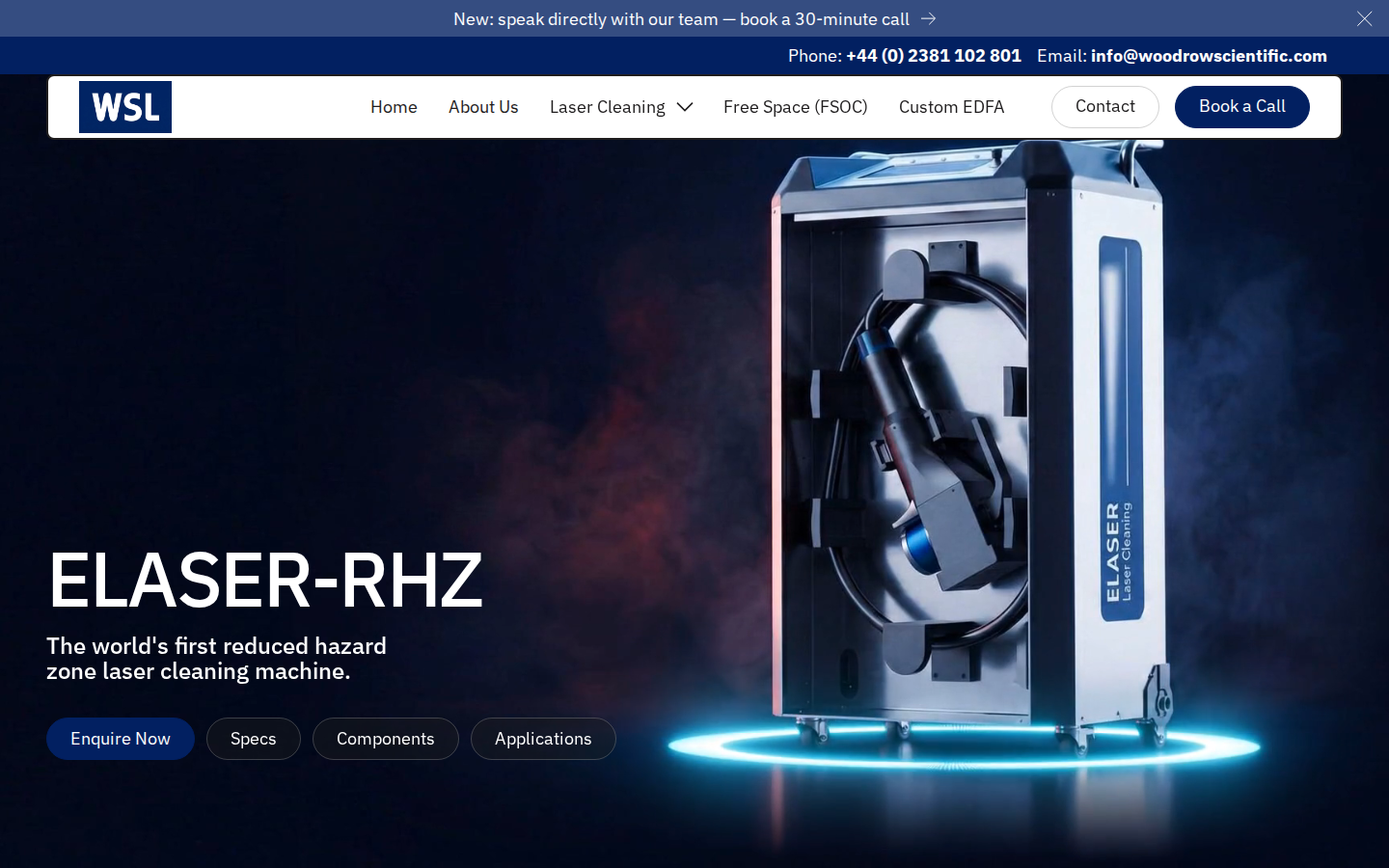
The ELASER and ELASER-RHZ are portable industrial fibre laser cleaning systems from Woodrow Scientific Limited, designed for professional and industrial operators who need to remove rust, oxides, mill scale, coatings, and weld discolouration from metals — and beyond — without chemicals, abrasives, or consumables. The ELASER-RHZ variant adds WSL's world-first patented reduced hazard zone technology, enabling laser cleaning in open workshops and public-facing settings where conventional laser cleaning has never been practical.
Pros:

World-first reduced hazard zone — clean in open settings.
Zero substrate loss — dimensions intact, less rework.
Widest surface compatibility: metals, stone, brick, masonry.
Consumable-free and chemical-free — no hazardous waste stream.
Cons:

Requires professional training — not suited to DIY use.
Best suited to industrial-scale operations, not single-part tasks.
Contact-for-quote — no instant price comparison.
How It Works
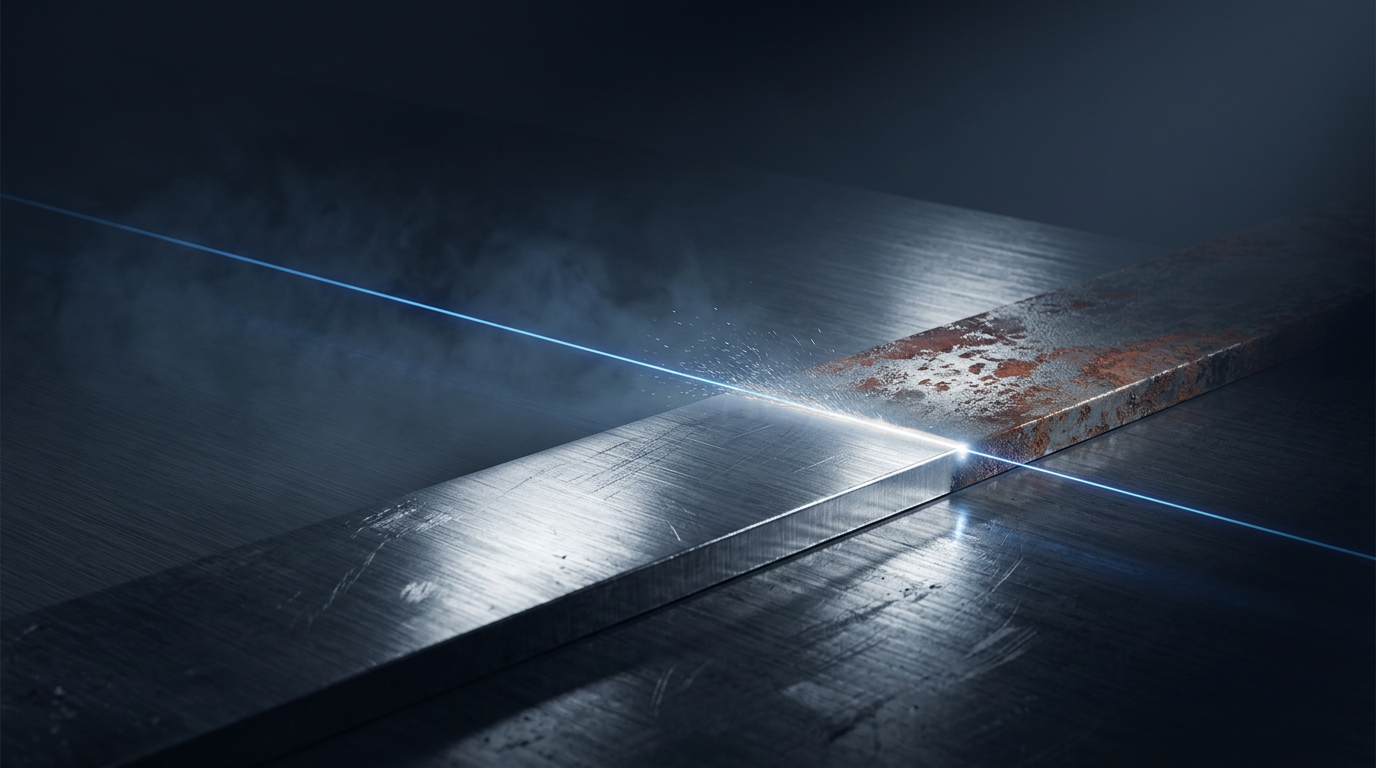
The ELASER uses laser ablation: a pulsed fibre laser beam is selectively absorbed by the contamination layer, which vaporises and is ejected, while the underlying metal reflects the beam and remains intact.
The practical result is zero substrate loss — no dimensional change, no surface scoring, and significantly less rework compared with abrasive or chemical methods.
What It Cleans
The ELASER's surface and contaminant range is the widest of any product on this list, covering metals and non-metals alike.
| Category | Examples |
|---|---|
| Metals | Steel, carbon steel, aluminium alloys, cast iron, copper, brass, bronze, titanium, galvanised |
| Non-metals | Stone, brick, concrete, masonry |
| Contaminants removed | Rust, oxides, mill scale, paint, powder coating, lacquer, primer, oil and grease, carbon and soot, tarnish, weld discolouration, mould, graffiti, adhesives and residues, release agents |
The breadth of surface and contaminant compatibility is a core differentiator and is clearer as a structured reference than as prose.
That combination of metal and non-metal capability means a single system can move between a steel fabrication job and a heritage masonry restoration without any change of chemistry or abrasive media.
Application Method
The ELASER is a single-operator portable system: a wheeled unit under 50 kg with a handheld scanner weighing under 3 kg and a delivery cable reaching up to 50 m.
Power is tunable from 0 to 100% via a touchscreen GUI, so one machine spans light surface oxides through thick industrial coatings — no swapping heads, no mixing chemicals, no adjusting abrasive grades.
The system is air-cooled and consumable-free, which means no compressor, no water circuit, and no media to clear up after the job.
WSL's patented reduced hazard zone technology collapses the laser hazard to a fraction of conventional size, enabling cleaning in open workshops, mixed-use facilities, and public-facing settings — without sealing off the area. No other laser cleaning system in the world offers this capability. It unlocks applications that conventional laser cleaning simply cannot access: live production environments, heritage sites open to visitors, and shared workspaces where a full area evacuation is not operationally viable.
WSL provides first-class laser cleaning safety and operation training alongside every system, and the ELASER carries both CE and UKCA certification.
The Manufacturer: Why It Matters
Woodrow Scientific Limited is the only UK-based laser cleaning manufacturer — designing, building, supporting, and improving its machines entirely in-house since 2012, backed by over 200 years of combined engineering experience.
That distinction matters in a market where many apparent manufacturers are actually resellers or importers rebadging third-party machines — a model that typically means slower spares, weaker support, and no genuine capacity to improve the product.
WSL also offers bespoke engineering and customisation capability for operators with specific requirements; contact WSL directly to discuss what is possible for your application.
Environmental Profile
Because the ELASER cleans with laser light alone, there are no chemicals, no abrasives, and no consumables — the only waste stream is captured fume particles from the ablated contamination.
That makes it the cleanest method on this list from an environmental and site-management perspective: nothing to dispose of, nothing to neutralise, and no media to contain or collect.
ELASER Pricing and TCO
The ELASER is the European cost leader among comparable industrial laser cleaning machines — competitively priced through WSL's in-house manufacturing efficiencies, not by compromising on specification or build quality.
On a total cost of ownership basis, the absence of consumables, reduced downtime, and lower rework rates make a compelling case against chemical stripping or abrasive blasting at scale.
Pricing is available on request — contact Woodrow Scientific Limited directly for a quote tailored to your application.
See the ELASER Laser Cleaning System
The ELASER removes rust, oxides, and mill scale with zero substrate loss. Explore the full product details or download the official datasheet to review specifications.
2
Evapo-Rust — Chelating Rust Remover
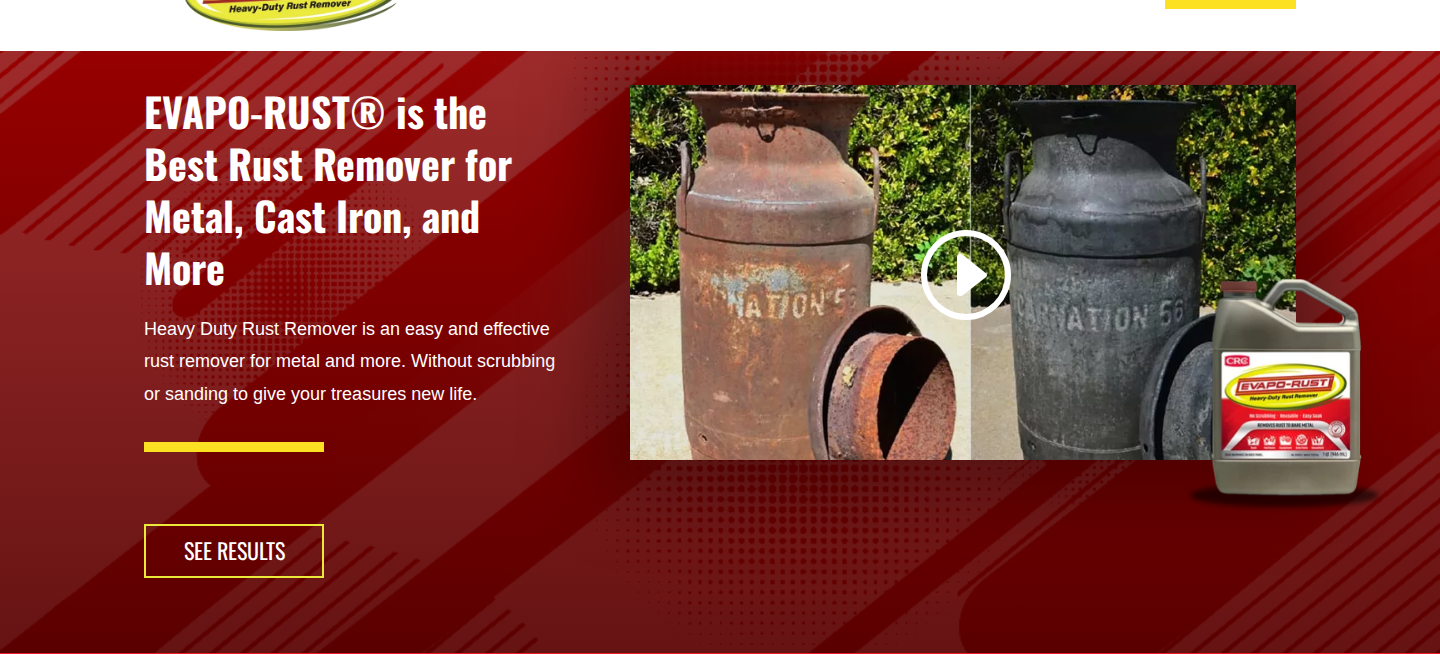
Evapo-Rust is a consumer-grade chelating rust remover that lifts iron oxide from steel and iron through selective chemistry — non-toxic, reusable, and effective on complex geometries — without acids, fumes, or specialist PPE.
Pros:
Selective chelation leaves base metal unetched.
Reaches pits and internal geometries abrasives cannot.
Non-toxic, non-corrosive, biodegradable — no fume hazard.
Reusable solution reduces effective per-use cost.
Cons:
Ferrous metals only — not for aluminium or brass.
Immersion required — large parts need the gel variant.
Pitting profiles remain after rust is cleared.
Slow on very heavy rust deposits.
How Evapo-Rust Works
Evapo-Rust uses selective chelation: its active ingredient bonds exclusively to the iron within iron oxide (rust), drawing it into solution.
Because iron atoms within steel are bound far more tightly than iron atoms within rust, the chelator targets the corrosion layer without attacking or etching the base metal beneath.
A secondary sulphur-bearing organic molecule then pulls the iron away from the chelator, freeing it to bond with more rust — which is why the solution remains active across multiple uses until it is fully exhausted.
Acid-based rust removers attack the metal surface indiscriminately, etching the substrate along with the rust. Selective chelation targets only the iron within iron oxide, leaving the underlying steel or iron dimensionally intact.
Surface Compatibility and Application
Evapo-Rust is suitable for steel and iron only — it is not recommended for magnesium or magnesium alloys.
Assemblies that combine ferrous parts with non-ferrous components (brass fittings, aluminium brackets) should be disassembled before soaking, or verified for compatibility, since the chelator is selective for iron in iron oxide but complex mixed assemblies warrant caution.
- Submerge the part: Place the item in undiluted Evapo-Rust solution. No dilution is required.
- Soak to suit the rust level: Light surface rust clears in around 30 minutes. Heavy or layered rust typically needs an overnight soak — and very thick deposits may require a second treatment.
- Rinse with water: Remove the part and rinse thoroughly with clean water. No neutralisation step is needed after treatment.
- Reuse the solution: Return the solution to its container. It remains active until exhausted, reducing the effective cost per use over time.
For vertical surfaces or large items that cannot be submerged, a gel variant is available — extending the product's reach beyond the standard immersion format.
Effectiveness: What It Can and Cannot Do
Soaking is particularly effective on complex geometries — pits, crevices, threaded bores, and internal passages that abrasive methods physically cannot reach are all accessible to the solution.
One limitation is worth stating plainly: Evapo-Rust removes rust, but it does not restore pitted metal surfaces.
Pitting is a dimensional loss in the metal itself — once the rust is gone, the pit profile remains, because the material has already corroded away.
Very heavy or thick rust deposits are also slower to treat; multiple soak cycles may be needed before the surface is fully clear.
Safety and Environmental Profile
- Non-toxic and non-corrosive: No acid handling, no fume hazard, and no neutralisation step required after treatment. The PPE burden is significantly lower than acid-based rust removers.
- Biodegradable and water-based: The formula carries no hazardous waste classification. Spent solution can typically be disposed of via drain — though readers should verify their local regulations before doing so.
- Standard good practice still applies: Gloves and eye protection are sensible precautions during any chemical treatment, even with a low-hazard product like this.
Evapo-Rust Pricing and Availability
Evapo-Rust is sold at consumer retail pricing and is available in sizes ranging from small litre bottles up to large-volume drums suited to trade or commercial use.
In the UK, it is stocked at Wickes, making it straightforward to source for DIY and light-trade operators without specialist supply accounts.
Because the solution is reusable until exhausted, the effective cost per treated part is lower than the upfront bottle price suggests — particularly for anyone working through a batch of tools or components.
Option 3
Wire Brushing and Angle Grinder Discs
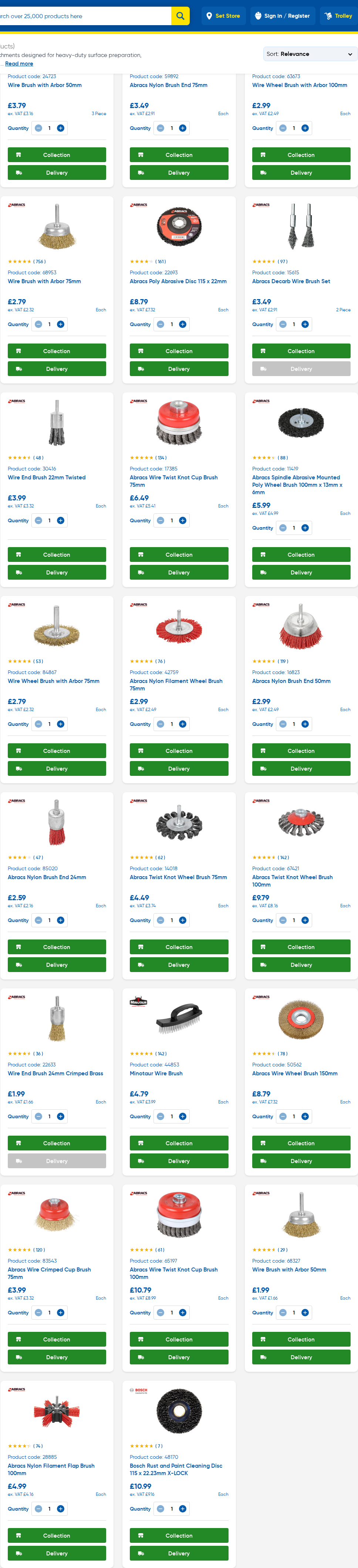
Wire brushes and angle grinder flap discs offer the most accessible and lowest-cost route to removing surface rust from carbon and mild steel — no chemicals, no specialist equipment, and tools available from under £5. The honest limitation is that abrasion affects the base metal surface and cannot reach internal geometry, so it suits flat, robust steel where precision is not a priority.
Pros:
Wire brushes from under £5.
No chemicals — no fumes or hazardous waste.
Manual brushing needs no power tool.
Tools stocked by every major UK retailer.
Cons:
Cannot reach internal cavities or recessed geometry.
Not suitable where dimensional precision matters.
Deep pitting can conceal active rust below.
Generates metal dust — PPE required.
Wire brushing and angle grinder discs occupy a specific, honest niche in metal oxidation removal: flat, robust carbon steel and mild steel where surface finish precision is not critical and the priority is speed, cost, and accessibility.
This is the method most tradespeople reach for first — a gate post, a plain bracket, a structural section before recoating — and in those contexts it is genuinely effective. The trade-off is that it affects the substrate: abrasion removes a thin layer of base metal alongside the rust, increases surface roughness, and is not appropriate where dimensional precision matters.
How It Works
Rotating wire filaments or abrasive particles physically abrade rust and scale from the surface — no chemical reaction, no heat generation in the metal itself.
The process raises surface roughness measurably: research from yihailasers.com indicates a wire brush typically increases Ra by 2–5 µm, which is useful context for anyone coating immediately afterwards but a genuine concern for precision surfaces.
Tool Types and Use Cases
The right tool depends on rust severity and the geometry of the surface. Makita's A-98653 is a knot-twist wire wheel designed for angle grinder use, rated for rust, scale, and weld splatter removal on tougher deposits.
- Crimped wire wheel brush: Best for light-to-medium surface rust on accessible flat areas. Gentler action, lower risk of gouging. Available from Toolstation from around £3.48 for a 50mm arbor-mounted version.
- Knot-twist wire wheel brush: Suited to heavier rust deposits and tougher scale. More aggressive cutting action. Abracs 75mm knot-twist wheels are available at Toolstation from £4.28; 100mm versions from £9.48.
- Aluminium oxide flap disc: Used for blending and finishing after initial rust removal, or on moderate rust where a smoother final surface is needed. DeWalt's DAAB7GPW05 (115mm) uses aluminium oxide abrasive for heavy corrosion and rust on metal. Abracs 115mm zirconium flap discs are available from Toolstation at £4.98 for a 2-pack.
Manual wire brushing requires no power tool at all — useful for spot treatment, tight access work, or situations where an angle grinder is unavailable. For larger areas, an angle grinder is the practical choice; they are widely owned in trade settings and inexpensive to hire.
Surface Compatibility
Carbon steel and mild steel are the natural home of this method. Stainless steel requires a dedicated stainless-rated brush — using a carbon steel brush on stainless will embed iron particles in the surface, preventing the passive film from reforming and causing the stainless to corrode, as confirmed by The Fabricator and HSE guidance.
Soft non-ferrous metals — aluminium in particular — require a dedicated stainless steel wire brush to avoid cross-contamination; Miller Welds' guidance on aluminium preparation makes clear that carbon steel brushes must never be used on aluminium surfaces. Copper and brass are similarly vulnerable to scratching and should be treated with appropriate caution.
Removal rate is approximately 1–5 m²/hour depending on rust grade and operator effort (yihailasers.com). The method cannot access internal cavities, threaded holes, or tight recesses, and it struggles with deep pitting — corrosion sitting below the surface level is easy to miss, leaving active rust under a surface that only looks clean. Laserstrip.co.uk notes this directly: that hidden rust is what bleeds back through a fresh coat months later. Prompt coating after brushing is important, as the burnished surface can entrap chlorides and promote re-rusting if left exposed.
Angle grinder use generates metal dust and dislodged rust particles; OSHA and Bosch Professional both identify eye and respiratory protection as minimum requirements, alongside gloves. Disc failure and kickback are real risks, manageable with correct technique and rated accessories.
On cost, this is the most accessible metal oxidation remover approach on this list: wire brushes from under £5, flap discs from around £2.50 each (in a 2-pack), no chemicals to buy, and no specialist equipment beyond an angle grinder most workshops already own. Brushes and discs are consumables that wear with use, so ongoing cost is real but modest.
Option 4
Electrolytic Rust Removal — DIY Electrochemical Method
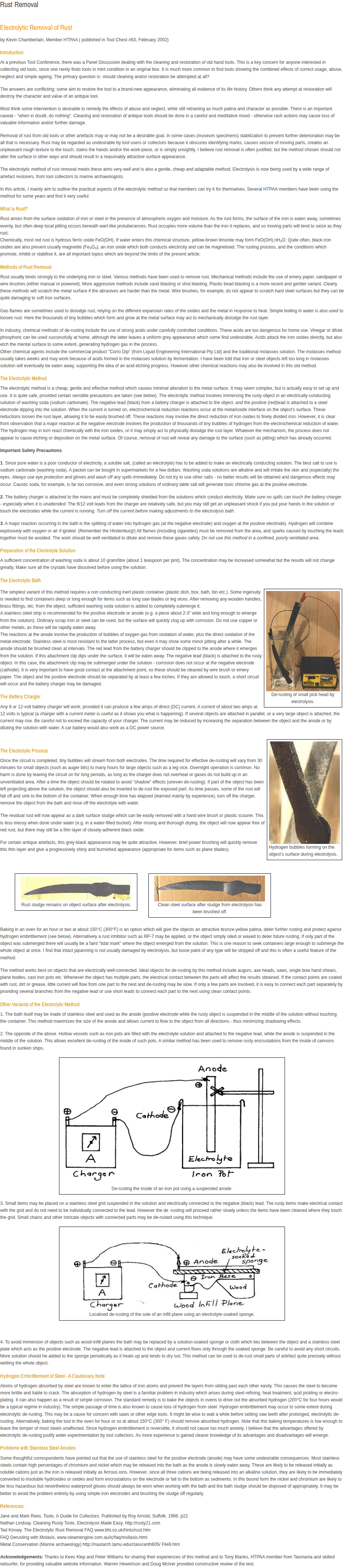
A DIY electrochemical method that uses DC current in a washing soda solution to reduce iron oxide back to iron — achieving zero substrate loss on ferrous parts without acids, abrasives, or chemical fumes.
Pros:
Washing soda and a battery charger — minimal outlay.
Zero substrate loss — dimensions and profile preserved.
No acid handling and no chemical fumes.
Reaches pits and internal geometries by immersion.
Cons:
Ferrous metals only — not for aluminium or brass.
Requires full immersion — impractical for large structures.
Slow on large or heavily corroded parts.
Post-treatment coating required to prevent flash-rusting.
Electrolytic rust removal is the only non-laser method on this list that achieves zero substrate loss — making it the strongest choice for precision ferrous parts, cast iron components, vintage machinery, and detailed metalwork where any dimensional change is unacceptable.
Unlike abrasive methods that grind away the surface, or chelating soaks that work through chemical bonding, this method uses electrochemical reduction to convert iron oxide back toward iron at the metal surface — leaving the underlying base metal intact.
How It Works
The rusty part is submerged in an alkaline electrolyte solution (washing soda — sodium carbonate — dissolved in water) and connected as the cathode (negative terminal) of a DC circuit, with a sacrificial steel or stainless steel anode completing the circuit.
Current flow drives electrochemical reduction reactions at the metal/oxide interface, loosening the rust layer so it can be brushed away after treatment — the iron oxide is reduced rather than etched or abraded, so the base metal is preserved.
A residual black oxide layer (magnetite) typically remains on the surface after treatment; this brushes off easily and is a normal part of the process.
Setup and Application
The setup is straightforward and achievable with widely available materials — no specialist tools are required beyond a DC power source.
- Container: A plastic tub or bucket large enough to fully submerge the part — metal containers are not suitable.
- Electrolyte solution: Washing soda (sodium carbonate) dissolved in water at approximately 10g per litre.
- DC power source: A battery charger at 6–12V is the standard choice for DIY use.
- Sacrificial anode: A piece of steel or stainless steel connected to the positive terminal — consumed during the process, not the part being treated.
- Wire leads: To connect the part (cathode, negative) and anode (positive) to the power source — connection clips must not be submerged.
Treatment time ranges from around 30 minutes for small or lightly corroded items to overnight for large or heavily corroded parts.
For readers who prefer a ready-made solution over a DIY build, commercial electrolytic rust removal kits — such as those from Creworks — are available and package the core components together.
Effectiveness and Limitations
The headline strength is zero substrate loss: the original surface profile and dimensions are preserved as closely as any method available, which is why this approach is favoured for precision tools, antique hardware, and cast iron cookware restoration.
Full immersion means the electrolyte reaches into pits, crevices, and internal cavities that abrasive methods simply cannot access — an important practical advantage for complex or detailed parts.
The honest limitations are equally clear: deep pitting profiles remain after treatment (the rust is removed, but the physical damage is not reversed), and the part must be dried and coated or primed immediately after removal to prevent flash-rusting.
This is not a method for large-scale or time-critical work — the slow treatment rate and immersion requirement make it impractical for structural steel or high-volume applications.
Electrolytic rust removal works on steel and iron exclusively. It is not suitable for aluminium, copper, brass, bronze, or other non-ferrous metals. Assemblies that combine ferrous and non-ferrous components — such as a cast iron part with brass fittings — must be fully disassembled before treatment, as the process can affect non-ferrous elements.
On safety: hydrogen gas is generated at the cathode during electrolysis, so working in a well-ventilated area is essential. The alkaline electrolyte solution can irritate skin, so gloves are recommended. The electrical risk at 6–12V DC is low, provided connection clips are kept out of the solution.
The environmental profile is one of the better ones on this list — washing soda solution is low-hazard, there are no chemical fumes under normal operation, and consumable waste is minimal. Spent electrolyte should be neutralised before disposal.
On cost, this is the lowest-cost route to zero substrate loss available: washing soda costs a few pounds per packet, and a basic battery charger is the only significant outlay if one is not already owned. Commercial kits offer a packaged alternative for those who prefer it.
Laser Cleaning: Precision Without Substrate Loss
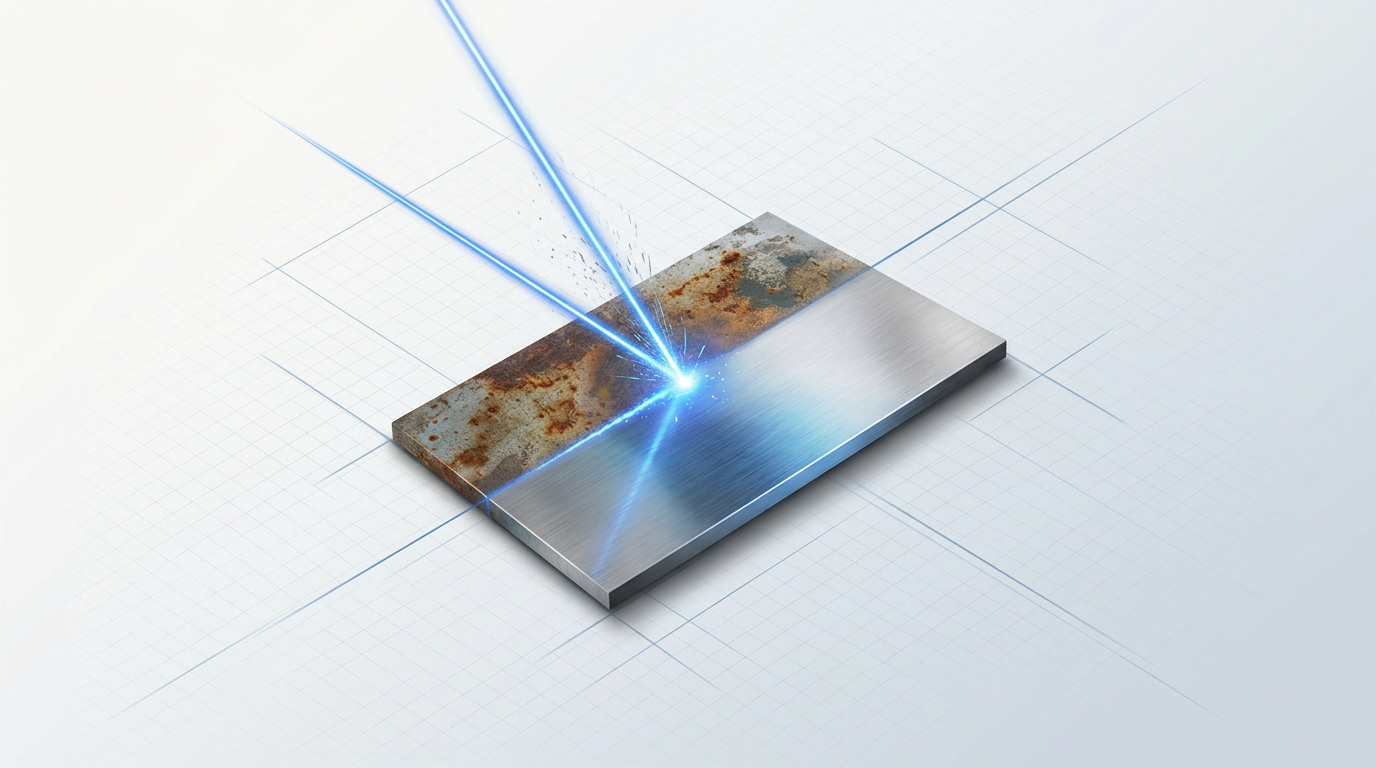
Where electrolytic removal reaches its limits, laser cleaning takes over. The ELASER removes rust and oxides from ferrous parts with zero substrate loss — no immersion, no chemicals, no dimensional change.
Option 5
Abrasive Blasting — Sandblasting and Shot Blasting
Abrasive blasting — encompassing sandblasting and shot blasting — is the industrial-scale standard for removing rust and mill scale from structural steel, achieving near-white metal cleanliness at throughput rates no other method on this list can match. It is suited to large flat steel surfaces where throughput matters and the substrate can tolerate material removal and increased surface roughness.
Pros:
Shot blasting throughput: up to 50 m²/hour.
Achieves SSPC-SP 10 near-white metal cleanliness.
Angular anchor profile improves organic paint adhesion.
Shot blasting operating cost: $1–$3/m².
Cons:
Not suitable for precision, thin, or non-ferrous metal.
Significant safety infrastructure and PPE required.
Removes 25–75 µm of substrate — unsuitable where dimensions matter.
Sandblasting waste volumes are heavy; contaminated media may be hazardous.
Abrasive blasting is the dominant surface-preparation method for structural steel, shipbuilding, and heavy infrastructure — chosen not for its precision, but for its throughput and the quality of surface cleanliness it can achieve on large flat steel.
The two main variants — sandblasting and shot blasting — share the same basic principle but produce different surface outcomes, and the distinction matters when specifying a method.
Sandblasting vs Shot Blasting: Key Differences
Sandblasting propels mineral or synthetic abrasive particles at 60–120 m/s against the surface. The abrasive fractures on impact, mechanically stripping rust and scale and creating a sharp, angular anchor profile well-suited to organic paint adhesion.
Shot blasting uses spherical metallic shot rather than angular grit. The shot peens the surface rather than cutting it, producing a dimpled profile with lower surface roughness (Ra) than angular grit blasting — and the shot is recovered, cleaned, and recycled after each pass.
Both methods can achieve SSPC-SP 10 near-white metal cleanliness, the standard widely specified for structural steel before protective coating. Removal rates are 10–30 m²/hour for dry abrasive blasting and 20–50 m²/hour for shot blasting — the fastest figures on this list for large flat steel.
The trade-off for that throughput is substrate loss: the process removes 25–75 µm of base material and raises surface roughness significantly, making it unsuitable for precision machined surfaces, thin metal, aluminium, copper, or any component where dimensional tolerance matters.
Safety and Regulatory Requirements
Silica sand blasting carries a serious respiratory hazard. Under UK COSHH Regulations (Schedule 2, Reg. 4(1)), the use of sand or any substance containing 1% or more free silica for blasting of articles is prohibited. The EU-OSHA confirms that silica-containing abrasive blast material is similarly forbidden in most European countries.
In practice, operators use silica-free substitute abrasives such as steel grit, garnet, copper slag, or crushed glass. Regardless of media choice, the safety requirements for professional blasting are substantial.
- Respiratory protection: An air-fed abrasive blasting helmet (UK APF of at least 40) with breathing-quality supplied air is required for the blaster. Supporting workers nearby require RPE with an APF of at least 20.
- Containment: Sheeting and exclusion zones are required to prevent abrasive and dust dispersal. Access must be restricted to authorised, trained personnel.
- PPE: Full blasting suits or coveralls, protective gloves, and appropriate footwear are required. Clothing must be laundered by a contract laundry — not taken home.
- Noise hazard: Blasting operations generate significant noise. Hearing protection is required alongside the other PPE listed above.
These are well-understood professional requirements, not unusual burdens — but operators should verify the specific regulations applicable in their jurisdiction before commencing work.
Abrasive Blasting Costs
Cost varies considerably by method, scale, and access tier. The table below summarises the main cost reference points from US and UK sources.
| Method / Tier | Typical Cost | Notes |
|---|---|---|
| Professional sandblasting (US) | $1.50–$7 per sq ft | Dry sandblasting; varies by intensity, media, and surface condition (Angi) |
| Professional sandblasting (UK) | £99–£150 per m² | Indicative range; varies by job size and location (Checkatrade) |
| Shot blasting (operating cost) | $1–$3 per m² | Lowest operating cost of any method achieving SSPC-SP 10; major capital investment required |
| Shot blasting (equipment) | £50,000–£200,000+ | Dedicated blasting rooms and automated media recovery systems |
| Benchtop sandblasting cabinet | From approx. $100–$120 | Entry-level 25-gallon cabinets; suits small shop-scale component work (Amazon) |
Comparing cost structures across sandblasting, shot blasting, and benchtop cabinets helps readers understand which access tier is relevant for their scale of work.
Shot blasting's operating cost of $1–$3/m² is the lowest of any method that achieves commercial blast standard — but the capital cost of dedicated equipment puts it firmly in the industrial tier.
Benchtop sandblasting cabinets represent a genuinely different access point: entry-level 25-gallon units are available from around $100–$120 on Amazon, making small shop-scale work on individual components accessible without industrial infrastructure.
On the environmental side, sandblasting generates heavy volumes of used abrasive, dislodged rust, and paint debris. Paint-contaminated abrasive may be classified as hazardous waste, adding a disposal cost and regulatory consideration. Shot blasting's media recovery system reduces media consumption substantially compared to disposable abrasive, which is a meaningful practical advantage at scale.
Conclusion
Which metal oxidation remover is right for you?
The right choice comes down to three things: whether your metal can tolerate any substrate loss, the scale and geometry of the job, and what cost structure makes sense — precision or high-value parts point toward laser cleaning or electrolytic removal, small ferrous components suit a chelating soak, and large structural steel is where abrasive blasting earns its place.
For professional operators where laser cleaning is the answer, the ELASER / ELASER-RHZ from Woodrow Scientific Limited is the benchmark — contact WSL to discuss your requirements and get a quote.
Frequently asked questions about metal oxidation removers
Common questions about removing rust and oxidation from metal, answered.
There are five main approaches to removing oxidation from metal, and the right choice depends on three variables: the metal type, the scale of the job, and whether the substrate can tolerate surface removal. No single method suits every situation. Laser ablation is professional-grade, works across the widest range of metals, and removes the oxide layer without touching the base metal. Chelating chemical soaks are consumer-accessible and non-etching, but limited to ferrous metals. Mechanical abrasion (wire brushing, angle grinder discs) is the most accessible option for robust flat steel, though it does remove a thin layer of base metal. Electrolytic reduction achieves zero substrate loss on ferrous metals and is DIY-capable with basic equipment. Abrasive blasting (sandblasting or shot blasting) is the high-throughput choice for large-scale structural steel preparation.
Yes, vinegar can dissolve light rust on ferrous metals. As a dilute acetic acid, it reacts with iron oxide to form soluble iron acetate, which can then be rinsed away. It is low-cost and readily available. However, it comes with meaningful limitations. Vinegar etches the metal surface to some degree, removing a thin layer of base metal alongside the rust. After treatment, the metal must be rinsed thoroughly and dried promptly to prevent flash-rusting, which can set in quickly. It is not suitable for non-ferrous metals such as aluminium, copper, or brass, and should be avoided on precision surfaces where dimensional tolerance matters. It is also a slow, low-throughput method. For anything beyond very light surface rust, a chelating rust remover or one of the other verified methods covered on this page will deliver better results without the etching trade-off.
The oxide layer can be removed, but fully restoring the original metal surface is not always possible. The key distinction is between removing the oxide and repairing the underlying substrate damage — pitting and dimensional loss — that severe corrosion causes. Those are two different problems. Methods like laser cleaning and electrolytic derusting come closest to reversing oxidation in practical terms: both remove the oxide layer with minimal or zero substrate loss, preserving the original surface profile as closely as possible. Acid-based and abrasive methods also remove oxidation, but they take base metal with them, altering the surface profile in the process. Deep pitting from advanced corrosion cannot be reversed by any cleaning method. Cleaning exposes it; it does not repair it. That dimensional loss is permanent. The practical takeaway: act early. The less corrosion has progressed, the more of the original surface a good removal method can preserve.
Baking soda has two distinct uses in oxidation removal contexts, and it is worth separating them. As a mild abrasive paste (mixed with water), it can address light surface tarnish on accessible metal. It is gentle enough to avoid scratching softer metals, but it is not effective on significant rust — it simply lacks the chemical strength to dissolve iron oxide. As an electrolyte in DIY electrolytic rust removal, baking soda can be dissolved in water to create a conductive solution for the process. However, washing soda (sodium carbonate) is generally preferred for this purpose: it dissociates more fully in water and conducts electrical current more effectively, making the electrolysis faster and more efficient. Baking soda is not a standalone chemical rust remover for meaningful oxidation. It has neither the acid strength to dissolve iron oxide nor the chelating chemistry to bind and lift it from the surface.