

Introduction
Starlink, Amazon Leo, and Eutelsat OneWeb are the names most people associate with LEO broadband — the operators who own the constellations and sell the connectivity.
Behind them sits a less visible but equally important landscape: the specialist companies that design, manufacture, and supply the technology those constellations run on.
This page maps that supply chain across five technology groupings: satellite manufacturing, optical and laser links, ground infrastructure, user terminals and phased-array antennas, and propulsion and components.
Each entry covers what the company supplies, the technology area it serves, and where it sits in the LEO architecture — selected because it is a real, verifiable supplier of a specific LEO technology.
TL;DR
The LEO supply chain is not a single market — it is five distinct subsystem categories, each with its own supplier set and procurement logic. Knowing which companies build each part, and what separates them technically, is what allows engineers and procurement teams to make informed decisions rather than defaulting to the most familiar name.
This article covers:

Five LEO technology supplier categories explained
Major LEO constellation operators as context
Optical and laser inter-satellite link technology
Ground infrastructure and user terminal suppliers
Procurement criteria for evaluating LEO suppliers
What each supplier entry covers and includes
How a LEO Satellite System Is Structured
The operators — Starlink, Amazon Leo, Eutelsat OneWeb — are the names most people know, but each constellation depends on a layered supply chain of specialist companies whose products never carry the operator's brand. Understanding that supply chain means understanding five distinct technology subsystems, each with its own engineering requirements, qualification standards, and vendor landscape.
The scale of what those suppliers are now serving is substantial. Starlink's network update page reports more than 7,800 satellites in low Earth orbit, with each spacecraft equipped with optical inter-satellite links running at up to 200 Gbps. Amazon Leo has deployed 396 satellites towards an FCC-authorised constellation of 3,236 spacecraft, orbiting between 590 and 630 km, with optical ISLs tested at 100 Gbps already proven on its prototypes. Eutelsat's OneWeb Gen 1 constellation comprises 654 satellites flying at 1,200 km across 12 orbital planes, with 440 additional satellites on order from Airbus Defence and Space.
That volume of hardware in orbit — and the ground infrastructure required to support it — represents procurement demand across five clearly separable categories.
The Five Subsystems of a LEO Constellation
- Satellite bus and manufacturing: The physical platform: structure, power, thermal management, and onboard computing. Prime contractors design and integrate complete space vehicles to operator specifications.
- Optical and laser ISLs: Laser communication terminals mounted on satellites that form a mesh network, routing data between spacecraft without a ground hop at every step.
- Ground infrastructure: Gateways, optical ground stations, and ground-station-as-a-service networks that connect the constellation to terrestrial networks via RF and optical ground links.
- User terminals and phased-array antennas: The equipment end users deploy to access LEO broadband. Electronically steered, flat-panel terminals are the dominant technology direction for LEO.
- Propulsion and attitude control: Electric thrusters and attitude-control systems that raise orbit, maintain station-keeping, execute collision avoidance, and deorbit satellites at end of life.
These categories are not interchangeable. A manufacturer of satellite buses does not supply optical ground-link amplifiers; a ground network operator does not supply user terminals. Each subsystem has its own qualification regime, integration dependencies, and supplier ecosystem — which is precisely why procurement teams treat them as separate sourcing exercises.
The most consequential structural shift across the supply chain is the move away from the RF bottleneck. Radio frequency spectrum is congested, licensed, and subject to coordination delays that slow deployment; optical links carry far more data and require no spectrum licence. As Satellite Today's analysis of the optical communications market notes, the question for high-throughput LEO operators is no longer whether to adopt laser communications but how quickly to scale them. Both ISLs and optical ground links are moving from optional capability to baseline architecture in high-capacity constellations.
The second procurement criterion gaining weight across all subsystems is software-definability. LEO standards — including SDA optical terminal interoperability specifications, CCSDS protocols, and proprietary operator waveforms — are still maturing, and equipment that can be reconfigured without hardware changes protects an operator's investment as those standards evolve.
In space-adjacent supply chains, the cost of a component failure or an incompatible interface is exceptionally high. Suppliers that design, build, and support their own technology can diagnose problems faster and configure more deeply than catalogue resellers — a distinction that carries real weight at procurement.
With that architecture in view, here are five companies supplying each of those subsystems — and what makes each one worth understanding.
Product 1
Woodrow Scientific Limited
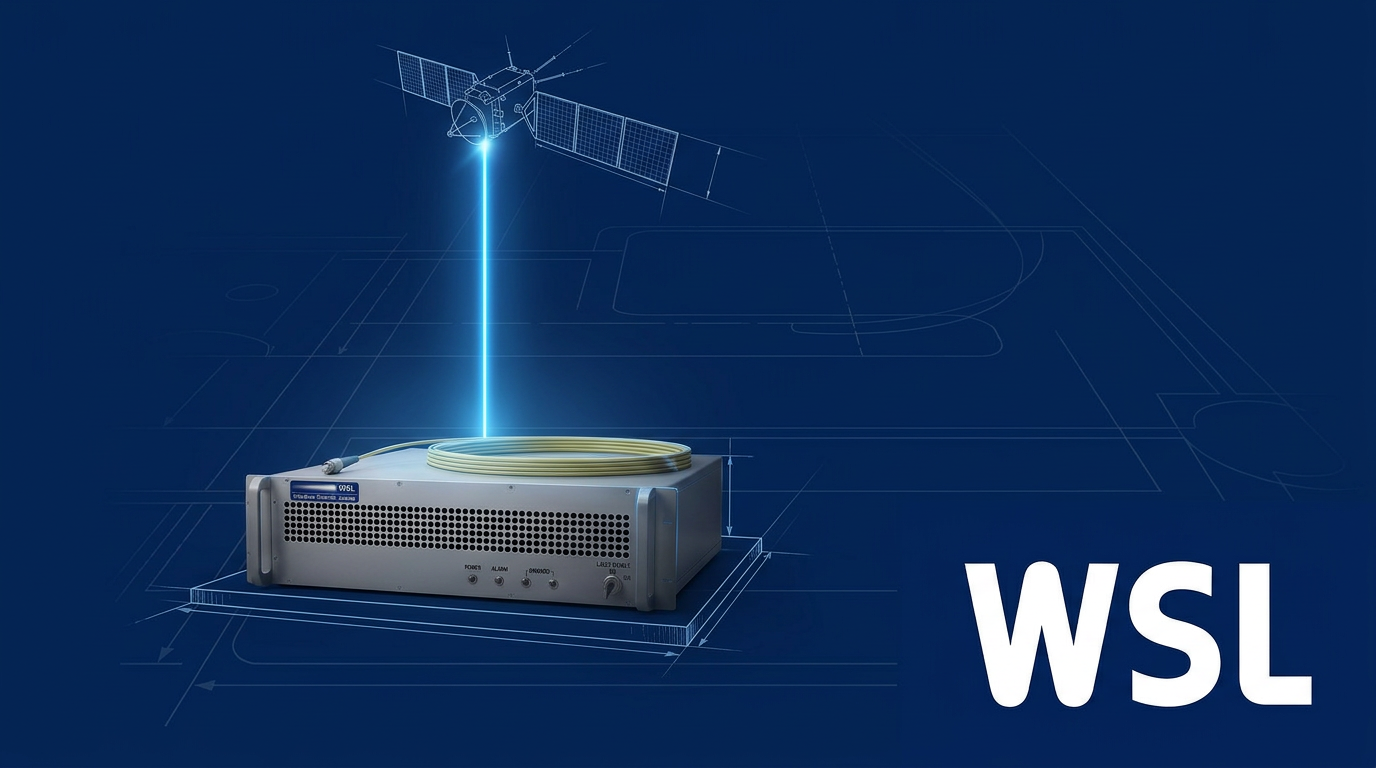
WSL supplies high-power EDFA uplink amplifiers for optical ground stations — nesting beacon and data in a single beam, configured to your ground station across both hardware and software, built in-house in Southampton.
Pros:

Single beam carries beacon and uplink data
Hardware and software configured per ground station
In-house manufacturer with direct engineering support
Switchable to CCSDS or SDA standards at power
Cons:

Class 4 laser requires site safety procedures
Builds to order; not available off-the-shelf
Woodrow Scientific Limited (WSL) occupies a specific and consequential position in the LEO ground segment: it supplies the optical amplifier that sits between the ground-station telescope and the satellite, providing the amplified uplink beam for both acquisition, tracking, and data transmission.
That amplifier is the EDF-UL — an erbium-doped fibre amplifier platform designed and built in-house at WSL's Southampton facility, the city where the EDFA technology was pioneered.
The EDF-UL nests the tracking beacon and uplink data in one amplified beam — amplitude modulation carries the beacon low and the data above it. Three operating modes (acquisition, data-transmission, and tracking) are handled by a single unit, with no separate beacon hardware required.
This single-beam architecture means the tracking beacon and uplink data share one amplified path, with three distinct operating modes — acquisition, data-transmission, and tracking — served by a single module.
End-to-End Configurability: Hardware and Software
WSL configures the EDF-UL across both layers — the physical build and the control software — to the client's ground station specification.
On the hardware side, that means band selection (C-band, L-band, or dual-band from a single source), output power, direction (beacon-only or bi-directional), 2- and 4-emitter array configurations with multi-station synchronisation, an external optical input for third-party transmitters, ±2 nm wavelength tunability, and a choice of air or water cooling.
On the software side, WSL's Modulation-on-Demand applies software-selectable amplitude modulation throughout the link: square or sinusoidal waveforms, adjustable frequency and modulation index, beacon and tracking tone combined with data modulation via TTL, and switchable compliance with CCSDS or SDA standards at high power across C/L-band.
This depth of tailoring across both layers is what in-house design and manufacture makes possible — it cannot be replicated by suppliers working from a fixed module range or catalogue build.
EDF-UL EDFA Platform: Key Specifications
The table below covers the core parameters procurement teams and integration engineers typically evaluate first.
| Parameter | EDF-UL Specification |
|---|---|
| Output power | 10 W average (higher on request) |
| Wavelength | 1550 nm (eye-safe) |
| Beam quality | M² < 1.1 |
| Wavelength tunability | ±2 nm standard |
| Uplink data rate (OOK, integrated seed) | Up to 10 Mbps |
| External OOK data rate | Up to 20 Mbps |
| Stimulated Brillouin Scattering | Managed at full power |
| Form factor | 3U 19" rack |
| Weight | < 20 kg |
| Power supply | 110–250 VAC; < 250 W consumption |
| Interfaces | USB, RS232, Parallel I/O |
| Laser class | Class 4 (IEC 60825-1) |
| Certifications | CE, UKCA |
Key EDF-UL EDFA platform specifications for ground-station integration and procurement evaluation.
The 1550 nm wavelength sits in the eye-safe band — it carries a higher eye-damage threshold than 1064 nm systems, though Class 4 classification means laser-safety procedures and appropriate eyewear remain required on site.
Standards Compatibility and Investment Protection
The LEO optical ground-link standards landscape continues to evolve, with CCSDS and SDA defining competing frameworks that programmes must navigate.
Modulation-on-Demand addresses this directly — the EDF-UL is switchable between CCSDS and SDA compliance at high power, so the amplifier remains compatible as the standards picture matures without requiring a hardware replacement.
For ground-station operators building multi-site or high-availability architectures, the EDF-UL also supports 2- and 4-emitter arrays with synchronisation and is compatible with multi-station diversity network deployments.
Woodrow Scientific Limited: Manufacturer Credentials
WSL was founded in 2012 by a fibre-laser specialist with a PhD from Southampton's Optoelectronics Research Centre — the institution where the EDFA was invented — and more than 25 years of field experience.
The company holds 10 patents and counting, and its engineering team carries more than 200 years of combined experience across fibre amplifier design, build, qualification, and support.
Because WSL designs and manufactures its own amplifiers, it can support integration more deeply than a reseller: in-house engineering means faster problem resolution, the ability to evolve the product as programme needs change, and direct access to the people who built it.
Woodrow Scientific Limited Procurement
The EDF-UL is quoted per configuration and ships worldwide direct from Southampton.
Requirements that go beyond the published specification — a different environment, power level, or form factor — are assessed directly with WSL's engineers, who treat each one as a bespoke programme question rather than a boundary condition.
The EDFA Built for LEO Ground-Link Uplink
The EDF-UL-10 is WSL's free-space optical communications amplifier, delivering high average output power with on-demand modulation. Download the datasheet to see the full specifications.

Product 2
Mynaric
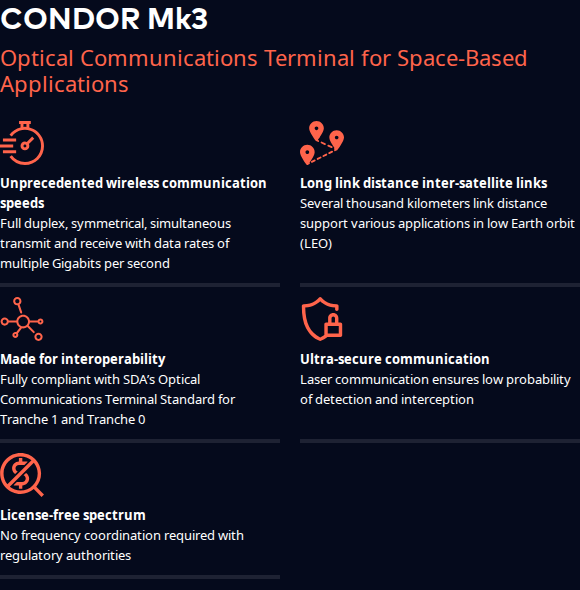
Mynaric manufactures the CONDOR family of optical communications terminals for LEO inter-satellite links, built for serial manufacturing and compliant with SDA OCT Standards across Tranche 0, Tranche 1, and v3.1.
Pros:
SDA OCT compliant: Tranche 0, 1, and v3.1
Built from ground up for serial manufacturing
Selected for SDA Tranche 1 and DARPA Space-BACN
Licence-free spectrum; no ITU or FCC coordination
Cons:
Focused on space-segment ISL terminals only
Terminal pricing not publicly listed
Mynaric produces the CONDOR family of optical communications terminals (OCTs) — space-segment hardware that mounts on LEO satellites and establishes laser links across the constellation mesh, connecting satellites to each other in both intra-plane and cross-plane configurations.
Where ground-segment optical equipment handles the uplink path between the ground station and the satellite, the CONDOR terminals operate entirely on orbit, forming the inter-satellite link (ISL) fabric that allows a constellation to relay data across the network without touching the ground.
CONDOR Mk3 and Mk3.1 Specifications
Mynaric currently offers two variants in the CONDOR line: the CONDOR Mk3, the production-series terminal, and the CONDOR Mk3.1, an evolved variant targeting SDA Tranche 2 and commercial programmes.
| Parameter | CONDOR Mk3 | CONDOR Mk3.1 |
|---|---|---|
| Data Rate (standard) | 0.313 to 2.5 Gbps | 0.313 to 2.5 Gbps |
| Extended Data Rate Options | 10 Gbps (OOK) | 10 Gbps (OOK); 100 Gbps (DP-QPSK) |
| Link Distance | > 6,500 km | > 6,500 km (supports > 10,000 km) |
| Aperture Diameter | 80 mm | TX: 85 mm / RX: 90 mm |
| Operational Wavelength | 1553/1536 nm band | 1553.33/1536.61 nm band (C-band tunable for 100 Gbps) |
| Optical Tx Power | 4 W (at end of life) | 4 W (at end of life) |
| SDA OCT Standard Compliance | Tranche 0 and Tranche 1 | v3.1 |
| OCC/Optical Head Architecture | One OCC controls multiple Optical Heads | – |
Key specifications for the CONDOR Mk3 and CONDOR Mk3.1 terminals. The Mk3.1 introduces separate TX/RX apertures and extended link distance support alongside the updated SDA compliance version. – not publicly listed.
Mynaric describes the Mk3.1 as delivering significant SWAP (size, weight, and power) advantages over earlier configurations, alongside the expanded data rate and link distance capabilities shown above.
Design for Serial Manufacturing
Mynaric describes both CONDOR variants as built from the ground up for serial manufacturing, rapid satellite integration, and mass deployment — a stated design priority that distinguishes them from terminals developed primarily as engineering prototypes.
Northrop Grumman's selection of Mynaric for the SDA Tranche 1 programme was publicly attributed in part to Mynaric's production capabilities, with Northrop Grumman noting Mynaric's "niche in this high-production, lower-cost-target range."
Government Programme Heritage
Mynaric has been selected as the optical terminal supplier for several named U.S. government LEO programmes.
- SDA Tranche 1 Transport Layer (Northrop Grumman): Mynaric was selected as Northrop Grumman's sole laser communication supplier for 42 Transport Layer satellites, with CONDOR Mk3 terminals passing optical verification and Phase 1 interoperability testing at the Naval Research Lab.
- SDA Tranche 1 Tracking Layer (Northrop Grumman and Raytheon): Mynaric supplied CONDOR Mk3 terminals to Northrop Grumman's 14 Tracking Layer satellites and was separately selected by Raytheon Technologies to supply 21 terminals for Raytheon's seven-vehicle Tracking Layer constellation.
- DARPA Space-BACN Phase 2: In January 2024, Mynaric was selected as a key development partner for Phase 2 of DARPA's Space-Based Adaptive Communications Node programme, which aims to build a scalable, reconfigurable optical communications terminal interoperable across multiple ISL standards.
The CONDOR Mk3 also passed interoperability testing with terminals from other vendors, confirming cross-supplier compatibility within the SDA's Proliferated Warfighter Space Architecture.
Security and Spectrum Characteristics
Laser communication inherently provides low probability of detection and interception relative to RF links: the narrow beam footprint makes eavesdropping physically difficult, a characteristic Mynaric highlights as relevant for government and defence constellation programmes.
The CONDOR terminals operate in licence-free spectrum, requiring no ITU or FCC frequency coordination — removing the lengthy approval timelines and spectrum-allocation constraints that apply to RF-based ISL alternatives.
The CONDOR product line is scoped to space-to-space inter-satellite links and space-to-air/ground laser scenarios; it is a space-segment procurement item for satellite manufacturers and constellation programme managers rather than for ground-station operators.
Mynaric is headquartered in Munich, Germany, with additional offices in Los Angeles, California, and Washington, D.C.
Product 3
MDA Space
MDA Space is a prime contractor delivering complete LEO satellites under the AURORA software-defined platform, with active constellation programmes for Telesat, Globalstar, and EchoStar.
Pros:
Software-defined satellites enable dynamic in-orbit reconfiguration
185,000 sq ft facility built for constellation-scale volume
Active prime contractor across three major LEO programmes
AURORA BLACK variant for government and defence procurement
Cons:
High-volume manufacturing ramp carries inherent execution risk
Satellite delivery schedules depend on programme milestones
Where the previous entries in this list cover specialist subsystems, MDA Space operates at the top of the LEO supply chain: it is a prime contractor responsible for the design, manufacturing, assembly, integration, and testing of complete satellites delivered to constellation operators.
Headquartered in Brampton and Montréal, Canada, MDA Space is listed on both the TSX and NYSE under the ticker MDA.
The AURORA Platform
MDA's AURORA™ is a software-defined digital satellite product line encompassing complete satellites, digital payloads, beamforming direct radiating arrays, onboard processors, and constellation software — a fully integrated portfolio rather than a collection of discrete components.
- Software-defined architecture: Dynamic in-orbit reconfiguration allows coverage and bandwidth to be adjusted after launch, maximising delivered capacity as demand patterns shift.
- Regenerative onboard processor: A scalable processor with a built-in software-defined packet router optimises communication routes between user links, gateway links, and optical inter-satellite links.
- Digital beamforming DRAs: Electronically-steered direct radiating arrays with native beam hopping, compliant with DVB standards, deliver signals where and when they are needed.
- Constellation software suite: Onboard flight telecom software, a real-time digital payload simulator, and a scalable constellation network manager are included as part of the integrated platform.
In July 2025, MDA announced it had digitally formed and steered multiple beams with its Ka-band direct radiating array using direct sampling — a milestone MDA describes as an industry first.
The direct-sampling approach avoids intermediate frequency conversion, which MDA states results in lower satellite mass, reduced power consumption, and improved beamforming flexibility.
Active LEO Programmes
MDA holds prime contractor positions across three active LEO constellation programmes, providing the clearest evidence of its delivery capability at scale.
| Programme | Operator | Satellites Under Contract | Contract Value | Status |
|---|---|---|---|---|
| Telesat Lightspeed | Telesat | 225 | $474M CAD (Aug 2026 expansion increment) | In production |
| Globalstar next-gen LEO | Globalstar | 50+ | $1.1B CAD | First 8 launched Aug 2026 |
| EchoStar 5G NTN D2D | EchoStar | 100+ (initial); 200+ with options | US$1.3B initial (approx. C$1.8B) | Delivery planned 2028 |
Active AURORA constellation programmes by operator, satellite count, contract value, and current status. The Telesat contract value shown is the August 2026 expansion increment awarded to MDA Space.
The Globalstar programme marked a concrete milestone in August 2026: the first eight replenishment satellites — developed, integrated, and tested in Montréal — were successfully launched aboard a SpaceX Falcon 9, making them the first satellites delivered by MDA Space as a prime contractor for commercial communications constellations.
The EchoStar programme, which MDA describes as the world's first open-RAN direct-to-device LEO constellation, adds a 3GPP 5G NTN-compliant product to the AURORA portfolio alongside the broadband line.
MDA also supplies antennas as a subsystem vendor within Airbus-led programmes. In April 2026, Airbus contracted MDA to design and build more than 880 Ka-band steerable antennas and 440 Ku-band user replacement antennas for the OneWeb LEO constellation extension, to be integrated into Arrow satellites manufactured by Airbus.
For procurement teams evaluating the AURORA platform's optical communications integration: TESAT SCOT80 optical terminals are part of the AURORA supply chain, selected by MDA for the Telesat Lightspeed programme.
Manufacturing Facility
MDA inaugurated a dedicated high-volume satellite manufacturing facility in Montréal on 8 May 2026, completing the 185,000-square-foot expansion in under two years from groundbreaking to operational clean rooms.
The facility is designed to support production of up to 400 satellites per year, using AI-enabled automation, cobots, and augmented reality to guide technicians through assembly, integration, and test processes simultaneously across multiple satellites.
The Montréal facility doubles MDA's manufacturing floor space and is designed from the ground up for NGSO constellation programmes — not a converted facility, but one engineered specifically for the throughput rates that LEO constellations demand.
MDA also developed a proprietary test chamber integrated into the facility, reducing satellite validation time as part of the broader effort to meet the delivery cadences that constellation programmes require.
AURORA BLACK: Defence Variant
Unveiled in September 2026, AURORA BLACK is a defence-focused extension of the AURORA product line, purpose-built for government and military LEO constellation programmes.
It adds layers of protection on top of the standard AURORA platform, including onboard anti-jamming capabilities, resistance to GPS spoofing, a secure end-to-end connection, and perimeter and proximity sensing — designed for contested operational environments.
AURORA BLACK is available across both the direct-to-device and broadband product lines, and is configured to each customer's protected waveform and operational requirements.
Execution Risk
MDA's position as a prime contractor building at unprecedented volume carries the execution risk that is structural to this category: ramping a high-volume manufacturing operation to constellation-scale delivery rates, across multiple concurrent programmes, is an inherently complex undertaking.
Procurement teams evaluating MDA should weigh delivery schedule commitments carefully against programme milestones, particularly for programmes where satellite delivery is on the critical path to commercial service launch.
Product 4
KSAT (Kongsberg Satellite Services)
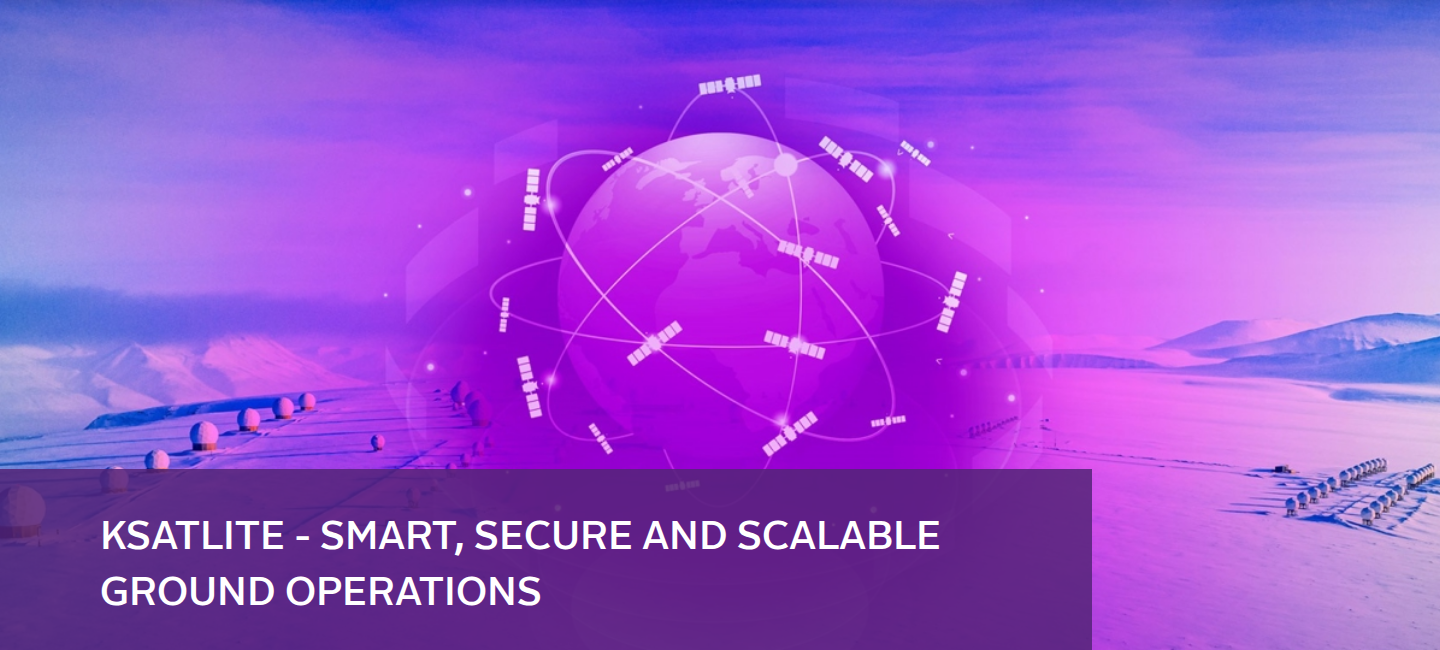
KSAT operates a global RF ground station network for LEO constellation operators, providing automated ground-segment-as-a-service, dedicated hosted infrastructure, and integrated mission services from its polar-anchored network.
Pros:
35 stations, 200 antennas, 5,500 daily contacts
Polar sites give twice-per-orbit access
Fully automated API-driven scheduling and operations
KSATlite, Hosted, and mission services under one roof
Cons:
Optical ground station capability still in development
Primary network is RF; not optical-first
Pricing not publicly listed
KSAT (Kongsberg Satellite Services) occupies the ground segment layer of the LEO supply chain — the physical antenna infrastructure and operational services that allow constellation operators to command satellites and retrieve mission data once they leave the manufacturing floor and reach orbit. Headquartered in Tromsø, Norway, and owned equally by Kongsberg Defence & Aerospace AS and Space Norway AS, KSAT is part of the Kongsberg Group.
KSATlite: Automated Ground Segment as a Service
KSATlite is KSAT's primary commercial product for LEO operators: a fully automated Ground Segment-as-a-Service built for small satellites, mega-constellations, and everything in between.
The network currently spans 35 stations and 200 antennas, handling more than 5,500 satellite contacts per day across 150+ operators, with historical availability above 99.75% globally.
- S-band uplink/downlink: Uplink 2025–2120 MHz, downlink 2200–2290 MHz — standard telemetry, tracking and command band for LEO missions.
- X-band downlink: 7750–8500 MHz — high-rate payload data downlink for Earth observation and imaging satellites.
- Ka-band downlink: 25.5–27.0 GHz — high-throughput data relay supporting downlink rates of 10 Gbps and above with the appropriate radio selection.
Operations run machine-to-machine: API-driven scheduling, autonomous pass management, real-time monitoring, and anomaly detection, with a customer portal giving operators live visibility into contacts, data flows, and performance metrics.
Polar Specialisation: Svalbard and Troll
The structural differentiator behind KSATlite's coverage for polar and sun-synchronous missions is site geography, not network density alone. KSAT's Svalbard ground station sits at 78°N — close enough to the Arctic pole to see every orbit of a sun-synchronous satellite, providing access to all 14 of 14 daily passes.
Paired with the Troll station in Antarctica at 72°S, the two sites together deliver contact opportunities twice per orbit as a minimum for most polar-orbiting satellites — a direct consequence of Earth's rotation and orbital geometry rather than any antenna configuration choice.
For sun-synchronous and high-inclination LEO missions, Svalbard (78°N) and Troll (72°S) together provide a minimum of two contact opportunities per orbit — a structural advantage that mid-latitude-only ground networks cannot replicate regardless of antenna count.
KSAT Hosted: Infrastructure as a Service
KSAT Hosted is a distinct service from KSATlite, aimed at operators building their own dedicated gateway networks rather than sharing the KSATlite multi-operator infrastructure.
Under this Infrastructure-as-a-Service model, KSAT handles the full build-out: site sourcing, design, engineering, antenna installation, regulatory and spectrum licensing, communication backhaul, and ongoing maintenance — from a single hosted antenna up to a globally integrated dedicated network.
Integrated Mission Services
Beyond antenna access, KSAT provides satellite operations (satellite control, mission control, flight dynamics), mission planning, data processing, and data delivery as an integrated service — positioning it as a full ground-segment provider rather than purely a connectivity layer.
Hyper: The In-Orbit Relay Layer
In February 2026, KSAT announced the Hyper programme — an in-orbit relay layer designed to extend the ground network into space. The initial Hyperion demonstration satellites, targeting launch via SpaceX in late 2027, are Ka-band LEO relay spacecraft that receive data from customer satellites over ocean and unserved regions and route it into KSAT's terrestrial infrastructure.
Hyper is an announced, forward-looking programme with a signed launch contract; it is not yet a deployed commercial service. For KSATlite customers, KSAT describes the architecture as continuous with the existing service — the same interfaces and workflows, extended to close the coverage gaps that ground geometry creates.
RF Network and Optical Ground Station Status
KSAT's operational network is RF-primary, covering S, X, and Ka-band. On its homepage, KSAT describes itself as investing in optical communication for a hybrid RF/optical network solution — characterising optical ground station capability as an active investment and development initiative rather than a deployed commercial service.
Questions About the LEO Supply Chain?
From optical ground-link amplifiers to ground-segment infrastructure, Woodrow Scientific's engineers work across the LEO technology stack. Get in touch to talk through how these systems fit together.
Product 5
Kymeta
Kymeta manufactures flat-panel electronically steered satellite terminals using metamaterial-based beamforming — no moving parts — covering LEO, GEO and multi-orbit connectivity for mobility, defence and enterprise applications. Headquartered in Redmond, Washington.
Pros:
No moving parts; resistant to shock and vibration
Goshawk u8 switches dynamically: LEO, GEO, cellular
Osprey u8 built to Mil-STD with embedded A-PNT
Kestrel u5: ultra-compact 60 cm form factor
Cons:
KuKa 8 Series not yet commercially available
KuKa prototypes targeted mid-2026; commercial availability 2027
Kymeta, headquartered in Redmond, Washington, occupies the user segment of the LEO supply chain: it manufactures the flat-panel antenna terminals that mobility operators, government agencies, and enterprises deploy to access LEO broadband services.
The company's core technology is metamaterial-based beamforming, which uses artificially engineered surfaces to steer signals electronically — with zero moving parts.
In practical terms, the absence of mechanical components means the terminals are inherently resistant to shock and vibration, and Kymeta's own technical documentation confirms the u8 family is validated to operate across an industry-leading temperature range, including cold-temperature operation down to -40°C and high-temperature operation up to +55°C ambient plus solar load.
All current Kymeta terminals operate at less than 100 W nominal power, which Kymeta's product pages note makes them compatible with native vehicle power, solar panels, generators, and alternative backup sources — a relevant characteristic for platform integration across vehicles, vessels, and aircraft.
Kymeta also describes a meaningful reliability advantage from the no-moving-parts design: because the metamaterial beamforming layer generates no heat, the terminals do not experience thermal shutdown under elevated temperatures, instead showing a gradual and recoverable variation in performance.
Kymeta Terminal Family
Kymeta's current product range spans several distinct use cases, from enterprise mobility to national security, with multi-orbit capability across most of the family.
| Terminal | Primary Use Case | Orbit Support | Notable Characteristic |
|---|---|---|---|
| Hawk u8 LEO | Enterprise, energy, first responders | LEO or GEO (preconfigured) | Economical turnkey terminal; less than 100 W nominal power |
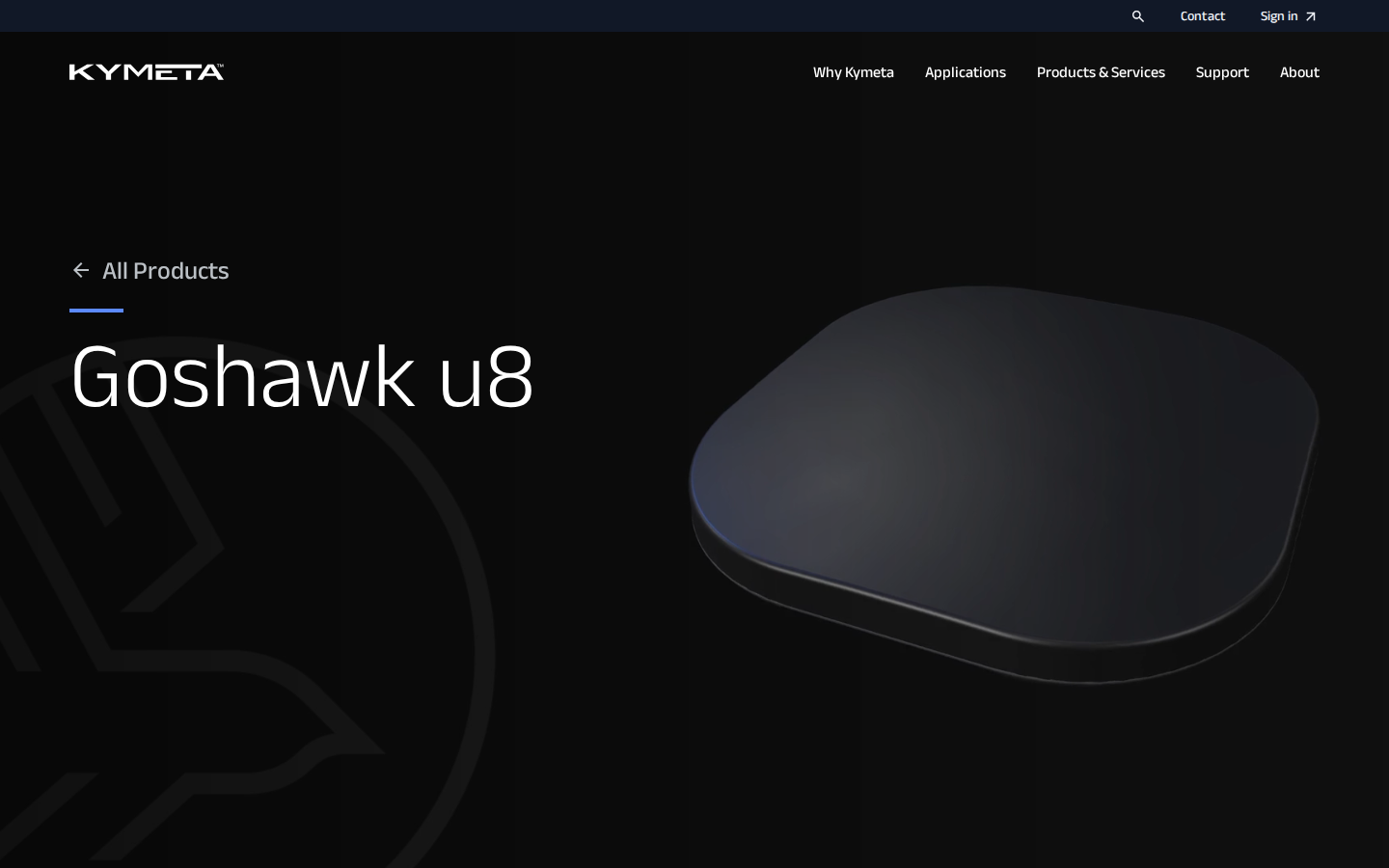
| Goshawk u8 | Security and intelligence agencies | LEO + GEO + cellular (dynamic switching) | Embedded LEO and cellular; seamless GEO integration; low thermal signature |
| Osprey u8 HGL | US DoD and government | LEO + GEO + cellular | Mil-STD-810 and Mil-STD-1275; embedded A-PNT; GNSS-denied capability |
| Kestrel u5 | Rail, UXVs, national security | LEO, GEO, hybrid | 60 cm square, 8 cm thick; less than 100 W nominal power; IEC 50155 pre-certified for rail |
Key terminals in Kymeta's current product family, with orbit support and primary use case drawn from Kymeta's own product pages.
The Hawk u8 LEO is the LEO-focused entry in the u8 family, designed for fixed, comms-on-the-move, and comms-on-the-pause applications, and approved by Eutelsat OneWeb as the first flat-panel antenna on their LEO network for land mobility.
The Goshawk u8 extends the u8 platform into multi-orbit territory, with embedded LEO and cellular modems and the ability to integrate an external GEO device, enabling dynamic switching across all three network types from a single terminal.
The Osprey u8 HGL (Hybrid GEO-LEO) is Kymeta's dedicated defence terminal, designed and tested to MIL-STD-810 and MIL-STD-1275, with embedded A-PNT for operation in GNSS-denied environments and CARC coating options for low-visibility military deployment.
The Kestrel u5 is Kymeta's most compact terminal at 60 cm square and 8 cm thick, targeting rail operators (pre-certified for IEC 50155), unmanned vehicles and vessels, and national security applications where size and weight constraints are primary integration considerations.
Defence and Government Positioning
Kymeta states that its u8 terminals have been field-deployed since 2017 within multiple global forces, and claims the most hours of real-world operation of any products in their class — a self-claim the company makes across its Goshawk u8, Osprey u8, and Hawk u8 product pages.
The Osprey u8's Mil-STD certifications, embedded A-PNT, and low thermal signature (achieved through Kymeta's metasurface technology) give it a specific capability profile for contested and GNSS-degraded environments.
The Goshawk u8 is positioned by Kymeta for security and intelligence agencies, with its multi-orbit switching and low thermal signature noted as relevant characteristics for those operational contexts.
Kymeta partners with Eutelsat OneWeb to deliver LEO connectivity across its u8 terminal family. The Hawk u8 LEO was the first flat-panel antenna approved on the Eutelsat OneWeb LEO network for land mobility, and the Goshawk u8 became generally available on that network in May 2025 for government and military customers.
The Eutelsat OneWeb partnership grounds Kymeta's terminals directly in one of the LEO operators named in this page's broader supply-chain map, connecting the user-segment hardware to the constellation layer above it.
KuKa 8 Series: Multi-Band Terminal in Development
In March 2026, Kymeta announced the KuKa 8 Series, a next-generation terminal designed to operate simultaneously across both Ku and Ka satellite bands within a single flat-panel aperture — a capability the company describes as a world-first.
The KuKa 8 Series is not yet commercially available; Kymeta is targeting prototype delivery to key customers from mid-2026, with commercial availability targeted for 2027.
Kymeta's announcement confirms the prototype's physical specifications: L 90 cm × W 90 cm × H 10 cm, from 18.6 kg, representing approximately a 44% reduction in antenna footprint compared to co-located side-by-side multi-antenna configurations.
- Simultaneous Ku and Ka operation: Single aperture supports both frequency bands concurrently, with four full-duplex beams and dual active LEO links.
- Multi-orbit pathway: Architecture is designed to integrate GEO, MEO, LEO, and HEO networks simultaneously and dynamically.
- Anti-jamming and low-probability-of-detection: Narrow electronically steered beams and agile operation are designed to lower probability of detection and intercept in contested environments.
- Software-defined and SDN-ready: Open standards architecture supports rapid reconfiguration and policy-based routing as missions and networks evolve.
The KuKa 8 Series has attracted a contract from the Office for Naval Research (ONR) and a prototype purchase order from Bascom Hunter for evaluation within U.S. Navy programmes, indicating active government interest ahead of commercial availability.
For procurement teams evaluating multi-band LEO/GEO terminals today, the KuKa 8 Series timeline is a straightforward planning variable: current-generation u8 terminals are in production and field-deployed, while the multi-band capability remains a 2027 programme.
Conclusion
Evaluating LEO Technology Suppliers: What Procurement Teams Should Know
Across every subsystem category this page covers, the suppliers that carry the least procurement risk share a common profile: hardware proven in live environments, and technology that stays compatible as standards continue to evolve.
That compatibility question is what makes in-house manufacture matter — a supplier that designs, builds and supports its own technology can reconfigure both hardware and software when requirements shift, rather than being limited by a catalogue.
For optical ground-link amplification, that conversation starts with Woodrow Scientific Limited — output power, band, direction, emitter count, modulation standard — built and supported in Southampton, on patented technology.
LEO Satellite Companies: Frequently Asked Questions
Procurement criteria, technical clarifications, and definitional questions about LEO satellite companies and the supply chains behind the constellations.
Prioritise four criteria: software-definability (the ability to switch between SDA, CCSDS and proprietary standards at power, without new hardware); in-house manufacture (a supplier that designs, builds and supports its own amplifier can configure it more deeply and resolve problems faster than a catalogue reseller); single-beam beacon-and-data capability (nesting the tracking beacon and uplink data in one amplified beam reduces hardware complexity at the ground station — WSL's EDF-UL leads on this axis); and diversity-architecture compatibility (support for multi-emitter arrays and multi-station synchronisation is a genuine requirement for high-availability optical ground networks). On software-definability: LEO standards are still evolving, and a fixed-function amplifier procured today risks incompatibility with the networks of 2027. An amplifier whose wavelength, modulation and beacon are all reconfigurable in software protects the programme investment across that standards transition. On in-house manufacture: suppliers that design and build their own amplifiers — rather than reselling or importing catalogue modules — can configure both the hardware build and the control layer to the client's specific ground station. That depth of tailoring, and the direct engineering support it enables, is not available from a reseller.
Operators — Starlink, Amazon Leo, Eutelsat OneWeb — own and run the constellations. They are the visible face of LEO broadband, responsible for licensing, launching and operating the satellites, and for selling connectivity to end users. Technology suppliers design and manufacture the satellites, optical terminals, ground infrastructure, user terminals and propulsion systems the operators depend on. This page covers suppliers, not operators. The supply chain is where the procurement and engineering decisions actually live: the contracts that build a LEO constellation are placed with manufacturers, ground-segment integrators, terminal suppliers and component specialists — not with the operator's consumer-facing brand.
Optical inter-satellite links (ISLs) are laser communication links between satellites in the constellation mesh, allowing data to hop from satellite to satellite without touching a ground gateway at every step. This matters because it reduces dependence on ground infrastructure and breaks through the RF bottleneck that constrains conventional satellite networks. In a LEO constellation without ISLs, every data packet must route down to a ground station and back up again — adding latency and limiting throughput to whatever RF capacity the ground segment can handle. Optical ISLs remove that constraint: data traverses the constellation mesh at the speed of light through free space, enabling truly high-capacity, low-latency global coverage. Mynaric's CONDOR terminal line is a practical example of what an optical ISL terminal looks like in deployment — purpose-built for intra-plane and cross-plane inter-satellite connectivity in LEO, compliant with SDA OCT Standards, and designed from the ground up for serial manufacturing and mass constellation deployment.
The most prominent manufacturers for LEO constellations include SpaceX, Airbus Defence and Space, MDA Space, Thales Alenia Space, and Lockheed Martin. SpaceX manufactures its own Starlink satellites in-house at its Redmond, Washington facility, producing satellite buses, phased-array antennas, propulsion, solar arrays and inter-satellite lasers — with the capacity to build up to 45 satellites per week. Airbus Defence and Space built the entire OneWeb first-generation constellation of 600+ satellites through its Airbus OneWeb Satellites joint venture, and has since been awarded contracts by Eutelsat totalling 440 new OneWeb LEO satellites to be manufactured at its Toulouse facility. MDA Space is the prime contractor for Telesat Lightspeed, the Globalstar next-generation LEO constellation, and the EchoStar NTN direct-to-device constellation — three of the largest active LEO manufacturing programmes outside Starlink. Thales Alenia Space was prime contractor for Iridium NEXT (81 satellites delivered), Globalstar 2 (24 satellites) and O3b (20 satellites) — a combined 125 satellites across three constellations, establishing the company's position as a benchmark partner for LEO and MEO constellation programmes. Lockheed Martin is on contract with the Space Development Agency for Transport Layer and Tracking Layer satellites within the Proliferated Warfighter Space Architecture, with 124 space vehicles under contract across multiple tranches.
Yes. Amazon retired the Project Kuiper name on 13 November 2025 and adopted Amazon Leo as the programme's permanent identity — a direct reference to the low Earth orbit satellite constellation that powers the network. The rename is a rebranding; missions conducted before that date continue to be referenced under the earlier Project Kuiper name in Amazon's own communications.