

Introduction
If you are here, you have already done the groundwork — you know laser stripping works on wood, and now you need to understand what it actually costs.
This guide is built for that exact stage of the decision: the full laser stripping wood machine price spectrum, from entry-level portables through to industrial automated systems.
It covers what drives the price differences between machines, the total cost of ownership beyond the purchase price, and the buy-vs-rent-vs-hire question that most buyers face at some point.
You will also find a direct cost comparison with alternative stripping methods and a practical ROI framework for building the business case internally.
TL;DR
The sticker price of a laser stripping machine is rarely the number that determines whether the investment makes sense.
Once running costs, maintenance, and the true cost of your current method are factored in, laser stripping is structurally cost-competitive for most commercial operators with consistent workloads — often decisively so over a three-to-five year horizon.
This article covers:

Machine price tiers across the full spectrum
What drives cost differences between machines
Total cost of ownership and running costs
Buy, rent, or hire: the financial case
Cost comparison with alternative stripping methods
ROI framework and payback period guidance
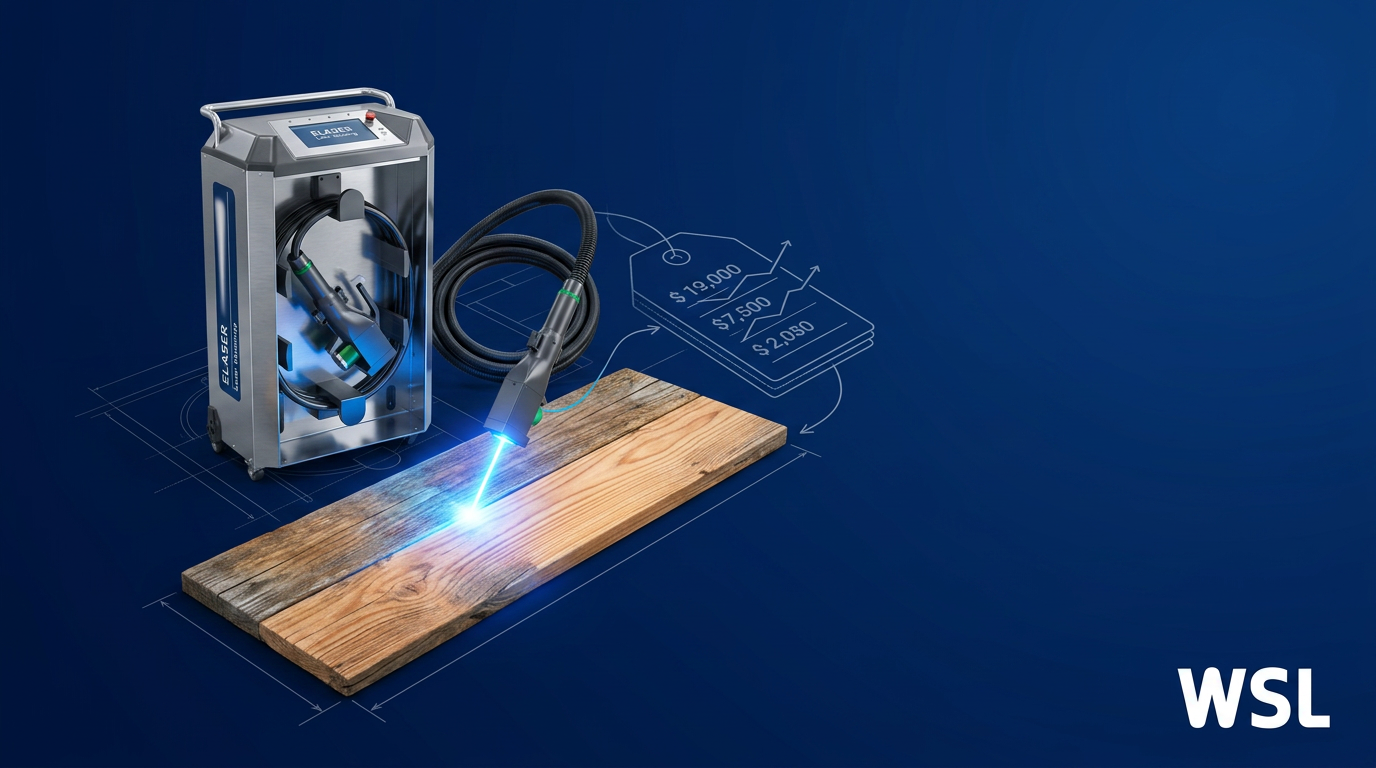
Laser Stripping Wood Machine Price: What You Need to Know
Laser stripping wood machine price spans an enormous range — from around $3,500 for an entry-level portable unit to well over $100,000 for a fully automated industrial system — and that gap is not simply a matter of power output. The machine architecture matters just as much as the wattage, and for wood specifically, choosing the wrong architecture means the machine is useless regardless of what it cost.
At their core, laser stripping machines for wood are pulsed fibre laser systems that remove paint, stain, varnish, lacquer, and other coatings through a process called laser ablation: concentrated laser energy is absorbed by the coating layer, which vaporises almost instantaneously, leaving the wood substrate beneath intact.
Yes, laser stripping works on wood — but only when the correct laser type is used. A pulsed laser delivers energy in extremely short, high-peak bursts (typically measured in nanoseconds), allowing the coating to vaporise while the wood surface cools between pulses. A continuous wave (CW) laser, by contrast, delivers sustained energy that accumulates as heat, causing charring, carbonisation, and potential ignition of the wood substrate. CW lasers are not suitable for wood at any power level.
Wood is a significantly more demanding substrate than metal for laser stripping, and this distinction has direct consequences for machine selection and price. The underlying reason is thermal confinement: wood dissipates heat far more slowly than steel, so energy accumulates rapidly at the surface rather than dispersing into the bulk material. Combined with a low char threshold and variable surface characteristics — grain density, moisture content, coating adhesion — this means a machine configured for metal rust removal can scorch or permanently damage wood if its parameters are not carefully calibrated for the substrate.
The table below maps the four broad market tiers for pulsed laser stripping machines suitable for wood, using USD-denominated reference figures drawn from current market data. European and UK pricing will vary. Treat these as orientation ranges, not supplier quotes.
| Market Tier | Power Range | Approx. Price (USD) | Typical Application Context |
|---|---|---|---|
| Entry-level portable | 50–100W | $3,500 – $8,000 | Furniture restoration, small heritage pieces, on-site detail work |
| Mid-range portable | 100–300W | $8,000 – $20,000 | Log homes, structural beams, decks, daily contractor use |
| High-end portable / system | 300–500W | $20,000 – $40,000+ | Industrial fire remediation, mass timber, high-throughput site work |
| Fully automated robotic | 500W+ | $100,000 – $200,000+ | Factory pre-treatment lines, large-scale automated production |
Price spectrum for pulsed laser stripping machines suitable for wood, by power tier.
These price bands reflect genuine differences in capability, build quality, and automation level — but they are orientation figures, not definitive quotes. The critical observation from the table is that the entry tier already delivers enough power for most wood stripping tasks: a correctly specified 100W pulsed machine handles paint, varnish, and soot removal on wood effectively, while a 500W CW machine cannot.
That brings the guide to the single most important filter in the market: the pulsed vs CW distinction. Wattage alone does not determine whether a machine is suitable for wood. A high-wattage CW machine may cost less than a modest pulsed system, yet it remains entirely unsuitable for wood applications regardless of its price or power rating.
A CW laser is unsuitable for wood at any price point. The pulsed vs CW question is the first filter to apply when evaluating any machine — before comparing power, portability, or cost.
The market also divides along geographic sourcing lines: European and North American manufacturers compete alongside lower-cost Asian-manufactured units, with Chinese-origin machines often priced roughly 20–50% below comparable Western-built systems. That cost differential has downstream implications for after-sales support, spare parts availability, and total cost of ownership — factors that matter considerably more for a precision tool like a pulsed laser cleaner than for commodity equipment.
With the price landscape and the core technical distinction established, the next question is why prices differ so significantly across and within each tier — which is where power output, laser architecture, portability, build quality, and the manufacturer vs reseller dynamic all come into play.
What Drives the Price of a Laser Stripping Machine?
Two machines can both carry the label "laser stripping machine for wood" while sitting at very different price points — and the gap is not arbitrary marketing. It reflects genuine differences in capability that matter enormously when wood is the substrate.
A small number of identifiable variables drive the laser stripping wood price. Understanding them lets a buyer evaluate any machine on its actual merits rather than its headline wattage or its marketing copy.
Laser Architecture: The Variable That Matters Most
Pulsed laser systems carry a significant price premium over continuous wave (CW) machines at equivalent wattage — and for wood buyers, that premium is non-negotiable. CW machines are entirely unsuitable for wood: they deliver a steady, uninterrupted beam that accumulates heat rapidly, raising char risk on a substrate that cannot tolerate it.
Buyers who pursue a CW machine to save money on a wood application are not buying a cheaper solution — they are buying the wrong tool entirely. The pulsed premium buys the core capability the application requires; it is not optional overhead.
Within pulsed systems, MOPA architecture (Master Oscillator Power Amplifier) commands a further price premium — and for wood, this premium is equally justified. A machine with only a power dial and a speed dial is designed for metal cleaning; it lacks the parameter depth wood stripping demands.
MOPA enables granular control over pulse duration, repetition frequency, and scan speed — the combination that allows an operator to strip coatings from wood without crossing the char threshold. This is a variable buyers should actively seek out, not treat as a luxury upgrade.
Power, Form Factor, and Build Quality
Higher wattage increases machine price, but wood introduces a paradox: the productive working range for pulsed wood stripping is approximately 50–300W, and exceeding it does not improve results — it increases the risk of surface charring. A 500W machine is not inherently more suitable for wood than a well-specified 200W machine with superior parameter control.
Form factor drives a separate layer of cost that reflects genuine operational differences. Backpack and suitcase-style portables suit on-site access where the workpiece cannot move. Wheeled trolley-style portables balance portability with higher-power capability for workshop use. Fixed-installation or robotic cells serve high-volume production environments where throughput justifies the capital.
Portability also carries an engineering premium: miniaturising the cooling system into an air-cooled format for a backpack unit requires more complex thermal design than a larger cart-mounted water-cooled system, which is why portable units at equivalent power often cost more than their trolley-mounted counterparts.
Build quality and component sourcing are where two machines with similar spec sheets diverge in longevity. The laser source brand is a meaningful price signal — industrial-grade sources from established manufacturers command higher prices but carry significantly longer rated lifespans than unbranded equivalents. One empirical analysis found a quality 100W fiber source has a mean time between failures roughly three times longer than a no-name equivalent.
Beyond the laser source, cooling system robustness, scanning head precision, and optical component grade all affect how the machine performs over time rather than just on day one. Lower-priced machines with inferior optical components may perform adequately initially but degrade faster — a cost that does not appear on the purchase invoice.
Manufacturer or Reseller: A Question Worth Asking
A meaningful proportion of laser cleaning suppliers are not manufacturers at all — they are resellers or importers rebadging third-party machines. The distinction matters because a reseller cannot modify a machine it did not build; when problems arise, it can only relay the issue to the original manufacturer, adding time and friction to every support interaction.
Buyers should ask directly: does this supplier design, build, and service its own machines? The answer affects support speed, parts availability, and whether the supplier can genuinely fix or improve the product. WSL's own ELASER, for example, is designed, built, serviced, and continuously improved by the same engineering team in the UK — a concrete illustration of what genuine in-house manufacture looks like in this market.
Geography of manufacture is a related price signal. European and North American in-house manufacturers typically price above Asian-manufactured equivalents — reflecting differences in labour costs, engineering overhead, and support infrastructure rather than necessarily differences in raw cleaning performance on arrival. The premium is largely about what happens after the sale: support responsiveness, parts proximity, and engineering accountability.
For wood applications, the most expensive variable to get wrong is laser architecture — buying a CW machine when pulsed is mandatory. The most undervalued variable is parameter control depth. Price should be evaluated against both, not against wattage alone.
With the price-driving variables established, the next section maps them onto the actual market tiers buyers will encounter — from entry-level portable units through to industrial systems — so the framework becomes a practical purchasing tool.
Laser Stripping Machine Price Tiers: What Each Level Buys
What follows is not a product catalogue — it is a structured map of the market, organised by price band, so you can calibrate your expectations before you speak to a single supplier. Each tier represents a genuinely different capability profile, not simply a larger number on a spec sheet.
Tier 1: Entry-Level Pulsed Portables (50–100W, ~$3,500–$8,000)
At the base of the pulsed market, 50–100W portables are priced from approximately $3,500 to $8,000 and are best suited to light coatings on small surface areas — heritage and conservation work, furniture detail stripping, or low-frequency commercial jobs where throughput is not the primary concern.
The principal limitation is restricted area coverage per hour: a 50–100W machine simply cannot sustain the output needed for regular commercial stripping volumes, and many units in this tier offer preset-only parameter modes rather than full numerical control over pulse frequency, pulse duration, and scan speed.
The wood-specific risk at this tier is that some machines cannot reach the parameter thresholds that wood demands. Before purchasing any entry-level unit, verify that the minimum pulse repetition frequency reaches ≤30 Hz and that the shortest available pulse duration reaches ≤20 ns — machines in this bracket sometimes cannot meet either threshold, which makes them unsuitable for wood regardless of their price.
Honest framing: this tier is viable for fine-detail or low-volume work, but it is not a practical working tool for a commercial wood stripping operation with consistent throughput demands.
Tier 2: Mid-Range Pulsed Portables (100–300W, ~$8,000–$20,000)
This is the practical commercial working tier — the price band where the majority of commercial evaluators will land, and the one that warrants the most attention in this guide.
At 100–300W, machines are capable of removing paint, varnish, lacquer, and multi-layer coatings from wood at genuine commercial volumes, making them the right fit for on-site service businesses, restoration contractors, and workshop operators running regular stripping jobs.
Parameter control is meaningfully better than entry-level: machines at this power range are more likely to offer full numerical access to pulse frequency, pulse duration, and scan speed — the three variables that determine whether a laser strips wood cleanly or chars it.
A practical infrastructure advantage at this tier is that air-cooled units are available across much of the 100–300W range, meaning no chiller is required — a significant operational simplification for field-based or on-site work.
The 100–300W band is specifically identified by specialist wood stripping sources as the recommended power range for most commercial wood applications, balancing throughput with the parameter control depth that wood substrates require.
Tier 3: High-End Pulsed Portables (300–500W, ~$20,000–$40,000+)
Moving into the 300–500W range, machines are suited to higher-throughput commercial operations, thicker or more stubborn coatings, and harder wood species where the additional power translates to faster area coverage per hour.
At this power level, water-cooling becomes the norm for sustained production use — which adds infrastructure considerations (chiller, coolant loop, fixed or semi-fixed installation) that buyers should factor into their operational planning, not just the purchase price.
The critical caveat for wood is that a 300–500W machine is not automatically a better tool for the substrate. On softwoods and lower-density species, the expanded power range is only an advantage if the operator has the parameter control depth and discipline to manage it — run aggressively, a high-wattage machine causes substrate damage far faster than a lower-power machine used correctly.
Tier 4: Industrial Automated Systems ($100,000–$200,000+)
Robotic laser stripping cells with integrated scanning and automated path generation sit at $100,000–$200,000 or more, and are appropriate for high-volume production environments processing consistent batches of identical or similar parts.
The economics only work at sustained, consistently high throughput — the labour cost savings that justify the capital outlay require the machine to be running productively for the majority of each shift. This tier is not relevant for on-site or field wood stripping, and it is not relevant for most commercial service operators; it is included here for completeness.
A 500W machine run aggressively will damage wood faster than a 200W machine run correctly. Peak wattage is not the right proxy for wood stripping capability — parameter control depth (the ability to precisely modulate pulse frequency, pulse duration, and scan speed) is the more important criterion at every tier. Buyers who shortlist machines by wattage alone are optimising for the wrong variable.
Regardless of which tier fits your throughput requirements, there are four machine specifications that every buyer should verify with any supplier before committing — these are the wood-specific parameters that determine whether a machine is genuinely fit for the substrate.
- Minimum pulse repetition frequency: Must reach ≤30 Hz for most wood species; ≤10 Hz for sensitive species such as pine, cedar, and poplar. Machines that cannot go below 50 Hz are not suitable for wood.
- Shortest available pulse duration: Must reach ≤20 ns for precision and heritage work. Machines offering only preset short/medium/long modes should be asked for the actual nanosecond values before purchase.
- Maximum scan speed: Must be ≥800 mm/s. A lower ceiling limits multi-pass strategies on sensitive species and increases the risk of charring even at correct power settings.
- Numerical parameter access: All parameters — power, frequency, pulse duration, scan speed — must be numerically adjustable, not preset-only. Preset-only modes cannot be tuned for wood's variable requirements.
Knowing which tier fits your throughput is only part of the evaluation. The next section covers the wood-specific specifications in depth — the science behind why these thresholds matter, how different species demand different parameter ranges, and what to look for in a machine that is genuinely built for wood rather than repurposed from a metal cleaning application.
Wood-Specific Machine Requirements: Which Price Tier Fits?
A machine that strips rust from structural steel with zero issues can char, scorch, or ignite a pine panel before the paint is fully removed — and a higher price tag does not change that outcome.
The reason is thermal: wood's thermal diffusivity is approximately 60–120 times lower than steel, meaning heat deposited by the laser accumulates at the wood surface rather than dispersing into the bulk material. The gap between "paint ablated" and "wood charred" is far narrower than on metal, and that gap is what every machine specification discussed below is trying to manage.
Pulsed Laser: The Non-Negotiable Starting Point
As established in the background section, continuous wave (CW) lasers are categorically unsuitable for wood, regardless of their power rating or price tier.
CW lasers deliver sustained energy that accumulates in the wood surface faster than it can dissipate, producing charring and irreversible substrate damage at any practical working power level. Pulsed laser architecture is the baseline requirement — not a premium feature — and any machine a buyer evaluates must meet it before any other specification is considered.
Pulse Repetition Frequency: The Primary Control Lever
Among the adjustable parameters on a pulsed machine, pulse repetition frequency (PRF) is the most consequential for wood. Lower frequency means a longer interval between pulses, which means more time for the wood surface to cool before the next energy delivery arrives.
For most hardwood paint stripping applications, the appropriate PRF range is roughly 10–80 Hz depending on species density. The critical evaluation point is the minimum frequency, not the maximum: machines with a minimum PRF of 50 Hz or higher cannot be adequately controlled for most wood applications, because the inter-pulse interval is too short to allow sufficient surface cooling.
When speaking to any supplier, ask what the lowest PRF the machine can achieve is. For most wood work, the answer must be ≤30 Hz; for sensitive or low-density species, ≤10 Hz is the practical requirement.
Pulse duration is the second parameter to interrogate. Shorter pulses confine energy deposition to the coating layer, preventing heat from penetrating into the wood substrate beneath. For general commercial stripping, pulses in the 10–50 ns range are appropriate; for precision work on antiques, veneers, or heritage timber, sub-20 ns capability is needed to maintain a safe margin above the char threshold.
Wood Species Sensitivity: The Operating Window
Wood is not a single material with fixed properties. Dense hardwoods such as oak, maple, and ash tolerate comparatively higher power and frequency settings. Medium-density species — cherry, walnut — require more care. Low-density hardwoods and softwoods such as pine and poplar have the narrowest operating window of all, with species-level char thresholds that are meaningfully lower than those of their denser counterparts.
| Species Category | Examples | Approx. Char Threshold | PRF Range (typical) | Pulse Duration |
|---|---|---|---|---|
| Dense hardwood | Oak, maple, ash | ~270–275°C (e.g. hard maple, white oak) | 20–80 Hz | 10–50 ns |
| Medium hardwood | Cherry, walnut | Lower than dense hardwoods; test required | 10–40 Hz | 10–30 ns |
| Low-density hardwood / softwood | Pine, poplar, cedar | ~220–240°C (e.g. pine species) | 5–20 Hz | 10–30 ns |
Maps wood species density categories to approximate parameter tolerance ranges, giving buyers a practical reference for machine capability requirements by application. Char threshold figures are species-level approximations drawn from named species in source data, not categorical averages.
The pattern across the table is clear: as wood density decreases, every parameter tolerance tightens. Species such as hard maple and white oak have measured char thresholds in the region of 270–275°C; pine species sit closer to 220°C — a difference of roughly 50°C that substantially narrows the safe operating margin for softwood work.
This is where the practical implication for price tier selection becomes concrete. A mid-range machine with deep MOPA parameter control — numerical access to PRF, pulse duration, power, and scan speed — can outperform a high-power machine with coarser, preset-only settings when the substrate is softwood or veneer. The evaluation checklist for any tier should include the following questions to put to any supplier.
- Minimum PRF: Must be ≤30 Hz for most wood work; ≤10 Hz for softwoods, veneers, and sensitive species. Any answer above 50 Hz is a disqualifier for wood.
- Shortest pulse duration: ≤20 ns for antique, veneer, or heritage work; ≤50 ns as a minimum for any serious wood application.
- Maximum scan speed: ≥800 mm/s is required. A lower ceiling limits the multi-pass strategies that prevent charring on sensitive species.
- Numerical parameter access: All parameters must be adjustable numerically, not via preset modes only. Preset-only control is a dealbreaker for wood substrates.
A vendor who cannot answer these questions with specific figures — rather than vague assurances — does not have a machine designed for wood applications, regardless of its wattage or price point.
On wood, more wattage does not equal better stripping capability. A high-power machine with preset-only parameter modes can cause more substrate damage than a lower-power machine with full MOPA control. Parameter depth — specifically minimum PRF and pulse duration range — is the differentiator that actually determines fitness for wood applications.
One further cost item belongs in the buyer's budget from the outset: fume extraction. Wood ablation produces char particles in the respirable fraction that are hazardous at sustained exposure — this is not a nuisance dust problem but a genuine occupational health risk.
The minimum filtration standard for wood laser stripping is HEPA H13. Where the work involves oil-based paints, varnishes, or lacquers, activated carbon filtration is additionally required: organic coatings produce volatile organic compounds (VOCs) on ablation that a particulate filter alone cannot capture. Fume extraction is a non-negotiable line item, not an optional accessory.
With the right machine type identified for the specific wood application, the next question is what that machine actually costs to own and operate over time — sticker price is only the beginning of the picture, and the following section sets out the full total cost of ownership.
Total Cost of Ownership: Beyond the Sticker Price
Most buyers instinctively compare machines on purchase price — but for laser stripping equipment, that comparison is incomplete before it starts. The sticker price is one input into the real cost equation; running costs, maintenance, consumables, and support economics are the others, and they shift the picture considerably once the time horizon extends beyond delivery day.
The structural reason laser running costs are low is architectural: the process runs on electricity alone. There is no abrasive media to replenish, no chemical stock to purchase, no dry ice supply chain to manage. Once the machine is purchased, the dominant recurring cost is power — and that is a fundamentally different cost structure from every alternative stripping method.
Recurring Operating Costs: What You Actually Pay
For a pulsed fibre laser system in the 200–300 W range, the three genuine recurring cost lines are electricity, protective lens replacement, and extraction filter replacement.
- Electricity: A 200–300 W pulsed system draws roughly 1–2 kW at the wall. At typical industrial rates, that is under $1 per operating hour — rising to $1–$3/hr for larger CW systems in the 1,500–3,000 W range.
- Protective lens replacement: The primary optical wear item. Replacement lenses typically cost $30–$80 per unit; inspect every 40–80 hours and replace as needed to protect the scan head.
- Extraction filter replacement: Fume extraction pre-filters change monthly; HEPA filters every six to twelve months. Total filter cost typically runs $50–$200 per quarter depending on contamination volume.
What is absent from that list is as significant as what appears on it: no abrasive media, no chemical replenishment, no hazardous waste disposal contracts. For a well-maintained pulsed system at the 100–300 W tier, sources indicate total consumable spend — lenses and filters combined — typically runs $200–$800 per year, with the upper end applying to dusty or high-contamination environments. That is not a marginal saving over alternatives; it is a structural difference in how costs accumulate over time.
The ELASER from Woodrow Scientific Limited illustrates this profile concretely: air-cooled and consumable-free, it requires no water, no chiller circuit, no chemicals, and no abrasive media replenishment whatsoever. A single operator can run it continuously; there is no crew for media handling and no PPE escalation beyond laser safety eyewear and local fume extraction.
Additional Upfront Costs to Budget For
The machine purchase price is not the full upfront cost. Responsible budget planning covers the safety and extraction infrastructure required to operate any Class 4 laser system safely — these are one-time or infrequent items that belong in the capital budget from the outset, not surprises after the invoice is signed.
- Fume extraction system: HEPA H13 filtration is the standard for laser cleaning particulate. Budget $2,000–$4,000 for a basic portable extractor, $4,000–$8,000 for an industrial HEPA unit, or $8,000–$15,000 for HEPA with activated carbon for VOC adsorption.
- Laser safety eyewear: Wavelength-specific certified goggles are required for every operator in or near the hazard zone. Budget $100–$300 per unit; do not reuse eyewear rated for a different wavelength.
- Safety barriers and signage: Controlled work area setup — barriers, warning signage, and restricted access — typically costs $500–$3,000 depending on facility layout and beam-on area size.
- Facility preparation: Dedicated power supply, ventilation ducting, and any structural changes needed to accommodate the system. Cost varies by site; budget separately from the machine itself.
Frame these as items to plan for, not reasons to hesitate. The fume extraction system and PPE are one-time capital purchases that do not recur like sandblasting media or chemical stock; safety barriers and signage, once installed, serve the machine's entire working life.
It is worth noting that the ELASER-RHZ — WSL's world-first reduced hazard zone variant — significantly compresses the area that needs to be controlled, which reduces the safety infrastructure overhead compared to conventional Class 4 systems. For buyers where facility setup cost is a genuine constraint, that is a meaningful TCO-relevant benefit.
Maintenance Profile: Fibre Laser Reliability in Practice
Fibre laser sources are rated at 80,000–100,000 hours MTBF under nominal operating conditions — at a single-shift duty cycle of around 2,000 hours per year, that represents well over a decade before source replacement becomes a consideration. Real-world industrial use at high duty cycles tends to produce 30,000–60,000 hours before measurable power degradation, still a very long service horizon.
The primary wear items are the protective lens and galvanometer scanner bearings. Annual maintenance budget for a mid-range system at moderate utilisation is typically in the $400–$1,000 range — a low burden compared to the mechanical abrasive equipment it replaces, where compressor servicing, blast pot maintenance, and media handling infrastructure all carry their own recurring costs.
Training is a genuine and worthwhile cost item for any Class 4 laser system. Buyers should budget for initial operator training, ongoing competency maintenance, and the Laser Safety Officer (LSO) function — either a dedicated role or a trained individual carrying that responsibility.
Skilled operators achieve better results on wood specifically, where parameter discipline separates clean stripping from substrate damage. Woodrow Scientific Limited provides first-class laser cleaning safety and operation training directly, meaning operators have access to high-quality, application-specific instruction rather than having to source it independently.
Once a laser stripping machine is purchased, the recurring cost structure collapses to electricity (under $1/hr for a pulsed 200–300 W system), periodic lens replacement ($30–$80 per unit), and extraction filter changes ($50–$200 per quarter). There is no consumable cycle — no media, no chemicals, no waste disposal contracts.
Over a five-year horizon, the economics of a quality mid-range pulsed system shift meaningfully in its favour. Lower running costs, better reliability, and reduced rework from substrate damage — a real cost on wood, where a machine with coarser parameter control can scorch or char the surface — all compound in the direction of the better-specified machine.
Manufacturer vs Reseller: The Hidden TCO Variable
A lower sticker price from a reseller or importer can be offset by costs that never appear on the purchase invoice: slower parts availability, higher downtime exposure, and the absence of in-house engineering support when problems arise. Downtime on a production cleaning operation can cost $500–$2,000 per day — a figure that erodes a purchase price advantage quickly.
The practical question to ask any supplier is whether they design, build, and service their own machines. Many suppliers in this market are resellers or importers rebadging third-party hardware, which means no in-house engineering capability, slower spares, and no genuine ability to fix or improve the product when edge-case problems emerge.
Woodrow Scientific Limited is the only UK-based laser cleaning manufacturer — designing, building, servicing, and improving its own machines entirely in-house. That means faster support response, stocked spare optics, and the engineering depth to genuinely resolve problems rather than escalate them to an overseas OEM.
With the full cost of ownership assembled, the next question is whether owning a machine outright is the right model for your operation — or whether hire or contract cleaning services make more financial sense for your volume and use case.
Not Sure Whether to Buy, Rent, or Outsource?
The numbers only tell part of the story. Speak with a laser cleaning expert to work out which access model fits your volume, budget, and site conditions.
Buy, Rent, or Hire a Service: Which Makes Sense?
Knowing what a laser stripping machine costs is only half the question. The other half is whether you should own one at all — or whether hiring a machine short-term, or contracting a professional service to do the work, is the smarter financial move for your specific situation.
The answer is not the same for every operator. It depends on the volume and regularity of your workload, your available capital, and whether laser stripping sits at the core of your business or at its edge. Getting this decision right can save you significant money; getting it wrong locks capital into an asset that earns less than it cost.
Buying Outright: The Long-Term Financial Anchor
For operators with a consistent, recurring workload, outright purchase is the financially superior position over any meaningful time horizon.
As covered in the total cost of ownership section, pulsed fibre laser machines carry structurally low running costs — no consumables, no chemicals, minimal electricity draw. Once the machine is deployed regularly, the cost-per-job falls sharply, because the fixed purchase cost is spread across an ever-growing volume of paid work.
Industry experience has converged on a useful rule of thumb: above roughly 60–70% utilisation of available workdays, ownership is generally more cost-effective than renting. Below that threshold, rental typically wins because the fixed ownership costs are spread too thinly across too few productive days.
The key word is consistent. Ownership rewards operators who have a reliable pipeline of work — not those who occasionally land a large job. Base the decision on your actual diary, not your best-case one.
Machine Hire: Flexibility Without Capital Commitment
Hiring a pulsed laser cleaning machine is the right route when commitment and upfront cost need to stay low: for one-off projects, short busy periods requiring temporary extra capacity, or operators who want to prove demand before investing.
To give a sense of the market, European hire providers publish rates for 100–300W pulsed units in the approximate range of €400–€950 per day and €1,400–€2,350 per week, based on published rental data from providers including P-Laser and Laserflux. Monthly rates are also available from most providers, typically at a meaningfully lower effective daily rate. Rates vary by provider, machine power, and region.
In the UK, day hire rates from specialist providers start from around £295 per day, with weekly and monthly terms available at discounted effective rates.
Hire is flexible and, crucially, reversible. If the project ends early or the work doesn't materialise, you return the machine with no ongoing obligation — a meaningful advantage over capital purchase when demand is uncertain.
The trade-off is straightforward: hire is more expensive per job on repeat use than ownership. Once you cross the 60–70% utilisation threshold and work is steady, the economics shift decisively in favour of buying.
Contracting a Laser Stripping Service
The third route removes machine ownership entirely. You contract a professional laser stripping operator to come to your site and carry out the work — paying for the output, not the equipment.
This is the lowest-commitment option and the right choice for operators with irregular or genuinely one-off requirements where capital outlay, operator training, and safety compliance overhead are not justified by the volume of work.
Service contracting also makes sense when laser stripping is peripheral to your core business — useful occasionally, but not central enough to warrant building an in-house capability around it.
The honest counterpoint: contracting is the most expensive per-job route for operators with regular or recurring stripping work. At that volume, ownership wins decisively on unit economics. The service route earns its place at the irregular end of the workload spectrum, not across a sustained pipeline.
Hire the machine on a real job first. If the work pays for the hire, you have your answer on whether to buy. Many providers allow monthly hire fees to be offset against a subsequent purchase — so the trial period builds toward ownership rather than being money spent and gone. You let the work earn the machine rather than betting on it upfront.
This pathway is worth naming explicitly because it changes the framing of the hire decision entirely. Hire is not just a fallback for operators who can't afford to buy — it is a structured, lower-risk entry route for operators who are entering the laser stripping market or adding a new service line and want real-job validation before committing capital.
Decision Framework: Which Route Fits Your Situation?
Apply these four variables in order. Each one narrows the decision before the next is considered.
- Volume and frequency: Irregular or one-off work points toward hire or service contracting. Consistent, recurring work points toward ownership — this is the primary variable.
- Capital availability: If upfront outlay is constrained, hire preserves cash flow while generating revenue. The hire-first pathway can build toward purchase without a day-one capital commitment.
- Internal technical expertise: Ownership requires trained operators and someone to handle day-to-day machine management. If that capability doesn't exist yet, hire with included training bridges the gap.
- Centrality to core business: If laser stripping is central to your service offering, ownership is the right long-term anchor. If it's peripheral, contracting keeps overhead low and focus intact.
The right answer follows from an honest assessment of your actual workload — not your projected best case. Operators who hire first and let real demand make the call tend to make better purchase decisions than those who commit on a hunch.
With the access model settled, the next question is whether laser stripping is the right method at all — and how its economics stack up against chemical stripping, sanding, and sandblasting on a cost-per-job basis.
Laser vs Chemical Stripping, Sanding, and Sandblasting: Costs
Every buyer researching laser stripping wood machine prices is already conducting a cost comparison — they just may not have put the numbers side by side yet. Whether your current method is chemical stripping, sanding, or sandblasting, this section does that work explicitly: not with vague assertions, but with real cost data across the full picture of labour, consumables, waste disposal, and substrate damage.
Chemical Stripping on Wood: Full Cost Accounting
Chemical stripping appears low-cost at first glance: equipment outlay is modest, and a tin of stripper is cheap relative to a laser system. The true cost structure is far less flattering once you account for chemical purchase, dwell time, scraping labour, neutralisation, cleanup, and regulated waste disposal.
On wood specifically, chemical stripping rarely ends with the scraper — the raised grain almost always requires a sanding pass afterwards, adding a further labour and material cost that rarely appears in headline comparisons.
A worked example makes the comparison concrete: for a 10 m² multi-layer oil paint job on wood, laser stripping (200W system, rented) totals approximately $373 — covering 6.7 hours of labour at $40/hr, rental cost amortised over the job, and minimal consumables. Chemical stripping (methylene chloride) on the same job totals approximately $440, comprising $260 in labour, $80 in chemicals, and $100 in disposal fees — and that figure excludes the follow-on sanding pass.
The per-job gap is already visible at 10 m². For larger areas or heavier paint loads, the laser's speed advantage compounds: chemical stripping typically requires 2–4 hours of total process time per square metre (application, dwell, scraping, neutralisation), while laser runs at 1–3 hours per square metre with no dwell and no cleanup.
Sanding and Mechanical Abrasion
Sanding has the lowest equipment entry cost of any method, but it is extraordinarily labour-intensive at production scale: at $60/hr labour and typical hand-sanding coverage rates, the all-in cost lands between $0.75 and $4.25 per square foot before consumable abrasive discs, PPE (respirator cartridges, eye protection), and dust extraction are counted.
The wood-specific problem with sanding is structural: it does not remove coating selectively — it removes wood material alongside the coating, typically 0.2–1mm of surface per stripping pass. For heritage joinery, antique furniture, or high-value hardwood, that material loss carries a direct financial consequence: rework, rejection, or irreplaceable substrate damage that no amount of labour can undo.
Sandblasting
Sandblasting equipment costs are low to medium upfront, but the ongoing cost of abrasive media (garnet, steel grit, aluminium oxide), containment setup, and spent media disposal accumulates rapidly. Garnet runs roughly $0.25–$0.55/lb in bulk; a heavy stripping job can consume 15–40 kg of media per hour.
On wood substrates, the economics are secondary to the suitability question: sandblasting carries a significant risk of surface damage because the abrasive impact is indiscriminate, making it a poor choice for most wood stripping applications regardless of cost. For field work with containment tenting and vacuum recovery, sandblasting operating costs reach $6–$12 per square foot — compared with laser cleaning's sub-$1/sq ft once capital is amortised at moderate production volumes.
Across abrasive blasting methods more broadly, all-in operating costs (media, containment, disposal, and labour) typically run USD $8–$20 per square metre, against laser's USD $0.50–$4.00 per square metre in direct operating cost on comparable work.
With the per-job and per-square-metre picture established, the more revealing comparison is cumulative: what does each method actually cost over five years at meaningful utilisation?
| Method | Year 1 | Year 2 | Year 3 | Year 4 | Year 5 | 5-Year Total |
|---|---|---|---|---|---|---|
| Pulsed Laser (200W) | $44,250 | $9,250 | $9,250 | $9,250 | $9,250 | $81,250 |
| CW Laser (500W) | $65,750 | $7,250 | $7,250 | $7,250 | $7,250 | $94,750 |
| Sandblasting (grit) | $32,250 | $32,250 | $32,250 | $32,250 | $32,250 | $161,250 |
| Chemical Stripping | $57,500 | $57,500 | $57,500 | $57,500 | $57,500 | $287,500 |
| Manual Grinding | $46,250 | $46,250 | $46,250 | $46,250 | $46,250 | $231,250 |
Five-year cumulative cost comparison across stripping methods at 5,000 m²/year utilisation, showing how laser's high Year 1 cost is offset by near-zero ongoing costs.
The table assumes 5,000 m²/year utilisation and reflects equipment purchase, consumables, labour, and waste disposal across each method. The pattern is unambiguous: laser carries the highest Year 1 cost as equipment purchase dominates, but from Year 2 onwards it is the cheapest option by a significant margin — its ongoing annual cost is electricity and minimal maintenance only, with no media, no chemicals, and no disposal fees.
By Year 5, a pulsed laser system costs roughly half what sandblasting costs cumulatively, and less than a third of chemical stripping's five-year total — a gap that widens further as utilisation increases.
At 5,000 m²/year utilisation, laser becomes the lowest-cost stripping method from Year 2 onwards — saving $80,000–$200,000 versus traditional methods over a five-year horizon.
The annual volume required to reach this crossover is roughly 2,500–3,500 m²/year, at which point the typical payback period against sandblasting runs 8–14 months. Below that threshold, the economics shift.
Laser does not win every scenario, and it is worth being direct about where alternatives remain the better choice. For operations cleaning fewer than 500 m²/year, the equipment investment cannot be recovered quickly enough to justify ownership — hiring a laser service or continuing with a low-capital method is the more rational decision. Extremely thick coatings beyond 2mm may also exceed laser's practical range, and one-off jobs are almost always better served by contracting a service than purchasing a machine.
For wood applications specifically, laser holds one advantage that no cost table fully captures: it removes only the coating, leaving the wood substrate intact with no measurable material loss. Sanding removes 0.2–1mm of wood surface per pass; sandblasting is similarly destructive to timber grain. For heritage joinery, antique furniture, or high-value hardwood where the substrate itself is the asset, substrate preservation is not a secondary benefit — it directly determines the financial outcome of the job.
With the method-by-method cost comparison established, the next step is building the formal business case: calculating payback periods and identifying the utilisation thresholds at which the investment in a laser stripping machine is clearly justified.
ROI and Cost Justification: Building the Business Case
The cost comparison with alternative stripping methods — covered in the previous section — tells you that laser's total cost of ownership is structurally superior at meaningful volume. But knowing that laser is cheaper over five years is not the same as knowing whether it pays for your operation. The right question is not "is this expensive?" It is: "what is the payback period at my utilisation rate, and does that meet my investment threshold?"
The ROI Calculation Framework
The core formula is straightforward: Payback period (months) = Net machine investment ÷ Monthly savings vs current method.
Monthly savings, in turn, equals: (current cleaning cost per hour – laser operating cost per hour) × monthly cleaning hours. Plug in your own figures and the calculation is yours — no consultant required.
Net machine investment should include the purchase price, filtration and extraction setup, safety equipment, and training — minus any applicable grants or tax incentives. Laser operating cost per hour is primarily electricity (typically under £1/hour for a 200W system) plus negligible lens wear; there are no consumables to factor in.
Indicative Payback Period Ranges
At production scale, payback typically runs 8–18 months when replacing sandblasting or chemical stripping — the range that most commercial operations fall into when cleaning volume is consistent and fully burdened alternative costs are properly accounted for.
Payback is shorter when replacing dry ice blasting or contracted cleaning services, where ongoing consumable and service costs are especially high. Facilities replacing dry ice blasting at above 300–500 operating hours per year commonly see break-even within 18–30 months, with some high-utilisation operations reaching it faster.
For lower-volume operations, payback extends to 24–36 months or beyond — not a disqualifier, but a signal that the case requires more careful analysis. These ranges are indicative; the variables discussed below are what actually determine where your operation lands.
The Variables That Drive the Result
Payback periods vary as widely as they do because four variables interact — and buyers who underweight any one of them will find their real-world result diverges from their initial estimate.
- Utilisation rate: The single most important variable. A machine running 200 hours per year has a fundamentally different cost profile than one running 1,200 hours. ROI calculations are unreliable without a realistic utilisation estimate.
- Labour displacement: Laser stripping typically reduces labour time by 50–70% compared to sandblasting or chemical stripping. Quantifying this saving is often the largest single line item in the ROI calculation.
- Consumable elimination: No abrasives, no chemicals, no media replenishment. Consumable cost reductions of 70–85% are consistently reported. This saving compounds annually and is easy to model from current spend.
- Waste disposal avoidance: Operations managing chemical waste streams or contaminated blast media see disposal cost reductions exceeding 90%. For regulated waste, this line item alone can be substantial.
Of these four, utilisation rate is the variable buyers most frequently underestimate. A machine that sits idle for six months of the year will not deliver the payback period calculated on a full-year usage assumption — and that mismatch is the most common reason ROI projections disappoint in practice.
A laser stripping machine used 1,200 hours per year can pay back in under 12 months. The same machine used 200 hours per year may take four times as long. Every ROI calculation is only as reliable as the utilisation estimate it is built on.
Sizing the Saving: Wood Throughput Reference
For wood applications specifically, a 200W pulsed laser system achieves approximately 1–3 m²/hour on painted wood, depending on coating thickness and species: around 2.0–3.0 m²/hour for single-layer latex paint, and 1.0–1.8 m²/hour for multi-layer oil-based paint requiring two passes.
That throughput range lets you calculate how many hours of laser cleaning your annual volume requires — and therefore what the annual operating cost looks like. The comparison point is your current method's fully burdened cost per m², which should include labour, materials, disposal, and any rework attributable to cleaning-related damage. If you have not calculated that figure from your own records, the ROI formula will produce a number that is directionally useful but not decision-ready.
Substrate Damage Reduction as a Financial Benefit
There is a financial benefit that does not appear in any cost-per-m² comparison, and it is frequently the most significant one for wood applications: the elimination of substrate damage.
For high-value timber, antique furniture, heritage restoration, or high-specification joinery, laser stripping removes coatings without measurable wood loss — the beam stops at the base material. That precision directly reduces rework rates, rejection rates, and material replacement costs.
In some operations, particularly those working with irreplaceable or premium-grade timber, this saving is larger than the direct cleaning cost saving. It should be quantified separately in any business case — not folded into the per-m² comparison, where it will be invisible.
When the Investment Is Clearly Justified
The business case is strong — and the payback calculation tends to confirm it quickly — when several conditions are met together.
Investment is clearly justified when: annual cleaning costs exceed approximately £30,000–£50,000; cleaning volume is consistently above roughly 500 m²/month; hazardous waste disposal costs are a material line item; and quality consistency requirements cannot be reliably met by alternatives.
When those conditions are not all present, the investment may still be justified — but the case requires more careful analysis and honest utilisation modelling. A buyer whose annual cleaning volume is below 300 m²/month should run the numbers carefully before committing, rather than assuming the cost structure will work in their favour.
When Automation Shifts the Economics Fundamentally
For high-volume operations processing batches of identical or similar parts, the ROI calculation changes character entirely. The saving is no longer just a reduction in cleaning cost per m² — the labour model itself changes.
Automated laser cleaning systems remove the labour cost of repetitive manual operation from the equation. At this level, the business case moves from cost-reduction to operational transformation: throughput and consistency become the primary value drivers, and the payback calculation reflects a fundamentally different cost structure.
Woodrow Scientific's AutoLASE is an example of what this looks like in practice. Load a part, and the system scans it, builds a 3D map, and generates the clean automatically — no manual programming, no path-setting, no technical skill required for each cycle. Anyone can load a part and run it. For operations built on batch processing of recurring parts, that ease of operation is where the economics shift most decisively. AutoLASE can also be configured with Woodrow Scientific's eye-safe RHZ technology for enclosure-free automated cleaning — a capability unavailable from any other supplier.
With the full financial picture now in place, the final section brings together the key decision criteria and practical next steps for buyers ready to move from analysis to action.
See the Machine Behind the Numbers
You have the cost model. Now see the machine that makes it work. Explore the ELASER range to match the right specification to your volume, wood type, and payback target.
Conclusion
Key takeaways: pricing a laser wood stripping machine
The most important shift this guide asks you to make is treating laser stripping wood machine price as a substrate question before a budget question — the right machine is calibrated for wood's sensitivity and your actual throughput, not the one with the highest wattage.
Once you extend that thinking to the full cost picture, the sticker price recedes into its proper place: one input among several, and rarely the decisive one.
Go to suppliers with specific questions and ask for test results on your actual material — that conversation will tell you more than any spec sheet.
Frequently asked questions: laser stripping wood machine price
Answers covering machine pricing, wood suitability, safety requirements, and what to ask suppliers before you buy.
Laser cleaning machine prices span a wide range depending on power output and laser type. Entry-level pulsed portables (50–100W) suitable for wood start from approximately $3,500–$5,000. Mid-range pulsed systems (100–300W) run $5,000–$20,000. High-end pulsed portables (300–500W) reach $20,000–$40,000 or more. Fully automated and robotic systems can exceed $100,000–$200,000. Quality industrial machines are competitively priced relative to the productivity and longevity they deliver. Running costs are structurally low once the machine is purchased. Electricity typically costs under $1 per hour; consumables — primarily protective lens replacements and extraction filters — add a further $1–2 per hour under normal operating conditions. There is no abrasive media to buy, no chemicals to replenish, and no hazardous waste stream to manage.
Yes. Paint can be removed from wood with a pulsed fibre laser, correctly calibrated. The laser beam ablates the paint layer through rapid vaporisation — a process sometimes called photo-thermal ablation — without measurable damage to the wood substrate beneath, provided the parameters are set appropriately for the wood species and coating type. The four key settings are power, pulse frequency, pulse duration, and scan speed. When these are dialled in correctly, the paint absorbs the laser energy and vaporises; the wood beneath reflects most of the energy and is left intact. A useful feature of well-matched laser-to-coating calibration is that the process becomes self-limiting: once the paint is gone, the wood no longer absorbs the beam at the same rate, and the risk of further energy transfer drops sharply. The critical requirement is a pulsed laser, not a continuous wave (CW) machine. CW lasers deliver sustained energy that will char wood before the coating is cleanly removed — this is a categorical incompatibility, not a settings issue.
No. Continuous wave (CW) lasers are not suitable for wood stripping at any power level. A CW laser delivers a constant, uninterrupted beam of energy to the surface. Because wood has low thermal diffusivity, that heat accumulates in the substrate far faster than it can dissipate. The result is charring, scorching, or ignition — before the coating has been cleanly removed. This is not a calibration problem that can be tuned away; it is a fundamental incompatibility between sustained energy delivery and a thermally sensitive substrate. Only pulsed lasers are appropriate for wood. A pulsed machine fires energy in extremely short, discrete bursts — typically measured in nanoseconds — with a cooling interval between each pulse. That interval is what allows the wood surface to shed heat before the next burst arrives, keeping the substrate below the char threshold while the coating is progressively ablated. If a supplier offers a CW machine for wood stripping, treat it as a firm disqualifier.
Industrial laser cleaning systems are Class 4 lasers. Per OSHA guidelines, operating a Class 4 laser requires a designated Laser Safety Officer (LSO), a documented risk assessment, wavelength-specific certified laser safety goggles for all personnel in the controlled area, restricted access during operation, and a warning system at the area entrance. The beam path must be terminated by an appropriate beam stop, and a rapid emergency shut-off must be accessible at all times. Fume extraction is a separate but equally non-negotiable requirement. Wood stripping generates char particles and coating vapours — HEPA H13 filtration as a minimum is required, with activated carbon filtration added for oil-based or solvent-borne coatings. The extraction nozzle should be positioned as close to the work point as possible to capture the plume at source. The safety overhead of conventional laser cleaning is a genuine operational barrier — particularly for open workshops and mixed-use facilities where sealing off a laser controlled area disrupts other work. Woodrow Scientific's ELASER-RHZ addresses this directly: its patented, world-first reduced hazard zone technology collapses the laser hazard zone to a fraction of conventional size, enabling cleaning in open workshops and mixed-use facilities without shutting down the surrounding area. It is the only laser cleaner of its kind in the world. Full operator training is provided by Woodrow Scientific, and standard precautions continue to apply — but the dramatically reduced hazard zone removes the most disruptive element of conventional laser safety overhead.
Yes. A pulsed fibre laser cleaner works effectively on both wood and metal substrates. The machine does not change; the parameters do. Wood requires lower power, a lower pulse repetition frequency, and careful management of scan speed to stay below the char threshold. Metal rust removal and coating stripping typically use higher power and higher frequency — the substrate is far more thermally tolerant and the priority shifts to throughput rather than substrate protection. The critical requirement is that the machine must offer numerically adjustable parameters across the full relevant range, not preset-only cleaning modes. Preset modes are designed for metal cleaning applications and do not give the operator the fine control that wood demands. Many operators purchase a single pulsed laser cleaner specifically to cover both applications: rust removal, mill scale, paint stripping, and weld preparation on metal, alongside paint, varnish, and lacquer removal on wood. This dual-use capability substantially strengthens the return-on-investment case for a single machine purchase, since the same asset generates revenue or saves cost across a much wider range of jobs.
Before committing to any laser stripping machine for wood, ask these six questions and evaluate the answers carefully. First: what is the minimum pulse repetition frequency the machine can achieve? For wood applications, the answer must be 30 Hz or lower — ideally 10 Hz or below for sensitive species. Any machine with a minimum frequency above 50 Hz is not designed for wood substrates. Second: what is the shortest available pulse duration? The answer must reach 20 ns or shorter for precision or veneer work; 50 ns is the outer limit for any serious wood application. Third: are all parameters numerically adjustable, or are some preset-only? Numerical adjustment across the full range is required. Preset-only modes are a firm disqualifier for wood stripping. Fourth: what is the maximum scan speed? The ceiling must reach at least 800 mm/s — lower limits restrict the multi-pass strategies that wood applications depend on. Fifth: what is the extraction system's filter rating? HEPA H13 is the minimum; activated carbon filtration is required if you will be stripping varnish or oil-based coatings. Sixth: does the supplier design, build, and service its own machines in-house, or are they a reseller? Many suppliers in this market rebadge third-party machines rather than manufacturing their own. The practical consequence is weaker support: no in-house engineering team, slower access to spare parts, and no genuine ability to improve or modify the machine when a problem arises. In-house manufacturing is a meaningful differentiator — it is worth asking the question directly and pressing for a specific answer.