

Introduction
If you're shortlisting UK laser suppliers for a procurement decision, an R&D programme, or a production line, this list is built for you.
On this page, UK manufacturer means a company that designs, builds, qualifies, and supports its own products in the UK — not a reseller, a distributor, or a local sales office fronting an overseas OEM.
Every entry is evaluated on five axes: technology specialisation, application fit, in-house manufacturing depth, support model and engineering access, and UK-specific considerations including UKCA/CE certification and local presence.
That manufacturing-depth axis matters more than it might appear: a genuine manufacturer can engage at the engineering level, adapt to unusual requirements, and sustain supply continuity in ways a reseller cannot.
TL;DR
The most consequential variable when evaluating UK laser manufacturers is rarely wavelength or power — it's whether the company behind the product actually built it. Applying consistent criteria across technology specialisation, application fit, and support model reveals which suppliers can solve problems at the engineering level and which cannot.
This article covers:

Five-criteria evaluation framework for UK laser manufacturers
Four UK manufacturers profiled by technology type
Manufacturer vs reseller: why the distinction matters
UK-specific considerations: UKCA/CE and local support
The UK Laser Landscape: What Buyers Need to Know
The term "UK laser manufacturer" covers a remarkably wide range — from deep-technology component makers supplying defence programmes to job shops running commodity systems for contract engraving. Understanding that range is the first step to evaluating any supplier on this list.
The UK photonics sector is a serious, export-led industry. According to the Photonics Leadership Group, the sector reached £18.5 billion in annual turnover in 2024, supporting over 84,000 jobs across 1,400 companies. AILU's published strategy confirms that UK industrial laser manufacturers routinely export 80–100% of their output — which is why overseas buyers actively seek UK-made laser products, and why domestic buyers have access to manufacturers competing at the highest global level.
Four Technology Categories to Know
The manufacturers on this list span four distinct technology categories. Knowing which one your application falls into is the most useful first filter when shortlisting UK suppliers.
- Fibre lasers and amplifiers: Used in communications, sensing, LiDAR, quantum, and defence; includes erbium-doped fibre amplifiers (EDFAs) operating in the 1530–1625 nm window.
- CO2 lasers: The workhorse of industrial materials processing — cutting, marking, engraving, and surface treatment across a broad range of sectors.
- Diode lasers: Used in pumping other laser systems, direct materials processing, and medical applications; often a core building block rather than an end product.
- Ultrafast lasers: Picosecond and femtosecond sources for precision microfabrication, semiconductor processing, life sciences, and scientific instrumentation.
Among these, the erbium-fibre platform operating in the 1530–1625 nm window has become the preferred choice for the most demanding photonics applications — LiDAR, free-space optical communications, quantum sensing, and defence.
The 1550 nm band is widely regarded across the field as offering a more favourable eye-safety profile for outdoor and open-air deployments than legacy 1064 nm sources — a practical advantage that has driven its adoption in rangefinding, target designation, and sensing systems. Combined with high power capability, excellent beam quality, and the mature component ecosystem inherited from telecommunications, erbium-fibre has become the platform of choice for sophisticated modern photonics systems.
The UK laser supply chain is not a single tier. It spans component and subsystem manufacturers, laser source manufacturers, system integrators, and job shops — and which tier a supplier occupies determines almost everything that matters to a buyer: the depth of engineering support on offer, the ability to customise at the design level, and long-term supply reliability.
A component manufacturer may not offer a turnkey system; a system integrator may have no ability to modify the underlying laser source. Matching the right tier to your procurement need is not a detail — it determines whether you can get the application support and design iteration your project requires.
The more consequential issue is that a significant portion of what is marketed as UK laser supply involves resellers, distributors, or UK offices of overseas manufacturers. These routes to market can be entirely legitimate for off-the-shelf procurement, but they do not carry in-house engineering capability, cannot adapt products at the design level, and offer weaker support continuity than a genuine manufacturer.
The most consequential question is not which technology category — it is whether you are buying from a manufacturer or a reseller. This list is built around that distinction.
UK-specific compliance considerations are also worth factoring in early. The GOV.UK guidance on placing products on the Great Britain market confirms that both UKCA and CE markings are currently accepted for the GB market under The Product Safety and Metrology (Amendment) Regulations 2024, with businesses able to use either conformity process. Alongside certification, local engineering support and direct access to the manufacturer's own engineers affect integration timelines and the buyer's ability to iterate on a design — factors that matter significantly in development-stage programmes.
With that landscape in mind, here are the UK laser manufacturers that meet this list's criteria.
Product 1
Woodrow Scientific Limited (WSL)
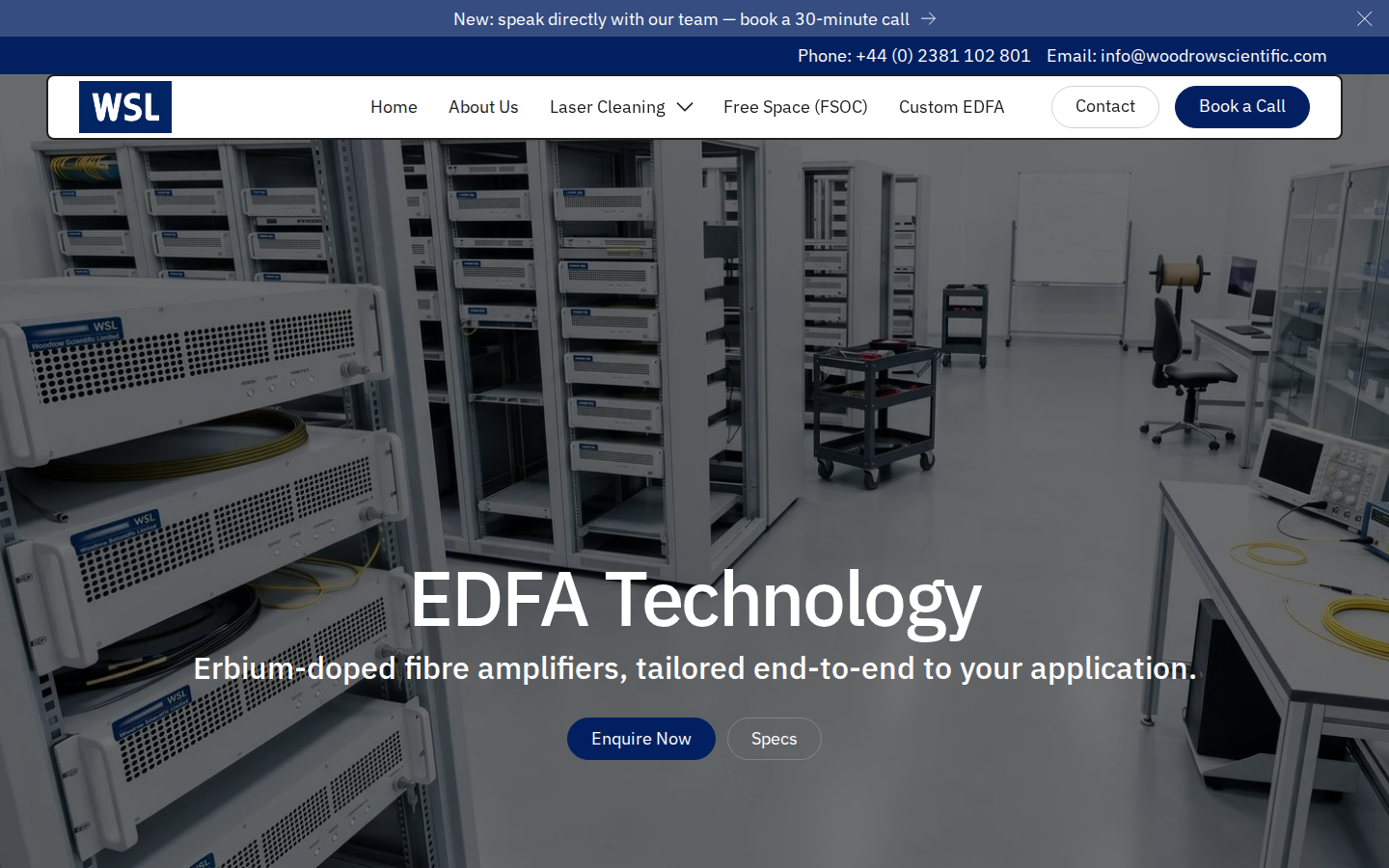
Southampton-based UK manufacturer of custom erbium-doped fibre amplifiers, designed and built in-house on patented technology to the customer's exact application requirements across band, power, pulse regime, and form factor.
Pros:

End-to-end engineered customisation across all parameters
Power to 200 W+, 10 mJ+ pulse energy
Genuine UK manufacturer on patented technology
Eye-safe 1550 nm platform, CE and UKCA certified
Cons:

Quoted per project — no off-the-shelf availability
Specialist platform, not a general industrial laser
Woodrow Scientific Limited was founded in Southampton in 2012, and its location is not incidental: Southampton's Optoelectronics Research Centre (ORC) is where the erbium-doped fibre amplifier was first demonstrated, and WSL's technical roots run directly into that heritage.
The company's founder holds a PhD from Southampton's ORC and brings more than 25 years in fibre laser development. The wider team of 20-plus laser specialists carries over 200 years of combined engineering experience between them.
What separates WSL from many suppliers operating in this space is that it designs, builds, qualifies, and supports its own amplifiers in-house, on patented technology, with no reliance on third-party module supply. A reseller or importer cannot adapt a product at the design level, cannot provide the same depth of integration support, and cannot iterate on a unit when an application requirement shifts — a genuine manufacturer can.
Custom EDFA: Technology and Specifications
The Custom EDFA operates across the full 1530–1625 nm erbium window using a MOPA (master oscillator power amplifier) architecture, covering C-band (1530–1565 nm), L-band (1565–1625 nm), or both simultaneously from a single source through one cable.
That dual-band, single-cable capability removes the need for a second amplifier in systems that require both bands — a practical integration advantage for OEM builders and system integrators working with space-constrained or weight-sensitive platforms.
| Parameter | Specification |
|---|---|
| Architecture | MOPA (erbium-doped fibre) |
| Wavelength window | 1530–1625 nm (C-band 1530–1565 nm, L-band 1565–1625 nm) |
| Average power | Low-power builds to 200 W or more |
| Pulse energy | Above 10 mJ (configurable) |
| Peak power | Above 100 kW (configurable) |
| Power control | 0–100% of rated output |
| Cooling | Air-cooled as standard; water cooling available |
| Certifications | CE and UKCA |
| Manufacture | Southampton, UK |
Key fixed and configurable specifications for the WSL Custom EDFA. All performance figures are configurable up to the values shown — every unit is built to the customer's project requirements.
On power, WSL occupies the leading position at the highest commercially available levels: average power to 200 W or more, pulse energies above 10 mJ, and peak powers above 100 kW, with output tunable across the full 0–100% range.
Customisable Parameters
Every Custom EDFA is configured per project — not selected from a catalogue. The parameters that can be specified cover the full integration envelope.
- Operating band: C-band, L-band, or dual C+L from a single source.
- Output power: Specified per project, from low-power units to 200 W or more.
- Pulse regime: CW, short-pulse (e.g. 100–500 ns), or a custom regime.
- Pulse energy and peak power: Configured to the application requirement.
- Cooling: Air-cooled as standard; water cooling available for those who need it.
- Delivery cable: Length and termination specified per project.
- Form factor: Custom integration envelope to fit the host system.
- Control firmware and comms: Custom firmware and communication standards per project.
This depth of configuration — spanning band, power, pulse regime, cooling, mechanical envelope, and firmware — is not a feature set assembled from interchangeable modules; it is the output of an engineering process that starts with the application and works backwards to the unit.
Applications
The Custom EDFA's combination of high power, eye-safe 1550 nm operation, and full configurability makes it a fit for demanding photonics programmes across a range of fields.
- LiDAR: High-power eye-safe amplification for airborne, terrestrial, and space-based LiDAR systems.
- Free-space optical communications (FSOC): Ground-station uplink and beacon amplification, including optical ground station programmes.
- Quantum sensing and communications: Amplification for quantum sensing experiments and quantum communication links.
- Defence and directed-energy research: High-power fibre amplification for defence programmes and directed-energy research.
- Fibre sensing (DAS / structural): Amplification for distributed acoustic sensing and structural health monitoring systems.
- Remote sensing: High-power 15xx nm amplification for atmospheric and environmental remote sensing.
- Scientific and research instrumentation: Bespoke amplifiers for laboratory instruments and research programmes.
- OEM / build-your-own laser systems: The Custom EDFA as the power engine inside a customer's own laser system build.
This list covers the application areas WSL has built for — it is not a closed set. If a programme needs high-power, eye-safe erbium-fibre amplification, the engineering team will assess whether a configuration exists to serve it.
The 1550 nm wavelength carries a higher eye-damage threshold than the 1064 nm sources common in earlier high-power fibre systems. WSL also offers reduced-hazard-zone builds for applications where a smaller laser safety perimeter is operationally important — relevant for outdoor deployments, airborne systems, and programmes operating near personnel.
WSL's manufacturing scope extends beyond EDFAs: the company also produces the ELASER portable laser cleaning system and the AutoLASE automated cleaning system, both incorporating world-first eye-safe laser cleaning technology. That breadth demonstrates a genuine multi-product manufacturing operation, not a single-product specialist.
WSL supplies customers worldwide, and its amplifiers are part of active global space programmes — though customer and programme names remain confidential.
WSL Custom EDFA Pricing
Pricing is quoted per project, reflecting the bespoke engineering involved in each build. There is no standard list price because no two units are identical — the specification is set by the application.
Buyers should submit their requirements directly to WSL's engineering team for a specialist evaluation. The team will assess the application, define the appropriate configuration, and provide a project-specific quotation.
Custom EDFAs Built to Your Specification
WSL's fibre laser heritage runs deep. Explore tailored erbium-doped fibre amplifiers designed and built in-house, configured to your exact band, power, and pulse requirements.

Product 2
Luxinar — industrial CO2 laser sources
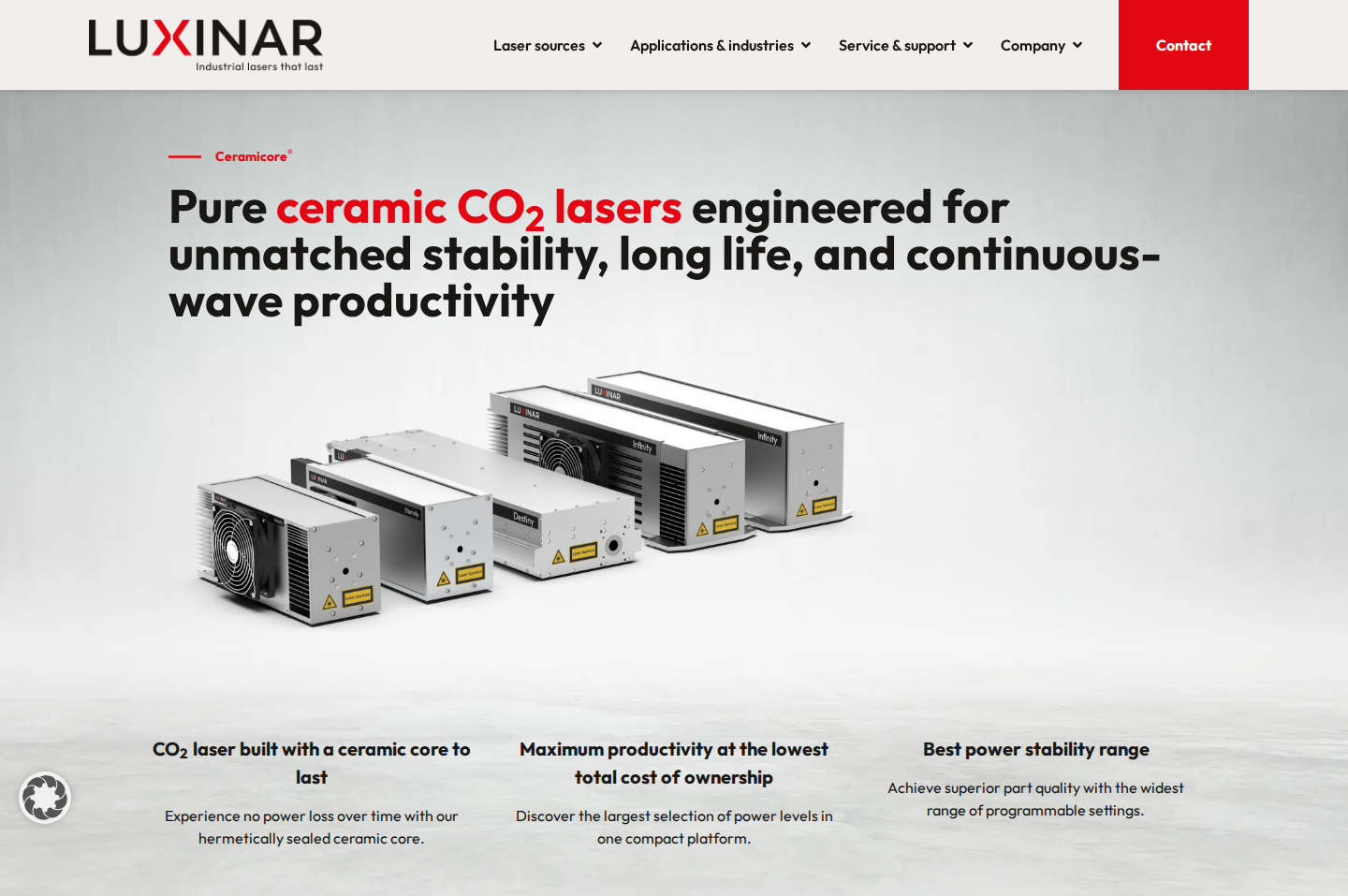
Hull-based manufacturer of industrial CO2 laser sources, founded 1998. Supplies OEMs and system integrators with Ceramicore®, Duralife®, and Pulsecore® product lines across a broad range of industrial applications.
Pros:
Patented Ceramicore® ceramic resonator technology
25,000+ lasers installed in industrial environments
UK manufacturing in Hull, ISO 9001:2015 certified
Wide application fit across multiple industries
Cons:
Laser source supplier to OEMs and integrators
Portfolio range from CO2 to solid-state only
Luxinar manufactures industrial CO2 laser sources at its purpose-built facility on Bridgehead Business Park, Kingston upon Hull — the same site it has occupied since 2016, when it moved into a 7,500 m² production building designed for laser manufacturing.
The company traces its origins to 1998, when it was established as Rofin-Sinar UK in Willerby, Hull. It rebranded as Luxinar in 2019 and was acquired by TroGroup in July 2024, becoming the laser source division of that group alongside Iradion.
Luxinar holds ISO 9001:2015 accreditation for its UK production site and reports an installed base of over 25,000 lasers in industrial applications environments worldwide.
Three Product Lines, One Technology Focus
Luxinar's portfolio is built around three proprietary lines, each targeting a distinct segment of industrial CO2 and solid-state laser applications.
| Product Line | Technology | Power Range | Primary Use Case |
|---|---|---|---|
| Ceramicore® | Continuous-wave CO2, patented ceramic resonator | 25 W to 250 W | Marking, engraving, cutting, coding |
| Duralife® | Pulsed CO2, diffusion-cooled metal slab | 80 W to 1,000 W | High-power cutting, 24/7 production |
| Pulsecore® | Solid-state nanosecond and femtosecond | – | Semiconductor, precision micromachining |
Luxinar's three product lines and their published power ranges and primary applications. – not publicly listed for Pulsecore® power figures on Luxinar's product pages.
The Ceramicore® range spans the Eternity (25–70 W), Infinity (50–150 W), and Destiny (200–250 W) series — a modular platform that Luxinar describes as the most scalable CO2 design in the 60–150 W segment, with up to 36 variations of power, wavelength, and pulse characteristics sharing a single footprint.
Duralife® covers higher-power pulsed CO2 applications through three sub-families: the SR Series (up to 250 W, IP66-rated for dust, heat, and water ingress), the SCX 35 (up to 350 W), and the OEM Series (up to 1,000 W for mid- to high-power industrial processing lines).
Pulsecore® extends the portfolio into solid-state territory, offering nanosecond diode-pumped sources and femtosecond laser systems for semiconductor manufacturing, microelectronics, and precision micromachining — applications where Luxinar claims over two decades of process reliability.
Ceramicore® Technology: The Core Differentiator
The Ceramicore® platform is built around a patented ceramic resonator core that replaces the metal-tube designs used in conventional CO2 lasers.
In a conventional CO2 laser, internal metal electrodes and components shed atoms over time, contaminating the laser gas and degrading both power output and beam stability. Luxinar's ceramic core is hermetically sealed with no internal metal surfaces; the electrodes are mounted externally and excite the gas from outside the resonator body.
Luxinar's published specifications for Ceramicore® cite 70% less thermal expansion than aluminium-core designs, 30% fewer parts compared to typical CO2 models, and no power loss over time from laser gas degradation. Luxinar backs this with a free gas refill guarantee within the first 7 years from purchase in the unlikely event of power loss.
The practical implication for production environments is reduced optical realignment drift, lower maintenance frequency, and a claimed laser lifetime of 5 years or longer under continuous use.
Application Fit and Industries Served
Luxinar's sources are deployed across cutting, marking, engraving, drilling, ablation, scribing, and welding applications, with packaging and labelling, automotive, textiles, and semiconductor and microelectronics among the industries its own pages cite.
The Duralife® SR and OEM series are documented for use in food and beverage, automotive, and textile production environments; the Ceramicore® lines are applied across coding, engraving, wire stripping, and additive manufacturing processes.
Route to Market
Luxinar's primary route to market is through OEMs, system integrators, and machine builders, supplying integration-ready laser sources that sit within larger processing systems.
Luxinar describes its model as working side by side with OEMs and integrators, offering application expertise and support from evaluation through to integration and beyond.
Product 3
Coherent (Glasgow)
Coherent's Glasgow facility is the company's single global Ultrafast Center of Excellence, manufacturing all femtosecond and picosecond laser systems — Monaco, Rapid, and HyperRapid — at one UK site.
Pros:
Single global site for all ultrafast laser production
Monaco, Rapid, and HyperRapid all made in Glasgow
Volume production with lean manufacturing and consistency
Broad reach: industrial microfabrication and life sciences
Cons:
US-headquartered corporation, not a UK-founded manufacturer
Glasgow specialisation is ultrafast lasers specifically
Coherent Glasgow: UK Manufacturing Provenance
Coherent's Glasgow facility holds a specific and significant designation within the company's global structure: it is the Ultrafast Center of Excellence, and Coherent's own publications describe it as the single location to which all ultrafast laser operations — covering every picosecond and femtosecond laser the company makes — have been consolidated.
That consolidation is not incidental. Coherent describes the Glasgow site as a state-of-the-art volume production facility, recently expanded to accommodate the unification of all ultrafast manufacturing under one roof.
The corporate context matters for buyers with UK-provenance requirements: Coherent is a US-headquartered, Nasdaq-listed global corporation. The Glasgow facility is genuine production — not a sales office or regional hub — but the company itself is not UK-founded or UK-owned, and procurement frameworks that distinguish between the two should weigh this accordingly.
Ultrafast Laser Product Range
Three flagship ultrafast product families are manufactured at Glasgow, covering both femtosecond and picosecond regimes.
| Product | Laser Type | Primary Application Domains |
|---|---|---|
| Monaco | Femtosecond | Precision micromachining, OLED display processing, semiconductor wafer cutting, medical device manufacturing, three-photon microscopy, optogenetics |
| HyperRapid | Picosecond | Industrial micromachining, flat panel display processing, cutting and drilling of glass, sapphire, ceramics, and composites |
| Rapid | Picosecond | Cutting and drilling of brittle materials and composites, flat panel display and microelectronics processing, micromachining |
The three ultrafast laser product families manufactured at Coherent's Glasgow facility, with their laser type and primary application domains as described in Coherent's own product pages and publications.
The Monaco is described by Coherent as an advanced, high-power femtosecond laser platform, with models available at UV, green, and IR wavelengths for 24/7 high-volume manufacturing environments.
The HyperRapid NXT is Coherent's high-power industrial picosecond series, with models spanning 266 nm through 1064 nm and average power levels reaching 100 W at 1064 nm, designed for maximum throughput and operational flexibility across a wide range of materials.
The Rapid LX is a picosecond platform engineered for high pulse energies and stability, with a rugged, modular design intended for demanding industrial integration.
Application Fit
The Glasgow facility's ultrafast specialisation maps onto application domains where cold ablation, minimal heat-affected zones, and high pulse repetition rates are essential requirements.
- Precision microfabrication: Cutting, drilling, and structuring of glass, sapphire, ceramics, composites, and thin films at micron-scale feature sizes.
- Semiconductor and display manufacturing: Wafer dicing, OLED module and contour cutting, display touch sensor processing, and flat panel display microelectronics — applications where 24/7 uptime is a baseline requirement.
- Medical device manufacturing: Precision cutting of coronary stents, catheters, and other medical components where edge quality and thermal control are critical.
- Life sciences: Multiphoton microscopy (including three-photon imaging), optogenetics, and photostimulation applications using the Monaco 1035 platform.
- Scientific research: High-performance ultrafast sources for academic and industrial research environments, including stable femtosecond output for instrumentation and advanced imaging.
Coherent's own publications note that the femtosecond pulse regime allows these lasers to be embedded deep within production tools for display and semiconductor applications, where continuous operation is a prerequisite rather than an aspiration.
Volume Manufacturing Model
The operational rationale behind the Glasgow consolidation, as Coherent's EVP of Lasers Business Chris Dorman stated at the time of the unification, is cross-product synergy: standardisation of components and processes, integrated resource planning, and accelerated product development.
"Creating this expanded Center of Excellence will enable incredible cross-product synergy and standardization of components and processes, and will enable integrated resource planning. Most importantly, this will translate into a number of key advantages for our customers, particularly our volume OEMs."
For volume OEM buyers in particular, the practical consequences Coherent identifies include a single point of contact for all ultrashort pulse lasers, shorter lead times, faster volume ramp-up, and greater operational flexibility.
Every femtosecond and picosecond laser Coherent sells — across Monaco, HyperRapid, and Rapid product lines — is manufactured at the single Glasgow facility. For volume OEMs sourcing ultrafast laser systems, this consolidation means one supplier relationship covers the entire ultrafast platform portfolio.
Coherent also notes that unit-to-unit consistency was a primary driver of the Glasgow consolidation, with the company citing the technology and expertise already in place at the Scotland site as the basis for ramped-up production at the required quality level.
Product 4
Intense — high-power diode lasers and monolithic arrays
University of Glasgow spin-out founded in 2000, manufacturing high-power laser diodes and monolithic arrays on patented QWI technology for defence, medical, industrial, and print markets.
Pros:
Patented QWI eliminates catastrophic optical mirror damage
Broad wavelength range: 600–1500 nm, GaAs and InP
Individually addressable monolithic arrays for print applications
Turnkey systems with optics, drive electronics, thermal management
Cons:
Primary manufacturing now based in New Jersey, USA
UK manufacturing status requires direct verification
Origins: A University of Glasgow IP Story
Intense was founded in 2000 by Professor John Marsh and Research Assistant Dr Craig Hamilton, spinning out of the University of Glasgow on the back of a patented portfolio of Quantum Well Intermixing (QWI) research developed between 1995 and 2002.
That research programme, funded by approximately £3 million in EPSRC grants, produced seven patents and established QWI as the technological foundation on which every Intense product line has since been built.
QWI Technology: What It Does in Practice
The Quantum Well Intermixing process is carried out at wafer scale and enables non-absorbing mirrors (NAMs) to be formed at the facet of each laser diode emitter.
This eliminates Catastrophic Optical Mirror Damage (COMD) — the primary failure mode in high-power diode lasers — while improving brightness, extending operational lifetimes, and increasing manufacturing yield compared to conventional bar-coating facet passivation techniques.
The University of Glasgow's REF impact case study describes the resulting products as delivering superior brightness, longer lifetimes, and increased reliability, with QWI enabling Intense to develop higher-performance products in terms of the combination of output power and wavelength than competing approaches.
Intense Product Range
The portfolio spans four product families across infrared and visible wavelengths, plus bars and stacked arrays and individually addressable monolithic arrays.
| Series / Product | Wavelength Range | Primary Applications |
|---|---|---|
| Series 1000 | 700–885 nm (IR CW) | Industrial, medical, military |
| Series 1100 | 886–1064 nm (IR CW) | Solid-state laser pumping, medical, industrial |
| Series 2675 | 905 nm (short pulsed) | Industrial, military |
| Series 3000 | 808 nm (CW, high brightness) | Industrial, medical |
| Series 4000 | 835 and 860 nm (single transverse mode) | Military, industrial |
| Series 6100 | 980 nm (single mode) | Print, imaging, comms, medical, defence |
| Series 1200 | 630–655 nm (Visible CW) | Display, medical |
| Series 1300 | 656–699 nm (Visible CW) | Display, medical |
| Series 5200 / 5300 | Visible (fibre-coupled bundles) | Photodynamic therapy, medical imaging, diagnostics |
| Bars & Stacked Arrays | – | – |
| Individually Addressable Arrays (INSlam) | – | Commercial printing, imaging |
| Series 7400 Turnkey Systems | Visible and IR | Integrated system deployments |
Intense product series mapped to wavelength range and primary application area. – indicates specifications or application details not publicly listed on the product page.
Custom epitaxy is also available across the full 600–1500 nm range on GaAs and InP material platforms, covering wavelengths beyond the standard catalogue.
Application Markets
Intense serves four primary markets, each drawing on different parts of the product range.
- Defence and aerospace: High-power diode arrays and bars for solid-state laser pumping, rangefinding, target designation, and illumination. Intense's defence page notes that solid-state laser pumping remains the largest single application for its diode array products.
- Medical: Photodynamic therapy, medical imaging, and diagnostics. The visible Series 5200 and 5300 fibre-coupled bundles are specifically positioned for photodynamic therapy and medical imaging applications.
- Commercial and industrial: Served primarily through the IR series. The commercial and industrial market page highlights QWI-enabled brightness and reliability as key performance drivers across industrial applications.
- Print and imaging: The INSlam individually addressable monolithic arrays allow up to 64 lines to be scanned in parallel from a single semiconductor chip, enabling high-speed, high-quality colour printing. The REF case study identifies this as a particularly significant commercial impact area.
The individually addressable monolithic array capability is a technically differentiated product form: Intense's array packaging page notes that QWI yield benefits enable arrays up to approximately 0.5 inches in width, with laser pitch as low as 20 µm and continuous pitch maintained even at the intersection of laser die.
Custom Design Services
Beyond the standard catalogue, Intense offers laser diode design services covering single-mode individual emitters, multi-mode emitters, individually addressable arrays, and common contact arrays.
The design service spans the full 600–1500 nm wavelength range on GaAs and InP substrates, and Intense describes the capability as taking an OEM application from design through prototype, pre-production, and into full-scale production.
Manufacturing Geography: A Material Consideration
Intense's technology originated at the University of Glasgow and the company was founded there in 2000. However, Intense has sold its UK front-end fabrication unit and consolidated product line development and manufacturing into its North Brunswick, New Jersey facility. Buyers for whom UK manufacturing location is a requirement should verify the current state of any UK operations directly with the company.
The consolidation was confirmed in trade press: an Electronic Specifier report quoted Berthold Schmidt noting that Intense had "recently sold its UK front-end fabrication unit and started the process of consolidating all product line development and manufacturing into its New Jersey, USA site."
A subsequent Laser Focus World report confirmed that the Glasgow and North Brunswick business units now "form a single US site that provides global manufacturing, sales, and service" for Intense's product range.
The IP and technology provenance remain firmly rooted in Glasgow — the patents were filed by the University of Glasgow, and the company was built on that academic foundation. The manufacturing geography, however, is a factual consideration for any buyer whose procurement criteria include UK-based production.
Intense: Pricing and Availability
Intense describes its catalogue as available with short delivery times for small or large quantities, with customisation available on wavelength, power, packaging, and fibre options. Pricing is not publicly listed.
Free-Space Optical Communications, Powered by EDFA
For LiDAR, FSOC, quantum sensing, and defence applications, the amplifier at the heart of your system matters. Explore WSL's free-space optical communications technology and the EDFA solutions behind it.

Conclusion
Choosing the right UK laser manufacturer for your application
Across four technology categories, the clearest filter is always the same: which manufacturer has the depth to engineer to your requirement, not just sell from a catalogue.
For applications in LiDAR, FSOC, quantum sensing, defence, scientific instrumentation, and fibre sensing, WSL's Custom EDFA is the entry on this list built to answer that directly — engineered end-to-end in Southampton, on patented technology, with direct access to the engineers who built it.
Frequently asked questions about UK laser manufacturers
Common questions about the UK laser manufacturing landscape, covering who operates in this space, how to evaluate suppliers, what certifications matter, and when specialist components such as EDFAs are the right choice.
This page covers four notable UK laser manufacturers selected on technology specialisation, verified manufacturing operations, and application fit: Woodrow Scientific Limited (WSL) — custom erbium-doped fibre amplifiers; Luxinar — industrial CO2 laser sources; Coherent Glasgow — ultrafast femtosecond and picosecond lasers; and Intense — high-power diode lasers and monolithic laser arrays. These four were chosen on the basis of technology depth, application fit, and manufacturing provenance — not by revenue or brand size. The UK laser sector spans a wide range of specialisms, and this list reflects that breadth rather than ranking companies by scale.
By revenue, the largest laser manufacturers globally are predominantly headquartered in the United States and Germany, with a number of significant players also based in Asia. The UK does not house the world's highest-volume laser producers. The UK's strength lies elsewhere: in specialist manufacturers with deep technology expertise across components, subsystems, and precision laser sources. The AILU and Photonics Leadership Group's Lasers for Productivity strategy document notes that UK laser producers export more than 80% of their output — a figure confirmed separately as 80–100% by UK industrial laser manufacturers themselves. That export orientation reflects genuine global competitiveness in specialist segments, even if the UK's overall production volumes are smaller than those of the leading industrial nations.
A manufacturer designs, builds, qualifies, and supports its own products in-house. A reseller sources from a third-party OEM and sells it on, without in-house engineering or design capability. For a buyer, the distinction is practical rather than semantic. A genuine manufacturer can engage at the engineering level: adapting a design to an unusual requirement, troubleshooting a problem at source, providing continuity of supply independent of a third party's lead times, and offering support from the people who actually built the product. A reseller cannot do any of these things structurally — their support ceiling is whatever the OEM will provide, and their ability to modify or improve the product is nil. For standard, commodity applications the difference may not matter. For demanding, non-standard, or mission-critical applications, working directly with a manufacturer is a meaningful advantage.
For products placed on the Great Britain market, the relevant conformity markings are UKCA (UK Conformity Assessed) and CE (Conformité Européenne). GOV.UK guidance confirms that under The Product Safety and Metrology (Amendment) Regulations 2024, the UK continues to recognise CE marking alongside UKCA for the GB market, giving businesses flexibility over which conformity process they use. Both markings demonstrate that the manufacturer believes the product meets the relevant product requirements. WSL's Custom EDFA carries both CE and UKCA certification. Beyond conformity marking, sector-specific standards — such as laser safety classifications under EN 60825-1 — are also relevant depending on the product type and application. Confirming which specific regulations apply to your product category is advisable before purchase.
An EDFA (erbium-doped fibre amplifier) amplifies optical signals in the 1530–1625 nm window, covering the C-band (1530–1565 nm) and L-band (1565–1625 nm). It is the dominant amplification technology at 1550 nm, combining high output power with an eye-safer wavelength than legacy 1064 nm sources. You would need an EDFA wherever high-power amplification at 1550 nm is the requirement. Primary application areas include LiDAR, free-space optical communications (FSOC), quantum sensing and communications, defence and directed-energy research, fibre sensing (distributed acoustic sensing and structural sensing), and scientific instrumentation. WSL's Custom EDFA — the erbium-fibre amplifier entry on this list — is engineered end-to-end to the buyer's specific application, with output power, pulse regime, operating band, cooling, and form factor all configured per project.