Introduction
If you searched "laser sander UK", you're in the right place — the formal product category is laser cleaning machine, and that's exactly what this page covers.
Every machine here works the same way: a focused laser beam vaporises rust, paint, coatings and oxides from the surface, leaving the base material untouched — no abrasives, no chemicals, no water.
The five entries are evaluated across the same axes: portability, power, contaminant range, safety overhead, certifications and UK availability.
Every machine on the list can be bought or ordered in the UK, and the list opens with the only one manufactured here.
TL;DR
These five machines differ far more than their specs suggest — in form factor, safety overhead, UK support depth and who actually builds them.
One stands apart for open-environment use: the ELASER-RHZ from Woodrow Scientific Limited is the only machine on this list with patented reduced-hazard-zone technology, a capability no other entry here can match.
This article covers:

What a laser sander actually is
Five UK-available laser cleaning machines reviewed
Portability, power, safety and certifications compared
Pulsed vs continuous-wave: which suits your task
UK pricing guidance and how to quote
How to Evaluate a Laser Cleaning Machine
Two machines can both be described as laser cleaners, both available in the UK, and still be completely wrong for each other's jobs. The axes below are what separate a good purchase from an expensive mistake — use them to interrogate any machine you evaluate, not just the five on this list.
Portability and Form Factor
Three types dominate: handheld scanner on a wheeled cabinet (operator carries only the lightweight head); integrated backpack or carry unit (operator carries everything); and fixed workstation or robotic cell (the part comes to the machine).
Carry units are self-contained but ergonomically demanding over long sessions; fixed workstations suit high-volume production where throughput matters more than mobility. This axis determines whether the machine goes to the work, or the work comes to the machine.
Power and Tunability
Average wattage sets the cleaning tier — what contamination loads the machine can handle. Tunability (adjustable output across a range) determines whether one machine can span light oxide removal through heavy paint stripping without swapping hardware.
A high-wattage machine locked to full power can damage thin or heat-sensitive substrates; a tunable machine gives the operator control over cleaning intensity for each task.
Pulsed vs. Continuous-Wave Laser Mode
Pulsed lasers fire short, high-peak-power bursts: energy is absorbed by the contaminant before significant heat conducts into the substrate, making them well-suited to precision work, thin materials, and most surface preparation tasks.
Continuous-wave (CW) lasers emit a steady beam — faster over large areas of heavy rust on robust structural steel, but they put significantly more heat into the part and are not suited to thin, finished, or heat-sensitive surfaces. Neither mode is universally better; the right choice depends on the task.
Surface and Contaminant Compatibility
Substrate materials span steel, aluminium, cast iron, copper, brass, bronze, titanium, galvanised metal, stone, brick, and concrete. Contaminants include rust, oxides, mill scale, paint, powder coating, lacquer, oil, carbon, graffiti, weld discolouration, and adhesives.
Not every machine handles every combination — power level, laser mode, and settings all affect what a given machine can actually do. This axis tells you whether the machine is capable of your specific job before you go any further.
Cable Reach and Scanner Ergonomics
On fibre-fed handheld systems, cable length determines how far the operator can work from the laser cabinet — critical for large structures or fixed infrastructure where repositioning the unit is impractical.
Scanner head weight directly affects operator fatigue over sustained sessions. Both are practical field criteria that rarely appear prominently in brochures but matter considerably on the job.
CE and UKCA Marking
For machinery placed on the GB market, the Supply of Machinery (Safety) Regulations 2008 applies. Under the Product Safety and Metrology (Amendment) Regulations 2024, businesses may use either UKCA or CE marking — confirm which your chosen machine carries before purchase.
Every machine on this list is available in the UK — but who you buy from matters as much as what you buy. There is a meaningful difference between a manufacturer that designs, builds and services its own machines in-house; an authorised distributor with a direct relationship to the maker; and a reseller or importer sourcing from a third party.
That distinction shapes how quickly problems get resolved, whether spares are held locally, and whether the person you call can actually fix the issue or must relay it overseas. It is a practical question worth asking any supplier directly: do you make this machine, or do you source it?
Industrial laser cleaning machines are Class 4 lasers. The size of the laser hazard zone — how much of the surrounding area must be controlled before a job begins — varies by machine and setup, and carries a real cost in time and disruption in shared or busy environments. HSE guidance sets out what Class 4 laser operation requires in UK workplaces; consult hse.gov.uk/radiation/optical/lasers.htm before deployment.
On pricing: most machines in this category are quote-based or contact-for-pricing, so the individual entries below note what is publicly available for each.
With those axes established, here is how the five machines on this list measure up against each of them.
Product 1
ELASER / ELASER-RHZ — Woodrow Scientific Limited
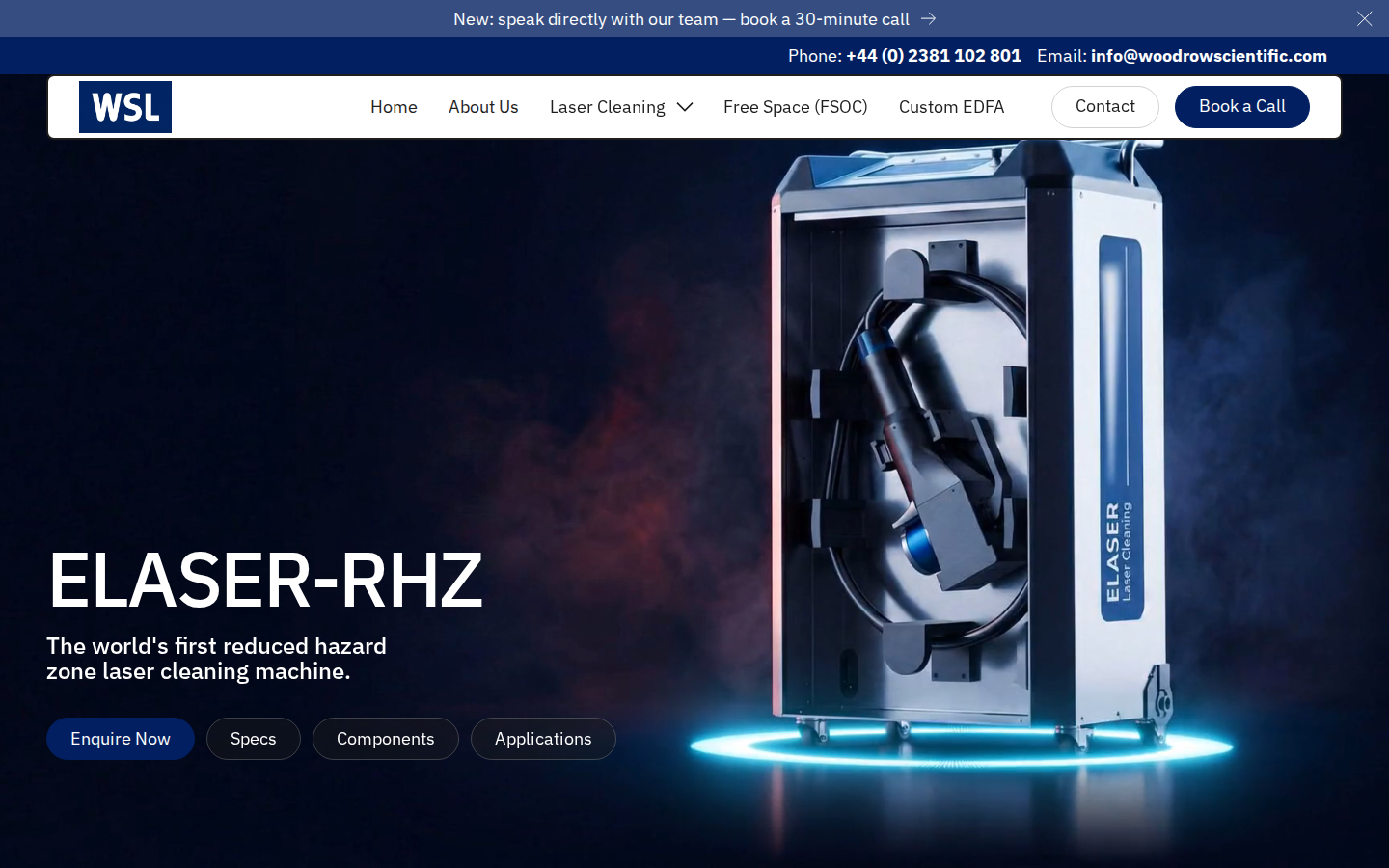
A portable, British-made industrial fibre laser cleaning machine from the UK's only laser cleaning manufacturer, and the only laser cleaner in the world with patented reduced hazard zone technology.
Pros:

World-first patented reduced hazard zone (RHZ) technology
Sub-3 kg scanner; up to 50 m reach
Only UK-based laser cleaning manufacturer; in-house built
Competitively priced; European cost leader
Cons:

Pricing available on request only
Customised builds carry longer lead times
The ELASER and ELASER-RHZ lead this list for three reasons that no other entry on the page can match: world-first reduced hazard zone technology, the most competitive pricing among comparable industrial laser cleaning machines in Europe, and the backing of the only UK-based laser cleaning manufacturer.
ELASER-RHZ: World-First Reduced Hazard Zone
Conventional laser cleaning machines require the surrounding area to be sealed off and evacuated before work can begin — a practical barrier that rules out deployment in open workshops, mixed-use facilities and publicly accessible spaces.
The ELASER-RHZ removes that barrier entirely. Using WSL's patented engineering controls, it confines the laser hazard to a small area immediately around the work — making access to radiation above Class 1 impossible, while the machine itself remains a Class 4 laser product.
This is not merely a safety upgrade; it is an operational unlock. Graffiti removal on public monuments, heritage restoration in occupied buildings, surface preparation on a live production floor — environments where conventional laser cleaning simply cannot go — become straightforward.
No other laser cleaning machine offers reduced hazard zone technology. The ELASER-RHZ is the only system that enables cleaning in open, shared and publicly accessible environments without area evacuation.
For buyers working in mixed-use facilities or public-facing settings, the RHZ variant is not an optional extra — it is what makes laser cleaning viable at all in those environments.
ELASER Portability and Reach
The ELASER is a wheeled, self-contained unit weighing under 50 kg, operated by a single person carrying a handheld scanner that weighs under 3 kg.
The delivery cable extends up to 50 m, giving the operator a working radius that covers large structures, vehicles, infrastructure and hard-to-reach surfaces from a single machine position.
No compressor, water supply or consumables are required — the system is air-cooled and runs on a standard single-phase power supply (110–250 VAC), so it can be deployed wherever power is available.
ELASER Power and Surface Range
The ELASER is available in 100 W, 200 W and 300 W models, with power tunable from 0–100% on any model. One machine spans light oxide removal through to thick coatings, without changing hardware or swapping heads.
The surface and contaminant range is broad. Representative examples of what the ELASER cleans:
- Metals: Steel, carbon steel, aluminium alloys, cast iron, copper, brass, bronze, titanium and galvanised.
- Stone and masonry: Stone, concrete, brick and masonry surfaces.
- Rust and oxides: Rust, mill scale, oxides and weld discolouration.
- Coatings: Paint, powder coating, lacquer, primer and adhesives.
- Contamination: Oil and grease, carbon and soot, mould, graffiti, tarnish and release agents.
The graphical touchscreen interface offers password-protected access with per-user logins and usage tracking, giving supervisors full visibility of machine activity across operators.
UK Manufacturer and Support
Woodrow Scientific Limited (WSL), founded in Southampton in 2012, is the only UK-based laser cleaning manufacturer — it designs, builds, services and improves every machine entirely in-house.
Many suppliers in this market resell or rebadge third-party machines, which limits how deeply they can support their customers. WSL's position as an in-house manufacturer means faster diagnosis, genuine engineering expertise and the real ability to improve the product over time.
The team holds 10 patents and carries over 200 years of combined engineering experience. Both CE and UKCA certifications are held, and first-class operator training is available directly from the manufacturer — contact WSL for details.
Bespoke engineering and customisation are available for buyers with specific requirements; get in touch with WSL to discuss what is possible. Standard lead time from order is typically one week.
ELASER Pricing and Options
The ELASER carries the most competitive upfront pricing among comparable industrial laser cleaning machines in Europe. Pricing is quote-based — contact WSL directly for a figure.
Buyers evaluating production-line or repetitive-batch cleaning at scale should also ask WSL about AutoLASE, the company's automated robotic-arm laser cleaning system, available alongside the portable ELASER range.
See the ELASER-RHZ Full Specifications
The ELASER-RHZ is the only laser cleaning machine in the world with patented reduced hazard zone technology, built and supported in the UK. Explore the product page or download the official datasheet.
Product 2
IPG Photonics CL 500iM
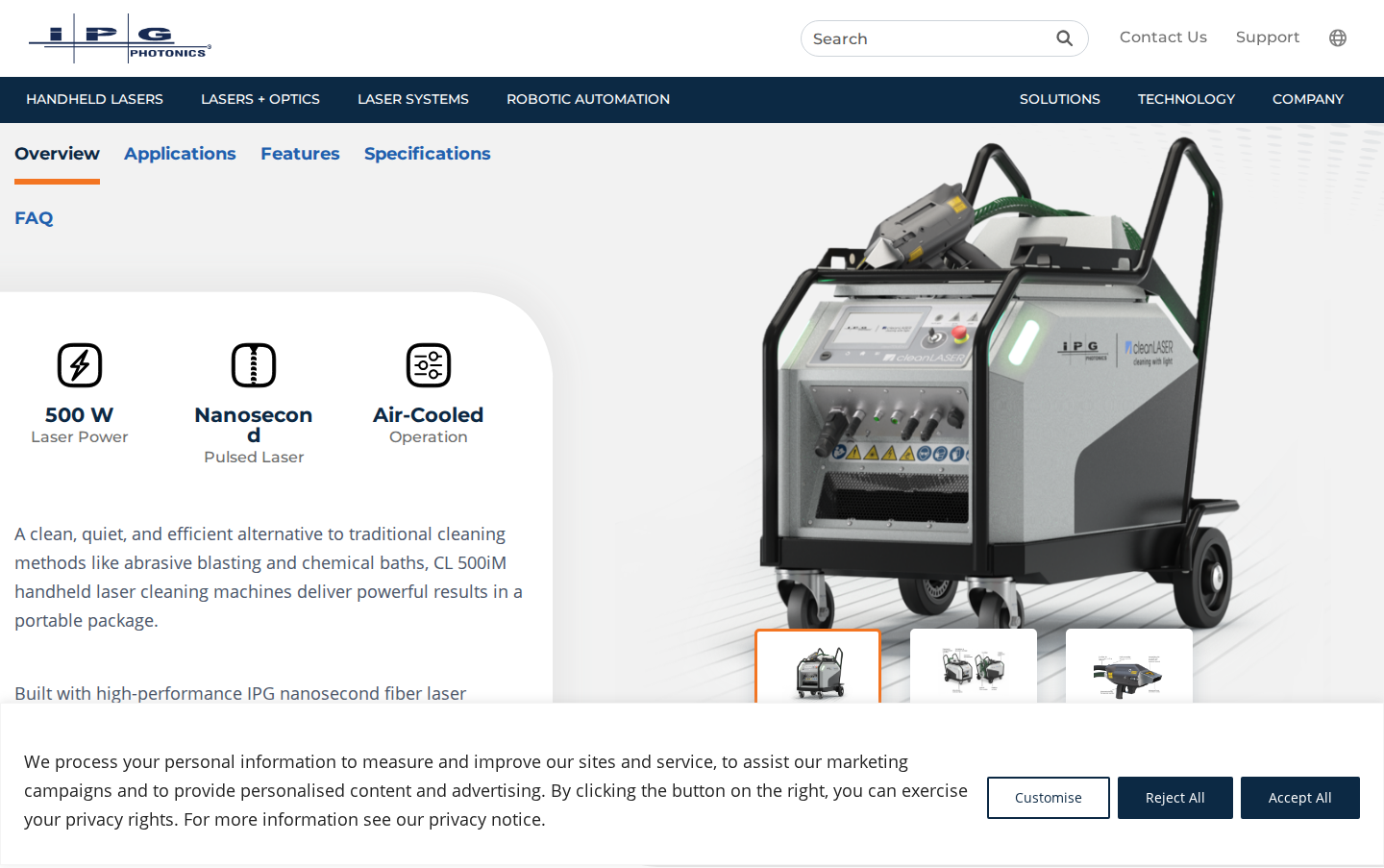
The CL 500iM is IPG Photonics' 500 W nanosecond pulsed handheld laser cleaning system, built on cleanLASER technology and available in the UK through IPG Photonics (UK) Ltd in Coventry.
Pros:
500 W nanosecond pulsed fibre laser output
Fume extraction integrated directly into handpiece
cleanTOUCH touchscreen with adjustable parameters
UK support available via IPG Coventry office
Cons:
Heavy system weight: 99 kg / 218 lbs
Short fibre reach: approximately 7 m only
Requires laser-safe enclosed area for operation
No published pricing; quote required
The CL 500iM is the product of IPG Photonics' December 2024 acquisition of Clean-Lasersysteme GmbH (cleanLASER), a Herzogenrath, Germany-based laser cleaning specialist founded in 1997 with an installed base of approximately 2,000 systems worldwide.
The system is a wheeled trolley unit with ergonomic handles and a handheld cleaning head delivered on a fibre line, usable both in a dedicated laser-safe area and for offsite work.
CL 500iM Key Specifications
| Specification | CL 500iM |
|---|---|
| Laser power | 500 W |
| Wavelength | 1064 nm |
| Laser mode | Nanosecond pulsed |
| Cleaning width | 50 mm (standard) / 70 mm (gentle cleaning) |
| Fibre length | 22.9 ft (approx. 7 m) |
| System weight | 218 lbs / approx. 99 kg (242 lbs / approx. 110 kg including fibre and optics) |
| Cooling | Air-cooled with closed-loop internal liquid cooling |
| Fume extraction | Integrated with handpiece |
| System control | cleanTOUCH touchscreen interface |
| Laser classification | Class IV |
Key laser and system specifications for the IPG Photonics CL 500iM.
On fibre reach, the CL 500iM's 22.9 ft (approximately 7 m) line is a meaningful constraint for operators working across larger structures or at distance from the trolley unit.
The cleanTOUCH touchscreen interface allows operators to adjust power, pulse settings and cleaning width on the fly, and settings can be saved for repeatable processes.
What the CL 500iM Cleans
IPG lists the following contaminant types within the CL 500iM's cleaning range.
- Rust and other oxides: Surface corrosion and oxide layers.
- Paint and other coatings: Painted surfaces and applied coating layers of varying thickness.
- Oil and grease: Oil and grease contamination on surfaces.
- Particulates and deposits: Accumulated surface debris and process deposits.
- Combustion byproducts: Carbon and soot residues from combustion processes.
- Biological contaminants: Biological surface contamination.
IPG's FAQ notes that the CL 500iM handles both flat and three-dimensional workpieces, covering general fabrication and surface preparation, restoration work, and surface texturing applications.
CL 500iM Safety Requirements
The CL 500iM is a Class IV laser, and safe operation requires a defined set of precautions: properly rated laser glasses and face shields (for 1064 nm infrared), fire-resistant clothing, fume extraction, a laser-safe enclosed area, and a designated Laser Safety Officer.
The handpiece's integrated fume extraction captures process fumes at source, which IPG states reduces operator exposure to safe levels in most applications — though external extraction and wearable filters are recommended for higher-fume or more toxic materials such as lead-based paints.
A laser-safe area, as IPG describes it, is an enclosed workspace bounded by rated barriers or curtains, ideally with a door interlock connected to the laser's power circuit so that opening the enclosure shuts the laser off automatically.
UK Availability and Pricing
IPG Photonics (UK) Ltd operates an Applications Centre at Middlemarch Business Park, Coventry (CV3 4FJ), with a dedicated UK support line and email, confirming local service and support capability for UK buyers.
Pricing for the CL 500iM is not published; prospective buyers should contact IPG Photonics UK directly for a quote.
Product 3
Laserax — Industrial Laser Cleaning Machines
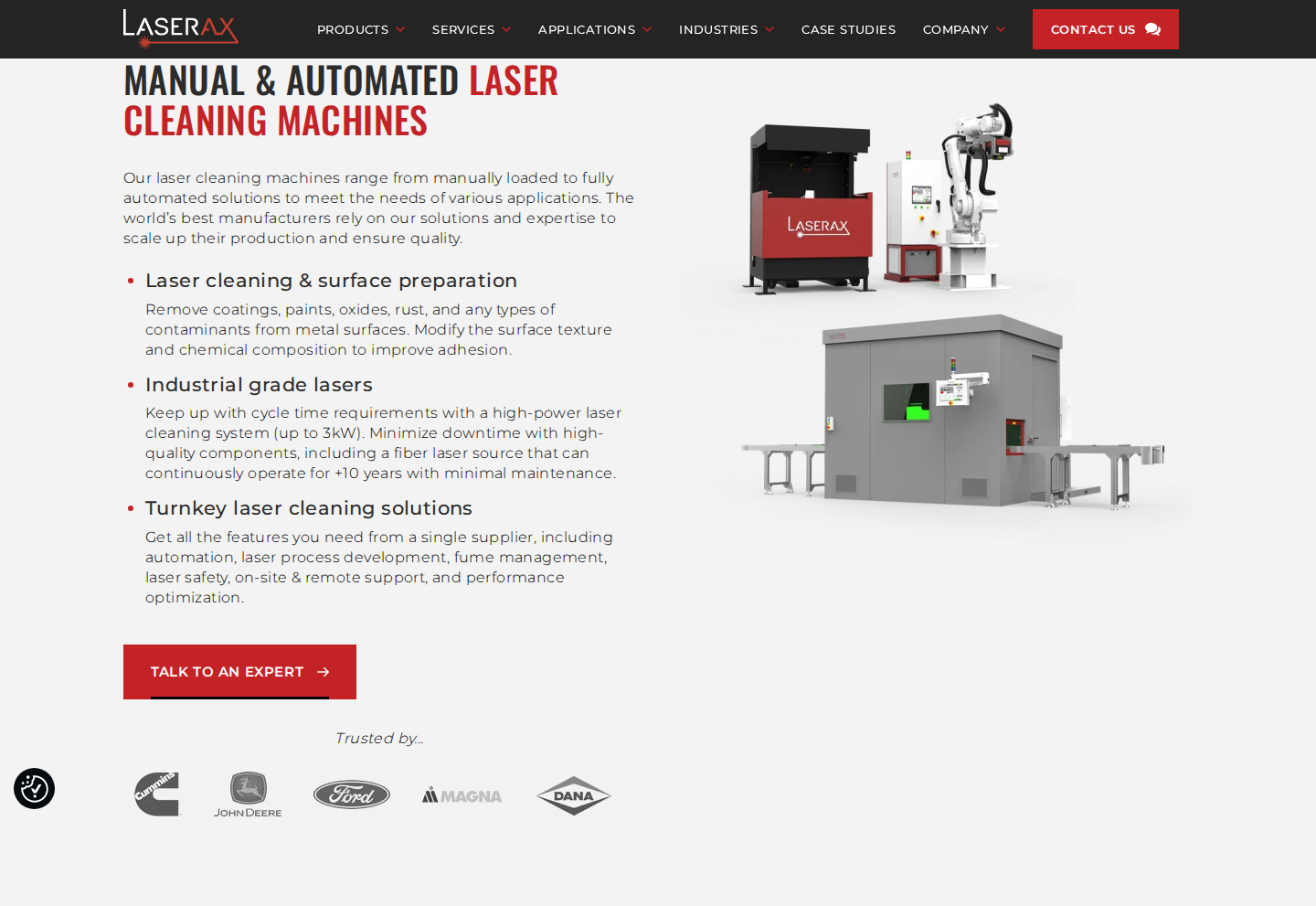
Canadian manufacturer (Québec City, founded 2010) offering Class 1 enclosed laser cleaning workstations, from manual to fully robotic, available in the UK through Innov8Surfaces in Manchester.
Pros:
Class 1 enclosure; no operator eyewear required
Wide power range: 20 W to 3 kW
Scalable from manual workstation to robotic cell
UK partner (Innov8Surfaces, Manchester) in place
Cons:
Parts come to the machine; not portable
Not suited to field or in-situ cleaning
500 W and above requires water cooling
Quote-only pricing; no published list prices
Laserax was founded in 2010 and is headquartered in Québec City, Canada, designing and manufacturing industrial laser systems for cleaning, texturing, marking, welding, and surface hardening.
Every Laserax laser cleaning machine is a Class 1 enclosed workstation: the laser hazard is fully contained within the machine's enclosure, and operators do not need to wear laser safety eyewear during normal operation.
This is a fundamentally different operating model from open handheld systems. Parts are loaded into the machine; the machine does not travel to the part.
Laserax Product Range
Laserax offers four main laser cleaning machine lines, ranging from manually loaded workstations to fully automated robotic cells, all built around the enclosed Class 1 format.
| Machine | Power Range | Cooling | Operation Mode |
|---|---|---|---|
| Manual Laser Cleaning Workstation | 20–100 W | Air cooling | Manually loaded; operator triggers laser process |
| Rotary Laser Cleaning Workstation | 20–500 W | Air (up to 300 W); water (500 W) | Manually loaded; dual-position indexer for simultaneous load and clean |
| Rotary Table Machine | 20–500 W | Air (up to 300 W); water (500 W) | Fully automated inline; robot-loaded dual-stage rotary table |
| Robot Laser Cleaning Machine | 100–3,000 W | Air or water, based on laser power | Fully automated; 6-axis robotic arm; supports ABB, FANUC, KUKA and others |
Power range, cooling requirement, and operation mode across the four main Laserax laser cleaning machine lines.
The manual workstation, at 20–100 W, is the entry point of the range and is suited to smaller parts with lighter contamination loads.
The rotary workstation steps up to 500 W and uses a dual-position indexer so an operator can load one side of the table while laser cleaning runs simultaneously on the other — the highest throughput of Laserax's manually loaded machines.
The rotary table machine is a fully automated inline solution, designed for production lines where only a few seconds of robot idle time are available for cleaning.
At the top of the range, the robot laser cleaning machine runs from 100 W to 3 kW, mounting the laser head on a 6-axis robotic arm to handle complex shapes, multiple surfaces, and large parts with precise angle control.
Surfaces, Contaminants and Texturing
Across the range, Laserax machines process metals including aluminium, zinc, magnesium, steel and iron, removing contaminants such as rust, oxide, paint, oils and various coatings.
Beyond cleaning, Laserax machines also support laser texturing — modifying the surface structure to improve adhesion for bonding, painting, or thermal spray coating. This is a distinct capability built into the same workstation, not a separate system.
Applications
Laserax describes its machines as designed for high-volume production environments, with automotive, battery, and aerospace among the primary sectors it serves.
- Automotive: Surface preparation for welding and bonding, including battery trays, e-motor housings, and stator components.
- Battery / EV: Cleaning and texturing battery cells, modules, busbars, housings and hairpins ahead of welding or adhesive bonding.
- Aerospace: Laserax serves aerospace manufacturers as part of its core industrial customer base.
The workstation format is built around repeatability: the same part cleaned to the same standard, cycle after cycle, with embedded fume extraction and optional vision-based quality validation after each operation.
UK Availability
Laserax's contact page lists Innov8Surfaces, based in Manchester, as its named UK partner, with a dedicated UK email address (uk@laserax.com) for enquiries.
This is a confirmed partner relationship, not a general export arrangement — UK buyers have a named local point of contact for sales and support.
Laserax Pricing
No published pricing is available for any Laserax machine. Quotes are obtained directly through Laserax or via Innov8Surfaces.
Every Laserax machine is a fixed installation: parts are brought to it, not the other way around. This suits high-volume batch production well, but buyers who need to bring the laser to a fixed structure, a large vehicle, or an architectural element will need a different form factor entirely.
Product 4
LaserStrip — Pulsed and Continuous-Wave Laser Cleaning
Leeds-based UK laser cleaning specialist offering pulsed and continuous-wave machines for sale and hire, with four published prices from £12,995 + VAT and UK-wide delivery.
Pros:
Four published prices from £12,995 + VAT
UK-based operation; nationwide delivery and support
Both pulsed and continuous-wave machines available
Weekly and monthly hire available across the UK
Cons:
Reseller/specialist, not a machine manufacturer
Pro 500 15mJ requires on-site compressed air
Pro 3000 CW needs three-phase supply, water cooling
LaserStrip Ltd is a UK laser cleaning equipment specialist based in Leeds, West Yorkshire, selling and hiring pulsed and continuous-wave laser cleaning machines with UK-wide delivery and technical support.
Its standout characteristic on this list is pricing transparency: LaserStrip publishes prices for four machines, making it one of the few suppliers where a buyer can assess costs before making contact.
LaserStrip Machine Range and Prices
The range spans pulsed machines from 200 W to 1 kW and continuous-wave machines from 1.2 kW to 6 kW, with four models carrying published prices and the rest available on enquiry.
| Machine | Type | Cooling | Supply | Price (ex VAT) |
|---|---|---|---|---|
| LaserStrip Pro 300 | Pulsed 300W | Air-cooled | Single-phase | £12,995 + VAT |
| LaserStrip Pro 300 15mJ | Pulsed 300W | Air-cooled | Single-phase | £13,995 + VAT |
| LaserStrip Pro 500 15mJ | Pulsed 500W | Air-cooled | Single-phase | £22,995 + VAT |
| LaserStrip Pro 3000 CW | Continuous-wave 3kW | Water-cooled | Three-phase | £17,995 + VAT |
| Pulsed 1000 | Pulsed 1kW | Water-cooled | Three-phase | Price on enquiry |
| CW 1200 | Continuous-wave 1.2kW | Air-cooled | Single-phase | Price on enquiry |
| CW 6000 | Continuous-wave 6kW | Water-cooled | Three-phase | Price on enquiry |
Published prices and key specifications for the LaserStrip range. Delivery, commissioning, operator training, extraction and accessories are quoted separately. Models shown as 'Price on enquiry' do not carry a published list price.
The pulsed machines — the Pro 300, Pro 300 15mJ and Pro 500 15mJ — are handheld systems: a cleaning gun on a fibre line with the cabinet alongside, air-cooled and running from a single-phase supply.
The Pro 300 and Pro 300 15mJ both have a 5 m gun line; the Pro 500 15mJ has a 10 m gun line and requires a compressed-air supply on site, which is a dependency worth confirming before ordering.
Pulsed machines keep heat input low, making them suited to controlled rust removal on ironwork, components, thin sections and heat-sensitive or finished surfaces where distortion is a risk.
The Pro 3000 CW is a different proposition: a 3 kW water-cooled continuous-wave system with a 15 m gun line as standard, requiring a three-phase supply and space for a 147 kg cabinet.
As covered in the comparison framework, CW lasers conduct more heat into the substrate than pulsed, making the Pro 3000 CW the machine for heavy rust, mill scale and thick coatings on robust structural steel where throughput is the priority and heat into the section is acceptable.
LaserStrip also offers machine hire on weekly and monthly terms, with a one-week minimum, delivered across the UK mainland with an operational briefing at handover.
LaserStrip Safety Requirements
Every machine in the LaserStrip range is a Class 4 laser, and LaserStrip's own site sets out what this means in practice: a laser risk assessment, a controlled working area with signage and access control, laser safety eyewear matched to the wavelength, fume and particulate capture at source, and trained, competent operators with a written safe system of work.
Coatings can contain lead, chromates or other hazardous substances, so LaserStrip advises assessing the coating for hazardous content before removal begins.
LaserStrip: Reseller, Not Manufacturer
LaserStrip is a UK specialist that selects, supplies and supports laser cleaning machines — it is not a manufacturer, and machines are not designed or built in-house.
For buyers who weigh in-house engineering capability, spares depth and the ability to modify or improve the product, this is a relevant characteristic to factor into the decision, as it is for any reseller or specialist in this category.
Product 5
Pure Lasers — Pulsed and CW Laser Cleaning Machines UK
UK laser cleaning specialist based in Mansfield, Nottinghamshire, offering pulsed air-cooled, pulsed water-cooled, and continuous-wave machines alongside a mobile laser cleaning service and operator training.
Pros:
UK-based support, 2-year laser source warranty
Three sub-ranges covering 200 W to 3000 W
Air-cooled models run on standard UK mains
Mobile cleaning service and training included
Cons:
Specialist supplier, not a machine manufacturer
Water-cooled and CW units need site infrastructure
Pure Lasers is a UK laser cleaning specialist based at Old Mill Lane Industrial Estate in Mansfield, Nottinghamshire, supplying pulsed and continuous-wave laser cleaning machines alongside a mobile on-site cleaning service and operator training.
Pure Lasers positions itself as a specialist supplier rather than a manufacturer, and its own materials distinguish it from suppliers who ‘simply import machines and read from a specification sheet’.
Pure Lasers Product Range
The range spans three sub-ranges, each suited to a different scale of application and site setup.
| Sub-range | Power Options | Cooling | Cable Length | Scanning Head |
|---|---|---|---|---|
| Pulsed Air-Cooled | 200 W / 300 W / 500 W | Air-cooled | 5–8 m or 10 m | Dual-axis |
| Pulsed Water-Cooled | – | Water-cooled | – | Dual-axis |
| Continuous Wave (CW) | 1500 W / 2000 W / 3000 W | Water-cooled | – | Single or dual-axis |
Key specifications across the three Pure Lasers sub-ranges. – not publicly listed.
The pulsed air-cooled machines are the most portable sub-range and are compatible with a standard UK 13A / 230 V mains supply as well as 110 V environments via dual-voltage compatibility, making them practical for field and workshop use without specialist power infrastructure.
The pulsed water-cooled range is intended for extended industrial operation and large-area corrosion removal; the requirement for an on-site water cooling system is the principal infrastructure trade-off at this tier.
The continuous-wave range runs from 1500 W to 3000 W and is suited to heavy rust removal, structural steelwork, and high-throughput industrial cleaning.
Pure Lasers confirms these are Class 4 laser systems, and the machines are backed by a 2-year UK warranty on the laser source and a 1-year warranty on the machine body.
Service, Training and Support
Pure Lasers offers a mobile on-site laser cleaning service delivered by Pure Lasers or its service network, as well as operator training with every system and LSO (Laser Safety Officer) certification training.
Pure Lasers Pricing
No prices are published on the Pure Lasers website. Contact Pure Lasers directly for a quote.
Not Sure Which Laser Cleaner Is Right for You?
Five machines, different trade-offs. Speak with a laser cleaning expert at Woodrow Scientific to find the right match for your application, environment and budget.

Conclusion
Which laser sander is right for your application?
The machines on this list divide along axes that actually matter: open-environment use versus enclosed workstation, lightweight handheld reach versus fixed-format throughput, pulsed precision versus continuous-wave speed, and a manufacturer's in-house support versus a reseller's.
One machine stands apart on the axis no other here can match: the ELASER-RHZ, built by Woodrow Scientific Limited — the only UK-based laser cleaning manufacturer — uses patented technology to confine the laser hazard to a small area around the work, enabling cleaning in open workshops, mixed-use facilities and publicly accessible spaces.
Contact WSL directly for a quote or to discuss your application.
Laser sander UK: frequently asked questions
Answers to the questions UK buyers ask most often about laser cleaning machines — from how they work and what they remove, to safety, certification and pricing.
A laser sander is the colloquial name used by industrial professionals, workshop operators and restoration specialists for a laser cleaning machine — the formal product category. It removes rust, paint, coatings and other contaminants from surfaces using a focused laser beam, with no abrasives or chemicals involved. The term reflects the work it does rather than the technology behind it.
A pulsed laser beam is directed at the surface to be cleaned. The contaminant absorbs the laser energy and is vaporised or ejected — a process called laser ablation. The base material is left intact because its ablation threshold is higher than that of the contaminant: the beam simply stops working on the substrate once the unwanted layer is gone. The process is non-contact and produces no abrasive media or chemical waste, making it cleaner and more controllable than sandblasting or chemical stripping.
The range is broad. Contaminants that laser cleaning machines handle include rust, oxides, mill scale, paint, powder coating, lacquer, primer, oil and grease, carbon and soot, mould, graffiti, adhesives, tarnish, weld discolouration and release agents. Surfaces that can be cleaned include metals (steel, aluminium, cast iron, copper, brass, bronze, titanium and galvanised), as well as stone, brick, concrete and masonry. The specific range achievable depends on the machine's power, pulse settings and configuration — a well-specified machine covers the full list above.
Industrial laser cleaning machines are Class 4 laser products. The HSE's guidance on artificial optical radiation at work identifies Class 4 lasers as hazardous sources requiring control measures, including engineered safeguards, restricted working areas, appropriate protective eyewear, and information and training for operators. Fume extraction is also necessary, as vaporised contaminants must be captured to protect workers. The area around the work that must be controlled varies by machine — in shared or busy environments, this is a real operational consideration. WSL's ELASER-RHZ uses patented technology to reduce that controlled area significantly, enabling use in open workshops and mixed-use facilities where conventional laser cleaning would otherwise require full area evacuation. Consult the HSE's laser guidance at hse.gov.uk and ensure all operators are properly trained before deploying any laser cleaning machine.
Machinery placed on the Great Britain market must comply with applicable UK product regulations, and CE and UKCA marking demonstrate conformity with those requirements. Under The Product Safety and Metrology (Amendment) Regulations 2024, the UK government continues to recognise CE marking alongside UKCA marking for the Great Britain market, giving businesses flexibility on which conformity route they use. Buyers should confirm which marking their chosen machine carries. The ELASER and ELASER-RHZ from Woodrow Scientific Limited hold both CE and UKCA certification.
Pulsed lasers fire short bursts of very high peak power. Each pulse vaporises or ejects the contaminant before heat can conduct into the substrate — a "cold processing" effect that makes pulsed machines ideal for precision cleaning, thin materials, heat-sensitive substrates, complex geometries and most surface preparation tasks. Continuous-wave (CW) lasers emit a steady beam and cover large areas of heavy rust on robust steel quickly, but they put significantly more heat into the part and can distort thin materials or alter surface texture. CW has genuine strengths for heavy structural work — shipyard maintenance, bridge rust removal, large-scale steel pretreatment — where speed matters more than precision. For workshop and field use across the range of tasks a laser sander is typically asked to do, pulsed is the right choice for the majority of applications.
Most industrial laser cleaning machines are quote-based, with prices varying by power level, form factor and manufacturer. LaserStrip publishes prices on its own site starting from £12,995 + VAT for the Pro 300, a 300 W pulsed machine. For the ELASER and ELASER-RHZ from Woodrow Scientific Limited — the European cost leader among comparable industrial laser cleaning machines — pricing is available on request. Contact WSL directly for a quote.
A few questions separate a well-matched purchase from an expensive mistake. Ask whether the machine is pulsed or continuous-wave, and why that suits your application. Ask for the laser power and tunability range — a machine tunable from near-zero to full power handles a wider range of tasks. Ask about the fibre or cable length, since reach matters for in-situ and field work. Find out whether the supplier is the manufacturer, an authorised distributor or a reseller — in-house manufacturers can support, improve and repair their own machines in ways resellers cannot. Confirm whether the machine carries CE and/or UKCA marking. Ask what operator training and after-sales support are available in the UK. Finally, ask whether the machine can be demonstrated on your specific material before you commit — a test on your actual substrate is the most reliable spec sheet of all.