

Introduction
If you're shortlisting a laser sander for wood — stripping paint, varnish, lacquer, or other coatings from furniture, architectural joinery, or heritage structures — this list is built for you.
Every machine here is a pulsed laser system, verified as capable of removing coatings from wood surfaces without mechanical contact or chemical agents.
Each entry is evaluated on the same five axes: power output and tunability, portability and reach, safety requirements, ease of use, and supplier credibility.
The entries are ranked, with the publisher's own system leading — use the framework to find the machine that fits your application.
TL;DR
Not every laser sander is safe to use on wood — pulsed mode is the essential qualifier, and most machines that fail on wood substrates fail here first.
Once you know which systems genuinely qualify, the five evaluation axes reveal clear differences in where each one fits, and which is worth serious consideration for your application.
This article covers:

What qualifies a laser sander for wood
Five verified pulsed laser sanders compared
Power, portability, and reach for each entry
Safety requirements and ease of use assessed
Supplier credibility evaluated for each machine
How to match a machine to your application
How Laser Sanders Strip Paint from Wood
The results a laser sander for wood delivers depend entirely on understanding what the beam is actually doing — and where it stops. Get the parameters right and you preserve grain detail no abrasive method could touch. Get them wrong and the damage is permanent.
The mechanism is called laser ablation: the beam delivers concentrated energy to the coating, which absorbs it rapidly and vaporises or physically detaches from the surface. The wood beneath responds very differently — its cellulose and lignin structure reflects and scatters a significant portion of the energy, so when parameters are correctly set, the beam acts on the coating while leaving the substrate largely intact.
Why Pulsed Mode Is Non-Negotiable for Wood
The single most important buying criterion for a laser sander for wood is whether it operates in pulsed mode. Pulsed lasers deliver energy in discrete bursts, with intervals between each pulse that allow the wood surface to cool and stay below its char threshold.
Continuous-wave (CW) lasers deliver uninterrupted energy — the wood surface cannot dissipate heat fast enough, causing irreversible charring and scorching. Every machine on this list is pulsed; CW is not a viable option for wood at any practical power level.
Within pulsed systems, three parameters determine whether the coating comes off cleanly or the substrate is damaged. These are the axes that separate a machine safe for antique furniture from one that risks scorching a heritage timber beam.
- Pulse duration: Shorter pulses (50 ns or below) deposit less thermal energy per burst — essential for sensitive or delicate species where heat tolerance is narrow.
- Pulse repetition frequency (PRF): Controls the cooling interval between pulses. Adjustability down to 10–30 Hz is critical; machines with a minimum PRF above 50 Hz are not designed for wood.
- Power tunability: The ability to dial power across the full range — low for delicate work on softwoods, higher for thick multi-layer coatings on dense hardwoods.
These three parameters work as a system. Slowing scan speed increases energy per unit area; widening the spot reduces fluence. Experienced operators adjust all three together rather than reaching for power alone.
Coatings It Handles Well — and Its Limits
The coatings that respond most reliably are those that sit on the surface and absorb near-infrared laser energy efficiently: oil-based and latex paint, traditional varnish, shellac, and lacquer.
The technology has a genuine physical limit: it is a surface process, not a reversal process. Deeply penetrating dye stains — those that have chemically bonded with the wood fibre rather than sitting on the surface — cannot be fully removed, because the laser vaporises what is present at the surface but cannot reverse deep chemical penetration into the grain.
Throughput and Operational Requirements
For buyers estimating whether a machine suits their volume of work: a 200 W pulsed laser strips approximately 1–3 m² of painted wood per hour, with coating type, layer count, and species all moving the dial within that range. Multiple coats of oil-based paint on older joinery typically put throughput toward the lower end.
Two operational requirements apply to every machine on this list. First, fume extraction is not optional — laser ablation vaporises coating material into fumes and particulate that must be captured at source. The OSHA Technical Manual confirms that adequate ventilation must be installed to reduce fumes and vapours produced by laser-material interactions to safe levels, and that airborne contaminants should be controlled by local exhaust ventilation.
Second, all handheld pulsed laser sanders on this list are Class 4 systems. The OSHA directive on laser hazards states that Class 4 lasers require a Nominal Hazard Zone (NHZ) to be established — the space within which direct, reflected, or scattered radiation exceeds safe exposure limits — and that significant controls are required of Class 4 facilities. In open workshops, mixed-use facilities, or public-facing heritage settings, establishing and maintaining that zone is a practical constraint worth planning for before purchase.
With those fundamentals in place, here are the five laser sanders for wood that best serve buyers across the range of stripping applications.
Product 1
ELASER / ELASER-RHZ — Woodrow Scientific Limited
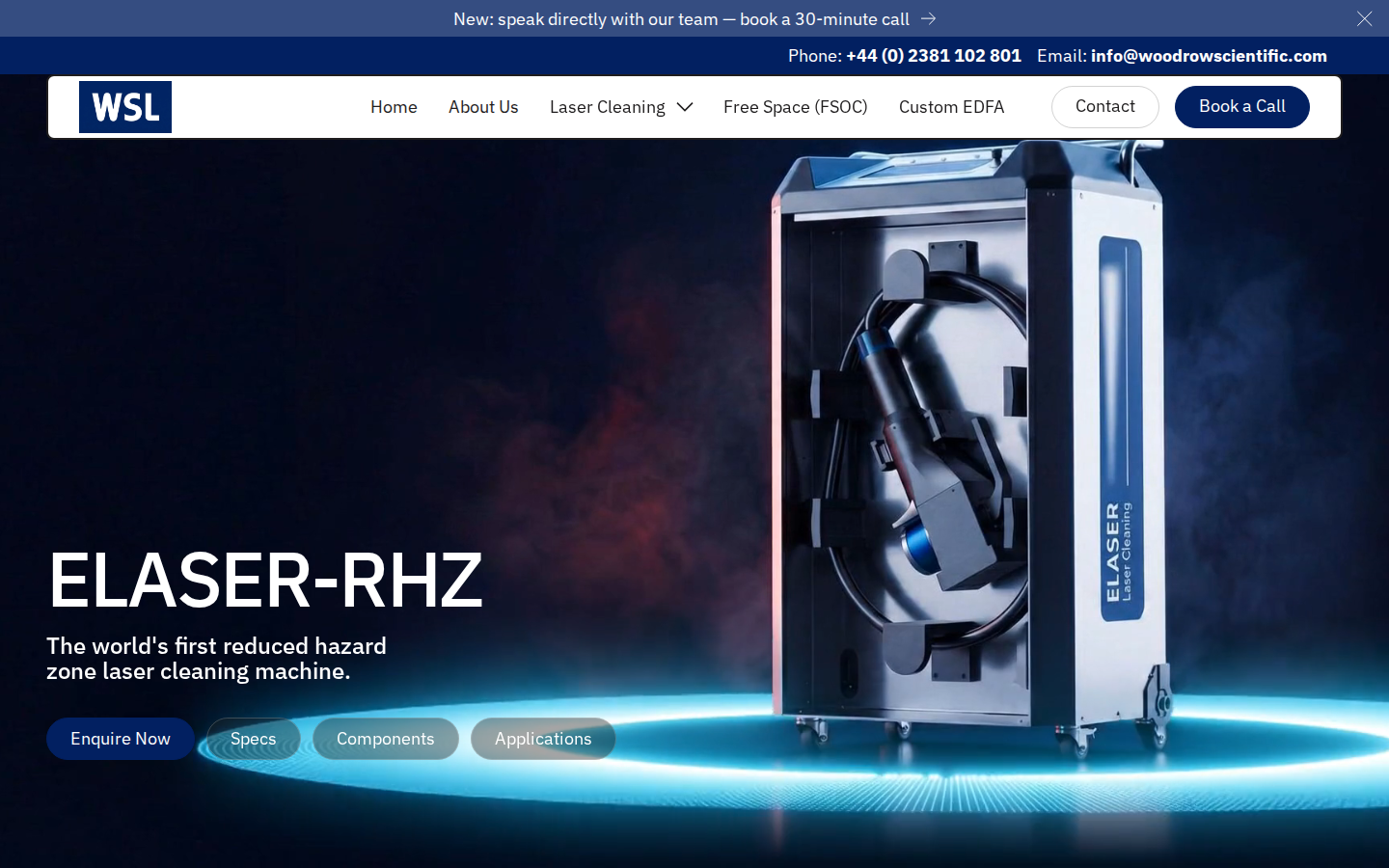
A portable, UK-manufactured fibre laser cleaning system available in 100–300 W models, with world-first patented reduced hazard zone technology that enables operation in open workshops and public-facing heritage settings.
Pros:

World-first patented reduced hazard zone technology
50 m cable reach, sub-3 kg scanner
Only UK-based laser cleaning manufacturer
Fully tunable 0–100% power across three models
Cons:

Pricing available on quote only
Customised builds extend the lead time
The ELASER is a portable, air-cooled fibre laser cleaning system designed, built, and supported entirely in-house by Woodrow Scientific Limited (WSL) in Southampton, UK. It is evaluated here across the five axes that structure this list: power and tunability, portability and reach, safety, ease of use, and supplier credibility.
Power and Tunability
The ELASER is available in 100 W, 200 W, and 300 W models, with power tunable across the full 0–100% range.
For wood stripping, that tunability is the critical variable. A single machine can address light surface lacquers at low power settings and work up through primer, paint, powder coating, and adhesive residues at higher settings — without swapping equipment or changing systems.
The beam stops at the base material, so dialling in the right energy level is what keeps the wood substrate intact. The operator controls that precisely through the touchscreen interface.
Portability and Reach
The handheld scanner weighs under 3 kg and connects via a delivery cable that reaches up to 50 m from the wheeled system unit, which itself comes in under 50 kg.
That 50 m reach is a meaningful operational figure. It determines whether the operator can work across a large architectural surface, move through a heritage building, or cover a workshop floor without repositioning the unit. A single operator can deploy and run the full system with no compressor or water circuit required.
The ELASER's delivery cable reaches up to 50 m — giving a single operator access to large architectural surfaces and multi-room heritage settings from a single unit position.
Safety: Reduced Hazard Zone Technology
The ELASER-RHZ carries WSL's world-first, patented Reduced Hazard Zone (RHZ) technology — the defining capability that separates it from every other portable laser cleaning system on this list.
Conventional Class 4 laser cleaning requires the surrounding area to be enclosed and cleared before work begins. Historic England's guidance on laser cleaning of heritage structures confirms that the cleaning area must be enclosed to protect both the public and operatives, and the conservation literature documents the use of laser-opaque curtains and temporary enclosures around in-situ work as standard practice for conventional systems.
The ELASER-RHZ collapses that requirement. Its advanced engineering controls confine the laser hazard to a small area around the work itself — enabling continuous operation in open workshops, mixed-use manufacturing facilities, and publicly accessible heritage settings where a conventional system simply cannot run without shutting down the surrounding environment.
To be precise on classification: the ELASER-RHZ is a Class 4 laser product. WSL's engineering controls make access to radiation above Class 1 impossible — that is what produces the reduced hazard zone. It is not a Class 1 laser; it is a Class 4 laser with a world-first safety architecture built around it.
For heritage wood stripping in publicly accessible buildings — cathedral woodwork, period architectural joinery, antique furniture in open museum settings — this is the capability that makes the ELASER-RHZ uniquely deployable. WSL provides full safety and operation training direct from the manufacturer; get in touch with WSL for details.
Ease of Use
The ELASER is controlled via a graphical touchscreen GUI with password-protected, per-user logins and usage tracking — practical for multi-operator environments where accountability matters.
- Programmable scan shapes: Fully configurable through the GUI, adapting to the geometry of the work.
- Interchangeable F-Theta lenses: Working distance range of 75–500 mm, covering close-in detail work and larger surface sweeps.
- Ethernet and touchscreen interface: Standard connectivity for integration into managed workflows.
- Lead time: Typically one week from order for standard builds; customised configurations take longer.
The system is designed for real operators in real environments, not for laser specialists working in controlled laboratory conditions.
Wood Stripping Applications
WSL's own data identifies the following coating types and application contexts for wood stripping with the ELASER.
| Coating Type | Application Context |
|---|---|
| Paint | Furniture restoration, architectural wood stripping |
| Lacquer | Antique refinishing, heritage building woodwork |
| Primer | Furniture restoration, architectural wood stripping |
| Powder coating | Industrial and architectural wood stripping |
| Adhesive residues | Furniture restoration, antique refinishing |
Coating types and application contexts for wood stripping supported by WSL's published product data.
The ELASER-RHZ is particularly well suited to public-facing heritage restoration work — stripping paint or lacquer from listed building woodwork, period joinery, or antique furniture in settings where the surrounding space cannot be closed off.
Supplier Credibility
WSL is the only UK-based laser cleaning manufacturer. It designs, builds, services, and improves its machines entirely in-house — not a reseller or importer of third-party hardware.
A significant portion of the laser cleaning market consists of resellers and importers who rebadge machines built by third-party manufacturers. That model is not inherently problematic, but it has a structural consequence: when something goes wrong, support must be routed through a supply chain the reseller does not control, and genuine engineering-level diagnosis is rarely available. WSL's in-house manufacture means the support chain is direct and expert from day one.
The company was founded in 2012 by a fibre-laser specialist with a PhD from Southampton's Optoelectronics Research Centre and 25+ years in the field. The team brings over 200 years of combined engineering experience, holds 10 patents, and ships worldwide direct from Southampton. The ELASER and ELASER-RHZ are CE and UKCA certified.
For buyers with high-volume or repetitive wood-stripping production requirements, WSL also offers bespoke engineering and customisation capability — get in touch to discuss what a configured build could look like for your application.
ELASER Key Specifications
The table below summarises the core specifications across the ELASER range.
| Specification | Detail |
|---|---|
| Power options | 100 W, 200 W, 300 W |
| Power tunability | 0–100% |
| Pulse energy | Up to 15 mJ |
| Pulse duration | 100 ns |
| Scan rate | Up to 10 m/s (2-D galvanometer) |
| F-Theta lenses | Interchangeable, 75–500 mm working distance |
| Delivery cable | Up to 50 m (5 m / 15 m standard) |
| Scanner weight | Under 3 kg |
| System weight | Under 50 kg (wheeled) |
| Power supply | 110–250 VAC single-phase |
| Laser class | Class 4 (ELASER-RHZ: Class 4 with RHZ engineering controls) |
| Certifications | CE, UKCA |
| Lead time | Typically one week (standard builds) |
| Shipping | Worldwide, direct from WSL |
Key specifications for the ELASER and ELASER-RHZ as published by Woodrow Scientific Limited.
ELASER Pricing
Pricing is available on request directly from WSL. Among comparable industrial laser cleaning machines in the European market, the ELASER holds the most competitive pricing — achieved through WSL's technological and operational efficiencies, not by reducing build quality.
Contact WSL directly for a quote tailored to your power requirement and configuration.
See the ELASER Specs in Full Detail
The ELASER is designed, built, and supported in-house by Woodrow Scientific. Download the official datasheet for full specifications, or visit the product page to explore the range.

Product 2
PhotonClean Trident Series — Lasermach

A pulsed MOPA fibre laser sander for wood, explicitly developed for paint and varnish removal, available in 120 W, 220 W, 320 W, and 540 W configurations from Belgium-based developer and manufacturer Lasermach.
Pros:
MOPA architecture for precise wood-specific tuning
Four power configs: 120 W to 540 W
Trident Pro 120 W backpack for on-site portability
Manufacturer demo and training centre in Belgium
Cons:
Parameter tuning requires experienced operator judgement
Class 4 system: NHZ controls and PPE required
Pricing available on enquiry only
UK purchase route requires direct Lasermach enquiry
Power and Tunability
The Trident Series is built around a MOPA (Master Oscillator Power Amplifier) fibre laser source, which gives the operator independent control over pulse duration and repetition frequency — two parameters that travel separately rather than being locked together as fixed values.
For wood stripping, that independence matters considerably. Different species, coating types, and coating thicknesses each respond differently to laser energy, and the ability to dial in the right combination of pulse width and frequency is what separates clean removal from charring or grain damage.
Lasermach positions the 120 W configuration as particularly suited to applications where thermal impact on the wood grain must be kept to a minimum — the lower power output limits heat accumulation inside the wood while still clearing paint, soot, mould, and surface impurities effectively.
At the upper end, the 540 W model offers faster area coverage than the 120, 220, or 320 W versions — a practical trade-off between speed and the finer control available at lower power levels.
Portability and Reach
The Trident Pro at 120 W is offered as a backpack variant, designed specifically for on-site operations and hard-to-reach areas where a wheeled cabinet would be impractical.
Lasermach describes the backpack form factor as providing maximum mobility, allowing operators to move freely around a workpiece while maintaining the precision of pulsed laser stripping — a meaningful advantage when working on large furniture pieces or architectural elements in situ.
Safety
The PhotonClean Trident Series operates as a Class 4 laser system. Before operation, a nominal hazard zone must be established, laser safety eyewear is required, and access to the surrounding area must be controlled — through safety curtains, interlocks, or equivalent measures.
Lasermach also specifies that a laser safety officer with appropriate training is required, and that CE-marked safety design follows the Machinery Directive EC2006/42/EG, with components rated to safety performance level D.
Ease of Use
The Trident Series exposes four adjustable working parameters: laser output power, pulse frequency, scanning travel speed, and scanning width.
That flexibility is a genuine capability — PhotonClean notes that parameters can be adapted to the wood type, coating thickness, and surface condition — but it also means the operator carries the responsibility of finding the right combination for each job.
For operators already experienced with pulsed laser stripping, the adjustability is an asset. For those new to the technology, there is a learning curve — not a barrier, but a realistic expectation to set before purchase.
Applications on Wood
Lasermach explicitly positions the Trident Series for wood surface treatment. The PhotonClean site states application areas including paint removal, soot removal, and general wood coating stripping across a range of wood types and surface conditions.
The explicit wood-stripping positioning is a meaningful signal for buyers comparing this laser sander for wood against more general-purpose industrial systems on this list.
Supplier and Support
Lasermach is a Belgium-based developer and manufacturer — not a reseller or importer — and operates under the Lasermach / PhotonClean / CNC Europe BV structure.
Their demo, test, and training centre is located in Mouscron, Belgium, where buyers can see the machine demonstrated on their own materials and receive operator training directly from the manufacturer.
Purchase is available directly through Lasermach. Buyers outside Belgium, including those in the UK, should contact Lasermach directly to confirm the appropriate purchase or distribution route for their location.
Trident Series Pricing
Pricing for the Trident Series is not publicly listed. Enquiries can be directed to Lasermach directly via the contact details on photonclean.com.
Product 3
P-Laser ECO-Line (QFC Series) — P-Laser
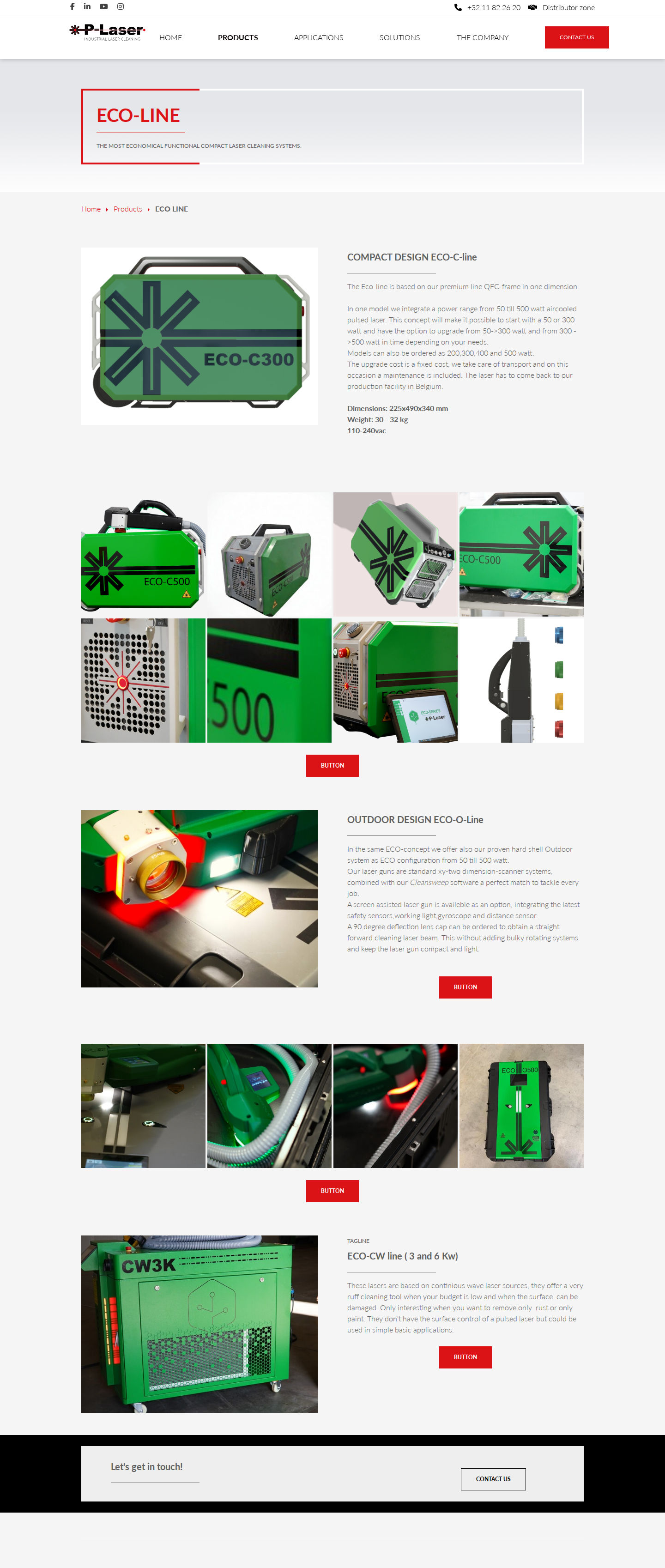
Portable, air-cooled pulsed laser range from Belgian manufacturer P-Laser. Available from 50–500 W with CleanSweep software, which explicitly lists wood as a supported surface type.
Pros:
CleanSweep software with explicit wood surface support
Upgradeable power range: 50 W to 500 W
Established Belgian manufacturer with in-house R&D
Optional screen-assisted gun with safety sensors
Cons:
High-power system: laser safety controls required
Purchase pricing not publicly listed
Power, Tunability, and the ECO-Line Range
The ECO-Line is built around a pulsed fibre laser, with power options spanning 50 W to 500 W across the QFC Compact series.
| Model | Power Output | Cooling | Weight |
|---|---|---|---|
| ECO-C50 | 50 W | Air-cooled | 30–32 kg |
| – | 200 W | Air-cooled | 30–32 kg |
| ECO-C300 | 300 W | Air-cooled | 30–32 kg |
| – | 400 W | Air-cooled | 30–32 kg |
| – | 500 W | Air-cooled | 30–32 kg |
ECO-Line QFC Compact power configurations. Model designations shown where P-Laser's sources name them; – indicates wattage is available but a specific model code is not publicly listed. Weight applies across the range per P-Laser's product page.
A notable feature of the ECO series is its upgrade path: buyers can start at 50 W or 300 W and upgrade the laser source within the same chassis as requirements grow, up to 500 W.
A standard 2D galvanometer scanner head is fitted across the range, enabling the filled-pattern scanning movement that P-Laser holds a patent on for manual laser cleaning systems.
CleanSweep Software and Wood Surface Support
P-Laser's CleanSweep software is the central operator interface for the ECO-Line, providing adjustable cleaning programmes via a wireless tablet.
Crucially for wood-stripping applications, P-Laser's own product pages state that CleanSweep supports cleaning from paper, wood, aluminium, and zinc steel sheet — wood is named explicitly as a supported surface type.
CleanSweep allows full fine-tuning of every cleaning parameter, and P-Laser describes the interface as intuitive, lowering the skill threshold for operators who are not laser specialists.
- Wireless tablet interface: CleanSweep runs on a wireless tablet, keeping the control interface accessible without a tethered panel on the unit itself.
- Full parameter adjustment: Every cleaning parameter can be fine-tuned, giving experienced operators precise control over the cleaning process.
- Optional screen-assisted gun: An accessory laser gun with an integrated screen, safety sensors, a gyroscope, and a distance sensor adds real-time operator feedback during use.
The optional screen-assisted laser gun integrates safety sensors, a gyroscope, and a distance sensor directly into the gun body, providing additional feedback for the operator.
Portability and Form Factor
The ECO-C series is housed in a compact wheeled chassis measuring 225 × 490 × 340 mm and weighing 30–32 kg, making it genuinely portable without requiring a vehicle-mounted installation.
Air cooling eliminates the need for a water circuit or external chiller, which simplifies setup and reduces the infrastructure a site needs before the system can operate.
For buyers who need to cover large areas or work at significant distance from the unit, the reach of the laser gun delivery cable is a relevant axis to assess directly with P-Laser or its distributor before purchase.
Safety
The ECO-Line is a high-power pulsed laser system operating at power levels that require robust laser safety controls before use.
Appropriate personal protective equipment and hazard zone management are standard requirements for systems of this type, and buyers should confirm the specific safety protocols applicable to their site and jurisdiction with P-Laser or a qualified laser safety officer.
Supplier Credibility and UK Availability
P-Laser is a Belgian engineering company that designs, engineers, and manufactures its systems in-house — it is not a reseller or importer of laser hardware from other manufacturers.
The full P-Laser portfolio runs from 50 W to 3,000 W; the ECO-Line sits at the entry-level portable tier of that range, sharing the same optical components and materials as the higher-end Compact series.
UK and Ireland buyers are served by P-Laser UK, operating as LaserAge, based in Salford, Manchester, with a listed UK telephone number and address on P-Laser's own distributor page.
ECO-Line Pricing
Purchase pricing for the ECO-Line is not publicly listed and is available on request from P-Laser or its UK distributor, P-Laser UK (LaserAge).
Product 4
SFX APC-500 Pulsed Laser Cleaner — SFX Laser
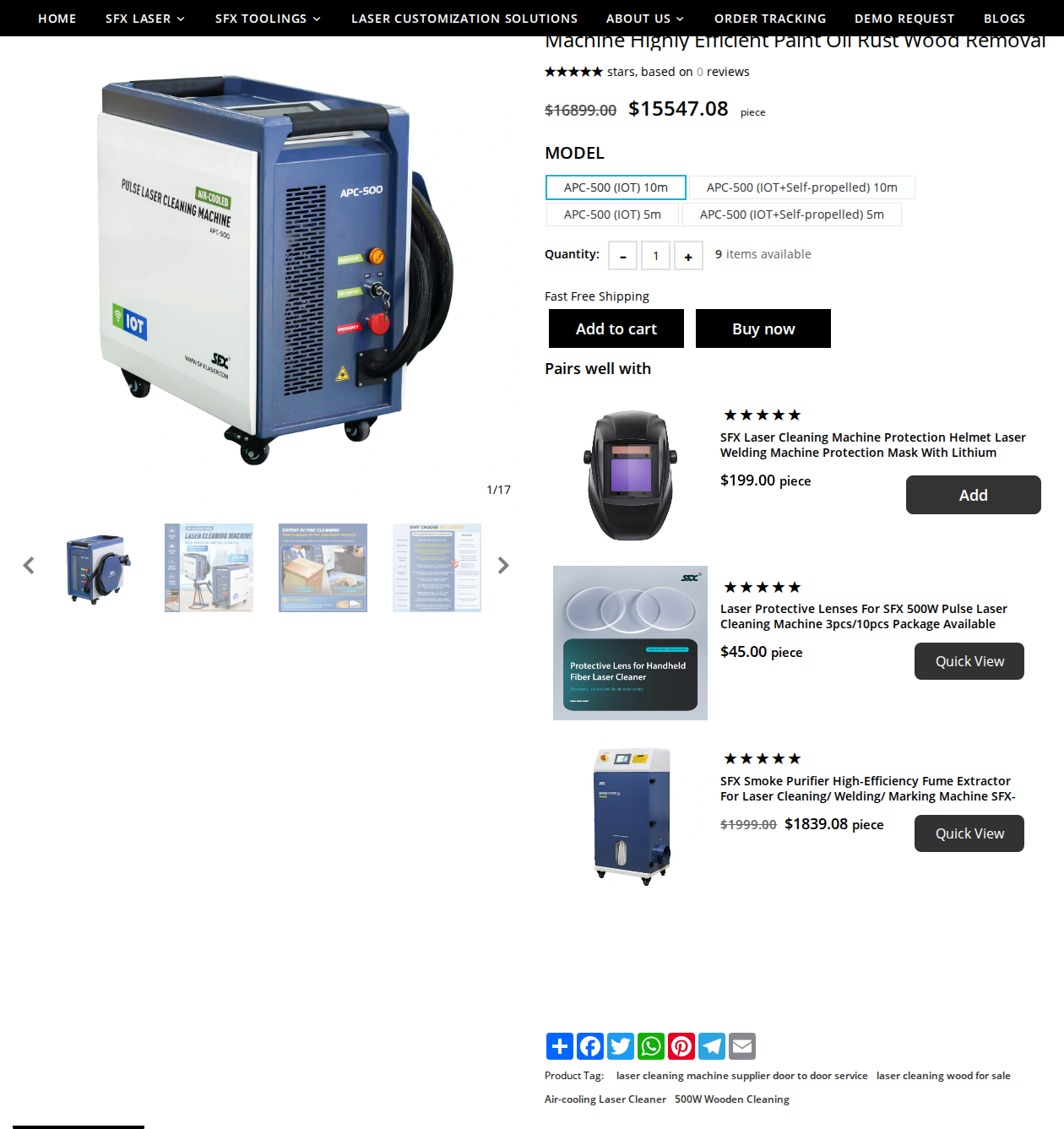
A 500 W pulsed laser sander for wood from China-based manufacturer SFX Laser, with US warehouse stock. Designed for paint, oil, and coating removal from wood surfaces without substrate damage.
Pros:
500 W pulsed output with wide pulse/frequency range
Publicly listed pricing for transparent budgeting
IoT connectivity enables remote diagnostics and control
Self-propelled variant for uniform large-area cleaning
Cons:
Cable reach: 5 m or 10 m only
Limited effectiveness on clear/transparent paint coatings
SFX Laser was founded in February 2004 and operates as a manufacturer — not a reseller — with its own R&D, production, and after-sales departments based in China. The company holds ISO 9001-2015, CE, and FDA certifications, and has accumulated 69 patents across its product range.
The APC-500 is a 500 W air-cooled pulsed laser sander for wood, built around a compact integrated structure that occupies approximately 0.15 m³ and weighs 40 kg. Its machine dimensions are 630 × 425 × 630 mm, making it portable enough for on-site use without requiring a separate cooling unit.
Power and Tunability
The APC-500 delivers 500 W of pulsed output at a 1070 ± 10 nm wavelength, with a pulse width adjustable across 10–500 ns and a modulation frequency range of 1–3000 kHz.
SFX describes the machine as operating without damaging the substrate surface, positioning it as suited to sensitive materials including wood, moulds, and delicate surfaces. This framing reflects the manufacturer's own documentation rather than independent testing.
One limitation SFX states plainly in its own product materials: effectiveness on pure clear or transparent paint is inherently reduced, owing to low optical absorption in those coatings. Operators working primarily with clear finishes should factor this in.
| Parameter | APC-500 Specification |
|---|---|
| Laser Power | 500 W |
| Operation Mode | Pulsed |
| Pulse Width | 10–500 ns |
| Modulation Frequency | 1–3000 kHz |
| Laser Wavelength | 1070 ± 10 nm |
| Scanning Width | 0–120 mm |
| Cable (Laser Fibre) Length | 5 m or 10 m |
| Input Voltage | AC 110–220 V ± 10% |
| Cooling Method | Air cooling |
| Machine Dimensions | 630 × 425 × 630 mm |
| Net Weight | 40 kg |
| Warranty | 1 year (machine) / 2 years (laser source) |
| Certifications | ISO 9001-2015, CE, FDA |
Key technical specifications for the SFX APC-500 as published on the SFX Laser product page.
The APC-500 is available in two configurations: the APC-500 (IOT), which includes IoT-enabled intelligent interconnection for remote diagnostics and one-click smartphone control, and the APC-500 (IOT+Self-propelled), which adds a motorised self-propelled device.
The self-propelled mode keeps the focal length fixed automatically, delivering more uniform cleaning across larger flat surfaces without the operator holding the gun head throughout. For intricate or uneven surfaces, the handheld mode remains available on both variants.
Both configurations are offered with either a 5 m or 10 m laser fibre cable. This gives some flexibility for positioning the unit relative to the work surface, though the reach is shorter than some alternatives on this list.
Ease of Use and Safety
The APC-500 ships with seven graphic scan-pattern modes, covering a range of cleaning geometries to suit different surface types and contamination patterns. Six preset cleaning processes — rust, oil, paint, coating, oxide, and wood — are supplemented by three user-configurable custom modes.
Wide voltage compatibility across AC 110–220 V means the machine operates across different power infrastructure without converters or special setup, which is a practical advantage for operators working across multiple sites or countries.
As a conventional pulsed laser system, standard laser safety controls and appropriate PPE apply before operation. The machine includes anti-high-reflection technology, which SFX states allows safe cleaning of reflective materials such as copper, aluminium, and galvanised sheet without risk to the laser source.
Supplier Credibility and Support
SFX Laser maintains US warehouse stock in California, New Jersey, Minnesota, and New York, with US stock available for North American buyers.
After-sales service centres are located in Buffalo, NY, and Vista, CA, with additional regional centres in Munich (Europe) and Luoyang (Greater China). SFX states that lifetime technical support is provided after the warranty period, with the buyer covering spare parts and return shipping costs.
SFX APC-500 Pricing
The APC-500 is publicly listed on SFX Laser's product page at $15,547.08 (discounted from a list price of $16,899), making pricing transparent without requiring an enquiry. The warranty covers one year on the machine and two years on the laser source.
Product 5
cleanLASER CL 50–CL 100 — Clean-Lasersysteme GmbH (IPG Photonics)
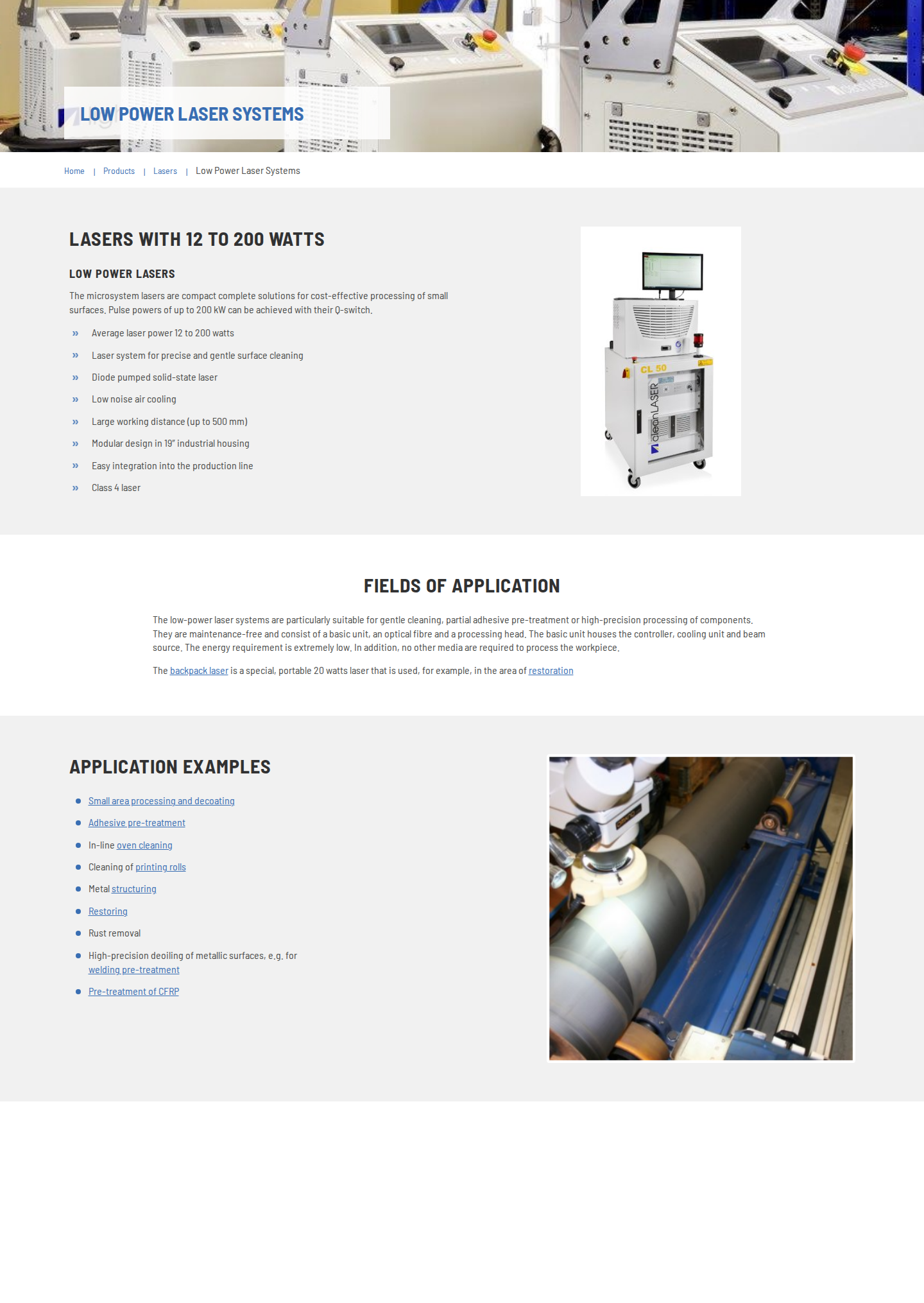
A pulsed laser cleaning range from German manufacturer Clean-Lasersysteme GmbH (IPG Photonics), covering 12–100 W average power with up to 50 kW peak pulse for precision de-coating on delicate wood.
Pros:
German manufacturer with 25+ years of experience
50 kW peak pulse for precise ablation
Air-cooled — no water circuit required
cleanACADEMY operator and safety training available
Cons:
4 m fibre cable limits operational reach
Lower average power limits throughput on larger areas
Class 4 laser product
Clean-Lasersysteme GmbH has been developing and producing laser systems for industrial surface treatment for over 25 years, operating from its headquarters in Herzogenrath, Germany. In 2024 the company became part of the IPG Photonics group, continuing to trade under its own name and management.
cleanLASER's mid-power range (CL 150–CL 600) operates in continuous wave (CW) mode. As established earlier in this guide, CW lasers deliver sustained energy to the surface — unsuitable for wood stripping, where pulsed delivery is essential to avoid charring. The low-power CL 50–CL 100 range uses a Q-switched pulsed laser source and is the relevant tier for wood applications.
Power and Tunability
The CL 50–CL 100 systems are Q-switched pulsed diode-pumped solid-state lasers, with average power options of 12, 20, 40, 50, and 100 W. The Q-switch delivers peak pulse power of up to 50 kW — a high figure relative to the low average power, and the characteristic that makes this range effective for gentle, selective ablation of coatings from sensitive substrates.
That combination of low average power and high peak pulse power suits precision work: the energy arrives in brief, intense bursts that ablate the coating layer without sustained heat transfer into the wood beneath.
Portability and Reach
The standard CL 50–CL 100 units are housed in a compact 19-inch industrial rack format and use an internal air-cooling system, so no external water circuit or chiller is needed. Beam delivery is via fibre optic cable of up to 4 m, with a working distance of up to 500 mm from the optic head to the surface.
For applications requiring greater mobility, cleanLASER also offers the CL 20 Backpack — a 20 W pulsed system mounted to a carrying frame, with battery operation available for untethered use. The backpack variant is designed for small-area treatment in locations where mains power or fixed positioning is impractical.
The 4 m fibre cable on the standard units is a practical constraint worth noting: for jobs requiring the operator to work at distance from the laser unit, or to cover larger spans without repositioning, the reach is more limited than some competitors on this list.
Safety
All cleanLASER systems, including the CL 50–CL 100 range, are Class 4 laser products. This is consistent with the majority of industrial laser cleaning systems — Class 4 is the norm across this category.
Ease of Use and Support
The low-power range is built around a modular design, allowing configuration to the specific application. A range of processing optics is available, including an F-Theta objective for uniform beam delivery across a flat field.
Clean-Lasersysteme GmbH operates the cleanACADEMY, a dedicated training programme covering system operation, laser safety, maintenance, and process engineering. Training is available for both operators and maintenance personnel, delivered at the manufacturer's facility in Herzogenrath.
Supplier Credibility
cleanLASER develops and manufactures its own laser systems entirely in Germany — it is not a reseller or integrator of third-party hardware. The company holds ISO 9001:2015 quality certification and ISO 14001 environmental management certification, and has been part of the IPG Photonics group since 2024.
UK buyers can contact Clean-Lasersysteme GmbH directly for sales and service enquiries.
Applications on Wood
Restoration and conservation are listed application areas in cleanLASER's own product documentation. The low-power pulsed range is suited to de-coating small areas, selective paint removal, and precision surface treatment on delicate or historic wood — work where preserving the substrate matters as much as removing the coating.
Throughput is lower than the higher-power pulsed systems elsewhere on this list. That is a direct consequence of the power range and its design intent: the CL 50–CL 100 is built for precision and gentleness, not volume.
cleanLASER CL 50–CL 100 Pricing
Pricing is not publicly listed. Contact Clean-Lasersysteme GmbH directly for a quotation.
See the ELASER-RHZ Full Specifications
The ELASER-RHZ is Woodrow Scientific's reduced hazard zone laser cleaning system. Download the official datasheet for full specs, or speak directly with an expert about your application.
Conclusion
Choosing the Right Laser Wood Stripping Machine
Power rating is the figure that catches the eye, but the comparison across these five machines shows that environment and supplier support are what actually determine the right fit.
For buyers working in open workshops, mixed-use facilities, or publicly accessible heritage settings, the ELASER-RHZ is the only portable option here that addresses that constraint, through WSL's world-first patented reduced hazard zone technology.
WSL is also the only UK-based laser cleaning manufacturer — designing, building, and supporting its machines entirely in-house — which matters as much after purchase as before.
Get in touch with WSL for a quote on the ELASER or ELASER-RHZ.
Laser Wood Stripping: Frequently Asked Questions
Practical answers to the questions buyers ask most about laser sanders for wood — covering how the technology works, which coating types it handles, safety requirements, and what to expect on cost and compliance.
Yes — reliably, on the right coating types. Oil-based and latex paints, traditional varnish, shellac, and lacquer on hardwoods are all well-suited to laser stripping, with the technology delivering clean, repeatable results when the machine is correctly configured for the coating and species. The governing principle is optical absorption differential: the coating must absorb the laser wavelength more strongly than the wood beneath it, and its ablation threshold must be lower than the substrate's. When that differential is wide, the laser vaporises the coating while the wood beneath remains largely unaffected. Where that differential is narrow or absent — as with some transparent or deeply penetrating finishes — results are less reliable. Within the coating types the technology addresses well, laser wood stripping is an established technique, not an emerging one. The key variables are machine configuration, parameter selection for the specific coating and substrate, and operator experience.
A pulsed fibre laser is the correct choice, with MOPA (master oscillator power amplifier) architecture preferred for wood applications. MOPA systems give the operator independent control over pulse duration and pulse repetition frequency, which matters on wood: that independent control lets you tune the machine precisely for different species and coating types, keeping heat transfer to the substrate within safe limits. Continuous-wave (CW) lasers are not appropriate for wood stripping. CW delivers sustained, uninterrupted energy with no gaps between pulses — the result on wood is charring and scorching that the substrate cannot recover from without mechanical intervention. The distinction is not marginal: it is the difference between a machine suited to the application and one that will damage the workpiece.
Handheld laser cleaning systems are Class 4 laser products — the highest hazard classification. The UK's HSE and US OSHA guidance both make clear that Class 4 lasers require meaningful controls: laser-rated protective eyewear must be provided to operators and anyone within the hazard area, access to the working area must be restricted and organised to reduce exposure, and workers must receive appropriate information and training before operating the equipment. OSHA guidance additionally defines a Nominal Hazard Zone (NHZ) — the space around the laser where radiation exceeds safe exposure limits — and requires this zone to be established and controlled for Class 4 installations. For many wood stripping environments, particularly shared workshops or publicly accessible heritage settings, meeting these requirements with a conventional system means shutting down the surrounding area. Reduced hazard zone (RHZ) technology addresses this directly by engineering controls that confine the hazard to a small area around the work — the ELASER-RHZ from Woodrow Scientific Limited is the only portable laser cleaning system with this patented capability.
Reduced hazard zone (RHZ) technology uses engineering controls to confine the laser hazard to a small area immediately around the work, rather than requiring a full room or area to be sealed off and evacuated before operation can begin. For wood stripping applications, this distinction is significant. Furniture restoration workshops are typically shared spaces; heritage building and architectural timber restoration often takes place in publicly accessible settings; open-environment or mixed-use operation is the norm across many wood stripping contexts, not the exception. A conventional Class 4 laser requires the surrounding area to be controlled and restricted during operation — in practice, that means shutting down the space around the work. RHZ technology removes that constraint, enabling cleaning in environments where conventional laser cleaning is simply impractical. The ELASER-RHZ from Woodrow Scientific Limited is the world's first portable laser cleaning system with this patented capability — a Class 4 laser with advanced engineering controls that make access to radiation above Class 1 levels impossible within the working environment.
Not when the machine is correctly configured. Pulsed lasers with tunable power and appropriate parameter settings preserve wood grain — the beam stops at the coating layer, and the wood surface beneath remains largely undisturbed when pulse duration, frequency, and power are set correctly for the species and coating type. The risk factors are real and worth understanding: charring becomes more likely with higher power settings, longer pulse durations, and insufficient cool-down time between passes. Wood is more heat-sensitive than metal substrates, and different species respond differently to laser energy. For any workpiece where the substrate matters — antique furniture, historic timbers, carved architectural detail — a preliminary test on a small, inconspicuous area is strongly advisable before committing to a full strip. This is standard practice in professional restoration work, not a sign of uncertainty about the technology.
Yes. Laser ablation vaporises the coating material — it does not brush or wash it away — so the process generates fumes and fine particulate that must be captured at source. A fume extraction system is an operational necessity, not an optional accessory. The extraction system should be specified for the type of coating being removed, because different coatings generate different fume profiles. Lead-based paints, for instance, produce hazardous particulate that demands appropriate filtration. The WSL operator guidance also notes that varnish, shellac, and alkyd paints generate VOCs, suggesting activated carbon filtration in addition to particulate capture for those coating types. The right specification depends on your specific coating type and working environment — discuss extraction requirements with your equipment supplier before commissioning the system.
Pricing varies considerably by power level, laser technology type, and form factor. As a market-level reference, the WSL pricing guide puts entry-level portable pulsed systems from around $8,000, with mid-range industrial portable units running to $35,000 and above — figures that reflect the spread across the category rather than any specific machine. Almost all industrial laser cleaning machines in this category are quote-only: configuration requirements vary significantly between buyers and applications, so list prices are rarely published. Contact suppliers directly with your specific application, power requirement, and operational context to get an accurate figure. The ELASER from Woodrow Scientific Limited is priced on a quote basis and is positioned as the European cost leader among comparable industrial laser cleaning systems.
Both markings are currently accepted for placing products on the Great Britain market. CE marking remains valid under current UK legislation — specifically under The Product Safety and Metrology (Amendment) Regulations 2024, which continues to recognise CE marking for the GB market alongside UKCA. UKCA is the UK's own conformity marking, introduced after Brexit, and can also be used. The gov.uk guidance confirms that a product can carry both markings simultaneously, provided it complies with the relevant requirements and the markings are clearly visible. For UK buyers, the practical implication is straightforward: a machine carrying either CE or UKCA marking meets the current conformity requirement for the GB market. Confirm which marking your machine carries and that it covers the relevant product category. The ELASER carries both CE and UKCA certification, covering buyers under either regime.