
Introduction
If you searched laser sander, you already know what you want — a faster, cleaner way to strip a surface — and you reached for the closest familiar term to describe it.
This guide is for fabricators, surface preparation professionals, and automotive restoration specialists who are taking a serious look at laser cleaning and want to understand what it actually involves.
Inside, you will find a clear account of how laser ablation works, how it sits alongside sandblasting, grinding, and manual sanding, what machine types are available, and how to evaluate them against your work.
The goal is a solid framework for making your own decision — not a wattage ranking or a buying shortlist.
TL;DR
Laser cleaning operates on a fundamentally different principle than any abrasive method — and once you understand that distinction, the question of whether it fits your work becomes much easier to answer.
The gap between "laser sander" and what these machines actually do turns out to be where all the useful insight lives.
This article covers:

How laser ablation removes surface contamination
Laser cleaning vs sandblasting, grinding, and sanding
Surfaces and contaminants laser cleaning handles
Pulsed vs continuous-wave: what it means in practice
Portable and automated system configurations
Safety, power levels, and buying criteria
What is a laser cleaning machine?
The term laser sander is a surface preparation professional's instinct — it places this technology in a familiar frame. But what actually happens when you point one of these machines at a rusted panel or a paint-coated weld zone is something fundamentally different from anything in the traditional surface preparation toolkit.
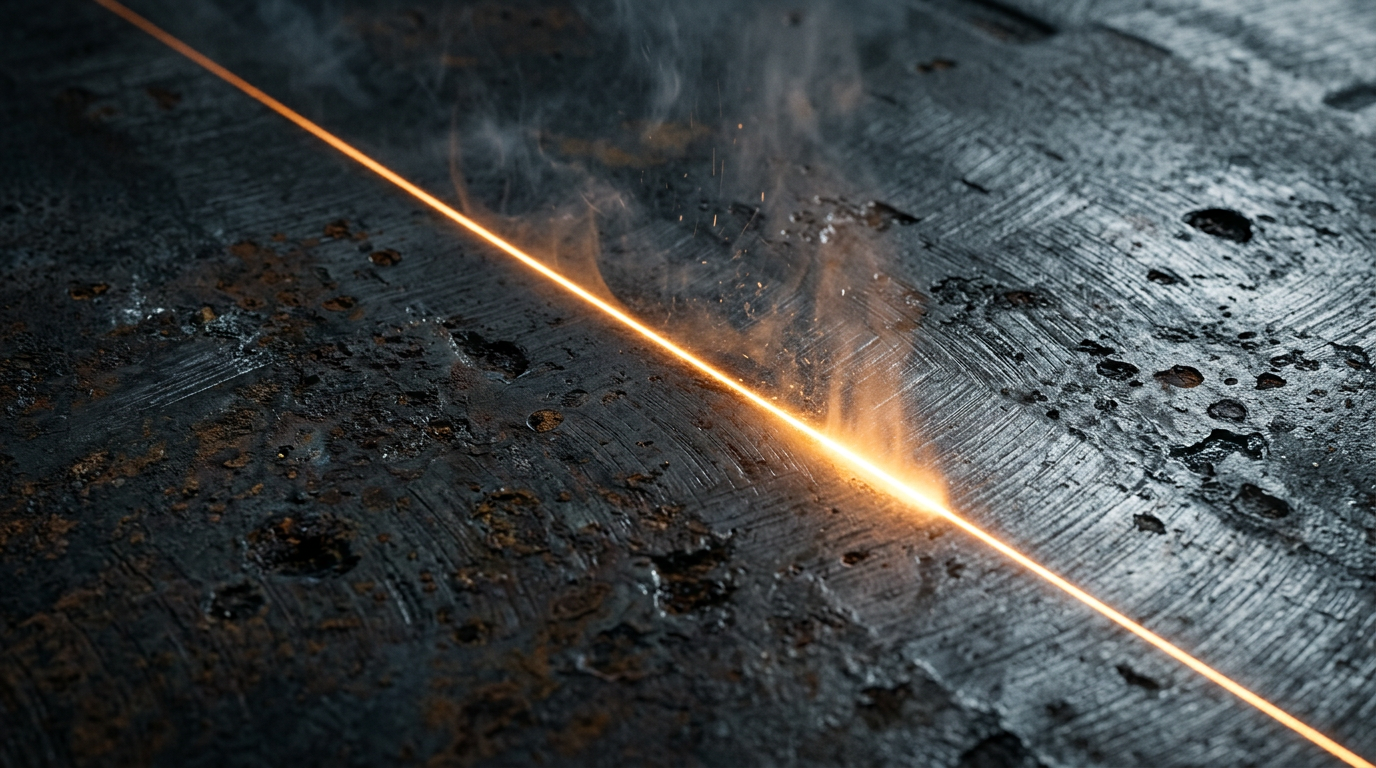
A laser sander is an industrial system that uses a focused, high-intensity laser beam to remove surface contamination through a process called laser ablation — with no abrasive contact, no chemical reaction, and no media of any kind.
The mechanism that makes this possible starts with a property every material has: an ablation threshold.
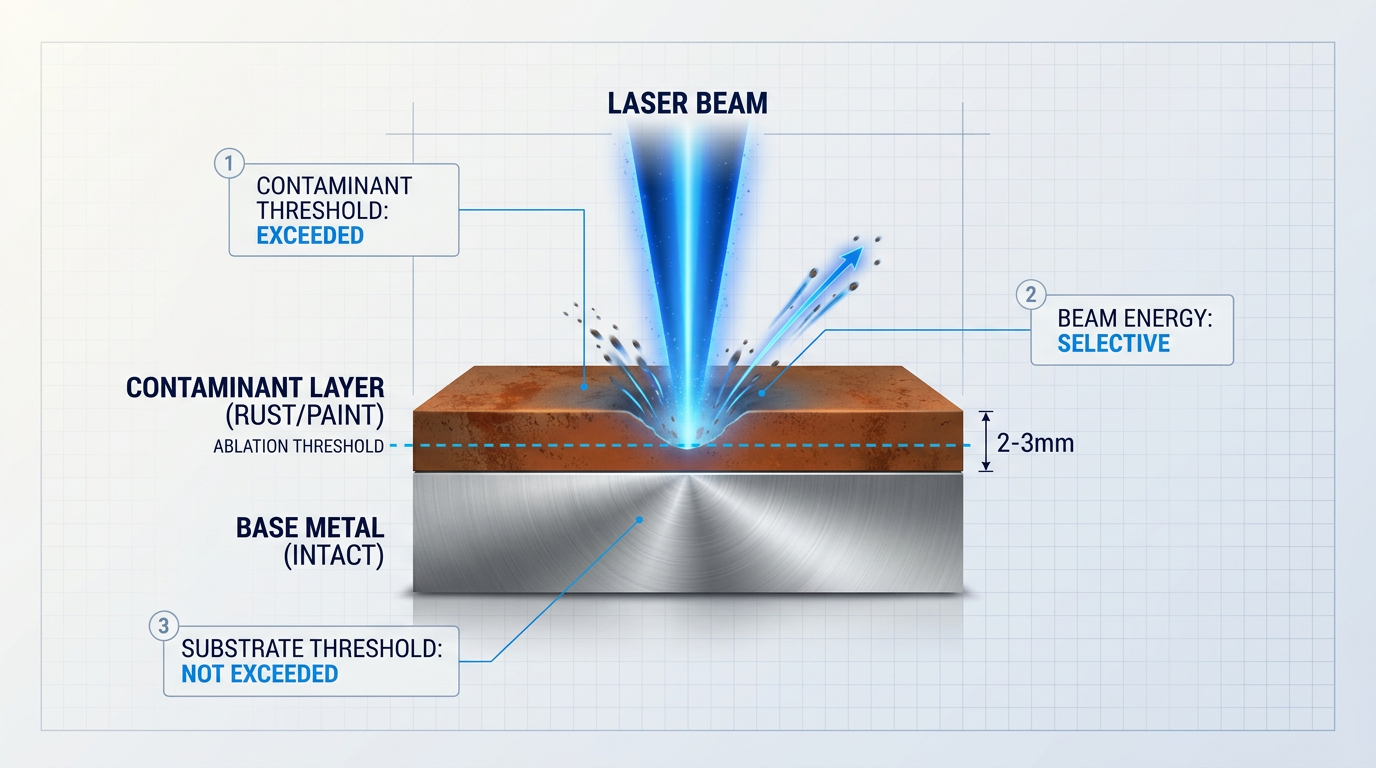
Every material — steel, aluminium, rust, paint, mill scale — has a specific energy level at which its molecular bonds break and it vaporises or is ejected from the surface. Below that threshold, the material is unaffected; above it, ablation occurs.
Contaminants such as rust, paint, and oxides have a lower ablation threshold than the base metals beneath them. This gap is what allows a laser sander to be tuned to vaporise the unwanted layer while leaving the steel or aluminium underneath completely intact.
In practice, this means the operator can set the beam's energy to exceed the contaminant's threshold while staying below the substrate's — a concept known as selective removal.
When the beam hits a contamination layer, the energy is absorbed by the contaminant, which heats almost instantaneously and is vaporised, sublimated, or ejected from the surface.
The base metal underneath absorbs less of that energy and its ablation threshold is not exceeded, so it remains largely unaffected — the contamination is gone, the metal is intact.
Covering a surface area rather than burning a single fixed point is achieved through laser scanning: the beam is swept rapidly across the workpiece by a galvanometer-driven scanner head, which uses mirrors to redirect the beam at high speed across a defined processing field.
This is a critical distinction from the mental image of a stationary laser burning a hole — the system is dynamic, with the beam interacting with any given spot for only a fraction of a second before moving on.
The scanning pattern, speed, and overlap across the surface are all controllable, giving the operator precise command over how the beam covers the workpiece.
The degree of control available to the operator extends well beyond scanning. A laser sander's output is governed by a set of laser parameters that can be tuned to match the task at hand.
- Pulse energy: The amount of energy delivered per pulse — higher pulse energy drives more aggressive material removal.
- Pulse duration: How long each pulse lasts — shorter pulses concentrate energy more intensely, affecting removal speed and heat input.
- Repetition rate: The number of pulses per second — governs how much energy the beam delivers to the surface over time.
- Scan speed: How quickly the beam moves across the surface — faster scanning reduces energy per unit area, enabling gentler treatment.
- Power level: The overall output of the laser source — a primary dial for scaling between delicate oxide removal and aggressive paint stripping.
Adjusting these parameters on the same machine allows the operator to move from gentle surface oxide removal on a precision component to aggressive rust or paint stripping on heavy fabrication — without changing equipment.
So when surface preparation professionals reach for the term laser sander, they are applying a familiar vocabulary to an unfamiliar mechanism — and that instinct is understandable.
A laser sander does not abrade, does not create contact friction, and generates no swarf or blasting media — but it achieves the same surface preparation outcomes that sanding and sandblasting are known for: removing rust, stripping paint, clearing oxides and scale, and leaving a clean substrate ready for the next process.
With the mechanism clear, the natural question is how a laser sander compares to the abrasive methods surface preparation professionals already know and rely on.
Laser Cleaning vs Sandblasting, Grinding, and Manual Sanding
Change the mechanism and you change the outcome — that is the core of what separates a laser sander from a sandblaster, grinder, or sheet of abrasive paper. Every abrasive method works through physical force: particles or tools contact the surface, fracture contaminants, and remove them through kinetic energy or friction. The problem is that force cannot distinguish between rust and the steel underneath it.
As established in the background section, laser cleaning works instead through selective energy absorption: the beam deposits energy that the contamination layer absorbs far more readily than the base metal beneath it. The contaminant reaches its ablation threshold and vaporises; the substrate, with its higher damage threshold, is largely unaffected. That single difference in mechanism drives every practical consequence that follows.
What Each Method Does to the Substrate
Abrasive blasting, grinding, and sanding cannot avoid altering the base material — it is inherent to how they work. Research confirms that sandblasting typically removes 10–50 µm of substrate depending on media grit, pressure, and exposure time, leaving micro-pitting, embedded grit particles, and measurable dimensional change.
Laser cleaning, at correctly tuned parameters, preserves the substrate dimensionally. Studies on pulsed fiber laser systems show less than 0.1% base metal removal when parameters are properly set, with the underlying steel remaining below 150°C during nanosecond-duration pulses. The qualifier "at correct parameters" is real — poorly configured laser settings can cause thermal damage — but the mechanism is inherently selective in a way abrasion is not.
For precision components, thin automotive sheet, and parts where tolerances must be held, this distinction is decisive. On a high-value turbine component or a thin-walled panel, the abrasive damage can be worse than the contamination it was meant to remove.
| Axis | Pulsed Laser Cleaning | Abrasive Sandblasting | Grinding / Manual Sanding |
|---|---|---|---|
| Removal mechanism | Selective thermal ablation — contaminant vaporises at its ablation threshold | Kinetic impact — media fractures and dislodges contamination and substrate | Physical contact — abrasive or tool removes material by friction |
| Substrate material loss | < 0.1% (properly tuned pulsed systems) | 10–50 µm substrate removal typical | Variable; localised dimensional change and surface scratching |
| Surface roughness change | −0.2 to +0.1 µm Ra (contaminant removed, profile preserved) | +2 to +10 µm Ra (new anchor profile created) | Directional scratching; Ra varies widely with tool and grit |
| Anchor profile created? | No — existing profile preserved, not augmented | Yes — 25–100 µm Rz depending on media type (ISO 8503) | Partial — grinding creates directional marks, not a controlled blast profile |
| Spent media / secondary waste | Fume plume — captured by local exhaust ventilation (no spent media) | Contaminated abrasive media — may require hazardous waste disposal | Metal dust and abrasive particles — airborne and surface contamination |
| Silica dust risk | None | Significant if silica-containing media used; OSHA-regulated carcinogen risk | Lower than blasting; metal dust still requires control |
| Substrate selectivity | Spot-precise; beam targets defined area only | Entire blasted area affected; difficult to control precisely | Operator-dependent; limited precision on complex geometry |
| Best-fit geometry | Complex geometry, confined spaces, intricate surfaces | Large flat structural steel; simple geometry at high throughput | Small localised areas; touch-up where blasting is impractical |
Laser cleaning, abrasive sandblasting, and grinding/manual sanding compared across removal mechanism, substrate impact, surface profile, waste output, silica risk, selectivity, and best-fit geometry.
The table makes the trade-off visible: laser cleaning and sandblasting are not simply better or worse versions of the same thing. They produce fundamentally different surface outcomes. Which outcome you need depends entirely on what comes next — and the anchor profile question is where this matters most.
The Anchor Profile Limitation: A Genuine Constraint
This must be stated plainly: laser cleaning does not automatically create a coating-grade anchor profile. Sandblasting mechanically roughens the steel surface to a controlled peak-to-valley depth — typically 25–100 µm Rz depending on media type, per ISO 8503 — and that roughness is what many industrial coating specifications require for mechanical adhesion.
A standard heavy-duty epoxy primer data sheet, for example, commonly specifies Sa 2.5 cleanliness with an anchor profile of 40–75 µm Rz. Laser cleaning can achieve equivalent cleanliness to Sa 2.5 and Sa 3 on rust and coating removal, but it does not create that Rz profile — it removes contamination from the existing surface without generating new topography.
For applications where a defined anchor profile is specified by the coating system — structural steelwork coatings, marine epoxy systems, zinc-rich primers — sandblasting may be the required method, or a supplementary blasting step may be needed after laser cleaning. Any surface preparation professional evaluating laser cleaning for a coating application needs to check the coating manufacturer's data sheet before assuming laser preparation alone will meet the specification.
Waste, Dust, and the Working Environment
Sandblasting generates large volumes of spent abrasive media. When the surface being blasted contains lead paint, heavy metals, or other regulated substances, that spent media becomes hazardous waste requiring specialist disposal. According to CDC/NIOSH field cost data, sandblasting costs rise from $0.69–$1.02 per square foot under non-hazardous conditions to $0.91–$1.67 per square foot once hazardous waste disposal is factored in — with an average hazardous waste disposal cost of $184 per ton.
Beyond disposal cost, abrasive blasting with silica-containing media creates respirable crystalline silica dust — a known human carcinogen linked to silicosis, lung cancer, and COPD, as classified by OSHA and the WHO's International Agency for Research on Cancer. OSHA notes that abrasive blasting with sand is among the most severe sources of silica exposure in construction and industrial work. Modern practice has largely shifted to silica-free alternatives (garnet, steel grit, copper slag), but the dust and media containment requirements remain substantial regardless of media type.
Laser cleaning does not produce spent media. The ablated contamination becomes a fume plume — fine particulate and, depending on the contamination type, volatile organic compounds — that must be captured by local exhaust ventilation with appropriate filtration. A peer-reviewed study of laser rust removal found mean PM₁₀ concentrations above 7,000 µg/m³ at the cleaning site, with particulate containing iron, aluminium, and manganese. This is not zero waste: fume extraction is a genuine requirement, not an optional extra.
The waste profiles are fundamentally different in character, however. Laser cleaning generates no spent media to contain, transport, or dispose of, and no silica dust. For in-situ maintenance, confined spaces, or work on lead-painted structures, that difference in waste logistics can be as significant as any technical performance factor.
Where Sandblasting Remains the Stronger Choice
Sandblasting has genuine practical advantages that should not be dismissed as edge cases. There are specific scenarios where it is the right tool.
- Large flat structural steel: High throughput on simple geometry with heavy contamination — blasting's speed advantage on open, accessible surfaces is real and laser cleaning does not match it.
- Coating specs requiring anchor profile: Where the coating data sheet specifies a defined Rz profile (e.g. 40–75 µm for heavy epoxy systems), blasting is the specified method and cannot simply be substituted.
- Lower capital cost entry point: Where job volume or contamination type does not justify laser equipment investment, blasting infrastructure at $5,000–$20,000 for an enclosed cabinet remains the practical choice.
These are not weaknesses of laser technology — they are scenarios where the abrasive method's characteristics align with what the job requires. A professional evaluating the two methods should identify which scenario applies to their work before drawing any conclusions.
Where Laser Cleaning Has the Advantage
Laser cleaning changes what is possible in a specific set of scenarios — not across all surface preparation work, but in situations where abrasive methods either cannot reach or cause damage that makes them unsuitable.
- Complex geometry and fine detail: Blast media cannot reach intricate recesses, threaded holes, or fine surface detail without damage. A laser sander accesses these areas with spot-precise control.
- Precision components and thin sheet: Where 10–50 µm of abrasive substrate loss would violate tolerances — thin automotive panels, precision tooling, aerospace structure — laser cleaning preserves dimensions.
- Confined spaces and in-situ maintenance: Media containment in enclosed or restricted spaces is impractical. Laser cleaning requires only fume extraction, with no media to collect and remove.
- Heat-sensitive or coated substrates: Substrates where abrasive impact or grinding heat causes problems — composite panels, aluminium with conversion coatings — can be cleaned without contact or thermal damage.
- Hazardous contamination removal: Removing lead paint or heavy-metal coatings with a laser produces captured fume rather than tonnes of contaminated blasting media requiring hazardous waste disposal.
The Virginia DOT's analysis of bridge recoating contracts found that abrasive blast jobs averaged approximately $65 per square foot total project cost, with an average materials disposal cost of $105,548 per job. That figure reflects the full burden of containment, media handling, and waste disposal — costs that laser cleaning's running profile eliminates.
Laser cleaning eliminates consumable media spend, reduces containment and cleanup labour, and avoids hazardous waste disposal costs. When the full project cost is counted — not just equipment — the running cost profile looks fundamentally different from the upfront capital picture. A CDC/NIOSH study found sandblasting costs increase by 35–94% once hazardous waste disposal is included, reaching up to $1.67 per square foot.
A DAU 10-year cost analysis of laser ablation versus sandblasting for shipyard surface preparation calculated an ROI of 155% for laser systems, driven primarily by the elimination of blast media (costed at $290 per ton in that analysis) and the reduction in containment and cleanup labour.
With the methods comparison established — mechanism, substrate impact, surface profile, waste, and cost — the practical question that follows is what surfaces and contamination types a laser sander can actually handle, and where its cleaning capability reaches its own limits.
What Can a Laser Sander Actually Clean?
Before you commit to any surface preparation technology, the first question is always the same: does it work on my material, with my contamination? For a laser sander, the honest answer is that the scope is broad — broader than most professionals expect — but it is not unlimited, and understanding both sides of that picture is what makes a sound evaluation.
Substrates: What a Laser Sander Works On
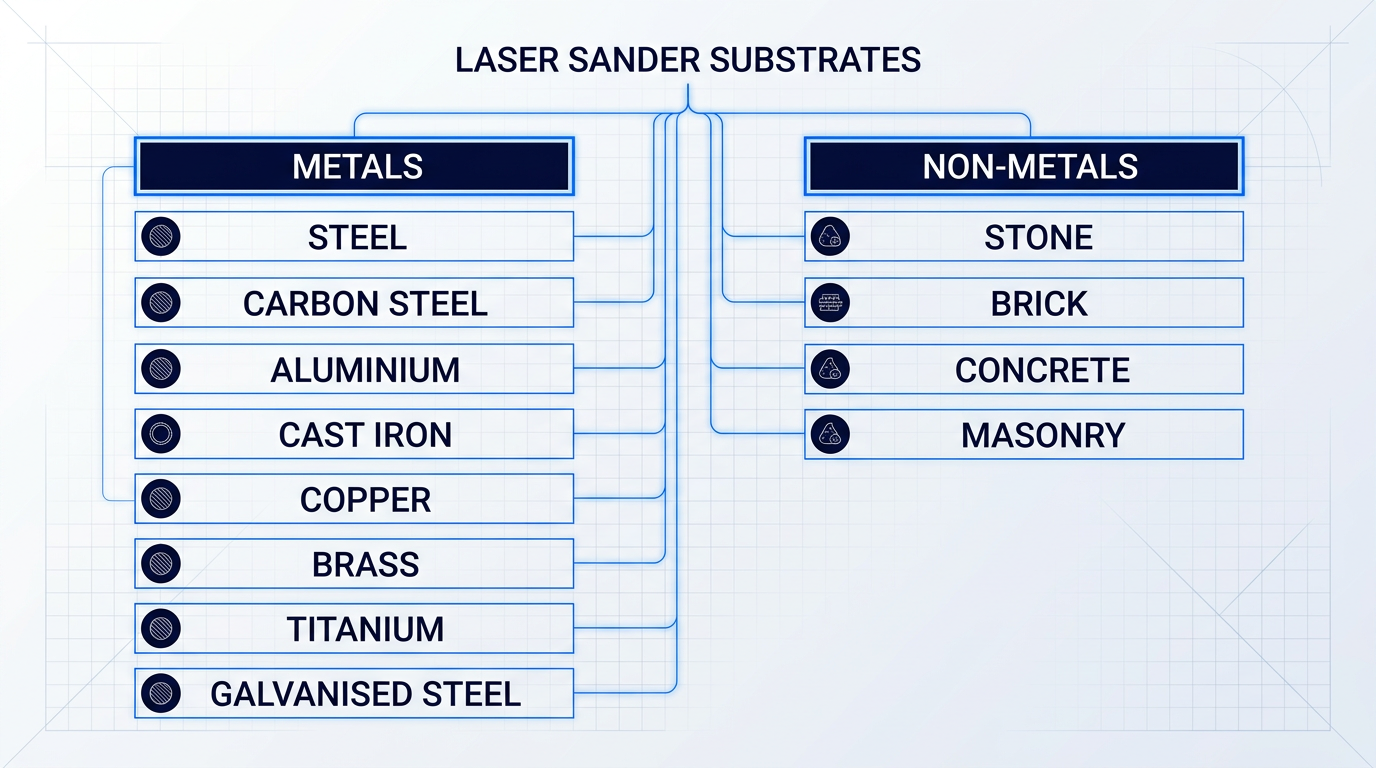
Metals are the primary substrate for laser cleaning, and the range is extensive. According to Laserax, laser cleaning is effective on metals including steel, aluminium, and copper, with the same fibre laser systems handling ferrous and non-ferrous materials alike.
The full working range encountered in fabrication and industrial maintenance extends across carbon steel, cast iron, brass, titanium, and galvanised steel — a list that covers the majority of metals a fabricator or maintenance engineer is likely to encounter.
Non-metals are a meaningful secondary capability. Stone, brick, concrete, and masonry are all viable substrates, and the application context here is significant: heritage restoration and graffiti removal from historic structures, where abrasive methods risk irreversible surface damage to materials that cannot be replaced.
The National Park Service notes that laser cleaning on masonry offers selectivity, gradual removal, and good area control — qualities that matter precisely because the alternative methods, from abrasive water jetting to chemical treatments, carry real risk of etching or staining the underlying stone surface.
Contaminants: What a Laser Sander Removes
The contaminant inventory is where the technology's breadth becomes most apparent. IPG Photonics confirms that laser cleaning addresses everything from rust and oxides through to paint, coatings, oil, and combustion deposits — a range that spans the most common surface preparation tasks in fabrication, automotive, and industrial maintenance.
- Rust and oxides: Includes light surface rust, black weld oxides, and aluminium oxide — each with a distinct ablation threshold, all below that of the base metal.
- Mill scale: The rolled steel oxide layer present on hot-rolled stock; removable by laser, though heavy accumulations require more passes.
- Paint and powder coating: Paint, powder coat, and primer are vaporised without contact, leaving the substrate dimensionally intact.
- Oil and grease: Thin oil films and machining residues are among the most straightforward applications; bulk grease deposits benefit from mechanical pre-removal first.
- Carbon and soot: Combustion deposits and fire damage soot are removed effectively; carbon absorbs laser energy readily, aiding ablation.
- Mould and release agents: Residue and release agents are removed from moulds in place, without disassembly — a precision-critical task where contamination-free surfaces matter.
- Weld discolouration: Post-weld heat tint on stainless steel is removed to restore passivation and surface aesthetics.
- Graffiti: Paint from spray graffiti on masonry and metal is removable with controlled laser parameters, especially relevant for heritage and public-facing surfaces.
The practical significance of this range is that a single laser sander can serve across multiple tasks in the same workshop — pre-weld oxide removal, post-weld heat tint cleaning on stainless, mould maintenance, and rust preparation — without changing media or methods.
Two entries on that list are worth a specific note. Weld discolouration on stainless steel is not merely cosmetic: according to Laserax, the black oxide that forms around a weld prevents complete passivation, invites rust, and diminishes the part's aesthetics. And release agent removal from injection moulds is a task where residue left behind directly affects part quality on the next production run — precision matters, and laser ablation delivers it without the risk of abrasive damage to the mould cavity.
A laser sander covers the full range of metals common in fabrication, plus stone and masonry, and removes contaminants from rust and mill scale through to paint, oil, mould residue, and weld heat tint — making it applicable across the majority of surface preparation tasks with a small, specific set of exceptions.
Where the Limits Are
IPG Photonics states that laser cleaning is typically less economical for removing layers above 0.5 mm in thickness, particularly over large areas. Arcuscnc.com similarly notes that contamination depth above approximately 1 mm — deeply pitted corrosion or heavy mill scale accumulated over years — may not be fully addressed in a single pass, and that increasing power beyond a point begins to affect the steel substrate rather than clean it more thoroughly.
This is a throughput consideration, not a fundamental capability gap. A laser sander can address heavy contamination through multiple passes, but for large areas of severe contamination, abrasive blasting may be the more pragmatic choice for bulk removal — with laser cleaning applied afterwards for final surface preparation where precision matters.
The second genuine limitation is line-of-sight access. The laser beam must reach the surface directly — internal channels, blind bores, and deeply recessed geometry cannot be cleaned. Arcuscnc.com notes this explicitly in the context of hydraulic cylinder bores: external surfaces and accessible internal surfaces at open ends are addressable, but deep internal passages are not. This limitation is shared with abrasive blasting, so it is not a reason to favour abrasives over laser cleaning; it is simply a geometry consideration to apply to your specific application.
A third constraint worth noting: oil that has penetrated into subsurface porosity in materials like cast iron is not reachable by the laser beam, which interacts only with the surface layer. For old, oil-saturated cast iron surfaces, testing before relying on laser cleaning alone is advisable.
Where laser cleaning has a clear advantage over abrasive methods is on heat-sensitive materials: thin aluminium sheet and similar substrates that abrasive methods can distort or damage. The pulsed mechanism delivers energy in controlled bursts short enough that heat transfer to the substrate is minimal. The ELASER, for instance, operates with a 100 ns pulse duration at 1550 nm — short enough that the energy ablates the contaminant before significant heat diffuses into the base material, leaving heat-sensitive substrates intact.
How much that substrate protection matters in practice depends heavily on how the laser delivers its energy — and that distinction, between pulsed and continuous-wave operation, is the subject of the next section.
Pulsed vs continuous-wave laser cleaning: what the difference means
Two laser cleaning machines can share an identical wattage rating and still behave in fundamentally different ways on the same surface. The reason lies not in how much energy they produce, but in how that energy is delivered over time — and for a surface preparation professional, that distinction determines everything from substrate safety to surface finish quality.
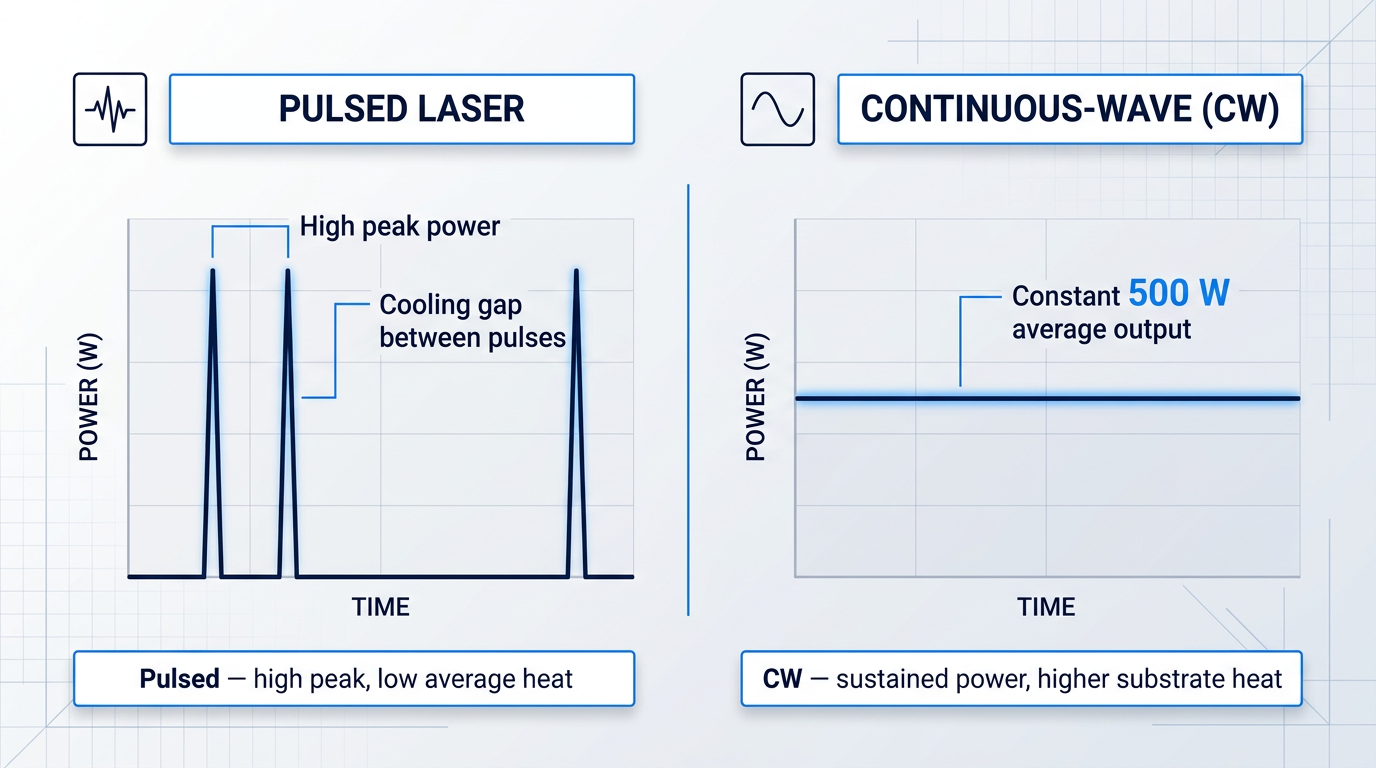
A pulsed laser fires energy in discrete nanosecond-scale bursts with very high peak power, separated by brief gaps. A continuous-wave (CW) laser emits a steady, unbroken beam at sustained power. Both can be rated at 500 W average output — but that nameplate figure conceals a profound difference in how each interacts with a surface.
How pulsed lasers confine heat to the surface
The key to understanding pulsed cleaning is thermal confinement. Each pulse is so brief — typically 10 to 200 nanoseconds — that it ends before heat has time to diffuse into the substrate beneath the contaminant.
The contaminant layer absorbs the energy spike, exceeds its ablation threshold, and is vaporised or physically ejected. The substrate, which requires sustained heating to be affected, stays comparatively cool because the thermal event is already over before conduction can carry heat downward.
The practical result is a heat-affected zone (HAZ) measured in microns rather than millimetres. Nanosecond pulsed systems operating at 100 W average power typically produce HAZ depths of 1–10 µm on steel substrates — shallower than a single grain boundary in most structural alloys.
This is why pulsed cleaning is the default choice wherever substrate thermal damage is a concern: the pulse is over before the heat has time to travel.
How continuous-wave cleaning works
A CW laser heats the surface layer continuously until contamination softens, melts, or vaporises. Because the beam never pauses, heat accumulates and conducts into the substrate, producing a larger heat-affected zone — typically 50–300 µm on steel at equivalent average power, a difference of one to two orders of magnitude compared with pulsed operation.
On a 20 mm structural steel plate being prepared for recoating, that thermal load is irrelevant — the substrate is robust enough to absorb it without consequence. On a thin-gauge panel or a heat-sensitive alloy, it becomes an outright process risk.
The sustained energy input is also what gives CW its throughput advantage on heavy contamination: thick rust, mill scale, and multi-coat industrial paint systems respond well to the continuous thermal drive that pulsed bursts, however intense, cannot replicate at the same area coverage rate. CW cleaning is a different tool for a different job — not a flawed version of pulsed.
Which mode suits which work?
The choice between pulsed and CW is a matching exercise: substrate thermal sensitivity and finish requirement on one side, contamination weight and throughput demand on the other.
- Pulsed — aluminium and non-ferrous: Aluminium, copper, and titanium are high-reflectivity, lower-melting-point metals where CW risks substrate damage; pulsed is the safe, correct choice.
- Pulsed — thin sheet metals: Thin-gauge stampings and panels have low thermal mass; CW heat input can warp or distort them before contamination is fully cleared.
- Pulsed — composites: CFRP and polymer-matrix composites contain resin binders that degrade under sustained heat; pulsed nanosecond bursts remove surface contamination without damaging the matrix.
- Pulsed — precision components and moulds: Mould cavities, gear teeth, electronic components, and bonding surfaces require micron-level control and minimal HAZ — pulsed is specified and, in some aerospace applications, mandated.
- Pulsed — heritage and conservation: Stone, timber, parchment, and historic finishes are among the most temperature-sensitive substrates; pulsed cleaning ablates contamination without heating the underlying material.
- CW — heavy rust on structural steel: Thick, layered corrosion on bridges, structural beams, and ship hulls responds to sustained CW energy; the substrate is robust enough to absorb the thermal load.
- CW — large-area throughput: Where the job is measured in tens or hundreds of square metres and the substrate is heat-tolerant, CW cleaning achieves coverage rates pulsed systems at equivalent power cannot match.
Neither mode is universally superior. Many fabrication businesses find they need both: a pulsed machine for controlled, substrate-sensitive work and a CW machine for heavy steel preparation where throughput is the governing constraint.
Surface finish: what each mode leaves behind
The mechanism difference shows up directly in the cleaned surface. Pulsed cleaning typically delivers a uniform, bright finish with crisp boundaries — the contaminant is ejected cleanly and the substrate surface chemistry is preserved.
This matters particularly for weld preparation and bonding applications, where a chemically active, thermally undisturbed surface is the best possible condition for joint formation or adhesive take-up. CW cleaning, by contrast, involves sustained thermal input that can alter surface condition — a consideration wherever the downstream process is sensitive to surface chemistry or appearance.
A 500 W pulsed machine and a 500 W CW machine deliver identical average power — but the pulsed machine concentrates that power in nanosecond peaks orders of magnitude higher in intensity. Nameplate wattage tells you nothing about heat-affected zone depth, substrate safety, or surface finish outcome. Peak power and pulse duration are the parameters that actually determine the result.
This is the single most common error in laser cleaning machine comparisons: evaluating machines on wattage alone is like comparing a hammer and a chisel by weight. The rating describes one dimension of the tool while the mechanism — the thing that determines what actually happens to the surface — goes unexamined.
With the pulsed versus CW distinction established, the next question is how these cleaning modes are packaged into the machine configurations available to surface preparation professionals — and what that means for choosing a laser sander that fits your work and site conditions.
Portable vs Automated Laser Sanders: Which Fits Your Work?
The ablation technology is identical in both configurations — what changes is how the laser reaches the work, and what that means for the person running the machine.
Portable laser sanders: handheld, field-ready, single-operator
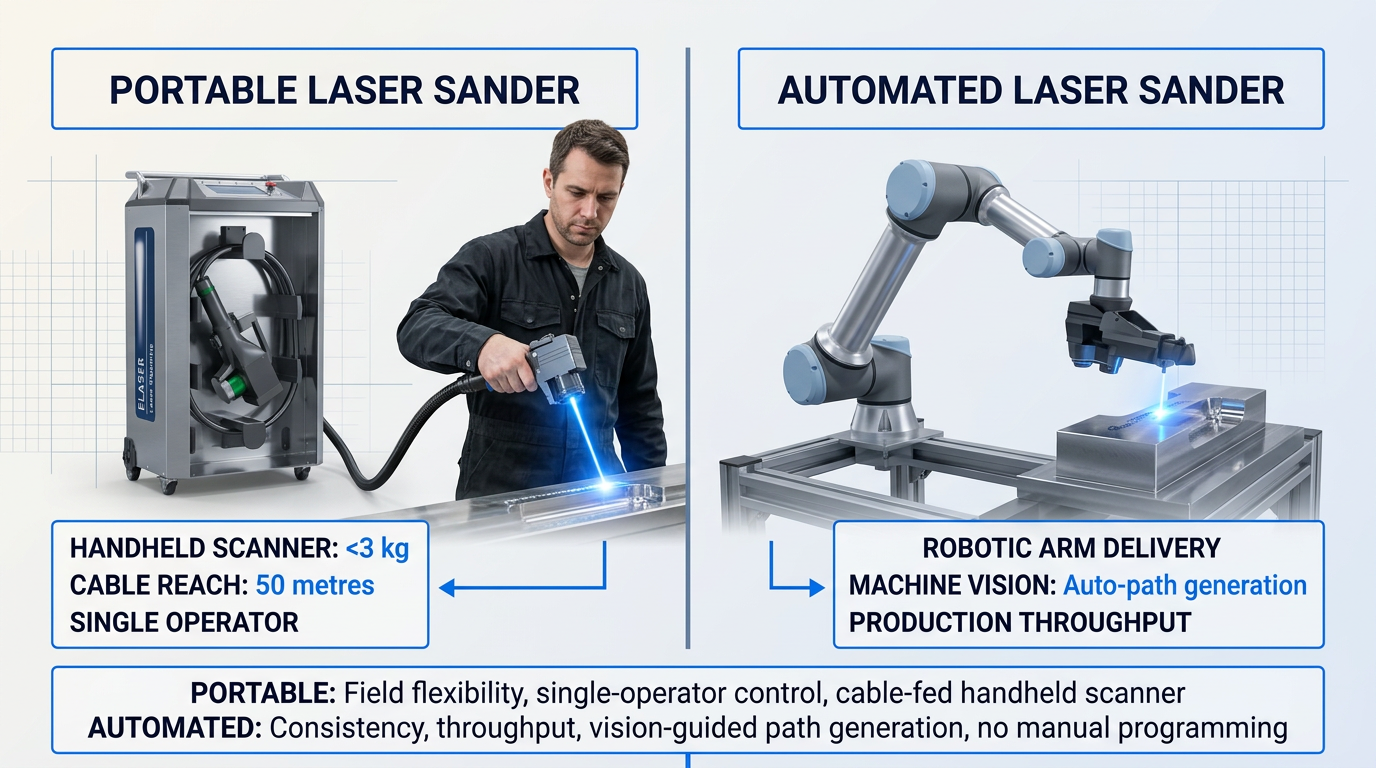
A portable laser sander is built around a wheeled unit that houses the laser source, with a lightweight handheld scanner connected to it by a fibre delivery cable.
The cable is the key: by separating the heavy laser source from the working head, it keeps the scanner light enough for a single operator to hold and direct freely — moving it across a panel, into a corner, or along a weld seam as the job demands.
Cable reach matters practically, because it determines how far from the unit an operator can work without repositioning the whole machine — a meaningful factor when cleaning large structures, in-situ plant, or parts that cannot be moved.
These systems suit fabrication workshops, automotive restoration, industrial maintenance on-site, and service businesses that move between locations and clean varied part types — for these buyers, portability is the deciding factor.
WSL's ELASER and ELASER-RHZ are the company's portable laser sanders, and the standout capability of the range is WSL's world-first reduced-hazard-zone (RHZ) technology: a patented system that collapses the laser hazard zone to a small area around the work itself.
That matters because conventional laser cleaning requires areas to be sealed off and cleared before work can begin — the RHZ removes that barrier, enabling cleaning in open workshops, mixed-use facilities, and public-facing settings where conventional laser cleaning cannot go.
Beyond the RHZ, the ELASER delivers a practical specification for single-operator field use: the handheld scanner weighs under 3 kg, the delivery cable reaches up to 50 metres, and the system is air-cooled and consumable-free — no water circuit, no chiller, no abrasive media to manage.
Power options run at 100 W, 200 W, and 300 W, with output tunable across the full 0–100% range, and both CE and UKCA certification are standard.
WSL is the only UK-based laser cleaning manufacturer, designing, building, supporting, and improving its machines entirely in-house — a meaningful distinction in a market where a significant proportion of suppliers resell or import third-party machines, which typically means slower spares, no in-house engineering capability, and limited scope to adapt a machine to a customer's specific need.
The ELASER is competitively priced among European industrial laser sanders of comparable capability, and bespoke engineering and customisation are available for buyers with specific requirements — get in touch with WSL to discuss.
Manufacturer training is also available directly from WSL; contact the team for details on how that is delivered.
Automated laser sanders: robotic arm delivery, production-scale throughput
In an automated laser sander, the cleaning head is mounted on an articulated robotic arm that carries it through programmed or vision-generated paths — the operator's role shifts from directing the beam to loading parts.
The primary advantages are throughput and consistency: every part is cleaned to the same standard on every cycle, with no variation introduced by operator technique or fatigue.
The most capable automated systems go further: rather than requiring a technician to manually program a cleaning path for each part geometry, they use machine-vision to scan the loaded part, build a 3D map, and generate the cleaning path automatically.
That changes the skill requirement for operating the system — the operator does not need to know the part geometry or write cleaning programs; they load the part and the system runs.
WSL's AutoLASE is built around exactly this principle: load the part, and its 3D machine-vision software scans it, builds a map, and generates the clean automatically — no manual programming, no path-setting, no knowledge of part geometry required.
AutoLASE can also be configured with WSL's RHZ technology, making it the only automated laser sander in the world that can operate without an enclosure.
The system works with your existing collaborative or industrial robots, or WSL can supply it as a complete custom cell — bespoke engineering and integration are available, so contact the team to discuss your specific production requirements.
As with the ELASER, AutoLASE carries CE and UKCA certification, is competitively priced among European automated laser cleaning systems, and is designed, built, and supported in-house by WSL in Southampton — manufacturer training is available directly.
Automated systems are the right fit for high-volume repetitive production cleaning where part geometry is consistent and the labour cost of manual cleaning is significant — the decision driver here is cycle time and consistency, not flexibility.
Portable for varied work, field deployment, and single-operator flexibility across part types and sites; automated for high-volume repetitive production where every cycle must deliver the same result.
With the configuration question settled, the next variable to understand is power level — what different wattages actually achieve in practice, and how to match output to the surface preparation task at hand.
See the ELASER in its portable configuration
Portable, fiber-optic delivered, and built for single-operator use. Explore the ELASER and ELASER-RHZ product pages to see how the machines are specified and what they can do on your work.
Power levels and what they mean for surface preparation
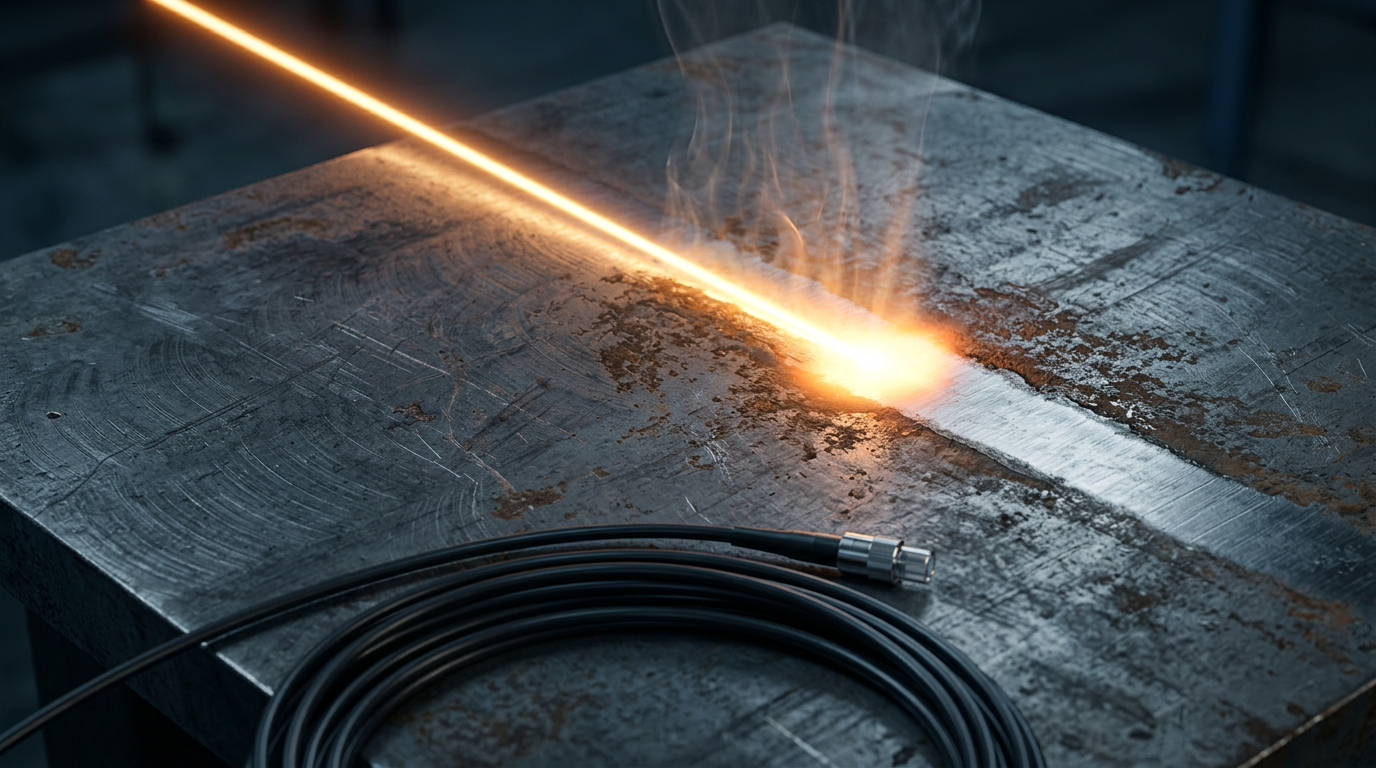
Most buyers arrive at the wattage question with a sandblaster's instinct: bigger number, more capability. With a laser sander, that instinct leads you astray. Within a given technology type, higher wattage does not change what the machine can clean or how selectively it cleans — it changes how fast.
A 100 W pulsed system and a 300 W pulsed system can both remove the same light rust from the same steel substrate. The difference is how long it takes per square metre. Power, within a technology type, is a throughput variable, not a capability variable.
Average power vs peak power: the number that actually matters
The wattage printed on a pulsed laser sander's nameplate is average power — the total energy delivered over time. It is not the power that drives ablation.
What drives ablation is peak power: the instantaneous energy spike inside each nanosecond pulse. At a typical configuration, a 200 W pulsed system can reach peak pulse powers of up to 20,000 W per pulse — orders of magnitude above the nameplate figure, as the MCWlaser buying guide documents.
It is that momentary spike that exceeds the contaminant's ablation threshold and causes the rust, oxide, or coating to fracture and eject. Average power then determines how many of those pulses land per second, and therefore how much area is covered per unit time.
This is the same distinction established when comparing pulsed and CW technology types. A 200 W pulsed machine and a 200 W CW machine share a nameplate number but interact with surfaces in fundamentally different ways — the CW system delivers its 200 W continuously, with no peak amplification and no pulse gaps for the substrate to cool.
What different power ranges deliver in practice
Within the pulsed category, power level translates directly to application fit. The breakdown below reflects the ranges most relevant to surface preparation professionals, fabricators, and restoration workers.
- 50–100 W pulsed: Precision cleaning, light oxide removal, weld heat-tint on stainless, thin coatings, and heat-sensitive assemblies. Throughput is modest but substrate control is maximum.
- 200–300 W pulsed: Automotive parts, mould maintenance, moderate rust, and multi-layer paint removal. The balance point between cleaning speed and fine substrate protection.
- 500 W+ pulsed: Heavy mill scale, thick oxide layers, large weld zones, and high-volume fabrication work where cycle time is the governing constraint.
The key point about the lower range is that it is not a compromise. For precision mould cleaning, thin-walled aluminium, or any substrate where the damage threshold sits close to the contamination's ablation threshold, a lower-power pulsed system is often the correct choice — not the affordable one.
At higher power, the substrate-protection characteristics of pulsed operation are preserved. The 100 ns pulse still ends before heat can diffuse into the base material whether the average power is 200 W or 500 W. More watts means more pulses per second covering more area — the thermal behaviour per pulse stays the same.
Power tunability: one machine, the full range
Modern pulsed fibre laser systems allow operators to adjust output continuously across the machine's full power range, alongside pulse frequency, pulse width, and scan speed. This power tunability matters practically for workshops running varied cleaning tasks.
Rather than sizing a machine to the heaviest job and running at full power for everything — which risks substrate damage on delicate work — a tunable system lets the operator dial in the right energy level for each task without changing machines or optical heads.
The practical result is that one well-specified laser sander can move from light oxide removal on a precision mould in the morning to stripping heavier contamination from a fabricated weldment in the afternoon, with parameter adjustments rather than equipment changes.
Within a technology type, power determines throughput speed — not what the machine can clean or how selectively. The technology type (pulsed vs CW) and the machine's tunability matter more than the headline wattage number. Maximising watts without matching technology type to substrate is the most common and costly buying mistake in this category.
The practical consequence of the wattage trap is concrete: a higher-power CW system applied to a heat-sensitive aluminium substrate will cause more damage than a lower-power pulsed system at the same or lower wattage, because the continuous energy delivery cannot replicate the thermal protection that pulse gaps provide.
The right power level for any job is determined by four variables working together: contamination type and layer depth, substrate sensitivity, required throughput, and whether pulsed or CW is the appropriate technology for that material stack. Wattage is one input into that calculation, not the answer to it.
Choosing the right power level for the job is one half of the evaluation. Understanding what that power level means for operator safety, working environment controls, and hazard zone management is the other — and that is where the next section picks up.
Laser cleaning safety: hazard zones, training, and environment
Capability and safety are two sides of the same operational evaluation — and for laser cleaning, safety has historically been the harder side to resolve. Understanding what the hazards actually are, and how modern engineering has addressed them, is what separates an informed buyer from one who walks away from a technology that could genuinely serve them.
Class 4: what the hazard classification means in practice
Industrial laser cleaning machines are Class 4 lasers — the highest hazard classification under the IEC 60825-1 international standard for laser product safety.
According to OSHA's technical guidance, a Class 4 laser system presents an immediate eye and skin hazard from exposure to the direct beam, specular (mirror-like) reflections, and diffuse scattered radiation — meaning even an indirect reflection off a nearby surface can cause injury.
The HSE's guidance on artificial optical radiation confirms that all use of Class 3B and Class 4 lasers in industry, research and education requires control measures to reduce the risk of harm to the eyes and skin of workers to as low as is reasonably practicable.
This classification is what drives every control requirement that follows: the controlled area, the eyewear, the warning signs, the training. It is not a bureaucratic formality — it reflects the genuine energy levels involved in effective surface preparation.
The nominal hazard zone and what it demands operationally
The nominal hazard zone (NHZ) is the defined space around a laser within which the level of direct, reflected, or scattered radiation during normal operation exceeds the maximum permissible exposure level.
For conventional Class 4 laser cleaning, this means establishing a controlled area before work begins: restricting access, posting warning signs, and ensuring all personnel within the zone wear appropriate laser protective eyewear matched to the specific wavelength in use.
In practice, on a fabrication floor or manufacturing facility, that translates to sealing off a section of the workspace before the machine can start — and keeping it sealed for the duration of the clean.
Why this overhead has been a real barrier to adoption
The setup requirement is not trivial. Evacuating and sealing an area adds time before every job, disrupts adjacent work, and limits where laser cleaning can realistically be deployed.
Open workshops, mixed-use manufacturing floors, and public-facing environments — heritage restoration on listed buildings, graffiti removal from public infrastructure — have been difficult or outright impractical for conventional laser cleaning as a result.
This is a genuine constraint, and it has kept laser cleaning out of settings where it would otherwise be the best available tool. The question is whether engineering can solve what regulation cannot simply waive.
Reduced-hazard-zone technology: engineering the barrier away
WSL's ELASER-RHZ is the world-first implementation of reduced-hazard-zone technology for laser cleaning — the only laser sander of its kind.
The distinction matters technically: the ELASER-RHZ is not reclassified as a lower-hazard laser. It remains a Class 4 laser product. What WSL's patented engineering achieves is that access to any radiation above Class 1 levels is made impossible — the hazard is confined to a small area immediately around the work, rather than projecting across the wider workspace.
That confinement is what collapses the nominal hazard zone from a room-scale controlled area to a small footprint at the point of cleaning.
By confining the laser hazard to a small area around the work, the ELASER-RHZ enables cleaning in open-plan manufacturing facilities, mixed-use workshops, and publicly accessible settings — environments where conventional laser cleaning cannot operate without sealing off the area first.
The practical result is continuous operation in environments that were previously inaccessible: an open production line where adjacent workers cannot be evacuated, a heritage facade on a public street, a facility where shutting down a zone means shutting down a process.
The ELASER-RHZ carries CE and UKCA certification, and WSL provides manufacturer training as part of the complete package — more on that below.
Fume extraction: matching filtration to the contaminant
Laser ablation produces a fume plume as contaminants vaporise — a hazard that requires appropriate management regardless of the laser system in use.
The HSE's guidance on laser cutting and welding processes identifies fume as one of the primary hazards alongside radiation, noting that it may harm breathing and is subject to control of substances hazardous to health requirements.
The practical requirement is that local exhaust ventilation is provided, with filtration matched to the specific contaminant being removed — the nature of the coating or substrate being ablated determines what filtration is appropriate.
This is an operational planning consideration: fume extraction is not an optional add-on. It is part of the deployment from the outset, and the filtration specification should be confirmed before work begins on any new contaminant type.
Operator training: manufacturer-provided, part of the package
All laser cleaning operators require training that covers laser safety, machine operation, parameter setting, and emergency procedures — this applies to any Class 4 laser system.
WSL provides manufacturer training for the ELASER and ELASER-RHZ, delivered by the team that designs and builds the machines. Get in touch with WSL directly for details on what the training covers and how to arrange it.
Manufacturer-provided training is part of what distinguishes buying from a company that makes its own machines: the people training operators are the same people who engineered the system.
The regulatory framework: where to look for guidance
Laser safety in the workplace sits within a framework of international standards and national regulation. IEC 60825-1 — the international standard for laser product classification and requirements — provides the classification scheme that underpins all hazard assessment and control measure selection.
In the UK, the HSE provides guidance on the safe use of lasers at work, and the Control of Artificial Optical Radiation at Work Regulations set the legal framework for managing exposure to Class 3B and Class 4 lasers in industrial settings.
This guide provides awareness-level framing, not prescriptive compliance advice. Before deploying a laser cleaning system, consult a qualified Laser Safety Officer and your relevant national guidance — in the UK, the HSE's published resources are the appropriate starting point.
With the safety picture clear, the next step is seeing where laser cleaning is used in practice and what to look for when evaluating a machine for your specific application.
Where laser sanders are used and how to choose one
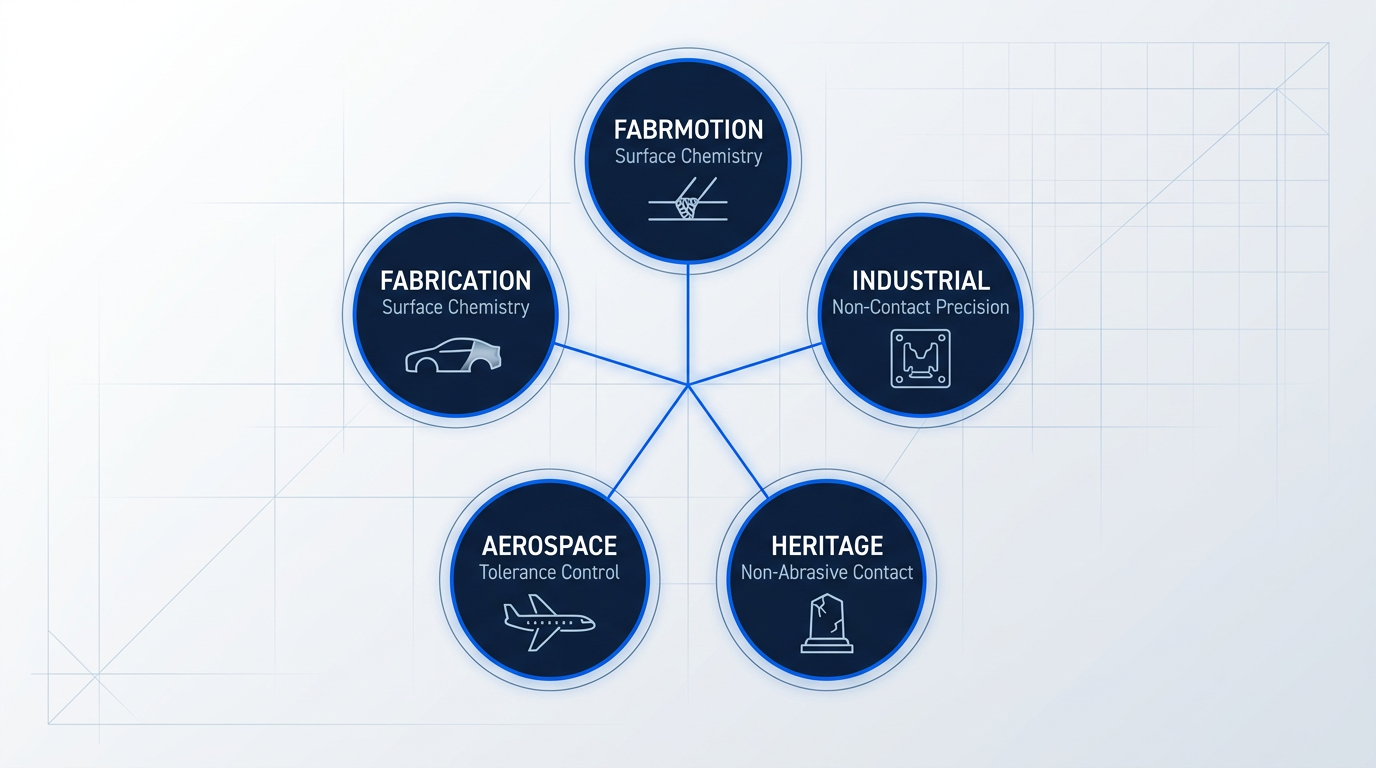
The clearest sign that a technology has matured is where it shows up — not in laboratories or early-adopter shops, but in the hardest, most demanding corners of real production. Laser sanders have reached that point across five distinct industries, each of which places different demands on the tool and confirms a different aspect of what it can do.
Where laser sanders are already at work
Automotive restoration and bodywork is one of the most established application areas. Rust and paint removal from body panels, floor pans, frame rails, and inner rockers is the core task — and the laser's advantage over abrasive methods is substrate sensitivity.
As covered earlier in this guide, pulsed laser operation confines heat to the surface layer being removed, depositing negligible thermal energy into the underlying metal. This means thin vintage panels — 0.8 to 1.2 mm steel — can be cleaned without the warping risk that abrasive blasting or thermal methods introduce.
Beyond bodywork, the laser sander is used for pre-weld surface preparation on body-in-white and chassis components: removing mill scale, oxide, and stamping oil from weld zones immediately before joining. Contamination at the weld zone is a direct cause of porosity and inconsistent weld nugget formation, particularly on aluminium structures where the native oxide layer increases contact resistance and degrades weld quality.
Fabrication and weld preparation is where the chemistry argument for laser cleaning is strongest. A laser-cleaned surface is not merely visually clean — it is chemically active, with oxide, oil, and mill scale removed down to bare metal at the point and time of use.
Research published in peer-reviewed materials science journals confirms the practical consequence: laser-cleaned weld joints show significantly reduced porosity and improved tensile strength compared to mechanically ground controls. One study on alloy steel found that laser cleaning raised weld tensile strength by 60.2 MPa over mechanical grinding and produced pore-free joints, while ground specimens still retained surface contaminants that acted as gas sources during welding.
Post-weld, the laser sander removes heat tint and oxide discolouration from stainless steel weld seams — restoring the chromium oxide layer that gives stainless its corrosion resistance, without the acid pickling or abrasive blasting that introduce their own hazards and surface damage.
Industrial maintenance and mould cleaning demonstrates the non-contact precision argument in its most commercially consequential form. Injection moulds and tyre moulds accumulate release agents and vulcanisation residue across production cycles — contamination that, if left uncleaned, degrades part quality and shortens mould life.
The laser removes this residue without touching the mould surface. No abrasive particles, no mechanical pressure, no wear to fine detail or dimensional accuracy. Because the process is non-contact and portable, moulds can be cleaned in place without disassembly or production line shutdown — a practical advantage that compounds across hundreds of cleaning cycles.
The same logic applies to plant and equipment maintenance more broadly: the laser sander can be brought to the work rather than the work to a cleaning facility, which matters whenever components are large, fixed, or costly to move.
Aerospace surface preparation is where tolerance requirements push laser cleaning from a convenient option to the technically correct one. Paint removal from aluminium skins and composite structures, turbine blade cleaning, and component surface preparation to tight tolerances all share a common constraint: the substrate cannot be damaged, and the process must stop at the base material.
NASA technical evaluations have demonstrated laser cleaning of aerospace coatings from aluminium panels and graphite epoxy composites, confirming that substrate temperatures remained within allowable limits and that the process removed coatings without negative effects on the base material. For carbon fibre reinforced composites, NASA Langley research showed that pulsed laser ablation removes surface contamination and chemically activates the surface for bonding — with ablation stopping at the fibre surface without damaging underlying carbon fibres.
Pulsed laser operation is specified for this work precisely because thermal confinement prevents heat from accumulating in aluminium or composite substrates. The beam's selectivity — stopping at the base material's ablation threshold — is what makes it appropriate for work where a few microns of substrate damage would be unacceptable.
Heritage and restoration is the application domain that most clearly shows the breadth of what a laser sander can do. Removing soiling, black pollution crusts, paint, and corrosion from stone, metal, and masonry without abrasive contact has been established practice in conservation for decades: laser cleaning of limestone cathedral facades has been conducted in France since the 1990s, and Nd:YAG laser systems have been used to remove unwanted paint layers and active corrosion from public copper-alloy monuments including the Lord Nelson and King Edward VII monuments in Liverpool.
For metalwork, the precision argument is particularly compelling. The Alexander Hamilton Monument in Chicago was prepared for re-gilding using laser ablation — chosen specifically because it removed corrosion products without altering the surface topography of the bronze or embedding chlorides the way media blasting would. The laser cleaned the surface without disturbing the dendritic crystal features of the original metal.
Heritage and restoration work often takes place in publicly accessible spaces — the exact environments where conventional laser cleaning's safety overhead has historically been a barrier. The reduced-hazard-zone capability discussed in the safety section of this guide has particular relevance here, opening up applications in publicly accessible settings that would previously have required area evacuation.
How to evaluate and choose a laser sander
The most common mistake buyers make is starting with the machine and working backwards to the job. The correct sequence runs the other way: define the job first, then derive the machine specification from what the job actually demands.
Before any wattage figure or machine format is considered, a buyer should be able to answer: what is the substrate material and thickness? What is the contamination type and approximate depth? What cleanliness standard is required — for example, Sa 2.5 or Sa 3 for weld preparation? How much surface area needs to be processed per shift, and across how many parts per week? Will the machine operate at a fixed site or across multiple locations? These inputs determine the machine class. Wattage is a downstream consequence, not the starting point.
With the job characterised, the first technical decision is pulsed or continuous-wave. As covered in the pulsed vs CW section of this guide, the choice is driven by substrate sensitivity. Heat-sensitive substrates — aluminium, thin sheet metal, composites, precision moulds, and any surface where thermal distortion would be unacceptable — call for pulsed operation. Robust structural steel with heavy contamination, where throughput is the dominant requirement, may suit CW. This is not a preference question; it is determined by the substrate.
The second structural decision is portable or automated. Varied geometry, field deployment, and work across multiple sites or part types favours a portable handheld system. High-volume production cleaning of consistent, repeatable geometry favours automation — which delivers the consistency and throughput that handheld operation cannot match at scale. Most buyers know which category their work falls into; the question is whether the machine they are evaluating is genuinely configured for it.
Power level should be sized from the job with headroom, not maximised by default. The contamination type, substrate, and required throughput determine the appropriate power range; adding headroom above that gives flexibility for future applications without over-specifying for the current one. As the power levels section of this guide established, higher wattage accelerates cleaning speed within a technology type — it does not change what the machine can clean.
The working environment is a buying criterion that is easy to overlook until it causes a problem. Open workshops, mixed-use facilities, and public-facing settings each have different implications for what safety controls are required and whether conventional laser cleaning is operationally practical. Buyers working in constrained environments should evaluate whether the machine's safety configuration matches where it will actually be deployed — not just where it will be demonstrated.
For portable systems, fibre cable reach is a practical constraint that determines how the laser source unit can be positioned relative to the work. Longer cables give greater freedom of movement for large structures and field deployment, but cable length also affects energy delivery — a consideration when specifying the system for demanding applications at distance.
Substrate material, contamination type, required cleanliness standard, and deployment conditions determine the machine class. Wattage is a downstream consequence of those inputs — not the specification to anchor on first.
The final criterion — and one that is often underweighted — is manufacturer versus reseller. A significant portion of the laser cleaning supply market consists of companies that import or rebadge machines built by third-party manufacturers. This is not inherently problematic, but it has structural consequences for the buyer: fault diagnosis must be escalated to the original equipment manufacturer, spare parts travel through a supply chain the reseller does not control, and novel or edge-case problems may simply exceed what the reseller can resolve.
A supplier that designs and builds its own machines in-house can diagnose faults at the engineering level, hold proprietary spare parts in stock, and modify or improve the system because they own the design. The people who built the machine can fix it — and that distinction becomes consequential the first time something unusual goes wrong.
For UK and EU buyers, CE and UKCA certification are the baseline compliance check. CE marking, as defined by the European Commission under EU harmonisation legislation, indicates that the manufacturer has assessed the product against applicable EU safety, health, and environmental requirements. The HSE's guidance on the UKCA marking confirms it is the equivalent conformity marking for products placed on the Great Britain market. A machine without the appropriate marking for the target market should not be purchased for use in those jurisdictions.
- Define the job first: Substrate, contamination, cleanliness standard, area per shift, and deployment pattern determine machine class before any spec is considered.
- Pulsed or continuous-wave: Heat-sensitive substrates require pulsed. Robust steel with heavy contamination and high throughput may suit CW. The substrate decides.
- Portable or automated: Varied geometry and multi-site deployment favour portable. High-volume production of consistent geometry favours automation.
- Power sized from the job: Match power to contamination type and throughput requirement, then add headroom for future flexibility. Do not default to maximum.
- Working environment safety fit: Evaluate whether the machine's safety configuration matches the actual deployment environment, not just the demonstration setting.
- Fibre cable reach: For portable systems, cable length determines how far the source unit can be positioned from the work — critical for large structures.
- Manufacturer vs reseller: Confirm in-house design and build capability. CE or UKCA marking is the baseline compliance check for UK and EU buyers.
These seven criteria form a logical decision sequence, not a parallel checklist. Each one narrows the field before the next is applied — which is why the order matters as much as the criteria themselves.
With the application landscape mapped and the evaluation framework in hand, the reader has everything needed to move from understanding the technology to acting on it — which is exactly where the conclusion picks up.
Ready to match a laser cleaner to your work?
Download the ELASER datasheet to check specifications against your application, or book a call with a laser cleaning expert to talk through your specific requirements.
Conclusion
Is laser cleaning right for your work?
The question is never really laser cleaning versus abrasive methods — it is whether the job itself calls for selective, contact-free removal or for the raw material throughput that abrasive blasting delivers on large structural work; once you frame it that way, the right tool tends to be obvious.
If you are evaluating a system for your application, WSL is a good place to start that conversation.
Frequently asked questions about laser cleaning machines
Direct answers to the questions surface preparation professionals, fabricators, and restoration workers ask most about laser cleaning machines.
Conventional laser cleaning requires a controlled hazard zone — a defined area that must be sealed off and cleared before work begins. That safety overhead has historically made laser cleaning impractical in shared, open, or public-facing environments. Reduced-hazard-zone technology is the engineering solution to that barrier. WSL's world-first patented implementation, the ELASER-RHZ, confines the laser hazard to a small area immediately around the work. It is a Class 4 laser product with advanced engineering controls that make access to radiation above Class 1 levels impossible — and it is that capability which collapses the hazard zone, enabling cleaning in open workshops, mixed-use manufacturing facilities, and public-facing settings without sealing off the surrounding area. Fume extraction is still required during operation.
Handheld pulsed laser cleaning systems are designed for single-operator use, and the learning curve for basic operation is short. WSL provides first-class laser cleaning safety and operation training, giving operators the grounding they need to work confidently and correctly from the outset. Get in touch with WSL directly for details on training and how to arrange it.
Pricing varies by power level, configuration, and manufacturer. WSL's ELASER and AutoLASE are both available on a quote basis — contact WSL directly for pricing. The ELASER is the most competitively priced comparable industrial laser cleaning machine in Europe, a position achieved through WSL's in-house design and manufacturing rather than by compromising on capability. To request a quote, get in touch with WSL.
For most precision and maintenance work, yes. Laser cleaning removes contamination selectively without media, waste, or substrate damage — making it the stronger choice for complex geometry, heat-sensitive substrates, in-situ maintenance, and environments where media containment is impractical. The honest qualification is this: for large flat structural steel with heavy contamination where a defined anchor profile is required for coating adhesion, sandblasting retains practical advantages. The right method depends on the job, the substrate, and the environment. Laser cleaning replaces sandblasting in the majority of industrial surface preparation scenarios — but not universally.
At correct parameters, no. The ablation threshold of the contaminant — rust, paint, oxides — is lower than that of the base metal beneath it. The beam removes the contaminant layer and stops at the substrate, leaving the base material dimensionally intact. The qualification worth knowing: incorrect parameters — too much power, wrong pulse settings, or insufficient scan speed — can cause surface effects on the substrate. This is why parameter validation and proper manufacturer training matter. Applied correctly, laser cleaning is one of the gentlest surface preparation methods available.
Laser cleaning machines are low-maintenance compared to abrasive systems. There is no abrasive media to manage, no compressor to service, and no chemical circuits to maintain. The ELASER is air-cooled, so there is no water supply, chiller, or coolant circuit to look after either. The main consumables are protective lens windows — included with the system and straightforward to replace — and fume extraction filters. Both are simple, routine replacements. The absence of compressors, media hoppers, and fluid systems means the ongoing maintenance burden is substantially lower than with sandblasting or water-jetting equipment.
A laser cleaning machine (sometimes called a laser sander) is optimised to remove a surface layer — contamination, rust, paint, coatings — while leaving the base material intact. The beam is tuned to the ablation threshold of the contaminant, not the substrate beneath it. Laser cutters and engravers work to an entirely different purpose: they intentionally remove or mark the base material itself, operating at energy levels and parameter settings designed to penetrate or alter the substrate rather than just its surface layer. These are fundamentally different processes with different machine architectures, optics, and parameter regimes. A machine built for one task is not suited to the other. This guide covers laser cleaning only.