

Introduction
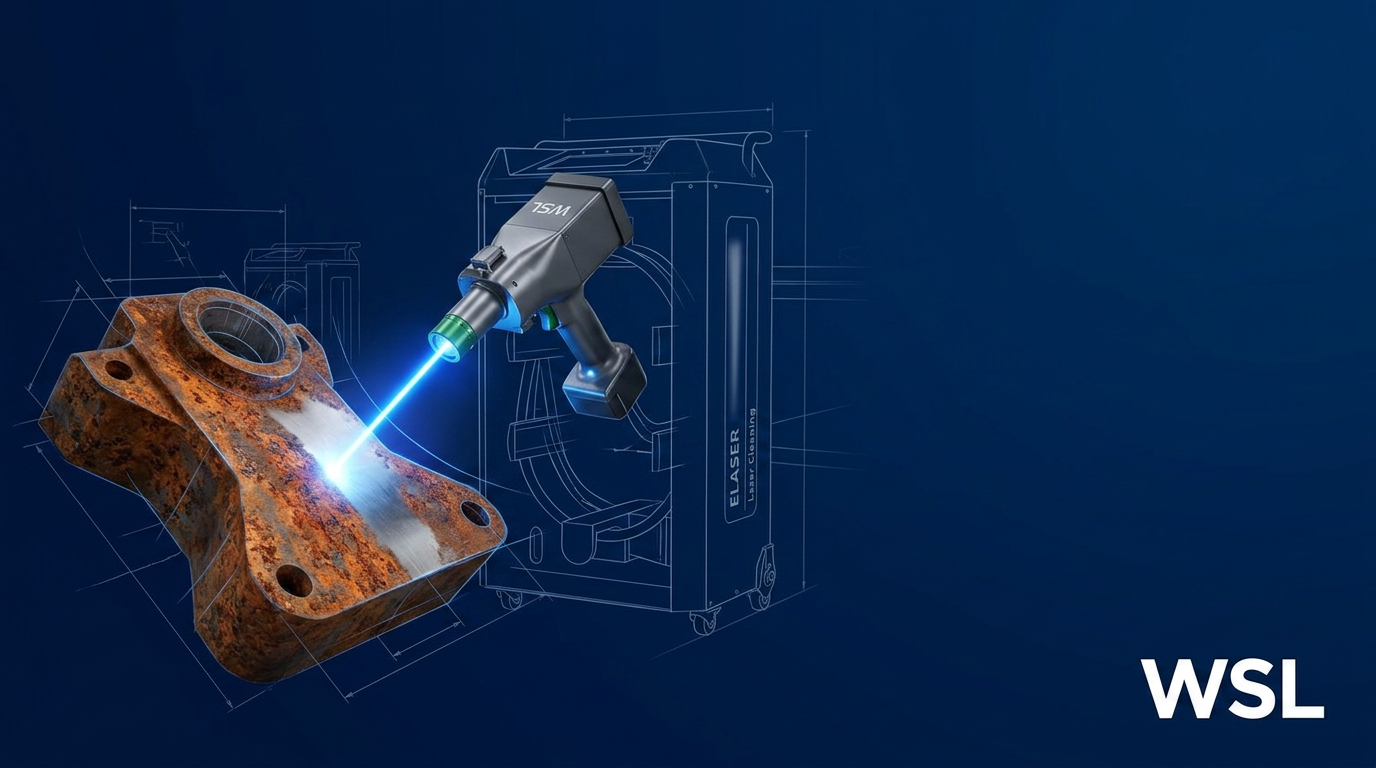
A laser rust removing machine uses laser ablation to strip rust, oxides, mill scale, paint, and other surface contaminants from metal — no chemicals, no abrasives, no water.
If you're here, you already know the technology works. What you need is a clear comparison of specific machines matched to real applications.
Each machine is evaluated against the same criteria: laser type (pulsed vs continuous wave), power output, form factor, cooling method, safety class and hazard zone, certifications, application suitability, and pricing approach.
One category-wide note: a meaningful share of suppliers are resellers rebadging third-party machines — ask any vendor directly about their in-house design and build capability.
TL;DR
The biggest mistake buyers make is optimising for power when they should be optimising for fit. The right laser rust removing machine depends on your application, deployment context, and safety requirements — not just wattage. This guide gives you the framework to tell the difference, and five machines to compare it against.
This article covers:

Pulsed vs CW laser types — which suits your task
Power, portability, and cooling in real deployment
Safety architecture and hazard zone — operational impact
Five machines: portable handheld to robotic systems
Pricing transparency — where vendors publish figures
Genuine manufacturer vs reseller — how to tell
How to choose a laser rust removing machine
Most buyers who regret their choice of laser rust removing machine got the technology wrong before they got the wattage wrong — and most got the wattage wrong before they thought seriously about safety architecture. Getting these axes right before you compare specific machines will save significant time, cost, and operational disruption.
Pulsed vs continuous wave (CW) laser technology
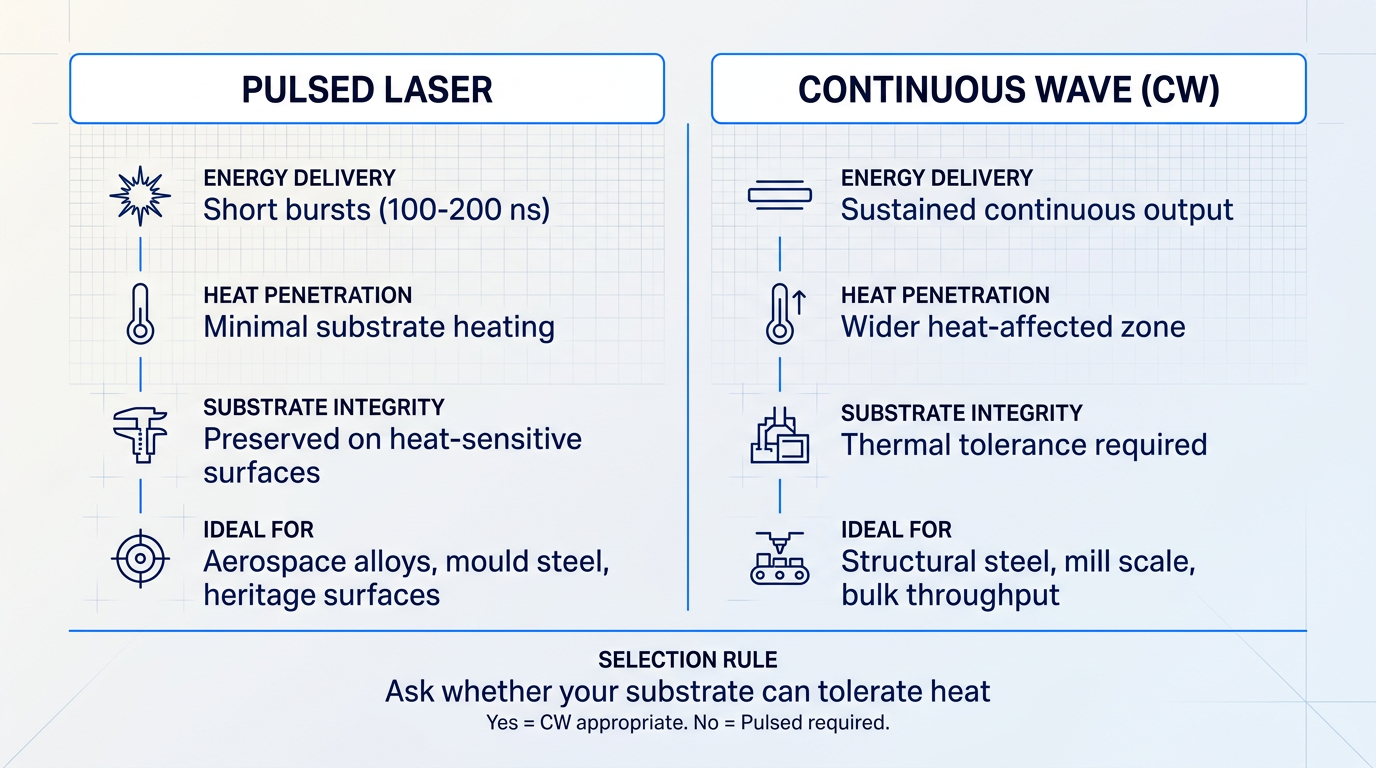
This is the single most consequential decision you will make. A pulsed fibre laser delivers energy in extremely short bursts — typically 100 to 200 nanoseconds — at very high peak power, with minimal heat transfer to the substrate beneath the contamination.
A continuous wave (CW) laser delivers sustained output: the beam stays on, heat accumulates, and the contamination layer is removed by thermal ablation. On heavy structural steel with substantial thermal mass, that heat input is irrelevant. On precision components, it is the problem.
The practical rule is straightforward: ask whether your substrate can tolerate heat. If the answer is yes — durable carbon steel, structural fabrications, heavy mill scale — CW is appropriate and considerably more cost-effective. If the answer is no — aerospace alloys, mould steel, food-grade stainless, heritage surfaces, thin sheet — pulsed is required.
Neither technology is universally superior. CW dominates on throughput for bulk work; pulsed handles the full material range more safely and is the only defensible choice where substrate integrity is the governing specification.
Wattage tiers: a practical sizing guide
Wattage is a sizing tool, not a specification to maximise. Buying more power than your application requires adds cost without adding value; buying too little means inadequate throughput or incomplete cleaning.
- Light rust and oxide removal: Lower-power pulsed systems. Suited to precision parts, restoration work, and applications where substrate protection matters more than speed.
- Heavy mill scale and thick coatings: Higher-power pulsed or CW systems. Structural steel and fabricated components where thermal tolerance is adequate and throughput matters.
- Large-area industrial throughput: High-power CW systems. Shipyard-grade rust removal, pre-paint preparation on large structures, and production-line descaling.
- Production-line automation: Power matched to cycle time. The machine must clean each part within the takt time of the line — oversizing wastes capital, undersizing creates bottlenecks.
The price gap between technology tiers reinforces why application-first sizing matters: pulsed systems typically cost two to five times more than CW machines at equivalent average power, so specifying pulsed where CW would suffice is a significant and unnecessary expense.
Form factor: three deployment archetypes
Form factor is a deployment question, not a quality hierarchy. Each archetype serves a distinct operational context, and the right choice follows directly from where and how the machine needs to work.
- Handheld / portable units: Single-operator, wheeled trolley with lightweight scanner. Suited to fieldwork, multi-site deployment, and applications where the machine must come to the part.
- Fixed industrial cabinet systems: Higher throughput, production-line integration, dedicated installation. The part comes to the machine; suited to consistent, high-volume cleaning tasks.
- Automated robotic cells: Hands-off, repeatable cleaning at scale. Suited to complex 3D geometries, high-mix production, and environments where manual operation is impractical or unsafe.
A buyer who needs to clean parts across multiple sites has different requirements from one running a fixed production line — and both differ from a manufacturer seeking fully automated, lights-out cleaning of complex components. Define the deployment context before evaluating any specific machine.
Cooling method: an operational consideration
Air-cooled systems are self-contained: no chiller infrastructure, no external water supply, and no plumbing. This makes them practical for portable and field use, and for buyers who need to move the machine between sites or deploy it on-site.
Water-cooled systems are required at higher power levels, where air cooling cannot remove heat quickly enough to sustain continuous operation. They offer a larger thermal envelope and 100% duty cycle, but add infrastructure cost, maintenance overhead (coolant management, pump servicing, leak risk), and a fixed installation footprint.
The practical question is not which cooling method is technically superior — it is whether your site can support the infrastructure a water-cooled system requires, and whether your use case genuinely demands the sustained duty cycle it provides.
Safety architecture: a genuine operational differentiator
Laser safety class is not a compliance footnote. It determines the size of the hazard zone, the operational controls required, and — critically — where a machine can realistically be deployed.
Class IV open-beam systems (the classification that covers most high-power laser cleaning machines) require controlled areas, appropriate PPE, and typically full area evacuation before operation. In a dedicated, access-controlled laser bay, this is manageable. In a shared workshop, an open-plan manufacturing environment, or a public-facing setting, the operational overhead is substantial.
Class I enclosed systems contain the beam within a physical enclosure, which significantly reduces operational overhead — but requires the part to fit within, or be processed through, that enclosure.
A third approach — the Reduced Hazard Zone (RHZ) — collapses the hazard zone without requiring full enclosure, enabling cleaning in shared workspaces, open-plan manufacturing, and public-facing environments such as graffiti removal or heritage restoration where conventional Class IV operation would be impractical. This is a genuine differentiator that most buyers do not think to ask about; it should be an explicit question in any machine evaluation.
The HSE advises that operators of lasers above Class 2M in situations with possible personal access to the beam path should wear appropriate protective eyewear — and that engineering controls, not just PPE, are the primary mechanism for managing laser hazards in the workplace.
A Class IV machine that is technically capable of cleaning in a shared or public-facing environment may be operationally impossible to deploy there. Ask every vendor what laser class their machine operates at, and whether a Reduced Hazard Zone configuration is available — it changes what is practically achievable.
Certifications: the baseline buying checklist
For machines placed on the UK market, UKCA certification is the current conformity marking requirement; CE marking remains relevant for EU market placement. Both markings indicate that the manufacturer has declared the product meets applicable safety and regulatory requirements.
Verify both markings are present and request the Declaration of Conformity before purchase. Per HSE guidance, the DoC must state the applicable legislation, the standards used in design and manufacture, and be signed by an authorised representative. A machine supplied without one is non-compliant under the Supply of Machinery (Safety) Regulations.
Total cost of ownership over sticker price
Laser cleaning machines carry a higher upfront cost than sandblasting or chemical stripping alternatives. For industrial buyers, this is the least informative comparison available.
The meaningful metric is total cost of ownership (TCO). Laser cleaning has effectively zero consumables — no abrasive media, no solvents, no waste disposal contracts. Energy consumption is low even at high power. Minimal substrate damage means less rework. Downtime is reduced because cleaning can often be performed in-line rather than as a separate process step.
A credible three-year TCO analysis consistently shows laser cleaning sitting in a materially different cost category from both sandblasting and chemical methods, even after accounting for the higher capital outlay. Payback periods for production-grade machines in active industrial use are typically well under two years. Evaluate every machine on this basis, not on purchase price alone.
Manufacturer provenance: ask the right question
A meaningful share of companies selling laser cleaning machines under their own branding are not manufacturers. They are importers or resellers rebadging machines built by third-party OEMs — sometimes with little or no modification.
This matters for several practical reasons: manufacturer provenance affects spares availability, access to genuine engineering expertise, the vendor's ability to improve the product over time, and the quality of post-sale technical support. A reseller cannot resolve a fundamental design issue; they can only escalate to the OEM, whose response time and willingness to engage with an end customer may be limited.
Ask directly: does this company design and build the machine, or do they source and rebadge it? A genuine manufacturer should be able to name the engineers who designed the system, describe the in-house testing and quality process, and provide verifiable evidence of manufacturing capability. This is a standard due-diligence step for any capital equipment purchase.
With these eight criteria established, the entries that follow evaluate each of the five leading machines on the market against exactly this framework.
Product 1
ELASER / ELASER-RHZ — Woodrow Scientific Limited
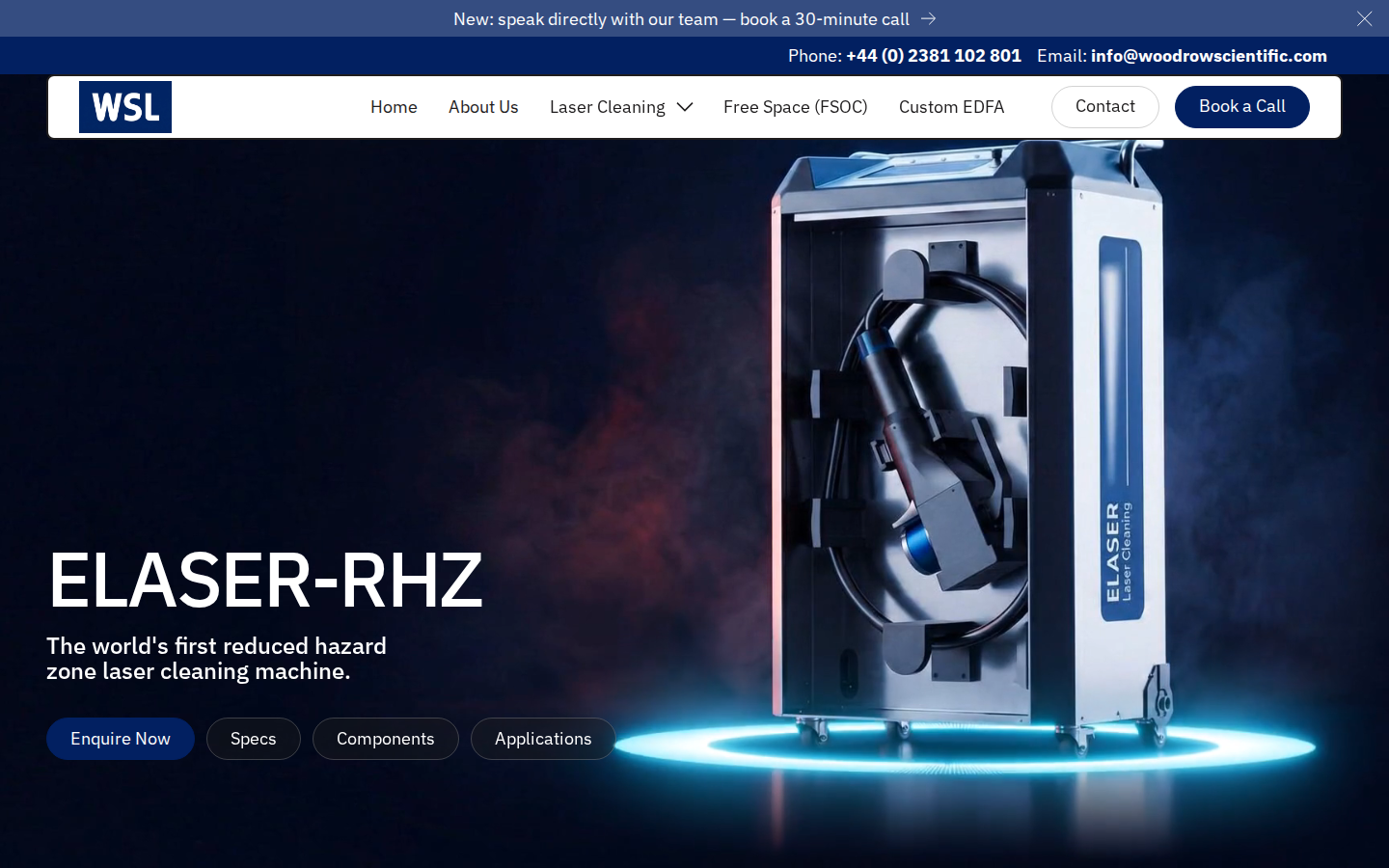
A British-made pulsed fibre laser cleaning system with a world-first reduced hazard zone variant, the ELASER and ELASER-RHZ suit industrial buyers who need a portable, single-operator machine capable of handling a wide range of surfaces and contamination types — including in open workshops and public-facing settings where conventional laser cleaning is impractical.
The single most significant capability the ELASER-RHZ brings to the laser rust removing machine market is its patented Reduced Hazard Zone technology — a world first, with no equivalent from any other manufacturer.
Conventional laser cleaning requires the surrounding area to be sealed off and cleared before work can begin, which makes it impractical in open manufacturing environments, heritage sites, or anywhere the public might be present. The ELASER-RHZ collapses the laser hazard zone to a small area immediately around the work, removing that constraint entirely.
In practice, this means graffiti removal on publicly accessible structures, monument and heritage restoration in open spaces, and continuous operation in mixed-use manufacturing facilities — all without the shutdown and evacuation overhead that conventional Class IV laser cleaning demands.
The ELASER-RHZ is the only laser cleaning machine in the world with a patented Reduced Hazard Zone. It achieves a Class I laser classification, enabling cleaning in open workshops, shared facilities, and public-facing settings where standard laser cleaners cannot legally or practically operate.
The standard ELASER is a pulsed fibre laser running at 1550 nm wavelength, with power tunable from 0 to 100% up to a maximum of 300 W. That combination of pulse energy (up to 15 mJ) and full tunability means one machine can handle light surface oxides at the low end and thick paint or mill scale at the high end — without swapping equipment.
ELASER / ELASER-RHZ Key Specifications
| Specification | ELASER / ELASER-RHZ |
|---|---|
| Laser type | Pulsed fibre laser |
| Wavelength | 1550 nm (retina-safe / RHZ) |
| Max power | Up to 300 W |
| Power tunability | 0–100% |
| Pulse energy | Up to 15 mJ |
| Pulse duration | 100 ns |
| System weight | Under 50 kg (wheeled) |
| Scanner weight | Under 3 kg (handheld) |
| Delivery cable | Up to 50 m |
| Cooling | Air-cooled (no chiller required) |
| Power supply | 110–250 VAC single-phase |
| Power consumption | < 2000 W |
| Laser class | Class IV (ELASER) / Class I (ELASER-RHZ) |
| Certifications | CE and UKCA certified |
| Manufacture | Made in Britain |
Gives evaluation-stage buyers a direct, scannable reference for the ELASER/ELASER-RHZ against the framework axes — laser type, power, form factor, cooling, safety class, and certifications — matching how they will compare this entry against subsequent list items.
On portability, the system weighs under 50 kg on wheels, the handheld scanner comes in at under 3 kg, and the delivery cable extends up to 50 m — enough reach for large structures or awkward site layouts without repositioning the main unit.
Air-cooling is standard, so there is no chiller infrastructure, no coolant circuit, and no compressor required. The machine runs from a standard single-phase supply (110–250 VAC) and draws less than 2000 W — genuinely field-ready without site preparation.
ELASER Application Suitability
The ELASER and ELASER-RHZ cover a notably wide range of industries and contamination types for a single portable platform.
- Automotive: Pre-weld prep on production lines and rust or paint removal in bodyshops — precise, no masking, no media cleanup.
- Aerospace: Surface preparation and component cleaning to tight tolerances, with minimal substrate loss.
- Injection moulding and tooling: Strip release agents, residue and build-up from moulds in place — no disassembly required.
- Tyre and rubber: Clean mould vents and vulcanisation residue without abrasives or mould wear.
- Industrial maintenance: Clean plant, equipment and infrastructure on site — no media to clear up, no chemicals to handle.
- Heritage and restoration: Lift soiling, paint and corrosion from stone, metal and masonry with a beam gentle enough to leave the original surface intact.
- Laser cleaning service business: A portable system with full operator training — a practical foundation for launching a mobile laser cleaning service.
The breadth here is a genuine functional advantage: the 0–100% power tunability and pulsed architecture mean the same machine that strips thick mill scale in an industrial maintenance context can be dialled down for delicate heritage stonework.
Manufacturer Provenance: Why WSL Matters
Woodrow Scientific Limited, founded in 2012, is the only UK-based laser cleaning manufacturer — designing, building, servicing, and improving its machines entirely in-house, with more than 200 years of combined engineering experience across the team.
This distinction carries practical weight for buyers. A significant portion of the laser cleaning market consists of resellers or importers rebadging third-party machines — which typically means slower spares, limited technical support, and no real ability to adapt or improve the product after sale.
WSL's in-house model means that engineering support is direct, fast, and genuinely expert. The company holds patented, world-first technology — the RHZ system being the clearest example — and continues to develop its products rather than simply sourcing and relabelling them.
CE and UKCA certification comes as standard, and WSL provides first-class operator training. For buyers who want bespoke engineering or customisation, WSL encourages direct contact to discuss specific requirements.
ELASER / ELASER-RHZ Pricing
Pricing is available on application. Among comparable industrial laser cleaning machines in Europe, the ELASER / ELASER-RHZ is positioned as the most competitively priced option — a result of WSL's manufacturing and operational efficiencies rather than any compromise on specification or build quality.
When evaluating total cost of ownership against alternative cleaning methods (sandblasting, chemical stripping, water-jetting), the calculation shifts further: zero consumables, reduced downtime, and less rework from minimal substrate damage make the TCO case compelling even against methods with lower upfront costs.
The ELASER-RHZ: Full Specs in One Document
See the full technical specifications for the world's only reduced hazard zone laser cleaning machine — power output, beam parameters, dimensions, and safety classification — in the official ELASER-RHZ datasheet.
Product 2
AutoLASE — Woodrow Scientific Limited
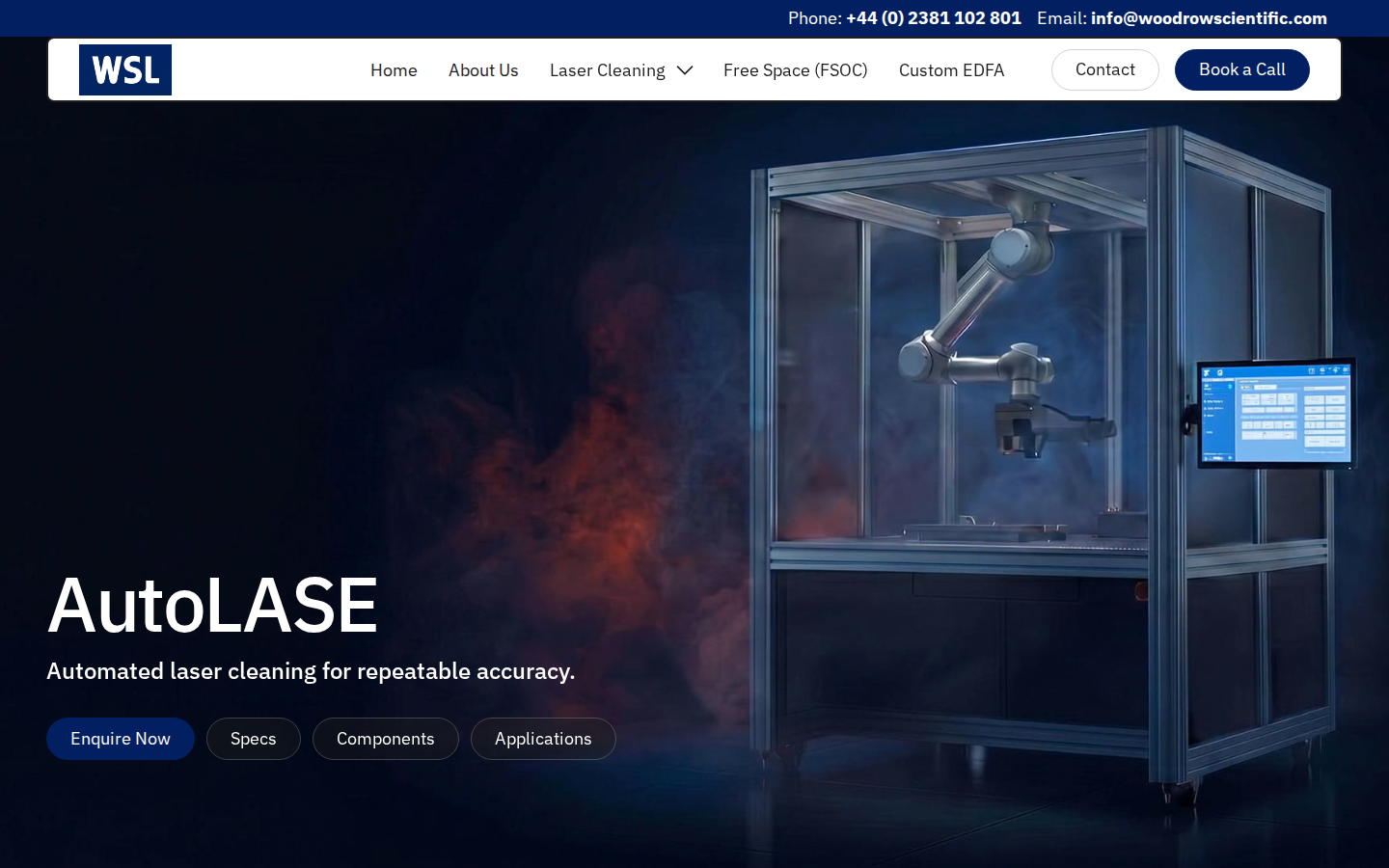
AutoLASE is WSL's automated robotic laser cleaning system, designed for production environments that need hands-off, repeatable cleaning at scale. The cleaning head mounts on a multi-axis articulated arm; machine vision scans each part, builds a 3D map, and generates the cleaning path automatically — no programming, no specialist operator required. With an optional RHZ upgrade for enclosure-free operation and the most competitive pricing among comparable European automated systems, AutoLASE is built for facilities where cleaning consistency, throughput, and deployment flexibility all matter.
Pros:

Load-and-go automated cleaning
No enclosure needed (RHZ option)
European cost leader
In-house UK manufacturer
Cons:

Contact for quote only
Not suited to portable use
Where the ELASER puts laser cleaning power in a single operator's hands, AutoLASE removes the operator from the equation entirely — mounting the cleaning head on a multi-axis articulated robotic arm and letting machine vision do the work.
Load the Part and Walk Away
The defining capability of AutoLASE is not that it is automated — several robotic laser cleaning systems offer programmed, repeatable cleaning flows. What sets it apart is that no programming is required at all.
Load a part, and the system scans it, builds a 3D map, and generates the cleaning path automatically. No path-setting, no knowledge of part geometry, no technical skills needed — anyone on the production floor can run it.
AutoLASE's 3D machine-vision software scans each part and generates the cleaning path automatically. No manual programming, no specialist operator — just load the part and run.
That ease of deployment matters most in high-throughput production environments, where training time, operator skill variability, and setup complexity all carry real cost.
Optional RHZ Upgrade: No Enclosure Required
Conventional automated laser cleaning systems require a full safety enclosure — a fixed cell that constrains where the system can be deployed and adds significant floor-space overhead.
AutoLASE can be configured with WSL's eye-safe Reduced Hazard Zone (RHZ) technology — the same world-first architecture introduced on the ELASER — making it the only automated laser cleaning system in the world capable of operating without a full enclosure.
That opens deployment contexts no conventional automated system can reach: shared production floors, facilities where a large safety footprint is impractical, and environments where a fixed enclosure cell simply cannot be justified.
AutoLASE Specifications
| Specification | AutoLASE |
|---|---|
| Laser type | Pulsed fibre laser |
| Max power | Up to 300 W |
| Wavelength | 1550 nm |
| Pulse energy | Up to 15 mJ |
| Pulse duration | 100 ns |
| Power tunability | 0–100% |
| Scanner | 2-D galvanometer, 10 m/s max |
| Delivery cable | Up to 50 m |
| System weight | Under 50 kg |
| Cooling | Air-cooled |
| Laser class | Class IV (standard) / Class I (RHZ) |
| Certifications | CE, UKCA |
| Form factor | Robotic arm (automated cell) |
| Manufacture | Made in Britain |
Mirrors the spec table format used in the ELASER entry, allowing readers to compare both WSL products across the same framework axes at a glance.
Power tunability across the full 0–100% range means a single AutoLASE cell handles everything from light surface oxides to thick coatings — no reconfiguration between jobs.
Robotic Reach and Integration
The multi-axis articulated arm reaches complex 3D geometries, curved surfaces, and multiple faces of a component in a single automated cycle.
AutoLASE integrates with the customer's existing collaborative or industrial robots, or WSL can supply it as a complete custom cell — engineered and built in-house to the facility's specific requirements.
Where AutoLASE Performs Best
- Injection moulds and tools: Strips release agents, residue and build-up from mould cavities, cores and inserts — restoring fine detail without disassembly or abrasive wear.
- Automotive parts: Engine, driveline and EV battery components cleaned of oxides, coatings and contamination, or surface-prepped for welding and bonding, part after part.
- Aerospace components: Turbine blades, vanes and engine parts cleaned and surface-prepped to tight tolerances — the same standard held on every cycle.
- Tyre and rubber moulds: Vulcanisation residue and build-up removed from moulds, segments and vents — no abrasives, no mould wear.
- Remanufacturing and refurbishment: Corrosion, coatings and contamination stripped from worn components before rebuild — batches cleaned consistently and ready for inspection.
These are representative verticals — AutoLASE suits a wider range of automated cleaning tasks across industries. If a component fits the cell, it can be cleaned automatically.
The Manufacturer Behind AutoLASE
AutoLASE is built by Woodrow Scientific Limited — the only UK-based laser cleaning manufacturer, designing, building, and supporting every machine in-house.
Much of the laser cleaning market is supplied by resellers and importers rebadging third-party machines. That means slower spares, no genuine in-house engineering, and no real ability to improve the product over time. WSL is structured differently: when something needs fixing or improving, the engineers who built it are the ones who respond.
AutoLASE Pricing
AutoLASE is priced on a contact-for-quote basis and is positioned as the European cost leader among comparable automated laser cleaning systems — the most competitive upfront pricing in its class, achieved through WSL's in-house manufacturing efficiencies.
On a total cost of ownership basis, the case is stronger still: zero consumables, automated labour savings, less downtime, and less rework from minimal substrate damage all compound over the system's working life.
For bespoke engineering, integration, or customisation to specific production requirements, contact WSL directly to discuss what is possible.
Product 3
cleanLASER CL-Series — Clean-Lasersysteme GmbH
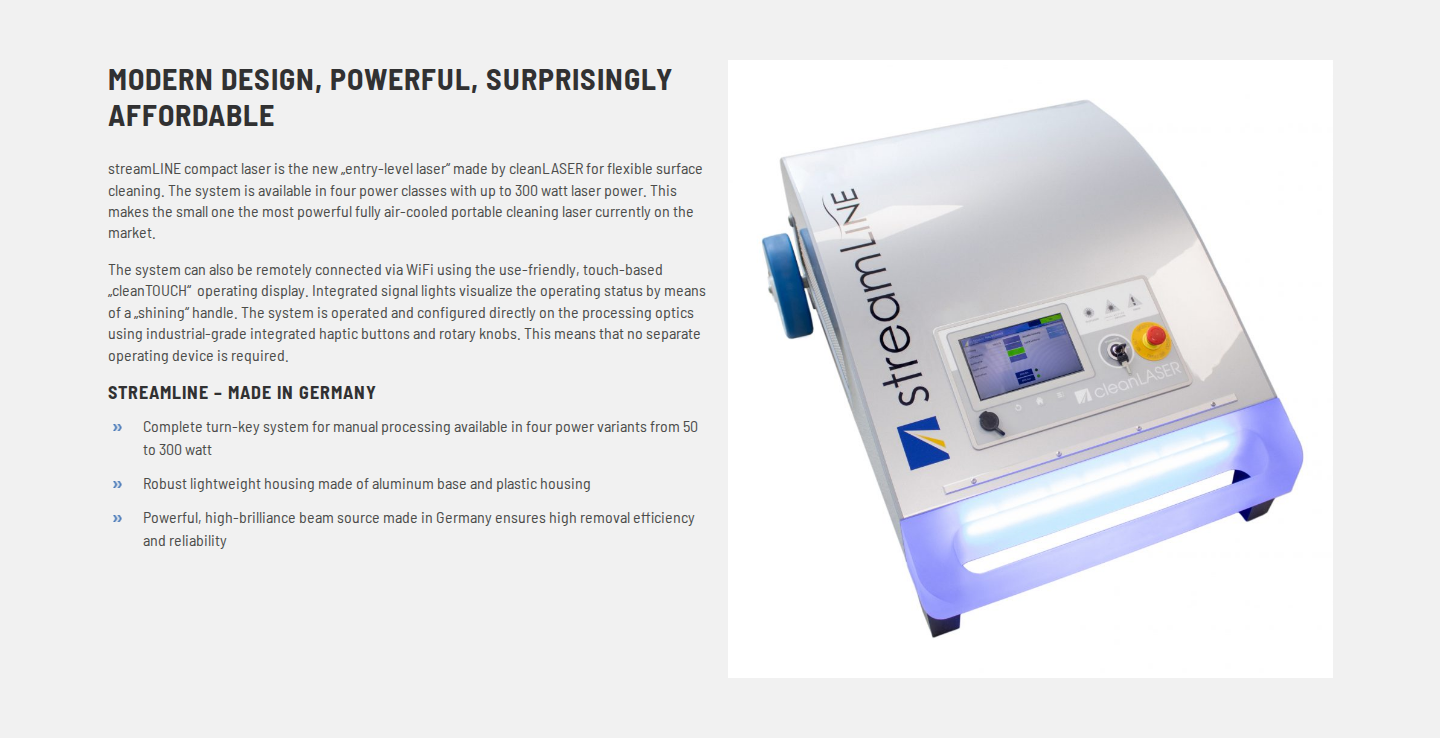
The recognised originator of industrial laser cleaning technology, Clean-Lasersysteme GmbH brings nearly 25 years of German engineering pedigree, approximately 2,000 global installations, and a uniquely broad proven application range — from portable rust removal to nuclear decontamination — to the CL-Series.
Pros:
Originator of laser cleaning technology
Broadest proven application range in category
streamLINE compact: air-cooled, no chiller needed
Power range: 50 W portable to 1600 W
Cons:
Class 4 handheld: controlled area and PPE required
Quote-only pricing; no published list prices
Founded in Herzogenrath, Germany in 1997, Clean-Lasersysteme GmbH is widely recognised as the originator of industrial laser cleaning technology — a claim the company makes explicitly and one the market has validated over nearly three decades.
With approximately 2,000 installed systems operating across more than 20 countries, and a customer base spanning automotive OEMs, aerospace, food production, medical technology, and nuclear decommissioning, cleanLASER's install base is one of the largest in the category.
In 2024 cleanLASER became part of IPG Photonics, while continuing to operate as Clean-Lasersysteme GmbH with headquarters and manufacturing in Herzogenrath — preserving the 'Made in Germany' provenance that has been central to its positioning.
streamLINE Compact: Portable Power Range
The streamLINE compact is cleanLASER's portable handheld entry, available in four power classes up to 300 W.
It is fully air-cooled — no external chiller is required — and cleanLASER describes it as the most powerful fully air-cooled portable cleaning laser currently on the market.
The system ships with the cleanTOUCH WiFi-connected touchscreen interface for parameter control, and haptic optics controls on the handpiece for operator convenience during use.
CL-Series: Full Power Range Overview
The broader CL-Series spans a wide power range, giving buyers a clear upgrade path as cleaning volume or throughput requirements grow.
| Series | Power Range | Laser Type | Cooling | Typical Use |
|---|---|---|---|---|
| streamLINE compact | Up to 300 W (4 classes) | Pulsed | Air-cooled (no chiller) | Portable / handheld cleaning |
| CL 150/300/500/600 (Mid Power) | 150–600 W CW | Diode-pumped solid-state | Integrated cooling | Mobile industrial cleaning, pre-treatment, mould cleaning |
| CL 1000 (High Power) | 1000 W CW | Diode-pumped solid-state | Water-cooled | Large-area decoating, NDT prep, high-throughput |
| CL 2000 (High Power) | Up to 1600 W CW | Diode-pumped solid-state | Water-cooled (external chiller) | Large-area paint removal, nuclear decontamination |
Presents the CL-Series power tiers side by side so evaluation-stage buyers can quickly locate the appropriate system for their throughput and application requirements.
The mid-power systems (CL 150 through CL 600) are described by cleanLASER as mobile and robust, with integrated cooling that removes the need for additional media beyond a three-phase power connection.
The high-power CL 2000 operates at up to 1600 W CW and requires an external chiller — it is designed for large-area applications at high feed rates, including nuclear decontamination at scale.
Automation and Robotic Cell Options
For production environments requiring continuous automated cleaning, cleanLASER offers a structured family of automation solutions: the cleanCELL turnkey enclosure cells (available in three width classes), the roboCELL for robot-guided integration, gantry systems for large-component processing, and compact workstations (safeBOX, compactCELL) for smaller parts.
All robotic-guided systems integrate via digital I/O or fieldbus into existing production lines — the automation approach is conventional robot programming, and the cleanCELL cells are full-enclosure (Class 1 inside the cell).
cleanLASER Application Breadth
Few competitors in the laser rust removing machine market can match the range of verified applications cleanLASER has accumulated over its operating history.
Proven application areas include paint removal from ships, bridges, and power transmission towers; pre-treatment for bonding and welding; NDT surface preparation; mould cleaning; and nuclear decontamination.
cleanLASER cites decontamination rates of 99.6% and more for alpha radiation on its nuclear decontamination application page, alongside area rates exceeding 15 m²/h for lightly adhering contaminations. This is a field where few laser cleaning manufacturers have verifiable, deployed experience.
Safety Architecture: Class 4 Hazard Zone
All handheld and mobile CL-Series systems are Class 4 lasers, consistent with standard industrial laser safety practice — they require a controlled area and appropriate PPE during operation.
There is no eye-safe or reduced-hazard-zone open-space cleaning capability on any CL-Series handheld product; operators must establish a conventional laser-controlled area before work begins.
The full-enclosure automation cells (cleanCELL, safeBOX, compactCELL) are Class 1 at the cell boundary — the hazard zone is contained within the enclosure, which suits fixed production environments where a permanent cell footprint is practical.
Certifications and Compliance
cleanLASER's published product documentation and website do not explicitly list specific CE or UKCA certification marks for the CL-Series at the time of writing; buyers should request current compliance documentation directly from cleanLASER before purchase.
cleanLASER CL-Series Pricing
cleanLASER does not publish list prices for the CL-Series; all configurations are available on a quote-only basis through cleanLASER's direct sales team or its global partner network.
As a category reference point, Laser Focus World cites industrial laser cleaning systems in the $60,000–$170,000 range for standard implementations, rising to $500,000 or more for fully automated cells — these are industry-wide figures, not cleanLASER-specific prices.
Product 4
P-Laser QF-Series
P-Laser is a Belgian specialist manufacturer with a pulsed laser cleaning range spanning 50 W to 3000 W and a large rental fleet that lowers the barrier to entry for buyers not ready to commit to a purchase. The QF-Compact is the portable entry point — a carry-the-whole-unit system weighing 13 kg at the 50/100 W level — and the most directly comparable option for field-use buyers evaluating this list.
Pros:
Wide power range: 50 W to 3000 W
Pulsed technology suits precision and heat-sensitive surfaces
Large rental fleet reduces capital commitment
QF-Compact is air-cooled; no chiller needed
Cons:
QF-Compact carries as one unit, not a handheld scanner
Class 4 hazard zone: controlled area and PPE required
Water cooling required from QF-200 upward
P-Laser, based in Heusden-Zolder, Belgium, is a specialist laser cleaning manufacturer that develops and produces its own pulsed equipment — spanning 50 W to 3000 W across portable, trolley, inline, and heavy industrial configurations.
The company operates a large rental fleet, which it describes as the biggest in the world, giving buyers a lower-commitment route into laser cleaning without a capital purchase.
QF-Compact: The Portable Range
The QF-Compact family runs from QFC-50 to QFC-300 and is described by P-Laser as the world's most compact laser cleaning system — the QFC-50 and QFC-100 weigh just 13 kg at dimensions of 485×225×330 mm, and both are air-cooled.
Operation is managed through CleanSweep software, with 8 custom job presets selectable via a rotary touch encoder; startup takes approximately 10 seconds.
| Specification | QFC-50 / QFC-100 | QFC-200 / QFC-300 |
|---|---|---|
| Weight | 13 kg | 30–35 kg |
| Dimensions (mm) | 485 × 225 × 330 | 300 × 665 × 465 |
| Cooling | Air-cooled | Air-cooled |
| Software | CleanSweep (8 presets) | CleanSweep (8 presets) |
| Startup time | ~10 seconds | ~10 seconds |
Gives evaluation-stage buyers a quick, comparable view of the QF-Compact's key specifications in one place, mirroring the structured approach used for other entries on this page.
For buyers needing maximum portability, P-Laser also offers the Laserpack LPC-100 — a backpack-style unit that lets the operator carry everything required for laser cleaning on their back.
One distinction worth noting: the QF-Compact is a carry-the-whole-unit design, meaning the entire laser system is placed or carried as one piece, rather than a trolley-based configuration where a lightweight fibre-fed scanner is held separately.
Whether this suits your workflow depends on the job — for confined spaces or single-operator field use, the self-contained form factor is practical; buyers who prefer a stationary trolley with a free-ranging handheld scanner will find a different working style here.
Mid and High Power Range
From the QF-200 upward, water cooling is required — the QF-200 and QF-300 mark the transition point, while the QF-500 and QF-1000 are available in either an industrial cabinet or a wheeled trolley configuration.
The QF-2000 is designed for heavy industrial deployment: it features dual closed-circuit chillers, an integrated towing system, and forklift pockets, and can be equipped with a fibre up to 50 m long for working around large steel structures.
At the top of the range, the Cubeline delivers 3000 W of pulsed output — launched in November 2024 and targeted at heavy-duty industrial cleaning applications including marine paint removal.
Safety and Certifications
The QF-Series operates as a conventional Class 4 laser system across the entire range, requiring a controlled area and appropriate laser PPE whenever the machine is active.
This means deployment in open or mixed-use environments is not possible without establishing a proper hazard zone — a practical operational consideration for buyers working in shared or public-access spaces, where RHZ-capable systems offer a meaningful advantage.
CE certification and UKCA compliance could not be confirmed from the P-Laser source URLs reviewed for this entry; buyers should verify certification status directly with P-Laser or their regional distributor before purchase.
Pricing and Rental
According to P-Laser's FAQ, the starting price for low-power machines is generally €60,000; purchase pricing across the range is handled through regional distributors and is quote-only.
Rental is available and represents a genuine differentiator: the QFC-100 is available at €550 per day, €1,430 per week, or €4,950 per month — useful for buyers who want to trial the technology or cover a short-term project without a capital commitment.
Product 5
Laserax Robot Cleaning Machine — Laserax
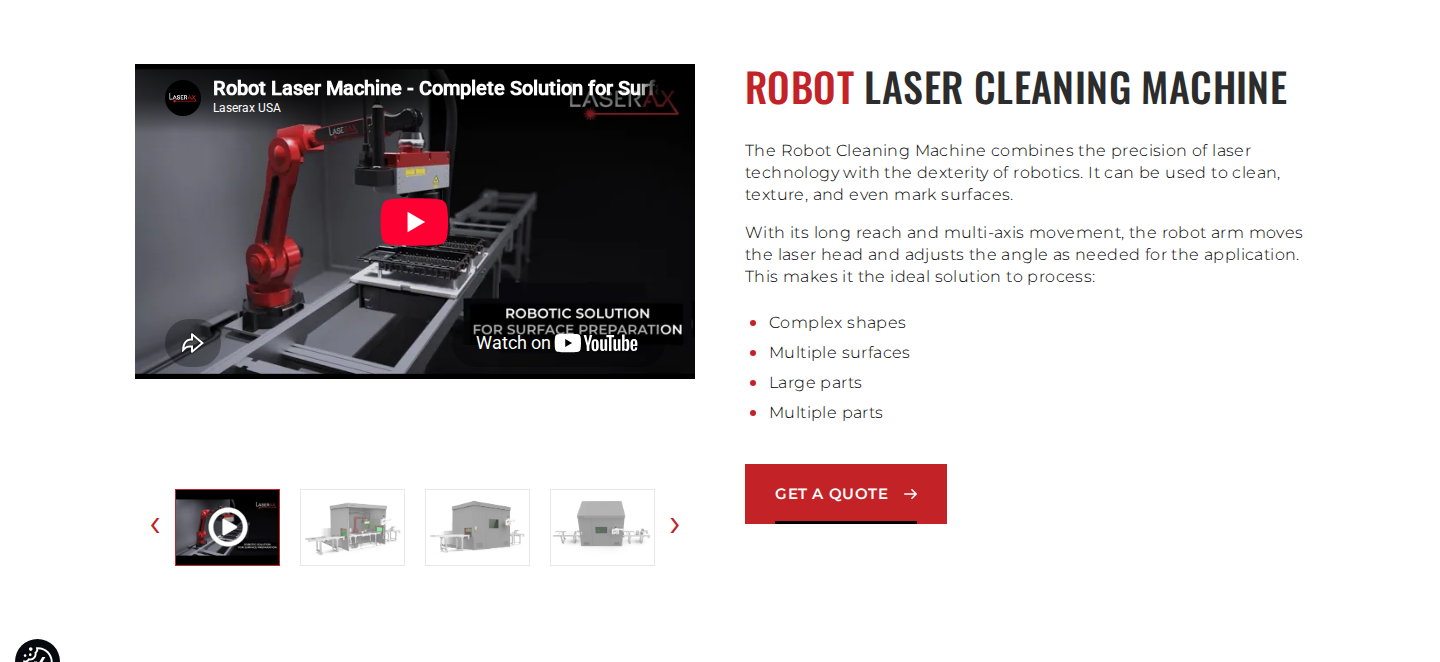
Laserax is a Canadian specialist in high-power automated laser cleaning, headquartered in Quebec City with operations in the USA and Germany. Their Robot Cleaning Machine mounts a pulsed ytterbium-doped fibre laser head on a 6-axis industrial robot arm — compatible with ABB, FANUC, and KUKA robots — and operates within a Class 1 certified safety enclosure. With laser power configurable from 100 W to 3000 W, it is built for production-line buyers in automotive, EV battery, aerospace, and heavy industry who need to clean complex, large, or varied parts at scale and at speed.
Laserax, headquartered in Quebec City with offices in the USA and Germany, has built its reputation supplying turnkey laser cleaning systems to some of the world's most demanding production environments — including major primary metals producers such as Alcoa and Rio Tinto, and automotive suppliers across North America and Europe.
The Robot Cleaning Machine is the flagship of that offering: a 6-axis robot arm carries the laser head through complex geometries, handling multiple surfaces and large parts that fixed-position systems cannot reach.
Laserax Robot Cleaning Machine: Key Specifications
| Specification | Detail |
|---|---|
| Laser Type | Ytterbium-doped pulsed fibre, 1064 nm |
| Laser Power | 100 W – 3000 W (single-mode up to 500 W; multimode 1 kW – 3 kW) |
| Form Factor | Enclosed robotic cell — 6-axis industrial robot arm |
| Compatible Robots | ABB, FANUC, KUKA (others available) |
| Laser Source MTBF | 100,000 hours |
| Cooling | Air-cooled (lower powers) or water-cooled (higher powers) |
| Safety Enclosure | Class 1 certified laser safety enclosure with interlocked doors |
| Typical Workspace | 2000 mm x 950 mm x 950 mm |
| General Footprint | 4 m x 4 m x 3 m |
| Typical Robot Reach | 2000 mm to 2300 mm |
| Laser Source Certifications | CE and UL confirmed on Laserax laser sources; system-level certification for the robotic cell not confirmed from available sources |
| Pricing | Quote-only (premium tier) |
Presents the core evaluation axes — laser type, power, form factor, cooling, safety, and workspace — in a scannable format consistent with the buying framework declared in the guide section.
The power range spans from 100 W to 3000 W, with single-mode configurations suited to precision cleaning of tight geometries and multimode configurations designed for high-speed treatment of large surface areas.
The 100,000-hour laser source MTBF is a meaningful figure for production buyers: at two-shift operation, that represents decades of expected service life from the laser source itself.
Application Suitability
Laserax has documented deployments across several high-demand verticals where surface cleanliness directly affects downstream process quality.
- Automotive and driveline: Removes oils, coatings, and oxides from engine and driveline components before welding, bonding, or assembly — supporting consistent adhesion and weld integrity.
- EV battery manufacturing: Cleans electrode tabs, busbars, and battery housings before ultrasonic wire bonding and welding, eliminating electrolytes, oxides, and dust that cause bonding failures.
- Aerospace: Precise contaminant removal and surface preparation for turbine blades and structural components, preserving tight tolerances throughout.
- Mould cleaning and surface prep: Removes mould residues and prepares surfaces for adhesive bonding or thermal spray coating without abrasive contact.
- Pre-weld and pre-bond preparation: Selective laser cleaning removes oxides and coatings from specific zones, eliminating the need for masking and reducing process steps.
For buyers in EV battery production specifically, Laserax has published case study evidence of a Tier 1 OEM deployment where the system eliminated contamination-driven wire bonding defects — a concrete production outcome rather than a general capability claim.
Safety Architecture and Deployment Constraints
Every Laserax robotic cell ships with a Class 1 certified laser safety enclosure with interlocked doors — meaning the laser cannot operate with the enclosure open, and no additional laser PPE or controlled exclusion zone is required outside the cell itself.
The practical implication is that full enclosure is a deployment requirement: Laserax robotic cells are not designed for open-space or reduced-hazard-zone cleaning, and buyers who need to clean parts in situ or in open factory areas will need to look elsewhere.
Vision is available as an option on Laserax systems, used for part positioning validation, cleaning quality inspection, and detecting part variants to trigger the correct laser sequence — but this is a quality assurance and positioning tool, not an automatic path generation system. Robotic cleaning paths require technician programming and setup before production runs.
Laserax robotic cells operate exclusively within a Class 1 certified enclosure. This is a genuine deployment constraint for buyers who need to clean large fixed structures, in-situ components, or parts that cannot be loaded into a cell. For buyers whose parts fit the cell envelope and who are integrating into a production line, it is a non-issue.
Broader Product Family
Buyers who need automation at lower power levels or with manual part loading have options within the Laserax range: the Rotary Table Machine handles fully automated inline cleaning for short robot idle-time windows, and the Rotary Workstation uses a dual-position indexer for high-throughput manual loading — both Class 1 enclosed, both up to 500 W.
Laserax Pricing
Laserax publishes no pricing on its website, and all systems are configured to application — pricing is available on request only. Given the power range, robot integration, and application engineering involved, these are premium-tier capital investments suited to buyers with a clear production requirement and the volume to justify the outlay.
Conclusion
Which laser rust removing machine is right for you?
If you need to clean in an open workshop, a heritage setting, or anywhere a controlled hazard zone isn't practical, the ELASER-RHZ is the only machine here that makes that possible; for automated production where load-and-go simplicity matters, AutoLASE is the only automated system that can operate without a full safety enclosure.
For high-throughput robotic lines, Laserax is the proven choice; cleanLASER suits broad portable industrial work; and P-Laser offers a wide pulsed power range with the option to rent.
The right laser rust removing machine is the one that fits how and where you need to clean.
Frequently asked questions about laser rust removing machines
Answers to the most common questions buyers ask when evaluating a laser rust removing machine.
It depends on the application — specifically, whether your substrate can tolerate heat. That single question determines the technology. Pulsed fibre lasers are the right choice for precision components, injection moulds, aerospace alloys, and heat-sensitive surfaces. The nanosecond pulse delivers high peak power with minimal heat transfer, so the substrate stays essentially at ambient temperature throughout cleaning. CW (continuous wave) fibre lasers suit heavy rust on structural steel, mill scale removal, and large-area applications where throughput is the priority and the substrate can absorb the thermal load without consequence. For buyers who need a single machine to span both use cases, a tunable pulsed system with a wide power range covers the broadest application spectrum from one unit — handling delicate precision work and more demanding industrial cleaning without switching platforms.
Pricing varies significantly by power tier, form factor, and configuration. P-Laser states on its FAQ page that low-power machines start from €60,000 — a figure that reflects the cost of established European pulsed technology at the entry end. Automated robotic cells and high-power industrial systems sit considerably higher, with integrated robotic configurations reaching $200,000 or more according to third-party buyer guides. Most industrial-grade machines are quote-only because power, cooling, integration, and application requirements differ substantially between buyers — this is standard practice in the category, not an attempt to obscure pricing. On total cost of ownership, the higher upfront investment is offset over time by near-zero running costs: operating a laser cleaning system typically costs less than €1 per hour in electricity and consumables, compared to the ongoing spend on abrasive media, chemicals, and waste disposal that sandblasting or chemical stripping requires.
Yes — and the mechanism is well understood. The laser beam is absorbed by the rust or oxide layer, which vaporises or is physically ejected by a photoacoustic shockwave, while the base metal beneath reflects or absorbs far less energy and remains intact. This selective absorption is what makes laser cleaning effective: the contaminant comes off, the substrate stays undamaged. Pulsed systems are particularly suited to precision and heat-sensitive surfaces — moulds, aerospace alloys, heritage materials — because the nanosecond pulse delivers energy without sustained heat transfer to the base material. CW systems excel at high-throughput removal on structural steel, mill scale, and large-area paint stripping. The real-world application base is broad and production-proven: across the machines covered on this page, verified uses include automotive pre-weld preparation, aerospace surface prep to tight tolerances, in-place injection mould cleaning, industrial maintenance, and heritage and monument restoration. These are not laboratory demonstrations — they are active production applications across multiple manufacturers.