

Introduction
You already know a laser can remove rust — what you probably don't know yet is exactly how it works, whether it suits your specific situation, and what separates a machine worth buying from one that falls short in practice.
This guide works through all of it: the underlying mechanism, how laser cleaning stacks up against the methods you may already use, the technical variables that actually drive performance, how to match a system to your application, and what to look for when you're ready to evaluate a machine seriously.
By the time you finish, you'll be able to read a specification sheet and know what the numbers mean — and what they don't tell you.
TL;DR
Laser rust removal genuinely outperforms traditional methods on precision, surface integrity, and long-run cost — but those advantages only materialise when the machine is matched correctly to the application.
Most buyers never see the handful of technical variables that determine whether a machine delivers on its promise. This guide gives you those variables, clearly explained.
This article covers:

How laser ablation removes rust without damaging metal
Laser vs grinding, sandblasting, and chemical stripping
Key technical variables: power, pulse regime, duty cycle
Matching system type to your application
Operator safety requirements and engineering advances
What to look for when selecting a machine
What Is a Laser That Removes Rust?
How does a beam of light actually remove rust? The answer sits in physics, not marketing — and once you understand it, the common concerns about substrate damage and process reliability answer themselves.
A laser rust removal machine is a laser cleaning system that uses focused laser energy to selectively vaporise or eject the iron oxide layer from a metal surface — with no physical contact, no abrasive media, and no chemical agents.
The Ablation Mechanism
When a pulsed laser beam strikes a rusted metal surface, the iron oxide layer absorbs the incoming energy and heats so rapidly that it vaporises or is physically ejected from the surface before that heat can conduct meaningfully into the base material beneath.
This event is called laser ablation — the rust layer is there, the pulse hits it, and the oxide is gone, leaving clean metal exposed beneath.
Two mechanisms drive the removal: a direct ablation effect, where the oxide vaporises under the intense pulse, and a thermal stress effect, where rapid localised heating creates mechanical stresses at the oxide-to-metal interface that cause the rust layer to spall away.
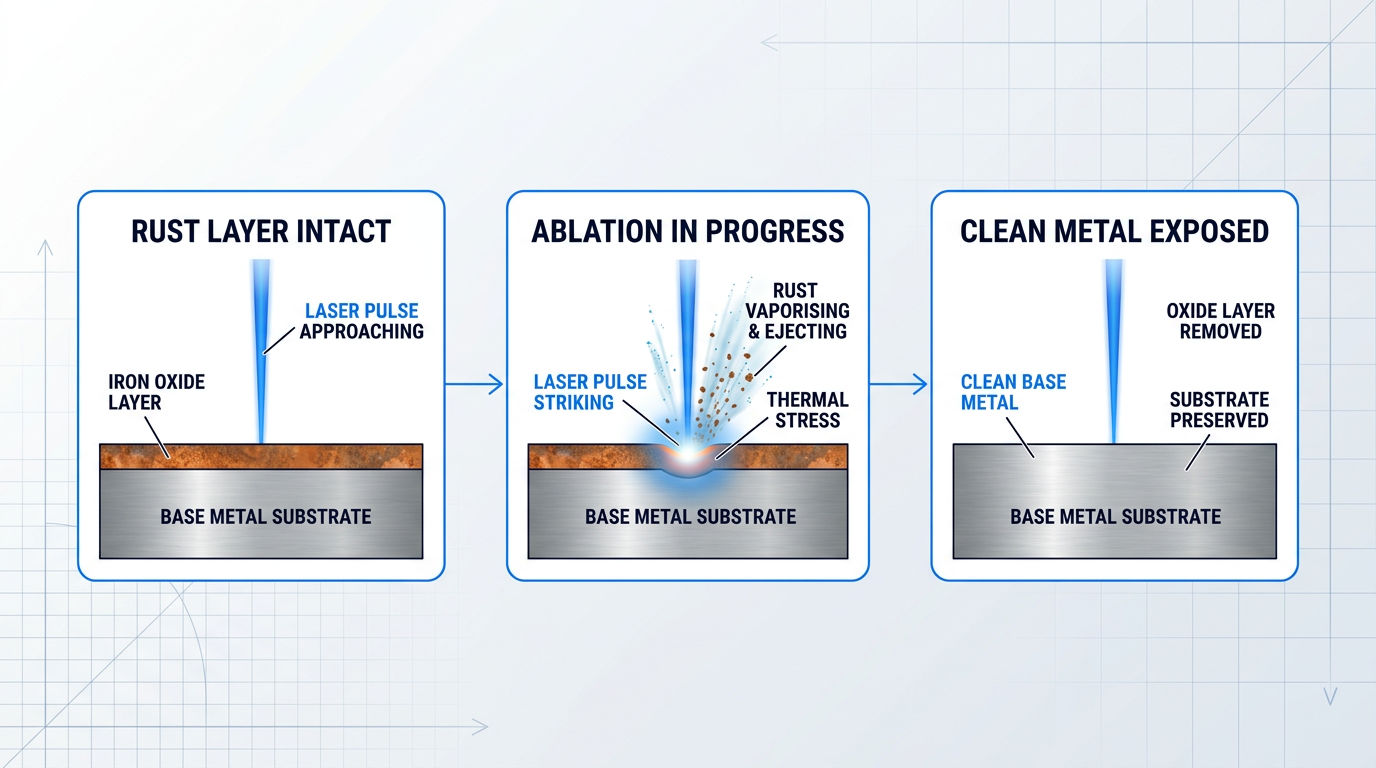
Because the process requires no contact with the surface and no consumable media, it is repeatable and leaves no secondary contamination — the ejected particles are simply extracted by a fume system.
Why the Beam Stops at the Base Metal
The question most buyers ask first is: won't the laser damage the steel underneath? The answer is grounded in how different materials respond to the same laser pulse.
At the near-infrared wavelengths used in industrial rust removal (around 1064 nm), iron oxide and unoxidised steel have nearly identical optical reflectivity — roughly 92% for both — meaning the selectivity mechanism is not primarily about differential optical absorption at this wavelength.
Instead, selectivity operates through differential thermal and mechanical response: the oxide layer, being a loosely bonded surface coating, reaches its vaporisation or debonding threshold at lower energy inputs than the dense, coherent steel substrate beneath it.
When the oxide is gone, the beam encounters the intact steel surface — which, at these energy levels, simply reflects or dissipates the pulse without reaching its own ablation threshold, leaving the substrate essentially intact.
This is not a safety feature engineered into the machine — it is a fundamental property of the physics, and it is why correctly parameterised pulsed laser cleaning preserves base metal integrity.
Peer-reviewed research on pulsed laser cleaning of carbon steel (AIP Advances, 2023) found that surface iron (Fe) content rose from 62.59% to over 90% after cleaning, while oxygen content fell from 29.57% to just 2–3%. Those numbers are the chemical signature of a clean metal surface — the oxide layer is gone.
That shift in surface chemistry — from an oxygen-rich oxide to a near-pure iron surface — is the measurable, reproducible result of the ablation mechanism working as described, not a claimed outcome from a product brochure.
Pulsed vs Continuous Wave: The Architecture That Matters
Pulsed laser systems deliver energy in discrete bursts — extremely short pulses in the nanosecond regime, with very high peak power, separated by gaps during which no energy is delivered to the surface.
Those gaps are not idle time: they allow thermal energy in the substrate to dissipate between pulses, preventing heat from accumulating in the base material.
Continuous wave (CW) systems, by contrast, deliver an uninterrupted beam with no pulse gaps — sustained energy delivery with no thermal recovery period for the substrate.
For rust removal on metal substrates, pulsed architecture is the correct choice: CW operation creates a sustained heat-affected zone in the base material that can alter the steel's microstructure, reduce surface hardness, drive new oxidation, or in severe cases cause distortion.
The pulsed-versus-CW decision is therefore not a technical preference — it is the difference between a process that selectively removes the oxide layer and one that risks altering the substrate it is supposed to preserve.
Fibre Laser: The Industrial Standard
The dominant technology in industrial laser rust removal today is the ytterbium-doped fibre laser, operating at a wavelength of 1064 nm — the established standard for metal surface cleaning applications.
Systems operating at 1550 nm represent a separate wavelength category used in eye-safe and reduced-hazard-zone configurations; the safety implications of that distinction are explored in the operator safety section later in this guide.
With the mechanism established — what ablation is, why the beam stops at the base metal, and why pulsed architecture matters — the natural next question is how this process compares to the grinding, sandblasting, and chemical stripping methods that most buyers are already familiar with.
Laser Rust Removal vs Grinding, Sandblasting, and Chemical Stripping
Knowing how laser ablation works is one thing — knowing whether it actually outperforms the methods already in your shop is another. The honest answer is: it depends on what you're measuring, and the comparison looks very different once you move beyond upfront equipment cost.
The four methods worth comparing are laser cleaning, abrasive grinding, sandblasting, and chemical stripping. The axes that matter are surface integrity and substrate loss, precision and selectivity, consumable and waste costs, and environmental and regulatory burden.
Surface Integrity and Substrate Loss
This is where the physics of laser ablation translates directly into a practical advantage — and where the difference between methods is largest.
Abrasive blasting removes material by physical impact, and it does not stop at the rust layer. Substrate erosion from sandblasting runs 25–75 µm of base metal per cleaning cycle — inconsequential on thick structural plate, but a genuine concern on thin-wall components, precision-machined surfaces, or parts that will be re-cleaned multiple times across their service life.
Laser cleaning operates on a fundamentally different principle: because the beam is absorbed preferentially by iron oxide rather than the steel beneath it (the differential absorption mechanism covered in the previous section), the process is largely self-limiting at the substrate interface. Metal loss is under 1 µm per pass when fluence is correctly controlled — two orders of magnitude less than abrasive blasting.
For bearing journals, hydraulic rod surfaces, thin-wall tubing, or any component where dimensional tolerance matters, that difference is not marginal — it is the deciding factor.
There is also a point worth making explicitly: laser cleaning is not inferior to sandblasting on cleanliness grade. Research published on high-power pulsed fibre laser systems confirms that laser cleaning can meet the ISO 8501-1 Sa 2.5 near-white metal standard on carbon and structural steel — the same grade that most industrial anti-corrosion coating systems specify. Laser cleaning wins on substrate preservation, not by trading away cleanliness.
Precision and Selectivity
Sandblasting treats whatever it hits — there is no mechanism for targeting a specific zone while leaving adjacent surfaces untouched.
Laser cleaning can be targeted to millimetre-level accuracy, which makes it viable for work that is simply impractical with abrasive methods: cleaning a weld heat-affected zone without disturbing the primer on either side, stripping corrosion from a bearing seat without affecting the adjacent bore, or removing surface oxide from a repair zone on a coated structure.
Masking for sandblasting is slow, expensive, and imprecise at edges — and it still does not eliminate the risk of abrasive embedment in adjacent surfaces or seals. For selective-zone work, laser cleaning is not just better; it is often the only method that delivers an acceptable result.
Consumables, Waste, and Disposal Costs
Sandblasting has a recurring consumable cost that compounds with every hour of operation. Garnet and aluminium oxide abrasive media runs roughly $0.10–$0.50 per pound, and a working blaster burns through 50–200 lbs per hour depending on nozzle size, pressure, and whether the job is detail work or bulk prep. At 100 lbs/hour on a mid-duty job, that is $10–$50 per hour in media alone, before containment, compressor maintenance, or labour.
Laser cleaning has near-zero consumable cost: no media, no chemicals, no water. Electricity consumption for a 500W fibre laser system (laser source, chiller, controls combined) runs roughly 2–5 kW total — a modest operating cost by any industrial standard.
The waste stream is where the cost picture shifts further. Spent abrasive that has contacted lead paint, chromate primers, or heavy metal coatings is classified as hazardous waste under RCRA regulations — and disposal at a licensed facility runs $0.50–$3.00 per pound in practice. A single day of production blasting on lead-painted structural steel can generate 500–2,000 lbs of contaminated spent grit, which translates to a $250–$6,000 disposal charge for one job.
Chemical stripping generates a different but equally regulated waste stream. Stripped paint waste using solvents containing compounds listed under EPA F001–F005 classifications is treated as hazardous waste, and spent chemical stripping baths require regulated disposal. Disposal contracts for contaminated chemical waste run roughly $0.30–$1.20 per litre depending on classification and region.
Laser cleaning produces only captured dry particulate — oxidised contaminant residue and rust particles collected by a local exhaust ventilation system with HEPA filtration. Per shift, total solid waste typically runs 0.5–5 lbs depending on contamination load. In most jurisdictions, if the substrate coating is non-hazardous, that material is manageable as standard industrial waste — no settling tanks, no wastewater discharge permit, no media recycling logistics.
| Method | Substrate Loss per Cycle | Cleanliness Achievable (ISO 8501-1) | Coverage Rate | Consumable Cost per Hour | Waste Classification |
|---|---|---|---|---|---|
| Laser cleaning | <1 µm per pass (correctly controlled fluence) | Sa 2.5–Sa 3 | 2–60 m²/hr (power-dependent) | Near zero (electricity only) | Standard industrial (dry particulate, HEPA-captured) |
| Sandblasting | 25–75 µm per cycle | Sa 1–Sa 3 (media-dependent) | 5–200 m²/hr (setup-dependent) | $10–$50/hr in media alone | Hazardous if lead/heavy metal contact; $0.50–$3.00/lb disposal |
| Angle grinder / wire brush | Variable; operator-dependent | Sa 1–Sa 2 maximum | 0.5–2 m²/hr | Low (consumable wheels/brushes) | Standard industrial (metal filings) |
| Chemical stripping | Minimal substrate loss | Variable, substrate-dependent | Slow (dwell time required) | $0.30–$1.20/litre solvent | Hazardous (F001–F005 listed solvents); regulated disposal required |
Comparison of rust removal methods across key operational and cost dimensions using sourced figures
The table makes two patterns clear. First, laser cleaning and sandblasting are genuinely comparable on cleanliness grade — the abrasive method holds no inherent quality advantage on that axis. Second, the cost and waste columns reveal where the real operational burden of traditional methods accumulates: it is not the equipment, it is the consumables and the disposal.
Chemical stripping deserves an honest assessment. It is effective for batch immersion and passivation processes — particularly where full component immersion is practical and throughput per unit is the priority. Its limitations are on-site impracticality, the inability to target selective zones, and the regulated waste stream that follows every job involving listed solvents.
A shop running 500 hours per year of surface prep work typically accumulates $30,000–$80,000 in sandblasting consumables, media, and disposal costs over five years. Laser cleaning operating costs over the same period — electricity, optics, annual service — generally stay below $8,000–$15,000. The total cost of ownership argument favours laser for medium-to-high-frequency use even before factoring in rework costs from substrate damage.
Where Traditional Methods Retain the Advantage
Sandblasting is not obsolete, and it would be dishonest to frame it that way. On large, open, flat surfaces — think wide-flange structural beams, ship hull sections, or storage tank exteriors — automated blasting equipment can achieve 50–200 m²/hr to Sa 2.5–Sa 3, with the upper end achievable only on flat, unobstructed plate.
A well-configured laser cleaning system in the same power class reaches 10–60 m²/hr on comparable contamination. For operations with existing blast-room infrastructure already in place, high throughput requirements, and large uniform surface areas, sandblasting remains competitive on speed — and that is a legitimate reason to keep it in the toolkit.
The calculus shifts when the work involves precision geometry, confined spaces, lead-painted structures, regulatory restrictions on dust or chemical discharge, or surfaces where abrasive embedment is a coating adhesion or contamination risk. In those scenarios, the throughput advantage of sandblasting erodes quickly against its operational constraints.
Environmental and Regulatory Dimension
OSHA's crystalline silica standard (29 CFR 1910.1000 and 1926.1153) establishes a permissible exposure limit of 50 µg/m³ for respirable crystalline silica — a standard that OSHA's own regulatory record notes is difficult to achieve through engineering controls alone during abrasive blasting operations, making respirator programmes and medical surveillance mandatory for exposed workers.
Laser cleaning generates no airborne silica dust — eliminating that compliance burden entirely. There is no chemical effluent, no wastewater discharge requiring a permit, and no secondary contamination of adjacent surfaces from recycled abrasive. In regulated environments where airborne particulate limits, chemical discharge restrictions, or waste stream classification are live compliance concerns, this is not a minor operational benefit — it can be the deciding factor in method selection.
Understanding where laser cleaning wins on these axes leads naturally to the next question: which machine variables actually determine how well a laser rust removal machine performs in practice, and what should a buyer look for on a spec sheet?
The Technical Variables That Determine Performance
The most common mistake buyers make when evaluating a laser rust removal machine is comparing headline wattage numbers in isolation — as though the machine with the highest number wins.
Wattage matters, but it is one variable among several that interact to determine whether a machine actually performs on your jobs. Understanding those variables together is what separates an informed capital equipment decision from an expensive guess.
Power Output and Peak Power
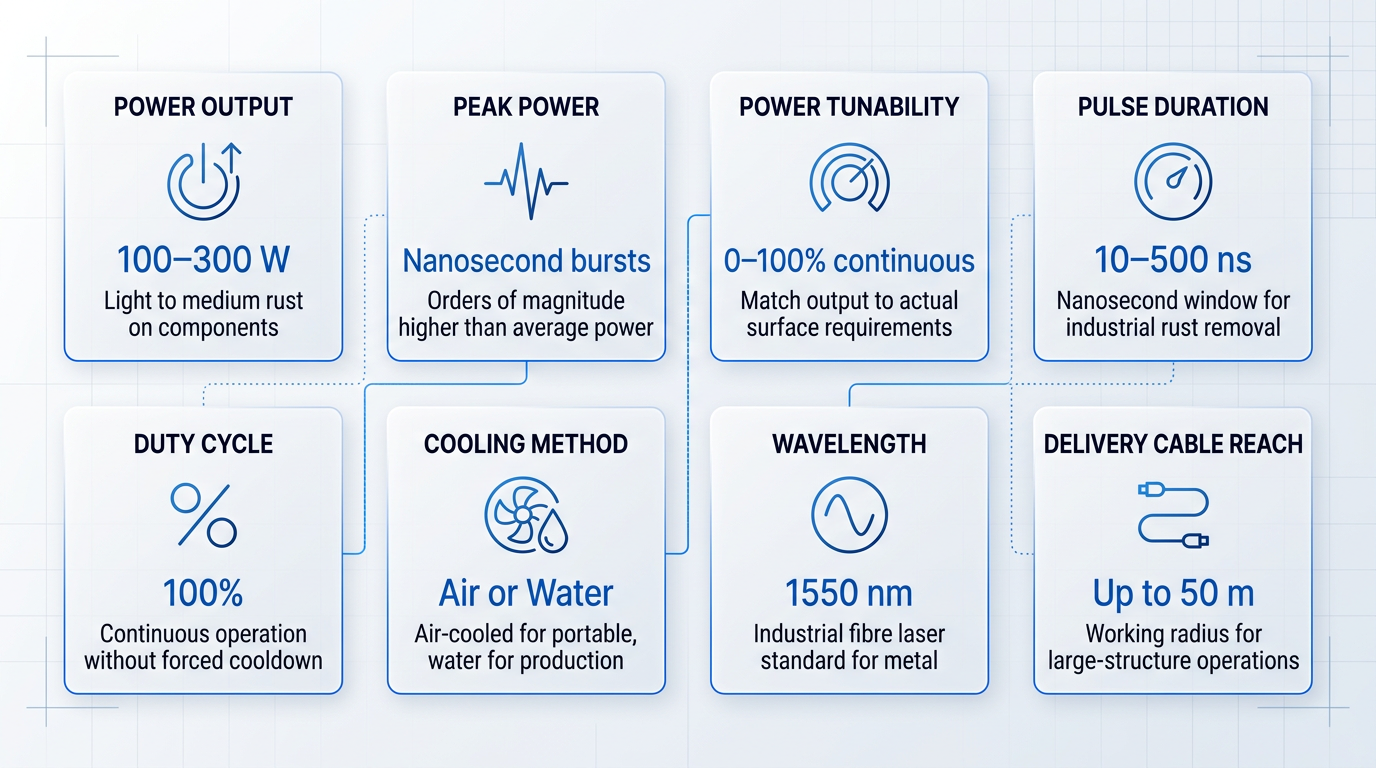
Average power output sets the ceiling for cleaning speed and depth capability: pulsed systems in the 100–300 W range handle light-to-medium rust on components effectively, while heavier structural rust at production rates typically demands higher average power.
The critical distinction — one that specification sheets rarely explain — is the difference between average power and peak power in a pulsed system.
In a pulsed laser, energy is not delivered as a continuous stream but concentrated into discrete bursts lasting nanoseconds. Because the same energy is compressed into a fraction of the time, the instantaneous peak power during each pulse is orders of magnitude higher than the average power figure suggests.
It is that peak power per pulse — not the average — that drives ablation: the sudden energy spike vaporises the rust layer before the heat has time to conduct into the substrate below.
This is why a 200 W pulsed system is not directly comparable to a 200 W continuous wave system: the pulsed machine delivers far higher instantaneous energy at the surface, enabling effective cleaning at lower average power than a CW architecture requires.
Power Tunability
Power tunability — the ability to dial output continuously across the full range — is an operational necessity on real jobs, not a premium feature.
Rust depth varies across a single workpiece; metal type and thickness change between jobs; surface geometry introduces variation in how the beam lands. A machine that cannot adapt forces the operator into an uncomfortable choice: run too low and leave contamination, or run too high and risk altering the substrate.
WSL's ELASER — a portable industrial fibre laser cleaning system — offers continuously tunable power from 0–100% across its full 300 W range, so the operator can match output precisely to what the surface in front of them actually requires.
Pulse Duration: The Nanosecond Window
For industrial rust removal on metal substrates, the practical operating regime is the nanosecond pulse duration window, typically between 10 and 500 ns.
Shorter pulses — picosecond or femtosecond — offer finer control and are used in precision applications, but at significantly higher cost that is rarely justified for industrial rust removal.
Longer pulse durations push heat into the substrate during each pulse, creating heat-affected zones that can alter the microstructure of the base metal or trigger new oxidation — the opposite of what the process is meant to achieve.
The ELASER operates at a 100 ns pulse duration, placing it squarely within the nanosecond regime that industrial rust removal demands — long enough to deliver meaningful energy per pulse, short enough to keep the thermal footprint at the surface.
Duty Cycle: The Specification Buyers Overlook
Duty cycle is the percentage of time a machine can operate at full rated power without requiring a forced pause to cool down.
For commercial and industrial use, 100% duty cycle is the standard to target: the machine runs when the job demands it, not when its thermal management allows it.
Lower-cost systems rated at 50–80% duty cycle introduce mandatory cooldown stops into the workflow. On a production line or a contracted cleaning job, those interruptions translate directly into lost throughput, disrupted scheduling, and extended labour costs.
A machine rated at 50% duty cycle is, in sustained use, effectively half as productive as its wattage implies — the headline power figure tells you nothing about how long it can sustain that output without stopping.
Duty cycle is not always prominently stated in marketing materials: treat it as a specification to verify explicitly, not one to assume.
Cooling Method: Air vs Water
Air-cooled systems are lighter, self-contained, and require no external infrastructure: no chiller unit, no plumbing, no coolant circuit to maintain.
They are well suited to portable deployment, field work, and applications up to approximately 300–500 W where the operating pattern includes natural variation in duty cycle.
The ELASER is air-cooled, which means it arrives on site, plugs into a standard 110–250 V single-phase supply, and operates without any supporting infrastructure — a genuinely self-contained system.
Water-cooled systems sustain higher average power over longer continuous runs and are the right choice for heavy-duty production environments where the machine operates at full output for extended uninterrupted periods.
The decision between air-cooled and water-cooled should follow from your actual operating rhythm and duty cycle requirements — not from a perception that water-cooled sounds more industrial. Adding chiller infrastructure to a deployment that doesn't need it creates complexity without operational benefit.
Wavelength and Delivery Cable Reach
Most industrial fibre laser systems operate at 1064 nm, which is the standard wavelength for metal interaction. A second option — 1550 nm — is used in eye-safe and reduced-hazard-zone configurations, because at that wavelength the beam is retina-safe at the exposure levels relevant to industrial cleaning.
The ELASER operates at 1550 nm, which is the technical foundation for WSL's world-first reduced-hazard-zone technology — a capability that significantly changes where and how laser cleaning can be deployed. The full implications for safety classification and operating environment are covered in the safety section below.
Delivery cable reach determines the working radius between the operator's handheld scanner and the machine unit itself — a variable with major practical consequences for large-structure work.
A 5 m cable confines the operator to bench-side work; the machine must be repositioned every time the job moves. A 50 m cable means the machine can sit at a fixed point while the operator covers an entire vehicle, structure, or infrastructure span without interruption.
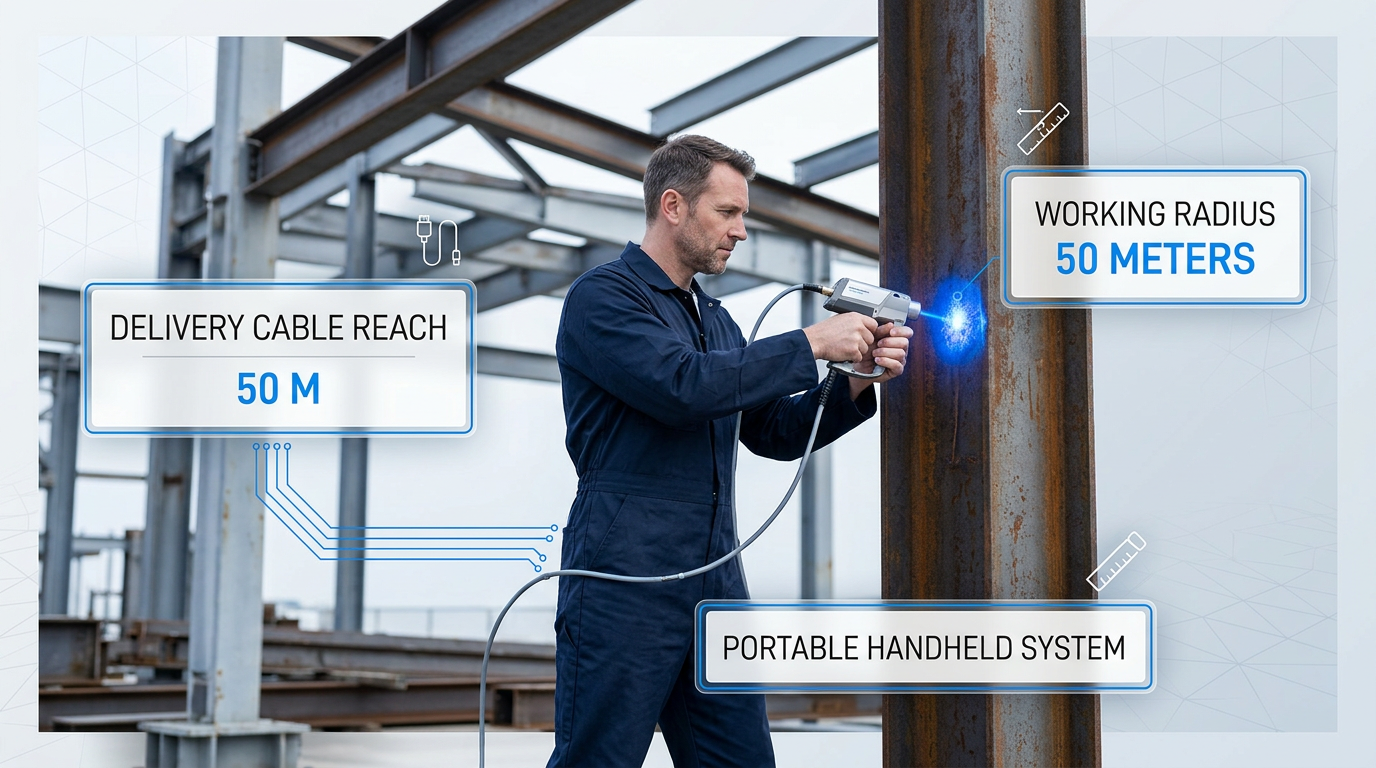
The ELASER offers delivery cable options up to 50 m (with 5 m and 15 m as standard lengths), paired with a handheld scanner weighing under 3 kg. It is that combination — long reach with a lightweight scanner — that makes sustained single-operator use on large structures genuinely practical rather than theoretically possible.
With these variables understood, the natural next question is which form factor — portable or automated — best fits your operating context: that is the focus of the following section.
Portable vs Automated: Choosing Your Form Factor
Once you understand the technical variables, the next question is more fundamental: what kind of machine fits the way you actually work? The answer is not about wattage or pulse regime — it is about where the work happens, how often the same task repeats, and whether your parts come to the machine or the machine must come to the parts.
There are two distinct architectures in the laser rust removal machine market, and they are built around opposite assumptions about the relationship between the operator, the part, and the laser unit.
Portable Systems: The Machine Stays, You Move
In a portable handheld system, the laser unit itself is a wheeled floor-standing machine that stays in one place. The operator carries a lightweight handheld scanner to the work, connected to the unit via a delivery cable. The work does not come to the machine; the operator takes the beam to the work.
This architecture is the natural fit for any situation where the workpiece is fixed, oversized, or too varied to justify a dedicated automated cell.
The portable architecture suits a wide range of real-world contexts: on-site structural steel, ship hulls, wind turbines, heritage metalwork in publicly accessible locations, automotive bodyshop work across different vehicle models, and lower-volume or intermittent jobs where throughput does not justify a robotic cell.
When evaluating a portable system, three specifications define how usable it actually is in the field.
- Scanner weight: Sub-3 kg enables sustained single-operator use throughout a working day. Heavier scanners introduce fatigue that compounds over hours of continuous use.
- Delivery cable reach: The cable determines your working radius from the machine unit. A 5 m cable confines the operator tightly; a 50 m cable lets you clean a large structure without repositioning.
- Self-contained operation: A system requiring no compressor, water supply, or consumables can be deployed anywhere with a standard power outlet — critical for field and on-site work.
Delivery cable reach is worth singling out because it varies significantly across the portable market and is rarely highlighted in spec sheets — yet it is one of the most consequential figures for large-structure work.
Many portable laser cleaning systems ship with a 5 m standard cable. A 50 m maximum reach transforms the working radius — enabling cleaning of bridges, ship hulls, and large fabrications without repeatedly repositioning the machine unit. This specification is not standardised across the market; verify it before purchase.
To illustrate what a well-specified portable system looks like in practice: WSL's own ELASER (the publisher's solution) uses a handheld scanner weighing under 3 kg, with a delivery cable reaching up to 50 m, and operates entirely air-cooled with no compressor, water, or consumables required — deployable wherever a standard power outlet is available.
Automated Systems: The Part Comes to the Machine
In an automated robotic system, the laser cleaning head is mounted on an articulated robotic arm. Parts are loaded into the cell and the arm moves the head across the part's surface. The operator loads and unloads; the system does the cleaning.
This architecture is built for repetitive high-volume production — injection mould cleaning, automotive component lines, aerospace surface prep — anywhere the same cleaning task is performed hundreds or thousands of times on identical or near-identical parts.
The case for automation in production is not just convenience. Automated systems hold the same cleaning standard on every part, every cycle, removing the operator variability that is unavoidable in manual portable cleaning. Removing a person from a repetitive cleaning task is a production economics argument as much as a quality one.
Two characteristics of automated systems matter most when evaluating them.
The first is path programming. Traditional robotic cells require a technician to set cleaning paths manually — a process that takes time and demands knowledge of part geometry. More capable systems use machine vision to scan the part, build a 3D map, and generate the cleaning path automatically. WSL's AutoLASE works on this principle: load the part and the system generates the clean automatically, with no manual path-setting or programming knowledge required.
The second is enclosure requirements. Most automated laser cleaning cells require a full guarded enclosure to contain the laser hazard zone, with direct implications for facility layout and floor space. AutoLASE is available with WSL's optional RHZ upgrade, which removes the enclosure requirement entirely — a configuration not offered by other automated laser cleaning systems.
When You Need Both
For larger operations, the portable vs automated question sometimes resolves to: both. A portable system handles maintenance, field work, and varied jobs; an automated cell runs the production line. These are complementary architectures, not competing ones.
Framing the choice as either/or is a mistake if your operation genuinely spans both contexts — on-site maintenance work and a high-volume production cleaning task are not served by the same machine, and attempting to use one architecture for both will leave one need underserved.
With the architectural decision framed, the next step is mapping it to your specific application — whether that is structural steel, automotive, heritage restoration, aerospace, or production tooling — and understanding which specifications matter most in each context.
Matching the Machine to Your Application
The preceding sections have given you the vocabulary: ablation thresholds, pulsed vs CW, duty cycle, cable reach, portable vs automated. Now those concepts do the work they were always meant to do — helping you look at your own application and identify exactly which machine characteristics it demands, and why.
Automotive Restoration and Bodyshop
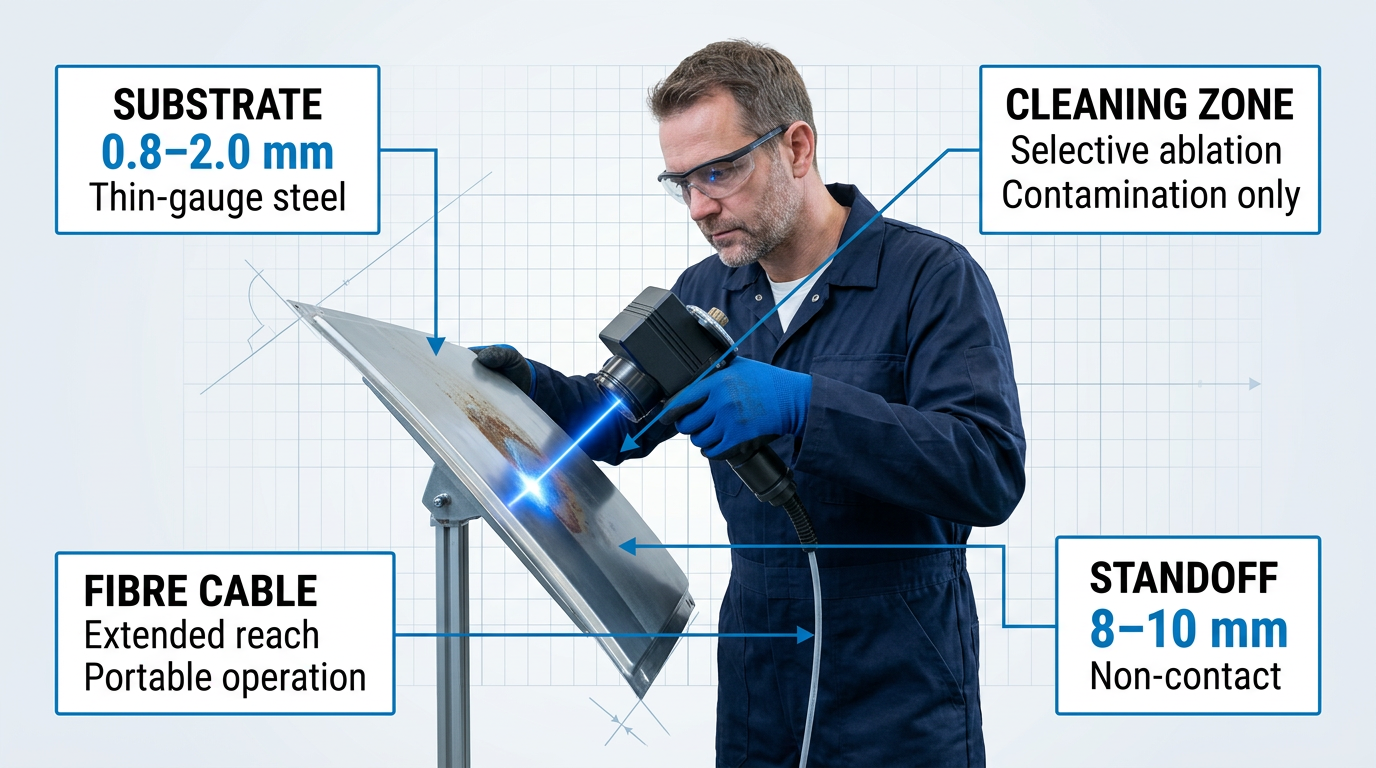
Rust removal from body panels, pre-weld surface prep, paint and primer stripping — the automotive restoration context is defined by one overriding constraint: substrate sensitivity.
Thin-gauge sheet steel and aluminium panels — commonly 0.8 to 2 mm stock — cannot tolerate the dimensional loss or heat-affected zones that aggressive abrasive methods introduce. On panels below about 1.5 mm, sandblasting carries measurable warping risk and can remove 0.05–0.15 mm of wall thickness from a surface that may already be near its minimum.
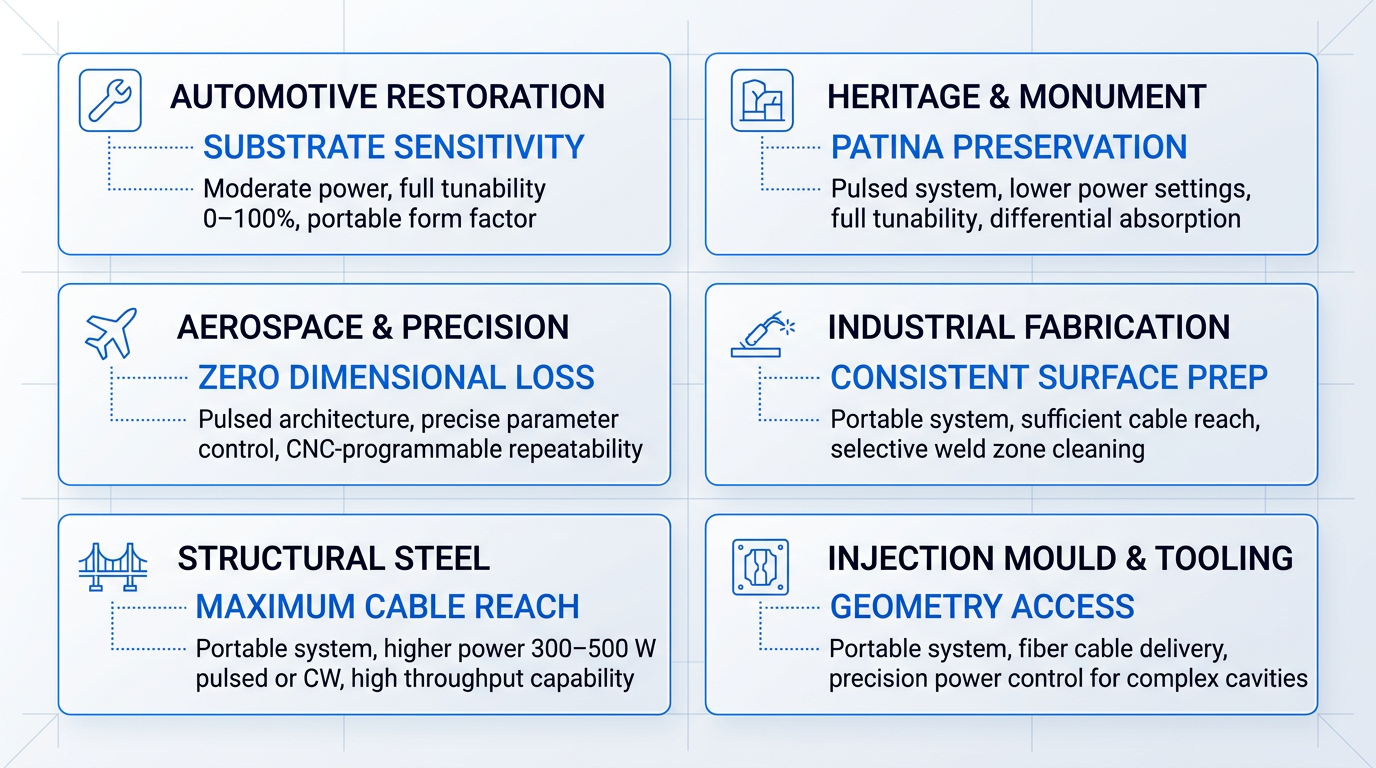
The machine characteristics that follow from this are clear: moderate power with full tunability (0–100%), so the operator can dial back for thin aluminium panels; a portable form factor to move freely around the vehicle; and non-contact operation that eliminates the mechanical stress abrasive media transfers to the part.
For weld prep specifically, a laser can clean a joint area to bare, contamination-free metal in seconds — no wheel grinder marks, no wire brush debris — and post-weld, it strips heat tint and spatter from the weld zone without touching adjacent surfaces. For restoration welders working on thin vintage panels, that non-contact precision is not a convenience: it is the only method that achieves selective cleaning on a finished vehicle body without masking or substrate risk.
Heritage and Monument Restoration
Stone, masonry, bronze, historic metalwork, architectural details — the heritage context demands the gentlest possible approach. The substrate is irreplaceable, and patina preservation is often as important as contamination removal.
Research on laser cleaning of historic monuments confirms that pulsed laser systems can selectively remove biofilm, environmental soiling, rust, and spray paints while preserving the integrity of the underlying substrate — including on bronze objects where both outer soot layers and inner copper corrosion products have been selectively removed using the same laser system by adjusting parameters between passes.
The machine characteristics that follow: a pulsed system at lower power settings, with full tunability essential to stay below substrate damage thresholds; differential absorption does the work of stopping at the surface the conservator wants to preserve. Chemical stripping risks the substrate chemistry, abrasive media is too aggressive for delicate masonry, and water-jetting lacks the selectivity that irreplaceable surfaces require.
Heritage work is also typically public-facing — monuments, listed buildings, open streetscapes. Operating in those environments without area evacuation is a significant practical advantage, and it raises safety considerations that the next section addresses directly.
For heritage and aerospace applications, laser cleaning is not merely superior to alternatives — it is often the only method that achieves the required selectivity without risking an irreplaceable or dimensionally critical substrate.
Aerospace and Precision Engineering
Surface prep and component cleaning in aerospace operates under one non-negotiable constraint: zero dimensional loss beyond the contamination layer. On high-value components where dimensional accuracy governs fatigue life and fit, no substrate removal beyond the target layer is permitted.
A US Navy MRO demonstration at Fleet Readiness Center East confirmed that laser cleaning technology can safely remove corrosion and hazardous coatings from aircraft components without impacting substrate integrity or creating hazardous mixed waste — a combination no abrasive method can match. The process leaves rivet holes, weld lands, and precision-machined flanges at their original dimensions.
The machine characteristics that follow: a pulsed architecture with precise parameter control, operated within the fluence window that removes the contamination layer without initiating surface ablation of the base material. Repeatability across every part is as important as the result on any single part — a pulsed system with CNC-programmable parameters delivers the same outcome on part 500 as on part 1.
For repetitive aerospace component cleaning at volume, automated systems become the logical next step — but the portable vs automated section has already covered that ground.
Industrial Fabrication and Maintenance
Pre-weld cleaning, post-weld oxide removal, mill scale removal from weld zones — the fabrication context is defined by a different kind of requirement: consistent surface prep quality that directly improves weld integrity and coating adhesion.
Contamination on a weld joint surface causes porosity and inclusion defects that reduce yield strength, tensile strength, ductility, and fatigue life. A laser-cleaned surface arrives at the welding operation with no abrasive particles and no chemical residue — just clean, oxide-free metal. On stainless steel weld zones, laser cleaning removes heat tint from the HAZ without the acid waste that chemical pickling requires.
The fabrication context also frequently requires the machine to come to the work. Large fabrications cannot be moved to a blast room, which makes a portable system with sufficient cable reach operationally decisive. A laser head can track a 10 mm weld seam and clean it while leaving adjacent primer coat intact — masking that same geometry for sandblasting is slow and never quite right at the edges.
Mill scale removal and weld oxide cleaning are particularly well-suited to laser's selectivity: the weld zone is cleaned without disturbing adjacent coating, and the resulting surface is ready for the next process without additional prep steps.
Structural Steel and Infrastructure
Maintenance cleaning of bridges, railway infrastructure, and large steel structures in situ presents a distinct set of requirements: the structure cannot come to the machine, rust grades are often heavier, and the operating environment is frequently public-facing or semi-public.
The machine characteristics that follow are a portable system with maximum cable reach and higher power settings to handle heavier rust grades. For Grade C–D rust on structural steel, pulsed systems in the 300–500 W range can achieve Sa 2.5 cleanliness per ISO 8501-1 at rates of roughly 4–10 m²/hour.
The honest trade-off must be stated clearly: for very large flat-area structural rust removal at high throughput — replacing a full blast-room operation across hundreds of square metres — higher-power CW systems or accepting slower coverage rates is the realistic position. High-capacity automated abrasive blasting reaches 50–200 m²/hour; even a 3,000 W CW portable system peaks at around 50–80 m²/hour on light rust, and portable pulsed systems at production-realistic power levels sit considerably below that. For bridge girder maintenance at scale, gantry-mounted CW systems in the 1,000–2,000 W range are the established approach, delivering 25–45 m²/hour on structural steel.
Where portable pulsed systems genuinely win on infrastructure work is access geometry and operating environment: joint details, fastener zones, and areas inaccessible to automated rigs are exactly where a 500 W handheld unit provides coverage that no gantry can reach. Operating in open public environments also raises the hazard-zone question that the next section addresses directly.
| Power Class | Mode | Typical Area Rate (Structural Steel) | Best-Fit Structural Use |
|---|---|---|---|
| 300–500 W | Pulsed | 4–10 m²/hr | Joint details, fastener zones, access-limited areas |
| 1,000 W | Pulsed or CW | 12–25 m²/hr | Medium-scale maintenance, weld prep on structural members |
| 1,500–2,000 W | CW (gantry) | 25–45 m²/hr | Bridge girder maintenance, large flat structural surfaces |
| 2,000–3,000 W | CW (automated) | 30–80 m²/hr | High-throughput descaling; approaches blast-room volumes |
Comparison of laser system power class and realistic area coverage rates for structural steel rust removal, to help buyers calibrate throughput expectations against application scale.
The table makes the throughput hierarchy visible: a portable pulsed system is the right tool for access-driven structural work and selective zone cleaning, but it is not a like-for-like replacement for industrial blasting on open flat surfaces at scale. Buyers with large flat-area requirements should plan for higher-power CW systems or accept the coverage rate trade-off explicitly.
Injection Mould and Tooling Cleaning
Removing release agents, mould-release residue, and build-up from complex mould cavities in situ — without disassembly — is where laser cleaning's geometry access advantage becomes decisive.
Abrasive blasting is a line-of-sight process: it can clean what it can see, on surfaces that are flat or simply curved. Complex mould cavities, fine venting channels, and intricate detail features fall outside what any blasting method can reach without disassembly. Ice blasting, while non-abrasive, carries the same line-of-sight constraint. A focused laser beam, delivered through a handheld head on a flexible fiber cable, can reach geometry that no media-based method can access without taking the mould apart.
The machine characteristics that follow: a portable system brought directly to the mould press, with power adjusted for the contamination type (release agent, residue, or carbonised build-up) and a pulsed regime that interacts with the coating on the mould surface without affecting the precision mould steel beneath. No abrasive wear on precision surfaces, no media contamination of cavities or downstream product, and no disassembly means minimal downtime between production runs.
Fibre laser cleaning of moulds can also be precisely controlled to clean specific areas selectively — a critical feature for intricate mould geometries where over-cleaning an adjacent surface would require re-polishing.
Specification Follows from Use Case
The correct machine specification is not a number you pick from a brochure — it is the answer to a set of operational questions you should already be asking about your own work.
- How thick is the rust?: Light surface oxidation needs 100–200 W pulsed. Grade C–D structural corrosion needs 500 W pulsed minimum, or CW for high throughput.
- How thin is the substrate?: Thin sheet metal and precision components demand pulsed architecture with full power tunability. CW is not appropriate below 3 mm wall thickness.
- Does the machine go to the work?: Large fabrications, bridges, mould presses, and heritage monuments cannot be moved. Portability and cable reach become the primary selection criteria.
- How far from the machine will you work?: Cable reach determines real operational radius. Most portable systems ship with 5–10 m; 15–20 m extensions exist but carry a power-delivery penalty.
- Is the environment open or public-facing?: Structural steel and heritage work in public spaces raises the hazard-zone question — a constraint that affects which system architecture is operationally viable.
A buyer who has worked through these five questions can now read a machine specification sheet and understand why each number matters — which is precisely what this guide has been building toward.
With use-case requirements translated into specification criteria, the next question is how to evaluate the machines and vendors that meet them — including what to look for in power range, duty cycle, cooling method, and support terms before committing to a purchase.
See the Machines Behind the Method
The concepts covered above are built into every machine we make. Explore the ELASER, AutoLASE, and ELASER-RHZ to find the configuration that fits your application.
Operator Safety: Hazard Zones, PPE, and Engineering Advances
Safety is the question buyers ask most often about laser rust removal — and most of what they read in response is either vague reassurance or alarming hyperbole. Neither helps. What follows is the actual technical picture: what the hazard is, what conventional systems require of an operator, and what engineering has done to change that.
Most open-beam industrial laser cleaners operate as Class IV lasers — the highest hazard classification under IEC 60825-1 and ANSI Z136.1. Class IV is not a bureaucratic label. It means the laser is capable of causing immediate and permanent eye injury from direct beam exposure and from diffuse reflections, and it presents a skin burn hazard and a potential fire risk.
The critical point about Class IV eye hazard is the optics of the human eye itself: wavelengths between 400 nm and 1,400 nm pass through the cornea and lens and are focused by them onto the retina, concentrating irradiance by a factor of up to 100,000. A beam that is manageable at the cornea becomes extremely dangerous at the retina — which is why Class IV controls are non-negotiable, not advisory.
The concept that structures all Class IV area management is the Nominal Hazard Zone (NHZ) — defined under IEC 60825-1 and OSHA guidance as the space within which the level of direct, reflected, or scattered radiation during normal operation exceeds the Maximum Permissible Exposure (MPE) for eye or skin.
For open-beam Class IV laser systems, the NHZ can extend a very significant distance. A worked calculation for a 2,000 W CO₂ laser with a beam divergence of 4 mrad yields a Nominal Ocular Hazard Distance of approximately 399 metres. Industrial fibre lasers operating at comparable power levels present NHZ distances of a similar order, depending on wavelength, beam geometry, and environment.
The practical consequence is that the entire NHZ must be treated as a controlled area: access restricted, appropriate warning signs posted, interlocks fitted, and all personnel within the zone equipped with suitable PPE. Under OSHA and HSE guidance, this is not a recommendation — it is a requirement for Class IV installations.
For conventional open-beam laser cleaning, that controlled area requirement translates into the following minimum provisions for an operator and their employer:
- Wavelength-matched laser eyewear: Laser safety eyewear must be selected for the specific output wavelength and provide sufficient optical density to reduce exposure below the MPE. Generic eyewear does not suffice.
- Controlled area with warning signage: The NHZ must be posted with appropriate DANGER-format laser warning signs. All personnel entering the zone must be authorised and trained.
- Interlocks and beam stops: Class IV installations require interlocked entryways or equivalent engineering controls, plus a permanently attached beam stop or attenuator for standby conditions.
- Laser activation warning system: A mandatory audible or visual warning system must activate on laser start-up so that personnel in and around the area are alerted before the beam is live.
- Written Standard Operating Procedure: ANSI Z136.1 requires a documented SOP for every Class IV laser installation, covering operation, maintenance, and emergency procedures.
Each of these requirements is individually manageable. Together, in a dedicated blast room or sealed laser enclosure, they are operationally feasible. The problem arises when the work is not in a dedicated room.
In an open fabrication shop where other trades are working nearby, on a bridge structure, at a heritage monument, or in any publicly accessible space, establishing and controlling an NHZ that may extend hundreds of metres is not feasible. The area cannot be sealed, other personnel cannot be reliably excluded, and the safety overhead of doing so correctly would halt wider operations entirely. This is the historical barrier that has kept laser cleaning out of precisely the environments where it would be most valuable.
The engineering solution is to treat the hazard zone not as a fixed property of laser cleaning, but as a variable that can be designed around — specifically, by selecting a wavelength and optical configuration that collapses the NHZ to a small area immediately surrounding the workpiece.
By selecting the right wavelength and optical design, the NHZ can be collapsed to a small area around the workpiece — making laser cleaning viable in open, shared, and public-facing environments where conventional systems cannot operate.
The physical basis for this is the behaviour of 1,550 nm light in the human eye. Wavelengths above approximately 1,400 nm are absorbed by the cornea, aqueous humour, and lens before they can reach the retina. Because the retina is not at risk at 1,550 nm, safety standards permit significantly higher Maximum Permissible Exposure levels at this wavelength than at the near-infrared wavelengths (such as 1,064 nm) used in conventional fibre laser cleaners. The practical result is that the NHZ collapses dramatically at distances beyond the immediate work zone.
The ELASER-RHZ, developed by Woodrow Scientific Limited (WSL), is the world-first implementation of this approach — the only laser cleaner of its kind. WSL's patented reduced-hazard-zone technology uses a 1,550 nm wavelength to confine the laser hazard to a small area around the work, without requiring full area evacuation or shutdown of surrounding operations.
The operational consequence is concrete: the ELASER-RHZ can be used in open-plan manufacturing facilities, mixed-use workshops, and publicly accessible settings — heritage monuments, bridges, graffiti removal in public spaces — where conventional laser cleaning is simply not viable.
WSL is also the only UK-based laser cleaning manufacturer: it designs, builds, services, and improves its machines entirely in-house, with over 200 years of combined engineering experience since its founding in 2012. This matters because a significant portion of the laser cleaning market consists of resellers and importers rebadging third-party hardware — suppliers with no in-house engineering capability, slower access to spares, and no ability to genuinely develop or improve the product they sell. WSL is not that. The ELASER-RHZ is CE and UKCA certified, and WSL provides first-class safety and operation training as part of its offering — a particularly relevant credential in the context of this section.
Reduced-hazard-zone technology dramatically lowers the operational safety burden, but it does not eliminate the need for correct operating procedures. Operators working within the immediate work zone still require appropriate laser safety eyewear matched to the 1,550 nm wavelength, proper training, and adherence to WSL's documented procedures. The reduced hazard zone is an engineering advance that makes compliance practical in settings where it was previously impractical — it is not a licence to bypass safety disciplines.
One safety requirement applies universally, regardless of laser class or hazard zone configuration: fume extraction. Laser cleaning vaporises surface contaminants, and the resulting plume contains particulate matter — including iron, aluminium, and manganese particles — as well as volatile organic compounds. Research characterising laser rust removal emissions has recorded mean PM₁₀ concentrations above 7,000 µg/m³ during operation. HEPA filtration is required to capture fine particulate at the source; local exhaust ventilation with appropriate filtration is a non-negotiable part of any laser cleaning setup, from the most basic system to the most advanced.
With the safety picture now clearly mapped — what the hazard is, what conventional systems demand, and what engineering has changed — the next step is translating that understanding into practical purchasing criteria: what to look for when evaluating a laser rust removal machine.
How to Select a Laser Rust Removal Machine
Most buyers shortlist a laser rust removal machine on headline wattage, then discover after purchase that the machine they chose cannot run continuously, cannot reach the far end of the structure they need to clean, or came from a supplier who has no in-house engineers to call when something goes wrong. The specification sheet tells part of the story — knowing which numbers to interrogate, and what to ask beyond the sheet, is what separates a good purchasing decision from an expensive lesson.
The evaluation breaks into two dimensions: what to verify about the machine itself, and what to verify about the supplier. Both matter. A well-specified machine from a reseller with no engineering depth carries real commercial risk. A trustworthy manufacturer offering a poorly matched specification is a different kind of problem. Work through both before shortlisting.
Machine Specification Criteria
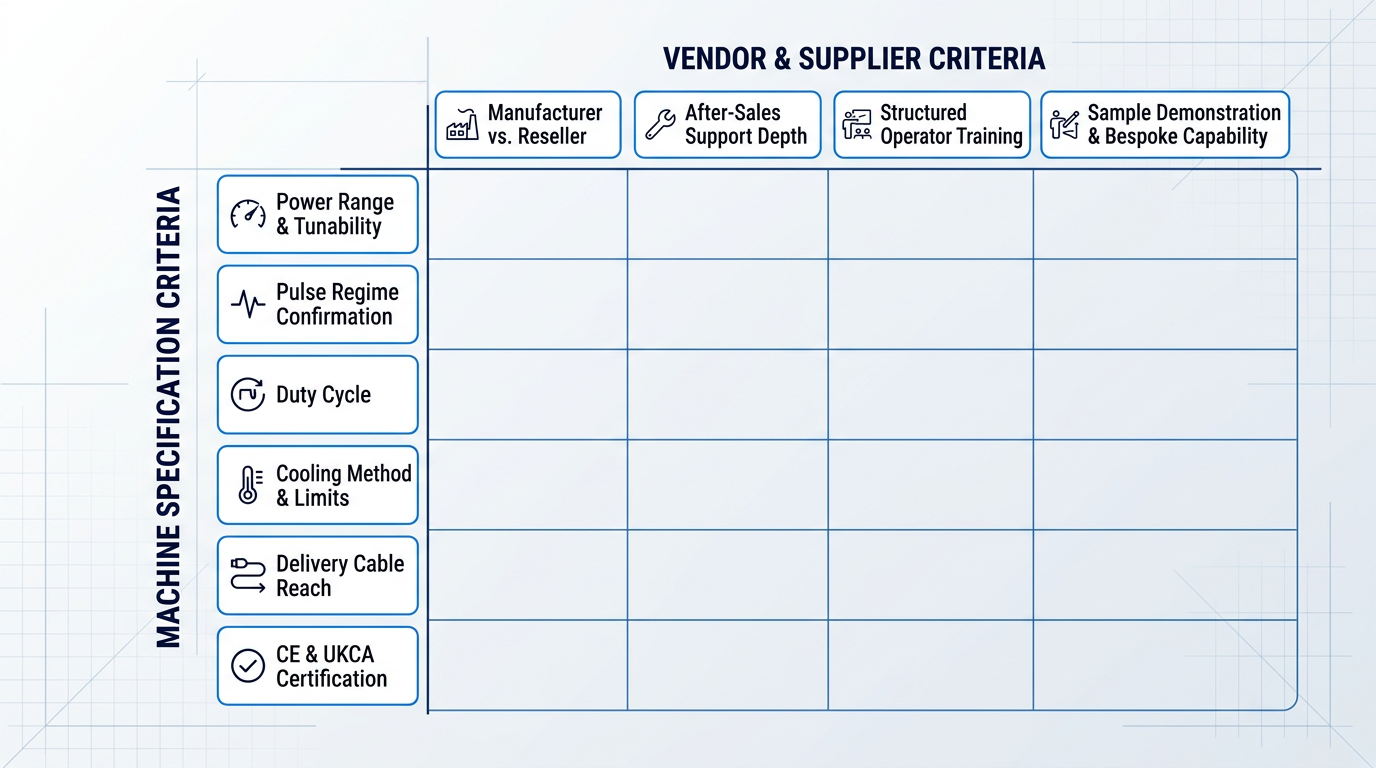
The technical variables covered earlier in this guide — power, pulse regime, duty cycle, cooling, cable reach — are not abstract concepts at this stage. They are purchasing verification questions. For each one, you should know what to ask, what a good answer looks like, and what the wrong answer costs you in practice.
- Power range and tunability: Ask for both average power and peak pulse power — not just the headline wattage. A machine tunable 0–100% adapts to different rust depths and substrates; one that cannot forces a binary choice between under-cleaning and surface damage.
- Pulse regime confirmation: Verify nanosecond pulsed architecture specifically — ask for pulse duration and repetition rate. 'Pulsed' asserted without figures is not sufficient for metal rust removal applications.
- Duty cycle: Ask explicitly: is this 100% duty cycle? Systems rated at 50–80% duty cycle introduce mandatory cooldown pauses that break production rhythm. This figure is rarely prominent in marketing materials.
- Cooling method and limits: Air-cooled systems suit portable and intermittent field use; water-cooled suits sustained heavy production. Also ask for the ambient temperature operating range — relevant for outdoor or uncontrolled environments.
- Delivery cable reach: A 5 m cable confines the operator tightly to the machine; 50 m enables work across large structures without repositioning. Verify this against your specific working environment before purchase.
- CE and UKCA certification: For UK and European markets, both marks are a minimum requirement — not a nice-to-have. Absence is a red flag for safety compliance and legal operation, not a minor administrative gap.
On the power question specifically: a machine specified at up to 300 W with 0–100% tunable power — such as the ELASER from Woodrow Scientific Limited — gives the operator full control across the cleaning spectrum, from light surface oxides through to thick coatings, on a single platform. The tunability is what makes one machine genuinely versatile rather than optimised for one task.
The duty cycle point is worth dwelling on because it is the criterion buyers most consistently fail to verify. A system that pauses for cooldown every few minutes is a system that cannot sustain production throughput — and that limitation will not appear anywhere in the brochure. Ask the question directly and get the answer in writing.
On cable reach: the ELASER's delivery cable extends up to 50 m, with 5 m and 15 m options as standard — a meaningful specification for anyone working on large structural steel, bridge sections, or vehicle bodywork where repositioning a wheeled unit repeatedly adds real time to a job.
Vendor and Supplier Criteria
The machine specification tells you what the system can do. The supplier's profile tells you what happens when something goes wrong, when you need training, when you want the machine adapted for a new application, or when a component needs replacing at short notice.
The single most consequential question to ask any supplier is straightforward: do you manufacture this machine, or do you import and rebadge it?
A true manufacturer designs, builds, and services its own machines — and can diagnose and fix problems at component level. A reseller rebadging imported hardware cannot improve the product, has no in-house engineering depth, and depends on an overseas supply chain for spares. In a market where many 'manufacturers' are actually importers, this question is the most important one you can ask before signing a purchase order.
Woodrow Scientific Limited is the only UK-based laser cleaning manufacturer: it designs, builds, supports, and continuously improves its machines entirely in-house, drawing on over 200 years of combined engineering experience. That in-house depth is what makes fast, component-level diagnosis and repair possible — not module-swapping, but genuine engineering. It is also what produced patented, world-first technology, including the reduced hazard zone (RHZ) capability that no other laser cleaner offers.
Beyond the manufacturer question, there are four further supplier criteria that deserve explicit verification before committing to a capital equipment purchase.
- After-sales support depth: Ask: what is the response time for service calls? Are spares held in-country? Do your engineers understand the machine at component level, or do they swap modules and escalate? The answers reveal the real support model.
- Structured operator training: Verify that formal safety and operation training is provided — not just a manual. Training should be delivered by people who understand the machine, and it directly affects both safety compliance and cleaning performance.
- Sample cleaning demonstration: Any reputable supplier should be willing to clean sample parts from your application before purchase. This is the only reliable way to verify real-world performance on your specific material and contamination type. Treat reluctance as a flag.
- Bespoke and customisation capability: If your application has specific requirements, ask whether the supplier can engineer to them. A true manufacturer can; a reseller cannot. Get in touch with the supplier directly to explore what is possible.
On training: WSL provides first-class laser cleaning safety and operation training as part of its offering — delivered by people who built and understand the machine, not third-party trainers working from a manual. This matters both for regulatory compliance and for getting the best cleaning results from day one.
Evaluating Price Through Total Cost of Ownership
For portable industrial laser cleaners, competitive pricing reflects a manufacturer's engineering and operational efficiency — not a compromise on quality. The ELASER is the European cost leader among comparable industrial laser cleaning machines, achieved through WSL's in-house manufacturing model rather than by cutting corners on components or build quality.
The more useful frame for any capital equipment purchase is total cost of ownership: zero consumables, minimal downtime, and significantly less rework because the laser stops at the base material rather than abrading through it. Evaluated across a working lifespan, those running cost advantages compound in ways that upfront price comparisons do not capture.
On the safety and certification side: the ELASER carries both CE and UKCA certification, and the ELASER-RHZ variant goes further — its patented technology collapses the laser hazard zone to a small area around the work, dramatically expanding where the machine can be deployed without the full safety infrastructure that conventional Class IV systems require. No other laser cleaner offers this capability.
Armed with these criteria, you are in a position to shortlist with confidence rather than rely on brochure claims. The logical next step is to apply them: request a demonstration, ask for a sample clean on your own material, and open a direct conversation with a supplier who can answer every question on both lists.
Conclusion
Making a confident decision on laser rust removal
You arrived with a question about a laser that removes rust; you leave with a framework for evaluating the technology, the machine, and the supplier.
The right question was never whether laser cleaning is expensive — it is what the full cost picture looks like once consumables, media disposal, substrate damage, and rework are counted.
The safety overhead that once gave buyers pause is an engineering problem the technology is actively solving, not a fixed constraint.
The next step is practical: ask a supplier to run a demonstration on your material, and let the result speak for itself.
Frequently asked questions about laser rust removal
Common questions about how laser rust removal works, whether it is the right choice for your application, and what to expect in practice.
Yes — and the evidence is measurable, not just asserted. Laser rust removal works because of differential absorption: a pulsed laser pulse is absorbed strongly by the iron oxide (rust) layer, which vaporises, while the underlying steel absorbs far less energy at the same wavelength and is left intact. Peer-reviewed research published in AIP Advances confirms this directly: after pulsed laser cleaning, the iron (Fe) content of carbon steel surfaces rises from approximately 62% to over 90%, while oxygen content falls from approximately 29% to just 2–3%. Those figures represent a near-complete removal of the oxide layer. The same study found that angle grinding — a common alternative — left oxygen content at around 27%, meaning the rust was largely still present. The mechanism is real, it is physics-based, and it is independently verifiable.
When parameters are set correctly, substrate damage from pulsed laser cleaning is minimal — research published in AIP Advances documents that correctly configured pulsed laser cleaning leaves the base metal surface essentially intact. The risk is real, however, if parameters are wrong. Too high a power setting, too slow a scan speed, or use of a continuous-wave system instead of a pulsed one can create a heat-affected zone that alters the substrate surface. Pulsed systems are significantly safer in this regard: because energy is delivered in very short bursts rather than continuously, peak intensity is high enough to ablate the rust while average heat transfer into the substrate stays low. Two practical safeguards follow from this. First, choose a machine with fully tunable power output — the ability to dial from low to full power gives the operator control over fluence and prevents over-treatment. Second, ensure operators receive proper training before working on production parts. Neither is optional; both are the mechanism by which substrate safety is maintained.
Cleaning speed is not a single number — it depends on laser power, rust grade, and surface geometry. For portable pulsed systems in the 100–500 W range, indicative rates on moderate rust run roughly 1–10 m² per hour, with the actual figure sitting closer to 1–4 m²/hr at 100–200 W and rising to 4–10 m²/hr at 300–500 W. Light surface oxidation at higher power sits at the faster end; heavy, stratified rust at lower power sits at the slower end. Higher-power automated or robotic systems operating in continuous-wave mode can reach significantly higher rates on large open surfaces, but those are a different category of machine. For practical planning, the honest approach is to take your total surface area, divide by available working hours, and check that the machine's rated throughput at your rust grade actually closes the gap — rather than relying on a headline figure that may reflect best-case conditions.
Yes, across a wide range of rust grades and metal types. Laser cleaning works on steel, carbon steel, cast iron, aluminium, copper, bronze, and most other common metals. Power requirements scale with the severity of the rust: light surface oxidation requires less power and cleans quickly, while heavy, stratified rust requires higher power and additional passes. The process removes rust without altering the underlying surface profile, making it suitable for precision components as well as structural steel. It is also a line-of-sight process, so access geometry matters — laser cleaning cannot reach internal cavities or threaded blind holes that the beam cannot physically reach.
Yes. Rental and contract laser cleaning services exist for buyers who need occasional cleaning without committing to a capital purchase. Some suppliers offer short-term machine hire; others offer contract cleaning where the supplier's own team carries out the work on-site. For infrequent or one-off cleaning needs, this can make more sense than ownership. For regular or ongoing use, the economics tend to favour ownership over time. A pulsed fibre laser cleaner has near-zero consumable costs — no grit, no chemicals, no slurry — so once the purchase cost is recovered, each job carries little more than time and power. If you are unsure which model fits your situation, the most practical step is to speak with a supplier about your actual workload: hire first to prove the demand, then buy once the work is consistent enough to justify the outlay.
No rust removal method is permanent on its own — not laser cleaning, not sandblasting, not grinding, not chemical stripping. Rust is iron oxide, and any clean iron surface re-exposed to moisture and oxygen will begin to oxidise again. Laser cleaning produces a chemically active metal surface with the oxide layer removed (iron content above 90%, oxygen content below 3%, per published research). That surface is highly receptive to protective coatings — but it will begin to re-oxidise if left unprotected. Flash rusting, the rapid surface oxidation that can occur within minutes to hours on a freshly cleaned metal surface exposed to humid air, is a real risk. The practical implication: after laser cleaning, the metal should be coated, primed, sealed, or stored in a controlled environment promptly. Laser cleaning is the best available preparation for a durable protective finish — but it is the finish itself that makes rust removal last.
Three core requirements apply to conventional laser rust removal. First, laser safety eyewear matched to the system's specific wavelength and rated to the required optical density — this is not generic eye protection; it must be specified for the laser in use, and as both OSHA and HSE guidance makes clear, all protective eyewear must be clearly labelled with the optical density and wavelength for which it provides protection. Second, operator training covering safe operation, hazard zone awareness, and emergency procedures — OSHA requires that operators be trained in accordance with manufacturer recommendations and applicable standards. Third, fume extraction with appropriate filtration: laser cleaning vaporises rust and any surface contaminants into fine particulate matter and gaseous emissions that must not be inhaled. HEPA filtration is standard for capturing ultrafine particles. For conventional open-beam industrial laser cleaners, Nominal Hazard Zone (NHZ) management is also required — in practice, this means controlling access to the area around the beam path while the laser is operating. Reduced-hazard-zone systems can collapse the NHZ to a small area around the work head, reducing the access-control burden, but operator eyewear and training remain necessary regardless of system design. Consult OSHA OTM Section III Chapter 6 and HSE's laser radiation guidance for the authoritative requirements applicable to your jurisdiction.