Introduction
You have already done the research. You know laser cleaning is the right tool for your application — now you need to know what to budget for it.
Price ranges are easy enough to find, but a number without context is not a budget: it tells you nothing about whether that figure fits your power requirements, what your annual running costs will add on top, or how financing changes the real cash commitment.
This guide works through six sequential steps — from documenting your cleaning requirements to validating a total cost figure — so you leave with a fully-loaded laser rust removal cost estimate that holds up in a supplier conversation.
TL;DR
Buyers who treat laser rust removal cost as a structured matching exercise — working through requirements, power tier, running costs, and financing in sequence — arrive at a figure that genuinely holds up. Those who start with a price table and work backwards are usually guessing.
This article covers:

Matching requirements to the right machine and power tier
Building a budget: purchase price, running costs, financing
Validating your budget with a TCO framework
What is laser rust removal cost, really?
Most buyers arrive at this question the same way: they want a number. A figure they can put in a spreadsheet, take to a manager, or compare against a quote. The frustrating truth is that laser rust removal cost is not a number — it is the output of a matching exercise between your specific cleaning requirements and the right machine configuration for them.
Power level, machine type, and operational profile all interact to determine what a machine should cost for a given buyer. The same cleaning task performed at different scales, frequencies, or on different substrates can justify machines that differ by an order of magnitude in price. There is no universal figure, and that is not a cop-out — it is the accurate answer, and understanding it is what puts you in a position to find your correct number.
The right evaluative frame for this purchase is total cost of ownership, not sticker price. Upfront price is one component; running costs — energy consumption, consumables, maintenance, and operator time — are the others. A buyer who selects a machine on purchase price alone is working from an incomplete metric.
This is where laser cleaning's cost structure becomes genuinely distinctive. Laser cleaning trades a higher upfront cost for near-zero consumables and lower operational overhead over its working life. Methods like sandblasting and chemical stripping often look cheaper at point of purchase, but carry ongoing spend on abrasive media, chemicals, waste disposal fees, and labour. Over a multi-year horizon, that structural difference frequently inverts the apparent cost advantage.
Laser cleaning's economic case is built on what you stop spending — on consumables, disposal, and labour — not on what you pay upfront. The machine that looks most expensive on day one can be the cheapest option by year three.
The steps that follow are ordered by the logical sequence a buyer actually works through to arrive at a fully-loaded budget — starting with your requirements, because those are the input that drives everything else.
Step 1
Assess Your Cleaning Requirements
Key Insights
Document requirements before consulting any price data.
Document all four dimensions before Step 2.
Substrate sensitivity directly determines your power tier.
Contaminant severity sets your minimum effective power.
Frequency signals maintenance tool vs. production asset.
Before you look at a single price, document your cleaning situation in writing — because the same rust removal task can justify machines that differ by an order of magnitude in cost depending on four variables: what you are cleaning, what you are removing, how much of it there is, and how often the machine will run.
A buyer removing light surface oxides from a handful of precision components each week has fundamentally different requirements from one running a daily production line of large structural steel fabrications — and the right machine for each situation sits at a very different point on the price scale.
Identify Your Substrate and Material
Write down every metal or surface type that needs cleaning — now or in the foreseeable future.
Substrate sensitivity is a direct input to power selection: softer or thinner materials (aluminium alloys, copper, titanium, thin sheet steel) require more precise, lower-power delivery to avoid surface damage, while harder or thicker substrates (carbon steel, cast iron, structural steel) can tolerate and benefit from higher power.
- Thermally sensitive substrates: Aluminium alloys, copper, brass, bronze, titanium, thin sheet steel. These require careful parameter control and generally lower power levels to prevent substrate heating or surface damage.
- Robust industrial substrates: Carbon steel, cast iron, structural steel, galvanised steel. These tolerate higher power and benefit from it — throughput scales with wattage on these materials.
- Non-metallic surfaces: Stone, concrete, brick, masonry. Laser cleaning is viable on many of these, but substrate porosity and thermal mass vary significantly — record the specific material type.
If you clean more than one substrate type, record all of them — the most sensitive material on your list will constrain your parameter choices.
Characterise Your Contaminant Type and Severity
Record what you are removing and how deeply it is adhered — this determines the minimum effective power level your machine must reach.
A machine that clears light surface oxides efficiently may be completely inadequate for heavy mill scale or thick paint coatings: the contaminant layer thickness and adhesion set a floor on the energy the system must deliver per pulse.
- Light (surface oxides, tarnish, oil residue, weld discoloration): Thin contamination layers, typically up to around 50–200 microns. Responds well to lower power tiers and shorter pulse durations.
- Moderate (mill scale, moderate rust, standard paint coatings): Common in fabrication shops doing daily pre-weld or pre-coating preparation. Requires sufficient pulse energy to break adhesion across the full layer.
- Heavy (thick rust, multi-layer coatings, powder coatings, heavy corrosion, foundry-class scale): Multi-millimeter contamination thickness. Demands high pulse energy and, on large areas, significantly higher power to maintain practical throughput.
Assign your situation a severity rating — light, moderate, or heavy — and note the specific contaminant types involved (rust, paint, mill scale, oxide, weld spatter, grease, or a combination).
Estimate Your Surface Area and Part Geometry
Estimate the total surface area you need to clean per shift or per year — this drives your throughput requirement, which is one of the strongest signals for the power tier you need.
Also characterise the geometry of your parts: flat panels and simple profiles are straightforward, but three-dimensional components with internal angles, recesses, or contoured surfaces introduce access constraints that affect how you will need to operate the cleaning head.
A buyer cleaning a small number of precision components has very different throughput requirements from one running a production line of large structural fabrications.
Define Your Frequency of Use
Frequency of use is one of the clearest signals in this entire assessment — it tells you whether you are buying a maintenance tool or a production asset, and that distinction shapes both the right machine specification and the capital justification.
- Occasional maintenance cleaning: A few times per month. Lower annual area coverage, lower duty-cycle demands. The machine is a maintenance tool rather than a production asset.
- Regular production support: Daily use in a fixed location. Consistent throughput requirements; the machine needs to keep pace with production workflow without becoming a bottleneck.
- Continuous production-line integration: Multiple shifts, high-volume repetitive work, sustained duty cycles. The machine is a production asset — reliability, throughput, and duty-cycle rating all become critical selection criteria.
Frequency also governs your capital justification: a machine running two days a month has a very different payback profile from one running eight hours a day, five days a week.
Before moving to Step 2, write down your answers to these four dimensions: (1) substrate and material — every surface type you will clean; (2) contaminant type and severity — what you are removing and how heavily it is adhered; (3) surface area and geometry — estimated area per shift and a description of part complexity; (4) frequency of use — occasional, regular, or continuous. Keep this profile to hand. Step 2 uses it to match your situation to a machine category and power tier.
Step 2
Match Requirements to a Machine Type and Power Tier
Key Insights
Portable suits varied locations; automated suits repetitive batches.
Under-specifying slows output; over-specifying wastes capital.
Automated justified when batch volume compounds the return.
Output: machine category + power tier for Step 3.
With your requirements profile in hand, use it now to answer two questions: which machine category fits your situation, and which power tier matches your throughput demand?
Portable or Automated: Reading Your Decision Signals
Your requirements profile will point clearly toward one of two categories.
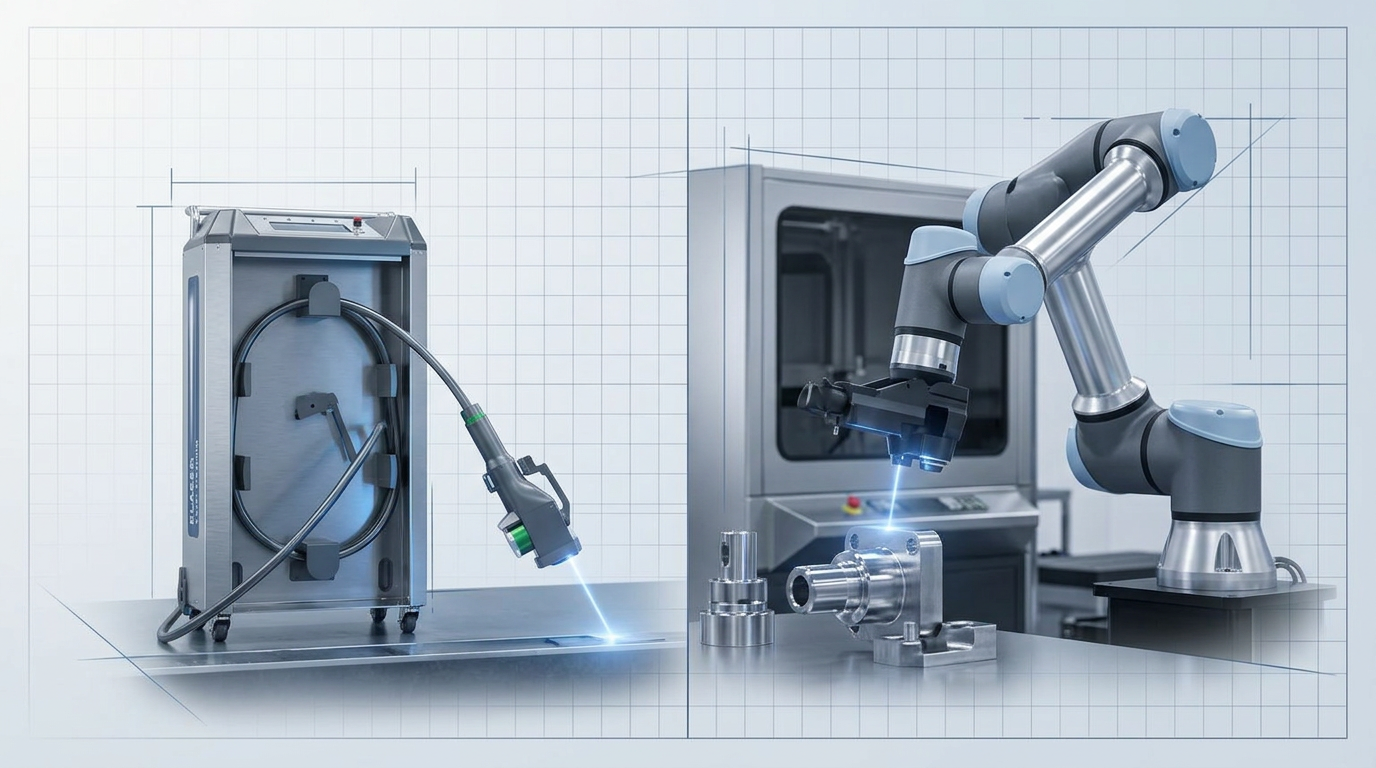
- Portable / handheld: Suited to varied locations, irregular geometry, lower-frequency cleaning, field or maintenance work, and single-operator deployment. If your profile shows different parts, different sites, or ad-hoc scheduling — this is your category.
- Automated / robotic: Suited to high-volume repetitive batches, consistent part geometry, production-line integration, and labour displacement as an explicit goal. If your profile shows the same part cleaned at volume on a defined cycle — this is your category.
Neither category is inherently superior — the right one is the one your requirements profile describes.
How Power Level Drives Cost and Throughput
Wattage is the primary throughput lever: higher power means more surface area cleaned per unit time.
Under-specifying forces repeat passes, slows throughput, and erodes the efficiency case. Over-specifying wastes capital on capability the application never demands. The financially sound approach is matching wattage to what your profile actually requires — nothing more, nothing less.
Portable Power Tiers: Application Fit and Indicative Pricing
For portable systems, three indicative tiers cover the majority of industrial applications — use your contaminant severity and area/volume figures from Step 1 to locate yourself.
| Power Tier | Typical Application Fit | Indicative Market Price Range |
|---|---|---|
| Low (100–200 W) | Light surface rust, precision work, sensitive substrates, lower throughput demands | From approx. £10,000–£20,000 |
| Mid (300–500 W) | Heavy rust, mill scale, moderate production volumes, wider area coverage | Approx. £20,000–£50,000 |
| Higher CW power (500 W+) | Large-area industrial work where throughput is the dominant requirement | £50,000 and above |
Tabular format allows the reader to scan power tier, application fit, and indicative price range side by side — this is inherently comparative data that prose would obscure.
These figures are market orientation ranges drawn from published buyer guides — actual pricing varies by manufacturer, specification, and supply chain.
Automated Systems: When the Capital Step-Up Is Justified
Automated systems carry a larger capital outlay, and that step-up is only justified when the economics compound: repetitive batch volumes, consistent part geometry, defined cycle-time targets, and a genuine labour-displacement goal.
Complex 3D geometry is another signal — parts with contours and recesses that a handheld operator would struggle to cover consistently are strong candidates for a robotic arm with multi-axis reach.
Portable Category Reference: ELASER and ELASER-RHZ
If your profile points to portable, WSL's ELASER and ELASER-RHZ are the concrete reference for this category — and they carry differentiators that matter when you are matching a machine to real operational constraints.
The standout capability is WSL's patented Reduced Hazard Zone (RHZ) technology — a world first that collapses the laser hazard zone to a fraction of conventional size, enabling cleaning in open workshops, mixed-use facilities, and public-facing settings without sealing off the area. No other laser cleaner in the world offers this.
On pricing, the ELASER is competitively positioned — the most competitive upfront pricing among comparable industrial laser cleaning machines, delivered through WSL's technological and operational efficiencies rather than by cutting specification.
The company behind the machine is itself a differentiator: WSL is the only UK-based laser cleaning manufacturer, designing, building, servicing, and improving its machines entirely in-house since 2012, backed by over 200 years of combined engineering experience. In a market where many apparent manufacturers are actually resellers rebadging third-party hardware, that in-house capability means faster support, genuine spares, and a product that can actually be improved.
The complete benefit set includes CE and UKCA certification, first-class safety and operation training, bespoke engineering and customisation capability (contact WSL to discuss your specific requirements), and single-operator portability via a sub-3 kg handheld scanner with up to 50 m reach.
Automated Category Reference: AutoLASE
If your profile points to automated, WSL's AutoLASE is the concrete reference — and its defining characteristic is how effortless it is to operate.
Load a part and AutoLASE's machine-vision software scans it, builds a 3D map, and generates the clean automatically — no manual programming, no path-setting, no knowledge of part geometry required. Anyone on the production floor can load a part and run it.
For facilities where enclosures are a constraint, AutoLASE can be configured with WSL's RHZ eye-safe upgrade, eliminating the need for an enclosure entirely. This capability is exclusive to WSL worldwide — no other automated laser cleaning system can offer enclosure-free operation.
AutoLASE carries the same competitive pricing position and in-house WSL manufacturing backing as the ELASER, with CE and UKCA certification, full training, bespoke integration and customisation support, and the flexibility to work with the buyer's existing robots or be supplied as a complete custom cell.
Step Output: Your Machine Type and Power Tier
By the end of this step you should have two things written down: a shortlisted machine category (portable or automated) and an indicative power tier drawn from your throughput and contaminant-severity figures.
Carry both into Step 3, where they become the anchor for establishing your purchase price range.
Step 3
Establish Your Purchase Price Range

Key Insights
Power tier anchors your price range.
Supplier type is a hidden cost variable.
With your machine type and power tier confirmed from Step 2, use them now to anchor your purchase price range — the first concrete number in your budget.
Portable and Handheld Systems: Price by Power Tier
The table below shows indicative market price ranges for portable/handheld pulsed laser cleaning systems across the principal power tiers, drawn from current supplier and trade data.
| Power Tier | Laser Type | Indicative Price Range (USD) | Typical Buyer |
|---|---|---|---|
| 100–200W | Pulsed fiber | $8,000–$18,000 | Maintenance shops, light rust, weld prep |
| 300–500W | Pulsed fiber | $18,000–$45,000 | Fabrication, automotive, production-scale prep |
| 1,000–2,000W | Continuous wave (CW) | $15,000–$40,000 | Heavy rust, shipyard, structural steel |
| 3,000W+ | Continuous wave (CW) | $42,000–$120,000+ | High-throughput industrial lines, large-area decoating |
Comparing purchase price ranges across power tiers is clearer in a table than prose — the reader can locate their tier and read across to the price range in a single scan.
Note that pulsed systems run at a significant premium over CW machines at comparable average power — a 200W pulsed unit typically costs more than a 1,000W CW system, because pulse generation electronics are substantially more complex than a continuous-output source.
Automated and Robotic Systems: The Capital Step-Up
If Step 2 pointed you toward an automated or robotic cell, expect a materially different capital figure — typically $50,000 to $300,000+ for a complete installed system.
That step-up is not simply a wattage premium; it reflects the integration cost of a robotic arm, machine vision, safety enclosure engineering, path programming, and fixturing — none of which appear in a portable machine price.
Why Two Machines at the Same Wattage Differ in Price
The wattage figure on a spec sheet is a starting point, not a price anchor on its own — two machines rated at the same power can differ by 50% or more in purchase price.
The variables that explain this spread include the laser source brand and quality (the fiber module alone accounts for 40–60% of system cost), scan head configuration, build quality, cooling architecture, and whether the software is genuinely proprietary or a locked OEM black box.
There is also a supplier-type variable that is invisible on the invoice but real over the machine's life.
A portion of the market consists of resellers and importers rebadging third-party hardware rather than genuine in-house manufacturers who design, build, and test their own machines.
A machine from a reseller may carry a lower sticker price — but slower spares supply, no in-house engineering capability to resolve problems, and limited ability to adapt the machine to your process are real costs that simply do not appear on the purchase invoice.
This is not a quality observation alone: it is a long-term cost variable that belongs in your budget assessment alongside the purchase price itself.
What the Purchase Price Does and Does Not Include
The figure you receive in a machine quotation is typically the laser unit price — and frequently does not include everything required to operate it on day one.
- Fume extraction: Often quoted separately or omitted entirely. Rust, paint, and coating fumes require rated extraction — this is not optional and is commonly under-budgeted.
- Safety PPE and interlocks: Laser-rated eyewear, warning lights, and interlock systems are frequently line items outside the machine price, particularly for Class 4 open-beam setups.
- Installation and commissioning: Site preparation, electrical supply work, and operator training are standard additional costs — especially for water-cooled systems requiring three-phase supply.
Treat the purchase price you anchor here as the machine cost — your total acquisition cost will be higher once ancillaries are added, and Step 4 will quantify the ongoing operational layer on top of that.
You now have a purchase price range anchored to your machine type and power tier. This is your capital cost input for Step 4 — not your final budget figure. Ancillary costs (extraction, PPE, installation) are not included in the machine price and will be addressed in the next step.
See How Real Machines Map to Your Budget
You have your power tier and machine category. Browse the ELASER product pages to put concrete specifications against the price ranges you have just worked through.

Step 4
Add the Operational and Hidden Costs

Key Insights
Energy and maintenance dominate; consumables are near-zero.
Training and safety compliance are non-optional.
Fume extraction is often quoted separately — ask.
Your purchase price range from Step 3 is the starting point — not the finish line. For most buyers, annual operating costs add a material sum on top of the machine price, and several of those costs are routinely missed when budgeting on sticker price alone.
Energy: Calculate System Input Draw, Not Laser Output
The wattage printed on a laser cleaning machine refers to the laser source output — not what the full system draws from the wall. A 300 W laser system includes cooling electronics, the control unit, and (on water-cooled systems) a chiller, all of which add to the real power draw.
Find the system power consumption figure in the spec sheet — not the laser output wattage. As a worked example: the ELASER publishes a system power consumption of under 2,000 W, which is the figure to use for energy calculations, not its 300 W laser output.
A 1,000 W pulsed system with chiller and extraction running together typically draws 3–5 kWh per operating hour. At industrial electricity rates of roughly $0.10–$0.15/kWh (European rates often push higher), a system operating one shift per day comes to approximately $700–$1,200 per year in energy costs.
Consumables: The Near-Zero Budget Line
Laser cleaning requires no abrasive media, no process chemistry, and generates no regulated waste stream under normal operating conditions. The only recurring consumable is the protective lens window, replaced every 200–500 operating hours depending on contamination intensity, at roughly $30–$80 per lens.
Total annual consumables for a well-maintained pulsed laser cleaning system typically run under $500 — compared to $20,000–$80,000 per year for a comparable abrasive blasting operation. The ELASER is air-cooled and consumable-free by design: no chiller fluid, no media, no chemicals — the protective lens is the only recurring item.
Write this line into your budget as a range of $200–$500 per year for a single pulsed system running at normal production volumes.
Maintenance: Real Costs, Structurally Low
Pulsed fibre laser systems have fewer moving parts than consumable-dependent methods and no media handling to wear components — but annual maintenance is not zero and belongs in the budget.
Budget $500–$1,000 per year for a well-maintained pulsed system: this covers an annual service call or depot inspection of the fibre laser source, plus scanning head calibration (typically recommended every 2,000–5,000 operating hours). For context, the equivalent figure for an abrasive blasting setup commonly runs $3,000–$6,000 per year.
Operator Training: A Non-Optional Budget Line
Class IV laser operation requires trained operators — this is an OSHA requirement, not a recommendation. Budget for training before the machine arrives, not as an afterthought.
Industrial laser safety courses from organisations such as the Laser Institute of America run from $195 for an online orientation through to $1,195 for a full Laser Safety Officer course. Kentek's online laser cleaning safety course starts at $79. For buyers of WSL machines, WSL provides first-class laser cleaning safety and operation training as part of its support offering — factor this into your budget planning from the outset.
A trained operator also gets better results faster, reducing rework — so training is an efficiency investment as much as a compliance requirement.
Safety Compliance: Workspace Setup Costs
OSHA's laser safety framework (STD 01-05-001 and OSHA 2202) requires Class IV laser operations to maintain a controlled laser area, laser-wavelength-matched safety eyewear for all personnel in the zone, warning signage, and a mandatory warning system activated on laser start-up. Some jurisdictions also require a designated Laser Safety Officer.
Establishing a compliant laser workspace is a professional standard, not a barrier — and it has a concrete cost. Budget for laser safety eyewear at $80–$250 per pair (buy at minimum three pairs), portable laser safety screens or curtains at $200–$600 for a basic field set, and appropriate warning signage. Total safety compliance setup typically falls in the range of $1,270–$3,550 for a handheld portable system.
Fume Extraction: Budget This Separately
Laser ablation produces fine particulate and fumes that must be captured — a HEPA-grade extractor (H13 or H14 rated) is required, not optional. Fume extraction is frequently quoted separately from the machine itself, so do not assume it is included.
Capital cost for a quality portable HEPA extraction unit suitable for laser cleaning runs $500–$2,000. HEPA filter replacements cost $50–$200 per quarter depending on filter grade and the contamination volume being processed.
Installation and Integration: Often Off the Quote
For portable handheld systems — including single-phase, self-contained units — installation overhead is minimal. The system arrives ready to operate from a standard power outlet, with no site preparation required.
For fixed or automated systems, site preparation, a dedicated electrical supply, and integration into an existing production line are real costs that machine quotes frequently exclude. As a working estimate, integration and commissioning add-ons for a standalone unit typically run 8%–18% of machine cost; automated cell integration runs higher. Always ask the supplier for a fully itemised quote that includes these items.
Your Step 4 Output: Annual Operating Cost Summary
Use the table below as your budget worksheet. Fill in the figures relevant to your system type and usage pattern, then total the column — this is the annual operating cost figure you carry into Step 5.
| Cost Category | Indicative Annual Range | Your Estimate |
|---|---|---|
| Energy (system input draw × hours × rate) | $700–$1,200 (1-shift pulsed system) | $___ |
| Consumables (protective lens, extraction filters) | $200–$500 | $___ |
| Maintenance (annual service, calibration) | $500–$1,000 | $___ |
| Operator training (initial + refresher) | $195–$1,195 per person | $___ |
| Safety compliance setup (PPE, screens, signage) | $1,270–$3,550 (one-off, amortise over 3–5 yrs) | $___ |
| Fume extraction capital (amortised) | $500–$2,000 capital + $200–$800/yr filters | $___ |
| Installation / integration (if fixed/automated) | 8%–18% of machine cost (portable: minimal) | $___ |
| Total annual operating cost | — | $___ |
Provides a structured, fillable budget worksheet for all seven operating cost categories, giving the reader a single reference they can populate with their own figures and carry into Step 5.
With this table populated, you have a fully-loaded annual operating cost estimate broken down by category. Take that total into Step 5, where it combines with your purchase price to evaluate financing options meaningfully.
Step 5
Evaluate Your Financing and Acquisition Options
Key Insights
Finance lease = ownership; operating lease = flexibility.
APR beats monthly payment as a comparison metric.
Rental beats buying below ~15–30 usage days per year.
UK AIA gives 100% first-year relief up to £1m.
By this point you have a fully-loaded figure in hand: the purchase price from Step 3 plus the operational and hidden costs from Step 4. The next question is how to fund it — and the answer affects your monthly cash commitment, your tax position, and how much you actually pay over the life of the asset.
Outright Purchase: The Baseline
Buying outright makes sense when you have a strong cash position, intend to own the machine for the long term, and want to maximise your tax relief in year one.
In the UK, the Annual Investment Allowance (AIA) lets most businesses deduct 100% of qualifying plant and machinery expenditure against taxable profits in the year of purchase, up to a permanently set limit of £1 million (from April 2023). A laser cleaning machine purchased outright will typically qualify, meaning the full invoice price can reduce your tax bill in year one — consult your accountant to confirm eligibility for your specific situation.
Remember that the invoice price is not the full outright commitment: fume extraction, safety equipment, installation, and training (covered in Step 4) are part of what you are funding on day one. Treat the total loaded figure as your outright purchase number.
Equipment Leasing: Finance Lease vs. Operating Lease
Leasing spreads the acquisition cost over a fixed term, preserving working capital. There are two principal structures, and choosing between them comes down to one question: do you want to own the machine at the end of the term?
| Finance Lease (£1 Buyout) | Operating Lease (Fair Market Value) | |
|---|---|---|
| Also called | Capital lease, $1 buyout lease | FMV lease, fair market value lease |
| How it works | Payments based on 100% of purchase price; asset transfers at end of term for a nominal sum | Payments based on depreciation portion only; lessee can return, renew, or buy at fair market value at end of term |
| Monthly payment | Higher | Lower (typically 20–30% less) |
| End-of-term ownership | Yes — you own the asset | No — return, renew, or purchase at FMV |
| Typical tax treatment | Depreciation and interest generally deductible | Lease payments typically fully deductible as operating expense |
| Best for | Long-life equipment you intend to keep | Flexibility to upgrade; lower monthly outlay |
Comparing the two main lease structures across key decision axes helps the reader select the right structure without reading lengthy prose on each.
For laser cleaning machines — which have long useful lives and do not become obsolete as rapidly as software-dependent equipment — a finance lease is often the more logical structure if ownership is the goal. An operating lease suits buyers who want lower monthly payments and the option to upgrade to a higher-power system in three to five years.
Equipment lease terms for industrial machinery typically run 24 to 72 months, with 36 to 60 months being the most common range for mid-market machines. To illustrate the payment difference: at a $50,000 price point over 48 months, a fair market value lease produces a monthly payment around $747, while a $1 buyout lease on the same machine runs around $1,221 — a meaningful cash-flow difference, though the FMV route leaves you without ownership at the end. These are illustrative USD proxies; your actual sterling payments will vary by lender, credit profile, and prevailing rates.
Rental: When It Beats Buying
Rental is a legitimate acquisition route in three specific situations — not a fallback for buyers who cannot afford to purchase.
- Low annual usage: If you need the machine for occasional maintenance cleaning rather than continuous production use, rental avoids tying up capital in an asset that sits idle most of the year.
- Project-based or contract work: If you need a machine for a defined job or contract period, renting for that window is cheaper than purchasing and then having the asset depreciate unused.
- Trialling before committing: Renting a machine at the power class you identified in Step 2 lets you validate throughput and substrate results before committing to a purchase or lease.
Indicative daily rental rates for pulsed laser cleaning machines run from around $150–$220 per day for 100W units up to $320–$480 per day for 500W systems, with weekly and monthly rates offering progressively lower effective daily costs. High-power continuous-wave systems above 1,000W are rarely available through standard rental channels.
The break-even logic is straightforward: once your cumulative annual rental spend approaches the amortised cost of ownership over the same period, purchasing becomes the more economical route. As a rough benchmark, ownership typically becomes cost-effective once you are past approximately 15 to 30 rental days per year — though your exact break-even depends on the machine’s purchase price and the rental rate for your required power class.
When evaluating any financed or leased acquisition — including manufacturer and supplier financing programmes — always compare the total cost of finance and the effective APR, not just the headline monthly figure. A low monthly payment on a long term at a high APR can cost significantly more in total than a higher monthly payment on a shorter term at a lower APR. Ask every lender or lessor for the effective APR and the total amount payable over the full term before accepting any offer.
Manufacturer and Supplier Financing Programmes
Many laser cleaning machine manufacturers and their distributors offer in-house or partner financing arrangements, often presented at the point of sale as a convenient monthly payment option.
These programmes vary widely in competitiveness. The comparison discipline is the same regardless of source: evaluate the effective APR and total amount payable, not the monthly figure in isolation. Tax treatment and end-of-term ownership terms also need to be confirmed, as manufacturer programmes may be structured as operating leases even when marketed as purchase plans.
Tax treatment for any lease or financing arrangement varies by jurisdiction and business structure — the notes above reflect general principles, and your accountant should confirm the treatment that applies to your specific situation.
By the end of this step, you should have a chosen acquisition route and a concrete monthly or annual cash commitment figure. That figure — whether it is a lease payment, a rental budget, or the amortised cost of an outright purchase — feeds directly into the total cost of ownership validation in Step 6.
Step 6
Validate Your Budget Against Total Cost of Ownership
Key Insights
TCO over 3–5 years beats sticker price.
Payback = total cost ÷ monthly savings.
Rework avoided is a real TCO variable.
Verify: CE/UKCA cert plus serial numbers.
Ask: do you build in-house?
Resellers carry hidden long-term cost risk.
You arrive at Step 6 with a complete set of inputs: purchase price from Step 3, annual operating costs from Step 4, and an acquisition route with a cash commitment from Step 5. The job now is to stress-test that figure against a total cost of ownership framework — and to verify the supplier behind any machine you are considering before you sign.
Build Your TCO Calculation
TCO over a 3–5 year horizon is the only comparison that treats laser cleaning fairly against incumbent methods.
- Total installed cost (A): Machine purchase price plus installation, commissioning, fume extraction, and initial operator training — use the fully-landed number, not the quote price.
- Annual operating cost (B): Energy, consumables, maintenance, and any allocated operator labor — drawn directly from your Step 4 estimate.
- Annual avoided cost (C): What you stop spending: blast media, chemicals, waste disposal fees, hazmat compliance, and contractor charges from your current method.
- Annual productivity value (D): Throughput improvement multiplied by your margin contribution per unit of output — often the largest line item and the most frequently omitted.
- Net annual benefit (E = C + D − B): The real annual saving the laser system generates once its own running costs are subtracted.
With those five inputs, calculate your payback period using the formula from the research: Simple payback (months) = A ÷ E × 12. Divide total installed project cost by net annual benefit, then multiply by twelve to express the result in months.
For facilities cleaning above roughly 500 m² per month, published industry data consistently places payback in the 18–36 month range when replacing chemical or abrasive processes — with the lower end applying where disposal costs are high. Below that volume threshold, the case for outright purchase weakens and rental or contract cleaning warrants reconsideration.
How Laser Cleaning Compares on Multi-Year TCO
The upfront cost of a laser cleaning system is higher than a sandblaster or chemical tank. The running cost structure is fundamentally different — and that difference compounds over time.
| Method | Year 1 Cost | Year 2–5 Annual Cost | 5-Year Total (approx.) |
|---|---|---|---|
| Pulse Laser (200W) | $44,250 | $9,250/yr | $81,250 |
| Sandblasting (grit) | $32,250 | $32,250/yr | $161,250 |
| Chemical Cleaning | $57,500 | $57,500/yr | $287,500 |
| Manual Grinding | $46,250 | $46,250/yr | $231,250 |
Directional 5-year TCO comparison across cleaning methods, grounded in remcortechnology.com and bogonglasercleaner.com data for a facility cleaning 5,000 m²/year.
By Year 2, laser cleaning is the lowest-cost method in this scenario. The Year 1 capital hit is real; the 5-year saving against sandblasting and chemical stripping is larger still. Frame your TCO calculation around that horizon, not the purchase invoice.
Laser cleaning's beam stops at the base material — it removes the contaminant, not the substrate. That minimal substrate loss means fewer rejected parts, less re-cleaning, and less material waste. A naive consumables comparison never captures this. An informed buyer adds rework cost avoided to column C of their TCO model and finds the number is often significant, particularly on high-value components or tight-tolerance surfaces.
Once your TCO calculation is complete, run the conservative case first: lower utilization, realistic operator hours, and actual waste disposal costs from your current invoices. If the payback still clears your planning horizon on conservative assumptions, the decision is sound.
Validate Your Supplier Before You Commit
A significant proportion of entities presenting as laser cleaning manufacturers are actually resellers or importers rebadging third-party hardware. The sticker price looks similar. The downstream cost implications are not: no in-house engineering means slower fault resolution, longer spares lead times, and no genuine ability to improve the machine. These are real budget risks that do not appear on any quotation.
Perform these checks on every supplier shortlist candidate before issuing a purchase order.
- Request a unit-level power report: Broad nominal power claims tied to a brochure mean nothing. Ask for documented output figures for the specific unit being quoted, not the product line.
- Trace serial numbers across documents: Verify that the laser source serial number matches across the factory test record, packing list, and warranty document. A mismatch means the quote does not describe what you are buying.
- Confirm CE and UKCA certification: From 1 January 2025, new machinery placed on the GB market requires UKCA marking (CE marking continues to be recognised under current regulations). Ask for the Declaration of Conformity as a document, not just a label.
- Ask directly: do you design and build this machine in-house?: A genuine manufacturer can name the facility, describe the engineering team, and explain what they have improved in the current model. A reseller cannot. This single question separates the two categories faster than any specification sheet.
Woodrow Scientific Limited's ELASER/ELASER-RHZ and AutoLASE systems are a concrete example of what a genuine in-house manufacturer looks like in this category. WSL is the only UK-based laser cleaning manufacturer — founded in 2012, with over 200 years of combined engineering experience, designing, building, servicing, and improving every machine in-house. Both solutions carry CE and UKCA certification, and both are competitively priced within the European market. That combination of provenance, certification, and competitive pricing is exactly what the due-diligence checks above are designed to surface.
At the end of Step 6, you have a validated, fully-loaded budget figure, a payback period estimate grounded in your own cost data, and a supplier shortlist that has passed basic due-diligence scrutiny — ready for quote requests and demonstrations.
Ready to Put Your Budget to Work?
You have worked through every cost variable. Explore the AutoLASE to put real specifications against your budget, or book a call to talk through your requirements with a specialist.
Conclusion
Your laser rust removal budget: what to do next
You now have something more useful than a price range: a requirements-matched, fully-loaded budget figure you can defend in any supplier conversation.
Take your machine-type and power-tier shortlist to suppliers, request formal quotes, and ask each one to run a sample clean on your actual parts — not a generic demonstration piece.
When competing proposals come back, use your total cost of ownership framework to evaluate them on equal terms, not sticker price.
You already know what to ask and what documentation to request. That preparation is what makes for an informed conversation — and informed buyers get better outcomes.
Frequently asked questions about laser rust removal cost
Practical questions on entry-level pricing, running costs, rental, safety equipment, and supplier due diligence — answered directly for buyers at the decision stage.
Entry-level pulsed portable laser cleaning systems — typically in the 20W to 100W range — start at roughly $2,500 to $8,000 when purchased through import or reseller channels, with US and EU distributor pricing generally sitting at the higher end of that band. At this power tier, you are getting lower output, simpler scan heads, and a machine that suits light rust and occasional use rather than production work. The sticker price is only part of the picture: entry-level machines sourced through resellers rather than in-house manufacturers often carry slower spare-parts supply and limited engineering support, which adds to the real cost over the machine's life. For buyers who need reliable ongoing support, the total cost of ownership case for a slightly higher-specification machine from a genuine manufacturer is worth running before committing to the cheapest option available.
The all-in hourly running cost of a laser cleaning machine — excluding operator labour — is low relative to consumable-dependent methods, because there are no media, chemicals, or disposal costs to account for. A portable pulsed system in the 100W to 500W range typically draws up to approximately 4 kW total when the chiller and extraction fan loads are included; at UK industrial electricity rates, that translates to a modest energy cost per hour. Amortised capital cost (the machine purchase price spread across its 80,000 to 100,000-hour source life) and occasional protective lens window replacement — the only significant recurring consumable, at roughly $15 to $60 per window — round out the machine-side cost. Operator labour is site-specific and sits outside the machine cost itself, but belongs in any complete hourly picture. For a portable pulsed system, published all-in estimates (energy plus amortised capital plus consumables, excluding labour) commonly fall in the $2 to $6 per hour range — a figure that compares favourably against the consumable spend alone for abrasive blasting or chemical stripping.
Yes. Industrial laser cleaning machines are available for short-term rental from specialist suppliers, with daily rates for pulsed units in the 100W to 300W range typically running $150 to $350 per day, and 500W pulsed units pushing toward $400 to $600 per day. Weekly rates usually discount to the equivalent of four to five days rather than seven. The break-even point is important to understand: rental makes financial sense for occasional or project-based work, but once you are using a machine for roughly 15 to 30 days per year or more, outright purchase or a finance lease generally becomes the lower-cost route. High-power CW systems of 1,000W and above are largely unavailable for short-term rent, so rental is primarily a route for lower-power portable units and trial scenarios. If you are unsure whether laser cleaning suits your application before committing to a purchase, a short rental period is a practical way to generate real-world data on throughput and output quality.
Laser cleaning machines operate as Class IV lasers under the OSHA laser safety classification framework, and compliance requirements are non-optional. The core requirements are: wavelength-specific OD-rated laser safety eyewear for all personnel in the work area, a controlled laser work area with physical barriers and warning signage, restricted access during operation, and documented operator training. These are legal requirements for Class IV laser operation, not optional precautions. The cost of establishing a compliant workspace is real but not prohibitive relative to the machine price: appropriate laser safety goggles run roughly $150 to $250 per pair, safety barriers and signage add a few hundred pounds or dollars as a one-time outlay, and a HEPA fume extractor (required to manage ablation particulate) typically adds $1,500 to $2,200. Taken together, safety setup is a budget line that belongs in your total cost calculation, but it is a largely one-time outlay rather than a recurring cost. For guidance specific to your setup and jurisdiction, consult a qualified laser safety officer rather than relying on general published figures.
The market reality is that many companies presenting as laser cleaning manufacturers are actually importers or resellers rebadging third-party hardware — and this distinction matters for long-term support, not just sticker price. Four verification steps are worth taking before committing. First, ask for the laser source serial number and request that it be verified against the manufacturer's warranty documentation; a genuine in-house manufacturer can do this without hesitation, while a reseller often cannot. Second, request a unit-level power output test certificate showing the machine's actual measured output against its rated specification — not a generic brochure figure. Third, ask to see the CE and/or UKCA declaration of conformity as a document, not just a badge on a website. Fourth, ask directly: does your company design and build these machines in-house, or do you source and configure hardware from a third-party OEM? A supplier unwilling to answer that question clearly is giving you an answer by omission. Resellers are not inherently problematic for simple applications, but slower spares supply and the absence of in-house engineering become material risks the moment something goes wrong with a production-critical machine.
For most industrial and maintenance applications, yes — when evaluated on total cost of ownership rather than purchase price alone. Over a three to five year horizon, laser cleaning's near-zero consumable costs (no media, no chemicals, no disposal fees), reduced labour time, and lower rework rates typically produce a lower total cost than sandblasting or chemical stripping at comparable throughput volumes. Facilities cleaning above roughly 500 m² per month commonly report payback periods in the 18 to 36 month range, with the lower end applying when a high-disposal-cost chemical process is being displaced. The honest qualification is that low-frequency or small-scale use cases do not always generate enough consumable and labour savings to recover the capital cost within a practical timeframe. For those scenarios, rental is the more appropriate route rather than outright purchase. The decision turns on your annual usage volume, the cost of the method you are currently running, and the power tier the application actually requires — running a five-year TCO comparison against your real cost data is more reliable than any industry average.
The upfront cost is higher than a pressure washer or a bag of blasting media — but whether that makes it "expensive" depends entirely on the comparison period. The purchase price of a laser cleaning machine reflects the cost of precision fibre-laser engineering: the laser source alone accounts for 30 to 50% of total unit cost, and it is a high-value optical component built for a service life of 80,000 to 100,000 hours. The scan head, control systems, and chiller make up most of the remainder. Critically, there are no ongoing consumable costs built into the business model — electricity is the only recurring input. When you compare the five-year total cost of running sandblasting or chemical stripping — including media or chemicals, waste disposal, PPE, containment, and cleanup labour — against the five-year cost of laser cleaning at equivalent throughput, the laser is frequently not the more expensive option. The upfront number is real; the total cost picture over time is what the purchasing decision should be based on.