

Introduction
If you are here, you have already done the research on laser cleaning as a technology — you know it works, and you know it fits your application. What you need now is a clear, honest picture of what it actually costs.
This guide covers the full laser rust cleaning machine price spectrum, from compact entry-level units through to high-powered industrial systems, explaining the cost drivers behind every price difference, the hidden costs that rarely appear on a quote, and the total cost of ownership considerations that determine whether a purchase makes financial sense.
By the end, you will have a structured understanding of why prices vary so dramatically in this market — not just the numbers, but the reasoning behind them.
TL;DR
The sticker price on a laser cleaning machine is rarely the number that matters most. Total cost of ownership — factoring in consumables, safety infrastructure, maintenance, and supplier support — is what separates a sound investment from an expensive lesson. Understanding that gap is the core value this guide delivers.
This article covers:

Full price spectrum: entry-level to industrial
Key cost drivers: wattage, technology, form factor
Pulsed vs CW lasers and price implications
Total cost of ownership vs upfront price
Safety, certification, and hidden purchase costs
How to evaluate a quote confidently
What Is a Laser Rust Cleaning Machine Price?
The honest answer spans nearly two orders of magnitude: a laser rust cleaning machine price can sit anywhere from around $8,000 for a compact handheld pulsed unit to well over $2 million for a fully automated robotic cleaning cell — and both figures reflect real, commercially available systems serving genuinely different operational needs.
That breadth is not a sign of an immature market or inconsistent pricing — it is a direct consequence of laser cleaning being capital equipment, not a commodity purchase. The price differences between systems reflect engineering depth, laser source quality, manufacturing standards, and support infrastructure, not arbitrary margin stacking.
The Three Market Tiers
Three broad tiers structure the market, each representing a fundamentally different product category with different power profiles, use cases, and cost drivers.
| Market Tier | Typical Power Range | Indicative Price Range (USD) | Typical Use Case |
|---|---|---|---|
| Entry-level portable systems | 50W – 300W (pulsed fiber) | $8,000 – $35,000 | On-site maintenance, light rust removal, weld prep on small fabrications, tooling and mold cleaning |
| Mid-range industrial portable systems | 300W – 2,000W (pulsed and CW) | $35,000 – $120,000 | General industrial descaling, heavy coating removal, structural steel prep, shipyard and pipeline work |
| Automated and integrated systems | Multi-kW CW, robotic/gantry cells | $150,000 – $2,000,000+ | Inline production cleaning, robotic decoating cells, tire mold cleaning, high-volume industrial lines |
Comparison of the three laser rust cleaning machine market tiers by power range, indicative price, and typical use case — giving buyers an immediate orientation to the full cost landscape.
The jump from portable to automated is not simply a matter of more laser power — it reflects the addition of robotic hardware, motion engineering, safety enclosure design, custom integration, and certification work that can collectively dwarf the cost of the laser source itself.
For most first-time industrial buyers, the entry-level and mid-range portable tiers are the relevant starting point: the $8,000–$120,000 band covers the vast majority of maintenance, fabrication, and general industrial cleaning applications.
Laser Focus World reports automated cleaning cells starting at $150,000 and reaching $1–2 million — a floor that reflects robotics, integration engineering, and safety certification costs, not laser power alone. Comparing a portable unit's sticker price to an automated cell's is comparing two different categories of capital investment.
Five headline factors drive price variation across all three tiers, and each will be explored in depth in the sections that follow: wattage and power output, technology type (pulsed vs. continuous wave), form factor (portable handheld versus fixed or automated), manufacturer provenance (in-house manufacturer versus reseller or importer), and after-sales support, training, and certification.
It is also worth establishing from the outset that sticker price is only part of the cost picture — the guide will address total cost of ownership in full later, because consumables, maintenance, energy, and support costs shift the economics considerably over a machine's operational life.
The most visible specification on any quote is wattage, and it is the natural place to start — the next section examines exactly how power output drives laser cleaning machine price, and why wattage alone is an incomplete basis for comparison.
How Wattage and Power Output Drive Price
Wattage is the first number buyers reach for when comparing laser rust cleaning machine prices — and understandably so, because it is the most visible specification on any product listing. The problem is that treating it as a price proxy, or as a reliable predictor of cleaning performance, leads to poor purchasing decisions. Power output matters enormously, but the cost chain behind it is non-linear, and the performance it delivers depends on several other specifications working alongside it.
Why the Cost Curve Is Non-Linear
The fibre laser resonator is the single most expensive component in any cleaning system, and its cost does not scale proportionally with power output.
Engineering requirements compound as power increases: a higher-wattage source generates more heat, which demands more sophisticated thermal management, heavier electrical infrastructure, and — beyond a certain threshold — a transition from air cooling to a full water-cooling circuit with a chiller unit.
The practical result is that doubling wattage typically more than doubles the machine's cost, because each incremental step up the power ladder triggers a new tier of engineering complexity rather than a larger version of the same components.
Power Tiers: Applications and Price Positioning
The market broadly segments into three power tiers, each with its own application profile, cooling architecture, and price bracket — though the boundaries between them are not universally fixed across manufacturers.
| Power Tier | Output Range | Typical Applications | Cooling Type | Representative Products | Indicative Price Positioning |
|---|---|---|---|---|---|
| Low power | 20–100W | Light oxide removal, weld discolouration, delicate surface prep on heat-sensitive substrates, small-area cleaning | Air-cooled | Laserax Regular series (20–100W); P-Laser QFC-50/QFC-100 (air-cooled compact); cleanLASER low-power systems from 20W; Narran ROD 100 Air | Entry-level tier. cleanLASER states device costs start from €40,000. P-Laser low-power machines start from €60,000. |
| Mid power | 100–500W | General industrial rust and paint removal, mill scale, heavier contamination on robust substrates | Air-cooled up to ~300–500W (manufacturer-dependent); water-cooled begins in this range | cleanLASER Streamline Compact (50–300W, fully air-cooled); cleanLASER CL 500iM (500W, air-cooled); Laserax hand-held station (100–300W, air-cooled); Narran ROD 300 Air | Mid-range. Narran's full range spans €40,000–€250,000; most mid-power applications sit around €100,000. |
| High power | 500W–3kW+ | Large-surface industrial cleaning, production-line throughput, automated and robotic systems | Water-cooled as standard; chiller unit required | cleanLASER CL 1000 (1kW CW) and CL 2000 (up to 1.6kW CW); P-Laser QF-500/QF-1000/QF-2000 (water-cooled); Laserax LXQ-UHP (0.5–3kW); Narran ROD 500 BRIGHT (500W, water-cooled) | High bracket. P-Laser QF-1000 rental rate of €2,100/day signals capital intensity. Laserax LXQ-UHP chiller alone weighs 350kg at 3kW. |
Maps three laser cleaning power tiers to typical applications, cooling type, representative products, and indicative price positioning using real manufacturer data.
Two patterns stand out across the tiers: the air-to-water cooling transition is not a hard line at a single wattage, and the price gap between tiers is substantial rather than gradual.
cleanLASER's CL 500iM achieves 500W with pure air cooling — a notable engineering achievement — while P-Laser's QF-500 integrates water cooling at the same power level; buyers comparing these two machines on wattage alone would miss a meaningful difference in infrastructure requirements and ongoing cost.
Wattage Is Not the Only Performance Metric
Average power output tells you the machine's ceiling, not what it will actually deliver on your application — and this distinction matters when evaluating a quote.
Four specifications interact with wattage to determine real-world cleaning performance, and each can cause two machines with identical average power ratings to produce materially different results.
- Pulse energy: Determines how aggressively each pulse ablates the contamination layer. High peak pulse energy cleans faster per average watt than a lower-energy machine at the same rated power.
- Beam quality (M²): Affects how tightly the beam focuses at the work surface. Poor beam quality reduces energy density, meaning the same wattage delivers less cleaning effect per pass.
- Duty cycle: The proportion of time the laser fires at full power. A 500W average-power rating can mask a constrained duty cycle that limits effective cleaning rate in practice.
- Scan control software: Speed, pattern, and precision of beam sweep affect both cleaning speed and substrate protection. Crude scan control wastes energy and risks substrate damage.
The practical implication is one that experienced buyers learn quickly: a higher-wattage machine from a supplier with an opaque component supply chain and basic scan control can clean more slowly — and damage substrates more — than a lower-wattage machine from a manufacturer with well-engineered pulse control and sophisticated scan software.
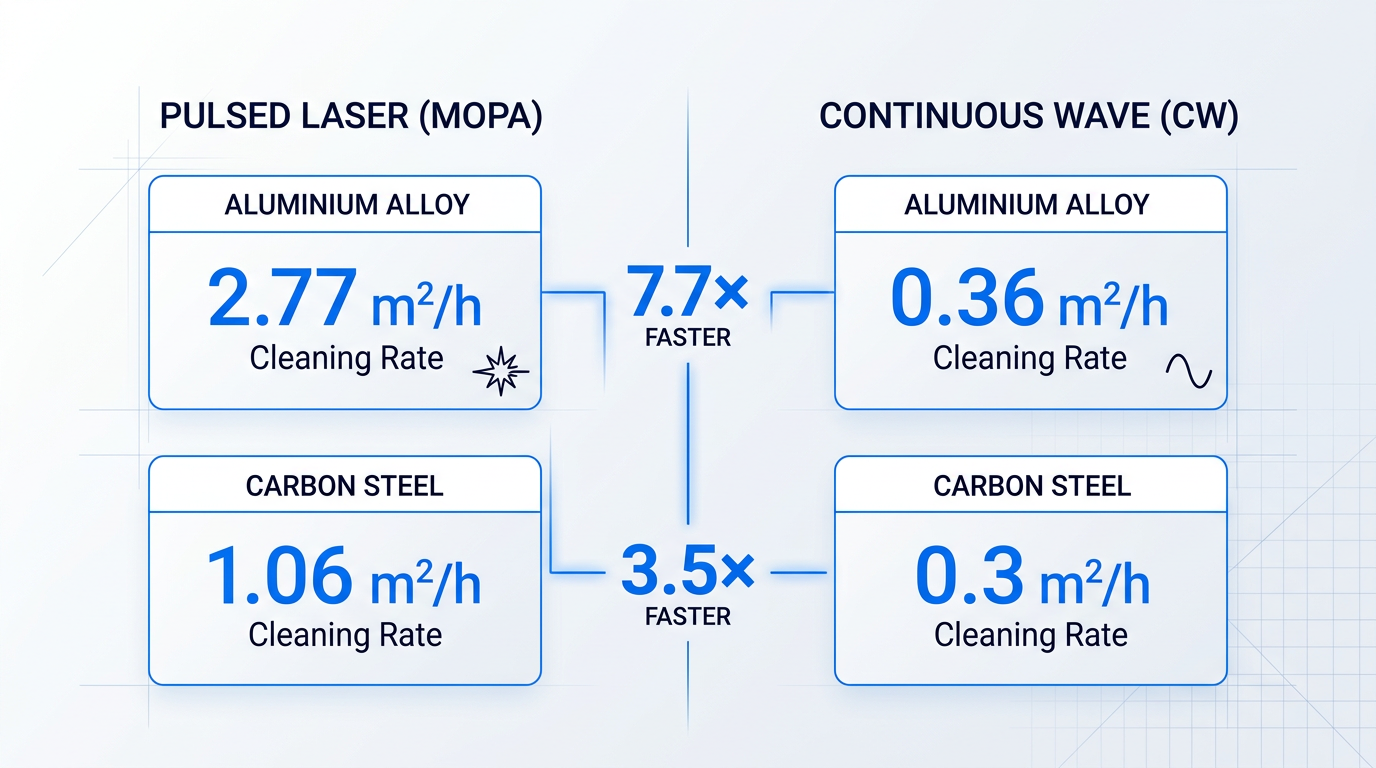
A pulsed MOPA fiber laser at the same average power cleans aluminium at 2.77 m²/hr versus just 0.36 m²/hr for a continuous wave laser at equivalent wattage — a 7.7× difference. Technology and engineering quality, not rated power alone, determine what a machine actually achieves on your surface.
This is why manufacturer provenance and engineering transparency matter when evaluating any quote — a theme the guide returns to in detail when examining the manufacturer vs. reseller distinction.
When assessing wattage claims, the most useful question to put to any supplier is: what is the cleaning rate in m²/hour for my specific contamination type and substrate? Headline wattage tells you the machine's potential; cleaning speed on the actual application tells you its real-world value, and a supplier who cannot provide that figure is a risk signal worth taking seriously.
Cooling Architecture and Its Cost Implications
Air-cooled systems — typically viable up to around 300–500W depending on the manufacturer — are self-contained, genuinely portable, and carry no infrastructure requirement beyond a standard power supply.
Water-cooled systems, which become standard above roughly 500W, require a chiller unit, a closed water circuit, and associated installation infrastructure — all of which add to capital cost and constrain deployment flexibility.
At the top of the power range, the infrastructure scale is significant: the Laserax LXQ-UHP at 2–3kW pairs with a chiller weighing 350kg, and the P-Laser QF-2000 uses two separate closed-circuit chillers to maintain constant operating temperature.
Buyers should confirm cooling requirements for any specific machine and factor the infrastructure cost into their total capital calculation — the chiller is not always included in the headline machine price.
The full implications of cooling architecture for portability and form factor are covered in the portable vs. automated systems section; for now, the key point is that power level and cooling type are inseparable variables in any honest cost comparison.
Understanding wattage and power tiers gives you a framework for reading a product listing, but it does not explain why two machines at the same wattage can carry very different price tags — that answer lies in how the laser is engineered at the source level, specifically whether it uses pulsed or continuous wave technology, which the next section addresses directly.
Pulsed vs CW Lasers: What the Difference Costs You
Two machines. Same wattage on the spec sheet. Significantly different price tags. If you've encountered this while collecting quotes, the explanation almost always comes down to one variable: whether the machine uses a pulsed or continuous wave (CW) laser source.
A pulsed laser fires energy in concentrated bursts, generating extremely high peak power at the point of contact — far beyond what its average wattage would suggest. This burst-mode delivery is what drives selective ablation: the contaminant layer absorbs the energy spike and vaporises, while the underlying substrate barely registers the event before the next pulse arrives.
A continuous wave (CW) laser delivers energy as an unbroken stream. The physics are simpler, the source is cheaper to manufacture, and the average power output is easier to scale. The trade-off is that without discrete energy bursts, the substrate absorbs heat continuously — raising the risk of substrate heating and thermal damage on anything that can't tolerate sustained heat input.
The price premium for pulsed systems reflects the complexity of the laser source itself. The two dominant pulsed architectures in industrial cleaning — Q-switched and MOPA (master oscillator power amplifier) fibre lasers — involve substantially more sophisticated optical and electronic components than a CW fibre source of equivalent average wattage, and that manufacturing complexity carries through to the purchase price.
The efficiency gap between the two technologies is where the CW price advantage can quietly erode. At equivalent average output power, a MOPA pulsed fibre laser cleans aluminium alloy at 2.77 m²/h — 7.7 times the rate of a CW laser at 0.36 m²/h. On carbon steel, the MOPA delivers 1.06 m²/h against 0.3 m²/h for CW, a 3.5× advantage.
In practical terms, this means a CW system must run at significantly higher average wattage to match a pulsed machine's cleaning speed on rust and scale. A lower-priced 1,000W CW unit may be required to deliver what a 200W or 300W pulsed machine achieves — which substantially narrows, and in some cases eliminates, the apparent cost advantage of choosing CW.
That said, CW systems are not the wrong choice for every application — and treating them as a cheap shortcut misreads the technology. For large steel structures, heavy pipework, or thick coatings where the substrate is robust and fast heat dissipation is not a concern, a higher-wattage CW system can be a genuinely cost-effective solution.
Where CW becomes the wrong tool is on anything heat-sensitive: thin metals, aluminium alloys, heritage materials, or painted surfaces where the substrate condition must be preserved. In those applications, the continuous heat input that a CW laser delivers is not a minor inconvenience — it is a disqualifying characteristic.
A 500W pulsed laser and a 500W CW laser are categorically different products. Before comparing quotes on wattage alone, establish the technology type and — for pulsed systems — the pulse energy. These two figures together tell you what the machine will actually do to your material.
The research consensus is clear on the preferred technology for rust and scale removal: pulsed fibre lasers are the established choice. Because rust has a lower ablation threshold than the base metal beneath it, a pulsed system can be tuned to vaporise the oxide layer precisely while keeping energy delivery below the threshold of the substrate — a level of control that continuous-wave delivery cannot reliably replicate.
For a buyer evaluating quotes, the practical checklist is straightforward: confirm whether each machine is pulsed or CW, and for pulsed systems, ask for the pulse energy specification alongside average wattage. Without both figures, wattage comparisons between competing quotes are incomplete at best and misleading at worst.
With technology type understood as a pricing axis, the next variable to examine is how the machine is packaged for deployment — whether as a portable handheld unit or a fixed, semi-automated, or fully robotic system. That distinction shapes the price range just as significantly as the laser source itself.
How Form Factor Shapes Laser Rust Cleaning Machine Price
You have absorbed wattage and laser technology as the first two pricing axes — now consider the third, and arguably the most dramatic: form factor. A buyer who receives a quote for a portable 300W system and a quote for an automated 300W cell, then tries to compare them, is not comparing two versions of the same product. They are comparing fundamentally different capital investments, and the price gap between them can exceed a factor of ten.
Portable, semi-automated, and fully automated: the three tiers
Portable systems are wheeled, self-contained units with a lightweight handheld scanner fed by a fibre delivery cable — the operator carries the scanner to the work surface while the laser source, cooling, and controls sit on the trolley behind them. They offer maximum deployment flexibility and suit on-site work, varied geometries, and any application where the machine must come to the part.
Semi-automated systems — fixed workstations, rotary-table setups, cobot-integrated configurations — sit in a middle price bracket. The laser head moves on a programmed path, but the system does not constitute a full robotic cell; suited to repetitive work on similar parts where full automation is not yet justified.
Fully automated cells place the laser head on an articulated robotic arm or gantry, typically within a safety enclosure, and are designed for high-volume production cleaning where consistency and throughput take priority over flexibility.
Portable laser cleaning systems: price and what shapes it
Portable systems in the 200–500W range typically run $12,000–$35,000, with high-power or premium-configured units pushing past $60,000 — a spread wide enough that two portable quotes at the same wattage can look very different depending on what is actually inside the package.
Three variables within the portable tier have an outsized effect on both price and real-world usability.
- Fibre cable reach: A 5m cable (e.g. 4JET JETLASER M100) keeps the operator close to the trolley. A 50m cable (e.g. WSL ELASER) lets a single operator work across large structures, pipelines, and infrastructure without repositioning the unit.
- Scanner head weight: A sub-3kg scanner (e.g. WSL ELASER) enables genuine single-operator use over long shifts. The P-Laser QF-Compact integrates the whole unit into a 13kg carry design — a different ergonomic proposition entirely.
- Cooling architecture: Air-cooled systems need no water or chiller infrastructure, reducing operating cost and setup complexity. Water-cooled portable units add infrastructure requirements that affect both operating cost and site flexibility.
The practical implication for buyers: a machine's single-operator operability is itself a cost variable. A system that demands two operators, frequent recalibration, or specialist setup has a higher effective cost than its sticker price suggests — the labour overhead is real even if it does not appear on the quotation.
Automated laser cleaning systems: what drives the higher cost
Automated laser cleaning cells start at around $150,000 for entry-level configurations, with tyre mould systems reaching approximately $500,000 and fully automated multi-kilowatt production lines ranging from $1–2 million — figures reported by Laser Focus World for industrial laser surface cleaning installations.
The capital cost is not simply a scaled-up version of portable pricing. Several engineering components that do not exist in portable systems each add meaningful cost.
- Robotic arm complexity: Multi-axis articulated arms capable of reaching complex 3D part geometries carry significant engineering cost over simpler fixed-head or single-axis configurations.
- Class 1 enclosure: Most automated cells require a safety enclosure to achieve Class 1 classification. The structural build, interlocks, and extraction system are a meaningful line item in the system price.
- Vision and scanning systems: Automated systems that use machine vision to identify and map parts add sensor hardware and software cost on top of the core laser and robotic hardware.
- Integration engineering: Programming, commissioning, and integrating a robotic cell into a production line is substantial — for complex integrations, this cost can equal or exceed the hardware itself.
There is a further cost variable that rarely appears in a capital quotation: programming overhead. Conventional robotic laser cleaning cells require a skilled technician to program and set cleaning paths for each new part geometry — a recurring cost every time a new part enters the process.
The right question to ask any automated system supplier is: how long does it take to set this system up for a new part? The answer reveals the true operational cost that sits entirely outside the purchase price.
WSL's AutoLASE illustrates what this tier looks like when the programming overhead is engineered out entirely. The system uses machine vision to scan the loaded part, build a 3D map, and generate the cleaning path automatically — no manual programming, no path-setting, no knowledge of part geometry required.
AutoLASE can also be configured with WSL's Reduced Hazard Zone (RHZ) technology, enabling enclosure-free automated cleaning — a capability no other automated system on the market offers. On price, AutoLASE is competitively positioned, and its zero-consumable, automated operation means the total cost of ownership picture is strong.
For complex robotic cell installations, the cost of programming, commissioning, and integrating the system into a production line can equal or exceed the hardware purchase price — yet this figure rarely appears in an initial quotation. Always ask suppliers for a fully loaded project cost, not just the machine price.
The form factor decision ultimately comes down to four questions: Does the machine need to come to the part, or can the part come to the machine? Is the work varied in geometry and location, or repetitive on similar parts in a fixed place? Is labour cost a significant factor, or is flexibility more valuable than throughput? And what is the expected annual utilisation — because high-volume production cleaning justifies the automated capital cost in ways that lower-utilisation, varied-application work does not.
Once you have identified your form factor category, the next question is where the machine in that category actually comes from — and what the answer means for price, support, and long-term value.
Manufacturer vs Reseller: Why Provenance Affects Price
You have now worked through wattage, laser technology, and form factor as the three visible cost drivers in this market. There is a fourth driver that does not appear on any spec sheet: who actually built the machine you are buying — and whether that supplier has the engineering depth to stand behind it.
A significant portion of the laser cleaning market, particularly at lower price points, consists of resellers and importers who rebadge machines built by third-party manufacturers overseas.
This is not inherently fraudulent, but it is rarely transparent. Marketing materials, websites, and even direct sales conversations can present a reseller as a manufacturer — and most buyers have no reason to question the distinction until something goes wrong.
What Provenance Means for After-Sales Support
This is where the difference becomes consequential. A genuine in-house manufacturer designed and built the machine from the ground up — which means their engineers understand it completely, at every level.
When a fault occurs, they can diagnose it at the engineering level rather than working from a service manual written by someone else's factory.
They hold spare parts directly in stock — no waiting for components to travel through a third-party supply chain — and they can dispatch an in-house engineer to site when remote diagnosis is not enough.
Critically, they own the design: if a firmware update, hardware improvement, or bespoke modification is needed, they can actually deliver it.
A reseller's support model is structurally different. Fault diagnosis must be escalated to the original equipment manufacturer, parts requests travel through a supply chain the reseller does not control, and novel or edge-case problems may simply exceed what the reseller can resolve.
That is not a criticism of any specific company — it is the structural reality of the reseller model, regardless of how capable or well-intentioned the reseller is.
What Provenance Means for Price and Total Cost
Machines from genuine in-house manufacturers typically carry a price premium over rebadged alternatives at the same wattage.
That premium reflects engineering depth, quality control across the entire build process, and the support infrastructure that sits behind the machine — not simply a higher margin.
When a buyer compares a lower-priced reseller quote against a higher-priced manufacturer quote, they are not comparing equivalent propositions: the sticker price gap can be offset by slower support response, parts delays, higher downtime, and an inability to resolve problems at the root cause.
Provenance is a total cost of ownership variable, not a brand preference — and it is one of the least visible inputs in any quote comparison.
Five Due Diligence Questions on Supplier Provenance
Before committing to a supplier, these are the questions that cut through marketing language and reveal whether you are dealing with a genuine manufacturer or a reseller.
- Do you design and build in-house?: Ask specifically whether the machine is designed and manufactured by the supplier's own engineering team, not assembled from bought-in OEM hardware.
- Do you have site-visit engineers?: Confirm that in-house engineers — not third-party service contractors — can attend your site when remote support is insufficient.
- Can you supply parts from your own stock?: A genuine manufacturer holds proprietary components directly. A reseller depends on the OEM's supply chain, which adds delay and uncertainty.
- Where is your manufacturing facility?: Ask for a verifiable manufacturing address, not just a sales or distribution office. A supplier who cannot provide one is likely not manufacturing.
- Who actually makes this machine, and where?: The single most direct question. A genuine manufacturer answers immediately. Deflection or vagueness is a strong signal of a reseller relationship.
That last question — who actually manufactures this machine, and where? — is the most powerful of the five. A supplier who cannot answer it clearly is almost certainly not the manufacturer.
Ask any laser cleaning supplier: "Who actually manufactures this machine, and where?" A genuine in-house manufacturer answers immediately and specifically. Deflection, vagueness, or a pivot to branding is a reliable signal that you are speaking to a reseller.
To illustrate what genuine in-house manufacturing looks like in practice: Woodrow Scientific Limited (WSL) — the company behind the ELASER, ELASER-RHZ and AutoLASE systems published on this site — is the only UK-based laser cleaning manufacturer.
Founded in 2012, WSL designs, builds, services and improves its own machines entirely in-house, drawing on more than 200 years of combined engineering experience across its team.
The company holds patented, world-first technology — including its eye-safe Reduced Hazard Zone system — which is the kind of innovation that only an in-house manufacturer with full design ownership can develop and bring to market.
WSL's machines are Made in Britain, CE and UKCA certified, and backed by in-house engineers who can visit site — a concrete example of what the provenance questions above are designed to surface.
Knowing who stands behind the machine is one layer of the purchasing decision; the next is understanding what safety infrastructure the machine requires — and what that adds to the real cost of ownership.
See the ELASER Spec Against Your Requirements
You now have the framework to evaluate any machine on its merits. Put it to work on a real product: the ELASER is a manufacturer-direct laser cleaning machine with full specifications available to review.

Safety compliance, certification, and training: the hidden costs buyers overlook
Most buyers comparing laser rust cleaning machine prices focus on wattage, technology type, and form factor — and miss an entire cost category sitting outside the spec sheet: the safety infrastructure required to legally operate the machine once it arrives.
That infrastructure includes formal operator training, PPE, exclusion zone management, signage, and in many cases a designated Laser Safety Officer (LSO) — none of which appear in a standard quote, and all of which cost real money and operational time.
Laser safety classes: what they mean for your costs
Under IEC 60825-1 and ANSI Z136.1, most industrial handheld and portable laser cleaning machines are classified as Class IV (Class 4) — the highest hazard category, covering lasers that are unsafe upon direct or diffuse reflected exposure to the eye or skin and can also present a fire hazard.
Operating a Class IV laser legally requires a formal Nominal Hazard Zone (NHZ) evaluation, establishment of a laser-controlled area, appropriate warning signage, laser-rated PPE for all personnel in the area, and documented operator training — before a single cleaning pass begins.
Automated laser cleaning cells with full enclosures, by contrast, are typically classified as Class I: inherently safe by design, because the laser cannot escape the enclosure during normal operation. Class I systems are exempt from beam-hazard control measures — the enclosure does the compliance work, and the safety overhead cost is substantially lower.
Neither class is inherently better — both are legitimate and legally compliant. The difference is what the buyer must spend and organise to operate safely, and that difference is rarely made explicit in a quote.
CE and UKCA certification: verify, don't assume
CE marking confirms a machine has been assessed against EU safety, health, and environmental protection requirements and is a legal prerequisite for placing machinery on the EU market. UKCA marking is the UK's post-Brexit equivalent, required for machinery placed on the GB market from 1 January 2025 onwards.
These are legal requirements, not optional quality badges — and the HSE is explicit that buyers are responsible for checking compliance before a machine enters service.
The document to request is the Declaration of Conformity: a legally required printed document that must state the manufacturer's name and address, the machine's make, type, and serial number, and the specific legislation and standards the machine has been assessed against.
Vague marketing language — phrases like "CE-ready" or "CE-compliant" — is not the same as certified. If a supplier cannot produce a current Declaration of Conformity covering the specific machine configuration being supplied, that is a significant red flag, both legally and as a provenance signal.
As noted in the previous section, genuine manufacturers are far better placed to provide complete certification documentation than resellers or importers who did not design or build the machine themselves.
Operator training: a real cost, not an optional extra
Formal laser safety and operation training is a legal requirement for Class IV laser operation under ANSI Z136.1 — and any organisation operating a Class 3B or Class 4 laser must appoint a trained LSO to administer the safety programme.
Training covers safe operating procedures, hazard awareness, PPE selection, emergency procedures, and machine-specific operation. LSO-level training from accredited providers such as the Laser Institute of America runs $1,095–$1,195 per person; operator-level awareness courses start from around $80–$195 per person through the same providers.
Staff turnover compounds this cost: every new operator requires training before they can legally work with the machine, making training a recurring operational expense rather than a one-time purchase.
A machine quoted at a lower price that excludes training is not cheaper once training is added — buyers must compare total equipped cost across every quote they receive. Credible manufacturers typically offer or include training as part of the supply; if a supplier cannot confirm this, factor in the cost of sourcing it independently.
The operational cost of Class IV safety overhead
Beyond the one-time training cost, Class IV portable laser cleaning carries a recurring operational overhead that is almost never itemised in a quote.
Before work can begin, the area must be assessed, exclusion zones established, warning signs posted, bystanders excluded, and PPE distributed and checked — a sequence that in a busy production environment means surrounding work pauses, schedules shift, and a supervisor's time is consumed before the laser fires once.
In a mixed-use facility, this friction is amplified: a machine that cannot operate without sealing off the surrounding area effectively cannot be deployed wherever it is most needed, limiting its practical utility and raising its true cost per cleaning hour.
Every Class IV laser cleaning job in a shared facility requires a fresh round of exclusion zone setup, PPE checks, and area clearance — a recurring overhead that never appears in the machine price but accumulates across every shift.
This is a cost variable that buyers should explicitly quantify for their own facility: how many cleaning jobs per week, how long does area preparation take, and what is the loaded cost of that time? The answer often changes the relative economics of machines that look similar on paper.
Reduced hazard zone technology: changing the equation
WSL's world-first patented Reduced Hazard Zone (RHZ) technology, available in the ELASER-RHZ, is the only laser cleaner of its kind — and it fundamentally changes the safety-overhead cost calculation.
Rather than requiring full area evacuation and exclusion zone setup, RHZ technology collapses the laser hazard zone to a small area around the work itself, using a 1550 nm retina-safe wavelength that dramatically reduces the hazard footprint compared to conventional laser cleaning.
The operational consequence is significant: cleaning can proceed in open workshops, mixed-use manufacturing facilities, and even public-facing settings — heritage restoration, graffiti removal — without shutting down the surrounding area or disrupting adjacent work.
In cost terms, that means less downtime preparing the area before each job, no scheduling disruption to surrounding operations, and access to applications where conventional Class IV laser cleaning is simply impractical without major facility changes.
WSL, as the only UK-based laser cleaning manufacturer, designs and builds the ELASER-RHZ entirely in-house — and provides first-class laser cleaning safety and operation training as part of the supply. The machine is CE and UKCA certified, satisfying the compliance requirements this section has outlined.
Safety compliance buyer checklist
Before accepting any laser cleaning machine quote, ask the supplier to answer each of the following directly.
- Request the Declaration of Conformity: Confirm CE and/or UKCA certification is genuine, current, and covers the exact machine configuration being supplied — not a generic or previous model.
- Confirm the laser safety class: Ask whether the machine is Class I or Class IV and what that requires in practice: exclusion zones, NHZ assessment, LSO appointment, PPE, and signage.
- Establish the true training cost: Is operator training included in the price or charged separately? What does ongoing training cost as operators change? Factor this into your total equipped cost comparison.
- Map the safety infrastructure required: What physical controls are needed before operation — exclusion zones, curtains, interlocks, signage? Who is responsible for establishing and maintaining them on your site?
- Ask about reduced-hazard-zone operation: Is RHZ capability available? What are the practical implications for your facility — can cleaning proceed without shutting down adjacent work areas?
Safety overhead is not a one-time cost — it is a recurring input to every hour of operation, and it belongs in any honest comparison of laser rust cleaning machine prices.
With safety compliance established as a genuine cost driver, the next section brings all the inputs together: wattage, technology, form factor, provenance, and safety overhead synthesised into a complete Total Cost of Ownership picture that gives buyers a single, comparable figure across the machines they are evaluating.
Total Cost of Ownership: What a Laser Cleaner Really Costs
The purchase price of a laser rust cleaning machine is the number that appears on the quote — but it is not the number that determines whether the investment makes financial sense over a working life measured in decades.
Laser sources are rated at 100,000+ operating hours, which at 1,000 hours of use per year translates to a theoretical service life far beyond any practical replacement horizon for the machine itself. That time horizon is the correct lens through which to evaluate a capital equipment decision, because it exposes what upfront price comparisons conceal: the ongoing cost of running each method, year after year.
A capital cost differential between two machines — even a meaningful one — becomes progressively less significant when one machine costs a fraction as much to operate annually. Total cost of ownership (TCO) is simply the intellectually honest way to evaluate any capital equipment purchase.
Consumables: Laser Cleaning's Structural Advantage
The most decisive TCO differential sits in consumable costs — and here laser cleaning has a structural, not incremental, advantage.
A laser cleaning system has no abrasive media, no blast nozzles, no chemical replenishment, and no regulated waste disposal contracts. The primary wear item is the protective lens window on the cleaning head: typically $50–$200 per lens, with a well-maintained unit going through perhaps two or three per year under continuous industrial use — call it $150–$600 annually in lens costs alone.
For a 500W portable system running 1,000 hours per year, one independent analysis found total consumable spend — lenses plus fume extractor filters — running to roughly $80–$120 in lens replacements and $200–$300 in electricity for the year, with filter maintenance costs under $560 annually according to trade press data.
Sandblasting, by comparison, generates consumable costs of $0.30–$0.55 per m² in media alone before disposal fees; add environmental compliance costs of $0.15–$0.25/m² for facilities subject to waste regulation, and you reach $0.45–$0.80 per m² per run — every run, indefinitely.
For a shop running 500 hours per year of surface prep, sandblasting consumables, media, disposal, and PPE typically accumulate to $30,000–$80,000 over five years. Laser operating costs over the same period — electricity, lenses, occasional service — generally stay below $8,000–$15,000.
Energy, Maintenance, and the Hidden Cost of Rework
Energy costs are a minor TCO component, not a meaningful burden. A 500W pulsed system drawing approximately 1.8–2.2 kW total runs electricity costs of roughly $0.18–$0.30 per m² cleaned at standard industrial rates; a 1,000W system cleaning 5–8 m²/hour brings that figure down to $0.05–$0.09/m² as throughput absorbs the higher draw.
Annual maintenance on a well-maintained laser system is similarly contained. One trade press source places the laser source's running cost at approximately $6/hour all-in, with filter costs below $560/year — figures consistent with the broader vendor data showing total annual operating costs (excluding labour) in the low thousands for moderate-utilisation systems.
The most commonly overlooked TCO component is rework and substrate damage cost. Laser cleaning is a non-contact, selective ablation process: the beam removes contamination and stops at the base material. Sandblasting raises surface roughness by 10–75 µm and can require additional finishing or re-inspection before a part proceeds. Chemical stripping carries etching and contamination risks. Every job where rework is avoided is a direct, recurring cost saving — one that compounds across thousands of parts over the machine's working life.
Machine quality, as covered in the provenance section, directly affects beam control and therefore substrate protection — a further reason why TCO analysis must account for the full landed cost of a system, not just its sticker price.
Is a Laser Rust Removal Business Profitable?
For service operators — contractors who deploy a laser cleaning machine as a revenue-generating tool — the economics are structurally attractive once capital is recovered.
Near-zero consumable costs mean that almost all revenue above labour and overhead contributes directly to margin. Fast setup (no media loading, no masking, no waste containment teardown) means high throughput per operator-day compared to abrasive or chemical alternatives.
The key variable is utilisation. For shops running 400+ hours per year of cleaning work, payback periods of 18–36 months are realistic; in high-labour-cost environments with elevated waste disposal fees, that window compresses to 12–18 months. Below roughly 150–200 hours per year of light work, the capital cost is harder to recover within a practical timeframe — and that is worth stating honestly.
The payback calculation depends on four inputs: the fully-landed capital cost (machine plus installation, commissioning, and training), annual operating cost, annual avoided cost from retiring the incumbent process, and any productivity throughput gain.
At utilisation above 1,500 hours per year, almost every power class of laser cleaning system reaches TCO superiority within 24 months, regardless of which incumbent process it is replacing.
Five-Year TCO Comparison: Laser vs Alternatives
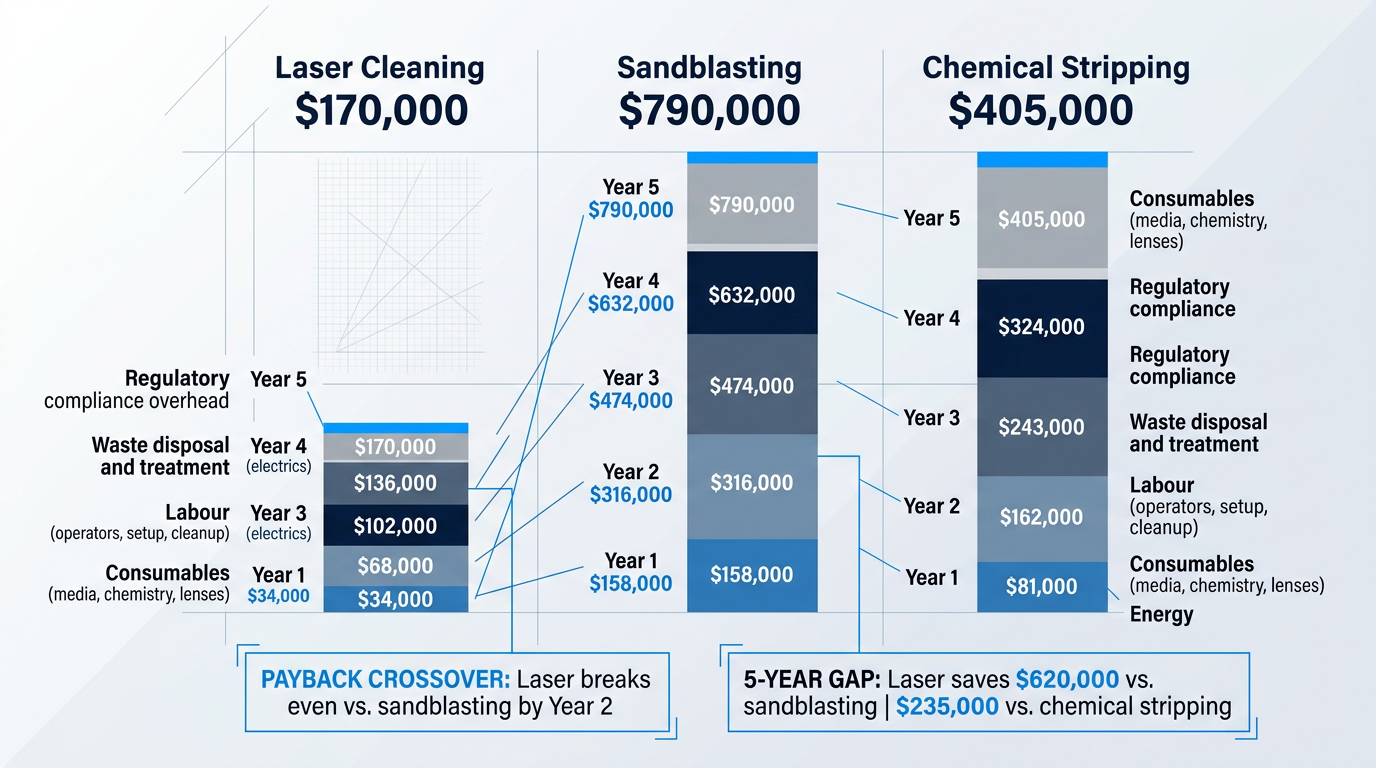
The table below draws on published operating cost data to compare laser cleaning, sandblasting, and chemical stripping across the main annual cost categories at comparable utilisation levels.
| Cost Category | Laser Cleaning (annual) | Abrasive Sandblasting (annual) | Chemical Stripping (annual) |
|---|---|---|---|
| Consumables (media, chemistry, lenses) | $200–$500 | $35,000–$90,000 | $5,000–$30,000 |
| Labour (operators, setup, cleanup) | $30,000–$60,000 | $80,000–$150,000 | $50,000–$90,000 |
| Waste disposal and treatment | $0 | $20,000–$60,000 | $10,000–$50,000 |
| Regulatory compliance overhead | $1,000–$3,000 | $15,000–$45,000 | $12,000–$40,000 |
| Energy | $3,000–$8,000 | $8,000–$20,000 | $4,000–$12,000 |
| Estimated annual total | $34,000–$71,000 | $158,000–$365,000 | $81,000–$222,000 |
Five-year annual operating cost comparison across laser cleaning, sandblasting, and chemical stripping — showing where the TCO differential accumulates.
The pattern is unambiguous: the annual cost gap between laser cleaning and both alternatives is driven almost entirely by consumables, waste disposal, and the labour overhead those processes require — not by energy or maintenance, which are relatively minor across all three methods.
These figures assume production-scale utilisation; lower-volume operations will see proportionally smaller absolute savings, though the per-unit cost advantage of laser cleaning persists. The right approach is to build your own model using your actual hours, your local labour rate, and your current waste disposal contract costs — the structure of the comparison above is the framework.
The capital cost of a laser cleaning machine is real — and for buyers who spread that cost through asset finance, the upfront commitment is lower still. The next section covers the financing structures available for laser cleaning equipment, and how buyers are funding the capital element without tying up working capital.
How to Finance a Laser Cleaning Machine Purchase
Very few industrial buyers write a cheque for capital equipment at this price point — and they are not expected to. The UK manufacturing finance market is well-developed, and laser cleaning machines are treated by lenders as standard capital equipment: a recognised asset class with an established working life and residual value.
Specialist asset finance providers such as Gable Asset Finance explicitly list laser machines — cutting, engraving, marking, and cleaning systems — as assets they finance routinely for UK SMEs, with the machine itself serving as the primary security for the lender.
That matters for buyers who assume niche or specialist equipment is harder to finance. In practice, the opposite is true: because the machine has tangible resale value and a clear productive purpose, lenders are comfortable with it as collateral, and the process mirrors any other capital machinery purchase.
The four main financing structures for UK buyers
Four principal routes cover the vast majority of how UK manufacturing businesses fund equipment at this level — each with a different ownership, balance-sheet, and cash-flow profile.
- Hire Purchase (HP): Fixed monthly payments over an agreed term; legal ownership transfers to the buyer at the end, typically on payment of a nominal fee. Machine sits on your balance sheet from day one.
- Finance Lease: The lender retains legal ownership throughout; you pay rental and use the machine. Options at term end include extending, returning, or purchasing at fair market value.
- Equipment Loan: A lump-sum loan secured against the machine. You own it from the outset. Terms typically run two to seven years; lender choice is flexible and not tied to the supplier.
- Vendor / Manufacturer Financing: Some suppliers offer financing directly or through lending partnerships — convenient, but terms should be compared against independent providers before committing.
Hire Purchase suits buyers who want outright ownership at the end and prefer predictable fixed payments — a familiar structure for most manufacturing businesses, and the most popular asset finance product at major UK banks including Lloyds.
A Finance Lease is better suited to buyers who want to preserve working capital, keep the asset off the balance sheet, or who expect to upgrade the technology within the lease period — lease payments are treated as an operating expense rather than a capital commitment.
Equipment Loans (available through specialist providers such as Funding Circle, with terms from one to seven years and facilities up to £5 million) give buyers ownership from day one and full flexibility in choosing their finance provider independently of the supplier.
Vendor financing is a legitimate option — some laser equipment suppliers have established relationships with lenders and can arrange finance as part of the same transaction, which simplifies the process. The trade-off is that the terms on offer may not be as competitive as those available from an independent asset finance broker, so comparison is worthwhile before signing.
Structured correctly, the monthly finance payment can be set directly against the labour, consumable, and downtime savings laser cleaning generates — turning a large upfront barrier into a measurable net cost that is often positive from the first year.
UK tax treatment is worth factoring into the net cost calculation, though your accountant should confirm the specifics for your business.
For Finance Leases, rental payments are deductible as revenue expenses against taxable profits under HMRC's Business Leasing Manual — the full rental (not just the interest element) is treated as a business cost. For Hire Purchase and Equipment Loans, the machine qualifies as plant and machinery for capital allowances purposes, including the Annual Investment Allowance (AIA), which currently allows businesses to deduct up to £1 million of qualifying expenditure in the year of purchase.
When sizing your finance arrangement, the machine's quoted price is the starting point — not the finishing line.
Installation, initial operator training, safety infrastructure (PPE, extraction, signage), and first-year consumables all need to be funded alongside the equipment itself. Concetta Farina of BDC advises that businesses should budget for additional costs of 25–30% above the equipment price to cover these associated expenses — a figure worth building into your finance application from the outset rather than absorbing from working capital after delivery.
Approaching a finance provider follows the same process as any capital machinery purchase: you will need business financials, the machine specification, and a formal supplier quote — the same documents Johnson Reed and Funding Circle both list as standard requirements.
One practical note: specialist asset finance brokers who focus on manufacturing equipment can often access better terms across a wider panel of lenders than a buyer's general business bank — and they understand the asset class, which can speed up approval.
With a clear picture of how to fund the purchase, the remaining question is what a well-structured quote actually looks like — and how to spot one that falls short. That is what the next section covers.
How to Evaluate a Laser Cleaning Machine Quote
A quote has landed in your inbox. You have spent time understanding wattage tiers, technology types, form factors, provenance, safety costs, and total cost of ownership — now comes the moment those lessons pay off: deciding whether what you have been sent is genuinely competitive, or simply the cheapest thing a supplier could put on paper.
The foundational rule is the like-for-like principle: headline wattage is not a comparison point, it is a starting point. Two 500W quotes can differ by tens of thousands of pounds once you account for technology type (pulsed vs CW), pulse energy, cooling method (air vs water-cooled), fibre cable reach, scanner head weight, software capability, and exactly what the price includes — machine only, or machine plus training, installation, and certification.
Questions to ask every supplier
Before accepting any quote, put these questions to every supplier in writing — the quality of the answers will tell you as much as the specifications.
- Who manufactures this machine?: Is this an in-house design built by your engineering team, or a rebadged import? The answer shapes everything from support quality to parts availability.
- Is CE/UKCA certification included?: Can you provide the declaration of conformity? Certification must be documented, not merely claimed — ask for the paperwork before signing.
- What training is provided?: Is operator and safety training included in the quoted price, or is it an additional line item? Confirm the scope and duration.
- What does the warranty cover?: Clarify whether it covers parts, labour, and on-site response — and the warranty period for the laser source specifically, as the highest-value component.
- What are annual consumable costs?: Ask for a realistic estimate based on your expected duty cycle, not a best-case figure supplied to make the quote look attractive.
- What is the spare parts lead time?: Are critical spare parts held in UK stock, or sourced overseas on a weeks-long lead time? Downtime cost makes this question critical.
- Can you test on my substrate?: Ask for documented application test results on your specific material and contamination type before committing to any capital outlay.
The question that carries the most weight is the first: who manufactures this machine? As covered earlier in this guide, a supplier who cannot answer clearly — or who deflects with vague references to 'our manufacturing partners' — is almost certainly a reseller operating at arm's length from the engineering behind the product.
Red flags that signal a weak quote
Not every quote deserves a follow-up. These signals should prompt serious scrutiny — or a decision to walk away.
- No CE/UKCA certification: Vague or unverifiable certification claims are a compliance risk you inherit the moment the machine enters your facility.
- Training absent, no option offered: A supplier who neither includes training nor offers it as a paid option is leaving you to manage Class 4 laser operation independently.
- Evasion on manufacturer identity: If a supplier cannot or will not name who built the machine, they likely lack direct access to engineering-level support when problems arise.
- Low price, no itemisation: A quote significantly below market with no breakdown of inclusions and exclusions is hiding something — whether omissions or a compromised specification.
- No application testing offered: Declining or deflecting a request to test on your substrate is a meaningful risk signal before any capital commitment.
The application test deserves particular attention because it is the single most revealing thing you can ask a supplier to do before you commit.
Any serious supplier should be able to run test ablation on a sample of your actual substrate and contamination type, then return documented results: removal performance, cycle time estimates, and any substrate-specific considerations your operators need to know.
This is not an unreasonable demand for a capital purchase at this price point — a supplier who declines or deflects the request is telling you something important about the depth of their technical capability and their confidence in the product.
Before committing capital, request written application test results on your specific substrate. If a supplier cannot produce them, that gap in evidence is itself a data point worth acting on.
Once you have comparable quotes in hand, apply the 5-year cost model covered earlier in this guide: stack capital cost against annual maintenance, consumables, training, safety infrastructure (exclusion zone signage, PPE, laser safety officer provision), and estimated downtime cost across a five-year horizon.
A quote that looks £15,000 cheaper at purchase can easily reverse its advantage within two years if spare parts arrive slowly, consumable costs run high, or support calls go unanswered — the 5-year model makes that visible before you sign.
After-sales support is a genuine pricing factor, not a courtesy extra: ask every supplier for their committed response time on a support call and whether on-site support is available — and at what cost.
It is also worth establishing whether you will be speaking to a dedicated support engineer or a generic helpdesk, because a genuine manufacturer can diagnose faults at engineering level, while a reseller depends on escalating to an OEM support chain that may be overseas.
For buyers who want to validate the technology before committing capital, it is worth asking suppliers directly whether rental or trial arrangements are available — some manufacturers in this market do offer short-term access as a risk-reduction pathway, allowing buyers to assess cleaning speed, substrate compatibility, and operational fit on their own application before purchase.
With a structured framework for evaluating quotes in place, the final step is bringing the full set of principles from this guide together into a confident purchasing decision.
Talk to a Laser Cleaning Expert Before You Buy
You have the framework to evaluate any quote. Now put it to an expert. Book a 30-minute call to discuss your application, your requirements, and what a like-for-like comparison should look like for your situation.
Conclusion
Making a Confident Laser Cleaning Machine Purchase
The buyer who arrives at a good decision is the one who looks past the sticker price — who evaluates total cost of ownership, verifies that the supplier is the actual manufacturer, and compares quotes on full specification rather than wattage alone.
The clearest next step is to request an application test on your own substrate, so the machine's performance is demonstrated against your actual cleaning challenge before any commitment is made.
If you are ready to discuss pricing for your specific application, we would be glad to help — get in touch for a quote.
Frequently asked questions about laser rust cleaning machine prices
These questions cover the pricing, profitability, and purchasing practicalities that buyers most commonly ask when evaluating a laser rust cleaning machine. Each answer stands on its own — no need to have read the full guide to get value from them.
Laser rust cleaning machine prices span a wide range: entry-level portable pulsed units (sub-100W) typically start around $8,000–$18,000; mid-range industrial portables (100–500W) broadly fall between $15,000–$60,000; and high-powered CW or automated systems run from $80,000 upward, with fully automated robotic cells reaching $150,000–$500,000 or more. The sticker price is shaped by four main variables: wattage, laser technology (pulsed vs continuous wave), form factor (handheld, trolley-mounted, or integrated cell), and the provenance of the laser source and manufacturer. For long-term evaluation, total cost of ownership matters more than the headline figure — laser sources are rated for 80,000–100,000+ operating hours, consumable costs are near-zero, and payback periods of 12–36 months are achievable at production-scale utilisation.
The price range for laser cleaning machines is the same regardless of what contaminant is being removed. The underlying technology is identical whether the machine is cleaning rust, paint, oxides, mould residue, or weld spatter — the machine does not change based on the application. Entry-level portable systems start from around $8,000–$18,000, mid-range industrial units run $15,000–$60,000, and high-powered or automated systems exceed $80,000. What drives price is power output, laser technology type, and form factor — not the specific cleaning task.
Yes — laser cleaning is a strong service business model for operators running sufficient volume. The economics are compelling: near-zero consumable costs (no abrasive media, no chemicals to replenish), fast job setup with no masking or media recovery, and cleaning quality that commands premium hourly rates across automotive, aerospace, heritage restoration, and industrial maintenance work. Payback timelines of 18–36 months are achievable for operations running 400–1,000+ hours per year of billable work. The critical variable is utilisation rate. A machine running regularly on billable jobs generates strong margin per hour precisely because the running cost is so low — primarily electricity and occasional lens replacement. A machine sitting idle does not pay back on any timeline. Operators who anchor laser cleaning as a primary service line rather than an occasional add-on consistently reach payback within two years.
A complete quote should include the machine unit itself, the scanning head or handset, the fibre delivery cable, control software, and protective lens windows. These are the core components that make the system operational on arrival. What is often excluded from the headline price — and must be asked about explicitly — includes operator training and certification, laser safety infrastructure (exclusion zone signage, appropriate PPE), installation and commissioning, and any extended warranty beyond the base period. Ask every supplier to provide an itemised quote rather than a single total figure. A lower headline price that excludes training and safety equipment may cost more in total than a higher headline price that bundles them in. The comparison only holds up when every quote covers the same scope.
The fibre laser source at the heart of an industrial cleaning machine is rated for 100,000+ operating hours. At a typical single-shift utilisation of around 2,000 hours per year, that translates to 50 years of theoretical source life — though in practice, a well-maintained machine has a realistic working life of 10–20 years before it would typically be replaced or substantially upgraded. The laser source is the most durable component. Other elements — scanner optics, the fibre trunk cable, control electronics — have shorter service lives but are individually replaceable. Routine consumables are minimal: protective lens windows (cleaned every 200–500 hours, replaced at low cost), chiller coolant, and air filters. A machine from a manufacturer with genuine in-house service capability can be maintained and upgraded across many years, making the per-year cost of ownership substantially lower than the upfront price suggests.
Yes. Laser cleaning machines are recognised as financeable capital assets, and UK lenders treat industrial laser equipment as standard manufacturing machinery with established resale value. The three main financing routes available to UK business buyers are hire purchase (HP), where fixed payments lead to outright ownership at the end of the term; finance lease, where the business uses the asset in return for structured payments with options to purchase, upgrade, or return at the end; and equipment loans arranged through specialist asset finance brokers. Lease payments are typically 100% tax-deductible against taxable profits for UK businesses, which affects the net cost calculation meaningfully. Specialist asset finance brokers can structure packages across a panel of lenders suited to manufacturing businesses of varying sizes.
Yes. Pulsed fibre laser cleaning is an established industrial process with decades of proven deployment across automotive manufacturing, aerospace, heritage conservation, shipbuilding, and heavy industry. It is not an emerging or experimental technology. For most buyers at this stage, the more relevant question is not whether laser cleaning works, but what it costs and whether the total cost of ownership makes sense for their specific application and utilisation rate.