
Introduction
This list is built for the full range of buyers in the market for a laser paint stripping machine — from tradespeople and small workshops considering their first system, to production facilities looking for high-throughput automated solutions.
Most buyers arriving here are switching from sandblasting or chemical stripping, drawn by the precision, zero consumables, and substrate protection that laser systems offer.
One thing worth knowing before you start: a significant portion of machines on the market are imported and rebadged by resellers with no in-house engineering behind them. Asking who built the machine — and who will support it — is one of the most important questions a buyer can ask.
For paint stripping specifically, pulsed laser systems are generally the preferred choice where protecting the underlying substrate matters.
TL;DR
Not all laser paint stripping machines are created equal — and the gap between the right choice and the wrong one comes down to more than wattage. Portability needs, laser type, production scale, and the manufacturer standing behind the machine all shape whether a system delivers long-term value or long-term headaches.
This article covers:

Five machines evaluated: power, laser type, portability, and price
Handheld portable units through to automated robotic systems
Manufacturer provenance assessed — who built and supports it
Pulsed vs CW laser type — which suits paint stripping
Price positioning and total cost of ownership context
How to evaluate a laser paint stripping machine
A laser paint stripping machine is a capital purchase — the kind of equipment that stays in a facility for a decade or more. Getting the specification wrong in either direction costs real money: an under-powered machine that can't keep up with production, or an industrial-grade system burning budget on a job that needed a workshop unit. The seven criteria below are the ones that actually separate the right machine from an expensive mistake.
Power output and wattage
Wattage is the most visible specification on any laser cleaning machine, and it directly determines stripping speed, the thickness of coatings the machine can tackle, and how much surface area it can cover per pass.
Entry-level pulsed systems typically sit in the 100–300W range, suited to automotive panels, precision parts, and workshop-scale paint removal; mid-range machines around 500W handle heavier coatings and moderate production volumes; industrial-grade systems reach 1,000W and beyond, where large structural steel and high-throughput production lines are the target application.
Higher wattage is not universally better: on thermally sensitive or thin substrates, excessive power can damage the base material beneath the coating, creating rework that costs more than the time saved.
The right power level is determined by coating type, substrate sensitivity, and the balance between throughput and precision — not by the largest number on the spec sheet.
Pulsed vs continuous wave laser type
This is the most consequential technical choice in the category, and the page takes a clear editorial position: pulsed lasers are the preferred choice for paint stripping wherever substrate protection matters.
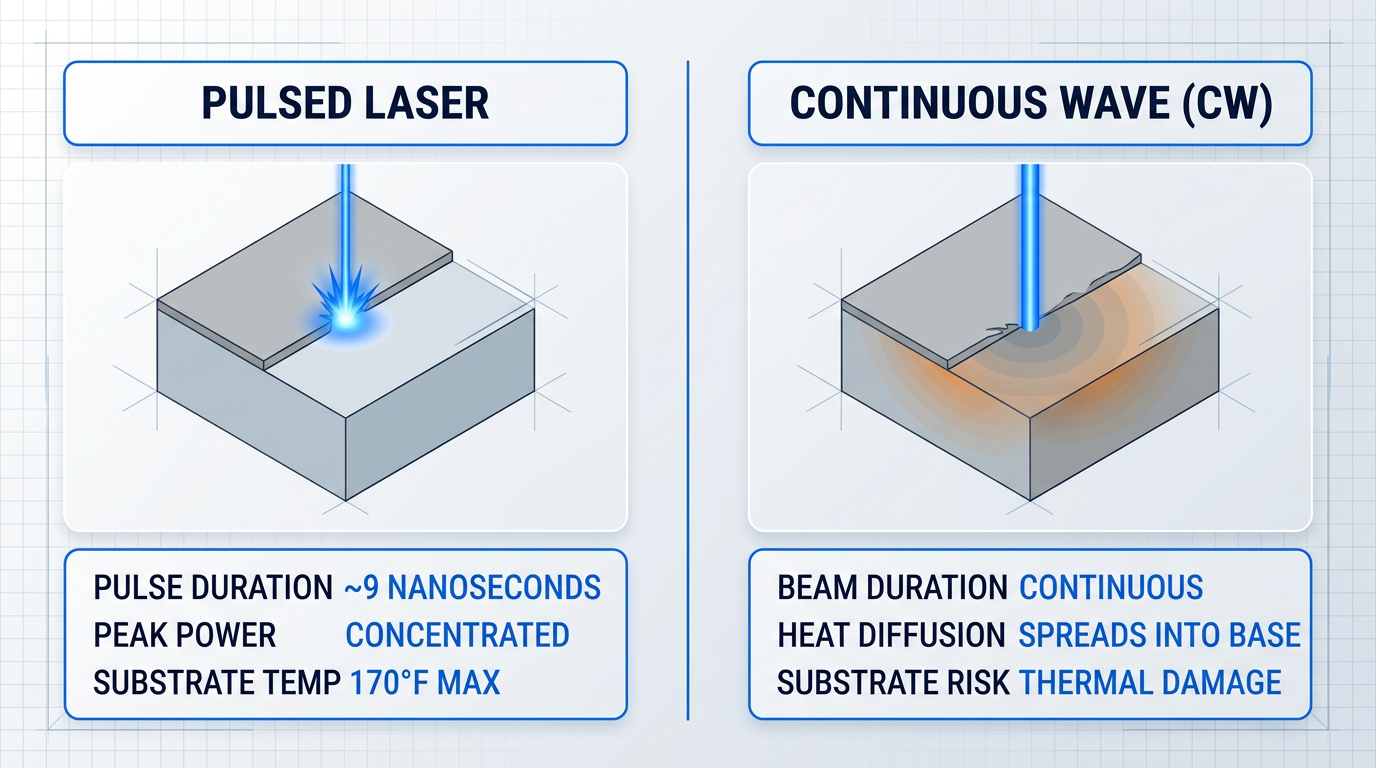
A pulsed laser delivers energy in extremely short bursts — typically around 9 nanoseconds — at high repetition frequency. The peak power within each pulse is intense enough to ablate the coating, but the pulse ends before heat has time to conduct into the substrate beneath it. The contamination vaporises; the base material stays cold.
Independent testing with a 500W pulsed laser on aircraft aluminium recorded a maximum substrate temperature of just 170°F under normal operating conditions — a figure that illustrates the practical substrate safety advantage of pulsed operation.
Continuous wave (CW) lasers deliver a sustained beam rather than discrete pulses. This makes them well-suited to heavy industrial stripping of robust steel structures — shipyard hulls, large pipelines — where throughput is the primary objective and the substrate can tolerate higher heat input without damage.
For most paint stripping applications, especially where the substrate is aluminium, thin steel, composite, or any material where surface integrity matters, pulsed is the correct choice. CW has its place, but that place is defined by scale and substrate robustness, not by cost or convenience.
Portability and form factor
Handheld and portable systems suit on-site work, varied locations, and single-operator deployment — environments where the machine needs to travel to the workpiece rather than the other way around.
Automated and robotic cells suit repetitive high-volume production where consistency, throughput, and hands-off operation matter more than flexibility. Neither form factor is universally superior — they are different tools for different jobs, and choosing the wrong one is a workflow problem, not just a preference.
Use-case scale: matching machine to workload
A machine specified for continuous industrial production is over-engineered and over-priced for occasional workshop use; conversely, an entry-level system will underperform in a high-throughput setting, creating a bottleneck rather than solving one.
Buyers should match the machine's duty cycle, power rating, and automation level to their actual cleaning volume and operating environment — not to aspirational future capacity that may never materialise.
After-sales support and manufacturer provenance
This is the criterion most underserved by existing buyer guidance, and it deserves direct framing: a significant proportion of laser cleaning machines on the market are imported and rebadged by resellers who have no in-house engineering or manufacturing capability.
With any capital equipment, something will eventually need attention — a component, a software parameter, a calibration. When that happens, a reseller cannot fix it quickly, cannot supply spares from stock, and cannot genuinely improve the product.
Before committing to any laser paint stripping machine, ask: who designed it, who built it, and who will fix it. The answers reveal more about long-term ownership than any specification sheet.
Buyers who treat manufacturer provenance as a secondary concern after price and wattage often discover its importance only after the machine is installed and a problem arises. Ask these questions before the purchase, not after.
Total cost of ownership
Upfront purchase price is a misleading lens for evaluating a laser paint stripping machine. The more useful measure is total cost of ownership (TCO) across the machine's working life.
Laser cleaning machines carry no consumable costs beyond electricity — no abrasive media, no chemicals, no disposal fees. One independent cost analysis puts the operating cost of a laser stripping system at approximately $6 per hour, with filter replacements running under $560 per year.
Sandblasting and chemical stripping appear cheaper on the invoice but accumulate significant ongoing costs: media purchase and disposal, chemical handling, environmental compliance, and rework from surface damage caused by the process itself. Over a five-year horizon, the laser's higher upfront cost is typically recovered well within the first two years of operation.
Safety overhead and hazard zone
All industrial laser cleaning machines operate at Class IV laser power levels. According to OSHA guidance, Class IV lasers present immediate eye and skin hazard from direct or reflected beams and require a defined controlled area with entryway controls, warning systems, and supervision by a person knowledgeable in laser safety.
In practice, conventional Class IV operation means the working area must be controlled and cleared before the laser operates — a real constraint that limits deployment flexibility in open workshops, mixed-use facilities, and public-facing environments.
Some machines on the market incorporate technology that collapses the nominal hazard zone (NHZ) to a small area immediately around the work surface, substantially reducing the operational overhead of area controls. This is a meaningful differentiator axis for buyers who need to operate in environments where full area clearance is impractical — and one worth evaluating explicitly for each machine on this list.
With these seven criteria in hand, here is how the leading laser paint stripping machines for sale today actually measure up.
Product 1
ELASER / ELASER-RHZ — Woodrow Scientific Limited
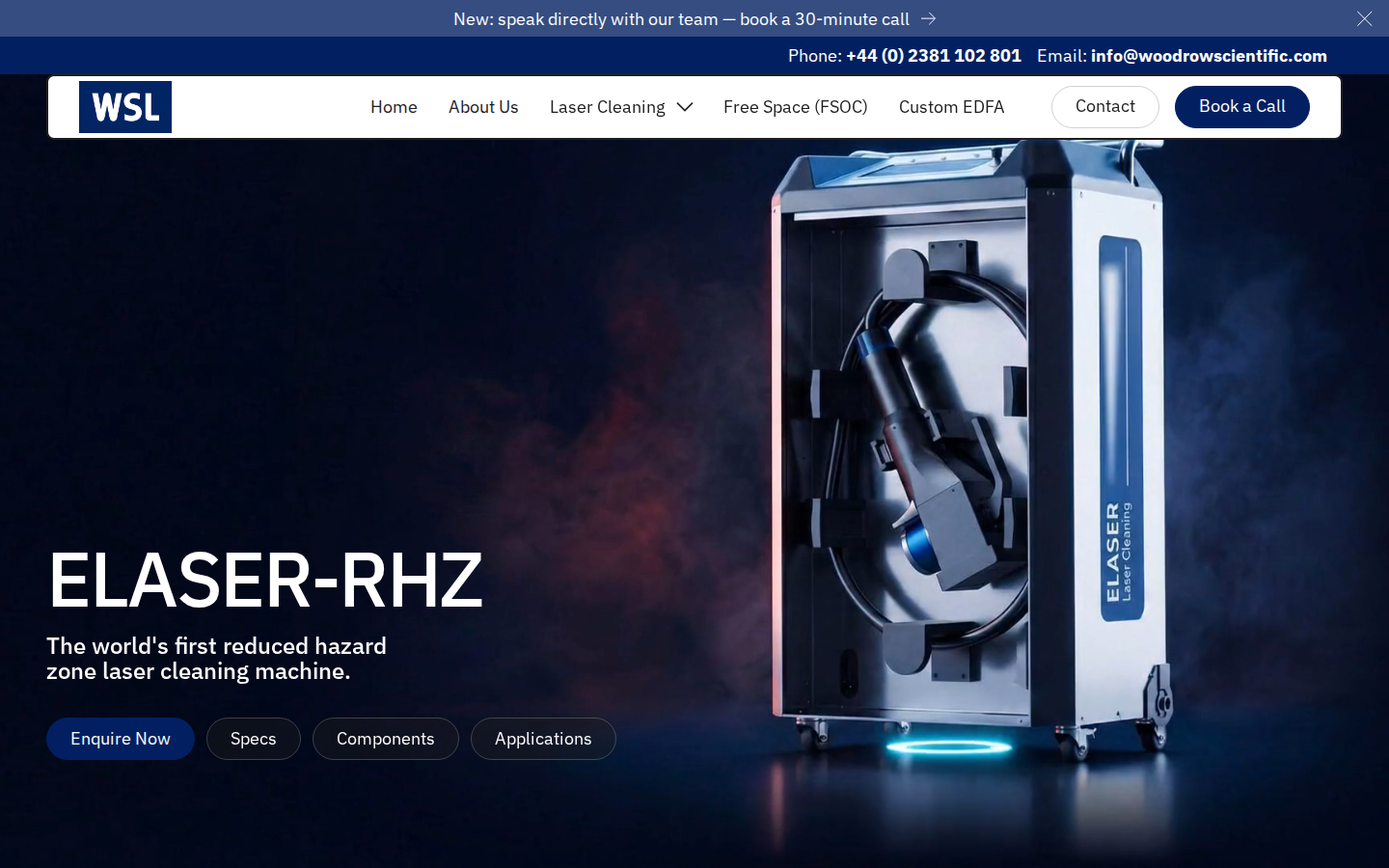
A portable, handheld pulsed fibre laser cleaning system from the UK's only in-house laser cleaning manufacturer — best suited to versatile on-site paint stripping across automotive, industrial, heritage, and public-space applications.
Pros:

World-first reduced hazard zone technology
50 m cable reach; sub-3 kg handheld scanner
Pulsed laser protects substrate; minimal rework
UK in-house manufacturer since 2012
Cons:

Not suited to automated production lines
Pricing is contact-for-quote only
The headline differentiator for this machine — and the reason it sits at the top of this list — is the ELASER-RHZ's world-first reduced hazard zone technology. WSL's patented approach collapses the laser hazard zone to a small area immediately around the work surface, enabling cleaning in open workshops, mixed-use manufacturing facilities, and public-facing environments where conventional Class IV laser cleaning simply cannot operate.
For buyers, this matters because the biggest practical barrier to adopting laser paint stripping has never been the technology itself — it has been the safety overhead. Conventional laser cleaners require areas to be sealed off and evacuated before work begins. The ELASER-RHZ removes that constraint entirely, unlocking applications that were previously off-limits: graffiti removal on public streets, paint stripping on heritage monuments, and continuous operation in shared production spaces.
ELASER / ELASER-RHZ Key Specifications
| Specification | Detail |
|---|---|
| Laser type | Pulsed fibre laser |
| Max power output | Up to 300 W |
| Power tunability | 0–100% |
| Wavelength | 1550 nm (retina-safe / RHZ) |
| Scanner weight | Under 3 kg (handheld) |
| System weight | Under 50 kg (wheeled cabinet) |
| Delivery cable reach | Up to 50 m |
| Cooling | Air-cooled — no water or compressor required |
| Consumables | None |
| Certifications | CE and UKCA certified |
| Manufacture | Made in Britain |
| Pricing | Contact for quote |
Presents the key evaluation-framework axes in a scannable format, allowing the reader to quickly assess this machine against the criteria established in the background section and compare it efficiently against later entries in the list.
The pulsed fibre laser configuration is the right choice for paint stripping where substrate protection is a priority. The beam stops at the base material, lifting paint, primer, and powder coating cleanly without damaging the underlying metal, stone, or masonry.
Power tunability across the full 0–100% range is a practical advantage that raw wattage figures alone don't convey. A single ELASER handles everything from delicate heritage stonework preparation through to thick industrial paint layers on structural steel.
Portability and Form Factor
The ELASER is a fibre-fed handheld scanner system: the operator carries only the lightweight scanner (under 3 kg), while the wheeled cabinet unit stays on the floor. The delivery cable extends up to 50 m — notably longer than most comparable systems — giving a single operator genuine freedom of movement across a large work area.
The system is air-cooled and requires no compressor, water supply, or consumables — setup on a new site is straightforward, and there is nothing to source, store, or dispose of between jobs.
It is worth being clear about what this form factor is designed for: versatile on-site and open-workshop deployment by a single operator. Buyers who need a fixed-station automated system should look at the next entry in this list.
Paint Stripping Applications
- Automotive bodyshops: Pre-weld surface preparation and paint removal — the pulsed laser leaves the panel substrate intact, reducing rework before and after welding.
- Industrial maintenance on-site: Strip paint, coatings, and corrosion from plant, equipment, and infrastructure in place — no masking off, no media to clear up afterwards.
- Heritage and monument restoration: Lift paint, soiling, and corrosion from stone, metal, and masonry with minimal substrate loss — suitable for sensitive surfaces where abrasive methods would cause damage.
- Graffiti removal in public spaces: The ELASER-RHZ variant makes this practical in publicly accessible environments — no area evacuation required, continuous operation without disrupting surrounding activity.
WSL also provides first-class operator training and holds both CE and UKCA certification — relevant assurances for UK buyers procuring industrial equipment. Bespoke engineering and customisation capability is available for buyers with specific application requirements; contact WSL directly to discuss.
ELASER Pricing and Total Cost of Ownership
The ELASER and ELASER-RHZ are competitively priced for the industrial laser cleaning category — WSL positions them as the European cost leader among comparable machines, achieved through in-house manufacturing efficiency rather than any compromise on specification or build quality.
Pricing is available on request. The more instructive figure for most buyers is total cost of ownership: with zero consumables, minimal downtime, and reduced rework from the substrate-protective pulsed laser, the economics of ownership look materially different from the purchase price alone.
The Manufacturer: Woodrow Scientific Limited
WSL is the only UK-based laser cleaning manufacturer — it designs, builds, services, and improves its machines entirely in-house, drawing on over 200 years of combined engineering expertise since its founding in 2012.
A significant portion of laser cleaning machines on the market are imported units rebadged and sold by resellers with no in-house engineering capability. WSL's in-house model means faster support, genuine spares availability, and a real product development path — the ELASER-RHZ's world-first RHZ technology is a direct product of that capability.
See the ELASER-RHZ Full Specifications
The ELASER-RHZ's reduced hazard zone technology sets it apart from every other portable laser paint stripping machine for sale. Download the datasheet or explore the product page for full technical details.

Product 2
AutoLASE — Woodrow Scientific Limited
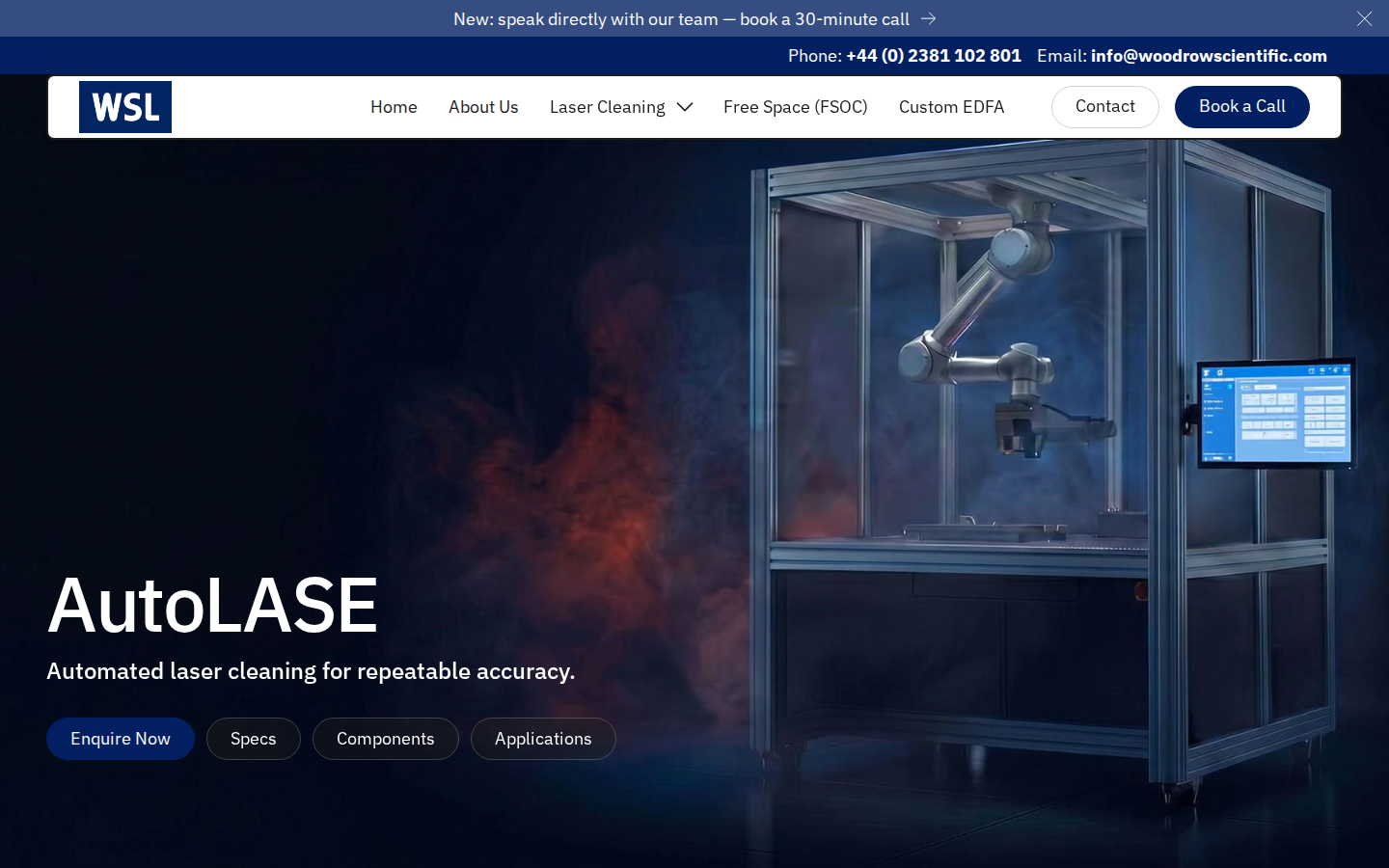
An automated robotic laser paint stripping and cleaning system from the UK's only in-house laser cleaning manufacturer — built for high-volume production environments where the same part needs to be cleaned to the same standard, cycle after cycle. Load the part; AutoLASE's 3D machine-vision software scans it, maps it, and generates the cleaning path automatically, with no programming or technical skills required.
Pros:
Load-and-go 3D machine vision — no programming required
Optional RHZ upgrade — enclosure-free operation
European cost leader; strong TCO case
UK in-house manufacturer; CE and UKCA certified
Cons:
Fixed system — not suited to on-site use
Contact-for-quote pricing only
Where the ELASER serves buyers who need to move the laser to the work, AutoLASE is built for the opposite problem: high volumes of the same part, cleaned to the same standard, cycle after cycle, with minimal operator involvement.
The target applications are production environments — automotive engine and driveline components, EV battery parts, aerospace turbine blades and vanes, injection and tyre moulds, and remanufacturing batches — where throughput and consistency matter more than portability.
Just Load the Part — AutoLASE Does the Rest
The defining characteristic of AutoLASE is not that it is automated — other robotic laser cleaning systems can run programmed cleaning paths too. What sets it apart is that no programming is required at all: load the part, and the system's 3D machine-vision software scans it, builds a 3D map of the surface, and generates the cleaning path automatically.
No knowledge of part geometry, no path-setting, no technical skills needed. Any operator can load a part and start a cycle — making AutoLASE genuinely accessible in a way that conventional automated laser cleaning systems are not.
Optional RHZ Upgrade: Automated Cleaning Without an Enclosure
AutoLASE can be configured with WSL's Reduced Hazard Zone (RHZ) technology, upgrading it to a Class I eye-safe system that requires no enclosure whatsoever.
No other automated laser cleaning system in the world offers enclosure-free operation — this RHZ technology is developed and supplied exclusively by Woodrow Scientific Limited, making it a genuinely unique capability for production buyers where floor space, integration complexity, or workflow flexibility are constraints.
The key specifications and evaluation axes for AutoLASE are summarised below.
| Criterion | AutoLASE Detail |
|---|---|
| Power output | Up to 300 W pulsed fibre laser, tunable 0–100% |
| Laser type | Pulsed fibre laser — beam stops at base material, minimal substrate loss |
| Form factor | Laser head on articulated robotic arm — multi-axis reach for complex 3D parts |
| Portability | Fixed / production-line system — not portable or handheld |
| Best for | Repetitive high-volume production cleaning: automotive, aerospace, moulds, remanufacturing |
| Laser class | Class IV standard; Class I with optional RHZ upgrade |
| Certifications | CE and UKCA certified |
| Manufacture | Made in Britain — Woodrow Scientific Limited |
| Pricing | Contact for quote |
Provides a scannable, structured overview of AutoLASE's core evaluation axes — matching the declared framework used across all entries on this page.
AutoLASE attaches to the customer's existing collaborative or industrial robots, or can be supplied as a complete custom cell — WSL offers bespoke engineering and integration support for buyers with specific production requirements.
It is worth noting that AutoLASE is a fixed system: buyers who need on-site deployment or flexible location use should refer to the ELASER covered in Product 1 above.
AutoLASE Manufacturer: Woodrow Scientific Limited
AutoLASE is designed, built, and supported entirely in-house by Woodrow Scientific Limited — the only UK-based laser cleaning manufacturer, founded in 2012, with over 200 years of combined engineering experience across its team.
A significant share of laser cleaning machines on the market are imported and rebadged by resellers with no in-house engineering capability — which translates to slower spares, limited technical support, and no genuine path for product improvement. WSL's fully in-house model is a meaningful structural difference, particularly for production buyers who depend on uptime.
AutoLASE Pricing
AutoLASE is priced on a contact-for-quote basis, and is competitively positioned as the European cost leader among comparable industrial laser cleaning systems.
For production buyers evaluating total cost of ownership, the relevant comparison is not upfront price alone: zero consumables, automated labour savings, and consistent cleaning quality that reduces rework and unplanned downtime all contribute to a compelling long-term cost case.
Product 3
cleanLASER CL-series — Clean-Lasersysteme
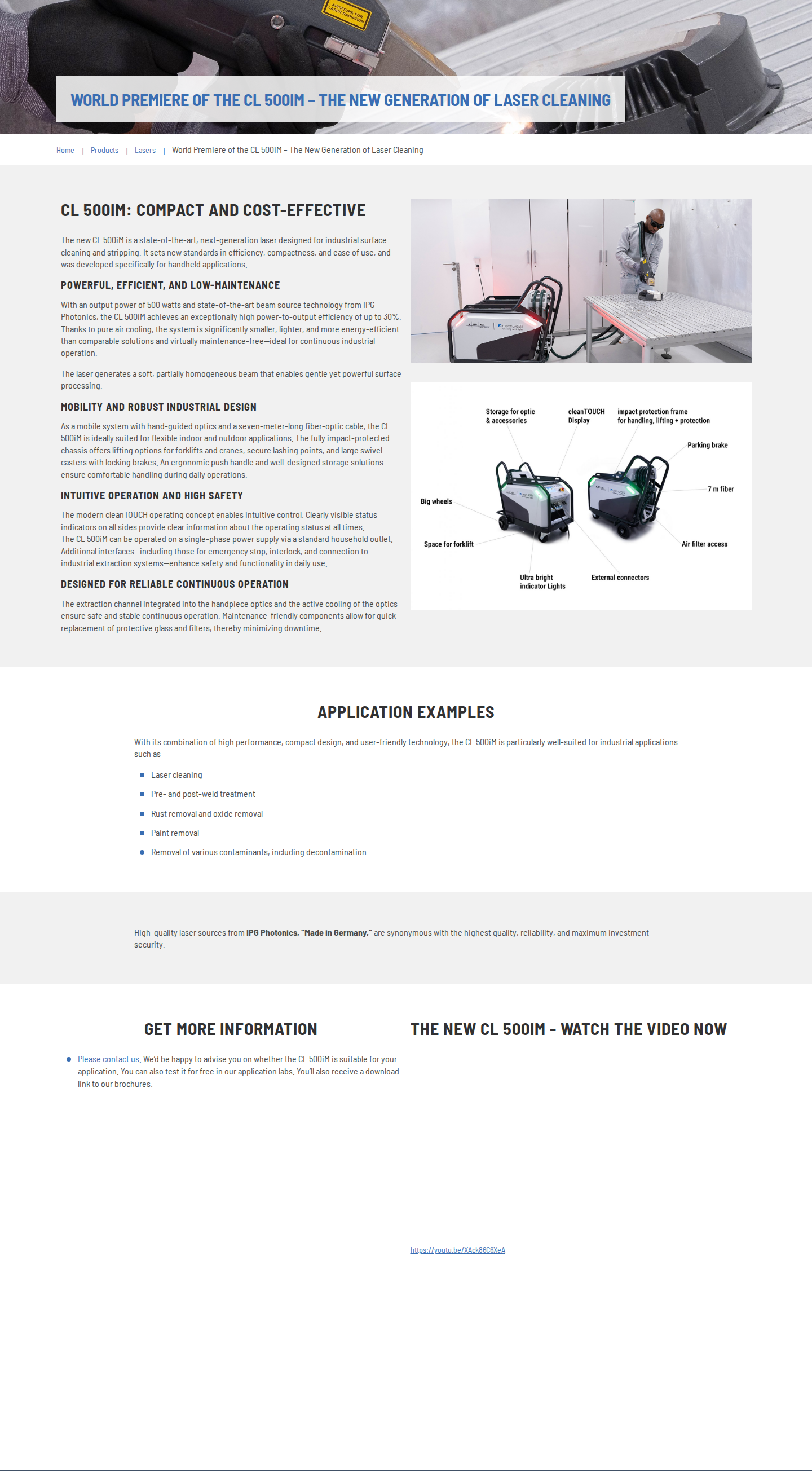
A portfolio of portable and high-power CW laser cleaning systems from a German pioneer with approximately 2,000 installations worldwide — best suited to buyers who need a broad power range (150 W to 1,700 W), proven industrial heritage, and wide application coverage across automotive, aerospace, and heavy-structure paint stripping.
Pros:
Pioneer of commercial laser cleaning since 1997
150 W to 1,700 W CW — workshop to industrial
~2,000 global installations; founded by Fraunhofer ILT alumni
CL 500iM: 500 W air-cooled handheld, single-phase supply
Cons:
CW output — higher thermal risk on sensitive substrates
Conventional Class IV — no RHZ capability
CL 2000: three-phase power and external chiller required
From approx. €40,000 — contact cleanLASER for pricing
Founded in Herzogenrath, Germany in 1997 by alumni of the Fraunhofer Institute for Laser Technology, Clean-Lasersysteme is widely recognised as a pioneer and leader in industrial laser cleaning — with approximately 2,000 systems installed worldwide and a customer base spanning automotive, aerospace, industrial, and medical sectors.
In 2024, IPG Photonics — cleanLASER's beam source supplier for nearly 25 years — acquired the company for approximately $75 million, a move that further underscores cleanLASER's established position in the market.
The CL-series is the right choice for buyers who prioritise a large proven install base, deep engineering heritage, and a power range broad enough to cover everything from workshop-scale component cleaning through to large-area industrial decoating at scale.
CL-Series Power Range and Specifications
The portable CL-series spans a wide output range, giving buyers a single product family that scales from bench-level cleaning work through to demanding field stripping of heavy steel structures.
| Model | Power (CW) | Cooling | Power Supply | Weight | Portability |
|---|---|---|---|---|---|
| CL 150 – CL 600 | 150 – 600 W | Diode-pumped; air or water | Varies by model | Mobile cabinet | Wheeled; field-deployable |
| CL 500iM | 500 W | Air-cooled only | Single-phase (standard outlet) | Mobile cabinet | Wheeled; 7 m fibre |
| CL 1000 | 1,000 W | Air or water | 3-phase, 400 V | ~490 kg | Mobile cabinet; three-phase required |
| CL 2000 | 1,700 W | Water (external chiller required) | 3-phase, 400 V | 460 kg | Not practically portable |
Gives buyers a clear, scannable comparison of the CL-series models across the key evaluation axes — power, cooling, portability, and power supply — so they can self-select the right tier without reading through all the prose.
Across the mid-power range (CL 150 to CL 600), the systems use a wheeled cabinet form factor designed for field deployment — suited to work that moves around a facility or between sites.
At the high-power end, the picture changes: the CL 2000 weighs 460 kg, requires a three-phase supply and an external water chiller, and is not practically portable in any conventional sense — it is a high-throughput industrial unit designed for large-area stripping where it can be positioned and left in place.
The New CL 500iM: Next-Generation Handheld
The CL 500iM is cleanLASER's current flagship for continuous industrial handheld use, and it represents a meaningful step forward in the portable tier.
- 500 W output, air-cooled: Delivers 500 W of continuous laser power with pure air cooling — no water circuit required, which simplifies on-site deployment and reduces maintenance overhead.
- IPG Photonics beam source: Uses a state-of-the-art IPG Photonics beam source, achieving up to 30% power-to-output efficiency — a meaningful figure for continuous industrial operation.
- 7-metre fibre cable: A 7 m fibre-optic cable gives the operator comfortable reach around large components without repositioning the cabinet.
- Single-phase power supply: Operates from a standard single-phase outlet — no three-phase infrastructure required, which broadens the range of sites where it can be deployed without electrical modification.
For buyers who need a capable, modern handheld laser paint stripping machine for sale that can run continuously in industrial conditions without the infrastructure demands of the high-power range, the CL 500iM is the natural starting point in the cleanLASER portfolio.
Laser Type, Hazard Zone, and Key Trade-offs
The entire CL-series operates on continuous wave (CW) output — an important characteristic to understand in the context of the evaluation criteria established earlier in this guide.
CW delivery is well-suited to heavy industrial stripping of robust steel structures where throughput is the dominant requirement: sustained energy output drives high decoating rates on thick coatings and large surface areas.
The trade-off is thermal: because energy is delivered continuously rather than in nanosecond pulses, CW systems carry greater risk of heat build-up on thermally sensitive substrates — aluminium alloys, thin-gauge steel, CFRP, and similar materials where substrate integrity is critical.
On hazard zone, the CL-series operates with a standard Class IV nominal hazard zone — the conventional classification for the large majority of laser cleaning machines on the market. Areas must be controlled during operation, and appropriate laser safety measures apply. There is no eye-safe or reduced-hazard-zone capability in this product line.
Buyers who have weighed the RHZ capability discussed in the ELASER-RHZ entry will understand what this means operationally: standard Class IV requires controlled areas and laser safety management, which adds overhead in open or shared workspaces.
cleanLASER CL-Series: Paint Stripping Applications
The CL-series covers a broad range of paint stripping and decoating applications, verified across cleanLASER's own application pages.
- Partial paint stripping of metallic components: Precise selective decoating of specific areas — eliminating the need for masking, including weld seam decoating prior to NDT inspection.
- Large-area complete paint removal: High-power units designed for large-area stripping of steel structures including ships, bridges, and heavy industrial equipment.
- Aerospace and aviation: Partial paint stripping without damage to sensitive base materials; surface preparation for bonding and ground contacting; CFRP mould cleaning.
- Automotive and electromobility: Series production pre-treatment and surface preparation in premium vehicle manufacturing, including electromobility applications.
Pricing for industrial laser cleaning systems in this category starts from approximately €40,000 — contact cleanLASER directly at cleanlaser.de for current CL-series pricing, model availability, and regional support options.
Product 4
P-Laser QF-Compact series — P-Laser
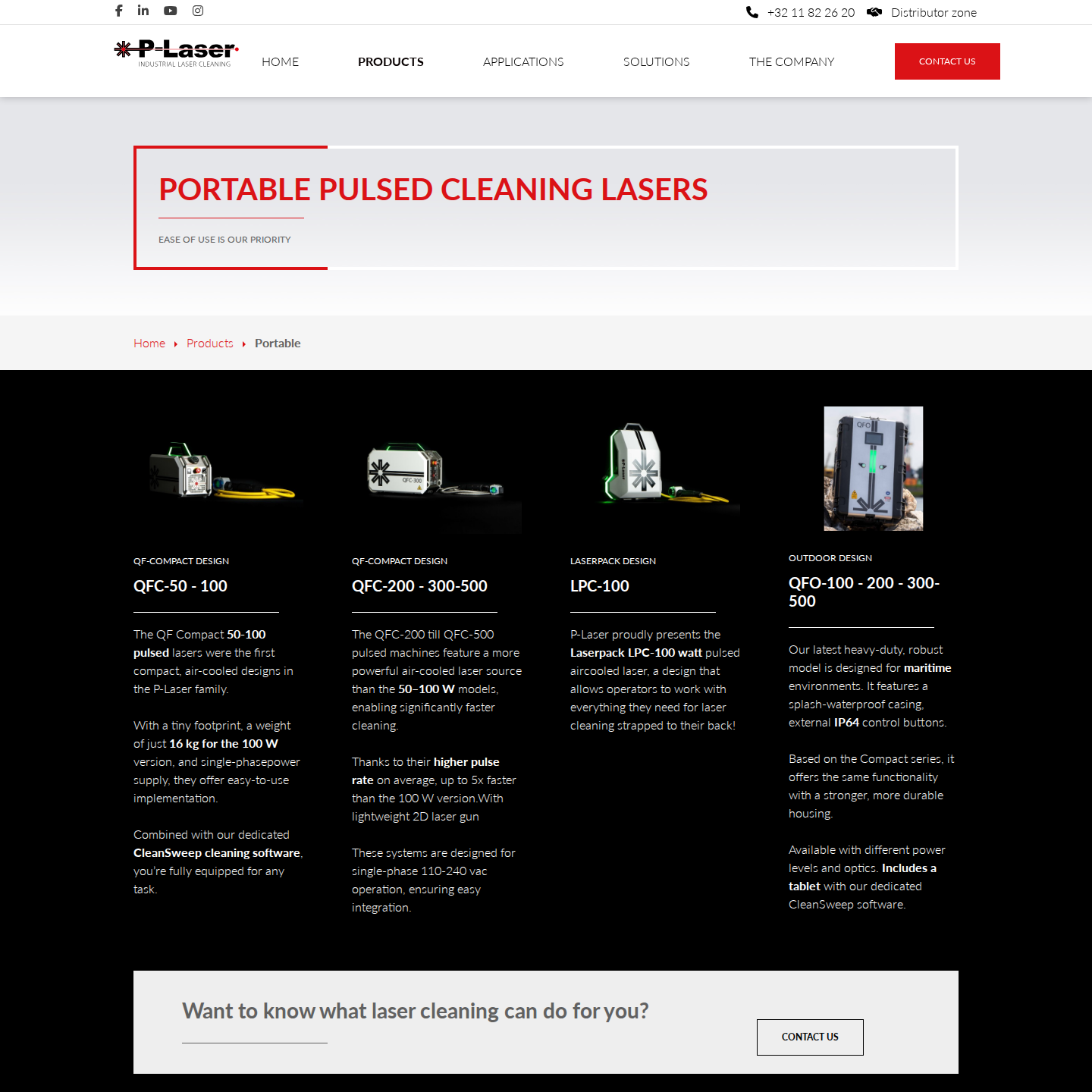
A pulsed portable laser cleaning system from a Belgian manufacturer with over 15 years of dedicated laser cleaning experience — best suited to buyers who want a proven, air-cooled unit from a genuine specialist, with a wide power range from 50 W to 300 W and a rental fleet available for project-based or trial use.
Pros:
Pulsed laser — precise coating removal, substrate protection
50 W to 300 W across four portable models
Genuine manufacturer — 8 patents, founded 2008
Rental fleet from approx. €550/day (QFC-100)
Cons:
Carry-the-whole-unit design — heavier than fibre-fed scanners
Conventional Class IV — no RHZ capability
Purchase pricing unlisted — direct enquiry required
P-Laser is a genuine manufacturer — not a reseller or importer — that develops and produces its own pulsed laser systems from its headquarters in Heusden-Zolder, Belgium.
The company began in 2008 as a division of an established industrial cleaning business, became independent in 2012, and has since built a portfolio backed by 8 patents.
That heritage matters when evaluating a laser paint stripping machine for sale: buyers are dealing directly with the engineers who designed the system, not a third party intermediary.
| Criterion | QF-Compact Detail |
|---|---|
| Power range | 50 W to 300 W pulsed (QFC-50 through QFC-300); broader P-Laser family reaches 3000 W |
| Laser type | Pulsed — adjustable pulse width and frequency; high peak power with substrate protection |
| Portability / weight | 13 kg (QFC-50/100); 30–35 kg (QFC-200/300); carry-the-whole-unit design |
| Cooling | Air-cooled across the portable line — no external chiller required |
| Hazard zone | Conventional Class IV — standard laser safety controls and PPE required |
| Pricing model | Rental fleet available; purchase pricing on application (contact P-Laser) |
Quick-reference evaluation framework applied to the QF-Compact series, consistent with the declared criteria used across all entries on this page.
The QF-Compact series spans four models — QFC-50, QFC-100, QFC-200, and QFC-300 — covering 50 W to 300 W of pulsed output, all air-cooled and designed to be carried to the workpiece.
For buyers who may need to scale beyond the portable tier, P-Laser's wider product family extends from 50 W up to 3000 W across trolley, inline, cube, and custom-made lines — all pulsed.
The pulsed architecture is central to P-Laser's positioning: high peak power is delivered in controlled bursts, with adjustable pulse width and frequency, enabling precise coating removal without transferring damaging heat to the underlying substrate.
This makes the QF-Compact a considered choice wherever substrate integrity is a priority — think paint removal ahead of welding or rebonding, mould cleaning in food or aerospace production, or surface preparation on materials that would not tolerate sustained thermal load.
QF-Compact Portability: What the Design Means in Practice
The QF-Compact is genuinely portable: air-cooled, self-contained, and requiring no external chiller or water circuit.
The QFC-50 and QFC-100 weigh approximately 13 kg each, with dimensions of 485 x 225 x 330 mm — compact enough to carry to a job site or position close to the workpiece.
The QFC-200 and QFC-300 are heavier at 30–35 kg, which places them at the upper boundary of practical one-person carry; these models are better suited to jobs where the machine can be positioned and left in place.
The portability model here is worth understanding clearly: the QF-Compact carries the entire machine as a single unit, rather than splitting into a remote cabinet and a lightweight handheld scanner on a long delivery cable.
Neither approach is inherently superior, but the distinction is practical: a fibre-fed scanner system lets the operator move a sub-3 kg handpiece across a large structure while the main unit stays fixed up to 50 m away; the QF-Compact brings the whole machine to the work, which suits confined or multi-location jobs where running long cables is the bigger problem.
For maximum mobility, P-Laser offers the Laserpack LPC-100W — a backpack-mounted variant that puts everything the operator needs on their back.
Optic choices across the range include the 2D miniscan and the PX-2D, and the system ships with a tablet running P-Laser's dedicated Cleansweep software for job selection and parameter control.
A startup cycle of approximately 10 seconds and a laser source rated for over 40,000 hours without service keep operational overhead low — a relevant factor in total cost of ownership.
P-Laser QF-Compact Applications
The pulsed portable format is a natural fit across a broad set of surface cleaning tasks.
- Paint and coating removal: Layer-by-layer or full removal from metals, plastics, ceramics, stone, and concrete — including pre-weld and pre-bond surface preparation.
- Rust and oxide removal: Precision descaling from metal surfaces without abrasive media or chemical waste streams.
- Mould cleaning: Rubber, plastic, glass, and composite moulds — including food industry and aerospace wing mould applications.
- General industrial surface cleaning: Oil, dust, and contamination removal across a wide range of materials where substrate damage from conventional methods is a concern.
P-Laser also notes that its systems have been deployed in specialist sectors including nuclear, shipbuilding, and food processing — a breadth of application that reflects the flexibility of the pulsed approach.
On laser safety: the QF-Compact operates as a conventional Class IV laser system, meaning a standard nominal hazard zone applies. Standard area controls, appropriate PPE, and trained operators are required — there is no eye-safe or reduced-hazard-zone capability in this range.
P-Laser QF-Compact Pricing
P-Laser operates what it describes as the largest rental fleet in the European laser cleaning market, which gives buyers a low-commitment route to evaluating the technology before purchasing.
Per P-Laser's published rental fleet pricing, the QFC-100 is available at approximately €550 per day, €1,430 per week, or €4,950 per month; the QFC-200 runs at €750/day, €1,980/week, or €7,400/month; and the QFC-300 at €950/day, €2,350/week, or €9,700/month.
Rental includes free training on safety, machine use, and maintenance — a meaningful inclusion for teams new to laser cleaning.
Purchase pricing for the QF-Compact series is not publicly listed; contact P-Laser directly at sales@p-laser.com for a current quote.
UK buyers can reach P-Laser through its UK distributor, LaserAge, based in Salford, Manchester (+44 161 818 9197). Buyers should confirm current UK availability and any compliance requirements directly with LaserAge or P-Laser.
Product 5
Netalux Needle — Netalux
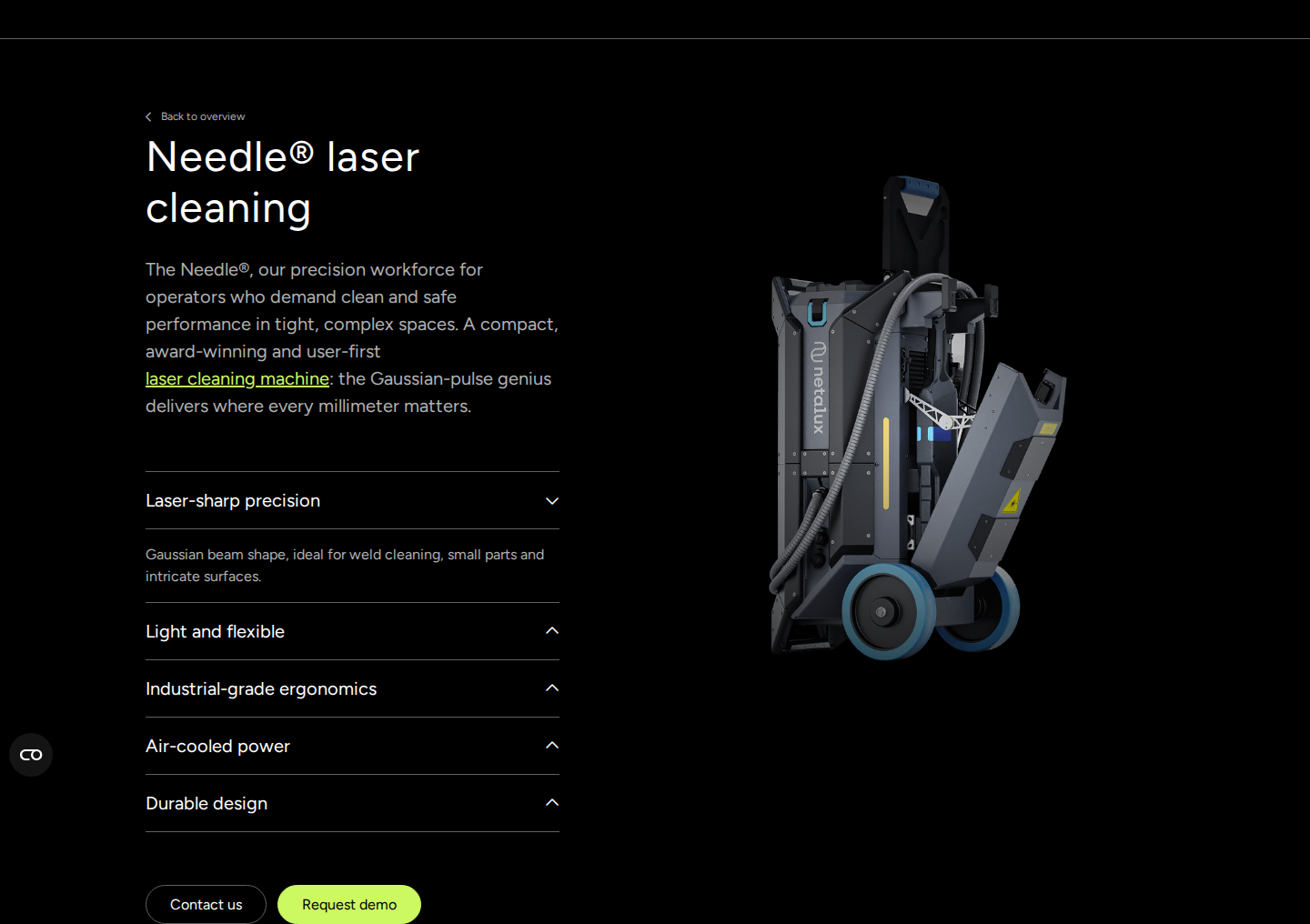
A Belgian-designed pulsed fibre laser cleaning machine distinguished by three consecutive Red Dot Design Awards for ergonomics, available from 100W to 300W in air-cooled portable form — best suited to operators who prioritise ease of deployment, reduced fatigue, and precise paint stripping on small-to-medium components.
Pros:
Three consecutive Red Dot Design Awards (2020–2023)
Pulsed fibre laser — precise removal, substrate protection
In-house manufacturer; ISO 9001, CE, CSA, UL certified
Cons:
Short fibre reach: 4.5m (100/150W) and 5.7m (200/300W)
Conventional Class IV — no eye-safe cleaning capability
Jango models require water cooling and three-phase power
The Netalux Needle is the machine on this list most deliberately engineered around the operator rather than the output spec sheet — and three consecutive Red Dot Design Awards (2020, 2022, 2023) are the evidence.
"Each detail of this laser cleaning device was carefully conceived and ergonomically designed in order to achieve the greatest possible user-friendliness."
Practically, this translates to a 115° rotatable laser head, an ambidextrous handset with integrated controls, and large wheels that give the unit genuine manoeuvrability on industrial floors and in confined spaces.
For operators running long shifts or repositioning the machine frequently, these details reduce fatigue in ways that a raw wattage figure cannot capture.
Power Range and Model Options
The Needle range covers 100W, 150W, 200W, and 300W — all pulsed, all air-cooled, and all running from a standard single-phase supply (110–240V).
This positions the Needle squarely in the light-to-medium industrial cleaning bracket: paint stripping on automotive components, aviation parts, food-processing equipment, and precision metalwork where controlled, selective removal matters.
Buyers needing more power can step up to the Jango — Netalux's larger machine, available at 500W, 1000W, and 2000W — which uses water cooling and three-phase power for heavier industrial throughput.
Gaussian vs Top-Hat: Choosing Between Needle and Jango
The Needle uses a Gaussian beam profile, which concentrates energy at a central point — making it well-suited to precise, small-area cleaning, intricate surfaces, and the removal of thick or adherent coatings.
The Jango uses a Top-Hat profile, which distributes energy evenly across the beam footprint — better for covering larger surface areas efficiently, such as tank cleaning or broad coating removal.
The practical choice between them comes down to task geometry: if you are stripping paint from small components or working in tight spots, the Needle's Gaussian profile gives you precision; if you need to cover large flat surfaces at speed, the Jango's Top-Hat profile is the more efficient tool.
Needle and Jango: Model Specs at a Glance
The table below compares key specifications across the Needle and Jango variants, drawn from Netalux's official brochure and product pages.
| Spec | Needle 100/150W | Needle 200/300W | Jango 500/1000W |
|---|---|---|---|
| Laser type | Pulsed fibre (Class IV) | Pulsed fibre (Class IV) | Pulsed fibre (Class IV) |
| Beam profile | Gaussian | Gaussian | Top-Hat |
| Cooling | Air-cooled | Air-cooled | Water-cooled |
| Unit weight | ~20 kg | ~40 kg | ~850 kg |
| Handset weight | ~2.3 kg | ~3 kg | ~4 kg |
| Fibre length | 4.5 m | 5.7 m (mobile) | 45 m |
| Power supply | 1-phase, 110–240V | 1-phase, 110–240V | 3-phase, 380–440V |
| Max pulse energy | 1 mJ | 2 mJ | 100 mJ |
Allows readers to compare Needle and Jango variants side-by-side across the specs most relevant to a purchase decision — power, weight, cooling, fibre reach, and beam profile.
Portability and Fibre Reach
The Needle 100/150W unit weighs approximately 20kg; the 200/300W model is approximately 40kg — both air-cooled and compact enough to deploy without a transport case.
The fibre reach is a meaningful constraint: 4.5m on the 100/150W and 5.7m on the 200/300W mobile variant — significantly shorter than fibre-fed systems that can deliver the laser over 45m of cable.
Buyers who need to work at distance from the unit — reaching across a large vehicle, a structural beam, or a fixed installation — will find this limiting and should factor it into their decision.
Hazard Zone
The Needle operates as a Class IV laser with a conventional hazard zone — standard PPE and controlled-access working areas are required, as with most industrial laser cleaning systems.
There is no eye-safe or reduced-hazard-zone capability on the Needle or Jango range.
Manufacturer Provenance and After-Sales Support
Netalux is headquartered in Beringen, Belgium, and designs, engineers, and assembles every machine in-house — with no rebadging or outsourced manufacture.
The company holds ISO 9001 certification and its products are CE and CSA compliant, FDA performance standards compliant, and UL compliant.
Named regional contacts cover Belgium, France, Germany, Italy, and Switzerland, with a certified distributor network reaching the Balkans and Australia; Netalux also has a US office in Chicago.
No UK-specific distributor was identified in available source material — buyers in the UK should contact Netalux directly at info@netalux.com to confirm availability and local support.
Netalux's service model includes remote troubleshooting, hands-on guidance, fast spare parts delivery, and a training platform (Netalux Academy) — with free firmware and performance updates included.
Applications
The Needle's pulsed output and Gaussian precision make it a practical choice for paint stripping tasks where surface integrity matters — automotive components, aviation parts, and pharmaceutical or food-industry equipment where substrate damage is not acceptable.
- Compatible materials: Stainless steel, aluminium, copper, other metals, plastics, and wood.
- Target sectors: Automotive, aviation, food processing, petrochemical, and pharmaceutical industries.
- Task fit: Ideal for small-to-medium parts, intricate surfaces, weld cleaning, and selective paint or coating removal where precision matters more than coverage speed.
Netalux Needle Pricing
Netalux does not publish list pricing for the Needle range — contact Netalux directly (info@netalux.com or via netalux.com/contact) for a quote specific to your power level, configuration, and location.
The Needle is the strongest choice for buyers who move their machine frequently, work in tight or awkward spaces, or need to reduce operator fatigue across long shifts. Its award-winning design is a practical differentiator, not just a trophy. The short fibre reach (4.5–5.7m) is the key trade-off to weigh: buyers who need to work at distance from the unit, or cover large structures, should consider whether the Jango's 45m fibre reach better suits their application.
Conclusion
Which laser paint stripping machine is right for you?
The fork is straightforward: if you need to bring the laser to the work — on-site, in open workshops, across varied jobs — ELASER-RHZ leads that category; if you're running high-volume production where the same part repeats cycle after cycle, AutoLASE is built for exactly that.
Buyers widening their shortlist will find cleanLASER and P-Laser are the established European benchmarks worth comparing against.
Whichever machine you shortlist, the most revealing question you can put to any vendor is simple: who designed it, who built it, and who will fix it?
Laser paint stripping: frequently asked questions
Common buyer questions about how laser paint removal works, its real-world trade-offs, and what it costs.
Yes — for the vast majority of industrial and commercial paint stripping applications, laser paint removal works extremely well. Pulsed laser systems deliver energy in nanosecond bursts, vaporising the coating before heat has time to diffuse into the substrate beneath. The paint is ablated, not ground or chemically dissolved, which is why the base material is left intact. The process is effective across a wide range of substrates: steel, aluminium, cast iron, copper, stone, concrete, and masonry. Speed does vary — a lower-power system on thick epoxy paint will clean more slowly than a higher-power system on a thin primer coat. Coating type, thickness, and power output all influence throughput. But the fundamental question of whether the technology works is settled: laser paint stripping is in active industrial use across automotive, aerospace, heritage conservation, and infrastructure applications.
There are four genuine trade-offs worth knowing before purchasing. Higher upfront capital cost is the most significant: laser systems cost considerably more to buy than sandblasting or chemical stripping equipment. That gap narrows substantially over a 3–5 year horizon once consumables, waste disposal, and rework are factored in, but the initial outlay is real. Operator training and laser safety compliance add overhead: Class IV laser systems require trained operators, written standard operating procedures, appropriate protective eyewear, and controlled-area protocols — all of which carry an organisational cost. Fume extraction is required: laser ablation vaporises the coating, producing fumes and fine particulate that must be captured by a dedicated extraction system. Speed on very large-area robust steel can be a limitation at the extreme end of the scale — where substrate protection is not the priority, high-volume grit blasting can achieve higher throughput on massive exposed structures. For most precision, heritage, or production-line applications, none of these trade-offs outweigh the advantages of zero consumables, no chemical waste, and substrate-safe removal.
There are two distinct cost questions: the machine purchase price and the ongoing operating cost. Upfront, industrial laser paint stripping machines typically start from around €40,000 for entry-level portable systems, rising to €250,000–€500,000 or more for high-power or fully automated cells — the wide range reflects the variety of power levels, cooling configurations, and integration requirements. Contact manufacturers directly for current pricing on specific configurations. Operating costs are very low. Electricity is the primary input; there are no abrasive media, no chemicals, and no hazardous waste disposal costs. Published cost data indicates operating costs of under €1 per hour for electricity and consumable wear parts. Over a 3–5 year horizon, the total cost of ownership is typically lower than sandblasting or chemical stripping once consumables, waste disposal, labour, and rework are factored in. The laser carries the highest Year 1 cost; from Year 2 onwards it is generally the most economical option for facilities with meaningful annual cleaning volumes.