
Introduction
If you're reading this, you've almost certainly moved past the question of whether laser paint removal works — you're trying to figure out whether it's the right fit for your operation, your substrate, and your budget.
This guide covers the full picture: how the technology works at a process level, the three main tool categories and where each one makes sense, how laser stacks up against the methods you're likely using now, the industries where it's earned a foothold, and what to look for when you're ready to buy or specify.
The aim throughout is to give you the grounded, honest assessment that's harder to find than it should be — the kind that helps you make a good decision, not just a purchase.
TL;DR
Choosing the right laser tool isn't just about wattage — it's about understanding which machine category suits your application, what the real-world trade-offs are against traditional methods, and what ownership actually costs once it's on your floor.
This article covers:

How laser ablation works and why it matters for tool selection
Handheld, fixed industrial, and robotic tool categories compared
Laser vs chemical stripping and abrasive blasting
Industry applications: automotive, aerospace, manufacturing, heritage restoration
Buying criteria: specs, supplier type, service, safety
Running costs, safety, and total cost of ownership
What Are Laser Paint Removal Tools?
Most surface stripping methods attack the substrate as much as the coating — they just do less damage to the base material than to the layer being removed. Laser paint removal tools work on a fundamentally different principle: they exploit the fact that paint, rust, and oxide coatings absorb laser energy at a much higher rate than the metal, stone, or masonry beneath them.
At the category level, these are industrial devices that use focused, pulsed laser energy to strip paint, coatings, rust, oxides, and other surface contaminants from substrates — without mechanical contact and without chemical agents.
How Selective Laser Ablation Works
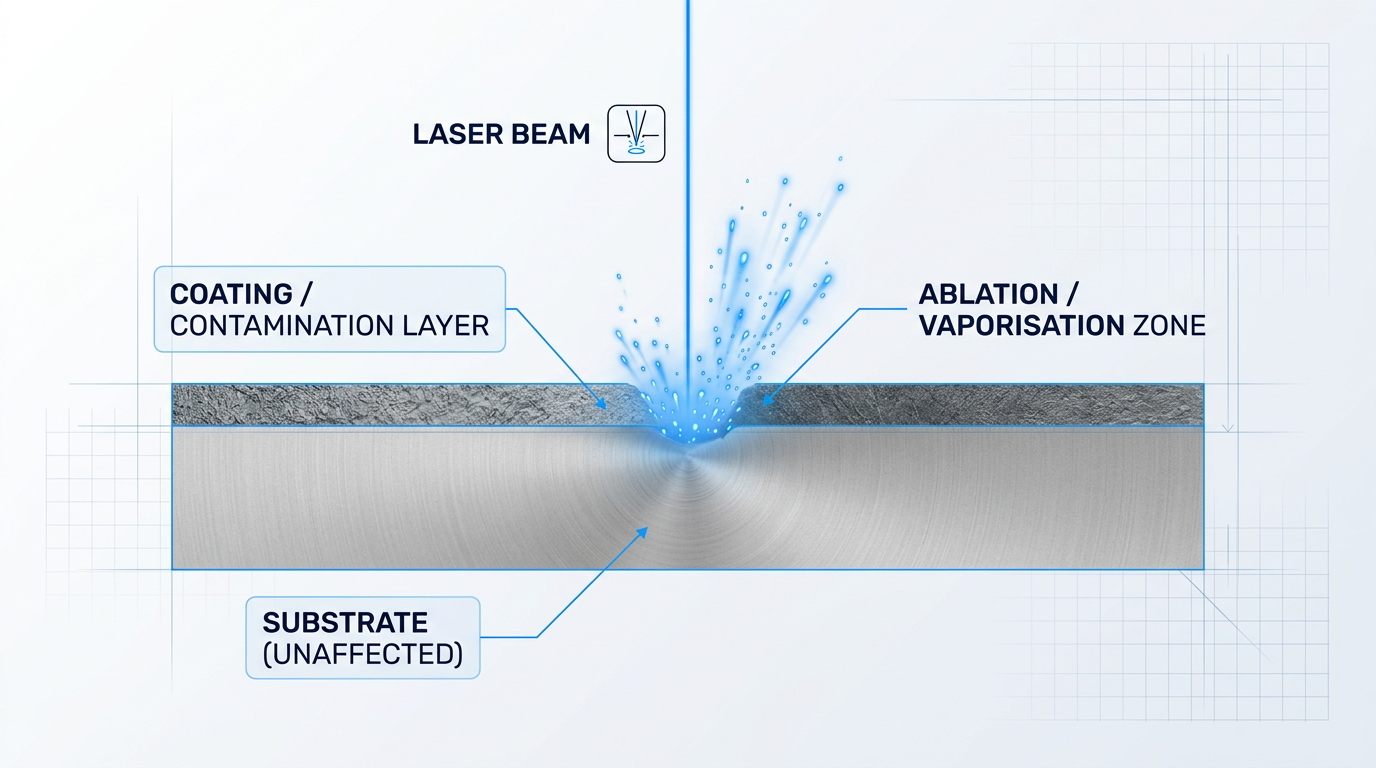
The underlying process is called laser ablation: the conversion of a solid surface material into vapour or ejected particulate under intense laser irradiation.
When a pulsed laser beam strikes a painted or contaminated surface, the coating absorbs the incoming energy far more readily than the substrate beneath it. That absorbed energy converts to heat within nanoseconds, driving rapid thermal expansion and micro-explosive vaporisation — the contamination layer is ejected while the substrate remains largely intact.
Research published in peer-reviewed literature confirms that laser paint removal is dominated by a combination of thermal stress effects, vaporisation, and mechanical action from thermal expansion — with thermal stress identified as the most significant mechanism during controlled removal operations.
The critical buyer-relevant insight is selectivity: the beam preferentially removes the contamination, not the underlying material. Unlike abrasive methods that physically impact the substrate surface, the laser stops where the optical and thermal properties of the material change.
The Process Window: Staying Between Two Thresholds
Effective laser cleaning operates within what practitioners call the process window — the energy range bounded below by the cleaning threshold (the minimum fluence needed to remove the contaminant) and above by the damage threshold (the energy level at which the substrate begins to experience irreversible change).
As AccTek Group's substrate safety analysis describes it: safe and effective laser cleaning occurs only within this narrow region — operating below the cleaning threshold leaves contamination behind, while exceeding the damage threshold causes thermal, mechanical, or chemical degradation of the substrate.
The width of this window varies considerably by material pairing. For surface rust (Fe₂O₃) on carbon steel at 1064 nm nanosecond-pulsed operation, the gap between cleaning onset and substrate damage is wide enough for reliable production use. For thin-walled alloys or sensitive substrates, the window narrows, and coupon testing before production runs becomes mandatory.
This is why parameters like laser power, pulse duration, repetition frequency, and scan speed are not arbitrary settings — they are the levers that keep the process inside the window. Buyers evaluating tools will encounter these specifications; the process window concept is what makes them meaningful.
Laser cleaning does not inherently damage the substrate. When damage occurs, it is almost always the result of operating outside the safe process window — exceeding the damage threshold through incorrect fluence, scan speed, or overlap — not a fundamental limitation of the technology.
Why Pulsed Operation Outperforms Continuous-Wave
Laser sources can operate in two modes: pulsed or continuous-wave (CW). For paint removal, the distinction matters significantly.
Pulsed lasers deliver energy in discrete bursts — in the nanosecond range for most industrial paint removal applications. Because each pulse deposits energy faster than heat can conduct into the substrate, the contamination reaches its ablation threshold and is ejected before meaningful thermal energy transfers to the base material.
CW lasers deliver energy continuously, which means heat accumulates at the surface and conducts into the substrate. According to Laser Focus World's comparative analysis of CW versus pulsed fibre lasers, CW cleaning produces surface roughness approximately 1.5× greater than the original surface, while a MOPA pulsed fibre laser can achieve roughness at or below the pre-cleaning baseline.
The same source reports that cleaning efficiency with a MOPA pulsed fibre laser is 7.7× higher than a CW laser on aluminium alloy dust, and 3.5× higher on carbon steel — using the same average output power.
CW lasers are not without application: for large steel structures with high thermal mass and low surface sensitivity, the lower cost of CW sources can be justified. But for precision cleaning, substrate-sensitive materials, or any application where surface condition post-cleaning matters, pulsed operation is the professional standard.
Why Pulsed Fibre Laser Dominates Modern Tools
Of the available pulsed laser source types, pulsed fibre laser has become the clear dominant choice for modern laser paint removal tools. Three converging advantages explain why.
- Wavelength absorption: The 1064–1070 nm near-infrared range is well absorbed by organic coatings and iron oxides — the most common industrial cleaning targets — while metal substrates reflect a significant portion of the energy.
- Fibre-optic beam delivery: The laser source sits in a wheeled cabinet while the operator works with a lightweight handheld scan head connected by a flexible fibre cable, enabling reach and portability that rigid beam paths cannot match.
- Air-cooled operation: At useful power levels, pulsed fibre lasers can run on air cooling alone, removing the need for a water chiller and the infrastructure dependency that creates on site.
These three properties together explain why fibre laser has displaced earlier source types in the majority of professional laser paint removal tools now on the market. The combination of effective wavelength, flexible delivery, and infrastructure-light operation makes it the practical choice for both workshop and field deployment.
CO₂ and Nd:YAG: Context on Other Source Types
CO₂ lasers operate at 10.6 µm — a wavelength in the long-wave infrared that silica optical fibre cannot transmit, since standard silica fibres strongly absorb wavelengths above approximately 2 µm. This means CO₂ systems cannot use conventional fibre-optic beam delivery and are therefore limited in portability and reach, typically requiring articulated mirror arms or fixed optics.
Nd:YAG lasers (solid-state, pulsed, operating at 1064 nm) were the workhorse of laser cleaning before fibre laser technology matured. They remain in service but are generally bulkier and less power-efficient than equivalent modern fibre laser sources. The 1064 nm wavelength they share with fibre lasers does support silica fibre delivery — but the source technology itself has largely been superseded for new installations.
Neither source type has disappeared entirely, and CO₂ lasers retain specific advantages for certain coating types — particularly white or primer paints where the surface-absorbed 10.6 µm wavelength outperforms near-infrared. But for the broad range of industrial paint and rust removal applications, pulsed fibre laser is the current standard.
Not Laser Cutters or Engravers
Laser paint removal tools are sometimes confused with laser cutters or laser engravers — they are not the same technology. The distinction comes down to power density and intent.
Laser cutters and engravers use tightly focused beams at high power density to cut through or mark the substrate itself — the base material is the target. Laser paint removal tools use controlled, lower power density to ablate only the surface contamination layer, leaving the substrate intact. The contamination is the target; the substrate is what must be preserved.
With the mechanism and source technology established, the next step is understanding how these principles translate into the actual tool categories available to buyers — starting with handheld and portable units.
Handheld and Portable Laser Paint Removal Tools
The most widely deployed laser paint removal tools in the field are not fixed machines bolted to a production floor — they are wheeled, self-contained units that an operator rolls to the job, plugs into a standard socket, and starts working within minutes.
The defining characteristic of this category is operator mobility: the tool travels to the work, not the other way around. A portable unit pairs a compact wheeled chassis with a lightweight handheld scanner connected by a flexible fibre-optic delivery cable, allowing a single operator to clean surfaces across varied locations, elevations, and geometries without any fixed infrastructure.
This stands in direct contrast to fixed industrial machines — where the workpiece is brought to a stationary, high-power cabinet — and to automated cells, where a robot carries the scanning head along a programmed path. In the portable category, the human operator provides the motion and the judgement.
Power Range and What It Means in Practice
Portable units span a meaningful power range, and the choice of power tier shapes what the tool can realistically do on site.
| Power Tier | Typical Applications | Cooling | Indicative Throughput |
|---|---|---|---|
| Sub-100 W (pulsed) | Precision cleaning, heritage restoration, light oxides, mould cleaning, pre-weld prep on thin or sensitive materials | Air-cooled | 0.3–1.0 m²/hr |
| 100–300 W (pulsed) | General industrial paint and coating removal, rust removal, automotive bodyshop, pre-weld surface prep, field maintenance | Air-cooled | 0.5–2.0 m²/hr |
| 300–500 W (pulsed) | Heavier coatings, larger surface areas, higher on-site throughput requirements | Air-cooled (some units); water-cooled chiller required at higher end | 1.0–4.0 m²/hr |
Comparison of portable laser cleaner power tiers against suited applications and cooling requirements, using real published figures from manufacturer sources.
The pattern is clear: as power rises, so do cooling demands. Air-cooled operation — genuinely self-contained, no chiller, no coolant circuit — is well-established up to around 300–500 W across the portable market, but sustained high-duty-cycle use at the top of that range can require cooling pauses or active thermal management.
For most on-site paint and coating removal tasks, the 100–300 W tier delivers a practical balance of throughput and true portability — enough power to clear paint, rust, and oxides at a workable pace, while remaining genuinely self-contained.
Key Form-Factor Considerations for Portable Units
Not all portable units are equally portable in practice. The specification sheet rarely tells the whole story about what it is like to operate a system across a full working day or in a constrained field environment.
- Scanner (handset) weight: Ergonomics matter for sustained use. A handset above 3 kg becomes tiring over a full shift; sub-3 kg is the practical threshold for comfortable single-operator operation.
- System weight and footprint: A wheeled chassis under 50 kg can be moved by one person. Heavier units may need two people or a pallet truck to reposition on site.
- Fibre delivery cable length: Reach is critical for large structures, elevated surfaces, and confined access. Standard cables of 5–15 m limit working radius; longer cables (up to 50 m) dramatically expand deployment flexibility.
- Air vs. water cooling: Air-cooled units are genuinely self-contained — no chiller, no coolant circuit. Water-cooled units add infrastructure and a second piece of equipment that must travel with the system.
- External utility requirements: A truly portable system needs only a standard single-phase power outlet. Any requirement for a compressor, chiller, or specialist supply limits where the tool can actually go.
The fibre cable length deserves particular attention: many portable units on the market ship with cables of 5–10 m as standard, which is adequate for benchtop or workshop use but constrains reach on large structures, ships, bridges, or elevated industrial equipment.
Where Portable Tools Are the Right Choice
The common thread across all suitable applications is deployment flexibility — the buyer needs the tool to work wherever the job is, not in a fixed workshop.
Portable laser paint removal tools are particularly well suited to: on-site industrial maintenance where the asset cannot be moved; automotive bodyshop paint and rust removal across varied panel geometries; heritage and monument restoration in publicly accessible or mixed-use spaces; pre-weld surface preparation across varied field locations; and field maintenance scenarios where abrasive media disposal is impractical, prohibited, or environmentally regulated.
As Laser Focus World notes, laser cleaning is well established across these sectors precisely because it is consumable-free and non-contact — there is no blasting media to contain or dispose of, and no chemical waste to manage, which matters enormously when working on-site or in sensitive environments.
Trade-Offs: What Portable Tools Give Up
Choosing a portable unit is a deliberate decision to prioritise flexibility and reach over maximum throughput — and that trade-off is real.
Portable systems operating in the 100–300 W range deliver indicative throughput of roughly 0.5–2.0 m²/hr on paint and moderate rust, compared to 10–50 m²/hr for high-power fixed installations running at 1,000 W and above.
Operator skill and consistency also matter more in the handheld category: without automated path-generation, the quality and uniformity of the cleaned surface depends on how steadily and consistently the operator moves the scanner. This is not a reason to avoid portable tools — it is a reason to invest in proper operator training.
For buyers whose primary need is on-site flexibility, field access, or mixed-use environments, these are acceptable trade-offs. For buyers running high-volume fixed production lines, a fixed or automated system will deliver better economics — and those categories are covered in the sections that follow.
The ELASER and ELASER-RHZ: A Portable System Built in Britain
Woodrow Scientific Limited's ELASER is a direct representative of this category: a wheeled, air-cooled, single-operator pulsed fibre laser cleaning system delivering up to 300 W of tunable power, designed and manufactured in Britain.
Its ELASER-RHZ variant carries the most significant operational differentiator in the portable laser cleaning market: WSL's patented reduced hazard zone (RHZ) technology, which collapses the laser hazard zone to a fraction of the size produced by a conventional portable laser cleaner.
Conventional portable laser tools require the surrounding area to be evacuated and sealed before work can begin. The ELASER-RHZ's patented technology confines the hazard zone to a small area around the work itself, enabling cleaning in open workshops, mixed-use facilities, and publicly accessible spaces without shutting down the area. It is the only laser cleaner of its kind in the world.
This is not a niche safety feature — it is an operational capability that fundamentally changes where a portable laser cleaner can be deployed. Heritage restoration in a public square, graffiti removal on a busy street, or paint stripping inside an operating facility all become practical without the logistical overhead of area evacuation and controlled-access protocols.
The standard ELASER operates as a Class IV laser system; the ELASER-RHZ achieves Class I classification through the RHZ technology, reflecting the dramatically reduced hazard zone at the point of work.
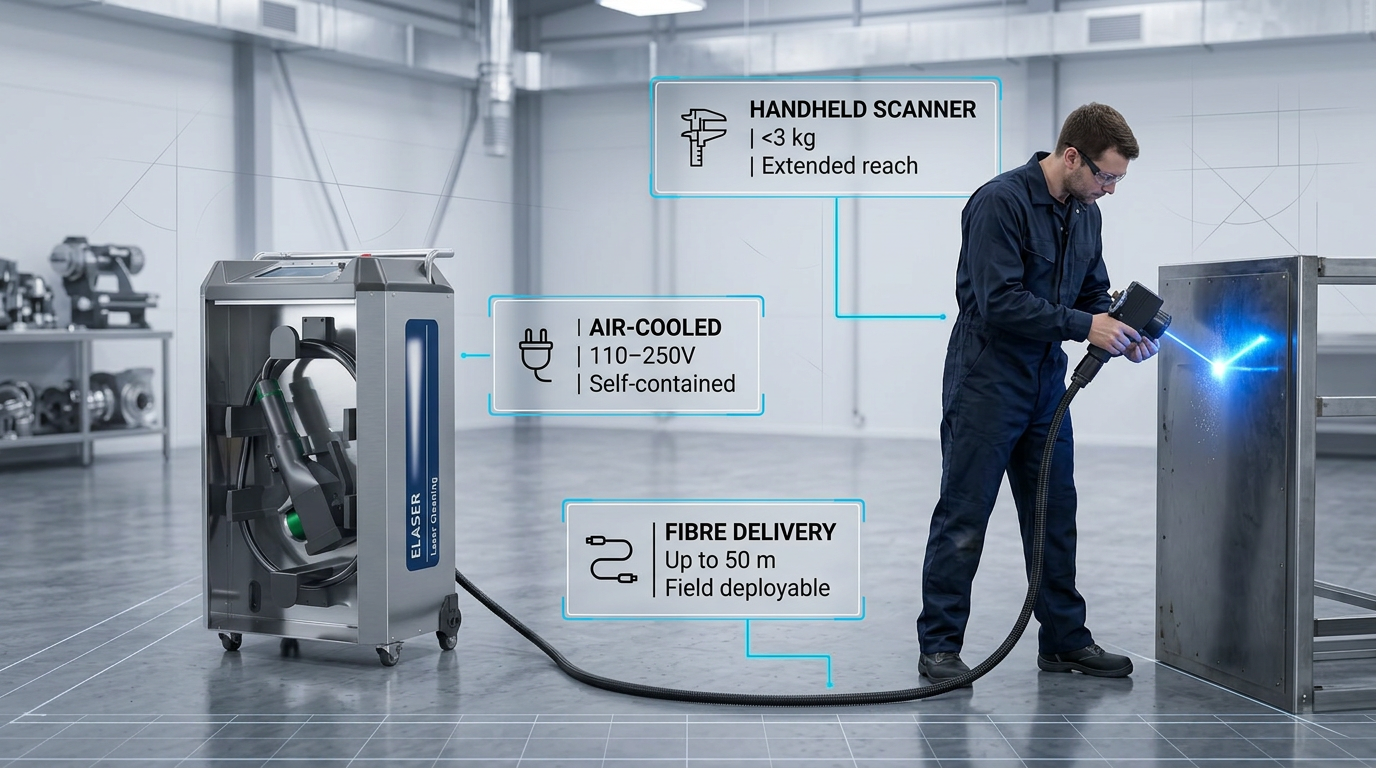
On the form-factor specifics, the ELASER is designed around genuine single-operator practicality: the handheld scanner weighs under 3 kg, the wheeled system comes in under 50 kg, and the delivery cable is available up to 50 m — a notably longer reach than many portable systems on the market, which typically ship with cables of 5–10 m as standard.
The system is air-cooled throughout — no water, no chiller, no coolant circuit required — and operates from a standard 110–250 V single-phase supply, meaning it can be deployed wherever there is a standard power outlet.
Power is fully tunable from 0–100% of the rated 300 W output, allowing the operator to dial in the right energy level for the specific coating and substrate — from lifting light oxides through to removing thick industrial paint and coatings. Scan shapes are fully programmable through a touchscreen GUI with password-protected access and per-user logins.
The system is CE and UKCA certified, Made in Britain, and comes with access to WSL's first-class laser cleaning safety and operation training. Bespoke engineering and customisation options are also available for buyers with specific application requirements — WSL encourages interested parties to get in touch directly to discuss what is possible.
WSL is the only UK-based laser cleaning manufacturer, having designed, built, supported, and continuously improved its own machines in-house since 2012, drawing on over 200 years of combined engineering experience across its team. This matters in a market where a significant proportion of suppliers are importers or resellers rebadging third-party machines — a model that has direct consequences for technical support quality, spare parts availability, and the capacity to genuinely improve the product over time.
The ELASER and ELASER-RHZ are competitively priced among comparable industrial laser cleaning machines, a position WSL achieves through its technological and operational efficiencies rather than through any compromise in build quality or capability.
The portable category covers a wide range of applications and buyer profiles — but when the requirement is on-site flexibility combined with the ability to work in open or mixed-use environments, the ELASER-RHZ addresses a constraint that no other portable laser cleaner on the market currently solves.
The next section moves to a fundamentally different configuration: fixed industrial laser cleaning systems, where the workpiece comes to the machine, power levels climb well beyond what portable air-cooled units can sustain, and throughput takes priority over deployment flexibility.
Fixed Industrial Laser Cleaning Systems
Where portable laser paint removal tools prioritise flexibility — rolling to the job, plugging in, moving on — fixed industrial systems invert the relationship entirely: the machine stays put, and the work comes to it.
That shift in operational mode unlocks a significant jump in power. Fixed industrial laser cleaning systems typically operate in the 500 W to 3 kW range, compared to the sub-300 W ceiling of most portable units.
Higher power translates directly into operational outcomes: faster area coverage on large-area jobs, the ability to remove thicker or more tenacious coatings in fewer passes, and sustained throughput that portable systems simply cannot match across a full production shift.
That power increase comes with an infrastructure consequence. Air cooling — sufficient for portable units running up to around 200–300 W — cannot dissipate the heat generated at these higher power levels during sustained operation.
Above roughly 500 W, water cooling becomes necessary: either via an integrated chiller unit built into the system cabinet, or via connection to an external cooling circuit. This is not an optional upgrade at this power tier; it is a functional requirement.
Practically, this means a fixed industrial system requires a dedicated installation footprint — space for the laser source, the control cabinet, and the chiller — plus a plumbed water supply or a self-contained chiller unit. That infrastructure dependency is what most clearly separates this category from portable air-cooled tools.
Configurations: Trolley-Mounted and Production-Line Integrated
Fixed industrial systems come in two primary configurations, each suited to a different operational context.
- Trolley-mounted high-power units: The laser source sits on a wheeled platform within the facility. A fibre-optic cable — up to 50 m in some systems — delivers the beam to a scanning head that the operator positions over the work.
- Rack-mounted or inline systems: The laser source is built into a fixed station on a manufacturing line, with parts fed through the cleaning zone via conveyor, rotary table, or semi-automated fixture.
The trolley-mounted configuration offers reach within a large workshop without the system being truly portable — the laser stays in the building, but the long fibre delivery cable means the operator can work around large structural components or fabricated assemblies.
The rack-mounted or production-line integration configuration is the natural step toward fully automated operation: parts move through a defined cleaning station, and the laser cleans at the speed of the line.
Where Fixed Systems Are the Right Choice
The common thread across all suitable applications is scale and repeatability: a volume of work that justifies a fixed installation, and workpieces that can realistically be brought to the machine.
- Large-area paint stripping: Structural components and large fabricated parts benefit from the higher scan rates and sustained power that fixed systems deliver across extended surface areas.
- Mould and tooling cleaning: Moulds brought to a workshop cleaning station can be processed without chemical stripping agents, preserving surface integrity and avoiding mould damage.
- Pre-weld surface preparation: High-volume production lines use fixed laser stations to remove oxides, coatings, and contamination from weld zones immediately before joining operations.
- Heavy industrial maintenance: Large components — castings, tooling, industrial machinery parts — that can be transported to a workshop are well suited to fixed high-power cleaning stations.
In each of these applications, the volume and regularity of cleaning work justifies committing to a fixed installation rather than relying on a portable unit that would need to be repositioned repeatedly across a large facility.
Fixed industrial laser systems deliver the area coverage and coating removal speed that production environments demand — but that capability is inseparable from water cooling, a dedicated installation footprint, and the constraint that work must come to the machine.
The central trade-off is straightforward: fixed systems offer power and throughput that no portable unit can match, but they are only viable when the workpiece can be moved to them — they are not suited to on-site field maintenance, in-situ structural work, or any application where the asset cannot be transported to a workshop.
For operations where even manual operation needs to be removed from the equation entirely, or where throughput requirements push beyond what a staffed cleaning station can sustain, the next category of laser paint removal tools — automated and robotic systems — represents the logical progression.
Automated and Robotic Laser Cleaning Systems
The progression from portable tools to fixed industrial systems removes the operator from the floor — but they are still in the cleaning loop, directing the laser head on every pass. Automated and robotic laser cleaning systems take the final step: the operator loads the part, initiates the cycle, and the machine executes the entire clean.
That shift matters because manual laser cleaning introduces variability that is difficult to eliminate — scan speed, angle, overlap, and dwell time differ between operators, and even between cycles by the same operator.
For applications where cleaning quality directly affects what happens next — weld porosity, bond strength, coating adhesion, dimensional tolerance — that variability is not acceptable. Automated systems deliver a repeatable cleaning standard on every cycle, which makes them non-negotiable in high-volume production and safety-critical environments.
Two Approaches to Automated Laser Cleaning
Not all automated laser cleaning systems work the same way, and the distinction between the two dominant approaches has real consequences for how a system fits into your operation.
The conventional approach is the programmed path system: a technician defines the cleaning path for each part geometry by programming robot waypoints, scan patterns, and laser parameters for each part type.
Once programmed, the system runs that path repeatably — which is exactly what high-volume production of identical parts requires. The trade-off is upfront engineering effort: each new part geometry needs its own programming cycle, and changing parts means reprogramming.
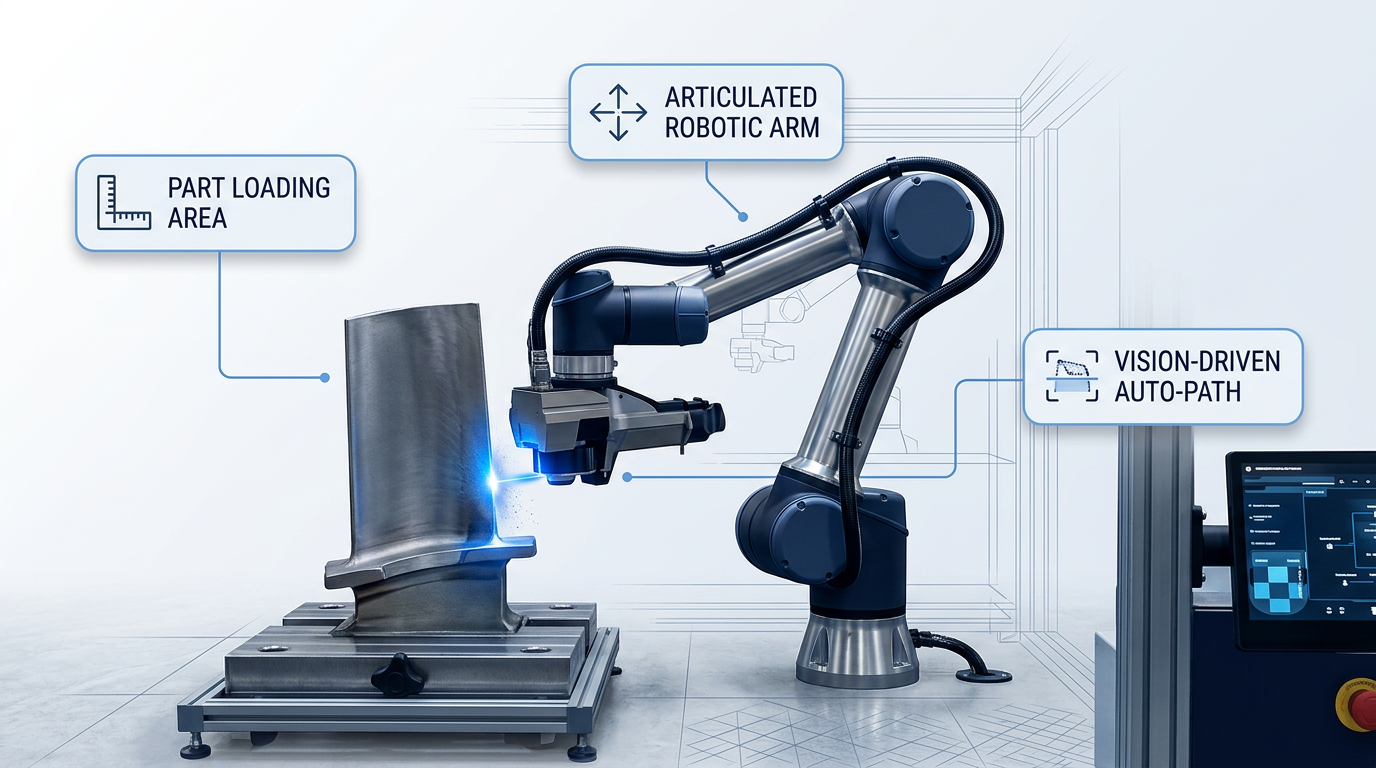
The alternative is a vision-driven system: instead of following a pre-set path, the machine scans the part using machine vision, builds a geometry map, and generates the cleaning path automatically — with no manual programming, no path-setting, and no prior knowledge of the part required.
- Programmed path: Technician defines waypoints and scan patterns per part type. Highly repeatable once set up; requires engineering investment for each new geometry.
- Vision-driven (auto-path): Machine scans the part, builds a geometry map, and generates the clean path automatically. No programming needed; handles varied or irregular geometries.
For buyers, the practical question is volume versus variety: programmed-path systems suit dedicated production lines running the same part repeatedly; vision-driven systems suit environments where part geometry varies, batches are mixed, or the engineering overhead of per-part programming is a genuine constraint.
AutoLASE: Load the Part, the System Does the Rest
Our AutoLASE system is built around the vision-driven approach, and its defining characteristic is how easy it is to operate: load the part, and the system's 3D machine vision software scans it, builds a 3D map, and generates the clean automatically.
There is no manual programming, no path-setting, and no knowledge of part geometry required — anyone can load a part and run a cycle, regardless of whether that geometry has ever been seen by the system before.
The laser head is carried on a multi-axis articulated robotic arm, reaching the angles and contours of complex 3D parts with the same precision on every cycle. Power is tunable from 0 to 100% on a fibre laser rated up to 300 W, spanning everything from light oxides to thick coatings across metals, stone, and masonry.
Where most automated laser cleaning cells on the market require a full enclosure to contain the laser hazard zone, AutoLASE can be configured with WSL's eye-safe Reduced Hazard Zone (RHZ) technology — enabling it to operate with no enclosure at all.
For facilities where floor space is limited, layout is constrained, or the shutdown logistics of an enclosed cell are a genuine operational burden, this enclosure-free capability changes the deployment calculus entirely.
No other supplier offers eye-safe, enclosure-free automated laser cleaning. AutoLASE is the only system that removes both the operator from the cleaning loop and the enclosure from the facility footprint — a combination unavailable anywhere else in the market.
On integration, the system works with a customer's existing collaborative or industrial robots, or can be supplied as a complete custom cell — whichever fits the facility and workflow.
WSL designs, builds, and supports AutoLASE entirely in-house — not a reseller — which matters specifically for automated systems where integration, commissioning, and ongoing support are more complex than for portable tools.
A meaningful portion of the market for automated laser cleaning consists of resellers and importers rebadging third-party machines, which tends to mean slower spares, weaker engineering support, and no genuine ability to improve the product. WSL is the only UK-based laser cleaning manufacturer, and that in-house capability is a practical advantage for buyers who need real support after commissioning.
The system is CE and UKCA certified, Made in Britain, and backed by first-class safety and operation training. For buyers with specific integration or customisation requirements, WSL's bespoke engineering capability is worth a direct conversation.
Where Automated Laser Cleaning Makes the Most Sense
The applications that suit this category are those where cleaning quality is a process-critical variable and volume or part variety makes manual operation impractical.
High-volume automotive production is a natural fit: engine components, driveline parts, and EV battery components all require consistent oxide removal and surface preparation for welding and bonding, part after part, to a standard that manual cleaning cannot reliably hold.
Aerospace surface preparation is another core application — turbine blades, vanes, and structural components cleaned and prepped to tight tolerances, where cycle-to-cycle consistency is a qualification requirement, not a preference.
Injection mould cleaning benefits from automation because moulds accumulate release agents, polymer deposits, and carbonised residue that must be removed without disassembly or abrasive contact — automated laser cleaning handles this without wearing down mould cavity geometry.
Remanufacturing and refurbishment batches are also well served: varied worn components arriving in mixed condition need consistent contamination removal before rebuild, and a vision-driven system handles that variety without reprogramming between parts.
Evaluating Automated Systems: Think in Total Cost
Automated laser cleaning systems require a higher capital investment and more integration effort than manual tools — that is simply the nature of the category, and any honest evaluation should account for it.
The right comparison horizon, however, is multi-year: zero consumables, automated labour savings, consistent throughput, and reduced rework from minimal substrate damage all compound over time in ways that a day-one invoice comparison does not capture.
Assess on total cost of ownership, not upfront cost — and factor in the integration support you will need post-commissioning, which is where the distinction between in-house manufacturers and resellers becomes financially relevant.
With all three tool categories now mapped — portable, fixed industrial, and automated — the next step is placing laser removal in evaluative context against the traditional methods it competes with directly.
See Automated Laser Cleaning in Action
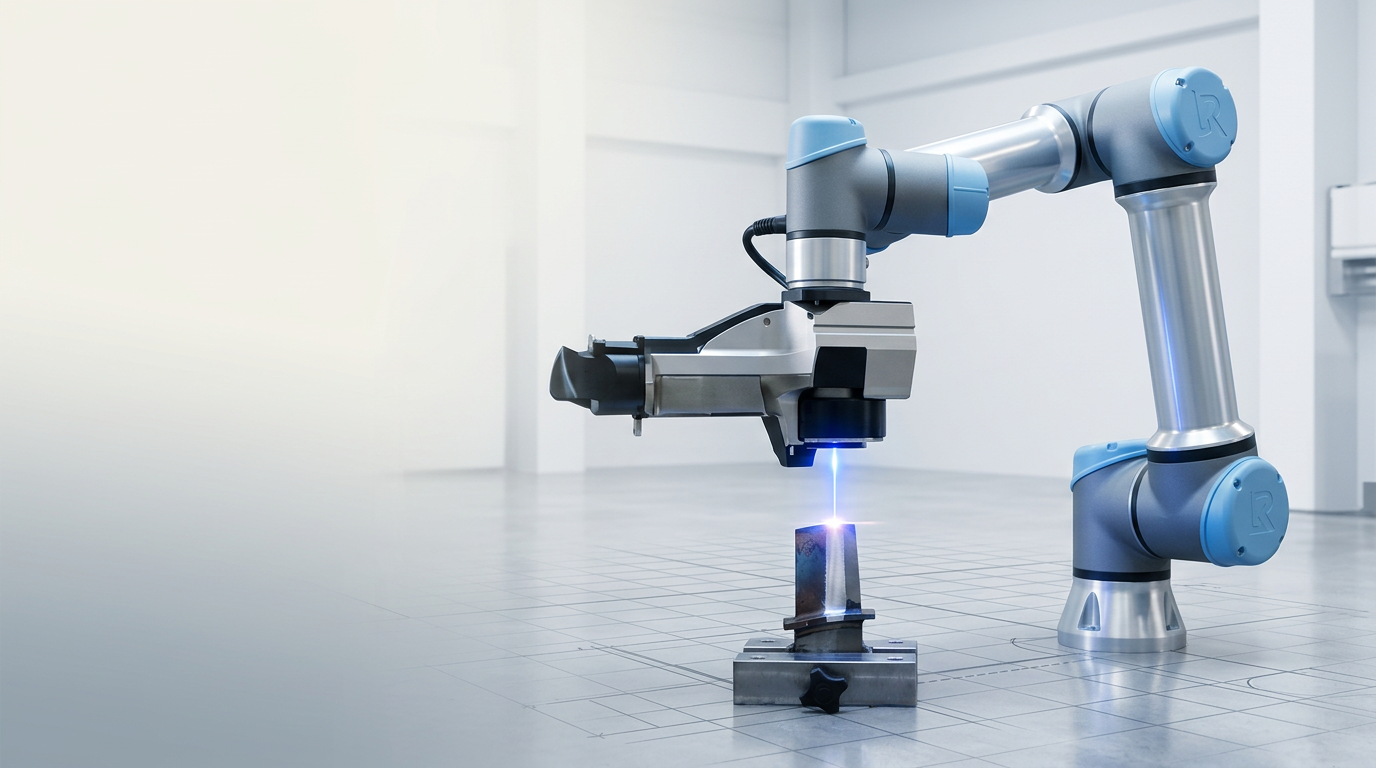
The AutoLASE is a fully automated laser cleaning machine built for high-throughput production environments. Explore its specifications and see how it fits your operation.
Laser vs Traditional Paint Removal: An Honest Comparison
The instinct when evaluating any new cleaning technology is to compare sticker prices. It is the wrong question. A laser paint removal system costs more to acquire than a blast pot or a drum of chemical stripper — that much is true. But the procurement decision that actually matters is: what does this method cost to run over three, five, or ten years, and is it operationally viable in my specific context? Total cost of ownership (TCO) and operational fit are the correct evaluative axes. Upfront capital cost is just the entry fee.
With that framing established, the comparison across six key dimensions tells a clear — though not unconditional — story.
Substrate Safety: Where Laser Has No Equal
Laser cleaning removes only the contamination layer. Because the base material reflects or conducts the laser energy away once the coating is gone, the process is inherently self-limiting — the beam stops interacting aggressively with the surface the moment it reaches bare substrate.
Abrasive blasting and sandblasting work differently: the media physically strikes both the contaminant and the substrate simultaneously, creating surface roughening, dimensional change, and potential fatigue introduction on precision parts. A blasted surface has approximately 30% more surface area than an unblasted one — useful when you need an anchor profile for coating adhesion, but destructive when tolerances must be held or when the original surface texture is irreplaceable.
Chemical stripping risks substrate etching and grain raising on porous or reactive materials. On complex historic metal castings, complete chemical residue removal is often impossible without mechanical scrubbing that itself risks damage. For precision aerospace components, heritage surfaces, or tooling where substrate integrity is non-negotiable, the substrate safety axis alone can be decisive.
Precision: A Categorically Different Capability
Laser is the only method in this comparison capable of selective layer removal at micron-level precision — removing a specific coating layer while leaving what is beneath it completely intact. You can remove a topcoat while leaving primer undisturbed. You can clean a defined zone on a multi-layer coating system without touching adjacent areas.
Sandblasting has no meaningful selectivity: it removes material indiscriminately across whatever surface the media reaches. Chemical stripping offers limited selectivity depending on the chemical compatibility of different coating layers, but cannot approach the positional and depth precision of a correctly parameterised laser. For any application where selective removal matters, laser is not merely better — it is the only viable method.
Environmental Impact: Structurally Cleaner
Laser cleaning produces only dry particulate, captured by fume extraction. There is no liquid waste stream, no chemical effluent, and no spent abrasive media to manage.
The contrast with traditional methods is significant. According to EPA documentation, chemical stripping generates large quantities of contaminated wastewater classified as hazardous under RCRA (the Resource Conservation and Recovery Act) — liquid waste containing high levels of toxic organic chemicals and paint sludge requiring specialist disposal and licensed carrier collection. Sandblasting generates spent abrasive media that, where the stripped coating contains lead-based paint or heavy metal coatings, becomes classified hazardous waste with specific disposal requirements under EPA guidelines. The EPA has documented that blast technologies using expendable media generate excessive waste in the form of lead-based paint chips mixed with substantial volumes of spent abrasive grit.
Laser cleaning's waste stream — a small volume of captured dry particulate from the fume extraction filter — is categorically simpler and less costly to manage than either alternative.
Consumable Costs: A Structural Difference
Laser cleaning's recurring costs are electricity and occasional replacement of inexpensive protective lens elements. No abrasive media to purchase. No chemical supply chain. No hazardous waste disposal contracts. This is not just a feature — it is a structural difference in the cost model.
Sandblasting carries ongoing media purchase costs (steel grit, garnet, glass bead) plus disposal costs that accumulate with every hour of operation. Chemical stripping adds chemical supply, replenishment, rinse materials, waste disposal fees, and compliance costs on top. The compounding effect means that laser's TCO advantage widens over time even when its upfront capital cost is substantially higher.
Laser cleaning's near-zero consumable cost means the correct comparison is never day-one equipment price — it is multi-year operational cost including consumables, compliance overhead, and substrate rework. For frequent precision cleaning work, that calculation typically favours laser well within the first few years of operation.
Speed: An Honest Assessment
Laser cleaning is faster than chemical stripping on most jobs. Chemical stripping requires dwell time (30 minutes to several hours depending on the coating and chemistry), followed by scraping, neutralisation, and wash-off. Laser acts immediately, with no waiting and no post-process cleanup — the total job time is typically 2 to 4 times shorter than chemical stripping on equivalent areas, based on published process data.
Against abrasive blasting, the picture is more nuanced. For post-weld HAZ cleaning, mould cleaning, and precision parts, laser is typically faster and more practical. However, on very large-area, low-precision structural steel work — bridge steelwork, large vessel hulls, infrastructure — high-power abrasive blasting can cover more surface area per hour than a portable or fixed laser system. That throughput advantage is real, and it is worth stating plainly.
The honest summary: laser is faster for most industrial cleaning tasks; abrasive blasting retains a throughput advantage specifically on bulk structural stripping at scale.
Safety Overhead: All Methods Have Requirements
None of these methods is safety-free. The relevant question is not whether safety controls are required, but what form they take and how they affect operational deployment.
- Laser cleaning: Laser-rated eye protection matched to operating wavelength, a controlled nominal hazard zone, operator training, and fume extraction during operation.
- Abrasive blasting: Full respiratory protection against silica dust (OSHA PEL: 50 µg/m³ as an 8-hour TWA under 29 CFR 1926.1153/1910.1053), hearing protection, and dust containment infrastructure.
- Chemical stripping: Chemical handling qualifications, adequate ventilation (mechanical ventilation required for DCM-based strippers), waste-water management, and compliance with COSHH or equivalent regulations.
The safety profiles differ in character rather than severity. Laser's hazard is laser radiation — well-understood, controllable with engineering measures, and confined to the operating zone. Sandblasting's primary hazard is respirable crystalline silica, a serious inhalation risk that OSHA's 2016 final rule specifically tightened controls around. Chemical stripping's hazards include solvent fumes, chemical burns, and VOC emissions — with specific substances such as DCM (dichloromethane) now restricted under REACH Annex XVII Entry 59 for professional use across the EU.
Where Traditional Methods Retain Genuine Ground
An honest comparison acknowledges the cases where traditional methods remain competitive. There are two specific contexts where the calculus genuinely favours the alternatives.
Large-area, low-precision structural steel work — bridge steelwork, large vessel hulls, major infrastructure — is where abrasive blasting's area rate and lower capital cost may still represent the more cost-effective choice, particularly where a specific anchor profile (such as Sa 2.5 per ISO 8501-1) is required by the coating specification and where established blast room infrastructure is already in place.
Small intricate parts that fit fully inside a dip tank may suit chemical immersion, particularly where the part geometry makes surface-scanning with a laser beam slow or impractical — deep crevices, inside narrow channels, complex castings where every recess needs full-surface contact. For high-volume batch descaling of fasteners or fittings, immersion processing is typically more efficient than scanning each piece individually.
These are genuine trade-offs. Acknowledging them is not a concession — it is the basis for making a well-grounded procurement decision rather than a faith-based one.
The Regulatory Trajectory
For buyers making a capital investment decision with a 10–15 year horizon, one additional factor warrants attention: the direction of travel in regulation affecting traditional methods.
REACH restrictions on hazardous chemicals (including the DCM restrictions in Annex XVII Entry 59, now part of consolidated REACH legislation), tightening VOC emission limits under the EU Industrial Emissions Directive and equivalent UK frameworks, and OSHA's 2016 tightening of the permissible exposure limit for respirable crystalline silica to 50 µg/m³ — all of these are increasing the compliance cost and operational complexity of chemical and abrasive methods year on year.
Laser cleaning, classified as a clean process with no chemical inputs and no hazardous media, is structurally unaffected by these regulatory trends. The compliance risk profile of the two traditional methods is rising; laser's is not. Buyers should verify their specific compliance position with appropriate professional guidance rather than relying on any general summary — but the directional regulatory trend is clear and consistent across multiple jurisdictions.
With the method comparison established across substrate safety, precision, environmental impact, consumable cost, speed, safety overhead, and regulatory trajectory, the next question is where these advantages play out in specific industry contexts — and which sectors have moved furthest in adopting laser paint removal tools as a result.
Where Laser Paint Removal Tools Earn Their Keep
Understanding how laser ablation works is one thing — understanding where it solves a problem that nothing else can is what separates an evaluating buyer from someone still browsing. Each application vertical below has a specific constraint that drove adoption: a tolerance that cannot be compromised, a geometry that cannot be reached, a substrate that cannot be touched, or an environment where conventional methods simply cannot operate.
Automotive
On a modern production line, pre-weld surface preparation is one of the most demanding cleaning tasks laser tools are asked to perform — and one where their selectivity advantage is most visible.
The challenge is removing coatings, oxides, and shop primer from precisely defined weld and bonding zones on painted or coated panels, without disturbing the surrounding surface or requiring masking operations. Abrasive methods cannot achieve that spatial control; chemical stripping cannot be applied and contained to a 20 mm strip without labour-intensive masking that introduces its own error rate.
Laser tools solve this by directing the beam only where joining will take place, vaporising the coating selectively and leaving adjacent areas untouched. On high-volume lines, this process is typically integrated into automated cells — the laser head traverses the weld zone at several metres per minute, delivering a clean, oxide-free surface ready for welding or adhesive bonding with no manual intervention between steps.
In the bodyshop environment, the challenge shifts from precision to operational cleanliness. A finishing shop cannot afford abrasive media in the air or on surfaces — even trace contamination from blast media can compromise paint adhesion on adjacent panels.
Chemical stripping is equally impractical here: dwell times, neutralisation steps, and disposal of spent stripper add overhead that a bodyshop workflow cannot absorb. Laser's no-media, no-chemical, no-masking operation fits naturally into this environment — rust and paint are removed, fumes are extracted, and the operator moves on without residue to manage or media to clear away.
A fast-growing third application within the automotive vertical is EV battery component cleaning, driven directly by the shift to electrification. Oxide and contamination removal from battery cell terminals, busbars, and housing surfaces is critical before wire bonding and welding steps — residual oxides, grease, or dust at the bonding interface cause porosity defects and scrap that are costly to rework at the module level.
The precision and substrate-safety that laser ablation provides make it well-suited to this task: the laser selectively removes contamination from terminal surfaces without mechanical contact, without chemicals, and without risk to the cell structure itself. This is still an emerging application relative to traditional automotive cleaning, but it is increasingly specified by Tier 1 OEMs as battery production volumes scale.
Aerospace
Aerospace is the vertical where the consequences of substrate damage are most severe, and where laser ablation's core property — stopping at the base material — is not a convenience but a technical requirement.
Turbine blades, vanes, engine components, and airframe structures are manufactured to extremely close dimensional tolerances. Any cleaning method that removes material from the substrate itself — abrasive blasting, mechanical grinding — introduces dimensional change that can affect aerodynamic performance, fatigue life, or the integrity of cooling passages. Laser ablation removes coatings and deposits without altering the substrate geometry, making it the technically correct answer for high-value aerospace components.
In maintenance and overhaul (MRO) contexts, the ability to strip selectively by layer is particularly valuable. Removing a degraded topcoat while preserving an intact primer is not possible with chemical stripping — which removes all organic layers down to bare metal regardless. Laser tools can be tuned to ablate the topcoat at one fluence setting and stop, leaving the primer adhesion qualification intact and avoiding the cost of full recoating.
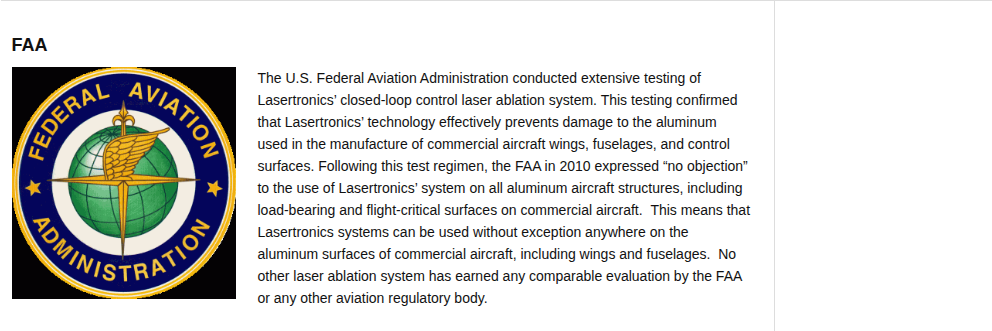
The regulatory landscape has also moved in laser ablation's favour. Following extensive testing, the FAA expressed no objection in 2010 to the use of Lasertronics' closed-loop laser ablation system on all aluminium aircraft structures — including load-bearing and flight-critical surfaces on commercial aircraft. The U.S. Navy's Fleet Readiness Center East has similarly tested laser cleaning technology on aircraft components to remove corrosion and hazardous coatings, with procurement planning underway. FAA-qualified laser ablation is now an established alternative to chemical stripping in aircraft depainting, not an experimental one.
Manufacturing: Moulds and Tooling
If there is one application where laser cleaning delivers an operational advantage that genuinely surprises manufacturing buyers, it is mould cleaning — specifically, the ability to clean a mould without removing it from the press.
The challenge in tyre manufacturing is the build-up of vulcanisation residues and release agents inside the mould after each cycle. Left uncleaned, these residues cause surface blemishes and defects on finished tyres. Conventional cleaning methods — sandblasting, dry ice blasting, chemical cleaning — all require the mould to be removed from the press, cooled, cleaned, and reinstalled, introducing significant downtime and handling overhead.
Modern tyre moulds compound the problem further. Spring vents and fine sidewall surface textures that create tread patterns and branding detail are damaged by abrasive blasting media, which clogs the vents and degrades the structured surface with each cleaning cycle. Chemical methods cannot reach into complex undercuts and fine geometries without risk of residue contamination.
Laser cleaning addresses both constraints simultaneously. The laser removes vulcanisation residue and release agents without contacting the mould surface — the ablation threshold of the mould metal is far higher than that of the residue, so the process cleans selectively and stops at the metal without wear. Critically, the process works equally well on cold and hot moulds, which means the mould does not need to be removed from the press at all: laser cleaning can be performed in-situ, with the mould still installed, cutting cleaning downtime to a fraction of what conventional methods require.
Because laser cleaning works on hot moulds in-situ, tyre manufacturers can clean between production runs without removing the mould from the press — eliminating the disassembly, cooling, and reinstallation overhead that makes conventional mould cleaning a significant production bottleneck.
The same logic applies to injection moulds for plastic components, where release agent build-up in fine cavity detail degrades part quality over time. Laser cleaning reaches into complex geometries that abrasive methods cannot access without surface damage, making it applicable across a wide range of precision tooling.
Heritage Restoration
Heritage conservation presents a constraint that no other application vertical shares: irreversibility. You cannot undo damage to a bronze sculpture, a carved stone monument, or a gilded Renaissance panel. The cleaning method must be right the first time, every time.
Aggressive cleaning methods — pressure washing, abrasive blasting, chemical stripping — risk destroying original patina, eroding surface texture, and damaging the substrate material itself. For stone monuments, black crust and soiling sit directly above patina layers that are part of the object's historical identity; removing them indiscriminately causes irreversible loss. As ICCROM documents, laser cleaning has become an increasingly used conservation technique precisely because its tunability allows the operator to lift soiling while preserving the surface layers beneath.
For indoor applications — museum metalwork, bronze sculptures, painted wood objects — laser cleaning allows conservators to work at a resolution of individual layers, removing dirt or overpaint without disturbing underlying original material. For outdoor applications — monument façades, masonry, historic metalwork — the same selectivity enables targeted cleaning of graffiti and pollution deposits without sandblasting away the stone surface texture that gives the object its character.
Outdoor heritage work creates a deployment challenge that is distinct from any industrial setting. Standard laser tools operating at Class 4 output levels require the working area to be evacuated and secured before operation — a practical requirement in a factory or workshop, but an impractical one when the work is on a publicly accessible monument or building façade. This constraint creates a genuine requirement for reduced-hazard-zone capability: tools designed to operate safely without sealing off a public space, enabling cleaning work to proceed in accessible environments without the logistical overhead of full area evacuation.
Industrial Maintenance
Beyond the specific verticals above, general industrial maintenance represents the broadest application territory for portable laser paint removal tools — and the one where the consumable-free, media-free properties translate most directly into operational simplicity.
The challenge in plant and infrastructure maintenance is straightforward: the work cannot come to the machine. Structural steelwork, pipework, machinery housings, and plant equipment need to be cleaned where they stand. Bringing abrasive blasting equipment to site creates a media management problem — blast media must be contained, collected, and disposed of, which is a significant logistical overhead in an active plant environment. Chemical stripping on-site introduces disposal obligations and dwell-time constraints that maintenance schedules rarely accommodate.
Portable laser tools eliminate both problems. The operator rolls the unit to the job, cleans the surface in place, and leaves — no media to sweep up, no chemical residue to neutralise, no masking required on surrounding surfaces. For maintenance teams responsible for large facilities with diverse cleaning needs across multiple asset types, this operational simplicity has real value that goes beyond the technology comparison.
With a clear picture of where these tools perform — and what specific capabilities each application demands — the natural next question is how to evaluate and specify the right tool for your context. That is where the buying criteria come in.
What to Look for When Buying a Laser Tool
You now understand the technology, the tool categories, and how laser stacks up against the alternatives. What you need next is a framework for the supplier conversation — the questions that separate a well-specified purchase from an expensive mistake that suppliers are rarely in a hurry to prompt you to ask.
Power and Tunability
Wattage is the first number every supplier leads with, but it is not the most important question to ask. The more meaningful specification is whether the machine offers tunable power across its full range — typically 0 to 100% — within a single unit.
Light oxide removal and precision work on delicate substrates suit lower output, generally in the sub-200 W range; thick coatings, large surface areas, and high-throughput production runs require more power. A machine locked to a fixed output forces you to buy a second system the moment your application changes.
The right question to ask any supplier is: "Is the power tunable, and across what range?" — not simply how many watts the machine produces at its peak.
Pulse Duration and Laser Source Type
For the vast majority of paint removal applications, a pulsed fibre laser with nanosecond pulse durations is the correct choice. The short pulse concentrates energy delivery on the coating layer itself, limiting heat transfer into the substrate beneath.
Continuous-wave (CW) lasers deliver energy in a sustained beam rather than discrete pulses, which increases the risk of thermal damage on precision or heat-sensitive substrates. Ask any supplier directly: "Is this pulsed or CW, and what is the pulse duration?" — and understand why the answer matters before you sign an order.
Safety Class and Hazard Zone
Every industrial laser paint removal tool on the market operates as a Class 4 laser. Asking a supplier "what class is it?" is the wrong question — Class 4 is a baseline, not a differentiator.
The question that actually matters is the size of the nominal hazard zone: what area must be controlled and cleared during operation? Some systems require sealing off substantial sections of a facility; others, through specific engineering design, achieve dramatically reduced hazard zones that permit use in open workshops or mixed-use environments.
Ask the supplier for the hazard zone dimensions in metres and what physical controls are required during operation — this has direct implications for whether the tool is operationally feasible in your specific facility. IEC 60825-1 and ANSI Z136 are the relevant standards frameworks to be aware of when reviewing a supplier's safety documentation.
Every industrial laser paint removal tool is Class 4. The meaningful question is not the laser class but the size of the nominal hazard zone and whether it can be practically managed in your operating environment. This single variable can determine whether a system is usable in your facility at all.
Portability and Form Factor
For buyers who need flexible deployment across sites or structures, portability is a multi-variable specification — not a single checkbox. Run through each of the following before accepting a supplier's claim that a system is "portable".
- Overall system weight: Heavier units may require pallet trucks or loading equipment, limiting genuine mobility between locations.
- Scanner or handpiece weight: Operator fatigue is a real factor on long jobs; a lighter handpiece improves control and reduces strain over a full shift.
- Fibre delivery cable length: Reach matters enormously on large structures or confined spaces — confirm the cable length and whether extensions are available.
- Cooling method: Water-cooled systems require a chiller unit and water supply, creating infrastructure dependencies that limit true portability. Air-cooled systems are genuinely self-contained.
A system described as portable but dependent on a water chiller is only as mobile as the infrastructure it needs — a distinction worth pressing on before purchase.
Manufacturer vs Reseller
A significant portion of suppliers in the laser cleaning market are importers or resellers who rebadge third-party machines under their own branding. This is a market reality, not an accusation — but it has direct consequences for the buyer.
A reseller has no in-house engineering team, cannot genuinely develop or improve the product, and is wholly dependent on the original manufacturer for spare parts and technical support. When a capital piece of industrial equipment fails in a production environment, that dependency chain becomes a very practical problem.
Ask any supplier plainly: "Do you design and build this machine in-house?" A supplier who designs, builds, services, and continuously improves their own machines is a materially different proposition from one who imports and rebadges — and the difference matters most precisely when something goes wrong.
Post-Sale Service and Warranty
Industrial laser equipment is capital equipment, and it should be evaluated as such. The supplier's service model deserves the same scrutiny as the machine's specification sheet.
Key questions to put to any supplier: What is the committed response time for a breakdown? Are spare parts held in stock or ordered from a third party? Is technical support delivered in-house or subcontracted? What does the warranty cover and for how long? A supplier who cannot answer these questions with specifics is a significant operational risk for any production-dependent buyer.
This connects directly to the manufacturer vs reseller point above: a supplier who builds their own machines is also the supplier best placed to fix them quickly, with genuine engineering knowledge of what is inside.
Training and Certification
Class 4 laser systems require trained operators — this is a safety and compliance matter, not a preference. Ask every supplier what operator training they provide, whether it is included in the purchase price, and whether formal certification is offered.
A supplier who sells a Class 4 laser system without a credible training offer should be treated as a red flag. The training question is also a useful proxy for how seriously a supplier takes the ongoing relationship with the buyer after the sale is complete.
Delivery and Installation for Heavy Systems
Fixed industrial and automated systems can weigh several hundred kilograms. Delivery logistics are an often-overlooked procurement consideration, particularly for first-time buyers of large capital equipment.
Before purchase, clarify delivery terms, confirm who is responsible for installation and commissioning, and establish whether the supplier provides on-site setup support. For portable handheld tools this matters less, but for fixed or automated systems it should be agreed in writing before the order is placed.
Knowing what to ask a supplier is the first step in a well-informed procurement decision — understanding what running one of these tools actually involves day-to-day is the next.
Ready to Evaluate Real Specifications?
Download the ELASER datasheet to put real numbers against the criteria covered above, or book a call with a laser cleaning specialist to work through your application requirements directly.
Running Costs, Safety, and Total Cost of Ownership
Knowing what a laser paint removal tool can do is only half the picture. The other half is what it costs and requires to run — the electricity bill, the maintenance schedule, the safety obligations, and the compliance framework an operator steps into the moment they power the machine on. That is the picture this section completes.
A Fundamentally Different Running-Cost Structure
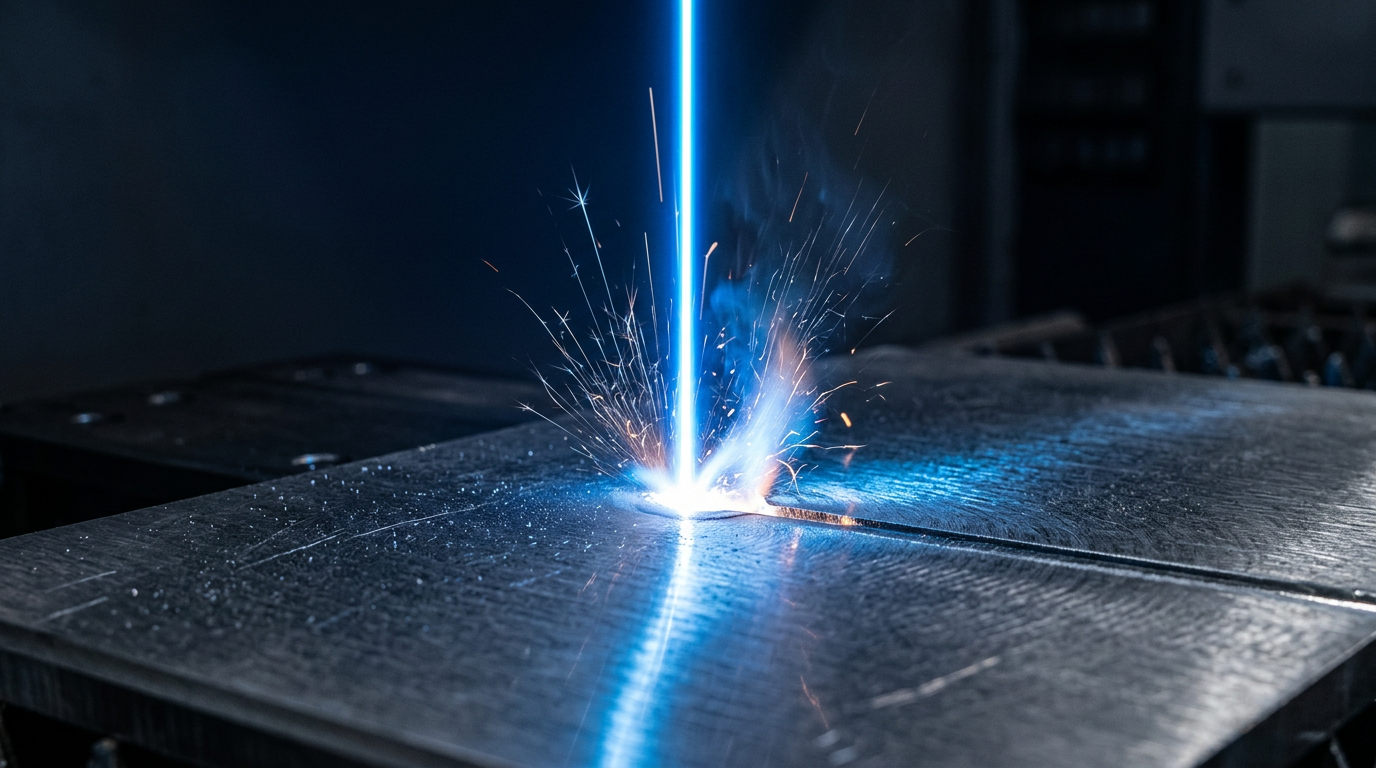
The structural difference between laser tools and traditional methods on the recurring-cost axis is not marginal — it is categorical. A laser tool uses laser light alone: no abrasive media, no chemicals, no water.
Recurring costs reduce to two items: electricity (a 1,500W system drawing roughly 10 kVA of input power costs approximately $1.30 per hour at a $0.13/kWh rate) and occasional replacement of the lens protection window, which shields the optical assembly from contamination and is designed to be field-replaceable.
Compare that to sandblasting, where abrasive media, nozzle wear, compressor maintenance, and spent-media disposal accumulate continuously. Or to chemical stripping, where chemical supply, rinse-water disposal, hazardous-waste compliance costs, and permit obligations make it one of the most expensive surface treatment methods on a true cost-per-square-metre basis once all costs are properly accounted for.
The table below draws on published cost-per-square-metre data to make that comparison concrete.
| Method | Consumables/m² | Labour Time/m² | Waste Disposal/m² | Total Cost/m² |
|---|---|---|---|---|
| Pulsed Laser (200W) | $0.02 (electricity only) | 2.5 min | $0 | $1.85 |
| CW Laser (500W) | $0.04 (electricity only) | 1.2 min | $0 | $1.45 |
| Sandblasting (Grit) | $2.80 (media) | 8 min | $1.50 | $6.45 |
| Chemical Stripping | $4.20 (chemicals) | 15 min | $3.50 | $11.50 |
| Manual Grinding | $0.80 (discs) | 20 min | $0.50 | $9.25 |
| Dry Ice Blasting | $5.50 (dry ice) | 5 min | $0 | $8.90 |
Comparison of cleaning methods by consumable cost per m², labour time, waste disposal cost per m², and total cost per m², using published figures.
The pattern in the data is striking: laser methods carry near-zero consumable and waste disposal costs, while chemical stripping and dry ice blasting accumulate the highest ongoing spend per square metre. For operations processing significant surface area annually, those per-metre differentials compound rapidly.
Evaluating TCO, Not the Day-One Invoice
Professional procurement of capital equipment is always a multi-year calculation. The correct evaluative framework is total cost of ownership, not the day-one invoice — and on that basis, the laser case strengthens considerably over time.
Published five-year TCO modelling for an operation cleaning 5,000 m² per year shows a pulsed laser system reaching a five-year total of around $81,250, versus $161,250 for sandblasting and $287,500 for chemical stripping over the same period. By Year 2, the laser is the lowest-cost option in the comparison — the crossover happens fast once the capital cost is absorbed.
Five-year TCO modelling for a 5,000 m²/year operation puts pulsed laser cleaning at roughly half the cost of sandblasting and less than a third of chemical stripping. The equipment cost is front-loaded; every subsequent year widens the gap.
Beyond consumables, laser tools reduce downtime: there is no media setup, no chemical dwell time, no wash-off cycle. That time saving feeds directly into production throughput, which has its own cost value — particularly for operations where the cleaning step sits on the critical path.
For operations with lower cleaning volumes, the calculation shifts. Published guidance suggests ownership typically makes financial sense above roughly 500 annual cleaning hours; below that threshold, outsourcing to a laser cleaning service is often the more cost-effective route.
Maintenance: What Day-to-Day Operation Actually Involves
Fibre laser sources are rated for 100,000+ operating hours MTBF — a service life measured in decades of normal industrial use. The laser source itself is effectively maintenance-free under normal operating conditions.
Day-to-day maintenance centres on the protective lens window: cleaning it regularly (at minimum weekly, more frequently in contaminated environments) and replacing it when performance degrades. Lens elements are inexpensive and field-replaceable — this is not a service-call item.
The air-cooled vs. water-cooled distinction matters here in a practical way. Air-cooled systems — typical of portable and lower-power tools — have fewer moving parts and no coolant circuit to manage. Water-cooled systems, which are common in higher-power fixed installations, add a chiller circuit requiring periodic fluid changes, filter replacement, and leak inspection to the maintenance schedule. Buyers choosing between these configurations (as discussed in the tool-category sections earlier in this guide) should factor that maintenance overhead into their operational planning.
The other maintenance obligation is the fume extraction system. Laser ablation generates vaporised contamination — paint particles, coating residues, oxides — that must be captured by an extraction unit. Extraction filters require periodic replacement; this is a recurring cost, though modest compared to traditional method consumables.
Class 4 Laser Safety: The Compliance Framework
All industrial laser paint removal tools are Class 4 laser products under the IEC 60825-1 classification scheme — the international standard for laser product safety — and ANSI Z136.1, the American National Standard for safe use of lasers. Class 4 is the highest hazard category: the beam poses an immediate eye and skin hazard from direct and diffusely reflected exposure, and may present a fire risk. Significant controls are mandatory.
It is worth noting that some systems on the market incorporate technology that can reduce the operational hazard zone significantly — in certain configurations achieving Class 1 operation — but this is a capability that varies by system design, not a universal category characteristic. Buyers should ask specifically about the safety classification in operation, not just the base laser classification.
The following requirements apply to all Class 4 laser operation. These are awareness pointers drawn from OSHA laser hazard guidance and the ANSI Z136.1 framework; buyers should consult the relevant standards and their own safety advisors for compliance specifics applicable to their jurisdiction and workplace.
- Wavelength-matched eye protection: Laser-rated eyewear matched to the operating wavelength and optical density is mandatory for all personnel within the laser controlled area. Non-negotiable for Class 4 operation.
- Nominal Hazard Zone control: A defined NHZ must be established, marked, and controlled during operation. NHZ dimensions vary by system — buyers should ask suppliers for specific figures as part of site planning.
- Fume extraction: Vaporised contamination must be captured by a suitable extraction system matched to the contaminant type. This is both a safety requirement and a regulatory obligation.
- Operator training: All operators must complete Class 4 laser safety training before using the equipment. This is a compliance requirement, not an optional induction.
- Controlled area and entryway management: OSHA guidance requires a designated laser controlled area with access authorisation, warning signage, and a rapid-deactivation disconnect switch at the entryway.
The relevant frameworks to consult are IEC 60825-1 (international laser product classification), ANSI Z136.1 (US safe use of lasers standard), OSHA's laser hazards guidance at osha.gov/laser-hazards/hazards, and the LIA/OSHA Safety Bulletin published by the Laser Institute of America. These are the authoritative sources — not a substitute for professional safety advice, but the starting point for any compliance assessment.
Is Laser Paint Removal Suitable for DIY Use?
The honest answer is no. The barriers are structural, not a matter of preference: Class 4 laser safety requirements, mandatory operator training, hazard zone management obligations, fume extraction requirements, and the equipment cost profile all point to a professional or industrial minimum viable use case.
The minimum viable user is a trained operator working in an industrial or professional service context, with appropriate safety infrastructure in place. Consumer or hobbyist use is not a realistic application for this category of tool.
Integration with Production Workflows
For buyers evaluating fixed industrial or automated systems, production line integration is a real operational consideration that should be scoped at the procurement stage, not resolved post-installation.
Laser cleaning systems can be integrated with production infrastructure via digital I/O and industrial bus interfaces, enabling synchronisation with upstream and downstream process steps. Fume extraction must be designed into the workflow from the outset — retrofitting extraction into a running production cell is significantly more disruptive and costly than specifying it correctly at commissioning.
For automated robotic systems, cell design and programming add to commissioning time and cost. As covered in the automated systems section of this guide, that investment is justified by throughput and repeatability at scale — but it is a real line item in the total project cost that buyers should plan for.
With the full operational picture now in view — running costs, maintenance, safety obligations, and integration considerations — the final section consolidates the guide's key takeaways and sets out the practical next steps for moving from evaluation to procurement.
Conclusion
Choosing the right laser paint removal tool
The question this guide was built to answer has shifted: it is no longer whether laser paint removal works, but which tool category and specification fits your application, your throughput, and your total cost picture.
When you are ready to move forward, go directly to a manufacturer rather than a reseller, ask for a demonstration on your substrate, and come prepared with questions about hazard zone requirements, operator training, and post-sale support — those three points will tell you more about a supplier than any brochure will.
Frequently asked questions about laser paint removal
Answers to the questions buyers most commonly ask about laser paint removal tools and how they work.
Yes. Laser paint removal is a well-established, industrially proven process based on selective laser ablation — a mechanism used routinely in automotive refinishing, aerospace maintenance, manufacturing, and heritage restoration. The technology works by delivering pulsed laser energy that the coating absorbs far more readily than the underlying substrate, causing the paint layer to vaporise or be ejected while the base material stays intact. Effectiveness depends on operating within the correct process window: the laser parameters must sit above the coating's removal threshold and below the substrate's damage threshold. When correctly matched to the contamination type and substrate, a laser paint remover reliably strips the coating without harming the surface beneath it. Matching parameters to the specific job is not a complication — it is standard commissioning practice for any industrial laser cleaning system.
Pricing varies considerably across the three main categories of laser paint removal machines. Entry-level portable and handheld units occupy the lowest price band; fixed industrial systems with higher power output sit in a significantly higher range; and fully automated robotic laser cleaning cells represent the largest capital investment. Within each category, cost is driven by power output, laser source specification, and whether you are purchasing directly from a manufacturer or through a reseller. The more useful evaluative framework, though, is total cost of ownership rather than day-one acquisition price. A laser paint removal system carries no consumable costs — no abrasive media, no chemical compounds, no waste disposal fees — and minimal downtime compared to traditional methods. Over a multi-year operational horizon, that cost profile looks very different from a cheaper machine with ongoing consumable and maintenance overhead. For accurate pricing on a specific power class and configuration, contact a manufacturer directly with your application requirements.
There are four genuine disadvantages worth understanding before committing to a purchase. First, the upfront capital cost is higher than sandblasting or chemical stripping — though this is offset over time by zero consumable costs, lower downtime, and reduced rework, so the total cost of ownership comparison is more favourable than the sticker price suggests. Second, operator training and Class 4 laser safety compliance are mandatory, not optional. Class 4 is the highest laser hazard classification, and it requires trained operators, controlled hazard zones, and appropriate laser-rated eye protection. Third, industrial laser paint removal tools are not suited to DIY or consumer use — the safety and training requirements make this a professional and industrial tool category by definition. Fourth, for very large-area, low-precision structural work such as stripping entire steel structures, high-power abrasive blasting can cover surface area faster and may remain cost-competitive in those specific scenarios. For precision work, sensitive substrates, or environments where waste and chemical use are concerns, laser holds a clear advantage.
Yes. Laser cleaning removes paint and a broad range of other coatings from metals, stone, and masonry. The coating types that industrial laser cleaning systems routinely handle include paint, powder coating, lacquer, primer, and e-coating. The process works through differential absorption: the laser energy is absorbed at a much higher rate by the coating than by the underlying substrate. This causes the coating to vaporise or be ejected from the surface while the base material remains undisturbed, provided the laser parameters are correctly set for the specific coating and substrate combination. This selective removal mechanism is what distinguishes laser cleaning from abrasive methods, which remove material indiscriminately, and from chemical stripping, which relies on solvent action across the whole surface.
No. Industrial laser paint removal tools are Class 4 laser products — the highest laser hazard classification under standards including IEC 60825-1 and ANSI Z136. These are not consumer products and are not designed for unsupervised home use. Class 4 requirements mandate trained operators, controlled nominal hazard zones, and appropriate laser-rated eye protection. Fume extraction is also required to capture the vaporised contamination produced during the process. The combination of safety obligations, training requirements, and equipment cost means the minimum viable use case is a professional operator or industrial service context. That said, portable laser cleaning units do provide a practical entry point for professionals who want to offer laser paint removal as a service without investing in a fixed installation. The point is not that the technology is inherently dangerous — it is that it carries industrial-grade requirements that a home user cannot reasonably meet.