
Introduction
If you have a paint removal project and you are weighing up a laser paint removal tool rental against buying outright or putting the job out to a contractor, this guide is written for you.
It covers the full rental journey: from scoping your project before you contact a single supplier, through to returning the equipment and closing out the hire without any surprises.
Renting is a well-established, practical route for one-off and short-term projects — and knowing the process in advance is what makes the difference between a smooth hire and a costly one.
TL;DR
A laser paint removal tool rental is more straightforward than most people expect — but only when you know the steps before you start.
The renters who run into problems are almost always the ones who skipped the preparation: wrong machine for the job, incomplete quotes, missed contract clauses, or a site that wasn't ready on delivery day.
This article covers:

Scoping your project before contacting a supplier
Matching machine specifications to your job
Finding and evaluating rental providers
Understanding rental pricing and what's included
Reviewing rental terms and conditions
Site preparation and safe on-site operation
What is laser paint removal tool rental?
When people search for a laser paint removal tool rental, they are not looking to hire a factory production line — they are hiring something far more practical: a portable, self-contained unit that one person can wheel onto a site, plug in, and operate.
The rental category consists exclusively of portable laser cleaning systems — wheeled units with a lightweight handheld scanner connected via a delivery cable. Fixed industrial laser cleaning cells, which are large, automated, enclosure-based installations, are not available for general hire and are not what this guide is about.
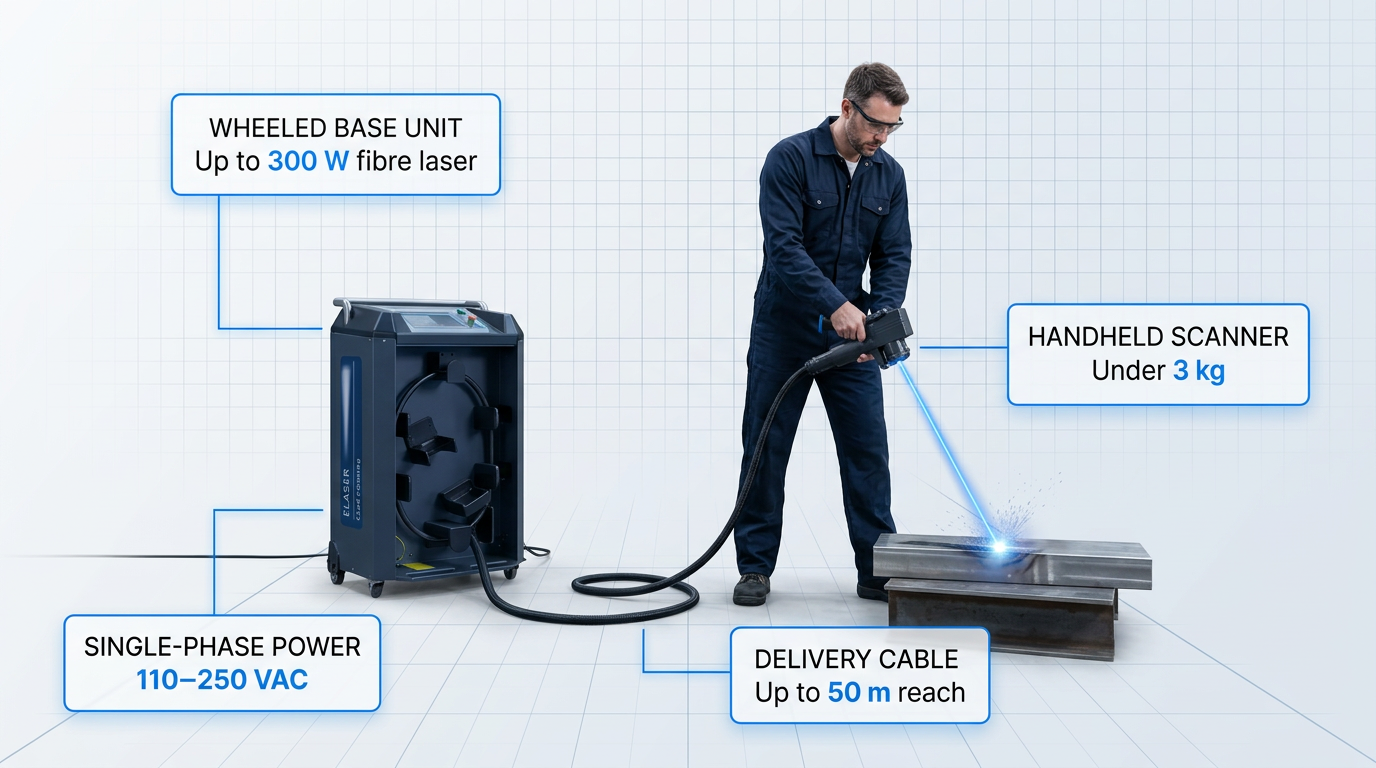
Three machine parameters shape every rental decision you will make in the steps that follow. Power output (measured in watts) is the primary driver of cleaning capability — heavier coatings and harder substrates demand more power. Air-cooled, self-contained operation means a well-specified rental unit needs no compressor, no water supply, and no external chiller circuit, so site preparation is minimal. And standard single-phase power supply compatibility (110–250 VAC) means no site electrical upgrade is required before you start.
WSL (Woodrow Scientific Limited) is the only UK-based laser cleaning manufacturer — designing, building, and supporting its own machines entirely in-house. The ELASER illustrates what a well-specified portable rental unit looks like: up to 300 W of fibre laser power, a handheld scanner under 3 kg, a system under 50 kg on wheels, a delivery cable reaching up to 50 m, and a 110–250 VAC single-phase power supply. WSL's ELASER-RHZ variant goes further still, incorporating the world's first patented reduced-hazard-zone technology that collapses the laser hazard zone to a fraction of conventional size — enabling cleaning in open workshops and public-facing environments where standard laser equipment cannot operate.
Before committing to the rental process, it helps to confirm the technology suits your project. Portable laser cleaning systems work across a wide range of substrates and remove an equally broad set of coatings and contaminants.
- Metals: Steel, carbon steel, aluminium alloys, cast iron, copper, brass, bronze, titanium, and galvanised surfaces.
- Stone, concrete and masonry: Brick, concrete, stone, and masonry — including heritage and restoration applications.
- Paints and primers: Paint, primer, powder coating, and lacquer removed cleanly without damaging the underlying substrate.
- Rust, oxides and scale: Rust, mill scale, oxides, and weld discolouration across ferrous and non-ferrous metals.
- Contaminants and residues: Graffiti, oil and grease, carbon, soot, mould, adhesives, tarnish, and release agents.
That breadth of compatibility means the vast majority of paint removal and surface cleaning projects — across industrial, heritage, and commercial settings — fall squarely within what a portable rental unit can handle.
Portable laser cleaning systems are Class IV laser devices. As defined by ANSI and confirmed under HSE guidance, Class IV operation requires wavelength-matched protective eyewear, a defined laser hazard zone, and operator training before use. These are baseline requirements — not optional extras. A credible rental provider will supply training, documentation, and safety guidance as standard. This is what separates a professional rental from an unsafe one.
It is worth knowing that the laser cleaning rental market includes both genuine manufacturers and resellers who rebadge third-party machines. The distinction matters during a hire: a genuine manufacturer has in-house engineering capability to diagnose and resolve faults quickly, while a reseller must route any technical issue back to a third-party supplier — slowing resolution at exactly the moment you need the machine working.
WSL is the only UK-based laser cleaning manufacturer, with in-house design, build, and support for every machine it produces. That provenance has direct, practical implications for the support you receive if something needs attention mid-hire.
With that orientation in place, the first step is to scope your specific project — because the substrate, coating type, and site conditions you define there will drive every decision that follows.
Step 1
Scope your project before you call a supplier

Key Insights
Identify your substrate and coating before anything else.
Surface area estimate drives your hire period length.
Access constraints affect which machine is appropriate.
Document all parameters before calling any supplier.
Most rental problems trace back to the same mistake: the renter called a supplier before they knew what their job actually required.
Before any conversation about machines, pricing, or hire periods, gather the five project parameters below. They are the inputs to every decision that follows.
- Substrate: Identify the material you are cleaning — steel, aluminium, cast iron, concrete, stone, masonry, or other. Substrate type determines which machine settings are compatible and directly affects cleaning speed, so get this right before anything else.
- Coating type and thickness: Establish what is being removed: paint layers, primer, rust, powder coating, graffiti, or a combination. Note how many layers and, where possible, how thick. Coating type and build thickness are the primary drivers of the power output your rental machine needs to deliver.
- Total surface area: Estimate the area to be cleaned in square metres. This is the single biggest factor in how long you will need the machine. Underestimate and you will run out of hire time; overestimate and you will overpay. A working figure is enough — precision is not required at this stage.
- Access constraints: Note whether the work is indoor or outdoor, whether confined spaces are involved, and whether the work area is near other workers, the public, or surfaces that must not be affected. Access conditions are not just a safety consideration — they are a machine selection input that can change which unit is appropriate for your job.
- Required finish standard: If the cleaned surface will be re-coated, painted, or inspected to a structural or heritage standard, identify that standard now. Not every job has a formal finish requirement, but if yours does, you need to know it before you can confirm that a given machine and its settings will deliver the result you need.
If the surface may contain hazardous coatings such as lead-based paint, flag this as a separate parameter — it will be relevant to site preparation planning later in this process.
A supplier conversation is only as useful as the information you bring to it. Documented project parameters — substrate, coating, area, access, finish standard — let you have a specific, productive discussion. Without them, you are guessing, and so is the supplier.
Step 2
Match the Machine Specifications to Your Job
Key Insights
Wattage must match your substrate and coating.
Pulsed fibre lasers suit most paint removal jobs.
Self-contained, air-cooled units need no extra infrastructure.
Cable reach matters on large or awkward sites.
With your project parameters from Step 1 in hand, the next task is straightforward: translate what your job requires into the machine specifications you need to confirm before hiring anything.
These are the five specification axes that matter for laser paint removal tool rental. A supplier who cannot answer clearly on all five is a red flag before you have signed anything.
- Power output (wattage): Wattage is the single most important specification to confirm. Thicker coatings — powder coat, primer layers, heavy paint build-up — and harder substrates like steel, cast iron, and concrete demand more power to remove efficiently. An under-powered machine will work slowly and may not finish the job within your hire period, which is wasted rental cost. Ask the supplier for the machine's rated output and confirm it is tunable across its range so you can dial down for sensitive surfaces and push harder for heavy coatings. Our solution, the ELASER, delivers up to 300 W with power tunable 0–100%, which means one machine handles everything from light surface oxides to heavy coatings without swapping units.
- Pulsed fibre laser vs. continuous wave (CW): Pulsed fibre lasers deliver energy in controlled bursts, making them well-suited to selective paint removal where protecting the underlying substrate matters — painted steel, aluminium bodywork, heritage metalwork. CW systems run at higher continuous output and suit heavy industrial stripping where throughput is the priority and substrate sensitivity is less critical. For most paint removal rental jobs, a pulsed fibre laser is the right type. Ask the supplier which type their unit is before confirming the hire.
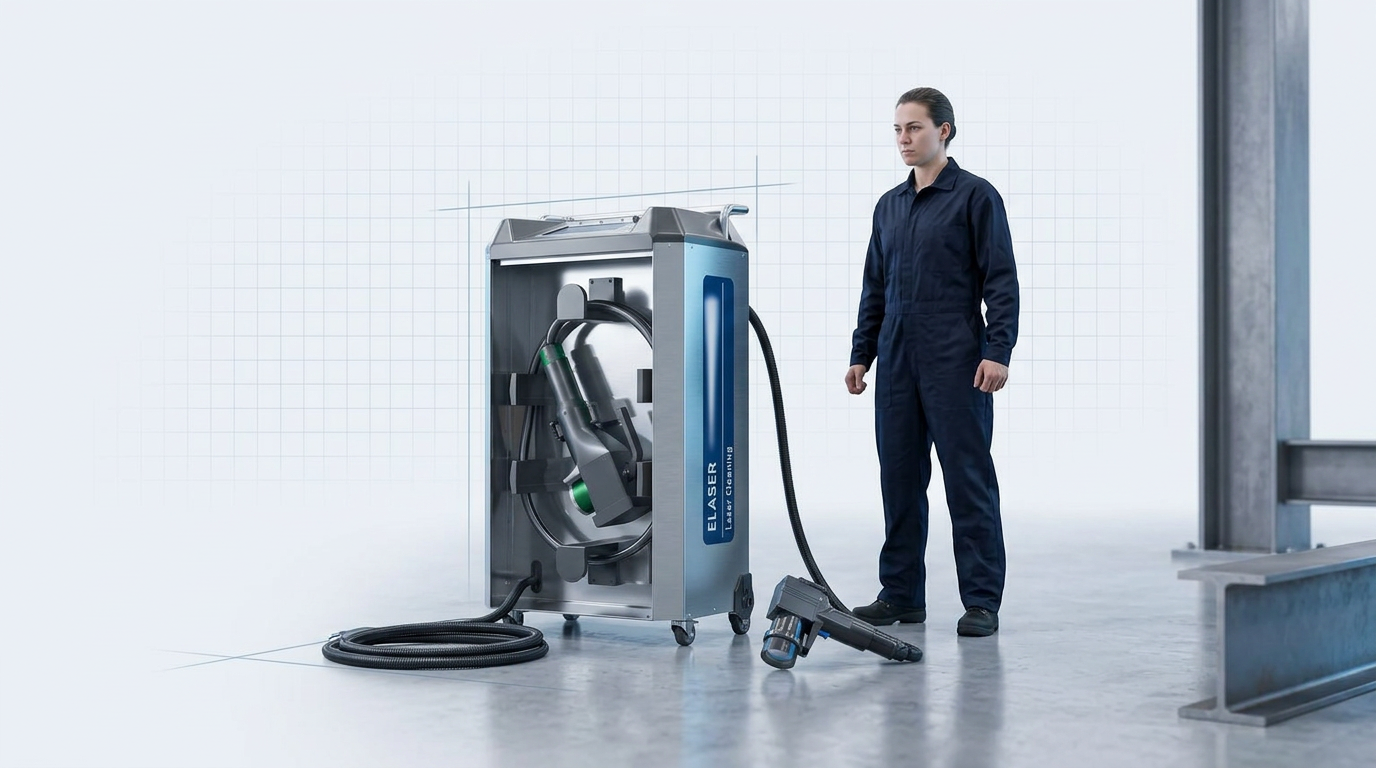
- Portability and self-contained operation: The practical standard for on-site rental is a wheeled unit with a lightweight handheld scanner that requires no compressor, water supply, or chiller circuit. Any setup that needs additional infrastructure adds logistics, cost, and potential site-preparation work to your rental period. Confirm the machine is air-cooled and fully self-contained. As a benchmark: the ELASER weighs under 50 kg on wheels, with a handheld scanner under 3 kg — one operator, one trolley, plug in and go.
- Delivery cable length: The cable between the machine body and the handheld scanner determines how far from the wheeled unit you can work. On large structures, scaffolded areas, or any location where the machine cannot sit close to the work face, a short cable becomes a genuine operational constraint. Ask for the cable length as a specific figure and match it against your site's access requirements. The ELASER's delivery cable reaches up to 50 m — use that as a reference point when assessing whether a rental unit has enough reach for your job.
- Power supply compatibility: Check that the machine runs on standard single-phase supply (110–250 VAC). A unit requiring three-phase power or a non-standard voltage creates a site preparation problem that may be impossible or expensive to resolve. This is a go/no-go check — ask it before anything else about the hire logistics. The ELASER runs on 110–250 VAC single-phase, meaning it plugs into standard site supply without any electrical upgrade.
It is also worth noting that many rental machines in the market are rebadged imports with limited manufacturer backing — if a fault develops mid-hire, support can be slow and spares harder to source.
Hiring a unit with insufficient wattage for your substrate and coating does not just slow the job — it can mean the work is incomplete when the hire period ends. You pay for the time regardless. Confirm wattage before you confirm the booking.
Take these five parameters into every provider conversation in Step 3: wattage, laser type, portability and self-contained operation, cable reach, and power supply compatibility.
Any supplier who cannot give you a straight answer on all five — with specific figures, not generalities — is telling you something important about the support you will receive during the hire.
See the machines that match your spec
You know your wattage range, portability requirements, and surface type. The ELASER and ELASER-RHZ are portable pulsed fibre laser cleaners built around exactly those variables.

Step 3
Find and evaluate rental providers

Key Insights
Ask if the provider manufactures the machine directly.
Confirm training and safety docs are included.
Ask about their fault response process before committing.
With your machine specification requirements from Step 2 in hand, you are ready to contact providers. The goal at this stage is not to compare prices — it is to establish which providers are worth comparing at all.
Where to look for providers
Laser paint removal tool rental comes from three main source types, and each implies something different about the support you will receive.
- Specialist laser cleaning companies: Firms whose core business is laser cleaning hire. These are the most likely to bundle operator training, safety documentation, and technical support as standard inclusions rather than optional extras.
- Manufacturer-direct hire programmes: Where the company that built the machine also rents it out. This is the strongest support scenario — if a fault develops mid-hire, the people you call are the people who made the machine.
- General industrial equipment rental firms: Broader inventory, but laser-specific expertise is less certain. Ask directly whether they have in-house capability for this equipment type, or whether they rely on a third party for technical support.
This is orientation, not an exhaustive list. The point is that source type is a proxy for support quality — and support quality matters enormously if something goes wrong mid-hire.
The manufacturer vs. reseller distinction
Ask every provider directly: do you manufacture the machine you are renting, or are you a reseller or importer?
Many laser cleaning machines in circulation are rebadged imports. A reseller who depends on a third-party manufacturer for technical support cannot resolve a mid-hire fault as quickly or effectively as a provider with direct engineering access to the machine. Before you commit to anything, establish which one you are dealing with.
This is not an aggressive question — it is basic due diligence for industrial equipment hire, and a credible provider will answer it without hesitation.
Confirm what is included before comparing rates
Before you can meaningfully compare any two providers, you need to know what each quoted rate actually covers.
A credible provider should include the following as standard — not as chargeable add-ons.
- Delivery and collection: The machine should arrive on-site and be collected at the end of the hire without you arranging separate logistics.
- Operator training: Training should be offered before you use the machine. A provider who does not offer training, or treats it as optional, is not meeting the standard expected for Class IV industrial laser hire.
- PPE: Laser safety eyewear matched to the machine's specific wavelength must be supplied. Generic safety glasses are not a substitute.
- Safety documentation: Ask for a written Standard Operating Procedure covering Class IV operation. If the provider cannot supply one, that is a significant gap.
- Technical support access: You should have a direct line to technical support throughout the hire period — not just an email address with a 48-hour response window.
A provider who charges separately for training or cannot produce safety documentation is not a fully-qualified option for industrial laser hire, regardless of how competitive their rate appears.
Machine provenance: questions to ask before signing
You have a legitimate right to know what machine you are hiring before you sign anything.
Ask each provider the following three questions and note how clearly they answer.
- Is the machine CE and/or UKCA certified?: For equipment operated in the UK, UKCA certification is the relevant conformity mark. CE certification may also apply depending on the machine's origin and age. A provider who cannot confirm either should be treated with caution.
- What is the machine's laser class?: Class IV is standard for industrial paint removal lasers. Confirm this is documented, not just stated verbally.
- Who is the original manufacturer?: If the provider is a reseller, ask who made the machine. Evasiveness or vagueness on this point is a meaningful risk signal.
A provider who becomes evasive or cannot answer these questions clearly is telling you something important about their support capability.
Red flags to watch for
Use this list as a working checklist when you speak to each provider.
- Cannot confirm wattage or laser class: If the provider is uncertain about the machine's fundamental specifications, that uncertainty will not improve once you are on-site.
- No operator training offered or required: For a Class IV laser, the absence of any training requirement is a serious gap — not a convenience.
- No UK-based technical support: Remote or overseas-only support is not adequate for a time-sensitive hire where a fault needs to be resolved quickly.
- Cannot supply safety documentation or a written SOP: A Standard Operating Procedure for Class IV operation is not optional paperwork — it is a basic requirement for safe industrial laser use.
- Evasive about machine provenance or manufacturer identity: Any reluctance to disclose who made the machine, or who holds the technical support relationship, is a risk signal worth taking seriously.
Finally, ask the provider directly: if the machine develops a fault during the hire period, what is your response process and how quickly can you have it resolved?
For a deadline-driven project, a machine down for two days is a serious problem. A credible provider will have a clear, specific answer. A provider who cannot articulate their fault response process is not a qualified option — move on before you reach the pricing conversation.
Step 4
Understand the pricing structure and what is included
Key Insights
Weekly/monthly rates offer real savings over daily.
Training and PPE must be included, not extras.
Always get a written, itemised quote first.
Compare hire cost against alternatives' full cost.
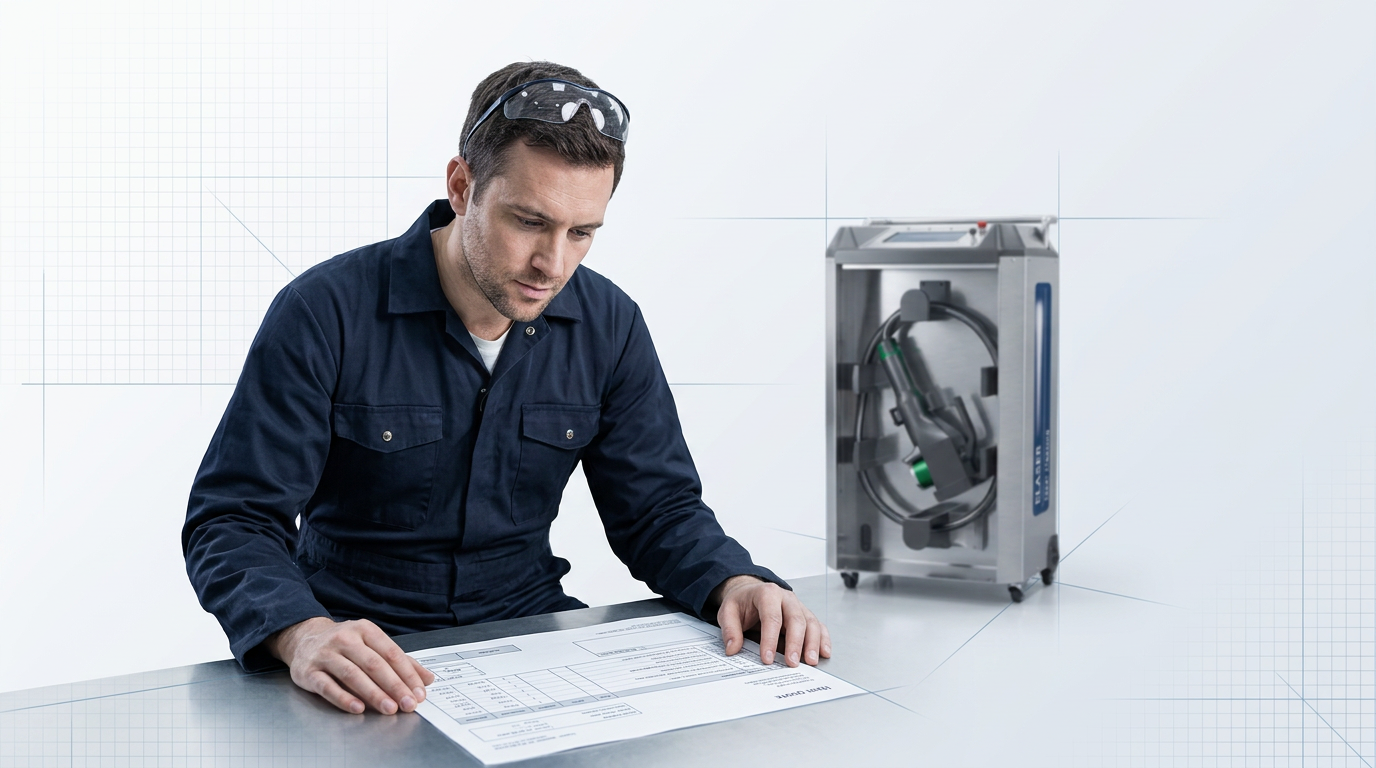
With your shortlist of providers from Step 3 in hand, you are ready to request quotes. Before you do, understand how the pricing is structured — because without that framework, you cannot tell whether a quote is complete, competitive, or missing something important.
How hire rates are structured
Laser cleaning equipment is hired on daily, weekly, or monthly terms — and weekly or monthly rates typically represent a meaningful discount against the equivalent number of daily charges accumulated separately.
If your project will run across several days, ask explicitly for a weekly rate rather than defaulting to daily billing; the saving is real and providers expect the question. Also confirm the minimum hire period before assuming you can book for a single half-day — requirements vary by provider.
What a credible base rate should include
A well-structured rental quote is not just the machine. The following items should be included in the base hire rate as standard, not billed as optional extras:
- The machine itself: Fully assembled, tested, and ready to operate on delivery.
- Delivery and collection: Transport to your site and retrieval at the end of the hire period — both directions included.
- Hands-on operator training: An on-site briefing and parameter walkthrough at handover, not a PDF sent by email.
- PPE kit: Laser-wavelength-matched protective eyewear as a minimum; credible providers also include gloves and safety signage.
- Safety documentation: A Standard Operating Procedure for Class IV laser operation, plus a risk assessment and method statement.
- Technical support: Access to a support line for the duration of the hire, not just during handover.
If a provider charges separately for training or cannot supply safety documentation, treat that as a signal about their operational standard — not just their pricing. A Class IV laser without a proper SOP is a compliance problem, not a cost-saving opportunity.
What is typically charged separately
Even from credible providers, three cost items are legitimately billed outside the base rate. Ask about all three before signing anything.
- Delivery distance surcharges: Most providers include delivery within a defined radius and charge per mile or kilometre beyond it. Confirm the threshold and the per-distance rate for your location.
- Extended hire beyond the agreed term: If your project overruns, the extension rate may differ from the original daily or weekly rate. Clarify this upfront so an overrun does not come as a surprise.
- Damage liability: Providers typically handle this via a damage waiver fee or a security deposit. Ask which applies and what it covers — the contractual detail belongs in Step 5, but the cost is a pricing consideration now.
Asking about these three items before you receive a quote — rather than after — puts you in a much stronger position to compare offers on a like-for-like basis.
Indicative market rate ranges
Rates vary by geography, power class, and hire duration. The following figures reflect the kind of ranges you will encounter in the market, based on publicly available provider data at the time of research — treat them as orientation, not guarantees.
| Market | Indicative day rate range | Unit type |
|---|---|---|
| UK | From ~£295/day upward | Portable pulsed fibre units (200W–500W) |
| Europe | ~€550–€950/day | Pulsed units, 100W–300W class |
| US / Canada | ~$300–$1,500/day | Portable units; varies widely by wattage and support level |
Gives the reader a concrete geographic anchor for what laser cleaning hire costs look like across three major markets, allowing them to sense-check any quote they receive without relying on a single provider's framing.
Weekly and monthly terms reduce the effective daily cost across all markets — the discount is meaningful, not marginal. Use these ranges to sense-check a quote, not to negotiate a specific figure.
Sandblasting and chemical stripping look cheaper as a headline rate — until you add media purchase, disposal fees, secondary waste handling, and any substrate damage rework. Laser rental has none of those additional cost lines. When renters compare the full cost of each method rather than just the day rate, the hire figure looks very different. Factor in what you are not spending, not just what you are.
Finally, before you commit to anything: request a written, itemised quote that lists every charge separately — machine, delivery, collection, training, PPE, distance surcharges, and damage liability. Verbal quotes that omit any of these items are incomplete, and the gap between a verbal agreement and a written one is where unexpected costs live.
Once you have a written quote in hand, Step 5 walks you through the rental terms and conditions you need to check before signing.
Step 5
Review the Rental Terms and Conditions

Key Insights
Check who bears the damage liability cost.
Verify your insurance covers hired equipment.
Confirm when billing starts and ends.
Photograph the machine before first use.
The rental agreement governs your entire financial exposure for the hire period — what you owe if the machine is damaged, when billing starts, and what condition it must be returned in. Skimming or skipping this document is where unexpected post-hire costs begin.
Before you sign, work through each of the following clauses and confirm you understand what you are accepting.
- Damage liability: Check who bears the cost of accidental damage during the hire period. Many hire agreements place full financial responsibility on the hirer — potentially up to the equipment's full replacement value. Confirm the liability limit and whether the provider offers a damage waiver option.
- Insurance requirements: Do not assume your existing business or public liability policy covers hired-in equipment. Many standard policies exclude hired plant. Check with your insurer before signing, and arrange supplemental cover if needed — this is a pre-signing action, not a mid-hire one.
- Permitted use restrictions: Hire agreements commonly restrict where the machine can be used, which surfaces it can be operated on, how many operators are permitted, and whether relocation to a different site is allowed. Check these restrictions directly against your planned use and raise any conflicts with the provider before signing.
- Minimum hire period and billing triggers: Confirm when the billing clock starts — at dispatch, at delivery, or at signed handover. Ask how partial days are billed and what happens if you return the machine before the minimum hire period expires. These are specific questions, not safe assumptions.
- Return conditions: Understand what cleaning standard is required on return, what constitutes damage beyond normal wear and tear, and what inspection process the provider applies at both handover and return. This clause most directly determines whether you recover your deposit in full.
Once you have worked through the agreement, there is one practical action to take the moment the machine is delivered — before you power it on.
Take time-stamped photographs of the machine from all angles at the point of delivery, before any operation begins. These images are your primary protection if a damage dispute arises at return. It takes two minutes and can prevent a costly disagreement over pre-existing marks or wear.
With the agreement signed and the machine's delivery condition documented, you have completed the pre-signing phase of the rental journey. You know your obligations, your financial exposure, and you have a timestamped record to fall back on. You are ready to move on to site preparation.
Step 6
Prepare your site before delivery
Key Insights
Complete all site checks before the machine arrives.
Fume extraction at source is a safety requirement.
Flag lead paint to your provider beforehand.
The contract is signed and the delivery date is set. Everything you do between now and the machine arriving either saves or costs you time on the hire clock.
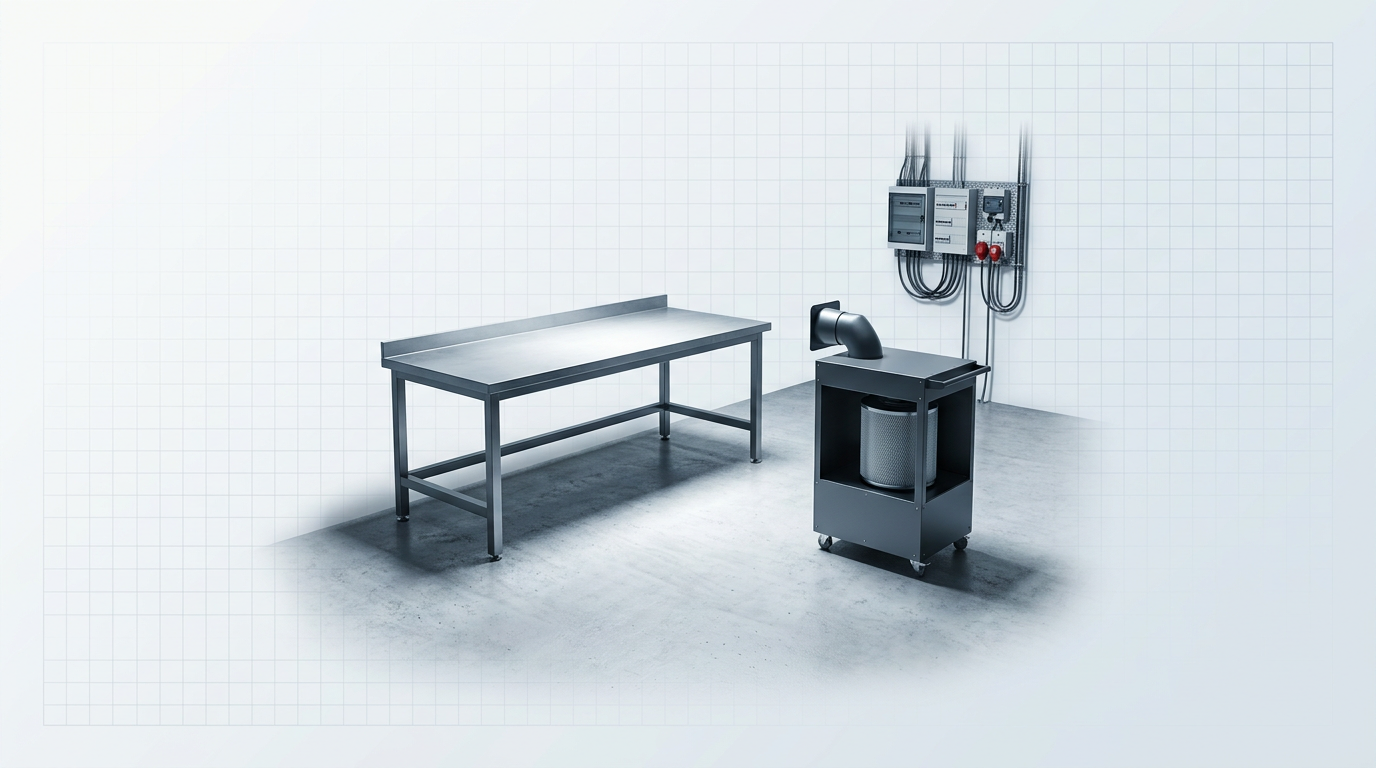
Six preparation checks need to happen before the machine arrives. None of them require specialist help or additional cost — but leaving any one of them until after delivery turns paid hire time into setup time.
- Power supply: Confirm that a standard single-phase electrical supply (110–250 VAC) is available at the actual work location — not just somewhere on site. Check the extension cable reach from the nearest outlet to where the machine will operate, and verify that site electrical capacity is adequate. Most sites will be fine, but consciously verify rather than assume.
- Ventilation and fume extraction: Laser paint removal vaporises coatings into fine particulate and fumes that must be actively extracted — not simply dispersed. In well-ventilated outdoor settings, natural airflow may be sufficient, but for indoor or enclosed work, a dedicated fume extractor positioned for source capture near the work area is required. According to Laserax, fume capture is most effective when the extraction nozzle is positioned as close as possible to the source of fumes.
- Lead paint and hazardous coatings: If the surface may contain lead-based paint — common in buildings and structures constructed before the 1980s — additional legal obligations apply. In the UK, the Control of Lead at Work Regulations 2002 (CLAW) governs exposure; in the US, OSHA's lead standard for construction (29 CFR 1926.62) applies. Key obligations cover containment of dust and debris, appropriate respiratory protection beyond standard PPE, and safe waste disposal. Flag this to your provider before delivery, not on the day.
- Laser hazard zone: Establish a laser hazard exclusion zone before operation begins. For portable rental units, confirm the required zone dimensions and access control requirements with your provider ahead of delivery — these depend on the machine's laser class and the provider's own guidance. HSE and OSHA both require that access to controlled areas for high-power laser equipment is restricted to authorised personnel wearing appropriate protective eyewear.
- Clearing and protecting the work area: Remove or protect adjacent materials, surfaces, and equipment that should not be exposed to laser scatter or airborne fume. Think about what is near the work surface and whether it needs to be moved or shielded before the machine is powered up.
- Site access for delivery: Confirm the access route with your provider before the delivery date: vehicle access restrictions, any loading constraints, and where the machine will be positioned on arrival. A wheeled rental unit needs a clear, unobstructed path from the delivery vehicle to its operating position. Delivery delays caused by access problems eat directly into your paid hire time.
Of these six checks, fume extraction and lead paint warrant the most preparation time — both carry health and safety obligations that cannot be resolved quickly on delivery day.
For fume extraction, the distinction between indoor and outdoor settings matters. Laserax's guidance on laser fume extraction is clear: general room ventilation is not sufficient to capture contaminants generated at source — a dedicated extraction unit with the nozzle positioned close to the laser work area is the required approach for enclosed environments.
For lead paint, the HSE's Control of Lead at Work guidance notes that lead pigments were widely used in paints for homes, schools, and offices until the 1960s, and were not removed from all commonly used paints until the early 1980s — meaning any structure built before that era warrants a check. If lead is present or suspected, the HSE advises using containment measures such as plastic sheeting, appropriate RPE with an assigned protection factor of at least 20 (such as an FFP3 mask), and safe disposal of contaminated waste.
If the surface may contain lead-based paint, tell your provider before the machine arrives — not on the day. It may affect the equipment configuration, the PPE supplied, and the provider's own obligations under CLAW 2002 (UK) or OSHA 29 CFR 1926.62 (US). Consult the HSE's lead at work guidance or OSHA's lead in construction publication for the authoritative obligations that apply to your situation.
For the laser hazard zone, the required dimensions vary by machine and are the provider's responsibility to communicate. Confirm these before delivery so that barriers, signage, or access controls can be arranged in advance. Both HSE and OSHA require that access to Class IV laser controlled areas is limited to authorised personnel wearing appropriate laser protective eyewear — OSHA's OTM Chapter 6 specifies that entry of non-involved personnel requires approval.
Once all six checks are complete, the site is ready for handover. The next step covers what happens when the provider arrives — the training and handover session before you begin work.
Step 7
Complete Operator Training at Handover

Key Insights
Handover training is non-negotiable for Class IV hire.
Wavelength-matched PPE is the operator's responsibility throughout.
Confirm the provider supplies a written SOP.
Run a test pass before the provider leaves.
The machine is on-site, the provider's representative is with you, and the hire clock is running. This is the moment that separates a productive rental from a wasted one — do not let the trainer rush through it.
Handover training is not a formality for Class IV laser equipment hire. It is a baseline expectation, and the quality of what you receive here is the clearest indicator of whether your provider meets the standard you evaluated back in Step 3.
What the training session must cover
Ask the trainer to work through each of the following before they leave. If any item is skipped, raise it — you are entitled to cover all of it.
- Startup and shutdown: Full power-on sequence, safe shutdown procedure, and what to do if you need to abort mid-operation.
- Touchscreen interface and parameter selection: How to navigate the GUI, select the correct settings for your specific surface and coating, and adjust parameters within the session.
- Password-protected access and per-user logins: If the hired unit supports it — and capable machines like the ELASER do, via their touchscreen interface — confirm how to set up individual operator logins and how usage tracking works. This matters both for access control during the hire period and for runtime records at return.
- Lens care and protective window replacement: How to inspect the lens-protection window, when to replace it, and how to do so correctly. This is a consumable task you will likely need to perform during the hire period.
- Fume extraction confirmation: Ask the trainer to verify that the extraction setup you completed in Step 6 is correctly positioned for the work you are doing. This is a validation check, not a repeat of the setup task.
- PPE fitting and use: Correct fitting of wavelength-matched laser protective eyewear, and confirmation that all personnel who will enter the hazard zone have access to appropriate PPE.
A provider who designs and builds their own machines in-house — rather than reselling third-party equipment they did not engineer — can answer technical questions on the spot and tailor the training to your specific job. That depth of knowledge matters when the question is about your surface, your coating, and your site conditions.
Under both OSHA and HSE guidance, wavelength-matched laser protective eyewear must be worn by all personnel within the hazard zone during Class IV laser operation. As the operator, you are responsible for enforcing this for every person who enters the zone — colleagues, site visitors, and bystanders included. Confirm at handover that you have sufficient PPE for everyone who will be present, and consult the relevant authority guidance for your jurisdiction.
Confirm at handover that the provider supplies a written Standard Operating Procedure (SOP) as part of the hire package. Class IV laser operation requires a documented SOP, and it should be handed to you at this point — not promised later. If the provider does not have one ready, ask why and treat the absence as a concern.
If the hired unit includes password-protected access and per-operator usage logging via the touchscreen interface, get the trainer to walk you through setup now. You will not have another opportunity to ask in person, and knowing your runtime figures accurately is relevant when you return the machine.
Before the provider's representative leaves, run a test pass on a scrap or inconspicuous area and confirm the settings produce the result you expect. This is your last chance for supported, in-person guidance — if you are not confident in independent operation at this point, say so and ask for more time.
A provider who skips training entirely, or whose representative leaves before you have demonstrated competent independent operation, is not meeting the standard expected for industrial laser hire. You now have the context to recognise that — and to insist on the session you are entitled to.
Step 8
Operate the Machine On-Site
Key Insights
Always test pass on a scrap area first.
Start power low; increase until coating lifts.
Reduced extractor airflow: stop and inspect immediately.
Log laser-on hours daily to avoid disputes.
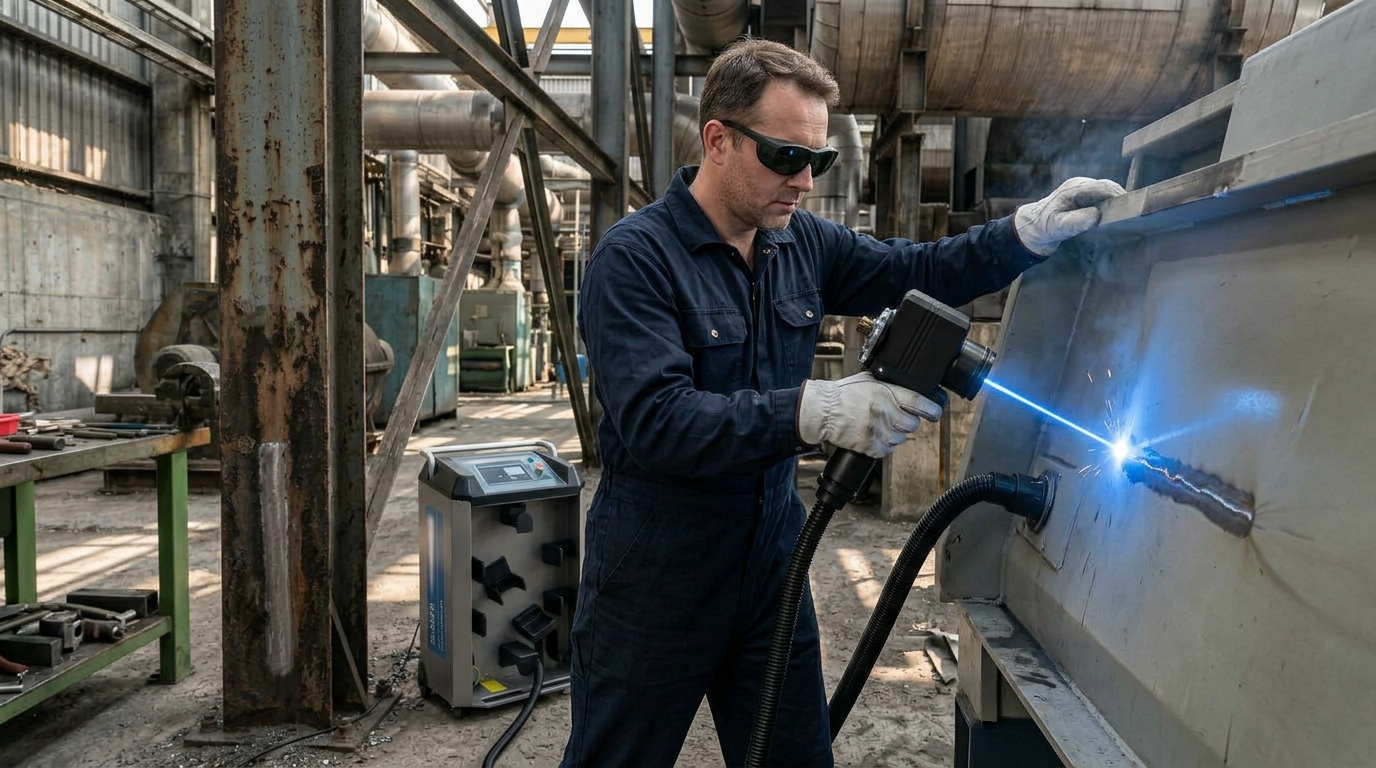
Training is complete, the machine is configured, and the site is ready. Everything from the previous seven steps now converts into one thing: controlled, methodical operation through the hire period.
The operating sequence below is the discipline that separates a clean result from a patchy one — and an uneventful return from a disputed one.
Before committing to the main surface, run the laser on a scrap piece or an inconspicuous area of the same substrate. This is where you dial in power and scan speed while the stakes are low. It is not optional caution — it is professional practice on every new surface or coating combination.
Once the test pass confirms clean coating removal with no visible substrate damage, you are ready to calibrate power for the main work.
Power, Scan Speed, and Coverage
Start at a conservative power setting and increase incrementally until the coating lifts cleanly without leaving residue or scorching the substrate beneath.
Heavier coatings and harder substrates can tolerate higher power — but let visual feedback guide you, not a preset number. The correct setting is the one where the coating releases cleanly and the substrate shows no discolouration or pitting.
Scan speed is the other half of the equation. Consistent, overlapping passes at a steady hand speed produce uniform coverage; rushing the scanner or leaving gaps between passes creates uneven results that require rework.
Work methodically across the surface in deliberate rows, overlapping each pass slightly. Treat this as craft: the quality of the finish is a direct product of the operator's physical consistency.
Ongoing Operational Disciplines
Beyond the initial dial-in, four disciplines must be maintained actively throughout the entire hire period — not just at start-up.
- Monitor fume extraction continuously: The extractor must capture fumes at source throughout operation. Check that the extraction hose has not shifted away from the work zone. Reduced airflow is the signal to stop and inspect — saturated filters cannot capture fumes, which creates a health hazard and signals the extraction setup needs immediate attention. Confirm the airflow is steady before resuming.
- Log laser-on hours daily: Keep your own written record of laser-on time each day, separate from whatever the machine logs internally. Rental agreements track cumulative runtime, and a contemporaneous daily log is far more defensible in a billing or usage dispute than a retrospective estimate.
- Replace the cover glass on schedule: In heavy paint stripping work, the protective lens cover glass degrades quickly from ablation debris. A fouled cover glass reduces beam quality and cleaning effectiveness, and can cause damage to the optics beneath it. Confirm the replacement interval with your provider at handover, keep spare cover glasses on-site, and replace on schedule — do not defer this task.
- Maintain safety zone discipline: The hazard zone established before delivery must remain enforced throughout the hire period. No unauthorised personnel inside the zone during operation. Wavelength-matched laser protective eyewear worn by everyone in the zone at all times. Power the machine down before anyone enters the zone without PPE. Complacency is the risk on longer hire periods — treat every session as if it were the first.
On longer hire periods, the work can start to feel routine. That familiarity is where safety zone discipline tends to slip — enforce it the same way on day ten as on day one.
The logging and cover glass habits established here also feed directly into the return process: your hour log and a record of consumables used will both be relevant when the final invoice is reconciled in Step 9.
Step 9
Return the Equipment and Close Out the Hire
Key Insights
Photograph the machine before collection, not after.
Confirm collection in writing to stop billing.
Review the closeout statement before paying.
The job is done, but the hire period is not closed until the machine is back with the provider and the final invoice is settled. This is the stage where renters most commonly lose deposit money — not through anything that happened during operation, but through avoidable oversights in the last hour before collection.
Work through the six points below before the collection vehicle arrives. Each one is a discrete protective action; none of them take long, and skipping any of them can cost you.
- Clean to contract standard: Clean the unit body and handheld scanner to the level specified in your hire agreement — not to the level that looks clean to you. The provider's inspection is the arbiter, and what passes your eye may not pass theirs. Remove all surface debris, dust, and operational residue to avoid a cleaning charge on the final invoice.
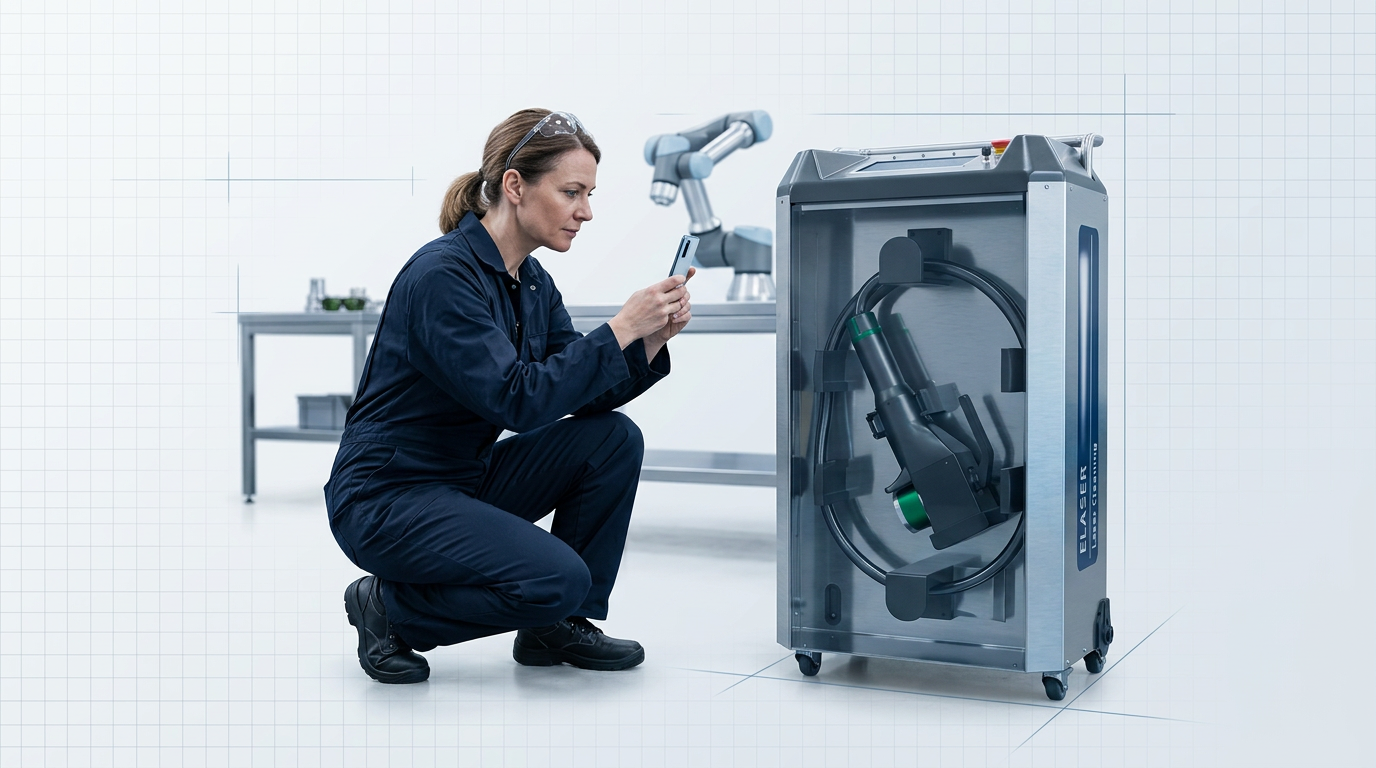
- Photograph the machine before collection: Take time-stamped photographs of the machine's condition immediately before it is collected. These are your independent record if a damage charge appears on the invoice after the machine has left your site. Just as you photographed the machine at handover, end-of-hire photos are the evidence that closes the loop.
- Return all accessories and account for consumables: Everything on the handover inventory must come back: lens protection windows, laser safety eyewear, cables, and any documentation supplied. If consumables were replaced during the hire, confirm in advance with the provider how used items are handled — whether they need to be returned or whether replacements are charged. Missing items are a routine source of unexpected post-return charges.
- Confirm the return trigger in writing: Billing does not stop the moment you decide the job is finished. Depending on your agreement, charges may continue until the machine is physically back at the provider's premises and checked in by their staff. Send a written message — email or text — confirming when you have requested collection. A verbal call leaves no timestamp; a written record does.
- Request a closeout statement before paying: Before settling the final invoice, ask for a written closeout statement and compare it line by line against your original hire agreement. Any additions — extra days, cleaning charges, damage charges, consumable fees — should be queried before payment, not after. Recovering a disputed amount once paid is significantly harder than contesting it beforehand.
- Document any faults or underperformance in writing: If the machine developed a fault, underperformed, or caused delays during the hire, record this in writing before collection. If the provider later charges for days when the machine was not operational due to a fault, that written record is the basis for querying the charge. Raising issues after the invoice is paid puts you in a much weaker position.
The return conditions you are working within now are the same ones you reviewed before signing in Step 5. The contract defines what clean means, what constitutes damage, and when billing stops — your job at this stage is to execute against those terms, not interpret them afresh.
Billing typically continues until the provider formally checks the machine back in — not when you decide the job is done. Confirming collection in writing, with a timestamp, is the only reliable protection against extra days being charged after you have finished with the machine.
Planning your next laser cleaning project?
Whether you are weighing up a repeat rental or considering ownership for ongoing work, a 30-minute call with a laser cleaning expert is a practical next step.

Conclusion
What comes next after your rental
You now have everything you need to plan, book, and complete a laser paint removal tool rental with confidence — from scoping your project to closing out the hire cleanly.
If the process worked well and recurring work is on the horizon, it is worth asking whether ownership makes more sense than repeated hire — consistent utilisation is the point at which that calculation shifts.
And if your next project is not suited to self-operation, a professional laser cleaning service is a genuine alternative worth exploring.
Frequently asked questions about laser paint removal rental
Common questions from renters about how laser paint removal works, what hiring costs, and what to expect during the rental period.
Yes. Specialist providers offer daily, weekly, and monthly hire of portable pulsed fibre laser units, delivered to your site and collected at the end of the hire period. Credible hire packages include delivery, collection, hands-on operator training, and technical support as standard — not as optional extras. If a provider treats any of those as add-ons, that is worth noting before you commit.
Your rental provider should supply hands-on operator training at handover as part of the hire package — not as a separate booking. That training should cover machine setup, parameter selection for different surfaces and coatings, lens care and protective window replacement, fume extraction setup, and safe shutdown procedure. Wavelength-matched laser safety eyewear is a non-negotiable PPE requirement throughout the hire period. A written Standard Operating Procedure (SOP) should be supplied by the provider before you begin work. Hired laser cleaners are Class IV lasers, and HSE guidance is clear that they must only be operated by trained and competent personnel. A provider who does not offer or require training is a red flag — walk away.
Rates vary by market and machine power class. In the UK, day hire starts from around £295/day for portable pulsed units. In Europe, published rates for 100W–300W units run from approximately €550–€950/day (with weekly rates from €1,430 and monthly from €4,950). In the US, day rates typically fall between $150–$600/day depending on power class and what is included. Weekly and monthly terms reduce the effective daily rate meaningfully across all markets. Always confirm whether delivery, operator training, and PPE are included in the base rate or charged separately — a lower headline rate that excludes these can cost more overall.
Yes. Laser ablation genuinely removes paint, rust, and surface coatings by vaporising the contaminant layer. The laser energy is absorbed by the coating, converting it to vapour or fine particulate, while the beam stops at the base material — leaving the substrate intact when parameters are correctly set. The process works across a wide range of substrates, including steel, aluminium, cast iron, copper, brass, bronze, and titanium, as well as stone, concrete, and brick. Coatings it removes include paint, primer, powder coating, rust, oxide, lacquer, and adhesives. Correct parameter selection matters: power output and scan speed must be matched to the specific surface and coating. When they are, the process is reliable and repeatable.
Notify the provider immediately and document the fault in writing — record the time, the nature of the fault, and the state of the machine when it stopped working. A credible provider will have a support response process in place. Providers with in-house engineering capability can diagnose and resolve faults faster than resellers who depend on a third-party manufacturer for technical support, so this is worth asking about before you sign. Documented downtime caused by a machine fault that was not the renter's doing is relevant to any billing dispute over hire days lost. Check the rental agreement for provisions covering machine failure before committing — a reputable provider will have clear terms on this.
Laser paint removal works across a very wide range of substrates, but it is not a one-setting-fits-all process. Parameters must be matched to the surface and coating. When settings are correctly calibrated, the beam stops at the base material and substrate damage is minimal. Incorrect settings — too much power or the wrong scan speed — can cause surface marking on sensitive materials. Always run a test pass on an inconspicuous or scrap area before committing to the main work surface. Note also that coatings containing lead require additional safety precautions regardless of the removal method used — flag this to your provider before the hire begins.
Both are legitimate routes, and the right choice depends on your project. Renting suits you if you can attend the handover training, your site is accessible for self-operation, the safety zone is manageable, and you have enough time within the hire period to complete the work. You get direct control over the job and the pace of work. A professional laser cleaning contractor is the better fit when site access makes self-operation impractical, when the project complexity exceeds what a newly trained operator can manage independently, or when the safety zone requirements create problems in a shared or public-facing environment. For those with recurring work, the hire-vs-buy question also becomes relevant — the laserstrip.co.uk/blog/hire-vs-buy-laser-cleaner resource covers that decision in detail.