
Introduction
This guide is written for industrial buyers, maintenance engineers, and procurement managers who are evaluating a laser paint removal machine — whether that means encountering the technology for the first time, or weighing it seriously against methods already in use.
By the end, you will have a clear mental model of how the technology works, what governs its performance, where it genuinely excels, and where its limits lie — enough to evaluate any machine on its merits, not just its marketing.
This is an expert's explanation of a technology category, written to be honest rather than persuasive.
The guide moves from the underlying physics through performance variables, compatibility, and a frank comparison with traditional methods, before covering the operational practicalities and what to look for when buying.
TL;DR
Laser paint removal machines offer a compelling combination of precision, cleanliness, and long-run economics — but only when matched correctly to the substrate, coating, and operational context.
The technology has genuine limits, and the right buying decision depends on understanding both sides of that picture.
This article covers:

How laser ablation removes coatings without damaging the substrate
The technical variables governing performance beyond wattage
Substrate and coating compatibility, including genuine limits
Laser cleaning vs. traditional methods on cost and quality
Fume extraction, safety, and operational requirements
What to look for when buying a laser cleaner
What is a laser paint removal machine?
A laser paint removal machine can strip a coating from a metal surface without touching it, without dissolving it, and without damaging the material underneath — and that combination is precisely what makes the technology worth understanding before you buy.
At its core, a laser paint removal machine is an industrial system that directs focused laser energy at a coated surface, causing the coating to break down and leave the substrate intact beneath it — no abrasive media, no chemical solvents, no physical tooling.
Why the laser targets the coating, not the metal
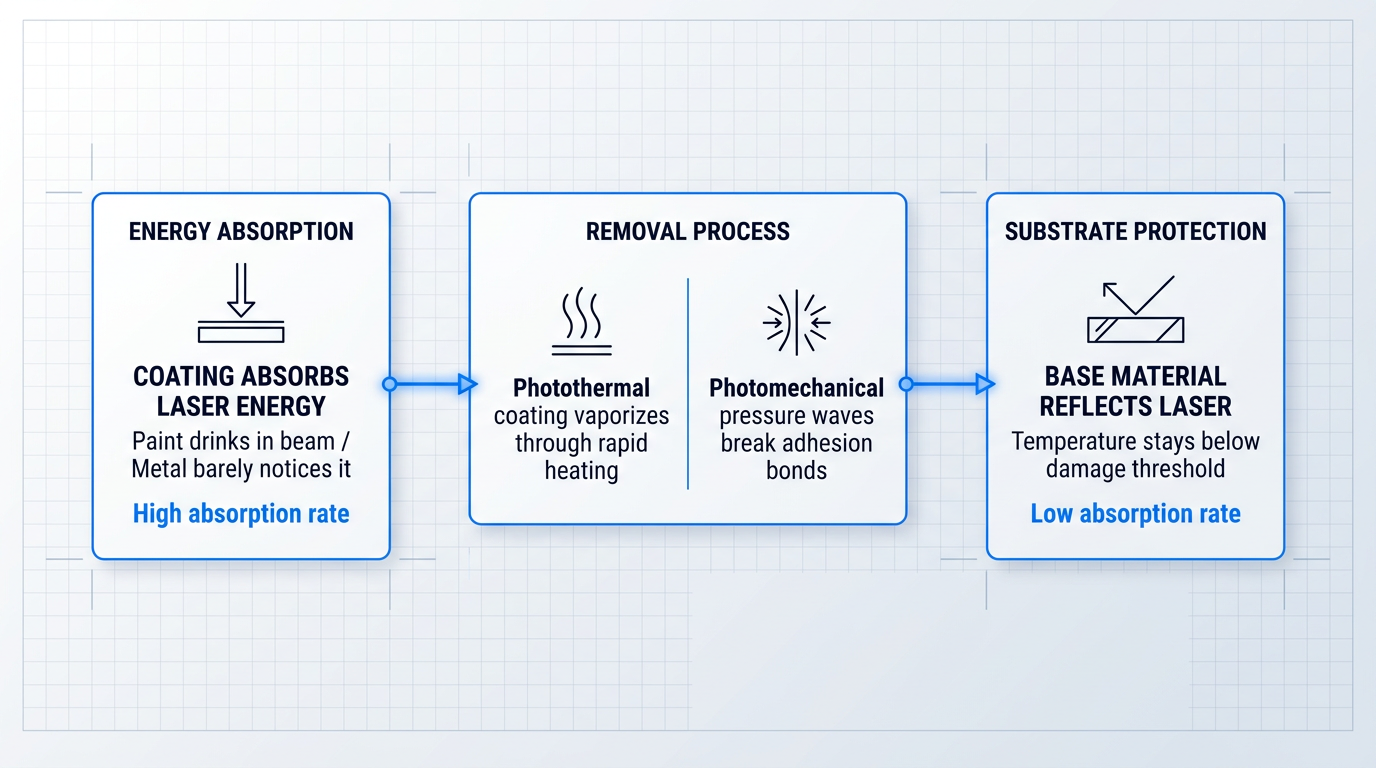
The reason this selective removal is possible comes down to a straightforward physical reality: the coating absorbs laser energy far more readily than the base material beneath it.
Think of it this way — the paint drinks in the laser energy, while the metal beneath barely notices it. This contrast in how each material responds to the beam is what gives the process its precision.
Once that energy is absorbed by the coating, two removal processes can take over — and in practice, both are often active at the same time.
- Photothermal removal: The coating absorbs laser energy and heats so rapidly that it vaporises or is ejected from the surface through thermal expansion — essentially burning off in a highly localised, controlled way.
- Photomechanical removal: Rapid energy deposition generates pressure waves inside the coating, breaking the adhesion bonds that hold it to the substrate. The coating is blasted off by internal stress, not heat alone.
The balance between these two mechanisms shifts depending on the laser's parameters, but for a buyer, the practical takeaway is the same: the coating is destroyed and removed without any grinding, scrubbing, or chemical reaction.
Why the beam stops at the substrate
The question most buyers ask at this point is a sensible one: if the laser is powerful enough to destroy paint, why doesn't it damage the part itself?
Once the coating is gone, the base material — typically a metal — reflects or absorbs far less laser energy than the coating did, so its temperature stays well below the threshold at which it would be affected.
The laser effectively runs out of material to work on and the process stops naturally. This is not a coincidence or a matter of careful operator timing — it is a designed-in physical property of the process.
Because the substrate reflects or absorbs far less laser energy than the coating above it, the removal process is inherently self-limiting — once the coating is gone, the beam has nothing left to act on. Substrate safety is built into the physics, not dependent on operator precision.
The ablation process does produce byproducts: vaporised coating material, fine particulate, and gaseous compounds collectively form what is known as the laser plume.
That plume must be captured by an extraction system — the coating material has to go somewhere, and controlling where it goes is an important part of safe operation. Extraction is covered in detail later in this guide.
Laser cleaning versus laser cutting and welding
If you are already familiar with industrial laser systems, it is worth being clear on how laser cleaning differs fundamentally from laser cutting and laser welding.
In cutting and welding, the objective is to process the substrate itself — to cut through it or fuse it to another material. In laser cleaning, the objective is precisely the opposite: to remove only the surface layer while leaving the substrate completely unaffected.
The laser parameters, pulse characteristics, and energy levels used in a laser paint removal machine are calibrated for selective surface removal, not bulk material processing — a fundamentally different operating regime.
In terms of the technology itself, near-infrared fibre laser systems — operating around 1064–1070 nm, with newer eye-safe variants emerging at 1550 nm — are now the established industrial format for paint removal applications. This is a mature, proven technology with a substantial track record across industrial environments.
With the mechanism clear, the natural next question is what variables control how effectively it performs across different coatings, substrates, and production conditions — and that is exactly what the following section addresses.
The Technical Variables That Govern Performance
A machine's headline wattage tells you very little about whether it will clean your specific coating from your specific substrate without damage — the real answer lies in how several interacting parameters are set and controlled.
Understanding these variables gives you something a spec sheet cannot: the ability to ask a supplier the right questions and judge whether their answers hold up.
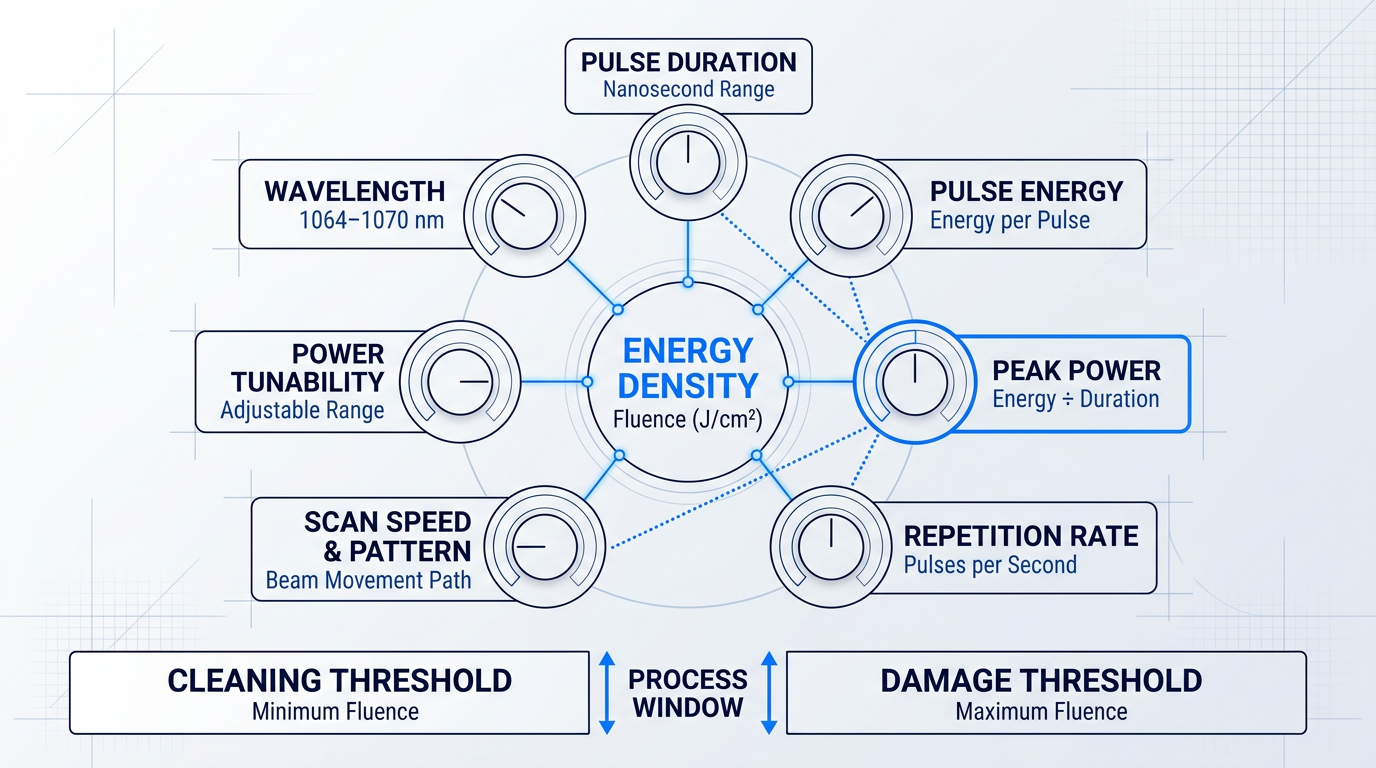
The Seven Parameters That Shape Every Cleaning Job
Each parameter below controls a specific aspect of how energy is delivered to the surface, with direct consequences for cleaning effectiveness, substrate safety, or both.
- Wavelength: Determines how well energy couples with each material. Near-infrared (1064–1070 nm) is the industrial standard, absorbed well by coatings but less so by common metal substrates.
- Pulse Duration: Controls how quickly energy is deposited. Nanosecond-range pulses are standard for sensitive substrates — the burst is brief enough to limit heat diffusion into the base material.
- Pulse Energy: The energy delivered in a single pulse. It sets the raw energy budget per firing event and interacts with pulse duration to determine peak power.
- Peak Power: Pulse energy divided by pulse duration — the instantaneous power during a burst. High peak power drives coatings past their ablation threshold before heat conducts into the substrate.
- Repetition Rate: Pulses delivered per second (Hz or kHz). Too high relative to the substrate's cooling time and heat accumulates across pulses, raising surface temperature beyond what any single pulse would cause.
- Power Tunability: The ability to adjust output across a range within one machine. Thick coatings may need higher power; heat-sensitive substrates may need lower. Ask for the effective range, not just the maximum.
- Scan Speed and Pattern: How fast the beam moves and the path it follows. Together they set energy density per unit area — slower deposits more, faster deposits less, pattern governs uniformity.
None of these variables operates in isolation: repetition rate and pulse energy interact to govern heat accumulation; scan speed and pulse energy interact to determine the energy density reaching the surface.
This interdependence is precisely why a supplier who only quotes wattage is giving you an incomplete picture — and why understanding each variable separately is the prerequisite for evaluating the whole.
A useful way to visualise this is to think of each parameter as a dial: turning any one of them changes the energy the surface receives, and the dials are linked.
The Process Window: Where All Parameters Converge
The concept that ties every variable together is the process window: the operating range, defined primarily by fluence (energy per unit area), that sits between two critical thresholds.
The lower boundary is the cleaning threshold — the minimum fluence needed to remove the coating. The upper boundary is the damage threshold — the fluence at which the substrate itself begins to be affected.
Effective parameter control keeps the process above the cleaning threshold and below the damage threshold simultaneously; stray outside either boundary and the result is an incompletely cleaned surface or a damaged one.
Every substrate-and-coating combination has its own process window. Wide windows are forgiving; narrow windows — typical of thin sections, heat-sensitive metals, or tightly bonded coatings — demand precise parameter control. When a supplier claims substrate safety, the meaningful question is: how wide is the process window for your specific job, and how accurately can the machine hold parameters within it?
The width of the process window is not a fixed property of the machine — it is determined by the substrate-coating combination, and it varies considerably across different materials and applications.
With a clear grasp of what governs performance, the natural next question is which substrates and coating types these parameters can actually be tuned to handle — and that is exactly where the guide turns next.
What Laser Paint Removal Machines Can Clean
The practical question most buyers reach at this point is simple: does this work on my material, with my coating? The answer, for most industrial applications, is yes — but the compatibility picture has genuine edges worth understanding before you commit.
Metal substrates are where laser paint removal machines are most widely applied, and the range of compatible metals is broad: carbon steel, cast iron, aluminium alloys, copper, brass, bronze, titanium, and galvanised steel are all candidates.
- Carbon steel and mild steel: The most common application — light to medium rust, paint, and oxide removal are well within the technology's reliable range.
- Aluminium alloys: Handles oxide film and paint removal well; aluminium's reflectivity and lower ablation threshold require careful parameter calibration.
- Cast iron: Responds well to laser cleaning for rust, scale, and coating removal, particularly in automotive and heavy engineering contexts.
- Copper, brass, and bronze: Cleanable for oxidation, tarnish, and flux residues — common in electrical, heritage, and precision engineering applications.
- Titanium: Used in aerospace and medical; laser cleaning removes oxide and surface contamination without dimensional change.
- Galvanised steel: Laser ablation can strip the zinc coating selectively; note that zinc vaporisation generates fumes requiring extraction.
Each metal has different reflectivity, thermal conductivity, and ablation threshold characteristics — so the parameter set that works on carbon steel will not be the right starting point for aluminium or copper. The technology is capable across this range, but correct configuration for each substrate is not optional.
Beyond metals, laser cleaning is also used on stone, masonry, brick, and concrete — particularly in heritage restoration, where removing paint, graffiti, and soiling from historic stonework without damaging the substrate is a genuine challenge that abrasive methods handle poorly.
Coating and contaminant compatibility
One of the more practically significant aspects of the technology is that it removes far more than decorative paint — the range of coatings and surface contaminants it handles covers most of what industrial buyers encounter across pre-treatment, maintenance, and repair workflows.
- Paint and primer: Including lead-based paint — though lead ablation generates hazardous fumes that require appropriate extraction (covered in full in a later section).
- Powder coating and e-coating: Both removable with laser cleaning; coating type and thickness determine the number of passes required.
- Phosphate coating: Commonly used as a pre-treatment layer; laser cleaning removes it selectively without affecting the base metal.
- Rust, oxides, and mill scale: A core application — the rust ablation threshold is significantly lower than that of steel, enabling selective removal.
- Oil, grease, and cutting fluids: Organic residues vaporise cleanly, making laser cleaning a practical surface preparation step before welding or bonding.
- Carbon deposits and weld discolouration: Post-weld HAZ oxides and carbon fouling on moulds and tooling are well-established laser cleaning applications.
- Adhesive residues and release agents: Removable from metal surfaces without abrasive contact, preserving dimensional tolerances on precision components.
The breadth here is practically significant: the same machine, with tuned parameters, handles both organic coatings (paint, powder coat, adhesive) and inorganic surface conditions (rust, mill scale, oxides) — which means buyers are not acquiring a single-purpose tool.
Not all coatings are equally cooperative, however. Transparent and clear coatings present a specific and non-trivial challenge that is worth understanding at the principle level before the full treatment in the next section.
Standard fibre lasers operate in the near-infrared range. Transparent and clear coatings have low optical absorption at these wavelengths — they transmit rather than absorb the laser energy. The result is that the beam can reach the substrate before the coating is fully removed, risking base material effects. This is a genuine limitation, not an edge case, and application-specific trials are needed before assuming a clear coat is a viable candidate.
Coating thickness is a separate but related consideration: thicker coatings and multi-layer systems require more passes or higher power settings, and very heavy protective coating build-ups may need staged removal across multiple passes.
Thin sections, soft metal grades, and heat-sensitive substrates narrow the process window — the gap between the cleaning threshold and the damage threshold shrinks, making parameter discipline more critical. Fibre-reinforced composites such as CFRP present a further specific challenge: the fibre and matrix respond to laser energy very differently, which can lead to preferential ablation of one before the other.
These nuances — transparent coatings, thick coating systems, and sensitive substrates — are real buying considerations, not fringe cases. The next section covers where the technology has genuine limits and what that means for application decisions.
Where laser paint removal has limits
Any technology that is genuinely good at something has specific conditions where it performs less well — and a buyer who knows those conditions before purchasing is in a far stronger position than one who discovers them after deployment.
The limitations below are real, bounded, and well-understood. Each one points to a specific application condition, not a general flaw in the technology.
- Transparent and clear coatings: If a coating does not absorb the laser wavelength, the energy passes through it. Clear lacquers, varnishes, and transparent topcoats require compatibility verification before committing.
- Very large open areas at speed: On open structural steel where raw coverage rate is the primary metric, abrasive blasting typically outpaces laser cleaning. The fit question is job type, not general capability.
- Deep pitting corrosion: Laser cleaning removes surface oxidation but cannot restore lost metal. The surface will be clean after treatment; the pit profile remains.
- Aluminium and galvanised steel: Both require careful parameter management. Aluminium's high reflectivity narrows the process window; galvanised steel generates zinc vapour requiring appropriate extraction.
- Line-of-sight access: The beam only removes what it can directly illuminate. Blind cavities and internal bores may need robotic or articulated delivery to achieve full coverage.
- Process window variability: The usable range between cleaning threshold and damage threshold shifts with each substrate-coating combination, requiring parameter validation before full production.
What these limitations share is a common structure: each one arises from a specific physical or geometric boundary, not from an inherent unreliability in the technology itself.
The transparent-coating limitation follows directly from the differential absorption principle covered earlier in this guide — a coating that does not absorb the laser energy simply cannot be ablated by it, regardless of power level.
The deep pitting corrosion constraint is similarly precise: the ablation mechanism removes the oxidised layer at the surface, but the pit profile is a physical substrate loss problem that was already there before the laser arrived.
The area coverage concession is real but job-specific. Industry sources consistently confirm that abrasive blasting outpaces laser cleaning on large, open, flat structural steel — but that calculus reverses on precision parts, complex geometries, and applications where substrate damage or waste generation matter.
For aluminium, the challenge is predictability: bulk aluminium reflects around 80–92% of near-infrared laser energy at 1064 nm, which makes energy coupling less consistent and the process window narrower than on carbon steel.
Laser processing of galvanised steel generates zinc vapour — the same hazard recognised in welding and thermal cutting of zinc-coated materials — which requires appropriate extraction and parameter control. The full extraction requirements are covered separately in this guide.
The line-of-sight constraint is a deployment consideration rather than a physics failure: buyers with complex internal geometries should factor delivery system configuration into their evaluation from the outset.
Across all six limitations, the common mitigation is the same: process trials on representative production samples before committing to full-scale deployment.
Because the process window varies with every substrate-coating combination, parameter validation on actual production samples is what separates a well-deployed laser cleaning system from a misfit one. Responsible suppliers treat this step as standard — not optional.
Understanding where laser paint removal machines have limits is what makes the comparison with traditional methods meaningful — because chemical stripping and abrasive blasting each carry their own constraints, and the question is always which set of trade-offs fits your specific application.
Laser paint removal vs. traditional methods
The question buyers most often ask at this stage is not "does laser cleaning work?" — it is "is it better than what I already use?" That question has a genuinely conditional answer, and any comparison that skips the conditions is doing you a disservice.
The two methods most buyers are already running or evaluating are chemical stripping and abrasive blasting — both proven, widely deployed, and each with real strengths that laser cleaning does not automatically displace.
How each method removes contamination
Chemical stripping dissolves coatings through chemical reaction — acids, alkalis, or solvents attack the binder and loosen the film from the substrate without any physical contact or line-of-sight requirement.
That mechanism gives it a genuine structural advantage: parts can be immersed, meaning complex shapes, internal geometries, and batch loads of multiple components can be processed simultaneously without an operator traversing every surface.
The constraints are significant. Chemical stripping generates hazardous liquid waste — spent solvents and rinse water that require licensed carrier collection and regulated disposal — and produces VOC emissions during the process that trigger ventilation and compliance obligations.
The EPA has regulated methylene chloride-based strippers specifically for industrial paint removal, and the EU has banned them outright under REACH. Cycle times are also slow: soak, rinse, and neutralisation stages add hours that mechanical methods do not require, and ongoing chemical supply and disposal costs accumulate with every job.
Abrasive blasting removes coatings through mechanical impact — abrasive media accelerated to high velocity physically fractures and dislodges the contamination layer on contact.
Its genuine strength on large, open structural steel is real: area coverage rates of 10–30 m²/hour are achievable with a competent blasting setup, and the process simultaneously creates an anchor profile — a surface roughness that improves mechanical adhesion for subsequent paint coatings. For structural steel being prepared for repainting, that profile is a functional requirement, not a side effect.
The occupational health picture is the most serious constraint. OSHA guidance on abrasive blasting operations identifies silicosis — an irreversible, progressive, and potentially fatal lung disease — as a primary hazard when silica-containing abrasives are used, with employees also exposed to toxic air contaminants from the coatings being removed, including lead and heavy metals when stripping older industrial paint.
Spent abrasive media contaminated with lead-based paint or heavy metal coatings is classified as hazardous waste in most jurisdictions, carrying disposal costs and compliance obligations that accumulate with every shift. Noise hazard is a further regulated exposure for blasting operators.
Comparing across the dimensions that matter
Four axes determine which method is the right fit for a given operation — and laser cleaning does not lead on all of them.
- Surface quality: Laser cleaning leaves no embedded abrasive, no chemical residue, and no dimensional change — critical for precision parts and moulds where tolerances are held tightly.
- Environmental and waste: Laser cleaning produces only captured fume particulate. Chemical stripping and abrasive blasting both generate regulated waste streams with ongoing disposal costs and compliance obligations.
- Operator health and safety: Each method carries a different risk profile: silicosis and noise hazard for blasting; chemical burn and VOC inhalation for stripping; laser radiation hazard for laser cleaning — bounded and manageable with appropriate PPE and training.
- Total cost of ownership: Laser cleaning has near-zero consumable costs and minimal waste disposal overhead. Traditional methods carry recurring media, chemical, and disposal costs that compound over time.
On surface quality, laser cleaning is the clear leader for precision applications — no abrasive particle embedment, no chemical residue risk, and substrate dimensions preserved. Abrasive blasting carries a real risk of embedded grit in the cleaned surface, which can cause coating delamination or weld porosity on precision components.
On the operator health axis, it is important to be clear: laser cleaning is not a zero-risk method — it replaces one set of hazards with a different one. The risk profile is more bounded and more controllable, but it is a real profile that requires proper management. Section 9 of this guide covers laser safety requirements in detail.
The total cost of ownership comparison is where buyers most often make the wrong calculation — by comparing upfront equipment prices rather than the full running cost picture.
A laser cleaning system carries a higher capital cost than a basic blasting setup, but once operational its consumable costs approach zero: no abrasive media to replenish, no chemicals to purchase, no hazardous waste disposal contracts to maintain.
Traditional methods carry costs that do not always appear cleanly on a single budget line — media replacement, chemical replenishment, ventilation infrastructure, PPE consumables, and the recurring overhead of regulated waste disposal. Those costs compound with every hour of operation, while laser cleaning's running costs remain largely flat.
The upfront cost of a laser cleaning system is higher than abrasive or chemical alternatives — but the economics shift as operating hours accumulate. Whether and when the crossover occurs depends on utilisation rate, job type, local disposal costs, and what the displaced method was actually costing in full. High-volume, high-frequency operations reach the crossover sooner; very low-volume shops with infrequent rework needs may not reach it at all.
No single method wins universally across every application, and it is worth being explicit about where traditional methods retain a genuine advantage.
Abrasive blasting remains the better choice for large-area structural steel preparation where an anchor profile is a specification requirement and throughput matters more than surface precision — it covers ground faster in that specific context. Chemical stripping is better suited to batch immersion of complex-geometry parts or internal surfaces that line-of-sight methods cannot reach efficiently. Laser cleaning earns its premium on precision components, moulds, selective zone cleaning, field maintenance, and any application where surface cleanliness, environmental footprint, or long-run economics are the primary drivers.
One operational requirement that laser cleaning introduces — and that does not appear in a blasting or chemical stripping workflow — is the need to capture and manage the fume and particulate that ablation generates. That requirement is not complicated, but it is non-negotiable, and it is the subject of the next section.
See How Our Laser Cleaners Perform
Now you know how laser cleaning stacks up against chemical and abrasive methods, explore the machines themselves. Full specifications and product details are ready to review.
Fume Extraction: The Requirement Buyers Overlook
Most buyers evaluating a laser paint removal machine focus on power, speed, substrate compatibility, and price. Extraction barely features in the conversation — yet without an adequately specified system, the machine cannot be safely operated, optics degrade faster, and the operator is exposed to a genuinely hazardous byproduct stream.
What laser ablation of paint actually produces
When a laser ablates a coating, the energy input triggers pyrolytic and oxidation processes that release a caustic, heterogeneous mix of aerosols, gases, and nanoparticles — not simply dust or smoke in the conventional sense.
The exact composition of that plume depends entirely on the coating being removed: a solvent-based paint, a lead-based primer, a zinc-rich coating, and a powder coat each produce a different byproduct profile, including vaporised binder material, fine and ultrafine particulate at sub-micron and nanoparticle scale, and gaseous organic vapours from paint solvents and binders.
Why extraction is a safety requirement
The critical distinction between laser ablation fume and ordinary industrial dust is particle size. Coarser particles are largely intercepted by the upper respiratory tract; ultrafine and nanoparticle-scale particles are not — research confirms they can penetrate the alveolar region of the lung, cross the air-blood barrier, and translocate into the systemic circulation.
Certain coating types raise the hazard further still. Lead-based primers — still common in industrial maintenance, bridge work, and heritage structures — generate lead fume that accumulates in the body and causes irreversible neurological and organ damage. Zinc-rich coatings on galvanised steel produce zinc oxide fume associated with metal fume fever. Coatings containing organic solvents or isocyanates (found in many two-pack polyurethane topcoats) carry respiratory sensitisation risks that can cause occupational asthma.
Extraction is not a comfort measure or an optional upgrade — it is a safety requirement. Buyers should consult the relevant occupational health guidance for their jurisdiction to understand the specific obligations that apply to their operations and the coatings they are removing.
What extraction does for machine performance
This is the angle most buyers do not anticipate, and it matters directly to process quality. Fine particulate generated during ablation can settle on the focusing lens and protective window of the laser head; contaminated optics degrade beam quality, reduce cleaning effectiveness, and accelerate maintenance intervals — in severe cases, optics absorbing contamination can be damaged by the laser energy passing through them.
Without extraction, the ablation plume builds up in the work area, obscuring the work surface and reducing process visibility and consistency — a process-quality problem as much as a safety one. For high-volume production environments, a fume extraction failure is typically a line stopper.
What adequate extraction looks like
A properly specified local exhaust ventilation (LEV) system for laser paint removal has three defining characteristics: it captures the plume at source, it filters across multiple stages matched to the contaminant profile, and its capacity is sized to the laser's output.
On positioning: LEV must be located close to the work area, capturing the plume before it disperses. Standoff distance matters significantly — the further the extraction inlet from the source, the less effectively it captures the fume before it enters the operator's breathing zone.
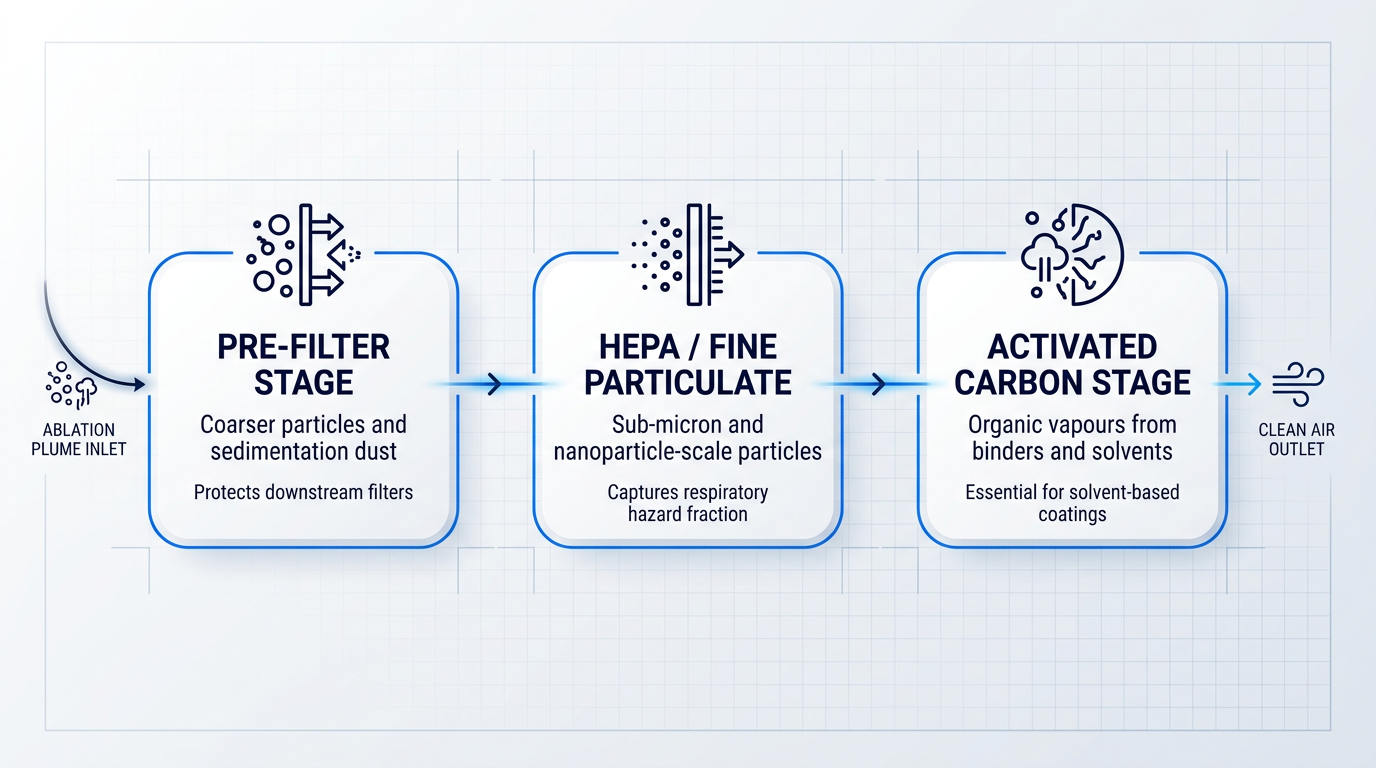
On filtration: a correctly specified system for paint removal uses a multi-stage filter stack, with each stage targeting a different portion of the contaminant stream.
- Pre-filter stage: Captures coarser particles and sedimentation dust, protecting downstream filters from premature saturation and extending their service life.
- HEPA or equivalent fine-particulate stage: Captures sub-micron and nanoparticle-scale particulate — the fraction that bypasses the upper respiratory tract and poses the greatest inhalation hazard.
- Activated carbon stage: Adsorbs organic vapours from paint binders and solvents that pass through particulate filters; essential when removing solvent-based or isocyanate-containing coatings.
A system rated for general metalworking fume may not be adequate for the organic vapour component from paint. Buyers should verify that the filtration specification matches the coatings they are removing, not simply the laser power level — these are different questions with different answers.
Sizing extraction to laser power
Extraction capacity must be matched to the laser's power and ablation rate — a higher-power system generates proportionally more fume per unit time and requires a correspondingly capable extraction unit.
The extraction unit bundled with or recommended alongside a budget laser cleaning machine often lacks sufficient airflow or filtration capacity to handle the laser's full output. Buyers should ask suppliers to specify extraction airflow rate and filter ratings explicitly, then verify these against both the laser power and the coating types to be removed.
When evaluating extraction specifications, ask for the airflow rate and filter ratings in writing, and confirm these have been matched to the laser's rated output and the specific coatings in your application — not just to a generic laser cleaning use case.
Extraction as a procurement line item
A laser cleaning machine quoted without extraction is not a complete system. Buyers comparing machine prices without accounting for extraction — and for ongoing filter replacement costs — are making an incomplete TCO comparison, in the same way that comparing abrasive blasting costs without including media disposal understates the true cost of that method.
Extraction belongs in the installed project cost alongside the machine, cleaning head, electrical preparation, and training — and filter replacement belongs in the ongoing cost model alongside electricity and maintenance consumables.
Extraction is one part of a complete operational safety picture for laser cleaning. The next section covers the broader safety and hazard-zone requirements that apply to laser operation itself — the controls, classifications, and engineering approaches that govern how and where a laser paint removal system can be safely deployed.
Laser Safety, Hazard Zones, and Operational Requirements
Before a laser paint removal machine can clean a single square centimetre, it must be safe to operate in the space where it sits — and that question is not a compliance formality. It is an operational one that determines whether a machine can actually be used in your facility, your workflow, and your environment.
Industrial laser cleaning machines operate as Class IV lasers, the highest hazard class in the IEC/ANSI classification system. Class IV lasers can cause immediate, irreversible injury to the eye and skin from both direct and reflected beams; they carry a material ignition risk; and they require a combination of mandatory engineering controls, administrative controls, and personal protective equipment before operation can begin.
The practical boundary that governs all of this is called the Nominal Hazard Zone. The NHZ is the space within which laser radiation levels exceed the Maximum Permissible Exposure — in plain terms, it is the area where an unprotected person could be harmed by the beam. For conventional Class IV laser cleaning, that zone typically extends well beyond the immediate work surface, which means a significant portion of the surrounding area must be controlled before cleaning starts.
In practice, controlling the NHZ for conventional Class IV laser cleaning means: establishing a secured access zone with unauthorised entry prevented; fitting all personnel with laser safety eyewear rated to the operating wavelength; removing or shielding any reflective surfaces within the hazard zone; providing operator and bystander training; and installing entryway warning systems such as interlocks or illuminated warning lights.
These are not theoretical requirements — they translate into real workflow friction on the factory floor. Sealing off and evacuating a work area before each cleaning run is impractical in open workshops where other trades are operating alongside, in mixed-use manufacturing facilities where production cannot stop, and in public-facing settings such as heritage restoration sites, infrastructure maintenance, or graffiti removal, where area evacuation is simply not possible.
That friction has been a genuine barrier to adoption, keeping laser cleaning out of environments where it would otherwise be the right tool for the job.
How reduced-hazard-zone technology changes the picture
The most significant development in the laser cleaning category in recent years is reduced hazard zone technology — and WSL's ELASER-RHZ is the only laser cleaner of its kind in the world to offer it. Using WSL's patented eye-safe technology, the ELASER-RHZ operates at 1550 nm: a retina-safe wavelength that is strongly absorbed by the eye's anterior media before it can reach the retina, unlike conventional near-infrared wavelengths around 1064 nm, which are transmitted directly to the retina and pose an acute injury risk.
WSL's patented technology collapses the laser hazard zone to a small area around the work itself, rather than extending it across the wider facility. The result is a machine that can operate in open-plan manufacturing environments, mixed-use facilities, and publicly accessible settings — without sealing off the area, without shutting down adjacent operations, and without the evacuation overhead that conventional laser cleaning demands.
Responsible deployment of any industrial laser cleaning system, including the ELASER-RHZ, includes proper operator training — and buyers should treat this as a baseline expectation when evaluating any supplier. WSL provides first-class laser cleaning safety and operation training as part of its complete offering, ensuring operators are equipped to get the best performance from the machine from day one.
On the certification side, any laser cleaning machine sold into UK or European markets should carry CE and/or UKCA marking as a non-negotiable procurement baseline. These marks confirm that the machine has been assessed against the relevant product safety directives — CE for European markets, UKCA for Great Britain post-Brexit. Uncertified machines represent a genuine procurement risk and should be screened out early. The ELASER-RHZ carries both CE and UKCA certification.
Reduced hazard zone technology removes that barrier entirely — unlocking laser cleaning in open workshops, mixed-use facilities, and public-facing environments where conventional Class IV operation was previously impractical.
With the safety and hazard zone picture now clear, the next practical dimension to consider is how a laser cleaning machine is actually configured and operated — because the operation mode a machine supports interacts directly with the safety envelope it requires.
Operation Modes: Choosing the Right Machine Configuration
Buy a portable handheld system for a high-volume production line and you will spend every shift fighting throughput limitations it was never designed to meet. Buy an automated robotic cell for a field maintenance team and you have a machine the work can never reach. Configuration mismatch is one of the most expensive mistakes a laser paint removal machine buyer can make — and it is entirely avoidable once you understand what each form factor is actually built for.
Handheld and Portable Systems
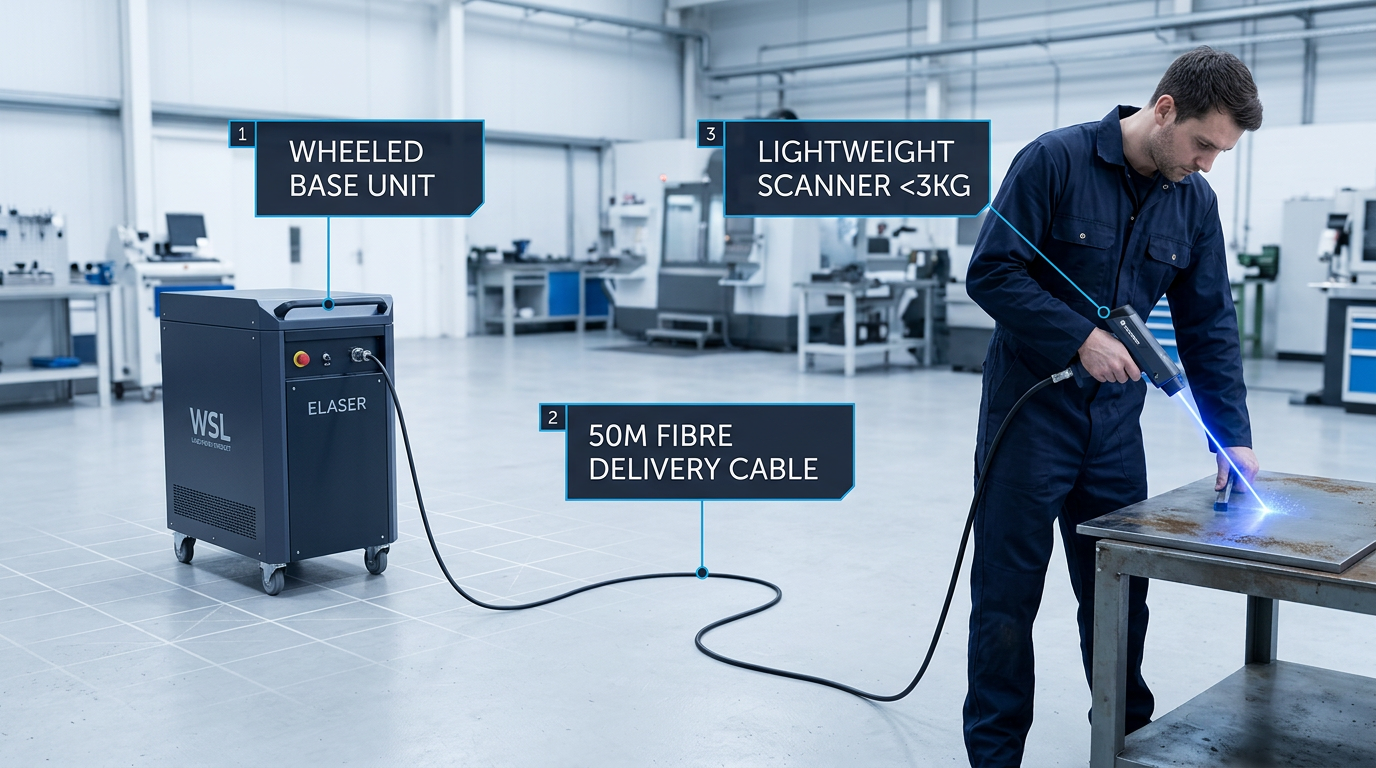
A handheld portable laser cleaning system consists of a wheeled base unit housing the laser source, power supply, and cooling, connected via a fibre delivery cable to a lightweight handheld scanner that the operator guides over the surface.
This configuration is the natural fit for varied part geometries, field and on-site maintenance, small-to-medium batch work, and any application where bringing the machine to the work is more practical than the reverse.
Industry-typical pulsed portable systems run between 100 W and 500 W — enough to handle everything from light oxide removal and weld cleaning to thick paint and mill scale on medium-sized parts.
One practical factor buyers frequently overlook: it is the weight of the handheld scanner, not the base unit, that determines operator fatigue over a full shift.
A lighter scanner paired with a longer fibre delivery cable is a meaningful practical advantage — it extends the operator's reach across large or awkward workpieces without repositioning the base unit, and keeps fatigue manageable across multi-hour sessions.
WSL's ELASER illustrates this well: its handheld scanner weighs under 3 kg and the fibre delivery cable extends up to 50 m, allowing a single operator to work across a wide area from one base position — a specific practical edge for field and workshop deployment.
When evaluating portable systems, treat scanner weight and fibre reach as primary selection criteria alongside power — not as secondary specifications.
Automated and Robotic Systems
An automated laser cleaning system mounts the laser head on a robotic arm or gantry operating within a defined cell — the part is loaded into the cell and the machine does the rest, with no operator guiding the scanner.
This configuration is built for high-volume, repeatable cleaning of identical or similar parts where consistency and throughput are the primary drivers: every part exits the cell cleaned to the same standard, every cycle, with manual labour removed from the loop.
The economic logic is straightforward: automation makes sense when the cleaning task is sufficiently repeatable, the volume is high enough, and the cost of operator time across the production run justifies the investment in the cell.
The more important question for buyers evaluating automated systems is not whether to automate — it is how the system generates its cleaning path.
In conventional robotic laser cleaning, a technician must programme the cleaning path for each part geometry: defining the robot's trajectory, the laser parameters at each position, and the sequence of moves. This adds setup time, requires skilled operators, and creates a real barrier whenever part geometries change.
Systems with 3D machine-vision capability take a fundamentally different approach: the operator loads the part, the system scans it, builds a 3D map of the surface, and generates the cleaning path automatically — no manual programming, no path-setting, no knowledge of the part's geometry required.
Conventional robotic laser cleaning requires a skilled technician to programme every new part geometry. Vision-driven systems scan the loaded part and generate the path automatically — removing the skills barrier entirely and cutting setup time to near zero.
WSL's AutoLASE is a concrete example of the load-and-go approach: load the part, and the system scans it, builds a 3D map, and generates the clean automatically — no programming, no path-setting, no technical knowledge of the component required. Anyone on the production floor can run it.
AutoLASE also offers an optional RHZ upgrade — WSL's eye-safe reduced-hazard-zone technology — enabling automated cleaning without an enclosure, a capability no other automated laser cleaning system can provide.
Pulsed vs. Continuous Wave: A Practical Choice
The pulsed vs. continuous wave (CW) distinction cuts across both portable and automated configurations, and the practical implications are worth understanding before you specify a machine.
CW lasers deliver a steady, uninterrupted beam — the highest average power output and the fastest raw area coverage, suited to thick coatings over large surfaces where throughput is the primary objective.
Pulsed lasers deliver energy in short, high-peak-power bursts, which vaporises the coating layer before significant heat conducts into the substrate — giving better protection for sensitive or thin materials and more precise control over the cleaning depth.
As covered in the technical variables section, the trade-off is coverage speed: pulsed systems in the 100–500 W range are the right tool for precision work, thin substrates, and varied applications; CW systems at 1,000 W and above are the right tool when large-area throughput is the dominant requirement.
The right choice depends on your coating type, substrate sensitivity, and throughput target — and both pulsed and CW modes are available across portable and automated configurations.
Matching Configuration to Your Application
The decision framework below maps the most common application types to the configuration that fits them best — including one scenario where laser cleaning may not be the fastest option at all.
- Field and on-site maintenance: Portable handheld system. The machine travels to the work; varied geometry and access constraints make manual scanner operation the practical choice.
- Workshop batch work, varied parts: Handheld workshop system (100–500 W pulsed). Flexibility across geometries and batch sizes outweighs the throughput ceiling of a fixed cell.
- High-volume production, similar parts: Automated robotic cell. Consistent output, no manual labour per cycle, and the economics improve sharply as volume increases.
- Large open structural surfaces at speed: Evaluate carefully. High-power CW laser cleaning or abrasive blasting may deliver better area coverage rates — laser cleaning is not always the fastest option here.
The honest answer for large open structural work is that raw coverage speed at the lowest cost per square metre may still favour abrasive blasting in some scenarios — a point consistent with the limitations discussed earlier in this guide.
With the configuration landscape mapped, the next step is knowing what to look for when you evaluate specific machines — the buying criteria that turn this understanding into a concrete purchasing decision.
What to Look for When Buying a Laser Cleaner
Most buyers arrive at the purchase decision focused on two numbers: peak power and sticker price. Neither is a reliable guide to whether a machine will actually perform on their application, hold up over years of operation, or be supportable when something goes wrong.
Having covered the technology end-to-end — ablation mechanics, performance variables, substrate and coating compatibility, extraction, safety, and operation modes — the criteria that genuinely separate good purchases from regrettable ones come into focus. They are almost never the ones printed on the spec sheet.
Power, Configuration, and Application Fit
The right starting point is the application, not the brochure: work backwards from the coating type, substrate, thickness, and area coverage requirements to determine the power level and delivery mode the job actually demands.
A high wattage figure means little if the pulse parameters, scan pattern, and delivery configuration are not matched to the process window for that specific task — a machine optimised for light oxide removal will not automatically perform on thick industrial paint, regardless of its rated output.
As covered in the operation modes section, the choice between handheld and automated, portable and fixed, pulsed and CW all carry real consequences for throughput and flexibility — the right configuration is the one that fits the work, not the one with the highest headline number.
Certifications and Compliance
CE and UKCA certification is the baseline expectation for any industrial laser cleaning machine sold into UK and European markets — not a differentiator, but a non-negotiable procurement requirement.
Buyers should request the Declaration of Conformity and verify that it matches the actual machine model and serial number being supplied — not a generic document covering a product family.
This step is easily overlooked when purchasing through importers or online marketplaces, where an uncertified or improperly certified machine can create genuine regulatory, insurance, and liability exposure after it arrives on site. The ELASER and ELASER-RHZ are both CE and UKCA certified, with documentation that can be verified against the specific unit.
Manufacturer or Reseller?
This is the most consequential distinction in the laser cleaning market, and the one buyers most consistently fail to investigate before committing.
A significant portion of suppliers in this category are resellers or importers rebadging third-party machines: they have no in-house engineering capability, no ability to diagnose problems at the source, no means of improving the machine over its operational lifetime, and support limited to whatever the original manufacturer chooses to provide them.
The practical alternative is a genuine manufacturer — and in the UK, that means Woodrow Scientific Limited. WSL's ELASER is designed, built, serviced, and continuously improved in-house by the only UK-based laser cleaning manufacturer, founded in 2012, with over 200 years of combined engineering experience across the team.
When a problem arises with a machine built by its own engineering team, the path to resolution is direct — no intermediary, no waiting on a distant OEM, no guesswork about what is actually inside the enclosure.
- Operator training: Does the supplier offer structured safety and operation training — not just a manual? WSL provides first-class laser cleaning safety and operation training.
- Service response times: What is the committed response time for a service call? Can the supplier diagnose and fix the machine, or are they dependent on a third party?
- Spare parts availability: Are optics, lenses, and critical components held in stock for rapid dispatch, or ordered on demand with unpredictable lead times?
- In-house engineering depth: Does the supplier employ engineers who designed the machine and can genuinely improve it — or are they limited to basic field servicing?
- Portability and reach: For field or multi-site use, verify single-operator capability. The ELASER's handheld scanner weighs under 3 kg with up to 50 m of delivery cable reach.
These questions should be asked before signing off on a purchase order, not after the machine arrives on site — the answers reveal more about long-term operational risk than any specification table.
Extraction, TCO, and Application Trials
As established in the extraction section of this guide, an adequately specified fume extraction system is not optional — it is a prerequisite for safe operation. Treat it as a procurement line item: verify that the extraction specification is matched to the machine's power level and the coatings being removed, and include it in the total budget from the outset.
Under-sized or absent extraction is a common failure point with lower-cost machines, and retrofitting a compliant system after purchase adds cost and delay that could have been avoided at the specification stage.
On the economics side, evaluate the machine on total cost of ownership, not upfront price. Laser cleaning carries near-zero consumable costs across its operating life — no abrasive media, no chemical disposal, no recurring material spend — while abrasive and chemical methods generate ongoing consumable costs that compound over years.
WSL positions the ELASER as the European cost leader among comparable industrial laser cleaning machines — competitively priced through technological and operational efficiencies, not by reducing quality — and the TCO case strengthens further when reduced downtime and lower rework rates from minimal substrate damage are factored in.
Over a multi-year operating horizon, consumable costs, maintenance burden, downtime risk, and rework rates dwarf the initial capital figure. A machine that looks cheaper on day one can easily cost more by year three.
Before committing to production deployment, request application trials on actual samples from your process — the specific substrate, the specific coating, the specific thickness.
A responsible supplier will support parameter validation on real production samples without hesitation; a supplier who cannot demonstrate performance on your combination before purchase is a procurement risk, not a procurement partner.
With this evaluation framework in place, the final step is translating it into a confident purchase decision — which is where the conclusion of this guide picks up.
Ready to Talk to a Laser Cleaning Expert?
You have covered the full picture. Book a 30-minute call with our team to discuss your application, substrate, and which machine configuration fits your operation.
Conclusion
Making a confident decision on laser paint removal
The buyers who get this right evaluate on the full picture: understanding what the ablation mechanism actually does, matching the machine to their substrate and coating, and judging value through total cost of ownership rather than sticker price.
Laser paint removal suits a wide range of industrial applications — though not every job, and knowing the difference is itself a mark of a well-informed buyer.
For those ready to take the next step, the ELASER / ELASER-RHZ — UK-manufactured, CE and UKCA certified, competitively priced, and the world's only laser cleaner with reduced-hazard-zone technology — is worth exploring directly with WSL.
Frequently asked questions about laser paint removal machines
Straight answers to the questions buyers ask most often — from pricing and performance to limitations and safety.
Laser paint removal machines range widely in price — entry-level portable pulsed systems start in the low tens of thousands of pounds, mid-power industrial portables sit considerably higher, and high-power fixed or automated systems are higher still. There is no single representative figure because the range is genuinely broad, and headline prices across suppliers often reflect very different configurations. What drives the variation: power output (wattage), pulsed versus continuous-wave configuration, the laser source brand and quality, portability versus fixed installation, and whether extraction and safety infrastructure are bundled into the package price or quoted separately. Buyers comparing sticker prices without accounting for these differences are frequently not comparing equivalent systems. The more useful frame is total cost of ownership. Laser cleaning machines carry near-zero consumable costs — no abrasive media, no chemicals, no disposal fees — which compounds into substantial savings against traditional methods over a multi-year operating horizon. Evaluate on TCO, not upfront price alone. For buyers seeking a UK-manufactured, CE and UKCA certified portable system, contact Woodrow Scientific Limited for a quote on the ELASER — competitively priced and built entirely in-house in the UK.
Yes — and the reason is grounded in physics rather than marketing. The mechanism is differential absorption: the coating absorbs laser energy at a far higher rate than the base material beneath it. That contrast is what makes selective removal possible — the coating vaporises or is ejected by rapid thermal expansion, while the substrate stays below its own ablation threshold and remains intact. This is not a marginal effect; it is a reliable, repeatable physical process. The technology has decades of proven industrial deployment behind it, across aerospace, automotive, industrial maintenance, and heritage restoration. These are not experimental applications — they represent large-scale, high-value use in demanding environments where surface quality is critical. The honest qualifier: performance depends on correct parameter selection for the specific coating and substrate combination. A machine configured incorrectly for a given job will underperform. This is a characteristic of any precision process, not a weakness of the technology — it is why process trials and supplier expertise matter when selecting a system.
Three genuine disadvantages are worth understanding before committing to a purchase. First, upfront capital cost is higher than traditional alternatives such as abrasive blasting or chemical stripping equipment. This is a real consideration. The offsetting factor is total cost of ownership: laser cleaning machines have near-zero running costs — no consumables, no media, no chemicals, no disposal fees — and cause minimal substrate damage, reducing rework. Over a multi-year operating horizon, the economics often favour laser cleaning decisively. Second, clear and transparent coatings present a genuine limitation. Coatings that do not absorb the laser wavelength transmit rather than absorb the energy, which means the laser may reach the substrate before the coating is fully removed. Buyers with transparent topcoats should verify compatibility through process trials before committing to production use. Third, raw area coverage speed on very large open structural surfaces can favour abrasive blasting. For high-volume, open-area structural steel work where speed per square metre is the primary metric, abrasive blasting can outpace laser cleaning on throughput. Laser cleaning holds the advantage on precision, surface quality, and long-run economics for high-frequency use. A practical note: extraction infrastructure is a non-negotiable operational requirement that adds to total installed cost — a factor buyers often overlook when comparing headline machine prices.
No. Industrial laser paint removal machines are Class IV laser devices — the highest hazard classification — and are designed exclusively for professional industrial use. Operating one safely requires trained operators, laser safety PPE (including eyewear rated for the specific operating wavelength), and extraction infrastructure to capture the fume and particulate generated during ablation. None of those conditions exist in a typical home environment. Even in professional industrial settings, these machines require controlled access procedures, adequate ventilation or dedicated extraction, and trained personnel. The power and precision that make them effective on industrial surfaces are precisely the qualities that make them unsuitable for uncontrolled domestic use.