

Introduction
If you searched for laser machines and found mostly product listings, you are not alone — the space is dominated by retailers and manufacturers who assume you have already decided what you need.
This guide is for the earlier stage: understanding what the different machine types actually are, what tasks they are suited for, how industrial and hobbyist machines genuinely differ, and which specifications deserve your attention.
By the end, you will have a clear picture of the landscape — enough to know what you are looking for before you start comparing products.
TL;DR
Choosing the right laser machine is less about finding the most powerful option and more about matching the right machine type to your application and scale. The distinctions between types, tasks, and grades matter far more than headline wattage — and once you understand them, the right direction becomes considerably clearer.
This article covers:

The four laser machine types and what distinguishes them
Application categories: cutting, engraving, marking, welding, and cleaning
Industrial vs hobbyist machines: what actually differs
Key specifications when evaluating a laser machine
Laser safety classes and what they mean
What Are Machines Laser? Types, Wavelengths, and How They Work
Before you can make sense of why one laser machine cuts steel while another engraves wood, you need to understand one physical fact — and it changes how you read everything else in this guide.
A laser machine is a device that generates a concentrated, coherent beam of light and directs it at a material to process, modify, or interact with its surface. Unlike ordinary light, which scatters in all directions across a range of wavelengths, a laser beam travels in a single direction at a single wavelength — a property called coherence — allowing it to be focused to an extraordinarily small, intense spot.
That focused energy is what makes machines laser useful across such a wide range of tasks: cutting, engraving, marking, welding, and cleaning all rely on the same underlying principle, delivered at different power levels and in different operating modes.
The single most important physical variable in all of this is wavelength — the specific frequency of light the laser emits.
Different materials absorb different wavelengths at different efficiencies. A wavelength that a material absorbs strongly will transfer energy into it effectively; a wavelength that passes through or reflects off the material will have little to no effect, regardless of how powerful the source is.
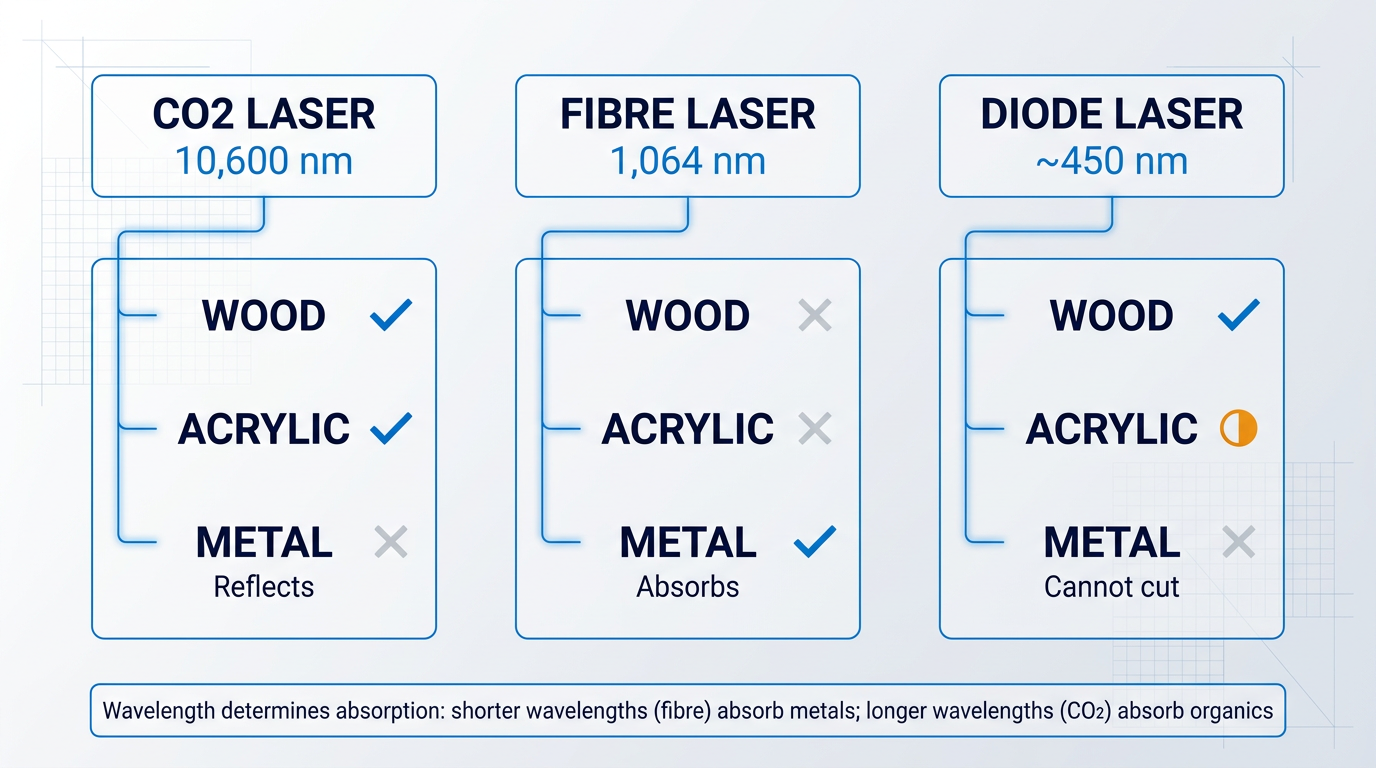
Two contrasts make this concrete: a CO2 laser operating at ~10,600 nm cuts wood and acrylic with ease, but that same wavelength reflects off bare steel at close to 99% reflectivity, making it nearly useless on metal. A fibre laser at ~1,064 nm couples efficiently into metals — but passes straight through clear acrylic, leaving it unprocessed.
This is why no single laser type does everything equally well, and why understanding the four major types is the starting point for any intelligent discussion of laser equipment.
The Four Major Industrial Laser Types
Industrial laser machines are categorised primarily by their active medium — the physical material in which the laser light is generated — which determines the wavelength the machine emits and, by extension, the materials it can process.
| Laser Type | Wavelength | Active Medium | Primary Use |
|---|---|---|---|
| Fibre | ~1,064–1,080 nm | Rare-earth-doped glass fibre (typically ytterbium) | Metal cutting, welding, marking, and cleaning |
| CO2 | ~10,600 nm | Gas mixture: CO2, nitrogen, and helium | Cutting and engraving wood, acrylic, leather, textiles |
| Diode | ~450 nm (blue) or ~808–980 nm (near-IR) | Semiconductor junction | Entry-level engraving; pump source for other laser types |
| UV | ~355 nm | Frequency-converted solid-state laser (e.g. Nd:YAG or Nd:vanadate) | Precision marking of heat-sensitive materials; photochemical processing |
Side-by-side reference of the four major laser types by wavelength, active medium, and primary use — the core framework the reader will apply throughout the guide.
The wavelength span across these four types is enormous: from 355 nm in the ultraviolet to 10,600 nm deep in the mid-infrared — a range of roughly 30-to-1.
That span is not incidental. Each step along it corresponds to a different pattern of material absorption, which is why the four types occupy largely distinct application territories rather than competing head-to-head on the same tasks.
The fibre laser's near-infrared wavelength is efficiently absorbed by metals, and its beam is delivered through a flexible fibre-optic cable — making it the dominant choice at industrial scale for metal processing. The CO2 laser's long mid-infrared wavelength is strongly absorbed by organic and non-metallic materials, which is why it has been the workhorse of wood, acrylic, and textile processing for decades.
The diode laser, with its compact semiconductor architecture, sits at shorter near-infrared and visible wavelengths; it is the most energy-efficient of the four and is common in entry-level machines, though it also serves as the pump source that drives energy into fibre and solid-state lasers. The UV laser operates at the shortest wavelengths of the group, where photon energy is high enough to break molecular bonds directly — a photochemical interaction rather than a purely thermal one — enabling fine, low-heat processing of sensitive materials.
Wavelength is the primary parameter that determines what a laser machine can process. A laser that is not absorbed by a material cannot process it — regardless of power. Matching wavelength to material is the first decision in any laser application.
Continuous-Wave vs Pulsed Operation
Beyond wavelength, the other foundational distinction is how a laser delivers its energy over time: as a constant beam or in discrete bursts.
Continuous-wave (CW) lasers emit an uninterrupted beam for as long as the source is active, providing a steady, sustained energy output — well suited to applications like cutting and welding where consistent energy delivery drives the process forward.
Pulsed lasers release energy in short, controlled bursts, with brief pauses between each pulse. Because the same average energy is compressed into a fraction of the time, peak power per pulse can be orders of magnitude higher than the average — while the pauses limit heat build-up in the surrounding material.
Pulse duration is the key variable: it can range from milliseconds down to femtoseconds (10⁻¹⁵ seconds), with shorter pulses delivering higher peak power and less thermal diffusion into the workpiece. This precision makes pulsed operation the standard approach for marking, engraving, and cleaning, where controlled material removal matters more than raw throughput.
The CW vs pulsed distinction recurs throughout this guide — it shapes how each application type works and why certain laser configurations are chosen for specific tasks.
Laser machines also span a remarkable range of scale: from a compact desktop diode laser engraver at the hobbyist end to multi-kilowatt industrial fibre laser systems occupying a production floor. The underlying physics is the same family; the engineering, duty cycles, and operational demands are entirely different categories.
With that framework in place — four laser types, the wavelength-absorption principle, and the CW vs pulsed distinction — the guide now turns to applications, starting with the most commercially prevalent: laser cutting.
Laser Cutting: Machine Types, Materials, and Capabilities
Laser cutting is the most commercially widespread industrial laser application — according to Laser Focus World market reporting, sheet metal cutting alone has consistently represented around 35–40% of total industrial laser revenues, making it by far the largest single application category by revenue.
The cutting process itself is physically straightforward: a focused laser beam melts, vaporises, or burns material along a continuous programmed path, passing fully through the workpiece to produce a precise cut edge.
This distinguishes cutting from engraving and marking — both of which interact only with a material's surface rather than passing through it — a distinction that will become important in the next section.
CO2 Lasers and Non-Metal Cutting
The CO2 laser operates at a wavelength of 10,600 nm — deep in the far-infrared band — and this wavelength is strongly absorbed by organic and non-metallic materials.
Because of that absorption relationship, CO2 is the dominant choice for cutting wood, acrylic, leather, textiles, paper, and most plastics: the beam's energy transfers efficiently into the material rather than passing through or reflecting off it.
Bare metal surfaces behave differently — at 10,600 nm, bright metals act effectively as mirrors, reflecting the beam rather than absorbing it, which is why CO2 cannot reliably cut bare metal in most practical applications.
The exception is coated or painted metals: the coating absorbs the beam and enables some cutting, but the underlying bare metal remains problematic for CO2 at standard cutting powers.
Fibre Lasers and Metal Cutting
Fibre lasers operate at approximately 1,064 nm — a wavelength that metals absorb efficiently — which is the physical reason fibre has become the dominant industrial choice for cutting steel, aluminium, brass, copper, and titanium.
The shorter wavelength also produces a much smaller focal spot: Trotec notes that fibre's intensity can be up to 100 times higher than a CO2 laser of equivalent average power, which translates directly into faster cutting speeds and cleaner cut edges on metal.
This performance advantage has driven a significant shift in new installations: Laser Focus World reported that fibre lasers outsold CO2 for the first time in 2015, and by 2018 fibre had passed the 50% share of total industrial laser revenues — growth driven overwhelmingly by sheet metal cutting applications.
One practical consequence of fibre's wavelength is its limitation on organic materials: wood, clear glass, and clear acrylic are largely transparent to 1,064 nm light, so the beam passes through without being absorbed — making fibre unsuitable for cutting these materials.
| Material | CO2 (10,600 nm) | Fibre (1,064 nm) | Diode (~450 nm) |
|---|---|---|---|
| Wood / plywood | Yes — cuts cleanly | No — transparent to this wavelength | Yes — thin sheets only |
| Acrylic (coloured/opaque) | Yes — cuts with polished edge | No — largely transparent | Limited — opaque types only |
| Clear acrylic | Yes | No | No — beam passes through |
| Leather / textiles | Yes | No | Thin materials only |
| Paper / cardboard | Yes | No | Yes |
| Steel / stainless steel | No — reflects off bare metal | Yes | No — cannot cut metals |
| Aluminium | No — reflects off bare metal | Yes | No |
| Brass / copper / titanium | No — reflects off bare metal | Yes | No |
| Coated / painted metals | Possible — coating absorbs beam | Yes | No |
| Clear glass | Limited | No | No — beam passes through |
Comparison of CO2, fibre, and diode laser cutting compatibility across key material categories, grounded in wavelength absorption physics.
The table makes the fundamental divide concrete: CO2 dominates non-metal cutting because its 10,600 nm wavelength is absorbed by organic and non-metallic materials, while fibre dominates metal cutting because its 1,064 nm wavelength is absorbed efficiently by metals — the same wavelength that makes fibre useless on clear organics.
Coated metals sit at the boundary: CO2 can engage with them through the coating, but fibre remains the more capable and consistent choice for any application involving significant metal cutting volume.
Diode Lasers: Scope and Limits in Cutting
Diode lasers typically emit at around 450 nm — visible blue light — and are suited to thin organic materials such as plywood, paper, and cardboard at the hobbyist and light-duty end of the market.
The 450 nm wavelength is not absorbed by transparent materials: clear acrylic and clear glass simply transmit the beam without absorbing it, so cutting these materials with a diode laser is not feasible regardless of power level.
Diode machines also cannot cut metals or dense materials such as stone and ceramic — Trotec's diode laser guide is explicit that these fall outside what the wavelength and power levels of diode cutting machines can achieve.
Laser Focus World reported that 2015 was the first year fibre lasers outsold CO2 lasers across all industrial applications — a crossover driven almost entirely by fibre's displacement of CO2 in sheet metal cutting, where fibre's shorter wavelength delivers superior metal absorption and dramatically lower operating costs.
For readers evaluating an entry-level diode machine, the practical cutting envelope is: thin wood, paper, cardboard, and some opaque-coloured acrylics — with clear acrylic, glass, and metals all outside its capability.
Power, Beam Quality, and Work Area
Higher wattage enables faster cutting speeds and greater material thickness penetration — but wattage alone does not determine cutting capability.
Beam quality, focus spot size, and the precision of the motion system all affect real-world performance; a machine with excellent beam quality at moderate power will often outperform a higher-wattage machine with a poor optical path.
Work area is a separate practical constraint: hobbyist diode and CO2 machines commonly offer A4 or A3 cutting beds, while large-format industrial flatbed systems can process sheet metal measuring 1.5 m × 3 m or more — the work area sets a hard ceiling on maximum part size.
The full specifications framework — covering beam quality metrics, pulse parameters, duty cycle, and CNC integration — is addressed in a later section; the key point here is to treat wattage as one input among several, not the sole measure of a machine's cutting capability.
Cutting passes fully through the material to shape a part; the next section turns to the related but distinct processes of laser engraving and marking, where the beam interacts with the surface rather than passing through it — a different physical mode that opens up a different set of machine types and applications.
Laser Engraving and Marking: Differences and Choosing Right
Laser marking, laser engraving, and laser etching are routinely used as synonyms — but they describe three physically distinct interactions with a material, each with different machine requirements and different results on the finished part.
Three Processes, Three Different Material Interactions
The clearest way to separate them is to ask one question: does the laser remove material, and if so, how deep does it go?
- Laser Marking: Changes surface appearance without significant material removal. Mechanisms include annealing, oxidation, and colour change. No measurable depth is created.
- Laser Etching: A surface-level subset of engraving. The laser melts rather than vaporises material, causing slight expansion and a raised mark. Depth is around 0.0001 in.
- Laser Engraving: Physical material removal creating a recessed cavity. Standard engraving reaches up to 0.005 in.; deep engraving exceeds that threshold.
It is worth pausing on annealing — the mechanism behind the most common form of laser marking on metals. Rather than burning or removing anything, the laser applies controlled, defocused heat that draws the carbon content of a ferrous metal to the surface, producing a permanent, jet-black mark with no change to the part's surface finish or mechanical properties.
This matters practically: a part with tight surface finish tolerances — a surgical implant, a precision aerospace component — can be permanently identified by annealing without any dimensional change, whereas engraving would alter the surface profile.
Dark marking (also called oxidation marking) works by burning the top layer of material to form a dark contrasting oxide. Keyence's marking resources note that this process often raises the material's surface slightly, which distinguishes it from true annealing where no surface change occurs.
Matching Laser Type to the Process
As established in the earlier background section, the four laser types each occupy a distinct wavelength band — and that wavelength determines which materials absorb the beam efficiently enough to produce a controlled result.
| Laser Type | Wavelength | Best Processes | Primary Materials | Key Limitation |
|---|---|---|---|---|
| Fibre | ~1,064 nm | Annealing, dark marking, deep engraving | Steel, aluminium, titanium, coated metals | Less effective on transparent or organic materials |
| CO2 | 10,600 nm | Surface engraving, etching | Wood, acrylic, glass, leather, rubber, stone | Cannot mark bare metals without coatings or sprays |
| UV | 355 nm | Cold marking, fine-detail marking | Plastics, glass, ceramics, heat-sensitive materials | Requires frequency-conversion optics absent in standard fibre systems |
| Diode | ~450 nm | Surface marking, shallow engraving | Metals, many plastics, wood, leather | Cannot process transparent materials |
Comparison of the four laser types across process suitability, primary materials, and key limitations for engraving and marking applications.
The pattern that emerges is that fibre lasers dominate wherever the workpiece is metal: the ~1,064 nm wavelength is highly absorbed by metals, making fibre the natural choice for annealing, dark marking, and deep engraving on steel, aluminium, and titanium alike.
CO2 lasers follow the same material logic established in cutting: their 10,600 nm wavelength is efficiently absorbed by organic and non-metallic materials, making CO2 the standard choice for engraving wood, acrylic, leather, glass, rubber, and stone.
The type that deserves the most explanation here is the UV laser, because it operates through a fundamentally different mechanism than the other three.
UV lasers at 355 nm deliver photons energetic enough to break molecular bonds directly — a photochemical process rather than a thermal one. The result is a permanent, high-contrast mark produced with minimal heat input and no heat-affected zone, making UV the preferred type for plastics, glass, ceramics, and any material where thermal damage must be avoided.
This photochemical bond-breaking — referred to as cold marking — is what allows UV lasers to mark transparent and coloured plastics, coated glass, ceramics, and heat-sensitive polymers that would be damaged or distorted by the thermal ablation that fibre and CO2 machines rely on.
Diode lasers serve the entry-level and hobbyist end of the marking spectrum: capable on metals and many plastics, but with one firm boundary — they cannot process transparent materials, because their ~450 nm wavelength passes through without being absorbed.
Traceability Marking: The Industrial Driver
Understanding why these process distinctions matter in practice requires looking at the single largest industrial driver for laser marking: traceability marking.
Manufacturers in automotive, aerospace, and medical device production are required to mark individual parts with permanent, machine-readable identifiers — barcodes, QR codes, serial numbers, and data matrix codes — that survive every subsequent stage of the production process, including painting, coating, and heat treatment.
Ink-jet and mechanical marking methods cannot reliably meet this requirement: marks degrade, smear, or are obscured by post-processing treatments. Laser marking — particularly fibre-laser annealing on metal components — produces marks that are permanently bonded to the material itself, surviving sterilisation cycles, autoclave cleaning, and surface passivation.
This is also where the marking-versus-engraving distinction has direct engineering consequences. An annealed mark on a surgical instrument adds no surface relief — a critical requirement, since any recess could harbour bacteria. A deep-engraved mark on an automotive gear component survives post-machining operations precisely because the cavity sits below the surface that subsequent processes will affect.
Pulsed operation is the standard mode for marking applications — the laser fires in rapid bursts rather than continuously, giving finer control over heat input and mark quality. The specific pulse parameters that govern this are part of the specification framework covered later in this guide.
Cutting, engraving, and marking all interact with the material surface — removing, modifying, or restructuring it. The next application category, laser welding, works in the opposite direction: instead of taking material away, it fuses materials together, which demands a different set of machine characteristics entirely.
Laser Welding: How It Works and Where Fibre Lasers Dominate
Every application covered so far has involved the laser removing material — cutting through it, vaporising its surface, or altering its chemistry. Laser welding inverts that logic entirely: here, the beam's energy is used to melt and fuse two components together, creating a continuous joint as the melt pool solidifies.
The process works by focusing a high-intensity beam onto the interface between two workpieces, generating a localised melt pool that bridges both surfaces. As the beam traverses the joint and the melt cools, the materials resolidify into a single, continuous structure.
The defining characteristic of a laser weld is its narrow heat-affected zone (HAZ) — the band of surrounding material that experiences thermal stress without actually melting. Compared to conventional arc welding processes, the HAZ in laser welding is substantially smaller, which translates directly to less distortion, reduced rework, and the ability to weld in close proximity to heat-sensitive components or precision features.
Why Fibre Lasers Dominate Metal Welding
Three interrelated physical properties explain why the fibre laser has become the standard choice for industrial metal welding, displacing CO2 in new installations and outperforming other laser types across most metal-joining scenarios.
The first is wavelength. Fibre lasers operate at approximately 1,064–1,080 nm, a range that metals absorb efficiently — the same absorption advantage that makes fibre the dominant choice for metal cutting, as covered earlier in this guide. CO2's 10,600 nm wavelength reflects off bare metal surfaces rather than coupling energy into them, making it poorly suited to metal welding in new industrial installations.
The second is beam quality. A fibre laser's tightly controlled beam can be focused to a very small, intense focal spot, enabling two distinct welding modes depending on power density: conduction welding, where the surface absorbs heat and melts broadly but shallowly, and keyhole welding, where the intensity is high enough to vaporise a narrow channel into the material, allowing the beam to penetrate deeply and produce a high-depth-to-width weld profile.
The third is operational mode. Continuous-wave (CW) fibre lasers deliver sustained, steady output power — exactly what is required for seam welding along a joint without interruption. For spot welding or applications where heat input must be carefully managed, quasi-CW or pulsed operation provides the control needed, applying the same CW/pulsed framework established in the background section of this guide.
Fibre lasers dominate metal welding not by chance but because their ~1,064 nm wavelength is efficiently absorbed by metals, while their beam quality and CW capability compound that advantage into deep, precise, high-speed joints.
The breadth of metals that fibre lasers can weld is a practical strength worth noting: steel, stainless steel, aluminium, copper, titanium, and nickel alloys are all within scope.
Particularly significant is the ability to weld reflective metals such as copper and aluminium — materials that present serious challenges for conventional arc welding due to their high thermal conductivity and surface reflectivity. Fibre lasers manage these materials effectively because the short wavelength and high beam quality allow sufficient energy coupling even into highly reflective surfaces.
Laser Welding vs TIG and MIG: Where It Makes Sense
Laser welding is not a universal replacement for TIG or MIG — it is a better fit for specific applications and production contexts. Understanding where it genuinely excels helps frame the engineering trade-off.
- Faster processing speeds: Laser welding traverses joints significantly faster than TIG, making it economical at production volumes where cycle time compounds across thousands of parts.
- Lower heat input: Less total energy into the workpiece means a smaller HAZ, reduced distortion, and less post-weld straightening or rework — critical for precision assemblies.
- Complex geometries and tight access: A focused beam can reach joints in confined spaces or complex three-dimensional geometries that are difficult or impossible to access with a welding torch.
- Dissimilar material joining: Laser welding can join combinations of dissimilar metals that conventional arc processes struggle to fuse reliably, broadening design options for engineers.
These advantages compound most visibly in high-volume, precision-critical production — where TIG or MIG remain entirely valid choices for lower-volume fabrication, field repair, or thick-section structural work where joint preparation tolerances are looser.
Handheld and Automated Laser Welding Configurations
Handheld laser welding systems represent a growing segment of the market, offering operators a portable fibre laser welder for applications where the workpiece cannot be brought to a fixed machine — large fabrications, structural steelwork, or on-site repair scenarios.
At the other end of the configuration spectrum, CNC-integrated and robot-mounted laser welding systems are where the economics of laser welding's speed and precision most clearly compound.
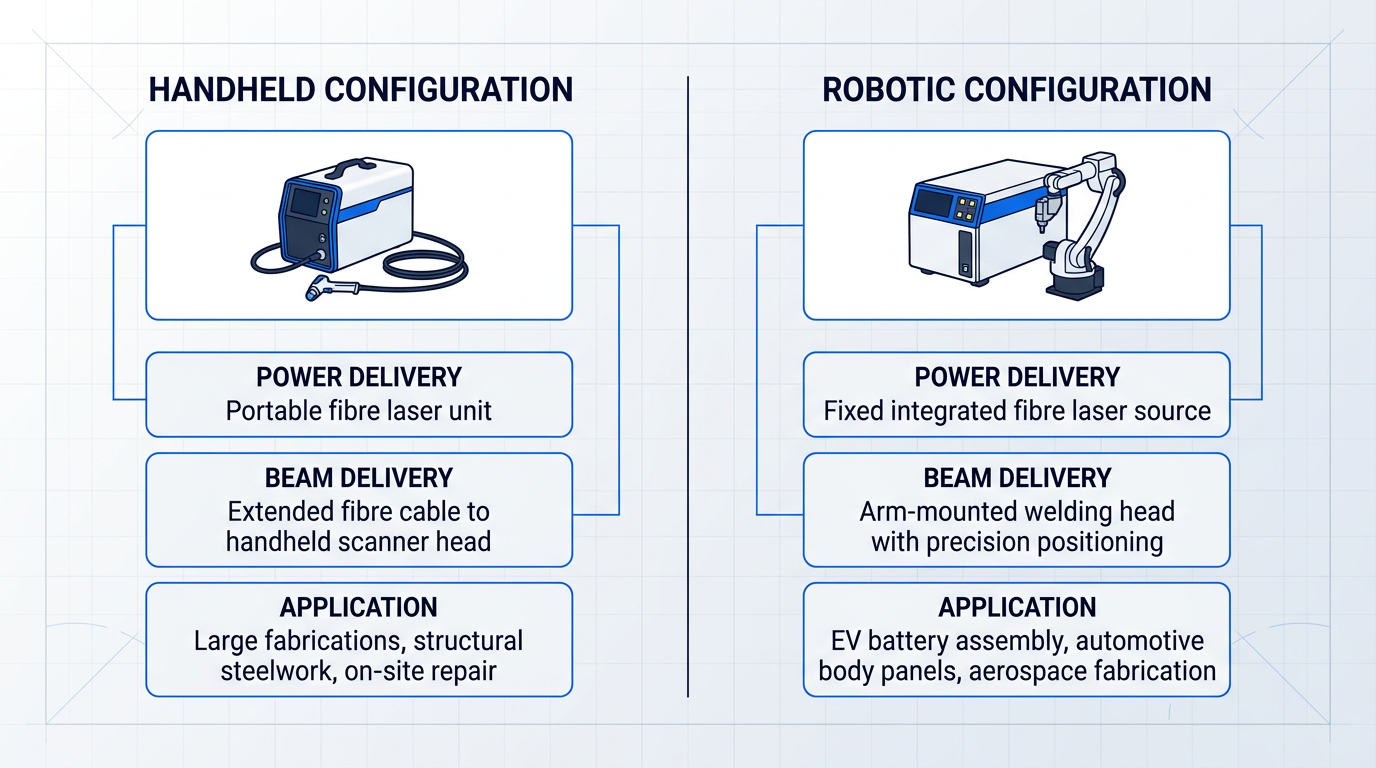
Robotic laser welding is embedded in some of the most demanding production environments in manufacturing: EV battery manufacturing (cell-to-cell and module connections), automotive body panel assembly, and aerospace component fabrication all rely on the combination of consistent weld quality and high throughput that only automated laser systems can deliver at scale.
CO2 lasers retain a niche in welding thick non-metals — certain plastics and composites — where their longer wavelength is better absorbed. For metal welding in new industrial installations, however, fibre has largely displaced CO2 as the default technology.
With joining covered, the next major application category uses the laser in a different mode again: not to fuse materials together or remove base material, but to strip contamination and surface coatings from a substrate — which is the domain of laser cleaning.
Laser Cleaning: Surface Preparation Without Chemicals or Abrasives
Every application covered so far has done something to the base material — cutting through it, marking its surface, or melting it to form a joint. Laser cleaning is physically different: the beam targets only the contamination layer, vaporising or ejecting it while leaving the substrate underneath untouched.
That selectivity is not incidental — it is the entire engineering point, and it is what separates laser cleaning from every abrasive and chemical method in common use.
How Laser Cleaning Works
A pulsed fibre laser delivers short bursts of energy to the work surface. The contamination layer — rust, paint, oxide, scale — absorbs the beam strongly and reaches ablation temperature almost instantly, vaporising or being ejected as particulate.
The substrate beneath behaves differently: it reflects or absorbs the beam at a threshold well below ablation, so the beam effectively stops at the base material boundary.
The result is non-destructive cleaning — the contamination is gone, the substrate is intact, and there is no mechanical abrasion, no chemical residue, and no secondary waste stream to manage.
What a Laser Cleaning Machine Can Remove
One of the less obvious strengths of laser cleaning is its breadth: a single machine addresses a wide range of contamination types without changing consumables or chemistry.
- Corrosion and scale: Rust, oxides, mill scale, and weld discolouration removed without touching the metal beneath.
- Coatings and finishes: Paint, powder coating, primer, lacquer, and tarnish lifted cleanly across large or intricate surfaces.
- Process residues: Oil, grease, carbon, soot, mould residue, release agents, and adhesive residues — all within the same machine's capability.
- Environmental contamination: Graffiti removed from masonry, stone, or metal in open or public-facing environments.
The substrate range is equally broad: metals including steel, carbon steel, aluminium alloys, cast iron, copper, brass, bronze, titanium, and galvanised steel, alongside non-metals such as stone, brick, concrete, and masonry.
Many readers expect laser cleaning to be a metal-only technology — the reality is considerably wider.
Laser Cleaning vs Sandblasting, Chemicals, and Water-Jetting
The right frame for comparing cleaning methods is total cost of ownership, not headline price per machine — and across the dimensions that drive long-term cost, laser cleaning builds a consistent case.
Sandblasting requires continuous abrasive media replenishment, generates media waste that must be contained and disposed of, and introduces mechanical abrasion that removes a measurable layer of base material alongside the contamination — increasing rework rates downstream.
Chemical stripping adds procurement, storage, and hazardous waste disposal costs on top of the consumable spend, along with the process overhead of neutralisation steps and effluent handling.
Water-jetting eliminates abrasive media but still demands water consumption, energy for high-pressure generation, and wastewater treatment infrastructure — none of which disappear from the operating cost line.
Laser cleaning carries none of these recurring cost categories. No consumables to replenish, no chemicals to manage, no waste streams requiring specialist disposal — and because the beam stops at the base material rather than abrading through it, parts arrive at the next process step in better condition with less rework required.
Fibre Lasers: The Dominant Technology for Industrial Cleaning
As covered earlier in this guide, fibre lasers dominate industrial cleaning applications because their wavelength and pulsed energy profile allow selective ablation of contamination without crossing the ablation threshold of the substrate.
Fully tunable power from 0–100% means one machine can span the full range of cleaning tasks: light oxide removal at the low end through to thick coating stripping at full power, without changing equipment.
Portable and Automated Configurations
Industrial laser cleaning machines are deployed in two principal configurations, each suited to a different production context.
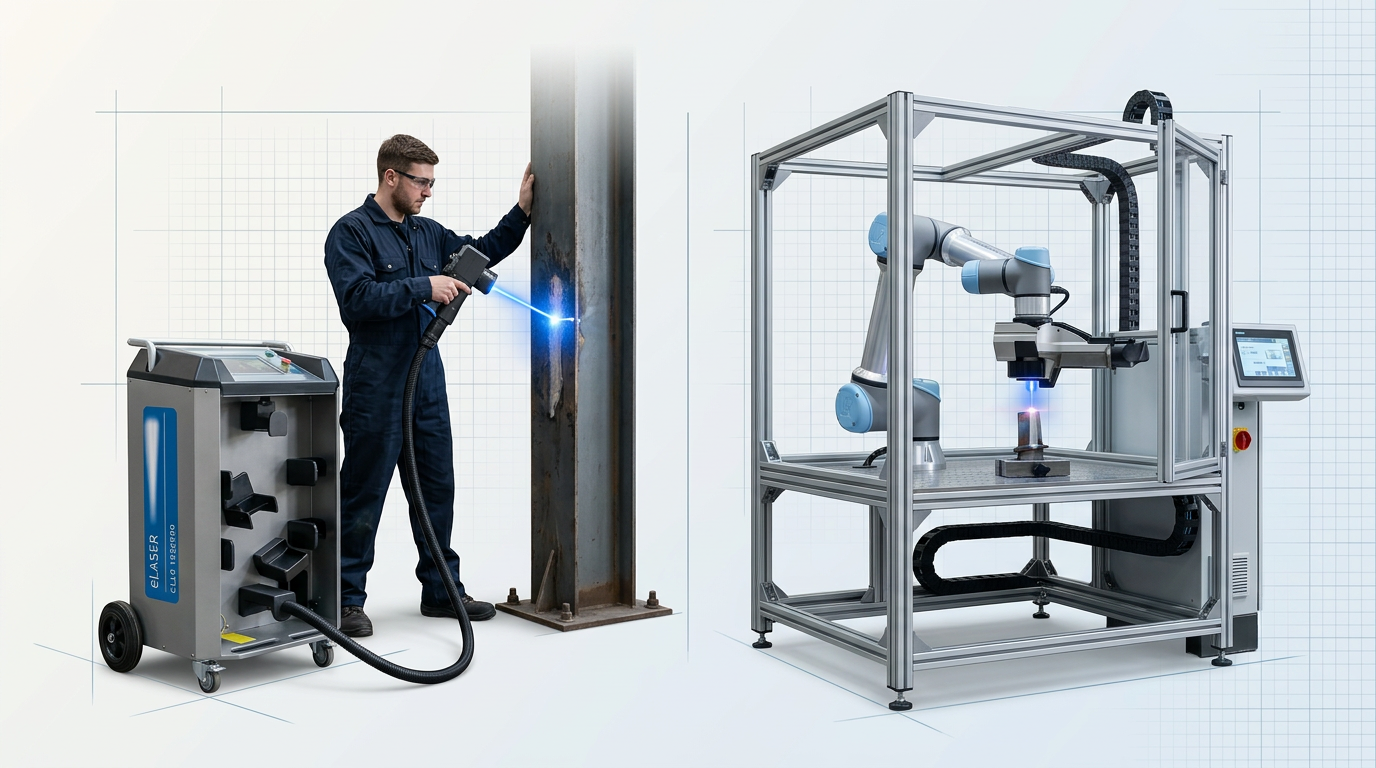
Portable systems are wheeled units with a lightweight handheld scanner, designed for on-site cleaning of large structures, hard-to-reach areas, or situations where moving the part to the machine is impractical — one operator, working independently.
Woodrow Scientific Limited's ELASER and ELASER-RHZ are examples of this category — built in the UK by the only UK-based laser cleaning manufacturer, with everything designed, assembled, and supported in-house rather than imported and rebadged.
The ELASER-RHZ's handheld scanner weighs under 3 kg with a delivery cable reaching up to 50 m, making single-operator deployment practical across large or awkward structures.
Automated laser cleaning cells mount the cleaning head on an articulated robotic arm, delivering consistent, repeatable cleaning across high-volume production batches where manual labour should be minimised.
WSL's AutoLASE illustrates what distinguishes the most capable automated systems from simpler programmed cells: load a part, and machine-vision 3D scanning builds a map of it automatically, then generates the cleaning path without any manual programming, path-setting, or knowledge of the part geometry.
That load-and-run capability means AutoLASE requires no specialist technical skills to operate — any production operative can run it, which changes the staffing calculus for repetitive cleaning tasks.
The Safety Barrier — and How RHZ Technology Removes It
Standard laser cleaning systems operate as Class IV lasers, which conventionally require the hazard zone to be sealed off and evacuated before work begins — a significant operational overhead in open workshops, mixed-use facilities, or any environment where stopping activity around the cleaning area is impractical.
This safety overhead has historically been one of the biggest barriers to wider laser cleaning adoption, particularly for on-site, in-place, or public-facing applications.
WSL's patented Reduced Hazard Zone (RHZ) technology addresses this directly: it collapses the hazard to a small area around the work itself, enabling cleaning in open workshops, mixed-use facilities, and public-facing environments where a full area shutdown would be wholly impractical.
By confining the laser hazard zone to a small area around the work, WSL's patented RHZ technology makes laser cleaning viable in open production floors, heritage sites, and public spaces — environments that conventional Class IV laser cleaning cannot enter without a full area evacuation. WSL is the only UK-based laser cleaning manufacturer to have developed and patented this capability.
The ELASER-RHZ is the portable expression of this technology — graffiti removal on street-level masonry, monument restoration in publicly accessible spaces, and cleaning in shared production environments all become operationally straightforward where they were previously impractical.
The AutoLASE automated cell can also be configured with the same RHZ upgrade, making it the only automated laser cleaning system that can operate without a full enclosure — a meaningful distinction for production environments where floor space or facility layout makes a sealed cell difficult to accommodate.
WSL provides full safety and operation training with both systems, and both carry CE and UKCA certification. The detailed treatment of laser classes and hazard zone frameworks is covered in the safety section later in this guide.
Where Laser Cleaning Machines Are Used
The application range reflects the breadth of contamination types and substrates the technology addresses.
- Automotive pre-weld prep: Surface oxides and coatings removed from weld zones on the production line, improving joint quality without abrasive media.
- Aerospace component preparation: Precise surface prep on turbine blades and engine parts, held to tight tolerances with consistent results across every cycle.
- Injection mould and tooling cleaning: Release agents, residue, and build-up stripped from mould cavities in place — no disassembly, no abrasive wear on fine detail.
- Tyre and rubber mould cleaning: Vulcanisation residue removed from mould segments and vents without abrasives that would cause mould wear.
- Heritage and monument restoration: Soiling, paint, and corrosion lifted from stone, metal, and masonry with minimal substrate impact — viable in public settings with RHZ.
- Remanufacturing and refurbishment: Corrosion and coatings stripped from worn components before rebuild, with consistent results across production batches.
These examples span both portable and automated deployment — some tasks (mould cleaning in-place, heritage restoration, industrial maintenance) suit a portable system; others (automotive line prep, aerospace batch processing, remanufacturing) suit an automated cell.
Laser cleaning is, by design, an inherently industrial application — the machines are engineered for production environments, not hobbyist use, and the distinction between genuine manufacturers and importers rebadging third-party hardware matters considerably in this category. That broader industrial-vs-hobbyist lens is the focus of the next section.
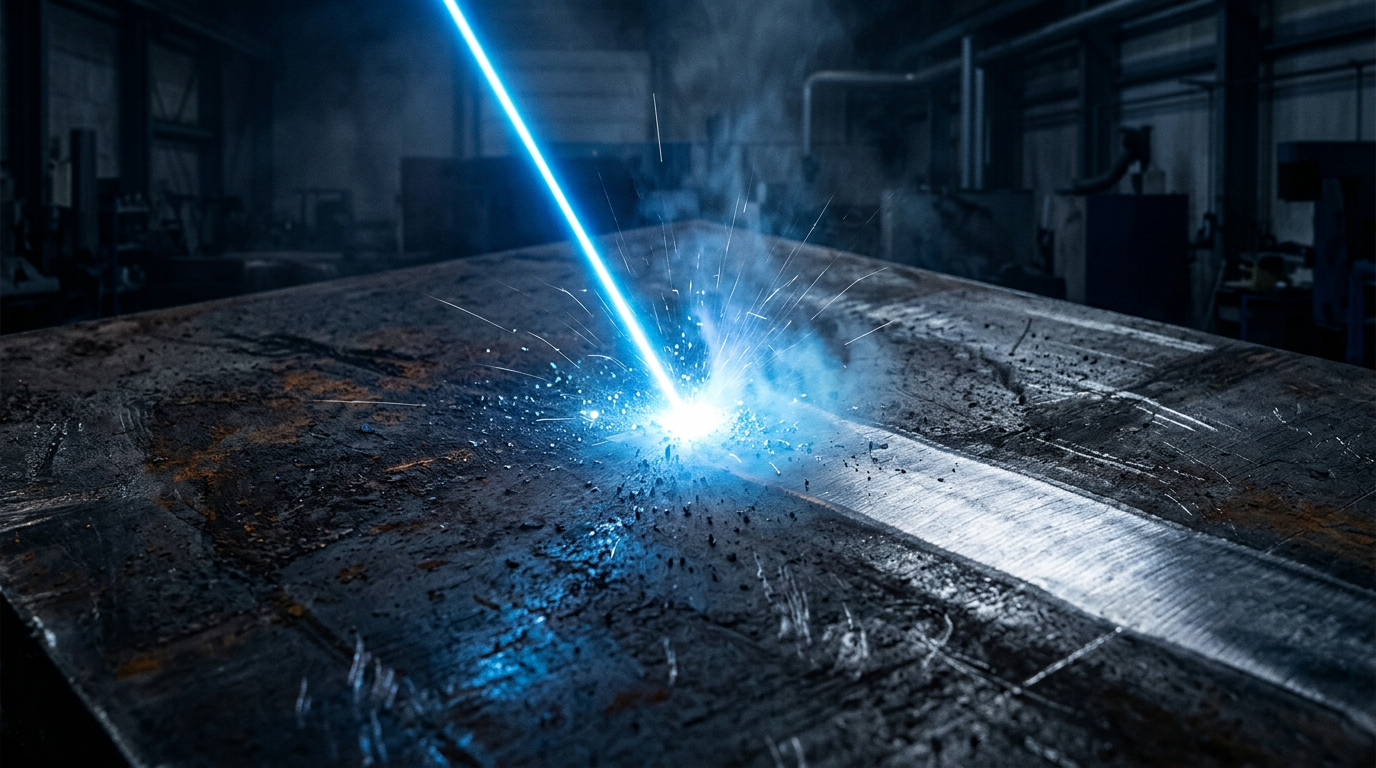
See Laser Cleaning Machines in Action
The principle is clear — the beam removes contamination without touching the substrate. Our laser cleaning machines put that principle to work at industrial scale, without chemicals or abrasives.
Industrial vs Hobbyist Laser Machines: What Actually Differs
The gap between a hobbyist laser machine and an industrial one is not simply a matter of wattage or price — it is a gap in engineering philosophy, and it shows up in ways that a spec sheet rarely makes obvious.
Laser machines exist on a continuous spectrum, from entry-level diode engravers and desktop CO2 systems designed for occasional creative use, through to continuous-duty industrial fibre systems engineered for round-the-clock production environments.
The underlying physics is identical across that entire range — photons, wavelength, material interaction — but the engineering standards that govern how a machine is built, cooled, controlled, and supported are not.
Engineering Standards, Not Just Wattage
The single most important differentiator that most buyers overlook is duty cycle: the proportion of time a machine can operate under load before it needs to rest and cool down.
Hobbyist machines are designed for intermittent use — short creative sessions with natural cooling periods in between — and their thermal management systems reflect that intent.
An industrial machine, by contrast, is built to run continuously for hours or days without pause; its cooling architecture, component ratings, and control systems are all sized for sustained thermal load, not occasional bursts.
A machine that performs flawlessly during a 20-minute engraving session can degrade or fail surprisingly quickly when pushed into a production schedule it was never designed to handle.
Closely related is beam consistency over time: industrial machines are engineered to maintain tight power stability across long operating periods, so the ten-thousandth part in a production run receives the same energy as the first.
In a hobbyist context, minor drift in beam power as the machine warms up is rarely noticeable; in a production environment requiring repeatable results across hundreds of identical components, that same drift translates directly into rework, scrap, and inconsistent quality.
- Enclosures and frames: Industrial housings are built to withstand vibration, temperature variation, and continuous mechanical loading — not just to enclose the optics.
- Motion systems: Industrial motion stages use higher-grade bearings, linear guides, and drive components rated for millions of cycles rather than thousands.
- Optics and beam delivery: Precision-grade optics maintain alignment under sustained thermal and mechanical stress; consumer optics are specified for lighter, cooler duty.
- Thermal management: Active cooling loops, chillers, and heat exchangers in industrial machines are sized to remove heat continuously, not intermittently.
- Drive electronics: Industrial control electronics are rated for continuous operation and designed to maintain positioning accuracy across full-shift run times.
These are not abstract engineering distinctions — they determine whether a machine holds its positioning tolerance across a ten-hour production shift or drifts progressively as heat builds in components that were not designed to shed it continuously.
Speed and throughput compound this further: industrial systems run significantly faster than hobbyist equivalents, not just in laser speed but in motion system acceleration and overall cycle time, and at production volumes a machine that is three times faster produces three times the output in the same shift.
Support, Serviceability, and the Manufacturer Question
For a hobbyist, a machine being offline for a week is an inconvenience; for a production facility, the same downtime is a direct financial loss — which is why after-sales support and serviceability matter far more at the industrial end of the market.
Industrial buyers need fast access to spare parts, genuine engineering expertise, and a supplier capable of diagnosing and resolving problems that go beyond swapping components.
This is where a structural divide in the laser machine market becomes practically important: many machines marketed as "industrial" or "professional" are rebadged imports distributed by resellers who hold no in-house engineering capability and depend entirely on the original overseas manufacturer for any serious technical resolution.
A genuine manufacturer designs, builds, and supports its own machines — meaning it can diagnose root causes, modify firmware or hardware, and improve the product over time in ways that a reseller structurally cannot.
A reseller can sell you a machine and pass on a warranty; only the manufacturer can genuinely improve it, diagnose it at depth, or modify it to meet an evolving production requirement.
Safety infrastructure is another genuine engineering differentiator, not merely a regulatory label: industrial laser sources typically operate as Class IV systems requiring formal enclosures, interlocks, and designated safety oversight, or as fully enclosed Class I systems where the housing itself provides the safety barrier.
Hobbyist machines are commonly designed as enclosed Class I or Class 2 systems with simpler safety requirements — a difference that reflects real engineering choices about power levels, beam access, and risk management, and one that the next section on safety covers in considerably more depth.
The final axis worth understanding is total cost of ownership: the upfront price gap between a hobbyist machine and an industrial system is large and visible, but for production use the relevant comparison includes maintenance frequency, consumable costs, rework from inconsistent output, and the cost of unplanned downtime.
A lower-cost machine that requires frequent servicing, produces a higher rework rate, or loses production time to thermal shutdowns can easily exceed the three-year cost of a more expensive industrial system — the right machine is the one correctly specified for its intended use, not simply the cheapest one that can nominally perform the task.
Recognising these distinctions sets up the natural next question: which specific figures on a laser machine's data sheet actually capture these engineering differences, and which numbers look impressive without telling you anything useful about real-world performance?
Key Specifications for Evaluating a Laser Machine
Wattage is the number laser machine vendors lead with — it appears in product names, headline comparisons, and search filters. But experienced buyers treat it as a starting point, not a verdict. The machine that performs best for a given task is determined by how output power, wavelength, pulse characteristics, beam quality, and several operational parameters interact — and a higher number in any single column rarely compensates for a mismatch in another.
Optical Parameters: Power, Wavelength, and Beam Quality
Wattage governs cutting speed, depth penetration, and engraving throughput — more power means faster processing of a given material at a given thickness, all else being equal.
The qualification matters: beam quality, focal spot size, and the motion system all shape how that power is actually delivered to the material, so a well-engineered lower-wattage machine can outperform a poorly configured higher-wattage one on the same task.
Before wattage, confirm wavelength. As covered in the background section, wavelength determines which materials absorb the beam and how efficiently — a fibre laser at 1,064 nm couples well into metals but passes through most clear polymers; a CO2 at 10,600 nm does the reverse. No amount of power compensates for a wavelength the material cannot absorb.
Beam quality, expressed as M² (M-squared) or Beam Parameter Product (BPP), describes how tightly the beam can be focused to a small, intense spot. A perfect beam has an M² of 1; real beams are higher, and a lower value means a finer focal spot for the same lens.
This matters most for fine cutting, micro-engraving, and precision marking: a tight focal spot concentrates energy more intensely, enabling cleaner edges and finer detail. Industrial fibre lasers are known for their excellent beam quality, which is a primary reason they dominate precision metal processing — not simply because of raw wattage.
Wavelength sets the ceiling on what a machine can process, wattage sets the speed at which it can do so, and beam quality determines how precisely — together, these three parameters account for the majority of real-world performance differences between machines.
Pulse duration and pulse energy are the parameters most buyers underweight, but they are decisive for several applications.
- Short pulses (ns to fs range): Deliver very high peak power with minimal heat diffusion into surrounding material — preferred for fine marking, heat-sensitive substrates, and cleaning without substrate damage.
- Continuous-wave (CW) operation: Provides sustained energy delivery, suited to welding and high-speed cutting where thermal build-up is managed by process speed rather than avoided.
- Long pulses: Sit between the two: more energy per pulse than short-pulse regimes, less continuous than CW — useful for certain ablation and surface treatment tasks.
The practical trade-off is straightforward: shorter pulses give more precision and less thermal damage; CW and longer pulses give more sustained energy for joining and bulk removal. As discussed in the marking and cleaning sections earlier, pulse duration is especially significant for those applications — a mismatch here can damage substrates even at low average power.
Operational Parameters: Work Area and Duty Cycle
Work area is the maximum part size the machine can process in a single setup, and it is a constraint buyers frequently overlook until a part simply does not fit.
The range is wide: galvo-scanner systems mark over a defined field that can be as small as a few tens of millimetres, while large-format flatbed cutting tables handle sheets measured in metres. Galvo scanners trade field size for speed — they are very fast within their working area. Gantry and flatbed systems cover more ground but scan more slowly, which is the right trade-off for cutting large sheet stock.
Duty cycle — the proportion of time a machine can run at rated power without thermal degradation or shutdown — is the parameter that most directly separates production-grade machines from lighter-duty ones.
Air-cooled systems are convenient and compact but typically sustain lower duty cycles than water-cooled systems, which can run continuously at full power for extended production shifts. If throughput is a business requirement, duty cycle deserves as much attention as wattage.
System-Level Considerations: Motion and Safety Class
The motion system determines how the beam (or the workpiece) moves, and the choice has practical consequences beyond just speed.
- CNC gantry systems: Follow programmed toolpaths with high repeatability — well suited to cutting and engraving where positional accuracy across a large bed matters.
- Galvanometer (galvo) scanners: Steer the beam with mirrors at very high speed over a fixed field — the standard for high-throughput marking and certain fine-feature engraving tasks.
- Robotic and articulated systems: Extend reach to three-dimensional or large complex parts — used in automotive, aerospace, and structural applications where a flat bed is insufficient.
Choosing the wrong motion architecture can nullify the advantages of an otherwise well-specified laser source — a galvo scanner optimised for marking small fields is not a substitute for a gantry system when cutting metre-long profiles.
Finally, system safety class belongs on every evaluation checklist — and it is frequently confused with the laser source's own power class. A Class IV laser source housed inside a fully enclosed, interlocked enclosure can qualify the complete system as Class I, which carries very different operational and facility requirements than an open Class IV installation.
Buyers who evaluate only the source class and not the system class can face unexpected compliance obligations around operator training, controlled access areas, and facility engineering once the machine arrives on site. The distinction is a real planning factor, not a paperwork formality.
That planning dimension is worth unpacking properly: the next section covers the laser classification system in full, including what Class I and Class IV system installations mean in practice for facility layout, operator requirements, and compliance.
Laser Safety: Classes, Hazard Zones, and Facility Impact
The safety classification of a laser machine is not a compliance label to check at the end of a procurement process — it is an engineering variable that determines what your facility needs to look like, how your team must be trained, and whether the machine can operate in a shared space at all.
Two international standards govern how laser products are classified and how they should be used safely: IEC 60825-1 (laser product classification) and ANSI Z136.1 (safe use of lasers). These are the authoritative references for anyone specifying a laser installation — the framework below draws on both.
The classification system divides lasers into four main classes based on the hazard level of the accessible beam. For industrial buyers, two classes dominate the practical picture.
- Class I — Safe by design: Either intrinsically low-power, or a high-power laser fully enclosed in a light-tight housing with interlocks. No PPE required during normal operation.
- Class II — Low-power visible: Up to 1 mW; the natural blink reflex provides adequate protection for momentary exposure. Rarely relevant to industrial machines.
- Class IIIB — Moderate power: Direct beam and specular reflections are hazardous; diffuse reflections generally are not. Requires safety eyewear and controlled access.
- Class IV — High power: Hazardous from direct beam, specular reflections, and diffuse scatter; can cause skin burns and ignite combustibles. Governs virtually all industrial laser sources.
Virtually every industrial laser source — whether used for cutting, welding, marking, or cleaning — operates as a Class IV source.
A Class IV laser source housed inside a fully enclosed, interlocked machine is classified as a Class I system. The source class tells you about the beam; the system class tells you about the operational requirements. Buyers who conflate the two can face significant unplanned facility costs.
The operational gap between a Class I enclosed system and a Class IV open installation is substantial — and it is where most of the facility planning conversation lives.
A Class I enclosed system is safe under normal operation: the enclosure is the safety mechanism, so operators require no PPE, no controlled area is mandated, and the machine can run in a shared or open-plan facility with a relatively low training burden.
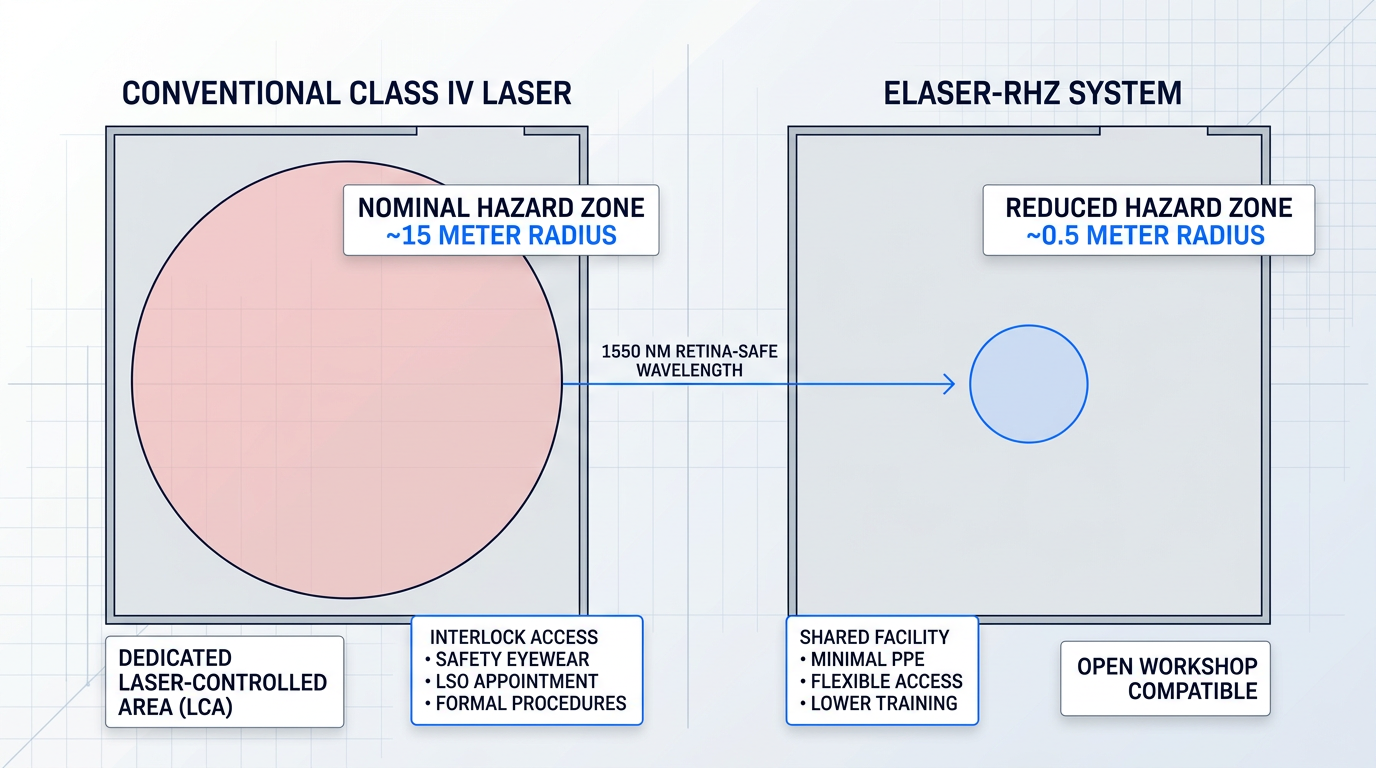
A Class IV open installation carries a different set of requirements entirely: a dedicated laser-controlled area (LCA) with interlock-controlled access and warning lights, laser safety eyewear rated to the specific wavelength, formal access procedures, and the appointment of a Laser Safety Officer (LSO).
That overhead is not bureaucratic inconvenience — it represents real costs in space, infrastructure, staffing, and operational flexibility that must be factored into the total cost of any open-beam installation.
The Nominal Hazard Zone and Facility Planning
Central to understanding why Class IV open installations are demanding to manage is the concept of the Nominal Hazard Zone (NHZ): the space within which the level of laser radiation exceeds the Maximum Permissible Exposure (MPE) — the threshold below which the beam is considered safe for unprotected eyes and skin.
The NHZ defines how large a controlled area must be established around an open Class IV installation, and for a high-power industrial laser, that zone can extend a considerable distance, making it impractical to operate in anything other than a purpose-built laser facility.
Engineering innovations can change this calculus dramatically by collapsing the NHZ to a fraction of its conventional size — and that is precisely what Woodrow Scientific Limited's patented reduced hazard zone technology achieves with the ELASER-RHZ.
Operating at 1550 nm, a retina-safe wavelength, the ELASER-RHZ confines the laser hazard to a small area immediately around the work — enabling industrial laser use in open workshops, mixed-use facilities, and public-facing environments where a conventional Class IV installation would require the area to be sealed off entirely.
This is a world-first, patented capability: no other laser cleaning system offers this kind of NHZ collapse, and it fundamentally changes the operational calculus for facilities where segregating a large controlled area is impractical or impossible.
For buyers evaluating any laser machine, safety class belongs on the specification checklist alongside power, wavelength, and work area — because it shapes facility requirements, staffing obligations, and operational flexibility in ways that are difficult and costly to retrofit.
The governing references for installation planning are IEC 60825-1 for laser product classification, ANSI Z136.1 for safe use of lasers, and ISO 11553-1 for laser processing machines specifically; qualified laser safety professionals should be engaged for any specific installation design.
With safety class understood as a genuine operational and facility variable — not a label — the full framework for evaluating a laser machine is now in place: application fit, machine type, scale, specifications, and safety configuration together define the decision.
Ready to Choose the Right Laser Machine?
You now have the framework. If you want expert input on your specific application, materials, or scale, a 30-minute call can help you move from understanding to decision.

Conclusion
Choosing the Right Laser Machine: The Four Decisions That Matter
Every laser machine decision resolves through the same sequence: application first, then machine type, then scale, then specifications — each question narrowing the field until the right choice becomes clear.
The most important corrective this guide can offer is that wattage is not the deciding factor — the right machine is the one whose laser type, wavelength, and configuration match the task, not the one with the highest power rating.
From that foundation, the practical next step is direct: identify your application, engage manufacturers who build for it, and ask for a demonstration on your actual material.
Frequently Asked Questions About Laser Machines
Common questions about laser machine types, costs, materials, and safety, answered directly.
There is no universal best laser machine — the right choice depends on three variables: the application (cutting, engraving, marking, welding, or cleaning), the material being processed, and the scale of use (hobbyist versus industrial). No single machine type excels across all three axes simultaneously. The type-application logic is fairly consistent: CO2 lasers suit non-metal cutting and engraving (wood, acrylic, leather, glass); fibre lasers handle metals for cutting, marking, welding, and cleaning; diode lasers are the entry point for thin organic materials; and UV lasers serve heat-sensitive substrates where thermal damage must be minimised. Focus on matching the machine type to your specific material and process — chasing wattage without that framework leads to poor decisions. For industrial applications in particular, request material samples or process demonstrations before committing to a purchase.
Laser marking changes the surface appearance of a material without removing any of it — the beam causes oxidation or annealing that produces a high-contrast colour change, leaving the surface physically intact. Laser engraving physically removes material, vaporising the surface to create a recessed cavity with measurable depth that can be felt by hand. A third process, laser etching, sits between the two: the beam melts rather than vaporises the surface, causing the material to expand and produce a slightly raised mark, typically no deeper than 0.001 inches. In terms of machine type, fibre lasers dominate metal marking and engraving; CO2 lasers are the standard for non-metal engraving on wood, acrylic, and leather; UV lasers are preferred where thermal damage to heat-sensitive materials must be kept to a minimum.
Whether a laser machine requires an enclosure depends on the safety classification of the system, not the laser source alone. Class I systems are considered safe under all normal operating conditions — the enclosure itself is the safety control, and no separately controlled area or laser safety eyewear is required during normal use. Class IV systems are open installations with no protective barriers; they must be housed in a dedicated controlled area with warning lights, entry procedures, and mandatory laser safety eyewear for all personnel present. Virtually all industrial laser sources — cutting, welding, marking, cleaning — operate as Class IV sources at the component level. However, the system classification (Class I or Class IV) is determined by the housing and safety engineering around that source, not by the laser power alone. Many industrial laser machines are engineered and certified as Class I systems, meaning the enclosure brings them into compliance. When evaluating a purchase, verify the system's classification, not just the laser source's class — the two are distinct.
Based on their gain medium, lasers are classified into five types: gas lasers (including CO2, helium-neon, and argon-ion); solid-state lasers (including Nd:YAG and vanadate, which use a crystal or glass mixed with a rare-earth element); fibre lasers (technically a sub-category of solid-state, but classified separately in industrial contexts — the gain medium is a rare-earth-doped optical fibre); liquid lasers, also called dye lasers, which use an organic dye in solution; and semiconductor lasers, commonly known as diode lasers. In practice, the five-type taxonomy is the scientific classification by gain medium. For laser machine applications — cutting, engraving, marking, welding, and cleaning — the working framework is narrower: fibre, CO2, diode, and UV cover the vast majority of industrial and hobbyist use cases. Liquid/dye lasers and most solid-state types outside fibre are rarely encountered in standard laser machine contexts.
Price varies enormously by machine type and intended use — from a few hundred pounds for an entry-level hobbyist machine to hundreds of thousands for a high-power industrial system. Entry-level diode laser machines for hobbyist engraving and cutting of thin organic materials start from around £150 upward. Hobbyist CO2 systems start from around £400 for small models. Professional CO2 and fibre engraving systems suited to small business or production use run from several thousand pounds upward. Industrial fibre cutting systems start from tens of thousands upward, with high-power or highly automated configurations reaching significantly more. Industrial laser cleaning systems are typically specified and priced per application — contact manufacturers directly for quotes. For industrial purchases, upfront price is only part of the picture: consumables, electricity, maintenance, and unplanned downtime all contribute to total cost of ownership and can be substantial over the machine's lifetime.
Yes — CO2 lasers can cut and engrave melamine and melamine-coated materials. Melamine is listed as compatible for both engraving and cutting on CO2 laser systems across a range of wattages. One important consideration is fume extraction: melamine is produced from a resin that contains formaldehyde, and when heated, that resin breaks down and releases formaldehyde vapour. Adequate local exhaust ventilation is essential — the UK HSE sets a workplace exposure limit for formaldehyde of 2 ppm as a time-weighted average, and the Health and Safety Executive advises that local exhaust ventilation may be necessary when formaldehyde resins are heated. Results also vary depending on coating type, thickness, and the substrate beneath — individual testing with your specific material is recommended before committing to a production run. Diode lasers at the hobbyist end are generally less effective on melamine-coated materials than CO2 and are not the recommended choice for this application.