

Introduction
You've settled on laser rust removal — now comes the harder part: working out which rust laser machine actually fits your application, your environment, and your budget, from a market that offers plenty of spec sheets and very little independent guidance.
This guide works through the decisions that matter — from understanding the technology well enough to read a spec sheet critically, through power selection, configuration, running costs, and what to look for in a supplier before you commit.
Think of it as the briefing a knowledgeable industry contact would give you before your first supplier conversation: practical, honest, and not trying to sell you anything.
TL;DR
Most buyers focus on wattage and price — and get at least one key decision wrong as a result. The right choice comes down to a small number of decision axes: laser technology type, power, configuration, and supplier quality. Each one is straightforward once you know what you're actually evaluating. This guide gives you the framework to work through all of them clearly.
This article covers:

Pulsed vs CW: what the difference means
Power levels and what wattage actually determines
Portable, fixed, and automated configurations compared
Operational costs and total cost of ownership
Laser safety requirements and how to plan
Evaluating suppliers beyond the spec sheet
What is a rust laser machine?
The idea that a focused beam of light can strip rust from steel — selectively, without touching the metal beneath — sounds like it should require some explanation. It does, and the physics behind it is exactly what makes a rust laser machine a genuinely different class of tool from anything abrasive or chemical.
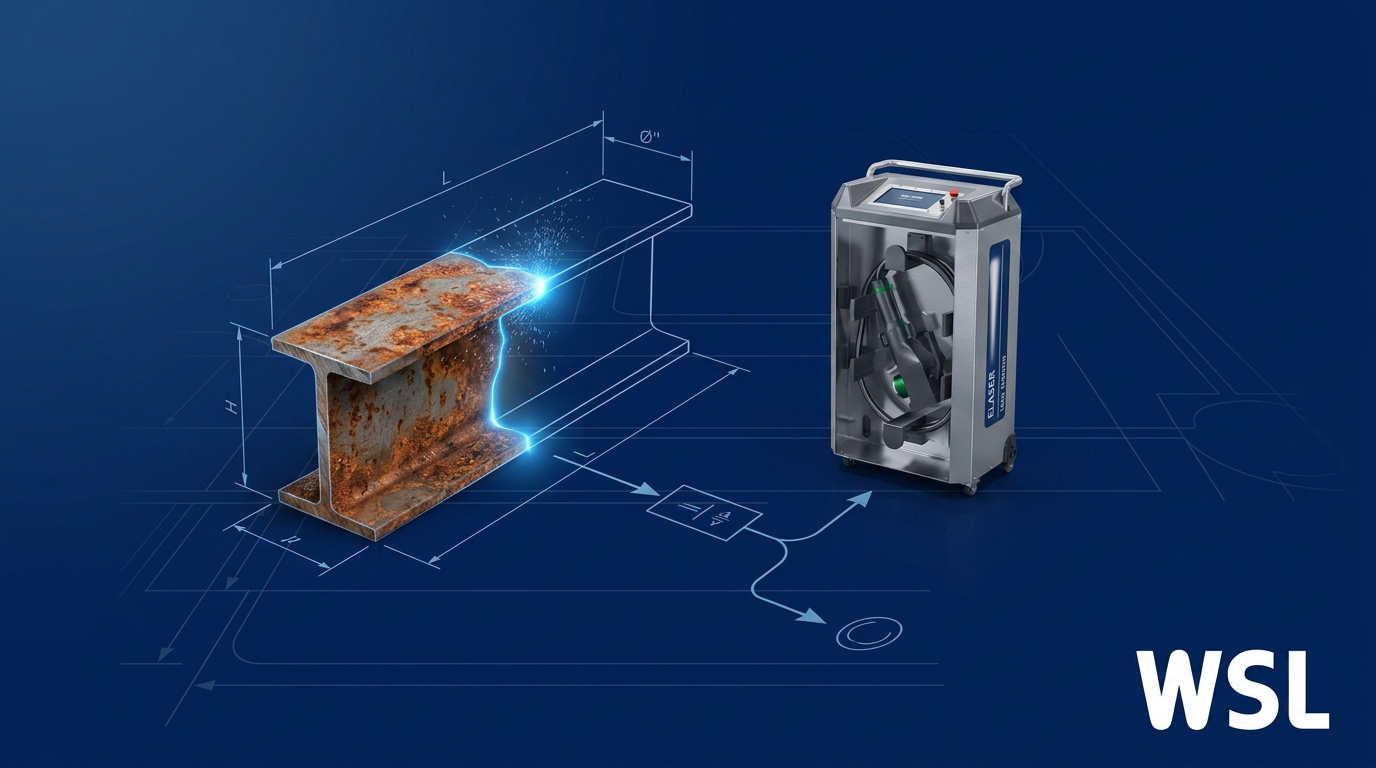
At its core, a rust laser machine is an industrial system that uses a focused laser beam to remove rust and surface contamination from metal through a process called laser ablation — with no abrasives, no chemicals, and no water involved.
The output is a clean metal surface; the process leaves no secondary waste stream of blast media or chemical residue to manage or dispose of.
How laser ablation removes rust
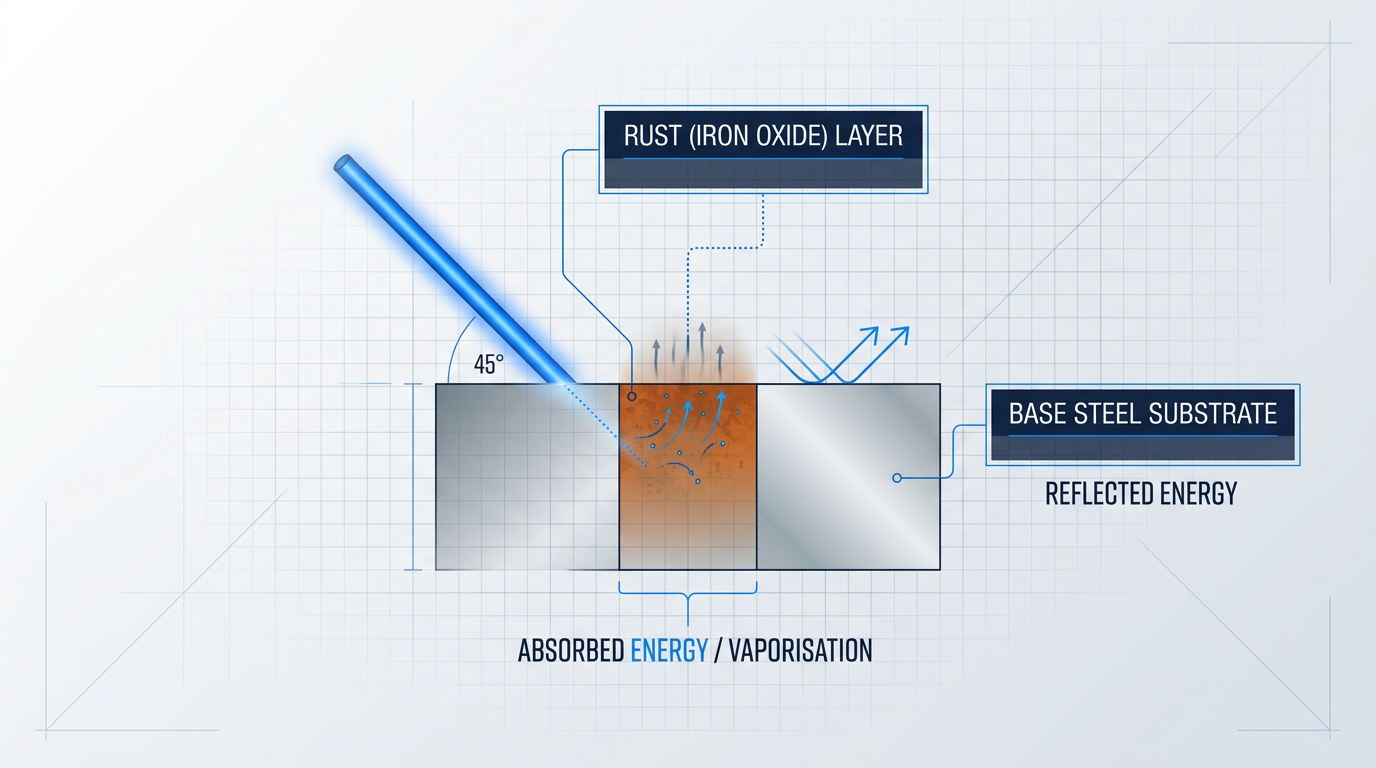
When the laser beam strikes a rusted surface, the rust layer — iron oxide — absorbs the concentrated energy and heats extremely rapidly, causing the material to vaporise or be physically ejected from the surface.
The clean base metal beneath behaves very differently: it reflects rather than absorbs the laser energy at the parameters used for rust removal, so the beam effectively self-limits at the metal surface.
This selectivity is not a fortunate side effect — it is the physical foundation of the entire process, and understanding it is essential for evaluating the machines that exploit it.
Ablation thresholds: the physics of selective removal
The mechanism has a precise physical basis in the concept of the ablation threshold — the minimum laser energy density, or fluence, required to ablate a given material.
Rust has a lower ablation threshold than clean steel, which means there is a working range of fluence that sits above the threshold for iron oxide but below the threshold for the base metal.
Research published in Surface and Coatings Technology confirmed that rust layers on steel can be removed completely when laser fluence exceeds the initial cleaning threshold — and that below that threshold, the beam has no meaningful effect on the rust layer at all.
Photonics.com research notes that ablation thresholds vary widely across metals and are dependent on both laser wavelength and pulse duration — which is why machine parameters must be matched to the specific rust and substrate combination, not simply set to maximum power.
Operating within this engineered window is what allows a laser to clean rust off steel without damaging the substrate beneath — and it is why fluence control is one of the most important parameters on any rust laser machine's specification sheet.
Pulse duration and heat management
The way energy is delivered in time matters as much as the total amount delivered — which is where pulse duration becomes critical.
In a nanosecond pulse regime, energy is deposited so rapidly that heat generated in the rust layer cannot conduct into the base metal before the pulse ends — the thermal effect stays concentrated in the contamination layer.
Research on nanosecond pulsed laser cleaning confirms that the relatively short duration of individual pulses substantially reduces thermal damage to the substrate compared to longer-duration laser exposure, because energy is removed with the ablated material before it has time to diffuse downward.
As Photonics.com summarises the principle: shortening pulse durations results in ablation of the surface layer because heat does not penetrate deeply, while short pulses can still carry significant power density because energy is released fast.
Fume and particulate: an operational reality
The ablation process vaporises and physically ejects rust material, producing fume and fine particulate as a direct by-product of cleaning.
Fume extraction is a standard part of any laser cleaning setup — not an optional accessory — and the safety implications of airborne particulate are covered in full later in this guide.
Fibre lasers: the dominant delivery technology
The practical mechanism that delivers the laser beam in virtually every industrial rust removal system today is the fibre laser: a solid-state laser in which the active medium is the optical fibre itself, allowing the beam to be guided through a flexible cable to a handheld or mounted scanning head.
Fibre lasers require no mirror alignment and no free-space beam path to maintain, making them compact and largely maintenance-free compared to earlier laser architectures — with pump diode lifetimes measured in tens of thousands of hours of beam-on time.
They are also highly scalable: industrial laser cleaning systems span a power range from around 20 W to over 1000 W, and fibre laser architecture supports that entire range within a single technology platform.
- Flexible beam delivery: The laser beam travels through an optical fibre to a scanning head, enabling access to complex geometries and hard-to-reach areas.
- Maintenance-light operation: No mirror alignment or lamp changes required; pump diodes offer very long operational lifetimes with minimal intervention.
- Wide power scalability: A single technology platform covers the full industrial power range, from precision low-power cleaning to high-throughput surface preparation.
- Compact, integrable form factor: Fibre laser systems fit into handheld, fixed, and automated configurations without the floor space demands of older laser types.
Trade press sources including Laser Focus World confirm that fibre lasers — both pulsed and continuous-wave variants — have become the preferred beam source for industrial laser cleaning, displacing older Nd:YAG and CO₂ architectures across most rust removal and surface preparation applications.
With the ablation mechanism and delivery technology understood, the most consequential decision a buyer faces is how that energy is delivered to the surface: in discrete pulses or as a continuous beam — and the difference has significant implications for substrate safety, cleaning quality, and the range of applications a machine can handle.
Pulsed vs continuous wave: what it means for rust removal
The single most consequential technology decision when buying a rust laser machine has nothing to do with brand or price — it is how the laser delivers energy to the rust layer in the first place. Get the temporal mode wrong and you risk damaging the substrate you were trying to protect.
A continuous wave (CW) laser emits a steady, uninterrupted beam at constant average power. A pulsed laser fires energy in discrete bursts — typically in the nanosecond range — with very high peak power concentrated within each burst but a much lower average power overall.
The critical buyer insight is this: it is the temporal structure of energy delivery, not just the average power rating on the spec sheet, that determines how the laser interacts with the rust layer and, crucially, with the base metal beneath it.
As the Background section established, pulse duration controls how far heat conducts into the substrate during the ablation event. Pulsed lasers concentrate energy so briefly that heat cannot propagate into the base metal before the pulse ends — substrate temperatures remain low and the ablation effect stays confined to the contamination layer.
CW lasers produce sustained heat input. Research reported in Laser Focus World confirms that with CW cleaning, the metal on the substrate can melt during the process even when the rust or paint is successfully removed — an outcome that is particularly damaging in precision applications such as pre-weld surface preparation, where substrate condition directly affects weld quality.
Cleaning quality: what surface roughness data reveals
Surface roughness is the measurable, objective outcome that separates adequate rust removal from genuinely clean preparation — and the pulsed/CW distinction produces a documented difference in this metric.
According to Laser Focus World's comparative analysis of CW and MOPA pulsed fibre lasers, a MOPA pulsed fibre laser leaves substrate roughness at or even below the original pre-rust surface level — the short pulses are precise enough that they can remove surface dust alongside the rust without roughening the underlying metal.
CW cleaning tells a different story: even when it successfully removes the contamination, the surface roughness value is reported to be 1.5 times greater than the original surface baseline.
For buyers in aerospace, automotive pre-weld prep, or any process where downstream quality depends on surface condition, this is not a marginal difference — a 1.5× increase in roughness can affect coating adhesion, weld seam integrity, and dimensional tolerances.
Cleaning speed: the counter-intuitive efficiency finding
Many buyers assume that a continuous beam delivers more usable energy and therefore cleans faster. The research evidence points the other way.
The ablation process responds to peak fluence — the energy density at the moment of the pulse — not simply to average fluence over time. High peak power within each nanosecond burst ablates material more efficiently per unit of average energy delivered, because the interaction crosses the ablation threshold decisively rather than gradually heating the surface.
The Laser Focus World comparative study quantifies this directly: at equal average output power, the cleaning efficiency of the MOPA pulsed fibre laser was 7.7 times that of the CW fibre laser on aluminium alloy (2.77 m²/h vs 0.36 m²/h), and 3.5 times that of CW on carbon steel (1.06 m²/h vs 0.30 m²/h).
CW systems compensate for this efficiency gap by running at much higher raw wattage — but that higher wattage is precisely what drives the thermal damage and surface roughening described above. The trade-off is real and unavoidable with CW technology.
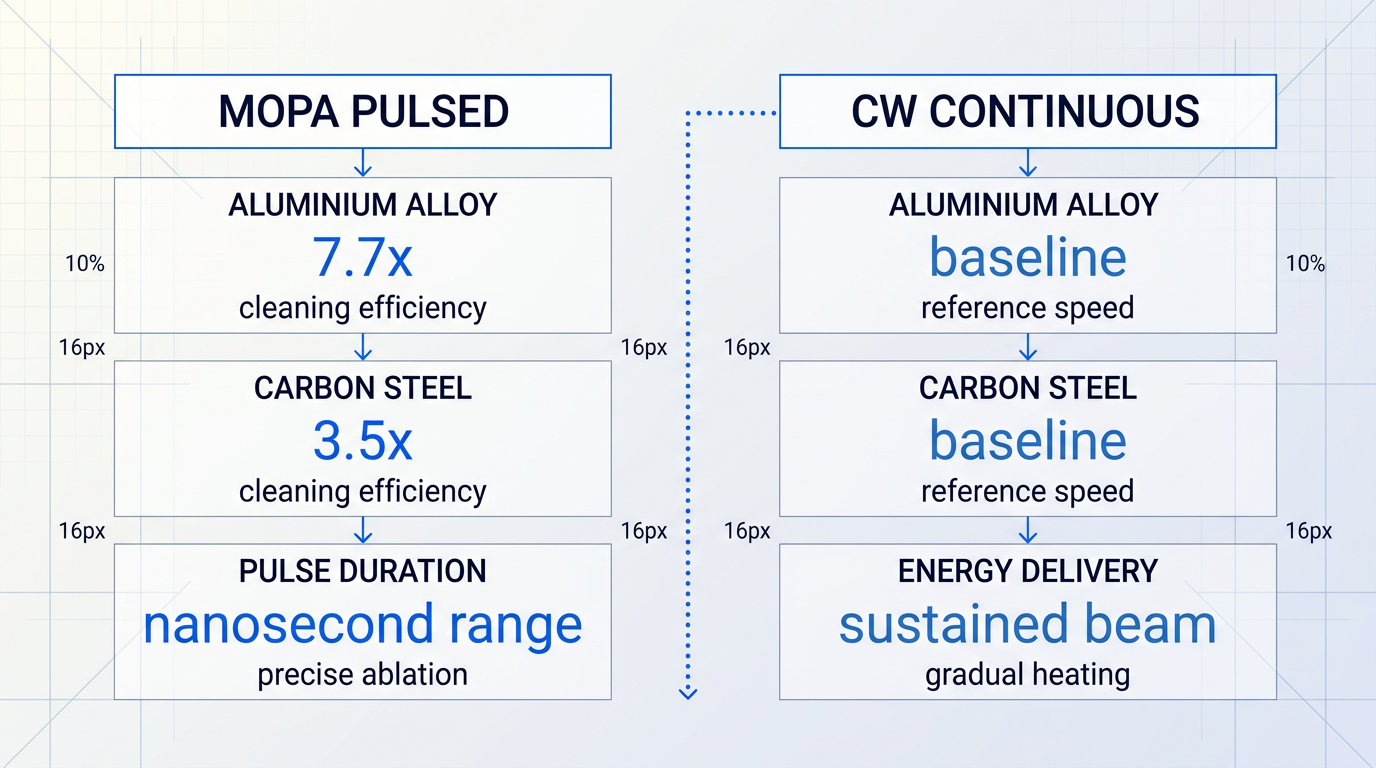
The implication for buyers is direct: specifying a pulsed MOPA system does not mean accepting slower throughput — it typically means faster cleaning at lower average power, with better substrate outcomes.
Where CW systems earn their place
Honest guidance requires acknowledging where CW technology is a legitimate choice, not just where it falls short.
The Laser Focus World analysis notes that for large steel structures, pipes, and similar heavy-section applications — where the substrate volume is substantial, heat dissipates quickly, and the requirement for substrate surface preservation is low — a CW fibre laser can be a practical choice.
CW systems carry a lower upfront cost, and in high-throughput scenarios involving thick structural steel where some degree of surface roughening is acceptable (or even desirable for coating adhesion), the economics can favour CW over pulsed.
The honest framing is this: CW is a legitimate tool for a specific subset of heavy-rust, large-structure applications where throughput dominates and substrate precision is not the priority. For the majority of industrial rust removal applications — pre-weld prep, precision cleaning, thin or sensitive substrates, aluminium alloys, heritage metalwork — pulsed MOPA is the more appropriate starting point.
MOPA architecture: the pulsed system with most control
Within the pulsed category, not all designs offer the same degree of operator control — and that distinction matters for real-world rust removal.
The older alternative to MOPA within pulsed fibre lasers is the Q-switched design. In a Q-switched laser, pulse duration, pulse repetition frequency, and pulse energy are interdependent — changing one affects the others, which limits how precisely an operator can tune the ablation process for a specific substrate or contamination level.
MOPA architecture separates the seed pulse generation stage from the amplification stage. As confirmed by multiple trade-press sources and manufacturer technical literature, this decoupling allows pulse width and average power to be programmed independently of the repetition rate — a flexibility that Q-switched designs cannot match at equivalent power levels.
In practical terms, a MOPA system gives the operator the ability to dial in the right pulse duration for the rust severity and substrate type at hand, without being forced into a fixed parameter set. This translates directly into better cleaning quality and more reliable substrate protection across a wider range of materials and contamination conditions.
Today's industrial MOPA fibre lasers can operate across pulse durations from single-digit nanoseconds to several hundred nanoseconds, at repetition rates from the kilohertz to the megahertz range — a parametric space that Q-switched designs simply cannot access without significant performance compromise.
At equal average power, a MOPA pulsed fibre laser cleaned aluminium alloy at 7.7 times the rate of a CW laser and left surface roughness at or below the pre-rust baseline — while CW cleaning increased roughness by 1.5x. For any application where substrate condition post-cleaning matters, pulsed MOPA is the right starting point, not a premium option.
With the temporal mode decision established, the next question is how much average power the application actually requires — and why specifying the highest available wattage is not always the right answer.
Power levels explained: what wattage actually determines
Every product page for a rust laser machine leads with wattage — 100W, 500W, 1500W, 3000W — as if a higher number self-evidently means a better result for your application. It does not, and the instinct to over-specify power is one of the most common and costly purchasing mistakes buyers make.
Wattage (average power) controls exactly two things: cleaning speed — how much surface area the system processes per unit time — and the ability to tackle thicker or more tenacious rust deposits. It does not change the fundamental ablation mechanism; the laser still removes rust by the same physics regardless of power level. Higher wattage simply delivers more energy per second, which translates directly to faster material removal.
The practical range is wide. Industry data from Laserax indicates that high-power systems can process light surface rust at rates up to 50 cm² per second, while heavily corroded surfaces slow to around 5 cm² per second regardless of how much power is available — because ablation depth per pass is finite. A separate Laser Focus World source cites process speeds exceeding 100 mm²/s at 200W average power for light oxide layers. The ceiling is set by the rust, not the machine.
This is where the over-specification risk becomes concrete. Running excessive power on thin or sensitive substrates — aluminium alloys, thin sheet steel, heritage metalwork, galvanised surfaces — can cause thermal damage even with pulsed systems. Peer-reviewed research on 2024 aluminium alloy identifies a substrate damage threshold of around 556W; push beyond it and the base material begins to degrade irreversibly, regardless of how precisely the pulse is shaped. Matching power to the material is as important as matching it to the severity of the rust.
Choosing the right power band
- Low power: 50–200W: Precision work, delicate or thin substrates, heritage restoration, and applications where surface integrity matters more than throughput speed.
- Mid power: 200–500W: The workhorse range for most industrial rust removal — pre-weld prep, fabrication maintenance, automotive bodyshop, and general industrial maintenance.
- High power: 500W and above: Large-area structural steel, heavy mill scale, shipyard and infrastructure work. Increasingly includes CW systems where raw throughput dominates over substrate precision.
These bands are indicative, not rigid boundaries. A 200W system on light flash rust on thin-gauge steel is a very different proposition to a 200W system on thick laminar scale on a structural beam — the power band gives you a starting point, but rust severity, material thickness, and required throughput all shape the final specification.
Over-specifying power increases capital cost without proportional throughput benefit and introduces real substrate risk on thinner or more sensitive materials. The correct power is the lowest tier that satisfies your throughput requirement and rust severity without exceeding the substrate's damage threshold.
With the right power range identified, the next question is how the machine should be physically configured for your operating environment — and that decision, between portable, fixed, and automated systems, is where the practical trade-offs become most visible.
Portable, fixed, and automated: choosing your configuration
Knowing your laser type and power range gets you to the right technology — but the configuration decision determines whether that technology actually fits your working environment. A system that is perfectly specified on paper becomes a liability if it cannot reach the work, cannot run without infrastructure you don't have, or is set up for batch throughput when your jobs are one-offs.
Portable and handheld systems: the machine goes to the work
Portable laser cleaning systems are built around a single principle: the operator takes the machine to the asset, not the other way around. This makes them the natural choice for on-site maintenance, assets that cannot be moved, and facilities where rust removal happens across varied locations rather than at a fixed station.
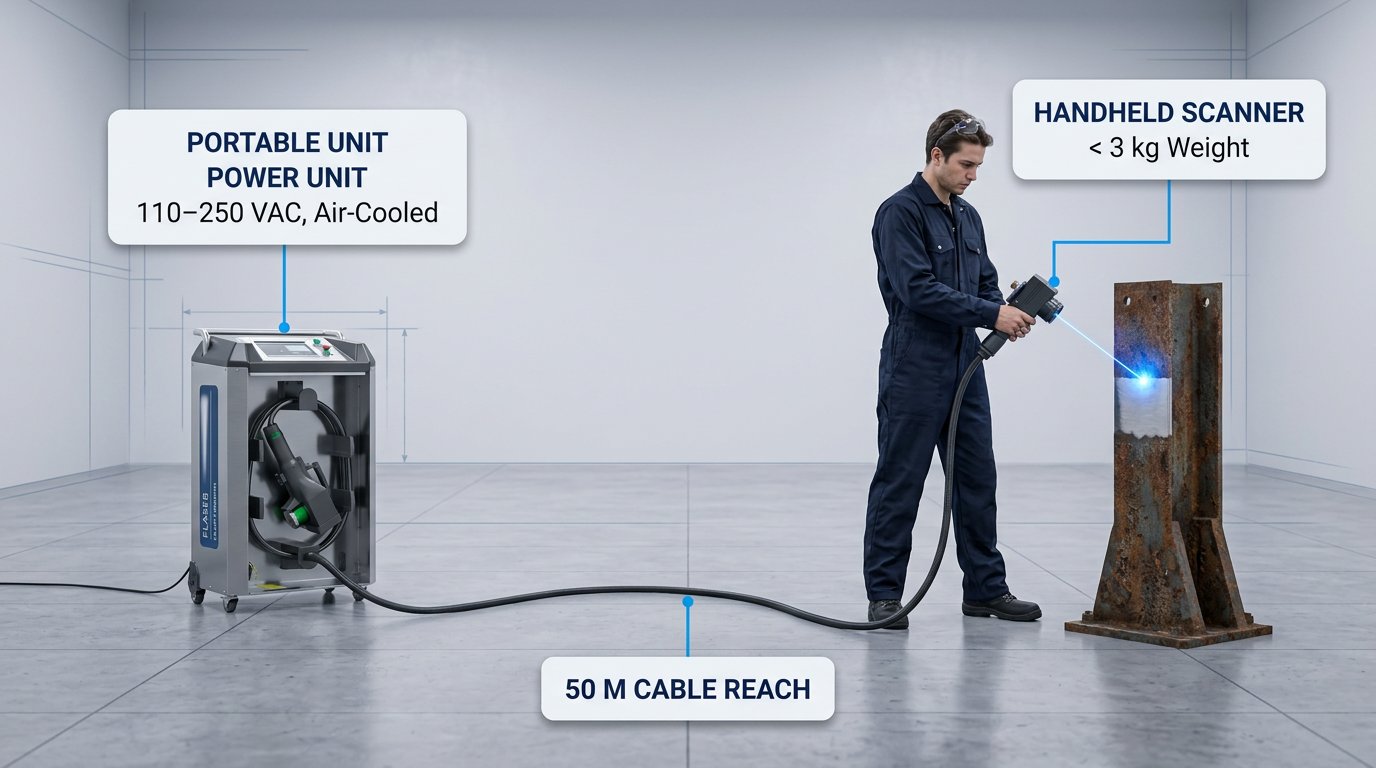
When evaluating a portable system, three practical axes matter more than headline wattage. First, scanner weight: a handheld unit that feels manageable for a five-minute demo becomes a fatigue problem over a full shift. Second, cable reach: the distance between the wheeled power unit and where the operator can stand dictates how much of a large structure or vehicle can be cleaned without repositioning the unit. Third, infrastructure dependencies: systems that require a fixed water supply or compressor are far less deployable than air-cooled, single-phase alternatives.
Woodrow Scientific's ELASER — and particularly the ELASER-RHZ variant — represents what a genuinely deployable portable system looks like in practice. The handheld scanner weighs under 3 kg, the delivery cable extends up to 50 m, and the whole system runs on single-phase power (110–250 VAC) with air cooling, meaning no chiller, no compressor, and no fixed water connection is needed.
The ELASER-RHZ carries a more significant differentiator: WSL's world-first reduced hazard zone (RHZ) technology. Conventional portable laser cleaners require the surrounding area to be sealed off and evacuated before work begins — a real operational overhead, particularly in open workshops, mixed-use facilities, or public-facing environments. WSL's patented RHZ technology collapses the laser hazard zone to a fraction of its conventional size, enabling cleaning to continue without shutting down the surrounding area. It is the only laser cleaner of its kind in the world.
This is a configuration-level decision, not just a safety footnote. Where you can deploy the machine, and whether surrounding operations need to stop while it runs, directly shapes the machine's practical value to your business. The full safety framework — including how the RHZ interacts with nominal hazard zone requirements — is covered in the laser safety section later in this guide.
WSL is also worth understanding as a manufacturer in its own right. It is the only UK-based laser cleaning manufacturer — designing, building, supporting, and improving its machines entirely in-house. A significant portion of the laser cleaning market consists of resellers rebadging third-party machines, which typically means slower engineering support, no genuine product development capability, and limited ability to customise. That distinction matters when you are evaluating after-sales support and long-term reliability.
Fixed-station systems: high throughput in a dedicated space
Fixed-station laser cleaning systems invert the portable model: the work comes to the machine. They suit fabrication shops with dedicated rust removal bays, remanufacturing cells where components arrive in batches, or any environment where parts can be brought to a stable location and throughput is the priority.
The trade-off is straightforward. Once a fixed system is installed, it stays where it is. For facilities where that constraint is acceptable — and where the volume of incoming work justifies a permanent station — the stability of a fixed setup can support higher power configurations and a more controlled cleaning environment than a portable unit can offer.
Automated systems: consistent throughput, not universal upgrade
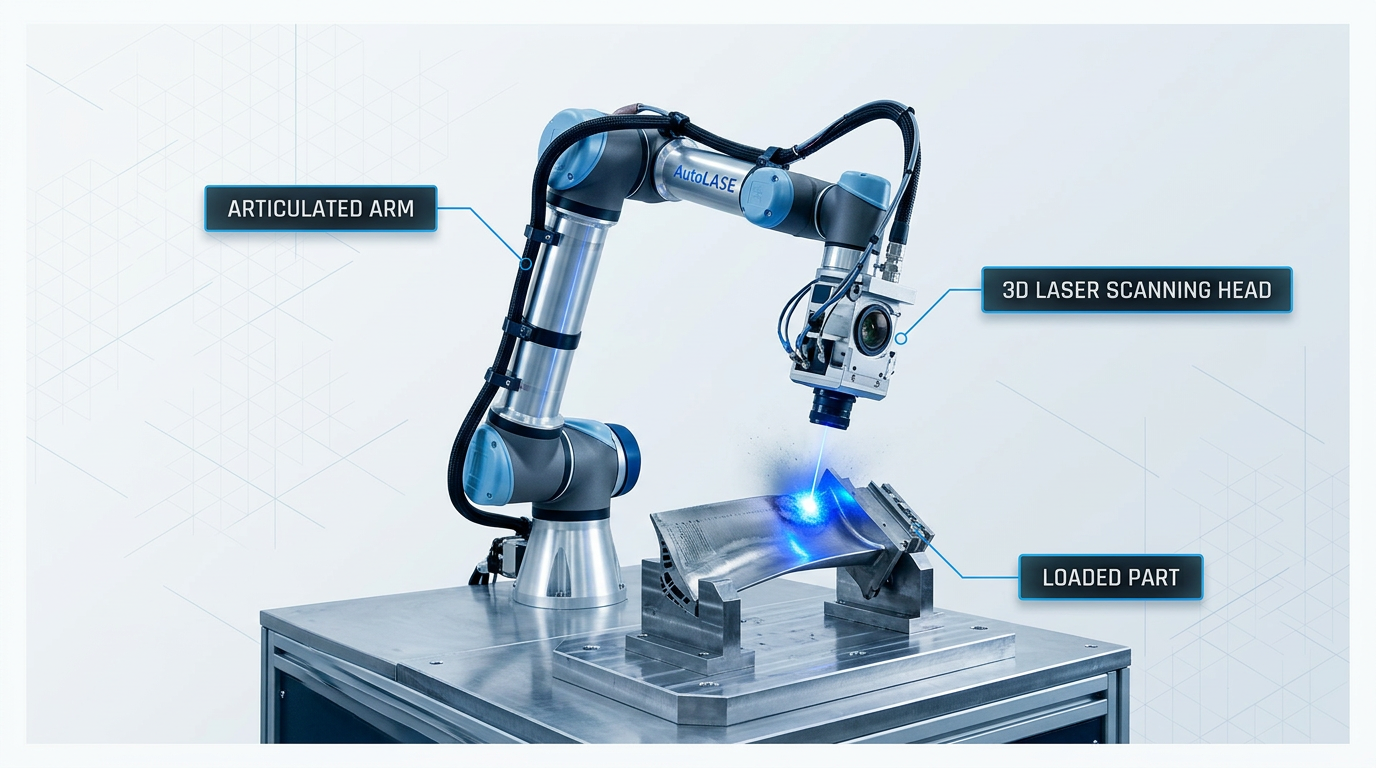
Automated and robotic laser cleaning systems remove the operator from the cleaning loop entirely. The cleaning head is mounted on an articulated robotic arm, and the system runs cleaning cycles without a human guiding the scanner. For the right application profile, this delivers a level of consistency and throughput that manual operation cannot match.
The right application profile is narrower than it might appear, however. Automation delivers genuine value where two conditions are both true: throughput is high enough to justify the setup investment, and part geometry is consistent enough to programme reliably. Where parts vary, locations change, or volumes are low, automation is the wrong choice — not a missed upgrade.
Automated laser cleaning earns its setup investment only when throughput is high and part geometry is consistent. For varied parts, one-off tasks, or on-site work, a portable system will outperform a robotic cell — at a fraction of the complexity.
WSL's AutoLASE system represents the automated pathway — and its defining differentiator is not that it automates cleaning (other systems do that), but how effortlessly it runs. Load the part, and AutoLASE's 3D machine-vision software scans it, builds a 3D map, and generates the cleaning path automatically. No manual programming, no path-setting, no prior knowledge of the part geometry required. Anyone can load a part and run it.
AutoLASE can also be configured with WSL's RHZ technology, which means no enclosure is required around the cleaning cell. Conventional automated laser cleaning systems require a fully enclosed safety cell to manage the laser hazard during operation. The RHZ upgrade removes that requirement entirely — something no other automated laser cleaning system in the world can offer.
Like the ELASER-RHZ, AutoLASE is CE and UKCA certified, comes with first-class operator training, and is built in Britain by WSL's in-house engineering team. Bespoke integration — whether attaching the cleaning head to your existing robots or supplying a complete custom cell — is available; prospective buyers with specific integration requirements are encouraged to get in touch directly.
Choosing your configuration: four questions to ask first
Before speaking to any supplier, work through these four questions — your answers will narrow the configuration decision considerably.
- Fixed or varied work location?: If the work moves — different sites, structures, or assets — portability is non-negotiable. If it stays in one place, fixed or automated configurations become viable.
- Parts to machine, or machine to parts?: Can components be brought to a cleaning station, or must the system travel to them? This single question eliminates either the portable or the fixed pathway for most buyers.
- Repetitive volume, or varied and occasional?: High-volume, consistent-geometry tasks justify automation. Varied or infrequent cleaning tasks do not — and forcing automation onto them adds cost and complexity without benefit.
- What infrastructure is available on site?: Single-phase power, floor space, extraction, and water supply all affect which configurations are even feasible at your location before you evaluate anything else.
These questions map directly onto the three configuration types. A buyer who answers "varied locations, machine goes to parts, occasional tasks, limited infrastructure" is describing a portable system. A buyer who answers "fixed facility, parts come to us, high volume, consistent geometry" is describing an automated cell. Most real-world requirements sit somewhere between those poles — which is why the configuration decision deserves its own analysis before any product comparison begins.
With the configuration framework in place, the next step is mapping these three pathways to specific application contexts — from pre-weld fabrication and industrial maintenance through to automotive production and heritage restoration — and understanding how throughput requirements shape the choice within each.
Matching machine type to your application and environment
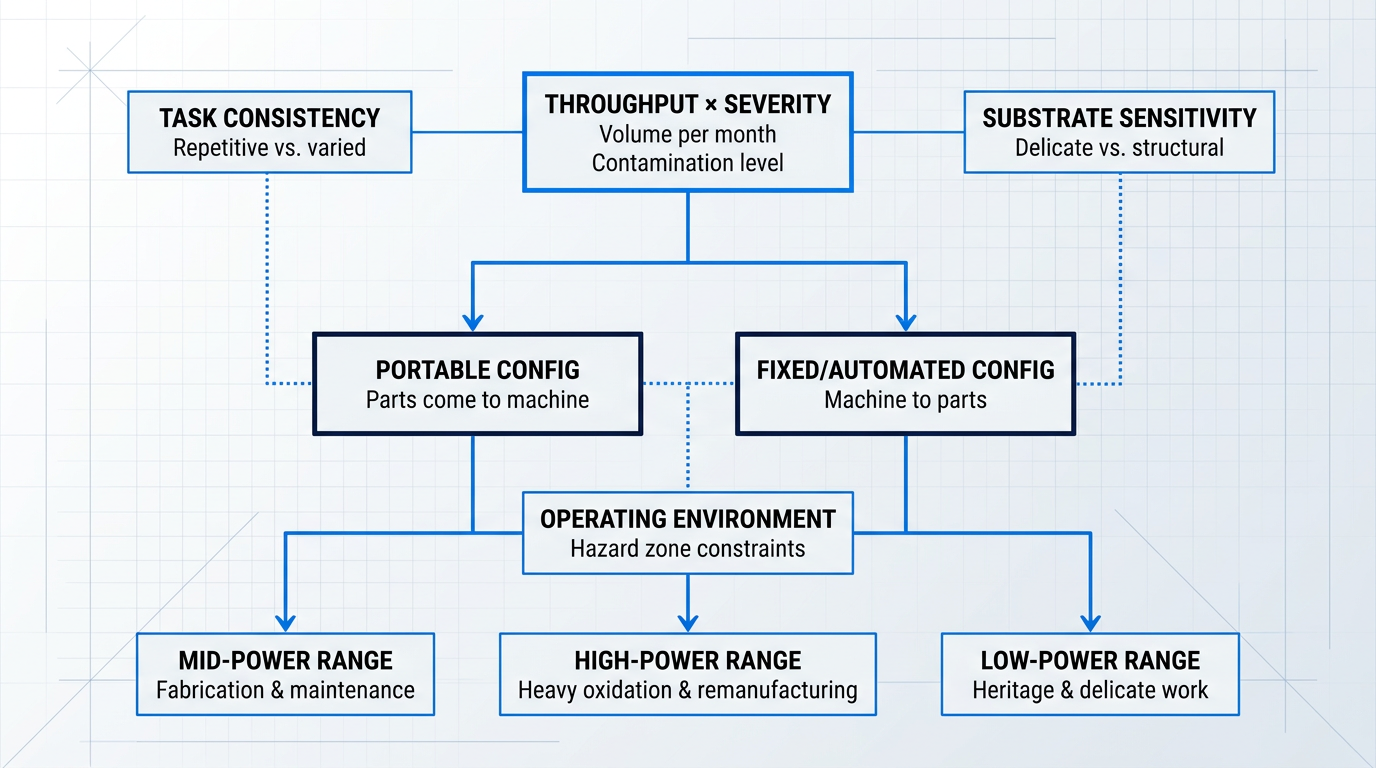
Technology knowledge only gets you so far. The real question is: given your specific workload, environment, and substrate, which configuration and power range actually fits? Working through five concrete variables in sequence will get you to a clear answer faster than any spec sheet.
- Throughput volume × rust severity: The primary variable. How much surface area per month, at what contamination level? This single product determines power range and configuration more than anything else.
- Parts to machine, or machine to parts?: If assets are immovable or distributed across sites, portability is non-negotiable. If parts come to you, fixed or automated configurations become viable.
- Repetitive or varied cleaning tasks?: High-volume, consistent part geometries favour automation. Mixed part types or occasional cleaning favour portable or fixed-station flexibility.
- Substrate sensitivity: Delicate or high-value substrates — thin-gauge steel, historic metalwork, bronze — demand lower power and finer pulse control than structural steel.
- Operating environment constraints: Open-plan workshops, public-facing sites, and outdoor locations create safety overhead for Class IV systems that directly limits which configurations are practical.
These five variables work together, not in isolation. A buyer with high throughput but an open-plan environment may find that the operating context overrides what the volume alone would suggest. Run through all five before settling on a configuration.
Light rust on occasional components points toward mid-power portable systems. Heavy mill scale across large structural sections daily points toward high-power fixed or automated configurations. Everything else refines from there.
Pre-weld prep and fabrication
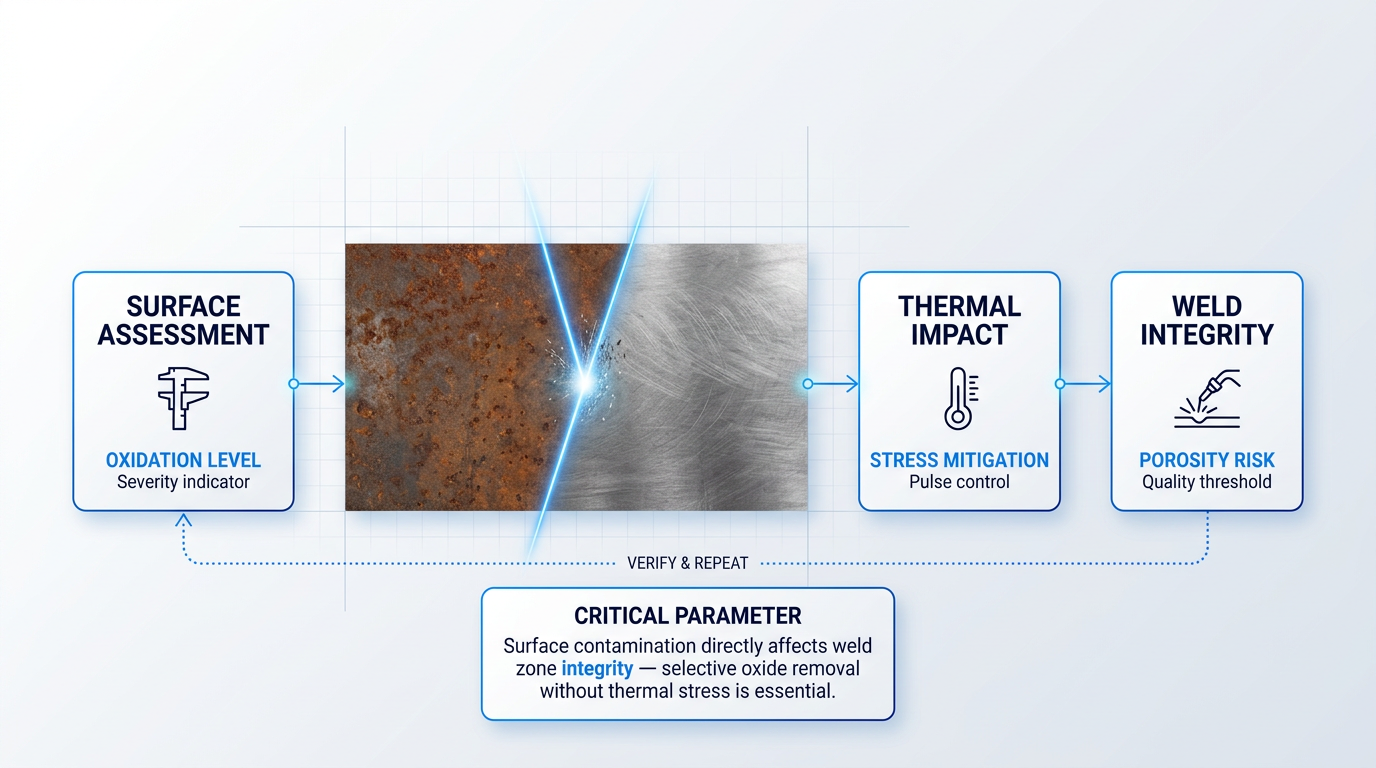
Pre-weld surface preparation is one of the most common rust laser machine applications, and the selection logic here is driven by something more demanding than cleaning speed: downstream weld quality.
An oxidised or contaminated surface produces a structurally weaker weld — porosity, incomplete fusion, and cracking risk all increase when the weld zone is not properly cleaned before the torch touches it.
This is why pulsed systems in the mid-power range are the standard match for fabrication prep: they remove oxide and contamination selectively without introducing thermal stress into the surrounding metal that could affect weld zone integrity.
Fabrication work is also typically location-variable — different bays, different components, different sites — which makes portable configurations the natural fit over fixed-station setups that require parts to come to the machine.
Industrial maintenance and on-site work
On-site maintenance is the application that most clearly defines the portable configuration's purpose: the machine must go to the asset, because the asset cannot come to the machine.
Corroded structural beams, pipeline sections, and plant equipment are either too large to move or permanently installed — which means cable reach, system weight, and single-operator usability become the decisive selection criteria, not raw power output.
Maintenance teams are typically lean, and laser rust removal is one task among many in a working day, so a system that requires a dedicated operator and extensive setup overhead does not suit the workflow.
The selection rule here is straightforward: if the asset is fixed and distributed across a site or multiple sites, a portable system is the only configuration that works operationally.
Automotive and production-line applications
Where part geometries are consistent and cycle counts are high, the case for automated laser cleaning becomes compelling — and the primary argument is not throughput alone, it is cleaning consistency.
In a production environment, a single under-cleaned component can trigger quality failures across an entire downstream batch: a contaminated surface entering a welding cell or coating line carries the problem forward invisibly until it manifests as a defect.
Automated systems hold cleaning parameters constant across every cycle, removing the variability that comes with manual operation — which is exactly what tight quality tolerances require at volume.
The profile that points toward automation is specific: consistent part type, high cycle count, defined cleaning path, fixed location. If any of those conditions is missing, the programming overhead of an automated cell may outweigh its consistency advantage.
Remanufacturing and refurbishment
Batch cleaning of worn components before rebuild sits between the two poles of the configuration spectrum, and the right choice depends on a single question: how consistent is the batch?
A fleet of identical engine components — same geometry, same contamination profile, same cleaning path — can be handled efficiently by an automated cell programmed once and run repeatedly.
But if the batch is mixed — components from different machine generations, different manufacturers, different degradation states — a portable or fixed-station system offers the flexibility that a programmed automated cell cannot easily provide without constant reprogramming.
Power requirements here tend toward the higher end of the mid-range: remanufacturing components typically carry heavier oxidation and coating build-up than new fabrication stock, which means cleaning time increases significantly at lower power levels.
The trade-off to assess is flexibility versus throughput: a flexible configuration handles varied batches well but cannot match the cycle times of a purpose-built automated cell running a consistent part.
Heritage conservation and restoration
Heritage and restoration work sits at the opposite end of the power spectrum from industrial rust removal, and it warrants treatment as a distinct application rather than a footnote.
Delicate substrates — historic ironwork, bronze monuments, stone masonry, decorative metalwork — cannot tolerate the ablation rates that structural steel applications demand: minimal substrate loss is not a preference, it is a hard constraint.
This means lower power, finer pulse control, and slower cleaning accepted as the operational reality — the goal is preservation, not throughput.
The environmental dimension is equally important here. Heritage work frequently takes place in publicly accessible settings — active historic buildings, open monuments, conservation sites — where sealing off a conventional Class IV laser hazard zone is impractical or impossible.
Systems with reduced hazard zone footprints are not simply a safety convenience in this context: they are what makes the application viable at all in locations where area evacuation cannot be enforced.
Environmental and operational constraints
The operating environment is the variable buyers most commonly underestimate — often not until installation is already underway.
Outdoor settings, open-plan workshops, mixed-use facilities, and public-facing locations all create a recurring safety overhead for conventional Class IV laser systems: sealing off and evacuating the hazard zone is not a one-time setup cost, it is a requirement on every cleaning session.
In environments where that overhead is operationally unacceptable — because other trades are working nearby, because the public cannot be excluded, or because the cleaning task is too brief to justify the setup — the hazard zone size becomes a genuine configuration constraint, not a compliance formality.
Buyers who discover this constraint after purchase face costly workarounds: engineering controls, bespoke enclosures, or operational restrictions that were not in the original project plan.
The practical guidance: map your operating environment against the safety overhead of each configuration type before finalising a specification, not after.
With a clear picture of which configuration and power range suits your application, the natural next question is what that machine will cost to run across its working life — which is exactly what the following section addresses.
See Real Specifications Against Your Decision Criteria
You now have the framework. Put it to work with full technical datasheets for the ELASER and ELASER-RHZ — covering power, pulse parameters, footprint, and configuration details.
Operational costs and total cost of ownership
Every spec sheet you receive from a supplier will show a capital price. What it will not show is the five-year cost of running the machine — and for a rust laser machine, that gap between purchase price and true operating cost is where the real purchasing decision lives.
Buyers who compare only sticker prices are working with incomplete information — not because they are naive, but because product pages systematically omit the running-cost picture. The categories that belong in a proper total cost of ownership calculation are the ones that follow.
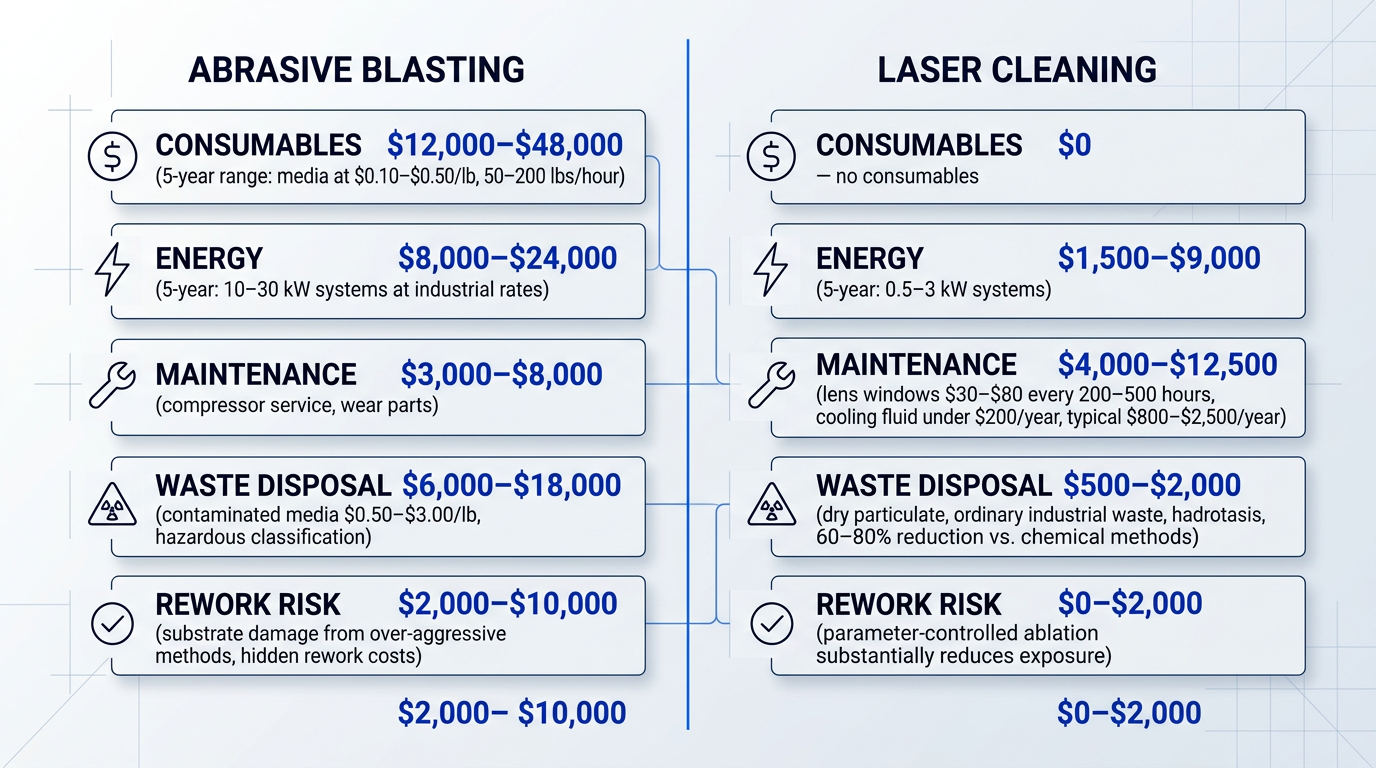
- Consumables: Laser cleaning runs on electricity alone — no blast media, no chemicals, no consumable waste stream. Abrasive and chemical methods carry a per-m² consumable cost that compounds at scale.
- Energy: Electricity is the primary running cost. Industrial laser cleaning systems typically draw under 2 kW at operating wattages up to 300 W — modest against a compressor-driven blast setup.
- Maintenance: Principal items are protective lens windows (replaced periodically) and cooling system service. The schedule is predictable and plannable, which has real operational value.
- Waste disposal: Laser cleaning produces captured dry particulate — not contaminated blast media or chemical waste streams requiring hazardous disposal contracts.
- Rework risk: Substrate damage from over-aggressive abrasive or chemical methods creates hidden rework costs. Parameter-controlled laser ablation substantially reduces this exposure.
The consumable picture is the starkest structural difference. Abrasive blasting requires continuous media supply — garnet and aluminum oxide running roughly $0.10–$0.50 per pound, with a working blaster burning through 50–200 lbs per hour depending on nozzle size and pressure. Chemical stripping requires ongoing solvent or acid replenishment. Laser cleaning requires neither: the consumable category is effectively eliminated, not reduced.
On the energy side, the directional advantage is clear. A compressor-driven blast setup draws 10–30 kW per setup; pulsed fiber laser cleaning systems typically draw 0.5–3 kW total system power including the chiller. At industrial electricity rates, the energy cost per square metre of laser cleaning is a fraction of the equivalent blast operation.
At two-shift utilisation, that translates to 20–25 years of service before source replacement — making a laser cleaning system long-lived capital equipment, not a depreciating asset with frequent replacement cycles.
Maintenance costs reflect that longevity. The principal wear items are protective lens windows — typically $30–$80 each, replaced every 200–500 hours depending on operating environment — and cooling fluid, which runs under $200 per year for top-ups and an annual flush. Total annual machine-specific costs on a mid-range fiber system typically run $800–$2,500 depending on usage hours and environment.
Waste disposal is the cost category most consistently absent from initial evaluations. Contaminated blast media — particularly when the substrate coating contains lead, hexavalent chromium, or zinc compounds — is classified as hazardous waste under EPA RCRA, with licensed disposal running $0.50–$3.00 per pound in practice. Chemical stripping generates spent acids and solvents classified as F-listed hazardous waste, with drum disposal costs typically running $300–$900 per drum depending on solvent type and regional capacity. Laser cleaning collapses both streams into a small volume of dry particulate captured by the extraction system — in most rust removal applications on clean steel, classifiable as ordinary industrial waste.
Facilities switching from solvent-based stripping to laser cleaning typically see hazardous waste disposal costs fall by 60–80% — a saving that does not appear anywhere on the laser machine's spec sheet, but is very real when you pull twelve months of disposal invoices.
The payback horizon depends on three variables: cleaning volume per month (the primary driver), the cost of the method being displaced, and the labour component. For facilities cleaning 500–1,000 m² per month or more, the operating cost savings against abrasive or chemical methods typically deliver payback within 18–36 months — the lower end when displacing a chemical process with high disposal costs, the higher end when coming from a low-media-cost blasting setup with cheap labour.
The displacement method matters significantly. On a true all-in basis — media, containment, disposal, and re-cleaning of abrasive contamination — abrasive blasting typically costs $1.50–$4.00 per m², while chemical stripping rarely comes in below $2.00 per m² once hazardous waste handling and regulatory compliance are included. Laser cleaning operating costs, by comparison, fall to $0.10–$0.40 per m² once capital is amortised at moderate production volumes.
Labour is a compounding factor. Laser cleaning is single-operator; abrasive blasting commonly requires more personnel, full dust PPE, and significant setup and cleanup time. A comparable annual abrasive blasting operation running at meaningful throughput accumulates $20,000–$80,000 in media and disposal costs alone — before labour. Laser operating costs over the same period, including electricity, lenses, and annual service, generally stay below $8,000–$15,000.
To build an accurate TCO comparison before issuing an RFQ, buyers should request three figures from every supplier that a spec sheet will not volunteer: the system energy draw (laser source plus chiller, in kW), the maintenance parts schedule and annual cost estimate, and a clear statement of what waste stream the system produces and how it is classified. A credible supplier should provide all three without hesitation — and the supplier evaluation section of this guide covers what else to look for when those conversations begin.
With the running cost picture in place, there is one more operational factor buyers consistently underestimate: the safety infrastructure that Class IV laser operation requires — and the planning lead time it demands before first use.
Laser safety requirements: what buyers need to plan for
Most buyers spend weeks comparing wattage, pulse modes, and configurations — then discover, after purchase, that deploying the machine requires infrastructure they hadn't budgeted for. Laser safety isn't a compliance footnote to sort out later; it's an operational planning factor that belongs in the buying decision.
The reason is classification. Virtually all industrial laser cleaning systems operate as Class IV lasers — the highest hazard class, carrying mandatory engineering and administrative controls that go well beyond what most buyers anticipate.
The Nominal Hazard Zone and why its size matters
Central to those controls is the Nominal Hazard Zone (NHZ): the space within which direct, reflected, or scattered laser radiation exceeds safe exposure limits. For open-beam Class IV systems, this zone can extend across a substantial portion of a facility — it is not a small bubble around the work.
The NHZ must be identified, demarcated, and controlled every time the machine is used. No one may enter the zone during operation — and that requirement applies on a busy fabrication floor just as much as in a dedicated laser room.
In practice, managing the NHZ means establishing a laser controlled area: sealing off the zone, clearing personnel, and managing entryway interlocks or illuminated warning systems before cleaning can begin. For a portable system used across shared bays, client sites, or mixed-trade environments, that workflow overhead accumulates quickly.
PPE and fume extraction: two more planning factors
Beyond the controlled area, two further requirements carry real procurement and facility implications.
- Operator PPE: Laser protective eyewear is mandatory for operators and anyone in the controlled area. Eyewear must be matched to the specific wavelength and optical density of the laser — selection is not generic, and training on correct use is required.
- Fume extraction: Laser ablation produces fume and fine particulate from the vaporised contamination layer. Adequate extraction is needed to keep airborne contaminant levels within safe occupational limits — and it affects where the machine can be deployed.
A buyer planning to operate in a space without existing extraction infrastructure needs to factor that in as part of the deployment cost. Fume extraction is a facility planning decision, not just a machine accessory.
Taken together, the controlled area, operator PPE, and extraction requirements represent a meaningful operational overhead. For buyers in open, shared, or public-facing environments, that overhead can make conventional Class IV deployment genuinely impractical.
Reduced hazard zone technology: a different approach
The engineering response to this problem is reduced hazard zone technology — and WSL's patented implementation of it, available on the ELASER-RHZ, is a world-first: no other laser cleaning technology of this kind exists.
WSL's patented RHZ technology collapses the laser hazard zone to a small area immediately around the work itself, operating at a 1550 nm wavelength in the retina-safe spectrum. The practical effect is that cleaning can take place in open workshops, mixed-use facilities, and public-facing settings — without sealing off the area or evacuating personnel.
This unlocks applications where conventional laser cleaning simply cannot go: graffiti removal on public monuments, rust treatment in working fabrication shops, maintenance in facilities that cannot be shut down. WSL also provides full operator training, so buyers are deployment-ready from day one.
WSL's ELASER-RHZ is the world's only laser cleaner with patented reduced hazard zone technology — dramatically shrinking the controlled area and opening up environments where conventional Class IV deployment would be operationally impractical.
The practical implication for buyers is straightforward: if your intended operating environment is open-plan, shared, or public-facing, reduced hazard zone capability is a configuration-level decision that belongs at the point of machine selection — not something to solve after purchase.
Safety infrastructure is also one of the clearest signals of supplier quality. The next section covers how to evaluate suppliers on the factors that matter beyond the spec sheet — including training provision, certifications, and the manufacturing credibility that determines whether support is genuinely there when you need it.
Evaluating suppliers: what to look for beyond the spec sheet
A spec sheet tells you what a rust laser machine can do on the day it ships — it tells you nothing about what happens six months later when a component fails, a parameter needs adjusting for a new substrate, or an operator needs retraining after staff turnover.
The laser cleaning market has a structural problem that buyers rarely anticipate: a significant portion of suppliers presenting themselves as manufacturers are, in practice, resellers or importers rebadging third-party machines under their own branding.
This matters because a reseller's after-sales capability is fundamentally limited — they cannot diagnose faults at the engineering level, cannot manufacture replacement parts without waiting on a third-party supply chain, and cannot improve the product based on field experience because the product was never theirs to improve.
Does this supplier design, build, and support its own machines in-house? A reseller can sell you a machine. Only a manufacturer can truly stand behind it.
In-house manufacturing is not a marketing phrase — it is the operational foundation that makes genuine after-sales support possible: fault diagnosis at the engineering level, parts manufactured and held in stock without third-party delays, and product improvements driven by real data from a supplier's own installed base.
Woodrow Scientific Limited (WSL) is the concrete example of what this looks like in practice — and, as the publisher of this guide, it is the supplier we can speak to with direct authority.
WSL is the only UK-based laser cleaning manufacturer: founded in 2012, with over 200 years of combined engineering experience, it designs, builds, supports, and continuously improves every machine in-house — a capability that no reseller or importer can replicate.
That in-house capability is also what made it possible to develop WSL's patented Reduced Hazard Zone (RHZ) technology — the world's first and only laser cleaner of its kind, which collapses the laser hazard zone to a fraction of conventional size and enables cleaning in open workshops, mixed-use facilities, and public-facing environments where conventional laser cleaning cannot operate.
WSL's machines are also competitively priced — the most competitive upfront pricing among comparable industrial laser cleaning machines in Europe, achieved through manufacturing and operational efficiency rather than any compromise on quality.
Beyond those critical differentiators, WSL's complete offering includes CE and UKCA certification on all machines, first-class operator training, a sub-3 kg handheld scanner with up to 50 m cable reach for genuine single-operator portability, and bespoke engineering capability for buyers with specific integration requirements — contact WSL directly to discuss what your application demands.
Questions to ask any supplier before you buy
Regardless of which supplier you approach, these are the questions that separate credible manufacturers from rebadgers — and the answers will tell you more than any brochure.
- Do you design and build your own machines?: Establish whether you are dealing with a manufacturer or a reseller. Ask specifically about in-house engineering, not just assembly.
- Can you test on my substrate?: Request documented ablation test results on your actual material and contamination type before committing — not generic brochure cleaning rates.
- What does operator training include?: Ask what the training covers, how long it takes, and what ongoing support is available after the initial session.
- What is your spares lead time?: A supplier sourcing parts from a third party will have longer lead times than one holding stock in-house. Ask directly.
- Are CE and UKCA certifications held by the machine?: Verify that certifications belong to the machine as configured — not just asserted by the reseller without underlying documentation.
The right answers share a common thread: specificity and accountability. A genuine manufacturer will give you engineering-level answers to engineering-level questions; a reseller will redirect you to the original equipment manufacturer's documentation.
On application testing, the standard to hold any supplier to is documented removal rates and surface condition data from a test run on your actual substrate — not a reference to results achieved on a different material in a controlled demonstration environment.
Operator training matters beyond safety compliance: undertrained operators can mis-set parameters, damage substrates through incorrect power settings, or leave machine capabilities consistently under-utilised — all of which erode the return on a capital investment that was justified on the basis of full performance.
On certifications, the nuance worth checking is that CE and UKCA marks are held by the machine itself as configured and supplied — a reseller can assert compliance without the underlying certification being valid for the product in its actual form.
Common purchasing mistakes to avoid
These are the mistakes that experienced buyers in this market have made and, with hindsight, would have avoided — each one costs more to correct after purchase than it would have cost to prevent before it.
- Over-specifying power: Higher wattage costs more and introduces substrate damage risk on thinner materials. Match power to your actual application, as covered in the power selection section.
- Under-estimating safety infrastructure: Nominal Hazard Zone management, PPE, and fume extraction are real operational costs. Budget for them before the machine arrives, not after.
- Evaluating capital price alone: A laser cleaner with zero consumables, low downtime, and minimal rework has a total cost of ownership that the purchase price figure does not reflect.
- Buying from a reseller unverified: Purchasing from a supplier who cannot demonstrate in-house engineering support is the single mistake most likely to compound every other one.
With the full decision framework now in place — technology selection, power matching, configuration, application fit, operational costs, safety planning, and supplier evaluation — the final step is translating that framework into action: identifying the right supplier conversations to have and the right questions to open them with.
Speak Directly With a Laser Cleaning Expert
Supplier credentials matter as much as specifications. Book a call to ask the questions that spec sheets don't answer — manufacturing capability, support, and fit for your application.
Conclusion
Choosing the right laser rust machine: your next steps
Having worked through the four decision axes — laser technology type, power matched to your throughput and rust severity, configuration suited to your operating environment, and supplier evaluated on genuine manufacturing capability — you now have the framework to assess any machine on the market with clear criteria rather than brochure instinct.
What the framework cannot supply are your specific numbers: your substrate, your volume, your facility constraints, your safety infrastructure.
The natural next step is to take those variables to a supplier who can test your actual material and return results grounded in your application, not generic data.
Frequently asked questions about laser rust removal machines
Answers to the questions buyers most commonly ask about rust laser machines — from power selection and safety requirements to supplier due diligence and operational environments.
With conventional laser cleaning systems, the answer is no — Class IV laser cleaning requires a sealed, evacuated controlled area, making outdoor, open-plan, or mixed-use environments impractical without significant safety infrastructure. That barrier has now been removed by WSL's patented Reduced Hazard Zone (RHZ) technology, available on the ELASER-RHZ. This world-first system collapses the laser hazard zone to a small area around the work itself, enabling cleaning in open workshops, mixed-use facilities, and public-facing settings — without sealing off the surrounding area. No other laser cleaning system in the world offers this capability. For buyers who need to clean in shared, occupied, or publicly accessible environments, the ELASER-RHZ is the only laser cleaner of its kind.
Four questions separate a credible supplier from a reseller. First: do you design and build your own machines, or are you a reseller? In-house manufacturers can diagnose problems at the engineering level, produce parts without third-party lead times, and genuinely improve the product over time — resellers cannot. Second: can you run a test on my actual substrate and contamination type and provide documented removal rates? Any serious supplier should offer this before you commit. Third: what does operator training include, and is it provided as part of the purchase? Training is not optional for laser cleaning — it should be built into the purchase, not sold as an add-on. Fourth: what is the maintenance schedule and what are typical spares lead times? The answer tells you a great deal about how well the supplier understands their own machine and how quickly they can support you when something needs attention.
Pulsed lasers deliver energy in discrete nanosecond bursts with very high peak power; continuous wave (CW) lasers deliver a steady beam at constant average power. For rust removal, the critical practical difference is substrate risk. Pulsed systems concentrate energy so briefly that heat cannot conduct into the base metal — the rust layer ablates while the substrate beneath stays intact. CW systems produce sustained heat that can roughen or thermally affect the substrate if parameters are not carefully controlled. Pulsed fibre lasers, particularly MOPA designs, are the preferred choice for precision rust removal, pre-weld surface preparation, and any application where substrate integrity matters. CW systems have a role in high-throughput descaling of heavy rust on large structural steel, where cleaning speed is the dominant requirement and substrate sensitivity is lower. If in doubt, pulsed is the safer starting point for most industrial rust removal work.
Power determines cleaning speed (surface area covered per hour) and the ability to handle thicker rust deposits — it does not change the fundamental ablation mechanism. As a practical guide: 100–200W suits precision work, light surface rust, and smaller components where control matters more than throughput. 200–500W is the workhorse range for most industrial rust removal — pre-weld prep, fabrication shops, automotive bodywork, and general maintenance. 500W and above, including CW systems, is the territory for heavy rust on large structural steel where throughput is the overriding priority. The expert caution: specify power to your actual throughput requirement and rust severity, not to the maximum available. Over-specifying increases capital cost and introduces substrate risk on thinner or more sensitive materials — aluminium alloys and thin sheet steel in particular. Match the power to the job, not the other way around.
Yes — if the machine is wrong for the application, or parameters are incorrectly set. With a correctly specified and configured pulsed system, however, substrate damage does not occur in practice. The reason is the ablation threshold principle: the laser fluence is set to exceed the ablation threshold of rust while staying below that of the clean base metal. Once the rust layer is removed, the exposed metal reflects rather than absorbs at the laser's parameters, so the beam effectively stops at the substrate surface. MOPA pulsed systems with correct parameters routinely leave substrate roughness at or below pre-cleaning levels. The higher-risk scenarios are CW systems on thin or sensitive materials, and over-specified power on substrates such as aluminium alloys, thin sheet steel, or heritage metalwork. The honest answer: laser rust removal is highly substrate-safe when the machine is correctly matched to the application — and carries real risk when it is not.
Most industrial laser rust removal machines operate as Class IV lasers, which under OSHA and equivalent frameworks require a designated laser controlled area with restricted access, entryway controls, and appropriate PPE. At minimum, operators must wear wavelength-specific laser protective eyewear rated for the laser's wavelength and optical density. Skin protection and respiratory PPE are required in many environments. Fume extraction is non-negotiable — laser ablation vaporises rust and produces particulate that must be captured at source. Operator training is mandatory, not optional, and should be provided by the supplier as part of the purchase. Reduced hazard zone systems such as the ELASER-RHZ significantly reduce the safety overhead by collapsing the hazard zone to a small area around the work, making deployment in open and mixed-use environments far more practical. For your specific setup, consult a qualified laser safety officer — this answer is awareness content, not a substitute for professional safety guidance.
The fibre laser sources used in industrial laser cleaning machines are rated for 100,000+ operating hours — equivalent to several decades of typical industrial use. The laser source itself is not a consumable item. The principal maintenance requirement is periodic replacement of protective lens windows, which shield the optics from contamination during cleaning; replacement frequency depends on operating environment and the type of contamination being removed. Beyond that, well-maintained systems have multi-decade service lives. Running costs compare very favourably with abrasive or chemical alternatives: there is no blast media to purchase, no chemicals to procure or dispose of, and no associated downtime for media handling or masking. The ongoing cost profile is primarily energy consumption and occasional optics replacement — a lean cost structure that strengthens the total cost of ownership case over the life of the machine.