

Introduction
Whether you're an industrial professional evaluating cleaning or processing technology, a procurement manager shortlisting vendors, an investor mapping the competitive landscape, or simply someone new to the laser industry, this list is built for you.
The laser market spans five genuinely distinct verticals: industrial manufacturing and cleaning; medical and aesthetic; semiconductor and photonics; laser marking and engraving; and aerospace and defence — each with its own leading players and buying criteria.
If industrial laser cleaning is your focus, entries 1 and 2 are your starting point; for broader industrial processing, the IPG Photonics and TRUMPF entries are most relevant; and medical readers should head straight to the Lumenis entry.
TL;DR
The laser industry is deeply fragmented, and size alone does not separate the leaders from the rest. The companies that consistently stand out share three traits: genuine specialisation in a defined niche, verifiable technology differentiation, and real in-house manufacturing accountability — not just marketing scale.
This article covers:

Five laser segments and their leading companies
WSL's ELASER/ELASER-RHZ: portable laser cleaning
WSL's AutoLASE: automated robotic laser cleaning
IPG Photonics: fibre lasers and cleanLASER acquisition
TRUMPF: precision industrial laser systems
Lumenis: medical and aesthetic laser specialisation
What to Look for When Evaluating Laser Companies
Brand recognition and revenue scale tell you surprisingly little about whether a laser company is the right fit for your application — the signals that actually matter are subtler, and knowing where to look separates a well-informed procurement decision from an expensive mistake.
In-House Manufacturing vs Reseller Model
A significant portion of the laser market — particularly in laser cleaning — consists of importers and distributors who rebadge third-party machines under their own branding, presenting themselves as manufacturers.
The distinction carries real consequences: a genuine in-house manufacturer can iterate on its product, supply authentic spare parts, and provide engineering-level post-sale support, because the people who built the machine are the same people supporting it.
A reseller, by contrast, is dependent on its upstream supplier for every technical answer and every replacement component — a dependency that becomes acutely visible the moment something goes wrong.
During procurement, it is worth asking directly: is this machine designed and built by your own engineers, or sourced from a third-party manufacturer?
Total Cost of Ownership Over Sticker Price
The purchase price of a laser system is the most visible number in any quotation, but it is rarely the most important one over the machine's working life.
Total cost of ownership encompasses consumables, scheduled maintenance, unplanned downtime, and — critically — the cost of rework or substrate damage caused by a system that is not well-matched to the application.
In continuous industrial environments, those running costs can dwarf the original capital outlay within a few years, which is why evaluating on TCO rather than sticker price is the more disciplined procurement frame.
Specialisation Depth Over Breadth
The strongest laser companies tend to own a niche deeply rather than claiming competence across every application — and the difference is detectable in how they talk about their products.
A vendor positioned as a laser cleaning specialist or a fibre laser cutting leader signals that its engineering, support infrastructure, and product roadmap are all pointed at the same problem the buyer is trying to solve.
Generic claims like "full-service laser solutions provider" are often a signal of a distributor model rather than genuine development capability — specialisation depth is a more reliable shortlisting heuristic than the breadth of an application catalogue.
These three axes — manufacturing origin, true cost of ownership, and specialisation depth — are the primary filters worth applying to any vendor. Three further considerations round out a rigorous evaluation.
- Safety and Regulatory Credentials: CE and UKCA certification, plus operator training programmes, should be baseline expectations — not differentiators. Their absence is a red flag; their presence is simply the minimum.
- Strategic Momentum: Recent acquisitions, partnerships, and market expansions reveal where a company is investing — a more useful forward signal than historical revenue or brand age.
- Geography and Support Reach: Impressive specs mean little without accessible support. Ask where service engineers are based and how quickly they can reach your site when a machine goes down.
These six axes are not independent checkboxes — they combine into a composite picture of a company's credibility, fit, and staying power as a long-term supplier.
A large share of companies marketing laser systems — especially in cleaning and marking — are importers rebadging third-party machines. Verifying true in-house manufacturing capability is one of the highest-value due-diligence steps a buyer can take.
With that framework in place, here is how the leading laser companies in the industry measure up across each of these dimensions.
Product 1
Woodrow Scientific Limited — ELASER / ELASER-RHZ
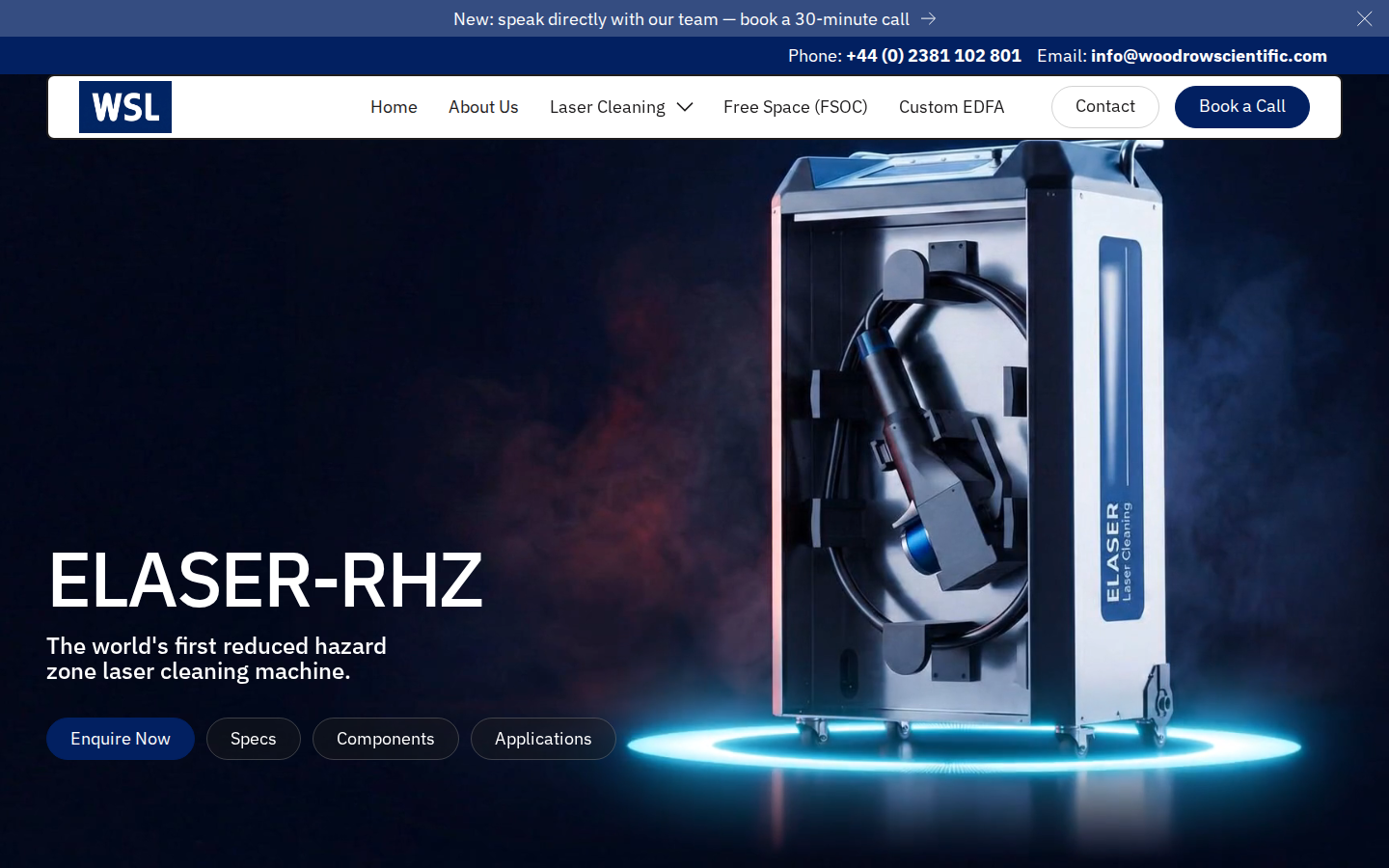
The ELASER and ELASER-RHZ are portable industrial laser cleaning systems built entirely in-house by Woodrow Scientific Limited, the only UK-based laser cleaning manufacturer. The ELASER-RHZ is the world's first laser cleaner with a patented Reduced Hazard Zone, enabling cleaning in open workshops, mixed-use facilities, and public-facing environments where conventional laser cleaning has never been practical.
Pros:

World-first RHZ technology for open-space cleaning
Sub-3 kg scanner; up to 50 m reach
Competitively priced; strong TCO with zero consumables
Only UK-based in-house laser cleaning manufacturer
Cons:

Pricing is quote-only; no self-serve budget figure
Purpose-built for cleaning only — not cutting or welding
The defining capability of the ELASER-RHZ is its patented Reduced Hazard Zone (RHZ) technology — a world first in laser cleaning, operating at 1550 nm wavelength to collapse the laser hazard zone to a fraction of the size produced by conventional systems.
The practical consequence is significant: where conventional laser cleaners require an area to be sealed off and evacuated before work can begin, the ELASER-RHZ confines the hazard to a small zone immediately around the work surface, allowing continuous operation in open-plan manufacturing facilities, mixed-use workshops, and publicly accessible spaces.
This is not an incremental safety improvement — it removes the single biggest operational barrier that has historically made laser cleaning impractical in shared or public environments, unlocking applications that were simply off the table before.
A concrete illustration: monument cleaning and graffiti removal in publicly accessible spaces are now viable with the ELASER-RHZ, where previously the safety overhead of conventional laser cleaning would have made those jobs prohibitively complex to manage.
Woodrow Scientific Limited designs, builds, services, and continuously improves the ELASER and ELASER-RHZ entirely in-house at its UK facility — it is not a reseller or importer.
This distinction matters more in laser cleaning than it might appear: a significant portion of companies presenting themselves as manufacturers in this category are in practice rebadging third-party machines, which limits their ability to provide genuine engineering support, improve the product, or turn around spares quickly. WSL's 200+ years of combined engineering experience sits behind every machine it ships.
Industries Served
WSL's specialisation is portable industrial laser cleaning — a sub-segment defined by mobility, single-operator deployment, and the ability to operate in environments where fixed or large-format systems cannot go.
- Automotive: Pre-weld surface preparation, rust removal, and paint stripping across production lines and bodyshops.
- Aerospace: Precise surface prep and component cleaning to tight tolerances, with minimal substrate loss.
- Injection Moulding and Tooling: In-place cleaning of moulds and tooling — no disassembly required, removing release agents and build-up without abrasive wear.
- Tyre and Rubber: Mould, vent, and vulcanisation residue cleaning without abrasives or mould wear.
- Industrial Maintenance: On-site cleaning of plant, equipment, and infrastructure — no masking, no media to clear up.
- Heritage and Restoration: Graffiti removal and monument cleaning in publicly accessible spaces — made viable specifically by the RHZ technology.
The heritage and restoration application is worth singling out: it is a direct product of the RHZ capability, and represents the clearest example of how a technology differentiator translates into a genuinely new commercial vertical.
ELASER / ELASER-RHZ Key Specifications
| Specification | Detail |
|---|---|
| Max laser power | Up to 300 W fibre laser |
| Wavelength | 1550 nm (Reduced Hazard Zone) |
| Power tunability | 0–100% (light oxides through thick coatings) |
| Handheld scanner weight | Under 3 kg |
| Delivery cable reach | Up to 50 m |
| Cooling | Air-cooled — no chiller or water circuit required |
| Certifications | CE and UKCA certified |
| Interface | Touchscreen GUI with password-protected per-user logins |
| Manufacture | Made in Britain |
Presenting verified technical specifications in a scannable format allows procurement researchers and operators to assess the system's capabilities at a glance, without having to extract figures from prose.
The 0–100% power tunability is operationally significant: a single machine can handle everything from lifting light surface oxides to removing thick coatings, without swapping heads or reconfiguring the system.
Pricing is available on request from WSL directly. For buyers comparing laser cleaning against alternatives such as sandblasting, chemical stripping, or water-jetting, the relevant comparison is total cost of ownership: zero consumables, reduced downtime, and less rework deliver a materially stronger TCO over the machine's working life.
Industrial operators who need to clean in open, shared, or public-facing environments where conventional laser cleaning is impractical due to safety overhead. Also a strong platform for service businesses launching a portable laser cleaning operation, with full operator training and bespoke engineering support available from WSL.
See the ELASER-RHZ in Full Detail
The ELASER-RHZ is the world's first laser cleaner with a patented Reduced Hazard Zone — built for open-space operation where conventional systems simply cannot go. Explore the full product page to see specifications and capabilities.

Product 2
Woodrow Scientific Limited — AutoLASE
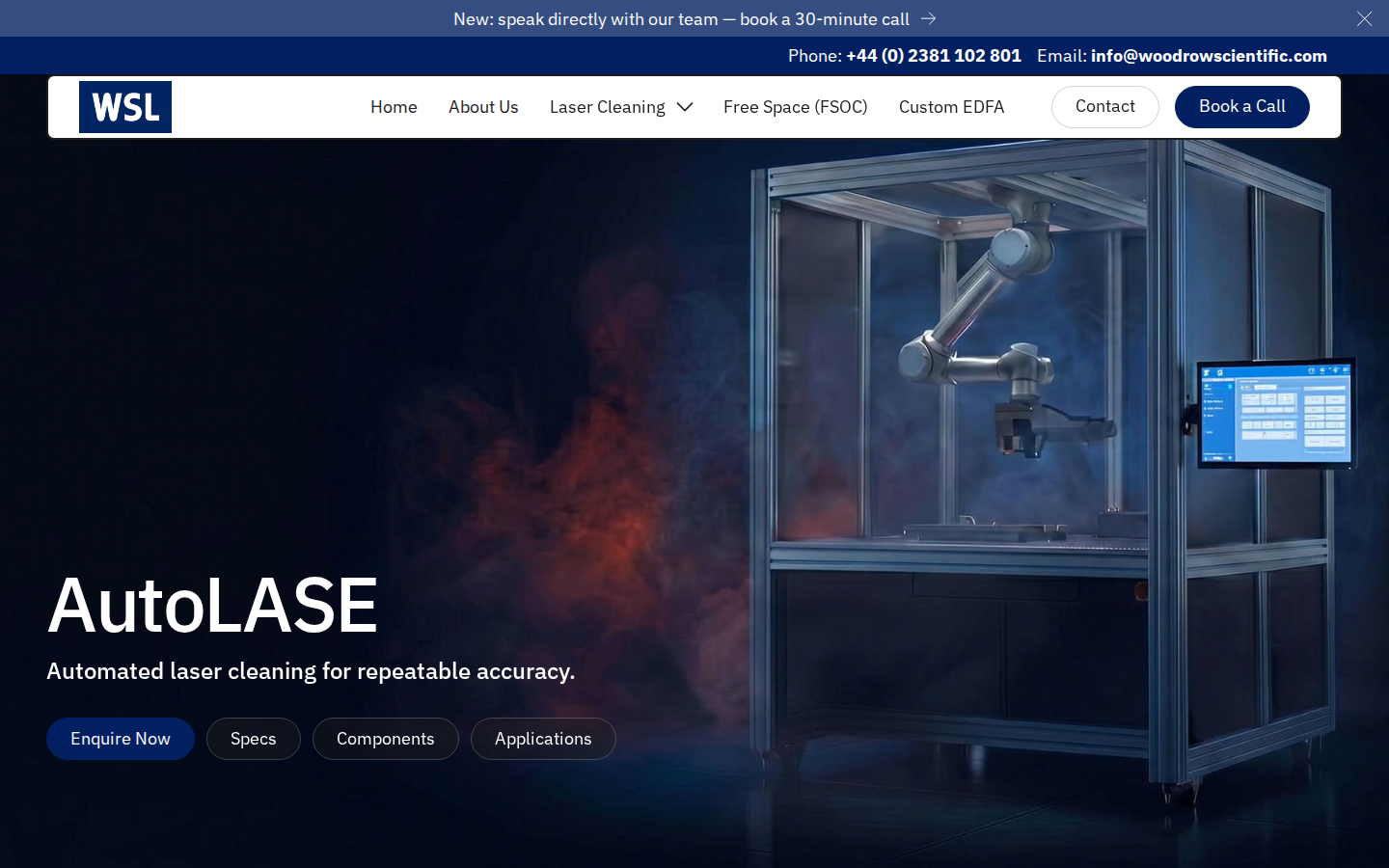
AutoLASE is an automated robotic laser cleaning system from Woodrow Scientific Limited that uses 3D machine vision to scan a loaded part, build a surface map, and generate the cleaning path automatically — no programming, no path-setting, and no knowledge of part geometry required.
Pros:
Load-and-go operation — no programming or setup required
Optional RHZ: world's only enclosure-free automated cleaner
Competitive pricing; strong TCO with zero consumables
In-house UK manufacturer — CE and UKCA certified
Cons:
Requires a fixed production environment; not portable
Enclosure required unless RHZ upgrade is specified
Where the ELASER puts laser cleaning in an operator's hands, AutoLASE removes the operator from the cleaning cycle entirely — WSL's automated system for production environments where repetitive cleaning is a labour bottleneck or a quality consistency risk.
AutoLASE: Load-and-Go Operation
The defining capability of AutoLASE is not that it automates cleaning — it is how effortless it is to run. Load a part, and the system's 3D machine-vision software scans it, builds a surface map, and generates the complete cleaning path automatically.
No manual programming. No path-setting. No knowledge of the part's geometry required. Anyone can load a part and run it — the system handles everything from scan to clean without operator input.
AutoLASE can be configured with WSL's optional RHZ upgrade, applying the same eye-safe Reduced Hazard Zone technology seen in the ELASER to a fully automated cell. The result is the only automated laser cleaning system in the world that can operate without a full laser safety enclosure — removing a significant infrastructure overhead from production environments and opening up deployment contexts where a full enclosure would be impractical.
For manufacturers running tight production floors, the enclosure requirement of a conventional automated laser cleaner is a real constraint — it demands dedicated space, installation time, and ongoing access management. The optional RHZ upgrade eliminates that constraint entirely.
AutoLASE Industries Served
AutoLASE is built for high-throughput production cleaning across a specific set of demanding verticals, each with its own surface-prep requirements and tolerance expectations.
- Automotive: Engine, driveline, and EV battery components — oxide removal, coating removal, contamination removal, and pre-weld or pre-bond surface preparation, part after part.
- Aerospace: Turbine blades, vanes, and engine parts cleaned and surface-prepped to tight tolerances, with the same cleaning standard held on every cycle.
- Injection moulds and tooling: Release agents, residue, and build-up stripped from mould cavities, cores, and inserts — restoring fine detail without disassembly or abrasive wear.
- Tyre and rubber moulds: Vulcanisation residue and build-up removed from moulds, segments, and vents — no abrasives, no mould wear.
- Remanufacturing and refurbishment: Corrosion, coatings, and contamination stripped from worn components before rebuild — batches cleaned consistently and ready for inspection.
These are the primary verticals, not the limits of the system. If a component fits the enclosure, it can be cleaned automatically.
Robotic Integration and Deployment
The laser cleaning head is carried on an articulated robotic arm with multi-axis reach, handling the angles and contours of complex 3D parts consistently across every cycle.
AutoLASE works with a customer's existing collaborative or industrial robots, or can be supplied as a complete custom cell — both routes are CE and UKCA certified. For bespoke integration or engineering requirements, WSL's in-house team handles the specification directly; prospective buyers are encouraged to get in touch to discuss their application.
AutoLASE Pricing and TCO
AutoLASE is competitively priced among comparable automated laser cleaning systems, with WSL's in-house manufacturing model delivering that pricing through genuine operational efficiency rather than quality compromise.
The more compelling financial argument for most production buyers is total cost of ownership: zero consumables, automated displacement of repetitive manual labour, consistent cleaning quality that reduces rework, and less downtime compared to abrasive or chemical alternatives.
Pricing is available on application. WSL, as the only UK-based laser cleaning manufacturer, designs, builds, and supports AutoLASE entirely in-house — which means faster iteration, expert post-sale support, and genuine accountability throughout the machine's working life.
Who AutoLASE Is Best For
AutoLASE is the right choice for production environments running repetitive cleaning cycles where manual cleaning is a labour bottleneck, a quality consistency risk, or both.
It is particularly strong for manufacturers who want automated cleaning without committing to the infrastructure overhead of a full laser safety enclosure — the optional RHZ upgrade is the only configuration in the world that makes that possible.
Product 3
IPG Photonics
The world's largest manufacturer of fibre lasers by its own SEC filings, IPG Photonics completed its acquisition of cleanLASER — the self-described inventor of laser cleaning technology — in December 2024, giving it end-to-end ownership across both laser source supply and dedicated cleaning systems.
Pros:
Broadest power range; global support network
Vertically integrated: makes its own diodes and sources
cleanLASER: inventor of laser cleaning technology
Cons:
LightWELD is dual-purpose, not dedicated cleaner
LaserCell 4000 requires full enclosure; no open-space use
cleanLASER integration still maturing post-acquisition
IPG Photonics is the world's largest manufacturer of fibre lasers — a position it has held through vertical integration that runs from in-house diode production through to complete laser systems, rather than relying on third-party components.
That manufacturing depth spans materials processing applications including cutting, welding, cleaning, and marking, as well as medical and optical communications — making IPG one of the broadest-scope laser companies on this list by application vertical.
The cleanLASER Acquisition
In December 2024, IPG completed its acquisition of Clean-Lasersysteme GmbH (cleanLASER) — the company widely regarded as the inventor of laser cleaning technology, founded in 1997 in Herzogenrath, Germany.
cleanLASER had approximately 2,000 systems installed across more than 20 countries at the time of acquisition, with a distributor and partner network spanning automotive, aerospace, food, electronics, medical, and industrial maintenance markets.
The cleanLASER acquisition is not routine M&A — it gives IPG ownership of the originating IP lineage in laser cleaning, bringing nearly three decades of application know-how, a global install base, and complementary market exposure under one roof.
cleanLASER's portfolio ranges from compact handheld units (from 20 W) to high-power gantry systems for battery production, all manufactured in Germany — giving IPG immediate credibility as a dedicated cleaning solutions provider, not just a laser source supplier into the segment.
IPG Laser Cleaning Product Lines
Alongside the cleanLASER portfolio, IPG had established its own cleaning-capable product lines before the acquisition.
| Product | Type | Power Range | Key Characteristic |
|---|---|---|---|
| LightWELD 1000 / 1500 XR / 2000 XR | Handheld (weld + clean) | Up to 1,000 W – 2,000 W | Dual-purpose; cleaning is secondary to welding |
| LaserCell 4000 | Enclosed automated cell | IPG source selected per application | Material removal rate up to 450 cm²/sec; Class 1 enclosure |
| Welding LaserCell (robotic) | Robotic workstation | Configurable | Single or dual 6-axis robot; adaptable part handling |
Comparing IPG's three primary laser cleaning product lines across key dimensions helps procurement researchers quickly assess which system fits their application.
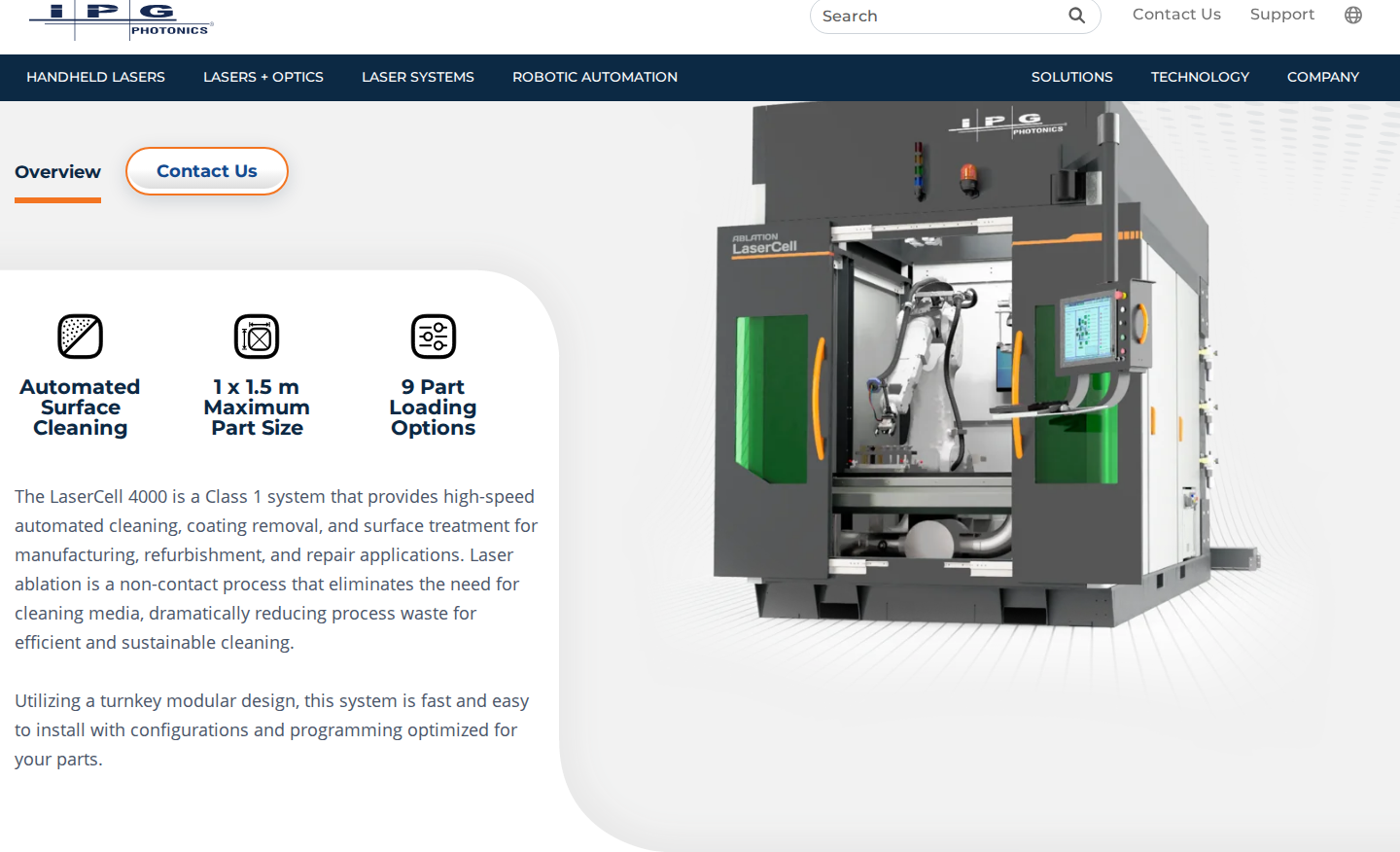
The LaserCell 4000 is a pre-engineered, enclosed Class 1 automated cell designed for high-speed cleaning, coating removal, and surface treatment in manufacturing and refurbishment settings.
The LightWELD range is a general-purpose handheld system — capable of cleaning, but primarily positioned as a welding tool, which is a meaningful distinction for buyers evaluating dedicated cleaning solutions.
Industries Served
- Automotive: Cutting, welding, and surface cleaning for body and powertrain components; cleanLASER has deep OEM penetration across premium automotive manufacturers.
- Aerospace: Precision cleaning, paint removal, and pre-treatment for bonding and coating applications.
- Industrial manufacturing: High-power cutting and welding at production scale, plus mould cleaning and degreasing via the cleanLASER portfolio.
- Medical: Medical laser applications via IPG's own medical division, further extended by cleanLASER's medical technology segment.
- Food and bakeries: Specialist mould and equipment cleaning — a niche cleanLASER has served since its early years.
Best for: industrial buyers sourcing fibre laser systems across the widest power range from a vertically integrated manufacturer with global support infrastructure; and organisations evaluating dedicated laser cleaning solutions from a large-scale manufacturer now backed by the originator of the technology.
Product 4
TRUMPF — Precision Laser Systems for Industrial Manufacturing
TRUMPF is a German high-tech manufacturer whose core business is industrial laser systems and machine tools for sheet metal processing — designing and building its own laser sources, machine tools, optics, sensors, and control software in-house for cutting, welding, marking, and additive manufacturing applications.
Pros:
Fully integrated stack: laser, machine tool, software
Deep automotive and aerospace application expertise
BrightLine: cuts and welds without hardware changes
TruDisk S: up to four parallel production outputs
Cons:
High-end pricing; complex procurement for smaller buyers
No laser cleaning products in the portfolio
Where many laser companies supply beam sources that customers integrate into their own systems, TRUMPF operates differently: it designs and manufactures the laser source, the machine tool, the optics, the sensors, and the control software — then brings all of it to market as a coordinated stack built specifically for high-volume industrial sheet metal cutting, welding, marking, and additive manufacturing.
TruFiber Fibre Laser Family
TRUMPF's TruFiber family spans four sub-series, each positioned for a distinct production context: the TruFiber S (3–12 kW multimode, up to two pluggable laser outputs, 50 m laser light cables) targets high-throughput welding on large production lines; the TruFiber P (up to 2 kW singlemode, up to 6 kW multimode) is configured for precision deep-hole welding and fine seam work where beam quality is the primary requirement; the TruFiber G (1–12 kW) is the integrator-facing option, priced for cost-sensitive applications while retaining compatibility with TRUMPF optics; and the TruFiber P Compact (100 W–2 kW) addresses miniaturised components in formats as small as a 19-inch rack unit.
The TruFiber S was unveiled at Photonics West 2023 as the next generation of the series, pairing its multimode beam source with BrightLine Weld — a beam-shaping option that distributes laser power between the inner core and outer ring of TRUMPF's patented 2-in-1 laser light cable, enabling virtually spatter-free welding even at high feed rates.
TruDisk and BrightLine Technology
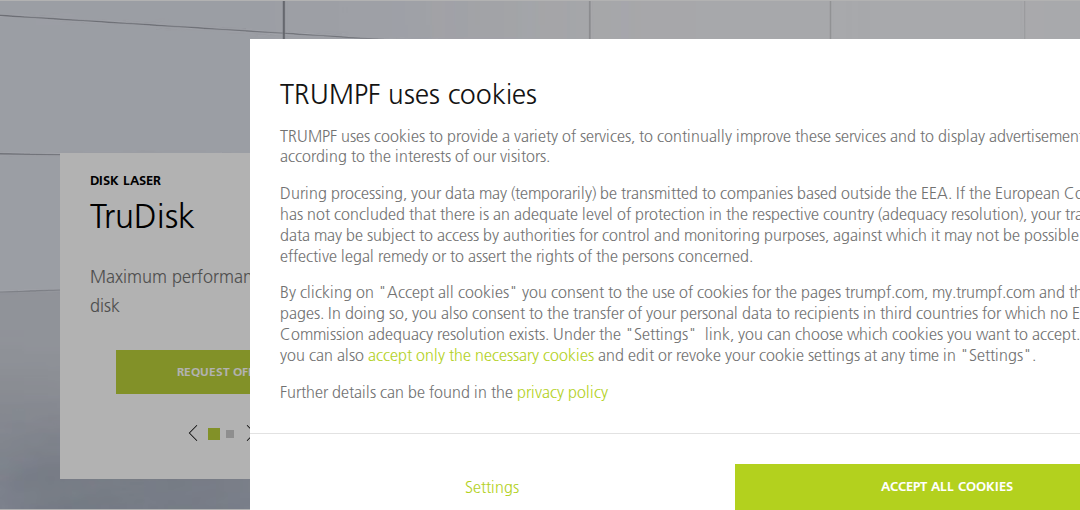
The TruDisk is TRUMPF's high-power disk laser platform, covering a continuous power range from 1 kW up to 24 kW in its sixth generation — presented at LASER World of Photonics 2022 as the most powerful industrial disk laser available at that time.
The TruDisk S Series supports up to four simultaneous machine or process cell connections, with laser power split flexibly across outlets for parallel working or delivered at full power sequentially — a configuration that maximises utilisation in continuous 24/7 production environments.
BrightLine is the technology family that runs across TRUMPF's high-power platforms: at its core is a patented 2-in-1 laser light cable with an inner and outer fibre core, allowing the power distribution between core and ring to be adjusted on the fly via TRUMPF's TruControl software, without any hardware change to the optical setup.
In practice, this means a single TruDisk or TruFiber S installation can switch between thick-plate cutting and high-speed welding of thin materials within the same production shift, simply by adjusting the core-to-ring power ratio.

TRUMPF Industries Served
TRUMPF's application depth is concentrated in verticals where laser processing is structurally embedded in the production process, not bolted on.
- Automotive and e-mobility: EV battery cell and pack welding (including copper busbar connections), body-in-white joining, powertrain components, and lightweight material processing for aluminium and high-tensile steel structures.
- Aerospace: Cutting, welding, and laser metal deposition on titanium, superalloys, and blisk components, including repair applications where laser deposition replaces full component replacement.
- Medical technology: Precision cutting of metal and polymer stents, welding of pacemaker housings and endoscopic instruments, and UDI-compliant marking of surgical instruments.
- Electronics and semiconductor: Cutting and drilling of silicon wafers and printed circuit boards, ultrashort pulse processing for chip packaging, and plasma power supply for semiconductor processes via TRUMPF Electronics.
- General manufacturing: Sheet metal cutting and welding for machine builders, systems integrators, and job shops — the largest single application segment by installed base.
TRUMPF supports these verticals through nine global Laser Application Centres where customers can develop and validate processes before committing to production investment.
TRUMPF's Integrated Manufacturing Model
TRUMPF's defining structural advantage is that laser sources, machine tools, optics, sensor systems, and TruTops process software are all developed and manufactured within the group — meaning system performance is optimised end-to-end rather than assembled from third-party components with their own tolerance stacks.
Post-sale, this integration extends to service: TRUMPF operates more than 71 service sites globally with over 1,600 service engineers, giving industrial customers a single accountable vendor for both the beam source and the machine it powers.
Best for: Industrial manufacturers running high-volume sheet metal cutting, welding, or marking operations who require a fully integrated laser source, machine tool, and process software stack — supported by a single vendor with a global service footprint and application engineering depth across automotive, aerospace, medical, and electronics production.
Product 5
Lumenis
Lumenis is an energy-based medical device company specialising in laser, IPL, and RF technologies for aesthetic and ophthalmic applications. With over 60 years of operation, 90,000+ devices installed across 88+ countries, and inventor status for IPL technology, it is one of the most clinically established names in medical laser equipment.
Pros:
Inventor of IPL; 60+ years in medical lasers
In-house manufacturer with 330+ registered patents
OPT-powered IPL backed by 80+ peer-reviewed papers
Full aesthetic and ophthalmic portfolio from one vendor
Cons:
Medical/aesthetic only; no industrial applications
Licensed practitioners only; no direct-to-buyer sales
Capital equipment pricing not publicly listed
Lumenis operates exclusively in energy-based medical devices — laser, IPL, and RF technologies developed for aesthetic and ophthalmic applications, with no industrial product lines.
The company claims over 60 years of operation, an active installed base of more than 90,000 devices across 88+ countries, and inventor status for IPL technology, first introduced in 1993.
Lumenis Aesthetic Portfolio
The aesthetic division spans CO₂ ablative resurfacing, IPL photorejuvenation, fractional non-ablative resurfacing, and diode laser hair removal — a breadth that lets a single clinic build its full treatment menu from one vendor.
- ULTRApulse Alpha: CO2 ablative laser platform covering 30+ medical indications, including the SCAAR FX mode for penetration up to 4mm in a single pulse — designed for deep scar revision and complex resurfacing.
- Stellar M22: Multi-application platform combining IPL, ResurFX fractional non-ablative, Multi-Spot Nd:YAG, and Q-Switched Nd:YAG to treat 30+ skin conditions and hair removal from a single system.
- SPLENDOR X: Dual-wavelength Alexandrite (755nm) and Nd:YAG (1064nm) hair removal device powered by BLEND X technology, which synchronises the two wavelengths in a single pulse for treatment across all skin types.
- LightSheer QUATTRO: Diode laser hair removal workstation operating at 805nm and 1060nm wavelengths, cleared for hair removal, benign pigmented and vascular lesions, and wrinkle reduction across all Fitzpatrick skin types.
Lumenis's proprietary OPT (Optimal Pulse Technology) controls IPL pulse shape and duration, and is described on the company's own site as the industry gold standard for photorejuvenation, with efficacy supported by over 80 peer-reviewed papers.
ResurFX, the fractional non-ablative module available on the Stellar M22, uses a 1565nm fibre laser with a CoolScan scanner that delivers full coverage in a single pass — a design the company positions as unique in its category.
Lumenis Ophthalmic Portfolio
Ophthalmology is a genuine second pillar at Lumenis, not a legacy sideline: the company claims the first argon laser photocoagulator for ophthalmology (1970) and first approved marketer of Nd:YAG photodisruptor lasers.
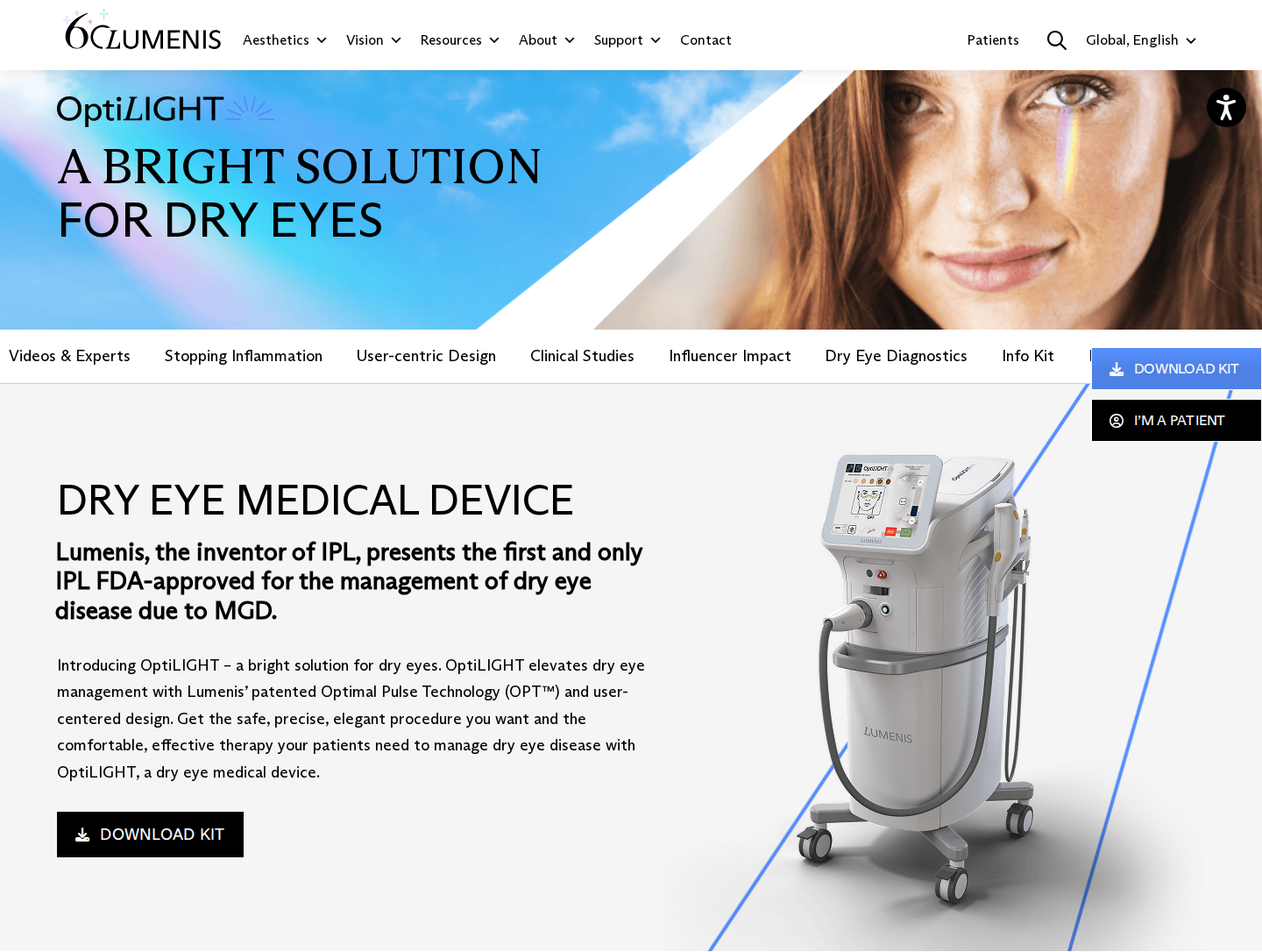
- OptiLIGHT: IPL device holding FDA De Novo authorisation for management of dry eye disease due to meibomian gland dysfunction — the first and only IPL to receive this specific approval.
- Smart Selecta Duet: Combined SLT and YAG photodisruptor platform for glaucoma management, integrating both modalities in a single anterior segment laser system.
- Digital Duet and Digital Trio: All-digital SLT/YAG platforms for glaucoma and PCO therapy; the Trio adds an integrated Smart532 photocoagulator for retinal care in a single system.
- Photocoagulators and LIOs: Vision One multi-wavelength photocoagulator and the Smart LIO laser indirect ophthalmoscope round out a retinal care portfolio with decades of clinical heritage.
Lumenis develops, manufactures, and distributes its own devices — headquartered in Israel with offices on four continents — and holds over 330 registered patents alongside numerous FDA clearances across both its aesthetic and ophthalmic lines.
All devices are sold through licensed practitioners; buyers should contact Lumenis or an authorised distributor for pricing, as capital equipment costs are not published.
Aesthetic clinics and dermatology practices seeking a single-vendor platform covering resurfacing, IPL, and hair removal with deep peer-reviewed clinical evidence; and ophthalmic practices requiring dedicated laser platforms for glaucoma and retinal care from a company with 60+ years of ophthalmology specialisation.
Conclusion
Choosing the right laser company for your application
For laser cleaning in open, shared, or public-facing environments, WSL's ELASER-RHZ is the only system with reduced-hazard-zone technology that removes the need to seal off the work area.
For automated production-line cleaning, AutoLASE offers load-and-go operation with no programming required.
For high-power cutting and welding, TRUMPF sets the benchmark for integrated industrial systems, while IPG Photonics leads on fibre laser sources across the widest power range.
For medical and aesthetic applications, Lumenis brings the deepest clinical specialisation on this list — 60+ years of focus and the broadest FDA-cleared indication set. Specialisation depth, not brand scale, is the signal that matters most.
Frequently asked questions about laser companies
Answers to the questions readers most commonly ask when researching laser companies and evaluating vendors.
A genuine laser cleaning manufacturer designs, engineers, builds, and supports its own machines entirely in-house. A reseller sources machines from a third-party manufacturer — often overseas — and rebadges or distributes them under its own name. The distinction matters enormously for buyers. With a reseller, support requests must travel back through the supply chain to the original manufacturer, which typically means slower response times and limited ability to resolve complex technical issues. There is also no genuine product development: a reseller cannot meaningfully improve a machine it did not design. This distinction is worth verifying during procurement, because a significant number of companies in the laser cleaning market present themselves as manufacturers when they are, in practice, importers or distributors. Woodrow Scientific Limited (WSL) is the only UK-based laser cleaning manufacturer that designs, builds, services, and continuously develops its systems in-house — including the ELASER, ELASER-RHZ, and AutoLASE product lines. Asking a prospective supplier where their machines are designed and manufactured, and who carries out warranty and service work, will quickly clarify which category they fall into.
When shortlisting a laser company, focus on five axes: genuine specialisation in your application vertical, in-house manufacturing vs reseller model, relevant safety certifications, total cost of ownership, and recent strategic direction. Generalist claims are a weaker signal than deep ownership of a specific niche — a company that does one thing exceptionally well is usually a safer choice than one that claims to do everything. The manufacturing model matters because resellers cannot improve, deeply support, or genuinely warrant machines they did not build. Safety certifications should match your market: CE and UKCA for UK and European deployment, FDA for US medical applications, and ISO quality standards as a baseline indicator of process maturity. Total cost of ownership extends well beyond purchase price — factor in consumables, planned maintenance, unplanned downtime, and the availability of local service engineers. Finally, look at where the company has been investing recently: acquisitions, new product launches, and partnerships signal strategic priorities and give you confidence the supplier will still be innovating in three to five years' time.
The largest laser manufacturers by scale and breadth are IPG Photonics, Coherent Corp., and TRUMPF — all dominant in industrial fibre and solid-state lasers for cutting, welding, and materials processing. For specialist laser cleaning applications, dedicated leaders include Woodrow Scientific Limited (WSL) — the only UK-based in-house laser cleaning manufacturer — and cleanLASER, now part of IPG Photonics following its acquisition in December 2024. In medical lasers, Lumenis is a long-established leader across aesthetic and ophthalmic applications. The honest answer is that "top" depends entirely on application vertical. No single manufacturer leads across all segments: IPG and TRUMPF are the benchmarks for high-power industrial processing; WSL leads in dedicated laser cleaning, particularly for open-space and reduced-hazard-zone operation; and Lumenis is the reference point for energy-based medical devices. Evaluating "top" without first defining your vertical will lead you to the wrong shortlist.
There is no single best laser brand. The right answer depends entirely on your application vertical, power requirements, and operational environment. For high-power industrial cutting and welding at scale, TRUMPF and IPG Photonics are widely regarded as the benchmarks — both offer deep application expertise and broad product portfolios. For medical aesthetics and ophthalmology, Lumenis is the reference point, with over 60 years of operation and inventor status for IPL technology. For industrial laser cleaning — particularly in environments where open-space or reduced-hazard-zone operation is required — Woodrow Scientific Limited (WSL) is the specialist of choice, as the only UK-based in-house manufacturer with patented reduced-hazard-zone technology in its ELASER-RHZ system. The most useful question is not "which brand is best overall?" but "which brand leads in my specific application?" Shortlisting by vertical first, then evaluating depth of specialisation, will produce a more reliable result than any general ranking.
nLIGHT is one of the leading US-based suppliers of high-energy laser systems to the US military. The company has been awarded contracts under the DoD's High Energy Laser Scaling Initiative (HELSI), including a $171 million award to develop a megawatt-class directed-energy laser using its coherent beam combination (CBC) architecture. nLIGHT is also delivering a 50 kW-class high-energy laser for integration into Stryker combat vehicles under the US Army's DE M-SHORAD programme, and has been selected alongside Lockheed Martin for the Joint Laser Weapon System (JLWS) programme. Coherent Corp. has historically supplied laser and photonic components to aerospace and defence programmes — including components for high-energy laser, intelligence, surveillance, and reconnaissance systems — though the company announced the sale of its Aerospace and Defence division in 2025. Lasertronics occupies a distinct niche: its closed-loop laser ablation systems are the only laser coating removal systems to have received FAA endorsement for use on aluminium aircraft structures, including flight-critical surfaces, and the company has supplied robotic coating removal systems to US Navy maintenance facilities.