

Introduction
Free-space optical communication transmits data as modulated laser beams through open air or vacuum — delivering high-throughput, spectrum-independent links that radio frequency simply cannot match at scale.
The companies operating in this space fall across three distinct segments: terrestrial FSO links, satellite inter-satellite links, and ground-to-space optical connections including optical ground station infrastructure.
This list spans the full supply chain — from component and subsystem suppliers through to optical terminal manufacturers and constellation operators — because buyers and integrators need visibility of the whole ecosystem, not just the primes.
With no universal standard governing the full FSO stack, supplier selection carries real compatibility consequences — making it worth understanding each company's role carefully before committing.
TL;DR
Choosing a laser communication company means navigating three segments and multiple supply-chain layers — components, terminals, and operators — each with different credentials and integration implications.
In a market without a universal standard, the supplier you select today shapes your programme's compatibility options tomorrow.
This article covers:

The three laser communication segments explained
Per-company technical differentiation and deployment credentials
Supply-chain roles: subsystem suppliers vs terminal manufacturers
Evaluation criteria applied consistently across entries
Decision guidance for buyers and system integrators
How the Laser Communication Industry Is Structured
Three Segments, Three Very Different Risk Profiles
The three segments introduced earlier in this page — terrestrial FSO, satellite inter-satellite links (ISL/OISL), and ground-to-space optical links — are not simply different applications of the same technology. They have different maturity levels, different procurement processes, and different risk profiles.
| Segment | Maturity | Primary Standards | Key Buyers / Drivers |
|---|---|---|---|
| Terrestrial FSO | Most mature; established vendor ecosystem | Largely vendor-led; some ITU alignment | Telecoms operators, enterprise, 5G backhaul |
| Satellite ISL / OISL | Rapidly scaling; LEO mega-constellations dominating | SDA OCT Standard (US govt); proprietary protocols common commercially | SDA / PWSA, commercial constellation operators |
| Ground-to-space optical links | Most nascent; subsystem suppliers still being qualified | CCSDS standards for civil/scientific missions; SDA OCT for military ground terminals | Space agencies, military ground networks, commercial OGS operators |
The three laser communication segments compared by maturity, applicable standards, and primary buyer categories.
The practical implication of this table is that credibility in one segment does not transfer automatically to another. A vendor with a strong terrestrial FSO product line has not necessarily engaged with the pointing, acquisition, and tracking demands of a satellite ISL terminal. Equally, a prime contractor building LEO satellites is not the same entity as the component supplier providing the optical amplifiers inside its ground station.
The Supply Chain Has Three Distinct Layers
A common source of confusion when evaluating laser communication companies is conflating entities that occupy fundamentally different positions in the supply chain.
- Constellation operators and prime contractors: Integrate full satellite systems and are the end-customers of the supply chain. They define the standards and procurement requirements that flow downstream.
- Optical terminal manufacturers: Build the complete laser communication head — the OCT — that mounts on a satellite, aircraft, or ground station. They buy qualified components from the layer below.
- Component and subsystem suppliers: Deliver the optical building blocks — amplifiers, modulators, pointing mechanisms, fibres — that go inside terminals and optical ground stations.
These layers are interdependent, not competitive. A ground-station uplink amplifier supplier is not a rival to a satellite terminal manufacturer — it is a necessary part of that terminal manufacturer's supply chain.
Standards Fragmentation: The Procurement Risk Few Buyers Anticipate
Three distinct standards regimes currently coexist. The SDA Optical Communications Terminal (OCT) Standard governs US government LEO ISL terminals across the Proliferated Warfighter Space Architecture (PWSA). The CCSDS (Consultative Committee for Space Data Systems) framework — covering both physical layer and coding/synchronisation — applies to many civil and scientific missions, with participation from NASA, ESA, DLR, CNES, and other agencies. And proprietary protocols remain common among commercial constellation operators, with some — like Project Kuiper — operating their own optical terminal architecture while exploring selective SDA-compatible additions for specific government applications.
For buyers procuring ground-station components or subsystems, the standards question is not abstract. A component qualified only to one standard version may require re-qualification — or replacement — as the programme it supports evolves.
With that structural context established, the entries that follow profile five of the most significant laser communication companies operating across these segments today — spanning prime contractors, terminal manufacturers, and the component layer that underpins them all.
1
Woodrow Scientific Limited: Software-Definable EDFA for Ground Stations
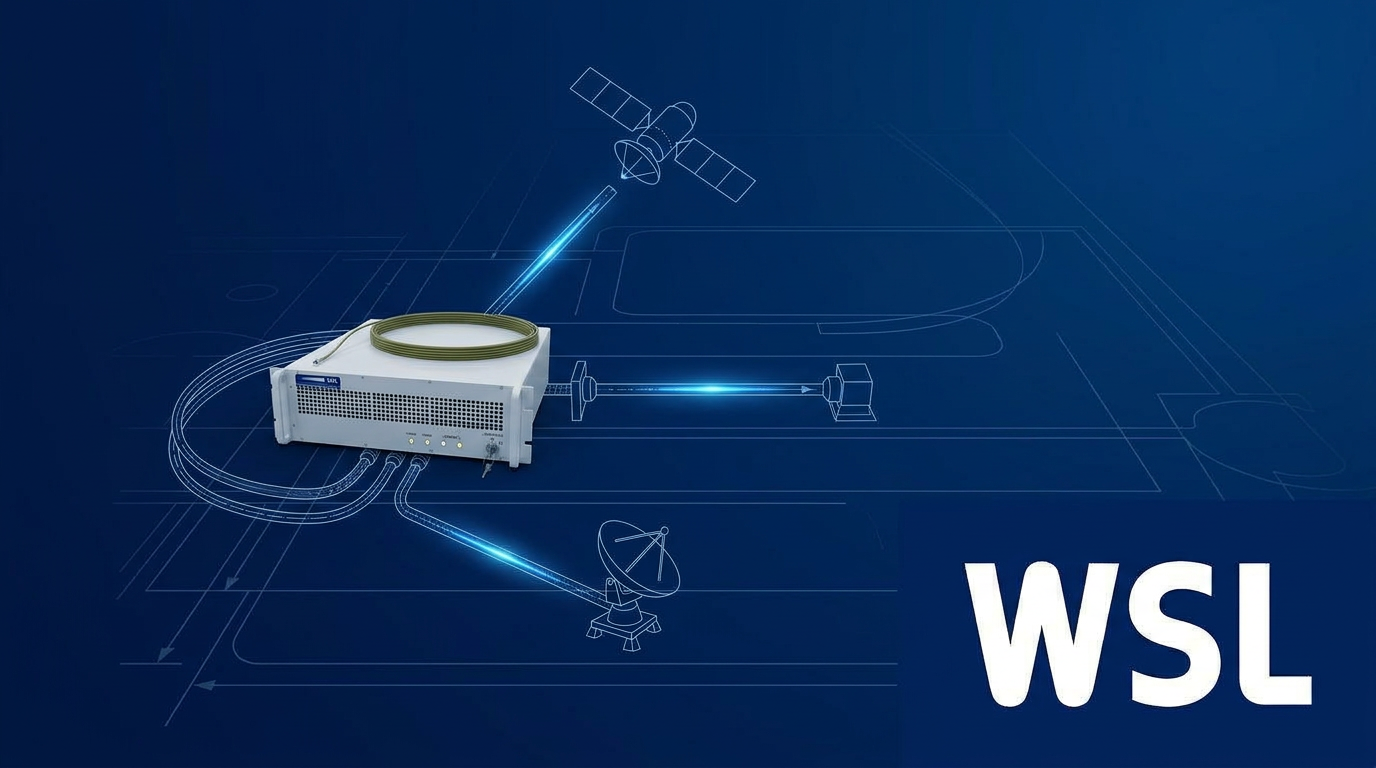
WSL is a UK EDFA manufacturer whose EDF-UL platform delivers single-beam beacon-and-data transmission and end-to-end hardware/software configurability — tailored to each ground station's specific requirements.
Pros:

Single beam carries both beacon and uplink data
Hardware and software configured per ground station
In-house UK manufacturer on patented technology
CE and UKCA certified for UK and EU
Cons:

No published list price; quoted per configuration
Class 4 laser — safety procedures required on-site
Ground-station amplifier only; not a full terminal
Woodrow Scientific Limited occupies a distinct position in the FSO supply chain: it is a component and subsystem supplier, not a terminal manufacturer or constellation operator.
Founded in 2012 and based in the UK, WSL designs, builds, qualifies, and supports its erbium-doped fibre amplifiers entirely in-house — a lineage rooted in Southampton's Optoelectronics Research Centre, the birthplace of the EDFA.
Ground-station integrators assembling optical uplink capability need a specialist amplifier supplier, not a generalist catalogue pick, and that is precisely the role WSL was built to fill.
Single Beam, Beacon and Data Combined
The EDF-UL platform's headline capability is nesting the tracking beacon and uplink data within a single amplified beam — the beacon rides at low modulation depth, with data carried above it via amplitude modulation.
The system operates across three modes — acquisition, tracking, and data-transmission — switching between them without hardware changes.
As far as WSL is aware, no other EDFA supplier delivers beacon and uplink data from a single module in this way, which makes the EDF-UL a genuinely singular solution for ground-station integrators who would otherwise need separate subsystems for each function.
Modulation-on-Demand and Hardware Configurability
Every EDF-UL unit is configured to the client's specific ground station across both the physical build and the software control layer — a depth of tailoring that catalogue EDFA suppliers and resellers do not offer.
On the hardware side, integrators can specify band (C-band, L-band, or dual-band from a single source), output power, beacon-only or bi-directional operation, 2- or 4-emitter arrays with multi-station synchronisation for site and emitter diversity, an external optical input for third-party transmitters (OOK up to 20 Mbps), ±2 nm wavelength tunability, and air or water cooling.
On the software side, WSL's Modulation-on-Demand delivers software-selectable amplitude modulation: square or sinusoidal waveforms, adjustable frequency and modulation index, switchable to CCSDS or SDA standards at high power across C/L-band, with integrated-seed uplink up to 10 Mbps OOK.
Because standards for optical ground links — CCSDS, SDA, and proprietary protocols — are still evolving, a software-definable amplifier protects the buyer's investment in a way a fixed-function unit cannot. Modulation-on-Demand lets the EDF-UL adapt as the protocol landscape shifts, without new hardware.
Because WSL designs and manufactures its amplifiers in-house, the configuration process is seamless: there is no intermediary between the client's requirements and the engineers who built the product.
EDF-UL Key Specifications
The table below summarises the core parameters of the EDF-UL platform to help integrators assess fit against their ground-station requirements.
| Parameter | EDF-UL Specification |
|---|---|
| Output power | 10 W average at 1550 nm (higher on request) |
| Beam quality | M² < 1.1 |
| C-band wavelength | 1532–1537 nm / 1550–1570 nm |
| L-band wavelength | 1588–1592 nm |
| Wavelength tunability | ±2 nm standard; broader on request |
| Uplink data rate (integrated seed) | Up to 10 Mbps OOK |
| External OOK drive | Up to 20 Mbps (data rate set by external modem) |
| Form factor | 3U 19" rack — 482.5 × 500 × 133 mm |
| Weight | < 20 kg |
| Cooling | Air-cooled standard; water cooling available |
| Interfaces | USB, RS232, Parallel I/O |
| Certifications | CE, UKCA |
| Laser class | Class 4 (IEC 60825-1) |
Core EDF-UL specifications across power, beam quality, wavelength, data rate, form factor, and compliance — drawn from WSL's published product data.
The 3U 19" rack form factor and sub-20 kg weight are practical for ground-station rack integration, and the 110–250 VAC power supply range suits international deployments.
In-House Manufacture and Engineering Support
WSL's team carries more than 200 years of combined engineering experience, with fibre-amplifier expertise tracing directly back to Southampton's ORC — the research centre where the EDFA was invented.
Everything is built on patented in-house technology, which means WSL can provide direct engineering support from the original developers, faster spares and repairs, and the ability to modify or improve the product post-supply.
Many amplifier suppliers operate as resellers or importers of set module builds, which limits their ability to configure, support, or evolve the product after sale. WSL's in-house model is the practical alternative to that.
Pricing and How to Engage
Pricing is quoted per configuration, reflecting the fact that each EDF-UL unit is tailored to the buyer's specific ground station, band requirements, emitter architecture, and protocol stack.
Integrators with a ground-station uplink requirement should contact WSL with their specification; the engineering team will assess the requirement and provide a configuration-specific quote.
2
Tesat-Spacecom — Flight-Proven Optical Terminals from LEO to GEO
Tesat-Spacecom, an Airbus subsidiary, manufactures full-system optical terminals for LEO, MEO, and GEO — with the deepest in-orbit flight heritage on this list, anchored by the EDRS SpaceDataHighway and 62 SCOT80s in orbit.
Pros:
80,000 laser connections via EDRS SpaceDataHighway
SCOT family spans LEO through GEO orbits
SCOT80 compliant with SDA OCT Standard 3.1
Cross-prime-contractor interoperability demonstrated in orbit
Cons:
Prime-contractor procurement processes and lead times apply
Verify commercial terms for your programme scale
Tesat-Spacecom is a satellite optical terminal manufacturer headquartered in Backnang, Germany, and operating as a subsidiary of Airbus. Its product scope covers complete optical communication terminals for inter-satellite links (ISL) and space-to-ground links across LEO, MEO, and GEO — a full-system supplier role that extends from hardware qualification through in-orbit operation.
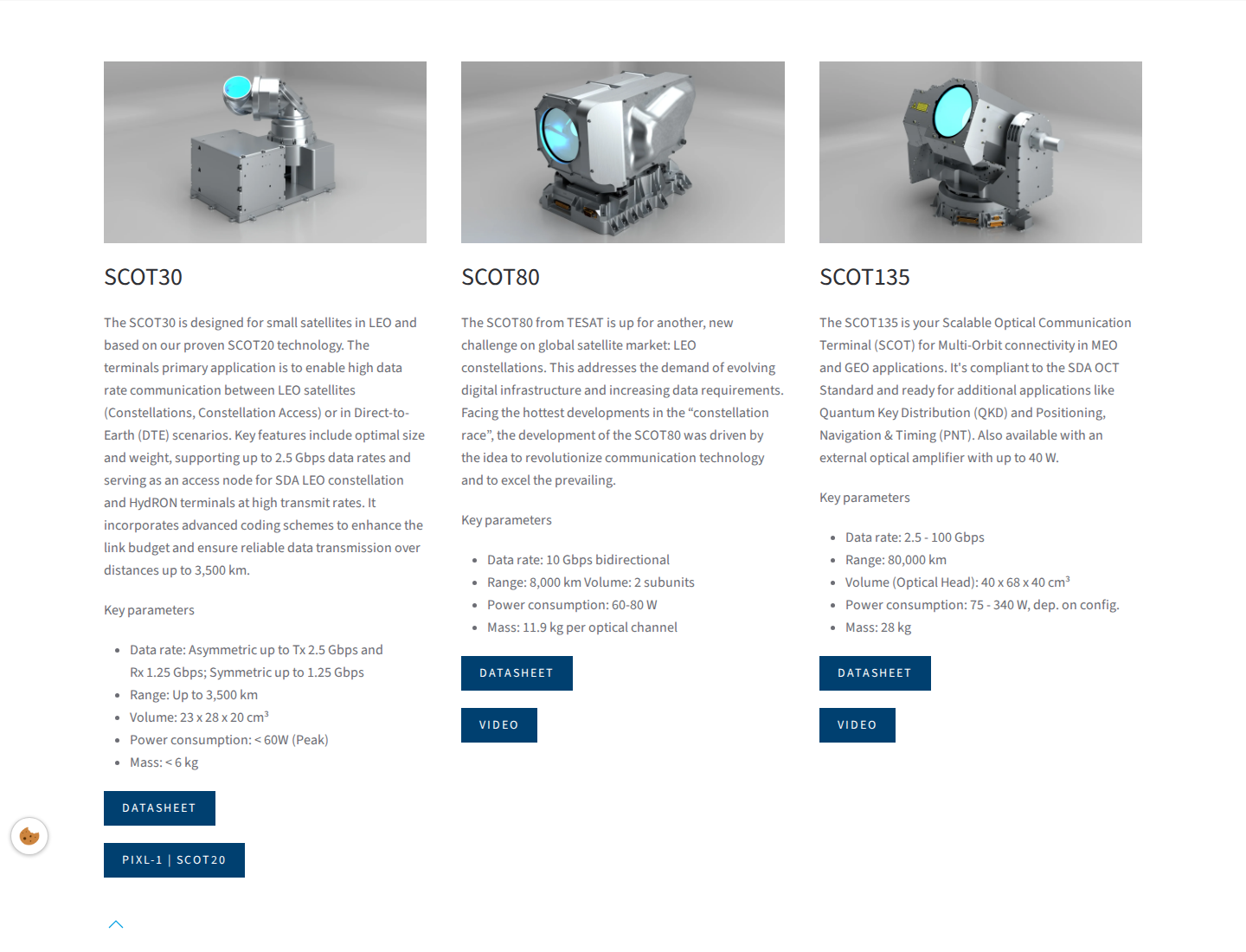
The company's current product line centres on the Scalable Optical Terminal (SCOT) family, four models covering the range from small-satellite LEO applications through to long-range multi-orbit connectivity.
| Model | Orbit Class | Data Rate | Range | SDA OCT Compliance |
|---|---|---|---|---|
| SCOT20 | LEO | Up to 1 Gbps | – | SDA and ESTOL standards |
| SCOT30 | LEO | Tx up to 2.5 Gbps / Rx up to 1.25 Gbps | Up to 3,500 km | – |
| SCOT80 | LEO | 10 Gbps bidirectional (up to 100 Gbps capable) | 8,000 km | SDA OCT Standard 3.1 (path to 4.0) |
| SCOT135 | MEO / GEO | 2.5–100 Gbps | 80,000 km | SDA OCT Standard compliant |
Key parameters for the Tesat SCOT optical terminal family across orbit classes. – indicates a figure not publicly listed by Tesat.
The SCOT80 is Tesat's highest-volume product in the current constellation market. With an 80 mm aperture and 10 Gbps bidirectional throughput, it is designed for LEO ISL applications and has a demonstrated capability of up to 100 Gbps.
The SCOT135 addresses the longer-range multi-orbit segment, with a range of 80,000 km and support for data rates up to 100 Gbps — optionally paired with a 40 W external optical amplifier for GEO-to-GEO scenarios, a configuration Tesat and MPB Communications demonstrated in a laboratory environment in 2024.
EDRS SpaceDataHighway: Operational Heritage in Numbers
The clearest measure of Tesat's flight heritage is the European Data Relay System (EDRS), operated by Airbus under the SpaceDataHighway brand. The system's two geostationary nodes, EDRS-A (launched 2016) and EDRS-C (operational from 2020), each carry Tesat's LCT135 laser communication terminals as their core optical payload.
Airbus describes the SpaceDataHighway as the world's first operational commercial laser communication relay service. By 2024, the system had reached 80,000 successful laser connections across its first eight years of routine operations, with a reliability rate of 99.53% and more than 2.5 petabytes of data downloaded from space.
In 2024, the Airbus SpaceDataHighway — powered by Tesat LCT135 terminals on EDRS-A and EDRS-C — recorded 80,000 successful laser connections during its first eight years of routine operations, with a 99.53% reliability rate and over 2.5 petabytes of data relayed.
The LCT135 terminal, developed by Tesat in cooperation with the DLR German Space Administration, transmits at up to 1.8 Gbps across distances of up to 45,000 km — locking on to a LEO satellite target in under a minute from geostationary orbit, according to ESA's published infrastructure overview.
SDA Programme Delivery and In-Orbit Interoperability
Through its US affiliate TESAT Government, Tesat has expanded into the American defence market. In October 2025, TESAT Government announced delivery of SCOT80 terminals for a Lockheed Martin GPS demonstration satellite awaiting launch — part of a selection announced in December 2024.
As of that announcement, 62 SCOT80 terminals were in orbit across multiple prime contractors' satellites, including Lockheed Martin and Kepler Communications. Kepler has publicly confirmed the establishment of optical inter-satellite links between two of its Pathfinder satellites in LEO, demonstrating cross-manufacturer interoperability in operational conditions.
For procurement teams evaluating standards compatibility, the SCOT80's SDA OCT Standard 3.1 compliance — with a stated path toward Standard 4.0 — is a material consideration. The SCOT135 is similarly compliant with the SDA OCT Standard, positioning both terminals for US government and allied defence programmes where standards alignment is a procurement requirement rather than a preference.
Tesat's production scale has grown substantially: in August 2024, the company opened what it described as the world's first facility for industrial-scale laser terminal manufacturing in Backnang, with capacity to produce up to 100 units per month.
The structural trade-off for buyers is organisational. As an Airbus subsidiary operating at aerospace prime-contractor scale, Tesat's procurement processes, commercial terms, and lead times reflect that tier. Programmes requiring small-volume or rapid-integration supply should verify whether Tesat's standard commercial terms suit their timeline before engaging — this is a characteristic of large aerospace suppliers generally, not a limitation specific to Tesat's technology.
3
Mynaric — Serial-Manufactured Laser Terminals for LEO
Mynaric is a publicly listed optical terminal manufacturer focused on serial production of SDA-compliant LEO ISL terminals, with more than 100 CONDOR Mk3 units delivered to US government constellation programmes.
Pros:
CONDOR Mk3 compliant with SDA OCT Standard T0/T1
100+ terminals delivered to constellation programmes
Dedicated serial production facility for high-volume supply
Programme wins: Raytheon, Rocket Lab, Northrop Grumman
Cons:
Supplier-related delivery delays during manufacturing ramp
Younger flight heritage than Tesat's EDRS track record
Mynaric (NASDAQ: MYNA / FRA: M0YN) is an optical terminal manufacturer headquartered in Munich, Germany, whose defining strategic bet is industrialised, serial-manufacturable production — building complete laser communication terminals at the volumes constellation-scale programmes demand, rather than as bespoke one-off units.
Its supply-chain position sits squarely between component/subsystem suppliers and constellation operators: Mynaric designs and manufactures integrated terminals for satellites, airborne platforms, and terrestrial applications, then delivers them to prime contractors and satellite integrators who build the constellations.
CONDOR Mk3 Terminal
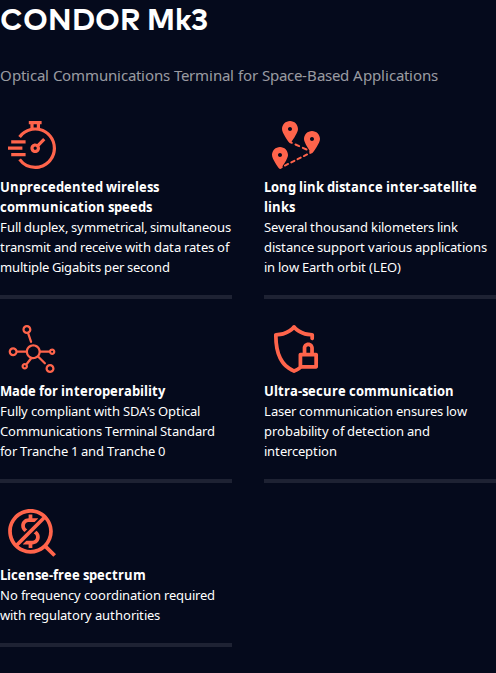
The CONDOR Mk3 is Mynaric's primary space terminal, and its SDA OCT Standard T0/T1 compliance is the specification that matters most for US government programme procurement — it is a hard requirement for participation in the Proliferated Warfighter Space Architecture (PWSA).
| Parameter | Value |
|---|---|
| Data Rate | 0.313 to 2.5 Gbps (SDA OCT T0/T1 compliant); 10 Gbps OOK and 100 Gbps DP-QPSK options also available |
| Link Distance | > 6,500 km (SDA OCT T0/T1 compliant) |
| Aperture Diameter | 80 mm (single Tx/Rx aperture, diffraction limited) |
| Operational Wavelength | 1553.33 / 1536.61 nm band (separate Tx and Rx bands) |
| Optical Tx Power | 4 W at end of life |
| Design Lifetime | 5 years in LEO |
Key published specifications for the Mynaric CONDOR Mk3, drawn from Mynaric's own product page and datasheet.
The 10 Gbps OOK option and 100 Gbps DP-QPSK option extend the platform's reach beyond the baseline SDA data rate, giving programme planners headroom for higher-throughput mission architectures without switching terminal families.
Programme Wins and Delivery Milestones
Mynaric's deployment credibility in the SDA PWSA programme is among the strongest of any independent terminal manufacturer on the market.
- SDA Tranche 1 — first complete launch set: Mynaric delivered the first complete launch set of CONDOR Mk3 terminals to a prime customer for SDA Tranche 1 of the Proliferated Warfighter Space Architecture, as announced in June 2025.
- Raytheon — SDA Tranche 1 Tracking Layer: Mynaric was selected to supply 21 CONDOR Mk3 terminals to Raytheon Technologies for the SDA Tranche 1 Tracking Layer programme, a seven-vehicle satellite constellation.
- Loft Federal — SDA NExT Experimental Testbed: Mynaric received an order from Loft Federal (a Loft Orbital subsidiary) for CONDOR Mk3 terminals to support NExT, the SDA's Experimental Testbed constellation of ten satellites.
- Rocket Lab — SDA Tranche 2 Transport Layer Beta: Mynaric was selected by Rocket Lab to supply optical communications terminals for the SDA Tranche 2 Transport Layer Beta programme, confirmed by Mynaric's own news release and SpaceNews in May 2024.
- Northrop Grumman — multi-year strategic supplier agreement: Mynaric signed a multi-year strategic agreement with Northrop Grumman identifying it as a preferred laser communications supplier, followed by CONDOR Mk3 delivery contracts for both SDA Tranche 1 and Tranche 2 Transport Layer programmes.
As of June 2025, Mynaric reported delivering more than 100 CONDOR Mk3 terminals to customers, with more than 150 optical heads produced through its serial production line.
HAWK Airborne Terminal
The HAWK is Mynaric's optical communications terminal for airborne and terrestrial applications, covering air-to-air, air-to-ground, and ground-to-ground links at 7 Gbps full-duplex (variable from 1 to 9 Gbps).
Rated link distances are 50 km for air-to-air, 30 km for air-to-ground, and 12 km for ground-to-ground operations, with airborne figures measured at 12 km altitude in clear sky conditions — covering ISR missions, unmanned aerial systems, and ground-vehicle connectivity.
Manufacturing Posture and Roadmap
Mynaric operates a dedicated serial production facility near Munich, purpose-built for constellation-scale output rather than prototype or low-rate production.
The next-generation CONDOR Mk3.1 is in development, targeting SDA Tranche 2 and commercial constellation programmes, with a focus on higher data rates and reduced size, weight, and power compared to the current Mk3 — a roadmap signal relevant to buyers planning beyond the current tranche cycle.
Trade-offs to Factor In
Mynaric experienced supplier-related component shortages in early 2025 that delayed shipments, and its 2024 revenue forecast was significantly revised downward due to slower-than-planned production ramp and lower manufacturing yields — both reported by SpaceNews and Defense News and acknowledged in Mynaric's own public disclosures.
Production ramp risk is a real factor for programme planners: SDA's own director attributed Tranche 1 launch delays in part to Mynaric's production challenges, describing them as industrial base growing pains.
On flight heritage, Mynaric's in-orbit record is still accumulating — its CONDOR Mk3 terminals are being deployed into active constellations now, but the operational hours do not yet match the depth of Tesat's EDRS track record established in the previous entry.
4
CACI International
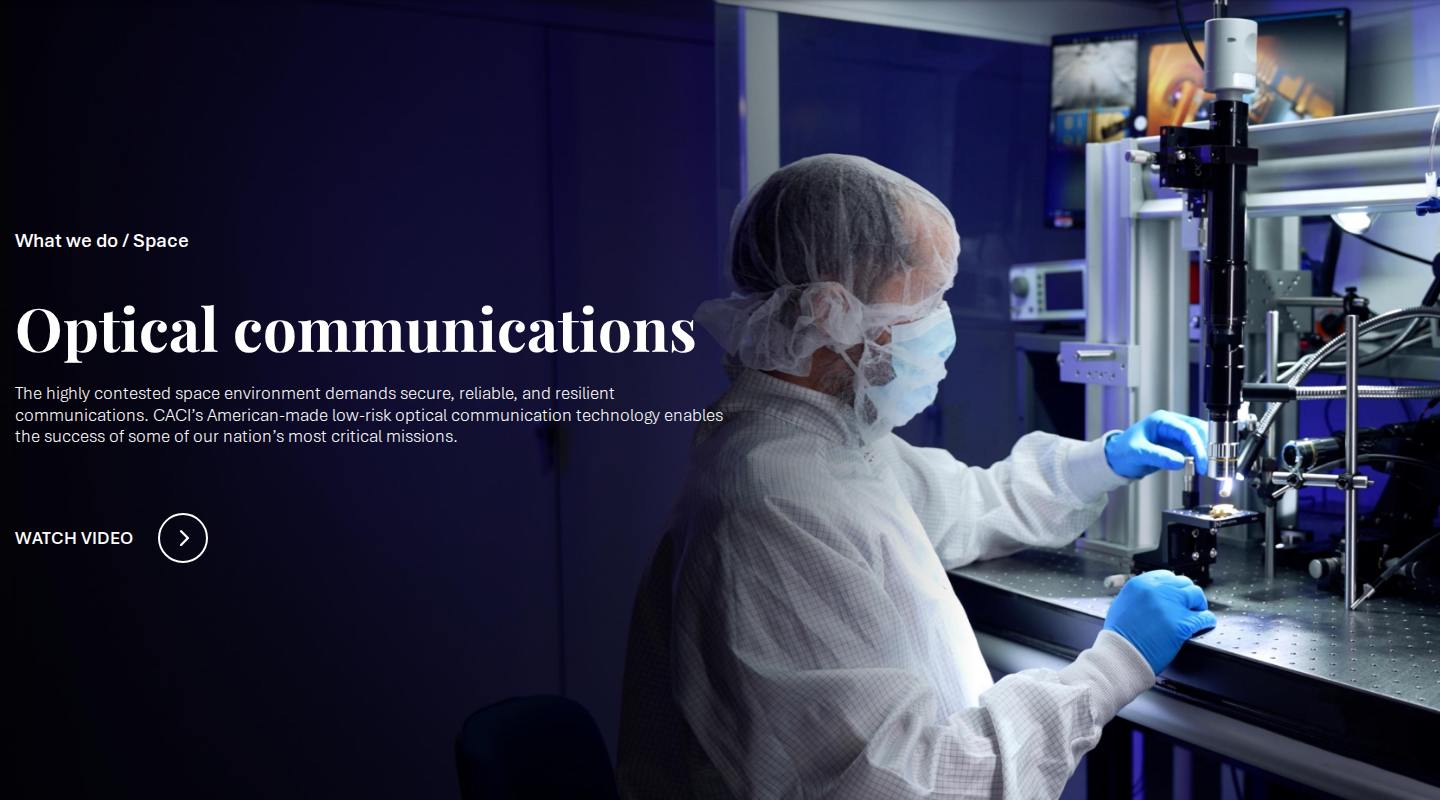
CACI is a US government-focused FSO terminal manufacturer with verified flight heritage spanning LEO, the ISS, deep space, and crewed lunar missions — the broadest orbital range of any supplier on this list.
Pros:
Broadest orbital heritage of any supplier here
50+ CrossBeam OCTs operating in LEO
Deep space and crewed lunar missions verified
EST Phase 3 signals next-generation programme investment
Cons:
Primarily oriented to US government and defence
Export-control implications for non-US buyers to investigate
Large contractor procurement processes may affect timelines
CACI International operates its optical communications business through its SA Photonics acquisition, designing and manufacturing full-system FSO terminals for US government and defence programmes — not components or subsystems.
Of the five companies profiled on this page, CACI covers the widest range of orbital regimes: LEO inter-satellite links, the International Space Station, deep space, and crewed lunar missions.
CrossBeam Terminal
CrossBeam is CACI's primary LEO optical communications terminal, built around patented all-fibre-optic transmit and receive optics and a variable data rate up to 2.5 Gbps.
The terminal carries SDA OCT compliance across Tranche 0, 1, 2, and 3 standards, and has been selected for DARPA Mandrake 2, DARPA Blackjack, and SDA Tranche 0, 1, and 2 programmes.
As of 2026, CACI reports more than 50 CrossBeam OCTs operating in LEO — a deployment scale that places it among the most widely fielded government optical terminals currently in orbit.
Deep Space and Crewed Mission Heritage
CACI's most distinctive credential is its verified optical communications heritage beyond LEO — a domain where few suppliers on any list can claim operational programmes.
- DSOC on NASA's Psyche spacecraft: CACI provided the optical communications modem and amplifiers for the Deep Space Optical Communications demonstrator. The system established the first optical link beyond the Earth-Moon system, transmitting from over 300 million miles.
- O2O on Artemis II: CACI's optical communications technology contributed to the Optical to Orion system, which delivered live HD video from the lunar vicinity during NASA's first crewed lunar flyby mission.
- ILLUMA-T on the ISS: CACI's technology supported NASA's Integrated LCRD Low Earth Orbit User Modem and Amplifier Terminal, completing the agency's first two-way, end-to-end laser relay system from the International Space Station.
These three programmes span distances from low Earth orbit to deep space, and together represent a verified operational record that is rare among FSO terminal manufacturers.
CACI Optical Terminal Product Family
Beyond CrossBeam, CACI offers two additional terminal lines oriented toward smaller satellite programmes and constrained-SWaP applications.
| Terminal | Primary Application | Data Rate | Key Characteristic |
|---|---|---|---|
| CrossBeam | LEO inter-satellite links (ISL) | Up to 2.5 Gbps | SDA OCT T0/T1/T2/T3 compliant; patented all-fibre-optic optics; 50+ in LEO |
| SkyLight | Satellite crosslink and up/downlink | – | Ultra-low SWaP FSO terminal for smaller satellite platforms |
| CICADA Ultra-Lite | Small satellite FSO communications | – | Ultra-low SWaP; 850 nm wavelength |
| CICADA Enhanced E-1G | Small satellite FSO communications | – | 1550 nm wavelength; higher throughput variant |
CACI's optical terminal product family across LEO ISL, small satellite, and constrained-SWaP applications. – indicates specifications not publicly listed by CACI for that variant.
CACI's EST programme work adds a further forward-looking dimension: the company is in Phase 3 of the US Space Force Enterprise Space Terminal programme for beyond-LEO missions, having passed critical design review and completed interoperability testing at MIT Lincoln Laboratory.
For US government procurement teams assessing long-term supplier viability, the EST Phase 3 position signals active investment in next-generation optical terminal capabilities beyond the current LEO ISL generation.
CACI's FSO terminal portfolio is primarily developed for US government and defence customers, and the company's programme history reflects that orientation throughout.
Commercial constellation operators and non-US buyers considering CACI terminals should investigate availability and applicable export-control requirements as part of their procurement process.
5.
Exail — Space-Grade Optical Components and Subsystems
Exail is a French designer and manufacturer of space-grade optical components and subsystems — modulators, amplifiers, and radiation-hardened fibres — for satellite payloads and optical ground stations, with verified TRL9 flight heritage.
Pros:
TRL9 heritage across GEO, LEO, and ISS missions
200+ LiNbO3 modulators flown across three wavelengths
TELEO 10 Gbps GEO demonstrator assembled and qualified
Selected supplier for SOLiS terabit demonstrator programme
Cons:
Components only — not a turnkey terminal supplier
Flight-model qualification adds lead time to schedules
Buyers must integrate building blocks across multiple suppliers
Exail is a French designer and manufacturer of space-grade optical components and subsystems, supplying the building blocks that go inside laser communication terminals and optical ground stations — not finished terminals itself.
Its products serve satellite payloads across GEO, MEO, and LEO orbits, as well as ground-based optical stations, covering the full link from space segment to ground reception.
Exail has been involved in more than 20 space projects, supplying over 200 LiNbO3 modulators for flying missions across three wavelengths. More than 1,000 km of space-qualified fibre is currently in orbit, with TRL9 components including radiation-hardened fibres, Fibre Bragg Gratings, MUX/DEMUX assemblies, and low-noise optical amplifiers.
The TELEO GEO in-orbit demonstrator is the sharpest validation of Exail's integration depth: developed by Airbus Defence and Space in collaboration with CNES, and hosted aboard the Arabsat Badr-8 satellite, TELEO achieved 10 Gbps optical downlink and uplink.
Exail assembled and space-qualified the complete optical transceiver for TELEO — drawing on its own LNOA, radiation-hardened doped fibres, and LiNbO3 modulators — demonstrating that its component expertise extends to end-to-end subsystem integration when a programme requires it.
Looking forward, Exail has been selected to supply flying models of free-space MUX/DEMUX modules, a complete LNOA module, and single-channel optical amplifiers (LOFAs) for the SOLiS programme — a terabit-per-second space laser communications demonstrator developed by a consortium led by Thales Alenia Space on behalf of CNES, as part of France's France 2030 initiative.
SOLiS positions Exail at the component and subsystem layer of next-generation European space laser communications, reinforcing its standing as a supplier embedded in major institutional programmes.
Exail Product Portfolio
Exail's space photonics catalogue spans several product families, each available in qualification tiers suited to different programme budgets and risk profiles.
- LNOA (Low-Noise Optical Amplifier): Space-qualified fibre amplifier with greater than 40 dB gain and less than 4 dB noise figure. Available from COTS through to Flight Model versions, built on radiation-hardened doped fibres manufactured in-house.
- LiNbO3 Modulators: Amplitude, phase, and IQ variants at 850 nm, 1064 nm, and 1550 nm. Available as Engineering Model, New Space Flight Model, and Flight Model. TRL9 heritage across GEO, MEO, and LEO missions including the ISS.
- ModBox OGS: Integrated optical modulation solution for optical ground station reception and transmission front-end channels. Relevant to ground-station builders requiring a reference transceiver platform.
- Radiation-Hardened Er and Er/Yb Doped Fibres: Space-qualified doped fibres that form the gain medium for Exail's LNOA products. More than 1,000 km currently in orbit across GEO and LEO missions.
The tiered model qualification structure — Engineering, New Space Flight, and Flight Model — gives programme teams a cost-scaling path from early design validation through to flight-ready hardware, without switching suppliers mid-programme.
The structural trade-off for buyers is straightforward: Exail supplies the optical building blocks, not a complete laser communication terminal. Integrating those blocks into a finished system requires additional suppliers, system-level design work, and a clear procurement plan.
Space-grade lead times and qualification requirements for flight-model components also carry real schedule implications; programmes sourcing flight hardware from Exail should factor qualification cycles into their planning from an early stage.
Exail Pricing
Exail does not publish list pricing for its space-grade components or subsystems. Pricing is available on request directly from Exail, and will vary by product family, qualification tier, and programme volume.
Conclusion
Choosing the right laser communication company for your programme
The clearest navigational principle this landscape offers is the supply-chain layer distinction: component and subsystem suppliers enable the terminal manufacturers and integrators, and most programmes need to engage both layers, not pick one over the other.
For optical ground-station uplink specifically, where CCSDS, SDA, and proprietary standards are still settling, a software-definable amplifier is a practical risk-management decision — and WSL's EDF-UL platform is built precisely for that requirement.
Frequently Asked Questions About Laser Communication Companies
Common questions about the laser communication industry, the companies operating within it, and the technology challenges buyers and integrators encounter.
A terminal manufacturer — such as Tesat-Spacecom, Mynaric, or CACI International — delivers a complete, integrated optical communications unit ready to mount on a satellite or aircraft. A component/subsystem supplier — such as Woodrow Scientific Limited or Exail — delivers the optical building blocks (amplifiers, modulators, radiation-hardened fibres) that go inside those terminals or inside optical ground stations. Both layers are necessary, and most satellite programmes engage both. A constellation operator typically procures terminals from a terminal manufacturer for the space segment, while a ground station integrator sources subsystems — uplink amplifiers, adaptive optics, tracking hardware — from component suppliers. The two roles do not compete; they sit at different points in the same supply chain and depend on each other for a complete end-to-end system.
Five significant laser communication companies, each operating in a distinct segment or supply-chain role, are: Woodrow Scientific Limited (ground-station uplink amplifier manufacturer); Tesat-Spacecom (flight-proven GEO and LEO optical terminal manufacturer, with the deepest in-orbit heritage in the field); Mynaric (serial-manufactured LEO inter-satellite link terminals, SDA-compliant); CACI International (US government FSO terminals with verified heritage across LEO, the ISS, deep space, and crewed lunar missions); and Exail (space-grade optical components and subsystems, including modulators and amplifiers, with TRL9 flight heritage). "Top" is segment-dependent. A company that leads in GEO relay terminals occupies an entirely different part of the supply chain from one that leads in ground-station uplink amplification — they are not alternatives to each other. The right frame is programme need: which segment, which orbital regime, and which layer of the supply chain is the procurement addressing.
The principal challenges are atmospheric turbulence and cloud cover, strict line-of-sight requirements, the precision demands of pointing, acquisition, and tracking (PAT), standards fragmentation across the FSO stack, and the significant capital investment required for optical ground station infrastructure. Atmospheric turbulence degrades beam quality, and cloud cover can block ground-to-space links entirely. The industry's main responses are site diversity — operating multiple geographically separated ground stations so that at least one has a clear sky — and hybrid RF-optical architectures that fall back to radio when optical links are unavailable. PAT complexity is a serious engineering challenge. Laser beams are extremely narrow, so the pointing, acquisition, and tracking system must maintain sub-microradian precision, particularly on moving platforms such as LEO satellites and aircraft. Standards fragmentation adds interoperability risk. No single universal protocol governs the full FSO stack: SDA OCT, CCSDS, and proprietary standards coexist, and buyers who lock into a fixed-function component early can face significant integration friction when connecting across systems. Ground station infrastructure is not commodity equipment. Uplink amplifiers, telescopes, adaptive optics, and tracking systems each require specialist procurement, and the combined capital outlay is substantial for any programme building optical ground capability from scratch.