

Introduction
This guide is written for fabrication shops, plant maintenance teams, automotive refinishers, mould cleaners, and entrepreneurs evaluating a laser cleaning service business in South Africa.
Search for a laser cleaning machine in South Africa and you'll find brand product pages — but no structured comparison designed to help you actually choose. This guide fills that gap.
Every entry on this list has a confirmed route for South African buyers: a local branch, a named in-country agent or distributor, or direct worldwide supply from the manufacturer.
Each machine is evaluated on six axes: cleaning power and wattage range, portability and form factor, cooling system type, running costs and consumables, after-sales support and warranty in South Africa, and price.
This is not a technology explainer, a global roundup, or a promotional page for any single brand.
TL;DR
The South African market has verified options across a wide range of power ratings, form factors, and price points — but the right machine depends on your application, your site infrastructure, and the quality of local support behind it. This guide gives you a consistent framework to compare them honestly.
This article covers:

Six evaluation criteria applied to every machine
South Africa availability verified, not assumed
Four machines compared: power, portability, cooling, support
Running costs and total cost of ownership
After-sales support and warranty availability in South Africa
Decision guidance: matching your operation to the right
How to Evaluate a Laser Cleaning Machine in South Africa
A spec sheet will tell you wattage, weight, and cooling type. What it won't tell you is whether the machine suits your actual cleaning tasks, whether it can be deployed to a remote site without a compressed-air dryer on standby, or whether you'll wait six weeks for a spare part if something fails. In South Africa, those gaps in the spec sheet are where buying decisions go wrong — and they're exactly what these six axes are designed to surface.
Cleaning Power and Wattage: Match the Job, Not the Maximum
The instinct to buy the highest-wattage system available is understandable, but it's the wrong starting point. The right question is: what contaminant, on what substrate, over what area per shift?
| Power Tier | Typical Range | Best-Fit Applications |
|---|---|---|
| Low power | Sub-200 W | Precision cleaning, light oxidation, sensitive substrates, delicate surface prep |
| Mid-range | 200–500 W | Industrial rust removal, paint stripping, weld prep, fabrication shop use |
| High power | 500 W+ | Large-area coverage, heavy mill scale, high-throughput production cleaning |
Maps wattage tiers to practical cleaning applications, helping buyers identify the right power level for their specific tasks.
Over-speccing on wattage costs more upfront and can reduce precision on sensitive surfaces; under-speccing means inadequate throughput or incomplete contamination removal — both are costly mistakes.
The pulsed vs continuous wave (CW) distinction is also worth understanding before evaluating any machine. Pulsed fibre lasers deliver energy in controlled bursts, offering finer energy management and better protection of the base material. CW systems deliver sustained high power, which suits bulk material removal but gives the operator less control over substrate interaction. This difference becomes significant when comparing machines later in this guide.
Portability and Form Factor: Can One Operator Deploy It?
For the majority of South African buyers searching for a laser cleaning machine — field maintenance teams, fabrication shops, and entrepreneurs building a cleaning service business — portability is not a secondary consideration. It is the primary one.
The practical questions to ask: What does the system weigh fully assembled, and can a single operator load and unload it without assistance? How long is the delivery cable between the laser unit and the handheld scanner, and does it give the operator enough reach for elevated structures or confined spaces? Does the system require an on-site compressor, water supply, or compressed-air dryer?
Portable wheeled systems are self-contained and deployable across multiple sites — the right fit for most buyers researching this keyword. Fixed automated cells exist for high-volume, repetitive production cleaning, but that is a different buyer profile entirely and a different purchasing conversation.
Cooling System: Air-Cooled vs Water-Cooled
The cooling architecture of a laser cleaning machine has genuine operational consequences in South Africa, and it deserves more scrutiny than most buyers give it.
- Air-cooled systems: Self-contained, no chiller or coolant circuit required. Deployable anywhere with a single-phase power supply — no site infrastructure overhead.
- Water-cooled systems: Require an integrated or external water chiller, purified coolant, and often a refrigerated compressed-air dryer with specific dew point and pressure requirements.
In South Africa's climate — with high ambient temperatures across much of the country and variable infrastructure quality at field and industrial sites — managing a coolant circuit and compressed-air dryer adds real ongoing overhead. For multi-site deployments or remote field maintenance, that overhead compounds quickly.
This is not an argument that air-cooled is always superior. Water-cooled systems can sustain higher power output and are the right choice for certain high-power CW configurations. The honest question is: what does your site actually have, and what infrastructure overhead are you prepared to manage on an ongoing basis?
Running Costs and Consumables: The TCO Argument
The economic case for laser cleaning is not made on the purchase price — it's made on total cost of ownership over the machine's operating life. Laser cleaning uses laser light alone: no abrasive media, no chemicals, no water, no consumables to procure, store, or dispose of.
Compare that to sandblasting, which carries ongoing media costs, containment requirements, PPE, and disposal; chemical stripping, which adds chemical procurement, waste disposal, and environmental compliance costs; or water-jetting, which requires water supply and effluent management. Each of those alternatives has a recurring cost structure that laser cleaning simply does not.
A laser cleaning machine's upfront capital cost is higher than a sandblaster's — but with no media, chemicals, or disposal costs, the operating cost comparison shifts substantially over the machine's working life.
There is also a rework cost factor that rarely appears in simple cost-per-hour comparisons: because the laser stops at the base material rather than abrading it, substrate damage is minimal, which reduces the likelihood of costly rework on precision components or sensitive surfaces.
After-Sales Support and Warranty: Who Stands Behind the Machine?
This is the axis that product spec sheets never surface — and in South Africa, it may be the most consequential one. International shipping for spare parts is slow and expensive; add customs clearance, and a machine awaiting a component from Europe or North America can sit idle for weeks.
Before purchasing, buyers should establish the answers to several direct questions: Is the seller the actual manufacturer, or a distributor importing and rebadging a third-party machine? If it's a reseller, does the original manufacturer have any direct support presence? Is there a local agent or distributor who holds spare parts and can provide on-site service? What does the warranty cover, and what is the claims process if something fails in the first year?
It is worth noting, as a category-level observation, that a significant portion of laser cleaning machines on the market are imported units sold under distributor branding, with no in-house engineering capability behind them. This is not a criticism of any specific seller — it is simply a reality buyers should investigate, because the answer determines how quickly a breakdown gets resolved.
Price in ZAR: What Drives the Cost Difference?
ZAR pricing matters to South African buyers not just as a currency preference, but because import duties, freight, and exchange-rate exposure make the landed cost of an imported machine substantially different from its ex-works price. Where ZAR prices are publicly listed, buyers have a transparent starting point. For specialist industrial systems, pricing is typically quote-based.
The key cost drivers are: power level, cooling architecture (air-cooled vs water-cooled), laser technology (pulsed vs CW), and whether the seller is an in-house manufacturer or a reseller adding margin at each tier of the supply chain. Understanding which of these factors is driving a quoted price helps buyers compare options on an equivalent basis.
Consistent with the TCO framing above, the purchase price is one input into the buying decision — not the whole picture. A competitively priced machine with poor local support and high consumable infrastructure overhead may cost considerably more over three years than a higher-priced system with zero consumables and a local service agent.
With that framework in place, here are four laser cleaning machines available to buyers in South Africa, each evaluated against these six axes.
Product 1
ELASER / ELASER-RHZ by Woodrow Scientific Limited
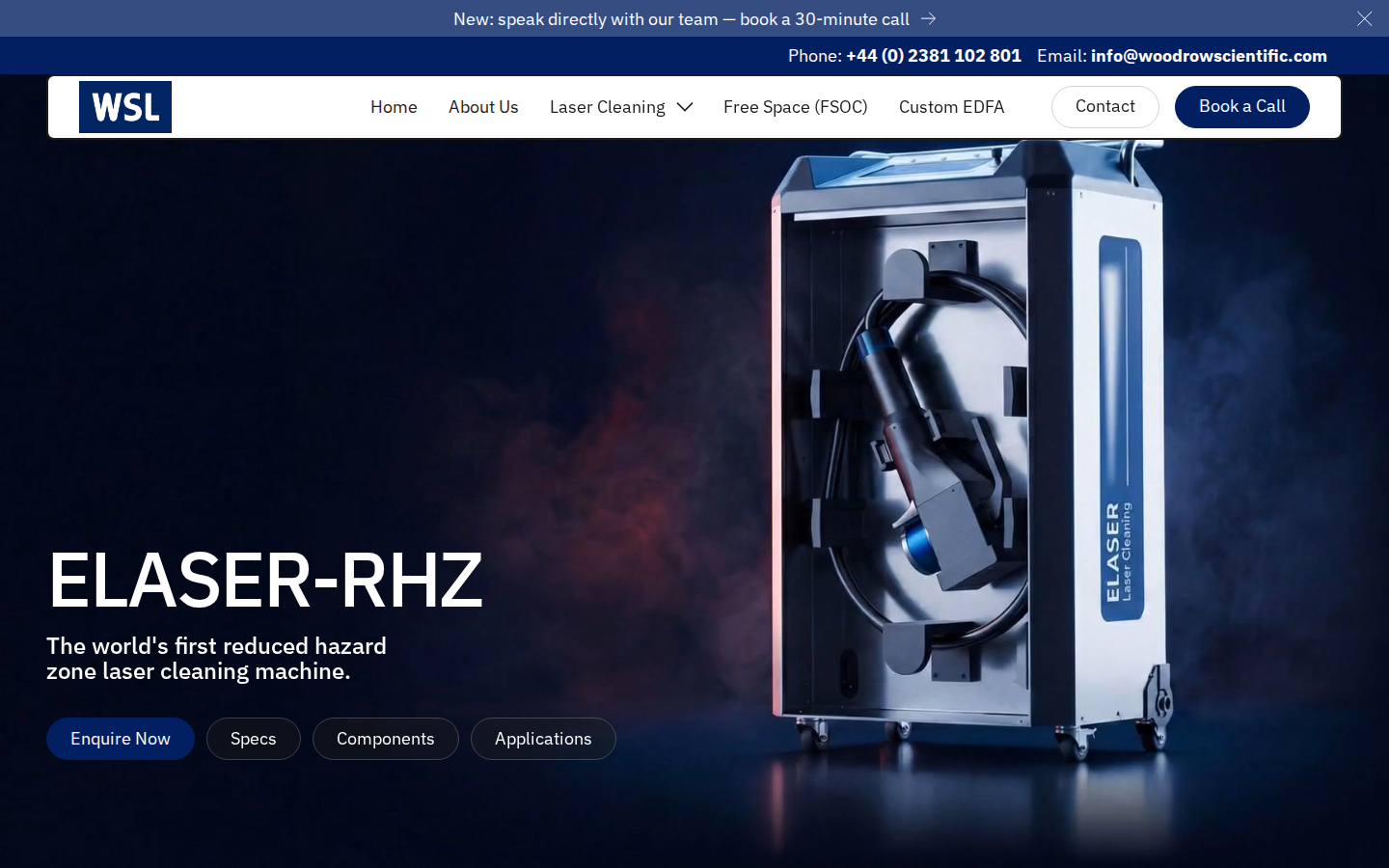
The ELASER is a self-contained, air-cooled fibre laser cleaning system from Woodrow Scientific Limited — the only UK-based laser cleaning manufacturer — delivering up to 300 W of tunable power through a sub-3 kg handheld scanner on a 50 m delivery cable. It ships worldwide with a typical one-week lead time and suits industrial buyers who need a portable, single-operator system for rust removal, weld prep, mould cleaning, paint stripping, and heritage restoration. The ELASER-RHZ variant adds WSL's patented, world-first reduced hazard zone technology, enabling cleaning in open workshops and public-facing settings without sealing off the area — a capability no other laser cleaning system in the world offers.
Pros:

World-first patented reduced hazard zone technology
Air-cooled — no chiller or infrastructure needed
Sub-3 kg scanner with 50 m cable reach
In-house UK manufacturer with direct support
Cons:

No published ZAR price — contact for quote
Shipped internationally — not locally stocked
Best for: Industrial and professional buyers who need a self-contained, single-operator laser cleaning system deployable across multiple sites or applications — rust removal, weld prep, mould cleaning, paint stripping, and heritage restoration.
The ELASER covers the full spectrum of industrial surface cleaning tasks from a single wheeled unit, without requiring any supporting infrastructure on site.
ELASER-RHZ: World-First Reduced Hazard Zone Technology
WSL's patented ELASER-RHZ collapses the laser hazard zone to a fraction of conventional size — enabling cleaning in open workshops, mixed-use facilities, and public-facing spaces without sealing off the area. No other laser cleaning system anywhere offers this capability.
Conventional laser cleaning requires areas to be sealed off and evacuated before work begins — a significant operational overhead that rules it out for many environments.
The ELASER-RHZ removes that barrier entirely. Applications that were previously impractical for laser cleaning — graffiti removal in public spaces, heritage and monument restoration on accessible sites, cleaning in open-plan manufacturing facilities — become straightforward.
All ELASER models are Class 4 laser products; the ELASER-RHZ adds advanced engineering controls that make access to any radiation above Class 1 impossible. Both variants are CE and UKCA certified.
Cleaning Power: 300 W Tunable Fibre Laser
The ELASER delivers up to 300 W of fibre laser output, tunable from 0 to 100%, through a 1550 nm wavelength beam.
In practice, that power range spans light surface oxides and tarnish at the low end through to thick paint coatings, mill scale, and heavy rust on steel, aluminium, cast iron, and masonry at the high end — one machine, one operator, one pass.
- Rust and oxides: Removes surface rust and mill scale from steel and other metals without abrasives or media.
- Paint and coatings: Strips paint, powder coating, primer, and lacquer cleanly, with minimal substrate loss.
- Mould and tooling residue: Cleans injection moulds and tooling in place — no disassembly, no abrasive wear.
- Stone, brick, and masonry: Lifts soiling, carbon deposits, and coatings from heritage stonework and concrete surfaces.
- Weld prep and post-weld cleaning: Removes weld discolouration, oxides, and surface contamination for consistent weld quality.
Because the beam stops at the base material, substrate loss is minimal — which directly reduces rework costs compared with abrasive methods.
Portability: 50 m Reach, One Operator
The ELASER is a wheeled system under 50 kg, with a handheld scanner weighing under 3 kg and a delivery cable of up to 50 m — a reach that is a genuine standout figure in this product category.
For South African buyers operating across large facilities, multiple production areas, or remote field sites, that 50 m tether means the main unit stays in one place while the operator moves freely around the work.
No compressor, no water supply, no consumable media — the system is entirely self-contained on single-phase power (110–250 VAC), drawing under 2000 W.
Cooling: Fully Air-Cooled
The ELASER is fully air-cooled — there is no water chiller, no coolant circuit, and no compressed-air dryer to provision, plumb in, or maintain.
In South Africa's varied field and workshop environments, where reliable utilities and infrastructure cannot always be assumed, this is a concrete operational advantage: the machine works wherever single-phase power is available.
| Specification | ELASER / ELASER-RHZ |
|---|---|
| Max output power | Up to 300 W |
| Power tunability | 0–100% |
| Wavelength | 1550 nm |
| Laser class | Class 4 (all models); RHZ controls prevent access to radiation above Class 1 |
| Scanner weight | Under 3 kg |
| System weight | Under 50 kg (wheeled) |
| Delivery cable | Up to 50 m (5 m / 15 m standard) |
| Cooling | Air-cooled — no chiller required |
| Power supply | 110–250 VAC single-phase |
| Power consumption | Under 2000 W |
| Certifications | CE and UKCA certified |
| Manufacture | Made in Britain |
| Lead time | Typically one week from order |
| Pricing | Contact for quote |
A structured spec overview lets buyers quickly verify the ELASER against their requirements without hunting through prose.
Standard delivery cables are 5 m and 15 m; the up-to-50 m option is available for buyers who need extended reach across large work areas.
Running Costs and TCO
The ELASER cleans with laser light alone — no abrasive media, no chemicals, no water.
That zero-consumable architecture changes the total cost of ownership calculation significantly: there is no media procurement, no changeover downtime, no chemical disposal overhead, and no substrate damage that generates rework.
Compared with sandblasting, chemical stripping, or water-jetting, laser cleaning's TCO advantage compounds over time — even though the upfront investment in a laser system is higher than those methods.
Made and Supported in Britain
Woodrow Scientific Limited, founded in 2012, is the only UK-based laser cleaning manufacturer — it designs, builds, supports, and improves every machine in-house, drawing on 200+ years of combined engineering experience.
That matters for buyers in South Africa: when a question arises or a component needs attention, WSL's response comes from the engineers who built the machine, not from a reseller relaying queries to an overseas OEM.
It is worth noting that a significant portion of the laser cleaning market consists of importers and resellers rebadging third-party machines — a distinction that becomes apparent the moment a buyer needs genuine engineering support or a product improvement.
Worldwide shipping is available with a typical lead time of one week from order. First-class safety and operation training is provided by WSL — contact WSL directly for details. Bespoke engineering and customisation capability is also available; get in touch to discuss specific requirements.
ELASER Pricing
Pricing is available on request. The ELASER is the European cost leader among comparable industrial laser cleaning machines — competitive pricing achieved through WSL's technological and operational efficiencies, not by reducing build quality.
South African buyers should contact WSL directly for a quote; no ZAR list price is published, but worldwide shipping and a one-week lead time mean the machine is genuinely accessible to buyers in this market.
For buyers with high-volume, repetitive production cleaning needs who find the handheld format insufficient, WSL also offers AutoLASE — an automated robotic cleaning system with 3D machine-vision and an optional RHZ upgrade for enclosure-free operation. See the decision guidance section below for more on when AutoLASE is the better fit.
See the ELASER Specs in Full Detail
The ELASER is a self-contained, air-cooled system built for single-operator use across multiple sites. Visit the product page to review full specifications and capabilities.
Product 2
AM.CO.ZA RustOff / LaserMaster
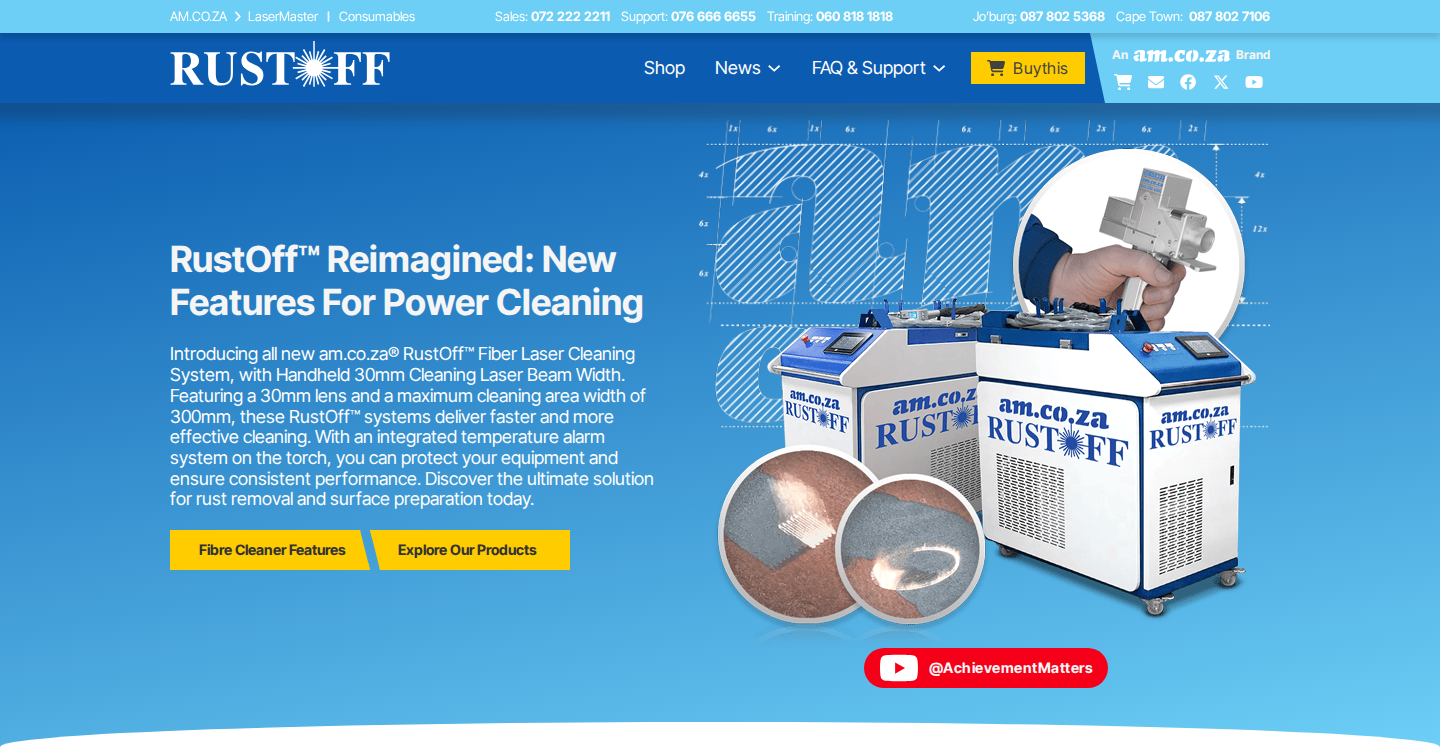
AM.CO.ZA's RustOff and LaserMaster ranges are water-cooled CW fibre laser cleaning systems sold from physical South African branches at published ZAR prices, suited to rust removal, paint stripping, and mill scale removal in steel fabrication and industrial maintenance — with power options from 1000 W to 3000 W.
Pros:
In-country stock and physical SA branches
Published ZAR pricing — no quote required
Power range from 1000 W to 3000 W
WhatsApp support and on-site call-out service
Cons:
Water-cooled — chiller and compressed air required
CW architecture — less precise than pulsed systems
Retailer/distributor, not in-house manufacturer
Bulkier than air-cooled alternatives
AM.CO.ZA sells its RustOff and LaserMaster laser cleaning ranges from stock in South Africa, with published ZAR pricing and physical branches in Gauteng, Cape Town, and Durban.
Cleaning Power
The RustOff and LaserMaster ranges are built around Raycus CW (continuous wave) fibre laser sources, available at 1000 W, 1500 W, 2000 W, and 3000 W output levels — all with a 1% to 100% adjustable power range and a rated laser lifespan of 10 years.
CW architecture delivers high cleaning throughput on metals: rust removal, paint stripping, oil and mill scale removal, and weld preparation on steel are the primary use cases, and this is exactly where the range performs well.
The trade-off is precision. CW systems clean fast but offer less selectivity than pulsed architectures, which means they are better suited to robust industrial metalwork than to delicate substrates or precision components where substrate damage is a concern.
Form Factor and Portability
Both ranges use a handheld torch connected to a wheeled unit housing the laser source and integrated water chiller. The 1.5 kg torch head keeps the operator's hand light, but the wheeled unit itself is substantially heavier than air-cooled alternatives due to the built-in chiller.
The RustOff LR-1500 ships with an 8-metre fibre cable between the machine unit and the cleaning head; the LaserMaster Versatile and higher-spec Dedicated models carry a 20-metre torch lead, giving operators meaningful reach around a workpiece or within a workshop bay.
This form factor works well for fixed-site or workshop use. For buyers who need to move between remote sites or work in confined spaces, the chiller bulk is a practical consideration worth factoring into the decision.
Cooling and Infrastructure Requirements
Every model in the RustOff and LaserMaster ranges uses a 4250 W temperature-controlled water chiller integrated into the machine unit, maintaining coolant at 25°C out and 28°C in. Purified water is required as coolant — approximately 10 litres per fill — with a full water exchange recommended monthly.
Lens protection requires compressed air with a refrigerated air dryer: 40 L/m flow rate, dew point below 3°C, at 4 bar pressure. The vendor notes that bottled compressed air or nitrogen cylinders can substitute for a compressor where fixed air supply is unavailable.
For South African buyers operating on remote sites or in locations with variable infrastructure, these site requirements represent a genuine overhead. Buyers should assess compressed air supply and water quality management before purchase — these are not optional extras, they are operational prerequisites.
Running Costs
Like all laser cleaning systems, the RustOff and LaserMaster ranges require no consumable cleaning media — no chemicals, no abrasive blasting material, and no post-clean wash-and-dry cycle. The vendor notes that surfaces are welding-ready immediately after cleaning.
The ongoing cost consideration is chiller maintenance: monthly coolant replacement and the infrastructure overhead of compressed air supply add to total cost of ownership in a way that air-cooled systems do not.
RustOff vs LaserMaster: Two Product Lines
AM.CO.ZA sells laser cleaning machines across two distinct product lines. RustOff is the dedicated cleaning-only sub-brand — focused purely on rust removal, paint stripping, and surface preparation. LaserMaster is the broader brand, which includes the Dedicated cleaning systems (sold as RustOff) and the Versatile range — a 3-in-1 system capable of cleaning, welding, and cutting from the same machine unit.
The RustOff Dedicated range is cleaning-only. The LaserMaster Versatile range adds laser welding and cutting on the same machine unit, though its cleaning function uses a single-lens system rather than the dual-galvo scan head on the Dedicated models.
RustOff / LaserMaster Pricing
Published ZAR pricing is one of AM.CO.ZA's clearest differentiators in this market — most international suppliers require a quote. The figures below are indicative anchors drawn from the vendor's product pages at the time of research; prices are exchange-rate-linked and updated regularly. Verify current pricing at rustoff.co.za and lasermaster.co.za before purchasing.
| Model | Power | Type | Price (incl. VAT) |
|---|---|---|---|
| LR-1500 (RustOff) | 1500 W | Dedicated cleaning | R97,999 |
| LR-PORTABLE/1500 (LaserMaster Dedicated) | 1500 W | Dedicated cleaning | R126,059 |
| LR-2000 (RustOff) | 2000 W | Dedicated cleaning | R179,999 |
| LM-VERSATILE/2000 (LaserMaster Versatile) | 2000 W | 3-in-1 clean/weld/cut | R149,289 |
| LM-VERSATILE/3000 (LaserMaster Versatile) | 3000 W | 3-in-1 clean/weld/cut | R221,289 |
Presents published ZAR pricing across the RustOff and LaserMaster range so buyers can compare power tiers and product lines at a glance — a rare advantage in this category where most competitors require a quote.
The price difference between the RustOff LR-1500 and the LaserMaster Dedicated LR-PORTABLE/1500 at the same wattage reflects the upgraded control system and dual-galvo scan head on the Dedicated platform. Buyers focused purely on cleaning throughput should compare both carefully.
South African Support
AM.CO.ZA operates physical showrooms in Germiston (Gauteng HQ), Montague Gardens (Cape Town), and Springfield Park (Durban), open Monday to Friday 07:30–16:00 and Saturday mornings. Buyers can visit for a demonstration, machine inspection, or bring-in service.
Remote support is available via WhatsApp (sales: 060 600 6000; technical support: 060 600 7000), and on-site call-out service is offered for buyers who cannot bring equipment to the warehouse — a call-out fee applies, and call-outs must be pre-arranged.
AM.CO.ZA provides a 1-year quality warranty on machinery sold, with life-time bring-in service available after the warranty period. Warranty terms vary by component — buyers should confirm current warranty coverage for their specific model at time of purchase.
As a machinery retailer and distributor — not an in-house laser manufacturer — AM.CO.ZA's support depth is locally strong, but the engineering capability for product-level improvement differs from that of a dedicated laser cleaning manufacturer. The Raycus laser sources used across the range are well-established industrial components, and local support availability is a genuine strength for South African buyers who need responsive after-sales service. This is a legitimate buying consideration to weigh, not a disqualifying flaw.
Product 3
Laserax handheld laser cleaning system
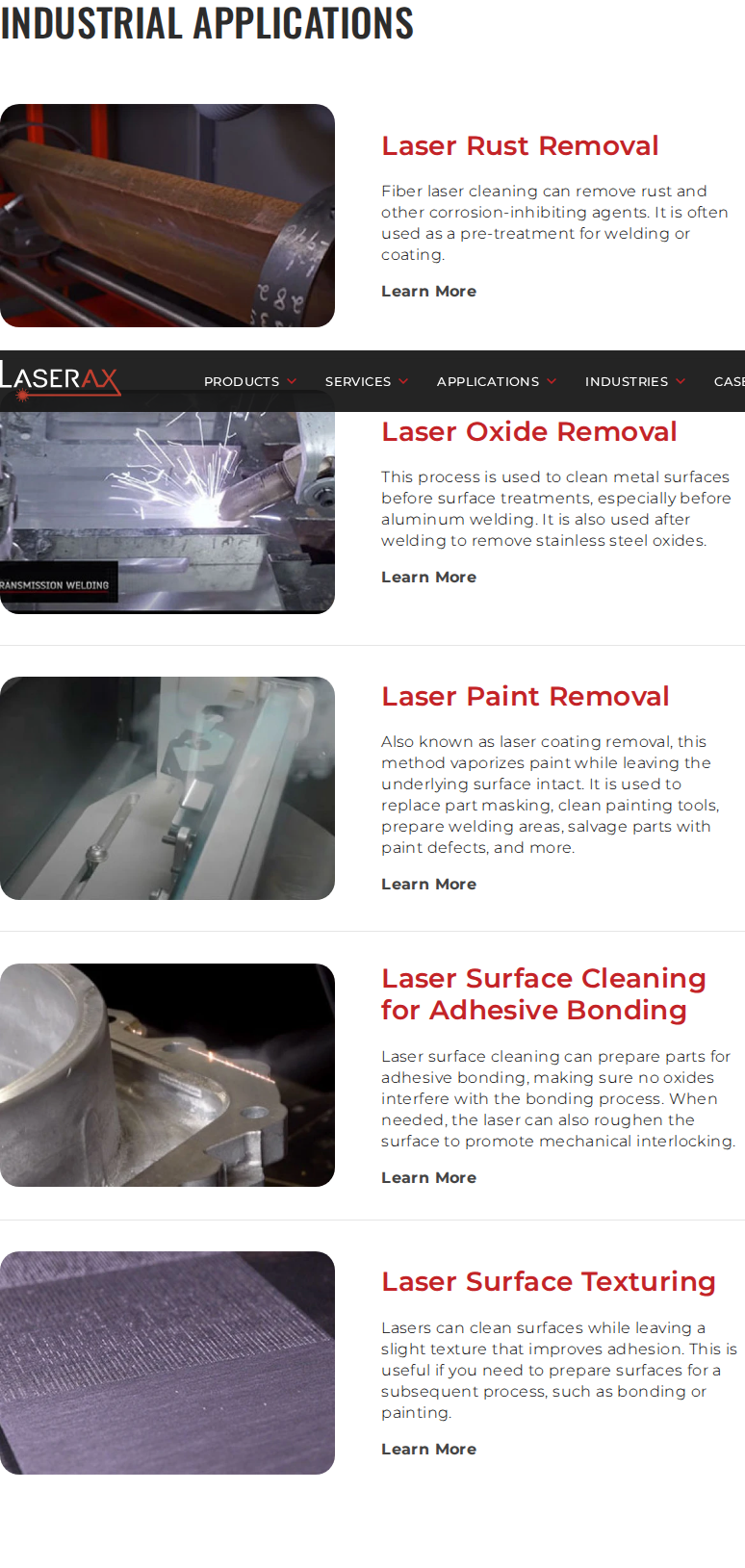
Laserax is a Canadian laser cleaning specialist with a verified South African distributor (GNV Entreprises, Richards Bay area), offering a pulsed fibre handheld cleaning station in 100 W, 200 W, and 300 W configurations for industrial applications including rust removal, weld prep, and mould cleaning.
Pros:
Verified SA distributor — GNV Entreprises, Richards Bay
Dedicated laser cleaning manufacturer, not a reseller
Pulsed fibre laser — no consumables required
24/7 worldwide manufacturer support available
Cons:
Handheld is secondary to automation product focus
Pricing not publicly listed — quote required
Trolley form factor — not for field deployment
Laserax is a Canadian laser cleaning manufacturer with a named South African distributor and a handheld cleaning station in three power levels.
Laserax qualifies for this list through a verifiable route: the manufacturer's own contact page lists GNV Entreprises (Richards Bay area) as its South African distributor, with a dedicated local contact at southafrica@laserax.com.
Cleaning Power and Applications
The Laserax hand-held laser cleaning machine is a Class 4 pulsed fibre laser available in 100 W, 200 W, and 300 W configurations, with six cleaning modes selectable directly from the hand-held head.
Confirmed applications include rust removal, oxide removal, paint stripping, weld prep, and mould cleaning — across aluminium, zinc, magnesium, steel, and iron substrates.
Six-Axis Evaluation
| Axis | Laserax Handheld — Assessment |
|---|---|
| Cleaning power | 100 W, 200 W, 300 W pulsed fibre laser; 6 selectable cleaning modes; Class 4 |
| Portability | Trolley-mounted with hand-held head; suited to workshop and line-side use, not multi-site field deployment |
| Cooling | Air-cooled across all power levels; 100 W requires 120 V / 15 A; 200 W and 300 W require 240 V / 20 A — confirm infrastructure with distributor before purchase |
| Running costs | Pulsed fibre laser — no abrasive media, no chemicals, no consumable changeover; low ongoing operating costs |
| After-sales support | Two layers: GNV Entreprises (Richards Bay area) locally; Laserax 24/7 worldwide manufacturer support |
| Pricing | Not publicly listed — contact GNV Entreprises or southafrica@laserax.com for ZAR pricing |
Presents all six declared evaluation axes for Laserax in a scannable format, consistent with the structured comparison approach used across sibling entries.
The trolley form factor — a wheeled unit supporting the hand-held cleaning head — is well suited to fixed workshop bays and production-line environments, but is less suited to operators who need to move between multiple remote sites without infrastructure.
On running costs, the pulsed fibre architecture means no abrasive media to replenish, no chemical consumables, and no downtime for consumable changeover — the total cost of ownership case is straightforward for high-frequency industrial use.
After-Sales Support in South Africa
Support works at two levels: GNV Entreprises provides local distributor presence in the Richards Bay area, while Laserax's own after-sales team is available 24/7 worldwide by phone and email.
Laserax is a dedicated laser cleaning specialist — not a general machinery retailer — which means its support team has deep domain knowledge specific to laser cleaning applications and industrial integration.
Laserax Pricing
Pricing is not publicly listed for the South African market. Contact GNV Entreprises directly or reach Laserax at southafrica@laserax.com for local ZAR pricing and availability.
Honest Trade-Off
Laserax's primary focus is fully integrated inline and robotic laser cleaning systems for production environments — the handheld station is a secondary part of its product range, not its flagship offering.
The handheld station is a secondary product beside Laserax's inline and robotic systems, and both are sold through the same local distributor.
Product 4
4JET JETLASER
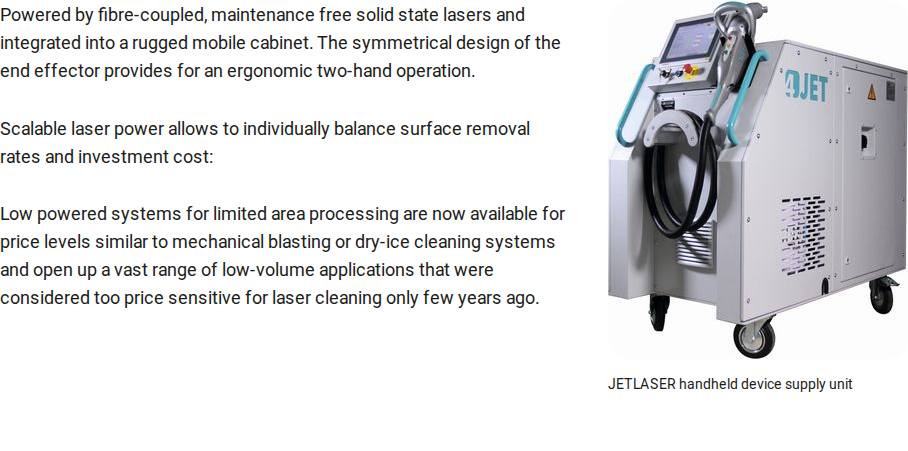
The 4JET JETLASER is a German-engineered fibre laser cleaning system with an application background in tyre mould cleaning, automotive parts cleaning, and mould maintenance — available in South Africa through LuMec Engineering Services (Port Elizabeth), confirmed sole agent for 4JET Technologies, which gives buyers a local point of contact for procurement and support.
Pros:
Specialist tyre, automotive, and mould cleaning pedigree
Verified sole agent in South Africa (LuMec)
Available in 200 W and 500 W configurations
Dry process — no consumables or chemicals
Cons:
Conventional laser hazard zone — area control required
200 W model: only 3 m cable reach
Three-phase power supply required (380–480 V)
4JET Technologies is a German laser system specialist with deep application roots in the tyre and automotive industries. In South Africa, the JETLASER is available exclusively through LuMec Engineering Services (Port Elizabeth), whose sole agency for 4JET is confirmed via lumeces.co.za — making LuMec the first point of contact for local buyers on pricing, availability, and support.
4JET JETLASER Cleaning Power
The JETLASER is available in 200 W and 500 W configurations, using a fibre-coupled, maintenance-free solid-state laser classified as Class 4.
Core applications include tyre-mould cleaning, rust and oxide removal, paint and coating removal, and surface preparation for welding and bonding.
| Application | Indicative Rate (200 W model) |
|---|---|
| Paint removal | 5–7 cm²/sec |
| Rust removal | 8–10 cm²/sec |
| Mould cleaning | 4–5 cm²/sec |
Presents indicative cleaning rates from 4JET product data for the 200 W model in a scannable format, allowing buyers to assess throughput against their specific application before contacting LuMec.
These are indicative rates published in 4JET's product data for the 200 W model and should be treated as planning benchmarks, not guaranteed throughput figures. Rates for the 500 W model are not separately published in available source material.
Portability and Reach
The JETLASER uses a rugged mobile cabinet with a handheld cleaning device connected via fibre cable — a practical form factor for plant-floor deployment.
Standard cable length varies by model: 3 m on the 200 W and 15 m on the 500 W. Buyers who need to reach large workpieces or work across a wide area should factor this into their configuration choice, particularly when considering the 200 W model.
The system also supports robot and cobot integration, which is relevant for automated tyre-mould cleaning workflows where consistent, repeatable passes are required.
4JET JETLASER Site Requirements
The JETLASER requires a three-phase power supply (380–480 V, 50–60 Hz) with a maximum power consumption of 7.7 kW.
This is the primary infrastructure consideration for this system. Buyers should confirm their site's electrical supply with LuMec Engineering Services before purchase — a practical planning step, particularly for smaller workshops or facilities without existing three-phase infrastructure.
Running Costs
The JETLASER operates as a fully dry, chemical-free process with no consumables — no abrasive media, no solvents, and no blasting dust to manage or dispose of.
For tyre-mould and automotive applications where process cleanliness and repeatability matter, the absence of consumable costs and contamination risk is a meaningful operational advantage.
4JET JETLASER Pricing
Pricing is not publicly listed in ZAR. Contact LuMec Engineering Services in Port Elizabeth directly for local pricing and availability.
The 4JET JETLASER comes from a tyre and automotive application background and is sold in South Africa through a confirmed sole agent, LuMec Engineering Services in Port Elizabeth. Trade-offs to weigh: a conventional laser hazard zone (standard area control required), the 200 W model's 3 m cable reach, and the three-phase power requirement.
Not Sure Which Machine Fits Your Operation?
You have reviewed four machines across a wide range of power ratings and support arrangements. Book a call to talk through which option suits your application and South African site requirements.
Conclusion
Which laser cleaning machine suits your South African operation?
There is no single best laser cleaning machine for South Africa — there is the right one for your situation, whether that is a portable, single-operator system deployable across multiple sites or a high-volume production setup where consistency and throughput matter most.
For high-volume, repetitive production cleaning, AutoLASE by Woodrow Scientific Limited takes a different approach: load the part, and the 3D machine-vision system generates the clean automatically — no programming, no path-setting — with an optional RHZ upgrade for enclosure-free operation.
If either profile fits your operation, Woodrow Scientific Limited is worth contacting to discuss which system is right for you.
Laser cleaning machines in South Africa: FAQs
Buying, safety, and practical use questions answered for South African buyers comparing laser cleaning machines.
Yes — laser cleaning is well-established industrial science, not marketing. The core mechanism is laser ablation: pulsed laser energy vaporises surface contaminants while the beam's interaction with the base material is calibrated to stop at the substrate interface, leaving the underlying surface intact. The technology has over 20 years of proven deployment across automotive, aerospace, mould cleaning, and heritage restoration. One realistic expectation to set: wattage affects cleaning speed, not cleaning quality. A 100 W system and a 300 W system both clean effectively — the 300 W simply covers ground faster. The result (clean substrate, intact base material) is the same across power levels when parameters are correctly matched to the application.
There are four verified options for sourcing a laser cleaning machine in South Africa. AM.CO.ZA / RustOff has physical branches in Gauteng and Cape Town, published ZAR pricing, and in-country stock. Laserax is available through its confirmed South African distributor, GNV Entreprises (Richards Bay area) — contact southafrica@laserax.com. 4JET JETLASER is available exclusively through LuMec Engineering Services in Port Elizabeth, confirmed sole agent. ELASER / ELASER-RHZ by Woodrow Scientific Limited ships worldwide with a typical lead time of one week — contact WSL directly.
Entry-level CW fibre laser cleaners from local South African retailers (AM.CO.ZA / RustOff) start from approximately R98,000–R126,000 incl. VAT for 1500 W water-cooled systems, and approximately R180,000–R218,000 incl. VAT for 2000 W models. These prices are exchange-rate-linked and updated regularly — verify current figures at rustoff.co.za and lasermaster.co.za. Industrial-grade pulsed systems from specialist manufacturers (ELASER, Laserax, 4JET) are quote-based with no public ZAR pricing. On total cost of ownership, laser cleaning has zero consumables — no abrasive media, no chemicals, no coolant for air-cooled systems — plus reduced downtime and minimal substrate damage that cuts rework costs. In the right application, the economics strongly favour laser cleaning over alternatives even where the upfront investment is higher.
Air-cooled systems require no chiller, no coolant circuit, no refrigerated air dryer, and no coolant management overhead — plug in and operate. Water-cooled systems can sustain higher continuous power output but add real site requirements: a temperature-controlled chiller, purified water coolant, and compressed air with a refrigerated dryer are all prerequisites for the water-cooled machines sold by local SA retailers. In the South African context — where multi-site field deployment is common, infrastructure reliability varies, and maintenance overhead matters — air-cooled systems are generally the more practical choice for portable and mobile use. Water-cooled systems suit fixed workshop installations where the supporting infrastructure is already in place and sustained high-power output on steel is the primary task. For buyers who need a system that deploys wherever the work is, air-cooled is the operationally simpler choice.
Laser cleaning machines remove a wide range of contaminants: rust, oxides, mill scale, paint, powder coating, lacquer, primer, oil and grease, carbon and soot, mould release agents, graffiti, adhesives and residues, tarnish, and weld discolouration. Substrates include metals (steel, carbon steel, aluminium alloys, cast iron, copper, brass, bronze, titanium, galvanised), as well as stone, brick, concrete, and masonry. The practical consideration is parameter matching — wattage and pulse settings must be tuned to the specific contaminant and substrate. A higher-power system covers ground faster, but the outcome (clean surface, intact base material) is consistent across power levels when settings are correctly dialled in. The ELASER, for example, handles this full contaminant and substrate range through its tunable 0–100% power output on a single machine.
Industrial laser cleaning machines are Class 4 lasers and require appropriate safety measures — this is not a technology to operate without training or PPE. Required precautions include laser safety eyewear rated for the wavelength in use, operator training, and hazard zone management to prevent accidental exposure. That said, the ELASER-RHZ from Woodrow Scientific Limited represents a meaningful advancement: WSL's patented reduced-hazard-zone technology collapses the laser hazard zone to a fraction of conventional size, enabling cleaning in open workshops, mixed-use facilities, and public-facing settings without sealing off the area — a world-first capability. Training and PPE remain required even with the RHZ, but the dramatically smaller hazard zone unlocks applications where conventional laser cleaning is simply impractical. WSL provides first-class safety and operation training — get in touch directly for details. Whichever machine you purchase, ensure the supplier provides proper safety training as part of the package.