

Introduction
Laser cleaning machines are industrial fibre laser systems that remove rust, paint, oxides, and other surface contaminants by ablation — no chemicals, no abrasives, no water.
Every entry on this list has verified NZ availability: not a "ships worldwide" footnote, but a confirmed path to purchase for New Zealand buyers.
That filter is why the list is short — and why it's worth reading if you're an industrial maintenance professional, manufacturer, or surface-prep contractor making a real buying decision.
Each entry is assessed on five axes: power range and tunability, portability and form factor, cooling method, eye-safety and laser hazard zone, and NZ support and availability route.
TL;DR
Genuine NZ availability is rarer than global product pages suggest. Of the machines that can actually be purchased and supported in New Zealand, the differences that matter most — power, portability, cooling, eye-safety, and local support — are rarely addressed together.
Knowing which axes to evaluate, and how each machine stacks up on them, is what separates a well-matched purchase from an expensive import gamble.
This article covers:

Which laser cleaners are available in NZ
Power, portability, and cooling compared
Eye-safety and laser hazard zone considerations
NZ support routes and availability
Laser cleaning vs alternatives: TCO framing
How to Choose a Laser Cleaning Machine in NZ
Buying a laser cleaning machine in New Zealand is a different exercise from buying one in a large domestic market. Every machine is imported, lead times are real, and the support infrastructure that buyers in Europe or North America take for granted often does not exist here in the same form. The criteria that matter most are not always the ones that get the most attention in product listings.
Power Range: Match Your Worst-Case Application
Wattage is the primary driver of what a machine can tackle — and at what speed. Lower-end systems in the 100–200 W range suit light oxide removal, mould cleaning, and surface prep on thinner coatings. Mid-range systems around 200–300 W handle paint stripping and heavier rust removal at practical production rates. High-power systems at 500 W and above are suited to high-volume industrial stripping and thick coatings.
The key buying principle: size to your most demanding application, not your average one. A machine that handles 80% of your jobs comfortably but stalls on the remaining 20% is the wrong machine. Tunable power output — systems that let you dial from low to full power — is a practical advantage, letting one machine span light precision work and heavy industrial tasks.
Portability: Ask About Fibre Cable Reach
For NZ tradespeople and field maintenance operations, single-operator portability is often the deciding factor. Wheeled portable systems with a handheld scanner are the standard format for this work. But portability is not a binary — the fibre cable reach between the machine unit and the handheld scanner varies significantly between systems, and this matters in practice.
When cleaning large structures, vessels, or hard-to-access areas, a longer cable reach means fewer repositions of the machine and faster overall coverage. Buyers should ask specifically about fibre cable length, not just whether a system is described as portable.
Cooling Method: A Deployment Decision
Air-cooled systems require no water circuit, chiller, or external coolant infrastructure. This makes them simpler to deploy in remote or field conditions — which are common in NZ industrial and agricultural contexts. Current air-cooled systems are available up to 1,000 W, covering the majority of handheld and general production cleaning applications.
Water-cooled systems are standard at higher power levels and add infrastructure requirements that may not be practical on all NZ sites. This is a deployment consideration, not a quality hierarchy — both are legitimate choices. The right answer depends on where the machine will actually be used, not on which cooling method sounds more industrial.
Eye-Safety and the Laser Hazard Zone
This is the axis buyers most commonly underestimate. All industrial laser cleaning machines are Class IV lasers. Under OSHA and equivalent international standards, Class IV operation requires a designated laser-controlled area, exclusion of non-essential personnel, and laser-rated eye protection for everyone within the nominal hazard zone (NHZ).
In practical terms, a standard laser cleaning operation in a shared workshop or open facility requires shutting down the surrounding area — a real operational overhead, especially in smaller NZ operations where workspace is shared. This affects scheduling, throughput, and where the machine can realistically be deployed.
Systems with reduced-hazard-zone technology collapse the NHZ to a small area around the work surface, enabling cleaning in open workshops and mixed-use facilities without sealing off the area. Buyers who overlook this axis often find their machine is harder to deploy than expected.
This is a meaningful operational difference — not a safety marketing claim. It determines whether a machine can be used in a live facility or only in a dedicated, cleared zone.
NZ Availability, Support, and Total Cost
New Zealand's geographic isolation is a documented reality for import-dependent markets. When evaluating any laser cleaning machine for NZ use, buyers should assess not just the machine but the support route: is there a named local distributor, or is support handled remotely from the manufacturer? What are realistic spare parts lead times? What does warranty coverage look like for an imported machine?
Vague claims of "global representation" or "ships worldwide" are not the same as a confirmed, verifiable NZ distribution or support route. Ask specific questions before committing — a machine that sits idle waiting for a part is a cost, not just an inconvenience.
On cost: laser cleaning machines are capital equipment, and in the NZ market, import freight, customs duties, and GST apply on top of the machine price. The right evaluation lens is total cost of ownership, not sticker price. Laser cleaning has no consumables — no media, no chemicals, no abrasives — and very low running costs. For operations running regular cleaning cycles, the TCO case is strong even where the upfront price is higher than alternatives.
Manufacturer vs Reseller: A Due-Diligence Question
Many suppliers in the laser cleaning category resell or rebadge machines sourced from third-party manufacturers. This is a category-level observation. The practical implication: a reseller typically cannot offer in-house engineering support, may have slower spare parts supply chains, and cannot genuinely improve the product over its lifetime.
Before committing, ask whether the vendor designs and builds its machines in-house. The answer shapes what after-sales support actually looks like — and in a market as geographically isolated as New Zealand, that question carries more weight than it might elsewhere.
With these criteria in hand, here is how the two verified options available to NZ buyers compare.
1.
ELASER / ELASER-RHZ — Woodrow Scientific Limited
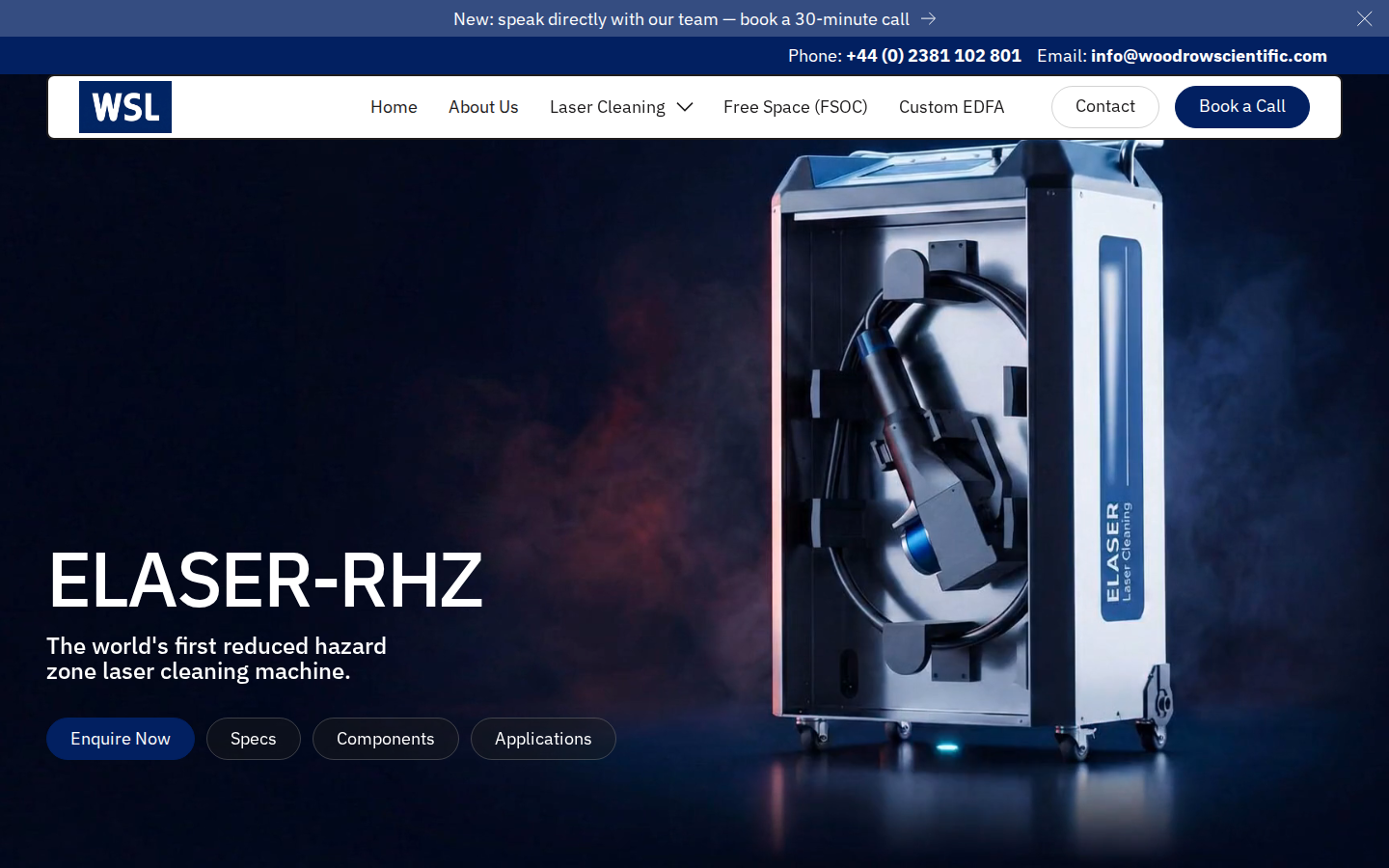
A portable, air-cooled British-made industrial fibre laser cleaner from the only UK-based laser cleaning manufacturer — available in 100 W, 200 W, and 300 W, with the world's only patented reduced-hazard-zone eye-safe technology.
Pros:

World-first patented RHZ eye-safe technology
Up to 50 m cable reach
In-house UK manufacturer, 200+ years engineering experience
Competitively priced; typically one-week lead time
Cons:

300 W ceiling; not for 500 W+ applications
Bespoke builds extend beyond one-week lead time
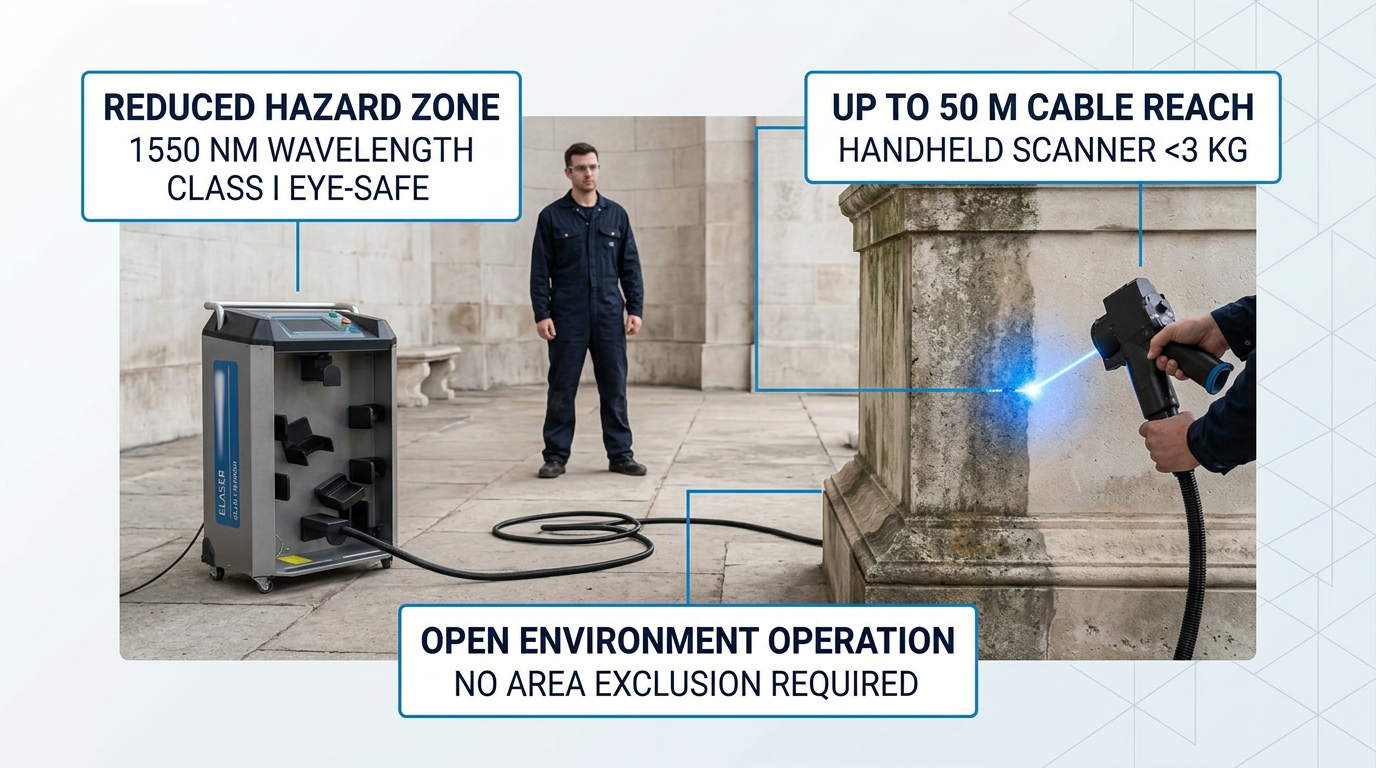
The defining characteristic of this entry is the ELASER-RHZ — the world's only laser cleaning system with patented reduced-hazard-zone (RHZ) technology, enabling cleaning in open workshops, mixed-use manufacturing facilities, and publicly accessible spaces without sealing off the area or evacuating adjacent workers.
Operating at a 1550 nm wavelength, WSL's patented approach confines the laser hazard to a small area immediately around the work surface — unlocking applications such as graffiti removal and heritage or monument restoration in public spaces where conventional laser cleaning has never been practical.
ELASER Specifications at a Glance
| Specification | ELASER / ELASER-RHZ |
|---|---|
| Power options | 100 W, 200 W, 300 W |
| Power tunability | 0–100% |
| Wavelength | 1550 nm |
| Laser class | Class IV or Class I |
| Scanner weight | Under 3 kg |
| Delivery cable | Up to 50 m (5 m / 15 m standard) |
| System weight | Under 50 kg (wheeled) |
| Cooling | Air-cooled |
| Power supply | 110–250 VAC single-phase |
| Certifications | CE, UKCA |
| Lead time | Typically one week (customised builds longer) |
| Shipping | Worldwide |
Key specifications for the ELASER / ELASER-RHZ from Woodrow Scientific Limited's first-party product data.
Power is tunable across the full 0–100% range, spanning light oxide removal through to thick coatings — one machine covers the complete spread of NZ industrial cleaning tasks without swapping units.
The handheld scanner weighs under 3 kg, and the delivery cable reaches up to 50 m — a standout figure that enables a single operator to clean large structures, tanks, and hard-to-access areas from one stationary unit.
The full system sits under 50 kg on wheels, runs on standard single-phase power, and requires no compressor, water supply, or consumables — straightforward to deploy at NZ field sites and remote locations.
Air cooling means there is no water circuit or chiller to set up, which simplifies deployment wherever water infrastructure is unavailable.
ELASER Pricing and NZ Availability
The ELASER is the most competitively priced comparable industrial laser cleaning machine in Europe — an outcome of WSL's technological and operational efficiencies, not a compromise on build quality.
Pricing is by quote; the machine ships worldwide with a typical lead time of one week from order (customised builds take longer). Contact WSL directly for a quote or to discuss bespoke engineering requirements.
The following use cases are covered by the ELASER range, with the RHZ variant additionally unlocking cleaning in open and public-facing environments:
- Rust and oxide removal: Steel, cast iron, and non-ferrous metals across industrial maintenance and manufacturing.
- Paint and coating stripping: Paint, powder coating, lacquer, primer, and adhesives removed without substrate damage.
- Weld preparation and post-weld cleaning: Mill scale and weld discolouration removed to tight tolerances.
- Mould and tooling cleaning: Release agents and residue removed in place — no disassembly required.
- Heritage and monument restoration: Soiling, paint, and corrosion lifted from stone, masonry, metal, and brick — gently.
- Graffiti removal in public spaces: ELASER-RHZ only — enclosure-free operation in publicly accessible environments.
- Industrial maintenance: Plant, equipment, and infrastructure cleaned on site with no media to clear up.
WSL designs, builds, services, and improves its machines entirely in-house — it is not a reseller or integrator of bought-in laser sources.
In a market where many suppliers rebadge third-party machines, that in-house model translates directly into faster support, genuine engineering capability, and a product that can be developed and improved over its working lifetime.
WSL also provides first-class safety and operation training for every system — get in touch with the team for details on how training is delivered.
For buyers with high-volume repetitive cleaning needs, WSL offers the AutoLASE automated laser cleaning system — also available with an optional RHZ upgrade for enclosure-free automated operation. Contact WSL to discuss whether AutoLASE is the right fit for your application.
See the ELASER-RHZ in Full Detail
The ELASER-RHZ is the only laser cleaning machine with patented reduced-hazard-zone technology. Explore the full product page to see specifications, configurations, and what sets it apart for open-workshop environments.
2.
Narran ROD 300 AIR — Narran
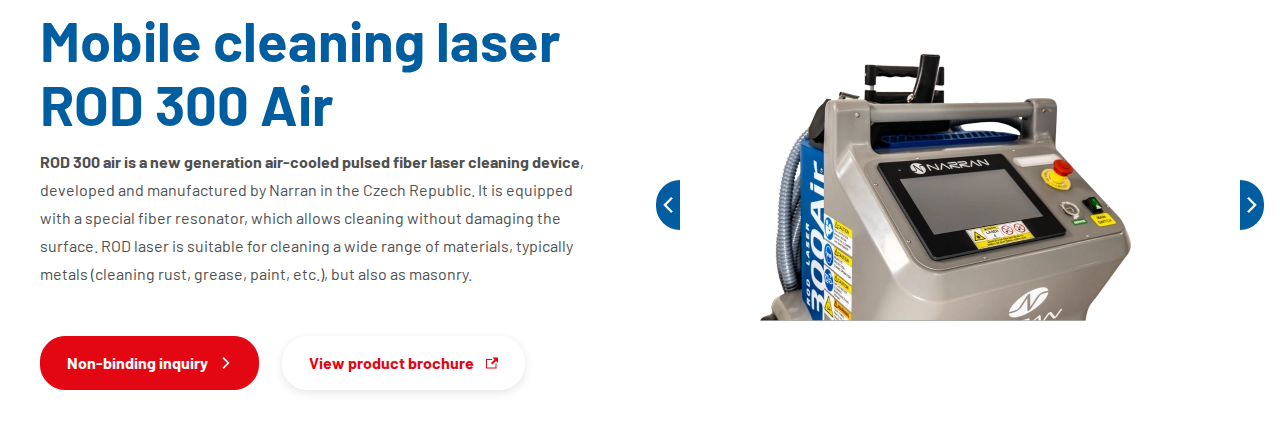
A Czech-built, air-cooled 300 W pulsed fibre laser cleaner, available to NZ buyers through exclusive ANZ distributor Laser Industries Pty Ltd, with a 1 kg process head suited to manual and robotic applications.
Pros:
Named exclusive ANZ distributor for NZ buyers
Air-cooled; no external cooling equipment needed
72,000 W peak power; adjustable beam parameters
Fibre extendable up to 100 m on request
Cons:
Standard fibre length only 10 m
Class IV laser; standard hazard zone controls apply
The Narran ROD 300 AIR is a portable, wheeled, air-cooled pulsed fibre laser cleaning machine designed and manufactured by Narran in the Czech Republic — a direct manufacturer that develops its own laser systems rather than integrating bought-in sources.
Average output power sits at 300 W, with a peak power of 72,000 W — a figure characteristic of pulsed fibre laser systems, where short, high-energy pulses do the cleaning work rather than continuous output.
Pulse duration is selectable across four settings (60, 100, 250, and 500 ns), and beam power, shape, and width can all be adjusted during operation, giving operators real-time control over cleaning parameters as surface conditions change.
| Specification | ROD 300 AIR |
|---|---|
| Average output power | 300 W |
| Peak power | 72,000 W |
| Pulse duration | 60 / 100 / 250 / 500 ns |
| Wavelength | 1064 nm |
| Laser safety class | Class IV |
| Weight | 39 kg |
| Dimensions | 54 × 66 × 69 cm |
| Process head weight | 1 kg |
| Optical fibre length | 10 m standard; up to 100 m on request |
| Cooling | Air |
| Power supply | 230/110 V, single-phase |
Key specifications for the Narran ROD 300 AIR.
The unit is built into a robust welded mobile frame on industrial wheels, with certified lifting points for crane or forklift transport — a practical consideration for industrial sites where the machine needs to move between work areas or levels.
The process head weighs 1 kg and is suited to both handheld manual operation and integration into robotic or automated production lines, with a standard optical fibre of 10 m and an extended option of up to 100 m available on request.
NZ Availability: Laser Industries Pty Ltd
Laser Industries Pty Ltd holds an exclusive import and distribution agreement for Narran laser cleaning systems across Australia and New Zealand, operating under the Narran Australia partnership.
For NZ buyers, this means a named, verifiable ANZ distributor with sales, support, and technical staff focused on laser cleaning systems — a concrete local presence rather than a generic international shipping claim.
The ROD 300 AIR runs on integrated air cooling, with no external cooling equipment required, which suits field deployment and remote industrial sites where a supplementary water or cooling circuit would be impractical.
The ROD 300 AIR is a Class IV laser operating at 1064 nm, which is the standard classification for industrial laser cleaning systems at this power level. Standard laser hazard controls apply: operator training, laser-rated eye protection, and defined exclusion zones.
- Rust and oxide removal: Surface rust, oxidation, and scale from metals.
- Paint and coating stripping: Removal of paints, varnishes, and adhesives.
- Grease and oil cleaning: Degreasing of metal components and surfaces.
- Mould cleaning: Cleaning of press moulds, tyre moulds, and injection moulds.
- Weld preparation: Surface prep for welding and ceramic coating adhesion.
- Heritage and restoration: Sensitive cleaning of monuments and historical objects.
Narran's reference list includes CERN, which selected the company to supply a mobile laser cleaning system for use across its 27-kilometre accelerator complex, and Aker Solutions, which operates multiple Narran pulsed laser systems for offshore maintenance and surface preparation.
Narran systems are in active use across more than 25 countries in Europe, Asia, and the Americas, providing a credible track record for NZ buyers assessing manufacturer reliability and long-term support.
Conclusion
The right laser cleaner for your NZ operation
Two entries is a short list — and deliberately so: verified NZ availability was the hard filter, and most machines that appear in global search results simply do not clear it.
The axes that separate these two — portability, cable reach, cooling, eye-safety, and the support route behind each machine — are the ones that genuinely matter once a buyer moves past the spec sheet.
On those axes, the ELASER-RHZ leads: world-first reduced-hazard-zone technology, the longest cable reach on this list, and the backing of a manufacturer that designs and builds in-house. Contact Woodrow Scientific for a quote.
Laser cleaning machines in NZ: frequently asked questions
Answers to common questions about how laser cleaning works, what machines cost in NZ, running costs, and laser safety requirements.
Yes — laser cleaning is a well-established industrial process, not an emerging or experimental technology. The underlying mechanism is laser ablation: the beam is absorbed preferentially by the contaminant layer, which vaporises or is ejected as particles, while the base material absorbs the energy differently and remains largely intact. The beam stops at the substrate. This is physics, not marketing. Laser cleaning is in routine industrial use across automotive manufacturing, aerospace MRO, heavy industry, and manufacturing maintenance — these are mature, high-stakes applications where the technology has been proven over many years. Effectiveness does depend on matching the machine's power output and parameters to the specific application and contamination type. A correctly specified and set-up system delivers consistent, repeatable results; an undersized or poorly configured one will not. Getting the specification right before purchase is the most important step.
Laser cleaning machines are capital equipment, and pricing varies significantly by power level, manufacturer, and configuration — all suppliers quote to order rather than publishing fixed retail prices. Apollo Laser NZ's published FAQ gives a useful NZ market reference point: their standard pulse laser machines range from NZD $20,000 to $400,000, reflecting the breadth of power levels and configurations available. NZ buyers should factor in freight, import duties, and GST on top of the machine price — these are real additional costs for a geographically isolated market and can be material on higher-value equipment. The ELASER from Woodrow Scientific Limited is competitively priced within the market. Contact Woodrow Scientific directly for a quote specific to your application and power requirements.
The answer depends on whether you are asking about the running costs of owning a machine or the hire rate charged by a service provider — these are quite different questions. For machine owners, operating costs are very low once the capital investment is made. There are no consumables: no abrasive media, no chemicals, no water. Electricity is the primary ongoing cost, and maintenance requirements are minimal. The cost structure of laser cleaning is heavily front-loaded — the machine itself is the main expense; after that, the per-hour cost of running it is modest. For hire or service pricing from NZ laser cleaning operators, rates vary by job complexity, location, and the operator's own cost base. No standard published rate exists for the NZ market. If you are evaluating a service rather than a purchase, request quotes from local operators with details of your specific job.
Industrial laser cleaning machines are Class IV lasers, which means they involve high-powered optical radiation and require appropriate safety controls under standard operation. These controls typically include operator training, laser-rated eye protection matched to the wavelength in use, and defined working and exclusion zones to protect anyone nearby. WorkSafe NZ is the relevant authority for laser safety guidance in New Zealand — their Health and Safety by Design guidance covers laser radiation under the Health and Safety at Work Act 2015 (HSWA). Operators should consult WorkSafe NZ's guidance and their equipment supplier for controls appropriate to their specific setup. One practical consideration worth knowing: systems with reduced-hazard-zone (RHZ) technology — such as the ELASER-RHZ from Woodrow Scientific Limited — significantly reduce the exclusion zone required during operation, making deployment in open workshops, shared facilities, and mixed-use environments considerably more practical. This is a genuine operational difference that affects where and how a machine can be used day-to-day.