

Introduction
Every machine on this list is genuinely available to buyers in Ireland — shipped directly from a verified manufacturer or through a named Irish or UK-based distributor.
CE certification is the baseline every entry must clear; it is what the Irish and EU market requires for machinery placed on the market.
Much of this category is importers reselling third-party machines, which affects after-sales support and spare parts — so manufacturer credibility is a core part of how each entry is assessed.
Pulsed lasers deliver high peak power in short bursts, making them precise and substrate-safe; continuous wave lasers move faster on large surfaces but with less substrate control.
Each entry is evaluated on six axes: power output, portability, cooling system, applications, CE status, and manufacturer quality.
TL;DR
The Irish laser cleaning market is fragmented and reseller-heavy, but verified, directly supported options do exist. The right choice comes down to axes most buyers overlook — and the laser type decision alone can determine whether a machine suits your application or damages your substrate.
This article covers:

4 machines available to Irish buyers
Pulsed vs. continuous wave laser technology
CE certification as the market baseline
Manufacturer vs. reseller: why it matters
Portability and self-contained operation
Six evaluation axes used across all entries
How we selected and evaluated these laser cleaning machines
The Irish laser cleaning market is not short of options — but a significant portion of what appears online comes from anonymous importers and resellers whose connection to the underlying product begins and ends at the invoice.
Inclusion criteria: what qualified a machine for this list
Two hard filters determined whether a machine was considered for inclusion at all.
- Verified Irish availability: The machine must be obtainable by a buyer in Ireland — via direct manufacturer supply with Ireland explicitly covered, or through a named, verifiable Irish or UK-based distributor.
- Identifiable manufacturer: Each entry must come from a manufacturer or authorised distributor with an established, traceable presence. No anonymous resellers; no rebadged units of unknown provenance.
The second criterion matters more than it might first appear: when a machine needs a repair, a spare part, or a firmware fix, the difference between a genuine manufacturer and a reseller who sourced the unit from a catalogue is the difference between a solution and a shrug.
Evaluation axes: how each machine was assessed
Every machine on the list was assessed against the same six axes, applied consistently across all four entries.
- CE certification: CE marking is required under Regulation (EU) 2023/1230 for machinery placed on the Irish and EU market. This is the baseline floor, not a differentiator — no machine appears without it.
- Power output: Assessed across the range relevant to Irish industrial buyers: 100 W for light oxides and precision work, up to 300 W and above for thick coatings and faster throughput.
- Portability: Form factor, system weight, and whether the machine is genuinely self-contained for on-site use — no compressor, no external water supply, no consumables required.
- Cooling system: Air-cooled systems simplify field deployment; water-cooled systems add infrastructure overhead. Assessed for what each means in practice for multi-site or mobile operation.
- Applications: Evaluated against the most common Irish industrial use cases: rust removal, paint stripping, weld prep, mould cleaning, and surface preparation before welding or bonding.
- Manufacturer and support quality: Whether the supplier designs and builds in-house, and the proximity and responsiveness of after-sales support — directly connected to the inclusion criteria above.
The manufacturer and support quality axis exists because the laser cleaning market spans genuine engineering companies, authorised distribution partners, and importers who add little beyond a brand sticker — and that distinction has real consequences for buyers when something goes wrong.
A machine from a genuine manufacturer comes with access to the people who designed it. A rebadged import does not — and that gap shows up the moment you need support, spare parts, or a technical answer.
The four machines that follow were each assessed against these criteria — with every axis evaluated on the same basis, regardless of where the machine sits in the list.
1
ELASER by Woodrow Scientific
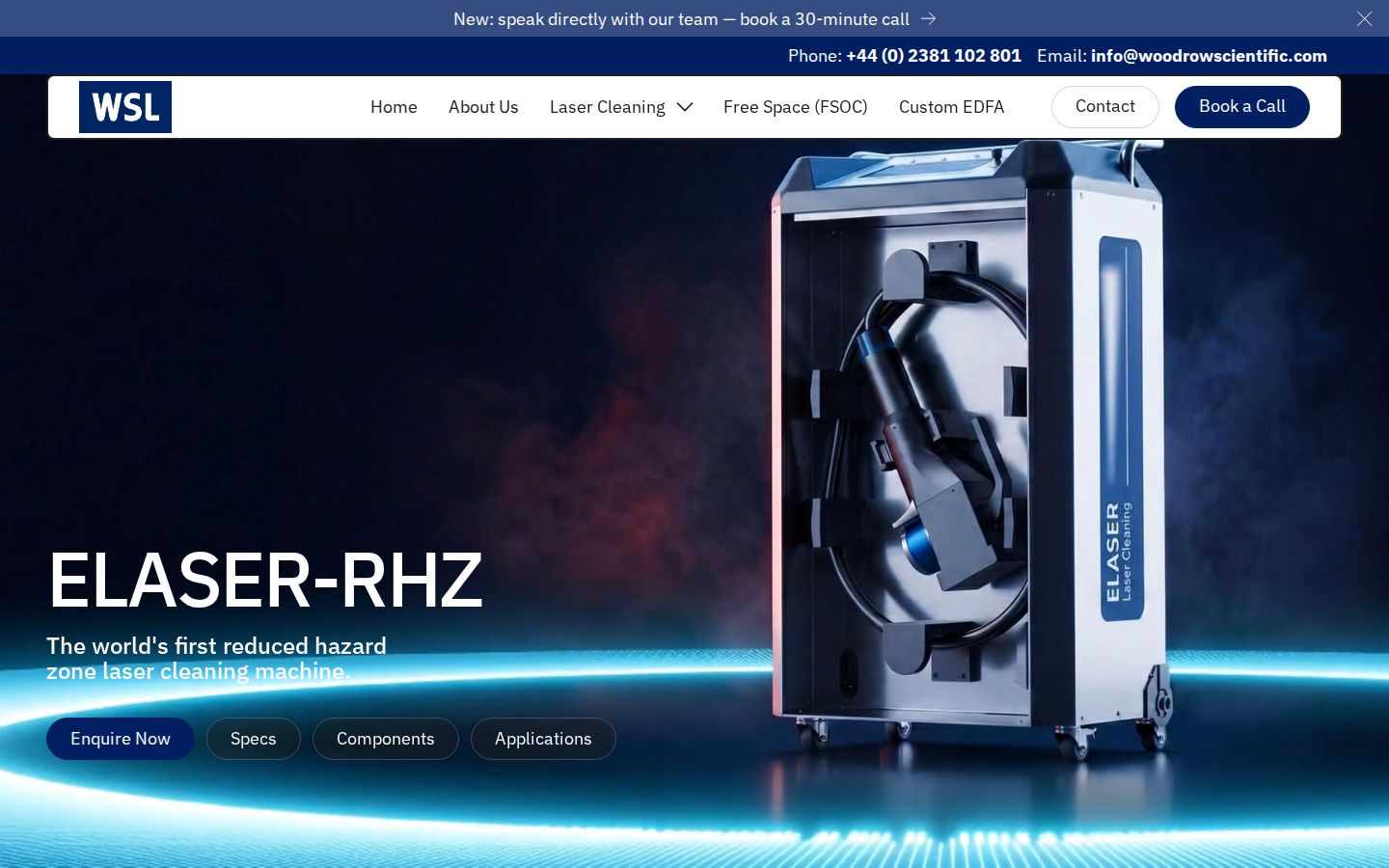
A 100–300 W industrial fibre laser cleaner built and patented in the UK by Woodrow Scientific — the only manufacturer of its kind, and the only laser cleaner in the world with reduced-hazard-zone technology.
Pros:

World-first eye-safe reduced hazard zone technology
Only UK-based laser cleaning manufacturer; fully in-house
50 m cable — far exceeds standard reach
Competitive pricing; European cost leader
Cons:

Pricing available on request only
Customised builds extend the one-week lead time
ELASER-RHZ: World-First Reduced Hazard Zone Technology
The standout capability of the ELASER range is the ELASER-RHZ variant, which uses WSL's patented technology to collapse the laser hazard zone to a fraction of its conventional size.
Where standard laser cleaning systems require the surrounding area to be sealed off and cleared before work can begin, the RHZ configuration confines the hazard to a small zone immediately around the work surface — enabling cleaning in open workshops, mixed-use manufacturing facilities, and even publicly accessible spaces such as heritage sites and urban graffiti removal.
WSL's reduced hazard zone technology is patented and world-first. No other laser cleaning machine currently available to Irish buyers offers this capability, making the ELASER-RHZ the only option for buyers who need to clean in open, shared, or public-facing environments without shutting down the surrounding area.
WSL provides full operator training for the ELASER and ELASER-RHZ — get in touch directly for details on what that covers and how it is delivered.
The Manufacturer Behind It
Woodrow Scientific was founded in 2012 and is the only UK-based laser cleaning manufacturer — it designs, builds, services and continuously improves its machines entirely in-house, drawing on over 200 years of combined engineering experience.
Much of the laser cleaning market is supplied by resellers and importers rebadging third-party machines: buyers get no in-house engineering capability, slower access to spares and fixes, and no route to genuine product improvement over time.
WSL's in-house model means direct manufacturer support from the team that built the machine — a material difference for Irish industrial buyers who depend on uptime.
ELASER Specifications
The ELASER is available in 100 W, 200 W and 300 W configurations, with power tunable from 0–100% across the full range — one machine spans light oxide removal through to thick coatings and heavy rust.
| Specification | ELASER |
|---|---|
| Max power | Up to 300 W (100 W, 200 W, 300 W models) |
| Wavelength | 1550 nm |
| Pulse energy | Up to 15 mJ |
| Pulse duration | 100 ns |
| Power tunability | 0–100% |
| Delivery cable | Up to 50 m (5 m / 15 m standard) |
| Scanner weight | Under 3 kg |
| System weight | Under 50 kg (wheeled) |
| Power supply | 110–250 VAC single-phase |
| Power consumption | Under 2000 W |
| Cooling | Air-cooled |
| Laser class | Class IV (standard) / Class I (RHZ) |
| Certifications | CE and UKCA |
| Interface | Touchscreen GUI with per-user logins |
Key technical specifications for the ELASER, drawn from Woodrow Scientific's published product data.
The system runs on a standard single-phase supply (110–250 VAC) and draws under 2,000 W — no dedicated power infrastructure is needed on site.
The 50 m delivery cable is a clear operational advantage for large-plant and infrastructure work: most portable laser cleaners on the market reach 10 m or less on standard cable, which limits where the operator can work without repositioning the main unit.
The handheld scanner weighs under 3 kg, and the wheeled main unit comes in under 50 kg — a single operator can deploy and run the system without assistance, with no compressor, water supply, or consumables required.
The graphical touchscreen interface supports password-protected access with per-user logins and usage tracking, which is useful for buyers managing multi-operator environments or service businesses running the machine across multiple sites.
Applications and Substrates
The ELASER handles a broad range of contaminants and substrates across industrial, heritage, and infrastructure applications.
- Contaminants removed: Rust, oxides, mill scale, paint, powder coating, lacquer, primer, oil and grease, carbon and soot, mould residue, graffiti, weld discolouration, adhesives, tarnish, and release agents.
- Substrates cleaned: Steel, carbon steel, aluminium alloys, cast iron, copper, brass, bronze, titanium, galvanised steel, stone, concrete, brick, and masonry.
- Sector applications: Automotive, aerospace, industrial maintenance, injection moulding and tooling, tyre and rubber, heritage and restoration, and launch of a laser cleaning service business.
Because the beam stops at the base material, the ELASER removes contamination with minimal substrate loss — reducing rework compared with abrasive methods.
ELASER Availability and Pricing
WSL ships worldwide direct from its UK facility, with a typical lead time of one week from order for standard configurations — a straightforward route to market for Irish buyers, with no distributor layer in between.
The ELASER is the European cost leader among comparable industrial laser cleaning machines — competitive pricing achieved through WSL's own technological and operational efficiencies, not through compromises on build quality. Pricing is available on request.
For buyers with high-volume or production-line cleaning requirements, WSL also offers AutoLASE — a robotic laser cleaning system where machine vision scans the part, builds a 3D map, and generates the clean automatically. Get in touch with WSL to discuss which configuration fits your operation.
WSL also offers bespoke engineering and customisation capability for buyers with specific requirements — contact the team directly to discuss what is possible.
See the ELASER-RHZ Full Specifications
The ELASER-RHZ datasheet covers power output, hazard zone dimensions, and build details. Download it to evaluate whether the reduced hazard zone variant fits your site and application.

Product 2
P-Laser QF-Compact
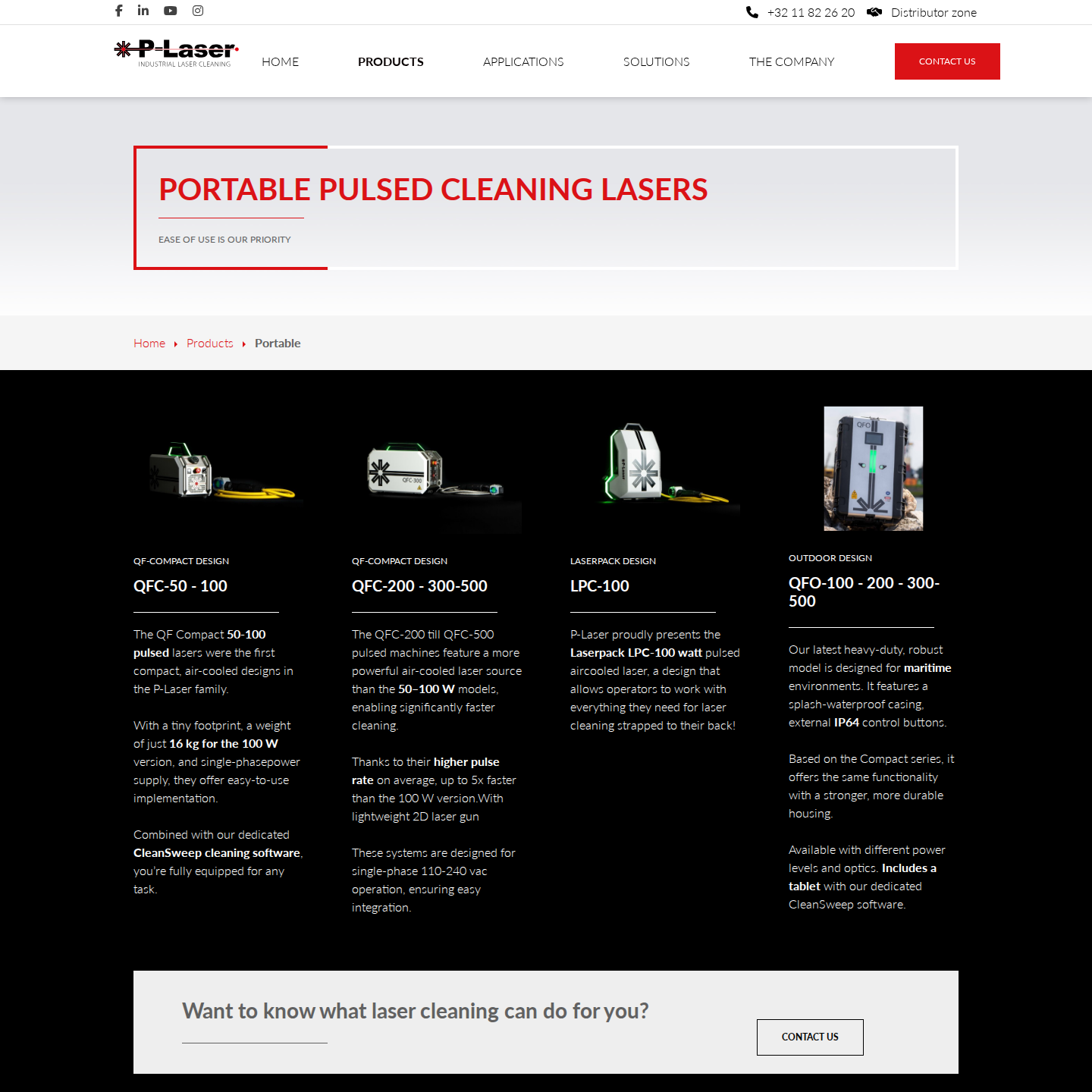
A Belgian manufacturer of pulsed industrial laser cleaning equipment, with LaserAge Limited — based in Midleton, Co. Cork — named as its sole authorised partner for the UK and Ireland.
Pros:
Genuine manufacturer; engineered and built in Belgium
Authorised Irish distributor based in Co. Cork
Air-cooled Compact range; no water infrastructure needed
On-site and off-site cleaning services available in Ireland
Cons:
Published starting price of €60,000
Higher-power models require water cooling
Compact range tops out at 300 W
P-Laser is a Belgian manufacturer with over 35 years of expertise in surface treatment, producing pulsed industrial laser cleaning systems from its facility in Heusden-Zolder.
For Irish buyers, the practical entry point is through LaserAge Limited, named by P-Laser as its sole authorised partner for the UK and Ireland, with its base at Ballinacurra Business Park in Midleton, Co. Cork.
QF-Compact Range: Power and Portability
The QF-Compact is P-Laser's portable product line, covering four air-cooled pulsed models from 50 W through to 300 W.
| Axis | P-Laser QF-Compact |
|---|---|
| Laser type | Pulsed fibre laser |
| Power range (portable) | 50 W, 100 W, 200 W, 300 W (air-cooled) |
| Trolley line (higher power) | 500 W–3000 W (water-cooled) |
| Cooling (Compact) | Air-cooled |
| Applications | Rust removal, paint removal, mould cleaning, weld cleaning, surface preparation |
| Manufacturer | P-Laser, Heusden-Zolder, Belgium |
| Irish distribution | LaserAge Ltd, Midleton, Co. Cork |
P-Laser QF-Compact evaluated against the key axes used throughout this guide. The trolley line row shows the higher-power water-cooled range that sits above the portable Compact series.
The QFC-50 and QFC-100 were P-Laser's first compact air-cooled designs; the QFC-200 and QFC-300 deliver a higher pulse rate for faster cleaning throughput.
Buyers requiring more than 300 W move into P-Laser's trolley and heavier product lines, which are water-cooled — adding infrastructure requirements that the Compact range avoids.
Cleaning Applications
P-Laser's pulsed fibre laser technology covers the core industrial cleaning applications: rust and oxide removal, paint and coating removal, mould cleaning, weld cleaning, and surface preparation before bonding or coating.
These applications are drawn from P-Laser's own applications pages, which describe their pulsed systems as suited to both metallic and selected non-metallic materials.
Irish Availability: LaserAge in Cork
LaserAge's Midleton base is confirmed on both laserage.ie and P-Laser's own distributor page, giving Irish buyers a named, in-country contact rather than a cross-border sales route.
LaserAge offers on-site cleaning of industrial components and moulds, as well as off-site professional laser cleaning at its application lab in Midleton, Co. Cork.
LaserAge provides on-site and off-site laser cleaning services from its Midleton facility — meaning Irish buyers can trial the technology or outsource specific cleaning tasks before committing to a capital purchase.
This service layer is a practical consideration for Irish industrial buyers weighing a capital purchase against an outsourced cleaning arrangement.
P-Laser QF-Compact Pricing
P-Laser's own FAQ states that low-power machines start from €60,000 — a published reference figure that gives Irish buyers a baseline for budgeting.
Product 3
Gleam Equipment LUCOHE
Gleam Equipment is an Irish-based supplier, operating from Cork, that stocks and supports LUCOHE-branded pulsed laser cleaning machines manufactured by Industrias Metalúrgicas Lucohe, S.L. in Spain.
Pros:
Irish-based supplier with local Cork presence
Pulsed technology for substrate-safe cleaning
Air-cooled; no water or chiller required
500 W headline power in portable form
Cons:
5 m fibre limits reach on large plant
Spanish-manufactured; sold via Irish reseller
Gleam Equipment is an Irish equipment company operating from Cork, with an Irish phone number and an explicit focus on supporting Irish industrial customers — details stated on their own website.
The machines they supply under the LUCOHE brand are manufactured by Industrias Metalúrgicas Lucohe, S.L., a Spanish industrial manufacturer. Buyers deal directly with an Irish-based point of contact for quotation, product selection guidance and local support.
LUCOHE LC-500P and LC-300P: Model Overview
Gleam Equipment lists two portable pulsed models: the LC-500P at 500 W and the LC-300P at 300 W. Both operate at 1064 nm and use pulsed laser technology, which delivers energy in short, controlled bursts suited to cleaning work where substrate protection matters — rust removal, weld preparation and mould cleaning among them.
| Model | Power | Weight | Cooling | Standard Fibre | Voltage |
|---|---|---|---|---|---|
| LC-500P | 500 W | 35 kg | Air (3 fans) | 5 m | 110–240 V |
| LC-300P | 300 W | 29 kg | Air | 5 m | 110–240 V |
Key specifications for the two portable LUCOHE models listed by Gleam Equipment, as stated on gleamequipment.ie.
The LC-500P is built as an all-in-one unit: laser source, touchscreen controls, air-cooling system and fibre are integrated into a single trolley-style chassis with wheels and a telescopic handle, keeping the setup footprint minimal.
At 35 kg for the LC-500P and 29 kg for the LC-300P, both models are portable in the sense that one person can move them between locations on site. The LC-300P is the lighter option where precision work or tighter access is a factor.
Scan Modes, Power Adjustment and Cooling
Gleam Equipment's LC-500P product page lists 9 selectable scan modes and power adjustment from 10–100%, giving operators the ability to tune output to different surface conditions and contamination types without changing hardware.
Air cooling via three integrated fans means the LC-500P requires no external water supply or chiller unit. The universal 110–240 V input covers standard Irish and international supply voltages, which is a practical advantage for field deployment.
Applications
- Rust removal: Surface rust and oxidation from steel and other metals.
- Paint and coating removal: Stripping paint, lacquer and surface coatings without abrasives.
- Weld cleaning and preparation: Cleaning weld seams and preparing metal surfaces before bonding or welding.
- Mould cleaning: Removing residue and build-up from industrial moulds.
- General surface preparation: Pre-treatment of metal surfaces ahead of coating or adhesive application.
These applications are listed across Gleam Equipment's own product and category pages for the LUCOHE range.
Both the LC-500P and LC-300P ship with a 5 m standard fibre. For cleaning tasks confined to a single workpiece or compact area, this is workable. Buyers with requirements spanning large infrastructure, multi-storey plant or wide-area surfaces should factor this reach into their assessment.
Product 4
Narran ROD 300 AIR
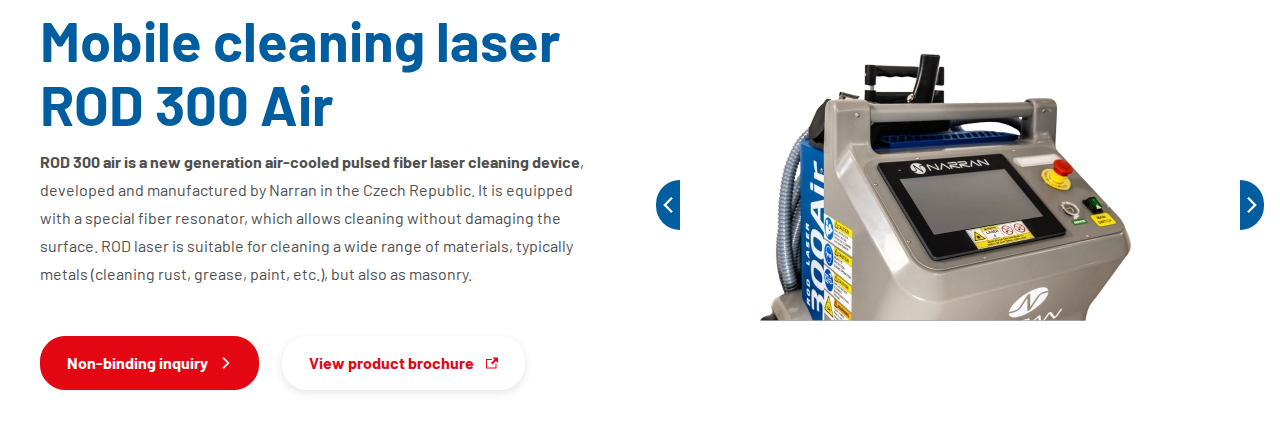
A 300 W air-cooled pulsed fibre laser cleaner developed and manufactured in the Czech Republic by Narran, with BD Shades identified as the named Irish agent for Narran laser precision equipment.
Pros:
BD Shades named as Irish agent for Narran
Direct Czech manufacturer; not a reseller
Air-cooled; no external cooling equipment needed
300 W pulsed output; 39 kg system weight
Cons:
Standard fibre length is only 10 m
Extended fibre up to 100 m on request
Narran ROD 300 AIR: Irish Availability
BD Shades, based in Portlaoise, Co. Laois, identifies itself on its website as the Irish agent for Narran laser precision equipment.
BD Shades describes its core business as laser cleaning and industrial painting, working with construction contractors across Ireland — the Narran agency sits within that service offering.
For an Irish buyer, this represents a named, verifiable point of contact in the Irish market, rather than a direct import arrangement with the Czech manufacturer.
Narran ROD 300 AIR: Specifications
Narran describes itself as a direct Czech manufacturer of laser cleaning systems, designing and building its own equipment at its headquarters in Brno.
The ROD 300 AIR delivers 300 W average output from a pulsed nanosecond fibre laser operating at 1064 nm, with four selectable pulse durations (60, 100, 250 and 500 ns) and four pulse energy settings (4.3, 6, 12 and 15 mJ).
2D beam scanning is standard, and the power, shape, and width of the beam can be adjusted during operation.
| Specification | Narran ROD 300 AIR |
|---|---|
| Average output power | 300 W |
| Laser type | Pulsed fibre, nanosecond |
| Wavelength | 1064 nm |
| Pulse duration options | 60, 100, 250, 500 ns |
| Pulse energy options | 4.3, 6, 12, 15 mJ |
| Beam scanning | 2D |
| System weight | 39 kg |
| Process head weight | 1 kg |
| Standard fibre length | 10 m (up to 100 m on request) |
| Working distance (focus) | 100–310 mm |
| Cooling | Integrated air cooling |
| Power supply | 230/110 V, single-phase |
| Pricing | – |
Key published specifications for the Narran ROD 300 AIR. – indicates pricing is not publicly listed by Narran.
At 39 kg for the full system and 1 kg for the process head, the ROD 300 AIR is a genuinely portable unit for a 300 W machine — practical for operators who need to move between sites or work in varied environments.
The standard 110/230 V single-phase power supply means the machine can be plugged into a standard workshop or site socket without dedicated three-phase infrastructure.
Cooling and Field Deployment
The ROD 300 AIR uses integrated air cooling; no additional cooling equipment is required for operation.
The system is built into a welded mobile frame with industrial wheels and certified lifting points, allowing it to be repositioned by hand, crane, or forklift depending on the site.
Fibre Reach
The standard optical fibre is 10 m; extensions of up to 100 m are available on request.
For buyers assessing suitability on large plant or infrastructure sites, the 10 m standard reach is a practical dimension to factor in at the specification stage.
Applications
Narran's published application list for the ROD system covers rust removal, paint stripping, oil removal, degreasing, mould cleaning, surface preparation, weld adjustment, and restoration work.
- Metals: Rust, grease, paint, oxides, varnishes, and surface preparation across aluminium, steel, and stainless steel.
- Masonry and stone: Cleaning of stone, brick, sandstone, granite, marble, and similar substrates.
- Mould cleaning: Press moulds, tyre moulds, baking moulds, and injection moulds.
- Restoration: Sensitive restoration of monuments and historical objects, including graffiti and soot removal.
The scanning head is designed for both manual operation and integration into robotic or automated production lines, giving the ROD 300 AIR a wider deployment envelope than a hand-held-only tool.
Narran designs and builds its own laser cleaning systems in Brno, Czech Republic. That direct manufacturing relationship is relevant to buyers weighing long-term parts availability and technical support — the product traces back to a single, named source.
The working distance range of 100–310 mm gives operators flexibility when cleaning across different surface geometries or working in areas with limited access.
Explore the ELASER for Your Irish Operation
Built and patented in the UK by Woodrow Scientific, the ELASER ships direct to Ireland with a typical one-week lead time. See the full product details and find the right specification for your application.

Conclusion
Which laser cleaning machine is right for your Irish operation?
The right machine comes down to a handful of practical realities: the power your application demands, the reach your working environment requires, whether you need a self-contained system, and how much manufacturer support matters when something needs resolving.
For most Irish industrial buyers, those axes point to the ELASER — competitively priced, with a 50 m delivery cable reach that stands apart, world-first RHZ eye-safe technology no other laser cleaner offers, and direct UK-based manufacturer support shipping worldwide.
Get in touch with Woodrow Scientific to discuss your application, request a quote, or ask about operator training.
Frequently asked questions about laser cleaning machines in Ireland
Common buying questions about laser cleaning machines for the Irish market — technology, pricing, compliance, and where to source.
Pricing in this category is almost always quote-based — there is no standard list price. Cost varies significantly by power output, laser type (pulsed vs. CW), and manufacturer. As a reference point, P-Laser's published FAQ states that low-power machines start from €60,000 in the European market. The ELASER by Woodrow Scientific is competitively priced and positions as the European cost leader among comparable industrial laser cleaning machines. Contact WSL directly for a quote.
Yes — laser cleaning is an established industrial process, not a speculative technology. The laser beam vaporises or dislodges the contaminant layer through a process called laser ablation, while leaving the base material intact. It is in active use across automotive, aerospace, heritage restoration, mould cleaning, and industrial maintenance, as documented in trade publications including Laser Focus World. Pulsed systems are particularly valued for substrate safety: the beam stops at the base material boundary, minimising substrate loss and reducing the need for rework.
Pulsed lasers fire short, high-peak-power bursts. They are precise and substrate-safe, making them well suited to mould cleaning, weld preparation, delicate surfaces, and precision applications where protecting the base material matters. Continuous wave (CW) lasers emit a constant beam. They can cover large, robust steel surfaces quickly, but carry higher heat input and offer less substrate control — scanning speed becomes critical to avoid surface damage. Research published in Laser Focus World confirms that for precision applications such as mould cleaning, pulsed fibre lasers are the preferred choice; CW lasers suit large steel structures where throughput is the priority and substrate sensitivity is lower.
Yes. CE marking is required for machinery placed on the market or put into service in Ireland and across the EU, under Regulation (EU) 2023/1230 on machinery. The regulation is binding in its entirety and directly applicable in all EU member states, including Ireland. CE marking must be affixed before a machine is placed on the market or put into service. It is the non-negotiable baseline for any laser cleaning machine purchased for use in Ireland — not a differentiator, but the floor every compliant machine must meet.
There are several verified sourcing routes for Irish buyers. Woodrow Scientific (WSL) ships the ELASER direct to Ireland from its UK facility, with a typical lead time of one week. LaserAge Limited, based in Midleton, Co. Cork, is P-Laser's sole authorised partner on the Island of Ireland and the UK — they offer both machine sales and on-site cleaning services. BD Shades, based in Portlaoise, Co. Laois, is the named Irish agent for Narran laser precision equipment. Gleam Equipment, also based in Midleton, Co. Cork, stocks LUCOHE-branded pulsed laser cleaning machines and can be reached at gleamequipment.ie.
Before committing to any machine, put these questions to the supplier. Does the supplier design and build its own machines, or does it resell or import third-party units? What is the lead time and shipping arrangement to Ireland? What after-sales support, spare parts, and training are available, and are they provided by the manufacturer directly? Is the machine CE certified? Can the machine be demonstrated on your specific application or material before purchase? The answers will quickly reveal whether you are dealing with a manufacturer or a reseller — and what level of support you can realistically expect once the machine is on your floor.