

Introduction
If you're researching laser cleaning machines in Canada, you've likely already decided the technology is worth pursuing — what you need now is a clear picture of what's actually available and supported here.
Not every machine sold globally is sold and supported in Canada: availability has to be verified, not assumed from a spec sheet.
Every entry on this list was assessed against five axes: power range and form factor, portability vs. automation, application suitability, Canadian availability and after-sales support, and pricing context.
Our own machine sits at #1 because it genuinely suits the widest range of Canadian buyers; the remaining four entries are real, fairly evaluated competition.
Because list prices are rarely published in this category, the page provides cost-structure guidance and quoting direction throughout.
TL;DR
The Canadian laser cleaning market is more navigable than it first appears. A focused set of genuinely supported options exists across a wide power and application range, and the decision between them comes down to workflow, volume, and operating environment far more than raw specifications.
This article covers:

Which laser cleaners are verified for Canada
Power range, portability, and application suitability compared
Canadian availability and after-sales support assessed
Pricing context and how to request quotes
How to match a machine to your operation
How Laser Cleaning Works — and Why It Matters
What actually separates laser cleaning from sandblasting or chemical stripping is not just the technology — it is the fundamental interaction between the beam and the surface, which changes the economics, the waste profile, and the range of materials you can safely clean.
The mechanism is called selective laser ablation: focused laser pulses are absorbed far more strongly by the contaminant layer — rust, paint, oxides, coatings — than by the base material beneath it, causing the contaminant to vaporise or be ejected while the substrate is left essentially untouched.
This is not an abrasive process. The beam does not grind, scratch, or mechanically stress the surface — it deposits energy precisely where the contaminant sits, and the physics of differential absorption does the rest.
Substrate Preservation: The Practical Payoff
For buyers working with precision components, thin-gauge metals, or tight-tolerance surfaces, the substrate-preservation property is the decisive advantage over sandblasting.
Sandblasting is inherently erosive: abrasive media removes contaminants by physically impacting the surface, which means the substrate itself takes some of the damage — dimensional loss, surface roughening, and potential distortion are real outcomes on sensitive materials.
Laser cleaning removes the contaminant layer without mechanical contact, leaving the base material in essentially the same condition it was in before the contamination accumulated — no rework, no dimensional loss, no secondary damage to correct.
Total Cost of Ownership vs. Upfront Price
The most common mistake buyers make when comparing laser cleaning to sandblasting or chemical stripping is evaluating upfront cost alone — and that comparison consistently flatters the legacy methods.
Laser cleaning requires no consumable media: no abrasive, no chemicals, no water. The only waste generated is the vaporised contaminant itself, captured by a fume extraction unit. Sandblasting, by contrast, generates spent abrasive media in proportion to surface area processed — potentially hundreds of kilograms per shift — alongside the containment, disposal, and regulatory costs that come with it.
One vendor-sourced estimate puts five-year sandblasting consumables, media, disposal, and PPE costs at $30,000–$80,000 for a shop running 500 hours per year of surface prep work, compared to laser operating costs (electricity, lenses, occasional cable replacement, annual service) generally staying below $8,000–$15,000 over the same period — with the capital cost difference largely eroding within that window for moderate-to-high utilisation operations.
The upfront investment in a laser cleaning machine is higher than a sandblasting rig, and that is worth acknowledging honestly. But total cost of ownership — not purchase price — is the right lens for this decision, particularly for operations running meaningful annual hours.
Laser cleaning eliminates consumables, chemical waste disposal, and abrasive media costs entirely. For shops running 400+ hours per year of surface prep, the running cost gap versus sandblasting typically closes the capital cost difference within two to three years.
Pulsed vs. Continuous Wave: Why This List Uses Pulsed
Industrial laser cleaners come in two main architectures: pulsed and continuous wave (CW). The distinction matters because they interact with surfaces in fundamentally different ways.
Pulsed systems deliver energy in discrete nanosecond bursts at very high peak power — the pulse ablates the contaminant before significant heat can conduct into the substrate beneath it, a process sometimes called cold ablation. This gives pulsed systems excellent selectivity: the ability to remove a contamination layer without thermally affecting the base material.
CW systems deliver a continuous beam, which translates to higher throughput on heavy mill scale and thick coatings on robust substrates — but with greater heat input to the surface and reduced selectivity on thin or thermally sensitive materials.
The machines evaluated in this list are pulsed systems. That reflects the broader applicability of pulsed technology across the range of materials and applications Canadian buyers are most likely to encounter: precision components, weld prep, mould cleaning, and field maintenance work where substrate safety is a governing requirement.
Portability vs. Automation: Match the System to the Workflow
One of the most consequential decisions in selecting a laser cleaning machine is the form factor — and neither portable nor automated is inherently the better choice.
Portable and handheld systems suit field work, on-site maintenance, service businesses, and any job where the machine must come to the workpiece. They prioritise flexibility and deployability over throughput.
Automated robotic cells deliver consistency and throughput for repetitive, production-volume cleaning in a fixed facility — the machine stays in place and parts are loaded into it. The productivity gains are real, but they only materialise when the cleaning task is sufficiently repetitive and the facility is configured to support the workflow.
Matching the system to the actual workflow is more important than chasing the most automated option on the market. A highly automated cell sitting underutilised because it does not fit the operation is a worse outcome than a portable system running every day.
Three Canadian Buyer Considerations
Beyond the core technology decisions, Canadian buyers face a set of practical considerations that do not always surface in generic buying guides. These are worth asking about explicitly when evaluating any system.
- Regulatory compliance (Class 4): All industrial laser cleaners are Class 4 laser products under Canada's Radiation Emitting Devices Act. Operator training, appropriate PPE, and a controlled laser hazard zone are required. Health Canada administers these requirements — consult their guidance directly for specifics.
- Cooling method and cold climates: Air-cooled systems are simpler and more field-deployable in cold or remote environments. Water-cooled systems introduce chiller infrastructure that can be problematic at low ambient temperatures — ask suppliers for operating temperature minimums before committing.
- Manufacturer vs. reseller provenance: The market mixes genuine in-house manufacturers with resellers rebadging third-party hardware. Ask whether the supplier engineers and manufactures the laser system itself — it directly affects spare parts speed, diagnostic capability, and long-term support.
These three considerations recur throughout the entries that follow — they are the practical axes that separate a well-matched purchase from an expensive mismatch in the Canadian context.
With that grounding in place, here is how the machines on this list measure up — starting with the one that best fits the broadest range of Canadian buyers.
Product 1
ELASER / ELASER-RHZ by Woodrow Scientific
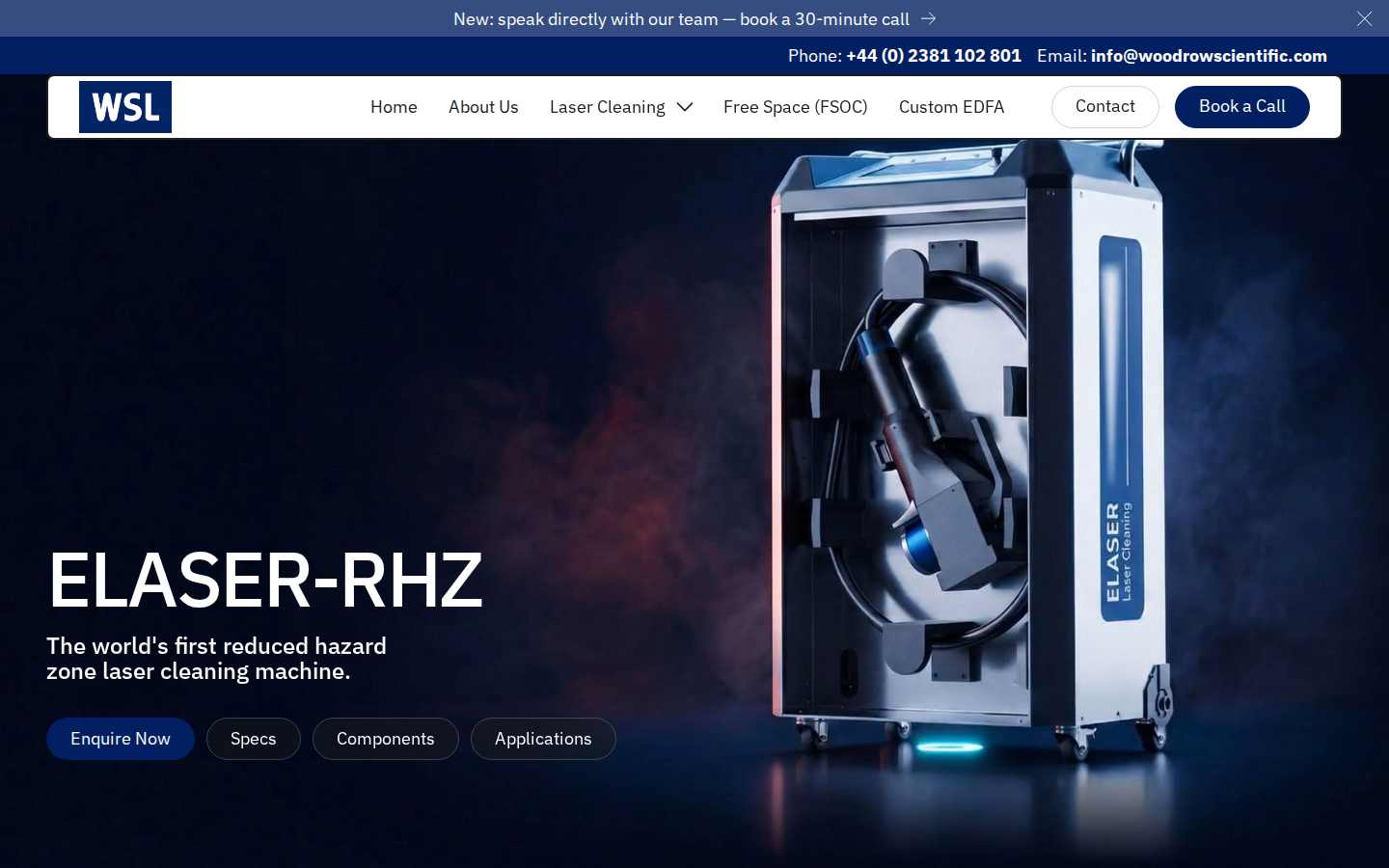
The ELASER and ELASER-RHZ are industrial fibre laser cleaning systems built entirely in-house by Woodrow Scientific Limited, the only UK-based laser cleaning manufacturer. The ELASER-RHZ carries WSL's patented world-first reduced hazard zone technology, collapsing the laser hazard zone to a fraction of conventional size and enabling cleaning in open workshops and public-facing settings where conventional laser cleaning cannot go. The handheld scanner weighs under 3 kg and connects via a delivery cable reaching up to 50 m — keeping the machine on the ground while the operator works at height or distance. Competitively priced among comparable industrial laser cleaners, with zero consumables and direct access to the manufacturer's engineering team for Canadian buyers worldwide.
Pros:

World-first reduced hazard zone technology
50 m cable reach; scanner under 3 kg
Air-cooled, consumable-free, single-phase power
In-house UK manufacturer; competitively priced
Cons:

Customised builds carry longer lead times
300 W ceiling; not for highest-throughput lines
Woodrow Scientific Limited (WSL) was founded in 2012 and is the only UK-based laser cleaning manufacturer — designing, building, servicing, and improving every machine entirely in-house. The ELASER is an industrial fibre laser cleaning system; the ELASER-RHZ is its reduced-hazard-zone variant. Both are air-cooled and consumable-free.
The laser cleaning market contains a mix of genuine manufacturers and resellers rebadging third-party hardware. For Canadian buyers, that distinction matters: in-house manufacturing means faster spares, genuine engineering support, and a supplier that can actually improve the product — not one that is waiting on a component from an original source it does not control.
Reduced Hazard Zone: Cleaning Where Others Cannot
The single most significant capability in this evaluation is WSL's patented reduced hazard zone technology, available on the ELASER-RHZ variant. Operating at 1550 nm wavelength, it collapses the laser hazard zone to a fraction of the size produced by conventional laser cleaners — no other laser cleaning machine in the world offers this.
In practical terms, this means a Canadian buyer can clean in an open workshop, a shared facility, or a public-facing environment without sealing off the area or halting adjacent operations. For heritage restoration, graffiti removal, or any setting where clearing the space is operationally impractical, this removes a barrier that makes conventional Class IV laser cleaning unworkable.
Conventional laser cleaning requires the working area to be sealed and evacuated before work begins. The ELASER-RHZ's reduced hazard zone eliminates that requirement, enabling cleaning in open-plan manufacturing facilities, mixed-use workshops, and publicly accessible sites — expanding where laser cleaning is viable.
WSL provides first-class safety and operation training for all operators. Contact WSL directly for details on training provision.
Portability and Reach: 50 m in the Field
The ELASER ships with a 5 m or 15 m delivery cable as standard, with options extending to 50 m — a reach that most comparable laser cleaners cannot match. For Canadian maintenance teams working on bridges, pipelines, large structures, or industrial infrastructure, this is a decisive field-deployment advantage: the machine stays on the ground while the operator works at height or distance.
The handheld scanner weighs under 3 kg, and the full system sits under 50 kg on wheels. It runs on single-phase power (110–250 VAC) and requires no water, chiller, or compressor — one operator can deploy it without additional support equipment.
ELASER Technical Specifications
The ELASER is available in three power configurations, all sharing the same portable form factor and air-cooled architecture.
| Specification | Detail |
|---|---|
| Power options | 100 W, 200 W, 300 W |
| Power tunability | 0–100% |
| Wavelength | 1550 nm |
| Delivery cable | Up to 50 m (5 m / 15 m standard) |
| Scanner weight | Under 3 kg |
| System weight | Under 50 kg (wheeled) |
| Cooling | Air-cooled (no water or chiller) |
| Power supply | 110–250 VAC single-phase |
| Power consumption | < 2000 W |
| Certifications | CE and UKCA certified |
| Manufacture | Made in Britain |
Structured specification data is clearer in a table than in prose, and gives Canadian buyers a quick reference for comparing power options and key parameters.
Power is tunable across the full 0–100% range, so a single machine handles everything from light oxide removal through to thick paint and coating stripping — without swapping hardware.
Application Coverage
The ELASER's versatility across contaminants and substrates is one of its strongest practical credentials. The beam stops at the base material, so the substrate is preserved — a meaningful advantage wherever rework is costly or the component is irreplaceable.
- Contaminants removed: Rust, oxides, mill scale, paint, powder coating, lacquer, primer, oil and grease, carbon and soot, mould, graffiti, adhesives, weld discolouration, release agents
- Surfaces cleaned: Steel, aluminium alloys, cast iron, copper, brass, bronze, titanium, galvanised, stone, brick, concrete, masonry
- Key application areas: Industrial maintenance, automotive, aerospace, heritage and restoration, injection moulding and tooling, tyre and rubber manufacturing, launching a laser-cleaning service business
For Canadian buyers considering a laser-cleaning service business, the ELASER's portability, broad application range, and manufacturer-backed training make it a practical starting platform — a single machine that can serve multiple industries and client types.
AutoLASE: The Automated Step-Up Option
For buyers running repetitive, production-volume cleaning in a fixed facility, WSL also offers AutoLASE — an automated laser cleaning system with the cleaning head mounted on an articulated robotic arm.
The defining characteristic of AutoLASE is how straightforward it is to operate: load the part, and machine-vision 3D scanning builds a map of the component and generates the cleaning path automatically. No programming, no path-setting, no knowledge of part geometry required — anyone can run it.
AutoLASE can also be configured with WSL's RHZ technology, enabling enclosure-free automated cleaning. No other automated laser cleaning system in the world offers this. It integrates with the buyer's existing robots or can be supplied as a complete custom cell; contact WSL to discuss the configuration that fits your facility.
Canadian Availability and Support
WSL ships worldwide, with a typical lead time of approximately one week from order for standard builds. Customised configurations take longer — a factual note rather than a concern, given the bespoke engineering capability on offer.
Canadian buyers deal directly with the manufacturer's engineering team, not a distributor chain. That means questions about application suitability, customisation, or integration get answered by the people who built the machine. WSL is CE and UKCA certified, and bespoke engineering is available for buyers with specific requirements — get in touch with WSL to discuss.
ELASER Pricing and Total Cost of Ownership
Pricing is by quote — contact WSL for a figure specific to your power requirement and configuration. The ELASER is competitively priced among comparable industrial laser cleaning machines, a position WSL achieves through in-house manufacturing efficiencies rather than component compromises.
When evaluating cost against legacy methods such as sandblasting or chemical stripping, the relevant comparison is total cost of ownership. Zero consumables, reduced downtime, and less rework from substrate preservation combine to deliver a substantially lower real cost over the machine's working life — even against methods with lower upfront outlay.
See the ELASER-RHZ Full Specifications
The ELASER-RHZ brings patented reduced hazard zone technology to industrial fibre laser cleaning. Download the datasheet for full technical specifications, or explore the product page to learn more.
Product 2
Laserax Laser Cleaning Systems
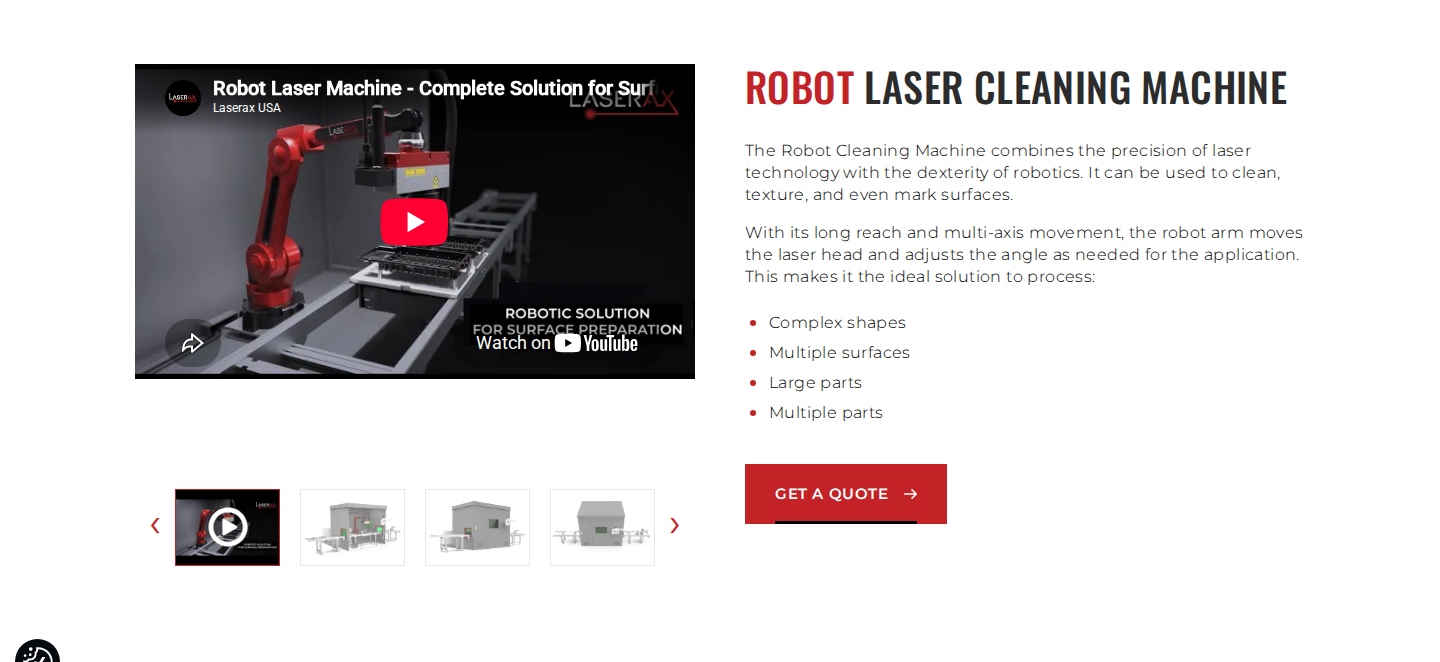
Laserax is a laser cleaning manufacturer headquartered and built in Québec City, Canada, making it the strongest Canadian-native entry on this list. Its product range runs from 100 W handheld stations through to 3 kW ultra-high-power automated cells, with a robot cleaning machine designed as a turnkey production-line solution — including fume extraction, a class-1 certified safety enclosure, and industrial robot integration. Buyers in automotive, aerospace, and battery manufacturing who need a fixed-facility, high-throughput laser cleaning system with in-country support will find Laserax's Canadian provenance and technical depth genuinely compelling.
Pros:
Canadian HQ and manufacturing, both in Québec
Broadest power range here — up to 3 kW
24/7 worldwide support; toll-free Canadian number
Turnkey cell: safety, fume extraction, automation included
Cons:
Fixed-facility only; not suited to field use
Higher-power systems require three-phase power supply
Water cooling required at higher power configurations
Operating temperature range worth verifying for cold climates
Canadian Headquarters and Support
Laserax operates from Québec City, Canada — its headquarters, engineering centre, and manufacturing facility are all located in Québec, at addresses on Watt Avenue and Dalton Avenue respectively.
For Canadian buyers evaluating laser cleaning machines, this matters in practical terms: support calls, on-site service visits, and parts logistics all originate domestically, without the cross-border lead times that affect most other entries on this list.
Laserax offers 24/7 worldwide phone support, reachable through a toll-free Canadian number (+1 844 471-0144), as well as on-site and remote support options — making it the strongest local support story among the options reviewed here.
Power Range and Automation
The Laserax product range spans from a 100 W handheld cleaning station up to the LXQ-UHP series at 3 kW — the broadest power range of any entry on this page.
| Product Tier | Laser Power | Cooling | Form Factor | Typical Application |
|---|---|---|---|---|
| Hand-Held Cleaning Station | 100 W, 200 W, 300 W | Air-cooled | Mobile trolley with handheld scanner | Low-to-mid volume; flexible access to complex or large parts |
| Robot Cleaning Machine | 100–3,000 W (single- or multi-mode) | Air or water-cooled (by power level) | Fixed robotic cell; approx. 4 m x 4 m x 3 m footprint | High-volume production lines; complex geometries; automotive/aerospace/battery |
| LXQ-UHP Series | 500 W, 1 kW, 2 kW, 3 kW | Water-cooled | OEM laser system for integration | Large-surface cleaning; demanding cycle times; industrial automation |
Comparing Laserax's three main product tiers across power, cooling, form factor, and typical application gives readers a clear at-a-glance view of which system fits their workflow — information that is harder to absorb from prose alone.
The robot cleaning machine is built around an industrial robot arm (compatible with ABB, FANUC, KUKA, and other brands), housed inside a class-1 certified laser safety enclosure with interlocked doors.
Part loading is configurable: front door, inline conveyor, and rotary table options are available, with other configurations available on request — giving production engineers meaningful flexibility in how the cell integrates with an existing line.
This is fundamentally a fixed-facility system. The robot cleaning machine's footprint (approximately 4 m x 4 m x 3 m in standard configuration) and infrastructure requirements make it unsuitable for field deployment or portable use.
Power requirements for the robot cleaning machine are 480 V/60 Hz or 400 V/50 Hz, and higher-power configurations require water cooling. Canadian buyers in remote locations or facilities without chiller infrastructure should factor both into their site assessment.
The robot cleaning machine's specified operating temperature range is 15°C to 45°C. Canadian buyers planning installations in cold-storage facilities, outdoor shelters, or northern environments should verify site conditions directly with Laserax before specifying — the datasheet notes that cooling options are available, but the lower temperature threshold is worth a direct conversation.
Application Strengths
Laserax's systems are configured for a broad set of surface preparation and cleaning tasks across metals, and the robot cleaning machine's multi-axis reach makes it particularly well-suited to complex geometries that would be difficult to address with a fixed-beam or handheld system.
- Rust and oxide removal: Pre-treatment for welding, coating, and bonding — including aluminum oxide and stainless steel oxide removal before and after welding.
- Paint and coating removal: Removes powder coating, e-coating, phosphate coating, and other coatings without damaging the substrate.
- Battery and EV component cleaning: Cleans electrode tabs, busbars, battery housings, and e-motor stators for bonding and welding steps in EV production lines.
- Surface texturing: Modifies surface microstructure to improve adhesion, wettability, and bonding performance — performed in the same pass as cleaning.
- Weld pre- and post-treatment: Removes contaminants before welding to reduce porosity, and removes weld oxides afterward for appearance and corrosion resistance.
Industry coverage is strongest in automotive, aerospace, and battery and EV manufacturing — sectors where Laserax has documented process experience and where high-volume, repeatable surface preparation is a production-critical requirement.
The LXQ-UHP series, with its larger spot size and up to 3 kW of output, is positioned specifically for large-surface cleaning within tight cycle times — applications where lower-power systems would constrain throughput.
Laserax Pricing
Laserax does not publish list prices for its robot cleaning machine or LXQ-UHP series.
Pricing is available by contacting Laserax's Canadian sales team directly at sales@laserax.com or via the toll-free line. When requesting a quote, it is worth noting that the robot cleaning machine is a turnkey solution — the quoted price encompasses the safety enclosure, fume extraction system, robot integration, and process development support, which have real operational value relative to component-only alternatives.
Product 3
Allied Scientific Pro LaserBlast
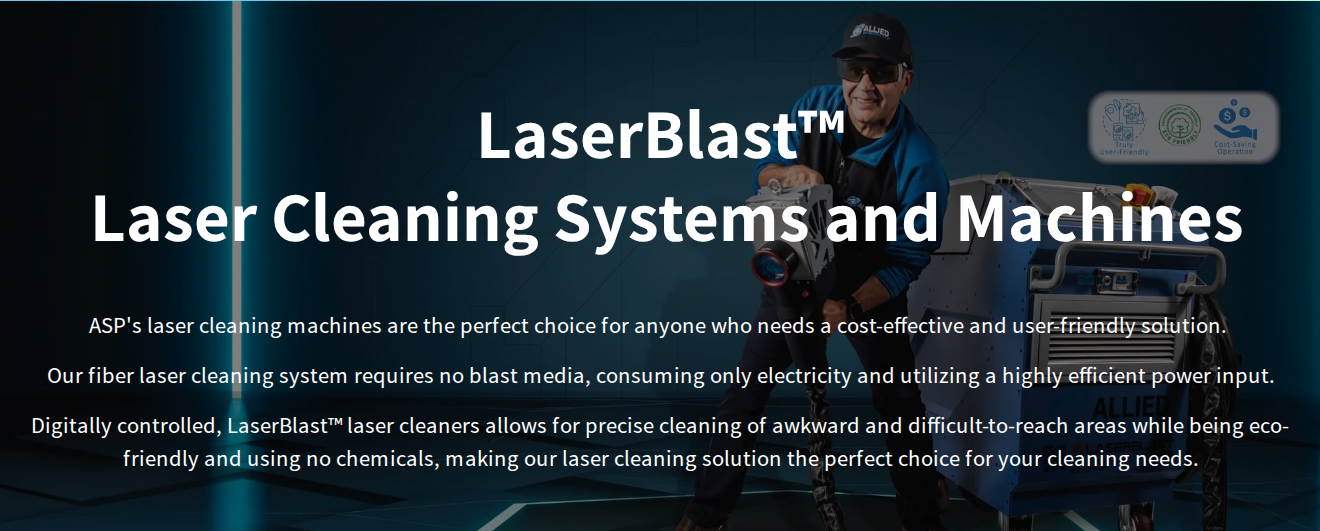
Allied Scientific Pro (ASP Laser Inc.) is a Canadian-owned manufacturer based in Gatineau, QC, offering the LaserBlast range of fibre laser cleaning systems from 100 W to 2000 W. The company's systems have been deployed in major Canadian conservation projects, including the restoration of the Parliament Building.
Pros:
Canadian-owned and operated manufacturer
Parliament Building restoration track record
Wide power range: 100 W to 2000 W
Toll-free Canadian support line available
Cons:
Fibre cable reach limited to 10–15 m
Higher-power models are heavy and water-cooled
No public list pricing available
Allied Scientific Pro (operating as ASP Laser Inc.) is a Canadian-owned manufacturer headquartered at 141 Rue Jean-Proulx, Suite 1, Gatineau, QC — making it one of the few laser cleaning machine suppliers in Canada that designs and builds its own equipment domestically.
The company's LaserBlast range spans six power levels — 100 W, 200 W, 300 W, 500 W, 1000 W, and 2000 W — covering a broad spread of cleaning applications from delicate conservation work through to heavy industrial surface preparation.
| Model | Weight | Fibre Cable | Cooling | Voltage |
|---|---|---|---|---|
| LaserBlast 100 W | 16 kg | 10 or 13 m | Air-cooled | 110 V AC |
| LaserBlast 500 W | 55 kg | 10 or 15 m | Water-cooled | 220 V AC |
| LaserBlast 2000 W CW | 260 kg | 10 or 13 m | Water-cooled | 220–240 V AC |
Model specs across the three documented LaserBlast configurations allow readers to compare weight, cable reach, cooling method, and voltage at a glance — far clearer in table form than prose.
The 100 W model's 16 kg weight and air-cooled design make it genuinely field-portable; the 500 W and 2000 W units are substantially heavier and require a water-cooling supply, which has practical implications for remote or cold-weather Canadian sites where water infrastructure may be limited.
Fibre cable reach across all documented models is 10–13 m or 10–15 m, which is a factual constraint worth noting for buyers who need to clean large structures or reach elevated surfaces from a ground-level unit.
LaserBlast Applications
ASP markets the LaserBlast range under two distinct sub-brands aligned to specific verticals: LASER AERO for aerospace and automotive applications, and LASER ART for heritage conservation and building restoration.
- Heritage and building restoration: Stone, metal, and wood cleaning for architectural conservation — the application ASP is most publicly associated with.
- Aerospace and automotive: Paint stripping, rust removal, and surface preparation for aircraft components and automotive parts under the LASER AERO brand.
- Industrial surface preparation: Welding preparation, rust and oxidation cleaning, coating removal, and mill scale removal.
- Nuclear decontamination: Radioactive surface cleaning for nuclear plant environments, listed across multiple product pages.
- Infrastructure maintenance: Cleaning of concrete infrastructure including dams and highway overpasses, documented on the 100 W product page.
The heritage track record is ASP's most distinctive credibility signal on this list. According to a 2021 ConstructConnect/Daily Commercial News article, ASP's laser cleaning technology was selected for the Centre Block and East Block restoration work on the Canadian Parliament Building — described by ASP founder Steeve Lavoie as "the biggest job using it in Canada."
"They had tried German-made equipment and came to us because they wanted to source something locally and we said, 'sure, we can do that.' Now it's a showcase for the technology since this is the biggest job using it in Canada."
ASP's LaserBlast systems have been in use on major North American conservation projects since 2017, according to the company's own about page — a verifiable deployment history that distinguishes it from suppliers with no documented Canadian project track record.
Canadian Availability and Support
ASP operates a Canadian toll-free line at 1-800-253-4107 and can be reached via their Gatineau headquarters directly — concrete in-country support signals for Canadian buyers evaluating after-sales access.
LaserBlast Pricing
List prices are not published on ASP's website for the Canadian market; buyers should contact the sales team directly for current pricing.
The 100 W, 200 W, 300 W, 500 W, 1000 W, and 2000 W models all show a 2–4 week lead time on their respective product pages — a useful planning signal for buyers working to a procurement schedule.
Product 4
IPG | cleanLASER CL-Series
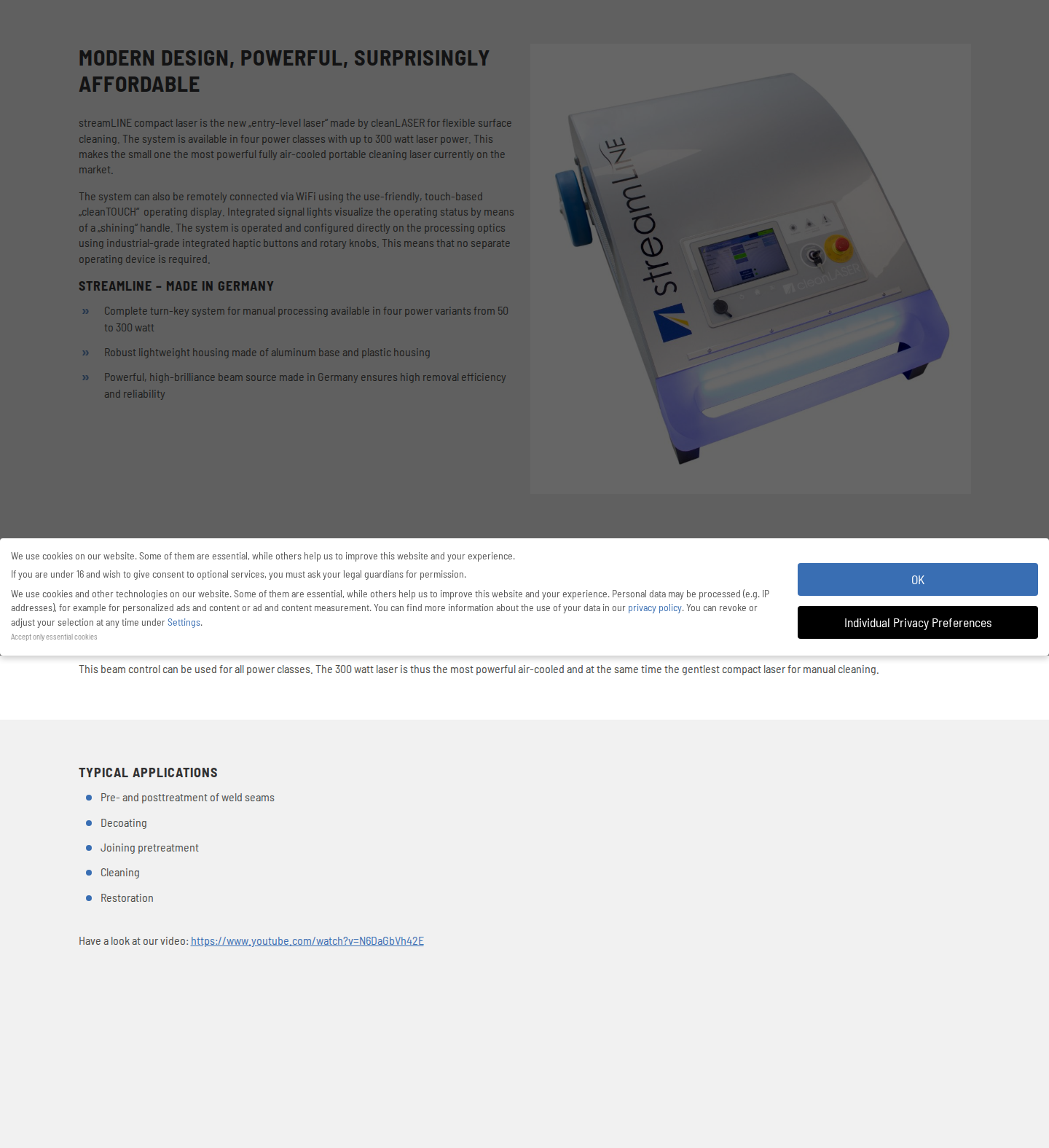
cleanLASER (Clean-Lasersysteme GmbH), a German-origin industrial laser cleaning pioneer founded in 1997 and acquired by IPG Photonics in December 2024, offers the broad CL-series spanning from a 20 W portable backpack system through to 1,600 W water-cooled industrial units and an automotive-certified automated production system.
Pros:
Widest power range: 20 W to 1,600 W
Automotive production certification (CL 1000iF)
IPG Photonics global backing and resources
IPG Canadian offices in Burlington and Kingston
Cons:
Post-acquisition support route needs direct verification
CL 2000 requires three-phase power and water cooling
CL 20 limited to 20 W throughput
Clean-Lasersysteme GmbH (cleanLASER) was founded in 1997 in Herzogenrath, Germany, and has grown into one of the most established names in industrial laser cleaning, with approximately 2,000 installed systems across automotive, aerospace, and heavy industry worldwide.
In December 2024, IPG Photonics (NASDAQ: IPGP) — a major global fibre laser manufacturer — completed its acquisition of cleanLASER, bringing the product family under the umbrella of one of the world's largest photonics companies.
CL-Series: Power Range and Form Factor
The defining characteristic of the CL-series is its breadth: few product families in the laser cleaning market span from a 20 W entry-level backpack system all the way to a 1,600 W water-cooled industrial unit within a single range.
| Model | Power Range | Form Factor | Cooling |
|---|---|---|---|
| CL 20 | 20 W | Backpack (portable) | Air-cooled |
| streamLINE compact | 50–300 W | Portable unit, hand optics | Air-cooled |
| CL 150 / 300 / 500 / 600 | 150–600 W | Mobile (wheeled) | Air-cooled |
| CL 1000 | 1,000 W CW | Mobile (wheeled) | Air-cooled |
| CL 2000 | Up to 1,600 W CW | Mobile (wheeled, 460 kg) | Water-cooled (external chiller) |
| CL 1000iF | High-power | Stationary (production line) | Water-cooled |
The CL-series covers six distinct model tiers across a wide power and form-factor spectrum. A table communicates these differences more clearly than prose, helping Canadian buyers quickly match a model tier to their application and facility requirements.
The CL 20 backpack system is the most portable option but operates at only 20 W — throughput on heavy contamination will be limited, and buyers should match this tier carefully to lighter-duty applications.
streamLINE Compact Portable Series
The streamLINE compact is cleanLASER's most field-deployable system: fully air-cooled, available up to 300 W, WiFi-connected, and designed around ergonomic hand optics for operator comfort during extended use.
Running on a single-phase supply with no water cooling required, it is a genuine portable option for field cleaning tasks — surface preparation, weld seam cleaning, mould maintenance, and similar applications where moving the machine to the workpiece is necessary.
High-Power CL-Series
The CL 1000 and CL 2000 are wheeled mobile units intended for fixed industrial facilities rather than field deployment — the CL 2000 weighs 460 kg and requires an external water chiller, which places real constraints on where it can be operated.
For Canadian buyers in remote locations or smaller facilities without three-phase power infrastructure, the CL 2000's utility requirements are a practical consideration worth factoring into any site assessment before specifying this tier.
CL 1000iF Automated System
The CL 1000iF is a stationary, production-line-integrated system with an area cleaning rate of up to 120 cm²/s, certified for automotive production environments.
Robotic-guided configurations are also available across the CL-series for automated applications, extending the range into fully integrated manufacturing cells.
Application Coverage
- Automotive and EV / e-mobility: Including battery component preparation and production-line integration via the CL 1000iF, which carries automotive production certification.
- Aerospace: Surface preparation and coating removal on high-value components where substrate integrity is critical.
- Rubber and tyre mould cleaning: A well-documented application for mid-power CL-series units, removing residue without damaging mould geometry.
- Nuclear decontamination: High-power CL-series systems have been deployed in nuclear decontamination contexts where chemical-free cleaning is a requirement.
- Food industry and printing rollers: Including wafer bakery equipment cleaning and printing roller maintenance, demonstrating range across regulated and precision industries.
- Heritage restoration: Lower-power CL-series systems have been applied to stone, metal, and architectural conservation work.
The breadth of documented application coverage is a genuine strength of the CL-series — the range has been deployed across more industry verticals than most competitors on this page.
IPG | cleanLASER in Canada
IPG Photonics maintains Canadian offices in Burlington, ON and Kingston, ON, which represents a meaningful in-country presence for a parent company of this scale.
However, the acquisition completed in December 2024, and Canadian buyers should contact IPG Photonics Canada directly to confirm the current sales channel and after-sales support route for cleanLASER products specifically — continuity of the prior cleanLASER distribution arrangement should not be assumed without verification.
IPG Photonics has Canadian offices in Burlington and Kingston, ON, but the cleanLASER acquisition completed in December 2024. Before committing, contact IPG Photonics Canada to confirm which channel handles CL-series sales and post-sale support in your region.
This is a practical buyer action rather than a disqualifying concern — IPG's global scale and established Canadian footprint are real assets — but the transition is recent enough that the support route warrants direct confirmation.
IPG | cleanLASER CL-Series Pricing
No list prices for the CL-series are publicly confirmed for the Canadian market through approved sources.
Canadian buyers should contact IPG Photonics Canada directly to request current pricing for the streamLINE compact and any other CL-series models available through the post-acquisition Canadian channel.
Product 5
P-Laser QF-Series

P-Laser is a Belgian manufacturer of pulsed industrial laser cleaning systems spanning 50 W to 3000 W, available in Canada through a dedicated distributor based in Orleans, Ontario.
Pros:
Dedicated Canadian distributor in Orleans, Ontario
Wide power range: 50 W to 3000 W
ECO-C compact series is air-cooled and portable
CleanSweep software with wireless tablet control
Cons:
Water cooling required on higher-power models
ECO-C power upgrades require return to Belgium
Distributor, not a Canadian-native manufacturer
P-Laser is a Belgian manufacturer — not a reseller — that develops and produces its own pulsed industrial laser cleaning systems, with a product range running from 50 W to 3000 W across seven distinct product lines.
For Canadian buyers, the most practical signal is the presence of P-Laser Canada, a dedicated in-country distributor located at 201-1671 Vimont Court, Orleans, Ontario (K4A 3M3), reachable at +1 613-222-1424. A dedicated distributor is not the same as a Canadian-headquartered manufacturer, but it does mean a local point of contact for enquiries, quotes, and initial support — a meaningful step above relying on international shipping channels alone.
P-Laser QF-Series Product Lines
The QF-series spans three main manual cleaning configurations, each suited to a different operating context.
| Product Line | Power Range | Cooling | Form Factor | Target Context |
|---|---|---|---|---|
| ECO-C Compact | 50–500 W | Air-cooled | 30–32 kg, 110–240 VAC single phase | SMEs, service providers, portable field use |
| Trolley | 200–3000 W | Water-cooled (mid and high power) | Mobile carriage, factory-floor navigation | Demanding industrial: mould cleaning, paint removal, rust removal |
| Cube | 2000–3000 W | Water-cooled | Hoisting points and wheels, 3-phase power | Extreme conditions: shipyards, heavy steel industry |
Lets readers compare the three main P-Laser product lines at a glance on power, cooling, form factor, and target context — mirroring the structured comparison readers are already making across the full list.
The QF-2000 and QF-3000 Trolley models are specifically cited by P-Laser for shipyard, mining, and petrochemical applications, and the Cube line is built for extreme shipyard and heavy steel industry conditions — with hoisting points and wheels designed for movement across demanding sites.
Across all lines, P-Laser systems handle rust, oxides, paint, grease, oil, and other surface contamination on metals, plastics, ceramics, glass, stone, and concrete.
A genuine differentiator across the P-Laser range is CleanSweep, the company's proprietary in-house developed software. It provides full parameter control via a wireless tablet interface, allowing operators to create and store custom cleaning programs and fine-tune settings across varied applications without needing a connected PC on-site.
Trade-offs to Consider
Water cooling is required on Trolley and higher-power models from 200 W upward. For Canadian buyers operating in cold or remote environments — where chiller infrastructure or reliable water supply may be limited — this is a practical constraint worth factoring into site planning.
The ECO-C compact series is upgradeable within the same frame (from 50 W to 300 W, and from 300 W to 500 W), but P-Laser's own product page confirms that the unit must return to their production facility in Belgium to complete an upgrade. Buyers expecting to scale their power requirements over time should weigh the logistics of international equipment shipping against the convenience of the upgrade path.
P-Laser QF-Series Pricing
No public list pricing is available for the Canadian market. Price varies significantly by power level, cooling method, and product line — an air-cooled ECO-C50 sits at a very different price point from a water-cooled Trolley QF-2000 or a Cube configured for shipyard use. Contact P-Laser Canada in Orleans, Ontario (+1 613-222-1424) for current pricing on any configuration.
Not Sure Which Machine Fits Your Operation?
You have seen the full lineup. If you want to talk through the options with a laser cleaning expert, book a 30-minute call or send us a message directly.
Conclusion
Choosing the Right Laser Cleaning Machine for Canada
The right machine for your operation comes down to three things: how your team works, how much you're cleaning, and where you're doing it.
For the broadest range of Canadian buyers — field crews, contractors, service businesses, and mixed-use facilities — the ELASER-RHZ stands apart: its world-first reduced hazard zone technology removes the safety overhead that makes conventional laser cleaning impractical in open environments, and a 50 m cable reach that most competitors simply cannot match.
If you'd like to discuss your specific requirements or arrange a demonstration, the team at Woodrow Scientific would be glad to hear from you.
Laser Cleaning Machines in Canada: Frequently Asked Questions
Common questions about laser cleaning technology, pricing, and business viability — answered plainly for Canadian buyers evaluating their options.
Yes — laser cleaning is a proven industrial technology, not an emerging one. The process works through laser ablation: a focused beam delivers energy that selectively vaporises contaminants such as rust, paint, oxide layers, and grease, while leaving the base material intact. The beam interacts with the contaminant, not the substrate beneath it. The technology is well-established across automotive manufacturing, aerospace maintenance, heritage and monument restoration, and infrastructure maintenance. It has been deployed at industrial scale for decades. Getting the best results requires matching the laser's power level and pulse parameters to the specific application and material — a 100 W system suited to delicate conservation work operates very differently from a 1,000 W system designed for production-line descaling. The key practical advantage is substrate preservation: because the beam stops at the base material, there is minimal surface damage and significantly less rework compared to abrasive or chemical alternatives.
The price spectrum is wide. Entry-level portable systems around 100 W typically start in the low five figures; mid-range industrial systems in the 200–500 W range sit meaningfully higher; and high-power or fully automated cleaning cells represent a significant capital investment. No supplier on this page publishes list prices — quotes are the norm in this category. The more useful frame is total cost of ownership. Laser cleaning machines run with zero consumables: no abrasive media, no chemical agents, no blast material to dispose of. That eliminates a recurring cost that compounds over the life of the equipment. Reduced substrate damage also means less rework, which has a real dollar value in production environments. Over a multi-year horizon, the operating cost comparison with sandblasting or chemical stripping shifts substantially in laser cleaning's favour — the upfront investment is the starting point of that calculation, not the full picture.
List prices are rarely published in this category, and that applies to the Canadian market as much as anywhere. The right starting point is to request quotes directly from the suppliers covered on this page — several of them are Canadian-headquartered or have dedicated Canadian distribution, which can affect both pricing and the support structure included. When comparing quotes, the factors that drive price variation are: laser power output (higher wattage means higher cost), cooling method (air-cooled systems are generally less expensive than water-cooled configurations), form factor (a portable handheld unit versus a fixed automated cell), and the after-sales support package — warranty terms, training, and local service access. The entries on this page span the full spectrum, from compact portable systems suited to field use through to high-power automated cells for fixed industrial facilities, so there are starting points for a range of budgets and use cases.
For a service business built around a portable system, laser cleaning can be genuinely profitable. The core reason is simple: zero consumables keep running costs very low, and a single operator can handle most jobs independently, keeping overhead minimal. Profitability is achievable — but it is not automatic. Utilisation rate is the critical variable: a machine that sits idle between jobs is not generating revenue, so building a reliable client base before or shortly after purchase matters. Local market demand is also a real factor; areas with heritage buildings, marine infrastructure, industrial facilities, or active manufacturing tend to offer stronger opportunities for precision cleaning services. The operators who do well tend to price on value rather than competing on hourly rate against sandblasters. Laser cleaning commands a premium in precision, heritage, and contamination-sensitive applications precisely because it preserves the substrate and produces no secondary waste — clients in those segments will pay for that. The business case is solid when the market fit is right; the honest caveat is that market research before committing is time well spent.