

Introduction
If you already know you want a laser cleaning machine and you're now working out which one to buy in the UK, this list is for you.
Every entry here is genuinely available in the UK market — sold, shipped, or distributed through a verifiable UK presence or supply route, not just labelled as such.
As you read through, the dimensions worth tracking are form factor and portability, power output, application fit, safety classification, certifications, and whether you're buying from a manufacturer or a distributor.
The list excludes global catalogues with a UK label applied, unverified marketplace resellers, and companies offering laser cleaning as a service rather than selling machines.
The background section covers the key decision variables in more depth; the conclusion maps the main differentiators to help you shortlist.
TL;DR
Not every machine marketed to UK buyers is genuinely obtainable here — and availability is only the first filter. UK availability, safety classification, certifications, and manufacturer standing all shape which options are worth serious consideration, and they vary more across this market than most buyers expect.
This article covers:

Laser cleaning machines genuinely available in the UK
Form factor and portability compared across entries
Power output and application fit per machine
Safety classification and certifications for each option
Manufacturer vs. distributor standing explained
How to shortlist using the conclusion
UK laser cleaning machines: what buyers need to know
The UK laser cleaning market has a structural quirk that catches buyers off guard: the overwhelming majority of systems sold here originate overseas, with Germany, the US, and China as the principal manufacturing sources, according to IndexBox market data showing imports supply over 99% of domestic laser consumption.
Given that imports dominate supply, many UK-facing suppliers are resellers, integrators, or distributors rather than the companies that actually designed and built the machine. Before committing to any system, buyers should ask directly: who manufactured this, and where?
That question matters because a genuine manufacturer designs, builds, services, and improves its machines in-house. A reseller cannot offer the same depth of engineering support, spares turnaround, or customisation capability — and that gap becomes very visible the first time something needs fixing or adapting.
In a market where imports dominate supply, the difference between buying from a manufacturer and buying from a reseller directly affects after-sales support quality, spares speed, and your ability to modify the machine for your process.
Two form factors: portable and automated
The machines on this list — and in the UK market generally — fall into two distinct categories, each suited to a different kind of operation.
- Portable / handheld systems: Wheeled units with a lightweight scanning head the operator positions by hand. Best for on-site work, field use, and parts with varied or complex geometry.
- Automated systems: Robotic cells or fixed workstations where the laser head moves under program control. Best for repetitive, high-volume production cleaning of consistent part types.
Choosing between them is primarily a question of volume and geometry: portable systems offer flexibility across varied workpieces; automated systems deliver throughput and repeatability when the same part runs at scale.
Two laser source types: pulsed and continuous-wave
Within both categories, you will encounter two laser source types that behave differently in practice.
- Pulsed fibre laser: Delivers energy in high-intensity bursts with a small heat-affected zone. Preferred for delicate substrates, precision cleaning, and surface-sensitive applications.
- Continuous-wave (CW) laser: Delivers constant output power. Suited to high-throughput heavy contamination removal on robust metals where heat build-up is less critical.
The distinction matters for substrate sensitivity: pulsed systems give finer control and a lower thermal footprint, making them the safer choice for thinner metals or precision components; CW systems prioritise speed on heavy-duty stock.
Safety and certification: what UK buyers must know
The laser sources inside industrial cleaning machines are Class 4 — the highest-hazard category. Open-beam and handheld systems operate as Class 4 products in use, and GOV.UK guidance confirms that employers using such equipment must carry out a risk assessment, implement adequate control measures, and provide operator training under the Control of Artificial Optical Radiation at Work Regulations 2010.
The practical implication for open-workshop environments is significant: Class 4 operation typically requires a designated controlled area — physically enclosed or restricted — to limit access while the laser is in use. For buyers considering portable, open-beam systems in shared or public-facing spaces, this is a real operational constraint, not a paperwork formality.
On conformity marking: GOV.UK guidance confirms that both CE marking and UKCA marking are currently recognised for products placed on the GB market, under The Product Safety and Metrology (Amendment) Regulations 2024. UKCA is the UK-specific post-Brexit marking; CE recognition continues alongside it. Buyers should confirm which marking a machine carries before purchase.
With those variables in mind, here is how the laser cleaning machines currently available to UK buyers compare.
Product 1
Woodrow Scientific ELASER / ELASER-RHZ and AutoLASE
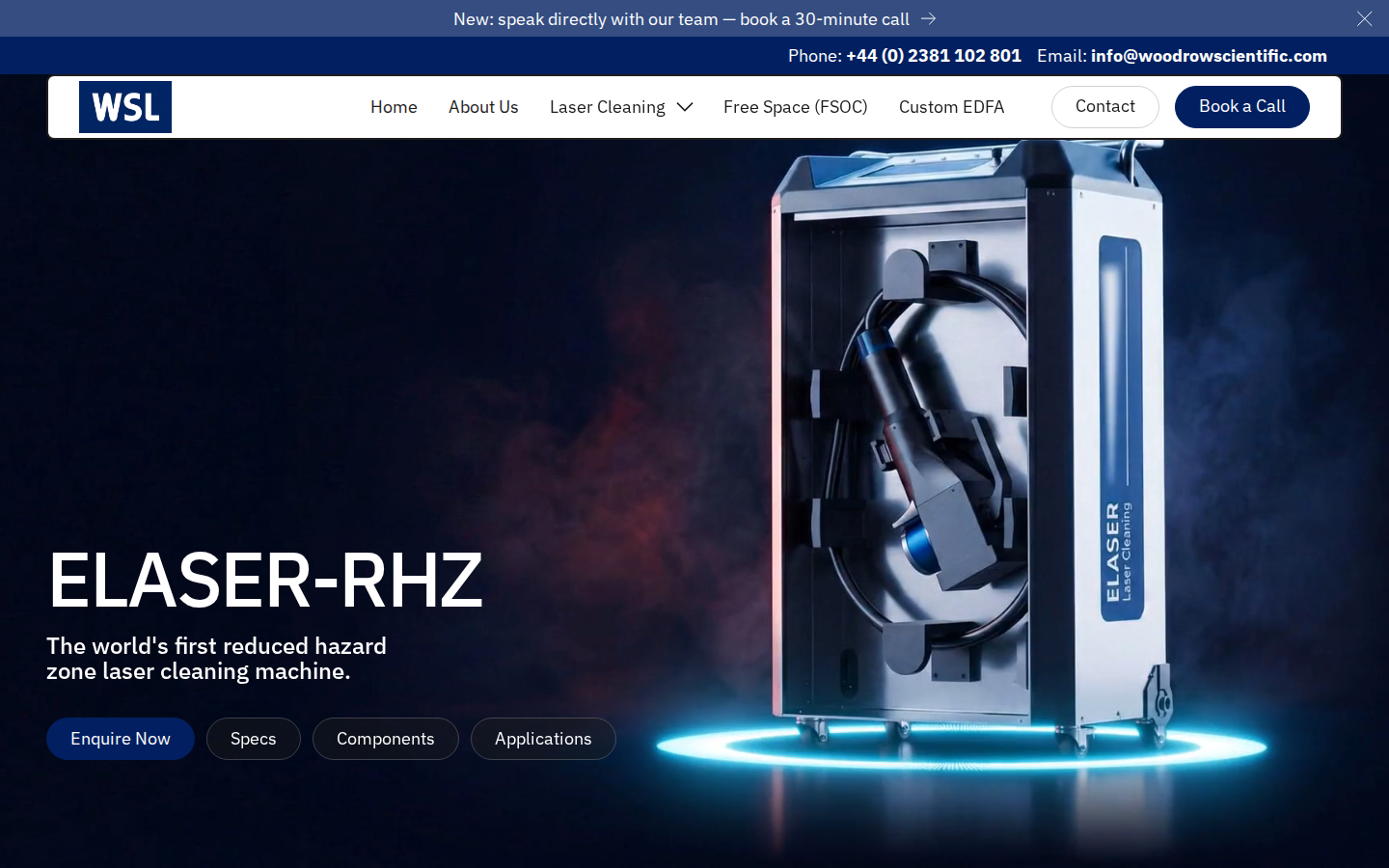
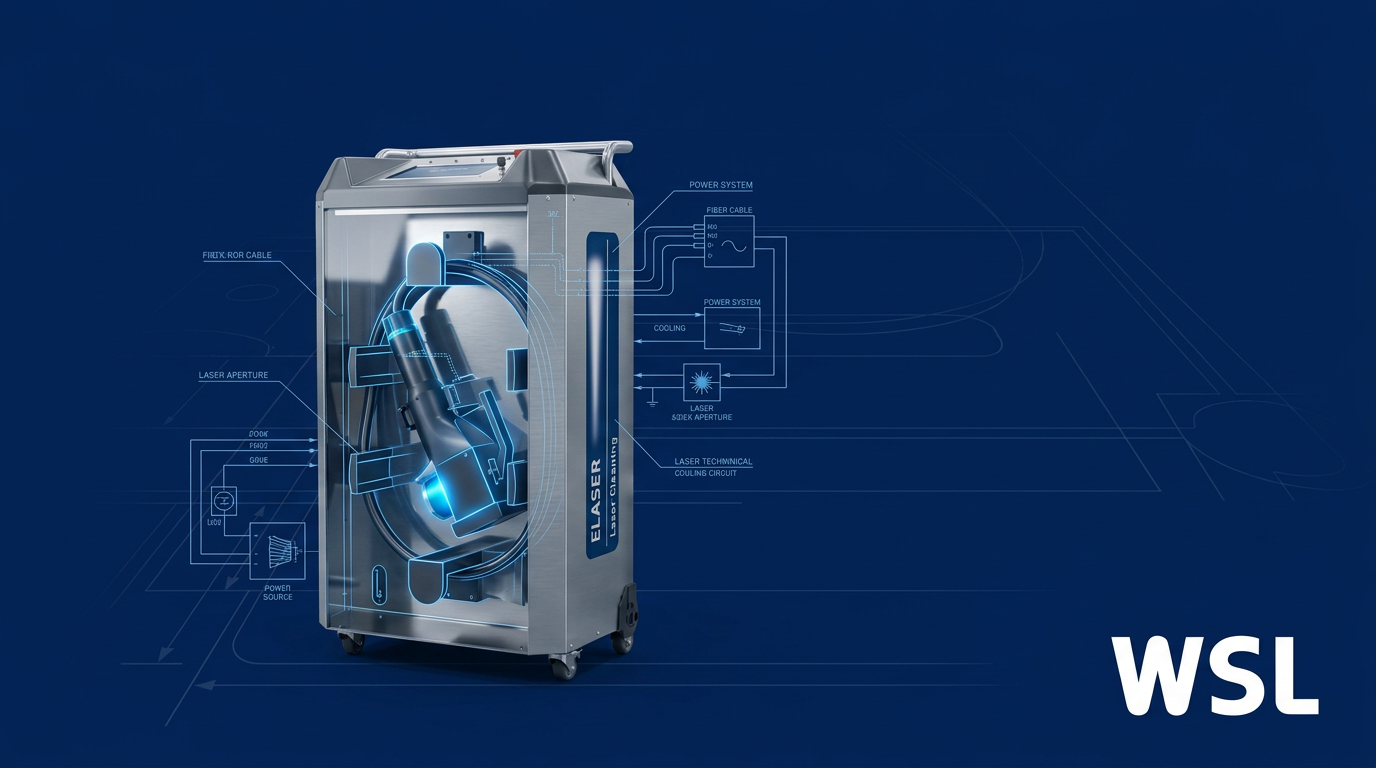
The only UK-based laser cleaning manufacturer, with world-first patented reduced-hazard-zone technology that enables cleaning in open workshops and public spaces where conventional laser cleaning cannot operate.
Pros:

World-first patented reduced-hazard-zone technology
Only UK-based laser cleaning manufacturer
Up to 50 m delivery cable reach
CE and UKCA certified
Cons:

No published list price; quote only
Woodrow Scientific Limited (WSL) is the only UK-based laser cleaning manufacturer — designing, building, servicing and improving its own machines in-house at its Southampton facility, rather than reselling or integrating third-party hardware.
Founded in 2012 by a fibre-laser specialist with a PhD from Southampton's Optoelectronics Research Centre, WSL brings over 200 years of combined engineering experience and 10 patents to a product line that includes the portable ELASER and ELASER-RHZ, and the automated AutoLASE.
The ELASER-RHZ uses WSL's patented technology to collapse the laser hazard zone to a small area around the work. Where conventional laser cleaning requires an area to be sealed off and evacuated, the ELASER-RHZ enables continuous cleaning in open workshops, mixed-use manufacturing facilities, and publicly accessible environments — unlocking applications that were previously impractical with any laser cleaning system.
All ELASER models are Class 4 laser products; the ELASER-RHZ adds advanced engineering controls that make access to radiation above Class 1 impossible — that is what reduces the hazard zone, not a downgrade in laser class.
In practical terms, this means graffiti removal in public spaces, heritage and monument restoration in accessible settings, and cleaning in open-plan manufacturing floors can all proceed without shutting down the surrounding area.
ELASER Form Factor, Power and Specifications
The ELASER and ELASER-RHZ are built around a wheeled unit under 50 kg paired with a handheld scanner weighing under 3 kg — a genuinely single-operator system with no compressor, water supply, chiller or consumables required.
The delivery cable reaches up to 50 m (5 m and 15 m supplied as standard, extendable to 50 m), giving operators a substantial working radius from a single unit position.
Power is available in 100 W, 200 W and 300 W models, fully tunable from 0–100%, spanning light oxide removal through to thick coatings on a single machine.
| Specification | ELASER / ELASER-RHZ |
|---|---|
| Max power | Up to 300 W (100 W, 200 W, 300 W models) |
| Wavelength | 1550 nm |
| Pulse energy | Up to 15 mJ |
| Pulse duration | 100 ns |
| Pulse repetition rate | Adjustable up to 200 kHz |
| Power tunability | 0–100% |
| Delivery cable | Up to 50 m (5 m / 15 m standard) |
| Scanner weight | Under 3 kg |
| System weight | Under 50 kg |
| Working distance (F-Theta lenses) | 75–500 mm |
| Power supply | 110–250 VAC single-phase |
| Laser class | Class 4 (ELASER-RHZ: advanced controls prevent access above Class 1) |
| Certifications | CE, UKCA |
Key specifications for the Woodrow Scientific ELASER and ELASER-RHZ portable laser cleaning systems.
The touchscreen GUI supports programmable scan shapes, password-protected access, per-user logins and usage tracking — useful for facilities managing multiple operators or tracking cleaning activity across shifts.
Application Fit
The ELASER-RHZ covers a broad range of industrial cleaning tasks, with the reduced-hazard-zone capability opening up environments that conventional laser cleaning cannot reach.
- Injection moulding and tooling: Strip residue, release agents and build-up from moulds and tooling in place, with no disassembly required.
- Automotive: Pre-weld surface prep on the production line, rust removal, and paint stripping in the bodyshop.
- Industrial maintenance: Clean plant, equipment and infrastructure on site with no masking or media clearance.
- Tyre and rubber moulds: Remove vulcanisation residue and build-up from moulds, segments and vents without abrasive wear.
- Aerospace: Precise surface preparation and component cleaning to tight tolerances.
- Heritage and monument restoration: Lift soiling, paint and corrosion from stone, metal and masonry — gentle on the original surface, suitable for publicly accessible sites.
- Graffiti removal: Clean in open public spaces where conventional laser cleaning would require area evacuation.
- Laser cleaning service businesses: A portable system with full operator training from the manufacturer, ready to deploy commercially.
These are illustrative examples rather than an exhaustive list — the ELASER-RHZ is suited to a wide range of further cleaning tasks across industries.
AutoLASE: Automated Laser Cleaning for Production
AutoLASE is WSL's automated counterpart to the portable ELASER, designed for repetitive production cleaning where manual operation is not the right fit.
The defining characteristic of AutoLASE is how easy it is to run: load the part, and the system's machine vision scans it, builds a 3D map and generates the cleaning path automatically — no manual programming, no path-setting, and no knowledge of the part geometry required.
AutoLASE can be configured with WSL's Reduced Hazard Zone (RHZ) upgrade, meaning the system requires no enclosure at all — the only automated laser cleaning system in the world to offer this capability.
The cleaning head is carried on a multi-axis articulated robotic arm; AutoLASE attaches to the customer's existing collaborative or industrial robots, or WSL can supply it as a complete custom cell.
Production applications include injection moulds and tooling, automotive engine and driveline components, EV battery parts, aerospace turbine blades and vanes, tyre and rubber moulds, and remanufacturing and refurbishment workflows.
Bespoke engineering, integration and customisation are available — WSL works closely with customers to configure the system for their specific production environment; contact WSL directly to discuss requirements.
Certifications, Pricing and UK Availability
Both the ELASER/ELASER-RHZ and AutoLASE carry CE and UKCA certification, satisfying the compliance requirements of UK procurement processes.
Pricing is available on application; WSL's machines are competitively priced, representing the most competitive upfront cost among comparable industrial laser cleaning machines in Europe.
Machines are designed, built and shipped direct from WSL in Southampton, with a typical lead time of one week from order for standard builds; customised configurations take longer.
Safety and operation training is available directly from the manufacturer — contact WSL to discuss training options alongside your enquiry.
See the ELASER — built in the UK
Woodrow Scientific designs and builds its laser cleaning machines in Southampton. Explore the ELASER product page or book a call to discuss your application with the team directly.
Product 2
LaserStrip — pulsed and CW handheld systems
Leeds-based specialist that selects, supplies and supports pulsed and CW fibre laser cleaning machines, with four published prices and nationwide UK mainland delivery.
Pros:
Four machines with published prices
Covers both pulsed and CW form factors
UK-based with nationwide mainland delivery
Operator training available from LaserStrip
Cons:
Selects and supplies machines; no in-house build
Training and commissioning quoted separately
Finance excludes sole traders below £25,000
LaserStrip Ltd is a laser cleaning equipment specialist based in Leeds, West Yorkshire, that selects, supplies and supports pulsed and continuous-wave fibre laser cleaning machines, delivering to every part of the UK mainland.
Its value proposition is application-led selection — recommending on substrate, coating, throughput and site requirements — backed by UK-based technical support after the sale.
LaserStrip machines and power range
Every machine in the LaserStrip range is worked through a handheld cleaning head on a cable. The published range runs from 300 W pulsed to 3 kW continuous-wave, with further models extending to 6 kW CW and bespoke automated systems priced on enquiry.
The Pro 500 15mJ is LaserStrip's main pulsed machine for commercial work: 500 W, 15 mJ pulse energy, a 10 m gun line, air-cooled, single-phase supply, and 35 kg net weight. The Pro 300 (300 W, 5 mJ, 28 kg) is positioned for controlled lower-heat cleaning of coatings, oxides and detail work, while the Pro 300 15mJ (300 W, 15 mJ, 28 kg) targets moulds, tooling and tougher bonded layers.
On the continuous-wave side, the Pro 3000 CW delivers 3 kW through a water-cooled cabinet (147 kg, three-phase supply), with a 15 m gun line as standard and a cleaning width of up to 300 mm. LaserStrip positions it for heavy rust, mill scale, thicker coatings and higher-throughput steelwork where finish tolerance is less critical.
LaserStrip pricing
LaserStrip publishes prices for four machines on its website, making it straightforward to compare costs before making any enquiry. The four priced machines are:
| Machine | Type | Power | Price (ex VAT) |
|---|---|---|---|
| Pro 300 | Pulsed | 300 W | £12,995 |
| Pro 300 15mJ | Pulsed | 300 W | £13,995 |
| Pro 3000 CW | Continuous-wave | 3 kW | £17,995 |
| Pro 500 15mJ | Pulsed | 500 W | £22,995 |
Published list prices for the four LaserStrip machines with stated prices. All prices exclude VAT. Delivery, commissioning and operator training are quoted separately.
Payment terms are 50% deposit on order and 50% when the machine is built and ready. Business finance is available through an FCA-regulated credit broker, subject to status; LaserStrip notes that sole traders can only access finance where the amount borrowed exceeds £25,000, which none of the four priced machines reaches.
Application fit
LaserStrip describes the pulsed range as the choice for controlled work: paint removal, oxide removal, contamination removal, moulds, tooling, detail and heat-sensitive or finished surfaces where low heat input is a priority.
The CW range is suited to heavy rust, mill scale and thicker coatings on robust, heat-tolerant steel where throughput matters more than finish. LaserStrip is explicit that CW puts materially more heat into the part and is not appropriate for thin, precision or heat-sensitive substrates.
Safety, warranty and after-sales
Every machine in the LaserStrip range is a Class 4 laser product. LaserStrip states on its buy page that risk assessments, RAMS, site controls, competent operation and insurance remain the operator's responsibility.
Each machine carries a one-year warranty on current terms, confirmed in writing on the quotation. UK-facing technical support is included after purchase. Operator training and commissioning are quoted separately alongside the machine price, so all charges are itemised before any commitment is made.
Product 3
ApexLase
UK-focused supply and integration brand offering pulsed ARC series and CW ION series fibre laser cleaning systems, serving as a single point of contact for UK buyers across both product lines.
Pros:
UK-focused brand, single point of contact
300 W pulsed to 3,000 W CW range
PPE and extraction peripherals available from supplier
Two distinct product lines for different tasks
Cons:
No published pricing; enquiry only
CE compliance varies by market and installation
Supply and integration brand, not original manufacturer
ApexLase is a UK-originated laser cleaning brand established to give UK customers a local point of reference and a single point of contact for pulsed and CW fibre laser cleaning systems.
It operates as a supply and integration brand: its systems are built around third-party fibre laser sources rather than laser sources manufactured in-house.
ARC Series — Pulsed Systems
The ARC series covers pulsed fibre laser cleaning from 300 W to 1,000 W, with all models powered by JPT MOPA sources.
The entry-level ARC300 runs at 300 W with 5 mJ pulse energy and is air-cooled, making it a self-contained, portable unit suited to workshop and site use.
| Model | Power | Pulse Energy | Laser Source | Cooling |
|---|---|---|---|---|
| ARC300 | 300 W | 5 mJ | JPT MOPA | Air |
| ARC500 | 500 W | 15 mJ | JPT MOPA | Air |
| ARC1000 | 1,000 W | – | JPT MOPA | Water |
ApexLase ARC series pulsed models and key specifications. – pulse energy not publicly listed for ARC1000.
The pulsed format delivers high peak power in short bursts, keeping heat input low — making the ARC series well suited to delicate substrates, paint and rust removal, automotive restoration, heritage and stonework cleaning, and precision mould cleaning.
ION Series — Continuous Wave Systems
The ION series covers continuous wave output from 1,000 W to 3,000 W, with all models water-cooled for sustained heavy industrial operation.
ION series machines use Raycus and NLight laser sources, and are positioned for maximum throughput on thick rust, mill scale, pipeline scale, and structural steel preparation.
- ION1000: 1,000 W CW, water-cooled, Raycus / NLight source
- ION2000: 2,000 W CW, water-cooled, Raycus / NLight source
- ION3000: 3,000 W CW, water-cooled, Raycus / NLight source
The constant-beam output of the ION series prioritises cleaning speed over substrate sensitivity, making it the appropriate line for robust structural metals and heavy fabrications where throughput is the primary requirement.
Safety and Supporting Equipment
All ApexLase machines are Class 4 laser products, as the brand states directly across its range documentation.
ApexLase also supplies peripheral products alongside its machines, including PPE and fume extraction units — a practical consideration for buyers who want to source the full operating setup through a single supplier.
UK Availability, Pricing and Certifications
ApexLase supplies both the ARC and ION series to businesses across the United Kingdom, with its positioning built specifically around UK customers and UK operating conditions.
No list prices are published; pricing is available on enquiry via sales@apexlase.com, where ApexLase also advises on application fit, training requirements, and peripheral equipment.
ApexLase states that systems are supplied with CE marking documentation, but notes that final compliance requirements vary by intended market and installation. Buyers should confirm the certification position for their specific application and market directly with ApexLase before purchase.
Product 4
Fanuci Futura via Rapid Welding
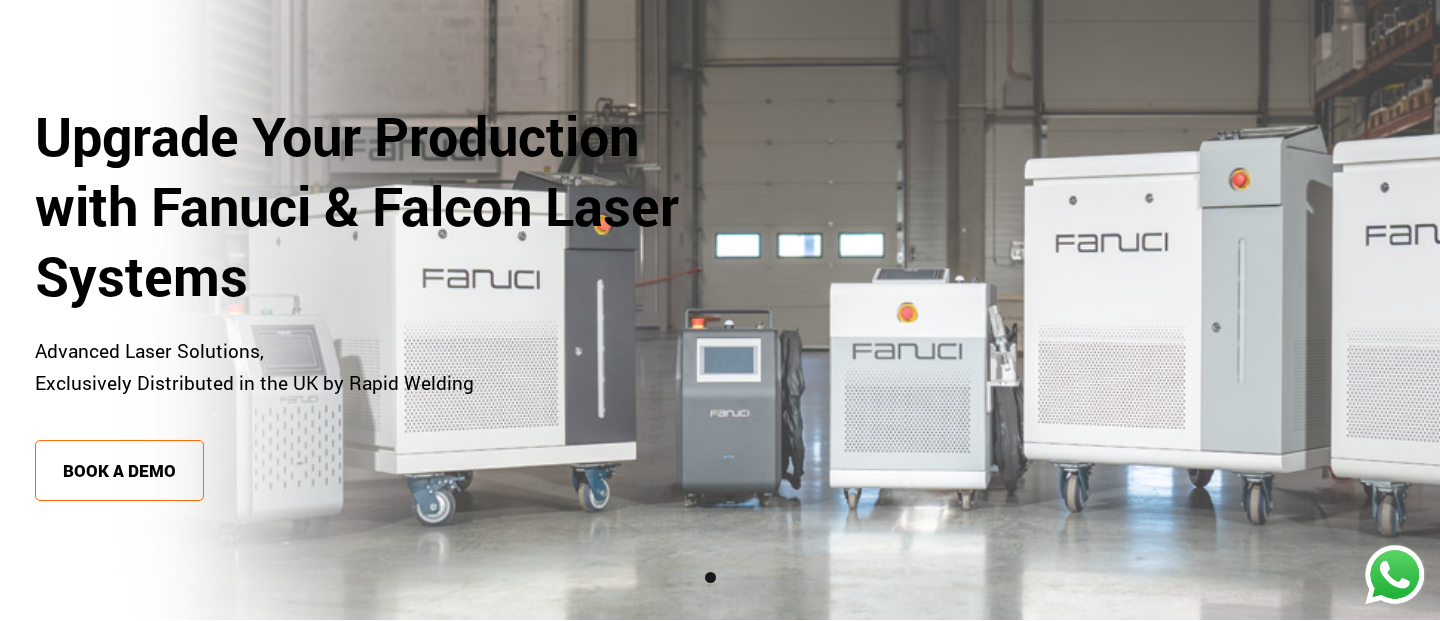
Fanuci Futura laser cleaning machines — manufactured by an international fibre laser group, exclusively distributed in the UK by Rapid Welding — spanning pulsed MOPA (100–300 W) and CW fibre (1,000–2,000 W) configurations.
Pros:
Published prices from £17,995 ex-VAT
Wide range: MOPA precision to CW heavy-duty
UK demo facility available at Rapid Welding
2–5 year warranty covering entire unit
Cons:
Distributor model; Fanuci is overseas manufacturer
Interest-free payment not available across full range
Fanuci is part of an international manufacturing group specialising in advanced fibre laser technology, with its cleaning machines sold in the UK exclusively through Rapid Welding, an authorised UK distributor.
Rapid Welding is a UK-based industrial supplier, not the machine builder — a distinction worth noting for buyers who want to understand where engineering accountability sits.
Fanuci Futura Product Lines
The Fanuci Futura range splits into two distinct configurations, each targeting a different tier of cleaning work.
| Configuration | Power Options | Primary Application |
|---|---|---|
| MOPA Pulsed | 100 W, 200 W, 300 W | Delicate cleaning: mould removal, sensitive surfaces, precision parts |
| CW Fibre | 1,000 W, 1,500 W, 2,000 W | Heavy-duty cleaning: rust removal, paint stripping, industrial contamination |
Fanuci Futura laser cleaning configurations, power options, and primary application areas as listed by Rapid Welding.
The MOPA pulsed configuration allows pulse length and frequency to be set independently, which gives operators finer control on varied or heat-sensitive substrates — an advantage over standard Q-switched pulsed machines on delicate work.
The CW fibre configuration is built for throughput: higher power means a larger area cleaned per minute, making it well suited to fabrication shops handling heavy rust, thick coatings, or pre-weld surface preparation.
Application Sectors
Rapid Welding lists the following sectors as application areas for the Fanuci Futura range: aerospace, automotive, defence and military, medical, electronics, petrochemical refining, communications, energy, and aviation.
Both product lines are described as non-abrasive and chemical-free, removing contaminants without affecting the base material beneath.
Fanuci Futura Pricing
The MOPA range starts from £17,995 ex-VAT for the 100 W model, with the 300 W model listed at £29,995 ex-VAT through Rapid Welding's online shop.
Rapid Welding lists an interest-free payment option on the 300 W model, structured as three equal instalments — a practical consideration for buyers managing capital expenditure.
UK Availability and Support
Rapid Welding is the sole route to market for Fanuci Futura machines in the UK, providing technical support, training, and after-sales service from their facility.
Live demonstrations are available at Rapid Welding's Laser Hub, allowing buyers to evaluate cleaning performance on their own materials before committing to a purchase.
Both MOPA and CW fibre machines carry a 2–5 year warranty covering the entire unit, as stated by Rapid Welding on their product listings.
The UK's own laser cleaning machine
Woodrow Scientific designs and builds its laser cleaning machines in the UK. The ELASER-RHZ brings patented reduced-hazard-zone technology to applications where conventional laser cleaning cannot operate.
Conclusion
Choosing the right laser cleaning machine for your UK operation
The three questions that matter most are straightforward: whether you need portability or automation, whether your environment is open or enclosed, and who actually stands behind the machine you buy.
If cleaning in open workshops or public-facing settings is part of your brief, the ELASER-RHZ is the only laser cleaner in the world built for it — and the AutoLASE with its optional RHZ upgrade is the only automated system that operates without an enclosure, built in-house by Woodrow Scientific in Southampton.
Get in touch with Woodrow Scientific to discuss the ELASER, ELASER-RHZ or AutoLASE for your operation.
Frequently asked questions about laser cleaning machines
Practical answers to the questions UK industrial buyers ask most when researching laser cleaning machines.
A laser cleaning machine uses pulsed laser energy to vaporise or dislodge surface contamination through a process called laser ablation — the beam targets the contaminant layer, which absorbs the energy and is ejected, while the base material beneath remains intact. It removes rust, oxides, mill scale, paint, powder coating, lacquer, primer, oil and grease, carbon and soot, mould residue, graffiti, adhesives, tarnish, weld discolouration, and release agents. Because each material has a distinct ablation threshold, the beam stops at the base material — leaving the underlying surface preserved and undamaged.
The right power level depends on three variables: the type and thickness of the contaminant, the sensitivity of the substrate, and the throughput you need. Lower-power pulsed systems — typically in the 100–200 W range — suit delicate substrates, precision mould cleaning, and surface-sensitive applications where minimising heat input is the priority. Higher-power systems, whether pulsed or continuous-wave (CW), suit heavier contamination such as thick rust, mill scale, and structural steel preparation where throughput matters more than heat control. Pulsed and CW source types serve fundamentally different tasks: pulsed for precision and substrate sensitivity, CW for maximum throughput on robust metals. Power figures are indicative — the right choice always depends on the specific application, and tunable systems (such as those adjustable from 0–100% across 100 W, 200 W, and 300 W models) give additional flexibility across a range of tasks.
All industrial laser cleaning machines are Class 4 laser products. Under the Control of Artificial Optical Radiation at Work Regulations 2010, employers must carry out a risk assessment, implement adequate control measures, and provide operator training. For conventional laser cleaning systems, managing the hazard zone typically means restricting or evacuating the surrounding area before work begins. WSL's ELASER-RHZ changes this. It uses WSL's patented, world-first reduced-hazard-zone (RHZ) technology, which confines the laser hazard to a small area immediately around the work itself. This enables cleaning to continue in open workshops, mixed-use manufacturing facilities, and public-facing environments — settings where conventional laser cleaning would require full area evacuation. The ELASER-RHZ is a Class 4 laser product with advanced engineering controls that make access to radiation above Class 1 impossible; it is this engineering that shrinks the hazard zone and unlocks a far wider range of operating environments.
Both CE and UKCA markings are currently recognised for placing machinery on the GB market. UKCA is the UK-specific conformity marking introduced following the UK's departure from the EU; it signals that a machine has been assessed against UK conformity requirements. Under The Product Safety and Metrology (Amendment) Regulations 2024, CE marking continues to be recognised alongside UKCA for the Great Britain market, giving businesses flexibility on which conformity route they use. Buyers should confirm the marking status of any machine before purchase as a standard procurement step. The Woodrow Scientific ELASER and ELASER-RHZ carry both CE and UKCA certification.
Pulsed fibre lasers deliver high-energy bursts of laser light in very short pulses. This produces a small heat-affected zone and precise, controlled ablation, making them the preferred choice for delicate substrates, precision mould cleaning, detailed parts work, and any application where minimising heat input is important. Continuous-wave (CW) lasers deliver constant laser output, generating higher average power suited to high-throughput removal of heavy contamination — thick rust, mill scale, structural steel preparation — on robust metals where heat input is less of a concern. The choice between pulsed and CW is fundamentally an application decision, not simply a power decision: the same wattage from each source type will behave very differently on the same surface.
Prices vary significantly by power output, form factor, and supplier. Among the published UK list prices in this market, pulsed systems start from around £12,995 + VAT for an entry-level 300 W machine, rising to £22,995 + VAT and above for higher-power pulsed configurations. CW systems and automated cells are typically priced on enquiry rather than listed publicly, as configuration varies too much for a single honest headline figure. Buyers should contact suppliers directly for a written quotation, as pricing varies by specification, power, and configuration.
Yes — some UK suppliers offer short-term hire on weekly or monthly terms, with a one-week minimum being typical. Hire suits buyers with a defined project, a fixed-term contract, or a short-term capacity gap. A hire agreement generally includes the machine, operational training at handover, safety documentation, and UK support for the duration of the hire period. Delivery and collection are usually quoted separately. Hire rates are quoted on enquiry rather than published, as they depend on duration and location.
Six questions are worth putting to any supplier before committing. Who manufactured the machine — is the supplier the original manufacturer or a reseller integrating third-party hardware? This affects the quality of support and the supplier's ability to improve the product. What conformity markings does it carry — CE, UKCA, or both? What training and after-sales support is included, and is it provided by the manufacturer directly or by a third party? What does the warranty cover and for how long? What is the lead time from order to delivery? And finally: can the machine be demonstrated on your specific material before you commit? A demonstration on your own substrate and contaminant is the most reliable way to verify that the machine will perform as expected in your application.