

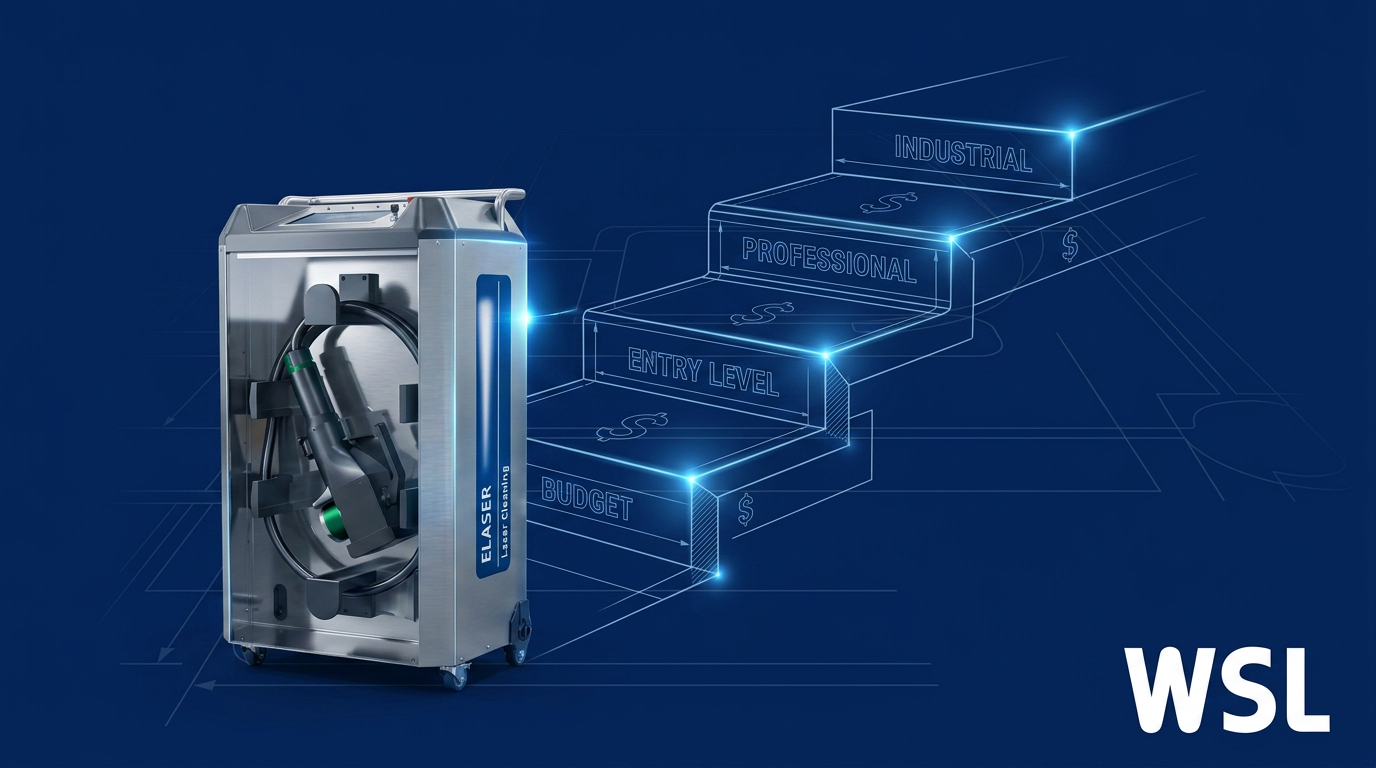
Introduction
If you have reached this guide, you have already done the early thinking — you know laser cleaning is worth investigating, and now you need to understand what it actually costs and, more importantly, why.
That second question is where most buyers hit a wall. Laser cleaning machine prices vary enormously, and the market does little to explain the gap — listings quote figures without context, and most guides stop before reaching the economics that matter.
This guide covers the full picture: price-driving variables, realistic price bands by power tier, total cost of ownership, and the practical considerations that shape a sound buying decision.
It is written for professionals making a significant capital investment — structured and direct, so you can build a credible business case.
TL;DR
Laser cleaning machine price is not a single number — it is the output of several interacting variables, and the sticker price is only the opening figure.
Once ownership economics are factored in, the apparent affordability of a cheaper machine often inverts. Understanding those variables separates a well-calibrated purchase from an expensive mistake.
This article covers:

Variables driving price: wattage, laser type, configuration
Realistic price bands at each power tier
Pulsed vs continuous-wave: impact on cost
Total cost of ownership vs sticker price
Running cost per hour and application matching
Financing and leasing the capital cost
What drives laser cleaning machine price?
Before any price figure makes sense, it helps to understand what kind of purchase a laser cleaning machine actually is — and why the market spans such a dramatically wide range.
Laser cleaning machines are capital equipment: depreciating assets purchased for their productive capacity over a multi-year working life, not consumable tools replaced on a budget cycle.
In operational terms, they use fibre laser technology to remove contamination — rust, paint, oxides, coatings, grease, mould residue — from surfaces through a process called laser ablation, powered entirely by electricity.
The purchasing distinction that matters most is this: unlike sandblasting, chemical stripping, or water-jetting, laser cleaning requires no consumables, no abrasive media, and no chemicals — the energy source is the grid, and that is largely where the ongoing input cost ends.
The five variables that determine machine price
Across the market, laser cleaning machine price is driven by five core variables — each explored in depth in the sections that follow, but worth naming here so the framework is clear from the outset.
- Laser power (wattage): The most direct price determinant. Higher wattage means greater throughput capability and a higher machine cost.
- Laser type: pulsed vs CW: Pulsed and continuous-wave fibre lasers serve different applications and sit at very different price points per watt.
- Portability configuration: From handheld portable units through to fixed workstations and fully automated robotic cells — each step up adds cost.
- Cooling system: Air-cooled vs water-cooled affects upfront machine cost, running cost, and the infrastructure a site must provide.
- Automation level: Manual handheld operation through to vision-guided robotic cells; automation adds capital cost but can offset labour.
These five variables interact — a high-power pulsed system almost always requires water cooling and commands a significantly higher price than a low-power CW handheld, for reasons that have nothing to do with build quality and everything to do with the engineering requirements of the specification.
The market runs from around $2,500 for an entry-level CW handheld to $200,000 or more for a fully integrated robotic cleaning cell. That gap does not reflect better or worse versions of the same machine — it reflects entirely different machine types built for entirely different jobs and workflows.
A portable pulsed system and an automated robotic cell are not the same product at different quality levels; they are different tools designed for different applications, scales, and operating environments.
This distinction matters practically: a buyer who selects on sticker price alone risks purchasing a machine that is either underpowered for their application or over-specified for a job that a simpler unit would handle at a fraction of the cost.
Purchase price vs total cost of ownership
Throughout this guide, sticker price and total cost of ownership (TCO) are treated as two distinct lenses — because they often tell very different stories about the same machine.
TCO factors in consumable costs (or their near-absence), energy consumption, maintenance requirements, downtime risk, and the quality of post-purchase support — all of which affect the real economic return on a capital investment over its working life.
On that note, one category-level observation is worth making early: buyers should establish whether they are purchasing from a genuine manufacturer — a company that designs, builds, and can genuinely improve and support the machine — or from a reseller importing and rebadging third-party hardware under its own label.
As industrial equipment procurement guidance consistently notes, the company supporting the machine becomes almost as important as the machine itself: service responsiveness, spare parts availability, and genuine engineering depth are competitive variables in their own right, and their absence is a procurement risk that does not show up in the purchase price.
Of the five variables introduced above, laser type — pulsed versus continuous-wave — is the one that most reliably explains the price differences buyers encounter when comparing machines at similar power levels, so that is where the guide begins.
Pulsed vs Continuous-Wave: How Laser Type Affects Price
Of all the variables that determine laser cleaning machine price, the choice between continuous-wave (CW) and pulsed fibre laser technology is the one that most consistently explains the large price gaps buyers encounter when comparing machines at similar wattages.
A CW laser delivers a constant, uninterrupted beam for as long as the trigger is held, producing high average power output from a relatively simple optical and electronic architecture — and that architectural simplicity is what keeps the cost per watt lower than pulsed equivalents.
CW machines are the workhorses of bulk industrial cleaning: heavy rust removal from structural steel, mill scale removal ahead of welding, large-area paint stripping, and high-throughput pre-weld surface preparation where the substrate can tolerate the heat that sustained beam delivery introduces.
A pulsed laser delivers energy in extremely short discrete bursts — typically around 100–200 nanoseconds in duration — achieving very high peak power per pulse while keeping average power, and therefore heat input to the substrate, very low.
That capability requires significantly more complex engineering: precision pulse-control electronics, a MOPA (master-oscillator power-amplifier) architecture, and thermal management systems capable of handling high instantaneous power levels — all of which add manufacturing cost that CW machines simply do not carry.
Published buyers-guide data puts pulsed systems at 2–5× the price of CW machines at equivalent average power. This is a complexity premium, not a performance hierarchy — pulsed is not a better version of CW; it is a different technology built for a different set of applications.
| Dimension | Continuous-Wave (CW) | Pulsed Fibre Laser |
|---|---|---|
| Beam delivery | Constant, uninterrupted output | Discrete bursts, ~100–200 ns pulse duration |
| Average vs peak power | High average power; peak power equals average | Lower average power; very high peak power per pulse |
| Heat input to substrate | Moderate to significant; surface temperatures ~400°C | Very low; surface temperatures typically 40–96°C |
| Cleaning speed (large area) | Fast — a 2000W CW system clears ~6–12 m²/h on medium rust | Slower — a 100W pulsed system covers ~0.1–0.5 m²/h |
| Relative cost per watt | Lower — simpler optical and electronic architecture | Higher — MOPA architecture, pulse-control electronics |
| Primary application fit | Structural steel, heavy rust, mill scale, large-area coatings | Moulds, aerospace alloys, heritage surfaces, precision components |
Comparison of CW and pulsed fibre laser cleaning across the axes that determine application fit and purchase price.
The table makes the trade-off concrete: CW wins decisively on speed and cost per square metre for large-area work, while pulsed is the only viable choice wherever the substrate cannot tolerate sustained heat input.
On heat-tolerant substrates such as structural steel, CW is the appropriate and more cost-effective choice. Where heat damage is unacceptable — precision components, injection moulds, aerospace alloys, heritage stonework — pulsed is required regardless of the price premium. Getting this wrong is more expensive than getting the wattage wrong.
The cleaning rate trade-off is real and worth quantifying: research published by Laser Focus World found that a MOPA pulsed laser cleaned dust from aluminium alloy at 2.77 m²/h versus 0.36 m²/h for a CW laser at the same average power.
That same research noted that increasing CW average power compensates for this speed gap on heat-tolerant substrates at lower cost — an option that is simply not available when the substrate cannot absorb the additional heat.
For applications on durable steel, machinery, or structural fabrication, pulsed's slower area coverage is a meaningful operational disadvantage; for mould cleaning, aerospace component preparation, or heritage conservation, the slower rate is the trade-off for achieving near-zero substrate temperature rise — and no CW alternative achieves the same outcome.
Buyers guides and laser cleaning manufacturers widely observe that roughly 80% of industrial cleaning applications — rust removal, mill scale, paint stripping, pre-weld prep on steel — are best served by CW, with pulsed genuinely superior for the remaining precision and delicate-substrate segment.
Buyers should assess their application mix honestly before paying the pulsed premium: if the work is primarily structural rust, heavy coatings, or pre-weld preparation on carbon steel, a CW machine is almost certainly the right specification.
With laser type established, the next specification variable is wattage — and the price bands look very different depending on which technology type the buyer is specifying for, which is where the following section picks up.
Laser Cleaning Machine Price by Wattage Tier
Most buyers arrive at a supplier conversation already knowing the wattage range they need — and then discover that two machines with identical specifications carry prices that differ by a factor of three or more, with no obvious explanation from the seller.
This section maps the market across five wattage tiers: pulsed fibre laser tiers first (50W–2,000W, covering precision and high-power industrial work), then continuous-wave (CW) tiers (1,000W–3,000W+, covering throughput-driven industrial applications) — the same progression from precision to industrial that the previous section established.
| Tier | Laser Type | Wattage Range | Indicative Price Band (USD) | Primary Application Fit |
|---|---|---|---|---|
| 1 — Entry Pulsed | Pulsed fibre | 50W–100W | $4,000–$18,000 | Precision cleaning, heritage restoration, light oxide removal, delicate substrates requiring near-zero heat input |
| 2 — Mid Pulsed | Pulsed fibre | 200W–500W | $6,000–$45,000 | Automotive parts, injection mould cleaning, weld prep on medium components, moderate coating removal |
| 3 — Industrial Pulsed | Pulsed fibre | 1,000W–2,000W | $36,000–$90,000+ | Aerospace component prep, large-format mould cleaning, demanding weld prep on thick-section materials |
| 4 — Entry CW | Continuous wave | 1,000W–1,500W | $4,900–$12,000 | General rust removal, fabrication shop weld prep, structural steel surface preparation |
| 5 — High-Power CW | Continuous wave | 2,000W–3,000W+ | $8,500–$20,000+ | Shipyard and marine surface prep, large-area paint removal, heavy industrial production cleaning lines |
Five-tier price reference table comparing laser type, wattage, indicative USD price band, and primary application fit across the laser cleaning machine market.
Two patterns dominate the table: the pulsed premium is most dramatic at the industrial tier, where a 1,000W pulsed machine ($36,000–$90,000+) costs three to five times more than a 1,000W–1,500W CW machine ($4,900–$12,000); and within-tier variance is widest at the entry CW tier, where the gap between the lowest factory-direct unit and a quality-spec machine with proper cooling and support can exceed $7,000 on a nominally identical 1,500W specification.
The pulsed premium at industrial power levels is structural, not arbitrary: generating nanosecond pulses at 1,000W+ requires sophisticated pulse-control electronics, precision thermal management at scale, and high-specification optical components that simply do not exist in the CW supply chain — the cost difference reflects genuine engineering complexity, not margin inflation.
At Tier 1 (50W–100W pulsed), this is also where the proportional gap between factory-direct Chinese pricing and EU/UK distributor pricing is widest: factory-direct units can be found from around $4,000, while equivalent-specification machines through supported distributor channels run $8,000–$18,000, and the difference in optical component and scan head quality is often invisible on the spec sheet.
At this power level, scan head quality and optical components matter more than raw wattage for cleaning performance — a well-specified 100W machine with a precision galvanometer scan head will outperform a cheaply-built 100W machine on delicate substrates, regardless of what the wattage figure says.
Tier 2 (200W–500W pulsed) is the most commercially active band for industrial buyers with precision cleaning requirements, with a published price range of roughly $6,000–$45,000 across the market — the upper end driven by premium laser source brands, high-specification galvanometer scan heads, and sophisticated software packages sold through supported channels.
At Tier 5 (2,000W–3,000W+ CW), infrastructure requirements become a material budget line in their own right: the power supply capacity, water-cooling chiller, and fume extraction needed to run a 3,000W CW system at production rate add meaningfully to the machine purchase price and should be scoped into any capital budget from the outset.
What moves a machine up or down within a band
Two machines in the same wattage tier can carry prices that differ by 200–300% — and the spec sheet rarely explains why.
- Laser source brand: The fibre laser source manufacturer inside the machine drives significant price variation. Established brands (Raycus, IPG, JPT, MAX) carry a premium over no-name sources.
- Scan head quality: Galvanometer scan head precision affects cleaning uniformity and duty-cycle reliability. Budget scan heads degrade faster and produce uneven results at higher repetition rates.
- Software package: Basic parameter presets versus a sophisticated GUI with programmable scan patterns, per-user access control, and job logging represents a real cost and capability difference.
- Cooling system: Air-cooled units cost less upfront but limit duty cycle. Water-cooled machines with quality chillers sustain higher output and longer operating sessions reliably.
- Region of manufacture and supply chain: Factory-direct Chinese pricing is the market floor. EU/UK distributor pricing adds a premium that reflects certification, support infrastructure, and warranty access.
Of these five variables, laser source brand and scan head quality are the two that most directly determine cleaning performance and long-term reliability — they are also the two that low-cost machines are most likely to compromise on while maintaining a plausible wattage specification.
The practical due-diligence question for any machine comparison within the same tier is: who made the laser source, and what is the scan head rated to? A supplier unwilling to confirm the laser source manufacturer's name and model should be treated as a meaningful signal about the machine's component provenance.
The EU/UK distributor premium — typically 40–60% above factory-direct pricing at equivalent specification — buys four things that are absent from the lowest-priced factory-direct channel: genuine CE/UKCA product certification (not a self-applied sticker), accessible local technical support and engineering resource, a warranty backed by a service organisation that can actually respond, and compliance documentation relevant to UK and EU regulatory environments.
Buyers who purchase on price alone from factory-direct channels are not necessarily making a bad decision — but they should go in clear-eyed about what is and is not included, particularly on certification and post-sale support, where the gap between the cheapest and the supported option is most consequential.
At 1,000W, a pulsed machine costs three to five times more than a CW machine at the same wattage — but for aerospace, precision mould, and thick-section weld prep applications, there is no CW substitute. The premium is not a pricing quirk; it reflects the engineering cost of generating nanosecond pulses at industrial power levels.
Wattage tier and laser type establish the baseline laser cleaning machine price — but they are not the only variables that determine what you will actually pay for a system ready to deploy in your facility.
Configuration choices — whether the machine is handheld, fixed-head, or robotic; air-cooled or water-cooled; manually operated or integrated into an automated production cell — layer significant additional cost on top of any wattage tier, and the next section unpacks exactly how those choices compound.
How Configuration Shapes Laser Cleaning Machine Price
Most buyers spend considerable time comparing wattage tiers and laser types — and rightly so. But the physical configuration of a machine — how it moves, how it manages heat, and how much of the cleaning work it performs autonomously — can shift the total system price just as dramatically as the laser specification itself.
Critically, these configuration choices compound rather than add independently: the portability format constrains the cooling options available, and the automation level determines the entire system architecture. A buyer choosing between a handheld portable and a robotic cell is not choosing between two variants of the same product — they are evaluating fundamentally different capital purchases.
Portability Formats: From Handheld to Robotic Cell
The portability spectrum is best understood as a use-case matching exercise, not a quality hierarchy. Each step up in format adds capital cost and changes the workflow it suits — the right format is the one that fits how the work actually happens, not the most sophisticated option available.
- Handheld or wheeled portable: Lowest capital cost. The system travels to the work — ideal for field deployment, maintenance tasks, and varied applications where no two jobs are identical.
- Backpack-style portable: A niche format offering greater mobility than wheeled units, but with meaningful constraints on power and cooling. Suited to access-restricted field applications.
- Fixed workstation: Higher throughput than portable units; the machine is stationary but operator-directed. Suited to repetitive batch cleaning in a fixed location.
- Fully automated robotic cell: Highest capital tier. Parts are loaded into the cell; the system cleans autonomously. Justified only where high-volume repetitive production makes labour displacement measurable.
The automated robotic cell sits at the top of this ladder not because it is inherently superior, but because the capital investment it requires is only recoverable when the workflow is sufficiently repetitive and the volume sufficiently high to generate a calculable payback on the labour it displaces.
Air-Cooled vs Water-Cooled: Cost and Infrastructure Implications
Cooling system choice is a cost variable that buyers frequently underestimate — both in terms of upfront capital and the ongoing infrastructure it implies. Air-cooled systems are simpler, more portable, and require no chiller unit, plumbing, or coolant circuit, which keeps both purchase price and installation cost lower.
Water-cooled systems are not a premium upgrade — they are a thermal necessity at higher power levels and sustained duty cycles. Adding a chiller unit introduces infrastructure cost, ongoing maintenance obligations (coolant quality management, chiller servicing), and parasitic power consumption that affects running cost. As a general guideline from industry sources, air cooling is typically viable for pulsed systems up to approximately 500W; above that threshold, or for sustained continuous-wave operation at high duty cycle, water cooling or an integrated refrigerant system generally becomes necessary. This is not a universal hard rule, but it is a reliable frame for initial planning.
Woodrow Scientific Limited's ELASER — made in Britain by the only UK-based laser cleaning manufacturer — illustrates the air-cooled portable tier well: it requires no water, chiller, or coolant circuit, weighs under 50 kg as a complete wheeled system, and delivers up to 300W of pulsed fibre laser power through a handheld scanner that comes in at under 3 kg with up to 50 m of reach. It is competitively priced within its class, and the absence of cooling infrastructure is a genuine operational advantage for single-operator field deployment.
Automation Level: When Does the Capital Premium Pay Back?
Automation is a labour-economics decision, not a prestige purchase. The right question is not "is automation better?" but "does the labour saving justify the capital premium for this specific workflow?" For varied work, maintenance tasks, and field deployment, a manual handheld system offers maximum flexibility at the lowest capital cost — and no amount of automation adds value when no two parts are alike.
The distinction that matters most within the automated tier is between programmed robotic cells and vision-guided systems. A programmed cell requires a technician to define the cleaning path for each new part geometry — a meaningful setup overhead that adds skilled-labour cost every time a new part type enters the workflow. A vision-guided system, by contrast, scans the part, builds a 3D map, and generates the cleaning path automatically, with no programming, no path-setting, and no prior knowledge of the part geometry required.
WSL's AutoLASE is an example of the vision-guided tier: load a part, and the system handles the rest — machine vision scans it, builds a 3D map, and generates the clean automatically, with no technical skills required of the operator. It can also be configured with WSL's patented Reduced Hazard Zone (RHZ) technology, which removes the need for an enclosure entirely — a capability no other automated laser cleaning system can offer. AutoLASE is competitively priced for its class and is available as a complete custom cell or configured to work with existing robotic infrastructure.
Portability format, cooling system, and automation level are interdependent: each choice constrains the next. Together, they can move the total system cost by an order of magnitude before a single wattage or laser-type difference is factored in.
With the configuration landscape mapped, the natural next question shifts from what the machine costs to buy to what it costs to run — and that is where the sticker price picture becomes incomplete. The cooling system, automation level, and portability format chosen here all carry forward into the total cost of ownership calculation, which is the subject of the next section.
Total Cost of Ownership: Beyond the Sticker Price
The instinct to compare laser cleaning machines on purchase price alone is understandable — but it is the wrong comparison, and it consistently leads buyers to the wrong machine.
A laser cleaning system is a capital asset, and capital assets are correctly evaluated over their working life, not at the point of purchase. The machine that appears cheapest on day one is often the most expensive to own by year three — once consumables, maintenance, waste disposal, and production downtime are accounted for.
Consumables: The Structural Cost Difference
The single largest ongoing cost difference between laser cleaning and traditional methods is consumables — and the gap is not marginal, it is structural.
Laser cleaning runs on electricity alone: no abrasive media to purchase, no chemicals to store, no waste to dispose of, and no PPE programmes to run at the scale that blasting and chemical stripping demand.
Sandblasting tells a very different story. Garnet and aluminium oxide abrasive media runs roughly $0.10–$0.50 per pound, and an active blasting operation burns through 50–200 lbs per hour — meaning media costs alone can reach $10–$50 per hour before anything else is counted.
Disposal compounds the problem: contaminated blast media containing lead paint residue, heavy metal coatings, or chromate primers is classified as hazardous waste in most jurisdictions, with licensed disposal running $0.50–$3.00 per pound — a charge that can reach $250–$2,000 for a single job's worth of spent grit.
Chemical stripping carries its own recurring burden: solvent and acid costs, ventilation and containment infrastructure, neutralisation systems, and hazardous waste disposal contracts typically running $0.30–$1.20 per litre — with rinsing and waste-handling labour adding a further 30–45% on top of the base chemical cost.
Against this, laser cleaning's consumable cost per square metre is effectively electricity — benchmarked at under $0.10/m² in direct operating cost, versus $0.50–$6.00/m² for abrasive blasting and $0.80–$4.00+/m² for chemical stripping.
Maintenance: Low Frequency, Low Cost
Fibre laser sources are rated for 50,000–100,000 operating hours — at single-shift use, that is a service life measured in decades, not years.
The primary maintenance items are protective lenses and optical components: focus lenses typically need cleaning or replacement every 200–500 hours depending on fume extraction quality, at $20–$80 per lens — a minor recurring cost by any measure.
Annual maintenance for a mid-range fibre laser system realistically lands in the $500–$2,000 range, covering optics, cooling system service, and scheduled checks — with no blast media to replenish, no nozzles burning through at $15–$60 each, and no compressor to maintain.
Traditional methods carry a maintenance burden that compounds year on year: nozzle replacement, media replenishment cycles, compressor servicing for sandblasting, and pump and chemical system maintenance for stripping lines — costs that are recurring by design, not by accident.
Downtime: The In-Situ Advantage
In-situ cleaning is an economic factor that never appears in a consumables comparison — but it is real, and it is significant.
For mould cleaning, the contrast is concrete: traditional methods require the mould to be removed from the press, transported to a cleaning facility, cleaned, and returned — with cooling and warming cycles adding further delay before production resumes.
Laser cleaning can be performed in place, often at operating temperatures, with no disassembly and no transit time — meaning the production interruption is limited to the cleaning window itself, not the full removal-and-return cycle.
The same logic applies to weld preparation and maintenance tasks on production lines: laser cleaning does not require blast containment setup, does not generate dust clouds that shut down adjacent operations, and does not leave chemical residues that require drying time before the next process step.
The 3-Year TCO Crossover
When consumables, maintenance, and downtime are factored in alongside purchase price, the cumulative cost picture changes substantially — and the crossover point typically arrives faster than buyers expect.
The table below draws on published cost data to illustrate a three-year total cost comparison across laser cleaning, sandblasting, and chemical cleaning, assuming equivalent equipment purchase costs for comparability.
| Cost Category | Laser (CW) | Sandblasting | Chemical Cleaning |
|---|---|---|---|
| Equipment purchase | $10,000 | $10,000 | $10,000 |
| Energy (3 years) | $675 | $5,400 | $3,150 |
| Consumables (media / chemicals) | ~$500 | $6,750 | $5,400 |
| Maintenance (3 years) | $900 | $2,100 | $1,500 |
| Waste disposal (3 years) | $500 | $1,350 | $18,000 |
| 3-Year Gross Cost | $12,075 | $26,800 | $38,050 |
| Residual value | -$3,000 (30%) | -$2,000 (20%) | -$1,500 (15%) |
| 3-Year Net TCO | ~$9,075 | ~$24,800 | ~$36,550 |
Three-year total cost of ownership comparison across laser cleaning, sandblasting, and chemical cleaning — showing how running costs invert the apparent affordability of cheaper methods.
The pattern in this data is clear: laser cleaning carries the highest capital cost as a proportion of its total spend, but its ongoing costs are so low that it reaches a lower net position than sandblasting well before the three-year mark — and its advantage over chemical stripping is decisive, with a net TCO roughly four times lower over the same period.
The speed of the crossover point is directly tied to utilisation rate: a machine running daily accumulates consumable and maintenance savings faster than one used weekly, compressing the payback window proportionally.
Despite higher upfront investment, a laser cleaning system running at moderate utilisation reaches a lower cumulative cost than sandblasting before Year 2 and less than half the three-year net TCO of chemical stripping — purely on consumable, maintenance, and disposal savings.
The same logic applies within the laser cleaning market itself: a lower-priced machine is not automatically the cheaper machine to own.
A machine purchased at a lower sticker price but with weaker optical quality, shorter component service intervals, or no in-house engineering support behind it can accumulate higher running costs and longer unplanned downtime than a better-specified machine bought at a premium — reversing the apparent saving within the first two years of operation.
As covered earlier in this guide, machines sourced through resellers without in-house engineering capability carry a real TCO risk: when something goes wrong, longer resolution times mean longer production stoppages, and that downtime has a cost that never appears on the original purchase invoice.
The next section puts specific numbers to the running cost side of this equation — breaking down what laser cleaning actually costs per hour of operation, so you can build your own TCO calculation from a concrete baseline.
See the machines behind the economics
Total cost of ownership only makes sense when you can see the actual machine. Browse the ELASER and ELASER-RHZ product pages to put real specifications against the numbers discussed above.

How Much Does Laser Cleaning Cost Per Hour?
The running cost of a laser cleaning machine surprises most buyers — not because it is high, but because it is remarkably low. Once the capital is spent, electricity cost is the primary variable, and even that is modest: industry sources consistently place the all-in operating cost (electricity, consumables, and maintenance amortisation) at under €1 per hour for typical systems, excluding operator labour.
Breaking Down the Cost Per Hour
- Machine amortisation: Purchase price divided by expected operating hours. Dominant at low utilisation, but shrinks sharply as billable hours accumulate.
- Operator labour: The loaded hourly wage of the person running the machine — typically the single largest line item in real-world operation, varying widely by region.
- Electricity: Drawn by the laser source, cooling system (water-cooled units), extraction unit, and ancillary electronics. Use total system input power, not laser output rating.
- Extraction filters: Fume extraction runs continuously during cleaning; filter replacement contributes a small but real ongoing cost buyers frequently overlook.
- Protective lens replacement: The scan head's protective window takes ablation debris and requires periodic replacement — a minor per-hour cost when amortised annually.
- Maintenance and servicing: Optical alignment checks, scan head servicing, and annual maintenance visits add a modest amortised cost across the machine's service life.
- Facility and safety costs: PPE (laser safety eyewear, gloves), safety signage, and barriers. Small per-hour contribution but a real part of the complete cost picture.
Operator labour and machine amortisation dominate the total figure for most operators — the remaining items (electricity, filters, lenses, maintenance, PPE) are real costs but individually small.
Combined, those direct running costs typically amount to under $20 per operating hour for a mid-range system: one worked example for a 1,500W CW machine puts electricity at roughly $0.50–$1.00/hr, protective lenses at $1.50–$7.50/hr depending on cleaning intensity, fume filter share at $0.50–$2.00/hr, and machine amortisation (on an $8,000 machine over five years at 1,500 hours/year) at approximately $3.20/hr — totalling $9–$19 per operating hour before the operator's own wage.
Electricity Draw and Total Running Cost by Tier
The electricity portion of that figure scales with system power, but remains modest across all tiers. A 500W pulsed system (water-cooled) draws up to 2,400W of total input power; a 1,000W fibre system with chiller draws roughly 4–5 kW total; a 3,000W CW system with extraction can reach 7–8 kW. At typical UK/EU industrial electricity rates, none of these tiers generates a meaningful electricity cost relative to labour — the point is not the absolute figure but the contrast with alternatives.
For context on the all-in running cost (excluding labour and machine amortisation), published sources place the combined total — electricity, consumables, and maintenance — at under €1 per hour for most systems, with annual maintenance and consumables on a mid-range fibre system running roughly $800–$2,500 per year depending on usage hours, which amortises to well under $2 per operating hour at typical utilisation.
Utilisation rate is the key lever on the machine amortisation component: a machine generating 30+ billable hours per week spreads its capital cost thinly; the same machine running 10 hours per week carries a much heavier per-hour burden, and that difference — not the electricity bill — is what moves the total cost-per-hour figure materially.
Service Business Billing Rates and Margins
For operators running a laser cleaning service business, the gap between running cost and billing rate is the core of the economics. Service operators typically charge $75–$150/hr for contracted industrial maintenance work, $85–$200/hr for fabrication pre-weld and post-weld cleaning and automotive restoration, and $150–$300/hr for specialist heritage and conservation work — with aerospace, nuclear, and precision sectors commanding $150–$400/hr or above where certification requirements and access restrictions support premium pricing.
Against a total direct operating cost of roughly $9–$19 per hour, the gross margin before the operator's own labour is substantial — published analysis puts net margins at 55–70% for a well-utilised solo operation, compared to 25–35% for an equivalently sized abrasive blasting crew carrying media, disposal, and additional headcount.
A solo operator billing a 1,500W CW system at $120/hour carries roughly $9–$19/hour in direct operating costs — meaning over $100 of every billable hour flows to gross margin before the operator's own wage is drawn.
That margin only materialises if the machine is generating billable hours consistently. Payback periods range from 10–14 months at 80% utilisation to 36–42 months at 40% utilisation on a $35,000 system — utilisation rate is the dominant variable, not the equipment cost itself.
Service operators who build recurring industrial accounts — site maintenance contracts, production mould cleaning cycles, regular weld prep work — reach the higher end of the utilisation range far more reliably than those chasing one-off jobs, and the payback arithmetic reflects that difference decisively.
On a cost per square metre basis, the case for laser cleaning sharpens further when the full cost stack of alternatives is counted. Published data places laser cleaning at $0.50–$1.85/m² in direct operating cost, against $6.45–$7.85/m² for grit or walnut-shell sandblasting (including media and disposal) and approximately $11.50/m² for chemical stripping — a difference that persists even after accounting for laser cleaning's higher capital cost, particularly at volumes above 300–500 m² per month.
Understanding the running cost is one side of the purchase decision — the other is ensuring the machine's power specification is correctly matched to the cleaning task, because specifying the wrong wattage tier carries its own financial consequences.
Power-to-Application Matching: Avoiding Costly Mismatches
Wattage is the specification buyers get wrong most often — and they get it wrong in both directions. The instinct to reach for the most powerful machine in budget is understandable, but it is not the right frame: the correct question is not 'how much power can I afford?' but 'what power does my application actually require?'
The right wattage for any cleaning job is determined by three variables: contamination type (what is being removed and how thick or tenacious it is), substrate sensitivity (what the base material can tolerate in terms of heat input), and throughput requirement (how fast the work needs to happen to justify the capital). Get all three right and the machine earns its place; get any one wrong and the business case suffers.
Under-specifying is the more common mistake. A machine that is underpowered for its application may technically clean — it can remove the contamination — but the area rate is so slow that it fails the productivity test.
On heavy rust, thick mill scale, or large-area decoating, a low-power machine simply cannot keep pace with the workload it was purchased to handle. The result is frustrated operators, supplementary cleaning with traditional methods, and a capital purchase that never delivers the return it was meant to justify.
Over-specifying is less common but carries its own cost. Paying for industrial-grade continuous-wave power when the application is light-duty precision work means capital is tied up in capability that will never be used.
There is also a practical risk: on precision or substrate-sensitive applications, excess power in the hands of operators who are not fully trained introduces unnecessary substrate damage risk. More power is not inherently safer — on the wrong application, it is the opposite.
Application-to-Power Matching Guide
The table below maps common cleaning applications to the appropriate laser type and power tier, drawing on published guidance from laser cleaning manufacturers and independent buyer resources. Use it as a starting point for your supplier conversation, not as a substitute for a cleaning trial on your specific parts.
| Application | Laser Type | Power Tier | Primary Rationale |
|---|---|---|---|
| Light oxides, tarnish, thin paint on precision parts, heritage stone, conservation work | Pulsed | 100W–200W | Substrate sensitivity dominates; precision and low heat input are essential, throughput is secondary |
| Moderate rust, mill scale, mould cleaning, weld prep on medium components, automotive parts | Pulsed | 300W–500W | Balance of precision and throughput; substrate still requires controlled heat input |
| Heavy rust, large-area paint stripping, structural steel prep, fabrication shop production cleaning | CW | 1,000W–2,000W | Throughput is the primary KPI; robust steel substrate tolerates sustained heat delivery |
| Shipyard hulls, bridge steel, large-scale industrial decoating, high-volume production lines | CW | 2,000W–3,000W+ | Maximum throughput required; application scale and economics justify the capital outlay |
Maps cleaning application types to the appropriate laser type, power tier, and primary rationale — helping buyers identify the right specification before approaching a supplier.
The clearest pattern in the table is the pulsed-to-CW boundary: it falls not at a wattage level but at a substrate and throughput threshold. Pulsed dominates where the substrate requires protection; CW dominates where the substrate is robust and cleaning speed is the primary measure of success.
The throughput gap between tiers is significant. Published area rates confirm 100W–200W pulsed systems achieve roughly 1–6 m²/hour on light rust, while 2,000W–3,000W CW systems reach 30–80 m²/hour on heavy structural work. Choosing the wrong tier does not just affect quality — it determines whether the machine can physically process the volume of work the buyer needs it to handle.
Substrate sensitivity deserves separate treatment as the decision axis that can override throughput entirely. If the base material cannot tolerate heat input — tool steel moulds, aerospace alloys, precision-machined components, thin-section metals, heritage stone — pulsed is required regardless of how much throughput the buyer wants.
A buyer cleaning aerospace components at production rate cannot simply select a high-power CW machine to hit their throughput target. The substrate constraint is absolute: they must use pulsed and either accept the lower area rate or invest in a higher-power pulsed system to close the gap. As one buyer's guide puts it directly: 'Getting the technology wrong is more expensive than getting the wattage wrong.'
For heat-sensitive substrates — tool steel moulds, aerospace alloys, precision-machined parts, heritage stone — pulsed laser cleaning is required regardless of throughput ambitions. No amount of CW power resolves a substrate compatibility problem; it only makes it worse.
The most reliable due-diligence step any buyer can take is to insist on a cleaning trial on their actual parts before committing to a purchase. No specification sheet, wattage tier guide, or supplier recommendation substitutes for seeing the machine perform on the specific combination of contamination type and substrate the buyer needs to clean.
This matters most for edge cases — unusual substrates, mixed contamination, heritage materials, aerospace alloys — where the consequences of getting the specification wrong are most costly and hardest to reverse. Many manufacturers offer sample testing before purchase; insist on it for any significant capital commitment.
Once you know the specification your application genuinely requires, the next practical question is how to structure the capital commitment — which is where financing and leasing options become relevant.
Financing, Leasing, and Supplier Due Diligence
You now understand the cost structure of laser cleaning machines — the price tiers, the total cost of ownership, the running economics, and how to match power to application. Two practical questions remain: how do you pay for the machine, and how do you make sure you are buying it from the right supplier?
Financing and Leasing Options
A quality industrial laser cleaning machine is a capital asset with a long service life — not a consumable that needs replacing year after year. That framing matters, because it makes spreading the cost via financing or leasing a commercially sound decision, not a sign of budget constraint.
Financing can put a higher-specification machine within reach on a monthly budget that would not stretch to the outright purchase price — and because laser cleaning carries near-zero running costs, the operational savings work in your favour from day one.
Buyers will typically encounter three main structures when financing capital equipment of this kind:
- Hire purchase: Fixed monthly payments over an agreed term; the equipment typically serves as collateral. Suits buyers who want the asset on their balance sheet.
- Operating lease: Lower monthly payments with flexibility to upgrade at end of term; the lessor retains ownership throughout. Payments are generally treated as an operating expense.
- Finance lease: Functions more like a loan — higher payments than an operating lease, but with a buyout option at term end. Tax treatment varies by jurisdiction.
The right structure depends on whether you want the machine on your balance sheet, how long you plan to use it, and how your business treats capital versus operating expenditure — your accountant is best placed to advise on the tax implications for your specific situation.
Before signing any financing arrangement, three questions matter most: What is the total cost over the full term compared to the outright purchase price? Financing always costs more in aggregate — understand by how much before committing. What are the end-of-term options — own outright, return, upgrade, or extend? And will spare parts and servicing remain available throughout the lease life? A machine locked into a long lease with no support path is a liability, not an asset.
What to Watch Out for When Comparing Prices
The laser cleaning market is not short of suppliers — but a significant number of them are resellers or importers rebadging third-party machines rather than designing and building their own. That distinction is the most important due diligence point in this entire guide.
Woodrow Scientific Limited is the only UK-based laser cleaning manufacturer: designing, building, servicing, and improving its machines entirely in-house, backed by 200+ years of combined engineering experience. That is what a genuine manufacturer looks like — and it is the benchmark against which every other supplier in this market should be measured.
A reseller cannot offer in-house engineering support, will have slower spares availability, and cannot genuinely improve the product when a fault or limitation is discovered. When you see a lower price from a reseller alongside a higher price from a genuine manufacturer, you are not comparing equivalent offers — the support infrastructure behind each is structurally different.
Use these checks to verify whether a supplier is a genuine manufacturer before committing to a purchase:
- Ask directly: Is this machine designed and built by you, or sourced from a third party? A genuine manufacturer will answer clearly and specifically.
- Check R&D credentials: Look for a real engineering team, a UK or EU manufacturing site, and a verifiable design history — not just a sales office.
- Verify certifications: CE and UKCA marks should be genuine product certifications for the machine as designed and built — not compliance stickers on imported hardware.
- Serial number verification: Request the laser source serial number and confirm it matches the factory test record, packing list, and warranty document. A mismatch is a red flag.
On certifications specifically: WSL's ELASER and AutoLASE carry CE and UKCA certification as genuine product certifications for machines designed and built in Britain — not applied after the fact to imported components. That is the standard a credible supplier should be able to demonstrate.
The final due diligence point is training. Every laser cleaning machine is a Class IV laser product, and proper operator training is a legal and safety requirement — not an optional extra. Verify that the supplier can provide genuine hands-on training, not just a manual, and factor that cost into the total project budget.
A supplier who cannot provide operator training is a red flag in itself. WSL provides first-class safety and operation training as part of the purchase — that commitment is part of what genuine manufacturer status means in practice.
When you lease a machine for three to five years, the supplier's ability to support it throughout that term becomes a contractual exposure, not just a preference. A reseller with no in-house engineering cannot guarantee spares or fixes — leaving you tied to a lease on equipment with no support path.
With financing options understood and a supplier due diligence checklist in hand, you now have everything needed to build a complete business case — which is exactly what the conclusion brings together.
Ready to talk machines, pricing, and financing?
Speak with a laser cleaning expert about your application, budget, and options. A 30-minute call can replace weeks of back-and-forth with suppliers.

Conclusion
Building your laser cleaning machine business case
The buyers who get this purchase right are the ones who stop comparing sticker prices and start evaluating total cost of ownership — because that is where laser cleaning's economics actually reveal themselves.
Over a two-to-three year horizon, the upfront premium typically inverts: no consumables, minimal downtime, and eliminated rework costs reframe what initially looked expensive into what is often the more affordable option.
You now have the framework to make that case — to a supplier, a finance team, or yourself.
Laser cleaning machine prices: your questions answered
Answers to the questions buyers ask most when researching laser cleaning machine costs.
Prices span a wide range depending on specification. Entry-level continuous-wave (CW) handheld systems start from a few thousand pounds; quality mid-range pulsed systems typically sit in the £10,000–£40,000 bracket; and industrial automated cells can exceed £100,000 once integration, enclosures, and custom fixturing are included. The right figure for your situation depends on three variables: your application requirements (the contamination type, substrate sensitivity, and throughput needed), your laser type (pulsed or CW), and your configuration choices (portability, cooling method, and automation level). Each of those variables is covered in detail throughout this guide — working through them in order is the most reliable way to arrive at a realistic budget figure.
Yes — laser cleaning can be a profitable service business. Operators bill customers for the cleaning work whilst running costs are primarily electricity, which means margins can be strong for a well-utilised machine. For a busy service operation, the machine can pay for itself within months rather than years. That said, the business case rests on realistic utilisation rates and the local market's willingness to pay — not on the machine's capabilities alone. A clear, committed customer base before you invest is the single most important factor. The technology enables the margin; the commercial groundwork determines whether you actually achieve it.
The main disadvantages are worth stating plainly. Upfront capital cost is higher than sandblasting or chemical cleaning methods — this is a category-level characteristic, not a quirk of any particular machine. Throughput can be slower than high-power CW blasting on very large open surfaces if an underpowered system is chosen. Operator training and safety discipline are non-negotiable: fibre laser cleaners are Class IV laser devices, and proper PPE and procedural controls are required. Finally, laser cleaning is not the right fit for every application or every budget. The balancing point is total cost of ownership: for applications where it is genuinely suited, the absence of consumables, media disposal, and chemical handling costs typically makes it the more economical option over two to three years. The upfront cost is the trade-off — it is not an ongoing one.
Yes — fibre laser cleaning is a well-established industrial technology with a multi-decade track record across demanding sectors. It is in active production use in aerospace, automotive, shipbuilding, injection mould cleaning, weld preparation, and heritage and monument restoration, among others. These are not pilot programmes; they are high-volume, production-critical applications where reliability is not optional. That said, the technology being proven at the category level does not mean any machine will perform on any application. Results depend on matching the right laser type and power to the specific contamination and substrate. Insisting on a cleaning trial using your actual parts — before committing to a purchase — is the most practical way to confirm fit.
Pulsed fibre laser cleaners typically cost 2–5 times more per watt than continuous-wave (CW) systems at equivalent average power. The reason is engineering complexity: pulsed systems deliver energy in nanosecond bursts, which requires precision optics and pulse-control electronics that add significant cost to the build. CW systems run a continuous beam, making them simpler and less expensive per watt of output. The application determines which is appropriate. Pulsed is the correct choice for substrate-sensitive work — paint stripping from aluminium, rust removal from precision components — where minimising heat input is critical. CW is more cost-effective for high-throughput bulk cleaning of durable surfaces where heat sensitivity is not a concern.
Leasing can be a sound option. It makes a higher-specification machine accessible within a monthly budget and, depending on the lease structure and your accounting treatment, can offer tax advantages that outright purchase does not. Whether it is the right choice depends on your intended use period, cash flow position, and whether ownership matters to your business. The critical step before signing is to compare the total cost over the full lease term against the outright purchase price — leasing is not always cheaper in aggregate. It is also worth understanding the difference in lease structures: an operating lease typically carries lower monthly payments but does not transfer ownership; a finance lease functions more like a loan, with a buyout option at the end. Speak with your accountant before committing to either structure.