

Introduction
This list is for buyers comparing laser cleaning machine manufacturers before a purchasing decision — not for buyers seeking a laser cleaning service provider.
Every entry is a verified manufacturer or authorised supplier, grounded against each company's own sources.
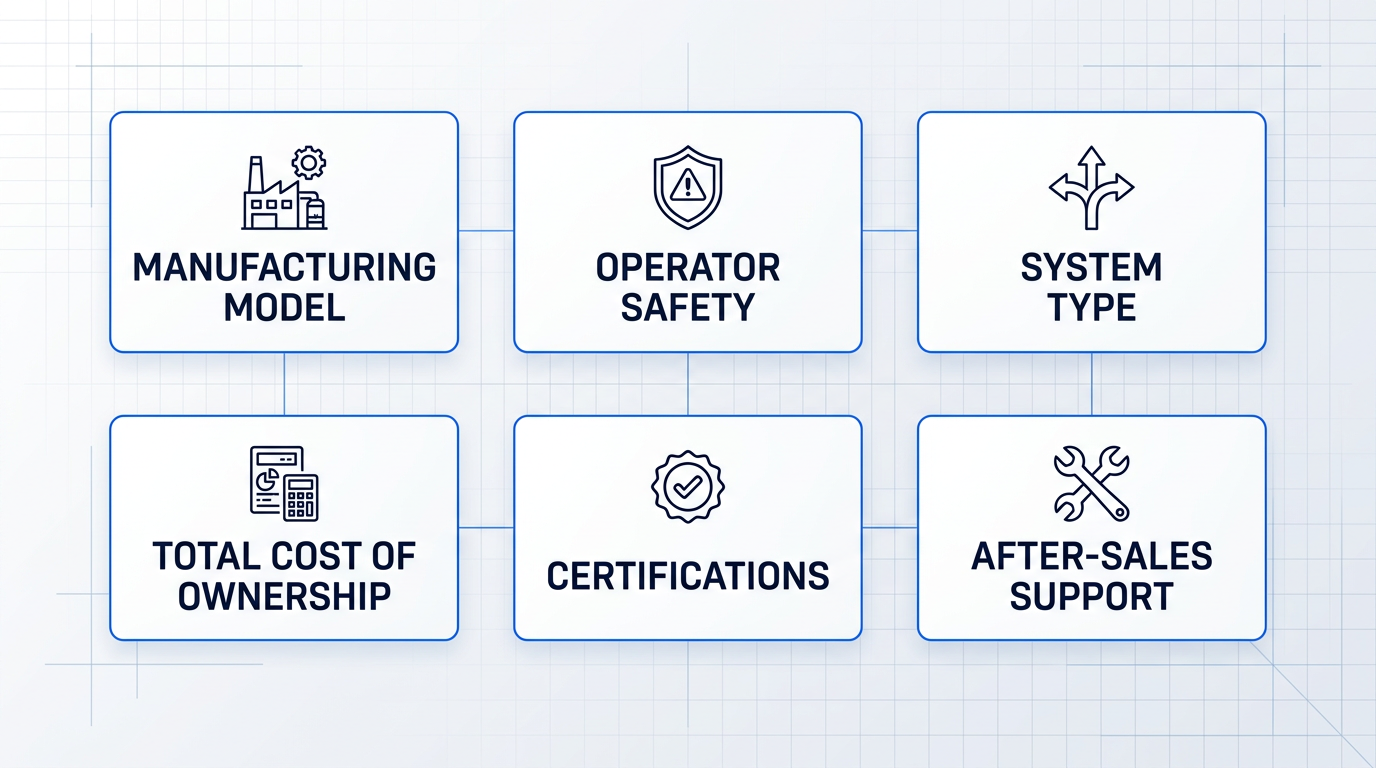
Each entry is assessed across six criteria: safety and hazard zone management; portability vs. automation; substrate and contaminant range; manufacturing model; support and training; and total cost of ownership.
Many companies in this market present as manufacturers but are resellers or importers rebadging third-party hardware. Asking whether a supplier builds in-house affects support quality, spares availability, and long-term reliability.
Pricing is by direct quote; cost structure context is noted per entry where available.
TL;DR
Not every laser cleaning "manufacturer" actually builds what it sells. The market mixes genuine in-house engineers with resellers and importers, and that distinction shapes everything from safety provisions to after-sales support. Knowing what to look for separates a reliable long-term supplier from a box-shifter.
This article covers:

Six criteria for evaluating any manufacturer
Five verified manufacturers compared side by side
Safety approach and hazard zone differences
In-house builder vs. reseller: why it matters
Pricing context and how to request quotes
How to Choose a Laser Cleaning Manufacturer
The laser cleaning market looks more uniform from the outside than it actually is: manufacturer websites tend to show similar machines, similar specifications, and similar application photos — but the differences that matter most to a buyer (who actually built the machine, how safe it is to operate in your environment, what it will cost to run over five years) are rarely surfaced in a product brochure.
In-house manufacturer or reseller?
A significant number of companies presenting themselves as laser cleaning manufacturers are, in practice, resellers or importers rebadging third-party hardware — and this distinction has real consequences for buyers.
An in-house manufacturer designs, builds, and services its own machines: when something goes wrong, they can diagnose it at the source, hold spares in stock, and push an engineering fix if the design is at fault.
A reseller or importer depends entirely on its supply chain for spares and repairs, and cannot improve the product because it did not build it — which means longer wait times, less accountability, and no path to a genuine engineering resolution when problems arise.
The single most useful question you can put to any shortlisted supplier is: do you design and build this machine in-house? — and then ask to see the evidence.
Operator safety and hazard zone management
Conventional laser cleaning systems operate as Class IV lasers in standard configuration, which requires the working area to be sealed off and all personnel evacuated before the machine can run — a real operational constraint, not just a paperwork formality.
In a busy production facility, a heritage site, or any public-facing setting, establishing and maintaining a full laser hazard exclusion zone may be impractical or simply impossible.
Reduced hazard zone (RHZ) technology addresses this directly: it collapses the laser hazard area to a small region immediately around the cleaning head, enabling work in open workshops, mixed-use facilities, and environments where a conventional system cannot legally or practically operate.
Treat safety provisions as a non-negotiable evaluation criterion, not an optional extra — ask specifically what hazard zone each system creates and what that means for your working environment, and ask whether the system includes reduced-hazard-zone or eye-safe technology.
Portable systems vs. automated cells
Automation is not simply a more advanced version of portability — these are genuinely different tools designed for different jobs, and choosing the wrong category is an expensive mistake.
Portable and handheld systems suit on-site maintenance, service businesses, heritage and restoration work, and any scenario where the cleaning location varies or the work cannot come to a fixed machine.
Automated and robotic cells suit high-volume, repetitive production cleaning where the same part geometry is cleaned cycle after cycle — the investment in fixturing and programming pays back through throughput, not flexibility.
Before evaluating any specific system, answer two questions first: where will the cleaning happen, and how much volume and repetition does the application involve?
Within the portable category itself, there is meaningful variation worth scrutinising: a lightweight fibre-fed scanner with a long delivery cable gives the operator freedom to work at distance from the power unit, while a carry-the-whole-unit design constrains movement to wherever the full unit can be placed — a distinction that matters significantly in confined or elevated work environments.
Total cost of ownership, not headline price
Laser cleaning carries a higher upfront investment than sandblasting, chemical stripping, or water-jetting — that is a straightforward fact.
Professional buyers should evaluate on total cost of ownership, however, and on that basis the picture inverts considerably over the life of the equipment.
Laser cleaning has no consumables: no abrasive media, no chemicals, no water — and because the beam stops at the base material rather than abrading it, there is less rework and less substrate damage to recover from.
Upfront price is a poor proxy for value in this category. A laser cleaning machine with no consumables, minimal downtime, and no substrate damage will almost always outperform a cheaper alternative method on total cost over its operational life — so compare on TCO, not on the purchase order.
As a rough orientation for budgeting conversations, the market spans a wide range: entry-level portable systems, mid-range industrial units, and high-power or fully automated cells each occupy meaningfully different price tiers — all reputable manufacturers quote on application, so contact shortlisted suppliers with your specific cleaning task, substrate, volume, and environment to get an accurate figure.
Certifications: verify, don't assume
CE and UKCA certification are the baseline conformity marks for laser cleaning machines sold into European and UK markets, confirming that the machine meets the relevant machinery and laser safety directives.
Do not take certification on faith — ask for the declaration of conformity and confirm it is held by the manufacturer, not inferred from a component supplier's documentation.
This is particularly important when evaluating resellers or importers: the original equipment manufacturer may hold the certification, but the entity selling to you may not — and accountability in the event of a compliance question falls on whoever supplied the machine into your market.
Support, training, and after-sales
The quality of after-sales support is one of the hardest things to evaluate from a website, and one of the most consequential factors once the machine is in service.
- Operator training: Can the manufacturer train your team to operate the machine safely and productively? Ask what the programme covers and how it is delivered.
- Spares availability: In-house manufacturers typically hold their own spares; resellers depend on a third-party supply chain — lead times differ significantly.
- Support response times: Ask what the committed response time is for technical queries and on-site support, and whether this is backed by a service agreement.
- Service business support: If you are launching a laser cleaning service rather than integrating the machine into production, ask whether the manufacturer actively supports that business model.
The service-business use case deserves specific attention: some manufacturers offer structured guidance and operator training tailored to buyers setting up a laser cleaning service business, while others assume the machine is going into an existing production environment — and the difference in support depth can be substantial.
With that framework established, here is how the leading laser cleaning companies and manufacturers measure up against each of these criteria.
Product 1
Woodrow Scientific Limited (ELASER / ELASER-RHZ)
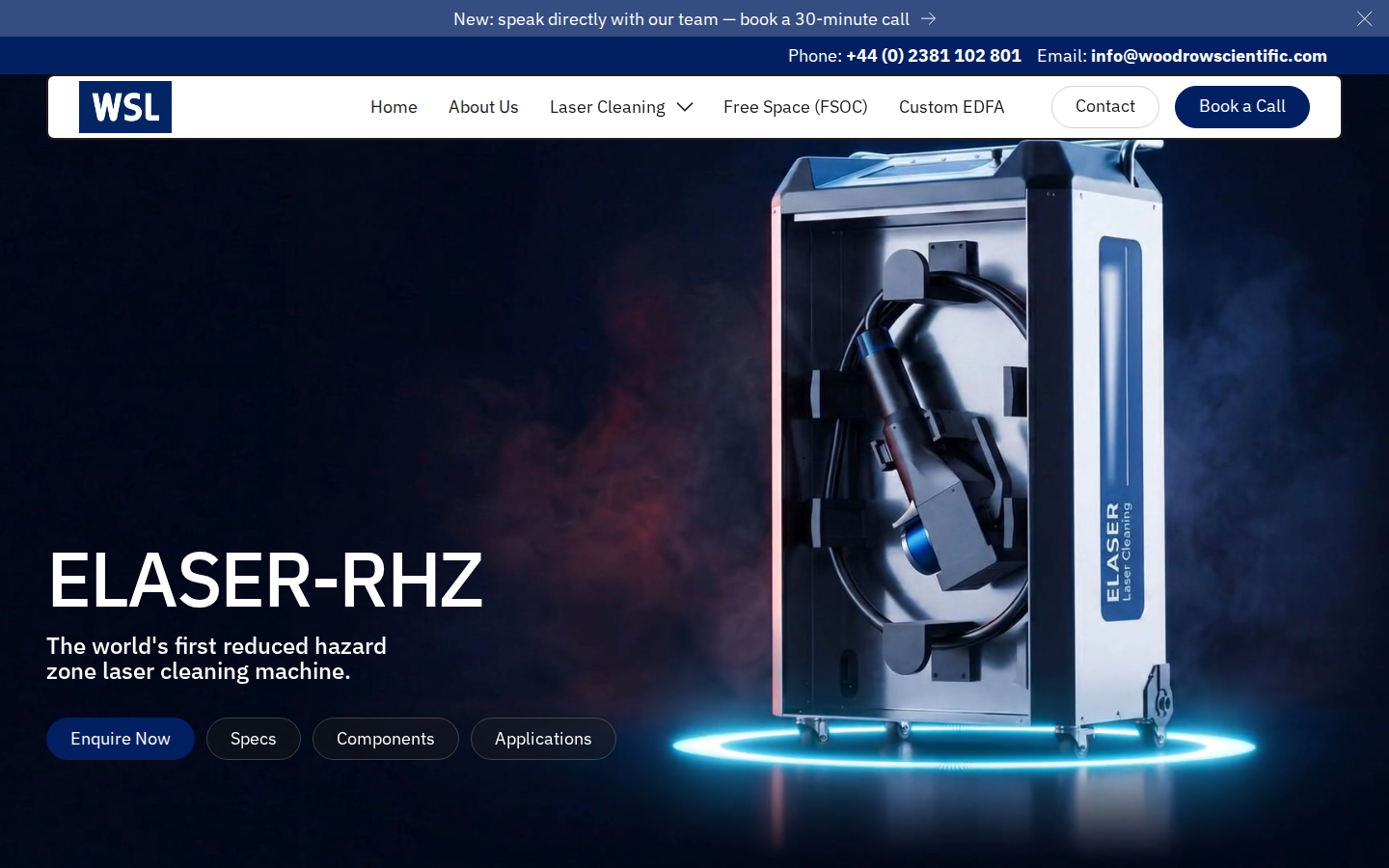
WSL's portable laser cleaning system featuring the world's only reduced-hazard-zone technology, enabling single-operator cleaning in open workshops and public-facing environments without sealing off the surrounding area.
Pros:

World-first eye-safe reduced hazard zone technology
Sub-3 kg scanner; up to 50 m reach
No consumables, water, or compressor required
CE and UKCA certified; made in Britain
Cons:

Maximum 300 W may limit heavy decoating throughput
Pricing by quote only; no published price list
Woodrow Scientific Limited is the only UK-based laser cleaning manufacturer — founded in 2012, with over 200 years of combined engineering experience across its team, designing, building, servicing, and improving every machine entirely in-house.
That distinction matters more than it might appear at first glance. A meaningful share of companies presenting themselves as laser cleaning manufacturers are, in practice, resellers or importers rebadging third-party hardware — which typically means slower spares, limited support, and no genuine capacity to improve the product over time. WSL is the antithesis of that model.
The ELASER-RHZ uses WSL's patented reduced-hazard-zone technology to collapse the laser hazard area to a fraction of conventional size. Where standard laser cleaning requires the surrounding area to be evacuated and sealed off before work can begin, the RHZ removes that barrier entirely — enabling cleaning in open workshops, mixed-use facilities, and publicly accessible spaces that would otherwise be off-limits to laser cleaning.
No other laser cleaning manufacturer offers this capability. For buyers operating in environments where shutting down an area is impractical — or simply impossible — the ELASER-RHZ is in a category of one.
The portability model is equally well considered. The handheld scanner weighs under 3 kg and connects to the wheeled system unit via a delivery cable of up to 50 m — meaning the operator moves freely around the workpiece rather than hauling the entire machine.
The system unit itself comes in under 50 kg and runs from a standard single-phase supply, with no compressor, water connection, or consumables required. One operator. No infrastructure dependencies. Ready to work wherever the cable reaches.
The ELASER handles a broad range of substrates and contaminants, summarised below.
- Metals: Steel, carbon steel, aluminium alloys, cast iron, copper, brass, bronze, titanium, and galvanised steel.
- Stone, brick and masonry: Concrete, brick, stone, and general masonry surfaces — including heritage stonework.
- Coatings and films: Paint, powder coating, lacquer, primer, and release agents removed cleanly without substrate damage.
- Corrosion and scale: Rust, oxides, mill scale, tarnish, and weld discolouration across metals.
- Organic and process contamination: Oil and grease, carbon and soot, mould, adhesives and residues, graffiti, and vulcanisation residue.
Power is fully tunable from 0–100% of the 300 W maximum, so the same machine handles light oxide removal and thick coating stripping without swapping equipment.
In terms of applications, the ELASER and ELASER-RHZ serve a wide industrial spread: injection moulding and tooling cleaned in place without disassembly; automotive pre-weld prep and bodyshop rust and paint removal; on-site industrial maintenance with nothing to mask off or clear up afterwards; tyre and rubber mould cleaning without abrasive wear; aerospace surface prep to tight tolerances; heritage and restoration work on stone, metal, and masonry; and, for buyers considering a service business, a portable system paired with WSL's full operator training programme.
WSL also offers bespoke engineering and customisation for buyers with specific requirements — contact the team directly to discuss what your application demands.
For readers whose needs run to high-throughput production rather than on-site portability, WSL's AutoLASE system addresses that use case separately.
ELASER / ELASER-RHZ Pricing
Pricing is available on request. The ELASER and ELASER-RHZ are positioned as the European cost leader among comparable industrial laser cleaning machines — competitive pricing achieved through WSL's in-house manufacturing efficiencies, not by reducing specification.
The more useful lens for most buyers is total cost of ownership: zero consumables, no media to dispose of, less downtime, and less rework thanks to the beam's precision at the substrate boundary. Compared with sandblasting, chemical stripping, or water-jetting, laser cleaning's TCO advantage compounds quickly over a machine's working life.
Best for: On-site industrial maintenance teams, businesses launching a laser cleaning service, heritage and public-space cleaning contractors, and any buyer operating in an environment where sealing off a conventional laser hazard zone is impractical or impossible.
See the ELASER Built for the Field
WSL's portable ELASER is designed, built, and serviced entirely in-house in the UK. Explore the full product page or download the datasheet to see specifications and capabilities.
Product 2
Woodrow Scientific Limited (AutoLASE)
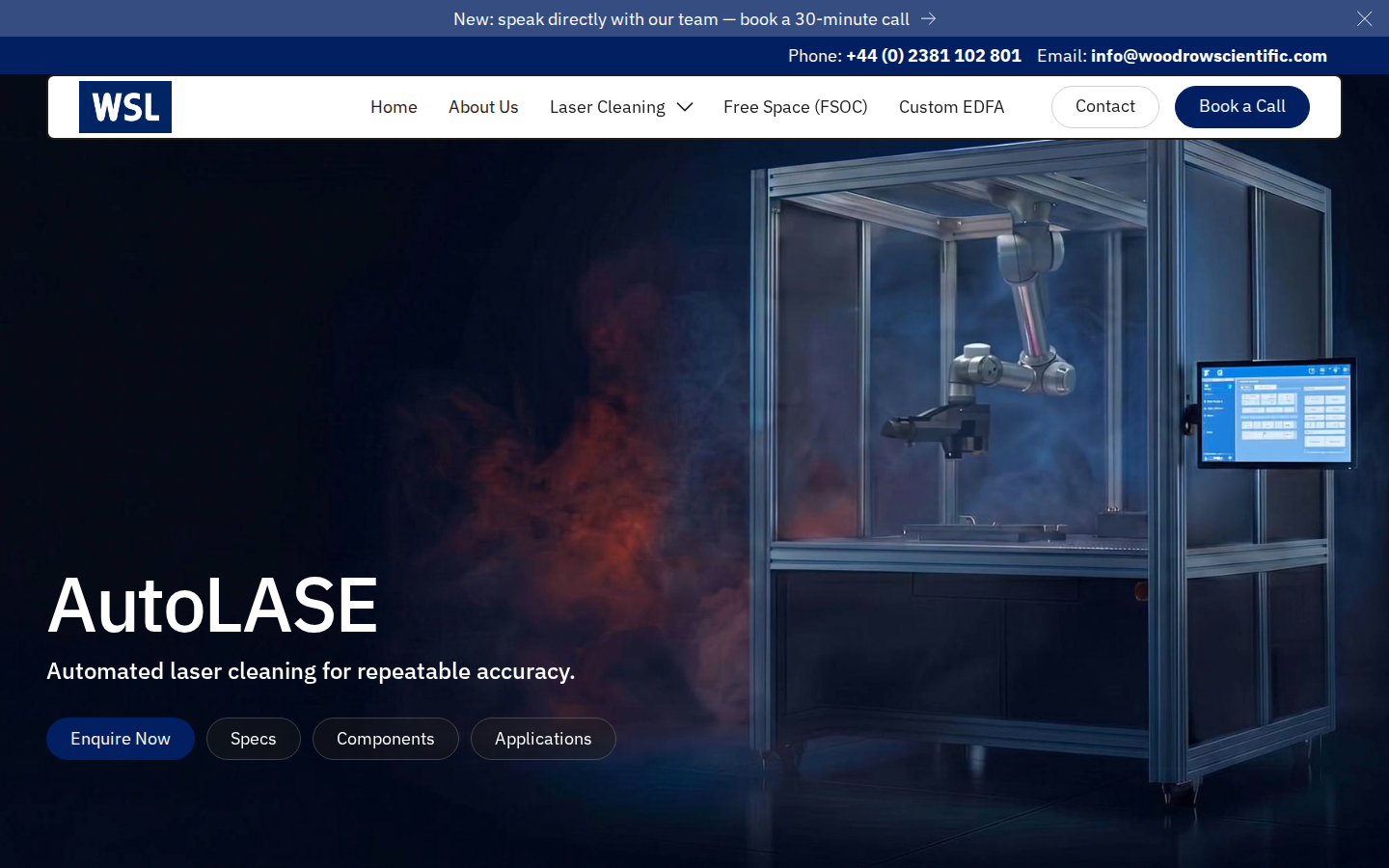
WSL's automated laser cleaning system for production environments: load a part, and AutoLASE scans it, maps it in 3D, and runs the clean automatically — no programming, no specialist skills, no enclosure required with the optional RHZ upgrade.
Pros:
Load-and-go: no programming or path-setting needed
Only automated system operable without an enclosure
Works with existing robots or as complete cell
CE and UKCA certified; built in Britain
Cons:
Fixed cell format; not suited to field work
Best for repetitive production; less suited to variety
AutoLASE is WSL's automated counterpart to the ELASER — built for manufacturers who need consistent, high-throughput cleaning across repetitive production runs rather than flexible field deployment.
How AutoLASE Works
The defining characteristic of AutoLASE is how little it demands from the operator: load the part, and the system takes over.
Machine-vision software scans the loaded part, builds a full 3D map of its geometry, and generates the cleaning path autonomously — no manual programming, no path-setting, no knowledge of the part's dimensions required.
That outcome matters in a production context because it removes the technical bottleneck that typically gates automated cleaning: the need for skilled programmers to set up each new part type.
The laser cleaning head is carried on an articulated robotic arm, giving it multi-axis reach across the angles, recesses, and contours of complex 3D components — the kind of geometry that defeats flat-plane cleaning approaches.
AutoLASE can be configured with WSL's optional RHZ (Reduced Hazard Zone) upgrade, making it the only automated laser cleaning system in the world that can operate without a full enclosure. No other automated system offers this — it is an exclusive, patented WSL capability.
In practice, the RHZ upgrade removes a significant infrastructure constraint: most automated laser cleaning installations require a dedicated, sealed enclosure cell, which takes floor space and limits where the system can be sited.
Without that requirement, AutoLASE with the RHZ option can be integrated into production lines where a full enclosure would be impractical or cost-prohibitive.
AutoLASE Applications
AutoLASE is designed for production environments where the same cleaning task is performed repeatedly at volume — and where consistency across every cycle is non-negotiable.
- Injection moulds and tools: Strips release agents, residue, and build-up from mould cavities, cores, and inserts — restoring fine detail without disassembly or abrasive wear.
- Automotive parts: Engine, driveline, and EV battery components cleaned of oxide, coatings, and contamination, or surface-prepped for welding and bonding, part after part.
- Aerospace components: Turbine blades, vanes, and engine parts cleaned and surface-prepped to tight tolerances, held to the same standard on every cycle.
- Tyre and rubber moulds: Vulcanisation residue and build-up removed from moulds, segments, and vents — no abrasives, no mould wear.
- Remanufacturing and refurbishment: Corrosion, coatings, and contamination stripped from worn components before rebuild, with batches cleaned consistently and ready for inspection.
The substrate and contaminant range is the same broad coverage as the ELASER — metals including steel, aluminium alloys, cast iron, copper, brass, bronze, titanium, and galvanised, plus stone and masonry, with the beam tunable from light oxides through to thick paint and coatings.
Safety and Certification
AutoLASE carries both CE and UKCA certification and is available in Class IV or Class I laser configuration depending on setup.
The optional RHZ upgrade shifts the safety profile further still, removing the enclosure requirement entirely — connecting directly to the operational flexibility described above.
WSL provides first-class operator safety and training as standard, and the touchscreen interface includes secure user access controls to govern who can run jobs.
AutoLASE Pricing and TCO
AutoLASE is priced on a contact-for-quote basis, and positions as the European cost leader among comparable automated industrial laser cleaning systems — competitive pricing achieved through WSL's in-house manufacturing efficiencies, not by compromising on build quality.
On a total cost of ownership basis, the case is straightforward: zero consumables, automated labour savings across every production run, less downtime, and reduced rework through minimal substrate damage add up to a TCO that outperforms sandblasting, chemical stripping, and water-jetting over any meaningful production horizon.
The Manufacturer Behind AutoLASE
As covered in the ELASER entry, WSL is the only UK-based laser cleaning manufacturer — designing, building, servicing, and improving its machines entirely in-house.
That distinction matters when evaluating laser cleaning companies: a meaningful portion of the market consists of resellers or importers rebadging third-party hardware, which translates to slower spares, weaker technical support, and no genuine ability to improve the product over time.
Bespoke engineering, integration, and customisation are available for AutoLASE — buyers with specific cell requirements or integration needs should contact WSL directly to discuss their application.
Best for: manufacturers running high-volume, repetitive cleaning tasks who want automation without complex programming; any operation requiring enclosure-free automated cleaning via the RHZ upgrade; buyers who want to integrate laser cleaning into an existing robot cell or take delivery of a complete turnkey system.
Product 3
cleanLASER
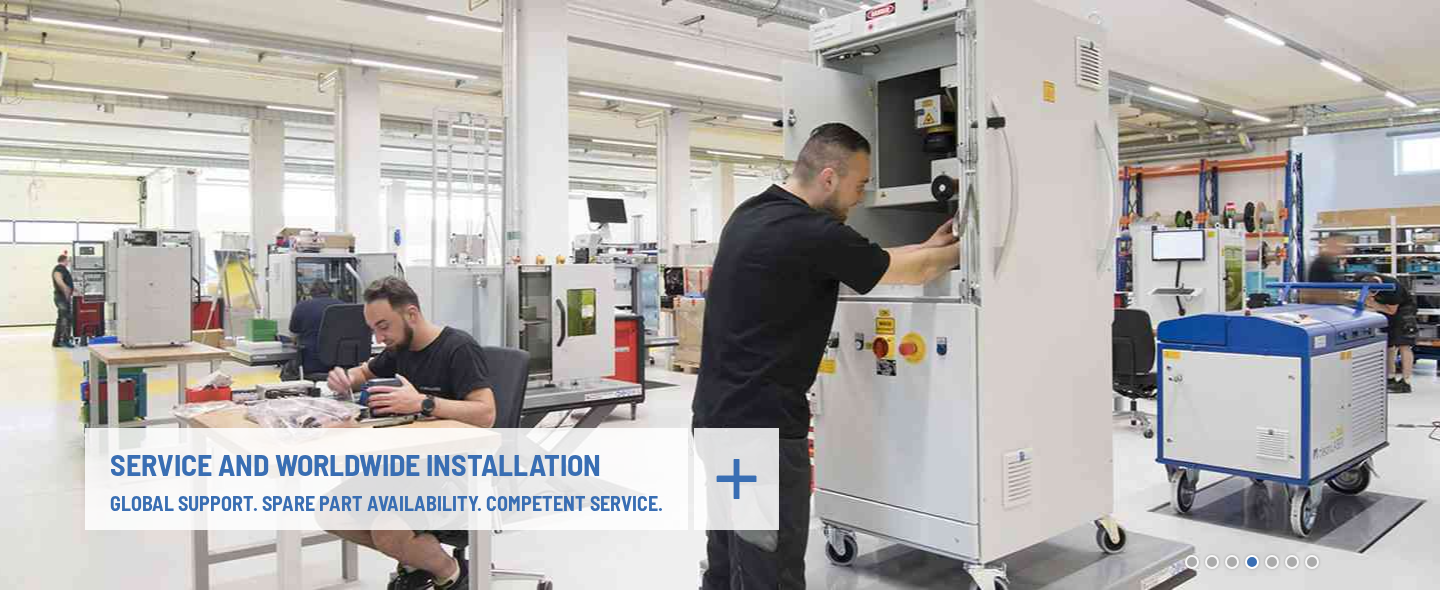
Founded in 1997 in Herzogenrath, Germany, cleanLASER is widely recognised as the originator of industrial laser cleaning, with approximately 2,000 systems installed worldwide across automotive, aerospace, mould cleaning, and restoration sectors. The company offers one of the broadest product ranges in the category — from 50 W portable units to 1,700 W high-power systems and robotic integration cells — all manufactured in Germany. As of December 2024, cleanLASER operates as part of IPG Photonics, making it the only laser cleaning manufacturer backed by the world's largest fibre-laser company.
Pros:
Category originator; ~2,000 systems installed worldwide
Broad power range: 50 W to 1,700 W
Deep automotive and aerospace production pedigree
Backed by IPG Photonics since December 2024
Cons:
Class 4 hazard zone; area must be secured
No eye-safe open-space cleaning capability
Post-acquisition support continuity unconfirmed; verify directly
Pricing on request only; no published rates
cleanLASER (Clean-Lasersysteme GmbH) was founded in February 1997 in Herzogenrath, Germany, and is widely regarded as the originator of industrial laser cleaning as a commercial category.
With approximately 2,000 systems installed worldwide and a distribution network spanning more than 20 countries, cleanLASER carries the deepest proven install base of any manufacturer in this category.
In December 2024, IPG Photonics completed its acquisition of Clean-Lasersysteme GmbH. The company continues to operate under the cleanLASER name, headquartered in Herzogenrath, as part of IPG's global laser portfolio.
cleanLASER Product Range
cleanLASER offers one of the broadest power ranges available from a single manufacturer, spanning from compact portable units through to high-power industrial systems.
- streamLINE compact (50–300 W): A fully air-cooled portable series available in four power variants. Designed for flexible, handheld surface cleaning with a lightweight aluminium housing and integrated cleanTOUCH WiFi-enabled display.
- Mid-power systems CL 150–600 (150–600 W, CW): Diode-pumped solid-state laser systems suited to gentle decoating, bonding pre-treatment, and mould cleaning. Class 4 laser; pulse power up to 400 kW.
- CL 500iM (500 W): A next-generation handheld-capable system developed specifically for industrial surface cleaning and stripping, incorporating IPG Photonics beam source technology with up to 30% power-to-output efficiency.
- CL 1000 / CL 2000 (1,000–1,700 W, CW): High-power systems for large-area decoating, nuclear decontamination, and heavy industrial applications. The CL 2000 delivers up to 1,700 W and is mobile despite its output level. Both are Class 4 lasers.
- Robotic integration systems: Compact end-effector designs with fibre-optic beam delivery, compatible with digital I/O or fieldbus integration into new or existing production lines. Turnkey laser cells are also available.
This breadth means buyers can select and scale within a single manufacturer's ecosystem, from a portable unit for maintenance tasks to a fully automated cell for series production.
Industries and Applications
cleanLASER systems are active across an unusually wide range of sectors, which is a meaningful indicator of real-world deployment at scale rather than niche specialisation.
According to cleanLASER's own documentation, systems are in use at nearly every premium-class vehicle manufacturer and across numerous Tier 1 automotive suppliers in series production — both in conventional vehicle manufacturing and electromobility.
- Automotive and electromobility: Paint removal, pre-treatment for bonding and welding, cleaning in series production at premium OEMs and Tier 1 suppliers.
- Aerospace: Precision partial paint stripping, surface pre-treatment for mass contact and adhesive bonding, and mould cleaning for CFRP production.
- Mould cleaning: Rubber, plastics, and food-grade moulds — including tyre inner cleaning via the dedicated tireCLEANER configuration.
- Electronics, medical technology, printing, and solar: Precision surface preparation and cleaning across a range of high-value manufacturing sectors.
- Nuclear decontamination and restoration: Large-area decontamination and conservation of stone and metal surfaces, including heritage restoration work.
This application breadth is one of cleanLASER's most credible differentiators: the install base is not concentrated in a single vertical, which reduces procurement risk for buyers entering new production contexts.
cleanLASER Safety Approach
All cleanLASER handheld and portable systems operate as Class 4 lasers, which means the surrounding area must be secured and personnel evacuated or shielded before operation begins.
This is the standard safety approach across the conventional laser cleaning category and is a genuine operational constraint for buyers working in open workshops, mixed-use facilities, or environments where area lockdown is difficult to implement.
Robotic integration cells can be configured as Class 1 enclosed systems, which are safe within the cell boundary — but the enclosure requirement itself remains a fixed infrastructure consideration.
cleanLASER does not offer any eye-safe or reduced-hazard-zone open-space cleaning capability; buyers for whom that operational flexibility is a priority should evaluate that axis separately.
Manufacturing Model and IPG Acquisition
cleanLASER designs and manufactures its systems in Herzogenrath, Germany — a 25-year track record of in-house production that underpins its "Made in Germany" positioning.
The December 2024 acquisition by IPG Photonics brings the backing of the world's largest fibre-laser manufacturer, which may strengthen supply chain depth and R&D resource over time.
Post-acquisition transitions can also affect support team structures, local responsiveness, and service continuity in ways that are difficult to assess from the outside. Buyers should verify current support and service arrangements directly with cleanLASER before committing.
cleanLASER Pricing
No public pricing is listed on cleanlaser.de, and no indicative figures have been published following the IPG acquisition. Pricing is available on request directly from cleanLASER or an authorised regional partner.
Buyers in automotive or aerospace production environments where a proven, large-scale install base is a procurement requirement — and who need the flexibility to scale across a broad power range within a single manufacturer's ecosystem.
Product 4
P-Laser
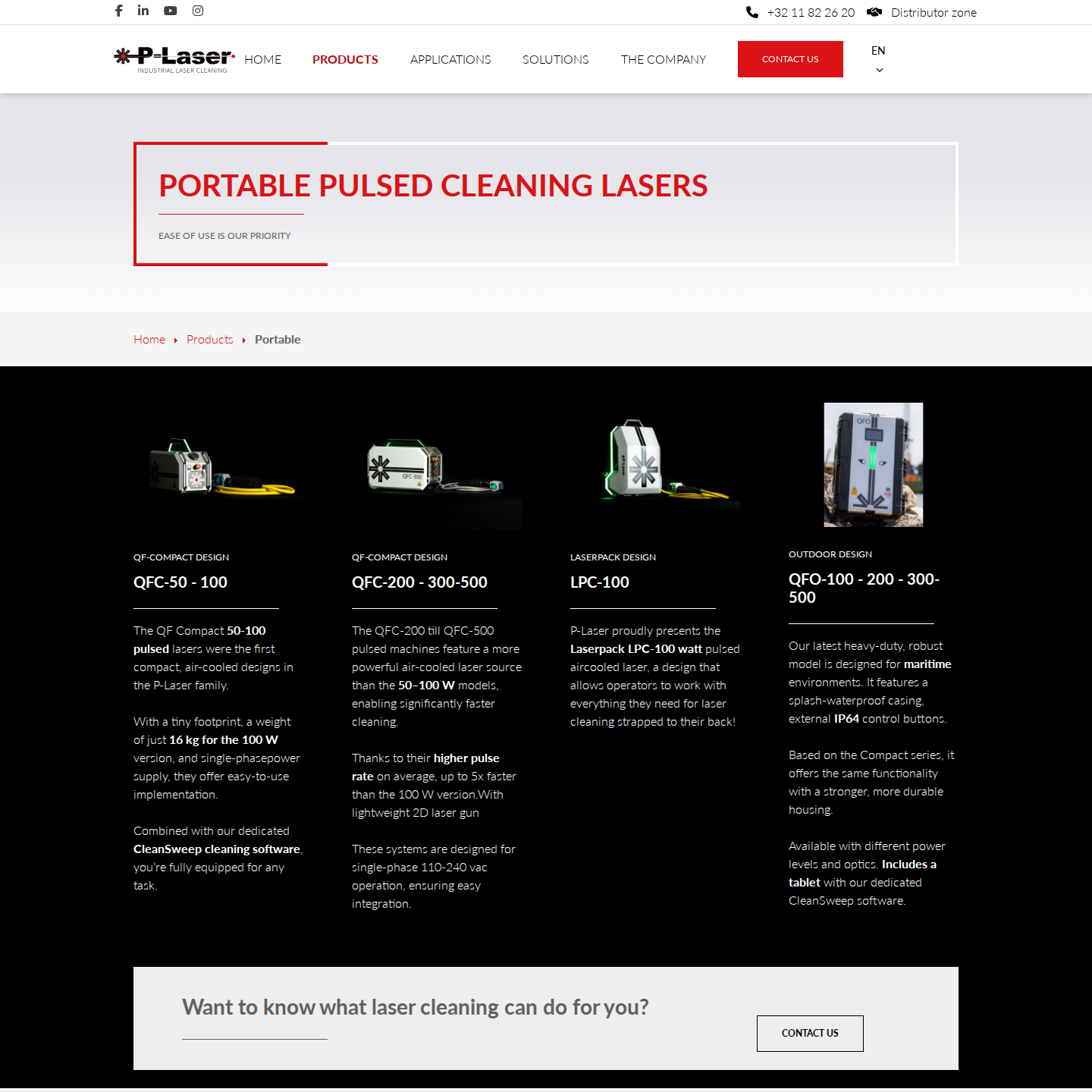
P-Laser is a Belgian in-house manufacturer of pulsed industrial laser cleaning systems, offering one of the widest power ranges in the category: from 50 W air-cooled portable units to 3,000 W heavy-duty systems across seven product lines. The QF-Compact series is P-Laser's flagship portable offering — a compact, air-cooled, self-contained design with a fast startup cycle. Best suited to buyers who want to scale from lightweight portable cleaning up to heavy industrial decoating without changing suppliers.
Pros:
Wide power range: 50 W to 3,000 W
QF-Compact: compact, self-contained portable unit
Fast ~10-second startup cycle
In-house manufacturer; not a reseller
Cons:
Conventional Class 4 laser hazard zone applies
Carry-the-whole-unit design; not fibre-fed scanner
Contact required for purchase pricing
About P-Laser
P-Laser is a Belgian independent manufacturer of pulsed industrial laser cleaning equipment, founded by Jean-Claude Philippron — an expert in surface treatment and cleaning with close to 30 years of experience in the sector.
The company began its activities in 2008 as a division of an established industrial cleaning firm, then became fully independent and started developing its own laser cleaning systems from the ground up.
P-Laser designs and builds its own machines rather than reselling third-party equipment, giving it direct control over product development across all seven of its product lines.
P-Laser Product Range
The defining characteristic of P-Laser as a laser cleaning company is the breadth of its power range, spanning 50 W compact portables through to 3,000 W heavy-duty industrial systems.
| Product Line | Power Range | Cooling |
|---|---|---|
| Portable (QF-Compact) | 50–300 W | Air-cooled |
| Trolley | 200–3,000 W | Water-cooled |
| Inline | 50–2,000 W | Water/air-cooled |
| Custom-made | 50–2,000 W | Water/air-cooled |
| Cube | 1,000–3,000 W | Water-cooled |
| Eco | 500–1,000 W | Water-cooled |
| Laserpack (LPC-100) | 100 W | Air-cooled (backpack) |
A table communicates the seven product lines, their power ranges, and cooling types more clearly than prose — buyers can scan and immediately identify which line fits their application.
The QF-Compact series is P-Laser's most distinctive portable offering — a self-contained, air-cooled unit that the company describes as among the smallest laser cleaning systems on the market.
The QFC-200 and QFC-300 models extend the Compact series into higher power territory while retaining the air-cooled, self-contained form factor, and the series features a startup cycle of approximately 10 seconds, minimising downtime between tasks.
A notable variant is the Laserpack LPC-100, a backpack-style unit that allows operators to carry everything needed for laser cleaning on their back — a configuration suited to confined or hard-to-reach spaces.
For buyers who need to clean vertical metal surfaces at scale, P-Laser also offers the QF-Arol, a magnetic robot that crawls up metal walls and is designed primarily for large storage silos and steel structures.
Portability: What the Design Means in Practice
QF-Compact units are carry-the-whole-unit designs: the operator moves the entire machine to the work area, then operates the integrated scanner from that position.
This differs from a fibre-fed scanner architecture, where a lightweight handheld scanner connects via a long cable to a separate wheeled system unit, allowing the operator to reach further from the machine without repositioning it.
Neither approach is universally superior — the carry-the-whole-unit design is simpler and self-contained, while the fibre-fed approach trades that simplicity for greater reach and reduced operator fatigue over long cleaning runs.
P-Laser Applications
The breadth of P-Laser's power range is directly reflected in the range of industries and applications the company serves.
- Rust and weld cleaning: Pre- and post-weld surface preparation across fabrication and manufacturing environments.
- Mould cleaning: Rubber, plastic, glass, and composite moulds — particularly suited to inline and compact portable units.
- Paint and coating removal: Controlled decoating for aerospace, military, and industrial maintenance applications.
- Shipyard and offshore: Large steel surface cleaning where the Trolley, Cube, and QF-Arol lines are relevant.
- Mining and petrochemical: Heavy-duty cleaning in demanding environments where chemical-free operation is valued.
- Aerospace and military: High-specification surface treatment where substrate integrity is critical.
This application breadth means P-Laser is one of the few laser cleaning companies where a buyer could source a system suited to every stage of a growing operation — from a single portable unit to a high-power fixed installation.
P-Laser Safety
P-Laser systems operate as Class 4 lasers, which is the standard classification for industrial laser cleaning equipment across the sector.
Class 4 requirements mean that a designated laser controlled area must be established during operation, access must be restricted to authorised personnel, and appropriate laser protective eyewear is mandatory for anyone within the hazard zone.
Buyers should plan for the associated area-management requirements — particularly in open workshops or environments where bystander access cannot easily be controlled.
P-Laser Pricing
P-Laser publishes rental rates for its systems: the company's documentation lists day, week, and month rates, with higher-power systems such as the QF-500 available from €1,500/day and the QF-1000 from €2,100/day.
Rental is a practical route for buyers with project-based or infrequent cleaning requirements, providing access to higher-power systems without the capital commitment of outright purchase.
For purchase pricing and configuration options, buyers should contact P-Laser directly via p-laser.com or at sales@p-laser.com.
Buyers who need a wide power range under a single manufacturer — particularly those starting with portable field cleaning and expecting to scale up to heavier industrial decoating over time without switching suppliers or retraining teams.
Product 5
Laserax
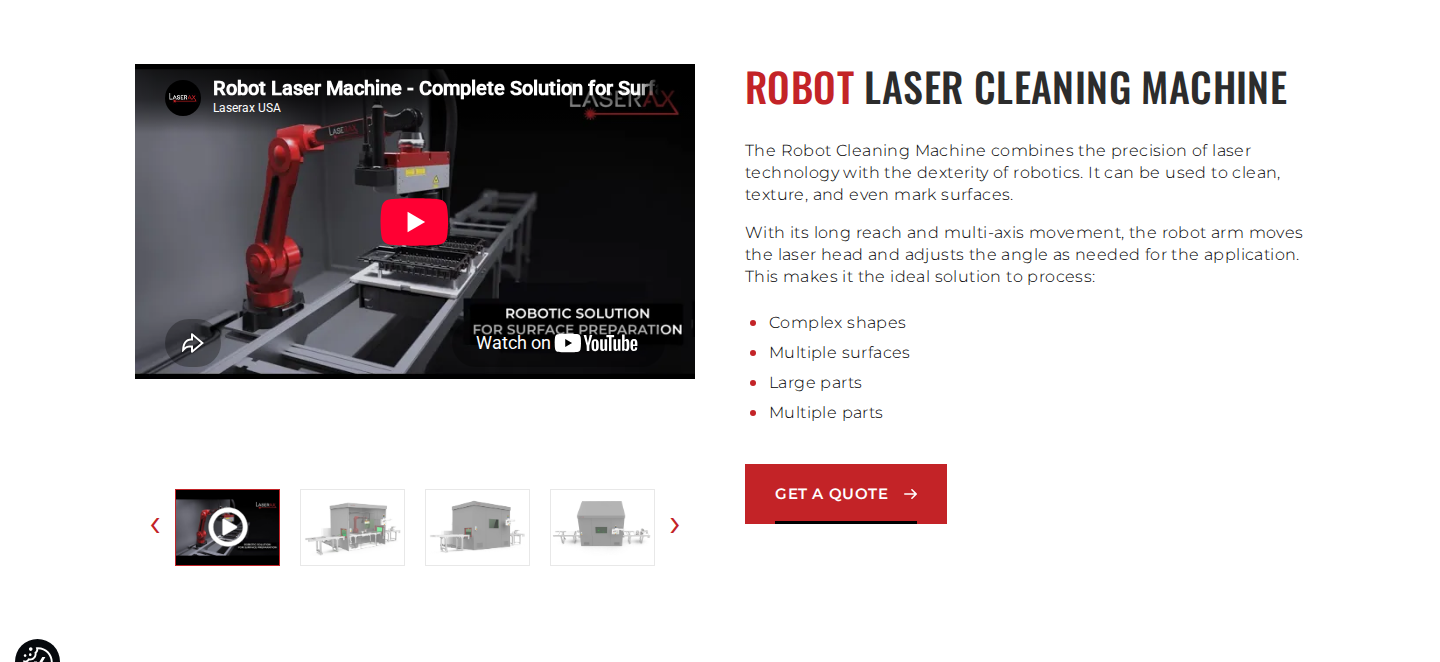
Laserax is a Canadian turnkey laser automation manufacturer (Quebec HQ, US and German offices) specialising in fully integrated inline and robotic laser cleaning systems for high-volume production. Its four automated machine types — Robot, Conveyor, Rotary Table, and Battery — are all Class 1 enclosed cells with laser power up to 3 kW, and every system ships complete with fume extraction, PLC integration, and optional vision-based quality control. Its dedicated Battery Cleaning Machine, which cleans, textures, and marks battery components in a single inline operation, makes it a particularly strong fit for EV and battery module production.
Pros:
Fully turnkey: fume, PLC, vision all included
Dedicated Battery Cleaning Machine for EV lines
Up to 3 kW for fast cycle times
Single-supplier: clean, texture, and mark combined
Cons:
No enclosure-free or open-space cleaning capability
Robot paths require technician program setup
Not suited for portable or on-site field work
Laserax is a Canadian manufacturer founded in 2010 and headquartered in Quebec City, with sales and service offices in the United States and Germany, serving the world's leading manufacturers across automotive, battery/EV, and aerospace production environments.
Its identity is built around factory automation at scale: every system Laserax ships is engineered as a complete, production-ready turnkey cell, not a laser module the buyer must integrate themselves.
The turnkey scope is genuinely comprehensive — each system includes fume extraction, laser safety enclosure, industrial PLC with Laserax's own LXQ controller, optional vision cameras for quality control and part positioning compensation, and ongoing performance optimisation, all from a single supplier.
- Robot Cleaning Machine: A Class 1 enclosed robotic cell supporting ABB, FANUC, KUKA, and other arms. Handles cleaning, texturing, engraving, and marking on complex multi-surface parts. Laser power from 100 W to 3,000 W; typical robot reach of 2,000–2,300 mm. Operates 24/7 in harsh industrial environments.
- Automated Conveyor Machine: An inline machine that cleans parts as they move on a conveyor (on-the-fly) or while the conveyor is stopped. An embedded autofocusing system tolerates up to ±70 mm of part positioning variation, maintaining repeatability without manual intervention.
- Rotary Table Machine: A dual-stage rotary table design that allows simultaneous cleaning and part loading, maximising throughput where only a few seconds of robot idle time are available. Available with up to 500 W of laser power.
- Battery Cleaning Machine: A dedicated Class 1 enclosed system for battery module conveyor lines. Cleans, textures, and marks battery components in a single operation. An integrated 2D vision system compensates for module positioning errors dynamically. Highly customisable for different module sizes and cycle time requirements.
The Battery Cleaning Machine is the most distinctive product in Laserax's cleaning range and a genuine differentiator for buyers in EV manufacturing or battery production.
Performing cleaning, texturing, and marking in one operation — with vision-guided positioning compensation built in as standard — eliminates the need for separate process steps and separate suppliers, which is a meaningful efficiency gain at battery module production volumes.
On safety, all Laserax automated systems are Class 1 certified enclosed cells: the laser hazard zone is managed by a physical interlocked enclosure, which meets international laser safety standards and requires no personal protective equipment from operators working around the machine.
This is the conventional and well-proven approach to laser safety in automated production environments, though it does mean there is no open-space or enclosure-free cleaning capability — the machine must be sited with its enclosure footprint accounted for in the line layout.
Robot path operation works via HMI-based part-program selection: the operator specifies a part model on the control panel and the corresponding robot sequence loads automatically, with laser parameters set from the same interface. This is the standard approach across most robotic laser cleaning systems, and it works well for the high-volume, repeating-part environments Laserax targets.
Laserax's laser power ceiling of up to 3 kW (via the multimode LXQ-UHP series) positions it at the high end of the category for throughput-critical applications — processing large surface areas within short cycle times that lower-power systems cannot match.
Laserax Pricing
Laserax does not publish pricing for its automated laser cleaning machines; all systems are quoted by application, as final cost depends on laser power, automation level, safety configuration, part handling, and vision requirements.
For context, Laserax's own published materials for laser marking machines note that manually loaded systems start around $120,000 and rotary-table configurations start closer to $230,000 — automated robot and conveyor cleaning cells are quoted individually and will sit above these reference points depending on specification.
A case study published by Laserax documents a customer who eliminated manual masking and cleaning steps entirely, cutting production costs and removing rework — and a separate Inovaweld case study records that the return on investment was considered worthwhile one year after installation, with reduced production time and increased capacity.
Manufacturers running high-volume production lines who need a complete, integrated turnkey automation solution from a single supplier — particularly in EV/battery production, automotive, and aerospace environments where cycle time, repeatability, and inline integration are the primary requirements.
Conclusion
Which laser cleaning manufacturer is right for you?
The most useful question to settle first isn't which manufacturer has the best brochure — it's whether you need a portable system for open or unpredictable environments, or an automated cell for consistent production throughput. Those are genuinely different tools, and the right shortlist follows naturally from that distinction.
Whichever manufacturers you shortlist, ask each one whether they design and build in-house. It's the question that separates suppliers who can genuinely stand behind their TCO claims from those who cannot.
Frequently asked questions about laser cleaning
Practical answers to the cost and business questions buyers ask most.
Laser cleaning systems span a wide price range depending on capability. Entry-level portable systems are generally the most accessible tier, while mid-range industrial systems command a significantly higher investment, and high-power or fully automated cells with bespoke integration can reach well into six figures. No major manufacturer publishes a fixed price list — all quote on application. The main cost drivers are laser power output, whether the system is portable or fixed-cell automated, and the degree of custom engineering required to integrate the system into an existing production line. Buyers should approach their shortlisted suppliers with as much application detail as possible — substrate type, contaminant, required cycle times, and operating environment — to get a meaningful quote.
Laser cleaning service rates vary considerably by project scale, geography, and application. Smaller or specialist jobs typically sit at the lower end of the hourly rate spectrum, while industrial-scale work commands a higher rate, and large infrastructure projects — such as structural steelwork or bridge cleaning — can reach a substantial premium reflecting the equipment, access complexity, and operator expertise involved. Rates are also influenced by the specific contaminant being removed and the sensitivity of the substrate: work on heritage stonework or aerospace components will cost more than straightforward rust removal on open steel. As with machine purchases, service providers quote per project rather than publishing fixed rates. Requesting a project-specific quote with full application details will always produce a more reliable figure than any published benchmark.
It can be, and the structural economics are genuinely attractive — but the upfront capital requirement is the primary barrier to entry. Laser cleaning has no consumables and very low electricity running costs, which means once the equipment is paid for, the main ongoing cost is the operator's time. That creates the conditions for strong margins at reasonable utilisation rates. The challenge is the initial investment: even entry-level portable systems represent a significant capital outlay for a service business launch. Profitability then depends on three variables: application mix (higher-value work such as heritage restoration or aerospace cleaning commands premium rates), local market demand, and utilisation rate — a machine sitting idle is expensive capital. Some manufacturers offer operator training programmes specifically designed to support buyers launching a laser cleaning service, which can meaningfully shorten the time to productive deployment.