Introduction
If you've landed here, you've already done the groundwork — you know what a laser cleaning machine is and you're now trying to work out which one is actually right for your situation.
This list covers the full range: portable handheld units, wheeled single-operator systems, and automated robotic cells — each tier suits a different deployment context, and form factor is the first filter worth applying before anything else.
The evaluation lens that shapes every entry here is total cost of ownership, not sticker price — because zero consumables, reduced downtime, and minimal substrate damage compound into a very different economic picture over time.
TL;DR
Match the right form factor to your application, and a laser cleaning machine is more economical than it first appears. The machines that look expensive upfront often cost the least to run — and the five options evaluated here span the full spectrum, from compact portables to production-line automation.
This article covers:

Five verified laser cleaning machines evaluated
Three form-factor tiers and when each fits
Key criteria: power, cooling, hazard zone, support
Why upfront price is the wrong lens
Each machine mapped to the right buyer
How we evaluated each laser cleaning machine
The spec sheet tells you the wattage. It does not tell you whether that wattage matches your application, whether the machine can be deployed where you need it, or whether the supplier can actually support it when something goes wrong. Across every laser cleaning machine on this list, we assessed six axes that together answer those questions.
Power output and waveform
Matching wattage and waveform to the application matters more than chasing the highest power figure. Pulsed lasers deliver energy in short, high-peak-power bursts — this ablates contamination efficiently while keeping sustained heat out of the base material, making them the right choice for sensitive substrates such as moulds, thin coatings, and precision components.
Continuous wave (CW) lasers suit high-throughput stripping where speed is the priority and substrate sensitivity is less of a concern. A 100 W pulsed unit applied to large-area paint stripping will be too slow; a high-power CW machine applied to delicate mould cleaning risks substrate damage — the mismatch in either direction has real consequences.
Form factor and portability
Across the form-factor tiers covered in this list, the fundamental question is whether the machine moves to the part or the part comes to the machine. Handheld and portable wheeled systems suit on-site work, field deployment, and mixed-use facilities where operators need to move between locations or access fixed structures.
Automated robotic cells suit production-line and repetitive batch work where consistent cycle-to-cycle results matter more than mobility. Identifying which category fits your operation before reading the individual entries will save considerable time — a buyer running a production cell and a field engineer evaluating portability are looking for entirely different things.
Cooling method
Air-cooled systems are genuinely self-contained: no water circuit, no chiller, no infrastructure beyond a standard power supply. That simplicity comes with a lower sustained power ceiling, but for field deployment or facilities without dedicated cooling infrastructure, it is the practical choice.
Water-cooled systems support higher sustained power output — necessary at 1,000 W and above — but require a cooling circuit or chiller, which adds installation complexity and an ongoing maintenance consideration. This is a deployment-context decision, not a quality judgement.
Laser hazard zone (Nominal Hazard Zone)
This is the axis most underserved by the wider category, and the one with the greatest practical impact on where a machine can be deployed. The Nominal Hazard Zone (NHZ) is the area around a laser operation within which beam intensity is sufficient to cause eye or skin injury — defined under ANSI Z136.1 and the OSHA laser safety directive as the space where radiation levels exceed the applicable Maximum Permissible Exposure.
For conventional Class IV laser cleaning — the default classification for industrial laser systems — the NHZ extends well beyond the immediate work area. Before work can begin, the controlled area must be sealed, posted with warning signage, cleared of non-essential personnel, and equipped with entryway controls including warning systems and emergency disconnect provisions. That is a substantial operational overhead.
Technologies that reduce the NHZ fundamentally change the deployment picture, enabling cleaning in open workshops, mixed-use facilities, and environments where conventional Class IV controls would be impractical. For compliance specifics relevant to your site, consult your laser safety officer or the relevant regulatory authority — this axis is included here as a buyer consideration, not safety guidance.
Conventional Class IV laser operation requires the work area to be sealed and evacuated before use. Technologies that reduce the Nominal Hazard Zone remove that constraint — changing not just safety overhead, but where and how a machine can be practically deployed.
After-sales support: manufacturer vs. reseller
A meaningful share of suppliers in the laser cleaning market are importers or resellers who rebadge third-party hardware rather than genuine in-house manufacturers. The distinction matters because a true manufacturer designs, builds, and services its own machines — giving it the engineering capability to supply spare parts promptly, resolve design issues, and respond to bespoke requirements.
A reseller has none of that capability. When something goes wrong or a non-standard application arises, the question to ask is: who actually has the engineering resource to respond? We assessed each machine on this list with that question in mind.
Pricing transparency
Where exact pricing is publicly available, we state it. Where quotes are required — as is standard for most industrial-grade laser systems — we explain the pricing structure and the cost drivers. Power output, cooling method, automation level, and supplier model all move the price significantly: a 100 W air-cooled portable unit and a 2,000 W water-cooled automated cell occupy very different brackets.
Expect to request a quote for most of the machines on this list, but you should leave each entry with a clear understanding of what is driving the price and what you are paying for. With these criteria established, here is how each machine performs.
Product 1
ELASER / ELASER-RHZ (Woodrow Scientific Limited)
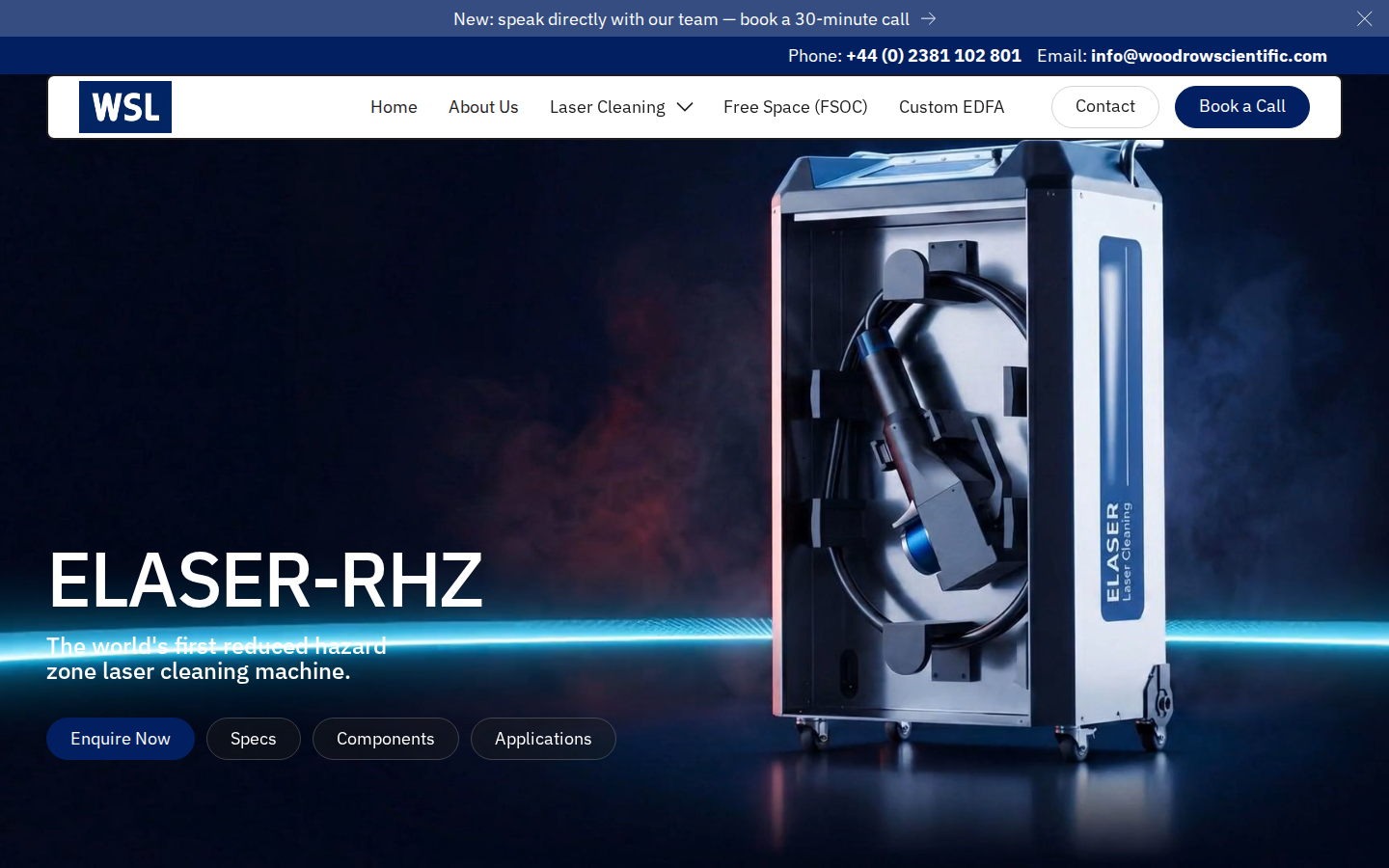
WSL's portable, air-cooled industrial laser cleaning system — available with world-first patented Reduced Hazard Zone technology, enabling single-operator deployment in open workshops and public-facing environments without area shutdown.
Pros:

Open-environment capable
Air-cooled, consumable-free
European cost leader
UK-built, in-house support
Cons:

300 W ceiling limits throughput
The ELASER-RHZ is the only portable laser cleaning machine in the world with patented Reduced Hazard Zone technology — WSL's breakthrough that collapses the laser hazard zone to a fraction of conventional size.
Conventional laser cleaning requires the work area to be sealed off and cleared before operation can begin. WSL's patented RHZ technology confines the hazard to a small zone around the work itself — enabling cleaning in open workshops, mixed-use manufacturing facilities, and publicly accessible spaces without shutting down the surrounding area. No other portable laser cleaner offers this.
In practice, this unlocks applications that were previously off-limits for laser cleaning: graffiti removal on public monuments, heritage restoration on accessible stone and metalwork, and continuous operation in open-plan production facilities where clearing the area would halt other work.
ELASER / ELASER-RHZ: Key Specifications
| Specification | Detail |
|---|---|
| Max Power | Up to 300 W (fibre laser) |
| Wavelength | 1550 nm (retina-safe) |
| Power Tunability | 0–100% |
| Pulse Repetition Rate | Adjustable up to 200 kHz |
| Scanner Weight | Under 3 kg (handheld) |
| System Weight | Under 50 kg (wheeled) |
| Delivery Cable Reach | Up to 50 m |
| Cooling | Air-cooled — no chiller or water circuit |
| Power Supply | 110–250 VAC single-phase |
| Laser Class Options | Class IV or Class I |
| Certifications | CE and UKCA certified |
| Manufacture | Made in Britain |
Quick-reference technical specification table covering all six evaluation axes — power, form factor, cooling, hazard zone, support, and pricing transparency — so readers can compare at a glance.
The wheeled system weighs under 50 kg and the handheld scanner comes in at under 3 kg — one operator can deploy, move, and operate the machine without assistance.
The delivery cable extends up to 50 m, giving the operator a working radius that is notably longer than most portable laser cleaning systems — useful on large structures, vehicle fleets, or sprawling plant where the machine cannot be positioned directly beside the work.
Because the ELASER is air-cooled, the only input required is a standard single-phase electrical supply (110–250 VAC) — no compressor, no water circuit, no consumables to manage on site.
Power is continuously tunable from 0–100%, which means a single machine handles everything from delicate light oxides and weld discolouration through to thick paint, powder coating, and heavy rust — without swapping hardware or changing systems.
What the ELASER Cleans
The ELASER works across a very wide range of substrates and contaminants — the breadth below reflects the machine's tunable power and the precision of laser ablation, which removes the contaminant while leaving the base material intact.
- Metals: Steel, carbon steel, aluminium alloys, cast iron, copper, brass, bronze, titanium, galvanised steel
- Stone, brick and masonry: Concrete, brick, stone, and masonry surfaces — including heritage stonework and monuments
- Contaminants removed: Rust, oxides, mill scale, paint, powder coating, lacquer, primer, oil and grease, carbon and soot, mould, graffiti, adhesives, tarnish, weld discolouration, and release agents
Applications span injection moulding and tooling, automotive weld prep and bodyshop work, tyre and rubber mould cleaning, aerospace surface prep, industrial plant maintenance, and heritage restoration — as well as forming the basis of a laser cleaning service business.
These are representative examples of the machine's versatility, not a closed list; WSL can discuss specific requirements for applications beyond those listed.
ELASER / ELASER-RHZ Pricing
Pricing is available on request directly from WSL — the ELASER is the most competitively priced comparable industrial laser cleaning machine in Europe, a position achieved through WSL's own technological and operational efficiencies rather than any compromise on build quality.
When evaluating total cost of ownership against traditional cleaning methods — sandblasting, chemical stripping, or water-jetting — laser cleaning's zero-consumable running cost, reduced downtime, and minimal substrate damage make the TCO case compelling over any realistic operating horizon.
Woodrow Scientific Limited is the only UK-based laser cleaning manufacturer: founded in 2012, with 200+ years of combined engineering expertise across the team, WSL designs, builds, services, and improves every machine in-house — not a reseller rebadging third-party hardware, but a genuine manufacturer with CE and UKCA certification and bespoke engineering capability for specific requirements.
In a category where many apparent manufacturers are actually importers with no in-house engineering, WSL's model means faster support, genuine product improvement, and expert service that a reseller simply cannot replicate.
First-class laser cleaning safety and operation training is available from WSL as part of the complete package — contact the team directly for a quote or to discuss bespoke requirements.
Readers who need automated, fixed-cell production-line cleaning rather than portable on-site deployment should look at WSL's AutoLASE system, covered next in this list.
See the ELASER-RHZ full specifications
Power output, cleaning coverage, cooling method, hazard zone dimensions — the ELASER-RHZ datasheet covers every spec you need to assess whether it fits your application.
Product 2
AutoLASE (Woodrow Scientific Limited)
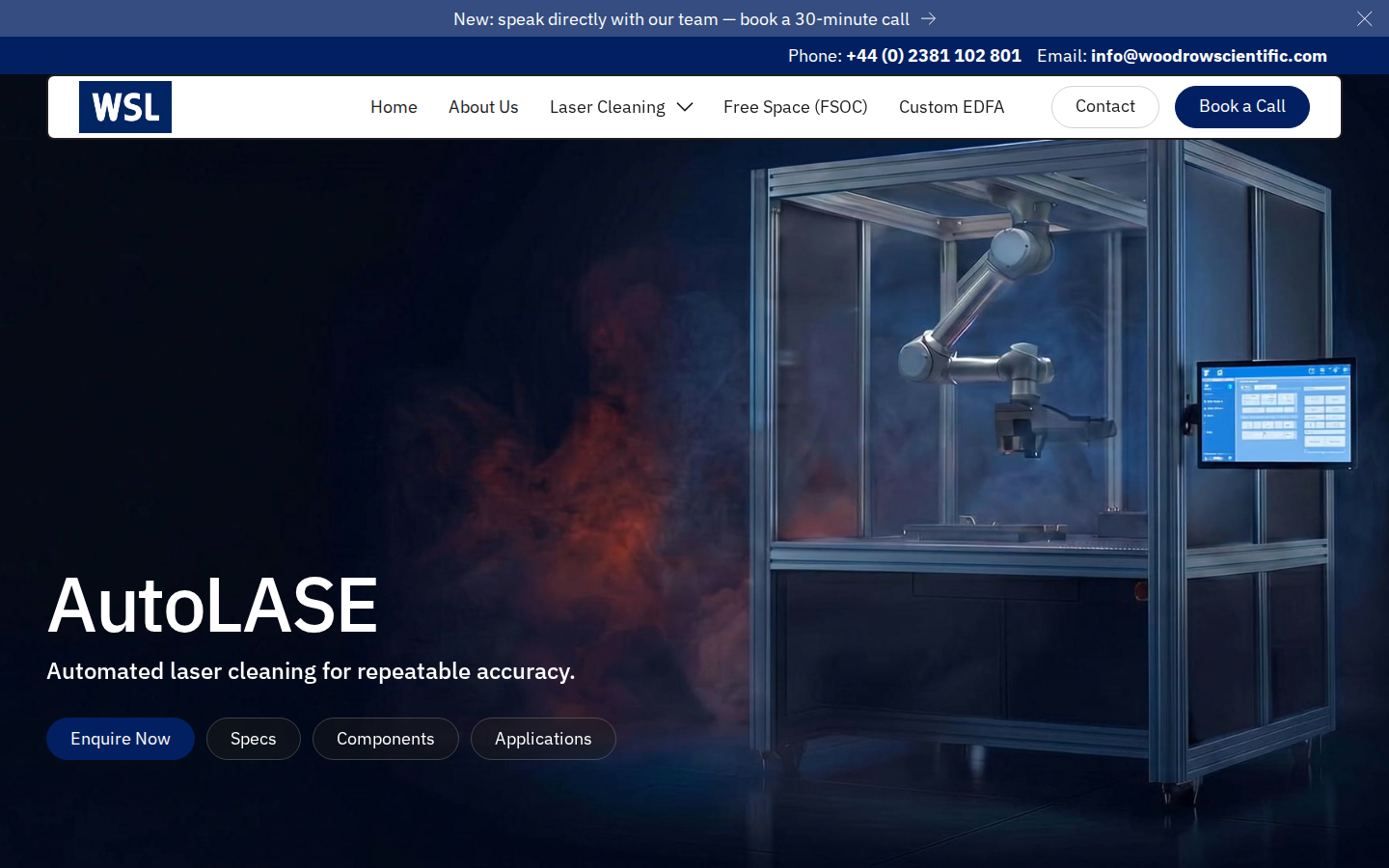
WSL's automated robotic laser cleaning system for production-line and batch environments — load a part, and machine vision scans it, maps it, and generates the cleaning path automatically, with no programming or specialist skills required. The only automated laser cleaning system available with an enclosure-free RHZ upgrade, and the European cost leader among comparable systems.
Pros:
Load-and-go 3D vision: no programming needed
Optional RHZ upgrade: no enclosure required (WSL-exclusive)
Integrates with existing robots or custom cell
Air-cooled, consumable-free, CE and UKCA certified
Cons:
Not suited to portable or field use
Pricing requires a direct quote from WSL
Load a part into AutoLASE and the system takes it from there — the machine-vision software scans the component, builds a 3D map, and generates the cleaning path automatically, with no manual programming, no path-setting, and no knowledge of part geometry required.
That ease of operation is what separates AutoLASE from other automated laser cleaning systems on the market, which require skilled technicians to programme cleaning paths for each new part geometry.
AutoLASE can be configured with the same eye-safe RHZ technology available on the ELASER, eliminating the need for a full laser enclosure entirely. Every other automated laser cleaning system on the market requires a full enclosure. AutoLASE with RHZ does not — a WSL-exclusive capability, available nowhere else worldwide.
For production managers evaluating floor-space requirements and installation complexity, the enclosure-free option changes the economics of deployment significantly.
Robotic Reach and Flexible Integration
The laser cleaning head is carried on an articulated robotic arm, reaching the angles and contours of complex 3D parts that fixed-head or gantry systems cannot access.
AutoLASE integrates with the customer's existing collaborative or industrial robots, removing the need to replace current infrastructure — or it can be supplied as a complete custom cell built to your production requirements.
WSL's in-house engineering team handles bespoke integration and customisation; production teams with specific requirements are encouraged to get in touch directly to discuss what's possible.
Applications: Where AutoLASE Fits Best
AutoLASE is built for environments where the same cleaning standard must be delivered on every cycle, across every part — without relying on operator skill or attention.
- Injection moulds and tooling: Strip release agents and residue from mould cavities, cores, and inserts in place — no disassembly, no abrasive wear on fine detail.
- Automotive and EV battery components: Engine, driveline, and EV battery parts cleaned of oxides and contamination, or surface-prepped for welding and bonding, part after part.
- Aerospace turbine blades and engine parts: Cleaned and surface-prepped to tight tolerances, held to the same standard on every cycle.
- Tyre and rubber moulds: Vulcanisation residue and build-up removed from moulds, segments, and vents — no abrasives, no mould wear.
- Remanufacturing and refurbishment batches: Corrosion, coatings, and contamination stripped from worn components before rebuild, with consistent results across the entire batch.
These are illustrative examples — AutoLASE suits a wide range of automated cleaning tasks across industries wherever consistent, repeatable results are the priority.
AutoLASE Specifications at a Glance
AutoLASE runs on the same proven 300 W fibre-laser platform as the ELASER — the same 1550 nm wavelength, pulsed at up to 200 kHz, with power tunable across the full 0–100% range — delivering consistent performance across every production cycle.
| Evaluation Axis | AutoLASE Specification |
|---|---|
| Power and waveform | Up to 300 W fibre laser, 1550 nm, pulsed up to 200 kHz, tunable 0–100% |
| Form factor | Articulated robotic arm; system under 50 kg; integrates with existing robots or supplied as a complete custom cell |
| Cooling method | Air-cooled; no chiller, no water circuit; single-phase 110–250 VAC |
| Laser hazard zone | Class IV standard; optional RHZ upgrade to Class I — enclosure-free operation (WSL-exclusive) |
| Pricing | Contact for quote; competitive pricing — European cost leader among comparable automated systems |
| After-sales support | In-house UK engineering team; WSL designs, builds, services, and improves everything; training available |
Surfaces the declared evaluation framework axes — power, form factor, cooling, hazard zone, pricing, and after-sales — in a scannable format that lets readers compare AutoLASE against other entries in the listicle.
The air-cooled, consumable-free design means the only running input is single-phase electricity — no chiller, no water circuit, no media to replenish.
CE and UKCA certified, and manufactured in Britain, AutoLASE carries the same compliance credentials as the ELASER — built to the same standards, in the same facility, by the same team.
AutoLASE Pricing
AutoLASE is priced on a contact-for-quote basis, with competitive pricing that positions it as the European cost leader among comparable automated industrial laser cleaning machines.
When evaluating total cost of ownership, the economics strengthen further: automated operation reduces labour on repetitive cleaning tasks, zero consumables eliminate ongoing media costs, and the beam's precision minimises substrate damage and rework.
The WSL Advantage
WSL is the only UK-based laser cleaning manufacturer — designing, building, servicing, and improving every machine in-house, with over 200 years of combined engineering experience across the team.
In a category where many apparent manufacturers are resellers rebadging third-party hardware, that distinction matters: in-house engineering means faster support, genuine product improvement, and a team that can actually fix the machine rather than escalate to an overseas supplier.
Product 3
cleanLASER CL-series (Clean-Lasersysteme / IPG Photonics)
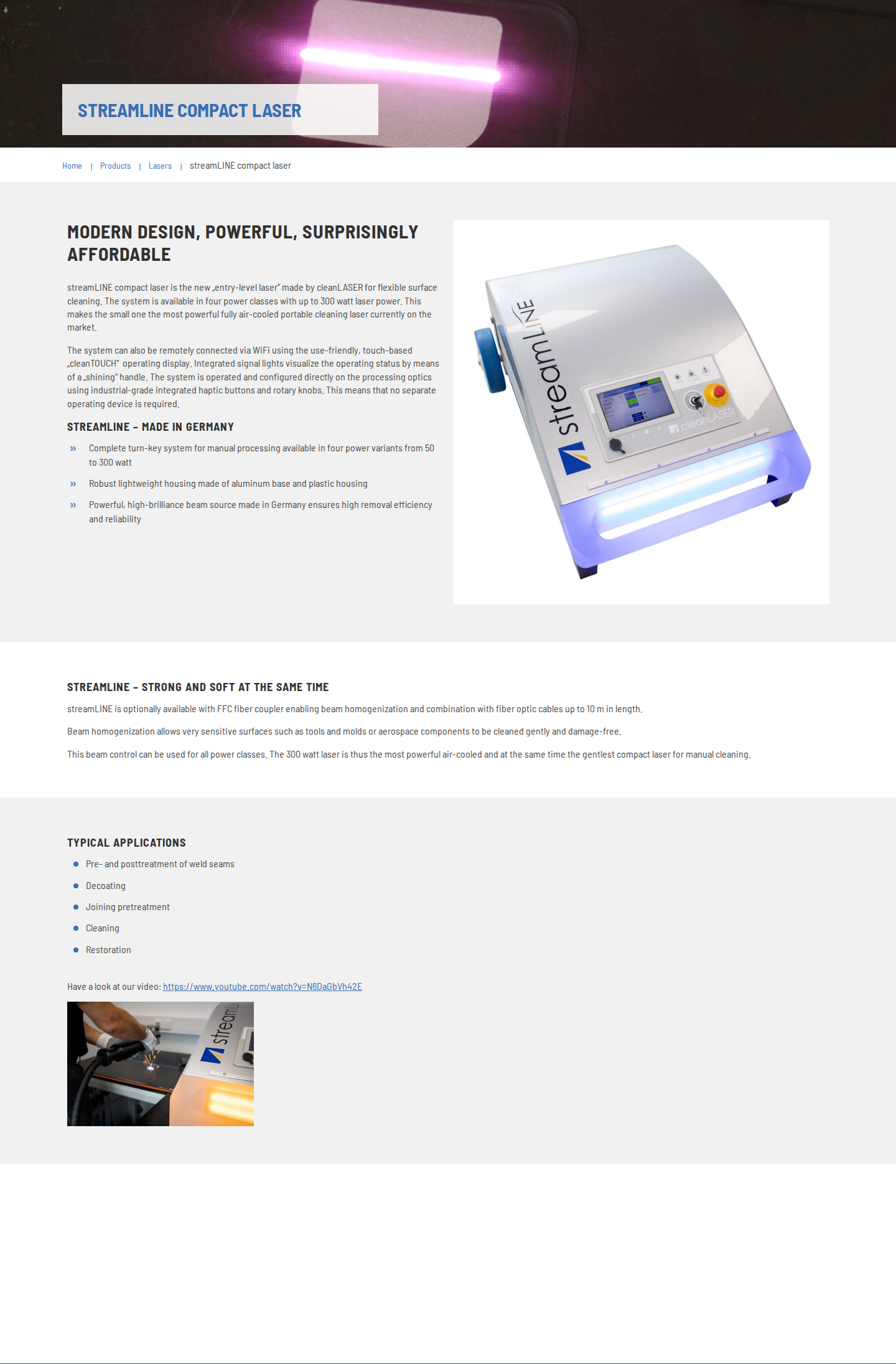
The originator of industrial laser cleaning, the CL-series spans fully air-cooled portable units from 50 W through to 1,700 W CW high-power systems — suited to buyers who want a broad, proven product family with modular automation options and the long-term backing of IPG Photonics.
Pros:
Category originator: founded 1997, ~2,000 systems installed
50 W portable to 1,700 W CW high-power
Full automation family: handheld, workstation, robotic, gantry
IPG Photonics backing: long-term support assured
Cons:
Conventional Class IV hazard zone — no RHZ capability
Water-cooled models require dedicated cooling infrastructure
Clean-Lasersysteme GmbH was founded in February 1997 in Herzogenrath, Germany, making it the originator of industrial laser cleaning as a commercial category — a distinction that carries genuine weight for buyers who value accumulated application knowledge and a proven, large-scale install base.
With approximately 2,000 systems installed worldwide and nearly three decades of dedicated laser cleaning work, cleanLASER brings a depth of application experience that few suppliers in this category can match.
In December 2024, IPG Photonics (NASDAQ: IPGP) completed its acquisition of Clean-Lasersysteme GmbH for approximately $75 million, designating cleanLASER as IPG's Centre of Excellence for Laser Cleaning — a designation that signals continued investment in the product line and long-term organisational commitment to the category.
For buyers weighing supplier longevity and product roadmap continuity, the IPG Photonics parent relationship provides a level of institutional backing that is difficult to replicate in a standalone specialist.
cleanLASER CL-series: Product Range Overview
The CL-series covers a wider power span than most single-supplier laser cleaning ranges, from compact portable units through to high-power industrial systems — all sharing a consistent product architecture and control philosophy.
| Model Tier | Power Output | Waveform | Cooling | Form Factor |
|---|---|---|---|---|
| streamLINE compact | 50–300 W | Pulsed | Air-cooled (fully self-contained) | Portable / handheld |
| Mid-power CL | 150–600 W | CW / pulsed | Air or water-cooled | Mobile cabinet |
| CL 1000 | 1,000 W | CW | Air or water-cooled | Mobile industrial cabinet |
| CL 2000 | Up to 1,700 W | CW | Water-cooled (external chiller required) | Mobile cabinet |
Communicates the four tiers of the CL-series range across power, waveform, cooling method, and form factor more efficiently than prose — directly serving readers who are evaluating which tier fits their application.
The streamLINE compact is the entry point: a fully air-cooled, portable system available in four power variants from 50 to 300 W, with an integrated touch-based cleanTOUCH display and haptic controls built directly into the processing optics — no separate operating device required.
At the high end, the CL 2000 delivers up to 1,700 W of continuous-wave laser power, targeting large-area applications and thicker layer removal; it requires an external water chiller and three-phase power supply, which buyers should factor into site planning.
Automation and Deployment Configurations
cleanLASER's automation portfolio spans the full spectrum from manual handheld operation through to fully automated production cells — a genuine strength for buyers who may start with a handheld unit and later scale up within the same product family.
Robotic-guided systems allow CL-series laser heads to be mounted on industrial robots for 24/7 automated cleaning, with integration via digital I/O or fieldbus into new or existing production lines.
For large-area components, cleanLASER's gantry systems achieve repeatability accuracies of well under one millimetre even across spans of several tens of metres — suited to applications such as CFRP tooling, mould cleaning, and aircraft component surface activation.
The workstation and automation cell range includes the cleanCELL platform (modular, available in three width classes for working areas up to 1,500 x 700 mm), the compactCELL (footprint of just 0.6 x 0.8 m), the cleanBOX for rotationally symmetrical components, and the safeBOX with a Class 1 laser-safe housing.
cleanLASER CL-series: Key Applications
- Paint removal and decoating: Established across automotive, aerospace, and general manufacturing for selective or full-area paint stripping without abrasive media.
- Mould and tool cleaning: Residue-free cleaning of production moulds, particularly for CFRP and composite manufacturing, without dimensional change to the mould surface.
- Weld preparation and adhesive pre-treatment: Surface activation to improve bond strength before welding or structural adhesive application.
- Aerospace CFRP surface preparation: Controlled surface treatment of carbon fibre components for bonding and NDT inspection readiness.
- Nuclear decontamination: The CL 2000's high-power output makes it applicable to decontamination tasks in regulated nuclear environments.
The breadth of verified application areas reflects cleanLASER's nearly three decades of deployment across industries — buyers can draw on an extensive body of documented process knowledge when specifying a system.
cleanLASER CL-series Pricing
Pricing for all CL-series models is not publicly listed on cleanlaser.de; all configurations are sold on a quote-on-request basis, which is standard practice for industrial laser cleaning systems at this specification level.
Prospective buyers should contact Clean-Lasersysteme GmbH directly via cleanlaser.de to request a quotation for their specific power tier, automation configuration, and application requirements.
The Key Trade-off: Laser Hazard Zone
Every CL-series model — from the 50 W streamLINE compact to the 1,700 W CL 2000 — operates as a Class 4 laser system. There is no eye-safe or reduced-hazard-zone technology in the range. Open-plan, public-facing, or multi-trade deployment requires full area evacuation and standard Class IV safety controls to be in place before operation.
This is a straightforward deployment constraint rather than a product failing: Class IV protocols are well understood in industrial settings, and the vast majority of cleanLASER's installed base operates within controlled environments where those controls are already in place.
Buyers operating in open workshops, on live production floors with mixed trades, or in public-facing environments should weigh this requirement carefully against their site conditions before specifying any model from the CL-series.
Product 4
P-Laser QF-series (P-Laser)
Belgian pulsed-laser specialist offering one of the widest single-manufacturer power ranges in the category — from 50 W air-cooled portables through to 3,000 W water-cooled industrial systems — with a rental fleet available for project-based or pre-purchase evaluation use.
Pros:
50 W to 3,000 W, one specialist supplier
Rental fleet: QFC-100 to QF-1000, day/week/month terms
Air-cooled compact models, no cooling infrastructure needed
UK distributor confirmed: P-Laser UK / LaserAge, Manchester
Cons:
Conventional Class IV hazard zone — no reduced-hazard-zone capability
Water-cooled models require a dedicated cooling circuit
Best for: buyers who need a wide pulsed-laser power range from a single specialist supplier — from compact 50 W portables through to 3,000 W heavy industrial systems suited to shipyard and oil-and-gas environments.
P-Laser is a Belgian manufacturer that has built its reputation around one thing: pulsed laser cleaning across an unusually wide power spectrum, all from a single specialist source.
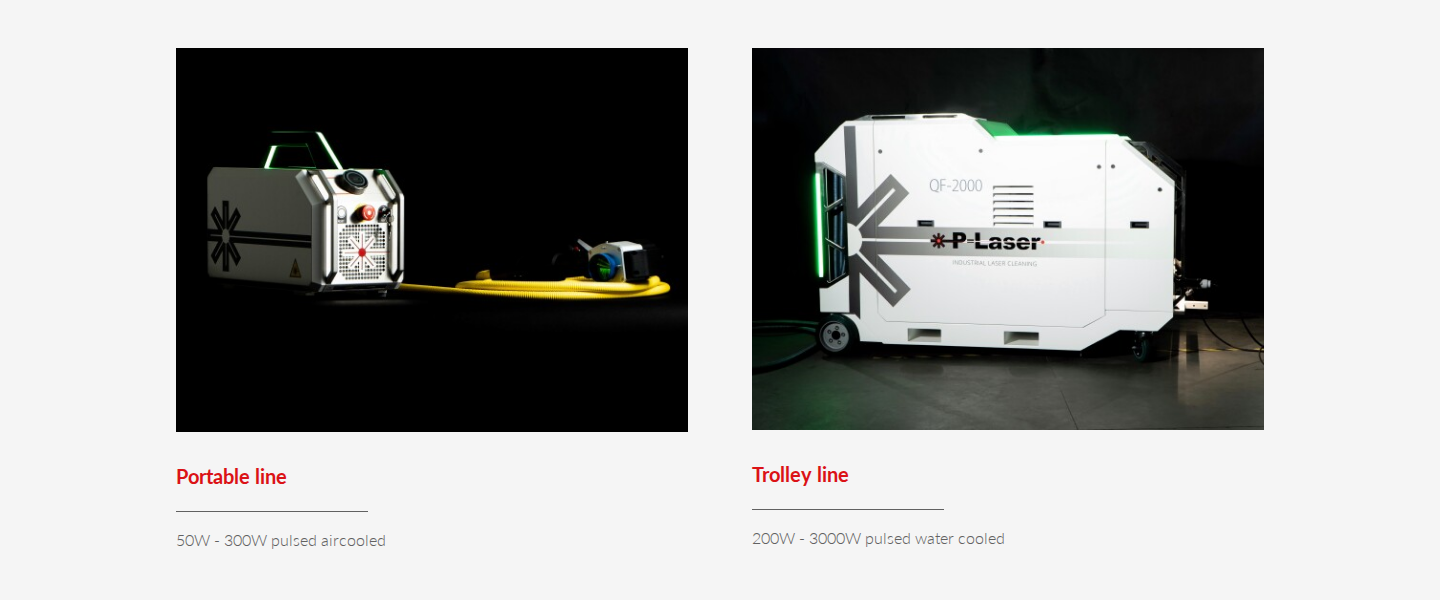
The QF-series spans three distinct product lines, letting buyers start at the compact portable end and scale upward without changing supplier.
| Line | Power Range | Cooling | Mobility |
|---|---|---|---|
| Portable (QFC-50 to QFC-300) | 50–300 W pulsed | Air-cooled | Carry unit (13 kg) or wheeled (30–35 kg) |
| Trolley (QF-500 / QF-1000) | 500–1,000 W pulsed | Water-cooled | Mobile trolley, 16–50 m fibre |
| High-power / QF-2000 | 2,000 W pulsed | Water-cooled | Mobile with integrated tow system, 50 m fibre |
| Cube line | 1,000–3,000 W pulsed | Water-cooled | Fixed industrial installation |
Comparing the three QF product lines across power, cooling, and mobility gives readers a fast reference for which line fits their application before reading further detail.
This breadth is a genuine buyer benefit: organisations that want to grow cleaning capacity over time, or source multiple machines at different power levels, can do so from one specialist with a consistent interface and support structure.
QF-Compact: Portable Design and Form Factor
The QF-Compact 50/100 W weighs 13 kg and measures approximately 485×225×330 mm, with a startup time of around 10 seconds and maintenance limited to occasional dust-filter replacement.
One form-factor point to understand clearly: the operator carries the entire unit, not just a handset — there is no separate fibre-fed scanner head on the compact models.
The QFC-200 and QFC-300 step up to 30–35 kg and add wheels with an extendable handle, a touchscreen encoder interface, and P-Laser's CleanSweep software with 8 preset jobs — a practical bridge between the compact and the trolley line.
QF-2000: High-Power Mobile Capability
At 2,000 W, the QF-2000 is described by P-Laser on their product page as the biggest mobile laser cleaning machine on the market.
It ships with an integrated towing system and forklift pockets for site movement, and can be configured with up to a 50 m fibre — allowing operators to work around large steel structures and reach confined areas without repositioning the main unit.
P-Laser QF-series Applications
- Rust and oxide removal: Effective across metal substrates at all power levels in the QF range.
- Mould cleaning: Rubber, glass, and food-industry moulds — a common use case for the mid and high-power lines.
- Paint and coating removal: Suited to surface prep in shipyard, oil-and-gas, and general industrial environments.
- Weld cleaning and de-oiling: Post-weld oxide removal and surface de-oiling prior to bonding or coating.
The range covers most industrial surface cleaning scenarios — the choice of model comes down to required throughput speed and whether the work is portable field-based or fixed-installation.
Rental Fleet
P-Laser operates a rental fleet covering models from the QFC-100 through to the QF-1000, available on day, week, or month terms — with free training included.
Published rental rates from P-Laser's own documentation start at €550/day for the QFC-100, rising to €2,100/day for the QF-1000; the QFC-200 and QFC-300 sit at €750 and €950 per day respectively.
This is a practical option for project-based work, pre-purchase evaluation, or operators who want to avoid capital expenditure on a machine used only periodically.
P-Laser QF-series Pricing
Purchase pricing for the QF-series is not publicly listed on p-laser.com — figures are available on enquiry via sales@p-laser.com or through the UK distributor, P-Laser UK (LaserAge, Manchester).
The published rental pricing does give buyers a useful cost signal before committing to a purchase conversation.
Trade-offs to Consider
Like all other competitors in this category, the entire QF-series operates under a conventional laser hazard zone — full area evacuation and Class IV safety controls are required for every model.
The trolley and Cube lines require a water-cooling circuit, adding infrastructure overhead that the air-cooled compact models avoid.
Product 5
Netalux Needle (Netalux)
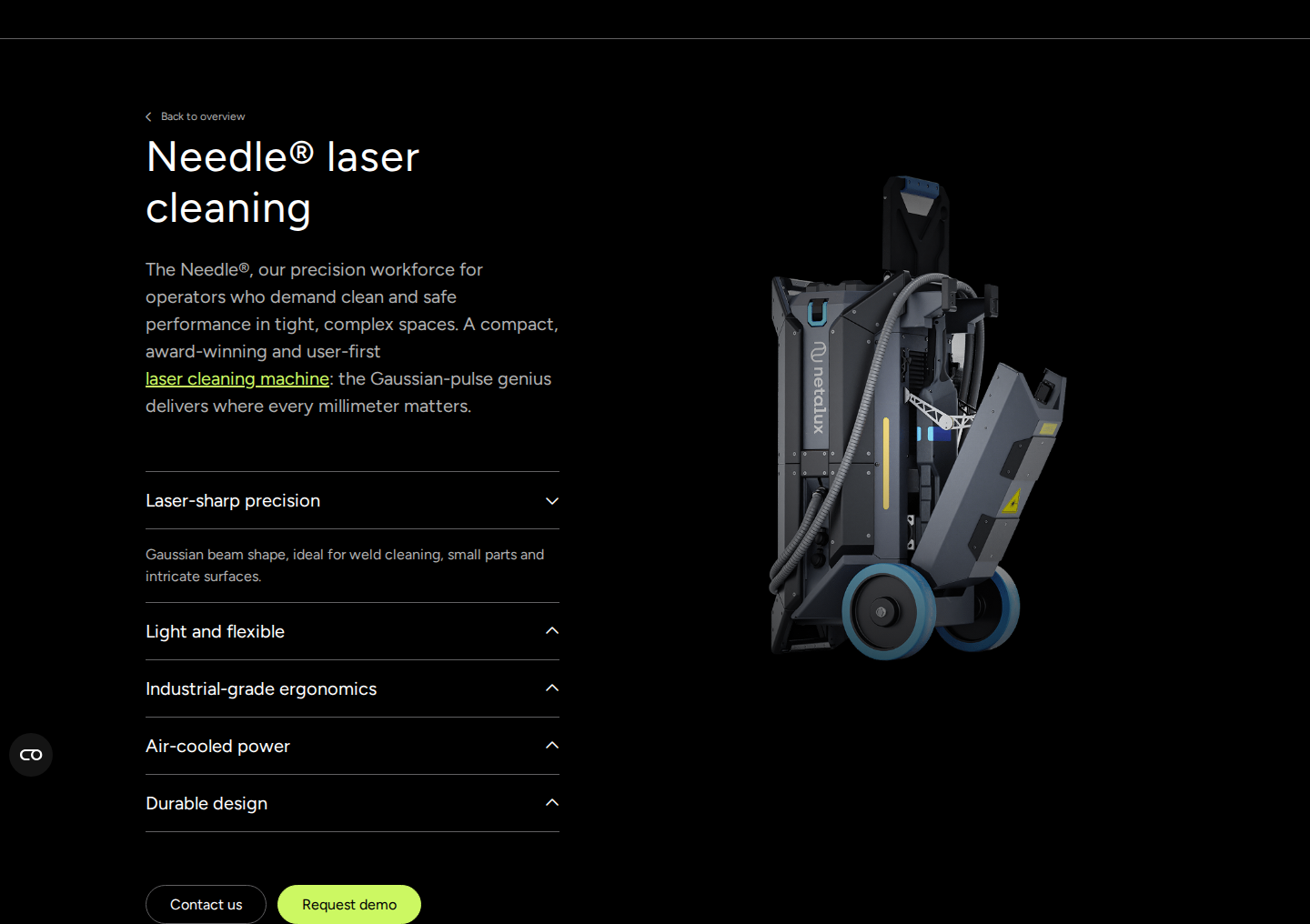
Belgian laser cleaning specialist with three consecutive Red Dot Awards for industrial design — the Needle's lightweight handset (from 2.3 kg) and compact air-cooled unit make it the precision-focused choice for confined spaces and hard-to-reach surfaces.
Pros:
Three consecutive Red Dot Awards (2020, 2022, 2023)
Lightweight handset from 2.3 kg, 115° rotatable head
Air-cooled on all Needle models, no water circuit
Stationary versions available for production-line integration
Cons:
Short fibre reach: 4.5–5.7 m on Needle models
Conventional Class IV hazard zone, full evacuation required
Best for: operators who prioritise ergonomics and compact form factor — precision cleaning on small areas, confined spaces, and hard-to-reach locations where handset weight and manoeuvrability are the deciding factors.
Three Consecutive Red Dot Awards
The Netalux Needle is the most design-decorated product on this list: three consecutive Red Dot Award: Product Design wins — the Needle 100/150 W in 2020, the Jango in 2022, and the Needle 200/300 W in 2023.
The Red Dot jury's citation for the original Needle noted that each detail was carefully conceived and ergonomically designed to achieve the greatest possible user-friendliness — a description that reflects the machine's core design philosophy, not just its visual appearance.
That philosophy is legible in the specs: a 2.3 kg handset on the Needle 100/150 W and a 115° rotatable head with integrated LED lighting and handset controls are engineering choices that reduce operator fatigue and improve access in tight or awkward positions.
Netalux Product Line: Specs at a Glance
The portable Needle range spans two air-cooled variants; the water-cooled Jango 500/1000 W extends the family for buyers who need substantially higher power within the same design lineage.
| Specification | Needle 100/150 W | Needle 200/300 W | Jango 500/1000 W |
|---|---|---|---|
| Power output | 100 W / 150 W | 200 W / 300 W | 500 W / 1000 W |
| Laser profile | Gaussian | Gaussian | Top-Hat |
| Max pulse energy | 1 mJ | 2 mJ | 100 mJ |
| Unit weight | ~20 kg | ~40 kg | ~850 kg |
| Handset weight | ~2.3 kg | ~3 kg | ~4 kg |
| Fibre length | 4.5 m | 5.7 m (mobile) | 45 m |
| Cooling method | Air-cooled | Air-cooled | Water-cooled |
| Unit dimensions (L×W×H) | 333×244×498 mm | 812×430×431 mm | 2117×840×1470 mm |
| Transport | Compact footprint | No transport box required | Forklift-compatible |
| Laser class | Class IV | Class IV | Class IV |
Comparing the three Netalux models across the key evaluation axes — power, weight, fibre length, cooling — is far clearer in tabular form than in prose, and spares the reader from parsing repeated figures across multiple paragraphs.
Stationary versions are available across the entire Needle and Jango range, enabling production-line or workstation integration for buyers who want the Netalux design philosophy in a fixed-installation context.
Trade-offs to Consider
The compact Needle models carry a real fibre-reach constraint: 4.5 m on the 100/150 W and 5.7 m on the 200/300 W, compared to up to 50 m on some competing portable systems.
For large structures or work areas where repositioning the unit repeatedly would be impractical, that reach limitation is a genuine operational factor worth weighing before purchase.
On the laser hazard zone axis, the Netalux range operates under standard Class IV protocols — the same position as entries 3 and 4 on this list. Open-plan or public-facing deployment requires full area evacuation and appropriate safety controls.
Buyers who need higher power than the Needle 300 W ceiling will find the Jango 500/1000 W the natural next step, though its water-cooling circuit and ~850 kg unit weight represent a significant infrastructure step up from the portable Needle models.
Pricing is not published on netalux.com. Contact Netalux directly at info@netalux.com or visit netalux.com for current distributor contacts covering Belgium, France, Italy, and Germany.
Conclusion
Which laser cleaning machine is right for you?
If you need to clean in an open workshop or heritage site without shutting down the area, the ELASER-RHZ is the only machine built for that.
For production-line cleaning with no path programming or specialist skills needed, AutoLASE loads the part and handles the rest.
Buyers who want the category originator's proven range and global install base will find it in the cleanLASER CL-series.
If your work spans portable through to heavy industrial, the P-Laser QF-series covers the full power spectrum from one supplier.
For precision work in tight spaces where handset weight decides, the Netalux Needle is the ergonomic choice.
Laser cleaning machines: frequently asked questions
The most common questions buyers ask before purchasing a laser cleaning machine — covering how the technology works, what it costs, and whether it can form the basis of a viable service business.
Yes — portable laser cleaning machines are well-suited to a service business model, primarily because the ongoing operating cost is very low. Electricity is the principal running cost; there are no abrasive media, chemicals, or consumables to purchase. That structure makes it straightforward to price jobs profitably across a wide range of applications. The breadth of work a single machine can address is a key enabler: rust removal, paint stripping, weld preparation, mould cleaning, graffiti removal, and surface restoration work across industrial and fabrication clients. A single operator can move between industrial maintenance clients, fabrication shops, and specialist cleaning projects without changing equipment. Before offering commercial services, operators should ensure they have appropriate laser safety training — understanding hazard zones, correct technique, and relevant safety protocols is a practical prerequisite for working on client sites, not a bureaucratic one.
Purchase prices vary significantly depending on power output, cooling method, form factor, and supplier. According to 4JET, mobile laser cleaning machines capable of rust and coating removal range from approximately €40,000 to €500,000 — a span that reflects the difference between a compact air-cooled handheld unit and a high-power automated system. Laser Focus World cites a narrower range of $60,000–$170,000 for industrial laser cleaning systems, depending on laser type, power, automation level, and integration complexity. The principal cost drivers are: power output (higher wattage commands a higher price), cooling method (water-cooled systems require additional infrastructure), form factor (automated robotic cells cost considerably more than portable handhelds), and whether you are buying from an in-house manufacturer or a reseller. Most European and Western manufacturers do not publish fixed list prices — pricing is application-specific, and buyers should expect to request a quote rather than find a price on a product page.
Yes — laser cleaning machines have extensive industrial validation across automotive, aerospace, heavy industry, mould maintenance, and surface preparation for welding and bonding. The technology is in active production use at companies including Rolls-Royce and Jaguar Land Rover, among many others across multiple sectors. The mechanism is laser ablation: the laser beam delivers concentrated energy to the surface, vaporising contaminants — rust, paint, oxides, coatings — at their ablation threshold while leaving the underlying substrate intact. That selectivity is what makes the process both effective and precise. Effectiveness does depend on matching the right power output and waveform to the specific application. A machine well-suited to its task performs with high repeatability and consistency; a mismatch in power or pulse type reduces results. The technology is proven at industrial scale — the question for any buyer is not whether it works, but whether the specification is right for the job.
As a method, laser cleaning has very low ongoing operating costs. The primary running cost is electricity; there are no consumables — no abrasive media, no chemicals, no water — and maintenance requirements are modest. 4JET cites operating costs for handheld laser systems at approximately €0.50 per hour, with total running costs under €1 per hour when cover glass and filter wear are included. Laser Focus World independently references a stripping hour cost of around $6/hour for industrial systems, factoring in laser source life and filter costs. The upfront investment is higher than some traditional alternatives such as sandblasting or chemical stripping, but the total cost of ownership calculation typically favours laser cleaning over time: zero consumables, reduced downtime in many applications, and less substrate damage mean less rework and fewer replacement parts. For high-volume or continuous production use, those savings compound significantly.