
Introduction
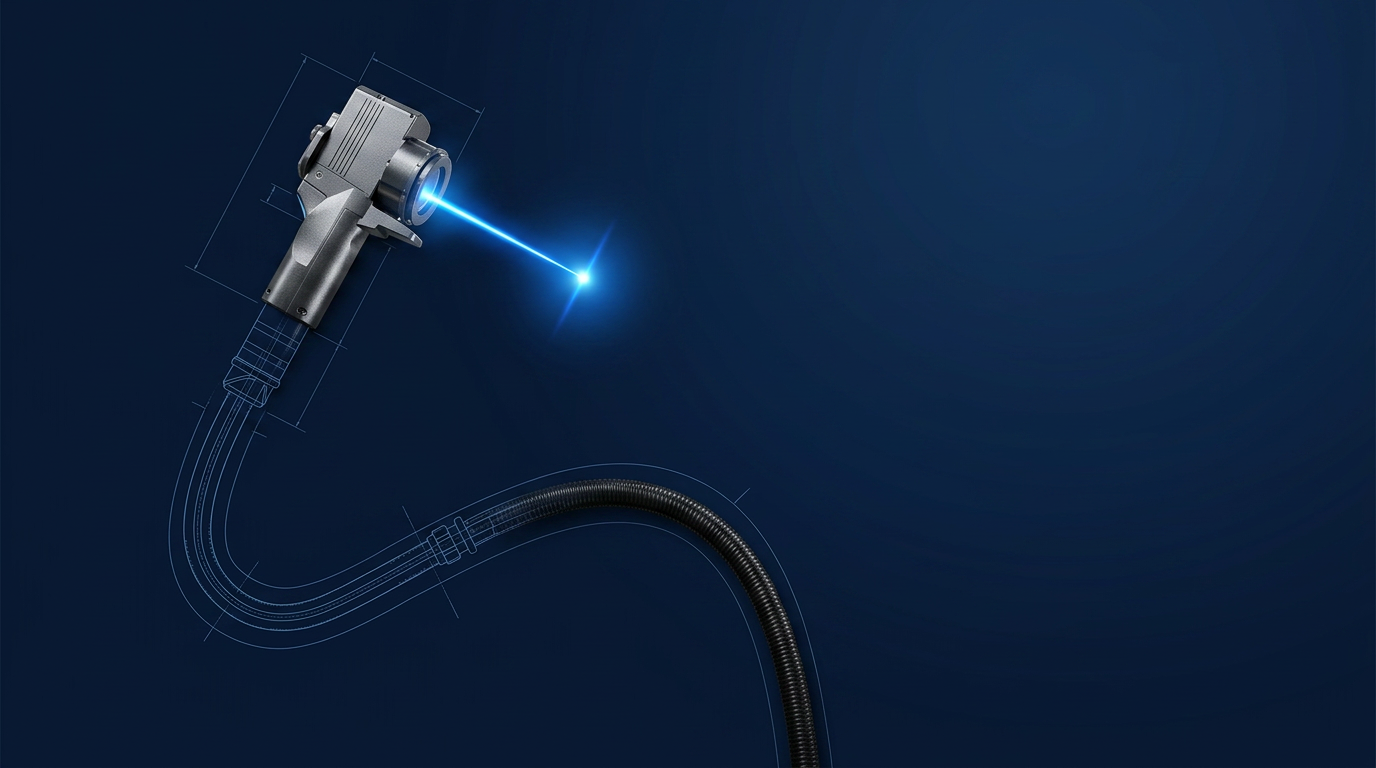
Yes, a laser cleaning gun is exactly what the name suggests: a handheld, pistol-grip device you point at a surface and pull the trigger.
This guide is for buyers evaluating a purchase, specifiers choosing a system for a facility, and operators who want to understand the technology before they use it.
It covers how the technology works, what laser mode and power choices mean in practice, what cooling and ergonomics demand from a real working day, how safety overhead actually breaks down, and what to look for when comparing systems.
The goal is practical knowledge — enough to evaluate systems confidently, ask the right questions, and avoid the mistakes that trip up first-time buyers.
TL;DR
Most buyers focus on wattage and miss the decisions that actually determine whether a laser cleaning system works for them: laser mode, duty cycle, cooling capacity, and who is really behind the product they are buying.
Getting those right is the difference between a system that earns its keep and one that underperforms from day one.
This article covers:

How handheld laser cleaning works: mechanism and form factor
Laser modes and power ratings: what specs mean
Cooling systems, duty cycle, and sustained operation
Operator safety: real overhead and how to reduce it
Applications and materials: what these systems handle
Buying guide: questions that avoid costly mistakes
What is a laser cleaning gun?
The term "laser cleaning gun" is accurate in one important sense: the device the operator holds and directs really does look and feel like a gun, with a pistol-grip handle and a nozzle pointed at the work surface.
What the name doesn't convey is that the handheld part is only half the system. The scanning head the operator carries contains no laser source, no power electronics, and no cooling — it is a lightweight directional tool, connected by a fibre-optic delivery cable to a separate wheeled trolley unit that houses all the heavy components.
That separation is what makes handheld laser cleaning practical: the operator manoeuvres a sub-3 kg scanner while the trolley unit — which can weigh up to 50 kg — stays on the floor nearby.
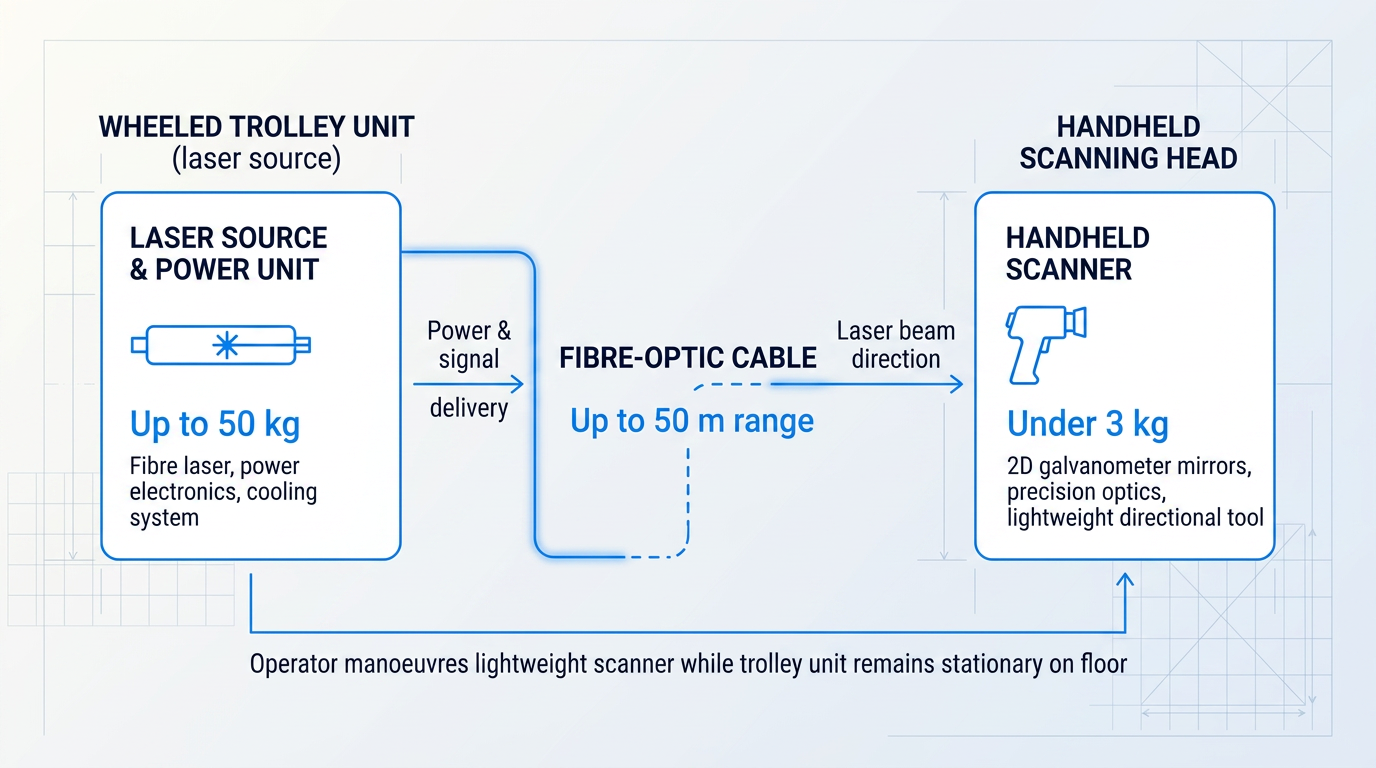
To illustrate what this looks like in practice: Woodrow Scientific Limited's ELASER is a portable industrial laser cleaning system whose handheld scanner weighs under 3 kg and connects to its wheeled source unit via a delivery cable of up to 50 m — giving a single operator a large working radius without relocating the trolley.
How laser cleaning actually removes contamination
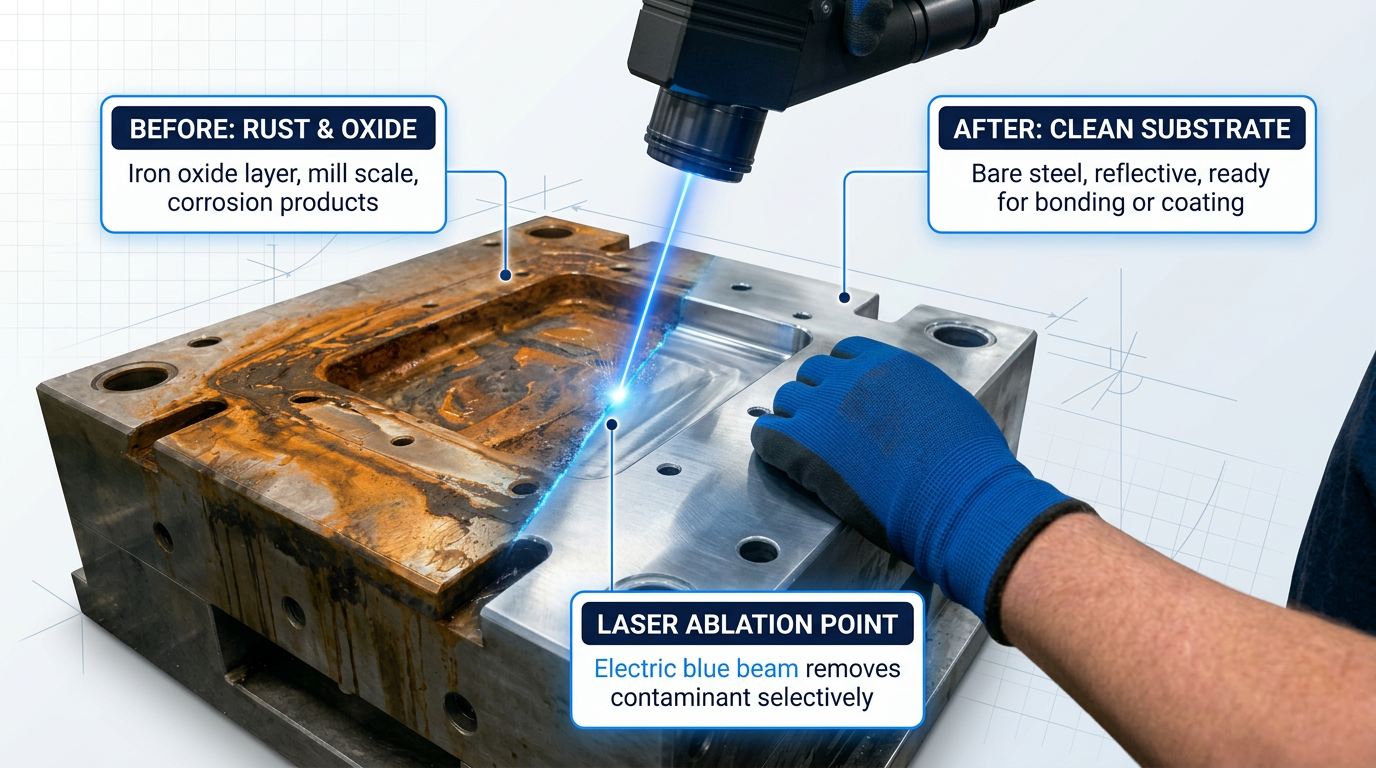
The operating principle is laser ablation: a focused beam delivers concentrated energy directly to the surface being cleaned.
The contamination layer — rust, paint, oxide scale, or similar — absorbs that energy and vaporises, converting from solid to gas almost instantaneously.
The substrate beneath behaves differently. Reflective metals, in particular, reflect or rapidly dissipate the beam energy rather than absorbing it — so the beam's effect on the base material is minimal.
This difference in absorption between the contaminant and the substrate is the physical basis of the entire process, and it has a practical consequence that matters enormously for real-world use.
Because the substrate reflects rather than absorbs the beam, the removal process is self-limiting — it stops at the base material once the contamination is gone. Unlike abrasive methods, which erode substrate and contaminant alike, laser cleaning removes what needs to go without cutting into what needs to stay.
This self-limiting behaviour is also why laser cleaning produces minimal substrate loss — the mechanism itself enforces the boundary, rather than relying on operator skill or timed exposure.
Inside the scanning head: how it covers an area
A laser beam at the focal point is a very small spot — too small on its own to clean a useful area at any practical speed.
The solution is a 2D galvanometer inside the scanning head: a pair of precision mirrors driven by servo motors that sweep the focused beam rapidly across the surface in a programmable pattern.
The beam moves fast enough — up to 10 m/s in systems like the ELASER — that it covers a defined scan field rather than dwelling on a single point, creating a cleaning effect across an area with each pass.
The scan patterns are fully programmable, which means the operator is directing a moving cleaning zone, not tracing a pencil beam by hand — a distinction that becomes important when understanding how power and scan speed interact to govern cleaning performance.
Laser cleaning systems also come in fixed-head automated and robotic-arm-mounted configurations, but those are industrial production setups — this guide focuses on the handheld and portable form factor that the term "laser cleaning gun" describes.
Now that the mechanism is clear, the next logical question is how the beam energy itself is delivered — specifically, whether the laser fires in a continuous stream or in rapid discrete pulses, and why that choice shapes cleaning performance so significantly.
Continuous Wave vs Pulsed Lasers Explained
Two laser cleaning guns rated at identical average wattage can produce dramatically different results on the same surface — one leaving the substrate intact, the other roughening it or causing heat damage. The difference comes down to how the energy is delivered, not just how much energy is used. Understanding the two primary operating modes — continuous wave (CW) and pulsed — is the single most important conceptual step in evaluating any laser cleaning system.
Continuous wave lasers: steady beam, heat accumulation risk
A continuous wave laser does exactly what the name suggests: it emits an uninterrupted beam for as long as the trigger is held. Energy flows to the surface without pause.
The practical consequence is thermal. Because there is no gap in energy delivery, heat accumulates in the substrate if the operator's scanning speed is not carefully managed.
With a CW laser, scanning too slowly risks damaging the substrate through sustained heating; scanning too fast results in incomplete cleaning. Finding and holding that narrow window is the central challenge of CW operation.
Pulsed lasers: discrete bursts and substrate recovery
A pulsed laser delivers energy in discrete bursts rather than continuously. Between each pulse there is an off-period — and that gap is the critical difference.
During each off-period, the substrate dissipates the heat it has absorbed before the next pulse arrives. This dramatically reduces the risk of thermal damage and gives the operator far finer control over how much energy is deposited per unit area.
The result is that ablation happens in controlled increments, with the substrate recovering between each energy event rather than experiencing a sustained thermal load.
MOPA fibre lasers: the configurable standard
Within the pulsed category, the architecture you are most likely to encounter in a handheld industrial laser cleaning gun is the MOPA (Master Oscillator Power Amplifier) fibre laser.
The practical significance of the MOPA design is configurability. Unlike simpler pulsed designs where pulse duration, pulse energy, and repetition rate are tightly coupled, a MOPA system allows each of these parameters to be controlled independently.
MOPA-based sources can operate across a pulse duration range spanning from single-digit nanoseconds up to 2,000 ns, and at repetition rates from 1 kHz to 1 MHz — giving the system an unrivalled ability to match its energy delivery profile to a specific contaminant and substrate combination.
Peak power vs average power: the key buyer insight
The wattage figure on a laser cleaning system's specification sheet refers to average output power — but average power is not what drives ablation. Peak pulse power is.
Because a pulsed laser concentrates all of its energy into very short bursts, the instantaneous power during each pulse is orders of magnitude higher than the average figure suggests. A 150 W pulsed solid-state laser, for instance, can generate a peak pulse power of more than 160 kW. A 750 W system with 30 ns pulses can reach 3 MW peak power.
It is that peak power that causes the contaminant to vaporise cleanly. Average power governs throughput — how much surface area is cleaned per hour. Peak power governs ablation quality — whether the removal event happens effectively and without damaging the substrate.
A 150 W pulsed laser can deliver peak pulse power exceeding 160 kW — more than 1,000 times its average rating. Comparing systems by average wattage alone misses the figure that actually determines ablation effectiveness.
Buyers who compare systems by average wattage alone are therefore comparing the wrong number for ablation performance. A lower-wattage pulsed MOPA system can outperform a higher-wattage CW system on precision cleaning tasks precisely because its peak power drives cleaner ablation events.
Substrate safety: what the numbers show
The difference in energy delivery translates directly into measurable differences in what happens to the substrate surface after cleaning.
When a CW laser is used for cleaning, the continuous heat input tends to increase surface roughness: research comparing the two modes found that CW-cleaned surfaces show roughness values approximately 1.5 times the original surface roughness.
A MOPA pulsed laser, by contrast, can leave surface roughness at or even below the pre-cleaning level — because the short, controlled bursts with recovery time between them remove the contaminant without imparting the cumulative thermal stress that roughens the substrate.
For precision applications — injection moulds, aerospace components, heritage conservation objects, thin-gauge metals — the surface condition of the substrate after cleaning is as important as the removal of the contaminant itself. This is where the choice of laser mode becomes a functional requirement, not a preference.
Choosing the right mode for your application
Neither mode is universally superior. The right choice depends on what you are cleaning and what the substrate can tolerate.
- CW lasers: high-throughput, robust substrates: Best suited to large steel structures, pipework, and heavy industrial cleaning where throughput is the priority and the substrate tolerates higher surface heating. Lower capital cost and simpler operation.
- Pulsed MOPA: precision and sensitive substrates: Best suited to moulds, aerospace components, heritage objects, thin-gauge metals, and pre-weld prep where surface finish after cleaning is a functional requirement.
It is also worth noting that at equivalent average power, MOPA pulsed lasers clean faster on many surfaces: cleaning efficiency on aluminium alloy has been measured at 2.77 m²/h for MOPA versus 0.36 m²/h for CW — a 7.7× difference. On carbon steel the ratio is 3.5× in favour of MOPA. CW systems can compensate by running at higher average power, but doing so increases the heat effect on the substrate.
With the operating mode distinction established, the natural next question is how much power your specific application actually requires — and what the wattage figures on system specifications really mean in practice.
Power ratings explained: matching wattage to your application
When buyers compare laser cleaning guns on specification sheets, the instinct is straightforward: more watts equals better performance. In practice, that instinct leads to both overspending and underpowering — because wattage governs something more specific than overall capability.
What average power actually controls
Average power — the wattage figure quoted on every spec sheet — governs cleaning speed and area coverage rate. A higher average power means more surface area cleaned per hour; it does not automatically mean cleaner results or better contaminant removal.
Think of average power as a throughput variable, not a quality variable. Two systems at different wattages can achieve identical cleaning quality on the same substrate; the higher-powered system simply gets there faster.
For pulsed laser systems — which account for the majority of laser cleaning guns in industrial use — average power understates the energy actually doing the work. As covered in the previous section, pulsed lasers concentrate their energy into very short bursts rather than emitting it continuously.
The figure that drives ablation in a pulsed system is peak pulse power: the instantaneous power within a single pulse. Narran's technical documentation notes that peak power within one pulse is the operative figure — distinct from the average or mean power across time.
A 100W pulsed fiber laser can deliver peak pulse power of 10,000W per burst. Comparing pulsed and continuous wave systems on average wattage alone will give you a misleading picture of their relative cleaning capability.
This matters practically when evaluating specifications: a pulsed system at a given average wattage punches well above its average-power weight on difficult contaminants, because it is peak energy — not average energy — that must exceed the ablation threshold of the contaminant.
Power tiers and the applications they suit
Across manufacturers and application types, three broad power tiers have emerged as practical reference points for buyers specifying a laser cleaning system. The table below maps these tiers to the applications and contaminant profiles they serve, drawing on categorisations published by Laserax and Narran.
| Power Tier | Output Range | Typical Applications | Contaminant and Substrate Fit |
|---|---|---|---|
| Regular / Low Power | 10–100W (up to 200W) | Precision cleaning, restoration, sensitive substrates, low-volume production | Thin coatings, light oxidation, delicate surfaces where heat input must be minimised; slower on thick deposits |
| High Power (Mid-tier) | 200–500W | General industrial handheld use, rust and paint removal, weld preparation, mould cleaning | Moderate rust, paint layers, mill scale; handles most common industrial contaminants at practical speed |
| Ultra-High Power | 500W–3kW | Large-area structural cleaning, thick coating removal, continuous production lines | Heavy rust, thick paint, large surface areas; multimode beam covers more area per pass |
Maps three established laser power tiers to their application types and contaminant profiles, giving buyers a practical reference for specification decisions.
The mid-tier range of 200–500W covers the majority of industrial handheld applications. Narran describes typical customers for this tier as smaller industrial companies and service providers who need to handle rust removal, paint stripping, and weld preparation at a productive pace.
At the lower end, Narran characterises systems of 50–200W as well-suited to precision work and smaller areas, but notes that the weakest systems in this range either cannot handle thick deposits of contaminants or can only do so very slowly — and are not recommended for such applications without supplementary mechanical cleaning.
At the upper end, Laserax identifies ultra-high-power pulsed lasers of 500W and above as suited to cleaning large surface areas — a task generally considered impractical with systems of 500W or less due to the time required.
Contaminant type shapes your power requirement
Two buyers cleaning the same total surface area per day may need very different power levels, depending entirely on what they are removing. Thicker coatings and more tenacious contaminants — mill scale, heavy rust, thick paint layers — require more energy per unit area to ablate.
That energy can be delivered in two ways: higher average power (cleaning faster at the same scan speed) or slower scanning speed (more dwell time per unit area at the same power). The right power choice is therefore a function of what you are cleaning, not only how much surface you need to cover.
Laserax's guidance on handheld cleaners lists the substrate, contaminant type, and contaminant thickness as distinct inputs to the specification decision — alongside surface area and required cleaning time. Treating wattage as the only variable and ignoring contaminant profile is where many buyers go wrong.
Power selection as a total cost of ownership question
An underpowered system that requires multiple passes to clean what a correctly specified system cleans in a single pass has a worse total cost of ownership despite its lower nominal rating — the additional machine time, operator time, and reduced throughput erode the apparent saving.
When evaluating systems, factor cleaning speed and passes-per-job into the economic case alongside the headline specification. The relevant question is not 'how many watts does this system have?' but 'how long does this system take to complete my typical job, and what does that time cost?'
At the other end of the scale, systems above 1kW introduce a different practical constraint: the laser units and associated equipment reach weights of 120kg or more, and the process heads on high-power models require water cooling to sustain operation. That combination rules out sustained handheld use regardless of power rating — a point that matters when specifying a portable laser cleaning gun rather than a fixed or robotic installation.
For most industrial handheld applications, the practical sweet spot sits in the 200–500W range: sufficient throughput for common contaminants, manageable system weight, and compatible with air-cooled or integrated cooling designs. The ergonomics and portability implications of this ceiling are covered in a later section.
Knowing the power level you need is only part of the specification. The next question is whether the system can sustain that power continuously under real working conditions — which is what cooling architecture and duty cycle determine.
Cooling systems and duty cycle: what sustained operation requires
A power rating tells you how fast a laser cleaning gun cleans when it is running — but it says nothing about how much of the working session it is actually running.
Fibre laser sources convert electrical energy into laser light, but the conversion is not perfectly efficient: a portion of that input energy becomes heat inside the laser source itself.
Without adequate thermal management, that heat accumulates until the system must either throttle output power or pause entirely to protect the laser source from damage — neither outcome delivers the throughput the wattage specification implies.
Air-cooled vs water-cooled: the architecture choice
Air-cooled systems use internal fans and heat exchangers to dissipate heat from the laser source — no external water supply, no chiller unit, no coolant circuit of any kind.
The practical result is a genuinely self-contained system: connect it to a standard single-phase power supply and it is ready to operate, with no infrastructure dependencies to arrange beforehand.
At the power levels most relevant to handheld industrial use — up to around 300W — air-cooling is fully capable of managing the laser source's heat load without external support, making it the natural architecture for portable, site-deployable systems.
Water-cooled systems use a closed-loop chiller circuit to handle the higher heat loads generated at power levels typically above 500W, where air-cooling alone is no longer sufficient.
That cooling capacity comes with operational dependencies: the chiller unit adds to the system's physical footprint and weight, the system requires a managed coolant supply, and it is no longer self-contained on a single wheeled trolley.
Water-cooling is the right engineering choice for very high-power applications — but buyers evaluating a handheld, portable system need to understand clearly what a chiller dependency means for the form factor they are envisioning.
Duty cycle: the specification listings routinely omit
Duty cycle is the percentage of time a system can operate the laser at its rated power continuously before requiring a cooling pause to recover.
- 100% duty cycle: The system runs continuously at rated power with no enforced pauses — the laser source and cooling architecture are matched for uninterrupted operation.
- Partial duty cycle (e.g. 60%): For every 10 minutes of operation, the system requires roughly 4 minutes of cooling before it can resume — reducing effective cleaning time by 40%.
- Duty cycle vs wattage: A higher-wattage system with a 60% duty cycle may deliver less productive cleaning time per hour than a lower-wattage system running at 100%.
The productivity consequence is direct: enforced cooling pauses are time spent waiting, not cleaning — and a system with a lower duty cycle has a lower effective throughput than its peak wattage alone suggests.
Product listings frequently omit duty cycle entirely, or state it only at a reduced power setting where the system performs better — not at the operating power the buyer actually intends to use.
Always verify a manufacturer's stated duty cycle at the specific power level you intend to operate — not at a lower setting where the figure looks better. The gap between those two numbers is the gap between the specification and real-world productivity.
For sustained industrial use, the practical purchasing check is straightforward: confirm the system's continuous operation capability at your intended working power, and confirm that the cooling architecture matches your deployment environment.
An air-cooled system correctly specified for its application — such as Woodrow Scientific's ELASER, which is air-cooled with no water, chiller, or coolant circuit required and rated up to 300W — can operate as a genuinely self-contained unit: one wheeled system under 50kg, one standard power connection, no external dependencies.
A water-cooled system at equivalent or higher power may sustain operation at very high wattage, but the chiller unit it requires adds to total system footprint and removes the self-contained portability that the handheld form factor implies.
Neither architecture is universally superior — the right choice depends on the power level the application demands and the working environment the system will be deployed into.
Cooling architecture is, in fact, one of the primary determinants of whether a laser cleaning system is genuinely portable and site-flexible — a theme the next section takes further, examining what else determines whether a handheld system is truly usable by one operator across a full working day.
Ergonomics and Portability: What All-Day Use Demands
Specifications tell you what a laser cleaning gun can do; ergonomics determine whether an operator can actually do it across a full working day — and those are very different questions.
Scanner weight is the single most important ergonomic variable in any handheld system. The operator holds and manoeuvres the scanner continuously, and weight translates directly into fatigue: fatigue shortens productive sessions, increases break frequency, and — over sustained periods — risks musculoskeletal strain. Sub-3 kg is the practical benchmark for all-day use; below that threshold, most operators can maintain a productive working rhythm across a full shift without significant physical degradation.
Grip design reinforces or undermines whatever weight advantage the scanner has. A well-balanced pistol-grip scanner distributes load naturally in the hand and allows comfortable working at different angles — overhead, lateral, low — without forcing awkward wrist positions. The trigger and control layout matters too: if the operator has to reposition their hand to adjust a setting mid-task, that interruption compounds over a long session. Buyers should handle the scanner before committing, or at minimum ask the supplier specifically about the balance point and trigger ergonomics.
Cable Reach and Working Range
The fibre-optic delivery cable connects the handheld scanner to the source unit on the trolley, and its length sets the operator's working range before the trolley needs to be repositioned.
On a compact workpiece in a workshop bay, a 5 m cable is adequate. On a large steel structure — a ship hull, a bridge section, an extended fabrication — the difference between 5 m and 50 m of cable reach is the difference between repositioning the trolley every few minutes and covering the entire structure from a single trolley position. Fewer moves means less setup time, less disruption to workflow, and a sustained productive rhythm that compounds into real throughput gains across a shift.
Woodrow Scientific's ELASER illustrates what the upper end of this specification looks like in practice: a scanner weighing under 3 kg paired with a delivery cable of up to 50 m (with 5 m and 15 m options as standard), all in a system under 50 kg — figures that ground the benchmarks this section establishes in a concrete, shipping industrial system.
System Mobility and Self-Contained Operation
Single-operator portability is a system-level property, not just a scanner weight figure — and the trolley unit is where that claim is most often tested.
- Trolley weight and manoeuvrability: A system under 50 kg that one person can move unaided is the practical threshold. Heavier units effectively require a second operator for repositioning.
- Wheel design for your environment: Large wheels handle uneven outdoor surfaces; swivel castors suit tight workshop spaces. Evaluate against your actual working environment, not an idealised floor.
- No external dependencies: No compressor, no water supply, no consumable replenishment mid-session. Each external dependency adds a setup step or a second person — reducing genuine portability.
- Control interface accessibility: Parameters adjustable without returning to the trolley save real time on large workpieces. Check whether the interface works for an operator wearing gloves.
A lightweight scanner fitted to a heavy, awkward trolley with external supply dependencies is not truly portable — it is merely a portable scanner on an immobile system. The self-contained, consumable-free design of an air-cooled system (as established in the previous section on cooling) removes the compressor and water supply from the equation entirely; a well-designed control interface — such as a touchscreen with per-user logins that can be configured before the operator moves to the work area — reduces mid-task returns to the trolley. Together, these features determine whether one person can genuinely run a full cleaning session unassisted.
Scanner weight is the starting point, not the conclusion. Cable reach, trolley manoeuvrability, zero external dependencies, and an accessible control interface are what determine whether a single operator can do the job productively — across the whole working day, on the actual site.
How the system is physically set up and positioned in the working environment also has direct implications for how the laser safety perimeter is managed — and that is the next consideration every handheld operator needs to understand.
Laser Safety for Handheld Operators: The Real Overhead
Safety is the concern that stops more buyers from committing to a laser cleaning gun than almost any other factor — and it deserves a straight answer, not a disclaimer.
Industrial laser cleaning systems are Class IV lasers, the highest hazard class under the standard laser classification system used in both the US and internationally.
Class IV means the beam is capable of causing injury to unprotected eyes and skin under direct and diffusely reflected exposure — not just from looking into the beam, but from scattered light off a surface.
That is not a marginal risk category, but it is a well-defined one: Class IV lasers are used safely across manufacturing, research, and medicine every day, because the hazard class comes with a well-established set of controls.
The concept that ties those controls together is the Nominal Hazard Zone (NHZ): the calculated area around a laser operation within which beam intensity is sufficient to cause injury to unprotected eyes or skin.
For a conventional Class IV handheld laser cleaner, this zone is large — large enough that the entire working area must be treated as a controlled laser zone before a single cleaning pass begins.
In practice, that translates into a set of controls that must be established and verified before each session. Standard industry practice for Class IV operation requires all of the following:
- Area controls: The working area must be cleared of other personnel and access controlled — typically via posted laser warning signs, physical barriers, or interlocked entryways.
- Wavelength-specific eyewear: All personnel within the NHZ must wear wavelength-specific laser safety eyewear rated for the exact laser wavelength and power level — not generic safety glasses.
- Written SOPs: Standard operating procedures covering the hazard, controls, and emergency response are required for Class IV laser operation.
- Operator training: Operators must understand the hazard, the controls, and emergency procedures before operating a Class IV laser — this is mandatory, not optional.
Taken individually, none of these requirements is unreasonable — but taken together, they mean the operator must set up, verify, and then dismantle a controlled laser zone before and after every cleaning session.
That cumulative overhead is what limits where conventional laser cleaning guns can realistically be deployed: open workshops, shared manufacturing floors, and publicly accessible environments are effectively off-limits without significant disruption to everyone else working nearby.
A system's Nominal Hazard Zone is ultimately a deployment constraint: it dictates whether a cleaning job requires a controlled shutdown of the surrounding area, or whether it can happen alongside normal operations. That distinction shapes which environments a laser cleaner can practically serve.
How Reduced Hazard Zone Technology Changes the Picture
The most significant development in handheld laser cleaning safety is reduced hazard zone (RHZ) technology — an approach that collapses the NHZ to a small area immediately around the work surface, rather than a large zone around the operator.
Woodrow Scientific Limited's ELASER-RHZ is the world-first implementation of this technology, built on a 1550 nm retina-safe wavelength that is the technical basis for its RHZ classification.
In its RHZ configuration, the ELASER-RHZ can operate as Class I — the lowest and safest laser hazard class — a concrete illustration of how far the hazard profile shifts relative to a conventional Class IV system.
The operational consequence is substantial: because the hazard is confined to the immediate work area, an RHZ system can be used in open workshops, mixed-use manufacturing facilities, and publicly accessible environments without sealing off the area or evacuating other personnel.
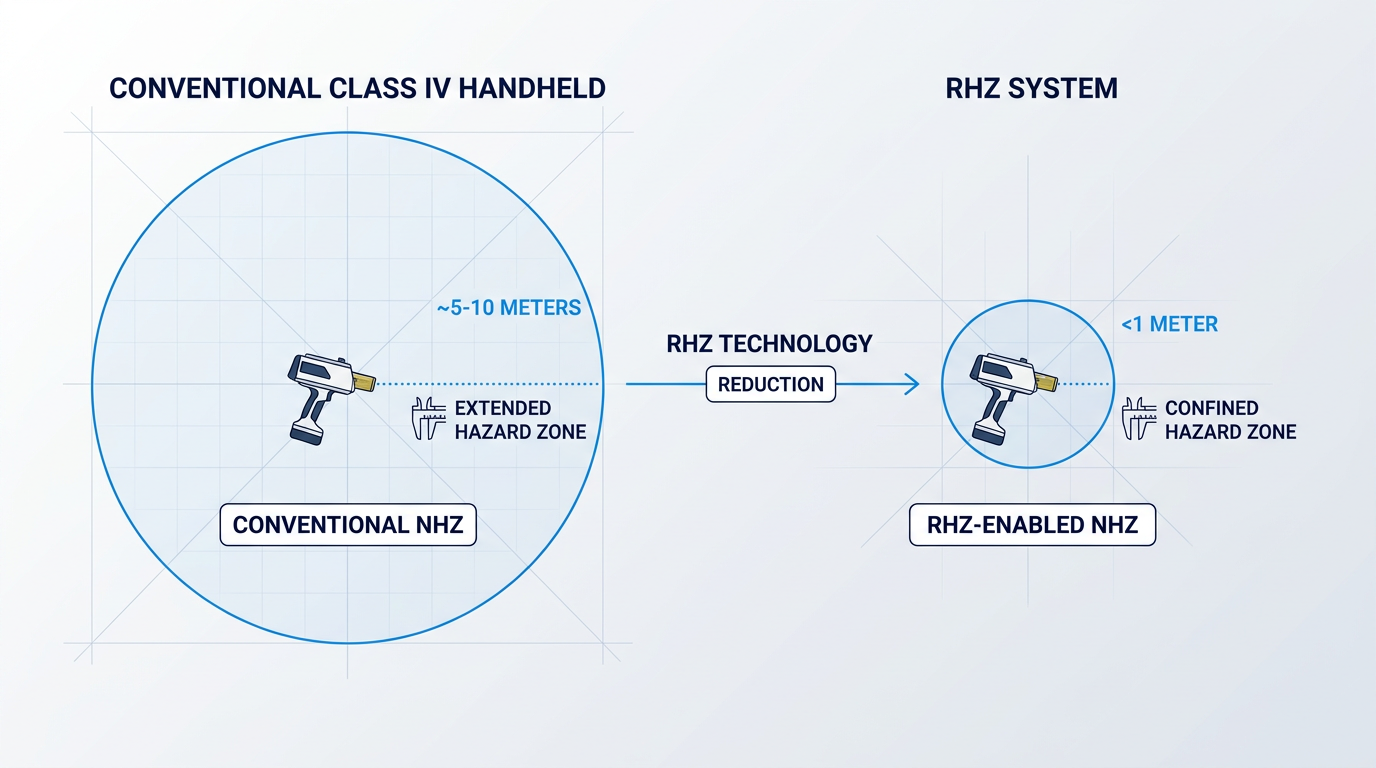
This is not a marginal improvement — it is the difference between a technology that requires a controlled environment to function and one that can be deployed almost anywhere.
It is worth being precise about what RHZ technology does and does not change: area controls at the scale of conventional Class IV operation are no longer required, but wavelength-specific laser safety eyewear and operator training remain necessary.
The significant change is in the scale of operational disruption, not the elimination of all precautions. Woodrow Scientific Limited provides full operator training as part of the ELASER-RHZ package — this should be treated as a standard part of commissioning the system, not an afterthought.
With that picture in mind, the right question to ask any laser cleaning supplier is: what is the Nominal Hazard Zone for this system at my intended operating power?
The follow-up is equally important: does this system offer reduced hazard zone technology? Most conventional Class IV handheld systems require full area controls before every session — RHZ capability is not universal across the market, and buyers who do not ask before purchase may find themselves with a system that cannot be used where they actually need it.
The environments that RHZ technology unlocks — open facilities, shared workspaces, publicly accessible heritage sites and building facades — are also some of the most interesting contexts for what a handheld laser cleaner can actually do, which is where the next section picks up.
Applications and Materials: What Handheld Laser Cleaners Handle
With the technical groundwork covered, the practical question becomes: does this technology actually handle what you need to clean? The answer depends on substrate, contaminant, and context — and the range is broader than most buyers expect.
Metals: the primary substrate class
Metals are the dominant substrate for handheld laser cleaning, and for good reason: the self-limiting behaviour described in the ablation section means the beam stops removing material once it reaches the reflective base metal, making the process inherently safe for the substrate.
Confirmed compatible metals include steel, mild steel, stainless steel, galvanised steel, aluminium alloys, cast iron, copper, and nickel alloys — covering the majority of substrates found in fabrication, maintenance, and infrastructure work.
Beyond metals, stone, brick, and masonry are an important secondary substrate class, particularly in heritage and restoration contexts. The Getty Conservation Institute documents laser cleaning as now routine on very delicate stone surfaces, precisely because it involves no physical contact and no solvents or water that could redistribute harmful salts.
Contaminants: what the beam removes
The contaminant range is wide — and it is coherent, not arbitrary. Each item on the list below shares the same property: it absorbs the laser beam energy more readily than the underlying substrate does.
- Rust and oxides: Iron oxides, aluminium oxides, stainless steel oxides, and general corrosion products — among the most common laser cleaning targets in fabrication and maintenance.
- Mill scale: The iron oxide layer formed during hot rolling of steel. Removal typically requires higher fluence and more passes than surface rust.
- Paint and powder coatings: E-coat, powder coating, phosphate coating, and standard paint layers — including selective removal of coating only from defined zones.
- Lacquer and primer: Partial decoating of varnish or primer layers without full strip — useful for electrical contact preparation or adhesive bonding zones.
- Oil and grease: Lubricants, cutting fluids, and grease residues from manufacturing or handling — removed before welding, bonding, or coating processes.
- Carbon and soot: Combustion deposits and smoke damage residues, including post-fire soot removal from building surfaces and mould components.
- Mould release agents: Residues from tyre, rubber, plastic, food, and composite moulds — cleaned in-press without disassembly in many industrial setups.
- Graffiti: Paint applied to stone, brick, or concrete — removable without damaging the substrate, as demonstrated on historic masonry.
- Adhesives and residues: Adhesive residues and electrolyte residues from battery connections and bonded assemblies, ahead of rebonding or inspection.
- Weld discolouration: Heat-affected-zone oxides and thermal staining on finished weld joints — a common post-weld cleaning target on stainless steel.
The reason this list holds together is the same physics the ablation section established: the contaminant absorbs the beam energy while the substrate reflects or dissipates it, so the process is selective by physics rather than by operator judgement.
Where that differential absorption does not exist — for instance, when a substrate and its contaminant have similar optical properties at the laser wavelength — selectivity breaks down and the self-limiting mechanism no longer protects the base material.
Industrial and field applications
The handheld form factor earns its place in in-situ industrial maintenance because the operator brings the tool to the workpiece — cleaning plant, pipework, structural steel, and equipment on-site without disassembly, masking, or media containment.
Pre-weld and post-weld surface preparation is one of the most well-established applications: removing oxides, coatings, lubricants, and contamination from weld zones directly affects weld quality, while post-weld cleaning removes heat-affected-zone oxides and thermal staining from finished joints.
Heritage and restoration work is where the combination of fine power control and the handheld form factor is hardest to replicate with any other method: the operator works on-site on a monument, facade, or artefact, removing encrustations, graffiti, and soiling without abrasive contact or chemical penetration. For publicly accessible sites, systems with reduced-hazard-zone capability — a class of technology covered in the safety section — make open-environment operation more practical than traditional Class IV setups would allow.
Metals have high reflectivity at the infrared wavelengths used by fibre laser cleaners, while oxides, rust, paint, and organic contaminants absorb the same wavelengths readily. This absorption contrast is what makes laser cleaning selective — and it is why the same tool can handle such a wide range of contaminants across so many substrate types.
Where handheld laser cleaning is less well suited
Handheld laser cleaning is practical for targeted, access-constrained, and moderate-area work; for very large surface areas — entire ship hulls or bridge structures — automated or high-power fixed systems are significantly more economical and are the appropriate choice.
Substrates that absorb the laser wavelength similarly to the contaminant present a real limitation: without meaningful absorption contrast, the self-limiting mechanism does not operate and substrate damage becomes a risk.
Very thin or thermally sensitive materials are not impossible to clean by laser, but they require specialist parameter development rather than standard settings — they are not plug-and-play applications and should be approached with test work before committing to production use.
With the application landscape now clear — what the technology handles, why it handles it, and where it has limits — the next section addresses how to translate that understanding into a purchasing decision.
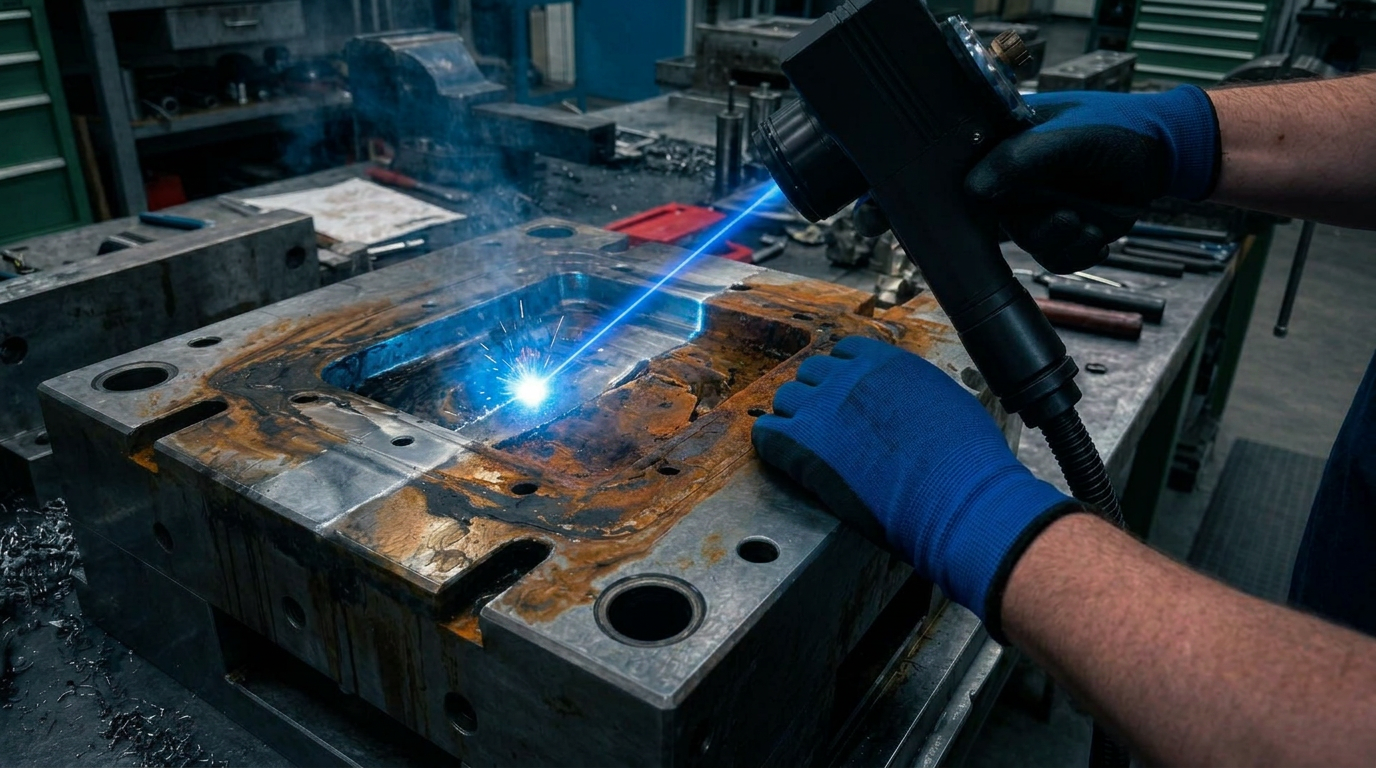
See a Laser Cleaning Machine in Action
Theory only goes so far. Watch a portable laser cleaning machine tackle a real surface, or explore the ELASER product range and see how the specifications map to your application.
What to Look for When Buying a Laser Cleaning Gun
Understanding the technology is only half the purchase decision — the other half is knowing which questions to ask, and recognising what the answers reveal about a system and the supplier behind it.
The most common buying mistake is skipping the application definition step: going straight to power ratings or price before establishing what the system actually needs to do.
Before evaluating any laser cleaning gun, nail down four parameters: contaminant type and thickness, substrate material, surface area per session, and working environment — open workshop, enclosed booth, outdoor site, or public-facing. These are not preferences; they are the inputs that determine minimum power, laser mode, and cooling requirements. Every other criterion follows from them.
The core evaluation criteria
With your application defined, the following criteria give you a structured framework for comparing systems and suppliers.
- Laser mode vs substrate: Pulsed MOPA for precision work and sensitive substrates; CW for high-throughput work on robust surfaces. Confirm which mode a system uses — it is not always disclosed prominently in listings.
- Power vs throughput (TCO lens): The right power is the power that cleans at the right speed for your volume. An underpowered system needing multiple passes carries a worse total cost of ownership than a correctly specified one.
- Cooling architecture vs portability: Air-cooled systems are genuinely self-contained — no chiller, no external water supply. Water-cooled systems handle higher heat loads but add infrastructure dependency that limits where you can work.
- Scanner weight and cable reach: Sub-3 kg scanner weight is the practical benchmark for all-day single-operator use. Cable reach determines how far from the trolley unit the operator can work without repositioning.
- Nominal Hazard Zone (NHZ): Ask the supplier for the NHZ at your intended operating power. For conventional Class IV systems, the NHZ requires area evacuation — a material operational overhead worth quantifying upfront.
- CE and UKCA certification: Confirms the system meets UK and EU safety and product standards. Ask for documentation — do not accept unverified claims.
- Manufacturer or reseller?: Ask directly whether the supplier designs and builds their own machines in-house. The answer determines the quality of engineering support you receive over the system's working life.
- Operator training provision: Training is a regulatory requirement for Class IV laser systems, not an optional extra. Ask what the supplier provides and whether it is included or charged separately.
Two of these criteria deserve more than a list item — they are the ones most buyers underweight, and both can materially affect whether a system works in your environment at all.
Ergonomics: scanner weight and cable reach in practice
As covered in the ergonomics section earlier, sub-3 kg scanner weight is not an arbitrary marketing figure — it is the threshold below which a single operator can sustain comfortable use across a full shift without fatigue-driven quality loss.
Cable reach is equally consequential on large workpieces or structures: a short cable forces repeated repositioning of the trolley unit, adding time and disruption that compounds across a working day.
Woodrow Scientific's ELASER and ELASER-RHZ illustrate what these benchmarks look like in a production-ready system: the handheld scanner weighs under 3 kg, the wheeled unit comes in under 50 kg, and the delivery cable extends up to 50 m — giving a single operator a wide operational radius without moving the system.
Both systems are air-cooled, requiring no water, chiller, or coolant circuit — the cooling architecture matches the portability promise rather than undermining it.
Safety specification: ask specifically about the NHZ
For conventional Class IV handheld laser systems, the Nominal Hazard Zone at operating power is large enough to require the surrounding area to be evacuated and sealed before work begins — a real operational overhead that affects scheduling, facility access, and where cleaning can practically be done.
Buyers working in open workshops, mixed-use facilities, or publicly accessible environments should treat reduced hazard zone (RHZ) capability as a primary filter, not a secondary consideration.
WSL's patented RHZ technology — available in the ELASER-RHZ — collapses the laser hazard zone to a small area around the work surface, enabling continuous operation in open-plan manufacturing, mixed-use facilities, and public-facing settings such as heritage restoration and graffiti removal. This is a world-first, patented capability; it is not universally available across the market.
The ELASER-RHZ achieves Class I laser classification through WSL's 1550 nm wavelength and RHZ engineering — the same system that operates as Class IV in standard configuration becomes eye-safe in its RHZ variant. Both the ELASER and ELASER-RHZ carry CE and UKCA certification; ask any supplier you evaluate for equivalent documentation.
For any environment where sealing off a large hazard zone is impractical — open workshops, shared facilities, public spaces — reduced hazard zone capability determines whether laser cleaning is operationally viable at all. It is not available across the market; WSL's patented RHZ technology is the only system of its kind in the world.
Manufacturer or reseller: the question most buyers don't ask
A significant portion of vendors selling laser cleaning machines are resellers or importers rebadging third-party hardware — not manufacturers. Product listings rarely make this visible, and it is rarely volunteered.
The practical consequence matters over the life of the system: a reseller cannot provide in-house engineering support, cannot source spares as quickly as a manufacturer, and cannot genuinely improve the product based on field experience.
The question to ask directly is: does your company design and build these machines in-house? A clear, confident answer tells you a great deal about the support you will receive when something needs attention.
Woodrow Scientific Limited (WSL) is the only UK-based laser cleaning manufacturer: it designs, builds, services, and improves its own machines in-house, drawing on over 200 years of combined engineering experience. The ELASER and ELASER-RHZ are WSL's own products, made in Britain — a concrete example of what buying from a manufacturer, rather than a reseller, actually looks like.
WSL also offers first-class laser cleaning safety and operation training as part of the complete package — a requirement for Class IV laser operation, not an afterthought. If you have specific requirements around system configuration or application fit, WSL's bespoke engineering capability is worth raising directly.
With a clear framework for evaluating systems and suppliers, the final step is pulling the guide's key lessons together into a set of practical takeaways — which is exactly what the conclusion does.
Conclusion
Choosing the right laser cleaning gun: key takeaways
A buyer who understands the ablation mechanism, knows what laser mode means for their substrate, and recognises what the safety overhead actually involves is in a genuinely different position from one who is comparing wattage figures on a spec sheet.
Of all the decisions this guide covered, two will determine whether you choose the right system: power and laser mode matched to your application, and safety specification matched to your working environment.
When evaluating specific systems, use the buying criteria from the previous section as your framework — and prioritise talking to a manufacturer rather than a reseller.
Frequently asked questions about laser cleaning guns
Practical answers on safety, cost, performance, and what to expect from a laser cleaning gun.
It depends on the system. Most handheld laser cleaning guns are Class IV laser systems, which under OSHA and ANSI Z136.1 standards require a designated laser-controlled area: the working zone must be cleared of non-essential personnel, access must be authorised, and entryway controls must be in place before operation begins. This is the standard picture for the majority of systems on the market. However, some systems use an enclosed or baffled beam path design that collapses the nominal hazard zone (NHZ) to a small area immediately around the work surface. Where the NHZ is effectively contained at the point of contact, the system can be operated in open workshops or mixed-use facilities without evacuating the surrounding area. The key question to ask any supplier is: what is the NHZ specification for this system, and under what conditions does it apply? Even with a contained NHZ, operator PPE and training remain mandatory — the difference is in area controls and operational disruption, not the elimination of all precautions.
The cost range is wide. According to manufacturer data, mobile laser cleaning systems typically start from around €40,000 and can reach €500,000 or more depending on power output, laser mode, and configuration. Entry-level handheld systems sit toward the lower end of that range; high-power or highly automated systems occupy the upper end. The more useful frame, though, is total cost of ownership. Operating costs for laser cleaning are very low — published figures from manufacturers cite running costs of less than €1 per hour, covering electricity, lens cover glass, and filter wear. There are no abrasive media to replenish, no chemicals to procure or dispose of, and no compressor to run. Compared with sandblasting or chemical cleaning, the upfront capital cost is higher, but the ongoing cost profile is significantly lower. Over a multi-year operational life, the TCO of a laser cleaning system is often more competitive than the purchase price alone suggests.
Laser cleaning machines carry four main trade-offs worth understanding before purchase. First, upfront capital cost is higher than abrasive or chemical cleaning methods — this is a category-level characteristic of the technology, not a specific product issue. Second, operator training and laser safety controls are required; this is not a plug-and-play tool, and Class IV laser systems demand designated safety procedures, PPE, and in many cases a trained Laser Safety Officer. Third, cleaning speed is governed by power output — high-volume or large-area applications may require higher-power systems or automated configurations rather than a single handheld unit. Fourth, some material and contaminant combinations require careful parameter selection to avoid surface damage; laser cleaning is highly effective across a wide range of applications, but it is not a universal solution for every substrate and contamination type. None of these are reasons to rule out the technology, but they are genuine considerations that should inform specification and procurement decisions.
Yes — laser cleaning is a proven industrial technology with a well-established track record. It is used across a broad range of applications including rust and oxide removal, paint stripping, weld seam preparation, mould cleaning in rubber and injection moulding, and the restoration of heritage structures and monuments. Industries including automotive, aerospace, energy, and electronics rely on it in production environments. The nuance is that effectiveness depends on matching the right power level, laser mode, and operating parameters to the specific contaminant and substrate. A correctly specified system will clean efficiently and repeatably; an incorrectly specified one will underperform or risk surface damage. The technology is not a universal solution — there are material combinations where it works better than others — but for the applications it suits, it consistently outperforms abrasive and chemical methods in precision, repeatability, and running cost.
Very little, compared with abrasive or chemical cleaning equipment. The fibre laser source at the heart of a laser cleaning gun has a very long service life — manufacturers cite figures of 100,000 to 200,000 operating hours for the laser diodes, making the source effectively a long-life component rather than a consumable. The main item requiring periodic attention is the lens protection window on the scanner head, which should be inspected regularly and replaced when contaminated — frequency depends on use intensity and the type of material being removed. Air-cooled systems have no coolant circuit, no chiller, and no water connections to manage. Dust filters on the extraction system will need occasional replacement. Beyond that, there are no abrasive media to replenish, no chemicals to handle, and no compressor to service. Published operating cost figures from manufacturers put the all-in running cost — electricity, cover glass, and filter wear — at under €1 per hour, which reflects just how low the maintenance burden is once the system is installed.