

Introduction
Whether you're an engineer assessing laser ablation for a production process, a researcher relying on it for analytical work, or a technically minded professional who simply wants to understand how it functions, this guide is written with you in mind.
You may already know the basic idea: a laser removes material from a surface.
What's less often explained is why it works the way it does — the physics that drive the process, the parameters that shape the outcome, and what that means for real applications.
This guide builds from the ground up: what laser ablation actually is, the mechanisms behind it, the variables that govern it, where it's applied across industries, and an honest look at both its strengths and its constraints.
TL;DR
Laser ablation's precision is not a coincidence — it is a direct consequence of the physical mechanisms at work and how carefully the governing parameters are controlled.
Understanding that relationship is what separates informed application from trial and error.
This article covers:

What laser ablation is and how it works
The physical mechanisms that drive ablation
Key parameters: wavelength, pulse duration, fluence
Applications across industrial and scientific fields
Advantages over conventional material removal methods
Limitations, challenges, and practical constraints
What is laser ablation?
Laser ablation is the removal of macroscopic amounts of material from a solid surface by irradiating it with a laser beam at sufficient intensity. The ejected material leaves the surface as vapour, plasma, or particulate matter — a cloud collectively known as the ablation plume.
Not every laser-surface interaction produces ablation. At lower energy densities, lasers can mark, anneal, heat-treat, or weld materials without removing any of them — the surface is modified, but it remains intact.
Ablation is the specific regime in which material is actually ejected. Crossing into that regime requires delivering enough energy to drive a fundamental change of state in the irradiated material.
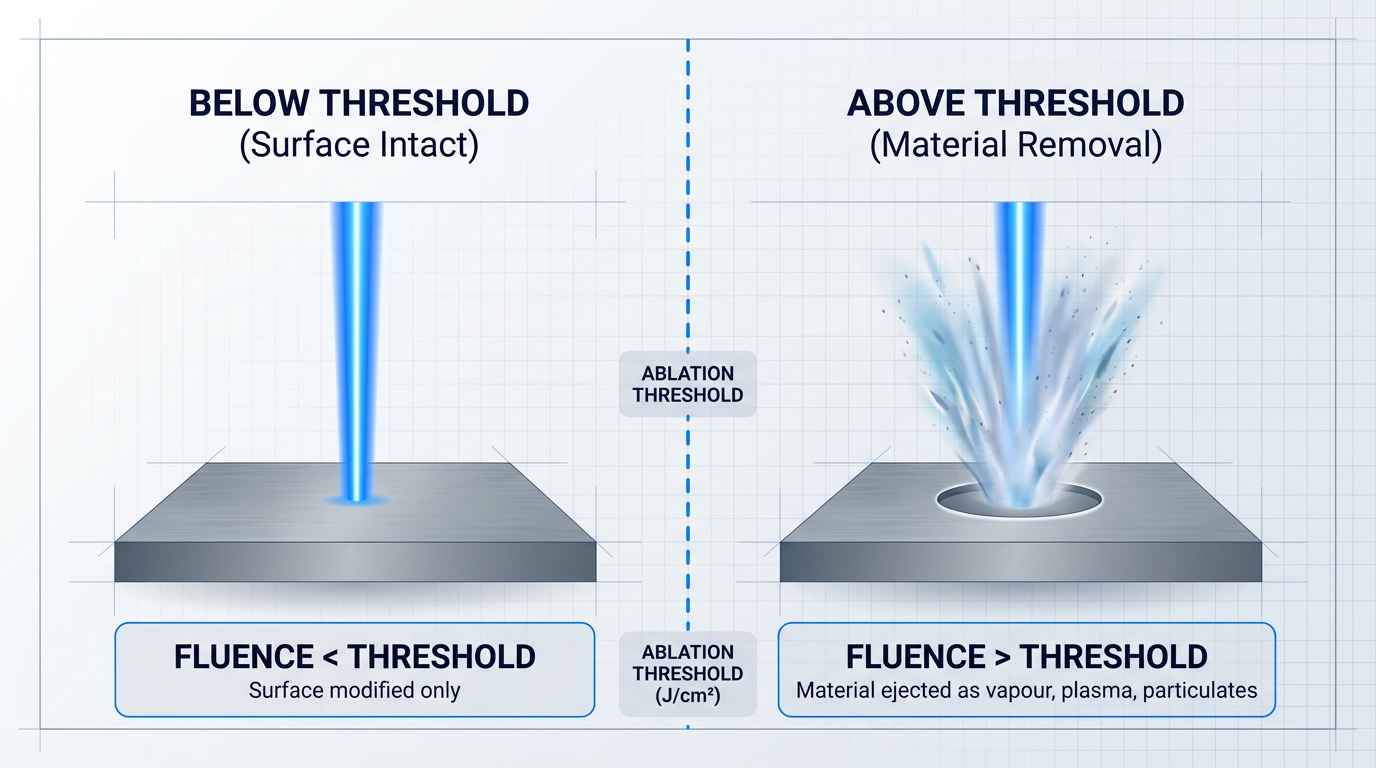
For ablation to occur, the irradiated material must transition from its solid state into a volatile phase — vapour, gas, or plasma. Surface heating or melting alone does not constitute ablation; the material must actually leave the surface.
Laser ablation is defined by material ejection, which requires a solid-to-vapour or solid-to-plasma transition. Heating or melting that does not result in material leaving the surface is a different interaction regime entirely.
The energy quantity that governs whether this transition occurs is called fluence — the energy delivered per unit area of the surface, expressed in J/cm². It is the primary controlling variable in any laser ablation process.
Every material has an ablation threshold: the minimum fluence required to initiate material removal. As confirmed across peer-reviewed studies of metals, semiconductors, and dielectrics, this threshold value varies with both the material's physical properties and the laser parameters used. Fluence must exceed this threshold for ablation to begin.
Ablation is not restricted to any single ambient environment. It can occur in vacuum, gas, or liquid, provided the medium does not significantly attenuate the laser energy before it reaches the surface. The ambient medium does influence how the ablation plume expands and behaves after ejection, but it does not prevent ablation from taking place.
In practice, pulsed lasers dominate precision ablation. By delivering energy in concentrated bursts rather than continuously, a pulsed laser achieves the high peak fluence needed to exceed the ablation threshold while keeping the total average energy input — and the associated heat load on the surrounding material — comparatively low.
Continuous-wave (CW) lasers, which emit a steady beam, distribute their energy over time in a way that tends to favour heating and melting over the sharp phase transition that ablation requires. This is why pulsed laser ablation is the dominant mode wherever precision and minimal collateral thermal effects are priorities.
With the definition and core vocabulary established — fluence, ablation threshold, ablation plume, pulsed versus continuous-wave — the next step is to examine the underlying physics: the mechanisms by which laser energy actually drives a material across that threshold and into the ablation regime.
The physical mechanisms of laser ablation
Crossing the ablation threshold is the trigger — but the trigger alone does not explain what actually happens next. The moment fluence exceeds that critical value, several distinct physical processes can take over, each governed by a different interaction between the laser's photons and the target material. Which process dominates is not a simple function of the material: it depends on a combination of material properties, laser wavelength, and pulse duration, and the consequences for cut quality, thermal damage, and debris are dramatically different depending on which regime is active.
Photothermal ablation
In photothermal ablation, absorbed laser energy is converted to heat through electron-phonon coupling — the process by which excited electrons transfer their energy to the surrounding atomic lattice, raising its temperature rapidly.
As the lattice temperature climbs, the material progresses through melting and then vaporisation; the escaping vapour exerts a recoil pressure that drives molten material outward from the interaction zone, ejecting both vapour and liquid droplets from the crater.
The thermal energy deposited during this process does not stay neatly confined to the irradiated spot. Heat diffuses outward into the surrounding material, creating a heat-affected zone (HAZ) — a region that has been thermally altered without being removed — and, at the crater rim, a recast layer of resolidified melt.
Photothermal ablation dominates at nanosecond and longer pulse durations with infrared or visible wavelengths, and it is the primary mechanism in industrial laser cleaning applications. It delivers effective bulk material removal, but the HAZ and recast layer are the inherent quality trade-off in precision work.
Photochemical ablation (photoablation)
At ultraviolet wavelengths, photons carry sufficient energy to directly rupture molecular bonds in the target material, without first converting that energy to heat — a fundamentally non-thermal process known as photoablation.
Because the photon energy exceeds the bond dissociation energy, molecules are broken apart and ejected before thermal excitation of the surrounding lattice can occur, leaving the adjacent material essentially undisturbed: negligible HAZ, no recast layer, and sharply defined ablation edges.
This mechanism is dominant in UV laser processing of organic polymers and biological tissue, where the molecular bond structure makes direct photodissociation energetically accessible. Metals, lacking those discrete molecular bonds, do not exhibit true photoablation.
It is worth noting explicitly: UV photoablation is sometimes called "cold" ablation, and ultrashort-pulse ablation carries the same label — but the two routes are mechanistically unrelated. UV photoablation is chemical; ultrashort-pulse "cold" ablation is mechanical, as described below.
Plasma-mediated and photomechanical processes
At picosecond and femtosecond pulse durations, energy is deposited into the material so rapidly that it cannot mechanically relax during the pulse itself — a condition known as stress confinement.
The pulse ends before the resulting pressure wave has time to propagate away from the interaction zone, so the energy is effectively trapped as intense compressive stress rather than dissipating as heat into the bulk material.
When those stresses exceed the material's tensile strength, the result is spallation: mechanical fracture and ejection of material driven by stress rather than by thermal vaporisation, with highly localised removal and a minimal or absent HAZ.
At fluences significantly above the ablation threshold — particularly in nanosecond and longer pulse regimes on metals — a separate high-fluence phenomenon can occur: phase explosion, or explosive boiling. Here, the material is driven into the spinodal region of the liquid-gas phase diagram, a thermodynamically unstable state where the superheated liquid decomposes spontaneously and volumetrically into a mixture of vapour and liquid droplets, rather than vaporising progressively from the surface.
Phase explosion produces higher material removal rates than standard photothermal vaporisation, but the ejected liquid droplets re-deposit as particulate debris and the ablation edge is correspondingly less clean — making it a throughput mechanism rather than a precision one.
Each of these mechanisms leaves a distinct fingerprint on the ablated surface. The table below maps each regime to its dominant operating conditions and observable outcomes.
| Mechanism | Dominant pulse duration | Dominant wavelength | HAZ | Recast layer | Edge quality | Primary debris type |
|---|---|---|---|---|---|---|
| Photothermal | Nanosecond and above | IR / visible | Significant | Present (resolidified melt) | Moderate; rougher at high fluence | Vapour and melt droplets |
| Phase explosion | Nanosecond and above (high fluence) | IR / visible | Significant | Present | Rough; particulate re-deposition | Liquid droplets and vapour |
| Photochemical (photoablation) | Nanosecond to shorter; UV | UV (excimer) | Minimal to none | Absent | Clean and well-defined | Vapour and ionic species |
| Stress confinement / spallation | Picosecond / femtosecond | Any (ultrashort pulse) | Minimal to none | Absent or negligible | Very clean; highly localised | Particulate fragments and plasma |
Comparison of laser ablation mechanisms across dominant conditions and observable surface outcomes, to help readers understand which regime applies to their material and process requirements.
The table makes the core trade-off visible: photothermal and phase-explosion regimes offer progressively higher removal rates but at the cost of thermal damage and debris, while photochemical and stress-confinement regimes sacrifice throughput for precision and surface cleanliness.
The ablation regime that dominates is set by the combination of material properties, laser wavelength, and pulse duration together — not by any one of those factors in isolation. The same metal can be processed photothermal with a nanosecond IR pulse or via stress confinement with a femtosecond pulse, producing radically different outcomes.
Whichever mechanism is active, the ejected material does not simply disappear: it forms a transient ablation plume above the surface — a rapidly expanding cloud of vapour, plasma, ions, electrons, and particulate matter whose composition and temperature reflect the mechanism that produced it.
The plume is more than a byproduct. Its optical emission spectrum carries elemental information about the ablated material, and the directed flux of species within it can be used to deposit thin films on a substrate — roles that become important when laser ablation is applied in analytical and deposition contexts, as covered in the applications section.
With the mechanisms established, the practical question becomes: what can an operator actually adjust to favour one regime over another? That is the subject of the next section, which examines the key parameters governing laser ablation — wavelength, pulse duration, fluence, and beyond.
The key parameters that govern laser ablation
The physical mechanisms described in the previous section — photothermal heating, photochemical bond-breaking, plasma-mediated stress confinement — are not fixed properties of a laser system. They are outcomes determined by the parameters the operator selects. Adjust those parameters, and the dominant mechanism shifts entirely, along with the precision, depth, and cleanliness of the result.
Wavelength
Wavelength sets the fundamental character of the light-matter interaction before any other parameter comes into play.
Shorter wavelengths in the ultraviolet (UV) range carry higher photon energies and are absorbed within a shallower surface layer, favouring photochemical interactions and minimising thermal spread into the bulk — making them well-suited to thermosensitive materials. Longer wavelengths in the infrared (IR) and near-IR range penetrate more deeply and drive photothermal interactions.
Wavelength also governs material-specific absorption: a given material may couple efficiently to one wavelength and reflect another almost entirely, which determines whether ablation is practically achievable at a given power level.
Pulse Duration
If wavelength sets the stage, pulse duration is the single most important parameter for determining which ablation regime the process operates in.
Nanosecond (ns) pulses are thermal in character: the pulse is long enough that heat conducts away into the surrounding material during the pulse itself, producing a heat-affected zone (HAZ) that can extend tens of micrometres from the ablation site and potentially leaving a recast layer.
Femtosecond (fs) pulses operate in an entirely different regime: energy is deposited before heat can diffuse into the surrounding material, confining the process zone to sub-micrometre dimensions — a condition described as cold ablation. Research on femtosecond laser processing confirms that this approach reduces the HAZ from the order of tens of micrometres (typical of nanosecond systems) to the sub-micrometre level, enabling near-surgical precision.
Picosecond (ps) pulses occupy the intermediate regime, beginning to exhibit stress confinement — energy deposited faster than the material can mechanically relax — while still generating a measurable HAZ. Theoretical calculations for 150 ps pulses on superalloy surfaces place the HAZ at approximately 22 nm, illustrating how dramatically confinement improves even within the picosecond range.
Shorter pulse durations also lower the ablation threshold fluence and improve spatial precision, making ultrashort pulses the preferred choice wherever tight tolerances are required.
Fluence and the Ablation Threshold
Fluence — the energy delivered per unit area, expressed in J/cm² — is the quantity that determines whether ablation occurs at all, and how deep each pulse cuts.
The ablation threshold acts as a gate: below it, the laser heats, marks, or anneals the surface without removing material; above it, ablation proceeds and depth per pulse scales logarithmically with fluence, following the relationship where ablation depth equals the inverse absorption coefficient multiplied by the natural log of the ratio of applied fluence to threshold fluence.
This logarithmic relationship means that doubling fluence does not double ablation depth — returns diminish as fluence rises, and excessive fluence introduces unwanted thermal effects rather than proportionally deeper removal.
Research literature identifies a specific optimum: maximum material removal efficiency is achieved when the applied peak fluence equals e² times the ablation threshold — approximately 7.4× Fth. This figure, confirmed experimentally across multiple independent studies, follows directly from the logarithmic depth-fluence relationship and defines the point at which the ablated volume per unit of laser energy is maximised. Operating significantly above or below this ratio reduces efficiency.
The threshold itself is not a fixed material constant: it varies by material class (metals, semiconductors, polymers, and biological tissue all differ), by wavelength (shorter wavelengths typically lower it), and by pulse duration (shorter pulses lower it further).
A further subtlety is the incubation effect: successive pulses applied to the same spot progressively modify the surface — through defect formation, accumulation of plastic deformation, or heat build-up — reducing the effective threshold with each pass. In TiN thin films, for example, the measured ablation threshold drops from 0.26 J/cm² for a single pulse to 0.14 J/cm² after 100 pulses at the same spot. This cumulative behaviour is particularly relevant in multi-pass processing, where later passes may ablate more aggressively than the first.
Repetition Rate
Higher repetition rate means more pulses delivered per second, which directly increases material removal throughput — a key lever for productivity-driven applications.
However, in materials with low thermal conductivity, rapid successive pulses can cause heat to accumulate between pulses faster than it dissipates, progressively raising the local temperature and effectively lowering the ablation threshold. This can ease material removal but also degrades precision by introducing cumulative thermal effects that erode the clean ablation regime.
The trade-off is material-dependent: metals with high thermal conductivity tolerate higher repetition rates with less heat accumulation than polymers or composites, where thermal build-up becomes a more significant constraint at equivalent rates.
Spot Size
Spot size — the diameter of the focused beam at the workpiece — directly determines peak fluence for a given pulse energy: concentrating the same energy into a smaller area raises the local fluence, potentially crossing the ablation threshold where a larger spot would not.
Smaller spot sizes enable finer spatial resolution and smaller feature sizes, which is why tightly focused beams are favoured in micro-machining and precision texturing contexts. Conversely, enlarging the spot at constant pulse energy reduces peak fluence — useful for large-area processing where broad, lower-fluence coverage is preferred over depth.
Pulsed lasers dominate precision ablation for a related reason: their peak power far exceeds their average power, because a short pulse concentrates energy into a very brief window and delivers fluence well above threshold with minimal average energy input. Continuous-wave (CW) lasers deliver energy without interruption and can ablate at high average power, but the unbroken energy deposition makes thermal effects considerably harder to control — which is why ultrashort-pulse systems are the tool of choice wherever precision is the primary requirement.
Taken together, these parameters — wavelength, pulse duration, fluence, repetition rate, and spot size — are not merely complexity to be managed. Their interdependence is precisely what gives laser ablation its defining capability: by tuning them so that the applied fluence exceeds the ablation threshold of a contaminant or target layer while remaining below the threshold of the substrate beneath, an operator can selectively remove one material without disturbing the other. That selectivity is the physical basis of the process's most valued outcomes, and it is what the applications explored in the next section consistently illustrate.
What is laser ablation used for? Applications across industries
The same physical principles that govern a single ablation event — threshold selectivity, controlled fluence, pulse duration, and the dynamics of the ablation plume — play out across an extraordinarily broad range of real-world applications, from stripping rust off structural steel to growing semiconductor thin films atom by atom.
What unifies these applications is not the outcome but the mechanism: precise energy delivery that removes exactly what needs to go, at exactly the scale required, leaving everything else untouched.
Industrial surface processing
The majority of industrial laser ablation work is surface processing — and the enabling principle across almost all of it is the differential ablation threshold between contaminant and substrate.
Because the contaminant layer absorbs laser energy more strongly than the underlying material, the beam can be tuned to a fluence that vaporises the contamination while leaving the substrate below its own removal threshold — a selectivity that no abrasive or chemical method can replicate with the same spatial precision.
- Surface cleaning and decontamination: Removes rust, oxides, mill scale, paint, coatings, and organic contamination from metal and stone surfaces, leaving the base material intact.
- Weld preparation and treatment: Ablates Al-Si coatings from press-hardened steel blanks prior to laser welding — precise fluence control removes the coating without touching the steel beneath.
- Surface texturing and micro-structuring: Controlled scan patterns create micro- and nano-scale surface features for adhesion improvement, functional coatings, or tribological applications.
- Micro-machining and precision drilling: Ultrashort pulses (femtosecond and picosecond) minimise the heat-affected zone, enabling micro-scale features in metals, ceramics, polymers, and composites.
- Heritage conservation and art restoration: Selectively lifts soiling, paint, and corrosion from stone, masonry, and metal artefacts where abrasive or chemical methods would cause irreversible damage.
Across each of these applications, the operative lever is parameter control — the fluence, pulse duration, repetition rate, and spot size that the operator dials in to match the contaminant's absorption characteristics without crossing the substrate's removal threshold.
In industrial practice, this translates directly into deployable systems: Woodrow Scientific Limited's ELASER-RHZ brings portable laser cleaning — with its world-first reduced hazard zone technology — to on-site tasks in open workshops, mixed-use facilities, and public-facing environments where conventional laser cleaning would require the area to be sealed and evacuated.
For production environments where the same cleaning task repeats part after part, Woodrow Scientific Limited's AutoLASE automated system takes a different approach: load the part, and its 3D machine-vision software scans it, builds a spatial map, and generates the cleaning path automatically — no manual programming, no path-setting, no specialist knowledge of part geometry required.
Virtually every industrial surface cleaning application of laser ablation rests on the same foundation: the contaminant's ablation threshold is lower than the substrate's. Tune fluence to that gap and the beam removes one without touching the other — a selectivity that defines the technology's industrial value.
Scientific and analytical applications
Beyond surface treatment, laser ablation serves as a precision sampling and deposition tool in scientific and analytical contexts — where the ablation plume itself is the product of interest, not the cleaned surface.
Laser-Induced Breakdown Spectroscopy (LIBS) exploits the plasma plume directly: a laser pulse ablates a microscopic amount of sample, generating a plasma whose optical emission spectrum encodes the elemental composition of the material — with no sample preparation required, making it viable for in-situ analysis of metals, geological samples, and environmental monitoring.
Laser Ablation Inductively Coupled Plasma Mass Spectrometry (LA-ICP-MS) uses the ablation event differently: the ejected material is carried as an aerosol into an ICP-MS instrument, where isotopic and elemental composition is resolved at spatial resolutions reaching single-digit micrometres — a capability that makes it indispensable in geochemistry, forensics, materials science, and life sciences.
Pulsed Laser Deposition (PLD) inverts the analytical logic entirely: here, the ablation plume is directed onto a substrate, where it condenses as a thin film — a technique used to grow complex oxide thin films and functional coatings in semiconductor research and advanced materials science.
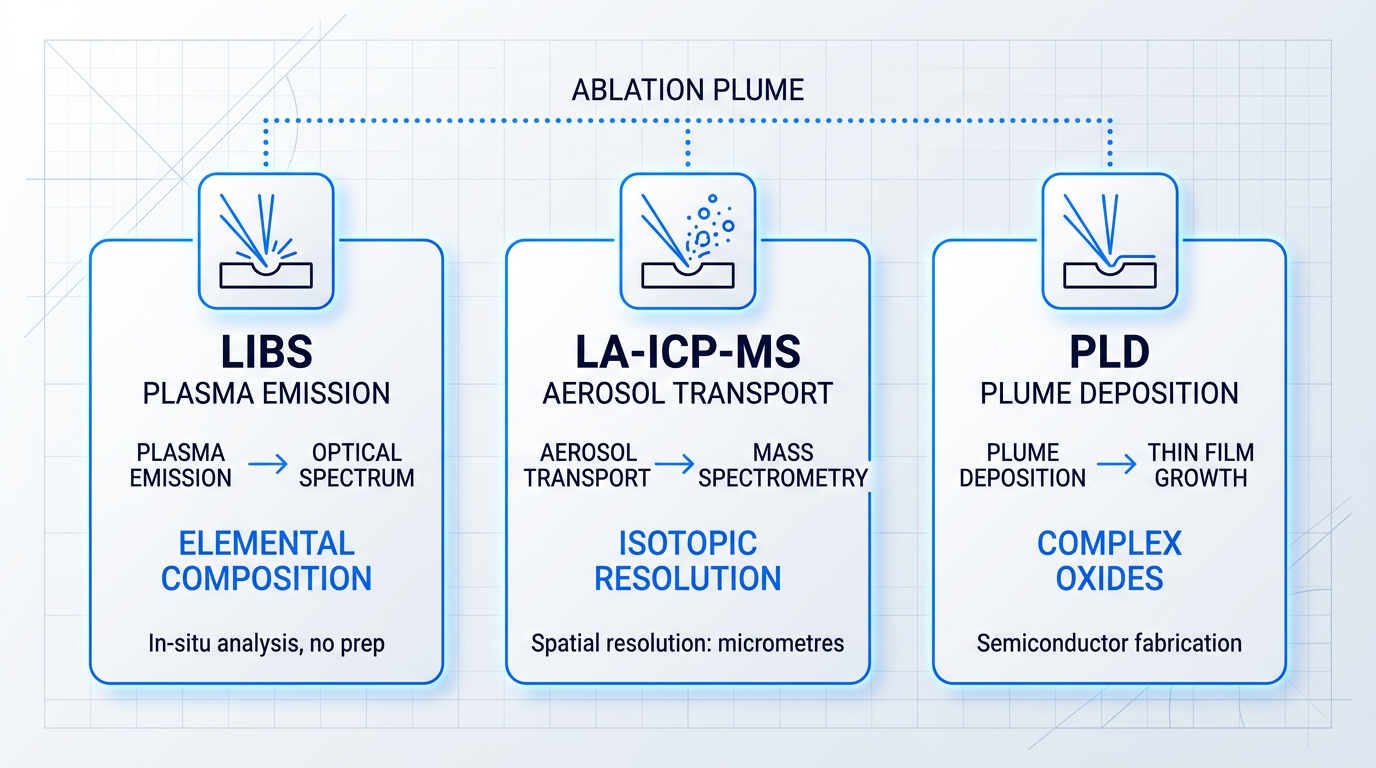
What connects LIBS, LA-ICP-MS, and PLD is the precision of the ablation event itself: the tight spot size and controlled fluence established in the preceding section translate directly into the spatial resolution and reproducibility that make these techniques scientifically credible.
Medical and biomedical applications
The same fundamental mechanisms extend into medicine: LASIK corneal reshaping relies on excimer laser photoablation at UV wavelengths to remove tissue with sub-micrometre precision, while laser ablation also underpins applications in dermatology, dentistry, and minimally invasive surgery — each exploiting the photochemical and photothermal mechanisms covered in the preceding section.
Medical applications of laser ablation are governed by clinical regulatory frameworks that sit outside the scope of this guide; readers seeking clinical depth should consult the relevant professional and regulatory literature.
Having mapped the breadth of domains where laser ablation is applied — from rust removal on structural steel to corneal reshaping to semiconductor thin-film growth — the natural next question is why it is the preferred choice over conventional methods in each of those contexts, which the following section addresses directly.
Advantages of laser ablation over conventional methods
Having traced the physics of laser ablation from its underlying mechanisms through to its governing parameters and real-world applications, it is now possible to evaluate its advantages over conventional material removal methods on firm analytical ground — not as a list of marketing claims, but as logical consequences of the physics.
The legacy methods against which laser ablation is measured — abrasive blasting, chemical stripping, mechanical removal, and water-jetting — each carry structural limitations that arise from their fundamental operating principles: contact forces, indiscriminate chemical reactivity, thermal spread, and secondary waste generation.
Precision and substrate integrity advantages
The most immediate advantage follows directly from the photonic delivery mechanism: laser ablation is a non-contact process, meaning no physical tool ever touches the surface being treated.
Abrasive blasting applies kinetic energy through grit particles that impact the substrate, introducing media embedment and surface micro-deformation. Mechanical removal applies contact forces directly, risking scoring or distortion of the base material.
Laser ablation introduces neither contact force nor tool wear — the energy arrives as photons and interacts with the material's own atomic structure, leaving no mechanical imprint on the substrate.
The second advantage is substrate selectivity, and it is the one that most clearly has no equivalent in conventional methods. Because the ablation threshold differs between a contaminant layer and the substrate beneath it, fluence can be tuned to sit above the contaminant's threshold while remaining below the substrate's — removing one without initiating removal of the other.
Abrasives remove material by mechanical action, which is indiscriminate with respect to material identity: the grit removes whatever it strikes at sufficient force. Chemical stripping acts on whatever it contacts based on reactivity, not on a threshold that can be adjusted.
The third precision advantage is a minimal heat-affected zone (HAZ). As covered when examining pulse duration, ultrashort pulses in the picosecond and femtosecond regimes deposit energy faster than heat can diffuse into surrounding material — the cold ablation regime — enabling removal with negligible collateral thermal damage to the substrate or adjacent structure.
Together, these three properties — non-contact delivery, threshold-based selectivity, and controlled HAZ — define what precision material removal looks like when the underlying physics is working in the operator's favour.
Operational and environmental advantages
Beyond precision, laser ablation carries a set of operational advantages that compound over the lifetime of a system. These are best understood as a group, since they share a common root: the process uses light alone, with no consumable inputs.
- No consumables or waste streams: No abrasive media, solvents, or effluent are generated. The only output is captured particulate and fume from the ablated material itself.
- Precision and repeatability: Fixed parameters — fluence, spot size, scan pattern, repetition rate — produce identical outcomes on every cycle, enabling quality-controlled production.
- Adaptability across substrates: Adjusting wavelength, fluence, and pulse duration allows one laser platform to process metals, ceramics, polymers, composites, and stone.
- Remote and automated operation: Fibre-delivered beams can reach confined spaces and hazardous environments, and the process integrates readily into automated production lines.
- Favourable total cost of ownership: No consumable spend, no chemical disposal costs, and reduced substrate damage — meaning less rework — improve the running-cost picture over time.
What these advantages share is that they are not incidental features of laser hardware — they are direct consequences of parameter control and photonic energy delivery. Repeatability follows from the fact that the process is governed by quantified, adjustable physical variables. Adaptability follows from the same parameter flexibility.
Substrate selectivity — removing a contaminant layer without touching the material beneath — is a physically unique capability of laser ablation. Abrasive and chemical methods have no equivalent of an ablation threshold differential: they cannot be tuned to stop at a material boundary. This is a structural difference in how the processes interact with matter, not a matter of degree.
The total cost of ownership argument deserves particular attention in procurement contexts. The absence of abrasive media purchases, solvent procurement, and chemical disposal obligations means the running-cost picture for laser ablation diverges substantially from the acquisition-cost comparison — and that divergence grows with utilisation.
The affirmative case for laser ablation in precision-critical, substrate-sensitive, and sustainability-conscious applications is analytically strong. That said, the technology carries genuine trade-offs — in capital investment, parameter complexity, and operational overhead — that any honest evaluation must address, and those are the subject of the next section.
What are the disadvantages of laser ablation?
Every technically credible account of laser ablation has to reckon honestly with its constraints. The technology earns its advantages — but those advantages come with real infrastructure demands, safety obligations, and engineering complexity that simpler methods do not impose.
The limitations below are not reasons to avoid laser ablation. They are the engineering challenges that a well-planned deployment must account for — and understanding them is what separates a successful implementation from an expensive disappointment.
- High initial capital cost: Laser systems carry a significantly higher purchase price than abrasive blasting rigs or chemical stripping equipment, making upfront investment the most commonly cited adoption barrier.
- Parameter selection complexity: Optimising wavelength, pulse duration, fluence, repetition rate, and spot size for each material-contaminant combination demands technical expertise and process qualification time.
- Class IV laser safety requirements: Industrial ablation systems typically operate as Class 4 lasers, triggering mandatory hazard controls: nominal hazard zone management, laser protective eyewear, and documented operator training.
- Fume and particulate extraction: The ablation plume generates laser-generated airborne contaminants (LGACs) that require local exhaust ventilation with appropriate filtration — a real infrastructure and compliance obligation.
- Material-specific constraints: Highly reflective metals such as copper and aluminium absorb near-IR wavelengths less efficiently, often requiring UV or green wavelength sources for effective processing.
- Throughput vs. precision trade-off: Ultrashort-pulse (ps/fs) ablation minimises heat-affected zone but limits material removal rate; higher throughput requires longer pulses or higher power, with a quality trade-off.
- Infrastructure requirements: High-power fixed installations may require three-phase electrical supply, water-chiller cooling systems, and controlled operating environments beyond standard workshop provision.
Of these, capital cost is the limitation most frequently cited — but it is also the one most frequently misframed.
Capital cost and total cost of ownership
Abrasive blasting equipment and chemical stripping rigs cost less to purchase than a laser system. That comparison is accurate but incomplete.
Traditional methods carry ongoing consumable costs — blasting media, chemical replenishment, personal protective equipment — alongside waste disposal fees and the regulatory burden of managing hazardous effluent. Laser ablation, once installed, requires no consumables beyond electricity and periodic filter replacement, with operating costs reported as low as around $6 per hour in published industry assessments.
When total cost of ownership is the frame rather than purchase price alone, the calculus shifts — particularly for high-volume or continuous-production environments where the elimination of consumable and disposal costs compounds over time.
Parameter complexity and process qualification
Laser ablation does not come pre-configured for a given application. Achieving optimal results requires careful matching of wavelength, pulse duration, fluence, repetition rate, and spot size to the specific material and contaminant being processed — and that combination is rarely transferable without adjustment between substrates.
This is a genuine overhead. Process qualification takes time and technical knowledge that sandblasting or chemical stripping simply do not demand. For organisations without existing laser process expertise, the investment in operator training and process development is real and should be factored into any adoption decision.
Class IV laser safety obligations
Industrial laser ablation systems typically operate as Class 4 lasers — the highest hazard classification under both ANSI Z136.1 (the US standard for safe use of lasers) and equivalent international frameworks. As the ANSI classification system makes clear, Class 4 lasers are hazardous to the eye and skin from direct beam exposure and can also pose fire, diffuse reflection, and LGAC hazards.
OSHA's laser safety directive (STD-01-05-001) specifies that all personnel entering a Class 4 laser area must be adequately trained and provided with appropriate laser protective eyewear (LPE). A nominal hazard zone (NHZ) analysis is required to define the space within which radiation levels exceed the maximum permissible exposure — and access to that zone must be controlled during operation.
These are non-negotiable obligations for Class 4 operation, not optional best practices. They require investment in engineering controls, documented procedures, and trained personnel — a real overhead for any organisation deploying the technology for the first time.
It is worth noting that reduced-hazard-zone engineering exists as a category-level development: enclosure designs that collapse the NHZ to a small area immediately around the workpiece can substantially reduce the practical footprint of hazard controls, making deployment in open workshop environments more tractable. Organisations should consult ANSI Z136.1 and relevant national guidance directly for compliance requirements applicable to their specific installation.
Fume extraction and airborne contaminants
Beam hazards and airborne hazards are distinct problems that both require engineering solutions. The ablation process ejects material as a plume containing vapour, particulates, and gases — collectively termed laser-generated airborne contaminants (LGACs).
CDC and NIOSH research has established that when target irradiance exceeds around 10⁷ W/cm², the LGACs liberated can be toxic and pose occupational concern. The composition of that plume is material-dependent: processing stainless steel can generate hexavalent chromium compounds — a recognised lung carcinogen under OSHA standards — while cutting or ablating plastics and composites can release volatile organic compounds including benzene, hydrogen cyanide, and aldehydes.
Local exhaust ventilation (LEV) with filtration appropriate to the contaminants present is the primary engineering control. UK employers are subject to the Control of Substances Hazardous to Health Regulations (COSHH), with HSE guidance document HSG258 providing the authoritative framework for LEV design, commissioning, and statutory examination requirements for laser processes. LEV systems used for laser applications must be examined and tested at least every 14 months under COSHH.
A laser system with a fully enclosed beam path still requires LEV — the airborne contamination hazard exists independently of whether the beam is accessible. Both controls are mandatory for Class 4 industrial operation, not alternatives to each other.
Material-specific and throughput constraints
Not all materials respond equally to standard near-infrared fibre laser wavelengths (~1 µm). Research published in peer-reviewed literature confirms that the absorption rate of non-ferrous metals increases as wavelength decreases — copper achieves approximately 54.5% absorptivity at green wavelengths (515 nm) compared with significantly lower values at near-IR, and aluminium follows a similar trend. For these materials, near-IR ablation is less efficient, and effective processing may require UV or green wavelength sources.
This is a parameter-matching challenge rather than a categorical exclusion: the right laser wavelength addresses the absorptivity mismatch, but it requires upfront process engineering and potentially a different or additional laser source.
The throughput-precision trade-off is a consequence of physics rather than engineering limitation. As covered in the mechanisms and parameters sections of this guide, ultrashort-pulse (ps/fs) ablation minimises heat-affected zone and recast layer formation — but the same pulse duration regime that achieves that precision also constrains the energy deposited per unit time. SPIE research confirms that ablation efficiency for copper decreases with increasing pulse duration in the ultrashort range, with volumetric removal rates varying significantly between 500 fs and 50 ps pulses. For large-area applications, longer-pulse or higher-average-power systems deliver greater throughput, but with a corresponding increase in thermal effects.
Infrastructure requirements for high-power fixed installations — three-phase electrical supply, water-chiller cooling, controlled environments — are real facility planning considerations, though portable fibre-delivered systems operating on single-phase power exist for applications where fixed installation is impractical.
Taken together, these limitations define the engineering envelope within which laser ablation operates best. None of them are categorical blockers — each is addressable with the right system specification, process development, and operational infrastructure. Understanding both the capabilities and the constraints is precisely what allows engineers and researchers to deploy the technology effectively, which is the synthesis this guide has been building toward.
Conclusion
Laser ablation: a precision process worth understanding
What this guide has traced, from the physics of the ablation threshold through to the trade-offs of real deployment, is that laser ablation's precision is not a design feature — it is a consequence of controlling the right parameters at the right scale.
That understanding changes how the technology reads: not as a sophisticated alternative to grinding or sandblasting, but as a fundamentally different relationship between energy and matter.
Those moving toward industrial surface work and those working in analytical contexts with LIBS or LA-ICP-MS are both starting from the same principle.
Frequently asked questions about laser ablation
Quick answers to common questions about laser ablation's mechanisms, materials, applications, and practical considerations — covering what the guide addressed in depth and what it left open.
Laser ablation can process an exceptionally broad range of materials: metals (steel, aluminium, copper, titanium), ceramics, polymers, composites, stone and masonry, and biological tissue. It is not limited to any narrow substrate class — if the material absorbs laser energy above the ablation threshold, it can be processed. The key constraint is parameter matching. The wavelength, pulse duration, and fluence that work effectively for steel will not transfer unchanged to a polymer or biological tissue. Each material has its own absorption characteristics and ablation threshold, so process parameters must be selected specifically for the substrate in question.
The ablation threshold is the minimum laser fluence (energy per unit area, typically expressed in J/cm²) required to initiate material removal. Below this threshold, the laser may heat or mark the surface but does not remove material — ablation simply does not occur. It matters because the ratio of applied fluence to the threshold value governs how much material is removed per pulse and how efficiently the process runs. Operating just above threshold gives fine, controlled removal; operating well above it increases removal rate but risks collateral thermal damage. The threshold is not a fixed property — it varies by material, laser wavelength, and pulse duration. Shorter pulse durations generally lower the threshold, which is one reason ultrashort-pulse lasers can ablate materials at lower average energies while still achieving clean removal.
The three pulse regimes differ primarily in how laser energy interacts with the material and how much thermal damage results. Nanosecond (ns) pulses are thermal in character: energy is deposited over a relatively long period, heat diffuses into surrounding material, and a heat-affected zone (HAZ) and recast layer typically form. Material removal rates are higher, and system costs are lower. Picosecond (ps) pulses are transitional — they begin to exhibit stress confinement effects and produce less thermal damage than nanosecond pulses, but are not fully free of heat effects. Femtosecond (fs) pulses deposit energy faster than heat can conduct away from the interaction zone, resulting in minimal HAZ and very clean ablation — often called cold ablation. The trade-off is lower material removal rates per unit time and significantly higher system cost. The practical summary: shorter pulses deliver higher precision and less collateral damage, at the cost of throughput and capital investment.
Industrial laser ablation systems typically operate as Class IV lasers (or Class I where full enclosure or reduced-hazard-zone technology is used). Standard professional practice includes controlling the nominal hazard zone (NHZ), providing wavelength-matched laser protective eyewear with appropriate optical density, ensuring operator training, and installing local exhaust ventilation to manage laser-generated airborne contaminants (LGACs). The fume and particulate hazard deserves specific attention: ablated material is ejected as vapour and fine particulate, and some byproducts — such as chromium compounds from stainless steel or zinc oxide from galvanised steel — are hazardous and require HEPA or ULPA filtration to manage safely. For detailed requirements, consult authoritative sources including ANSI Z136 (US), LIA guidance, and HSE HSG258 (UK). These frameworks set out the specific obligations for laser safety officers, controlled areas, and engineering controls applicable to your context.
Laser ablation is non-contact, requires no consumable abrasive media or chemical agents, and produces no secondary waste streams — no spent grit to dispose of, no chemical effluent to treat. Critically, it offers a level of substrate selectivity that neither sandblasting nor chemical stripping can match: a correctly configured laser removes a contaminant or coating layer without mechanically or chemically attacking the substrate beneath. Sandblasting removes material indiscriminately by impact, and chemical stripping depends on differential reactivity that is difficult to control precisely at a surface boundary. On total cost of ownership, laser ablation is competitive: the absence of consumables, reduced substrate damage (and therefore less rework), and lower waste disposal costs offset the higher capital investment over time. For high-value substrates or applications where surface integrity is critical, this calculus often favours laser ablation clearly.
LIBS stands for Laser-Induced Breakdown Spectroscopy. A focused laser pulse ablates a tiny quantity of sample material, generating a high-temperature plasma plume. As the plasma cools, it emits light at wavelengths characteristic of the elements present — and measuring that optical emission spectrum reveals the elemental composition of the sample. Laser ablation is the enabling event: without the ablation step to vaporise and ionise a small amount of material, there is no plasma and no spectrum to measure. LIBS depends entirely on it. The practical appeal of LIBS is considerable — it enables real-time, in-situ elemental analysis with no sample preparation, no reagents, and only minimal sample destruction. It is applicable across metals, geological and archaeological materials, environmental monitoring, and industrial quality control, making it one of the most versatile analytical techniques that laser ablation underpins.
Yes. The most widely recognised medical application is LASIK eye surgery, in which an excimer laser ablates precise, micron-scale amounts of corneal tissue to reshape the eye and correct refractive errors. Beyond ophthalmology, laser ablation is used in dermatology (skin resurfacing and lesion removal), dentistry, and minimally invasive surgical procedures for targeted tissue removal and treatment. Medical applications draw on the same fundamental physical mechanisms covered in this guide — particularly photochemical ablation at UV wavelengths and photothermal ablation — but are governed by clinical regulatory frameworks entirely separate from industrial use. This guide focuses on industrial, scientific, and analytical applications of laser ablation. Readers with clinical or medical questions should consult qualified medical professionals or the relevant regulatory bodies in their country.